Tragedy for WA Police as homicide squad detective takes own life at police facility
Rebecca Le May
The Nightly
Monday 9 September 2024
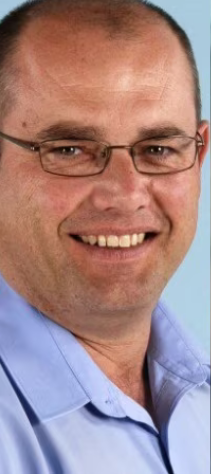
A WA police officer has taken his own life at a police facility.
Credit: Simon Santi/The West Australian
A homicide squad detective has taken his own life at a WA Police facility in Perth overnight.
It is understood the male officer fatally self-injured in the early hours of Monday morning.
In a statement, police said the death was being considered non-suspicious.
Commissioner Col Blanch extended his condolences to the officer’s family, his colleagues and everyone who knew him.
“Information regarding this officer’s death has been shared with his colleagues, and health and welfare support has been offered to all police officers and staff who may be impacted by this tragedy,” Mr Blanch said.
WA Police Union president Paul Gale said the whole force and membership were distraught by the loss.
“All of our members both here and across Australia will be affected by this,” Mr Gale said.
Police are investigating the circumstances surrounding the man’s death and compiling a report for the coroner.
A WA Police officer has died overnight in a Perth facility in what is thought to be suicide, with an investigation under way into how the tragedy unfolded.
WA Police confirmed the news on Monday, stating that the man’s death was non-suspicious and that a report would be prepared for the coroner.
This terminology is generally understood to relate to a self-harm incident.
Police Commissioner Col Blanch extended his condolences to the family of the officer, his colleagues and all who knew him.
“Information regarding this officer’s death has been shared with his colleagues, and health and welfare support has been offered to all police officers and staff who may be impacted by this tragedy,” a WA Police spokeswoman said.
WA Police Union president Paul Gale said the whole force and union membership were distraught.
“All of our members both here and across Australia will be affected by this,” he said.
A St John Ambulance spokeswoman said three ambulances attended a Stirling Street building just after 1am on Monday.
WA Police officers who have taken their own lives in the line of duty include officer Darren Igglesden, 50, who was found by colleagues at Cockburn police station in 2018 after suffering a self-inflicted gunshot wound.
Gang Crime Squad detective sergeant Scott Blanchard, a married 45-year-old father of three, took his own life while travelling in a convoy en route to Kalgoorlie in 2015. In her findings, deputy State Coroner Evelyn Vicker concluded Blanchard had become overcome by his perceptions of his work and private responsibilities, and delusional about a medical condition.
If you or someone you know is in need of support contactLifeline on 13 11 14orBeyond Blue. In the event of an emergency dial Triple Zero (000
Police officer who took his own life at work stopped at airport days before death
A police officer who took his own life at work was stopped at an international airport days before he took his own life, police have said.
Emma Kirk
less than 2 min read
September 10, 2024 – 9:06PM
A police officer who took his own life at work was stopped at an international airport days before his death.
WA Police commissioner Col Blanch told 6PR the officer was a 45-year old Homicide Squad detective who had returned from a family event overseas.
The officer took his own life at a Perth police facility on Monday morning.
Mr Blanch said it was not clear if the incidents were connected in any way, but it was a focus of the police investigation.
“It is not unusual for Homicide Squad detectives (to access the armoury out of hours) because as you would appreciate they are called in at all hours of the day or night,” he said.
“All of those detectives have access to the building including the armoury for exactly that reason.”
Mr Blanch said sadly, when he talked to families of police officers who had died through suicide, work was always a contributing factor.
“It is a tough job,” he said.
“There are often multiple factors … and many many issues within people’s lives that leads them down this path.
“We understand and acknowledge it is a very difficult job for police.”
Mr Blanch said he had focused on building the health and welfare section of the force, with more support available to officer’s than ever before.
He said right now the priority was the welfare of the officer’s family, his colleagues and the staff who were in the building at the time.
“We have a lot of support from our health and welfare area being deployed throughout the agency to give that support to the officers and to the family,” he said.
“Police Legacy are also involved to provide support to the family when officers pass away.”
In a statement released by police, a spokesperson said the death was not being considered suspicious.
“Information regarding this officer’s death has been shared with his colleagues, and health and welfare support has been offered to all police officers and staff who may be impacted by this tragedy,” the statement said.
Nothing further, than what is recorded above, is known about this person at the time of publication and further information and photos would be appreciated.
Yesterday afternoon, Mounted constable Edward Martin committed suicide at the police barracks, St Kilda road, by shooting himself.
The deceased was a single man, a native of the colony, and had been about two years in the force.
He had been stationed during the greater portion of that period at Swan-hill, and some time ago he received a sunstroke.
On the 16th of last month he was forwarded from Swan-hill to Melbourne, and reported as insane.
On his arrival he was sent to the police hospital, where under treatment his general health was greatly improved, and he was discharged from the hospital on the 3rd inst.
Since that time he has been doing duty about the depot until Saturday last, when he was despatched for temporary duty to Ringwood.
He returned to the barracks at a quarter to 3 o’clock yesterday afternoon, and reported himself to Sergeant Fagin, and appeared to be all right.
He was ordered by the sergeant to go to the barracks, get his dinner, and then to clean his horse and accoutrements.
Martin left Sergeant Fagin and went to his room, and in less than five minutes afterwards he shot himself through the head with his revolver.
A little boy nine years of age, son of Quarter-master Fahey, was passing through the passage when be heard the report of a revolver. He looked into the room and saw Martin standing in the centre of the room, with one side of his helmet all blackened.
He said to Martin, “One side of your helmet’s all black,” where upon Martin took it off and laid it down.
Young Fahey then went outside, and on looking through the window he saw Martin loading his revolver, which he did very quickly, placed it to his head, fired, and fell down.
The boy instantly gave the alarm, and Sergeant Fagin at once proceeded to the room, where he found Martin lying on his back in a pool of blood.
The bullet had entered on the right side of the head passed through and out on the left side, and stuck in a corner of the room.
Dr Webb, who was quickly in attendance, pronounced the case hopeless. Martin was at once removed to another room, and every attention shown to him, but be never rallied, and died shortly before 8pm.
The deceased has a brother living at Castlemaine and a sister at Swan-hill.
The Maitland Mercury and Hunter River General Advertiser ( NSW )
Thursday 12 January 1882 Page 3
Constable Edward MARTIN, lately confined as a lunatic, on account of the effects of sun-stroke, committed suicide yesterday ( Wednesday 11 January 1882 ) by blowing his brains out, in the police barracks.
An inquest was held on the remains at the police hospital on Tuesday.
The unfortunate young fellow had been sent down from his station, at Swan-hill for medical treatment, as he exhibited signs of insanity. He progressed so favourably that he was sent on special duty to Ringwood on Saturday.
On Monday afternoon Sergeant Fagan’s attention was drawn to the fact that Martin had shot himself, and upon examination he found Martin had shot himself through the head. Two bullets were found embedded in a beam in the room.
Dr. Ford said the deceased was quiet but stupid when under treatment in the hospital, and to all appearance was perfectly sane when he returned to duty.
On examining him, after being shot, he found the brain protruding from both sides of the head.
The deceased’s brother gave evidence, that he suffered from a sunstroke some years before he joined the force.
A verdict of suicide whilst of unsound mind was returned.
Nothing further, than what is recorded above, is known about this person at the time of publication and further information and photos would be appreciated.
On September 27, at the NSW Police Wall of Remembrance, and all around the nation, National Police Remembrance Day was celebrated. Before the ceremony, our Chair Det Supt Donna McCarthy held a private Touchstone Ceremony, where members of the Zucchetti, Burns, and Schell families were presented with the Touchstones of their loved one.
At the service we honoured the names of NSW Police Force’s Sergeant Peter Thomas Stone, and SA Police’s Brevet Sergeant Jason Christopher Doig, who died while on duty, as well as the serving members of NSW Police who have passed away in the last 12 months:
General Administrative Support Officer Tammy Leigh Nagle
After the ceremony, three of our young Police Legatees – Oscar, Max, and Bronte – were presented with the Commissioner’s Scholarship. This award has the personal endorsement of the Commissioner, and each young Legatee receives money to support them in their chosen studies and endeavours.
A day of love and remembrance, a day of sadness and of promise.
Nothing further, than what is recorded above, is known about this person at the time of publication and further information and photos would be appreciated.
After his retirement, Rogers was named as one of the five “immortals” of the Cronulla club.[3] He became involved in the administration of rugby league, and held the position of Cronulla’s CEO at the time of his death.[4]
Rogers died after swallowing a combination of prescription drugs and alcohol on 3 January 2006. In April 2006, the NSW state coroner ruled that the death was accidental.[5]
Biography
Steve Rogers was born on the Gold Coast and played his first senior game for the Southport Tigers.[6] In the 1972 Gold Coast Group 18 competition 17-year-old centre Steve Rogers helped a Gold Coast Tigers outfit to victory in the Grand Final against Tweed Heads Seagulls.[7] The following season he moved to Sydney to play in the NSWRFL Premiership.
1973
Rogers began playing first grade rugby league at the age of eighteen for the Cronulla-Sutherland club in 1973. Playing the position of centre, his talent did not go unnoticed. He was described by the club’s captain/coach, Tommy Bishop as a “rare, rare talent – the greatest all round centre three-quarter I have seen.” In that year, he played in his first Grand final, which Cronulla lost to the Manly-Warringah Sea Eagles and made the first of three Kangaroo Tours.
1974–1982
Rogers led Cronulla to the grand final as captain, in 1978, once more against the Sea Eagles. The match was a tie, and Cronulla lost a replay in the following week. During that season, he was often switched to lock forward and was effective in that role. Three years later, he won the Dally M Lock of the Year award.
As a result of Cronulla’s serious financial difficulties, Rogers signed for 1983 with Cronulla’s local rival, the St. George Dragons. He played with them for two seasons, culminating in playing five-eighth in the Saints 1984 reserve grade Grand Final (a side which featured others such as Michael O’Connor), which the Dragons lost.[8]
1985–1986
Rogers returned to Cronulla in 1985, but only played nine minutes in the season after breaking his jaw in his first game of the year against the Canterbury-Bankstown Bulldogs, in a tackle from Mark Bugden.
In 1986 Rogers signed with Widnes in the English competition, but only played for 13 minutes before breaking his leg in his first game of the year against Wigan. This was the last game of his career.
Post playing
After retiring from the playing field Rogers remained involved with rugby league coaching. He coached for a time in Queensland, and worked in administrative roles for the Australian Rugby League in Darwin and Perth. After an unsuccessful business venture running a hotel at Lennox Head, Rogers became involved once more with the Cronulla club, becoming the football manager and later, Chief Executive Officer of the club.
His personal life was marred by tragedy. After losing his father (Don) and mother (Marj) to cancer, his wife Carol also died from the disease on 11 May 2001. Rogers’s brother also committed suicide.[9]
On 3 January 2006, Rogers was found dead outside the door of his Cronulla unit. Initial reports of a heart attack soon turned to suggestions of suicide as the existence of three letters—apparently suicide notes to his three children—was revealed. His son Mat also confirmed that his father had been suffering from depression: “He was suffering from some depression and, as a person of his stature and a public figure, he found it really hard to talk about it to other people and therefore exacerbated the problem,” he said. Police believed that he had swallowed a cocktail of alcohol and prescription drugs. There has been some speculation that Rogers may have attempted to make an emergency telephone call in the moments before his death.[10]
Accolades
In February 2008, Rogers was named in the list of Australia’s 100 Greatest Players (1908–2007) which was commissioned by the NRL and ARL to celebrate the code’s centenary year in Australia.[11][12] While playing football, Rogers also served in the New South Wales Police Force and in 2008, rugby league’s centennial year in Australia, he was named at five-eighth in a NSW Police team of the century. Also in 2008 Rogers was named in New South Wales’ rugby league team of the century.[13]
Until 2002, Rogers held the record for the most points scored in a match (26) for the Cronulla club.
Rogers is one of twenty Australian internationals to come from the Cronulla club, and one of two players (alongside Greg Pierce) to have captained the national side.
Rogers holds the standing record for the most points ever scored for the Cronulla club (1253)[15]
Mat Rogers ( son of Steve ) with wife Chloe Maxwell, 2012
Rogers married model and media personality Chloe Maxwell on the Gold Coast on 26 October 2008.[21] Rogers has four children: Jack and Skyla from a previous relationship, Max Danger (born 5 June 2006) and daughter Phoenix (born 21 September 2007) with current wife Chloe.
Rogers has been committed to raising awareness about depression since the death of his father Steve in January 2006. His father battled depression for three years and, while suicide was initially suspected, his death after taking alcohol and prescription drugs was ruled an accident.
He has signed on to be an ambassador for Movember, an initiative that encourages men to grow a moustache during November to raise funds for research into depression and prostate cancer. Rogers has said he fears inheriting a propensity for the mental illness. He has made a pact with brother Don always to be honest about their feelings and encouraged men to talk to family, doctors or mates.
The legacy of one of rugby league’s greatest players will again be remembered at 4 Pines Park on Sunday, May 14.
Outside of the two competition points, the Manly Warringah Sea Eagles and the Cronulla Sutherland Sharks will do battle for the annual Steve Rogers Memorial Trophy in round 11 of the Telstra Premiership.
An Immortal of the Cronulla Sharks, Rogers played 202 first grade games and led the Sharks in the 1978 grand final and grand final replay against the Sea Eagles.
Rogers represented NSW 21 times and Australia 24 times. He had many good friends at the Sea Eagles in Immortal Bob Fulton and Max Krilich through the Kangaroos tours.
The Steve Rogers Memorial Trophy was first played in March 2006 and had been played for each time the teams met up until the end of the 2010 season.
The trophy was then only contested just once a season at the current holders’ home ground should both clubs be drawn to play each other twice.
However, Manly and Cronulla agreed in May 2016 to return to the original format of playing for the trophy each time the two clubs meet to coincide with the 10th anniversary of Steve’s passing.
Manly has won 20 of the 27 premiership matches contested for the Steve Rogers Memorial Trophy, including eight of the last 12 games played.
Steve Rogers Memorial Trophy
Results
2022 Rd 23: Cronulla 40 d Manly 6, Rd 7: Cronulla 34 d Manly 22
2021 Rd 20: Manly 40 d Cronulla 22
2020 Rd 7: Cronulla 40 d Manly 22
2019 Rd 10, Manly 24 d Cronulla 14; SF: Manly 28 d Cronulla 16
2018 Rd 21: Manly 33 d Cronulla 32
2017 Rd 16: Manly 35 d Cronulla 18
2016 Rd 3: Manly 22 d Cronulla 12, Rd 11: Cronulla 20 d Manly 12
2015 Rd 26: Manly 14 d Cronulla 12; Rd 17, Manly 28 d Cronulla 16.
2014 Rd 6: Manly 24 d Cronulla 4, Rd 15: Manly 26 d Cronulla 0
2013 Rd 6: Manly 25 d Cronulla 18; SF: Manly 24 d Cronulla 18
2012 Rd 3: Cronulla 17 d Manly 14
2011 Rd 5: Manly 19 d Cronulla 13
2010 Rd 5: Manly 40 d Cronulla 12; Rd 19: Manly 48 d Cronulla 18
2009 Rd 19: Manly 32 d Cronulla 26: Rd 25: Manly 18 d Cronulla 16
2008 Rd 1: Cronulla 16 d Manly 10, Rd 18: Manly 34 d Cronulla 6
2007 Rd 19: Manly 29 d Cronulla 22
2006 Rd 3: Manly 20 d Cronulla 18, Rd 16 Cronulla 15 d Manly 12
* Story behind any Nickname: the Prince of Centres – in relation to his footballing position on the field.
Nothing further, than what is recorded above, is known about this person at the time of publication and further information and photos would be appreciated.
“The far north police community has been deeply impacted by this loss, particularly those who knew and worked with Scott during his many years as a highly regarded police officer,” Assistant Commissioner Brett Schafferius said in a statement.
“Our officers are being provided with a range of support services as they come to terms with this terrible news.”
Duff was last seen walking in Edmonton on the afternoon of April 8.
Police launched an appeal for public assistance in the search, asking people to check their dashcam and CCTV footage in Edmonton on the day Duff went missing.
His disappearance was described as “out of character”.
The precise location of the discovery of his body has not been revealed.
Police are preparing a report for the coroner.
In a statement confirming “with great sadness” the death of Duff late on Tuesday, the Queensland Police Service urged people to contact mental health support services Lifeline or Beyond Blue “if you need help”.
“Our thoughts are with the senior constable’s family, friends and colleagues at this difficult time,” the statement read.
The Queensland Police Union posted that officers playing in the Queensland Police Service Rugby League State Championship in Mackay have worn black armbands and “paused in sacred silence to honour” their colleague.
The union been contacted for comment by 7NEWS.com.au.
If you need help in a crisis, call Lifeline on 13 11 14.
For further information about depression contact beyondblue on 1300224636 or talk to your GP, local health professional or someone you trust.
Drones and rescue helicopters were also involved in the search.
Police launched an appeal for public assistance in the search, asking people to check their dashcam and CCTV footage in Edmonton on the day Duff went missing.
“His disappearance is out of character and his family have concerns for his welfare,” police said in an alert.
His body was found on Monday, with police not revealing the location of the discovery.
It has also not been revealed if his death is being considered as suspicious.
“Police will prepare a report for the coroner,” police said in a statement.
“The public and the media are thanked for their assistance.
“The QPS would also like to thank State Emergency Service volunteers and officers from other districts who supported the search effort.”
Police have released new images of the missing officer as investigators continue to appeal for information regarding his whereabouts.
Detectives are investigating unconfirmed sightings across the southern corridor area and are encouraging anyone with relevant CCTV in the Edmonton and Bentley Park areas on Monday April 8 to come forward, especially households and businesses backing onto bushland and creek reserves.
The officer was last seen wearing a dark blue-grey t-shirt, grey shorts, khaki shoes and a grey baseball cap.
His disappearance is out of character and his family have concerns for his welfare.
Search efforts are continuing, with ongoing support from police aerial assets, the State Emergency Service, and officers from Townsville and the south-east corner travelling to Cairns to assist.
Police are grateful for the community’s continued cooperation during the search, however are urging members of the public not to undertake searches of bushland for their own safety.
Police are appealing for anyone with CCTV or dashcam vision near Walker Road, Timberlea Drive and Fitzmaurice Drive between 1pm and 4pm yesterday, April 8.
Officers continue to search for a 50-year-old man reported missing from Edmonton.
He was last seen wearing a dark blue-grey t-shirt, grey shorts, khaki shoes and a grey baseball cap.
Police are appealing to anyone with information or relevant vision to come forward.
Police have resumed the search for a 50-year-old man missing from Edmonton yesterday, April 8.
Several crews including the Tactical Crime Squad, State Emergency Services volunteers and assets including drones and the Rescue 510 helicopter conducted an extensive search of the Edmonton area, before resuming early this morning.
He was last seen wearing a dark grey t-shirt, grey shorts, khaki shoes and a grey baseball cap.
Officers are appealing to the man, or anyone with information about his whereabouts to come forward.
Earlier: Police are seeking public assistance to locate a 50-year-old man missing from Edmonton.
He was last seen at a Slipper Street, Edmonton address at approximately midday today, April 8.
Police and family have concerns for his welfare as his disappearance is out of character.
He was last seen wearing a light blue t-shirt and light coloured shorts.
Anyone with information about his whereabouts, or CCTV footage of the area from today, is urged to contact police.
* Story behind any Nickname: Duff Man, Duffy: Play on surname.
Nothing further, than what is recorded above, is known about this person at the time of publication and further information and photos would be appreciated.
Coroner urges six-monthly welfare checks after inquest into four police suicide deaths
Posted
In short: A Hobart coroner who investigated the deaths of four police officers who took their own lives has recommended Tasmania Police conduct mandatory half-yearly well-being screenings for PTSD.
What’s next? The Police commissioner says work will continue with the police association to implement changes
The family of one of four Tasmanian police officers who died by suicide between 2016 and 2020 say they hope the findings of a coronial inquest may prevent a similar tragedy in the future.
Coroner Simon Cooper has handed down his findings into the deaths of Constable Paul Hunt, Senior Sergeant Paul Reynolds, Constable Simon Darke and Sergeant Robert Cooke, recommending a swathe of welfare supports be implemented.
WARNING: This story touches on themes of depression and suicide.
During last year’s hearings, the court was told how overworked officers were self-medicating with alcohol and drugs, and of significant shortfalls in welfare support — particularly in areas such as fatigue management and protocols around interactions with the Professional Standards Command.
In his findings, Coroner Cooper, acknowledged the fact that these men were all serving police officers was “only part of the whole picture” of their lives, but he said he had “no doubt” that “Sergeant Cooke‘s police service was the direct cause of his death“.
But he said the provision of welfare support and whether it was adequate was a “central consideration at the inquest.”
He called for Tasmania Police to immediately develop and implement a fatigue management policy saying it was essential it was “addressed urgently”.
The inquest heard Robert Cooke had reportedly worked “16-hour continuous shifts for four weeks” during the Central Highlands bushfires in 2019.
This had left him “exhausted and barely functioning towards the end of the third week”.
“Tasmania Police had no fatigue management policy at any time, up to and including as recently as when the evidence at the inquest was publicly taken at the end of 2022,” he said.
“The absence of any fatigue management policy was, I consider, a direct factor in Sergeant Cooke’s death.”
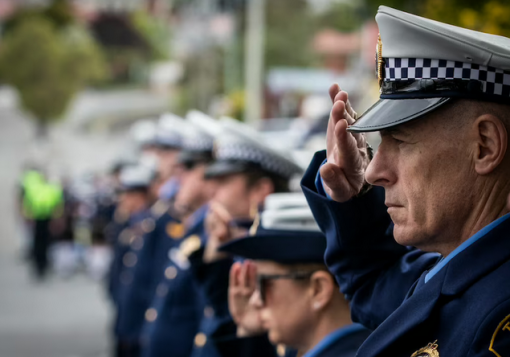
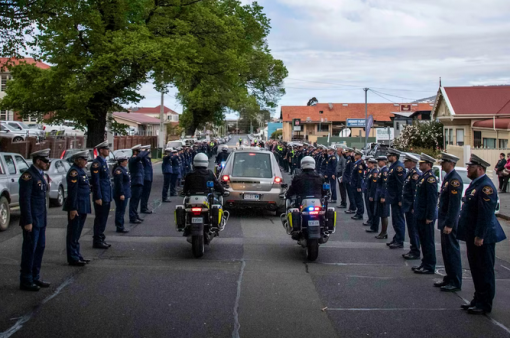
Tasmania Police officers salute at Robert Cooke’s funeral in 2020 .(ABC News: Luke Bowden)
The coroner also recommended six-monthly screenings of all operation police officers for post-traumatic stress disorder.
“Sergeant Cooke obviously suffered from the effects of PTSD for a long time before it was diagnosed,” he said.
“Every health care professional who gave evidence … unanimously agreed that his PTSD was entirely attributable to his service as a police officer.
“Every health care professional also agreed that earlier detection of PTSD increases the chances of successful treatment and recovery.”
Tasmania Police investigating the feasibility of “introducing a points system”, whereby an officer’s exposure to severe incidents would be tracked, was also recommended.
When a “critical points threshold” was reached, an automatic referral to a psychologist should be triggered, Coroner Cooper said.
The coroner also called for better support for officers under investigation for misconduct — including ensuring that those who had their phone seized by Professional Standards be given a replacement mobile pre-programmed with well-being support numbers.
“The death of any member of the community by suicide is a tragedy,” Coroner Cooper said.
“The suicide of serving police officers, whatever their individual circumstances, is particularly tragic for serving members of the police force and the community at large.
“My sincere hope is that some improvements and learnings can emerge from the deaths of Constable Hunt, Senior Sergeant Reynolds, Constable Darke and Sergeant Cooke.”
Sergeant Robert “Cookie” Cooke was well-regarded among his Tasmania Police colleagues.(ABC News: Luke Bowden)
Families welcome findings
In a statement, Robert Cooke‘s mother Lyn and sister Michelle said they were satisfied with the findings, particularly the recommendations for a fatigue management policy and screenings for PTSD stress disorder.
“The family miss Rob terribly and hope the findings and increased support for mental health may prevent similar events in the future,” they said.
“[Our] thoughts are with all the families involved in this inquest.”
Commissioner committed to ‘safe model of policing’
Police Commissioner Donna Adams acknowledged it was a difficult time for the families and colleagues impacted by the coronial report.
She said improvements had already been made within Tasmania Police.
Strategies included “a strong peer support group, and a critical stress program” to ensure officers could access the help they needed.
But she said changes wouldn’t end there — and that Tasmania Police would work with the Police Association to examine the coroner’s recommendations.
Police Minister Felix Ellis said the government had allocated funding to “Tasmania Police and the Department of Police, Fire and Emergency Management’s nation-leading wellbeing program”.
“Police officers, by the nature of the job, are exposed to some pretty difficult and extraordinary circumstances, so providing that support is important,” he said.
“We want to work to make sure that policing continues to be a career or choice, and that we’re supporting our officers if they do find themselves facing challenging circumstances.”
An inquest examining the deaths by suicide by four police officers in Tasmania has heard how overworked officers were self-medicating with alcohol and drugs, were poorly served by under-trained welfare staff, with one officer enduring horrific nightmares of what he had seen in the line of duty.
WARNING: This story touches on themes of depression and suicide.
The three-weeks of hearings learned about one instance where an officer went from being a happy-go-lucky family man who was exceptionally good at his job, to an absolute wreck who couldn’t get out of bed before his eventual death by suicide.
Sergeant Robert Cooke — affectionately known as “Cookie” — had been diagnosed a year before he died in October 2020 with post-traumatic stress disorder, which was attributed to years of cumulative trauma and over-work.
Before he was placed on leave, the veteran officer of 30 years was in charge of Oatlands police station, in rural central Tasmania, which meant he was regularly on-call and would often take sole responsibility for an incident.
The inquest was given evidence that Sergeant Cooke had worked 16-hour continuous shifts for four weeks during fires in the Central Highlands in 2019, and was experiencing increased anxiety, including nightmares of the dead and burnt bodies he had seen throughout his career.
Sergeant Robert “Cookie” Cooke was well-regarded among his Tasmania Police colleagues.(ABC News: Luke Bowden)
Clinical psychologist Jacqueline Prichard — who was treating Sergeant Cooke — said he could sometimes go from one traumatic incident to the next or straight into shift work before he would have had the opportunity to fully process the initial trauma.
“Your brain naturally resolves trauma in your sleep patterns in the three days following a traumatic incident, which is why it is important to get at least eight hours of sleep in the subsequent nights,” Ms Prichard said.
“If there’s no chance for sleep, or to think about the traumatic incident, then it becomes stored within the brain and can be as vivid as it was on the day.”
The inquest also heard there was a tendency among some police officers to abuse alcohol after a serious incident, which can also be disruptive to a person’s sleep pattern.
“If officers could clean out each trauma as they occurred, so they weren’t getting the cumulative effect, that would help,” Ms Prichard said.
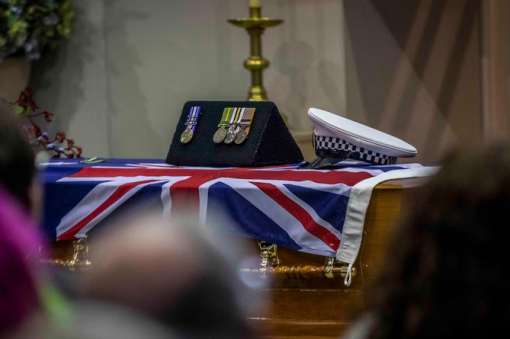
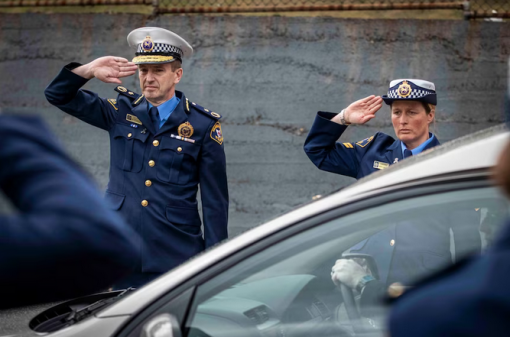
Former Tasmania Police commissioner Darren Hine and Senior Constable Jenny Carlisle salute the hearse at Sergeant Cooke’s funeral in 2020.(ABC News: Luke Bowden)
Sergeant Cooke‘s then-partner, Senior Constable Elizabeth Carlisle, said well-meaning but under-trained people in welfare roles at Tasmania Police had a negative impact on his mental health.
Senior Constable Carlisle told the inquest she did not believe a welfare officer supporting the 49-year-old in the lead-up to his death had any formal training in assisting someone with post-traumatic stress disorder (PTSD).
“Welfare officers back then were not equipped to deal with someone as unwell as Sergeant Cooke … but they are significantly better trained now,” she said.
Abused during bushfire evacuations
The deaths of Senior Sergeant Paul Reynolds, Constable Simon Darke and Constable Paul Hunt, between 2016 and 2020, have also formed part of the inquest that ended in Hobart on Friday.
Shanna Sweeney, said she contacted police after Constable Darke threatened suicide in 2011 but did not believe her concerns were taken seriously.
She said that Constable Darke was concerned he could be punished if he was seen as being vulnerable.
The inquest also heard evidence from Constable Darke’s father, Graham, who told the court the long hours during the 2019 bushfires and run of night shifts at a Hobart police station became too much for his son.
“He mentioned he had copped a lot of abuse when he asked people to leave their homes during the fires. He then went onto night shift by himself,” Mr Darke told the inquest.
The catastrophic 2019 bushfires in Tasmania were cited several times during the inquest.(Supplied: Tasmania Fire Service)
The inquest was also told the Department of Police, Fire and Emergency Management had made significant changes to the welfare protocol as a direct consequence of Constable Hunt‘s suicide in 2016.
Constable Hunt took his own life on the same day he received an unannounced visit from Professional Standards Command (PSC) personnel over allegations that he used his police badge and other people’s driver’s licence numbers to obtain codeine and pseudoephedrine-based medications from pharmacies in Hobart.
The court was told that the 32-year-old had his personal phone confiscated and did not have a support person present at the meeting with officers from PSC when he was officially stood down from his role.
Tasmania Police officers salute at Robert Cooke’s funeral in 2020.(ABC News: Luke Bowden)
Police Inspector John Ward told the inquest that he saw the benefit of putting a system in place where a risk assessment is carried out before an officer is approached about an investigation involving them.
“I was aware that Constable Hunt had been suffering from a medical condition, but didn’t realise he was experiencing suicidal thoughts,” he said.
At the time, he was facing allegations that he had sent and received child exploitation material, and that he had groomed young men.
Director of wellbeing support at Tasmania Police, Matthew Richman, told the court, the organisation has looked at what additional early intervention opportunities could be implemented as a direct consequence of Senior Sergeant Reynolds‘ death.
“Every aspect of policing has changed dramatically from when Senior Sergeant Reynolds started his career to the time of his death, but I think there is an opportunity to rethink our wellbeing check approach,” he said.
The inquest was told it is now standard procedure for a Tasmania Police officer to be offered a replacement mobile phone if their personal one is confiscated as part of an investigation.
It also heard that significant improvements had been made regarding welfare after the deaths of the four officers, including de-stigmatising post-traumatic stress disorder and other mental health conditions.
The inquest was told that, while Tasmania Police has made improvements in staff rosters and resourcing, it is facing an 18-month delay in the publication of a fatigue-management policy.
Work is continuing between the department, the Police Association of Tasmania and the University of Tasmania to research and identify areas that regulate workloads.
Former commissioner Darren Hine said a lot of improvements had been made over the years and Tasmania Police had dramatically increased the number of welfare officers after a funding submission to the government.
“The area of welfare and mental health will never be finished. It is a growing body of knowledge and it’s something we should never stop learning about,” Mr Hine said.
Coroner Simon Cooper is expected to hand down his findings next year.
The funeral motorcade for Tasmania Police officer Robert Cooke in 2020.(ABC News: Luke Bowden)
Nothing further, than what is recorded above, is known about this person at the time of publication and further information and photos would be appreciated.
Coroner urges six-monthly welfare checks after inquest into four police suicide deaths
Posted
In short: A Hobart coroner who investigated the deaths of four police officers who took their own lives has recommended Tasmania Police conduct mandatory half-yearly well-being screenings for PTSD.
What’s next? The Police commissioner says work will continue with the police association to implement changes
The family of one of four Tasmanian police officers who died by suicide between 2016 and 2020 say they hope the findings of a coronial inquest may prevent a similar tragedy in the future.
Coroner Simon Cooper has handed down his findings into the deaths of Constable Paul Hunt, Senior Sergeant Paul Reynolds, Constable Simon Darke and Sergeant Robert Cooke, recommending a swathe of welfare supports be implemented.
WARNING: This story touches on themes of depression and suicide.
During last year’s hearings, the court was told how overworked officers were self-medicating with alcohol and drugs, and of significant shortfalls in welfare support — particularly in areas such as fatigue management and protocols around interactions with the Professional Standards Command.
In his findings, Coroner Cooper, acknowledged the fact that these men were all serving police officers was “only part of the whole picture” of their lives, but he said he had “no doubt” that “Sergeant Cooke‘s police service was the direct cause of his death“.
But he said the provision of welfare support and whether it was adequate was a “central consideration at the inquest.”
He called for Tasmania Police to immediately develop and implement a fatigue management policy saying it was essential it was “addressed urgently”.
The inquest heard Robert Cooke had reportedly worked “16-hour continuous shifts for four weeks” during the Central Highlands bushfires in 2019.
This had left him “exhausted and barely functioning towards the end of the third week”.
“Tasmania Police had no fatigue management policy at any time, up to and including as recently as when the evidence at the inquest was publicly taken at the end of 2022,” he said.
“The absence of any fatigue management policy was, I consider, a direct factor in Sergeant Cooke’s death.”
Tasmania Police officers salute at Robert Cooke’s funeral in 2020 .(ABC News: Luke Bowden)
The coroner also recommended six-monthly screenings of all operation police officers for post-traumatic stress disorder.
“Sergeant Cooke obviously suffered from the effects of PTSD for a long time before it was diagnosed,” he said.
“Every health care professional who gave evidence … unanimously agreed that his PTSD was entirely attributable to his service as a police officer.
“Every health care professional also agreed that earlier detection of PTSD increases the chances of successful treatment and recovery.”
Tasmania Police investigating the feasibility of “introducing a points system”, whereby an officer’s exposure to severe incidents would be tracked, was also recommended.
When a “critical points threshold” was reached, an automatic referral to a psychologist should be triggered, Coroner Cooper said.
The coroner also called for better support for officers under investigation for misconduct — including ensuring that those who had their phone seized by Professional Standards be given a replacement mobile pre-programmed with well-being support numbers.
“The death of any member of the community by suicide is a tragedy,” Coroner Cooper said.
“The suicide of serving police officers, whatever their individual circumstances, is particularly tragic for serving members of the police force and the community at large.
“My sincere hope is that some improvements and learnings can emerge from the deaths of Constable Hunt, Senior Sergeant Reynolds, Constable Darke and Sergeant Cooke.”
Sergeant Robert “Cookie” Cooke was well-regarded among his Tasmania Police colleagues.(ABC News: Luke Bowden)
Families welcome findings
In a statement, Robert Cooke‘s mother Lyn and sister Michelle said they were satisfied with the findings, particularly the recommendations for a fatigue management policy and screenings for PTSD stress disorder.
“The family miss Rob terribly and hope the findings and increased support for mental health may prevent similar events in the future,” they said.
“[Our] thoughts are with all the families involved in this inquest.”
Commissioner committed to ‘safe model of policing’
Police Commissioner Donna Adams acknowledged it was a difficult time for the families and colleagues impacted by the coronial report.
She said improvements had already been made within Tasmania Police.
Strategies included “a strong peer support group, and a critical stress program” to ensure officers could access the help they needed.
But she said changes wouldn’t end there — and that Tasmania Police would work with the Police Association to examine the coroner’s recommendations.
Police Minister Felix Ellis said the government had allocated funding to “Tasmania Police and the Department of Police, Fire and Emergency Management’s nation-leading wellbeing program”.
“Police officers, by the nature of the job, are exposed to some pretty difficult and extraordinary circumstances, so providing that support is important,” he said.
“We want to work to make sure that policing continues to be a career or choice, and that we’re supporting our officers if they do find themselves facing challenging circumstances.”
A 32-year-old Tasmanian policeman who took his own life in 2016 has been described as “gentle, kind and popular” with a “deep love for animals and his family” — and whose struggles with depression weren’t “a secret”.
WARNING: This story touches on themes of suicide, depression and substance abuse; reader discretion is advised
Constable Paul Hunt is one of four policemen whose death is being investigated as part of a coronial inquest in the Launceston Magistrates Court.
The deaths of Senior Sergeant Paul Reynolds, Constable Simon Darke and Sergeant Robert Cooke will also form part of the inquest.
All four men took their own lives in the period between 2016 and 2020.
Council assisting the coroner, Cameron Lee, said the inquest will look at the circumstances surrounding the deaths, the policy and procedures of Tasmania Police and the nature of welfare and fatigue management.
“The life of a police officer is a very dangerous one, they’re often exposed to dangerous and traumatic events,” he said.
“It’s very much the luck of the draw, one cannot unsee what they have seen.”
Constable Hunt was found dead on the July 8, 2016 at his father’s property at Mount Direction, near Launceston.
His father, Matthew Hunt gave evidence during the inquest and told the court his son battled for years with anxiety and depression and was in and out of hospital.
He told the court he first noticed signs of his son’s depression when he was visiting him for Christmas one year while Paul was working as a policeman on King Island, off Tasmania’s north-west coast.
“I believe he was first diagnosed there,” he said.
“We went over there quite regularly to visit … he met his wife Jess there.”
Questioned over drug purchases
The court heard on the day Constable Hunt died he was called in for an unannounced meeting with officers from the Professional Standards Command.
The meeting was regarding allegations he had been using his Tasmania Police badge and fake driver’s licence numbers for several years to obtain codeine-based and pseudoephedrine-based medications from a number of pharmacies in Hobart.
In early 2014, the court heard he was identified through Project STOP, which is a tool pharmacists use to track purchases, as being in the top four purchasers in Tasmania between January and August.
The Pharmacy Guild of Australia said the tool is aimed at preventing the use of pseudoephedrine-based products to manufacture methamphetamine.
He was spoken to by senior police following this — and was flagged again the following September.
On 13 November 2015, he was interviewed by Professional Standards about the allegations.
On the day he died, his work station and locker were also searched and his personal phone was confiscated. He was also officially stood down from his role.
He then withdrew $600 from his joint bank account with his wife and took a taxi to Launceston, and then another taxi to his father’s property in Mount Direction.
His father Matthew Hunt was travelling at the time and wasn’t home.
Constable Hunt then sent his wife a message on Facebook on his dad’s computer saying goodbye.
“Paul had always wanted to be a policeman, and he had depression, it wasn’t a secret,” Matthew Hunt told the court.
He said his son’s wife or another person who could have offered support should have been included at the meeting with his police superiors.
“It was a pretty significant event for him,” Mr Hunt said.
The inquest also heard in the days after his death, Matthew Hunt was told by a Tasmania Police officer that “it wasn’t a compensable issue” which he said he felt was a strange thing to say.
“I checked with other family members afterwards that I had heard that correctly and they said yes,” he said.
“It was very strange … this was before the funeral.”
When asked if other members of Tasmania Police visited him afterwards, he said three had.
The inquest is continuing.
Key points:
A coroner is investigating the deaths of four Tasmania Police officers between 2016 and 2020
Paul Hunt, a constable, died by suicide in 2016 at his father’s property
The inquest heard he had been called in by the Professional Standards Unit on the day he died
Nothing further, than what is recorded above, is known about this person at the time of publication and further information and photos would be appreciated.
Deepest condolences to Randalls wife – Janean, family and friends.
My husband Sergeant Randal Moulden was one of those officers that tragically took his own life on Tuesday 29th June 2021.
He couldn’t carry the pain of the trauma of what he had experienced over the 30yrs as a serving Police officer.
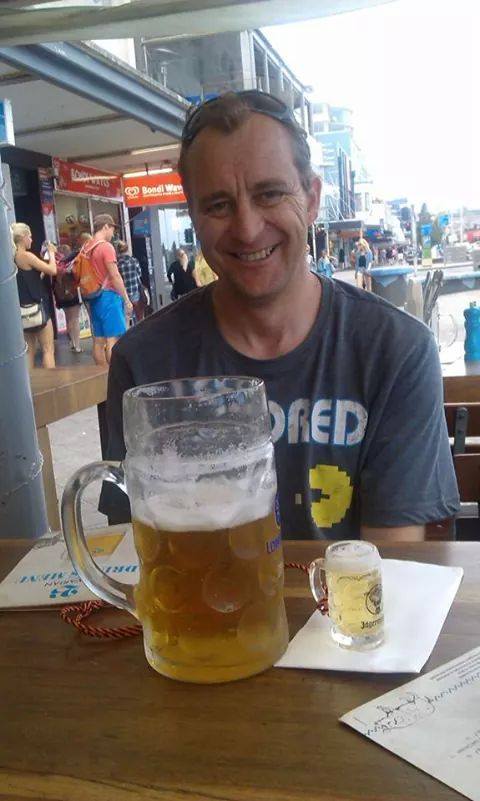
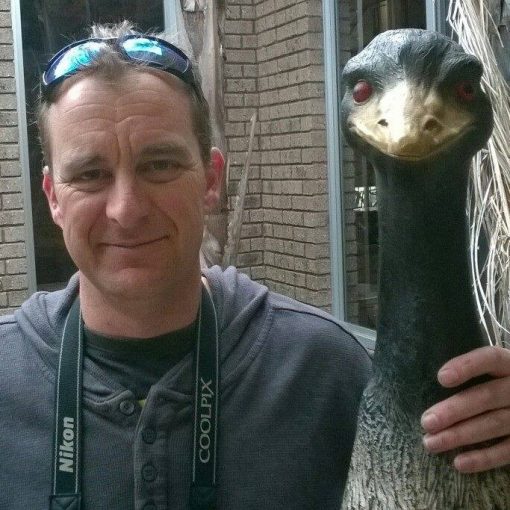
He was one of a kind, Professional, Caring, Empathetic, Understanding, Passionate. These traits that not only I as a wife, but his children, his friends, his colleagues are what we loved about him.
Regardless of what he had seen, experienced and witnessed.
Every day that he put on his uniform he wore it with pride, dignity and grace, ultimately it was these traits as a serving officer that made him suffer.
To EVERYONE I can not stress this enough, PLEASE, PLEAS,E PLEASE, get help.
There is ABSOLUTELY no shame in reaching out.
As partners we are here to support, to love and to comfort those suffering. Your burden is our burden to share.
Don’t let this tragedy be in vain, lets learn from it and try to change it as death is never the answer.
To all the people that have shared their respect and Grief, there are not enough words to thank you.
This is an Audio file by Janean MOULDEN – wife of Randall MOULDEN, about the impact that his suicide has had on her, the family and Policing families.
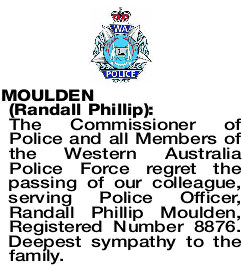
MOULDEN (Randall Phillip):
The Commissioner of Police and all Members of the Western Australia Police Force regret the passing of our colleague, serving Police Officer, Randall Phillip Moulden, Registered Number…
Randall Moulden: Wife of cop who took own life says WA Police, State Govt still not providing enough support
Daryna Zadvirna The West Australian
Randall Moulden was a larrikin, the “fun” parent and so dedicated to his job as a WA Police officer, he literally gave his life to the role, according to his widow Janean.
She recently commemorated one year since her husband died by suicide on June 29 by spreading his ashes across the desert in Morocco.
“I had coppers ring me the next day to tell me how graphic and horrendous it was out there.
“He became very withdrawn. I just couldn’t help him.”
Finding helpful support
It was not until January 2016 that Mr Moulden realised he needed help and started seeing a counsellor employed by WA Police.
“Then in the August, the counsellor said, ‘I can’t help you. You need medication,'” Ms Moulden said.
“He just felt like it was just a horrible thing to say, you know?
“So then he was just sort of left stranded.”
It wasn’t until he found Soldiers and Sirens, a free not-for-profit service for veterans and first-responders, that Mr Moulden’s health began to improve.
The service was co-founded by Danielle Baldock, a psychologist and former police officer who felt there was a gap in support for police and other emergency services staff.
“There was no service for first responders that was independent and external and confidential,” Ms Baldock said.
“One of the big concerns that officers have is that if they go to their internal support it might limit their career in some way.
“That’s not a reality, it’s more of a perception. The WA Police psych unit is amazing — they do great work.”
Ms Baldock said because police officers were often hesitant to seek counselling through their workplace she was motivated to provide external support.
“We wanted to provide this separate space where they could come together and be a community,” she said.
‘A massive improvement’
Ms Moulden said the counselling Soldiers and Sirens provided to both her and her husband was a godsend.
“He was doing amazing, he really was. Every time he saw Danielle he walked out with bounce in his step, a smile on his face,” she said.
“He had made such a massive change this year.”
Ms Moulden said the key difference was that the service was independent and staffed by people who had lived experience in emergency services.
“It’s the essential ingredient. You cannot speak to someone who does not have a clue about trauma,” she said.
“And there is a genuine fear out there.
“I’ve spoken to many police officers and they all say the same thing, that they would not go to the police psychiatrist or the police doctor — not when the commissioner is in the same building. You can’t be honest.”
Funding discontinued
Soldiers and Sirens received initial start-up funding from the federal Department of Communities as well as bulk-billing fees from Medicare and the Department of Veterans Affairs.
However, at the end of June the federal funding ended and has not been renewed.
“We were hoping in the time that we could fundraise, that we could apply for the grants and get some funding from somewhere,” Ms Baldock said.
“But unfortunately, with the COVID situation, we just haven’t been able to secure any further funding.
“So on the first of August we shut our doors.”
Service closure ‘daunting’
Ms Moulden said the news that the service was closing devastated her husband as he faced the prospect of having to re-tell his story to a new psychologist.
“He had built a rapport with Danielle and that’s half the key,” she said.
“The thought of going to another psychologist is daunting; you’ve got to keep reliving it. It’s cruel.”
In June, Mr Moulden died by suicide.
His death has motivated his wife to fight for funding for the Soldiers and Sirens service.
“I know that he would want me to speak up [and] speak about my own experience,” Ms Moulden said.
“Not just for me, but for anyone suffering. He would want me to be their voice.”
Request for state funding
Soldiers and Sirens is now hoping the WA state government will provide the additional funding needed for the service to remain accessible.
“We want there to be no barriers to entry,” Ms Baldock said.
“[So] that you can ring up and get an appointment straight away within a couple of weeks without lots of triage barriers in the way, and we really wanted it to be free.
“WA Police are amazing. They paid for all of the sessions for their officers. We were also cost-recovering from Medicare and DVA and the places that we could, but unfortunately, it just wasn’t enough to sustain us.”
In a statement, Minister for Police Paul Papalia said the WA government provided funding to the WA Police Force for “a range of wraparound services through the Health and Welfare Division”.
“In addition to internal outreach services which include 24/7 access to on-call clinical psychologists and chaplains, officers are able to access private psychological and psychiatric support services from a network of external providers,” the statement said.
“Soldiers and Sirens is one of a number of those approved external providers which police officers are able to access.”
Nothing further, than what is recorded above, is known about this person at the time of publication and further information and photos would be appreciated.
Cop refused to seek WA Police force’s help before taking own life
By Aaron Bunch
A WA Police officer who took his own life after becoming disillusioned with his job had refused to undertake mental health counselling with the force for fear his reputation would be tarnished, an inquest has heard.
Main image: Cameron FYFE. Inset right – Randall MOULDEN
Senior Constable Cameron Fyfe died at home on June 20, 2021 after drinking heavily amid bouts of depression following a series of on-the-job incidents that threatened his safety.
The 27-year-old was prescribed antidepressant medication, which he took irregularly, and his family and friends had made numerous pleas for him to seek mental health support after he told his father he was having suicidal thoughts.
“Mr Fyfe made it clear to his loved ones that he did not want to involve the police force in pursuing any mental health assistance,” counsel assisting Sarah Tyler told the Coroner’s Court of Western Australia on Tuesday.
Fyfe’s father suggested reaching out to the police employee assistance program. Fyfe refused, saying there was a stigma attached to doing so.
The constable did, however, tell his family that he was seeing a psychologist, who diagnosed him with major depression.
It came after a series of incidents that left Fyfe questioning whether he wanted to remain a member of the force, including responding to the death of a baby, and a family violence incident where he was hit in the face.
“The person said to have struck Mr Fyfe was found not guilty after trial,” Tyler told State Coroner Rosalinda Fogliani.
In November 2020, the officer was spat on as he attempted to arrest an offender.
“Saliva entered Mr Fyfe’s mouth,” Tyler said.
He was forced to undergo blood screen testing and quarantined for two weeks due to COVID-19 laws amid the global pandemic.
“While quarantined, Mr Fyfe (again) expressed to his family his disillusionment with the police force,” Tyler said.
On the evening of June 19, 2021, Fyfe drank whiskey alone at his home while exchanging text messages with his parents, his girlfriend and ex-partner.
In the early hours of the next morning, he told his father that he’d stopped taking his antidepressant medication because it impacted his libido.
Fyfe then sent a message to his mother saying he couldn’t live his life on medication.
The next morning, his parents and partner sent messages to Fyfe, but he did not respond.
By the afternoon, Fyfe’s parents drove to their son’s home address, and his father used his key to go inside.
He found Fyfe’s lifeless body in his computer gaming chair in his study.
A post-mortem showed very high levels of alcohol in Fyfe’s system.
A police investigation did not identify any evidence to suggest another person was involved in the death.
During that investigation, it became apparent that the police force did not hold any information about the officer’s reported mental health issues.
The inquest continues.
AAP
Crisis support is available from Lifeline on 13 11 14. Support is also available from Beyond Blue on 1300 22 4636.
A coronial inquest into the suicide of a young first class constable is examining the WA Police force’s off-duty firearm access rules as well as mental health safety and support for officers.
Key points:
WA Police first class constable Cameron Fyfe took his own life in June 2021
A coronial inquest into his death is underway in Perth
His father, sister and uncle were in the coroner’s court for the hearing
WARNING: The following story contains details that may distress some readers.
Cameron Fyfe was 27 when he killed himself at his home in June 2021.
A coronial inquest into his death has heard Mr Fyfe had been struggling with his mental health for some time, and while he was getting support privately – including being medicated at times — he appeared to have hidden his situation from his workplace, telling his father there was a stigma attached to seeking support internally.
State Coroner ( W.A. ) Ros Fogliani is heading up the inquest at Perth Coroner’s Court, exploring specific issues including:
Why Mr Fyfe had access to his police issue firearm within his home while off duty, and
Safety considerations in the context of mental health, in relation to serving police officers having access to police issue firearms in their homes while off duty.
Counsel assisting the coroner Sarah Lynton began by giving a brief overview of Mr Fyfe‘s life, with his father Brett — who discovered his son’s body — his sister Anna and his uncle sitting in court.
Ms Lynton mentioned several incidents throughout the later years of Mr Fyfe‘s life where he had shared with family members he was struggling with his mental health.
Jobs affected wellbeing
She told the court Mr Fyfe attended confronting jobs throughout his work, one of significance being the death of a baby and another where he was struck in the face when attending a family violence incident.
The court was told that in 2017, Mr Fyfe told his then partner and his father he had gone to The Gap in Albany, where he was working at the time, and contemplated taking his own life.
A number of further red flags were noticed by Mr Fyfe‘s family and loved ones, including that he was experiencing sleeping difficulties and mood swings, and was drinking alcohol heavily on his rostered days off.
In 2018, when he mentioned to his partner he was considering leaving the police force, his loved ones again suggested he seek mental health support.
Ms Lynton told the court Mr Fyfe made it clear he did not want to involve his work in pursuing any mental health assistance, later telling his father there was a stigma attached.
In 2019, Mr Fyfe was assessed by his GP and prescribed antidepressant medication, which he soon stopped taking.
Then in 2020, a person spat on Mr Fyfe while he was attempting to arrest them, at which point some saliva entered his mouth.
The COVID pandemic was well underway at that time and Mr Fyfe was quarantined for two weeks, telling his family he was feeling disillusioned with the police force.
Ms Lynton said Mr Fyfe‘s father had understood that his son’s reluctance to seek assistance through the police force’s mental health support unit was due to his concerns it could see him taken off operational duties, which could affect his pay and impact his ability to cover his mortgage.
At this time, towards the end of 2020, Mr Fyfe told his dad he had been seeing a private psychologist who had diagnosed him with major depression. Medical records show he had a mental health care plan and was on medication, which he took irregularly.
Police gun taken home
In 2021, Mr Fyfe started with the Traffic Motorcycle Group, which allowed him to take his own police motorcycle home — as well as his police-issued firearm.
Ms Lynton told the court officers are occasionally allowed to keep their police-issued firearm, ammunition and other accoutrements at their home address.
She said Mr Fyfe had been drinking and communicating with friends and family on the evening of June 20, 2021 at his home.
The next day, when no-one had heard from him, his parents went to his house and discovered his body.
Toxicology analysis showed very high levels of alcohol in Mr Fyfe’s system and the forensic pathologist determined the cause of his death was a self-inflicted gunshot injury.
Stigma in seeking help
A number of police investigations have taken place since his death, including an external review into allegations Mr Fyfe might have been bullied, but nothing was substantiated.
Ms Lynton said it appeared Mr Fyfe had hidden his mental health issues from work, with no evidence of him seeking help identified in the system.
Nothing further, than what is recorded above, is known about this person at the time of publication and further information and photos would be appreciated.
Senior police officer found dead at work in horrifying discovery in Melbourne’s inner south
Police have confirmed the death of a senior sergeant who was found at a police station in Melbourne’s inner south.
WARNING: Confronting.
Jessica Wang
less than 2 min read
January 14, 2023 – 1:44PM
NCA NewsWire
WARNING: Confronting
A senior Victoria Police officer has been found dead at a station in Melbourne’s inner south, police have confirmed.
Victoria Police confirmed the death of the senior sergeant which happened at around 7.30pm on Friday.
A spokesman confirmed he was not on-duty at the time.
“It is with great sadness that we can confirm a senior sergeant has taken his own life on Friday 13 January, ( 2023 )” a statement from Victoria Police reads.
“The male police officer was located deceased at the station just before 7.30pm.
“His death is not being treated as suspicious and a report will be prepared for the coroner.”
The senior sergeant’s death has sent shock waves around the police community.
The Police Association of Victoria shared their condolences and said the officer’s family and colleagues will be taken care of.
“We can confirm reports of a non-operational incident that occurred at the Moorabbin police station yesterday afternoon where a police member has sadly passed away,” read a post made on social media.
“Our thoughts are with the family and colleagues of the deceased member who will be supported by The Police Association and Victoria Police.”
In a Facebook group dedicated to fallen members of the force, one member said it was a “sad day” for the force.
“RIP Sarge,” he wrote.
“Rally around the troops and make sure they’re okay.
“It’s going to be hard for them.”
Former police officer and Opposition corrections spokesman Brad Battin also shared his condolences.
“My thoughts are with the family, friends and colleagues of a life gone too soon,” Mr Battin, who is also the MP for Berwick, shared on social media.
“Today, reach out and thank all police for the stress and pressure they put themselves and their family under to protect our community.
Nothing further, than what is recorded above, is known about this person at the time of publication and further information and photos would be appreciated.
**********
Cal
24 February 2024 Above newspaper article discovered by me on 23 Feb 2024 relating to this 2023 suicide