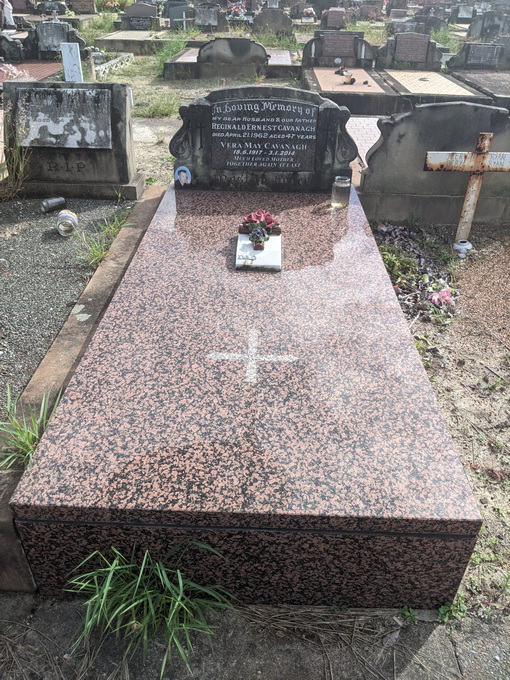
Dedication date of Memorial / Plaque / Monument: Nil – at this time ( February 2026 )
REG is NOT mentioned on the Police Wall of Remembrance * BUT SHOULD BE died as a result of injuries received and also took seriously ill whilst On Duty.
( last checked on 21 April 2026 and still does NOT appear on the National Police Wall of Remembrance. )
FURTHER INFORMATION IS NEEDED ABOUT THIS PERSON, THEIR LIFE, THEIR CAREER AND THEIR DEATH.
If you have anything further to add to what is recorded here, please get in touch.
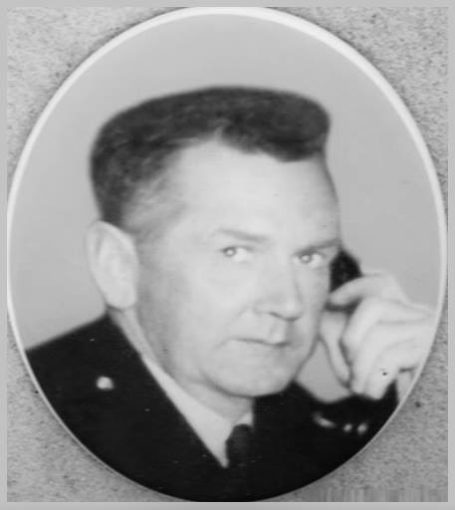
On 23 June, 1956 the sergeant was involved in the violent arrest of an offender at the Commercial Hotel, Junee. During the incident the sergeant suffered injuries to his kidneys which subsequently led to a number of operations and ongoing medical treatment for many years afterward.
On the morning of 14 April, 1962 Sergeant Cavanagh, then the Officer In Charge of the Morisset Police Station, collapsed on duty and was conveyed to the Newcastle Hospital. He remained in a semi-coma until he sadly passed away a week later. The cause of death was kidney failure caused by his injuries in 1956.
R. E. Cavanagh of Junee was promoted from Constable 1st Class to Senior Constable around 24 December 1954 as advertised in The Sydney Morning Herald, Friday 24 December 1954 on page 3 of 12.
The sergeant was born on 15 March 1915 and joined the New South Wales police Force on 25 August, 1939. At the time of his death he was stationed at Morisset.
Reg’s son, Geoff, last saw his dad being carried out of the Morisset Police Station on a stretcher to an ambulance in full uniform but never saw him again.
Reginald Ernest CAVANAGH AKA Reginald CAVANAGH, Reg CAVANAGH
Reginald Ernest CAVANAGH AKA Reginald CAVANAGH, Reg CAVANAGH
* Story behind any Nickname:
Nothing further, than what is recorded above, is known about this person at the time of publication and further information and photos would be appreciated.
Nothing further, than what is recorded above, is known about this person at the time of publication and further information and photos would be appreciated.
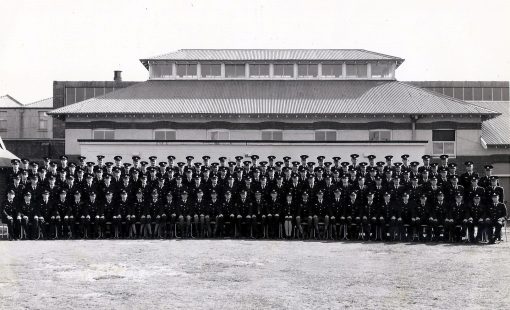
NSW Police Training Centre – Redfern – Class # 115
New South Wales Police Force
Regd. # 13273
Rank: Commenced Training at Redfern Police Academy on Monday 13 May 1968 ( aged 19 years, 2 months, 1 day )
Probationary Constable- appointed Monday 24 June 1968 ( aged 19 years, 3 months, 12 days )
Constable – appointed 24 June 1969
Constable 1st Class – appointed 24 June 1973
Detective – appointed ? ? ? ( YES )
Senior Constable – appointed 24 June 1977
Leading Senior Constable – appointed ? ? ? ( N/A )
Sergeant 3rd Class – appointed 31 August 1984
Sergeant 2nd Class – appointed ? ? ?
Sergeant 1st Class – appointed ? ? ?
Final Rank: = Detective Senior Sergeant
Stations: ?, Hurstville Scientific ( 31 Division ), ?, Ex War Crimes Investigator, Special Operations – Forensic Services Group – Identifications Services Branch ( DNA Advancement Program ), Forensic Intelligence & Results Management – Retirement
Time employed ( Paid ) with NSW Police: From: 13 May 1968 to 29 September 2018= 50 years, 4 months, 16 days
Service ( From Training Date ) period: From 13 May 1968to 29 September 2018 = 50 years, 4 months, 16 days Service
( 44 years in Crime Scene )
Retirement / Leaving age: = 69 years, 6 months, 17 days
Time in Retirement from Police: 5 years, 8 months, 10 days
Awards: National Medal – granted 29June 1984 ( Det SenCon )
1st Clasp to National Medal – granted 7 May 1994 ( Det SenCon )
Australian Police Medal ( APM ) – granted 26 January 2016 ( Det SenSgt )
Born: Saturday 12 March 1949
Died on: Saturday 8 June 2024
Age: 75 years, 2 months, 27 days
Organ Donor: Y / N / ?
Cause: Cancer – Bladder ( Renal – Kidney failure )
* Stage 4 Ureter Epithelial Cancer
Health Cluster from his FSG work
* Stage 4 Ureter Epithelial Cancer (also known as Stage 4 Urothelial Carcinoma of the Renal Pelvis and Ureter) is a cancer that spreads to distant organs, such as the lungs, liver, or bones, or has metastasized to lymph nodes far from the original tumor.
It is considered advanced and has a poorer prognosis than earlier stages.
Event location: ?
Diagnosis date: shortly after Retiring
Funeral date: Wednesday 19 June 2024 @ 11am
Funeral location: South Chapel, Woronora Memorial Park, 121 Linden St, Sutherland, NSW
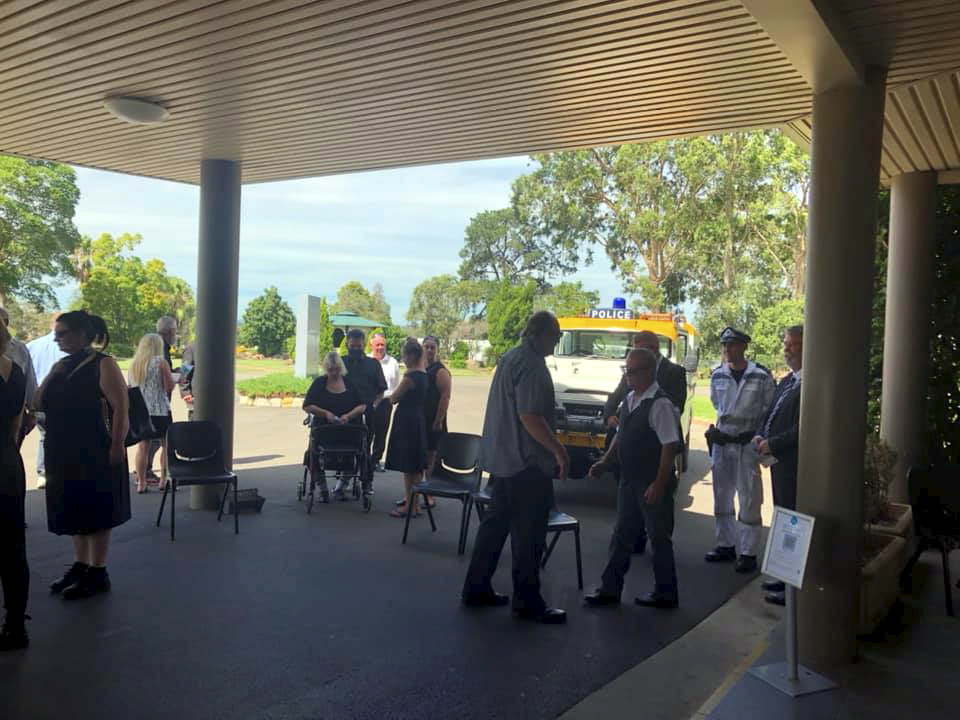
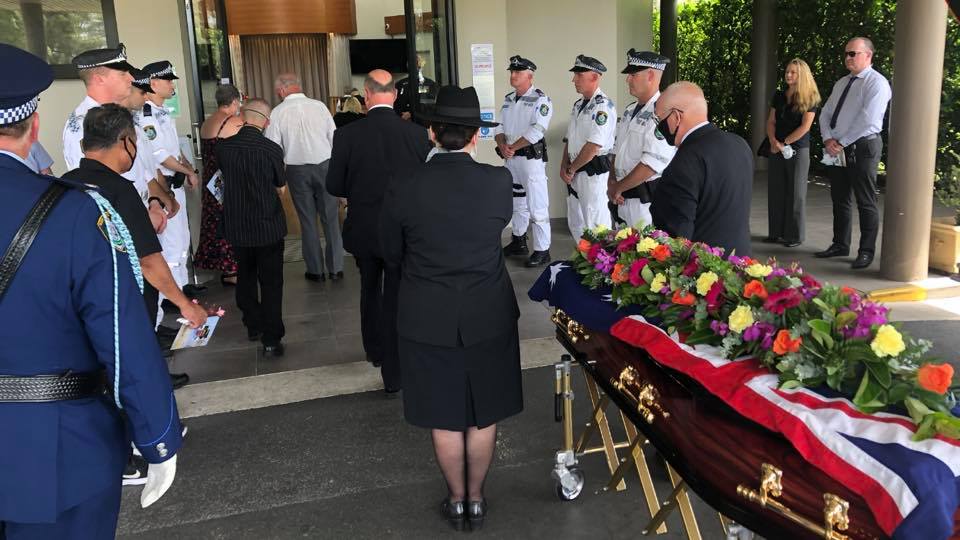
Forensic Evidence & Technical Services Command will provide an Official Police Guard of Honour
Family and friends are warmly invited to the farewell service for Stephen at Woronora Memorial Park, South Chapel.
The service can be viewed via the following live stream link from 11am. A recording of the service will also be available for download after the service has concluded.
NSW Police , Thought to share this – Remember those Nightshifts and early morning crime scene’s when Detective Senior Sergeant Steve Horn arrived. It was a matter of “who was in charge til I got here”.. A career spanning more than 50 years, there isn’t much this cop hasn’t seen. Detective Senior Sergeant Stephen Horn has investigated and solved some of the highest-profile crimes and disasters in Australia, and across the world.
Courtesy of Colin Walsh.
Granville train to war crimes: Hero cop’s 50 years on the front lines
From the Granville train disaster to the long search for Matthew Leveson’s remains, there isn’t much Detective Sergeant Stephen Horn hasn’t done in more than 50 years with NSW Police.
The veteran is hanging up his badge and hopes to spend more time with his family, and he spoke to A Current Affair about his career and the cases that have stayed with him.
“I’ve always tried to give more than 100 percent – as I say to some young people, get down and get dirty,” Det Sgt Horn said.
Detective Sergeant Stephen Horn is retiring after more than 50 years with NSW Police. (A Current Affair)
He joined the force in 1968, and for 44 years of his career he has been on the front line of crime scenes gathering any clue that might unravel a crime.
“Who else is going to speak for (the deceased) if not the police?” he said.
But despite his long career, he admitted the burden could be a heavy one.
Det Sgt Horn joined the force in 1968. (A Current Affair)
“I try not to take the work home and think about it at home, because if I worry about it and freak out and think about it, I’ll end up making mistakes,” he said.
“Multiple murders where a family has been murdered and children were involved – you always think to yourself, ‘why the children?'”
Det Sgt Horn was a fresh-faced, young forensic officer when a train derailed at Granville in Sydney in 1977.
Det Sgt Horn was one of the forensic officers on the scene at the Granville train disaster in 1977. (A Current Affair)
His job was to retrieve the 83 victims who died, and identify them.
“We had a temporary morgue put up in a large tent and when portions of the concrete from the roadway were actually moved off the carriages, we would go down and retrieve the bodies and take them up to the morgue, do an initial examination of them, photograph them, look at their injuries, look at their clothing,” he said.
It was far from the last disaster scene Det Sgt Horn would attend.
The forensic officers did their work at Granville in a temporary morgue in a large tent. (A Current Affair)
He also carried out his duties at the 1981 Sylvania Nursing Home fire (19 dead), the 1989 Kempsey bus crash (35 dead).
And in 1991, he received a phone call that shaped his career.
Det Sgt Horn was called on to investigate war crimes in Ukraine, where he dug up two mass graves and exhumed the remains of dozens of World War II victims – including 20 children.
Assistant Commissioner Peter Cotter with Det Sgt Horn who hopes to spend more time with his wife and granddaughter in retirement. (A Current Affair)
“When we started to exhume these remains, we could actually see they were almost all grouped in an area – little tiny baby remains and things like that,” he said.
“Why did this happen? Why were these children taken from this village when the information was they didn’t know if they were Jews or not? They just decided to take them and dispose of them.”
He spent three months in the trenches, with minimal food and supplies.
Det Sgt Horn has also been called upon to investigate war crimes in Ukraine. (A Current Affair)
Back home, the evolution of DNA technology has allowed Det Sgt Horne to solve cases that were otherwise impossible to crack.
“I think we had about 27 sexual assault cases solved with DNA, with about 33 charges – some of them serial offenders,” he said.
Most recently, Det Sgt Horn’s experience played an integral role in finding Matthew Leveson’s remains, 10 years after he went missing.
Det Sgt Horn exhumed the remains of dozens of WWII victims, including children. (A Current Affair)
It is a gift Matthew’s parents Mark and Faye Leveson could never repay.
“He helped bring our Matty home and without that, we might still be out there looking for him, so a massive thank-you isn’t enough,” Faye Leveson said.
Assistant Commissioner Peter Cotter commended Det Sgt Horn’s service.
Most recently, Det Sgt Horn played an integral role in finding the remains of Matthew Leveson. (A Current Affair)
“The NSW Police Force is extremely proud of you, we wish you the very best in retirement, and please go and enjoy yourself, and thank you for 50 years,” he said.
And Det Sgt Horn himself had one message for the new generation of young police officers.
“Be professional, diligent, loyal, courteous, and don’t give up,” he said.
There are three other ex-Forensics guys from Sydney who have the same problem.
One appears to have beaten it, but two others’ prognoses are very poor.
I worked with them all over the years.
I’m going to get a kidney health check next week, as are a few other former Forensics work mates.
Nothing further, than what is recorded above, is known about this person at the time of publication and further information and photos would be appreciated.
( Due to current Govt. restrictions on ‘Gatherings’ due to Corona19 Virus Pandemic, some families may wish to have a Memorial Service / Wake with friends and family at a later date )
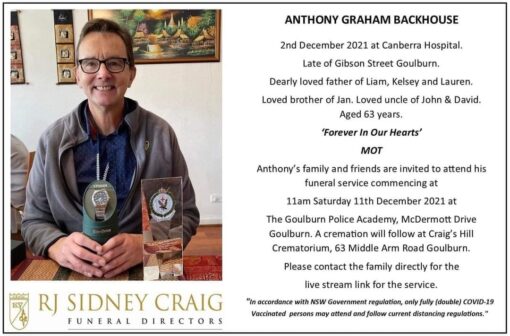
Funeral Parlour: R J Sidney Craig, Goulburn, NSW
Buried at: Cremation at Craig’s Hill Crematorium, 63 Middle Arm Rd, Goulburn, NSW
Memorial / Plaque / Monument located at: ?
Dedication date of Memorial / Plaque / Monument: Nil – at this time ( December 2021 )
TONY is mentioned on the NSW Police Wall of Remembrance, SPC ( 2022 )
FURTHER INFORMATION IS NEEDED ABOUT THIS PERSON, THEIR LIFE, THEIR CAREER AND THEIR DEATH.
This afternoon, in a quiet and deeply-felt ceremony at the Sydney Police Centre, another thirteen names were added, and the memories of another thirteen dedicated NSW Police Force employees were honoured, at the NSW Police Force Service Memorial:
Nothing further, than what is recorded above, is known about this person at the time of publication and further information and photos would be appreciated.
Cal
8 December 2021
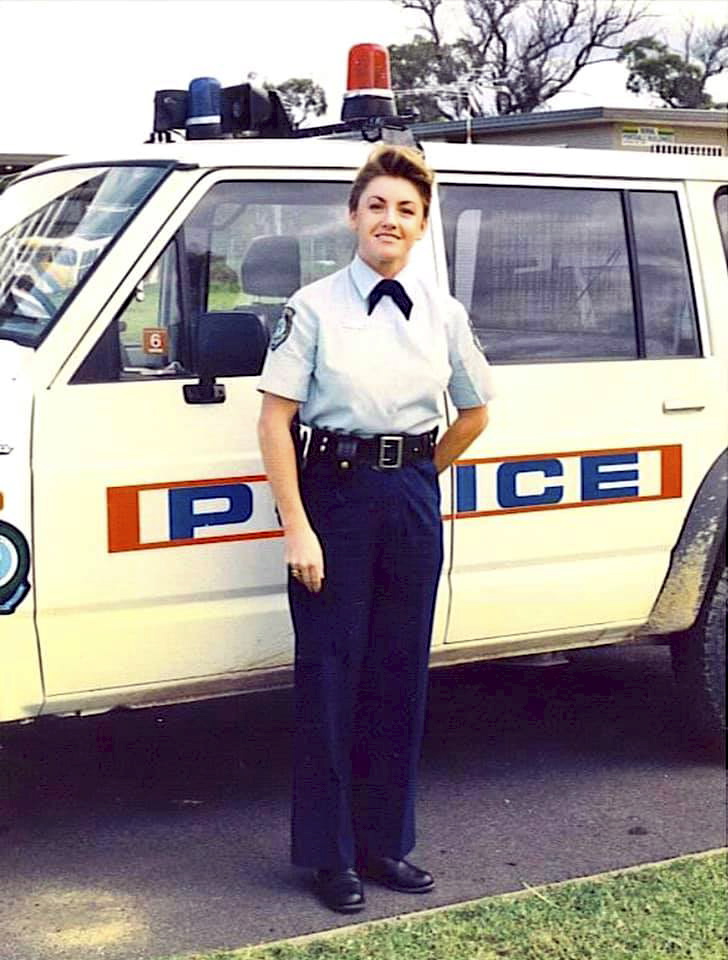
Lisa Ann CAMWELL
18/02/2026
Lisa Ann CAMWELL nee PARRISH
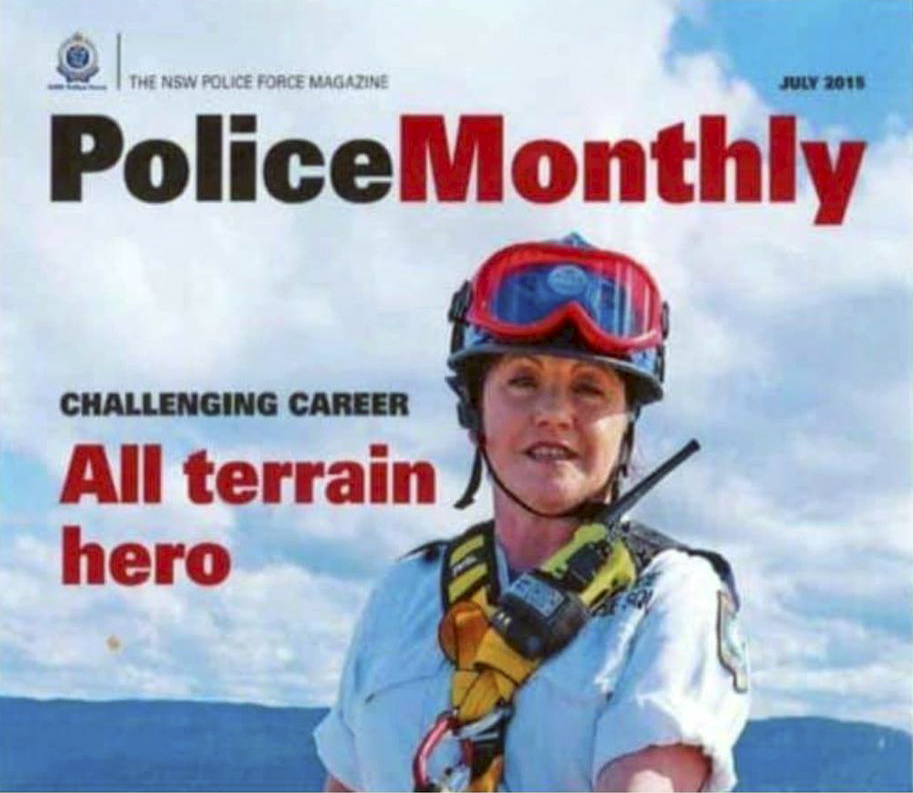
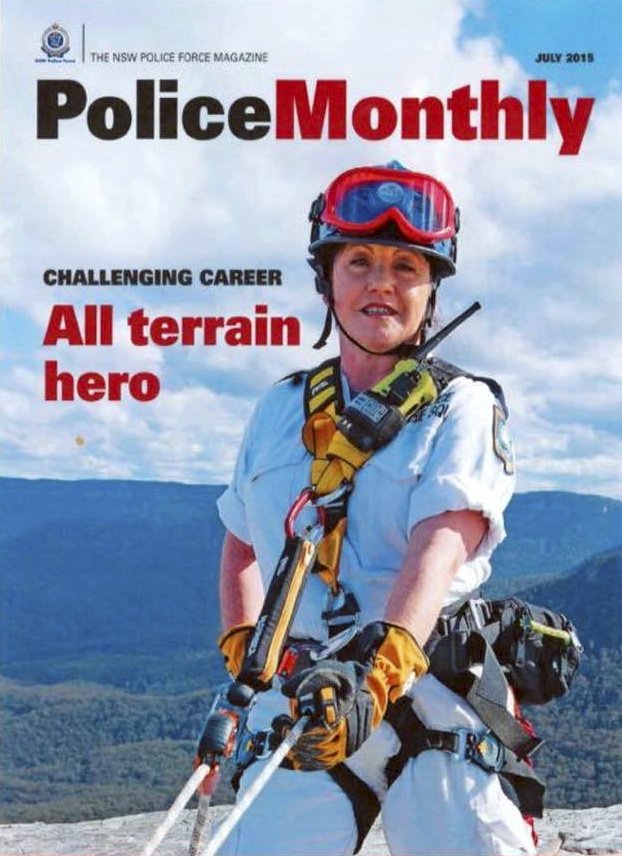
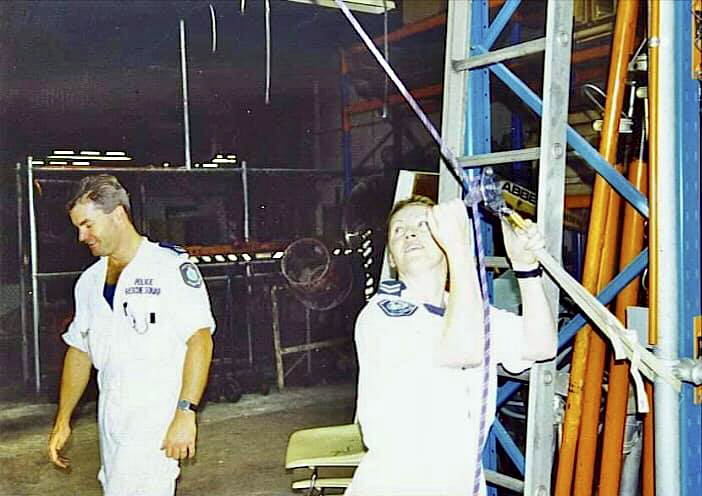
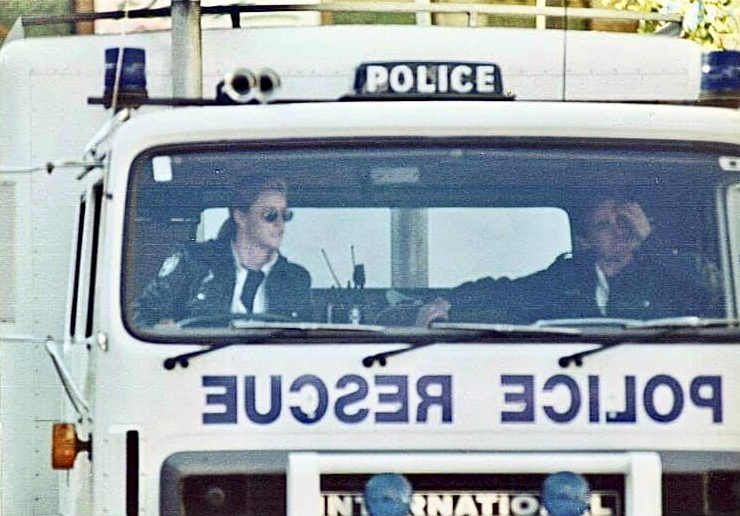
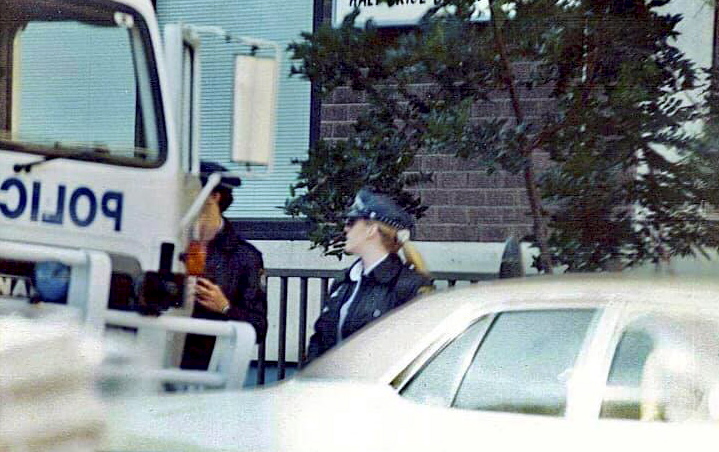
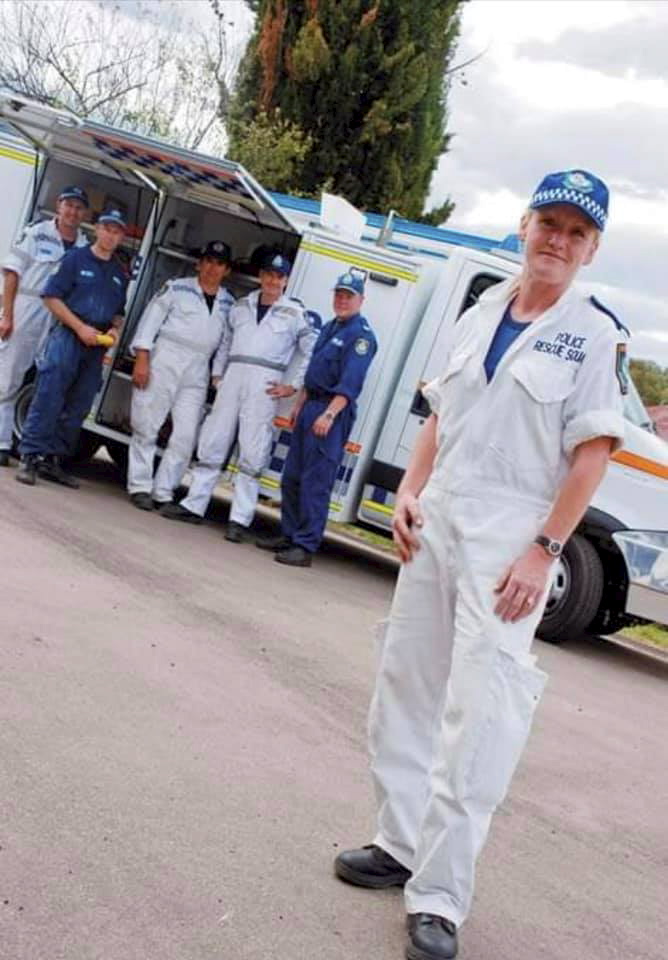
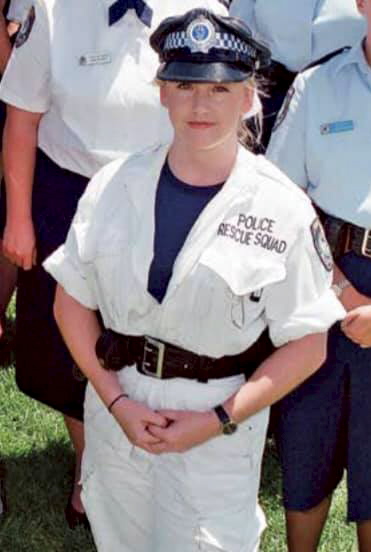
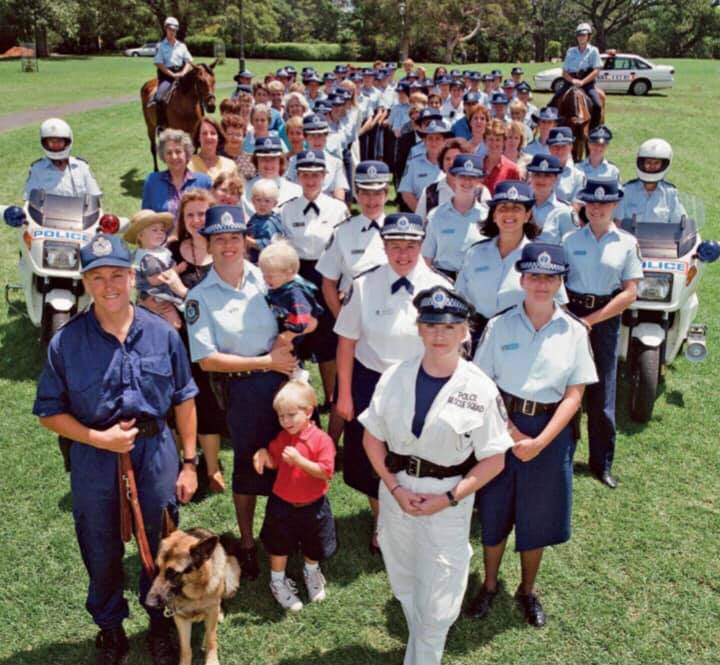
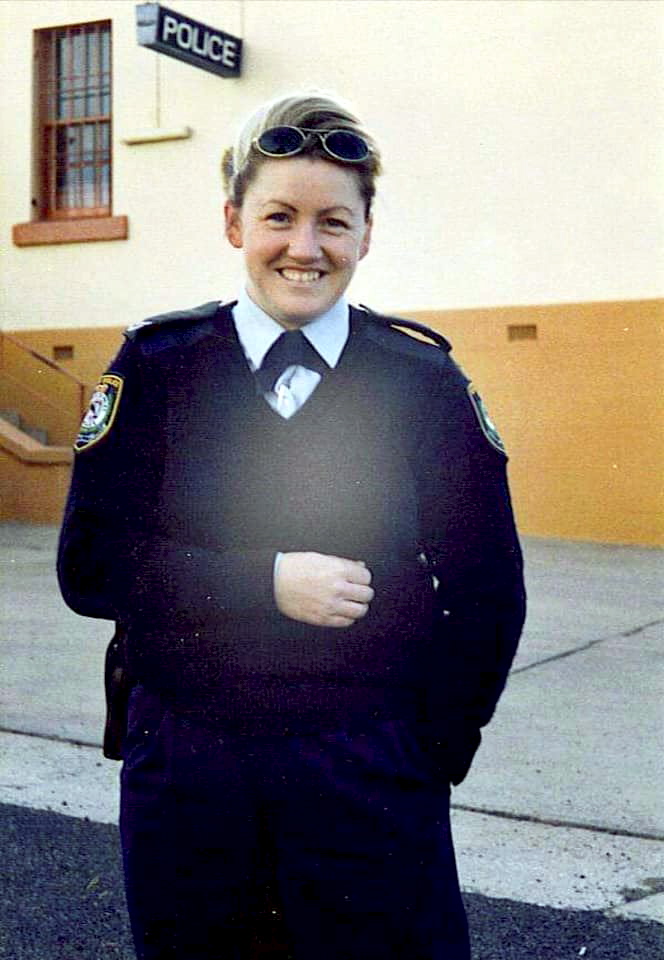
the First Full Time Female Rescue Operator at Zetland Rescue Squad
AKA ?
Late of ?
NSW Goulburn Police Academy – PREP Class # 242
New South Wales Police Force
Regd. # 26988
Rank: Commenced Training at Goulburn Police Academy on 30 July 1989 ( aged 20 years, 9 months, 26 days ) ( spent 5 months, 26 days at the Academy )
Probationary Constable- appointed Thursday 25 January 1990 ( aged 21 years, 6 months, 23 days )
Constable – appointed 27 April 1991
Constable 1st Class – appointed ? ? ?
Detective – appointed ? ? ? ( NO )
Senior Constable – appointed 30 June 1995
Leading Senior Constable – appointed ? ? ?
Final Rank = Senior Constable
Retirement / Leaving age: = 49 years, 6 months, 15 days
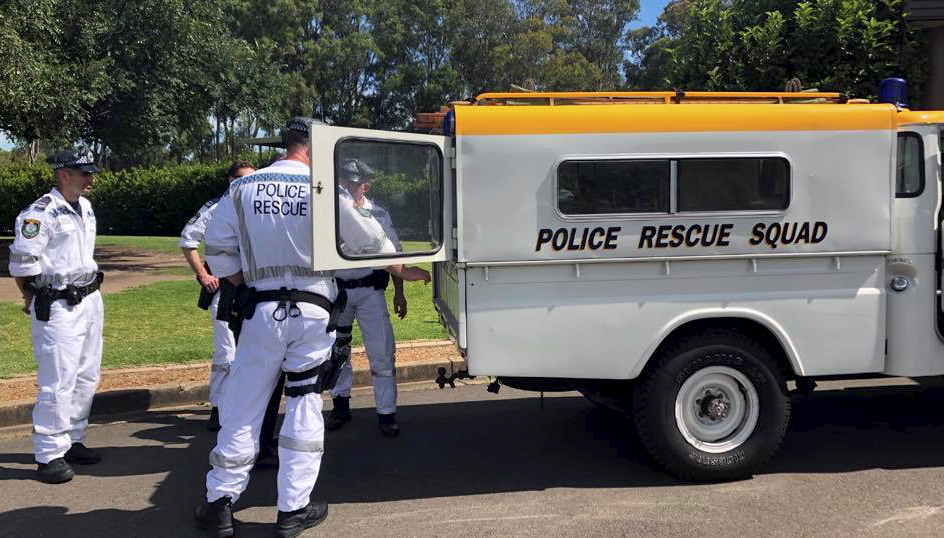
Stations: Sutherland, Menai GDs, State Protection Group – Police Rescue Squad – Zetland ( 4 July 1993 – ? ), Engadine Police Rescue Squad, ?, Monaro District, Police Rescue Squad – Cooma & GDs & Lock Up Keeper ( 12 July 1998 – 5 January 2004 ), Queanbeyan GDs ( 6 January 2004 – 18 September 2010 ), Queanbeyan had a name change to Monaro / Cooma District ( 12 January 2004 ), Blue Mountains GDs & Police Rescue ( 19 September 2010 – 19 April 2018 )
Service: From 29 October 1989 to 19 April 2018 = 28 years, 8 months, 20 days Service
Awards: No Find on Australian Honours system although –
NSW Police Medal ( 10 years ) granted on 30 September 2004
1st Clasp to NSW Police Medal ( 15 years ) granted on 30 March 2005
National Medal ( 15 years ) granted on 28 April 2005
2nd Clasp to NSW Police Medal ( 20 years ) granted on 11 October 2010
NSW Police Commissioners Sesquicentennary Citation granted on 4 October 2012
1st Clasp to National Medal ( 20 years ) granted on 10 September 2018
3rd Clasp to NSW Police Medal ( 25 years ) granted on 10 September 2018
NSW Police National Service Medal granted on 10 September 2018
Born: Friday 4 October 1968
Died on: Saturday 2 January 2021
Age: 52 years, 2 months, 29 days
Cause: PTSD – Liver and Kidney failure
Event location: Blacktown Hospital, NSW
Event date: Saturday 2 January 2021
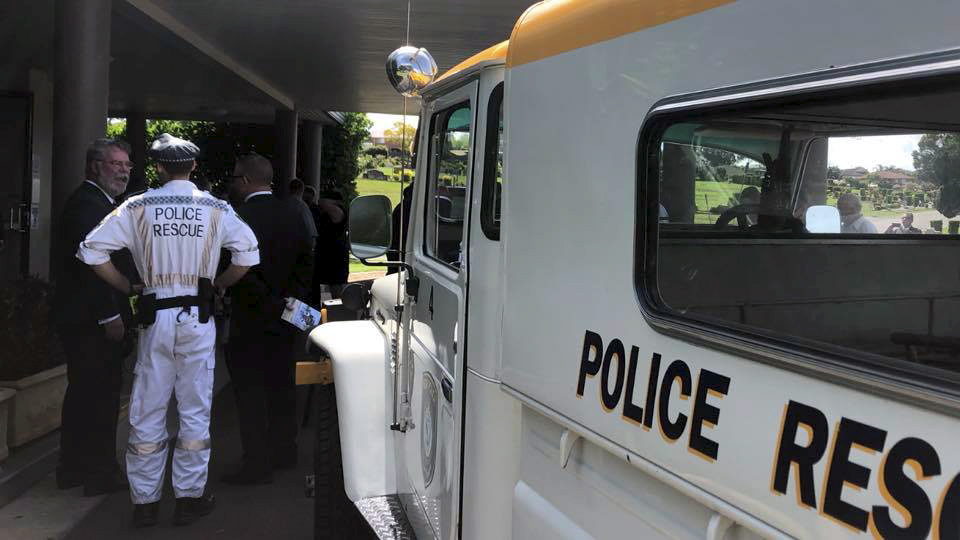
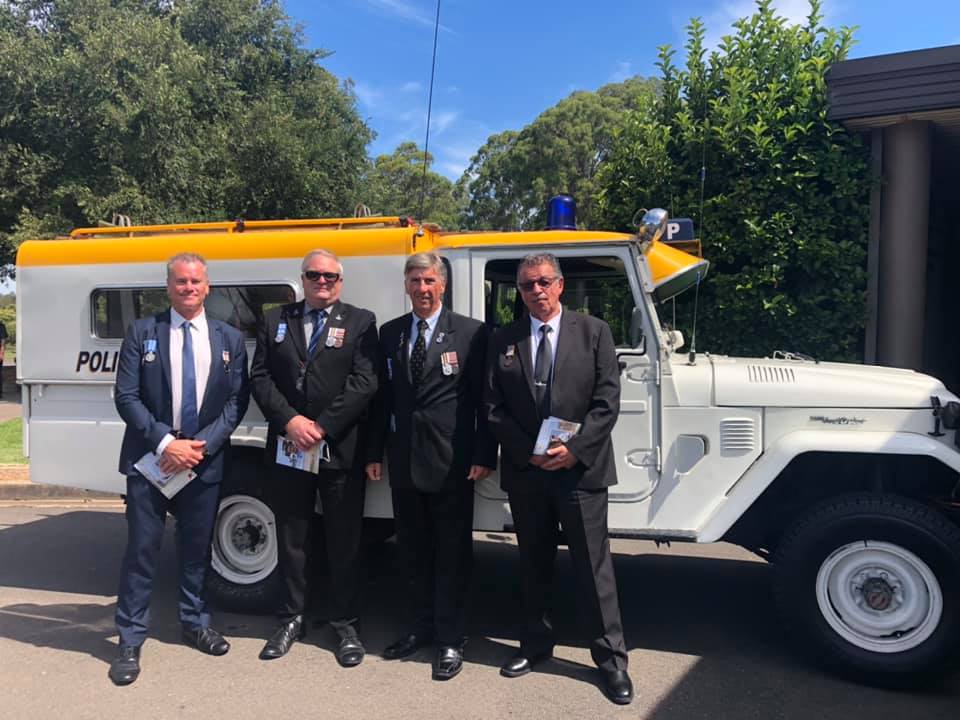
Funeral date: Tuesday 12 January 2021 @ 2pm
Funeral location: Pinegrove Memorial Park, North Chapel, Kington St, Minchinbury, NSW 02 9625 8066
( Due to current Govt. restrictions on ‘Gatherings’ due to Corona19 Virus Pandemic, some families may wish to have a Memorial Service / Wake with friends and family at a later date )
Funeral Parlour: Guardian Funerals
Buried at: ? TBA
Memorial / Plaque / Monument located at: ?
Dedication date of Memorial / Plaque / Monument: Nil – at this time ( January 2021 )
LISA is NOT mentioned on the Police Wall of Remembrance *NEED MORE INFO
FURTHER INFORMATION IS NEEDED ABOUT THIS PERSON, THEIR LIFE, THEIR CAREER AND THEIR DEATH.
Condolences to her partner, Grant Gibson & his two children, family and friends.
Lisa was the eldest child of parents, Ian Roderick Parrish and Marilyn Ann Gibson and Stepmom Judith Parrish.
Sister to Jody and Amanda and Aunty to their children.
Mother of Dayna, Hunter, Kade and Tamsyn.
This was published 13 years ago
Officer who found Byrne’s body grilled
The policeman who found Caroline Byrne dead at The Gap has told a Sydney court that in almost 20 years of rescue work, he had not seen any other bodies so far out from the cliff face.
Senior Sergeant Mark Powderly ( # 14425 ) gave evidence at the committal hearing for Gordon Wood, who is defending the charge that he murdered his former girlfriend.
The body of the 24-year-old model was found wedged head-first in rocks at the bottom of The Gap at Watsons Bay, in Sydney’s east, on June 8, 1995.
Wood, who was stockbroker Rene Rivkin‘s chauffeur at the time, is accused of throwing her from the 29-metre high cliff.
Exactly where Ms Byrne landed is central to the case, but her death was initially treated as suicide and no photographs were taken of her body at the scene.
Sgt Powderley told Burwood Local Court he and Constable Lisa Camwell retrieved Ms Byrne‘s body from a crevice next to a pyramid-shaped rock.
The officer, who spent 19 years in the Police Rescue Squad, said he had recovered up to 20 bodies from The Gap but had never found anyone that far out from the cliff.
Research by physics expert Rodney Cross allegedly shows that Ms Byrne could only have landed at this point, 11.8 metres from the cliff face, if she was hurled using a spear throw.
But a different place was nominated as the point of impact in a 1996 police video, which was played to the court.
In the video, Sgt Powderley narrates from the cliff top as Constable Camwell indicates a place several metres from the pyramid rock.
Sgt Powderley said he “wasn’t really concentrating” when the video – intended to publicise the Byrne case – was recorded.
He had only realised in 2004 that it showed the wrong place.
“If we were there to do a Forensic Services assessment of the scene and pinpoint the exact location … things would have been done differently,” he said.
Sgt Powderley said he saw the video for the first time at the 1997 inquest into Ms Byrne‘s death, but did not notice the position was wrong because he “just wasn’t paying the attention to it that I should have”.
Police initially gave Prof Cross the wrong information about where Ms Byrne landed and he concluded she probably jumped, the court has been told.
Defence barrister Winston Terracini SC suggested measurements of the location had been “wrong for ages”, but were changed when police received a report “that doesn’t suit their purposes”.
Sgt Powderley denied having been asked by the detective heading the investigation, Paul Jacob ( # 18752 ), to reconsider the body’s location.
Earlier, Prof Cross told the court he had not considered information from 1994 about Ms Byrne‘s sporting ability when concluding she could not have jumped so far from the cliff.
Instead, he used reports from Ms Byrne‘s high school teachers that she had no athletic ability.
Mr Terracini asked why he had not taken into account the more recent information which, he said, showed Ms Byrne “excelled at a whole range of different sports” including basketball, swimming and aerobics.
“I presumed that that material was provided by Caroline Byrne herself,” Prof Cross said.
On 9 September 2008 the Daily Telegraph / AAP reported “Exact spot of model’s body ‘forgotten’”
It said a police officer who recovered the body of model Caroline Byrne has told a Sydney court she will never remember the exact location of the body. Senior Constable Lisa Camwell told the New South Wales Supreme Court a controversial 1996 video re-enactment was her best memory of the recovery operation.
Ms Byrne, 24, was found wedged head first in rocks at the base of cliffs at The Gap, in Sydney’s east on June 8, 1995. Her live-in boyfriend Gordon Wood is on trial for her murder. Sen Const Camwell was one of two police involved in retrieving Ms Byrne’s body. She was tasked with carrying a body bag and stretcher across to the recovery site.
The officer today told the jury her recollection of the morning was based solely on her own actions “which was carrying equipment and looking at the ground”. When she took part in a video re-enactment about a year after Ms Byrne‘s death, Sen Const Camwell said she determined the place she believed the body found was based upon an estimate of how long it had taken her to reach it that night. “Most of those large rocks found down the bottom there are mostly just large rocks to me,” she said. “I wouldn’t ever say I know exactly where her body was.”
Sen Const Camwell said she had no further involvement in the case until she was contacted about the video in 2004. She told the court the officer then in charge of the murder investigation said the position of Ms Byrne‘s body had become a ” significant issue ”, and where she had indicated on the video appeared to be incorrect. She agreed with Wood’s barrister Winston Terracini SC that her best memory of events was as recorded on the video.
The location of the body is essential to the Crown case that Ms Byrne was not pushed nor jumped, but was forcefully thrown to her death. Sen Const Camwell‘s partner Mark Powderly has told the jury the body was recovered from a different location which is consistent with the theory that Ms Byrne was murdered. The location indicated by Sen Const Camwell supports the hypothesis that Ms Byrne took her own life. The trial continues.
MICK BRUNETTA had heard a lot of screams during his 17 years of fishing at The Gap, but he had never heard anything like the one he heard on the night of June 7, 1995, he told a murder trial yesterday.
Mr Brunetta and his brother-in-law Norm Wano were not having much luck as they cast their lines into the darkness from the clifftop. About 11pm they heard what they variously described as a woman’s “freakish scream” and that she sounded “like someone who was panicked or scared”.
Mr Wano turned and said, “F— man, what was that?” and the pair continued fishing.
Gordon Wood, 45, has pleaded not guilty to throwing his girlfriend, Caroline Byrne, a 24-year-old model, from the cliffs at the notorious suicide spot in Sydney’s east.
Mr Wano said that he contacted the police 11 months later after seeing a re-enactment on television where police asked the two fishermen, who were potential witnesses, to come forward.
Wearing an olive-green bandanna over his dreadlocks and his sunglasses perched on top of his head, Mr Wano said that although he was not a keen fisherman, he often accompanied his brother-in-law.
He said he had heard the scream about 11pm and, “It wasn’t a scream of happiness. It was like a scared scream.”
He said that later three men had come by calling out the name “Caroline”. Upon being told of the scream, Mr Wano said, one of the men had said, “On no, she’s done it, she’s done it.”
Mr Brunetta, who gave evidence with the assistance of an Italian interpreter, said that he recalled seeing a lone man calling out “Caroline” and that later that night that same man, who had blond hair, had come back with two other men. After telling the group of the scream, they asked to borrow his torch.
Mr Brunetta said his torch was not very good because the battery “was a bit flat”.
He agreed that in his 2004 statement he had said that when he saw the men trying to shine the torch to illuminate the bottom of the cliff, he had said, “There’s no way that man will be able to see anything because the torch is not strong enough.”
The two fishermen stayed on until dawn watching the police recover Ms Byrne’s body. Mr Brunetta said no one had ever taken him back to The Gap to try to pinpoint the exact location of where Ms Byrne had landed.
Also yesterday, a police witness contradicted another on critical evidence against Wood.
One officer told the jury that she would never be able to pinpoint the exact location of the body, which is vital to proving that Ms Byrne’s death was murder.
The jury has heard conflicting evidence about where the body was found, with senior retrieval officer Mark Powderly testifying Ms Byrne was some 10 metres from the cliff face.
But his partner, Senior Constable Lisa Camwell, yesterday told the court she believed Ms Byrne was in a crevice closer to the shore.
No measurements or photographs were taken on the night of her death.
A 1996 video re-enactment of the rescue operation shows Senior Constable Camwell pointing to a spot, which is referred to as the “exact location” of Ms Byrne’s body.
The officer yesterday said she had estimated the site based upon how long it took her to reach the body on the night of the retrieval, and the video showed her best recollection of events.
“Most of those large rocks found down the bottom there are mostly just large rocks to me,” she said.
“I wouldn’t ever say I know exactly where her body was.”
During the trial, the Court was told of some uncertainty regarding the actuallocation where the body was found. Senior Constable Lisa Camwell, one of theofficers who retrieved Byrne’s body in 1995 gave evidence that she had in 1996participated in a video re-enactment in which she indicated the body’s location.She gave evidence that in 2004 she was contacted by an officer in charge of themurder investigation (Sergeant Powderly) and told that the position of MsByrne’s body had become a significant issue. She was told that the body positionshe had indicated on the video now appeared to be incorrect. Media reportsduring the second trial suggested the location of the body was an essentialcomponent to the Crown case that Ms Byrne was not pushed nor jumped, butwas forcefully thrown to her death [The12]
2.4.3.3
Deliberation and verdictAfter five full days of deliberation on 21 November 2008 they found Wood guilty.On 3 December 2008 Wood was sentenced to a custodial sentence of 17 years,with a minimum time in prison of 13 years. Wood lodged an appeal to theconviction.2.4.4Inquests, Investigations and TrialsTwo inquests were held into Byrne’s death by New South Wales State coronerJohn Abernethy, with Wood claiming it was suicide. The second inquest in 1998delivered an open finding. That same year, Wood left Australia.Police investigations continued from 2000 onwards as “Strikeforce Irondale“with hundreds of witnesses interviewed and resulting in a brief of evidencerunning to more than 350 pages. Caroline’s father Tony Byrne continued to pressfor action from the investigation eventually enrolling the assistance of New SouthWales politician Fred Nile who raised questions about the investigation in StateParliament up till 2004.In 2004 scientific reports relating to the physics of a body falling/jumping/beingprojected from the cliff produced by Professor Rod Cross were the principalelements of new evidence which encouraged the Crown to push for a trial ofGordon Wood. In March 2006 the New South Wales Director of PublicProsecutions Nicholas Cowdery QC agreed with police that there was enoughevidence to charge Wood with Byrne’s murder. Wood was detained in London inApril 2006, extradited to Australia and released on bail by a Sydney court on 4May. On 6 July 2007, Wood was committed to stand trial for the murder of Byrne.The first trial started on 21 July 2008 with Mark Tedeschi QC appearing for theCrown and Winston Terracini QC defending Wood. On 6 August 2008, JusticeGraham Barr declared a mistrial because of the alleged contact that a member ofthe jury had with 2GB radio host Jason Morrison. The juror, who remainedanonymous, claimed that some of the jurors were planning a secret night visit tothe crime scene (the Gap) being organised by a particular juror who was a “bully”and who had “already decided that Wood was guilty.” Justice Barr ruled “I had todischarge the jury … because some jurors disobeyed my instructions andmisconducted themselves.”The second trial commenced on 25 August 2008 and for the first time in NewSouth Wales court history a panel of 15 jurors was sworn in instead of the usual12 to provide some contingency.
Caroline Byrne (8 October 1970 – 7 June 1995), an Australian model, was found at the bottom of a cliff at The Gap in Sydney in the early hours of 8 June 1995. Her then boyfriend Gordon Eric Wood (b. 1962), who at the time of her death was chauffeur and personal assistant to businessman Rene Rivkin, was convicted of her murder on 21 November 2008 and spent three years in Goulburn jail. He was acquitted of the conviction in February 2012.[1][2]
Events of 7 June 1995
The Gap at Watsons Bay, location of Byrne’s death.
Born on 8 October 1970,[3] Byrne had been in a relationship with Wood since 1992. She was a model but principally worked as a modelling instructor for Sydney deportment and etiquette educator June Dally-Watkins. On 7 June 1995, she failed to turn up for work and for an appointment with a psychiatrist. There were three claimed sightings of her near The Gap at Watsons Bay that afternoon and evening, in the company of two men, one of whom matched Wood’s description. Two of the sightings – at 1 pm and 3 pm – were by local cafe owners, Craig Martin and Lance Melbourne. In 1998 John Doherty, an Irish artist who had been out of the country in the intervening years, came forward to say that around 8.30pm that evening he too had seen Byrne outside his studio window arguing with one man while another man stood nearby.[4]
Wood denied being present at Watsons Bay that afternoon. Evidence was sworn at both inquests by Wood’s friends Brett Cochrane and Nic Samartis that they lunched with him briefly around 1:15 pm in Potts Point before he was called away after a call from Rivkin.[5]:206 Wood claimed that he was asked by Rivkin to chauffeur prominent lobbyist and ex-federal minister Graham Richardson to an appointment and then spent the afternoon doing regular chores for Rivkin before going home around 7 pm. The Richardson alibi was compromised by Richardson when he was interviewed by police in 2001, when he advised that he had lunched that day with rugby league administrator Peter Moore.[4]
Wood’s movements in the afternoon have never been reported prior to the late evening, when Wood said he awoke on his couch having fallen asleep in front of the television and was immediately alarmed that Byrne was still not home. Wood has said he did not know Byrne’s whereabouts but was led by what he termed “telepathic communication” to The Gap. He had first driven to the beachfront car-park at Bondi Beach where he and Byrne had spent much time and then to a favourite park at Camp Cove where they had often picnicked. Heading back from Camp Cove he spotted Byrne’s white Suzuki Vitara parked in a lane at The Gap. It was when running about the cliff-top and shouting her name that Wood encountered two rock fishermen who verified his appearance around midnight.
Wood then rang Tony Byrne and Caroline’s brother Peter. He drove back into Sydney city and collected them and all three then went to the Gap and scoured the cliff-top. Peter Byrne later gave evidence that at about 1am Wood claimed to have spotted her body at the base of the cliff using torchlight. Byrne himself said he could see nothing and nor could the police who arrived soon after with police torches. The night was dark and the cliff misty. Peter Byrne claimed it was difficult to see the rocks below the cliff, let alone a body. The contention whether Wood had claimed he could see something in the darkness figured in much media speculation over the years and formed a key part of Crown evidence in the 2008 trial. In 2011 the Appeal Court felt that the Crown had presented speculation in this area posing as evidence. This was one of the grounds resulting in Wood’s 2011 appeal being upheld.
The identity of the second man supposedly sighted by Melbourne and Martin with Wood in Watsons Bay earlier in the day has remained unclear. With evidence contradicting the likelihood that the man was either of those whom the police considered in investigation (Byrne’s modelling agent Adam Leigh or Rivkin associate Gary Redding) the Crown chose to pose speculation without evidence on either during the trial and drew criticism from the trial judge and later the appellant judges.
Media interest
Byrne’s death was accepted as a suicide by local Rose Bay Police and others. No photographs were taken of the location of her body’s landing point.
In 1996, Byrne’s father begin to agitate against the notion of suicide such that from 1997 onwards the case and circumstances of Byrne’s death were regularly examined in Australia’s national newspapers and reported as “one of Sydney’s unsolved crimes”. The death of a beautiful model at one of Sydney’s notorious suicide spots, the connection to the flamboyant and newsworthy Rivkin, and a net of witnesses and commentators which included some prominent Sydney identities all added to the intrigue of the case.
Offset Alpine speculation
Attention was particularly heightened by the still unproven speculation of a connection with Rene Rivkin’s financial activities. The day before Byrne’s death, Wood and Rivkin were interviewed by the Australian Securities and Investments Commission about the Offset Alpine fire of 1993 and the true ownership of share parcels traded in Offset Alpine owned by nominees related to Swiss bank accounts.[5]:203 Tony Byrne claimed that Wood had indicated to his daughter that the fire was a set-up for insurance purposes.
Ultimately in 2001 Rivkin was charged with insider trading (of Qantas shares) and his eventual conviction in 2003 had a devastating effect on his mental stability, culminating in his 2005 suicide.[6] However the ASIC investigation into share trading in Offset Alpine and the true beneficiaries proved an epic that outlived Rivkin, commencing in 1995 and continuing from 2005 with a focus shifted to Graham Richardson and Trevor Kennedy until eventually closed without outcome by ASIC in 2010.[7]
Peripheral celebrities
Adding to this intrigue was a list of celebrities with a peripheral involvement in the case. Byrne’s medical doctor who had referred her to the psychiatric appointment she did not keep on 7 June was television celebrity physician, Dr Cindy Pan.[5]:205Graham Richardson‘s diarised luncheon appointment that day (which caused him to question whether he may have been chauffeured anywhere by Wood) was with rugby league identity Peter Bullfrog Moore at Sydney’s Hilton Hotel and was set up to broker a peace deal in the Super League war which deeply divided Australian rugby league at that time. Wood always claimed that he had driven Moore from a noon meeting with Rivkin to what may well have been a lunch, though the press and (later) the Crown ignored this possibility. Moore died in July 2000 a year prior to the Strikeforce Irondale interview with Richardson, thus preventing corroboration of the luncheon timings and Rivkin too was dead before the trial.[8]
Byrne’s close friends included entertainer Tania Zaetta and actress Kylie Watson, a Home and Away cast member. It was the amateur sleuthing around Watsons Bay armed with photographs of Byrne in the weeks after her death which had Dally-Watkins and Watson uncover the Martin/Melbourne sighting lead.[5]:206 Other celebrity witnesses who figured in the case at some point included businessman John Singleton, journalist Paul Barry and paparazzo Jamie Fawcett.
Inquests, investigation and trials
Two inquests were held into Byrne’s death by New South Wales State coroner John Abernethy, with Wood claiming it was suicide. The second inquest in 1998 delivered an open finding. That same year, Wood left Australia.
Police investigations continued from 2000 onwards as “Strikeforce Irondale” with hundreds of witnesses interviewed and resulting in a brief of evidence running to more than 350 pages. Caroline’s father Tony Byrne continued to press for action from the investigation eventually enrolling the assistance of New South Wales politician Fred Nile who raised questions about the investigation in State Parliament up till 2004.[9]
In 2004 scientific reports relating to the physics of a body falling/jumping/being projected from the cliff produced by Professor Rod Cross were the principal elements of new evidence which encouraged the Crown to push for a trial of Gordon Wood.[10] In March 2006 the New South Wales Director of Public Prosecutions Nicholas CowderyQC agreed with police that there was enough evidence to charge Wood with Byrne’s murder.[11] Wood was detained in London in April 2006, extradited to Australia and released on bail by a Sydney court on 4 May. On 6 July 2007, Wood was committed to stand trial for the murder of Byrne.
The first trial started on 21 July 2008 with Mark Tedeschi QC appearing for the Crown and Winston Terracini QC defending Wood. On 6 August 2008, Justice Graham Barr declared a mistrial because of the alleged contact that a member of the jury had with 2GB radio host Jason Morrison. The juror, who remained anonymous, claimed that some of the jurors were planning a secret night visit to the crime scene (the Gap) being organised by a particular juror who was a “bully” and who had “already decided that Wood was guilty.” Justice Barr ruled “I had to discharge the jury … because some jurors disobeyed my instructions and misconducted themselves.”[12]
The second trial commenced on 25 August 2008 and for the first time in New South Wales court history a panel of 15 jurors was sworn in instead of the usual 12 to provide some contingency. [12]
Trial evidence
Presentation of the Crown case
Following the aborted first trial Tedeschi, as Crown Prosecutor, presented the Crown case over a nine-week period from 26 August until 24 October 2008. Over 70 witnesses were called and the jury heard hours of audio and video evidence including taped interviews with Rivkin and Wood.[13]
Witnesses called by the prosecution included Pan, Richardson, Watson, Zaetta, Singleton, Fawcett, Bob Hagan and sports journalist Phil Rothfield. Tony Byrne, Peter Byrne, Dally-Watkins and her daughter Carol Clifford appeared. Doherty and Cochrane gave evidence via video link up from overseas. Police witnesses included Tracey Smit ( ProCst # 61020 ) and Paul Griffiths ( # 23770 ? ) (officers on scene), Sgt Mark Powderly ( # 14425 ), Sgt Neville Greatorex ( # 16136 )(who gave evidence on police procedures), Snr Const Lisa Camwell( # ????? )(who retrieved the body) and the first investigating officer of the case Sgt Craig Woods ( #22599 ? ) of Rose Bay who had first dismissed the death as suicide and who gave evidence that in the first weeks Tony Byrne too accepted the suicide verdict and was explicitly against the idea of an inquest. Another ex-policeman to appear was Byrne’s former boyfriend Andrew Blanchette ( # ????? ). At one stage Justice Barr counselled Blanchette that he ought consider taking legal advice before answering a particular question. Sensationally on his second day in the witness box, Blanchette admitted that early that morning he had phoned another witness – Melinda Medich, his girlfriend and a minor at the time of Byrne’s death – before she was due to give evidence later that day. Blanchette was reported to police by Medich who had not heard from him for a number of years. Blanchette denied that he had been attempting to influence her evidence.
Location of the body
Retired University of Sydney physicist Associate Professor Rod Cross spent two days in the witness box. Over a six-year period Cross had produced six reports on the case – with his initial findings being quite different to the later findings presented in the trial.[10] Although formally qualified in the field of plasma physics, Cross had experience working with biomechanists regarding sports research and had published and refereed many papers on biomechanics;[14] he was therefore proposed by police investigators as a forensic expert in fall dynamics. Between 1998 and 2004 Cross’ reports all concluded that Byrne could have jumped to her death, as he was told that Byrne’s body had been found at a distance of 9 metres (30 ft) from the cliff.[15] In 2005, when he was recontacted by the police that the position of the body was in fact farther away (11.8 metres (39 ft)), he conducted experiments which informed his speculation that Byrne could not have jumped that far and must have been thrown.[5]:210[16] The required launch speed, from the top of the 29 metres (95 ft) high cliff, was 4.5 m/s (see range of a projectile[17][18]), and the available runup distance was only 4 metres (13 ft) – although appeal submissions in 2011 called this into question. Cross tested eleven females from the New South Wales Police Academy and found that they could dive and land head first (in a swimming pool) at about 3.5 m/s after a 4 metres (13 ft) runup. A strong male could throw a 61 kilograms (134 lb) female at 4.8 m/s after a runup of only 2 metres (6 ft 7 in) or 3 metres (9.8 ft).
During the trial the Court was told of some uncertainty regarding the actual location where the body was found. Senior Constable Lisa Camwell, one of the officers who retrieved Byrne’s body in 1995 gave evidence that she had in 1996 participated in a video re-enactment in which she indicated the body’s location. She gave evidence that in 2004 she was contacted by an officer in charge of the murder investigation (Sergeant Powderly) and told that the position of Ms Byrne’s body had become a significant issue. She was told that the body position she had indicated on the video now appeared to be incorrect. Media reports during the second trial suggested the location of the body was an essential component to the Crown case that Ms Byrne was not pushed nor jumped, but was forcefully thrown to her death.[19]
Suicide history
The court heard that Caroline’s mother Andrea Byrne had committed suicide in March 1991 after she became depressed following a breast enlargement operation that went wrong.[20] Terracini also read to the court a letter Tony Byrne had previously provided to police in which he claimed that Caroline had made an attempt on her own life via overdose in 1992. In court Tony Byrne denied that Caroline had on that occasion intended to kill herself and instead was making “a cry for help”. At another stage of the cross examination, he claimed to suppose that had Caroline wanted to kill herself she would have copied her mother’s method rather than jumping from a cliff.[21]
Byrne’s doctor, author and television personality Cindy Pan, gave evidence that she had seen Byrne for two years before her death and had specifically discussed Byrne’s depression with her in the weeks leading up to her death. Dr. Pan told the court Byrne said she had felt depressed for about a month and the condition had worsened in the week leading up to their appointment on 5 June 1995. Pan said the model told her she could not put a finger on what she was unhappy about.
“I was trying to explore with her what she might be depressed about, but she was not really able to identify any one specific thing,” Pan told the court. She said Byrne told her she “had the same thing three years ago” and had been put on medication, which had helped. Pan said Byrne denied having thoughts of self-harm and she referred her to a psychiatrist, obtaining an appointment for 4 pm on 7 June.[22]
Presentation of the defence
One defence witness, Prof John Hilton, a forensic pathologist, was called during the Prosecution case, due to his later unavailability. Otherwise Terracini commenced the defence case on 27 October 2008 calling another physics expert Prof Marcus Pandy, a electromechanical engineer who conducted experiments on running and jumping speeds of two females. Only a handful of defence witnesses were called – two forensic pathologists, one psychiatrist, Prof Pandy, a stunt diver, and Wood’s sister Jacqueline Schmidt – and the defence case concluded within a week.
With the trial drawing to a close, the jury made a number of requests of Justice Barr that included a visit the Gap for a third time; for a transcript of Doherty’s evidence; and for video footage of Pandy’s running experiments.[23]
Deliberation and verdict
For the first time in New South Wales court history, a ballot was used to select the three jurors who would stand down so that twelve of the sitting fifteen would deliberate to a verdict. After five full days of deliberation on 21 November 2008 they found Wood guilty.[24][25] On 3 December 2008 Wood was sentenced to a custodial sentence of 17 years, with a minimum time in prison of 13 years. Wood lodged an appeal to the conviction.[26]
Appeal
Wood’s appeal hearing commenced on 22 August 2011 in the Criminal Court of Appeal before Chief Judge at Common Law Peter McClellan, Justice Megan Latham, and Justice Stephen Rothman. Wood’s barrister Tim Game SC submitted that the jury’s verdict was unreasonable and not supported by the evidence. His submission spoke of nine grounds for appeal. One was that the trial miscarried by reason of the prejudice occasioned by the Tedeschi’s closing address. Others related to criticisms of Barr’s directions to the jury.
Early media reporting of the appeal focused on Game’s submission that the scientific evidence used to convict Wood and presented by Associate Professor Cross was flawed. A photograph was presented in the trial and purported to be taken in 1996 showing that scrub near the fence line had limited Byrne’s possible run-up to the jump, supporting an argument that she would have needed to have been thrown to achieve the horizontal distance from the cliff wall that her body travelled. The appeal judges heard and the Crown acknowledged that the photo was in fact taken in 2003 and that photo’s quality meant that a shadow might have appeared to be scrub. The appeal judges heard that a 1996 colour photo which showed that there was no scrub limiting the run-up was available to the Crown during the trial but that the Crown had chosen to introduce the blurrier, non-contemporaneous, more ambiguous image.[27]
Game’s submission, consistent with so much of the trial evidence, concerned matters relating to the exact positioning of Byrne’s body at the base of the rocks and the orientation of her legs and torso and leading to questions regarding the contended launch point and the assumptions and assertions made by Cross in his pre-trial studies and reports and his trial evidence. Day two of Game’s submission focused on the police’s changed view between 1996 and 2005 as to Byrne’s landing spot and specifically trial evidence given by Sergeant Mark Powderly used to justify the reconstruction.[28]
The Criminal Court of Appeal delivered their opinion on 24 February 2012 acquitting Wood of Byrne’s murder and ordering his release from jail.[1] The appellate judges delivered a unanimous decision that there was insufficient evidence beyond reasonable doubt that Wood murdered Byrne and that the jury’s verdict was not supported. They dismissed the Crown evidence as being critically flawed and ruled that the possibility of her suicide ought not have been excluded.[1][2]
Justice McClennan described Cross’ experiments as “unsophisticated” and in the summation of his decision said that he was not satisfied by either of the two motives presented by the Crown.[1] Regarding the motive submitted by Tedeschi that Byrne had information about Rivkin’s business dealings that Wood was trying to hide, McClennan said “The exploitation of public rumour and the use of mere innuendo to compensate for inadequate evidence of motive is not consistent with the obligations of a prosecutor to press the Crown case “to its legitimate strength” by reliance upon credible evidence”.[2]:para 305 McLennan was also troubled that the notion Byrne may have been unconscious when she left the cliff top was introduced by the Crown late in the case.[2]:para 277 He described Tedeschi’s suggestion, first made in his closing address and mentioned at no other time in evidence, that a “shot-put” action was used to despatch Byrne as “an invention of the prosecutor…for which there was absolutely no support in evidence”.[29] McClennan also expressed some doubt as the reliability of evidence concerning the claimed sightings of Wood and Byrne at Watson’s Bay on 7 June 1995 noting that some of these witnesses had come forward years after the event and the initial investigations; he raised concerns that the Melbourne/Martin first identification of Wood and Byrne was based on a specific photos shown to them by Dally-Watkins rather than from being picked from a selection. Tedeschi was criticised by McClellan for presenting reasoning that was “dangerous” and “entirely without foundation”. Tedeschi contributed to the alleged miscarriage with his “50 killer questions” which took an “impermissible course” in asking the jury to consider rhetorical questions dealing with matters that had not been presented with in evidence.[29] McClennan ruled that he was not persuaded that Sgt Powderly’s evidence regarding the changed landing position of the body was entirely reliable.[2]:para 317
Wood was freed from prison on 24 February 2012; having served three years two months in Goulburn Correctional Centre, following an initial month in Parklea prison. Three weeks later the new New South Wales Director of Public Prosecutions, Lloyd Babb SC, issued a press release simply announcing that “the OPDD will not appeal the Court of Criminal Appeal’s judgement in the matter of R v Gordon Wood . No further comment will be issued”.[30] This was 24 hours after meeting Tony Byrne and attending the Gap with him – a meeting which Byrne described as ‘fruitful’.[31]
Post-appeal
Wood left Australia after his release from prison and spent time in the United States and Britain. In 2014 he brought defamation actions against the Sydney radio stations 2GB and 2UE, Channel Seven Sydney, and The Daily Telegraph[32] which were all settled out of court in his favour for undisclosed sums.[33]
In 2016 Wood sued the state of New South Wales for millions of dollars plus costs for malicious prosecution and wrongful imprisonment, based on a number of grounds including a “hopelessly corrupted” and “ridiculous” police case against him.[34] In a witness statement filed as part of his lawsuit against the state, Mr Wood said that during his three years in Goulburn Jail he lived in constant fear of guards who dished out “therapy” and was king-hit (a term widely used in Australia, meaning a very hard punch, usually delivered to the head, that is completely unexpected) and knocked unconscious in the prison yard by an infamous rapist and killer.[35] The suit was dismissed on 10 August 2018, with Wood receiving no compensation.[36]
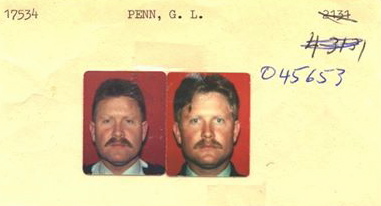
Gregory Lewis PENN New South Wales Police Force – Right Wall – Sydney Police Centre
Lauren’s page has now expired
901 days ago ( as of 28 November 2016 ), Lauren created this page in support of NSW Police Legacy.
With the help of NSW Police Legacy, Lauren gave everything:
Shared their page with everyone they could.
Received 6 donations from generous family and friends.
Raised $192.
My Story
Thank you for visiting my page. My name is Lauren Penn. To do city 2 surf has been on my to do list for over 10 years. As a young teenager my Dad would come in and wake me up at the crack of dawn to go for a walk with him, we talked about anything and everything on our walks and we would often talk about doing city 2 surf together.
Unfortunately we never were able to as my Dad pasted away from cancer when I was 15. My Dad, Senior Sergeant Greg Penn joined the NSW police force when he was only 21 and served 27 years. My Dad served in almost every duty as a police officer, from radio, blue light unit, highway patrol, PCYC. He worked at a number of stations, Rosebay, Mascot, Corrimal and Lake Illawarra.
Throughout his career he was highly commended and received a number of honors and medals. My Dad also created a computer program to track youths at the PCYC clubs and I remember visiting different clubs with him when he went to install the program.
Late 2003 we found out dad had cancer, brain cancer, lung cancer and kidney cancer. On the 4/4/04 my Dad passed away surrounded by our family at our home, he was 48. 2014 marks 10 years since losing Dad.
Every choice and decision I have my in the last ten years I would stop and ask myself “what would dad say”, “what you he do”. So being ten years, I wanted to do something with a lot of meaning; I choose to do city 2 surf, like we always talked about. At the time of registering, I hadn’t exercised properly for 3yrs, since registering I have started boot camp and eating correctly and have lost 10kgs so far, my goal is to be able to do city 2 surf in 2 hours and 20minutes.
After Dad passed away Police Legacy had a benefit night in my Dads honor which raised money for my sister and I to receive when we turned 25. With Police Legacies help I have been able to complete 4 TAFE certificates which have help me hugely in returning to work after having my daughter.
So as a small token of my appreciation towards Police Legacy, my goal is to raise $500.
I also believe that Greg PENN did a lot of computer work in relation to the macro system in WordPerfect 5.1 in making shortcuts to the forms that were used in everyday police work – especially in relation to traffic matter and developed the system which was widely used throughout NSW Police Stations around the 1990’s.
TARGETED PROGRAMMING: THE PENN SYSTEM
Real results in reducing juvenile crime
Police Officers working within PCYC tackle juvenile crime through what is known as “Targeted Programming”. The work of the Officers in 2004 was again instrumental in preventing and reducing youth crime.
Targeted Programming consists of three program areas:
1. Case Management of individual young offenders referred to PCYC Officers by a Police Local Area Command or local Magistrate, identified as Priority One work, or P1s;
2. High visibility policing in juvenile crime of anti-social behaviour locations or ‘hot-spots’, referred to as Priority Two work, or P2s;
3. Community Policing projects such as involvement in driver education or school visitation.
Targeted Programming is supported by a software planning and evaluation program developed within PCYC, and now known as the PENN system, in honour of one of the key architects of targeted programming, S/Sgt Greg Penn (see story page 35).
All 57 Clubs throughout NSW received Young Offender and Youth Crime ‘Hotspot’ referrals from Police Local Area Commands and the Crime Management Units throughout the year.
At the end of the 2004, PCYC Police had received 1951 young offender (Priority One) referrals since launching Targeted Programming in July 2001, of which 433 were Aboriginal & Torres Strait Islander (ATSI) young people.
By the end of 2004, there were 575 Priority One young people being currently case managed by PCYC Police.
The Priority One results as at December 2004 were extremely positive with young offenders reducing their offending behaviour collectively by a staggering 68.9% over a nine month period.
In regards to Priority Two referrals and Youth Crime ‘Hotspots’, PCYC have received a total 336 referrals since July 2001, with 207 current Priority Two Referrals being targeted by PCYC Police in 2004.
There were a total of 24 807 ‘other’ young people involved in community policing conducted by PCYC Police.
PCYC’s work in crime prevention was recognised in 2004, through the Australian Violence and Crime Prevention Award Scheme.
During 2004, the PCYC Board funded a review of the PENN system to determine its validity and reliability. The evaluation focused on 861 referrals between 2001 and 2003, which were compared with a control group of all other young offenders not referred to PCYC Targeted Programming (92, 237 young offenders).
Some specific findings of the evaluation were:
8% of Targeted Programming participants reduced incidents by five or more in the three months immediately after referral;
29% of Targeted Programming participants reduced incidents by two or more.
Another interesting finding of the evaluation was that 9.9% of the non-PCYC group were Aboriginal or Torres Strait Islander (ATSI) young people, while ATSI young people made up 34.2% of the PENN referrals studied.
This shows that PCYC Targeted Programming has been particularly beneficial to many ATSI young people.
Other findings of the evaluation were:
That offence rates amongst those involved in the program drop significantly as reported;
That PCYC manages some of the State’s more difficult young offenders; and
The next stage in the evaluation of Targeted Programming could be a focus on long term behavioural change by persistence with young offenders.
PCYC looks forward to the further development of PENN in 2005 and congratulates the many dedicated Police Officers and their civilian colleagues in PCYC who, on a daily basis work with young people in their local community. The work they undertake is extremely important and challenging; their reward is the satisfaction of knowing they have a real impact, and they are positively changing the direction of the lives of young people.
SNR SERGEANT GREG PENN
In April 2004, PCYC lost one of its most respected Police Officers, when Snr Sgt Greg Penn lost his long battle with cancer. With the movement for about 10 years, Snr Sgt Penn began as the Inner Metro Zone Commander, served as Zone Commander for the Southern region and was acting State Co-ordinator when illness struck.
Despite his battle with cancer, Snr Sgt Penn dedicated himself to the progression of Police computer systems such as PASS (Programs And Services System).
The success of Targeted Programming and the PENN system were recognised by the Federal Government in the 2003 National Crime and Violence Prevention Awards.
After his passing, Snr Sgt Penn was honoured by the NSW Police for his work in the areas of computer software design and youth crime prevention, by being
awarded a Commissioner’s Commendation. The commendation recognised his outstanding commitment and dedication to duty throughout his career, particularly the vital role he played in the design and implementation of computer systems that have enabled enormous benefits to operational Police and the community. His wife Joanne gratefully accepted this award in his honour.
PCYC State Coordinator, Insp Paul Macmillan, said Snr Sgt Penn’s commitment in this most important area of policing merited acknowledgement at the highest level.
“His work has brought tangible benefits to the community and the NSW Police and is an example for others to follow in the best traditions of policing,” Insp
Macmillan said.
“Greg was extremely popular with a great sense of humour and warm personality. He will be enormously missed by his many friends in PCYC and the NSW Police.”
Sadly, Snr Sgt Penn leaves behind his wife Joanne, and two school aged daughters, Lauren and Alexandra.
PCYC hosted a benefit night for the Penn family at the Illawarra Master Builders Club which featured a performance by the NSW Police Swing Band, with