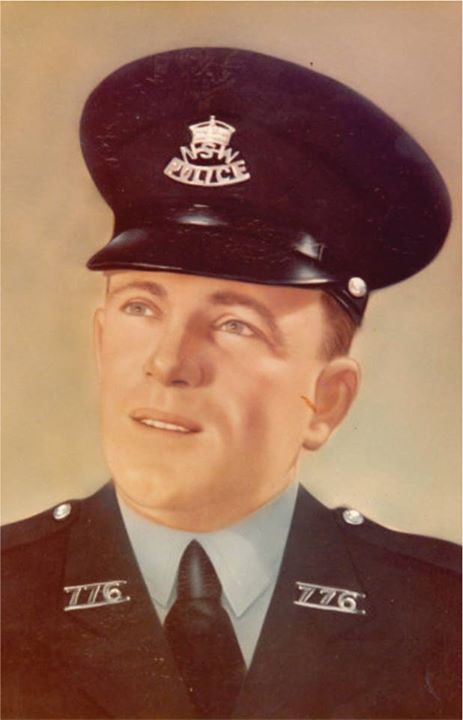
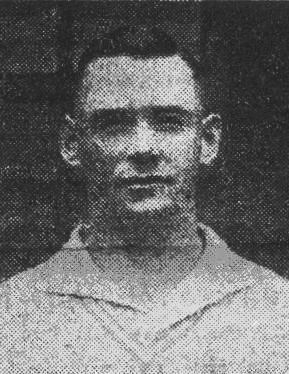
William Watson RILEY

William Watson RILEY

( Double Police Murder – )

Father of Ian RILEY – NSWPF Cadet # 1953 ( joined 17 Aug. 1964 )  NSWPF Regd # 12383 from Class 109
Father of Jeanie RILEY – NSWPF – SenCon 17386 who Attested on 27 September 1976 from Class 152
Late of St Marys, NSW

New South Wales Police Force

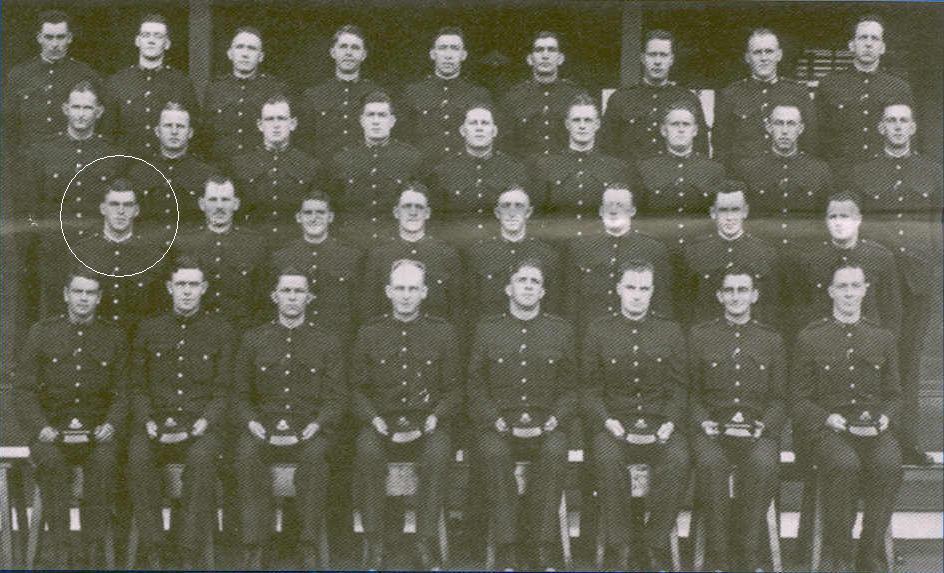
NSW Police Academy – Penrith College – Class # 001

Regd. #  4831

Rank:  Commenced Training at Redfern Police Academy on Monday ? ? ?

Probationary Constable – appointed 3 December 1945

Sergeant 2nd Class – appointed 1 July 1967

As of the 1968 Police Stud Book – William had passed his Sgt 1/c qualification exam

Posthumously promoted to Sgt 1/c on ???


Stations: ?, Blacktown – Death


ServiceFrom  ? ? pre December 1945?  to  30 September 1971 = 26+ years Service

Age at Leaving NSWPF:  50 years, 7 months, 8 days

Time in Retirement:  0


Awards:  Queens’ Police Medal for Gallantry – Awarded 25 May 1972 ( Sgt 1/c )


Born:  Tuesday 22 February 1921

 Died on:  Thursday  30 September 1971

Age:  50 years, 7 months, 8 days

Cause:  Shot – Murdered – shotgun ( Double Police Murder )


Event location:  Mimosa Ave, Toongabbie  Approximate GPS:  -33.781884,  150.951727

Event date:  Thursday  30 September 1971


Funeral date:  Tuesday  5 October 1971

Funeral location?


Buried at:  Cremated

Pinegrove Memorial Park Location:

Peace Rose Gardens

Section: Family Memorial

Lot:  ?

Lat/Long: -33.78922, 150.84705


 Memorial located at:

1/  Pinegrove Memorial Park, Eastern Creek

2/  Blacktown Police Station. Memorial photos was in the foyer, then the boss’s foyer & now in the corridor between the front counter & muster room.

3/ Plinth at the entrance to the Memorial Rose Garden, NSW Police Academy, Goulburn.

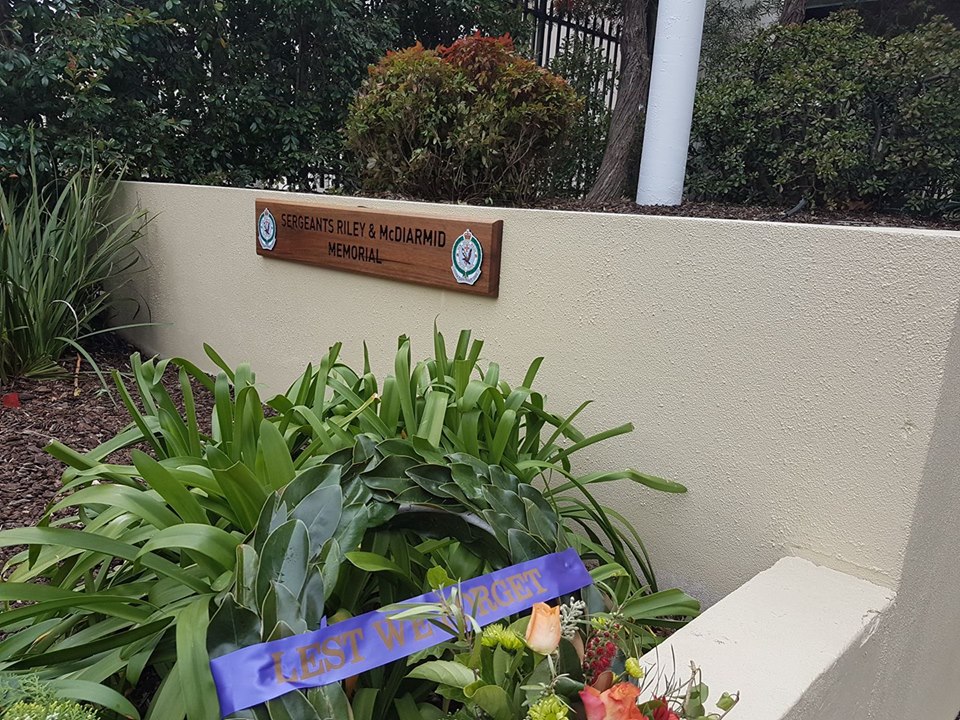
4/  Memorial Gardens at the front of Blacktown Police Station – Dedicated in September 2017.
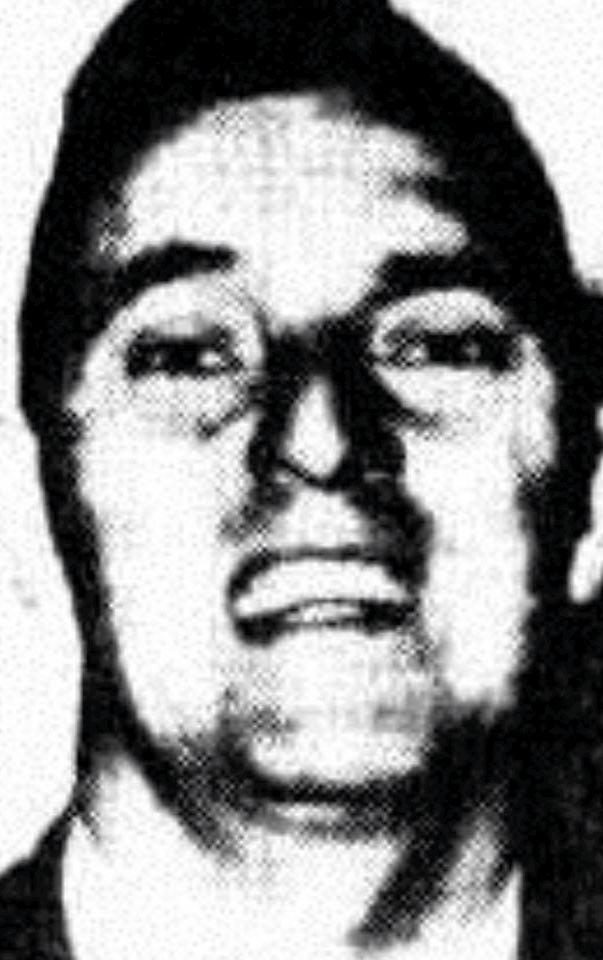
 

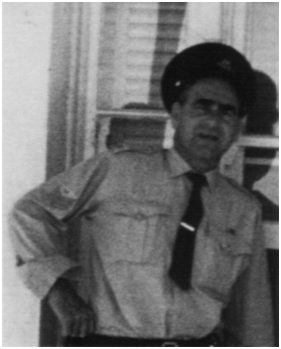
William Watson RILEY
Sgt William Riley


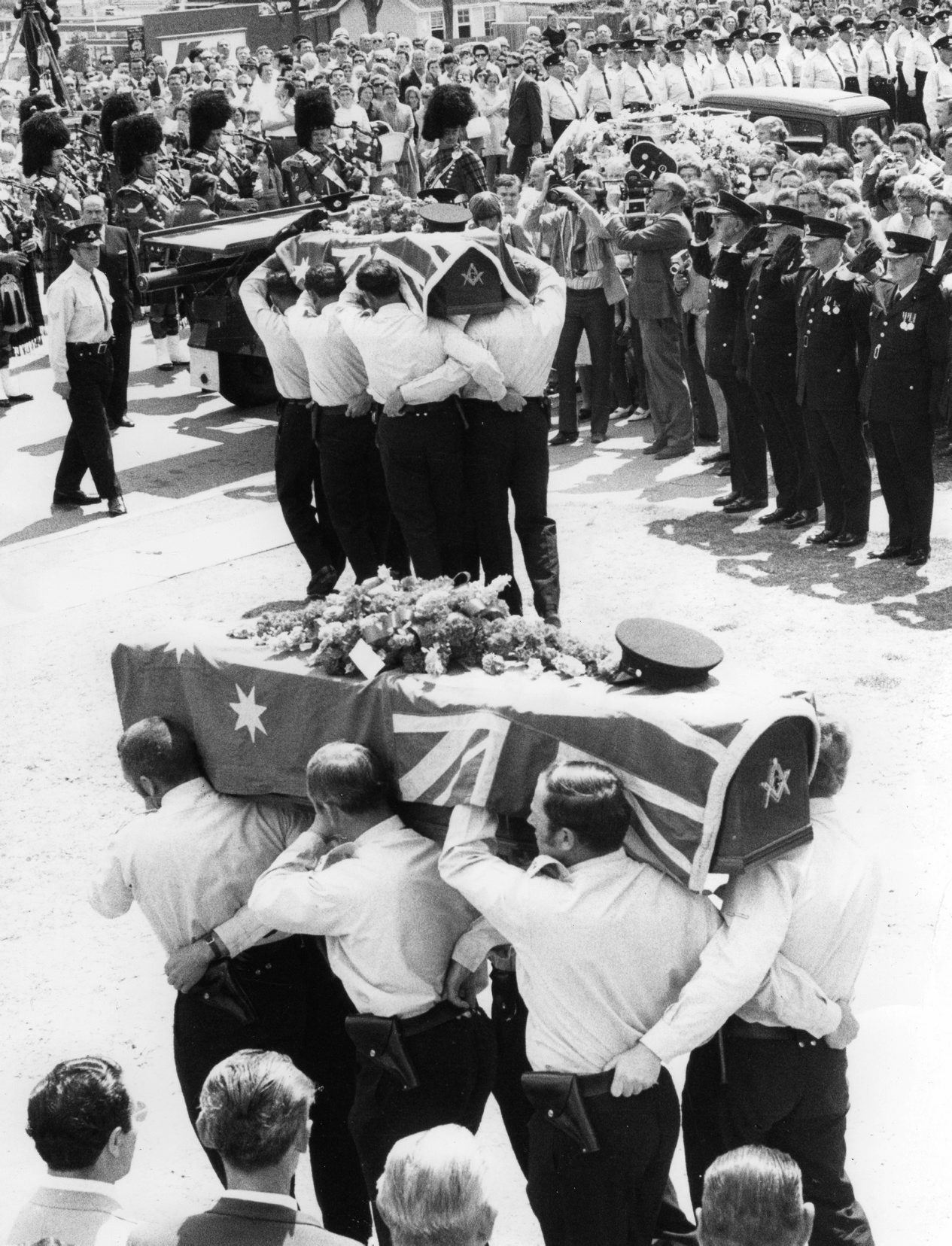
Double Police Funeral


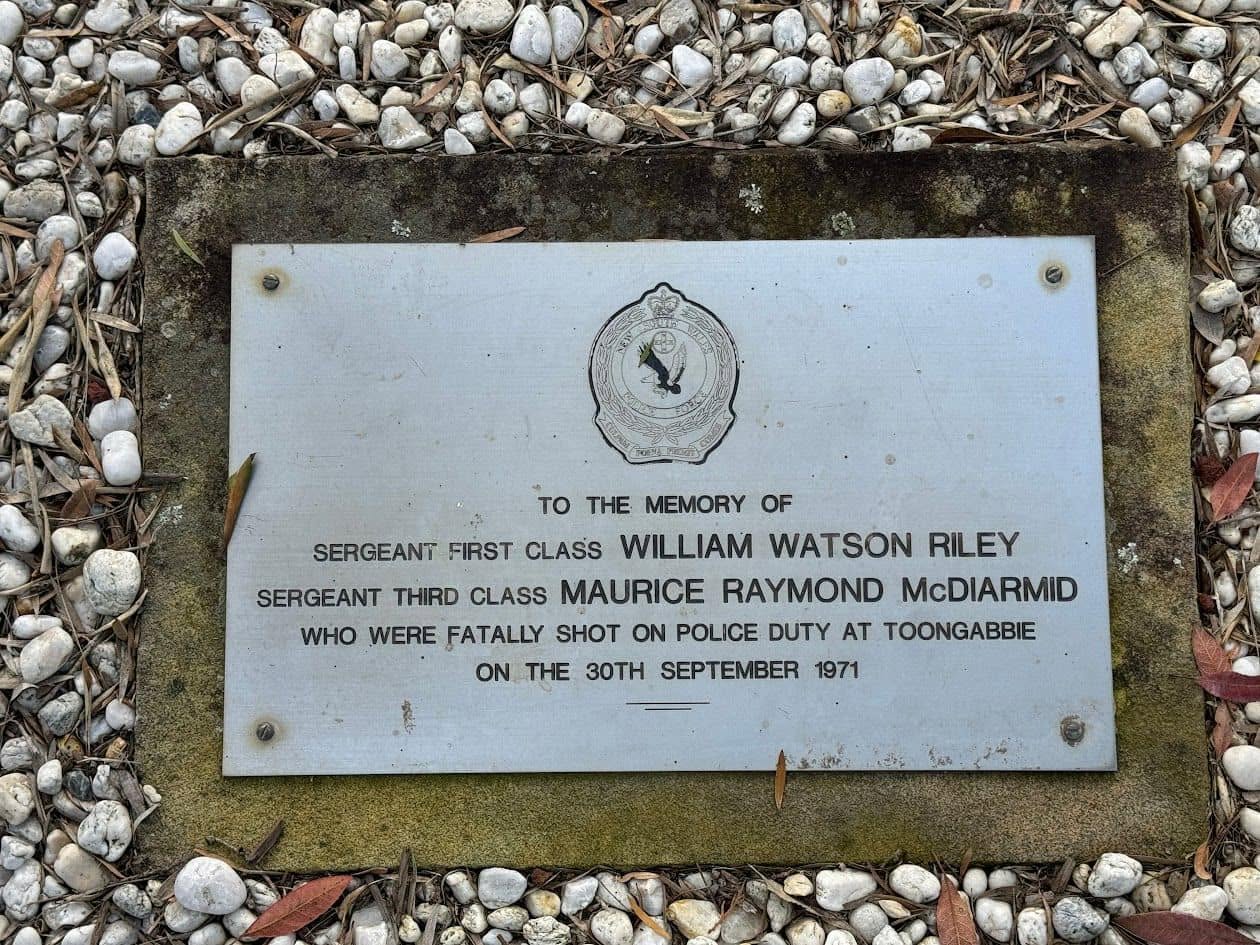
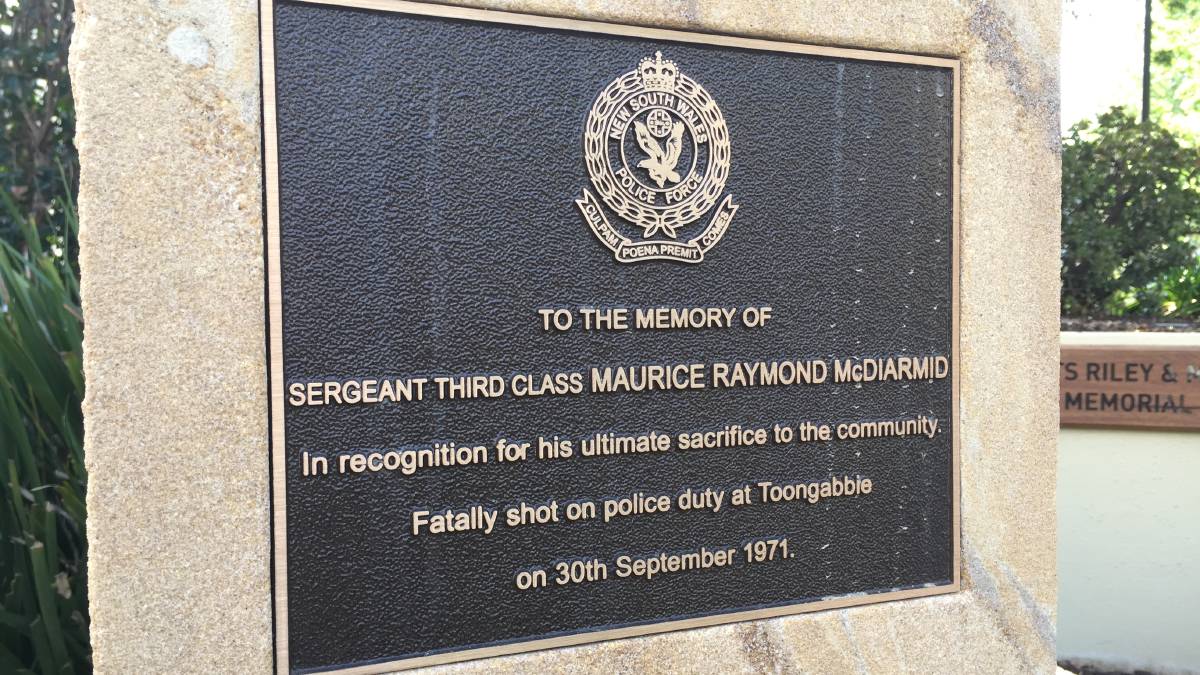
Inscription:To the memory of Sergeant First Class William Watson RILEY, Sergeant Third Class Maurice Raymond McDIARMID who were fatally shot on Police Duty at Toongabbie on the 30th September 1971

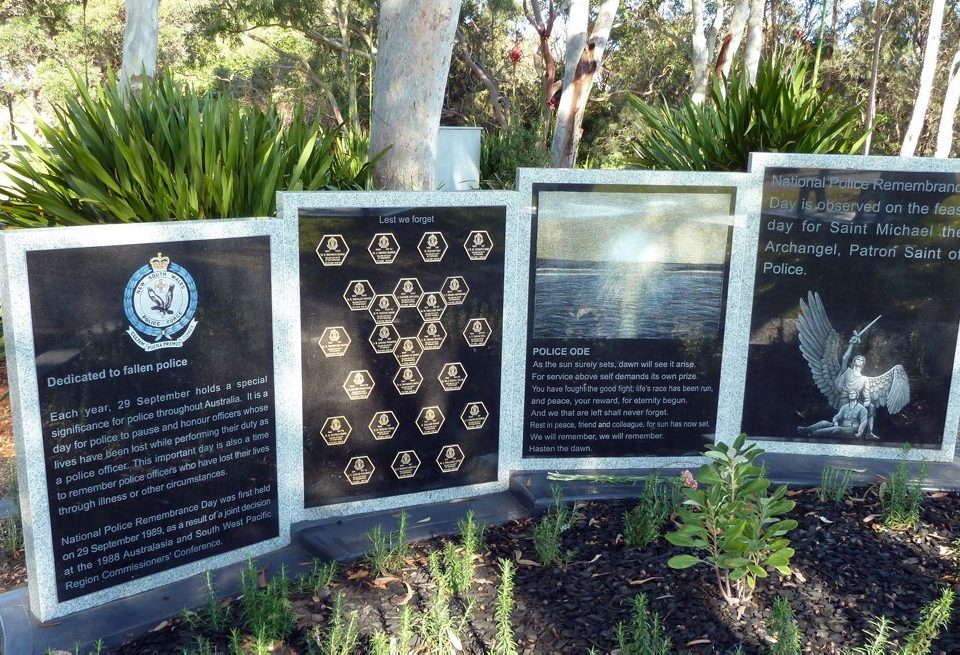
WILLIAM IS mentioned on the National Police Wall of Remembrance ( photo needed )
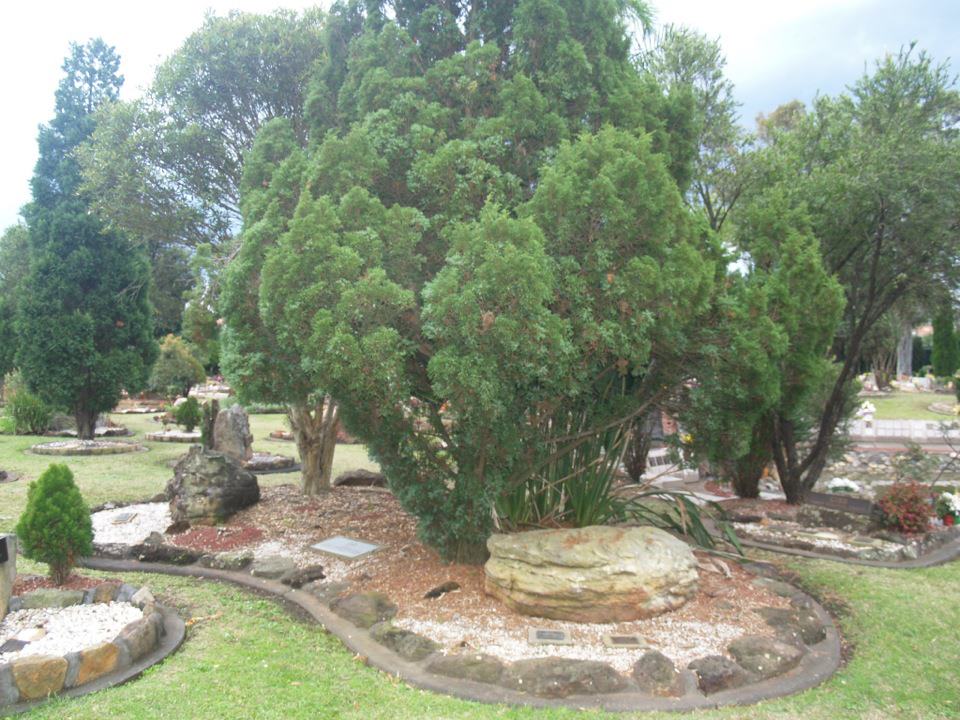
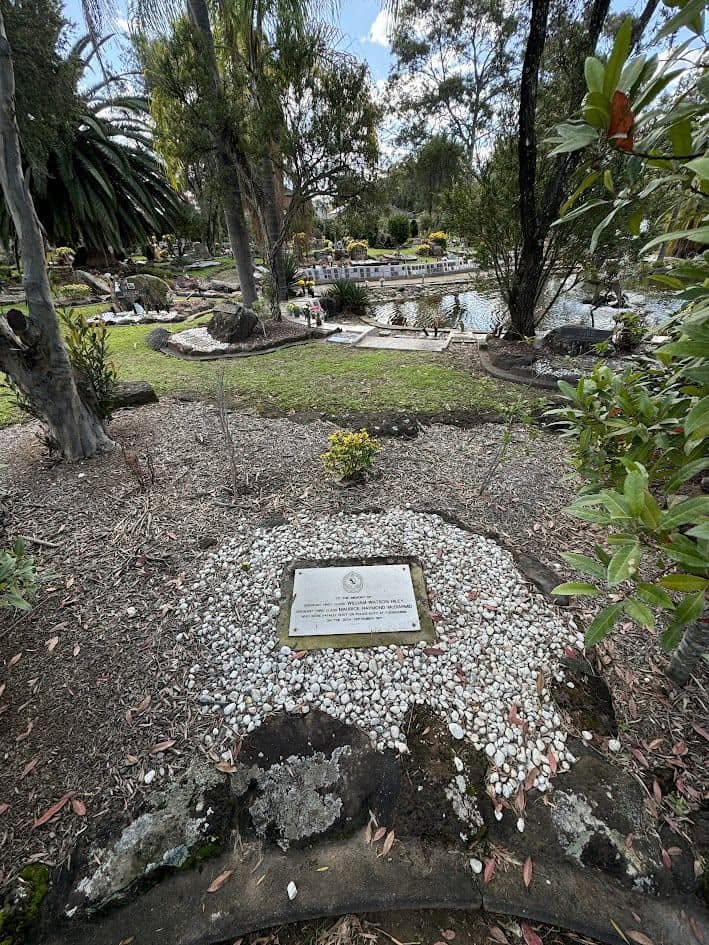
This whole garden is a memorial to both McDIARMID & RILEY. RILEY is in the foreground with McDIARMID being in front of the darker bolder to the left.


Sgt RILEY & Sgt McDIARMID Memorial outside Blacktown Police Stn, NSW.

Sgt RILEY & Sgt McDIARMID Memorial outside Blacktown Police Stn, NSW.
Sgt RILEY & Sgt McDIARMID Memorial


Sgt RILEY & Sgt McDIARMID Memorial outside Blacktown Police Stn, NSW.
Sgt RILEY & Sgt McDIARMID Memorial


Sgt William Watson RILEY Memorial


Sgt RILEY & Sgt McDIARMID Memorial

Sgt RILEY & Sgt McDIARMID Memorial outside Blacktown Police Stn, NSW.

Sgt RILEY & Sgt McDIARMID Memorial outside Blacktown Police Stn, NSW.
Sgt RILEY & Sgt McDIARMID Memorial


FURTHER INFORMATION IS NEEDED ABOUT THIS PERSON, THEIR LIFE, THEIR CAREER AND THEIR DEATH.

PLEASE SEND PHOTOS AND INFORMATION TO Cal


May they forever Rest In Peace


On 30 September, 1971, Sergeant 2nd Class Riley and Senior Constable McDiarmid attended a dwelling in Mimosa Avenue, Toongabbie to investigate a report that a man had shot and killed his brother at that address. On arrival the police saw the offender Ronald Clarke who quickly ran to the rear of the house. Senior Constable McDiarmid followed him while the sergeant entered through the front door. As the senior constable entered through the back door the offender opened fire with a shotgun, inflicting a fatal wound. It appears the offender then went back through the house where he also shot and killed Sergeant Riley. Although the senior constable was still alive when other police arrived he died a short time later in an ambulance on the way to hospital. The offender was shot and killed by police ( Cst 1/c Alf GREGORY ) the same day.


William Riley was born in 1921 and joined the New South Wales Police Force on 3 December, 1945. At the time of his death he was stationed at Blacktown. He was posthumously promoted to Sergeant 1st Class.


Maurice McDiarmid was born in 1932 and joined the New South Wales Police Force on 9 July, 1956. At the time of his death he was stationed at Blacktown. He was posthumously promoted to Sergeant 3rd Class.


Report of the Police Department for 1972.  Printed 28 August 1973

George Lewis Memorial Trophy
This trophy for the year 1971, which is for the most courageous act performed by a member of the New South Wales Police Force, was awarded posthumously to the late Sergeant 1st Class W. W. Riley and the late Sergeant 3rd Class M. R. McDiarmid who were stationed at 27 Division.
The trophies were presented to Mrs Riley and Mrs McDiarmid at the Police Academy during 1972.

PETER MITCHELL TRUST AWARDS
The ten awards under this Trust for the year 1971 were made to the following police, the trophies being presented at the Police Academy during 1972:
Most Courageous Act Posthumously awarded to the late Sergeant 1st Class W. W. Riley and the late Sergeant 3rd Class M. R. McDiarmid in conjunction with the George Lewis Memorial Trophy.


Blacktown_remembers_Sgt_1st_Class_Bill_Riley_and_Sgt_3rd_Class_Maurice_McDiarmid


Canberra Times (ACT : 1926 – 1995),

Tuesday 21 March 1972, page 3

Plaque

SYDNEY, Monday. — At the Pine Grove Memorial Park near Rooty Hill today, Bishop Hulme-Moir, chaplain of the NSW Police Force, dedicated a plaque in memory of Sergeant Maurice McDiarmid and Sergeant William Riley, who were shot when attempting to arrest an armed man at Toongabbie on September 30 last year.

http://trove.nla.gov.au/newspaper/article/102204297


Canberra Times (ACT : 1926 – 1995),

Thursday 13 January 1972, page 11

Payments to 3 police widows

SYDNEY, Wednesday. – The NSW Government agreed today to make, as “an act of grace”, lump-sum payments of $12,500 to each of three police officers’ widows.

“The Premier, Sir Robert Askin, said the payments would be in addition to the pensions and dependant’s allowances already paid out of the police superannuation and reward fund.

The three policemen involved in the payments are Senior Constable W. E. King, who was murdered at East Gresford police station on August 13 last year, and Sergeants W. Riley and M. McDiarmid, who were shot by a man at Toongabbie on September 30 last year.

Sir Robert said members of the police force had always been specifically excluded from the definition of “worker” under the Workers Compensation Act.

He said the Commissioner of Police, Mr Allan, had brought to the notice of the Government that, in certain matters of workers’ compensation, police were in an anomalous position in relation to other Crown employees.

Sir Robert said a full examination would be made of overall benefits of workers’ compensation available to police.

http://trove.nla.gov.au/newspaper/article/101752567


Canberra Times (ACT : 1926 – 1995),

Wednesday 6 October 1971, page 3

Funeral

SYDNEY, Tuesday. -More than 400 policemen attended the funeral this morning of the two policemen shot by a man in Toongabbie last Thursday. Both men, Sergeant William Watson Riley and Senior Constable Maurice Raymond McDiarmid, were given full police honours at their funeral.

http://trove.nla.gov.au/newspaper/article/110680624


William RILEY’s son, Ian, also joined the NSW Police Force as a NSW Police Cadet, # 1953, on 17 August 1964, and was Sworn In on 14 December 1966 by Assistant Commissioner Joe BUCK in his office in the old Police Headquarters in Hunter St, Sydney, alongside of NSW Police Cadet Kevin TANT, Cadet # 1838.

William RILEY’s daughter, Jeanie, also joined the NSW Police Force in 1978 but had resigned several years later.  Jeanie had Regd. # 18503.  Was a Probationary Constable on 2 April 1979 and a Senior Constable on 2 April 1988.


Canberra Times (ACT : 1926 – 1995),

Friday 1 October 1971, page 1


Shooting in Sydney Brothers, two police die
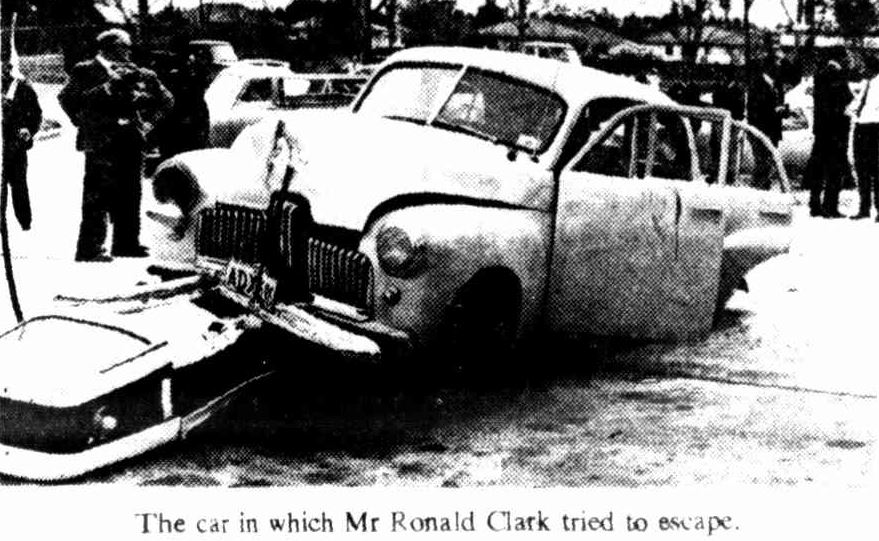
The car in which Mr Ronald Clark tried to escape. Rego ADX-6??

SYDNEY, Thursday. – Two policemen and two other men were shot dead in the outer western Sydney suburb of Toongabbie today.

The policemen were shot while investigating a report of rape and murder.

Earlier, Mr Warren Clark about 22, died in his bed. Police said his elder brother, Ronald. 23, had shot him through the head with a .22 calibre repeater rifle.

A young woman, living in the house in Mimosa Ave, Toongabbie, with Mr Warren Clark, told police that Mr Ronald Clark had awakened her and then shot his brother.

The woman alleged that Mr Ronald Clark then raped her and forced her to accompany him in his car.

After driving her around for several hours, he had released her at Blacktown.

The woman went to Blacktown police station.

She was in a hysterical condition.

Sergeant Second-Class William Riley, 50, and Senior-Constable Morrie McDiarmid, 39, left the station immediately to go to the house.

While they were on their way the police radio directed other police to the house.

The next-door neighbour, in Mimosa Ave, Toongabbie, Mrs Ethel Roberts, 54, said she first knew something was wrong when a police officer ran down a driveway at the side of her house.

He began kicking on the door of the house next door.

“He eventually forced the door and went inside”, she said.

“All was quiet for perhaps two minutes, then three shots rang out.

“I ran to the front porch as a young blond man ran from the house with a rifle in his hand, entered a car and screeched off down the road”‘. Mrs Roberts said.

“After he drove off, I saw a policeman’s blood stained hand grasping the back steps of the house”.

Stem flow of blood

“I ran to the road where a woman was delivering bread and told her to call an ambulance”.

Another neighbour, Mrs Dawn Harris, was called by Mrs Roberts, who was trying to stem the flow of blood from Constable McDiarmid.

“When I reached the house a policeman was propped against the back steps”, Mrs Harris said.

“His mouth and part of his face were torn and shredded from the shotgun blast.

“Another policeman was lying dead on the ground.

“In a bedroom in the house another man covered with a sheet was also dead and blood could be seen everywhere”.

Police said later they believe Sergeant Riley died immediately when he was shot at point-blank range with a shotgun.

Constable McDiarmid was taken by ambulance to Blacktown Hospital. He died shortly after arrival.

Meanwhile an all-points bulletin was broadcast over the VKG police network for all cars to be on the lookout for a bright blue 1950 sedan.

The broadcast warned, ‘This man is dangerous. He has a .22 rifle, a shotgun and two police pistols”.

“We have sighted him”, one car replied. “He is going toward Hillview”.

“We have stopped the car”, was the officer’s next report.

Constable Alfred Gregory and Constable Les Crawford said later they had rammed the suspect’s car with their police van.

The sedan got out of control and crashed into a bowser at a service station.

Constable Gregory jumped out of the van. As he approached the car he saw Mr Clark take one of the police pistols from the seat and transfer it to his right hand.

Three shots from pistol

Constable Gregory fired three shots from his pistol.

One of his shots struck Mr Clark in the side of the head, killing him.

In the car, police found several Commonwealth Bank cash bags, a blood stained nightgown and two suitcases containing mostly women’s clothing.

Two police revolvers, a .22 repeater rifle and a sawn-off shotgun were also recovered.

Tonight forensic and ballistic experts were still examining them.

The policemen killed are each survived by a widow and two children.

Sergeant Riley joined the force in 1945 and Constable McDiarmid in 1956.

A CIB spokesman said this afternoon the families were eligible for a special allowance paid to police killed while on duty.

He said that the lack of witnesses, particularly when the two policemen were shot, was hampering investigations.

http://trove.nla.gov.au/newspaper/article/110679922


Government Gazette of the State of New South Wales (Sydney, NSW : 1901 – 2001),

Friday 28 April 1972 (No.44), page 1544

RE the estate of WILLIAM WATSON RILEY, late of St Marys, in the state or New South Wales, police sergeant, deceased. —

Probate of the will dated 21st June, 1951, granted by the Supreme Court of New South Wales on the 7th day of April, 1972.—

Pursuant to the Wills, Probate and Administration Act, 1898 -1954, Testator’s Family Maintenance and Guardianship of Infants Act, 1916 -1954, and Trustee Act, 1925 -1942, the Public Trustee, the executor of the will of the said William Watson Riley, who died on the 30th day of September, 1971, hereby gives notice that creditors and others having any claim against or to the estate of the said deceased are required to send particulars of their claims to the said Public Trustee at his Branch Office hereunder mentioned, on or before the 28th day of June, 1972, at the expiration of which time the said Public Trustee will distribute the assets of the said deceased to the persons entitled, having regard only to the claims of which he then has notice.


W. J. STOKES,

Branch Manager,

Public Trust Office,

A.M.P. Building,

20 – 22 Macquarie Street,

Parramatta.        9161 $4

http://trove.nla.gov.au/newspaper/article/220140775/14441598#


Blacktown Police dedicate memorial to slain officers William Riley and Maurice McDiarmid
Harrison Vesey@harrisonvesey

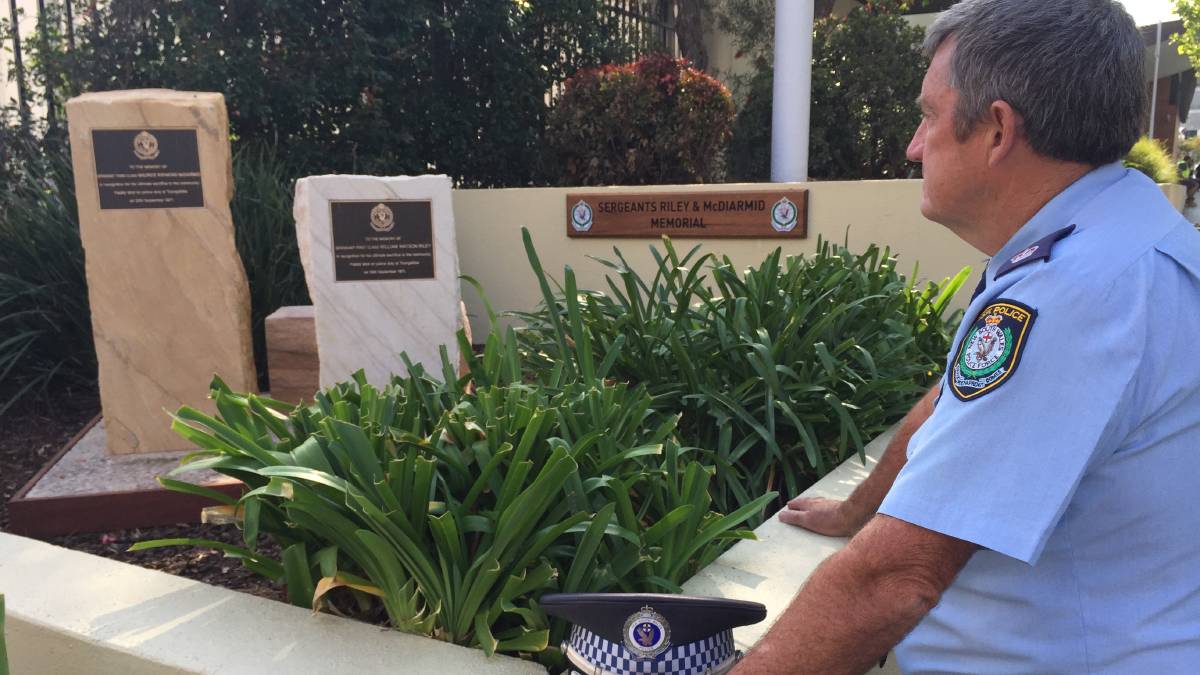
NOT FORGOTTEN: Blacktown Police Chief Inspector Bob Fitzgerald pays his respects at a memorial to slain officers Sergeant 1st Class William Riley and Sergeant 3rd Class Maurice McDiarmid. Picture: Harrison Vesey
NOT FORGOTTEN: Blacktown Police Chief Inspector Bob Fitzgerald pays his respects at a memorial to slain officers Sergeant 1st Class William Riley and Sergeant 3rd Class Maurice McDiarmid. Picture: Harrison Vessey

A solemn memorial stands to remind Blacktown police officers of the price paid by two of their colleagues.

William Riley and Maurice McDiarmid were both killed in the line of duty on September 30, 1971, while trying to apprehend a murder suspect in Toongabbie.

They are now remembered by commemorative plaques outside Blacktown Police Station, as well as a plinth at the entrance to the Memorial Rose garden at the NSW Police Academy.

The plinth features two police caps pictured the way they fell when the men were murdered, and bears the words: “For The People”.

Detective Senior Sergeant Adam Wilson, Probationary Constable Peta Kendall, Acting Inspector Lauren Martin and Chief Inspector Bob Fitzgerald.

Chief Inspector Bob Fitzgerald said the permanent memorials were important for police and the community.

I hope it’s a reminder when you come to work, you do the job to the best of your ability and go home to your family,” he said.

Acting Inspector Lauren Martin said Police Remembrance Day gave every officer a chance to think about those who didn’t make it home.

It’s good to have a visual reminder so you can reflect on what could happen when you come to work,” she said.

Sergeant 2nd class Riley and Senior Constable McDiarmid were attending a home in Mimosa Avenue, Toongabbie, following reports a man had raped a woman and shot her lover, who was also his brother.

The offender, Ronald Clarke, shot and killed both officers as they attempted to surround him. He was shot and killed by police in Hillview later that day.

It is a very sad day for all those who believe in upholding the law and order,” Police Commissioner Norman Allen said at the time.

Both officers were posthumously promoted for their outstanding courage and devotion to duty.

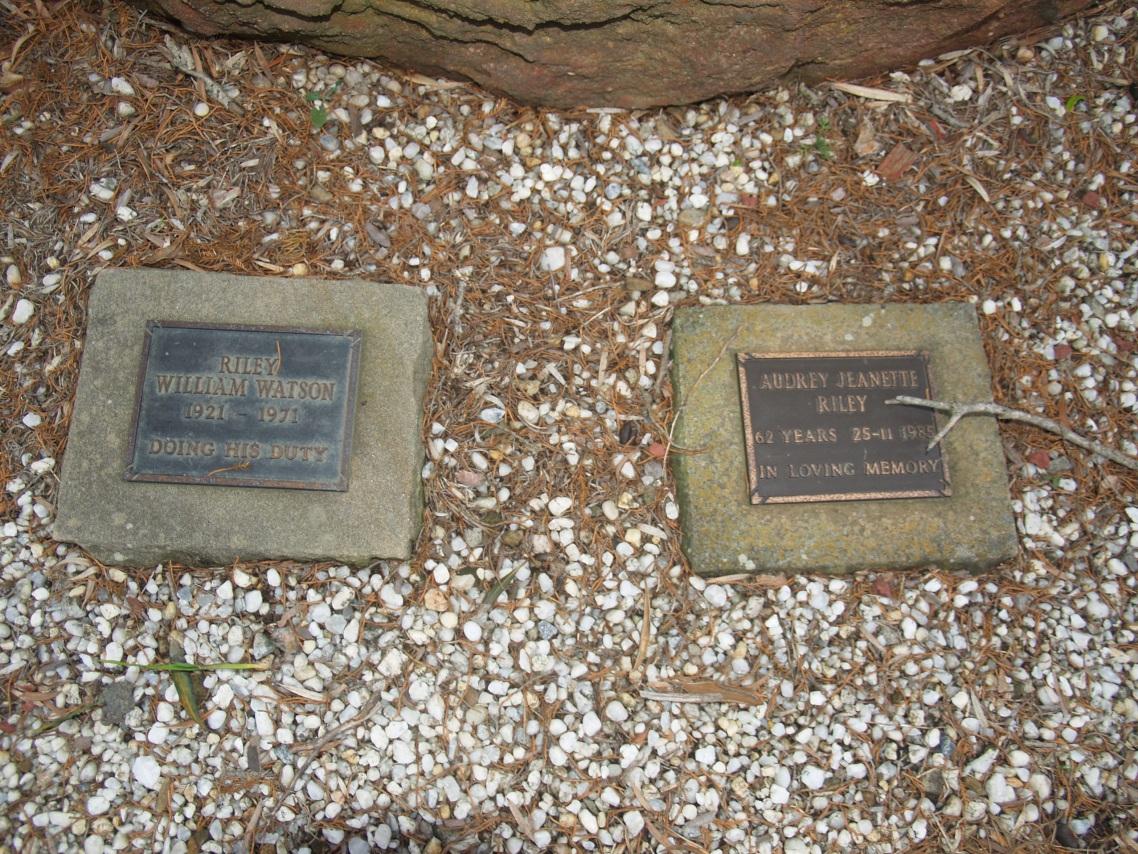
More than 400 officers attended their funeral in Blacktown. They were laid to rest at Pinegrove Cemetery with plaques bearing the inscription: “Doing His Duty”.

Outside Blacktown Police Station

The story Blacktown Police honour slain colleagues first appeared on Blacktown Sun.

http://www.queenslandcountrylife.com.au/story/4969361/blacktown-police-honour-slain-colleagues/?cs=1179#slide=1


Canberra Times (ACT : 1926 – 1995),

Saturday 27 November 1971, page 9


Two policemen commended by coroner

SYDNEY, Friday. — A Sydney coroner has commended two policemen who chased and stopped “an armed and desperate man“.

The man, Mr Ronald Desmond Clarke, had earlier shot and killed two other policemen after having killed his own brother in Toongabbie on September 30.

The coroner, Mr J. Parnell, SM, found on Wednesday that Mr Clarke in turn died in a car of cerebral lacerations and gun shot wounds to the brain inflicted by a person defending himself.

Constable A. C. Gregory, giving evidence at the inquest into the deaths of the four men, said that he and Constable L. ( Les ) A. Crawford in a police truck had rammed Mr Clarke‘s car, causing him to lose control.

Constable Gregory had seen Mr Clarke transfer a gun from his left hand to his right. The gun had been pointing at the policeman’s face and the constable had fired “one shot towards his shoulder“.

The impact of this bullet appeared to throw him towards the passenger side of his car, but he still had the revolver, which he now held in both hands, levelled at my face“, Constable Gregory said.

He appeared to be endeavouring to discharge the gun and it was then that I fired two quick shots at him“.

The four men who were killed were Sergeant First Class William Watson Riley, 50, and Sergeant Maurice Raymond McDiarmid, 39, of Blacktown, and Ronald Desmond Clarke, 20, and Warren John Clarke, 22, both of Toongabbie.

( Both policemen were promoted posthumously. Sergeant Riley was raised from second-class to first class, and Sergeant McDiarmid from senior constable to sergeant third class. )

Mr Parnell found that Mr Warren John Clarke died from gunshot wounds inflicted by his brother, Mr Ronald Desmond Clarke.

He found also that Sergeant Riley died from a fractured skull and lacerations to the brain, and Sergeant McDiarmid died in an ambulance between Toongabbie and Blacktown Hospital.

Both died as a result of bullet wounds inflicted by Clarke.

He said Mr Ronald Clarke, a professional criminal, had shot his brother, Warren Clarke, after having raped his brother’s de facto wife.

http://trove.nla.gov.au/newspaper/article/110690828


The Canberra Times of

1 October, 1971

reported the murders of the two police in graphic detail.

“SYDNEY, Thursday – Two policemen and two other men were shot dead in the outer western Sydney suburb of Toongabbie today. The policemen were shot while investigating a report of rape and murder. Earlier, Mr Warren Clark about 22, died in his bed. Police said his elder brother, Ronald. 23, had shot him through the head with a .22 calibre repeater rifle. A young woman, living in the house in Mimosa Ave, Toongabbie with Mr Warren Clark, told police that Mr Ronald Clark had awakened her and then shot his brother. The woman alleged that Mr Ronald Clark then raped her and forced her to accompany him in his car. After driving her around for several hours, he had released her at Blacktown. The woman went to Blacktown police station. She was in a hysterical condition. Sergeant Second-Class William Riley, 50, and Senior-Constable Morrie McDiarmid, 39, left the station immediately to go to the house. While they were on their way the police radio directed other police to the house.

“The next-door neighbour, in Mimosa Ave, Toongabbie. Mrs Ethel Roberts, 54, said she first knew something was wrong when a police officer ran down a driveway at the side of her house. He began kicking on the door of the house next door. “He eventually forced the door and went inside”, she said. “All was quiet for perhaps two minutes, then three shots rang out. I ran to the front porch as a young blond man ran from the house with a rifle in his hand, entered a car and screeched off down the road”, Mrs Roberts said. “After he drove off, I saw a policeman’s blood stained hand grasping the back steps of the house. I ran to the road where a woman was delivering bread and told her to call an ambulance”. Another neighbour, Mrs Dawn Harris, was called by Mrs Roberts, who was trying to stem the flow of blood from Constable McDiarmid. “When I reached the house a policeman was propped against the back steps”, Mrs Harris said. “His mouth and part of his face were torn and shredded from the shotgun blast. Another policeman was lying dead on the ground. In a bedroom in the house another man covered with a sheet was also dead and blood could be seen everywhere”.

“Police said later they believe Sergeant Riley died immediately when he was shot at point-blank range with a shotgun. Constable McDiarmid was taken by ambulance to Blacktown Hospital. He died shortly after arrival.

“Meanwhile an all-points bulletin was broadcast over the VKG police network for all cars to be on the lookout for a bright blue 1950 sedan. The broadcast warned, ‘This man is dangerous. He has a .22 rifle, a shot gun and two police pistols”. “We have sighted him”, one car replied. “He is going toward Hillview“. “We have stopped the car”, was the officer’s next report. Constable Alfred Gregory and Constable Les Crawford said later they had rammed the suspect’s car with their police van. The sedan got out of control and crashed into a bowser at a service station. Constable Gregory jumped out of the van. As he approached the car he saw Mr Clark take one of the police pistols from the seat and transfer it to his right hand. Constable Gregory fired three shots from his pistol. One of his shots struck Mr Clark in the side of the head, killing him.

“In the car, police found several Commonwealth Bank cash bags, a blood stained nightgown and two suitcases containing mostly women’s clothing. Two police revolvers, a .22 repeater rifle and a sawn-off shotgun were also recovered. Tonight forensic and ballistic experts were still examining them. The policemen killed are each survived by a widow and two children. Sergeant Riley joined the force in 1945 and Constable McDiarmid in 1956.”

The Canberra Times of the 25 May, 1972 briefly recorded the awarding of bravery medals to both men, reporting that “Sergeant William Riley, 50, and Sergeant Maurice McDiarmid, 39, who were shot dead while trying to arrest a man at Toongabbie last year, have been posthumously awarded the Queen’s Police Medal for gallantry”.

The sergeant was born in 1921 and joined the New South Wales Police Force on 3 December, 1945. At the time of his death he was stationed at Blacktown. He was posthumously promoted to Sergeant 1st Class. He is listed in the official New South Wales Police Honour Roll.

https://www.facebook.com/groups/514697128544865/permalink/1857154217632476/


POLICE KILLED OR WHO DIED FROM INJURIES RECEIVED IN THE EXECUTION OF THEIR DUTIES

On 13th August, 1971, Senior Constable William Edward King, who was then the officer-in-charge of police, East Gresford, was shot dead at East Gresford Police Station by a man who fired upon him with a rifle.

On 29th August, 1971, Constable 1st Class Patrick Mark Hackett died from injuries received in a motor accident at Polis, Cyprus, whilst performing duty with the New South Wales Police component of the Australian Police Contingent of the United Nations Peace Keeping Force.

On 30th September, 1971, Sergeant Second Class William Watson Riley and Senior Constable Maurice Raymond McDiarmid, both then attached to Blacktown Police Station, were shot dead in a house at Toongabbie which they had entered to arrest a man who a short time before had murdered his brother and raped a woman in the same house.

A police funeral with full ceremonial honours was accorded these deceased officers at which appropriate tributes were paid.

In recognition of their outstanding courage Sergeant Riley and Senior Constable McDiarmid were posthumously promoted by me to Sergeant 1st Class and Sergeant 3rd Class respectively. In addition, I submitted recommendations to the Premier for favour of consideration of Royal Awards being granted in both cases.

To assist the widows of the deceased police the Premier approved the payment to each of them of the sum of $12,500 as a gratuity. This payment did not in any way affect their entitlements to payments under the provisions of the Police Regulation (Superannuation) Act.

Report to the Police Department for 1971 – printed 7 September 1972
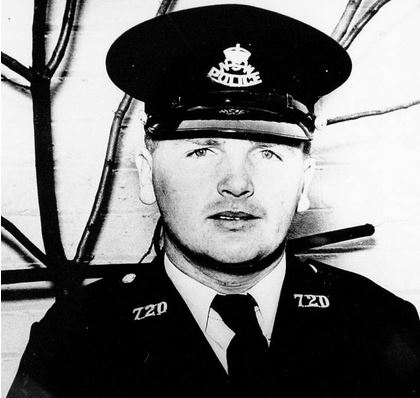


William Edward KING

William Edward KING

Late of East Gresford

New South Wales Police Force

[alert_yellow]Regd. # 8241[/alert_yellow]

Uniform # 720

Rank:  Probationary Constable – appointed 7 November 1955

Senior Constable – appointed 7 November 1966

Senior Constable – Death

Stations:  East Gresford Police Station

ServiceFrom pre 7 November 1955 to 13 August 1971 = 15+ years Service

Awards:  No find on It’s An Honour

Born:  31 January 1933

Died:  13 August 1971

Age: 38

Cause:  Shot – Murdered

Event location:  East Gresford Police residence

Funeral Date?

Funeral location?

Buried at?

[alert_green]William IS mentioned on the Police Wall of Remembrance[/alert_green]

William KING
William KING

About 6.45pm on 13 August, 1971 Senior Constable King went home to the East Gresford police residence for dinner. When he later answered a knock on the front door he was shot in the chest. He died a short time later. Enquiries later revealed that Senior Constable King had arrested the offender, a sixty-two year old labourer, the previous year for a drink driving offence (DUI). The offender was arrested two hours after the murder of Senior Constable King and later sentenced to life imprisonment.

The constable was born in 1933 and joined the New South Wales Police Force on 7 November, 1955. At the time of his death he was stationed at East Gresford.


William Edward KING
William Edward KING


 [codepeople-post-map]Location of Police residence

[divider]

The Canberra Times                  Tuesday  17 August 1971                     3 of 20

Murder of constable alleged

NEWCASTLE, Monday. — Mr Arthur Clement Warr, 63, timber worker, of Church Street, East Gresford, appeared in Maitland court today charged with the murder of Senior-constable William Edward King, of East Gresford, last Friday.

The police prosecutor, Sergeant B. Bourne, said it would be alleged that last Friday Mr Warr had drunk at a Gresford hotel then had driven to East Gresford police station and that when Constable King had come from the residence in uniform Mr Warr had shot and fatally wounded him with a .22 rifle.

http://trove.nla.gov.au/ndp/del/article/110674055


 The Canberra Times                  Friday  24 September 1971         page 6 of 18

Man for trial over death

NEWCASTLE, Thursday.

A 62-year-old labourer was committed in Maitland Court today for trial at the Newcastle Supreme Court on November 8 on a charge of murdering a policeman.

Mr Wilde, SM, refused bail for the man, Mr Arthur Clement Warr, of East Gresford, who is charged with having murdered Senior Constable William Edward King at East Gresford on August 13.

A Gresford station hand, Mr Howard Huckstadt, told the court that Mr Warr had sung out to him, “I shot King Billy”.

He said he had heard Mr Warr refer to Constable King, of Gresford police station, as “King Billy” before.

Mr Warr had asked him if he had any bullets, but he had replied, “no”. He had then said that he had wanted the bullets “to shoot the cop that would come after him”.

Mr Huckstadt said he had asked Mr Warr why he shot Constable King and Mr Warr had replied, “He was all the time picking on me”.

http://trove.nla.gov.au/ndp/del/article/110678944


The Canberra Times          Saturday  20 November 1971         page 12 of 42

‘Life’ for murder

NEWCASTLE, Friday. — Mr Arthur Clement Warr, 63, fencing contractor, of Gresford, was jailed for life at Newcastle Supreme Court today for the murder of a police constable.

He had pleaded not guilty to a charge of having murdered Constable William Edward King, 38, at Gresford on August 13. Mr Warr did not give evidence or make a statement during his trial.

http://trove.nla.gov.au/ndp/del/article/110689180

[divider]

*** Although NOT confirmed, another article was found with this offenders name and the age between 1943 – 1971 is correct.  ***

The Sydney Morning Herald            Tuesday  31 August 1943         page 3 of 9

MILITIAMEN ON THEFT CHARGE

U.S. Army Clothing

Charges of having stolen United States Army clothing at Alexandria railway goods yard on August 17 were made against three australian militiamen, at a court-martial yesterday.

They were Privates Roy Westland Smith, 20; Arthur Edward Roberts, 47: and Arthur Clement Warr, 34.,

Alternative charges of having been unlawfully in possession of the goods were dismissed. On the charges of stealing the Court did not announce its decision.

Evidence was that the three men, members of an employment unit, were on duty at the goods yard unloading trucks. A warrant officer said that he saw the accused moving between two lines of trucks in a shed, and on being challenged they dropped several pairs of United States Army trousers.

Each of the accused said he had seen the articles lying on the ground and had picked them up, intending to examine the article in a better light. It was unusual, they said, to see anything lying about in the yards.

At a previous trial, Private John Henry Hanson, 27 was charged with having unlawfully removed a case containing 24 pairs of United States Army trousers from a railway truck at Alexandria on August 17.

Hanson, who pleaded not guilty, said he had not touched any of the clothing.

The Court did not announce its decision.

http://trove.nla.gov.au/ndp/del/article/17862462


POLICE KILLED OR WHO DIED FROM INJURIES RECEIVED IN THE EXECUTION OF THEIR DUTIES

On 13th August, 1971, Senior Constable William Edward King, who was then the officer-in-charge of police, East Gresford, was shot dead at East Gresford Police Station by a man who fired upon him with a rifle.

On 29th August, 1971, Constable 1st Class Patrick Mark Hackett died from injuries received in a motor accident at Polis, Cyprus, whilst performing duty with the New South Wales Police component of the Australian Police Contingent of the United Nations Peace Keeping Force.

On 30th September, 1971, Sergeant Second Class William Watson Riley and Senior Constable Maurice Raymond McDiarmid, both then attached to Blacktown Police Station, were shot dead in a house at Toongabbie which they had entered to arrest a man who a short time before had murdered his brother and raped a woman in the same house.

A police funeral with full ceremonial honours was accorded these deceased officers at which appropriate tributes were paid.

In recognition of their outstanding courage Sergeant Riley and Senior Constable McDiarmid were posthumously promoted by me to Sergeant 1st Class and Sergeant 3rd Class respectively. In addition, I submitted recommendations to the Premier for favour of consideration of Royal Awards being granted in both cases.

To assist the widows of the deceased police the Premier approved the payment to each of them of the sum of $12,500 as a gratuity. This payment did not in any way affect their entitlements to payments under the provisions of the Police Regulation (Superannuation) Act.

Report to the Police Department for 1971 – printed 7 September 1972


Adam Boland SCHELL

Sergeant 2nd Class Adam Boland SCHELL

Father to John SCHELL & Roy SHELL – NSWPF members

Regd. # 4367

Aged:  52

Shot

Bobbin Head

8 October, 1968

Sergeant Adam Schell ( 1968 )


In the early hours of 8 October, 1968 Sergeant Schell and Probationary Constable Dick Letchford attended Halvorsens Boats, Bobbin Head following a report of a break and enter in progress. On their arrival the police were met by the caretaker Mr Frederick Marshall and the sergeant accompanied him to check inside the premises, leaving the probationer outside. A short time later Constable Letchford apprehended two offenders whom he had seen running from the direction Sergeant Schell and Mr Marshall had taken. When police reinforcements arrived a few minutes later they were informed that Sergeant Schell and Mr Marshall had been found critically wounded in a storeroom. Mr Marshall had been shot in the head and Sergeant Schell had been shot five times in the head and body. Despite being rushed to Hornsby Hospital Sergeant Schell died a short time later. The offenders were later sentenced to life imprisonment.


Sergeant Schell was born in 1916 and joined the New South Wales Police Force on 3 July, 1939.


Cyril Elgar HOWE

Cyril Elgar HOWE   QPM

Late of ?


This Murder led to NSW Police later being issued with Smith & Wesson .38 revolvers

New South Wales Police Force

Regd. #   8663

Redfern Police Academy Class # 068


Rank:  Commenced Training at Redfern Police Academy on Monday 4 February 1957

Probationary Constable – appointed  1 April 1957

Constable 1st Class – appointed ? ? ?

Posthumously promoted from Cst 1/c to Sergeant 3rd Class


Stations: ?, Oaklands – Death


Service: From ? ? pre April 1957  to 20 December 1963 = 6+ years Service 


AwardsQueen’s Police Medal ( QPM ) for Gallantry ( Imperial ) – granted 24 March 1964

the Peter Mitchell Award.


Born: ? ? 1932

Died on:  Friday  20 December 1963 @ 10.45pm at Wagga Base Hospital, NSW

Age: 31

Cause:  Shot – Murdered – Shotgun

Event location:  Oaklands – Jerilderie road, Urana, NSW

Event date:  Thursday  19 December 1963

1963 Cyril Elgard HOWE, Cyril HOWE, Sgt HOWE, Constable 1/c HOWE
1963

Funeral date: ? ? ?

Funeral location: ?

Funeral Parlour: ?


Buried at: Woronora Cemetery, 121 Linden St, Sutherland, NSW

Grave location:  Anglican Monumental. Sect Aj – 0126


Memorial located at:

1/  Sgt. Howe’s name is mounted on the Memorial Wall at the NSW Police Memorial situated in the Tranquil Gardens, Woronora Memorial Park Cemetery, 121 Linden St, Sutherland.
It is important to know that in mid September each year, since 2015, 11 other NSW Police Officers killed on duty in the Sutherland / St. George PAC and 13 Police Officers killed in other PAC’s (Sgt 3/c Howe – Oaklands) and laid to rest within the WMP Cemetery are remembered.
Ron Alexander – Chairman NSW Police Memorial Service Committee – WMP.

2/ Memorial located at Oaklands Police Station, NSW – Dedicated on 19 December 2014


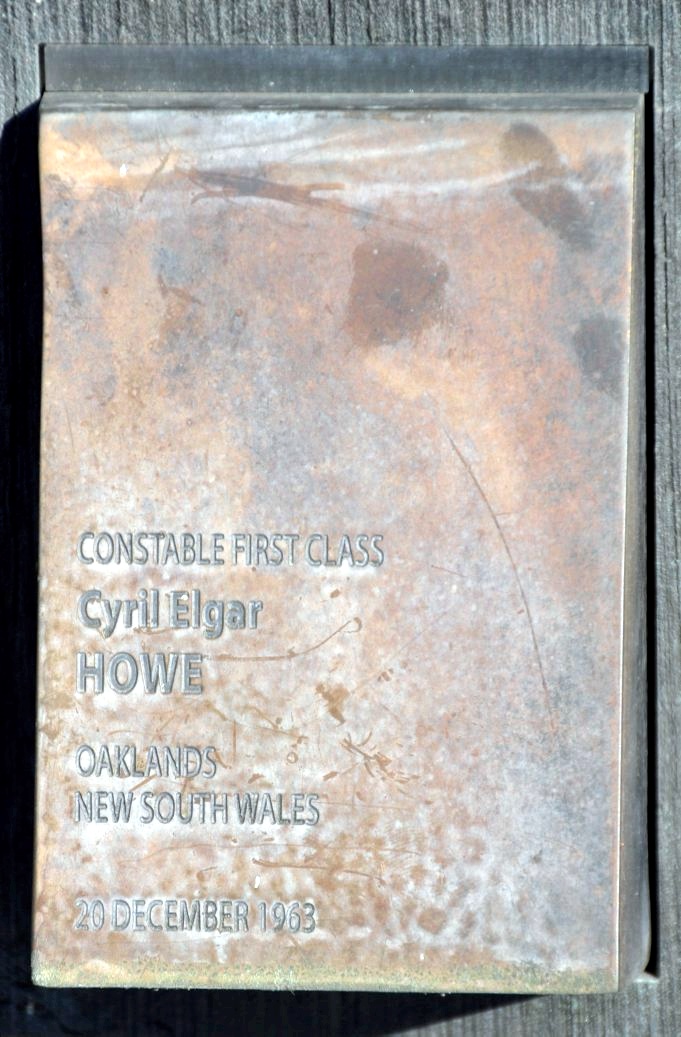
Touch plate at the National Police Wall of Remembrance, Canberra, for Cyril Elgar HOWE
Touch plate at the National Police Wall of Remembrance, Canberra


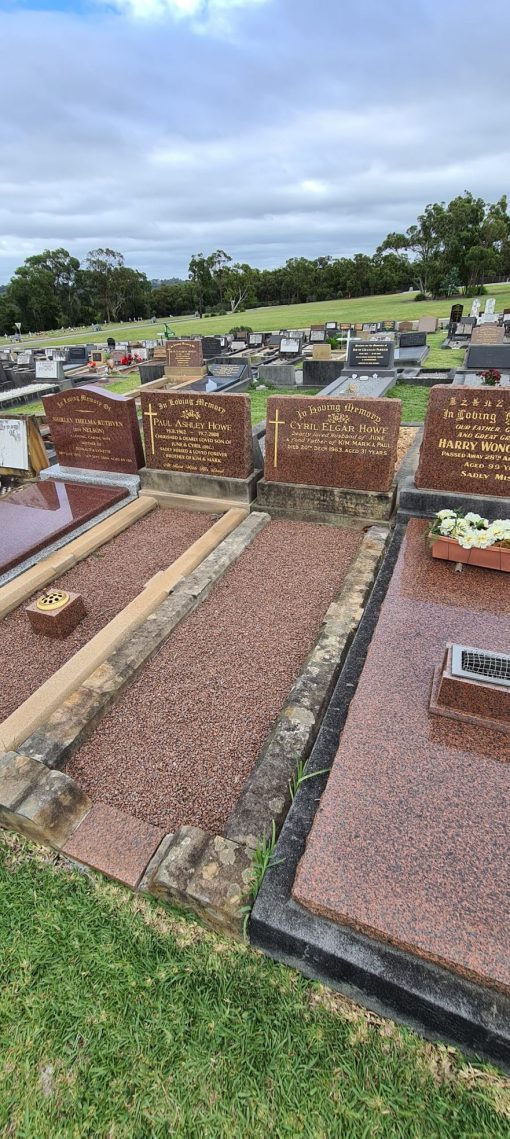
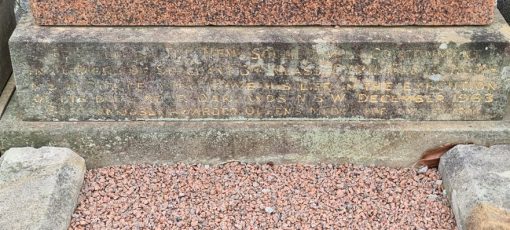
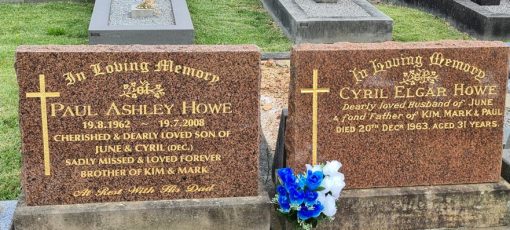
Cyril Elgar HOWE grave

Cyril Elgar HOWE QPM, Cyril HOWE, Sgt HOWE, Constable 1/c HOWE:

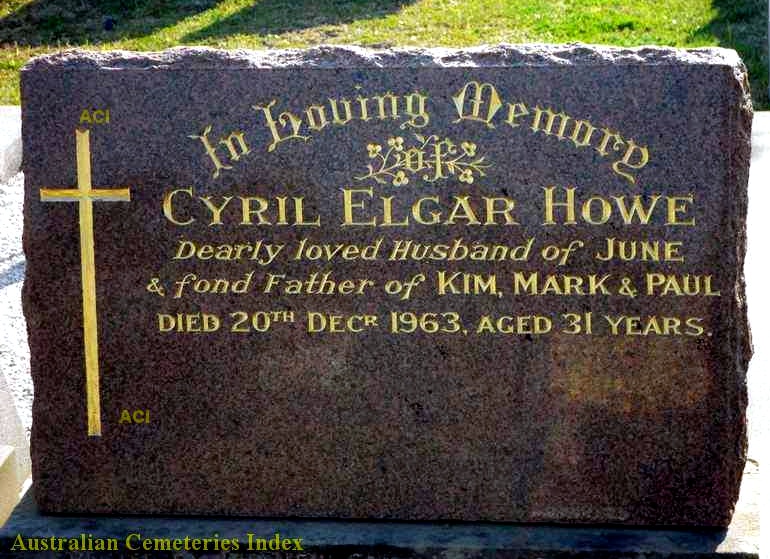
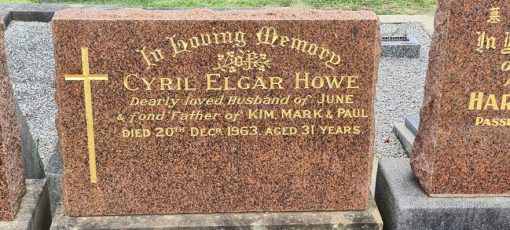
Cyril Elgar HOWE QPM, Cyril HOWE, Sgt HOWE, Constable 1/c HOWE: Inscription:<br /> In Loving Memory of Cyril Elgar HOWE<br /> Dearly loved Husband of June<br /> &amp; fond Father of Kim, Mark &amp; Paul<br /> Died 20th December 1963, aged 31 years.

Cyril Elgar HOWE QPM, Cyril HOWE, Sgt HOWE, Constable 1/c HOWE:

Cyril Elgar HOWE QPM, Cyril HOWE, Sgt HOWE, Constable 1/c HOWE: Paul HOWE, one of Cyrils' sons, is buried alongside of his father. Cyrils' wife, June HOWE, having died in September 2020, is buried with Cyril. " Together forever "
Paul, one of Cyrils’ sons, is buried alongside of his father. Cyrils’ wife, June, having died in September 2020, is buried with Cyril. ” Together forever “

CYRIL IS mentioned on the Police Wall of Remembrance


Funeral location: TBA


FURTHER INFORMATION IS NEEDED ABOUT THIS PERSON, THEIR LIFE, THEIR CAREER AND THEIR DEATH.

PLEASE SEND PHOTOS AND INFORMATION TO Cal


May they forever Rest In Peace


On the evening of 19 December, 1963 Constable Howe detained an offender named Little near Oaklands and spoke to him regarding a stolen cheque book. He then directed the offender to drive his vehicle to the local police station while he followed in the police vehicle.

En route the offender sped away, and was pursued by Constable Howe for several kilometres. When the offender eventually stopped, the constable approached his vehicle. The offender, who had taken cover behind his vehicle door (the doors opened backwards from hinged centre pillars), then produced a shotgun and shot Constable Howe.

The constable crawled back to the police vehicle where he took cover, and although seriously wounded, returned fire until his automatic pistol jammed. He then sought further cover by crawling underneath the police vehicle, where he cleared his pistol and fired another shot before it again jammed. The offender then fired at the police vehicle, shooting out the headlights, steering, and the police sign from the top, before escaping.


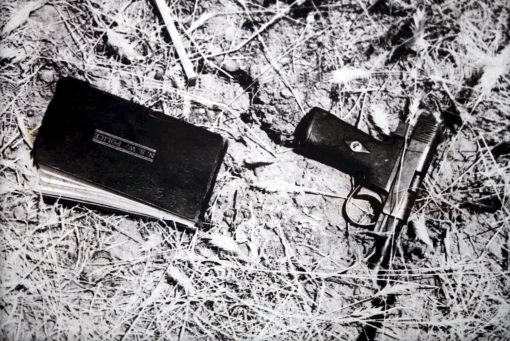
Constable Howe then wrote “LITTLE SHOT ME” in the back of his police notebook ( in ink, and not blood, as sometimes stated ) before dragging himself into the police vehicle.

Constable Howe then wrote the offender’s name several times in his police notebook before dragging himself into the police vehicle.

He was only able to drive it a few metres before it ran into a roadside ditch.


After being found, the constable was able to detail the events leading to the shooting.

He was taken to the Wagga Base Hospital, however despite a five-hour operation he died at 10.45pm on 20 December, 1963.


Constable 1st Class Howe was posthumously promoted to Sergeant 3rd Class and awarded the Queen’s Police Medal for Gallantry ( QPM ), and the Peter Mitchell Award.

The offender later committed suicide.


The circumstances surrounding Sergeant Howe’s death ( pistol repeatedly jamming ) led to the introduction of Smith & Wesson .38 calibre 6 shot revolvers as general service issue to New South Wales Police. These, in turn were replaced by Glock semi-automatic pistols in the late 1990s.


The sergeant was born in 1932 in Arncliffe, NSW, and joined the New South Wales Police Force on 1 April, 1957. At the time of his death he was stationed at Oaklands.

Notebook & Pistol of Cst HOWE


20 December 2023

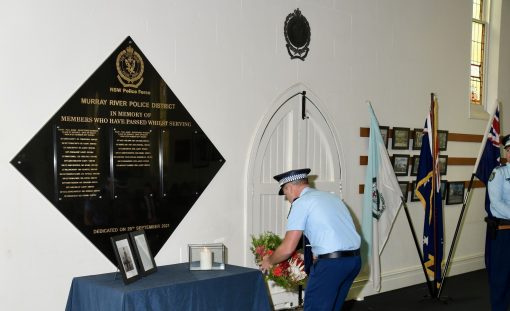
Today (Wednesday 20 December 2023) marks the 60th anniversary of the tragic loss of Constable 1st Class Cyril Howe of Oaklands Police Station – now part of the Murray River Police District – in the state’s south.
On Thursday 19 December 1963, Constable Howe was assisting neighbouring police in relation to the theft of a cheque book by a 47-year-old man.
Constable Howe located the man travelling along a local road – in what was later established to be a stolen car with five young children.
After a pursuit of the vehicle, the man shot and seriously injured Constable Howe whilst using the children as a human shield which prevented the officer from effectively returning fire.
Despite being critically wounded Constable Howe wrote the assailants name in his notebook.
Constable Howe died the following day at Wagga Wagga Base Hospital.
An inquest into the incident commended Constable Howe’s actions where the coroner noted, “Howe displayed tremendous strength, courage and presence of mind. Considering the shocking wounds he received, and the terrible agony he was in, his actions after being shot leave no doubt in my mind that he was one of the bravest Policemen ever to wear the Queen’s uniform.”
Constable Howe was posthumously promoted to Sergeant 3rd Class and awarded the Police Medal for Gallantry.
To commemorate this event, a service was held at the Albury Police Station Conference Room.
The Commander of Murray River Police District, Superintendent Paul Smith APM, said that despite the passage of time, the events of that day serve as a reminder to a current generation of officers as to the dangers police face.
“Sergeant 3rd Class Cyril Howe displayed extraordinary bravery and fortitude when confronted with an armed and dangerous offender,” said Superintendent Smith APM.
“He refused to shoot at the offender for fear of striking one of the children, and then wrote the offenders name in his notebook.”
“Along with being an exceptional police officer he was also a father to three young children. It’s terribly sad what happened.”

https://www.facebook.com/photo?fbid=763621499143605&set=pcb.763621672476921


Police and the community will come together on December 19 to mark the 50th anniversary of the murder of Oaklands police officer Sgt Cyril Howe.

Sgt Howe was stationed at Oaklands when he was gunned down in December, 1963.

His murder resulted in one of the biggest man hunts in the local area with many people from Yarrawonga and Mulwala involved in the search for his killer.

Since plans began for a commemorative march to honour the 50 year anniversary of Sgt Howe’s untimely death, local police have collected a variety of newspaper articles, telling the story of that fateful day in 1963.

On December 20, 1963 Sgt Howe was patrolling in Oaklands when he stopped a car driven by William Little who was a suspect for a stealing matter.

Sgt Howe requested Little to drive back to the Oaklands Police Station where he intended to question him further.

Little drove his car towards the police station with Sgt Howe following.

Upon getting close to the police station Little attempted to drive away and was pursued by Sgt Howe.

Little crashed his car into a ditch while attempting to escape.

Sgt Howe got out of his police car and approached Little’s car.

At this time Little produced a shotgun shooting Sgt Howe at close range in the stomach.

Sgt Howe returned to his car and fired a number of shots from his pistol.

Sgt Howe whilst dying on the side of the road was able to write Little’s name in his notebook indicating Little was responsible for the shooting.

Sgt Howe later died at Wagga Hospital from his wounds.

Little then went to a nearby property where he shot and killed Reginald Hunter a 57 year old bridge builder. Little then stole Hunter’s car.

The next six days saw a massive man hunt for Little with many local people assisting in the search along with offering accommodation for police who had been brought into the area to look for Little.


Cyril Elgard HOWE, Cyril HOWE, Sgt HOWE, Cst 1/c HOWE, Oakley Police Station, Dedication, Memorial
Ron Bloxham
20 December 2015
re the death of Sergeant Cyril Edgar HOWE. This was a matter I was involved in then when I was stationed at Finley.The offender Little’s car was located at Finley. On the 19th December 2013 I attended the Ceremony and the dedication of the impressive plaque that is now located in the front area of the Oaklands Police Station. I played golf with Cyril a few times and his wife was a brilliant golfer if I remember right she was the only female golfer then playing off scratch. She now lives at Kooralbyn near Beaudesert Qld. Here are a couple of photos from that day. Great effort by the troops after so long a time
R.I.P. Cyril.

Cyril Elgard HOWE, Cyril HOWE, Sgt HOWE, Cst 1/c HOWE, Oakley Police Station, Dedication, Memorial

Cyril Elgard HOWE, Cyril HOWE, Sgt HOWE, Cst 1/c HOWE, Oakley Police Station, Dedication, Memorial

Cyril Elgard HOWE, Cyril HOWE, Sgt HOWE, Cst 1/c HOWE, Oakley Police Station, Dedication, Memorial

Cyril Elgard HOWE, Cyril HOWE, Sgt HOWE, Cst 1/c HOWE, Oakley Police Station, Dedication, Memorial

Cyril Elgard HOWE, Cyril HOWE, Sgt HOWE, Cst 1/c HOWE, Oakley Police Station, Dedication, Memorial

Cyril Elgard HOWE, Cyril HOWE, Sgt HOWE, Cst 1/c HOWE, Oakley Police Station, Dedication, Memorial

Cyril Elgard HOWE, Cyril HOWE, Sgt HOWE, Cst 1/c HOWE, Oakley Police Station, Dedication, Memorial

Cyril Elgard HOWE, Cyril HOWE, Sgt HOWE, Cst 1/c HOWE, Oakley Police Station, Dedication, Memorial

Cyril Elgard HOWE, Cyril HOWE, Sgt HOWE, Cst 1/c HOWE, Oakley Police Station, Dedication, Memorial

Cyril Elgard HOWE, Cyril HOWE, Sgt HOWE, Cst 1/c HOWE, Oakley Police Station, Dedication, Memorial

Cyril Elgard HOWE, Cyril HOWE, Sgt HOWE, Cst 1/c HOWE, Oakley Police Station, Dedication, Memorial


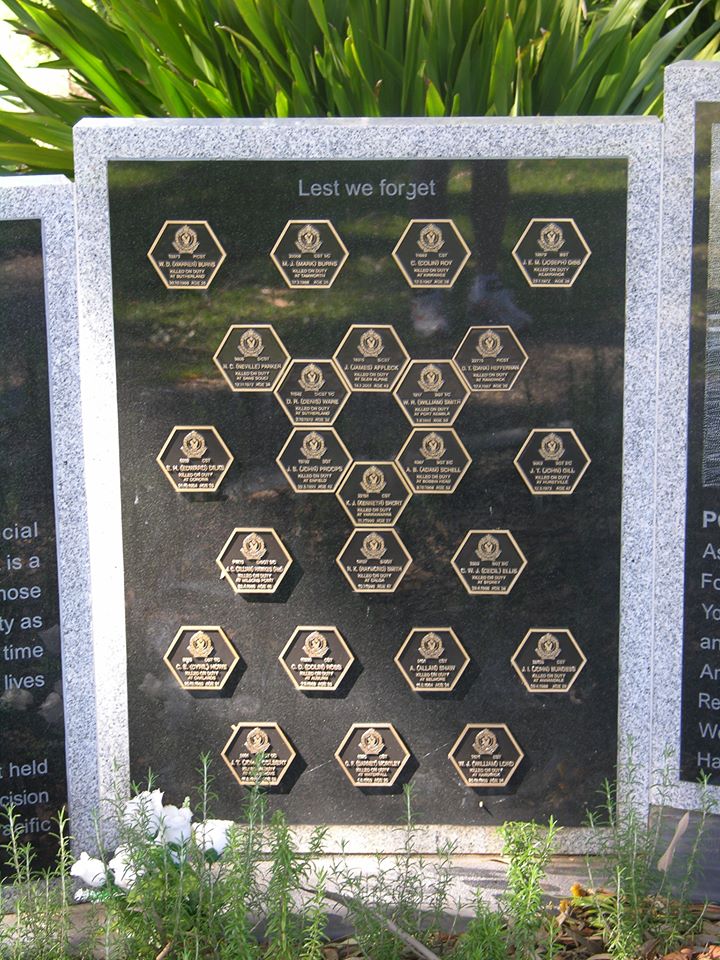
NSW Police Force 9 April 2015 NSW Police Commissioner Andrew Scipione has officially dedicated a new memorial honouring fallen officers in the St George and Sutherland Shire. The Commissioner was joined by local police, families, friends, and colleagues, for the dedication of the NSW Police Memorial, led by Police Chaplain, Reverend David Warner, at Woronora Cemetery today (Thursday 9 April 2015). The memorial honours 24 NSW Police officers who have died on duty while serving in the St George, Sutherland and Miranda Local Area Commands or who were cremated or laid to rest at Woronora Cemetery. Commissioner Scipione said the plaques and memorial wall is a perfect way to honour local officers who have made the ultimate sacrifice. “The NSW Police Memorial at Woronora Cemetery is our first collective police tribute in a private cemetery,” Commissioner Scipione said. “As we unveil the plaques today, we reflect on the lives and achievements of the officers who died while serving this community. “One of the toughest challenges for police is starting work each day not knowing what will happen yet understanding they may have to risk their own life to save another. “It is with great pride I dedicate this memorial and honour the officers, whose names are inscribed, remembering their selfless sacrifice and courage. They will not be forgotten,” Commissioner Scipione said. The names of the 24 local fallen officers, who died on duty since 1862, are inscribed on the wall of the memorial. An additional two colonial police killed in 1845, prior to the inception of the NSW Police Force, will also be remembered in the form of separate plaques. The NSW Police Memorial is a joint project of Woronora General Cemetery and Crematorium, Southern Metropolitan Associates Branch of the Police Association of NSW and the NSW Police Force. Officers honoured on NSW Police Memorial at Woronora Cemetery: Sergeant 1st Class William Smith, killed on duty at Port Kembla on 1 September 1951, age 53 Constable Garnet Mortley, killed on duty at Waterfall 1 June 1953, age 25 Constable Edward Dilks, killed on duty at Corowa on 21 October 1954, age 28 Sergeant 2nd Class Cecil Ellis, killed on duty at Sydney on 29 April 1956, age 58 Constable William Lord, killed on duty at Randwick on 23 December 1958, age 24 Constable Colin Robb, killed on duty at Auburn on 7 September 1963, age 28 Constable 1st Class Cyril Howe, killed on duty at Oaklands on 20 December 1963, age 31 Constable Allan Shaw, killed on duty at Belmore on 11 May 1964, age 24 Constable Colin Roy, killed on duty at Kirrawee on 12 May 1967, age 28 Sergeant 2nd Class Adam Schell, killed on duty at Bobbin Head on 8 October 1968, age 52 Probationary Constable Warren Burns, killed on duty at Sutherland on 30 October 1968, age 25 Detective Senior Constable Denis Ware, killed on duty at Sutherland on 2 October 1970, age 32 Constable Joseph Gibb, killed on duty at Miranda on 23 January 1972, age 28 Senior Constable Neville Parker, killed on duty at Sans Souci on12 November 1972, age 34 Sergeant 2ns Class John Gill, killed on duty at Hurstville on 12 May 1973, age 47 Sergeant 1st Class John Colbert, killed on duty at Kingsgrove on 11 March 1979, age 58 Detective Sergeant Jillian Hawkes, killed on duty at Milsons Point on 22 April 1986, age 46 Probationary Constable Dana Heffernan, killed on duty at Randwick on 17 April 1987, age 20 Constable 1st Class Mark Burns, killed on duty at Tamworth on 17 March 1988, age 25 Constable John Burgess, killed on duty at Annandale on 27 April 1989, age 29 Constable Kenneth Short, killed on duty at Yarrawarra on 11 July 1990, age 27 Sergeant John Proops, killed on duty at Enfield on 22 May 1993, age 42 Senior Sergeant Raymond Smith, killed on duty at Calga on 13 July 1998, age 47 Senior Constable James (Jim) Affleck, killed on duty at Glen Alpine on 14 January 2001, age 43 Colonial police honoured: Corporal Stephen Kirk, killed on duty at Heathcote on 12 November 1845, age 32 Trooper Luke Dunn, killed on duty at Heathcote on 21 November 1845, age 33
NSW Police Force 9 April 2015 NSW Police Commissioner Andrew Scipione has officially dedicated a new memorial honouring fallen officers in the St George and Sutherland Shire. The Commissioner was joined by local police, families, friends, and colleagues, for the dedication of the NSW Police Memorial, led by Police Chaplain, Reverend David Warner, at Woronora Cemetery today (Thursday 9 April 2015). The memorial honours 24 NSW Police officers who have died on duty while serving in the St George, Sutherland and Miranda Local Area Commands or who were cremated or laid to rest at Woronora Cemetery. Commissioner Scipione said the plaques and memorial wall is a perfect way to honour local officers who have made the ultimate sacrifice. “The NSW Police Memorial at Woronora Cemetery is our first collective police tribute in a private cemetery,” Commissioner Scipione said. “As we unveil the plaques today, we reflect on the lives and achievements of the officers who died while serving this community. “One of the toughest challenges for police is starting work each day not knowing what will happen yet understanding they may have to risk their own life to save another. “It is with great pride I dedicate this memorial and honour the officers, whose names are inscribed, remembering their selfless sacrifice and courage. They will not be forgotten,” Commissioner Scipione said. The names of the 24 local fallen officers, who died on duty since 1862, are inscribed on the wall of the memorial. An additional two colonial police killed in 1845, prior to the inception of the NSW Police Force, will also be remembered in the form of separate plaques. The NSW Police Memorial is a joint project of Woronora General Cemetery and Crematorium, Southern Metropolitan Associates Branch of the Police Association of NSW and the NSW Police Force. Officers honoured on NSW Police Memorial at Woronora Cemetery: Sergeant 1st Class William Smith, killed on duty at Port Kembla on 1 September 1951, age 53 Constable Garnet Mortley, killed on duty at Waterfall 1 June 1953, age 25 Constable Edward Dilks, killed on duty at Corowa on 21 October 1954, age 28 Sergeant 2nd Class Cecil Ellis, killed on duty at Sydney on 29 April 1956, age 58 Constable William Lord, killed on duty at Randwick on 23 December 1958, age 24 Constable Colin Robb, killed on duty at Auburn on 7 September 1963, age 28 Constable 1st Class Cyril Howe, killed on duty at Oaklands on 20 December 1963, age 31 Constable Allan Shaw, killed on duty at Belmore on 11 May 1964, age 24 Constable Colin Roy, killed on duty at Kirrawee on 12 May 1967, age 28 Sergeant 2nd Class Adam Schell, killed on duty at Bobbin Head on 8 October 1968, age 52 Probationary Constable Warren Burns, killed on duty at Sutherland on 30 October 1968, age 25 Detective Senior Constable Denis Ware, killed on duty at Sutherland on 2 October 1970, age 32 Constable Joseph Gibb, killed on duty at Miranda on 23 January 1972, age 28 Senior Constable Neville Parker, killed on duty at Sans Souci on12 November 1972, age 34 Sergeant 2nd Class John Gill, killed on duty at Hurstville on 12 May 1973, age 47 Sergeant 1st Class John Colbert, killed on duty at Kingsgrove on 11 March 1979, age 58 Detective Sergeant Jillian Hawkes, killed on duty at Milsons Point on 22 April 1986, age 46 Probationary Constable Dana Heffernan, killed on duty at Randwick on 17 April 1987, age 20 Constable 1st Class Mark Burns, killed on duty at Tamworth on 17 March 1988, age 25 Constable John Burgess, killed on duty at Annandale on 27 April 1989, age 29 Constable Kenneth Short, killed on duty at Yarrawarra on 11 July 1990, age 27 Sergeant John Proops, killed on duty at Enfield on 22 May 1993, age 42 Senior Sergeant Raymond Smith, killed on duty at Calga on 13 July 1998, age 47 Senior Constable James (Jim) Affleck, killed on duty at Glen Alpine on 14 January 2001, age 43 Colonial police honoured: Corporal Stephen Kirk, killed on duty at Heathcote on 12 November 1845, age 32 Trooper Luke Dunn, killed on duty at Heathcote on 21 November 1845, age 3.


Woonona Cemetery - Police Memorial


Canberra Times (ACT : 1926 – 1995),

Friday 5 June 1964, page 6


Above: Mrs. Howe and her children. Mark, 4, Paul, 2, and Kim, 5, proudly examine the medal after the presentation.

Above: Mrs. Howe and her children. Mark, 4, Paul, 2, and Kim, 5, proudly examine the medal after the presentation.

SYDNEY, Thursday. – A police sergeant, shot dead by a crazed gunman at Oaklands last year was today posthumously awarded the Queen’s Police Medal for gallantry.

The policeman, Cyril Edgar Howe, although extensively wounded and in great pain, wrote the name of his killer in his notebook.

When he was found by police, Sgt. Howe gave them full particulars of the incident before being taken to hospital, where he died following an emergency operation.

The State Governor, Sir Eric Woodward today presented the award to Sergeant Howe‘s widow, Mrs. June Howe at an impressive Government House ceremony.

Sir Eric said Sgt. Howe displayed devotion to duty, fortitude and courage of an extremely high order.


The Queen’s Commendation for Brave Conduct was presented to Constable William Terence Johnston.

Constable Johnston risked his life in the sea at Bombo Beach, Kiama, to rescue a fisherman washed off the rocks.

https://trove.nla.gov.au/newspaper/article/105764683


Canberra Times (ACT : 1926 – 1995),

Wednesday 25 March 1964, page 8


Bravery Is Recognised

SYDNEY, Tuesday. — The Queen’s Police Medal for Gallantry has been awarded posthumously to Sergeant Third Class Cyril Elgar Howe.

Sgt. Howe was wounded fatally while trying to apprehend murderer William Stanley Little at Urana on December 19, 1963.

On the night of December 19, Sgt. Howe — then a Constable First Class, while investigating a theft stopped a car driven by Little.

Little, armed with a shotgun, shot Const. Howe when the officer attempted to arrest him.

Although in great pain, Const. Howe took out his official police notebook and wrote the words, “Little, Little“.

On the back cover of the notebook, he printed the words, “Little shot me“.

After being found, he gave other police particulars of the incident and of the offender.

He died in Wagga Base Hospital on December 20, soon after an emergency operation.

https://trove.nla.gov.au/newspaper/article/104276025


Canberra Times (ACT : 1926 – 1995),

Monday 6 January 1964, page 3


WAGGA , Sunday. — More than £2,000 has been subscribed to appeals for the family of the late Cyril Howe, the Oaklands police officer shot by a killer on December 20 at Oaklands.

The Bushfire Brigade, of which Const. Howe was captain, has opened an appeal, to close on January 21. Tonight the secretary, Mr. D. J. Kerr, reported that a little more than £300 had been received to date, including a £200 gift from the Nowranie Pastoral Co.

This weekend Wagga radio station 2WG conducted an appeal which has raised £1,726.

People from all parts of the Riverina telephoned, promising money.

Gifts ranged from as high as £30 to 2/6 given from a child’s money box.

https://trove.nla.gov.au/newspaper/article/131738282


Canberra Times (ACT : 1926 – 1995),

Saturday 28 December 1963, page 6

Police Seek New Pistol

SYDNEY, Friday. -The Police Association of N.S.W. will press the Police Department to replace all Webley and Scott issue automatic pistols following the death last week of Constable Cyril Howe at Oaklands.

The secretary of the association, Mr. F. C. Laut, said today his organisation had been pressing for a replacement of this type of pistol “for many years”.

Two police officers had lost their lives in recent years when using these pistols, he said.

Both had fired their pistols twice and the mechanisms had jammed at the third shot. They were Constable Howe and Sergeant Nash, who lost his life several years ago at Wollongong.

Mr. Laut emphasised that the failure of the pistols could not necessarily be claimed to have been the cause of the officer’s deaths.

The department, however, apparently admitted a flaw in the issue type of pistol when it permitted officers to arrange for “personal replacements” of weapons.

Mr. Laut said the association had “pinned its hopes” on an Italian made .38 calibre automatic pistol.

Officers had to carry pistols when on duty and could be called to use them at any time.

https://trove.nla.gov.au/newspaper/article/104283713


Canberra Times (ACT : 1926 – 1995),

Friday 27 December 1963, page 1

Manhunt Ends With A Second Double Killing

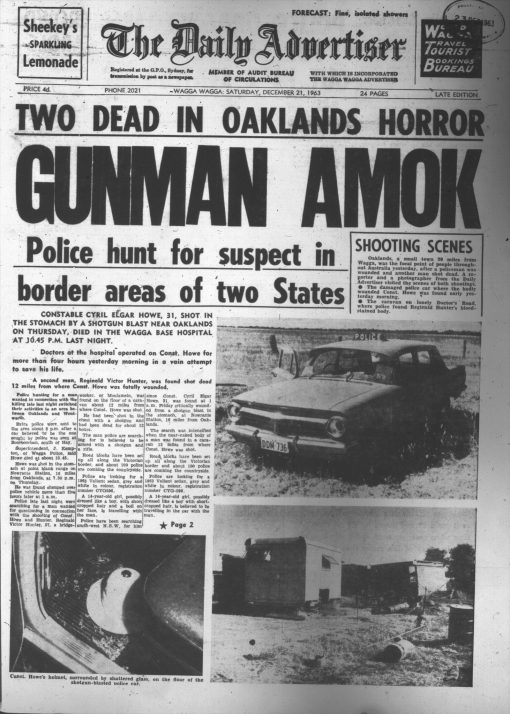
WAGGA, Thursday. – A week-long hunt for a man and a girl ended tragically today in a fowlhouse at Oaklands, a small village near Wagga.

As five police approached him, the man, William Stanley Little, shot 14-year-old Susan Lyons and then killed himself.

The fowlhouse in which the double shooting took place was only 50 yards from the house in which Little had been living with Susan Lyon‘s mother for several weeks.

The hunt for Little began last Thursday night when the bodies of Constable Cyril Howe, 31, and a bridge worker, Reginald Hunter, 57, were found within a few miles of Oaklands.

This morning Little made a surprise return to the hut where he had been living.

Police, under Det. Const. W. Sheather, made a routine check of the house today and noticed that a pound of butter had been moved since they checked last night.

Det. Sheather ordered an inspection of all huts and sheds around the house.

As the five policemen began searching a shotgun blast rang out from the fowlhouse.

Police took cover behind a car and then fired three shots over the top of the fowlhouse.

Another single shotgun blast followed.

The police closed in on the shed and Det. Sheather opened the door.

He found the girl dead and Little critically wounded.

Little died before any medical help could be given.

The chief of the C.I.B., Supt. R. Walden, said later the man had shot Susan Lyons and then committed suicide.

Neither the girl’s death nor the man’s injury was caused by our men,” he said.

Post-mortem

A post-mortem examination was today made in Urana of the bodies of Little and the girl.

A coroner’s inquest will be held, but no date has yet been fixed.

Police believe she had been held captive by Little since last Thursday night.

Police several times had expressed fear that the girl would be held hostage by the man.

The whole Riverina is seething,” Supt, Kempton, in charge of Wagga district, said tonight.

Everyone is appalled by the girl’s death.”

The Commissioner of Police, Mr. Allan, tonight expressed his sincere appreciation of police efforts in the hunt.

All police showed a keenness to see this matter through, which did them great credit,” he said.

They worked hours and in conditions above and beyond those of the normal requirements of their duty.”

Maximum temperature for the search area has not fallen below 100 degrees for the past seven days.”

Mr. Allan also thanked private citizens for their part in the search.

Co-operation

Four planes were donated by district graziers to help the search.

Local polo players risked prize ponies to search through dangerous country for the killer.

This shall be remembered as a typical example of public co-operation with the Police Department in the interests of law enforcement,” Mr. Allan said.

The hunt for Little began when the body of Const. Cyril Howe was found in his police car just off the Oaklands – Jerilderie road.

Before he collapsed, Const. Howe scribbled the name of his assailant in his notebook.

Several hours later, police found Reginald Victor Hunter‘s body in his caravan, 12 miles away.

Like Const. Howe, Hunter has been killed by a shotgun blast.

This picture was taken yesterday only seconds before police fired warning shots over a fowlhouse near Oaklands after they heard the first of two shot gun blasts. They later found William Stanley. Little inside, mortally wounded, and 14-year-old Susan Lyons dead.

This picture was taken yesterday only seconds before police fired warning shots over a fowlhouse near Oaklands after they heard the first of two shot gun blasts. They later found William Stanley Little inside, mortally wounded, and 14-year-old Susan Lyons dead.

https://trove.nla.gov.au/newspaper/article/104283487


Canberra Times (ACT : 1926 – 1995),

Monday 23 December 1963, page 3

‘MAN TRAPPED’ IN FOREST SEARCH

WAGGA, Sunday. – Police searching for the shotgun killer of a policeman and a contractor in the southern Riverina believe they will track him down

some time tomorrow.

The search will go on through the night.

I think we’ll have good news for you by tomorrow night,” Supt. J. C. Kempton said tonight.

Supt. Kempton, in charge of the Wagga Police District, is leading the search for the murderer.

Four hundred men-on foot, on horseback, in cars, trucks and four planes today concentrated the search on the sprawling 15,000-acre Werai Forest, near Deniliquin.

They had to fight their way through thick scrub in temperatures between 106 and 110 degrees.

“The men are weary, but confident they are getting close,” another senior police officer said tonight.

Trapped

All available police have been sent to the forest following a report that a car, believed to be driven by the killer, was seen parked in bushes in the forest yesterday.

Mr. J. Haydon, a station hand from Moulamein, told police he saw the car. Its description answered that of the Valiant in which the killer and a 14-year-old girl escaped.

Searchers late yesterday began a methodical check of the entire forest.

We started on the outside working in; we believe he is trapped in there,” Supt. Kempton said.

Planes

In another new development today, police discovered that the murderer stole a large quantity of food from one of his victims, bridge contractor Mr. Reginald

Hunter, 57, after he had shot him on Thursday.

The other victim was 30 year-old Oaklands policeman Cyril Howe, who died in Wagga Base Hospital yesterday.

Hunter’s family checked his caravan today and found that a lot of food and some petrol were missing,” Supt. Kempton said.

The car the wanted man is driving also was stolen from Hunter.

All four planes in the search have been volunteered by district graziers. They are using the main street of the small town of Booroorban, about 200 miles west of Wagga, as a runway.

Disguised

The girl travelling with the killer is believed to be pregnant.

Police fear for her life. They believe she may have been forced to cut her hair and dress as a boy.

The girl is of medium build, five feet tall, with brown hair and hazel eyes. She has a boil on the right side of her face.

She was dressed as a boy in a brown shirt, black jumper and khaki trousers.

Before he collapsed Const. Howe was able to scrawl the name of his attacker in his notebook.

In the massive search that followed, police found the body of Hunter in a caravan about half a mile from the spot where Howe was fatally wounded.

He had shotgun wounds in the chest and police believe he died instantly. A doctor said he had been dead for about 12 hours.

The fugitive is believed to be armed with a .22 rifle as well as the shotgun.

Police think he has plenty of ammunition.

https://trove.nla.gov.au/newspaper/article/104283124


Hi


I have some information prior to Cyril joining the police force.

Cyril was engaged to my mother. It would have been late 1950’s I guess.

Cyril worked as a volunteer ambulance officer around the Rockdale area I believe.

The engagement was broken off because my grandfather had spent 12 months in Glen Innes prison for stealing some years earlier and that would have impacted Cyrils’ chances of getting into the force.

I do have another photo somewhere, would need to hunt it down.


Cheers

Paul


2020
Constable Cyril Howe was stationed at Oakland’s at the time of his passing.
I believe it was 19 December 2013, when I was LAC of Albury we held a 50 year memorial service at Oakland Police Station for Cst Howe which his wife and daughter attended. They unveiled a memorial plaque and I presented them with framed memorial photos.
It was the first time his wife had returned to Oakland’s since the day he died.
The community And former officers attached to the Murray River area came out to remember him in huge numbers. Many were present in the town on that day or on duty in other nearby locations and reflected on what happened. It is such a shame that it takes the death of one of our fine officers for the government and organisation to act and move onto a different weapon. Again a shame that it was one not designed for the first responders, and again not appropriate in the circumstances until we finally were issued with the glocks.
I was very proud to stand with his wife and daughter and have Constable Howe recognized in this way.
I recently noticed that the picture of that day and the presentation is currently on the NSW Police Legacy home page.

NSW Policing History Forum


Clarence Roy PIRIE

Clarence Roy PIRIE

AKA CLARRIE

Late of Capertee, NSW

Husband to widow Frances Josephine PIRIE who died 12 October 2019 ( see below ) 58 yrs 11 mths 29 days after Clarrie


NSW Penrith Police College Class # “possibly” 005

New South Wales Police Force

Regd. #  5824


Rank: Probationary Constable – appointed 15 September 1947

Constable – appointed ? ? ?

Constable 1st Class – appointed ? ? ?

Senior Constable – appointed ? ? ?


Final Rank = Senior Constable


Stations: Parramatta ( 18 Division 1947 – ? ), Young – Lock-Up-Keeper ( ? – 1958 ), Capertee ( 1958 – 1960 ) – Death

Service: From ? pre September 1947 ? to 13 October 1960 = 13+ years Service


C.M.F.                                1 October 1941 – 28 April 1943

A.I.F.                                  29 April 1943 – 6 August 1946

World War II                    Australian Imperial Force

Regiment:                         2 Aust. Ord. Port Detachments

Enlisted:                            28 June 1943

Service #                           NX171227  ( N210415 )

Rank:                                 Private

Embarkation:                   Duntroon for Pt. Moresby 12 July 1943

Next of kin:                       Mrs Henrietta PIRIE, 50 Meehan St, Granville – Mother

Religion:                            C of E

Single / Married:              Single

Returned to Australia:    ?

Date of Discharge:           6 August 1946

Posting at Discharge:       HQ 6 A B S A

WWII Honours & Gallantry:  None for display

POW:                                  No

Occupation upon joining:     Mill Hand – Process Operator

War Service In Au:           195 days

Active Service outside Au: 553 days

Active Service in Au:        1017 days


Police Awards: No find on Australian Honours


Born: Sunday  22 August 1920 at Paddington, NSW

Died on: Thursday  13 October 1960

Age: 40 yrs  1 mth  21 days

Cause:  Shot – Murdered

Event location: Jews Creek, Capertee, NSW

Event date: Thursday  13 October 1960


Funeral date: Monday  17 October 1960

Funeral location: ?

Wake location: ?

Funeral Parlour: ?


Buried at: Rookwood Cemetery, NSW

Grave Location:  Zone E, Section 19, Grave 3661


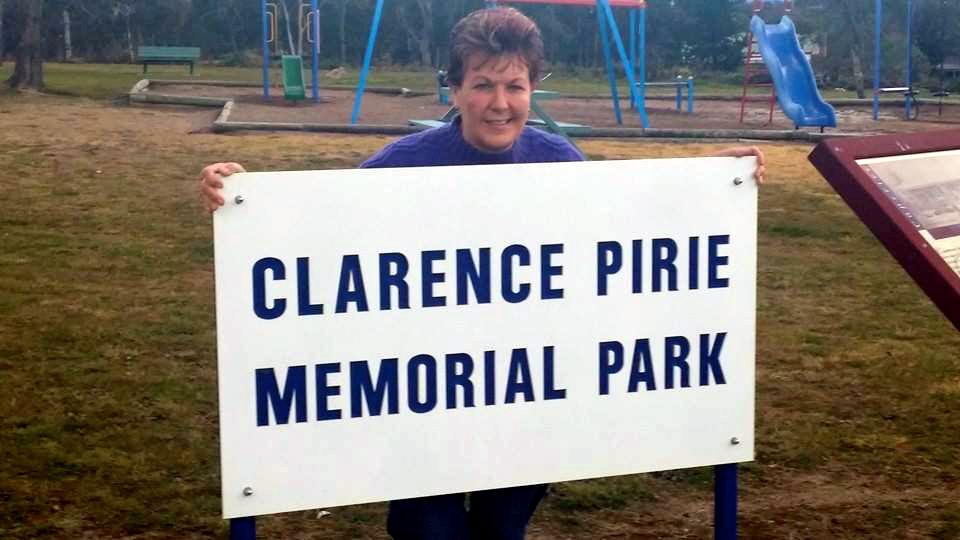
Memorial located at: 1/  Glen Davis Rd, Capertee – the Clarence Pirie Memorial Park

Lat: -33.143736
Long: 149.983791


2/ a Wall Plaque at Chifley L.A.C.


SenCon Clarrie Pirie ( 1960 )

Clarence Roy PIRIE


Clarence Roy PIRIE
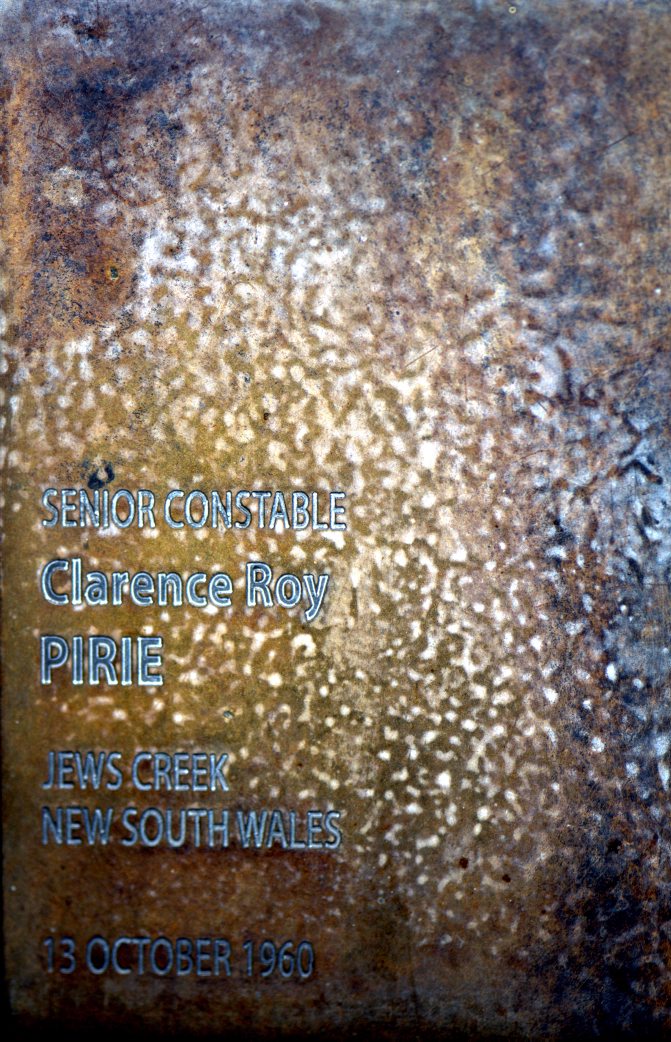
Clarence Roy PIRIE – Touch Plate at the National Wall of Police Remembrance, Canberra


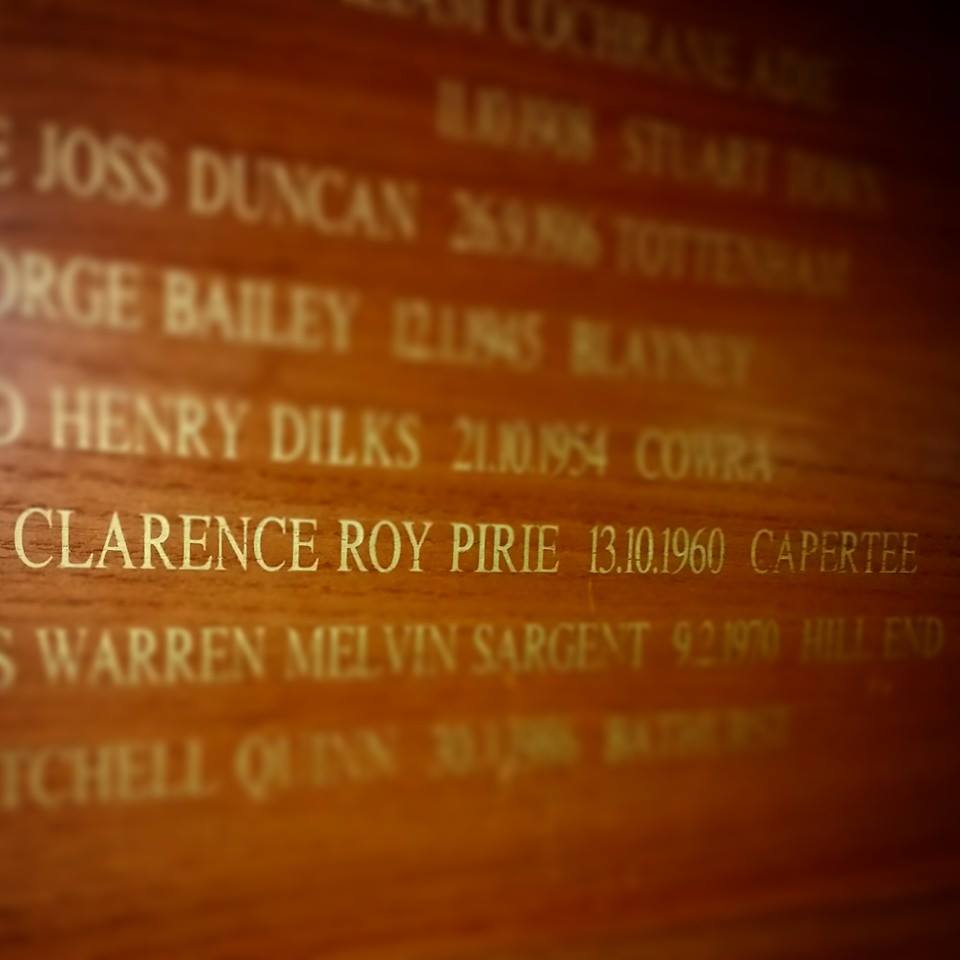
CLARENCE IS mentioned on the Police Wall of Remembrance


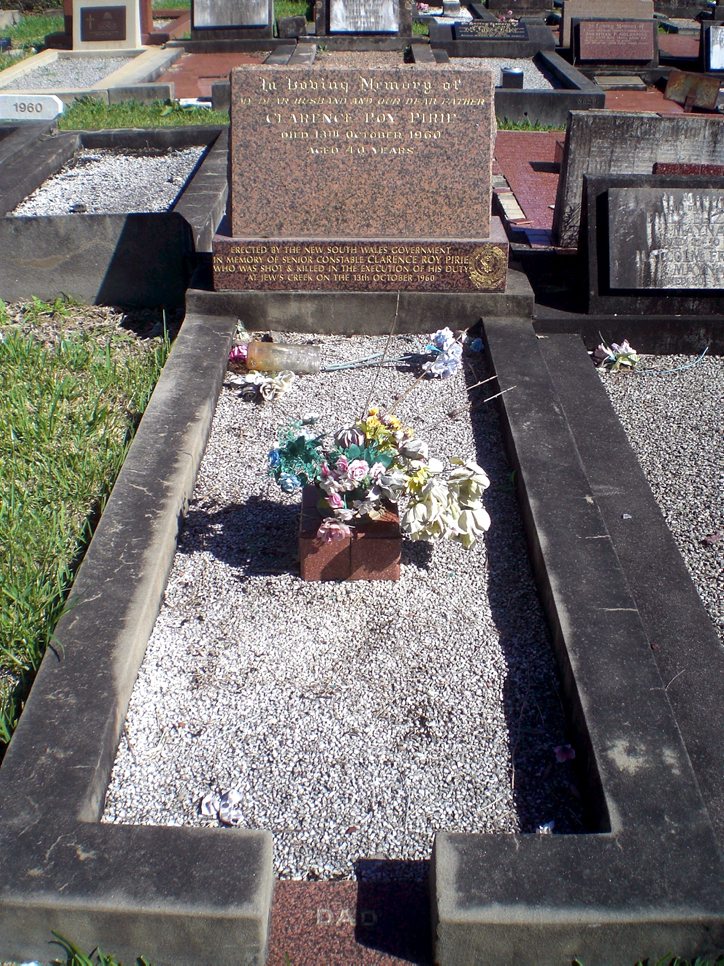
Grave location:  Rookwood Cemetery, NSW

Zone E, Section 19, Grave 3661

INSCRIPTION: In Loving Memory of my dear husband and our dear father Clarence Roy PIRIE died 13th October 1960 aged 40 years. Erected by the New South Wales Government in Memory of Senior Constable Clarence Roy PIRIE who was shot & killed in the Execution of his Duty at Jew's Creek on the 13th October 1960 Police Crest.
INSCRIPTION:
In Loving Memory of my dear husband and our dear father Clarence Roy PIRIE died 13th October 1960 aged 40 years.
Erected by the New South Wales Government in Memory of Senior Constable Clarence Roy PIRIE who was shot & killed in the Execution of his Duty at Jew’s Creek on the 13th October 1960.
Police Crest.

INSCRIPTION:<br /> In Loving Memory of my dear husband and our dear father Clarence Roy PIRIE died 13th October 1960 aged 40 years.<br /> Erected by the New South Wales Government in Memory of Senior Constable Clarence Roy PIRIE who was shot &amp; killed in the Execution of his Duty at Jew's Creek on the 13th October 1960.<br /> Police Crest.


FURTHER INFORMATION IS NEEDED ABOUT THIS PERSON, THEIR LIFE, THEIR CAREER AND THEIR DEATH.

PLEASE SEND PHOTOS AND INFORMATION TO Cal


May they forever Rest In Peace


Senior Constable Clarrie Pirie was the Officer-in-Charge of the Capertee Police Station from 1958 until his death on 13 October, 1960. On that day he was informed by Lithgow Police that two male offenders had abandoned a stolen car at Cudgigong, north of Capertee.

While patrolling the area Senior Constable Pirie found two fourteen year-olds with a vehicle at a roadside camping area at Jews Creek, ten miles south of Capertee. These however were not the two offenders the police were searching for and as such Constable Pirie did not know that on the previous day the pair had escaped from the Yasmar children’s detention centre ( Lidcombe ) and had broken into a dwelling where they stole several items of property and the vehicle before driving to the Jews Creek area.

As the constable was talking to the young offenders one of them suddenly produced a .22 rifle and shot Constable Pirie. He died a short time later. Both youths were captured the following day.


The senior constable was born in 1920 and joined the New South Wales Police Force on 15 September, 1947.

At the time of his death he was stationed at Capertee.


Source:  Beyond Courage


As an aside – Clarence PIRIE was the cousin of Victor AHEARN who was also shot and murdered in 1946 aged 40.


( 2019 )
Knew Clarie well when I was at Cowra and Clarie was LUK at Young, I was transferred on the PSB at Lithgow and Clarie was transferred to Capertee so I used to see a lot him as the Highway Patrol done daily runs to Capertee.
I took the phone call at Lithgow from a chap from Cullen Bullen to say Clarie had been shot, then drove Insp. Eli Hanson and Det S/Cst Jimmy Foster to the Scene at Jew’s Creek.
Never will forget that day.
His Youngest son John was a Police Support Officer and KAC Manager at Orange.

( Eli HANSON, NSWPF # 2207, Retired in 1962 and died in January 1973 ( aged 71 years, 0 months, 2 days ) )


Police Remembrance Day – 29 September 2022

A message received from one of the daughters of Roy & Frances PIRIE on 21 September 2022:

Dear Greg, Not sure if you are the right person to find out some info on Police Memorial Day Services in the Young area.

I live near Young & would really like to be able to pay my respect to my Dad who was killed on duty in 1960. It’s my only way to keep my memory going & now my Mum has passed, I’m feeling the sadness even more.

My Dad was Constable Clarence Roy Pirie who was shot & killed at Capertee.

I usually find out after the event that there had been a service around Young so what I’m hoping is that someone could let me know beforehand so I could attend.

Sorry to trouble you but just reaching out.

Yours respectfully,

Francine Pirie.

/////////////////////

Hello Francine.

Good choice picking me. lol.

I have tried to phone Young ( without success ) but I have just spoken with the District Commander, Supt. Paul Condon, and he confirms that there WILL be a Service in Young.

He is now on the phone to obtain the ‘where and when’ for us.

/////////////////////

omg, bless you & thank you x

I am on NSW Fallen Police ( FB Group ) so that’s how I got you so; thanks again.

////////////////////

There is a Service at Young Police Station ( only a small Service though ) at 11am on Thursday 29 September. The troops there will be expecting you.

////////////////////

Greg thank you from the bottom of my heart.

I’ll be there

x

////////////////////

You are very welcome Francine.

xoxox

Cal

///////////////////


Dear Greg,

Thank you so much for organising my attendance yesterday.

The staff at Young Police Station were amazing. The young Police Officers were so interested in my family’s story.

Thank you for the link as I read through the article I read things I didn’t know about. Many tears have been cried but I still believe it’s been a healing time for me even though it’s been 62 years.

Sometimes you need a reason & yesterday was a good reason to grieve, not only for my Dad but for all the other families who have lost their loved one.

Again Greg, thank you from my heart as this would not have happened if you hadn’t gone to the trouble to organise this for me.


God bless you

Francine Pirie

xx


The Result

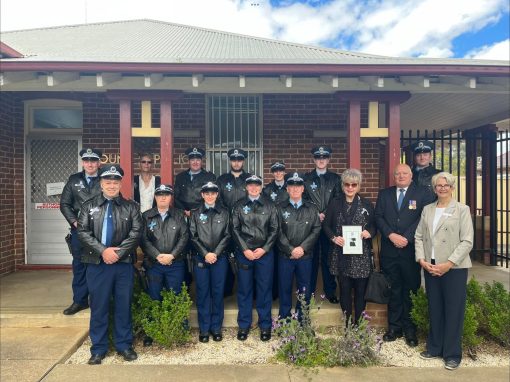
Young Police - Remembrance Day - 2022 - Francine Pirie - Daughter of Clarence Pirie - killed 13 Oct 1960
Young Police – Remembrance Day – 2022 – Francine Pirie – Holding picture – Daughter of Clarence Pirie – killed 13 Oct 1960


Great effort from Young Police and Supt. Paul Condon, Goulburn


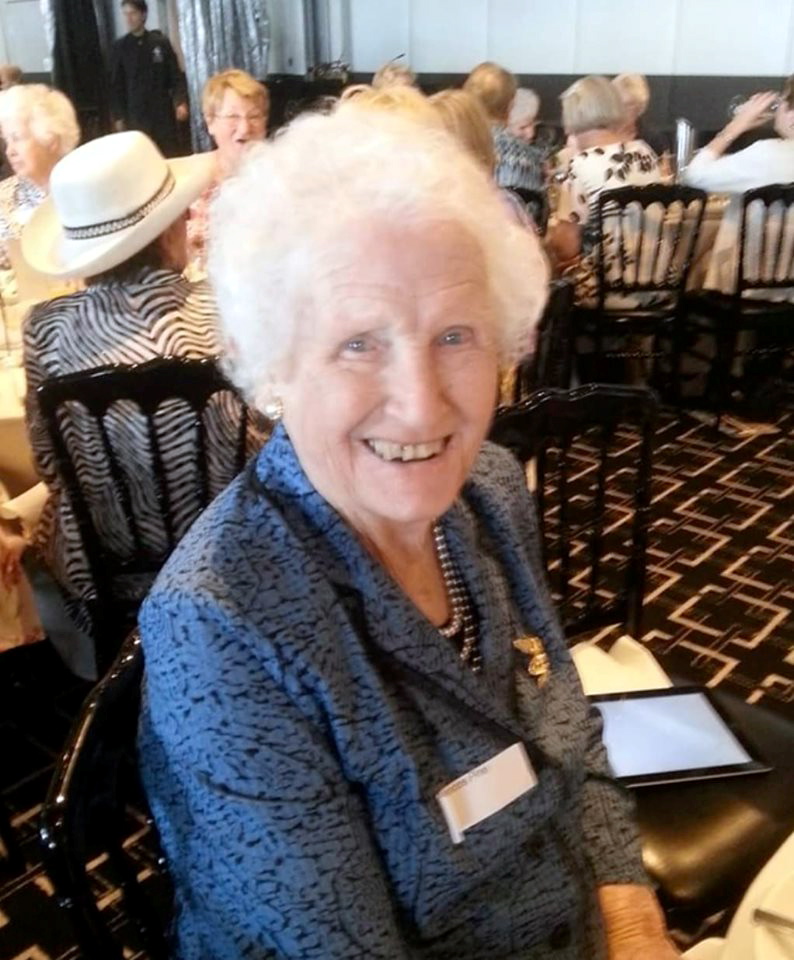
Mrs Frances Josephine PIRIE sadly passed away last night ( Friday 12 October 2019 ) aged 94 years – 5 days shy of her 95th birthday.

Wife of Senior Constable Clarence Roy PIRIE of the Capertee Police.

Almost 59 years to the day, Frances and Clarey are together again.

May they both, forever, Rest In Peace.


Clarence Roy PIRIEs wife - Frances PIRIE
Clarence Roy PIRIEs wife – Frances PIRIE


Gordon Weaver ( Monday 15 July 2019 )
Knew Clarie well when I was at Cowra and Clarie was LUK at Young, I was transferred on the PSB at Lithgow and Clarie was transferred to Capertee so I used to see a lot him as the Highway Patrol done daily runs to Capertee.
I took the phone call at Lithgow from a chap from Cullen Bullen to say Clarie had been shot, then drove Insp. Eli Hanson and Det S/Cst Jimmy Foster to the Scene at Jew’s Creek.
Never will forget that day.
His Youngest son John was a Police Support Officer and KAC Manager at Orange.


Capertee HERITAGE

http://caperteeheritage.blogspot.com.au/2013/09/the-tragic-death-of-clarie-pirie.html

Friday, 20 September 2013

The tragic death of Clarie Pirie

Almost all visitors to Capertee will notice the large memorial park in the middle of the village close to the Glen Davies turnoff. This recreational area, which includes a car park, childrens’ playground and toilets, is officially named after Clarence Pirie a notable policeman who was stationed in the community during the late 1950s and early 60s. While many police have served the Capertee district well over the years Pirie deserves lasting recognition as he gave his life to protecting the community.
Senior Constable Clarence (Clarie) Roy Pirie was born in Paddington, Sydney, in 1920. During World War 2 he joined the army and served in New Guinea. After the war, in 1947, he joined the New South Wales Police Force, and from 1959 to 1960 he was the Officer-in-Charge at Capertee Police Station
On the 13th October 1960 he was asked to look out for two male offenders who had abandoned a stolen car north of Capertee.While patrolling the area the following day, Pirie found two 14 year-olds with a vehicle at a roadside camping site at Jews Creeks south of Capertee. According to police records, these were not the suspects who had abandoned the vehicle the previous day but two escapees from the Yasmar juvenile detention centre in Haberfield, Sydney. While interviewing the youths one of them suddenly produced a stolen .22 rifle and shot the officer twice. The Senior Constable died of his wounds at the scene a short time after. The two youths were arrested the following day and were later imprisoned. Pirie was survived by his wife Frances and four young children.
The memory of Clarie Pirie as well as the many other police who have been killed in the line of duty is commemorated each year on Police Memorial Day which is held near the end of September.
1 comment:

Mum often talked about him, said he was a good man and never carried a gun.


Clarence Pirie Memorial Park Rest Area

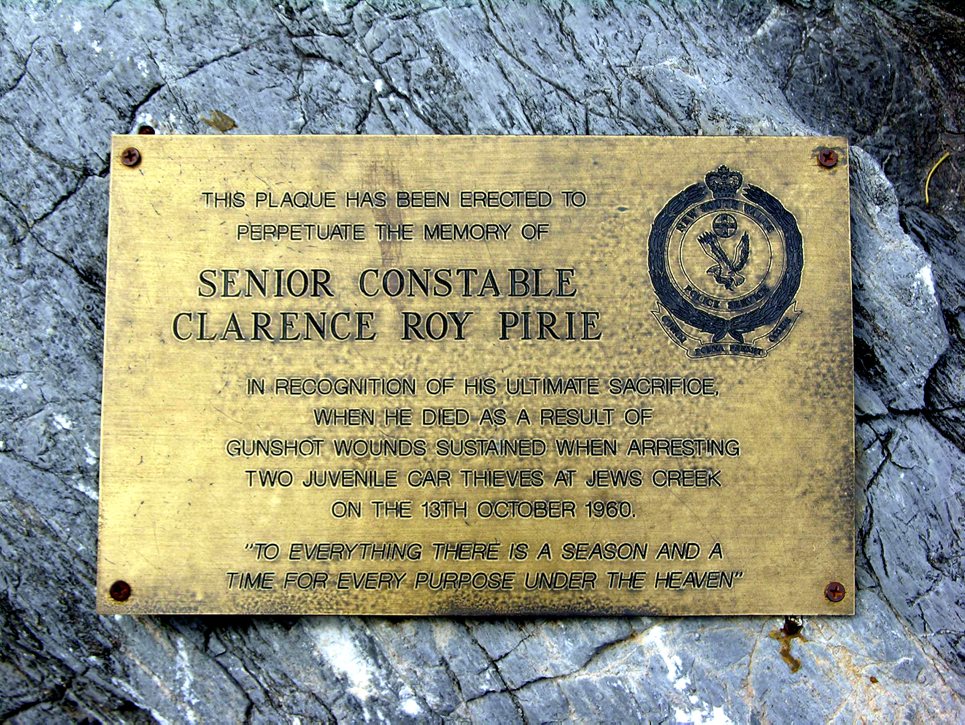
INSCRIPTION:<br /> This plaque has been erected to perpetuate the memory of Senior Constable Clarence Roy PIRIE in recognition of his ultimate sacrifice when he died as a result of gunshot wounds sustained when arresting two juvenile car thieves at Jews Creek on the 13th October 1960.<br /> "to everything there is a season and a time for every purpose under the heaven"
INSCRIPTION:
This plaque has been erected to perpetuate the memory of Senior Constable Clarence Roy PIRIE in recognition of his ultimate sacrifice when he died as a result of gunshot wounds sustained when arresting two juvenile car thieves at Jews Creek on the 13th October 1960.
“to everything there is a season and a time for every purpose under the heaven”

Clarence PIRIE Mmemorial Park

Clarence PIRIE Mmemorial Park


The Canberra Times  Friday

14 October 1960  page 1 of 28

http://trove.nla.gov.au/ndp/del/article/136940872
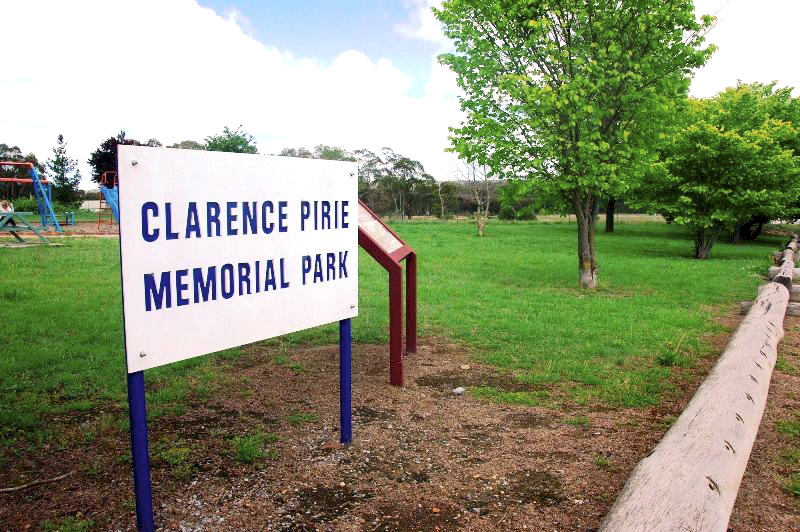
Constable Shot Dead In Chase

SYDNEY, Thursday: – Police were to-night conducting one of the largest manhunts ever in the Central Western district for two youths who are alleged to have shot dead Senior Constable Clarence Roy Pirie, 40, of Cullen Bullen.

The constable was chasing two youths on the Capertee Cullen Bullen Road early to- night.

Pirie, a father of four, was believed to have been killed with a .22 rifle.
Police from Lithgow, Bathurst, Mount Victoria, Kandos, Rylstone, Katoomba, Oberon, Orange and other centres are searching dense bush near Jews Creek.

Police from other Central Western stations and from Sydney will join the searchers to-morrow.

The searchers are heavily armed with rifles and riot guns.

Other specialised weapons will arrive from Sydney to-morrow.

At 9 a.m. to-day a stolen car was found abandoned at Cudgegong.

Two youths were seen to leave the car and police in the area were alerted.

Constable Pirie sighted two youths in a second stolen car on the Lithgow-Mudgee Road near Jew’s Creek.

Overturned

The stolen car overturned at high speed about a half mile farther on.

Two youths scrambled from the wreck and fled into the bush.

Constable Pirie followed them.

Police believe that the elder youth, realising that Pirie was following them, turned and fired the shot which fatally wounded the policeman.


The Canberra Times  Wednesday

19 October 1960  page 29 of 33

Murder Charge Remand For Boy

http://trove.nla.gov.au/ndp/del/article/103107227

LITHGOW, Tuesday:- A 14-year-old Sydney boy was remanded in Lithgow Children’s Court to-day on a charge of murdering a policeman.

He was remanded till November 1 without bail and will be detained in custody until that date.

The boy was charged with having murdered Constable Clarence Roy Pirie at Jews Creek camping reserve on October 13.

Police prosecutor Sergeant J. S. Smith said the youth charged with murder had   escaped from a Sydney boys’ home on October 12 and together with another boy had stolen a car.

The car was allegedly parked at Jews Creek’ Camping reserve the next day.

When Const. Pirie approached the vehicle he was allegedly shot dead.


The Canberra Times  Tuesday  7 March 1961  page 3 of 20

http://trove.nla.gov.au/ndp/del/article/103115285

Boy, 15, Goes To Gaol For 15 Years

SYDNEY, Monday: — Christopher Lindsay, 15, went to gaol to-day for 15 years for killing a policeman last year.

Mr. Justice Else Mitchell described the fair-haired, well-dressed boy as a “young gangster.”

Lindsay, of Alice Street, Newtown, did not appear to be emotionally upset at the sentence.

He turned to court officials who led him from the dock to the cells below.

The sight of the boy being led away brought an outburst of sobbing from the public gallery.

Lindsay last week had pleaded not guilty to having murdered Constable Clarence Roy Pirie, 39, at Jews Creek Camping Reserve off the Mudgee Road near Cullen Bullen on October 13 last.

The Crown accepted Lindsay’s plea of guilty of man slaughter.

Lindsay – standing in the dock of Central Criminal Court with hands clasped in front of him – heard Mr. Justice Else Mitchell say that the deposition and Lindsay’s own signed statement left slender ground for the lesser offence.

“Before committing this crime, you had shown a refusal both in England and in this country to conform with the laws which are made for the good of society.

“From the record, it is clear that the processes of the habitation and reform which are provided by the country here have made no impact on your attitude or conduct.

“In pursuit of this anti-social conduct you twice escaped from Yasma shelter, where you were being detained awaiting trial for various charges, and on the second occasion in company with a confederate, younger than yourself, stole a rifle, food, other goods and then a motor car in which you travelled to the scene of the crime.

“When you were in fear of apprehension by a constable of the police for the theft of the car you did not hesitate to shoot him because as you said ‘You did not want him to catch you with the car.’

“Your subsequent conduct and your attempt to evade capture though perhaps natural do not appear to have been accompanied by any manifestation of c0ntrition or remorse, a fact which seems to me all the more serious in view of Dr. McGeorge’s conclusion that you are not suffering from any mental or psychiatric disorders.

“A substantial sentence appears to be necessary not only for the reasons I mentioned but as the only possible way in which you may begin to understand your obligations to society.”


The Canberra Times  Saturday
12 August 1961  page 23 of 28

Boy Killer’s Appeal Fails

SYDNEY, Friday:— The Full Supreme Court to-day dismissed a school boy’s appeal against a 15-year sentence for the manslaughter of a policeman.

The boy, Christopher Lindsay, 15, appealed against the severity of the sentence.

Mr. Justice Else-Mitchell, in Central Criminal Court, had sentenced Lindsay to 15 years gaol for the manslaughter of Constable

Clarence Roy Pirie, at Jew’s Creek, last October.

Pirie was questioning Lindsay on a car theft at the time.

Lindsay to-day conducted his own case before the Full Bench — comprising the Chief Justice, Mr. Justice Evatt, Mr. justice Herron and Mr. Justice Hardie.

He handed the bench a written statement, headed —’ “No Discourtesy.”

The statement read: “I respectfully submit that His Honour, at the time of imposing the severe sentence for manslaughter, regarded the offence as tantamount to murder.

“I further most respectfully submit the crime was not premeditated.

“The whole tragedy took place in a matter of seconds.

“At no time did I intend this man’s death.

“I respectfully submit that a 14-year-old youth to be sentenced to 15 years imprisonment for a crime he did not intend, is too severe.”

Mr. Justice Else-Mitchell, reported to the Full Court, that Lindsay’s offence was hardly distinguishable from murder.

However, he had felt that he was bound by the Crown’s acceptance of the manslaughter plea.

Lindsay originally had been charged with murder.

Mr. Justice Else-Mitchell said it had been submitted he should not impose a crushing sentence.

He also was mindful of the danger with a youthful offender — that the imposition of a heavy gaol sentence often could produce more harm than good.

The Full Court ruled unanimously against Lindsay’s appeal.

It added that Lindsay’s crime called for the greatest condemnation.


Police remember fallen

http://www.centralwesterndaily.com.au/story/767925/police-remember-fallen/

PERSONAL LOSS: Inspector Greg Pringle and police administration manager John Pirie have personal experience of the loss of someone close on Police Remembrance Day. Photo: JUDE KEOGH 0926police2


REPRESENTATIVES from Orange Police Station will today attend a national memorial in Canberra for Police Remembrance Day.

For Inspector Greg Pringle and Canobolas Local Area administration manager John Pirie, the day bears a special significance.

John Pirie was just coming up to his fifth birthday when his 40-year-old father Senior Constable Clarence Roy Pirie was shot at point-blank range and killed near Capertee.

It was on October 13, 1960, that Mr Pirie’s father was patrolling when he came across a stolen vehicle. He stopped the vehicle and spoke to two youths inside, but one of them pulled a gun on Snr Const Pirie and shot him.

Inspector Pringle’s experience is in contrast, but he agrees the grief that comes with losing a colleague on the job remains for many years.

“I was with highway patrol working out of Cootamundra in 1988. I had a cup of tea with a fellow officer Constable Kurt Schetor before we headed off to patrol in separate directions,” Insp Pringle said.

Ten minutes later the then Constable Pringle received a call to respond to a crash and he arrived to find his friend and colleague was in involved in a head-on crash with a truck.

“I did my best but I couldn’t revive him,” he said.

Insp Pringle said many police officers carried a burden of grief with them for colleagues who died on the job.

“In many ways it is harder to deal with your own grief,” he said.

“When you are a police officer your ‘tank’ is full of other people’s grief because that’s part of the job. But it doesn’t leave much left.”

Officers from Canobolas Local Area Command will not be marking Police Remembrance Day in Orange this year.

Instead, this year’s service will be held at Cowra which is part of the Canobolas Local Area Command.


Family honours a dad’s sacrifice


Slain policeman remembered

15 Oct, 2010 08:40 AM

When Senior Constable Clarence (‘Clarrie’) Roy Pirie went to work on the morning of the October 13, 1960, he fully expected to go home to his wife Frances and their four young children at the end of the day.Sadly, 40-year-old Senior Constable Pirie lost his life that day at Jews Creek, when he was shot by one of two escapees from a juvenile detention centre.

Senior Constable Pirie’s family returned to Capertee this week to remember the events that turned their lives upside down for all time.

On Thursday morning Senior Constable Pirie’s wife Frances, with her children, grandchildren and some great-grandchildren, joined senior police including Deputy Commissioner Dave Owen, Assistant Commissioner Steve Bradshaw, Chifley Area Command Superintendent Michael Robertson, Member for Bathurst Gerard Martin, and many members of the police force at Clarrie Pirie Memorial Park in Capertee to mark the 50th anniversary of his death.

A service was conducted by Police Chaplin Mark Jenkins from the Anglican Diocese of Bathurst and was addressed by the Superintendent Robertson, Mr Martin and Detective Superintendent Jim Foster who investigated Senior Constable Pirie’s death.

Senior Constable Pirie paid the ultimate sacrifice and was the sixth of eight police officers [in the Chifley command] to lose their life upholding the law,” Superintendent Robertson said.

“Those who follow [in the police force] serve to do his memory proud and he lives on through this park, which was named in his honour.

“The debt owed by society to Senior Constable Pirie cannot be measured and we will always ensure that he is remembered.”

Member for Bathurst Gerard Martin related how Clarrie Pirie served with the Australian Armed Forces in New Guinea during World War II and how he met his wife in military service.

“He undertook a very challenging front line career, which can be extremely dangerous,” Mr Martin said, speaking on behalf of Police Minister Michael Daley.

“His loss will always be a tragedy and compares to the recent death of trainee detective William Crews, the former Glen Innes who lost his life in the line of duty last month.”

Detective Superintendent Jim Foster told how Senior Constable Pirie had joined the police force in 1947 and served at Parramatta and Young before being transferred to Capertee in 1958.

“Those were difficult times with no two-way radios or mobile phones, but the community spirit was evident as we investigated the case,” Detective Foster said.

“The Postmaster at Cullen Bullen kept the phone lines open after the 6pm regular closing time so that we had communications.

“The only police photographer was hours away and a local chemist took the photos we needed to record evidence.

The offenders were arrested at 3am on October 14 as they were attempting to board the Mudgee Mail train at Capertee.”

Detective Superintendent Foster said Senior Constable Pirie was faithful to his duty as a police officer and earned the respect of the Capertee community and the police in the then Lithgow sub-district.

Mrs Pirie said her husband’s attention to detail in his work as a police officer was incredible.

“He knew just about every car that passed through town,” she said.

“Strange cars always attracted his attention.”

Perhaps that attention to duty led him to investigate the stolen vehicle driven by the two escapees, that he saw at Jews Creek that day 50 years ago.

Mrs Pirie, now in her 80s, said her husband’s death changed her life forever as she struggled to raise four children.

“At the time of Clarrie’s death Ron was 8, John 5, Mary Anne 3 and Francene 2,” she said.

“I received a small police pension but had to go out and work to be able to raise and educate them.

“I had to remove our personal effects from the police house at Capertee soon after Clarrie’s death and we moved to Young.”

The ceremony concluded with wreaths being laid by Mrs Pirie and family, Assistant Commissioner David Owen, Superintendent Michael Robertson and the students from Capertee Public School.


John Pirie‎Wall to Wall - Ride for Remembrance I was immensely proud, felt hugely honoured and felt very humbled that the Wall to Wall riders from the Western Region led by Geoff Mckecknie stopped at Capertee today. I would also like to express my gratitude to Pual Bousfield and the Capertee Community, especially the school children and those that help with providing lunch for the riders.
John Pirie  ‎Wall to Wall – Ride for Remembrance – 2014
I was immensely proud, felt hugely honoured and felt very humbled that the Wall to Wall riders from the Western Region led by Geoff McKecknie stopped at Capertee today. I would also like to express my gratitude to Paul Bousfield and the Capertee Community, especially the school children and those that help with providing lunch for the riders.

Glen Davis Rd, Capertee, NSW

Lat:  -33.143736  Long:  149.983791


"INSCRIPTION: This plaque has been erected to perpetuate the memory of Senior Constable Clarence Roy PIRIE in recognition of his ultimate sacrifice when he died as a result of gunshot wounds sustained when arresting two juvenile car thieves at Jews Creek on the 13th October 1960.<br />"to everything there is a season and a time for every purpose under the heaven"


December 2010

Police News

by Det. Supt. ( Retired ) Jim FOSTER ( R.I.P. 9 July 2019 )

Clarence Pirie - NSWPF - Murdered 1960 - 50 years on - page 22 - Policenews - Dec 2010


Clarence Pirie - NSWPF - Murdered 1960 - 50 years on - page 23 - Policenews - Dec 2010


( 2014 )  The offender, Christopher Lindsay ( assuming he served the full 15 years, would have been 30 years of age when released from gaol in 1975.  Assuming he is still alive today, he would now be around 69 years old.
I did a cursory search for him, via Google, but it is a common name and pursued it no further.
Cal

Clarence Roy PIRIE's Daughter, Maryanne - July 2014 in the park dedicated to her father killed 54 years earlier.
Clarence Roy PIRIE’s Daughter, Maryanne – July 2014 in the park dedicated to her father killed 54 years earlier.

[blockquote]Stopped at my Dad’s park and had a cuppa a few days ago, often wonder how different our lives would have been if he hadn’t been killed. I will, in my elderly mother’s honor, ride the Wall to Wall ( of Remembrance ) this September.[/blockquote]


Clarence Roy PIRIE 13.10.1960 Wall Plaque, Chifley L.A.C.
Clarence Roy PIRIE 13.10.1960
Wall Plaque, Chifley L.A.C.


Kenneth Desmond COUSSENS

Kenneth Desmond COUSSENS

New South Wales Police Force

Regd. #  ????

Rank:  Constable 1st Class

Stations:  ‘Safety Bureau’, Sydney, Kogarah, Cooma, Bega

Service:   From 18 October 1948  to  29 July 1957 = 11 years Service

[blockquote]

World War II

Australian Imperial Force

Regiment:                                  Royal Australian Navy

Enlisted:                                     30 June 1944 at Rockdale, NSW

Service #                                     32875

Rank:                                           Able Seaman

Embarkation?

Next of kin:                                Edith COUSSENS

Religion?

Single / Married?

Returned to Australia ?

Date of Discharge:                   12 October 1948

Posting at Discharge:             HMAS Penguin

[/blockquote]

Awards:  Nil

Born:  2 July 1926 – Hastings, England

Died on:   29 July 1957

Cause:  Murder – Bomb Attack

Event location:  Bega

Age:  31

Elizabeth COUSSENS nee McCampbell nee Gowing
34 old

Bruce James COUSSENS
7 months old


Funeral date:  31 July 1957

Funeral location

Buried at:  Bega Cemetery

Anglican, Section 7, Row A, Grave 3


Constable Kenneth Coussens ( 1957 )


Kenneth Desmond COUSSENS grave

Kenneth Desmond COUSSENS grave

Kenneth Desmond COUSSENS touch plate in Canberra


[alert_green] KENNETH IS mentioned on the Police Wall of Remembrance[/alert_green]


The constable, his wife Elizabeth and baby son Bruce were murdered by the offender Kelly who had placed a bomb on the front verandah of the constable’s home at Bega. The offender had become incensed at being spoken to by the constable regarding traffic offences and on 29 July, 1957 he placed a metal dairy container packed with over 200 sticks of stolen gelignite at the constable’s home. About 2am the offender lit the fuse to the bomb and the dwelling was almost obliterated in the resultant explosion.

Constable Coussensstepson, eight year-old Roger McCampbell, was the sole family survivor of the explosion. The offender Kelly was arrested after a major police investigation and was later sentenced to life imprisonment.

The constable was born in 1926 and joined the New South Wales Police Force on 18 October, 1948. At the time of his death he was stationed at Bega.


OBITUARY


Senior Constable Kenneth Coussens; wife – Elizabeth Coussens; infant – Bruce Coussens 7 months old.

Killed by a bomb blast on July 29, 1957.

Senior Constable Ken Coussens moved to Bega in 1954 where the officer took up motor cycle traffic duties for the Public Safety Bureau (now known as the Highway Patrol).

He married a local girl Elizabeth who came from a well known local family and they had two children, Roger nine (from Elizabeth’s first marriage) and an infant son Bruce, seven months old.

Constable Coussens performed his police duties in a conscientious and professional manner in the Bega area attending to traffic duties, attending the scene of motor vehicle accidents and performing other police and community duties as required of a country police officer.

About 1956, in the course of his traffic duties Constable Coussens came into contact with a local man named Myron Bertram Kelly, 32.

The officer had cause to speak to Kelly regarding traffic offences and issued traffic fines to the man on a number of occasions.

Kelly appears to have become enraged when Constable Coussens issued fines and defect notices to Kelly’s tractor and rotary hoe.

As a result Kelly formed a grudge against Constable Coussens.

After this event Kelly went to a silica mine at Rock Flat between Nimmitabel and Cooma in his truck and removed five cases of gelignite and took it to Nethercote where he buried it.

He then stole a six gallon cream can from Curtis Brothers Creamery and took that to Nethercote.

He later built a home made bomb by placing 240 sticks of gelignite and a fuse into the cream can.

In the late hours of July 28, 1957 Kelly sneaked to the officers home while he was asleep in the house with his wife and young family.

He set the bomb at the front of the fibro and iron home situated in Girraween Crescent, Bega and ignited the fuse a few hours later.

Kelly left the scene and went home and at about 2am the bomb detonated causing a huge explosion which completely demolished the house.

The bomb also caused extensive damage to other homes and windows in the vicinity, up to a mile away.

More than 100 windows at Bega Hospital were shattered by the blast.

Constable Coussens and his wife and young baby were killed instantly.

The 9-year-old son Roger survived the blast as he was sleeping at the rear of the house.

Shocked neighbours saw him emerge from the wreckage dazed and confused.

Local residents did not know what had happened and due to the enormity of the blast rumours quickly spread that the gas works had exploded or a Navy plane from HMAS Albatross Nowra had accidentally bombed the town.

However, when it was learned a police officer had been killed by a bomb, police quickly recognised it had all the hallmarks of an assassination.

A criminal investigation swung quickly into action with detectives from Sydney travelled to Bega.

Forensic evidence from the crime scene indicated the explosion was caused by a home made bomb and fragments of a dairy can were located at the scene.

An intense investigation followed, lead by crack homicide squad detectives. Subsequently Kelly was identified as the prime suspect when his hatred of Constable Coussens became known as a motive.

Investigators later searched Kelly’s home and found explosives, fuses and gelignite and a demolition hand book.

Kelly was subsequently arrested and charged with the murder of Constable Coussens and his wife and baby.

He was also charged with the theft of six cases of gelignite, 800 detonators, 1000 feet of fuse, an army .303 rifle, 50 rounds of ammunition and possessing an unlicensed pistol.

The trial was conducted in Central Criminal Court and Kelly was convicted by a jury on the murder charges.

On December 6, 1957 he was sentenced to life imprisonment by Mr Justice McClemens who said at the time: “One could only hope for the sake of common human nature that a crime as terrible and devilish as the Bega bombing on July 29 sprang from some deep seated mental derangement. It is not a case where in the interest of the community one could recommend or hold out any hope for mercy”.

Constable Coussens was also a returned serviceman having served in the Royal Australian Navy.

(Research courtesy of David Gardner Australian Police Journal March 2005.Vol 59 No 1.)

Sergeant Ken Cousins (sic) and Family

Address: 167 Auckland Street, Bega Police Station, Bega, 2550

State: NSW
Area: AUS

Please Note: GPS Co-ordinates are approximate.

Latitude: -36.676667
Longitude: 149.839722

View Google Map

Monument Type: Plaque

Theme: People

Sub-Theme: Crime

Description:

Plaque commemorates a local policeman and his family who were murdered in 1957.


Senior Constable Ken Coussens, his wife and seven-month-old son were blown up by 240 sticks of gelignite. It was discovered that local man Myron Kelly had held a well-known grudge against the constable and in the absence of other leads this seemed worth following up. The offender had become incensed at being spoken to by the Constable regarding traffic offences and placed a metal dairy container loaded with the stolen gelignite outside the front door of the Constable’s home.


When Kelly’s house was searched, four and half sticks of gelignite, 20 feet of safety fuse and 58 detonators were discovered. The offender was arrested after a major Police investigation and later sentenced to life imprisonment. Myron Kelly was released from jail in 1980 and returned to the district. He died in Cooma in July 2007 aged 83.

Actual Monument Dedication Date: 29 July 2007

http://monumentaustralia.org.au/australian_monument/display/20280


 NSW Births, Deaths, Marriages:

 Kenneth Desmond COUSSENS, born to Albert James & Edith Mabel COUSSENS.

NSW Deaths Registration number 34296/1957


National Archives of Australia:

 Merchant Navy & Royal Australian Navy

Service # 32875

Born:  Hastings, England     Trade:  Ex Apprentice Fitter & Turner

He reported for Duty on the 30 June 1944 as a ‘Ordinary Seaman II’ and Served upon the H.M.A.S. Cerberus as of the 3 July 1944.

He was described as being 5′ 10 1/2″, with brown hair and brown eyes with a scar on his right thigh.

It appears as though he was still ‘Serving’ with the R.A.N. on 12 June 1947.

He was ‘Rated’ as a ‘Ordinary Seaman’ on 2 July 1944

‘Rated’ ‘Able Seaman’ on 1 June 1945

Was transferred to Royal Australian Navy for 2 years from 4 October 1946.

On his ‘Blue card’ of the R.A.N. it appears, in the Medals, Clasps, etc. section, that the date of May 1958 appears with Const. Police Station Bega NSW.

In the area of the ‘Blue Card’ of the R.A.N. it appears, in the Good Conduct Badges, he was ‘Granted’ a ‘Penguin’ in July 1947.

Other data, written in pen and pencil, on his R.A.N. Service cards is hard to decipher.

http://recordsearch.naa.gov.au/SearchNRetrieve/Interface/DetailsReports/ItemDetail.aspx?Barcode=4411454&isAv=N


 CONSTABLE AND FAMILY KILLED

FATAL BLAST AT BEGA STILL PUZZLE

The Canberra Times  Tuesday  30 July 1957  page 1 of 12

SYDNEY, Monday. – Mystery still obscures the cause of the explosion which killed a police constable, his wife and their six-month-old son when it shattered their Bega home early to-day.

Police said to-night it would be several days before they could sift and examine the wreckage to determine the cause of the explosion, but they have found fragments of metal which appear to be from the casing of a high explosive shell.

Victims of the tragedy   were: Constable Kenneth Desmond Coussens, 31, his wife Elizabeth, 34, and their son, Graham.

Their bodies were hurled from their beds and thrown 50 yds. into a neighbour’s garden. The sole survivor of the tragedy was Roger, 9, a son of Mrs. Coussens by a former marriage.

Detectives of Sydney Arson Squad were to-night uncertain of the cause of the explosion.

Fragments of metal which may be from the casing of a high explosive shell, will be examined by an R.A.N. explosive expert called in from Nowra Fleet Air Arm Base.

The explosion, shortly after 3 am. rocked Bega, damaging other houses and breaking 100 windows in Bega Hospital, almost half a mile away.

Awakened by the explosion, terrified neighbours rushed into the   streets, which were   blanketed by heavy fog.

Thick smoke hung over the Coussen’s house, which was shattered.

As horrified neighbours watched, young Roger Coussens staggered from the ruins, screaming, and slowly walked past torn down electricity and telephone wires which crackled and sparked.

He collapsed into the arms of a neighbour, dazed but uninjured.

The bodies of Constable Coussens and his wife were found near each other in a neighbour’s garden, 50 yards away.

It was almost five hours before the shattered body of the baby boy was found, behind a tree in the backyard.

Panic

As the explosion shattered windows of the four storey Bega Hospital, panic broke out among patients.

Men and women screamed and jumped from their beds as nurses ran through the wards, soothing patients.

Ambulanceman Keith Beresford said the house was like a scene in war time.

“Dense fog and hovering smoke hung over the wrecked building with sparkling electric wires on the ground,” he said.

At dawn, hundreds of people had gathered and Superintendent Mijch, officer in charge of the   South Coast District Police to cordon off the area.

Pieces of furniture and personal possessions of the Coussens family were strewn over hundreds of yards.

The mattress from the bed on which the couple were sleeping together with bloodstained children’s clothing, were hurled many yards.

Supt. Mijch ordered that nothing be touched until Sydney. C.I.B. detectives, Sergeants Behrens and Bateman, and Det. Bradbury of the Arson Squad   arrived.

Explosives expert, J. Parsons of the N.S.W. Mines Department and Det. Sgt. Ray Kelly of the C.I.B. Homicide Squad, were also rushed from   Sydney.

Detectives are working on theories that the Coussens were the victims of a bomb plot perpetrated by a madman with a grudge, or that the explosions may have been caused by a war souvenir collected by Constable Coussens, who had served in the R.A.N, for a short time.

Bomb Theory

The theory of the bomb plot was strengthened this afternoon when police   found a tunnel had been dug under the Coussens’ bedroom.

Police say the explosive could have been placed in the tunnel.

They have ruled out the possibility of a gas explosion.

Police are mystified at the escape of Roger Coussens.

Dazed and terrified, the boy said the only thing he remembered was a large piece of timber falling across his bed.

It was the boy’s second escape. His father, an American businessman, was killed in a car crash in the United States when Roger was still a baby.

Roger and his mother, then Mr. McCampbell, who were in his car, escaped unhurt.

Police said the only thing that saved Roger to-day was the fact that he was sleeping in a separate bedroom.

Under Room

The explosion apparently occurred in or beneath the bedroom where his mother, step-father and step-brother lay sleeping.

Residents told police that after the first tremendous explosion, shock waves spread across the district.

Mr. Kevin Barham, a neighbour, said he rushed into the street and heard screaming.

“I saw Roger staggering towards me, dressed only in his pyjama top.

“He was bare footed and crying and had dirt in his hair.

“He kept screaming ‘The house is ruined – the house is ruined.’

“When Roger walked towards me, he was stepping through live wires brought down by the explosion,” Mr. Barham said.

Barham said there was a strange smell about the Coussens’ home after the explosion, but he could not identify it.

Constable Coussens had been attached to Bega for about three years.

He had been a member of the police force for 11 years and was attached to the Safety Bureau in Sydney before being sent to Bega.

He had been stationed at Kogarah and also Cooma.

Police to-night placed a guard over the wreck of the home.

They said it would “be several days before they could sift and examine the debris to determine the cause of the explosion.

Earlier to-day a giant mobile crane was used to lift huge blocks of reinforced concrete which had been scattered over a wide area.

Police to-night appealed to residents to examine their gardens for any strange fragments of metal which may have come from the seat of the explosion.

They said even the smallest fragment could play an important part in solving the mystery.

http://trove.nla.gov.au/ndp/del/article/91594680?searchTerm=coussens&searchLimits=sortby=dateAsc|||l-decade=195#pstart7146877


Grudge Theory On Cause Of Bega Explosion

The Canberra Times  Wednesday  31 July 1957  page 1 of 12

SYDNEY, Tuesday. – Detectives are carefully investigating the background of a constable, who with his wife and seven-months-old son, was killed in a bomb explosion at Bega yesterday.

Detectives will also inquire into his activities and arrests since he joined the police force, about 10 years ago.

Those killed were Const. First class Kenneth Desmond Coussens, 31, his wife, Elizabeth, 34, and their son, Graham.

The trio were killed when a mysterious explosion wrecked their home at Bega and smashed windows throughout the town, a half mile away. Coussens step-son, Roger, escaped unharmed.

Detectives to-day discovered metal casings, which strengthens a theory that a maniac with a grudge against the constable, placed a bomb under the house.

They are also interviewing the hoodlum element in the town, for the constable, despite his unblemished police record, was described as a “hard man” by certain sections of the public.

His application to duty had earned him a number of “threats.”

With this in mind, a team of detectives headed by Detective Superintendent Norman Mitch, are investigating his local arrests.

The State Police explosives expert, Mr. S. W. Parsons, has established that the blast was not caused by gelignite.

No traces of a detonator been found.

A theory, described as “doubtful,” is that Coussens became involved in the fishing war on the South Coast.

Detectives have established that Coussens had purchased a £1,500 fishing launch 12 months ago and had engaged a crew of three to fish commercially.

The launch, registered in his wife’s name, was sold two weeks ago.

http://trove.nla.gov.au/ndp/del/article/91594774?searchTerm=coussens&searchLimits=sortby=dateAsc|||l-decade=195#pstart7146889


Metal May Give Clue To Cause Of Tragedy

The Canberra Times  Thursday  1 August 1957  page 4 of 16

BEGA, Wednesday. – Fragments of metal found at the site of the fatal explosion which killed a police constable, his wife and his young son on Monday, were sent to the C.I.B. to-day.

The fragments will be examined by the Scientific Bureau and metallurgists in the hope of identifying them.

Police are now certain that the explosion occurred from a container which was under the front verandah of the house. However,  it is not yet known if it was a war souvenir or a home-made bomb planted by a maniac.

Victims of the blast were Constable Kenneth Coussens, 32, his wife, Elizabeth, 32, and his son, Graham Bruce, 7 months.

They were buried at Bega to-day. More than 1,500 people attended the funeral service and many wept at the cortege passed through the crowded main street. Shops and businesses were closed as a mark   of respect.

Fifty police from all parts of the South Coast formed a guard of honour and police who had worked with Constable Coussens acted as pall-bearers.

The couple and their child were buried in a family grave two miles out of Bega.

Sole survivor of the explosion was Mrs. Coussens’ son by a former marriage nine-year-old Roger.

Roger’s father, a U.S., businessman, was killed in a car crash when Roger was a baby.

http://trove.nla.gov.au/ndp/del/article/91594888?searchTerm=coussens&searchLimits=sortby=dateAsc|||l-decade=195


Arrest In Bega Murder Case

The Canberra Times   Friday  9 August 1957  page 1 of 20

SYDNEY, Friday.- Late last night, C.I.B. detectives arrested a man for the murder of a Bega policeman, his wife and son.

They died when their home was blasted to pieces in the early hours of Monday July 29.

The victims, were Constable Kenneth Desmond Coussens, 31, his wife Elizabeth, 33, and infant son Graham.

The man will appear at Bega Court to-day.

http://trove.nla.gov.au/ndp/del/article/91595509?searchTerm=coussens&searchLimits=sortby=dateAsc|||l-decade=195#pstart7147013


PROSECUTION CLAIMS

Hatred Motive To Bega Explosion

The Canberra Times   Saturday  10 August 1957  page 1 of 16

BEGA, Friday. – Hatred had led a man to make a milk can bomb which exploded killing a police constable, his wife and baby son, police alleged in Bega Court to-day.

Before the court was Myron Bertram Kelly, 32, agricultural contractor, of Gipp Street, Bega.

Kelly has been charged with the murder of Const. Kenneth Desmond Coussens, 31, his wife, Elizabeth Coussens, 34, and their son, Bruce Coussens (7 months), of Girrawheen Crescent, Bega, on July 29.

Police Prosecutor Det. Sgt. J. Behrens told Mr. W. Cobcroft, J.P., that Coussens, his wife and son were killed after a violent explosion near the front door of their home.

Sgt. Behrens said police alleged Kelly made a bomb by stacking stolen gelignite into two milk cans and detonating them with a home-made time fuse.

Inquiries, he added, had shown that the milk cans had been stolen from Bega and the explosives from Nimmitabel.

“The explosion was sufficiently violent to catapault their bodies out of the house on to the adjacent vacant allotment,” Sgt. Behrens said.

Metal Found

“A scientific examination was made and a large number of pieces of metal were recovered embedded in woodwork and in the ruins of the house.

“Pieces were collected in various positions in the vicinity, approximately 400 yards away.”

Sgt. Behrens said Kelly was a native of Nimmitabel

and had an intimate knowledge of the places from where the explosives were stolen.

Kelly had been questioned by police about his knowledge of explosives, Sgt. Behrens said.

“He has had experience of explosives and when questioned he denied that he had any explosives in his possession.

In Bedroom

“This was found to be false, as a search of his home revealed a quantity of gelignite and detonators stored in his bedroom.

“During the search, identical nameplates from the missing milk cans referred to were found at his home.

“He has not offered any explanation of their presence there,” Sgt. Behrens said.

The prosecutor said Kelly had put forward an alibi for his movements on the night before and the morning of the explosion, but this alibi would be disproved.

He said, “We contend that the defendant had the strongest motive, which is hatred.”

”Differences”

“Evidence will be given,” Det. Sgt. Behrens said “that the defendant had had differences with the late Constable Coussens in connection with traffic matters over a lengthy period.”

Mr. Cobcroft remanded Kelly to Bega Court on September 4. He refused bail.

Immediately after Kelly had been remanded, Mr. Cobcroft opened the Coroner’s Court inquest into the death of Coussens, his wife and son.

On a request from Sgt. Behrens, he adjourned the hearing to a date to be fixed.

http://trove.nla.gov.au/ndp/del/article/91595595?searchTerm=coussens&searchLimits=sortby=dateAsc|||l-decade=195#pstart7147035


Inquest On Bega Home Blast

Victims Opens

The Canberra Times   Tuesday  15 October 1957  page 1 of 12

BEGA, Monday: A 9 year-old boy told the Bega coroner’s Court to-day that a blast which killed his mother, stepfather and baby stepbrother, had caused his house “to come down on top of him.”

The boy, Roger Clinton McCampbell, said he thought he was dreaming and called out to his mother, but she did not come to him.

The District Coroner, Mr. W. Cobcroft, opened the inquiry into the deaths of Constable Kenneth Desmond Coussens, 31, his wife, Elizabeth, 34, and his 7-months-old son Bruce.

All three died in an explosion which wrecked Constable Coussen’s home in Girrawheen Crescent, Bega, on July 29.

Before the court, charged on three counts of murder, was Myron Bertram Kelly, 34, agricultural contractor, of Gipps Street, Bega.

He was also charged with stealing six cases of gelignite, 800 detonators and 1,000ft of fuse.

The hearing was adjourned till to-morrow.

http://trove.nla.gov.au/ndp/del/article/91239997?searchTerm=coussens&searchLimits=sortby=dateAsc|||l-decade=195#pstart7147920


Bega Coroner Told Of Alleged Confession

The Canberra Times   Wednesday  16 October 1957  page 3 of 12

BEGA, Tuesday.—A man allegedly told police he planned and lit a home-made bomb which later exploded, killing a police constable, his wife and baby son, Bega Coroner’s Court was told to-day.

In a statement allegedly made by Myron Bertram Kelly, 32, of Gipps Street, Bega, Kelly said he and the policeman were “bitter enemies”.

Kelly has been charged with the murder of Constable Desmond Kenneth Coussens, 31, his wife, Elizabeth Coussens, 34 and their eight-months-old son, Bruce James Coussens.

The three died when an explosion rocked, their home in Girawheen Crescent, Bega, on July 20.

The statement alleged to have been made by Kelly was handed to the Coroner, Mr. Cobcroft, S.M., by Detective Sergeant C. Behrers.

Not Particular

It read “The first trouble I had with Constable Coussens was about three years ago. That was a series of defect notices about a Howard tractor and rotary hoe.

“Coussens was not very particular what he did.

“The first real trouble was two years ago when he overtook a taxi I was travelling in and arrested me for riding an unregistered motor cycle and then  carried out a search of my premises, where I am now living.  “I was fined £5 for that offence.

“The next incident was a collision in front of the Bega Police Station on April 13, 1956.

Collision

“I had been working on the river bank below the town. On my way home I saw him on the corner of Auckland and Bega Streets. I was driving a rotary hoe.

“He then followed me a fair way behind along Bega Street and up Gipps Street.

Opposite the police station, he closed in and collided with the tractor.

“He then charged me with everything, he could think of, although the accident was of his own neglect.

“I appeared before the Bega Court and I was fined a total of about £40.”

The statement also alleged several other traffic incidents between Coussens and Kelly, but no charges were laid.

“From these incidents, we were bitter enemies,” the statement said.

It continued: “About the middle of June this year, I went in my truck to Rock Flat and I took five cases of gelignite from there.

Stole Can

“A week before the tragedy when Constable Coussens was killed, I stole a six-gallon milk can from the platform at the Bega butter factory. It had ‘Curtis Bros.’ on the can.

“I took the labels off the can, dug up the gelignite and made a bomb out of the milk can and brought it back in my car to my home in Bega.

“That week I fitted it up with about 20ft. of fuse and a detonator and sealed it up with mud.

“About midnight that night, I put the bomb in the back of my car and drove into Auckland Street.

“I took it out of the car and put it on the verandah of Constable Coussens’ house, near the front door.

“At about 2 o’clock in the morning, I walked up to Constable Coussens’ house and lit the fuse on the bomb.

“After that I went back to bed. Not being a strong container, I expected very little damage to be done and a lot of noise.

“I thought it would go no further than to break some fibro off the walls and give the constable a bad fright, causing the Police Department to move him.

“I did not think that it would kill him, his wife and his child.

“It was the last thing in the world that I wanted to happen.

“I have all the regrets in the world.

http://trove.nla.gov.au/ndp/del/article/91240059?searchTerm=coussens&searchLimits=sortby=dateAsc|||l-decade=195#pstart7147934


BEGA INQUEST ADJOURNED

The Canberra Times   Thursday  17 October 1957  page 5 of 20

BEGA, Wednesday: The inquiry into the deaths of Constable Desmond Coussens, his wife and baby son in an explosion which wrecked their home, was adjourned to-day till tomorrow.’

The hearing was adjourned because some witnesses could not attend.

http://trove.nla.gov.au/ndp/del/article/91240173?searchTerm=coussens&searchLimits=sortby=dateAsc|||l-decade=195#pstart7147948


Saw Milk Can Bomb, Farmer Tells Coroner

The Canberra Times   Friday  18 October 1957  page 18 of 20

BEGA, Thursday: A farmer told the Coroner’s Court to-day that he had believed a milk can filled with explosives was to be placed on a police constable’s verandah as a practical joke.

The farmer, Edward Morris Williams, said he had been a close friend of Bartram Myron Kelly, 32, contractor, of Bega, who has been charged with murder.

The inquiry is being held into the deaths of Constable Kenneth Coussens, 31, his wife, Elizabeth, 34, and his son, Bruce, 8 months, at Bega on July 29.

The three died when a bomb wrecked the house.

Williams said Kelly had shown him a milk can containing gelignite, at the back of Kelly’s home, and said he was going to put a burnt-out fuse in it and leave it on the patio to frighten Coussens.

Williams said he had not reported the matter to the police because he had understood it was a practical joke by Kelly.

The hearing was adjourned until to-morrow.

http://trove.nla.gov.au/ndp/del/article/91240238?searchTerm=coussens&searchLimits=sortby=dateAsc|||l-decade=195#pstart7147981


Contractor For Trial For Family’s Death

The Canberra Times   Saturday  19 October 1957  page 6 of 16

BEGA, Friday,— An agricultural contractor was committed for trial to-day by the Bega District Coroner on a charge of having murdered a police constable, his wife and baby son.

The coroner, Mr. W. Cobcroft, found Constable Kenneth Coussens, 31, his wife, Elizabeth, 34, and son Bruce James, 8 months, died from injuries received on July 29 in an explosion, in their home in Girrawheen Street, Bega.

The explosion had been feloniously and maliciously brought about by Myron Kelly, he said.

He committed Kelly for trial at Central Criminal Court.

Mr. Cobcroft said a bomb had been placed on the patio of the constable’s home near his bedroom and detonated. The bomb had been housed in a cream can. It has been established that the cream can was stolen from the Bega Butter Factory shortly before the explosion and that the can was in the possession of Kelly.

Kelly was also found to be in possession of a quantity of gelignite, detonators and a fuse.

Mr. Cobcroft said he was not satisfied with the evidence of one of the 40 witnesses who appeared at the inquest, Edward Morris Williams, farmer, of Pambula, who said that he had seen and handled the bomb made by Kelly.

One would have expected that in these circumstances Williams would have gone to the police and volunteered information which probably would have led to the “frustration of Kelly’s intention,” said Mr. Cobcroft.

“I don’t believe Williams’ evidence where he stated he thought the whole affair was to be nothing more than a practical Joke,” he added.

Had Williams acted as a prudent man, the tragedy might have been averted.

http://trove.nla.gov.au/ndp/del/article/91240386?searchTerm=coussens&searchLimits=sortby=dateAsc|||l-decade=195#pstart7147989


Contractor Sentenced To Gaol For Life

The Canberra Times   Saturday  7 December 1957  page 1 of 16

SYDNEY, Friday: An agricultural contractor found guilty of setting off a bomb which killed a police constable, his wife and child, was sentenced to life imprisonment by Mr. Justice McClemens in the Central Criminal Court to-day.

The contractor is Myron Bertrand Kelly, 32, of Gipps Street, Bega.

Kelly pleaded not guilty to the murder of Constable Kenneth Desmond Coussens, 31, of Girraween Crescent, Bega.

Coussens, his wife Elizabeth, 34, and their baby son, Bruce, 9 months, were killed when an explosion wrecked their home on July 29.

The Crown alleged that Kelly confessed to placing a home-made bomb under the patio of Coussens’ home and lighting the fuse.

The bomb was a milk can filled with gelignite.

In a statement from the dock yesterday Kelly said he had no intention of harming the Coussens’ family.

“I have thought the matter over day and night and still cannot believe that the explosive I had did that damage and killed three people,” he said.

http://trove.nla.gov.au/ndp/del/article/91252148?searchTerm=coussens&searchLimits=sortby=dateAsc|||l-decade=195#pstart7148682


Bega District News

Bega bombing – 50 years on

By JUSTIN WELSFORD

July 23, 2007, 11:38 p.m.

TRAGIC incidents litter the Bega Valley’s long and proud history – fire, homicides and accidents cutting lives far too short.

However, very few incidents stir emotions, ignite debate and were more widely reported than a bombing that claimed the lives of a local police constable, his wife and infant son.

This coming Sunday (July 29) marks the 50th anniversary of this tumultuous event in 1957 when the town was rocked by the monumental explosion about 2.10am on that fateful day.

The cold air of the winter’s night was pierced by the noise of the explosion that woke everyone in town and many in the surrounding farming districts.

Hundreds of windows were smashed by the concussion, more than 100 in the hospital alone, and some up to a mile away from the explosion site.

Residents initially were confused as what exactly had blown up.

The obvious culprit, the gasworks, was still standing as were Slater’s fuel depot and the various service stations.

As emergency service personnel fumbled for their boots and warm clothing the initial cacophony was replaced by an eerie, yawning silence.

It took several minutes of fruitless searching before the source of the blast was identified.

It was the two-year-old home of Constable Kenneth Coussens and his family on the northern side of Girraween Crescent that had borne the brunt of the explosion.

The entire front of the house had been blown away, with the remainder barely standing.

Vast sections of the roof were missing and supporting wooden tresses had fallen into the void.

Such was the force of the blast, that Constable Coussens, his wife Elizabeth (nee Gowing) and infant son Bruce, who had all been sleeping in the front bedroom at the time, were flung large distances through the air.

All three sustained devastating injuries and were killed instantly.

Horrified and instantly sickened by the war-like scene they found when arriving at the house, those who converged were stunned when, incredibly, Mrs Coussens’ elder son Roger (9) crawled physically unscathed from the hotchpotch of metal and wood that only minutes earlier had been his family’s home.

While the cloak of night may have hampered emergency workers in their efforts, it enabled neighbours to shield the boy from the horrors that lay only metres away.

As daylight greeted investigators, reminders of the horror of the incident continued to emerge, with soiled children’s books and bloodstained booties among the items that littered the lawn and street.

The investigation

Superintendent Mitjch of Wollongong, along with detectives Bevan, Bateman, Clark and Davenport, arrived in Bega shortly before noon on the day of the blast to commence investigations.

The chief explosive expert of the Department of Labour and Industry, Mr Parsons, followed shortly after.

Accident or murder?

The house had been destroyed and apart from a vast hole and the devastation there were precious few leads.

With inquiries leading nowhere, speculation an innuendo continued to mount throughout the community.

One popular story (which was quickly disproved) was that planes from the Nowra naval base had mistakenly dropped a bomb during a flyover.

The subject of gossip also turned to Constable Coussens who had served in the Navy during World War II prior to joining the force.

The story went that he was a souvenir hunter and had stored a mortar bomb on the landing – this theory was also kyboshed.

It wasn’t until detective Bob Bradbury suggested: “I wonder if those bits of metal could have come from a cream can which might have been used as bomb” that things started to fall into place for the investigative team.

A number of checks were made and the investigators scored a hit: the Bega Creamery Society confirmed that a six-gallon cream can had been stolen from the factory recently.

The owner of the can, the Curtis family, was contacted and it was ascertained that the stolen item was one of two bought years previously.

The second can was subsequently examined and the metal was found to be identical to that located at the explosion site.

Further investigation revealed that a substantial quantity of gelignite had been stolen from a mine at Rock Flay (between Nimmitabel and Cooma).

The detectives continued to pore over Constable Coussens’ life in an attempt to discover a reason for such a malicious act and it was quickly discovered that local man Myron Bertrand Kelly, 32, had held a well-known grudge against the constable.

In the absence of other leads it seemed worth following up.

So on August 7 a search was made of Kelly’s house and a safety fuse and an unexploded detonator in a tobacco tin were found in a tool shed on the property.

Also located was an empty landmine, and brass nameplates bearing the name ‘Curtis Bros, Brogo’ – the plates from a dairy cream can.

In a cabinet in the main bedroom four and half sticks of gelignite, 20 feet of safety fuse and 58 detonators were discovered.

There was also an empty hand grenade, powder tins and equipment for loading rifle and gun cartridges, together with a demolition handbook.

A search of Kelly’s Dodge vehicle revealed a circular marking on the floor mat in the back that matched up perfectly with the identical cream can the police had procured from the dairy.

Two weeks later, upon receipt of further information, five cases of gelignite were located under a rock on a property at Nethercote frequented by Kelly.

The grudge

Constable Coussens had been stationed at Bega since 1954 on motorcycle traffic duties for the Public Safety Bureau (now known as the Highway Patrol).

He was praised by his fellow officers and a large proportion of the local community for his vigilance in dealing with hoodlums and ‘hoons’, but it was his zeal that had him offside with some – including Myron Kelly.

Kelly had been booked of a number of occasions by the constable and harboured palpable ill-will towards him.

In an interview at Bega Police Station on August 14, Kelly outlined his dealings with Constable Coussens.

He said he had received a number of defect notices on his tractor and rotary hoe and had been stopped frequently for licence checks by the officer.

He also made the accusation that Constable Coussens had instigated a collision between the pair in order charge him with a number of offences.

“It was April 13, 1956… I saw him on the corner… I was driving the rotary hoe. He followed me and opposite the police station he closed in to collide with the tractor. He then charged me with everything he could think of, although the accident was mainly of his own neglect. I appeared before the Bega Court and was fined a total of 40 pounds,” Mr Kelly said.

Minor incidents also had occurred in May and July 1957 (just before the bombing), no breaches were issued but there were words between the pair.

There remain some people in the community who are sympathetic to Kelly and who speak of the constable “having it in for him”.

The bomb

In the same interview with police, on August 14, Kelly also outlined how he made the bomb.

On Sunday, June 16 he had gone to Rock Flat in his truck, entered a silica mine and removed five cases of gelignite. He then returned to a property at Nethercote and buried it.

Then about a week before the bombing he stole the six-gallon cream can and also took that to Nethercote.

Kelly told investigators, “A few days after, instead of going to work, I removed the labels from the can and dug up the gelignite. I packed 240 sticks into the can like cigarettes and made a bomb. I took in my car home and put it in my shed. Later, I fitted it with about 20 feet of fuse and a detonator and sealed it with mud.”

Then, just before midnight on July 28, he sneaked over to the Coussens residence and set the can down on the front landing, then hurried home to bed.

Two hours later he returned, lit the fuse and walked away – he was at his home again by the time the blast shook Bega.

Court proceedings

After being charged with the murders of Constable Coussens, Elizabeth and Bruce on August 9, Kelly appeared in the Bega Local Court of Petty Sessions before being remanded to reappear at a later date.

The coroner’s inquiry into the three deaths began on October 14 before William Cobcroft, JP.

During the lengthy inquiry, Mr Cobcroft heard evidence from a large number of witnesses, including the detectives involved in the case, family members of the deceased, and Kelly, among others.

During his time in the stand, Kelly reiterated his accusations that the constable had unfairly targeted him and that his intention had been simply to frighten the officer after his requests to councillors and high ranking police for Constable Coussens to be transferred fell on deaf ears.

“I have all the regrets in the world for what happened,” Kelly said.

The following is an extract of Mr Cobcroft’s findings, handed down on October 15:

“Kenneth Desmond Coussens, Elizabeth Mary Hamilton Coussens and Bruce James John Coussens died from injuries received on July 29, 1957, in an explosion felonously and maliciously brought about on that date by Myron Bertrand Kelly, and I further find in the manner aforesaid that the said Myron Bertrand Kelly did felonously and maliciously murder them.”

Mr Cobcroft committed Kelly to the Central Criminal Court, Sydney.

After five days of evidence the jury retired and after just one hour they returned with a guilty verdict.

Justice McClemens asked Kelly if he had anything to say. Kelly shook his head and said loudly, “No!”

In sentencing the then 32-year-old farming contractor to life imprisonment on December 6, 1957, Justice McClemens said: “One could only hope for the sake of common human nature that a crime as terrible and devilish as the Bega bombing on July 29, sprang from some deep-seated mental derangement.

“It is not a case where in the interest of the community one could recommend or hold out hope for mercy.”

When being led away Kelly turned to his elderly father, waved his hand and simply said in a loud voice: “Goodbye!”

The miracle boy

Amazingly, this hideous event was not the first time that nine-year-old Roger’s (the sole survivor) life had been touched by tragedy.

Eight years earlier his American father (Elizabeth’s first husband) was killed in car accident in the United States.

The youngster had been in his mother’s arms in the car at the time and somehow, miraculously, both had survived.

Upon returning to Australia and the Bega Valley, Elizabeth met, fell in love with, and married Constable Coussens.

Roger, who now lives in Sydney, has a family of his own and is returning to Bega this weekend for the memorial service.

Myron Bertrand Kelly

After being sentenced to life imprisonment on December 6, 1957, Kelly was released in 1980 and returned to the district.

In the ensuing years he lived a quiet life at Austral Farm, Nimmitabel, before moving to the Sir William Hudson Memorial Centre in Cooma where he died, aged 83, on July 4 this year. He never re-offended.

Kelly was married to Viola and the father of two sons – David (dec) and John – and a daughter, Jeanette.

There are still some in the community who believe Kelly was provoked and others who believe his version of events that he didn’t intend to physically harm Constable Coussens or his family.

Senior Sergeant, Garry Nowlan, of Bega Police disputes this.

“It is easy to see from the evidence the man had a fixation with explosives,” Mr Nowlan said.

“He knew what they could do. You don’t use 240 sticks of gelignite to scare somebody. You don’t murder a family because you got a few traffic tickets.

“Kelly was judged by a jury of his peers and they got it right. He was a cold, reckless killer.”

Whatever the truth is, there is no doubt Myron Bertrand Kelly will always hold an infamous place in the history of Bega.

http://www.begadistrictnews.com.au/story/1070073/bega-bombing-50-years-on/


Grave site:  Anglican, Section 7, Row A, Grave 3

[codepeople-post-map]


30 July, 2007 4:00PM AEDT

Bega bombing 50 years on

Kenneth Desmond COUSSENS - NSWPF - Murdered with his family - 29 July 1957

Around 150 people gathered alongside police officers in Bega to remember the tragedy that claimed the lives of Constable Kenneth Coussens, his wife Elizabeth and baby son Bruce, who were murdered by Myron Kelly, who had placed a bomb outside the Constable’s home in Bega.

Fifty years ago a policeman, his wife and baby were murdered in Bega in south-east New South Wales.

Around 150 people gathered alongside police officers to remember the bombing tragedy that claimed the lives of Constable Kenneth Coussens, his wife Elizabeth and baby son Bruce, who were murdered by Myron Kelly, who had placed a bomb outside the Constable’s home in Bega.

NSW Police Commissioner Ken Moroney stated, “This was a very important occasion, not only for the Coussens family who had gathered from as far as Adelaide and Sydney. It was important for people in the Bega Valley to come together, with members of the NSW Police Force to acknowledge the 50th Anniversary of when Senior Constable Ken Coussens his wife Elizabeth and their seven month old son Bruce were murdered in Bega.”

“It’s was an occasion to reflect, to remember but also acknowledge that which is good about this community. These are always occasions for sadness and reflection but they also give you optimism for the future, said Commissioner Moroney.”

He continued, “Mr Coussens is one of 280 officers in NSW who have lost their lives in the execution of their duties. It’s a reflection on the legacy that people like Ken Coussens leave us and on the proud history and traditions of the NSW Police.

Locals recall the enormous explosion at about 2am as hundreds of windows were smashed close to the Constable’s home and some up to a mile away from the explosion site.

The home was almost obliterated by the explosion with the entire front of the house being blown away and the remainder barely standing. Much of the roof was missing and Constable Coussens, his wife Elizabeth and infant son Bruce, who had all been sleeping in the front bedroom at the time, were flung through the air and killed instantly.

I can think of no greater breach of civil liberty than the taking of another life 

In search of a suspect, detectives intimately examined Constable Coussens’ life in an attempt to discover why such a violent act had occurred in the usually quiet town.

It was discovered that local man Myron Kelly had held a well-known grudge against the constable and in the absence of other leads this seemed worth following up.

The offender had become incensed at being spoken to by the Constable regarding traffic offences and placed a metal dairy container loaded with over 200 sticks of stolen gelignite outside the front door of the Constable’s home.

When Kelly’s house was searched, four and half sticks of gelignite, 20 feet of safety fuse and 58 detonators were discovered. The offender was arrested after a major Police investigation and later sentenced to life imprisonment.

Myron Kelly was released from jail in 1980 and returned to the district. He died in Cooma in July 2007 aged 83.

Commissioner Moroney said, “This was a terrible act of evil…from my reading of the historical documents, Mr Kelly stated he only ever intended to frighten the constable. However, I can think of no greater breach of civil liberty than the taking of another life.”

Incredibly, Mrs Coussens’ elder son Roger who was 9 years old at the time was physically unharmed by the attack.

For the Commissioner, being able to meet Roger who was the sole survivor from that day was very inspiring.

Commissioner Moroney said of Roger, “He had a bit of a tear in the eye as he reflected on his mother, brother and step-father. I think it was also an opportunity for him to catch up with family and to reflect what I believe was the honour that his step-father holds in terms of service Kenneth Coussens gave to the NSW Police Force and the community.”

http://www.abc.net.au/local/stories/2007/07/30/1992004.htm


Allen William NASH QPM

Allen William NASH  QPM    

New South Wales Police Force   

Regd. #  ????   


Rank:  Senior Constable – posthumously promoted to Sergeant 3rd Class   


   Service:  From 3 July 1939 to 22 August 1956 = 17+ years Service


Stations?, Pt Kembla – Death


Awards:  Queen’s Police Medal for Gallantry – granted 28 December 1956

Peter Mitchell Trophy and the George Lewis Trophy


Cause:  Shot – Murdered

Event location:  Primbee, NSW


Born? ? 1916

Age:  40


Date of Event: Thursday  16 August 1956

Date of Death: Wednesday 22 August, 1956 at 5.25pm in Wollongong Hospital, NSW


Funeral date:  Saturday  25 August 1956 – Wagga Wagga

Allen is buried in the Wagga Wagga Cemetery, Kooringal Rd, Kooringal, NSW.

His grave is located in the Anglican Section  K – 5-0077


 Allen IS mentioned on the Police Wall of Remembrance

Senior Constable ( Sergeant 3rd Class ) Allen William NASH, Shot at Prmbee on 16 August 1956 and died on 22 August 1956.1939 Police Academy class photo with NASH being first on the left in second row from front ( circled ).
Senior Constable ( Sergeant 3rd Class ) Allen William NASH, Shot at Primbee on 16 August 1956 and died on 22 August 1956.   1939 Police Academy class photo with NASH being first on the left in second row from front ( circled ).


Allen William NASH
Allen William NASH

Allen William NASH
Allen William NASH

Allen Willim NASH


On 16 August, 1956 Senior Constable Nash was on duty at the Port Kembla Police Station. Following the receipt of a message of shots fired at a Primbee dwelling occupied by a woman and two children, Senior Constable Nash left to attend to the complaint.

On arrival he found the offender Russin near the back verandah of the house and spoke to him. Russin, however simply raised the rifle he was carrying and shot the constable. The bullet unfortunately passed through Nash’s abdomen, damaging his spine and causing him to drop his pistol. With his right arm paralysed, Nash picked up the pistol with his left hand and, although in great pain, managed to fire two shots. One shot hit the offender in the hands, and the other penetrated the heart, killing him.

Senior Constable Nash was posthumously awarded the Queen’s Police Medal for Gallantry, the Peter Mitchell Trophy, and the George Lewis Trophy.

Commissioner Delaney also promoted him sergeant 3rd class on the day before he died from his wounds.


The sergeant was born in 1916 and joined the New South Wales Police Force on 3 July, 1939.  At the time of his death he was stationed at Port Kembla.


Allen William NASH 05 - NSWPF - Killed 22 Aug 1956


THURSDAY 4 SEPTEMBER 2014
RETIRED POLICE DAY HELD AT LAKE ILLAWARRA POLICE STATION, OAK FLATS.

THURSDAY 4 SEPTEMBER 2014
RETIRED POLICE DAY HELD AT LAKE ILLAWARRA POLICE STATION, OAK FLATS.

THURSDAY 4 SEPTEMBER 2014
THE 3RD RETIRED POLICE DAY – LAKE ILLAWARRA POLICE STATION, OAK FLATS. THURSDAY 4 SEPTEMBER 2014
LAKE ILLAWARRA POLICE STATION, OAK FLATS.
MEMORIAL WALL PLATES FOR THE 8 IDENTIFIED POLICE ( INCLUDING STUDENT POLICE OFFICER ROBERT BROTHERSON ) WHO HAVE DIED, ‘ON DUTY’ WHO HAVE BEEN STATIONED IN THE WARILLA / LILAC LOCAL AREA COMMAND OVER THE YEARS.


Police Remembrance Day: Lake Illawarra sergeant Allen William Nash honoured

Kenneth Nash (left) at the Police Remembrance Day ceremony on Monday. Picture: ANDY ZAKELI.

Almost 60 years on, Kenneth Nash still misses his uncle Allen.

Sergeant Allen William Nash, aged 40, was killed in the line of duty by a gun-wielding offender at Primbee in 1956.

Sgt Nash was one of eight officers stationed in the Lake Illawarra local area command who were recognised with memorial plaques on a wall of honour outside Lake Illawarra police station on Monday, as part of Police Remembrance Day commemorations.

Dozens of current and retired officers, families, friends, politicians, councillors and members of the public gathered at Oak Flats for a ceremony to unveil the memorial wall, and honour past and present officers.

Kenneth Nash travelled from Brisbane for the ceremony, laying a wreath below his uncle’s name.

‘‘We came to Port Kembla some time ago to see where he was, and they had a plaque on the wall at the station,’’ Mr Nash said.

‘‘They called us and asked if we could come for the ceremony.’’

On August 16, 1956, Sgt Nash, stationed at Port Kembla, responded to shots fired at a Primbee house.

Finding a man on the verandah, Sgt Nash attempted to speak to the man but was shot through the abdomen, the bullet piercing his spine and paralysing his right arm.

Sgt Nash then shot the offender with his left hand. He died not long after.

Sgt Nash was posthumously awarded the Queen’s Police Medal for Gallantry, the Peter Mitchell Trophy, and the George Lewis Trophy.

‘‘He wasn’t even supposed to be on duty that day, he was covering for someone else,’’ Mr Nash said.

‘‘Having a recognition like this, it’s everything for us. He had a lot of siblings but only one or two are left. This plaque means people won’t forget about him.’’

Mr Nash carries with him a cigarette case Sgt Nash had in his jacket on the day he died, and counts a cutlery set sent to his uncle by Queen Elizabeth herself as a prized family heirloom.

Since 1862, more than 250 NSW Police officers have died in the line of duty.

http://www.illawarramercury.com.au/story/2591540/lake-illawarra-officers-honoured-on-police-remembrance-day-photos/


The Canberra Times

Friday  17 August 1956

page 1 of 16

http://trove.nla.gov.au/ndp/del/article/91220605

Badly Wounded Constable Kills Gunman In Duel

WOLLONGONG, Thursday. — A critically wounded police constable shot dead his beserk attacker in a gun duel at Wollongong early to-day.

Doctors at Wollongong Hospital are fighting to save the life of the policeman, Allen Nash, 40, of Wentworth Street, Port Kembla, who was shot through the groin by a .22 bullet.

The bullet pierced his liver and lodged near his spine.

Doctors said to-night they had performed an emergency operation on Constable Nash, but his condition was still critical.  The dead man is Czech migrant, Nokolaj Russin, steelworker, of Shellharbour Rd, Primbee.

As Constable Nash lay wounded he shot Russin through the heart.

Police described Russin as a woman-basher.

Before Constable Nash fought the duel with him, Russin had terrorised a housewife and her family for an hour.

The woman is Mrs. Mildred Pearce, who lives with her husband and two children aged three and six in Allowra Crescent, Primbee.

She said that shortly before midnight Russin forced attentions on her.

When she refused him admission to the house he went berserk and fired a fusillade of shots, which shattered a window of her bedroom.

Residents said to-day they knew Russin as a gun happy lover who had approached many women in the Primbee area, but had been rejected.

Police said he was estranged from his wife, who lives in Trundle with her 10 year old son.

They believe Russin watched the Pearce home until Mr. Pearce went to work.  When Mrs. Pearce was alone, he went to the rear of the house and tried to enter.

Just after midnight Mrs.  Pearce was awakened by rifle shots and heard Russin‘s voice as he called out. As she went to open the back door, a bullet whizzed past her head. She went back to the bedroom and locked her children in the bathroom.

“I shouted to neighbours, but they didn’t hear me and when I heard a couple more shots I ran out of the front door to Mr. Stanton‘s shop opposite,” she said.

Mr. B. Stanton rang Port Kembla police and when Constable Nash arrived in a police truck, Mrs. Pearce said she went back into the house.

She heard more shots and Constable Nash called out “Mrs. Pearce, get me help. He’s shot me“.

Then Nash said “I’ve got him“.

A few minutes later Detective Sergeant Davenport and Detectives Marrott, Knott and Morgan, of Wollongong, arrived.

They found Russin dead. He was still clutching a .22 repeating rifle, on the small back verandah below the bullet-perforated back door.

Russin had been shot through the heart by one bullet from Nash‘s service pistol and a second shot had passed through both of his hands.

Nash told police that as he walked to the back verandah he saw Russin firing shots into the back door.

Russin turned and at a range of only a few feet, shot him in the stomach. Nash fired two shots and then his pistol jammed.

An examination of the house showed ten shots had been fired into the back door and bullets were buried into the wall inches from where Mrs. Pearce had been standing.


The Canberra Times

Monday  20 August 1956

page 1 of 12

http://trove.nla.gov.au/ndp/del/article/91220815

Rise For Constable Nash

WOLLONGONG, Sunday,— The Police Commissioner, Mr. C. J. Delaney, to-day visited wounded police hero, Allan Nash, and promoted him from the rank of senior constable to third-class sergeant.

Sergeant Nash, 40, was promoted for bravery and devotion to duty.

He was wounded before he shot dead a beserk Czech migrant at Primbee last Thursday.

The migrant, Nokolaj Russin, had fired shots at a woman and her children and had terrorised them, for an hour before Nash tackled him.

Doctors at Wollongong Hospital said to-night that although Nash was still in a critical condition he had a fighting chance.

Mr. Delaney and several high police officers visited sergeant Nash to-day.

About 16 friends and relatives of Sergeant Nash including his parents, who came from Wagga waited outside the hospital but were not allowed to see him.

Mr. Delaney read a letter to Nash telling him of his promotion.

Part of the letter read: “Your conduct has been hailed by colleagues and the public alike as a magnificent effort.

“We of the police force are proud of you.”

Sergeant, Nash thanked Mr. Delaney for the tributes.


The Argus ( Melbourne )

Tuesday  21 August 1956

page 7 of 18

http://trove.nla.gov.au/ndp/del/article/71653081

Police hero still critical

SYDNEY, Monday: Police sergeant A. Nash was still critically ill in Wollongong Hospital today.

He was shot in a gun duel with migrant Nikolaj Russin last Thursday.


The Canberra Times

Thursday  23 August 1956

page 3 of 16

http://trove.nla.gov.au/ndp/del/article/91221095

Policeman Hero Dies From Migrant’s Bullet

WOLLONGONG. Wednesday. — Sergeant Allan Nash, 40, of Port Kembla, died in Wollongong Hospital this afternoon, a week  after a beserk Czech migrant critically wounded him with a .22 rifle.

Sergeant Nash had a relapse at 3 pm. and died at 5.25 pm.

When he was admitted to hospital, he was suffering from a bullet wound in his liver.

He rallied soon after admittance and doctors yesterday said his condition, although still critical, was improved.

The Police Commissioner, Mr. Delaney, visited Sergeant Nash on Sunday and promoted him from a Senior Constable to Sergeant Third Class.

Mr Delaney told Nash the Police Force and the public regarded him as a hero after shooting dead the man who shot him.

The man, Nojolsi Russin, 40, of Port Kembla, had terrorised a woman and her family at Primbee with a .22 rifle before Sergeant Nash challenged him.


The Central Queensland Herald ( Rockhampton )

Thursday  23 August 1956

page 4 of 32

http://trove.nla.gov.au/ndp/del/article/79267740

Death Of Police Hero

SYDNEY. August 22. – Sergeant Allen Nash, 40, police hero in a gun duel with a crazed Czech gunman near Port Kembla last week, died this afternoon in the Wollongong Hospital, after nearly a week fighting for his life.

He was critically wounded by the gunman before he shot him dead.

The gun duel was mentioned in the Wollongong Court to-day, when a 33-year-old man was freed of a charge of occasioning bodily harm.

Ladeus Skora, labourer, of Primbee, near Port Kembla, was charged with occasioning actual bodily harm to Nikolaj Russin, the gunman whom Nash shot dead.

It was alleged that during an argument at a Port Kembla hotel, on July 23, Skora had jabbed Russin in the face and neck with a broken beer glass.

Detective J. Gudgeon told the court he knew Russin as a violent man before Nash had shot him.

GEORGE MEDAL?

The Police Commissioner ( Mr. C. J. Delaney ), said tonight the late Sgt Nash would probably be recommended for the George Medal – the highest civilian award for gallantry.

A doctor at the Wollongong Hospital said tonight that Sgt Nash had displayed ” magnificent courage ” in his fight for life.


The Central Queensland Herald ( Rockhampton )

Thursday  23 August 1956

page 11 of 32

 http://trove.nla.gov.au/ndp/del/article/79267850

GEORGE MEDAL AWARD FOR POLICE HERO?

SYDNEY, August 16. -Port Kembla police hero, Constable Allen Nash, would almost certainly be recommend for the George Medal, a senior police official said to-day.

Nash is in hospital critically wounded after shooting dead crazed Czech gunman. Nikolaj Russin, in gun duel on Thursday.

The police official said the Police Department was waiting until Constable Nash was off the danger list before interviewing him about the shooting.

Until Constable Nash gave a report on the shooting, the question of an award could not be considered.

Doctors at Wollongong Hospital said today Nash had rallied slightly during the night, but it would be several days before they could know if he would survive.

PROMOTED

Nash was yesterday promoted from senior-constable to sergeant, 3rd class.

The Police Commissioner (Mr Delaney) told him of his promotion when he visited his bedside today.

Mr Delaney told him that the promotion was in recognition of his courage and devotion to duty.

Nash smiled at the news and said weakly: “Thank you, sir!” He was very weak and could not say anything more.


The Argus ( Melbourne )

Thursday  23 August 1956

page 1 of 22

http://trove.nla.gov.au/ndp/del/article/71653431

Police hero   dies

SYDNEY, Wednesday: Police hero Sergeant Alan Nash died in Wollongong Hospital at 5.30 p.m. to-day.

Sergeant Nash was critically wounded last Thursday in a gun battle at Primbee with crazed Czech migrant Nicholaj Russin, whom he shot dead. Mr. Delaney, Police Commissioner,

promoted him from senior constable last Saturday in recognition of his bravery.

Mr. Delaney said to night: “It was with profound regret that I learned of the death of Sergeant Nash.  “He gave his life in the service of the community, and was a classic example of a courageous police officer.”

Curtain falls in gun duel drama – P. 5


page 5

http://trove.nla.gov.au/ndp/del/article/71653505

CURTAIN FALLS IN GUN DUEL DRAMA SYDNEY, Wednesday:

A migrant was discharged in Wollongong Court today on a charge of assaulting Nicholaj Russin, who was shot dead last week in a gun duel with Sergeant Nash, who died today.

He was Ladeus Skora, 35, laborer.

Police said he jabbed a broken beer glass in Russin’s face in a Port Kembla hotel on July 23.

‘Beer glass’

Constable J. M. Gudgeon said Skora told him: “I lent Russin £30, but when I asked him for the money: he said, ‘You will not get a penny,’ and abused me.”

Skora denied he had broken a glass and jabbed Russin with it. He said he hit Russin with a full glass of beer.

Gudgeon said Russin had been known to him as a man given to violence.

Commenting, “No jury on earth would convict on the evidence,” Mr. Lake, S.M., discharged Skora.


The Canberra Times

Friday  24 August 1956

page 1 of 16

 http://trove.nla.gov.au/ndp/del/article/91221244

Police Hero To Be Buried At Home Town

WOLLONGONG, Thursday. —Police Sergeant Allen Nash, 40, who died in Wollongong Hospital yesterday, will be buried at Wagga on Saturday.

A service will be held at Wollongong to-morrow and the body then taken by train to Wagga, where   Sergeant Nash’s parents live.

Sergeant Nash shot dead a Czech migrant in a gun dual last Thursday at Primbee.

Before Sergeant Nash shot the man, Nikolaj Russin, the Czech wounded him in the stomach.

Russin had terrorised a woman and her children with a .22 rifle.

The woman, Mrs. Mildred Mary Pearce, 24, said to-day she would attend the funeral at Wagga.

“If he had not fired at this maniac, I am sure my children and myself would not be alive to-day.”

The Police Commissioner, Mr. Delaney, said he had made an urgent recommendation that Sergeant Nash be decorated for his bravery.


The Canberra Times

Saturday  25 August 1956

page 1 of 16

 http://trove.nla.gov.au/ndp/del/article/91221352

Police Honour Dead Hero

WOLLONGONG, Friday; -More than 130 police to-day escorted a coffin bearing the body of police hero; Sergeant Allen Nash, 40, to Wollongong Railway station to-day.

Sergeant Nash’s body will be taken to Wagga and buried there with full police honours to-morrow.

Sergeant Nash was wounded in a gun duel with Czech migrant Nikolai Russin near Port Kembla last week and died in Wollongong Hospital two days ago.

Although critically wounded Nash shot Russin dead.

The Deputy Commissioner of Police, Mr. George Smith, represented the Commissioner, Mr. Delaney, at the funeral, service to-day.

The Minister without portfolio, Mr. Gollan, represented the Premier, Mr, Cahill.

Sergeant Nash’s father,   Mr. Albert Nash, of Wagga and other relatives also attended the service.


The Argus ( Melbourne )

Saturday  25 August 1956

page 3 of 38

http://trove.nla.gov.au/ndp/del/article/71653974

15,000 AT POLICE HERO’S FUNERAL

SYDNEY, Friday: More than 15,000 people attended the funeral at Wollongong today of police hero, Sergeant Alan Nash.

Members of Parliament marched in the funeral procession, which was given full police honors. [ Sergeant Nash was shot last week in a gun battle with a crazed man, whom he shot dead. ]

His body was taken today to Wollongong railway station.

He will be interred at Wagga tomorrow.


The Central Queensland Herald ( Rockhampton )

Thursday  30 August 1956

page 16 of 32

http://trove.nla.gov.au/ndp/del/article/79267937

10,000 At Police Hero’s Funeral

SYDNEY, August 24.-Ten thousand people today saw the funeral procession for the police hero, Sgt. Alan Nash.

Crowds lined the streets of  Wollongong after the funeral service.

A police band, a motor cycle escort and 100 uniformed policemen led the process on to the Wollongong railway station after the service.

Another service will be held tomorrow at Wagga, Southern New South Wales, before Sgt Nash’s body is buried there.


The Argus ( Melbourne )

Saturday  22 December 1956

page 6 of 30

 http://trove.nla.gov.au/ndp/del/article/71772885

POLICE HERO DIED WHEN GUN JAMMED

SYDNEY, Friday: Police sergeant Nash’s pistol jammed during a duel with a Ukrainian migrant, Wollongong coroner was told today.

Mr. W. Musgrave, Coroner, was conducting an inquest on Sergeant Allan William Nash, 39, of Port Kembla, and Nikolaj Russin, 34, of Primbee.

Both were fatally shot in a gun duel at Wollongong on August 15.

Detective-constable W. Ross, C.I.B, ballistics expert, told the coroner that 50% of N.S.W. police used the same type of pistol Nash used, which was obsolete.

He said Nash’s pistol had failed to fire four times in a test when 50 shots were fired.

Mr. Musgrave said this type of pistol should be re placed.

He said most Australians respected the police force, who rarely had to draw their batons or pistols.

“A few quiet words is all that is necessary at most times,” he said.

“Some recent arrivals in Australia, unfortunately, carry life cheaply, and although they are in the minority, it is a matter members of the force should keep in mind.”

Mr. Musgrave found Sgt. Nash died as the result of complications following gun shot wounds inflicted by Russin.

He said Sgt. Nash had “upheld the valor and tradition of the N.S.W. police force.”

He found Russin died when justifiably shot by Sgt. Nash in self-defence.

Det.-sgt. J. Davenport said when, with Det. V. Marrott, he interviewed Nash in hospital soon after the shooting Nash told him he had been called to the home of Mrs. Mildred Pearce, at Primbee, where Russin was firing shots at the back door.


The Canberra Times

Friday  28 August 1956

page 1 of 8

http://trove.nla.gov.au/ndp/del/article/91230726

Queen’s Medal Awarded To Sgt. Nash

SYDNEY, Thursday.

Sergeant Allan Nash, formerly of Wagga, has been posthumously awarded the Queen’s Police Medal for gallantry.

Sgt. Nash, 40, who was stationed at Port Kembla, was fatally wounded in a gun battle with a beserk Czech, Nokolaj Russin, at Primbee, near Port Kembla, early on August 16, after the man had terrorised a married women and her family with a rifle.

Sgt. Nash, although shot in the stomach, shot the .22 rifle from Russin’s hand and then shot him through the heart.


Canberra Times (ACT : 1926 – 1995),

Saturday 28 December 1963, page 6


Police Seek New Pistol

SYDNEY, Friday. -The Police Association of N.S.W. will press the Police Department to replace all Webley and Scott issue automatic pistols following the death last week of Constable Cyril Howe at Oaklands.

The secretary of the association, Mr. F. C. Laut, said today his organisation had been pressing for a replacement of this type of pistol “for many years”.

Two police officers had lost their lives in recent years when using these pistols, he said.

Both had fired their pistols twice and the mechanisms had jammed at the third shot. They were Constable Howe and Sergeant Nash, who lost his life several years ago at Wollongong.

Mr. Laut emphasised that the failure of the pistols could not necessarily be claimed to have been the cause of the officer’s deaths.

The department, however, apparently admitted a flaw in the issue type of pistol when it permitted officers to arrange for “personal replacements” of weapons.

Mr. Laut said the association had “pinned its hopes” on an Italian made .38 calibre automatic pistol.

Officers had to carry pistols when on duty and could be called to use them at any time.

https://trove.nla.gov.au/newspaper/article/104283713


First published 12 September 2014.

Updated 10 September 2025 with new hyperlink to NPM website and fresh news article together with Memorial plaques outside of Oak Flats Police Stn.


Victor Donald AHEARN

 Victor Donald AHEARN

( late of Lavender St [ cnr of Walker St ], North Sydney )

New South Wales Police Force

Regd. #  ?

Rank:  Detective Constable 1st Class

Stations?, Clarence Street Station, North Sydney Station – Death

ServiceFrom  8 January 1930  to  11 August 1946 = 16+ years Service ( 10 years as Detective )

Awards:  No find on It’s An Honour

Born? ? 1906 at Penrith, NSW

Died on:  Sunday  11 August 1946

Cause:  Shot – Murdered

Event location:  Anzac Pde, Matraville

Age:  40

Funeral date:  Tuesday  13 August 1946

Funeral locationChrist Church, Lavender Bay

Buried at:  Rookwood Cemetery

Zone C, Anglican Section 8, Row 19, Grave 2214, 2215

Headstone inscription:  In loving memory of my Dear Husband & my dear father. Erected by the N.S.W. Government
in memory of Detective Constable 1st Class. Shot in the execution of his
duty at Sydney. ( Victors father is also buried with him.  His father, Maxwell Victor Ahearn, died 4 August 2007 aged 72 )


Victor Donald AHEARN


Touch plate for Victor Donald AHEARN at the National Police Wall of Remembrance, Canberra.

VICTOR IS mentioned on the Police Wall of Remembrance


On 11 August, 1946 Detective Constable Ahearn and Detective Constable Bowie waited at Long Bay Gaol to arrest two suspects ( Sydney Grant and Keith George Hope ) who were wanted for break and enter and motor vehicle theft offences. When the two men arrived to visit two female prisoners at the gaol, as expected, the detectives arrested them. They then set out to convey the prisoners to Daceyville Police Station, with Constable Bowie driving and Constable Ahearn seated in the rear of the vehicle between the prisoners. Shortly after leaving the gaol Grant produced a firearm and shot Constable Ahearn twice in the side. Constable Bowie quickly stopped the vehicle, and when trying to assist his colleague now struggling with the offenders, he was also attacked. The offenders then made good their escape. Unfortunately Detective Constable Ahearn died of his wounds before medical assistance arrived at the scene. Both offenders were later arrested.


The Sydney Morning Herald of 14 August, 1946 reported on the detective’s funeral.


LARGE NUMBER AT FUNERAL OF DETECTIVE.

The funeral yesterday of Detective V. D. Ahearn, who was shot by a gunman on Sunday, was one of the largest seen in North Sydney. Christ Church, Lavender Bay, was crowded for a memorial service. About 300 members of the police force remained in the street, and many other sympathisers were unable to get into the church. Detective Constable Alexander Bowie, who was injured in the police car in which Detective Ahearn was shot, was among the mourners. The funeral service was conducted by the Rev. Dr. Frank Cash. Archbishop Mowll, who gave the address at the service, said he hoped it would be some comfort to Mrs. Ahearn that so large and representative a gathering had come together to do honour to her husband, who in the course of his duty had suddenly been killed.


The Advocate newspaper of 12 December, 1946 announced the result of the trial of the two offenders.


GRANT SENTENCED TO DEATH: UNUSUAL SCENES.

SYDNEY, Wednesday – Extraordinary scenes were witnessed at the conclusion of the murder trial in the Central Criminal Court to-day of Sydney Grant (23), labourer, and Keith George Hope (23), farm laborer, for the murder of Detective Constable Victor Donald Ahearn on August 11 at Matraville. The jury found Grant guilty and Hope not guilty. Grant was sentenced to death. Mr. Justice Herron agreed that the jury’s verdict was inevitable.

The constable was born in 1906 [ and was the son of Percy Augustis Ahearn & Elizabeth Anne Pirie ] and joined the New South Wales Police Force on 8 January, 1930. At the time of his death he was stationed at North Sydney.


As an asideVictor AHEARN was the cousin of Clarence PIRIE who was also shot and murdered in 1960 aged 40.


NSW BDM’s
Birth
17164/1906 AHEARN, VICTOR D : PERCY, ELIZABETH A   @ PENRITH

Marriage
14450/1934 AHEARN, VICTOR D,  MALLARD IRENE  on 15 September 1934 in St Johns Church, PARRAMATTA, NSW

Death
25813/1946 AHEARN, VICTOR DONALD : Parents: PERCY AUGUSTUS & ELIZABETH ANNE  @ KINGSFORD


Kalgoorlie Miner (WA : 1895 – 1950), Wednesday 14 August 1946, page 4


MANHUNT ENDS

Shooting of Detective BECKETT GIVES HIMSELF UP.

Sydney, Aug. 13. — The intensive search for Keith Beckett, alias Hope, whom the police allege was with Charles Grant (28), when detective Victor Donald Ahearn was shot dead in a police car on Sunday, ended dramatically when Beckett gave himself up to the police at Scone to-night. He said he had been working on a farm in the district. It was disclosed to-day that three bullets had been fired into Detective Ahearn‘s body as he sat between the two men in the police car during the drive from Long Bay Gaol. The police believed that two of the shots were fired as Ahearn attempted to grab the gun after one of the men in the car had pulled it from his pocket. The funeral to-day of Detective Ahearn was one of the largest seen in North Sydney. So large was the crowd at the church service that many hundreds were unable to get into the church and the streets through which the cortege proceeded to the Rookwood Cemetery were lined with citizens desiring to pay their last tribute to the late detective.

http://trove.nla.gov.au/newspaper/rendition/nla.news-article95543797.txt


CALLOUS MURDER OF SYDNEY DETECTIVE
Shot By Two Men While Being Escorted To Police Station
SYDNEY, Sunday.
Detective-Constable Vincent Donald Ahearn, 40, was murdered this afternoon in a police car in Anzac Parade, while two men were being taken to North Sydney police station for questioning in connection with car thefts. It was one of the most cold-blooded and callous crimes committed in Australia. The men had been detained after visiting two female prisoners at Long Bay Gaol, Joyce Read and Edna Grant. An attempt was made to shoot Detective-Constable Bowie, 27, who was seated in the police car, but the pistol jammed. The two men then bashed Bowie about the head and jumped from the car, escaping into the bush near the Bunnerong power house.The shooting took place within a few miles of the Long Bay Gaol. As the police car approached the old speedway at Maroubra one of the men pulled a revolver that had been concealed among his clothing, and shot Ahearn twice through the chest, one bullet puncturing his heart. Detective Bowie was seated in the front seat of the car while Detective Ahearn was in the back seat between the two men. On hearing the shots Detective Bowie turned round and saw his colleague in a slumped position on the edge of the seat.For the first time the new police plane was used in a search for the two escapees over the area of the crime. More than 400 police, assisted by police dogs and with soldiers armed with tommy-guns in support, are scouring dense scrub between Bunnerong Road and La Perouse Road. At the North Sydney Court last Tuesday, two attractive girls, Joyce Read, 19, and Edna Grant, 20, were committed for trial on three charges of illegally using motor cars, and one of breaking, entering and stealing from a Lindfield garage. Bail was fixed at £200 for Grant and £100 for Read, but they did not find the surety. During the hearing, in a statement allegedly made by Read, she told how she and Grant were arrested in a stolen car at Northbridge in the early hours on July 29, when they had been left by two men. Caught in the headlights of an oncoming car one of the men called, “It’s the ‘coppers’ go through.” The men then disappeared into the bushes. The alleged statement added that Read had been lured into crime by a man and his associates whom she had met one night at the California, a cafe in Darlinghurst Road, King’s Cross.Detective-Constable Bowie applied the brakes at the same time as he was grappling with the two men, one of whom hit him about the head and face with the butt of a revolver. Bowie continued to fight back and shortly afterwards collapsed into unconsciousness. The two men were seen to leap from the car and run in opposite directions. When the police arrived, Bowie was still clutching his half-drawn revolver and the body of Ahearn was found crouched on the back seat. Darkness set in soon after the search of the Bunnerong scrub land had started, and military searchlights were used to assist. The police warned residents in the Malabar district, who owned cars, to be on the watch as the wanted men were experienced drivers.The police are anxious to interview a man, known as Keith, who was in company with the two men this morning. Late to-night the police stated they were anxious to interview Sidney Greenep, alias Grant and also alias McMahon.
The Canberra Times 12 August 1946


The Sydney Morning Herald                    Monday  12 August 1946               page 1 of 14

DETECTIVE SHOT IN POLICE CAR

Troops And Plane Join In Sydney Manhunt

One detective was shot dead and another brutally attacked at Matraville yesterday afternoon while they were escorting two men they had arrested at the gate of Long Bay Gaol.

Four hundred armed police, soldiers ( some carrying machine-guns ), the police aeroplane, and police dogs later took part in one of the most intensive manhunts ever organised by the New South Wales police.

The two men, who had been visiting two girl prisoners in the gaol, were not located at an early hour to-day.


DRAMATIC DRIVE FROM GAOL

The detectives were attacked as the men were being driven away in a police car. After a fierce struggle in the car the men made off across sand dunes and scrub covered hills.

Detective First-class Constable Victor Donald Ahearn, 40, married, with one child, who was stationed at North Sydney, was shot dead. Two bullets entered his body, one passing through his heart. Ahearn joined the police force 16½ years ago, and lived at Lavender Bay.

Detective Constable Alexander Bowie, 27, stationed at Mosman, was kicked about the head and body, and suffered severe abrasions and shock. He is the son of Superintendent L. Bowie, who was recently in charge of the Tamworth police district.

The two detectives had driven in a police car to Long Bay in the morning, believing that two men for whom they had been searching in connection with charges of car stealing and breaking and entering garages might visit two girls, aged 19 and 20.

The girls recently had pleaded not guilty to charges of illegally using motor cars and breaking into a Lindfield garage. According to the police, two men had   been seen with the girls on the night of one alleged crime, but escaped.

The detectives yesterday parked their police car near the outer gates of the gaol. Soon afterwards the big gates opened and two men came out.

Ahearn and Bowie immediately intercepted them, and after a short conversation, ordered them to get into the car.

Bowie sat at the wheel and Ahearn sat between the two men in the back seat. The men, though sullen and disinclined to talk, gave no indication that they intended resisting arrest until the car had travelled about two miles along Anzac Parade.

About 300 yards from where the main road crosses the tram line near Pozieres Avenue, Matraville, and where dunes and tea-tree skirt the road, one of the prisoners is alleged to have pulled a .32 revolver from his pocket.

Bowie did not know it until he was attracted by a sudden scuffle from the back seat of the car. In less than two seconds there were two shots, and as Bowie turned round Ahearn muttered, “They’ve got me.”

Two bullets had plunged into the side of his body, piercing the heart and other vital organs.


LONG STRUGGLE IN MOTOR CAR

As Ahearn slumped dying on the floor of the car with portion of his clothes singed with the flame from the shots, Bowie swerved the car on to the grass track off the macadam road.

He pulled on the brake and after throwing the engine into neutral, he leaned over the seat to seize the two men.

The tracks of the car showed that during the subsequent struggle, the car travelled several yards before stopping.

As Bowie attempted to hurl himself on to the men, the one with the revolver pointed the gun at his head with the muzzle only a few inches from Bowie’s temple, the man said. “Get back or you’ll get it, too!”

Bowie saw the man pull the trigger and he heard a click. The revolver had jammed. The man holding the gun then crashed the butt of the revolver on to Bowie’s head, causing a deep cut.


Still Fought On

As Bowie was attempting to lever himself over the back of the front seat, the two men leaned back and raising both their feet, kicked him viciously about the face and head.

Each kick brought a new trickle of blood down Bowie’s face, but he continued to struggle with the men, and eventually wrested the gun from them.

Evidently, fearing that Bowie would continue the fight and get the better of them, the men threw open the doors on either side of the car and leapt to the road.

One ran through a wire fence up the sandhill towards Yarra Bay and was soon lost in the thick scrub.

Offender - Sidney Greenep @ Grant @ McMahon
Offender – Sidney Greenep @ Grant @ McMahon

The police last night issued these pictures of two men they are seeking in connection with the shooting of a detective at Matraville yesterday.


TOP: Sidney Greenep, alias Grant, alias McMahon.

LOWER: Keith Beckett (or Hope).

Offender - Keith HOPE
Offender – Keith HOPE

The other bolted in the opposite direction and was last seen making across the tramline over the sand

dunes.

Bowie, who by this time was on the point of collapse, tried to lift Ahearn from the door of the car.

But Ahearn was dead. Powder marks   and blood on his clothing showed where the bullets had entered his body.

Glen Rich, a young man living in Page Street, Botany, who was passing on his bicycle, saw Bowie leave the   car and stagger towards the road. He helped to lift Ahearn from the car to the grass on the side of the road, and then went to look for a telephone to summon the police.

Many Cars Passed

Police believe that many cars passed after the shooting, but it was not until 15 minutes later that a man and a woman who had driven along Anzac Parade to Maroubra, accosted Sergeant Ryan and Constable Watts on   the beach.

The man said, “We think there’s been a bit of shooting along the road. You had better go along and see what’s happened.”

Ryan, and Watts raced back along Anzac Parade until they came upon the police car still parked on the side   of the road. Bowie was sitting, still dazed and bleeding profusely, on the grass alongside the body of Ahearn, holding the revolver which he had taken from one of the men.

Two empty cartridge shells from which Ahearn had been shot were in the car. One cartridge bore a faint hammer imprint, but had jammed. There were other live cartridges in the revolver.


SPECTACULAR HUNT DEVELOPS

With at least 20 minutes start the men had probably travelled a long distance before the police search for them was begun, but within a short time Superintendent F. Matthews had organised   one of the biggest manhunts ever known in Sydney.

The police plane was called out for the first lime to assist in the search. Police dogs were rushed to the car in which the shooting had occurred

and then they were let loose in the direction taken when the men ran away. And 400 armed police were rushed from the city and all suburbs to form a cordon around the district.   Army personnel some armed with sub-machine guns, were rushed in military wagons to join in the hunt and within an hour an area extending from Malabar, Botany Bay, Yarra Bay and Kingsford was being systematically combed.

Every car returning from the seaside of the district was stopped and searched. The contents of several utility vans being removed to ascertain if anyone was hiding there.


Plane Uses Radio

The police plane swept low in circles over the sandhills, the observer using powerful glasses to scan the thick scrub as he kept in touch by radio with the police cars racing backwards and forwards throughout the district.

One message radioed from the plane and picked up by the police cars near the scene of the shooting was that a man was seen making his way over the sand dunes towards Yarra Bay.

Superintendent Matthews revealed late last night that a taxi-driver had picked up a man walking along Bunnerong Road near the Matraville Hotel about 3.30 p.m.

The man asked him to take him to East Sydney.

The description of the man tallies with that of one of the escapees. There were bloodstains visible on his neck and clothing.

Police found a cream Hillman car with a Victorian registration plate, near Long Bay Gaol. It was later learned that the car had been stolen in Melbourne on Friday.

The police state that the two men had used the car to drive up to the gaol and brazenly left it near the gate while they visited the two girl inmates.

Police said last night that one of the men sought is known to them as Sidney Greenep, alias Grant, alias McMahon.


Suspects Described

The police issued the following description of him:

“Twenty-six years old, 5ft 7in, dark hair and complexion, freckled face, brown eyes, scar over right eye, appears to be new scar on forehead, and two old scars on forehead as well. Lobe of left ear is peculiar shape. Dressed in black and white or dark brown and white very small check pattern sports coat. Badge in lapel appeared to be returned soldier’s badge. Man wearing light blue or bluish-green sports trousers. Green silk open-neck sports shirt, no hat. Very tidy appearance.”

A second suspect, the police say is known as Keith Beckett (or Hope). He is 22 to 25 years old, 5ft 9in or 10in. fair complexion, medium brown-coloured straight ball hooked nose, rather large and red; wearing a light blue American type of coat of woollen material, large lapels, and dark blue piping on pockets and lapels blue shirt with collar to match, a tie and fairly new grey felt pork-pie-shaped hat.


North Sydney Report

On latest reports, it was believed both hunted men had reached and possibly passed through the city.

Becket was said to have been seen in North Sydney at 3.30 p.m., after the shooting. He was wearing a white open-neck shirt, light coloured sports suit, light grey felt hat.

The search early this morning was covering a great part of the metropolitan area.

ABOVE: The scene at Matraville yesterday afternoon when a police cordon was thrown around the area in a search for two men who escaped from the police car ( indicated by circle ) in which Detective-Constable Victor Ahearn was killed.

LEFT: Police questioning motorists in Bunnerong Road last night.
Police questioning motorists in Bunnerong Road last night.

LOWER RIGHT: A detective-sergeant checking his rifle before joining the search. A spotlight was attached to the barrel of the gun.
A detective-sergeant checking his rifle before joining the search. A spotlight was attached to the barrel of the gun.


http://trove.nla.gov.au/ndp/del/article/17982254#pstart995837


The Sydney Morning Herald                    Monday  12 August 1946               page 1 of 14

SURPRISE AT GAOL VISIT

The fact that a visitor with a loaded revolver could be admitted to Long Bay Gaol to “interview prisoners on remand caused comment in police circles after the   shooting.

Remand prisoners are allowed greater liberty than sentenced prisoners, but police say it is at the least disquieting that visitors are not searched for firearms even it they are visiting only women in the remand section.

http://trove.nla.gov.au/ndp/del/article/17982253#pstart995837


MAN ARRESTED FOR MURDER OF SYDNEY DETECTIVE
Intense Search for Accomplice
SYDNEY, Monday.
Early this morning Sidney Grant, 28, was arrested at gunpoint in a guest house at North Sydney, and charged with the murder on Sunday afternoon of Detective-Constable Victor Donald Ahearn. A police cordon had been thrown around Sydney to apprehend Keith George Hope, 23, alias Beckett, and all trains, planes and ships are being closely watched while the cooperation of the Victorian police has been sought in case Hope should break through the cordon in an at tempt to return to Victoria. The search for Hope is also being intensified in the Newcastle district. Grant was arrested by armed police while he was breakfasting at a guest house. He offered no resistance. A large squad of police was rushed to the guest house and, while all exits were guarded. Detective H. Hughes and Sergt. R. K. Knight, with revolvers drawn, rushed inside. They threw open the door of a room and found Grant having breakfast.Later, Grant appeared before the North Sydney Court with his head bandaged and was charged with the murder of Detective Ahearn on which charge he was remanded to the Central Court on August 20, bail being refused. Grant appeared in court handcuffed to a detective-sergeant and was later removed under a heavy escort.Sergeant M. Whelan, who conducted the prosecution, told the court that Grant and another man had been arrested at the entrance to the women’s reformatory at Long Bay Gaol. The two men were placed in a police car, which was driven by Detective-Constable Bowie, while Ahearn sat between the men. After the police car had proceeded about a mile and a half from the reformatory, Grant drew a revolver and twice shot Ahearn, who died in a few minutes, Bowie, stopped the car and struggled with Grant, who was disarmed, but Bowie was assaulted about the face. Grant and the other man then disappeared.Shortly before 3.30 p.m. Grant was again before the North Sydney Court and was remanded until August 20, on nine charges of breaking, entering and stealing, including the theft of four sub-machine guns, two revolver chambers, and a quantity of ammunition, to the value £50, from Rushcutters Bay naval depot, on July 30.Four counts dealt with alleged thefts of wireless Sets. He was also charged with stealing clothing, valued at £200, from a shop at Crow’s Nest on July 31, with breaking into a shop at King’s Cross Road on July 5 and stealing women’s clothing, worth £100, and with breaking into a garage at Killara on July 28, and stealing tyres and money to the value of £30. Grant was also remanded on two charges of having been in possession of firearms.The police produced four Thomson sub-machine guns and two ammunition cases which were found among some bush at Roseville. The Victorian police advised that ballistic tests proved that the revolver which bad been used in the murder, had been stolen from a resident of Hawthorn in 1942. It is believed that Grant left a considerable sum of money in Melbourne. His arrest followed probably the greatest man-hunt ever staged in this State. Almost 500 police and soldiers were engaged. Grant told the police that he arrived by car from Melbourne on Saturday and, with a companion, booked in at the guest house early on Sunday morning.
NO POWER TO SEARCH GAOL VISITORS
There was no power to search any person whether visiting a gaol, a police court or any other establishment unless such a person was first arrested and charged, said the Minister of Justice (Mr. Downing) who added that such searching would be an offence.The Minister explained there was no restriction about the number of visits by friends to gaol prisoners who were also permitted to receive foodstuffs, but there was no physical contact between such prisoners and visitors because of a heavy wire gauze separating them. A Sydney detective stated that when a policeman visited the gaol he was required to hand over his revolver and he could not understand why the same regulation did not apply to civilians. A late Melbourne message stated that two men had been detained at the C.I.B. office for questioning in connection with the murder.
The Canberra Times 13 August 1946


Victor Donald Ahearn
AHEARN. — August 11, 1946, Victor Donald. Dearly beloved husband of Irene Ahearn, and loving father of Max, aged 40 years.
Sydney Morning Herald 13 August 1946


Large Number At Funeral Of Detective
The funeral yesterday of Detective V. D. Ahearn, who was shot by a gunman on Sunday, was one of the largest seen in North Sydney. Christ Church, Lavender Bay, was crowded for a memorial service. About 300 members of the police force remained in the street, and many other sympathisers were unable to get into the church. Detective-Constable Alexander Bowie, who was injured in the police car in which Detective Ahearn was shot, was among the mourners. The funeral service was conducted by the Rev. Dr. Frank Cash. Archbishop Mowll, who gave the address at the service, said he hoped it would be some comfort to Mrs. Ahearn that so large and representative a gathering had come together to do honour to her husband, who in the course of his duty had suddenly been killed.
INCREASING DEBT
“Others are here,” said Archbishop Mowll, “to show regard for the police force, to whom the community owes an increasing debt of gratitude. “The episode of last Sunday afternoon brings home to everyone the risk continually being run by members of the force. We are grateful to them for what they are doing to protect us.” Boy Scouts of the 1st Lavender Bay Troop, of which Max Ahearn, son of the detective, is a member, occupied the choir seats at the service. The coffin was carried from the church after the service by Detectives Whiteman, Fagan, Griffin, Kelly, and Tupper, who had worked with Detective Ahearn. A detachment of about 300 uniformed and plainclothes men preceded the hearse. These were followed by a company of’ military police in the charge of Captain Wiseman, and by members of the New South Wales Fire Brigade under Inspector J. Neville, who also represented the Chief Officer and the Board of Fire Commissioners.
CITIZENS LINE ROUTE
The funeral proceeded through the city to Rookwood Cemetery. The cortege as it left the church was preceded by motor cyclists, a detachment of mounted police, and the police band. Along Lavender Street, Blues Point Road, and Blue Street to Bradfield Highway the route was lined by hundreds of spectators. Ordinary traffic along the route to the Bridge was held up for about half an hour. There were about 100 motor cars following the hearse. The chief mourners were Mrs. Ahearn, widow, Max Ahearn, son; Mr. P. Ahearn, father; Mrs. R. Moon, and Mrs. A. Clarke, sisters, Messrs. Moon and Clarke, brothers-in-law; and Mr. and Mrs. H. Mallard, father-in-law and mother-in-law. Officers and members of Masonic Lodge Tuscan also attended. Superintendent J. F. Scott represented the Chief Commissioner, Mr. Mackay. Other police officers present included Superintendent B. E. Sadler, who was in charge of the police arrangements; Superintendents F. Matthews, T. Wickham, and N. D. James, of the C.I.B.; Superintendent W. E. Sherringham, Inspectors M. Cahill, W. L. Alford, C. Kennedy, and J. Nealon; ex-Superintendent W. Sherringham and a number of retired officers and men.
Sydney Morning Herald 14 August 1946

Grave Headstone of Victor AHEARN


WANTED MAN SURRENDERS TO SCONE POLICE
NEWCASTLE, Tuesday.
Keith George Hope, who was wanted by the police for questioning in connection with the shooting of Detective Ahearn on Sunday, walked into the Scone police station at 11.45 p.m. and gave himself up. He told the police that he arrived at 3 a.m. on Monday and, after staying at the Royal Hotel, obtained work on a farm. The police were advised that a man answering to his description, had booked in at the hotel. Hope when he entered the police station, said, “I understand that you were making inquiries about me, so I thought I had better give myself up.” He added that the farmer, by whom, he had been employed, had driven him to the police station.Two detectives will leave Sydney to-morrow to take Hope back to Sydney. They have been instructed to take no chances with him. Police in Sydney to-night hinted that intensified co-operation between forces in other States, following the murder of Ahearn on Sunday, may lead to a clean-up of certain inter-state crimes. A senior officer of the C.I.B. said that detectives in Melbourne, Sydney and Brisbane had been working to break up certain interstate criminal activities.Large crowds gathered to-day to pay their last respects to Detective Constable Ahearn, when the funeral was held. Mounted police were in attendance with detachments of police, military provosts and motor cyclists. The funeral of Detective Ahearn was conducted to-day. A service was held at Christ Church where Archbishop Mowll paid a moving tribute to the service rendered to the community as a whole by the police force.
The Canberra Times 14 August 1946


Hope Charged With Murder
Keith George Hope, also known as Keith Beckett, 23, labourer, was charged at Central Police Court yesterday with having on August 11 murdered Detective Victor Donald Ahearn. Hope was also charged with having had in his possession a car stolen in Victoria, knowing it to have been stolen. The police prosecutor, Sergeant Whelan, said that last Sunday afternoon, Detectives Ahearn and Bowie were escorting in a car Hope and a man named Grant from the women’s reformatory at Long Bay gaol. Some distance from Long Bay gaol Ahearn had been shot three times and had died almost immediately. Sergeant Whelan asked for a remand until August 20. Grant had been remanded to that date, he added. Mr. Beavers, S.M., granted the remand and refused bail. Hope was escorted into the court by the two detectives who had brought him back from Scone yesterday morning. He was neatly dressed in a brown suit, blue shirt, and red tie.
The Sydney Morning Herald 16 August 1946


HOPE REMANDED ON MURDER CHARGE
SYDNEY, Thursday.
Keith George Hope, 23, was charged at the Central Court to-day with the murder of Detective-Constable Ahearn on Sunday last and was remanded until August 20. He was also charged with being in possession of a stolen motor car. Hope was escorted into court by Detectives Hargreaves and Strachan, who had brought him from Scone where he had given himself up. During the brief court proceedings Hope did not speak.
The Canberra Times 16 August 1946


KITCHEN IS STILL UNPAINTED
Det. Ahearn’s Death
SYDNEY, August 16.—The big, dark-haired policeman kissed his wife [Irene] before sitting down to breakfast in his cheerful flat at Lavender Street, North Sydney. He had been up late the night before, but that had not affected his good-humour. Nothing, his wife reflected, ever seemed to affect that. He ate his cornflakes and chops, drank his cup of strong coffee. Then, with his 11-year-old son to help, he started to paint the kitchen woodwork. He had promised his wife to do it, and, once he had promised — even little things — she could always count on him to do them. It was Saturday. He stuck at the painting until he had to go on duty.Sunday, he was on duty again. As he went out this time, whistling softly, his wife saw him turn, heard him call back cheerily: “I’ll finish off the paint when I get home.” But this week, the woodwork was still waiting to be finished. Early on the Sunday afternoon policeman Victor Ahearn was shot twice through the heart while doing duty as an escort. Said his widow, pretty, sad-eyed Rene Ahearn, this week: “Vic. was a big, strong chap; but he never thought it sissy to help me in the flat. He was always doing something for me. “I get sciatica. When I was sick he used to do all the shopping for me. Sometimes he’d get so many vegetables we wouldn’t know what to do with them. “He used to cook for our son Max and me when I was ill. He was a good cook, too. “When you met him once you knew him. He never changed. I met him when I was 16 and he was 28. He lived in a boarding house next door. We married four years later. That was nearly 13 years ago. “He was in the Police Force sixteen and a half years. The last 10 he’d been a detective. “That meant broken shifts, working until the job was done, coming home at odd hours. But he was always so dependable, so jolly. I didn’t mind the anxiety, the strain of being a policeman’s wife. “Week-ends, when he was off duty, we used to go fishing with our son. Vic. loved fishing more than any other pastime. We had planned a trip from Mosman Bay this week-end. “He had only lately been transferred from Clarence Street Station to North Sydney. He liked the move because it brought him nearer home — he could come back to the flat for lunch when he was working early shifts. “Vic. took me to the C.I.B. ball two days before he was killed. I wore a new wine velvet evening dress — my first since the end of the war. Vic. said to me: ‘You don’t look a day older than when I married you. Let’s have our photo taken.’ “He asked me three times before I agreed. I was so surprised, because he hadn’t had a photo taken since our wedding. He hated posing for a picture.” Widowed Mrs. Ahearn will continue to live in her flat at the corner of Walker and Lavender Streets. Said she: “My friends are here. So are my happy memories. Why should I move?
Townsville Daily Bulletin 17 August 1946


REMAND ON MURDER CHARGE
SYDNEY, Tuesday.
Sidney Grant and Keith George Hope, charged with the murder of Detective V. D. Ahearn at Matraville on August 11, were remanded until September 10 at the Central Court to-day. Grant said that a writ of habeas corpus had been served on the police to enable his wife to give evidence on a theft charge against him. Grant also faces nine charges of breaking, entering and stealing and two of possessing firearms while being a person previously convicted. Bail was refused both men.
The Canberra Times 28 August 1946


The Sydney Morning Herald                 Wednesday  11 September 1946                  page 4 of 36


DETECTIVE TELLS OF CAR SHOOTING

Sidney Grant who has been charged with the murder of Det.-Constable Victor Donald Ahearn, drove through the police cordon in a taxi a few minutes after Ahearn had been shot on August 11.

A witness said this at the inquest into the detective’s death at the City Coroner’s Court yesterday.

Present in court were Sidney Grant and Keith Hope, who have been charged with the murder of Ahearn. They were handcuffed together and escorted by police.

Mr. Peter Pelligrini, taxi proprietor, of Nagle Avenue, Maroubra, said that Grant had hailed his cab at Matraville about 3.30 p.m. on August 11 and had asked him to drive to King’s Cross.

Pelligrini said that while driving along Military Parade he had remarked on the presence of a large number of police.

Later he saw a patrol car and a police truck full of police coming along the road followed by an ambulance. He said that Grant then said, ‘There must have been an accident.”


“Blood On Grant”

Pelligrini said there was blood on Grant’s shirt and sleeve and the shoulder of his coat was slightly torn. He had a wound behind his ear.

He drove Grant to Cathedral Street, King’s Cross, where Grant got out and paid him. He said he thought Grant had been involved in an accident.

Mr. A. J. Forestal, proprietor of the Alloa Private Hotel, North Sydney, said Grant and Hope had booked accommodation about 2 a.m. on August 11. They said they had come from Melbourne and expected to stay a week. They paid seven days’ rent in advance. He said they had a small cream car.

About midday on August 11, Grant and Hope told Forestal they wanted to go to Mosman. He gave them a street directory.

Hope came back later for a short while and went away with a suitcase. About 4.30 p.m. Grant returned to the hotel with a little blood on his shirt collar, coat, and trousers, and with cuts on his fingers and head.

He told Forestal he had been in a car smash. He said that when driving his car down Military Road he had hit a pole. He said that police were there and he had reported the accident to the North Sydney police station. He discussed the accident with Forestal for about an hour.

Mrs. Esme Olive Lawson, wardress at the Women’s Reformatory, Long Bay, said that Grant and Hope came to visit Edna Grant about 2 p.m. on August 11.

When they left, she saw them being escorted to a police car by two detectives.

Constable Alexander Leslie Bowie, stationed at Mosman, said that he and Detective-Constable Ahearn arrested Grant and Hope outside Long Bay Gaol about 2.30 p.m. on August 11. There was a small cream car with Victorian registration plates outside the gates.

Hope, Grant and Ahearn got into the back seat of the police car with Ahearn in the centre. He and Ahearn had lightly gone over Hope’s and Grant’s clothing for small-arms. Just as he was driving away, Grant asked for his overcoat.

Bowie said he went over to the small cream car and found two overcoats, two scarves, a jemmy, torch, leather gloves, and a bunch of keys.

After searching the coats, he threw them on the back seat of the cream car.

He then drove away from the gaol. While going along Anzac Parade he heard some mention of “tailor-made” cigarettes, and this was followed immediately by the sound of a shot.

“I thought it was a blow-out until I heard Ahearn say: ‘He’s got me,’ ”  Bowie said.

“Then I heard the sounds of another two shots. I applied the brakes and swung the car to the side of the road. I turned to the back seat and saw Hope getting out the door, and Grant with an automatic pistol in his hand pointing it at me.

“Detective Ahearn was trying to swing himself over in Grant’s direction. I struggled with Grant and tried to take the gun from him. I saw the gun was jammed, and when I took it from him I hit him on the forehead with the butt.


Kicked In Face

Grant then said that he had had enough, and I told him to stay still until I handcuffed him. Grant leaned back and kicked me in the face, but I continued to struggle with him, hanging on to his trouser belt. Grant broke my grip, ran down Anzac Parade, and turned into the bush towards Matraville.”

Bowie said he then took Ahearn out of the car and laid him on the side of the road. He was unconscious.

Under cross-examination by Mr. Carruthers ( for Hope ), Bowie said that Hope had made no effort to attack him, and had been quite submissive outside the gaol when being arrested.

Dr. Stratford Sheldon, Government medical officer, said that when he examined Ahearn‘s body there were what he thought to be powder stains on his hands.

One bullet had entered the body near the right wrist and had run along to the elbow joint. A second wound was found on the left side of the chest, and a bullet track through the right ventricle of the heart and the abdomen, ending in the left loin. This was the bullet that had killed Ahearn.

There was a third bullet track through the spine. The bullet was recovered from just above the right hip.

Mr. A. Brindley appeared for Grant, Mr. J. E. Carruthers for Hope, and Sergeant Forde assisted the coroner.

http://trove.nla.gov.au/ndp/del/article/17994334#pstart996502


CORONER TOLD OF SHOOTING OF DETECTIVE
SYDNEY, Tuesday.
Evidence of the shooting of Detective Ahearn in a police car at Matraville on August 11, was given at the Coroner’s Court to-day by Constable Bowie, who was driving the car. Sydney Grant and Keith George Hope were present in custody, charged with murder. Constable Bowie told how he and Ahearn were driving in a police car, in which the accused were also sitting. Previously they had met the accused at the women’s reformatory and told them they were wanted for a “couple of jobs at North Sydney.” They ran their hands over the accused’s clothes, after which the men got in the car with Ahearn between them. After proceeding about a mile and a half, something was said about cigarettes and this was followed immediately by a shot. He heard Ahearn say he had been shot. Almost immediately there were two more shots. Witness stopped the car and saw Hope get out. Grant had a pistol pointed at witness but the pistol jammed. He took the gun from Grant who punched him about the head, but witness grabbed the gun and hit Grant with the butt. The latter replied he had had enough and, referring to Ahearn, said, “Will the poor ———— die?” Grant then leaned back in the seat and kicked witness about the face. The inquiry was adjourned until next Tuesday.
The Canberra Times 11 September 1946


“DETECTIVE GOT IN WAY, SO I LET HIM HAVE IT”
Alleged Admission by Accused
SYDNEY, Tuesday
At the resumed inquest to-day into the death of Detective Ahearn, the police produced two letters, alleged to have been written by Sidney Grant, one of the accused, to his wife who was an inmate of Long Bay Gaol. An extract from one letter read: “He got in my way, so I let him have it. As for the other fellow, well, he’s lucky he’s not there calling for the angels too. Only for my rod jamming he would have been.”The second letter said in part: “Ahearn got the works for standing in my way and yours.” and also stated: “I got the word through that everything is working as planned by the boys in Melbourne and as soon as they take that escort off, well, it’s on and I’ll be free again.” Telling the court that the letters had been forwarded to the C.I.B., but he could not say by whom, Detective-Constable H. J. Hughes said that Grant had admitted writing the letters but had claimed he did not mean what was in them.The police also tendered to the Court a statement allegedly made by Grant in which it was claimed that the shooting of Detective Ahearn was accidental. According to the statement Grant was getting cigarettes from his pocket when Ahearn saw that he had a gun and tried to grab it. “It accidentally went off the first time and realising what I had done I just went on with it by shooting him again,” the alleged statement added.Also tendered was a statement allegedly made by Keith George Hope, the statement read in part: “I did not want to give myself up until after Grant was caught, as I was frightened at what he might do to me, because after he shot the detective in cold blood he would shoot me without compunction.”
The Canberra Times 18 September 1946


DEFENCE CLAIMS SHOOTING WAS ACCIDENTAL
SYDNEY, Tuesday.
A demonstration to support his claim that the shooting was accidental was given in the Criminal Court to-day by Sidney Grant. Grant and Keith George Hope are jointly charged with the murder of Detective Victor Ahearn, at Matraville, on August 11, and both pleaded not guilty. Grant denied that he was a cold-blooded killer and claimed he had had an opportunity to seize Detective Bowie’s pistol and also shoot him, but had refrained from doing so. With the assistance of a constable, two chairs and a pistol, Grant demonstrated to the jury how the pistol had been removed from his hip pocket. Grant said that when he had withdrawn the pistol, Detective Ahearn saw it and grabbed at it. The safety catch was on when he put it in his pocket and the pressure of Ahearn’s hand must have set it off. “After the first shot was fired I wanted to let the gun go and escape but I feared that if I left the gun in Ahearn’s hand he might shoot me”. I tried to take the gun from his hand and, in doing so, I shot him again.” Grant claimed he handed the gun to Bowie who pointed it at his (Grant‘s) head and he heard three distinct clicks. He did not know the pistol was loaded until it went off. Hope declared on oath that he had taken no part in the shooting. He had not given himself up until Grant was caught as he thought that Grant might shoot him, seeing he was the only witness to the crime. The trial will be resumed to-morrow.
The Canberra Times 4 December 1946


Detective Shot Accidentally, Accused Claims
Sydney Grant, 28, labourer, claimed in the Central Criminal Court yesterday
that Detective Constable Victor Donald Ahearn was shot accidentally
at Matraville on August 11.
Grant and Keith George Hope, 23, farm labourer, were charged with having murdered Ahearn in a police car travelling from Long Bay Gaol to North Sydney. Grant said in evidence yesterday that Ahearn had been shot accidentally while struggling in the car for a gun which he (Grant) was trying to dispose of. Grant said he came to Sydney from Melbourne in a stolen car on August 11. He was accompanied by Hope. He found an automatic pistol in the glove box of the car. In the afternoon, he and Hope went to Long Bay Gaol to see his wife. When he went into the gaol, he put the pistol in his hip pocket. As they left the gaol, they were approached by Constables Ahearn and Bowie, who asked them to accompany them to the North Sydney police station for questioning.
“JAMMED IN POCKET”
Ahearn sat in the middle of the back seat, and Constable Bowie sat at the wheel. He asked Ahearn if he could smoke and he agreed. While trying to pull the revolver out of his pocket it became jammed. Ahearn looked down and saw the weapon. Ahearn grabbed his hand, and tried to pull it forward, causing the pistol to explode. “I realised then what had happened, and thought of escaping,” said Grant. “I thought I would take the gun because Ahearn might shoot me. His body slumped over my shoulder, but he continued to struggle for the gun. I now know he had a death grip on the gun, and it again exploded. The recoil of the gun again caused it to fire.”
COURT DEMONSTRATION
Grant, with a police officer sitting on a chair, demonstrated on the floor of the Court to the jury the movements of the struggle in the car. “After the third shot, I handed the revolver to Constable Bowie,” Grant added. Constable Bowie said, ‘You have killed my mate in cold blood.’ I replied ‘It was an accident. I had no reason for shooting him.’ Hope tried to leave the car after the first shot. Bowie pointed the revolver at me and tried to shoot me, but the pistol had jammed. I punched and kicked Bowie in the face. I felt justified in doing this, because he had just tried to take my life. I eventually worked my way to the offside [ right ] door of the car. I was in a position to see Bowie’s service pistol in a holster. If I had been what the police and public believed me to be-a coldblooded killed-I could have taken his pistol and killed him in cold blood, but I did not, because I am not a killer.”Grant said he got out of the car and picked up a taxi. Hope, he added, did not know he had the pistol in his possession when they went into the gaol. He denied that he had told Hope previously that he would use it if he got into a jam. Keith George Hope, in evidence, said he first knew Grant had a pistol when he went with him to the gaol. He asked him whether it was loaded, and Grant replied that it was, and that he wanted to do a few hold-ups to get his wife out of gaol.Mr. Kinkead ( for Hope ): At any time was there an arrangement to prevent yourselves from being arrested? Hope: No. Hope added that he thought Grant might shoot him as the only witness to his crime. He made up his mind to surrender to the police as soon as Grant was arrested.Sergeant Brown, ballistics expert, recalled, said that if the first shot had been fired as indicated by Grant, with the hands in the position shown by him, the pistol would have jammed after the first shot, because the hands on the pistol would have interfered with the movement of the slide and the ejection of the fired shell.The trial will resume this morning. Mr. T. S. Crawford, K. C. ( by Mr. F. Cleland ) for the Crown; Mr. Kincaid (by Messrs. J. E. Carruthers and Co., for Hope; and Mr. A. G. Brindley for Grant.
The Sydney Morning Herald 11 December 1946


GRANT SENTENCED TO DEATH
SYDNEY, Wednesday.
Sidney Grant, who was found guilty by a jury in the Criminal Court to day of murdering Detective Ahearn on August 11, was sentenced to death. Keith George Hope, who was presented on the same charge was found not guilty but he is being held on other charges.
The Canberra Times 12 December 1946


£1,295 FOR SON OF DETECTIVE
   Civilians and police have contributed £1,294/16/8 to the fund for the education and future welfare of Max Ahearn, 11, son of Detective V. D. Ahearn, who was shot dead while arresting two men at Matraville recently.
Detective Sergeant H. Miller, who is secretary of the fund said yesterday that the money would be invested in Commonwealth stock. The Masonic schools would take care of Max’s education until he was ready to continue his education at the University. The fund would be used for this higher education.
The Sydney Morning Herald 25 March 1947


LIFE IMPRISONMENT
SYDNEY, TuesdayState Cabinet to-day commuted the death sentence imposed on Sidney Grant, 28, for the shooting of Detective Ahearn at Matraville on August 11, to life imprisonment.
The Canberra Times 11 June 1947


£1,428 GIVEN FOR SON OF DETECTIVE
Public subscriptions to the fund for the education of Max Ahearn, 11, son of Detective Don Ahearn, of North Sydney who was shot dead in a car at Matraville last September, total £1,428. Detective-Sergeant H. Miller, of Petersham, who acted as chairman of the appeal has announced that the fund is closed. “One thousand pounds has been placed in Commonwealth war loans and £250 in war savings certificates,” he said. Max Ahearn will enter a High school soon.
The Sydney Morning Herald 10 July 1947

http://homepages.rootsweb.ancestry.com/~aherns/ahvda.htm


Eric George BAILEY GC

Eric George BAILEY GC

Arrested his own Murderer

Father to John ‘Jack’ George BAILEY – NSWPF # 6293

Grandfather to Stephen Colin MARTIN, NSWPF # 24821

New South Wales Police Force

NSW Redfern Police Academy Class # ???

( Class # 001 was in March 1947 – so Eric pre dates that. )

Regd. # 2382


Rank: Commenced Training on ? ? ?

Probationary Constable – appointed Wednesday 16 March 1927

Constable 1st Class – appointed 23 April 1938

Constable 1st Class – posthumously promoted to Sergeant 3rd Class


Stations: No. 4 Division from 14 June 1927,

The Rocks in 1928, then Gundagai, Narrandera & other rural stations.

Moruya 1938 then Blayney from 4 January 1945


ServiceFrom 16 March 1927 to 12 January 1945 = 18 years Service


Awards:  * George Cross  ( GC ) awarded, Granted 20 October 1946 – posthumously

also the George Lewis Trophy.

Bravery Commendation re arrest at Batemans Bay in 1940.

Highly Commended and awarded six months seniority for Conspicuous Bravery for the rescue of survivors, at sea, off Moruya on the 3 August 1942, after a fishing trawler had been attacked by a Japanese submarine.  Also received a Certificate of Merit from Royal Shipwreck Relief and Humane Society of NSW.


Born:  Sunday  14 October 1906 at Tenterfield

Died:  Friday  12 January 1945

Age:  38 years, 2 months, 29 days old

Cause:  Shot – Murdered

Event location:  Outside of Exchange Hotel, Adelaide St, Blayney, NSW


Funeral date:  Monday  15 January 1945

Funeral location:  Buried in Rookwood Cemetery, Lidcombe, NSW


Grave location:  Anglican Section, Rookwood Cemetery.  Zone C, Section 08, Grave 1959

GPS:  -33.87119050511541,  151.05958014008522

Grave:  [codepeople-post-map]

Inscription:<br /> In Loving Memory of<br /> My Dear Husband and our Dear Father<br /> Eric George BAILEY<br /> Died 12th January 1945<br /> Aged 38 years<br /> Our Dear Mother<br /> Florence May BAILEY<br /> Died 1st December 1985<br /> Aged 78 years.<br /> Erected by New South Wales Government in Memory of Sergeant 2nd Class Eric George BAILEY G.C. who was shot in the Execution of his Duty at Blayney<br /> 12th January 1945.<br />

Sergeant Eric George Bailey ( 1945 )

Eric George BAILEY and his son - John
Eric George BAILEY and his son – John “Jack” BAILEY ( NSWPF # 6293 )


ERIC IS mentioned on the Police Wall of Remembrance


Eric George BAILEY GC. Touch plate at National Police Wall of Remembrance, Canberra
Touch plate at National Police Wall of Remembrance, Canberra

Memorial location:  Below plaque is located at the location of the murder.

This plaque commemorates and honours the bravery and dedication of Sergeant Eric Bailey of the N.S.W. Police Force who was shot and killed when arresting a criminal at this place on the 12th January 1945. Placed on behlaf of the community by the Blayney Shire Council by Barry Colburt, Shire President, 11 December 1989.

On 4 January 1945, Constable 1st Class Bailey commenced duty at Blayney Police Station.  On his 8th day at that station, he was dead.

On a hot summer evening, eight days later, while on duty in Adelaide Street, he was informed that a drinker at the Exchange Hotel was displaying a revolver.

Shortly after 8pm on 12 January 1945, Constable 1st Class Bailey spoke to a man, Cyril Norman, who was dressed in an American Naval Uniform outside the Exchange Hotel, Blayney. The constable told the man that he intended to search him and his belongings regarding his alleged possession of a revolver. The man suddenly produced the revolver and shot Constable Bailey in the stomach. The constable then took hold of the offender and during the ensuing struggle two more shots were fired and the offender was wounded in the wrist. Three railway employees quickly came to the constable’s aid and the offender was handcuffed and detained until the arrival of Constable GradyBailey told Grady: ” He shot me through the back.  Don’t let him get away …I had a go.  I didn’t squib it “.

The wound suffered by Constable Bailey proved to be severe and he died on admission to the Orange Base Hospital with his wife by his side. He had in fact arrested his own murderer.


Allegations were later made suggesting that the offender was a contract killer sent to murder another local policeman, Constable Stan Grady, who had been enthusiastically investigating sly grog sellers and SP bookies in the area. The offender was said to have inadvertently shot Constable Bailey, whom he mistook for Grady, who was off duty at the time. When shot, Constable Bailey was in mounted police uniform, and until that day Stan Grady had been the only mounted constable in Blayney, thus the offender’s error. The offender, well-known Sydney criminal Cyril Normanalias Thomas Couldrey – was convicted and sentenced to death.

Norman was charged with the murder of Bailey and that of Maurice Hannigan, a Sydney shopkeeper from whom he had stolen guns and ammunition. Although he was convicted, the death sentence was later commuted to life imprisonment.


Bailey was posthumously awarded the George Cross, instituted in 1940 by King George VI and intended primarily for civilians, which recognized ‘acts of the greatest heroism or of the most conspicuous courage in circumstances of extreme danger’.

The first Australian policeman to be so honoured, he was also posthumously promoted sergeant 3rd class and awarded the George Lewis trophy in 1945 for the most courageous act by a policeman.

Bailey was accorded an official police funeral in Sydney and was buried in the Anglican section of Rookwood cemetery. His daughter and son John, who was to join the New South Wales police at the age of 16, also survived him.

( John ‘Jack’ George BAILEY, NSW Police Cadet # 0613, Regd. # 6293 )


28 May 2020

Maz Herrmann His son John “Jack” Bailey an ex cadet was our boss at Albury during the 80s and the day he retired I spoke to him that evening and said “Jack what are you fkn doing at work; today is your last day”? He said “I’m just tidying up some things before I go.
I knew Jack when he was a Snr Sgt at Wollongong and I was the Inspectors Clerk in 1977-1980.
I joined the cops the following year 1981 – then I had to call him Sir!
He was definitely an old school copper – enough said.
May he R.I.P.

https://www.facebook.com/groups/1087842541279097/


The Sydney Morning Herald of 11 September, 1947

announced the presentation of Sergeant Bailey’s George Cross by Sir William McKell.


GEORGE CROSS AWARD – INVESTITURE BY MR. McKELL.

Mrs. F. M. Bailey, of Cleveland Street, Moore Park, widow of Police Sgt. Eric G. Bailey, yesterday received the George Cross awarded to her husband for holding a man who had fatally wounded him until assistance arrived, at Blayney in January, 1945. The decoration was made at an investiture held by the Governor General, Mr. McKell, at Government House.


Sergeant Bailey was born in 1906 and joined the New South Wales Police Force in 1927. At the time of his death he was stationed at Blayney. He was posthumously promoted to Sergeant 3rd Class ( Although his grave states Sgt 2/c ) and awarded the George Cross and the George Lewis Trophy.

* Eric BAILEY is the ONLY Australian Police Officer to be awarded the Imperial Honour, namely the George Cross Medal.


Bailey, Eric George (1906 – 1945)

by Christa Ludlow

This article was published in Australian Dictionary of Biography, Volume 13, (MUP), 1993

Eric George Bailey (1906-1945), policeman, was born on 14 October 1906 at Tenterfield, New South Wales, ninth child of Arthur Peter Bailey, compositor, and his wife Jane, née Bush, both native-born. Eric worked as a postal assistant before joining the New South Wales Police Force on 16 March 1927. After training, he was transferred to Sydney’s No.4 Division on 14 June, and sent to The Rock in 1928; he then served at Gundagai, Narrandera and other rural stations. Bailey was confirmed an ordinary constable on 16 March 1928. He married Florence May O’Connor at Mount Carmel Catholic Church, Waterloo, on 24 November that year.

Promoted constable 1st class on 23 April 1938, Bailey was next stationed at Moruya on the south coast. In 1940 he arrested a criminal at Batemans Bay and was commended for bravery, cool-headedness and devotion to duty. Learning that a fishing trawler had been attacked by a Japanese submarine off Moruya on 3 August 1942, he and Sergeant Horace Miller set out at night in a pleasure launch in heavy seas to assist with the rescue of the survivors. Bailey was highly commended and awarded six months seniority for conspicuous bravery; he also received a certificate of merit from the Royal Shipwreck Relief and Humane Society of New South Wales.

On 4 January 1945 Bailey was transferred to Blayney, south-west of Bathurst. On a hot summer evening eight days later, while on duty in Adelaide Street, he was informed that a drinker at the Exchange Hotel was displaying a revolver. When Bailey questioned the offender, Cyril Norman, and declared that he would search his room, Norman drew a revolver and shot him. In the ensuing struggle two more shots were fired, but Bailey managed to handcuff Norman and restrain him until Constable Grady arrived. Bailey told Grady: ‘He shot me through the back. Don’t let him get away . . . I had a go. I didn’t squib it’. Fatally wounded by the first shot, Bailey died hours later on 12 January 1945 in Orange Base Hospital, his wife at his side.

Norman was charged with the murder and that of Maurice Hannigan, a Sydney shopkeeper from whom he had stolen guns and ammunition. Although he was convicted, the death sentence was later commuted to life imprisonment.

Bailey was posthumously awarded the George Cross, instituted in 1940 by King George VI and intended primarily for civilians, which recognized ‘acts of the greatest heroism or of the most conspicuous courage in circumstances of extreme danger’. The first Australian policeman to be so honoured, he was also posthumously promoted sergeant 3rd class and awarded the George Lewis trophy in 1945 for the most courageous act by a policeman. Bailey was accorded an official police funeral in Sydney and was buried in the Anglican section of Rookwood cemetery. His daughter and son John, who was to join the New South Wales police at the age of 16, also survived him.

Select Bibliography

  • I. Bisset, The George Cross (Lond, 1961)
  • L. Wigmore (ed), They Dared Mightily (Canb, 1963)
  • Police News (Sydney), Feb 1945, p 7, Sept 1945, p 9, Oct 1947, p 44
  • Sydney Morning Herald, 14, 20 Jan, 8, 22 Feb, 5 Aug 1945, 30 Oct 1946, 11 Sept 1947
  • Sun (Sydney), 17 Jan 1979
  • service records of E. G. Bailey (police registry, New South Wales Police Dept, Sydney).

Citation details

Christa Ludlow, ‘Bailey, Eric George (1906–1945)’, Australian Dictionary of Biography, National Centre of Biography, Australian National University, http://adb.anu.edu.au/biography/bailey-eric-george-9403/text16527, published first in hardcopy 1993, accessed online 6 January 2015.

Life Summary [details]

Birth

14 October 1906
Tenterfield, New South Wales, Australia

Death

12 January 1945

Orange, New South Wales, Australia

Religious Influence
Occupation
Workplaces


This article was first published in hardcopy in Australian Dictionary of Biography, Volume 13, (MUP), 1993

http://adb.anu.edu.au/biography/bailey-eric-george-9403


Sun (Sydney, NSW : 1910 – 1954),

Tuesday 16 January 1945, page 3

MURDER HUNT IN WEST

Inquiries into the murder of Maurice Joseph Hannigan (68), who was battered to death in a King-street shop last week, have extended to a town in western NSW.

Detectives from the CIB are in the town, and sensational developments are expected.

New evidence was obtained following a gun duel between Stephen Henry Cunningham, who committed suicide after shooting two detectives at Redfern on Saturday.

Detectives left for the country on Sunday, and it is likely that their inquiries will solve more than one recent major crime.

Wounded Detectives

Condition of Sergeant V. Hughes, one of the wounded detectives, continues to improve daily, and doctors are hopeful now that he will recover. Detective-Sergeant V. Turner, the other shooting victim, is improving rapidly.

Commissioner of Police ( Mr. W J. MacKay ) yesterday promoted both sergeants, and also promoted posthumously Constable Eric George Bailey, who was fatally shot at Blayney on Friday night.

https://trove.nla.gov.au/newspaper/article/231710842


First published on 12 January 2014.


John Edward DUNN

John Edward DUNN

New South Wales Police Force

Shot – Murdered

Detective Constable 1st Class

35 years

Wollongong

25 April, 1940


Detective Constable 1st Class John Edward DUNN Shot at Wollongong 25 April, 1940
Detective Constable 1st Class John Edward DUNN
Shot at Wollongong
25 April, 1940


On 25 April, 1940 Sergeant Hall attended a dwelling in Ocean Street, Wollongong where an offender named Hinsby had beaten his wife to death.

After he was confronted and threatened by the offender, who had now taken siege in the house, he called for reinforcements.

Among those to attend were Detectives John Dunn and R.A. Debney.

While negotiations were taking place with the offender, a piece of paper was thrown from a window, and, assuming that it was a note from the offender, Detective Debney crept up to the window to retrieve the paper. As he did so, a shot was fired from inside the house, through the window. The shot struck Detective Dunn, who was waiting nearby and watching Detective Debney. The bullet hit Detective Dunn in the forehead and he was killed instantly.

Tear gas was then used in an effort to flush the offender out, however it was soon found that Hinsby had committed suicide.


The Advocate newspaper of 22 May, 1940 reported briefly on the inquest into the matter.


RISKED LIFE ONLY TO SEE COMRADE SHOT

SYDNEY, Tuesday – “You two are married, I’m single. I’ll go and get it.” Saying this to two other detectives, Detective Debney went to a window of a house in which an armed murderer was holding the police at bay at Wollongong on April 25 to receive a paper which had fallen from the window.

When he reached the window a shot was fired and Detective Dunn, one of the detectives who had remained behind, fell fatally wounded.

This story was told at the inquest to-day into the death of Detective John Edward Dunn (35), George Hinsby (55), and his wife, Amelia Devine Hinsby (45).

The Coroner found that Hinsby murdered his wife and Detective Dunn and committed suicide while temporarily insane.

It was stated in evidence that since an accident 15 years ago Hinsby had been subject to ungovernable fits of rage.”


The detective constable was born in Victoria in 1904 and joined the New South Wales Police Force on 27 March, 1929.

At the time of his death he was stationed at Wollongong.


National Police Memorial


John was, reportedly, married to Lawna DUNN nee COOK.