Lionel George GUISE
Lionel George GUISE
New South Wales Police Force
Constable
Regd. # ?
Stationed at Newtown Police Station
Murdered – Shot
Newtown
Born 1916
Joined NSW Police Force on 22 November 1937
22 old
Died 26 February, 1939
Buried in Rookwood cemetery
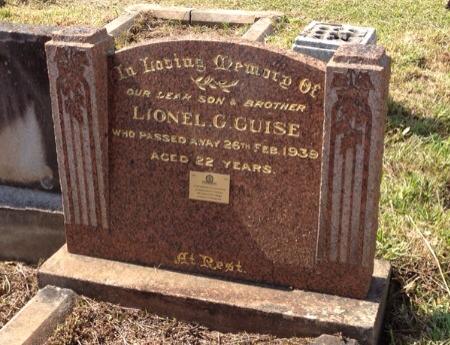
On the afternoon of 26 February, 1939 Constable Guise and Sergeant Werner were patrolling the Newtown area when they were advised of a possible break and enter offence occurring in Marion Street, Newtown. On attending the address, the police stopped their vehicle beside a truck which had apparently been used in the offence. As they stopped, two men jumped from the truck and fled on foot, pursued by the two police. As Constable Guise caught up with one of the offenders the man turned and threw a torch, striking the constable in the chest. In the struggle that followed the offender managed to shoot the constable in the abdomen. Constable Guise died in hospital a short time later.
The Advertiser dated 14 June, 1939 reported on the trial of the murderer Leslie Murphy.
CONSTABLE SHOT WHILE MAKING ARREST-
ACCUSED SENT TO GAOL FOR MANSLAUGHTER.
SYDNEY, June 13 – Leslie William Murphy, 28, was found guilty before Mr. Justice Owen and a jury in the Central Criminal Court this morning with the manslaughter of Constable Lionel George Guise, 22, and was sentenced to three years’ imprisonment. Constable Guise was fatally shot at Newtown early in the morning of February 26 and died in hospital about seven hours later. The Crown Prosecutor (Mr. L.J. McKean K.C.) said that the Crown alleged that Murphy had been doing an unlawful act in attempting to resist apprehension. If a person resisted lawful apprehension and did something which brought about the death of a police constable, then, the Crown contended, such person would be guilty of manslaughter. Following the theft of a lorry a struggle took place between Guise and Murphy and Guise lost his life while lawfully apprehending Murphy.
The dying depositions of Constable Guise, taken at the hospital, were read in court. They were as follows: “We had a fight and my own gun went off. The other man did not have a gun. I don’t know the people. One ran one way, one another. I caught one and he threw a torch and missed. We had a scuffle. My gun went off and I felt a terrible pain. I shot from the ground at the man. I don’t know whether I hit him or not. He was about 35 years old.”
The constable was born in 1916 and joined the New South Wales Police Force on 22 November, 1937. At the time of his death he was stationed at Newtown.
NEWTOWN LOCAL AREA COMMAND POLICE COMMEMORATION SERVICE
http://www.parliament.nsw.gov.au/prod/parlment/hansart.nsf/V3Key/LA20130508056
Ms CARMEL TEBBUTT (Marrickville) [7.07 p.m. 8 May 2013]: Recently at Rookwood Cemetery I attended a memorial service to commemorate police officers from the Newtown local area command killed in the line of duty. The moving service was attended by Deputy Police Commissioner Nick Kaldis, Superintendent Simon Hardman, the commander of the Newtown Area Local Command, many other police representatives, and relatives and descendants of the police officers. Those attendees included Ms Avona Wallace, Mr and Mrs Norman Stephenson, Mrs Lynette Everton and Ms Edna Stevenson. Representatives from the emergency services and community members were also in attendance. The member for Campbelltown, Bryan Doyle, attended representing the Premier.
The five officers being remembered at the ceremony gave their lives to protect the community. They were Constable First Class John Wallace, Constable First Class Ruston Stephenson, Constable Lionel Guise, Detective Inspector Reginald Stevenson and Constable Pashalis Katsivelas. The ceremony to mark the sacrifice of these officers reflected on the enormity of their contribution to the community, as well as the impact of their death on their families. It is often said, and it is true, that police officers leave their homes for each shift uncertain of what any day may bring and whether they will return at the end of the day. We owe these men and women our deepest gratitude for the risks they face and take every day in their job. At Rookwood Cemetery we visited each of the graves of those officers who lost their lives in the line of duty and behind each individual was an illuminating life story.
We began at the grave of Constable First Class Ruston Stephenson, who died 80 years almost to the day of the commemoration. Constable Stephenson joined the Police Force in 1912, and four years later enlisted in the army, later joining the fight in France during the First World War. He was awarded the Distinguished Conduct Medal for conspicuous gallantry in rescuing injured soldiers while under fire. Remarkably, when he returned he rejoined the Police Force and continued to serve until his death on 9 April 1933 after a tragic accident involving a motorcycle at the then Newtown Stadium while performing general duties policing.
We were also told the story of Detective Inspector Reginald Hugh Stevenson—I was honoured on the day to meet his widow, Ms Edna Stevenson, who still had strong memories of the incident that led to Inspector Stevenson’s death. Detective Inspector Stevenson joined the NSW Police Force as a cadet in 1943 at the age of 17. In an act of extraordinary selflessness, Detective Inspector Stevenson was on annual leave on 9 December 1974 when he decided to go to work to assist in the planned arrest of a dangerous offender in Newtown, at the time telling his wife, “I don’t want my boys doing this on their own.” During the operation he was shot in the chest after leading his team in pursuit of the offender.
Detective Inspector Stevenson partially recovered and was awarded the Queen’s Commendation for Brave Conduct and the Queen’s Police Medal for Distinguished Service. However, he died in 1980 of a heart attack, deemed to be the result of the injuries he sustained on duty in 1974. These officers are just a few of many across New South Wales whose lives have been cut short as they have gone about performing their duty. I pay tribute to them all. They will not be forgotten and local events such as this are a powerful reminder of their sacrifice.
I also take this opportunity to acknowledge two Marrickville police officers, Sergeant Stewart and Constable Steele, who on Monday of this week rescued an intellectually disabled person from a house fire in Marrickville. Thankfully, those two officers who took huge risks survived and are quite rightly being hailed as heroes by their colleagues and the community. It is yet another example of the risk our police men and women take every day in order to keep the community safe. I take this opportunity to pay tribute to them.
[divider]
Norman Thomas ALLEN
Norman Thomas ALLEN
New South Wales Police Force
Rank: Constable
Regd. # 32??
Stations: Waverley
Served: From 14 May 1926 & Resigned then rejoined on 26 September 1928 to 3 January 1931 = 3+ years Service
Awards: No find on It’s An Honour
Born: ? ? 1901
Died: 3 January 1931
Age: 29
Cause: Shot – Murdered at Bondi Junction
Funeral date: 5 January 1931
Funeral location: Rookwood Cemetery
Buried: Buried in Rookwood Cemetery ( side by side with Ernest Andrews )
Zone: C Section: 09 Grave 4212
DOUBLE POLICE MURDER
Memorial location:

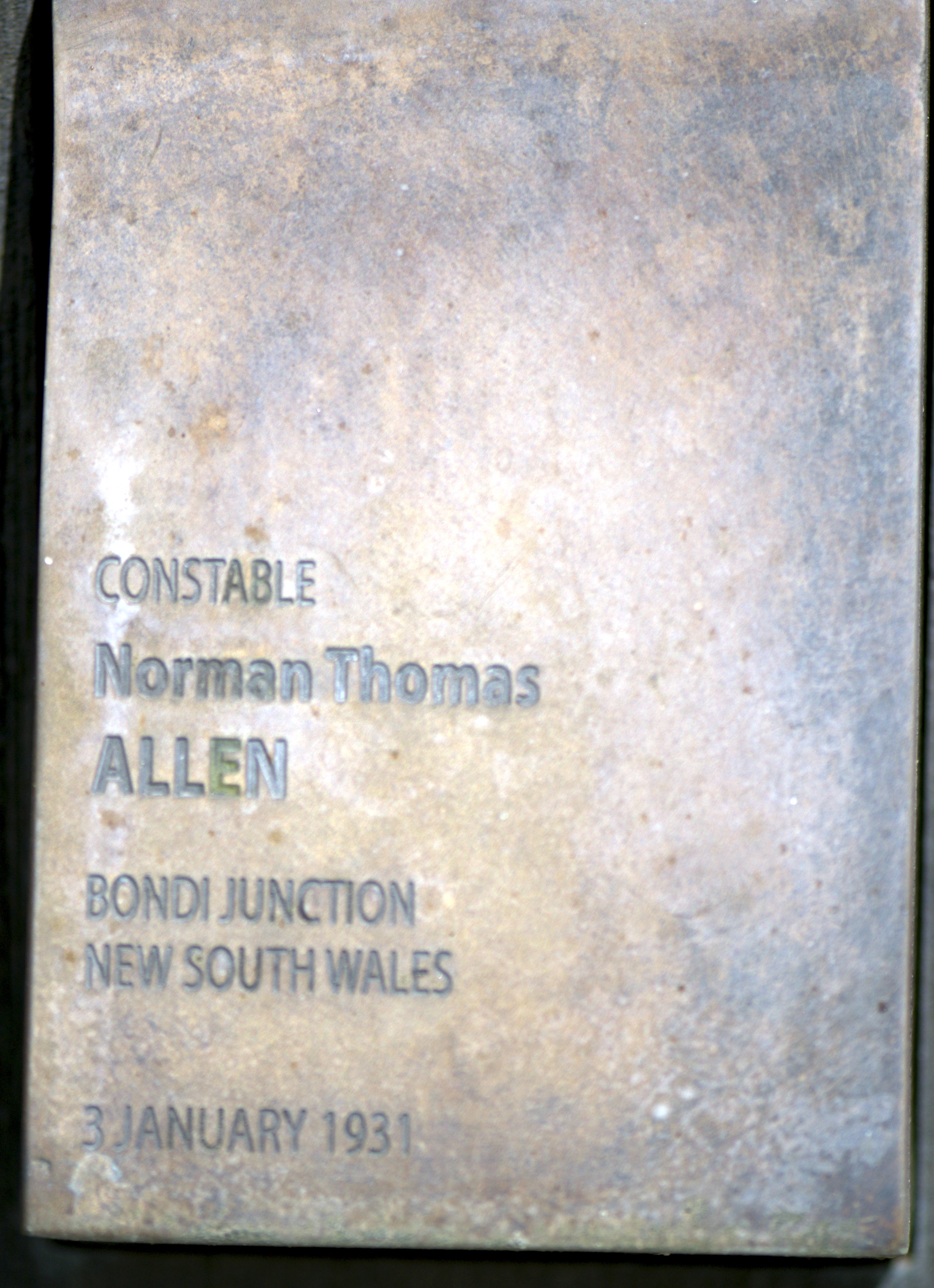
[alert_green]NORMAN IS mentioned on the Police Wall of Remembrance[/alert_green]
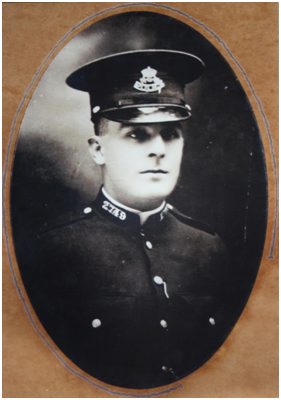
Constable Allen was shot in the street at Bondi Junction while attempting to detain an armed, deranged man named Kennedy who had earlier had an altercation with a local shopkeeper. The constable had been directing traffic and when informed of the dispute he found and confronted the offender. As he approached Kennedy from behind, the man spun around and shot Constable Allen in the chest at point blank range. He then shot the constable twice more in the heart. At this time Constable Andrews – unarmed, off duty and heading for the beach – passed by in a tram and saw a crowd gathered around the body of Constable Allen. Alighting from the tram he joined in the pursuit of Kennedy who managed to reach his home in nearby Lawson Street.
On arriving and finding the front door locked Constable Andrews went to the rear of the dwelling and burst through the back door. Unfortunately Kennedy was waiting with rifle raised and as Andrews lunged at him he shot him twice in the chest. He then took a knife and stabbed the constable in the throat. Sergeant Seery and Constable Johnson from Waverley Police then arrived and began to smash their way in through the front door. Although fired at by Kennedy, Constable Johnson returned fire, hitting Kennedy in the chest. Seery and Johnson then smashed their way in and found the offender in a bedroom bleeding to death. He died that night.
In the aftermath of the murders, the Brisbane Courier dated 5 January, 1931 published a complete account of the entire incident, and concluded with the following.
COMMISSIONER PRAISES MURDERED POLICE.
Both murdered constables were highly efficient and popular officers. Allen leaves a widow and young child. He lived in New Street, Bondi. Constable Andrews was single, his only relative in Australia being a sister, Mrs Clark. The men will be buried tomorrow with full police honours. The Commissioner of Police Mr. Childs, in an appreciation, said “I wish to pay a tribute to the manner in which both these young men carried out their duty according to the best traditions of the service. They saw their duty before them, and did not hesitate a moment in the execution of it. Although I would not make any distinction between them I cannot help referring to the action of Constable Andrews, who, though unarmed, rushed in to effect the arrest of a man who had already shot Constable Allen. “
Constable Norman Thomas ALLEN was born in 1901, joined the New South Wales Police Force on 14 May, 1926 and shortly thereafter resigned. He rejoined on 26 September, 1928. At the time of his death he was stationed at Waverley.
Constable Ernest ANDREWS was born in 1908 and joined the New South Wales Police Force on 24 April, 1929. At the time of his death he was stationed at George Street North Police Station.
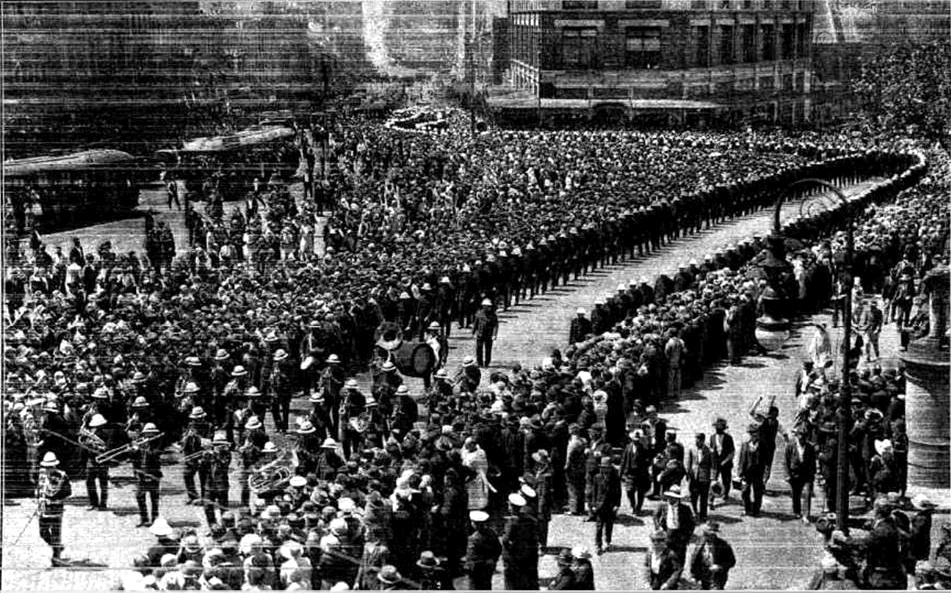
The Sydney Morning Herald Tuesday 6 January 1931 page 10 of 14
DEAD POLICEMEN.
Impressive Scenes at Funeral.
THOUSANDS PAY TRIBUTE.
The State paid homage yesterday to the two policemen, Constable Norman Thomas Allen and Constable Ernest Andrews who met their death at the hands of a madman at Bondi Junction on Saturday. There were mourners from almost every part of New South Wales.
Many thousands lined the route as the funeral cortege moved from Wood Coffill’s funeral parlours George-street to the mortuary station; the mortuary platform was thronged when the funeral train moved off to Rookwood and thousands had assembled in the cemetery.
The scene in the vicinity of Wood Coffill’s funeral parlours is likely to be remembered by the thousands of people who thronged the streets leading into Railway-square. Early in the morning bearers of wreaths and floral tributes passed through the doors to deposit their tokens of sympathy. At the approach of noon people began to assemble on the footpath and many entered the chapel to view the coffins. The near relatives arrived at 1 o’clock and the chapel was cleared while Constable Allen’s widow and her mother approached the silver mounted caskets which rested on trestles side by side. An affecting scene followed. Then the simple Church of England burial service was conducted by the Rev Frederick Riley and the coffins were borne to the waiting hearses.
MUFFLED DRUMS
The scene was unforgettable. A solid mass of people crowded the thoroughfares. Presently the mounted troopers urged their restive horses forward and with the deep roll of muffled drums the cortege moved off. Thousands of hats were removed.
Handel’s Dead March in “Saul” was played by the Police Band. Behind the band came a contingent of foot police under the direction of Superintendent Leary. Two hundred men drawn from the various stations, marched behind. Then came the hearses, the wreath-laden carriages, and the chief mourners, Firemen, the sun glinting on brightly-polished helmets, were represented by over 40 uniformed officers and men. At the end of the slow-moving procession came numbers of retired men, friends of the dead officers, and business people from the eastern suburbs.
Along the route to the mortuary thousands stood bareheaded as the cortege passed. At the mortuary gates another huge crowd paid tribute to the dead men.
Among those who marched in addition to the police and firemen, were employees of motor bus companies in the eastern suburbs.
“THEY SAW THEIR DUTY.”
A most affecting scene at the graveside in the Church of England section of the Rookwood Cemetery was the playing by the police band of the hymns “Lead Kindly Light” and “Abide With Me.” The remains were buried side by side.
“Let men’s opinions be what they may,” said the Rev. Frederick Riley in an address at the graveside, ” we should be doing violence to the most sacred emotions of human life if we were to allow our brethren to depart without a word of farewell. We are met here today to pay honour to the memory of two men who were comrades of yours men whom we all respected and loved. Let us remember that these two men died in the carrying out of their duty. They served their King and country as men and soldiers who fall for their King on the battlefield. They saw their duty and the fear of death could not deter them. They have not created a new tradition for the traditions of the police force of New South Wales are amongst the highest in the world already, but these two men have added a new lustre to the traditions of your past. These two young men Norman Thomas Allen and Ernest Andrews, died in the execution of their duty. There is no higher glory to which a man can aspire. We pray to God that those who have been so suddenly bereaved may share the comfort which we know these two brave men are experiencing in the nearer presence of God.”
MAGISTRATE’S TRIBUTE
At the Burwood Police Court yesterday Mr. G. R. Williams, S.M. commented on the bravery of the two constables. They acted nobly and upheld the traditions of the force,” he said.
PALL BEARERS AND MOURNERS.
The pall bearers were.- For late Constable Allen: Constables Tomkins, Martin, Moore, Hudson, Steele and White. For late Constable Andrews: Constables Booth, Kimber, Fraser, O’Neill, Morgan, and Wright.
The principal mourners were Relatives of the late Constable Allen: Mrs Allen (widow), Mrs Prankish (mother-in-law), Mr and Mrs N. Frankish (brother In law and sister in law), Mr and Mrs Sutcliffe (uncle and aunt) Mrs Lamb, Mrs Hourigan, and Mrs Cummings (aunts) and Mr Rowland Allen (cousin).
Relatives of the late Constable Andrews: Mr and Mrs Edward Clarke (sister and brother in law).
The Government was represented by Mr Gosling (Chief Secretary) and Mr McKell (Minister for local Government). Police representatives in addition to the non commissioned officers and men who marched were Mr W H Childs (Commissioner) Superintendents Leary, Mackay and Linegar, Inspectors Winter, Weir, Bennetts, McCauley, Woodrow, Lynch, Duffell, Roberts, McMaster, O’Brien, Chaseling, Anderson, White, Long, Roser, Scott, Michaelis, Robson, Allen, Farley and Fowler.
Retired members of the police force who attended were ex-Commissioner James Mitchell, ex-Superintendents Roche, Cook, McIntosh, Sinclair, Thom, Drew and Park, ex Inspectors Fullerton, W J Jones (also representing the Navy and Army Veterans Association) Fraser, Tracey, Bolton, Smith, Fewster, Doran, Mankletow, Stutchbury, Briggs, Ewen, Dunn, O’Dea and Robertson, ex-Sergeants McDonald, T. Dobson, Payne, A. Smith, Taylor, J. Salmon, J. Loomes, R. C. Harper, Bath and Butcher, ex-Constables Swan and Dixon.
The Board of Fire Commissioners of New South Wales was represented by Mr T J Smith, M.L.C. (president) Mr J McNamara (Commissioner), and Mr H M Webb (secretary and executive officer).
Mr Nance chief officer New South Wales Fire Brigades was present and 38 men marched under Mr Grimmond (deputy chief officer). Inspector Neeve, District Officer McLachlan, and Station Officers Arthur, Neville, Parkes, McCarthy, Rust, Currier and Sclater.
Others who attended were:- Judge Sheridan, Mir George Cann, ex M.L.A., Mr J Herlihy ( Under-Secretary for Lands) representatives of the Prisons Department including Mr Seery (superintendent of the Long Bay Penitentiary) Mr T.W. Irish (Assistant Under Secretary for Lands) Mr H. B. Mathews, (Surveyor General Department of Lands).
Mr N. W. Bond (representing the head office Bank, of New South Wales) representatives of ambulance divisions, Mr. and Mrs. C. R. Law, Mr. A. L. Parker (representing Superintendent O. H. Parker, of Goulburn) Mr Foster Doolan (vice president Police Association), Mr B Fortescue (secretary Police Association), Mr C T Thackeray (Police Association staff), Mr F M Jackson (representing Mr F C Hackett of Merriwa), Mr W T Missingham,
M.L.A., Mr A J Pollack, M.L.A., Mr W P Monaghan (Waverley Cemetery bus service), Mr W M Niland Mrs A Shuttleworth, Mr H L Harnett (representing Mr F M Burke, Speaker of the Legislative Assembly), Mr W E Clapin (representing Sir John Peden, President of the Legislative Council), Alderman David Hunter (Mayor of Waverley), Mr T J Thompson (Deputy Town Clerk of Waverley), Mr and Mrs A Williams, Miss Williams, Miss Beryl Williams, Miss Brady, Mr and Mrs McMorland, ex Warder Charles Stone, ex Warder Little and a number of eastern suburbs business people.
The wreaths Included those from the mother and other relatives of the late Constable Allen, relatives of the late Constable Andrews, the New South Wales Police Commissioned Officers Association, comrades of No 2 Division, Redfern Police, New South Wales Police Association, members of the Railway Detective Office, officers, detectives, and staff of the C.I.B., No 3 Police, comrades of No. 10 Division, cyclists and drivers of police headquarters, officers and men of Circular Quay Fire Station, comrades at No. 4 Station, police at No 7 Station, “police pals at Bondi Junction.” end eastern suburbs bus drivers and conductors.
http://trove.nla.gov.au/ndp/del/article/16743642
Frederick William MITCHELL
Frederick William MITCHELL
New South Wales Police Force
Regd. # ‘Q’ 9212
Rank: Constable 1st Class
Stations: ?, Moss Vale
Service: From 31 March 1911 to 17 December 1920 = 9 years, 8 months, 16 days Service
Awards: No find on It’s An Honour
Born: ? ? 1890 at Newtown, NSW
Died on: Friday 17 December 1920
Cause: Shot – Murdered
Event location: Bowral, NSW
Age: 30
Funeral date: Monday 20 December 1920
Funeral location:
Buried at: Moss Vale General Cemetery, Berrima Rd, Moss Vale, NSW
Grave: Catholic Section, Row 1, Plot 14
[codepeople-post-map]
Memorial location:
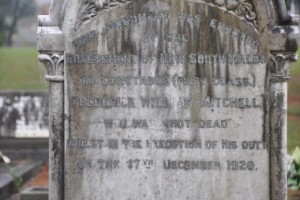
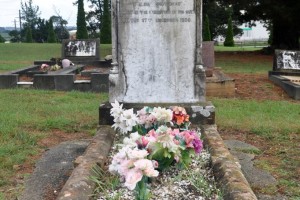
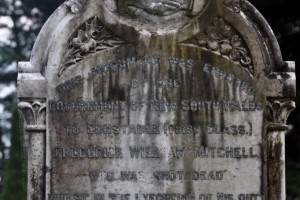
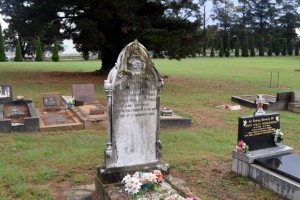
![This monument was erected by the Government of New South Wales to Constable [First Class] Frederick William Mitchell who was shot dead whilst in the execution of his duty on the 17th December 1920.](https://www.australianpolice.com.au/wp-content/uploads/2012/10/2014-0969-300x200.jpg)
![This monument was erected by the Government of New South Wales to Constable [First Class] Frederick William Mitchell who was shot dead whilst in the execution of his duty on the 17th December 1920.](https://www.australianpolice.com.au/wp-content/uploads/2012/10/2014-0971-300x200.jpg "Photos taken in 2014 by Cal")
FREDRICK IS mentioned on the Police Wall of Remembrance
On the evening of Friday 17 December, 1920 neighbours rang Moss Vale police to say that they could hear shooting coming from Major Thomas La Barte‘s house, “Old Castle“, near Bowral.
Sergeant Mackie then rang La Barte, and asked him if anything was wrong, however all the major would say was, “I’ve gone over the line, I’ve gone over the line!” Suspecting that something serious was occurring, or had occurred already, the sergeant quickly sent Constable Mitchell out to the house on a motor cycle while he (Sergeant Mackie) followed on a push bike. On the way to the house Constable Mitchell met Constable Edward Charles Finch of Moss Vale police, and they both went out to La Barte’s home together.
At the dwelling, which appeared quiet and deserted, the three policemen consulted for a few minutes and then decided to search inside. They crept up to the front bedroom window, and looking through, could see Mrs La Barte lying on her back on the floor. The police then separated, with Mitchell going to the back door and the other two going to the front door. Constable Mitchell then entered the house through the door and into a hallway. A few moments later a shot was heard, followed by a heavy thud on the floor. Fearing that Mitchell had been shot, Sergeant Mackie immediately ran in through the back door and, reaching the end of the hallway barely escaped being shot in the head when another shot dislodged plaster from the wall near his head. Although both Sergeant Mackie and Constable Finch made several attempts to enter the hallway they were driven back each time by the unseen offender.
Police reinforcements had begun to arrive by this time, and Constable Charles Eadie (Bowral) then climbed through the window of the maid’s room while the other police, including Sergeant Henry John Shailer (Bowral), fired shots into the house to distract the offender. At this time Constable Eadie heard the offender call out to the police, and realizing that the voice came from the drawing room, he switched on the light in that room and saw La Barte crouching under the table with a double barrelled shotgun in his hand. Eadie leapt on the offender and pinned him to the floor with one hand on his throat, and the other on the shotgun.
When the house was searched, five revolvers and a rifle were found. The body of Mrs Doleen Maud La Barte, the offender’s wife, was found with sixteen bullet wounds to her head and chest, while the body of Constable Mitchell was found in the hall with wounds to the head and stomach.
The Argus newspaper of 23 December, 1920 reported on the inquest into the two deaths, including the words of the coroner, who paid a tribute to the police for their bravery in effecting La Barte’s arrest, and said, “I wish to especially bring under the notice of the authorities the conduct of Constable Eadie. This young officer, at considerable peril and risk, rushed into a darkened room, and although it would have been easier to have shot La Barte, he effected the capture without shooting him. He is to be commended for this, and I hope it will not be overlooked by his superiors.”
The constable was born in 1890 and joined the New South Wales Police Force on 31 March, 1911. At the time of his death he was stationed at Moss Vale.
Scrutineer and Berrima District Press (NSW : 1892 – 1948),
Saturday 25 December 1920, page 2
OLDCASTLE TRAGEDY.
CORONIAL INQUIRY. WITNESSES BREAK DOWN.
The circumstances surrounding the murder of Mrs. La Barte and Constable Frederick William Mitchell at “Oldcastle” on Friday last were inquired into at the courthouse, Moss Vale, by Mr. H. W. Taylor, district coroner.
The small available space in the courtroom was overtaxed by persons desirous of witnessing the proceedings. Mr. F. O Ebsworth (Sydney) appeared for La Barte, and Mr. B. H. Paine watched the proceedings on behalf of the police.
Major La Barte was brought into the courtroom between two policemen. He is a fine-looking dark young man with the build of an athlete, of medium height, and he was neatly dressed, also wearing a soft shirt and bow tie. He wears a small military moustache, and his distinguishing features are his large blue eyes, set wide apart, and his well-formed lips and mouth. He sat in the dock, with one neatly shod ankle hoisted on to his knee, and he displayed a keen interest in the proceedings. Otherwise he was unperturbed, and showed no signs of nervousness.
The first witness was William James Robb, solicitor, of St. Kilda, Victoria. He said that on Sunday last at Oldcastle he had identified the body as that of his daughter, Doleen Maud La Barte, aged 26. She was born in Melbourne, and was married to Thomas Butler La Barte in July, 1919, in Sydney.
Henry Wesley Mitchell, furniture manufacturer, Moss Vale, brother of the late Constable Mitchell, broke down and wept hysterically as he entered the box. Recovering, he said that at about midnight on Friday last, at Oldcastle, he identified a body as that of his brother, who was born at Newtown and a married man, 30 years of age. He had no children, and had been about nine years in the service; the last time witness saw his brother alive was at about 5.15pm on Friday last, being then in his usual good health.
The witness, during his evidence, suddenly looked across at the prisoner in the dock and cried “Let me at him and I will kill him.”
Senior Sergt. Alexander Mackie, of Moss Vale, deposed that at about 6 p.m. on Friday last he received a message from Mr. T. Mack, licensee of the Royal hotel. After conversation with Constable Mitchell he rang up Major La Barte, who replied “La Barte speaking!” Witness inquired if he wanted to see him and La Barte answered “You had better come out; I have just gone over the line (or over the mark).” Witness asked what was the matter, and La Barte said “Oh, just gone over the line; I might be dead when you come out!” The sergeant asked, “What have you done?” and he answered, “Oh, just gone over the line.” Witness then said he would go out and talk to him and settle matters alright.
Constable Mitchell went to Oldcastle behind a man named Howard on a motor cycle, and he (witness) followed on an ordinary bike. When he rode up to the house he saw Constables Mitchell and Finch coming from the rear of it. “Constable Mitchell and I,” continued witness, “looked through the window of Mrs. La Barte’s bedroom and saw a woman lying on the floor apparently dead. We then went to the rear of the house, placing Constable Finch at the front of the house where he could watch if anyone left, Constable Mitchell meanwhile walking around to the back. As witness followed and entered the back passage he could hear Constable Mitchell‘s footfalls in front; when about two yards from the main hall he heard a shot. Constable Mitchell cried, “Oh, my God!” and witness heard a fall. Witness went on to state that he was just stepping from the passage into the main hall when another shot was fired, which must have passed very close to him, as some plaster fell around where he was standing.
Constable Finch then came running up to him. A curtain hanging in the main hall obstructed their view and the person who fired the shot and Constable Mitchell were both on the opposite side of it. He got down on his knees and tried to see who fired the shots, but all I could make out was the muzzle of a gun rising slowly from the floor and just as he drew back another shot was fired. He then took his boots off and decided to get through a window, but as he was approaching it two shots were fired and he was forced back; a mattress on the verandah near the wall obstructed him. He then went out and found the man Howard, who went and procured assistance, and six civilians from Moss Vale arrived and surrounded the house to prevent anyone escaping; about 9 o’clock Sergt. Shailer and Constable Eadie arrived from Bowral; witness and Constable Eadie went to the window of the maid’s room, and fired three shots in with the intention of locating the person inside; there was no response; he left Constable Eadie, and he and Sergt. Shailer went round to the opposite side and fired two shots into the lighted room, and immediately La Barte called out, “Come in, I have no firearms” — he was in the dining room next to the lighted room. Sergt Shailer then went into the room and witness followed. Just then Constable Eadie called out, “I’ve got him.” They went in, and saw La Barte lying on his back on the floor and handcuffed.
Altogether, some 30 shots were fired, from the passage and windows. The dead body of Constable Mitchell was lying near the telephone.
He had a large wound in the groin, and part of the left side of the head was blown away. His regulation revolver, loaded in five chambers, had never been taken out of the pouch.
In Mrs. La Barte‘s room witness saw the dead body of Doleen Maud La Barte, who was lying partly on the left side, and dressed only in a nightdress. There was a large wound in her head. Near the body on the floor was lying the rifle produced. It had jammed, and was not fit for use. It contained four live cartridges and one empty shell The revolver produced was found in Mr. La Barte‘s room. It had also become jambed, and contained three live cartridges.
At the police station La Barte suggested sending a wire to his uncle. When asked what he wanted in the wire, he said: “Arrested for murder; no excuse; must have gone mad!”
While Constable Mitchell and witness were in the passage, he heard a voice at the telephone say: “I want the police station. Send out the police. I want to kill them all.”
In all about 3o shots were fired at Oldcastle from the passage and windows of the house, while Constable Finch and witness were there.
Every time they attempted to look down the passage a shot was fired.
When La Barte was arrested he was drunk — stupidly drunk. “Otherwise,” added witness, “we should all have been shot, I reckon.”
Dr. F. C Stevenson described the injuries received by the two dead persons; the constable died from the gunshot wound in the skull and Mrs. La Barte from a bullet wound through the skull; there were sixteen bullet wounds in various parts of Mrs. La Barte‘s body; in some instances the entry and exit of the same bullet accounted for two wounds.
When witness was at Oldcastle on Friday night La Barte, lying on the floor, opened his eyes, and said “Hullo, is that you, doc?” Witness said, “Yes.” Prisoner said, “How much strychnine would it take to knock a chap out?” Witness said, “Oh, you’re alright.” La Barte spoke quite rationally.
Sergt. Mackie: Could you say anything about his sobriety.
Dr. Stevenson: No, I could not.
Lily Drain, cook and housekeeper at Oldcastle, said that at 5 30 p m. on Friday she heard a bell ring; this was followed by screams from Mrs. La Barte, and her voice calling “Tammy’s shooting me.”
Witness went into Mrs. La Barte‘s room; Mrs. La Barte stood near the bed, facing her; La Barte had his back to witness. Mrs. La Barte cried out, “Lily, he’s shooting me.” Two shots were fired rapidly. The room was darkened. La Barte appeared to be holding his wife with his left hand and a revolver was in his right hand. (Witness at this stage broke down). Continuing, witness said that she ran out of the house into the yard, calling to the men to go quickly for the police, as Mrs. La Barte had been shot.
Mrs La Barte had not been well that day, and had remained in bed, with the exception of a few minutes at lunch time, when she heard La Barte say to his wife, “Are yo happy, Nooks?” She said, “Certainly not, Tammy — not for the next 24 hours.” Later, Mr. La Barte took his wife a hot water bottle and told witness not to disturb her and to watch the telephone; he subsequently left the house; he was addicted to whisky drinking.
James McKay, farmer, employed at Oldcastle said that when Lily Drain gave the alarm he went out looking for the saddle mare; he found her near the garage, ready saddled. As he went to mount a shot rang out and the mare fell. Witness saw La Barte on the verandah with a revolver in his hand. Witness ran, and three shots were fired — one struck the ground before him and another just behind him; he did not know where the other one went.
La Barte drank whisky a good deal, but it was difficult to tell when he was drunk; his eyes looked peculiar that afternoon before he went to Moss Vale.
Constable Edward Finch said that after Sergeant Mackie left him in the passage after Mitchell had been shot, whenever he tried to look into the passage where Mitchell lay a shot would be fired. Then La Barte went to the telephone and called the police station and said, “Send more policemen, I will shoot them all.” Shortly after he again called the station and said “La Barte here; I have shot one policeman ; I will shoot them all ; leave La Barte alone, he is all right.” Later he saw La Barte crawling along the passage with a gun in his hand. Immediately witness showed himself La Barte fired at him. Witness fired twice and La Barte fired again. Witness fired once more and La Barte crawled away into the room, where he was later caught by Constable Eadie.
The constable added that he had been in conversation with La Barte and his wife the previous day, when the latter invited him to take shelter at Oldcastle from the storm; La Barte then appeared quite rational.
Constable Charles Eadie, of Bowral, said that after he was left alone outside La Barte‘s room he heard three shots from the other side of the house. When the last were fired he heard someone say “Come in ; I’m not armed.” He then got into La Barte‘s room and locked the door of the left-hand room. He then went to the door leading to the hall, and flashed his electric torch up and down the hall and across into the dining room, as both the rooms were in darkness. As a result he saw La Barte lying under the table with a gun in his hand.
Witness rushed into the room and caught the gun in one hand and seized La Barte‘s throat with the other. He took a double barrelled breech-loading gun from him, which contained one live and one empty cartridge. In his pockets he found 20 loaded cartridges. He called out, “I’ve got him,” and, with the help of Finch and Shailer, handcuffed him.
Under the table where La Barte was lying was a decanter about half full of whisky.
With Sergeant Shailer witness took La Barte to Moss Vale police station, where he was placed in a cell.
La Barte said nothing further to witness. His conversation was rational. He was stiff in the legs and under the influence of drink.
To the Coroner: He could have shot La Barte; but thought discretion the better thing and arrested him.
Sergt Henry John Shailer generally corroborated Constable Eadie‘s evidence. He asked La Barte if he had realised what he had done and the prisoner replied “Don’t mention it, sergeant; I don’t want to talk about it.” He was groggy and unable to stand properly.
EVIDENCE OF DRUNKENNESS
Edward C. Bradbury, chemist, gave evidence concerning the purchase of two bottles of the best perfume at his shop by La Barte; he handed him the parcel, together with some medicine for his wife, which La Barte promised to take home; he dropped the parcel and one bottle broke on the floor; he was under the influence of drink, but witness noticed nothing peculiar about him, except that he was not as chatty as usual.
Edward Breen, laborer, of Berrima, corroborated the chemist’s evidence re the breaking of the bottle of perfume. La Barte, he added, was drunk, swaying from one side to the other in front of the counter.
A man named J. Egan, from Exeter, prevented prisoner from riding his horse afterwards into the shop. La Barte told him to leave the horse alone and said, “If you come on to the street I will fight any one of you!” Egan replied “I could not fight a paper bag,” and advised La Barte to go home like a good man, when prisoner left.
Leslie Edward Wallis, a drover, said he met La Barte at the sale yards on Friday last, who stated that he was pleased with the bull witness had sold him. After more conversation respecting cattle he muttered something and then asked witness to go with him to the hotel and “have a wad.” Subsequently, La Barte appeared to witness to be drunk.
The evidence concluded at 4 p m.
The Coroner returned a verdict that Mrs. La Barte and Constable Mitchell had been murdered by Major Thomas La Barte, whom he committed for trial at the Central Criminal Court, Sydney, on March 21, 1921.
The Coroner paid a tribute to the police for their bravery in effecting La Barte‘s arrest, and said: “I wish to especially bring under the notice of the authorities the conduct of Constable Eadie. This young officer, at considerable peril and risk, rushed into a darkened room and, although it would have been easier to have shot La Barte, he effected his capture without doing so. He is to be commended for this, and I hope it will not be overlooked by his superiors.”
Scrutineer and Berrima District Press (NSW : 1892 – 1948),
Wednesday 8 June 1921, page 2
Moss Vale Tragedy.
It is announced that the charge of murdering Constable Frederick William Mitchell, upon which Major Thomas la Barte was remanded to the next sittings of the Criminal Court, will not now be proceeded with.
The constable was one of the victims of a tragedy which occurred at Moss Vale on December 17 last. After a trial for murder lasting two days la Barte was sentenced to seven years’ hard labour, the verdict of the jury being that he was guilty of manslaughter in relation to the death of his wife.
http://trove.nla.gov.au/newspaper/rendition/nla.news-article124751058.txt
The Friends logo is derived from the female figure that forms part of the impressive Robb monument, located to the left upon entering the cemetery from Dandenong Road.
An inscription on the pedestal of the monument refers to Doleen Maude La Barte, the only daughter of W J and E M Robb who was murdered by her husband, Major Thomas Butler La Barte on 17 December 1920 at their home at Moss Vale, New South Wales.
The Argus newspaper of 20 December 1920 told the tragic story:
Details of the shooting of the wife of Major Thomas Butler La Barte, the shooting of Constable Frederick William Mitchell and the arrest of Major La Barte near Mossvale on Friday night give a story of grim tragedy. Major La Barte is the son of the Rev. T. La Barte, formerly of Brighton. Major La Barte, who was educated at the Brighton Grammar School, is 34 years of age. He served with distinction in France in the Royal Field Artillery, gaining the M.C. Mrs La Barte was well known in Melbourne. She was the only daughter of Mr. W. J. Robb, and was 27 years of age.
Major La Barte was in Mossvale on Friday, and, according to the police account, was drinking heavily. Not long after his return home at about 6 o’clock, the cook at the house was summonsed by her mistress’s bell. When the cook got to Mrs. La Barte’s bedroom she saw Major La Barte holding his wife by the wrist. Mrs. La Barte cried out “Oh, he’s shooting me!” Two reports from a revolver followed, and Mrs. La Barte sank down, shot in the head and chest. The neighbours telephoned to the police station at Mossvale, about two miles distant.
Constable Mitchell left for La Barte’s on a motor-cycle, and was followed by Sergeant Mackie, Mounted-constable Finch and Constable Eadie. Constable Mitchell entered the house at the front, when shots were heard, and Mitchell fell. He must have died instantly.
When darkness came on, Constable Eadie, who had an electric torch, climbed through the window of the maid’s room, while the other constables fired at the adjoining windows. Eadie walked into the living room, and found Major La Barte crouched beside the table, with a gun in one hand. With a leap Eadie reached La Barte, gripped him by the neck, and warded off the gun. While they were struggling other constables rushed in. La Barte was disarmed, and taken into custody.
After reaching the police station, Major La Barte spoke of having pains in his head, but said nothing further. The funeral of Constable Mitchell was largely attended. He left a young widow, but no children.
http://foskc.org/about/our-logo/
First published on 23 March 2014.
Updated 18 September 2025.
George Joss DUNCAN
George Joss DUNCAN
New South Wales Police Force
Regd. # ‘Q‘ 9575
( For the purposes of this website ‘Q’ represents those Police joining between 1 March 1862 ( commencement of NSWPF ) – 23 February 1915 ( Commencement of NSWPF current numbering system )
Rank: Probationary Constable – appointed Saturday 4 January 1913 – Mounted Constable
Stations: Forbes, Bogan Gate, Grenfell, Tottenham ( by 3 days )
Service: From 4 January 1913 to 26 September 1916 = 3+ years Service
Awards: No find on It’s An Honour
Born: 1891 in Scotland
Died on: Tuesday 26 September 1916 a few minutes after 9pm. The eve before his marriage.
Cause: Shot – Murdered at Tottenham
RESULT: Offender Frank FRANZ & Ronald Nicholas KENNEDY were hanged at Bathurst Gaol at 9am on Wednesday 20 December 1916
Age: 25 – 27
Funeral date: Sunday 1 October 1916
Funeral location: ?
Buried at: Parkes Cemetery, Want St, NSW
Plot Presbyterian, Row M
Memorial location: Parkes Cemetery, Want St, Parkes, NSW
Lat: -33.137193
Long: 148.192287
Note: GPS Coordinates are approximate.
George IS mentioned on the Police Wall of Remembrance

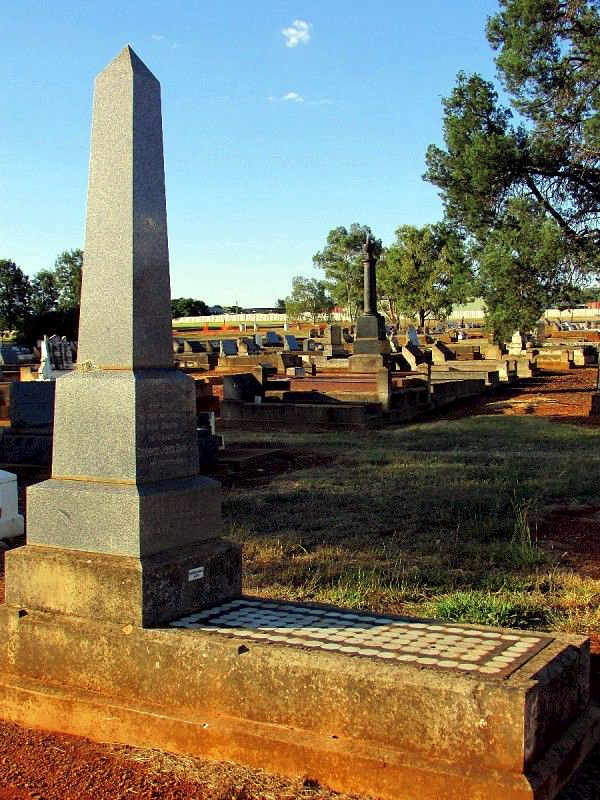
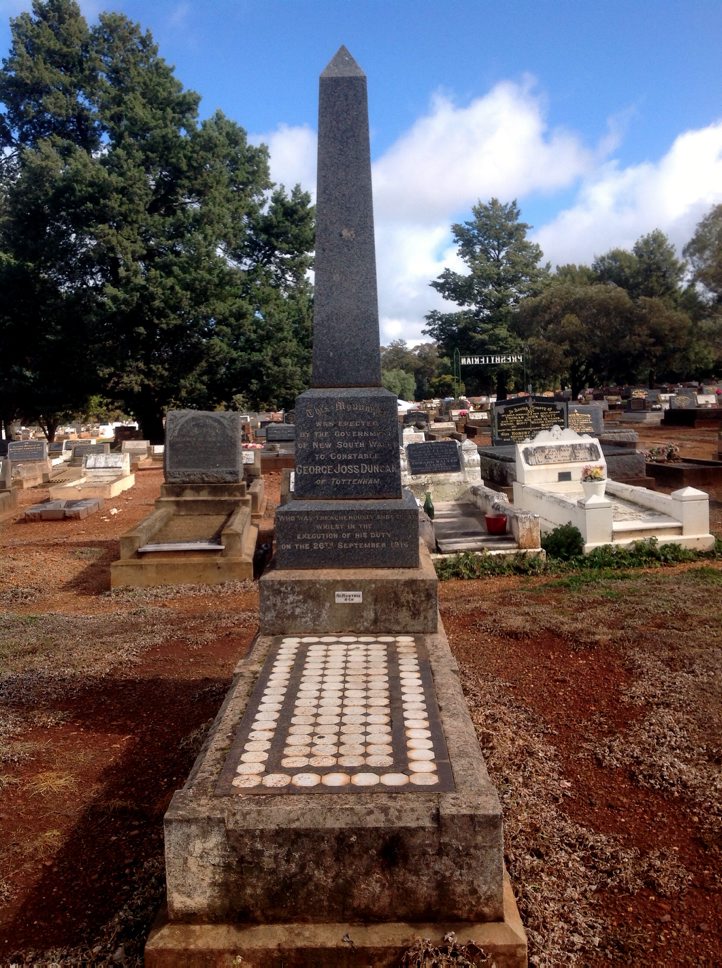
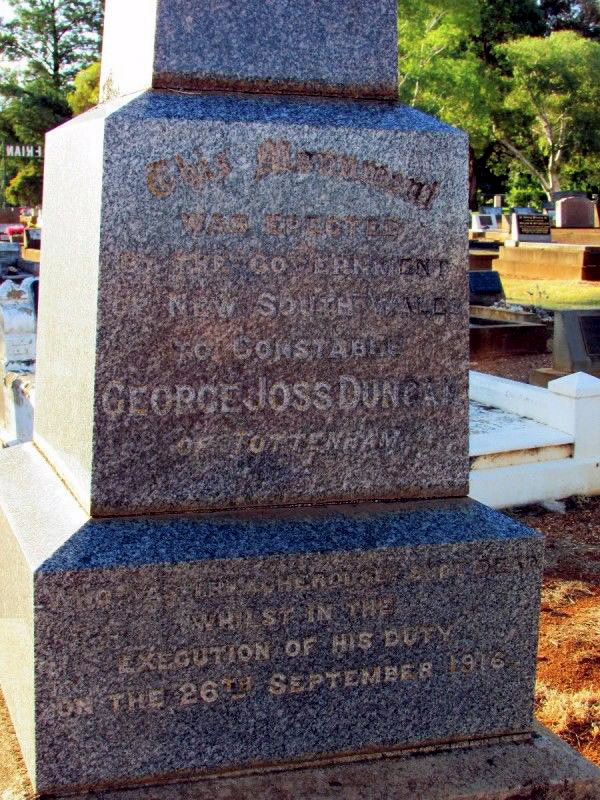
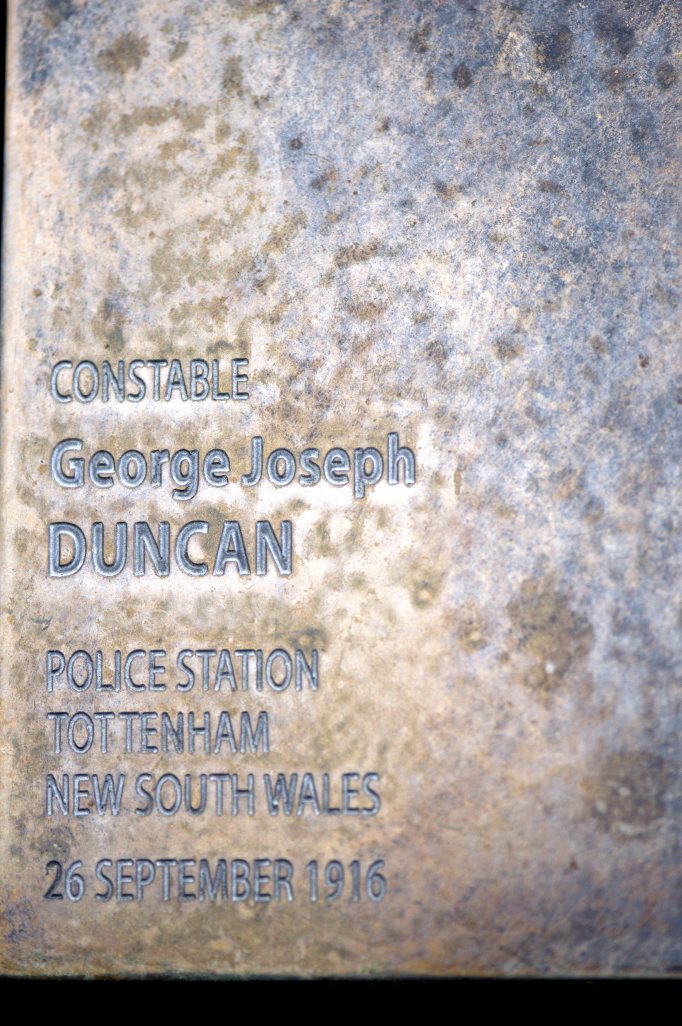
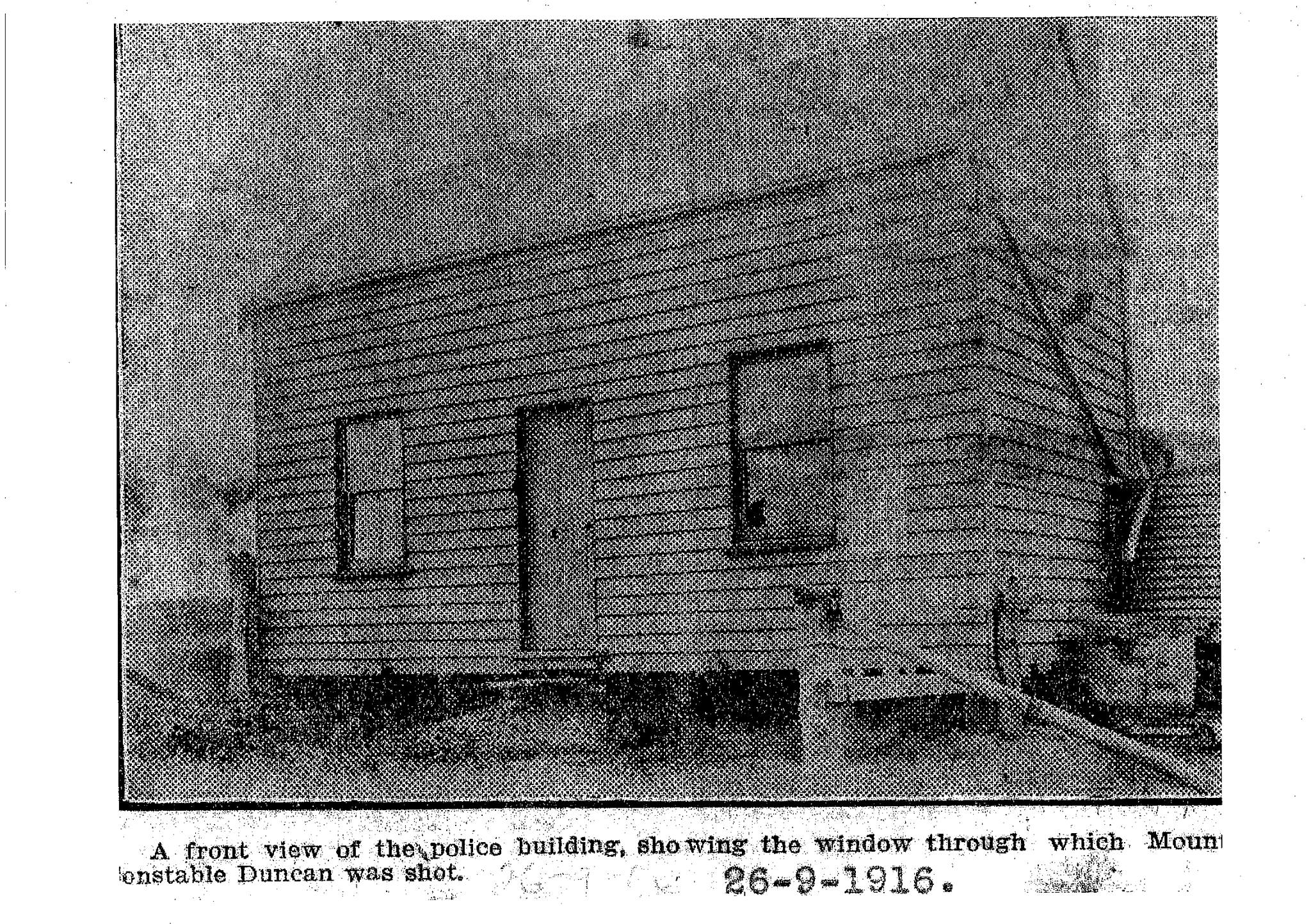
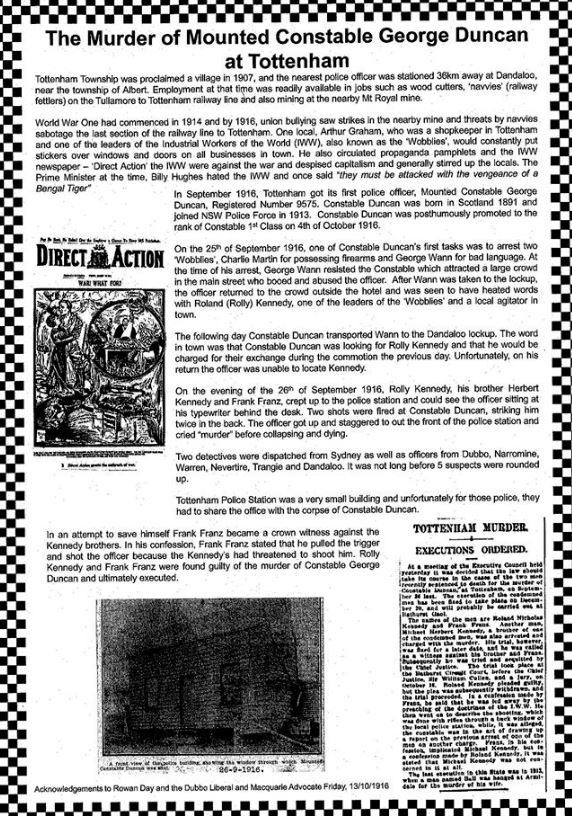
The constable was shot at the Tottenham Police Station by offenders Roland Kennedy (20) and Frank Franz (28). The offenders were members of the “Industrial Workers of the World” organisation during World War 1 and were incensed at the constable’s arrest of one of their members the previous day. While the constable was sitting typing at his desk in the station the offenders crept up to a small window behind him, aimed their rifles and shot him from close range. He died a few minutes later. Both offenders were arrested and hanged at Bathurst Gaol. A third accused, Michael Kennedy, was acquitted.
The Kalgoorlie Western Argus of 3 October, 1916 printed the following brief account.
A CONSTABLE MURDERED – Sydney, Sept. 27.
Confirmation has been received by the Inspector-General of Police, that Constable George Joseph Duncan, stationed at Tottenham about fifty miles from Trangie, was shot dead last night. Yesterday afternoon, Duncan was at Dandaloo and there arrested a German whom he lodged in the lockup there. After his return last evening, two shots were heard by the neighbours and Duncan was found lying dead in his office. He had apparently been working at a typewriter when the shots were fired. Detectives have been sent from Sydney to make investigations. Duncan was 25 years of age.
The constable was born in 1891 and joined the New South Wales Police Force on 4 April, 1913. At the time of his death he was stationed at Tottenham.
The Sydney Morning Herald
Thursday 28 September 1916 page 8 of 12
CONSTABLE SHOT.
TRAGEDY AT TOTTENHAM.
The Inspector-General of Police M.G. Mitchell, received a telegram yesterday evening stating that Constable George Joseph Duncan was found dead in the office of the Tottenham Police station at about 9 o’clock on Tuesday night. The information was communicated to headquarters by Constable McIntosh, who is stationed at Trangie, about 45 miles from Tottenham.
According to the telegram, two neighbours made the discovery. They heard a couple of shots fired, and on entering the lockup found Duncan dead. The position of the body made it apparent he had been using a typewriter when the shots were fired.
On Tuesday afternoon Duncan arrested a man whom he took to the Dandaloo Police Station, a distance of about 1 1/2 miles. After lodging the prisoner in the cell he returned to Tottenham.
Up to the present no clue has been found ; and yesterday morning two detectives were sent from Sydney to make investigations.
Duncan, who was 25 years of age joined the Service in 1913. He had previously been stationed at Forbes, Bogan Gate, and Grenfell.
http://trove.nla.gov.au/ndp/del/article/15688139
National Advocate ( Bathurst )
Monday 2 October 1916 page 1 of 6
TOTTENHAM MURDER
REWARD OF £200 SYDNEY, Sunday.
The Inspector-General of Police (Mr. Mitchell) has authorised the issue of a reward of £200 for information leading to the discovery of the murderer of Mounted-constable George Joseph Duncan, whose dead body was found in his office at Tottenham on Tuesday.
http://trove.nla.gov.au/ndp/del/article/158525265
Dubbo Dispatch and Wellington Independent (NSW : 1887 – 1932),
Tuesday 10 October 1916, page 1
TOTTENHAM MURDER
FULL STORY OF A FOUL CRIME.
BY SERGEANT MEAGHER.
Sergeant Meagher, after nearly a fortnight spent at Tottenham in investigating the murder of Constable Duncan, attending the inquest, etc., has returned to Dubbo.
Interviewed at his residence on Sunday, Sergt. Meagher supplied particulars of the crime, as learnt by him and his fellow officers, and elicited at the inquest.
Sergt. Meagher states that on the night of the murder he received instructions from Inspector Peterswald ( John Peterswald # Q5489 ) to go to Tottenham.
He proceeded to Trangie by the midnight goods train, which was late in arriving at Dubbo. He waited at Trangie till daylight, and got into communication with Tottenham, learning that Sergeant Scott, of Narromine, had just arrived after an awful night in the rain and mud. The night was pitch dark.
He rang up Dr. Bertram, of Trundle, who set out for Tottenham, but his car became bogged six miles from his destination.
The doctor then set out on foot and walked three miles, when he had the good fortune to get a lift in a sulky.
Without X-rays the doctor was unable to locate the bullet that had entered the body on the right side of the back.
Arrived at Tottenham after much tedious travelling owing to the soft state of the country, Sergt. Meagher, with Sergt. Sawtell (Warren), Sergt. Scott (Narromine), Constables Sykes (Nevertire), McIntosh (Trangie), McLean (Narromine), and Lewis (Dandaloo), made every possible inquiry and search of the police station and surroundings.
They located the suspects, measured up the building for the purpose of making a plan.
Subsequently Inspector Whitfield arrived from Forbes, and two detectives (Messrs. Davelin and Downey) from Sydney, and the suspects were brought to the station.
Constable McLean, having been stationed at Tottenham previous to the deceased, was of great assistance in the investigations.
The three accused and two others were brought to the station in strict silence without causing the slightest excitement in the village. “That, I am pleased to know,” said Sergt. Meagher, “gave general satisfaction to the public, and it was pleasing to hear the appreciative reference to the sound judgment and discretion of the police. It was a difficult task on account of the wet and cold weather, and the inadequacy of the arrangements for the housing of the suspects.
Two of those were kept in a wooden cell in the yard, and two others, were guarded day and night in the office.
The station is only a small structure— two rooms — and it was difficult for the police to converse without the prisoners hearing them.
The residents, however did everything possible to help the police, and,” said Sergt. Meagher with much earnestness, “we are all very thankful to the hotel keeper, Mr. Veech, and his good wife and staff, who did everything possible for our comfort and convenience. The meals and beds were excellent, and we were attended to in a way that warrants every gratitude, especially on account of the bad weather Mr. and Mrs. Veech had also to contend with.” Continuing, Sergt. Meagher stated that the late Constable Duncan had his life assured with the A.M.P. for £250. He was 27 years of age, a native of Scotland, and had only taken over Tottenham from Constable McLean (now of Narromine) on the 23rd ultimo— three days before he was foully murdered.
An attempt was made to dig a grave for his body at Tottenham, but it filled with water as fast as it was dug out.
“Sergeant Sawtell,” says Sergeant Meagher, “is deserving of all praise for the way he attended to the guarding of the prisoners in relays— and keenly alert to seize any little word or look, or piece of evidence to sheet home the guilt.
Sergt. Sawtell‘s good services will no doubt be a matter the inspector will not miss. The police worked together in a way that reflects the highest credit on themselves and the department. It was also very pleasing to observe that there was a total absence of any ill-feeling amongst the police towards the accused men, not withstanding the strain in full view of a murdered comrade in a small room with them from Wednesday to Friday morning, it was a great relief when the body passed out of our sight, seeing that we were not able to attend the funeral, which took place at Parkes, and we hope, and request, that Inspector Whitfield will be good enough to put the inward feeling of us all in the service with a view of a small coin being asked from all to mark the last resting place of poor Constable Duncan.
THE ACCUSED.
The three men detained in custody and subsequently committed for trial at Bathurst were Michael Herbert Kennedy, Roland Kennedy (brothers), and Frank Franz.
Preliminary to the crime certain events happened which are worth mentioning.
Deceased has only been three days in Tottenham.
Charles Martin, a German, was charged with having firearms in his possession, and at Dandaloo was fined £3 and costs by Mr. Gates, relieving P.M. of Dubbo.
George Wann, a German, the man arrested by deceased on the night before the tragedy, for obscene language and resistance to arrest, was taken by deceased to Dandaloo the next morning and lodged in the lockup — he pleaded guilty before Mr. Gates, P.M., and was fined £1 and £2 with costs.
Deceased was hooted by a number of men when he arrested Wann and he spoke to Roland Kennedy when he returned from the lookup, and was heard to say to Kennedy that it was no laughing matter.
A summons was found in the police office, but not declared or signed—no doubt it was prepared at Dandaloo. There was also an entry of the matter in deceased’s pocket book.
On returning from Dandaloo that evening deceased asked after Roland Kennedy, and Kennedy, hearing of this, went from the residence of his father into the street and inquired for deceased, but didn’t see him.
After returning from Dandaloo deceased went to Mr. Travers’ place— where he had his meals—for tea.
To Mrs. Travers he said: “I am sopping wet; I will put my horse in the stable and come back for tea.”
He said he was tired, and the roads were in a dreadful state. He asked about Roland Kennedy, but did not see him. After going to the station, subsequent to his having his tea, deceased took off his wet uniform, and put on an old singlet, blue police jumper, socks, and dry shoes, and sat at the typewriter with his back to the office window.
He was making out a monthly return of diseased cattle, and was shot before he had completed it, as three letters, the last on the paper, were struck together.
The window is a two sash, with two panes of glass in each. There was a hole one could put the tip of a finger into in the left-hand corner, and there was a large piece broken out of the other pane. There was another bullet hole in the bottom frame, six inches below the line of the other two shots, and six inches to the right. That bullet passed through and out of the weatherboard wall on the opposite side of the room and could not be traced, except that it struck the ground ten yards from the hole in the wall.
The bullet was a 32 calibre, and that is the bore of the rifle owned by Frank Franz, who, at the inquest, said he fired that shot only. It didn’t hit deceased.
Roland Kennedy said he fired the shot that left the small hole in the window at the con-stable. That would have hit the constable on the right side. He fired a 32. That shot, if the one that entered the right side of deceased’s back, fractured two ribs, passed upwards through the lung, and came out about his neck, just above the breastbone. The bullet could not be found.
Roland Kennedy said that Franz fired the other shot at the constable, the shot that broke the pane, and then stepped to the right in front of him (Roland Kennedy) and fired the shot that passed through the bottom of the frame.
Roland Kennedy pulled the trigger a second time, but the cartridge missed fire.
It was afterwards discovered that Roland Kennedy had a cartridge in his vest at the residence of his parents, the cap of which was dinted, and the bullet still in it.
Franz said that the two Kennedys stood side by side, and one counted three as a signal for all three— the two Kennedys and himself— to fire together through the window at the back of deceased.
Franz also said that after the word three both the Kennedy fired a volley, but he (Franz) didn’t fire.
The Kennedy then turned to him and ordered him to fire, and he, being frightened that they would shoot him, fired the shot that hit the bottom of the frame.
Franz then pointed to a spot at the boundary post of the fence and said, “I stood there when I fired” — that was 11 feet from the window.
The spot where Kennedy said Franz stood was about half that distance.
Both spots were in a line of the bullet’s course, but there were no powder marks on the window, as there were in the case of the other two shots, the showing that this shot was fired at a distance.
Michael Kennedy said he was not at the shooting, nor was he a party to the arrangement to shoot the constable.
Roland Kennedy said that his brother was not at the shooting, but he was at the verandah of their father’s residence when it was arranged to shoot deceased.
Roland Kennedy further stated that he said to his brother “Come on,” and Michael Kennedy said, “It is no good to me; I am a married man, with a wife and two children.”
Roland Kennedy also said that his brother advised them to let it alone.
According to Roland Kennedy’s statement, when Franz was told that deceased was home from Dandaloo, he (Franz) said, “The —— is back; we will stone the b— — and he picked tip stones and put them in his pocket. Roland Kennedy then said to Franz: “It’s no good stoning him; let us shoot him.” Franz then said — according to Roland Kennedy, “I will go and get my rifle.” Franz did so, and he and Kennedy shot the constable.
Against this, Franz said the two Kennedy and he were on the verandah at old Mr. Kennedy’s residence, and the two Kennedy’s said, “We will shoot the policeman; get your rifle.”
He, being afraid of them went home and had his tea, but his wife objected to him going out again, and cried.
He stopped three-quarters of an hour, put his rifle out through the window when she was not looking, and at last got her consent to go out.
He had been served with a small debt summons and a summons by Const. McLean for riotous behaviour.
Franz said he wanted to see Herb Kennedy, who was regarded as a bush lawyer, to get advice about the summonses.
He went out and met the two Kennedys on the verandah of their father’s residence, and the three of them then went to the police station, sneaked up, and the deceased was shot as described.
They ran away — R. Kennedy and Franz in one direction and Herb Kennedy in another — in the grass so as to make no tracks.
There was no tracker to be got, and a half caste, who was in Tottenham, refused to try to track.
Another, seven miles away, was sent for, but he would not come.
The weather was wet, and the roads in a dreadful state, and the indistinct tracks at the window in the grass could not be followed.
Mr. Kennedy, senior, 80 years of age, passed away during the trouble.
His unhappy son saw him before he died, but he didn’t know of their trouble.
He and his wife were drawing the old age pension, and lived 50 yards away from the hotel, facing a street.
The old man had been a stock dealer and master butcher at Parkes and Peak Hill ; also a storekeeper.
The accused said they were I.W.W. men, but they didn’t believe in taking life.
They were committed for trial by the coroner, Mr. James Patterson, the owner of the local paper, on a charge of wilful murder.
10 Oct 1916 – TOTTENHAM MURDER – Trove
National Advocate ( Bathurst )
Thursday 19 October 1916 page 1 of 4
Tottenham Murder
KENNEDY AND FRANZ ON TRIAL.
PLEA OF GUILTY WITHDRAWN. ACCUSED FOUND GUILTY DEATH SENTENCE PASSED
Roland Nicholas Kennedy and Frank Franz were arranged before the Chief Justice (Sir William Cullen) and a jury at the Bathurst Circuit Court yesterday charged with having at Tottenham on September 26 last murdered Constable George Joss Duncan. Both accused are comparatively young men. Kennedy is sturdily built, dark complexioned (he had about a week’s growth of beard), and intelligent looking. As he entered the dock his eyes wandered around the court room and there was indications that he realised the gravity of the situation. In fact there was a trace of a smile as he stood up preparatory to answering the charge. The other accused, Franz, is fair complexioned, and the usual bush worker type. He is about 5ft in height, of medium build, and a demeanor that by no means indicated the strong will power of the alleged partner in crime.
The court room throughout the day was thronged with interested spectators, whilst during the morning two young women occupied seats in the body of the court, both of whom appeared to be little concerned about the fact that perhaps on the issue of the proceedings depended the lives of two — perhaps three — men.
Mr. Wilfrid Blackett, K.C. and Mr. D. S. Edwards, instructed by Mr. E. A. Withey, of the Crown Law Office, appeared for the Crown. Kennedy was defended by Mr. N. Pilcher, of Sydney, whilst Mr. E. R. Abigail appeared in the interests of the accused Franz.
The first to be called upon to plead was Franz, who replied ” Not guilty ” in a firm voice. Then Kennedy created somewhat of a sensation by pleading guilty in a firm voice and with a broad smile. Immediately Mr. Pilcher asked his Honor not to accept the plea of guilty, and Sir William Cullen then explained to the accused that the charge was a serious one and that the only way in which it could be properly investigated was by a plea of not guilty. Then all the circumstances would be brought out.
Kennedy: I can hardly hear what your Honor is saying.
The Chief Justice repeated his advice, whereupon Kennedy said: And if I plead guilty all the circumstances will not be brought out.
The Chief Justice: That is so.
Kennedy: Then I’ll withdraw my plea and plead not guilty.
The jury were then empanelled, the first to be called being Mr. W. Boyd. Franz freely exercised his right to challenge, and ordered six jurors to stand aside. Kennedy, on the other hand, accepted all the jurymen as they were called without demur.
THE CASE OUTLINED.
Mr. Blackett outlined the case for the Crown. He said that Tottenham was situated about 52 miles from Trangie. On September 25 last Constable Duncan arrested a man, a member of the I. W.W., for having used abusive language. A crowd collected and there was some hooting and general disorder. However, he arrested the man and took him to Dandaloo, about 13 miles. On his return he interviewed accused Kennedy and told him that he would take proceedings , against him for having used abusive language on the next night, September 26, Constable Duncan’s dead body was found near a wire fence just outside the police station door with two bullets in the back. A third bullet was found in a panel of the wall of the room. The Crown theory was that the two accused and another, man, Herbert Kennedy, agreed to shoot the constable at a given signal. Two were to fire, whilst a third was to reserve his shot in the event of the shots not having the desired effect. The three stood outside the window of the police station, where Constable Duncan was sitting with his back towards them engaged at the typewriter. When the shots were fired the constable rose and staggered towards the door. This was when the third shot was fired, and the Crown contended that the third shot was fired as arranged, but missed Duncan and entered the wall just above his head. The chief evidence against the accused was statements made by each. Franz said that he was terrorised into participating in the shooting by the Kennedys, who threatened to shoot him. Kennedy, in his statement, stated that Franz planned the murder and threatened to shoot him if he did not go with him. He made no reference at all to his brother being present. However, the Crown would contend that all were equally guilty of the crime.
‘The Crown does not suggest, added Mr. Blackett, ” that this foul murder was committed out of revenge for the arrest or threatened arrest. Such would be too trivial. It does suggest, however, that these men were members of the I.W.W. and had their minds inflamed and saturated by the pernicious literature of that body and which was found at their residences. Boys, after reading Deadwood Dick stories, commit crime, and in the same manner this murder was committed by men after reading the pennicious literature regarding the objects and methods of an organisation to which no law abiding citizen would attach himself. ”
Mr. Blackett also pointed out that the two bullets found in Duncan’s body were 32 calibre, similar to those from the rifle found at Kennedy’s, whilst the bullet in the panel was of 38 caliber, and used in rifles similar to that owned by Franz.
THE EVIDENCE.
Detective Patrick Joseph Downey, of Sydney, stated that he went to Tottenham shortly after the murder. During his investigations he interrogated Ronald Kennedy, who denied any connection with the murder. He admitted he had a 32 caliber Winchester rifle and that he and his brother were members of the I.W.W. He stated, however, that they did not advocate the destruction of life and property. He took Kennedy to the inspector of police and had Franz’s statement read to him. Kennedy laughed during, the first part of the statement, but became white and broke out into a perspiration when the circumstances of the actual shooting were being read. In reply to witness, Kennedy said it was. ” all a lie. ” Franz, at his (witness’s) request, then recognised Ronald Kennedy as the man mentioned in his statement. When he formally charged Kennedy with the present charge the latter said, ” Well, fix me up : I wish you would take me out and shoot me. ” He put Kennedy in the cell and afterwards heard him crying. Later he heard a man named Martin, who also occupied the cell, say to Kennedy, ” I always knew that you were a headstrong young man, but I did not think you would take up a rifle and shoot a man down like this. ” Afterwards, in company with Inspector Whitfield, he took the accused to the window of the lockup and asked him to mark the positions where he considered that the three men stood. He then took Franz to the lockup and asked him to do likewise. While Franz was present Kennedy pointed out the hole in the window which, he said, had been caused by his bullet. He (witness) then examined the window and performed experiments ( in company with Inspector Whitfield ) which went to show that Franz’s statement, that three men were present when the murder took place, was correct.
Inspector Whitfield stated that he saw Franz at the police station on September 28, when the accused said that he was born in Wellington ; that his mother was a Scotch woman and his father of German descent. In regard to the arrest of Wann, accused said that he had not become excited when Wann was arrested. On the day after the murder Franz approached him, telling him that he had something to tell him and that he could not refrain from doing so any longer. Continuing, Franz said; ” The Kennedys shot the constable ; I was there also and fired a shot. ” He took the accused to the lockup, where he made a statement.
Constable Stewart. L. McIntosh, stationed at Trangie, stated that he examined the police station at Tottenham on September the 28th and described the condition in which he found the room in which the Constable was murdered.
William Henry, a tinsmith residing about 15yds from the police station at Tottenham stated that at about ? o’clock on the evening of September 26th. he was lying in bed when he heard two shots, as if from a double barreled gun. The first shot was much the louder. Only a second lapsed between the reports of the two shots. It was impossible to reload the rifle during the interval between the shots.
Thomas Johnson, dentist of Peak Hill, said that on the evening of September 26th. he was sitting at his table in Tottenham when he heard two shots. He walked outside and thought he heard moanings, which he thought was caused by cows. The first of the two shots was much louder than the second.
To Mr. Abigail : He was engaged in mechanical work when he heard the shots. There were two distinct shots.
Augustus Loftus Travers Smelter, residing at Tottenham also heard the report of the two shots when he was occupied at his home. It would have been absolutely impossible for anyone to reload a rifle during the interval between the two shots.
Annie Woods, who resides with her parents in Tottenham, corroborated the evidence of the previous witnesses regarding the quick succession of the two shots.
Herbert Oswald Rudd, a laborer, of Tottenham, stated that on the night of the murder he met Franz, who told him that the policeman had been shot and added, ” We shot him. ” Franz also told him that there had been three shots, to which he (witness) only replied, ” Did you? ” Franz replied, ” Yes ; but don’t you tell the Kennedys. ”
Mr. Abigail : Although you had heard from Franz that the Kennedys and he had shot the constable you did not inform the authorities ? — No. When did you tell them ?— When they asked me. You robbed a drunken man, didn’t you? — He wasn’t drunk; I just picked the money up from the ground. And divided it amongst your friends ?- Yes.
You used to live in the same house as one of mates at Tottenham, didn’t you? — Yes. And in a lapse of forgetfulness you walked off with his clothes?— Yes. What did that cost you?— £3 at the Police Court.
Stephen Horton, laborer; and photographer residing at Tottenham gave formal evidence in connection with photographs taken at the Tottenham Police Station.
George Fishpool, mining manager of Tottenham, stated he saw Constable Duncan arresting a man in front of Beach’s hotel on the evening of September 25. A crowd assembled on the occasion and hooted. The constable returned, spoke to the Kennedy’s and Roland Kennedy laughed. He did not hear the conversation between the constable and the Kennedys.
Margaret Eva Traters, married woman, residing at Tottenham gave evidence of having last seen, the deceased early on the evening of September 26.
Dr. Thomas D. Betram of Tottenham stated that on September 27 he made a post mortem examination of the body of the deceased and found two bullet wounds in the back and one on the front of the body. The organs were in a healthy condition. He found in one of the lungs fragments of glass and ribs.
To Mr. Abigail : He believed that the two bullets that entered the body were of 32 calibre and the one that struck the sash of the window, of 38 calibre. He knew a 32 calibre bullet, at sight.
Dr. William Boazmam of Parkes also gave formal evidence.
Constable James Sykes, stationed at Nevertire, stated that he arrived at the Tottenham Police Station on September 27 and saw the body of constable Duncan lying there and he removed garments from the body 0f the deceased and obtained pieces of glass and bone from Dr. Bertram.
To Mr. Abigail: He was of opinion that the hole in the sash was made by a 38 calibre bullet.
Frank Franz, 23 years old said that he had been employed in the Tottenham district for some considerable time. He was born in Wellington his father was of German descent and his mother was a Scotch woman, he last saw his father about 10 years ago. He had never been taught the German language. About a month ago he was asked to join the I. W. W. by the Kennedys. They told him that any man who did not belong to the organisation was no good, but a rotter and a —–.
He had had no transactions with any one in connection with joining the I. W. W. , but had given his subscriptions to the Kennedys, in the stated. He had received literature, but did not understand the rules of the organisation. He had received a book of membership tickets, but had not used them. He did not believe in the destruction of life. At the time constable McLean was leaving Tottenham he had a conversation with the Kennedys who, referring to McLeans successor, Duncan stated that he was a —– and would have to be stopped. He did not reply to this remark. He had never fallen out with Duncan. He had never spoken to him with the exception of one occasion when he bade him good-day. The first conversation he had had, in regard to shooting the policeman, was with the Kennedys, on the day of the murder. He had met the Kennedys on Hudson’s verandah when Roland Kennedy said ” ain’t this constable a —— ; we’ll shoot him.” He the ( accused) had had a few drinks that day, but did not reply. In the evening he again saw Roland Kennedy at the Kennedys house. He had gone there to get some comic papers but he did not have them. Roland Kennedy on this occasion said ” you ought to bring your rifle up ; me and Herb is going to shoot the policeman. ”
As he was going they told him not to forget to bring his rifle up or they would blow his –— head off. He went home and sneaked the rifle through the window, not allowing his wife to see him. The rifle was of 38 calibre. He subsequently left home and went to the Kennedys. Both Roland and Herb Kennedy told him to fire at the constable or they would shoot him. They then left for the police station. When within 20 yards of the station, they stopped, Accused became frightened and lagged behind. The Kennedys whispered something that was, to him, unaudable and they walked on. The Kennedys walked up to the window of the police station and he stood against a post, that was not quite in front of the window. He could see the policeman, who was using his type writer. The Kennedys took aim, and as soon as the constable sat erect they fired simultaneously. The deceased, when shot, fell to his right and disappeared. The accused then fired while the policeman was still out of sight.
He then went home. He put the rifle in the back room an went to bed. Be could not sleep that night. He got up next morning and put the rifle under some bags. He next saw Roland Kennedy at a hotel. Kennedy told him not to get drunk and not to ” split, ” or he would blow his brains out.
On Thursday he stayed at home, and on Friday he saw the Inspector of Police and made the statement. The first statement he made was untrue, and he was frightened, at first, to alter it. That was why he had to see the Inspector alone. He had never intended to shoot the policeman, and only accompanied the Kennedys because he was frightened that they would shoot him. They had told him they would do so. He did not say to Rudd that they had stopped the policeman.
Mr. Blackett, in his cross-examination of the accused, endeavoured to connect the murder with his association with the I. W. W. but in answer to Mr. Blackett, the accused said that his connection with the I. W. W. had no bearing on the murder, at all. He had known the Kennedys before he joined the I. W. W. and although he subscribed to the I. W .W paper, he did not read it. He had not paid his subscriptions for three or four months.
He did not believe in the destruction of life. He could not explain why he said the I. W. W. had led him astray, but supposed it was on account of his association to the Kennedys. After a short retirement the jury returned a verdict of ” guilty ” in both cases.
When asked if he had anything to say why sentence should not be passed upon him, Kennedy replied in the negative, and added, ” I must thank the jury for their verdict. ”
Franz asked why Herbert Kennedy had not been tried with Roland Kennedy and himself? His Honor explained that this was not the time to answer such questions as this.
Franz further stated that the jury had not returned a proper verdict.
The sentence of death was passed by his Honor without comment.
http://trove.nla.gov.au/ndp/del/article/158525214#pstart17099302
Forbes Advocate (NSW : 1911 – 1954),
Friday 22 December 1916, page 4
PAID THE PENALTY
CONSTABLE DUNCAN’S MURDERERS
Executed at Bathurst..
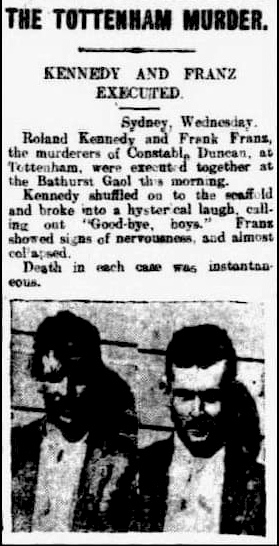
The Tottenham murderers; Frank Franz and Ronald Nicholas Kennedy, were executed in Bathurst Gaol at 9 o’clock on Wednesday morning. Mr ?. M. Wilshire, of Sydney, represented the sheriff. No one but the gaol officials and press representatives was present.
In tragic irony for such an occasion, the day was a beautifully fine and peaceful one. The sun shone in all the splendour of mid-summer, and the birds sang and chirped in the trees in pure joy of the life around them.
There was nothing outside the grim-looking walls of the gaol to indicate that on the inside the tragedy of, two misguided, misspent lives was about to come to a sharp and awful conclusion.
A period of only 35 seconds elapsed from the time the men left the condemned cell till the bolts were drawn, death in each case being instantaneous.
Kennedy hobbled, or it would; be more correct to say that he danced, on to the scaffold, and, as he turned and faced those present, he laughed somewhat hysterically, though his voice was firm enough when he exclaimed: ” Good-bye, boys.”
Franz showed unmistakable traces of fear. His legs trembled, and his face twitched nervously. As the hangman adjusted the caps over the eyes of the men, his lips moved as if he was about to say something, but the bolt was withdrawn, and both men died instantly.
At the conclusion of the trial, and after sentence of death had been pronounced, the condemned man Kennedy turned to Franz and said, ” I’m satisfied so long as you get the same length of rope as I do.” Since then there had been a strong feeling of antagonism between the pair, but prior to the execution the men were brought together, and shook hands.
Franz was a married man, with a wife and two small children. He was a native Wellington, N.S.W.. and 25 years of age.
He was a first offender.
Kennedy was a single man, a native of Peak Hill, and only 20 years of age. He has a mother and several brothers living. The murder was his first offence also.
Since their conviction both men gave little trouble. Kennedy, though, at times, would show signs of breaking down, but succeeded in maintaining his expressed determination to die gamely. However, he, as well as his confederate in crime, clung to the hope of a reprieve up till Tuesday, but the hope was shattered by the decision of the State Cabinet that day.
Franz always protested his innocence, and complained that he had not received a fair trial. He felt his position keenly, and at times would completely break down, and weep bitterly. Both men passed their time reading and writing, and eagerly accepted the spiritual ministrations offered them.
Both men saw their relatives and friends for the last time on Tuesday night. Each passed a fair night, awoke early, and partook of a light breakfast. Just prior to execution, they expressed themselves as perfectly resigned, and fully prepared to die.
Franz‘s last words before he left the cell were in regard to his wife and children. He also expressed thanks for the manner in which he had been treated by the gaol authorities.
Kennedy also expressed his thanks to the latter, and said he was prepared to accept the punishment for his crime.
The murder for which the men paid the extreme penalty of the law was described by Sir William Cullen, Chief Justice, who presided at the trial, as the most callous and cruel in the annals, of Australian crime.
On September 25, Constable George Duncan, who had only arrived at Tottenham on the day previous, arrested a friend of Kennedy’s on a charge of having used indecent language.
According to a statement made by Franz, the murder was planned at the residence of the two Kennedys, and it was agreed that the two Kennedys and Franz should visit the lockup that night, and shoot Duncan. This was done, and, an Duncan was engaged at a typewriter, he was shot twice in the body from the rifles of the men, who stood at the window, and aimed at a distance of only about 8ft. The third bullet struck a partition just above where the constable was sitting. Duncan staggered outside to the wire fence, where his dead body was found a few minutes later by residents, who were attracted by the rifle reports.
Franz was responsible for the arrest of the two Kennedys, under whose threats he alleged he was forced to participate in the deed. Franz and Roland Kennedy were tried together, and convicted, whilst Michael Joseph Kennedy, an elder brother, was tried the following day, and acquitted, the case being withdrawn from the jury by the Chief Justice, on the ground that the Crown had failed to corroborate the evidence of the accomplice, Franz.
It is a noteworthy fact that Franz was the first Informer in New South Wales to suffer the death penalty.
Both bodies were buried in the Bathurst cemetery. It is understood that the relatives of Kennedy applied for the body to be taken to Sydney for burial, but the request was refused by the authorities for certain reasons.
Previous hangings at Bathurst gaol were:- Bertie Glasson, in 1893, for murdering Mr J. W. Phillips, bank manager, Carcoar, and Miss L. Cavanafh. In 1804, Frederick Dennis, alias Paton, was hanged for shooting J. W. Hall, at Fifield.
https://trove.nla.gov.au/newspaper/article/100282062
Western Champion (Parkes, NSW : 1898 – 1934),
Thursday 10 May 1917, page 17
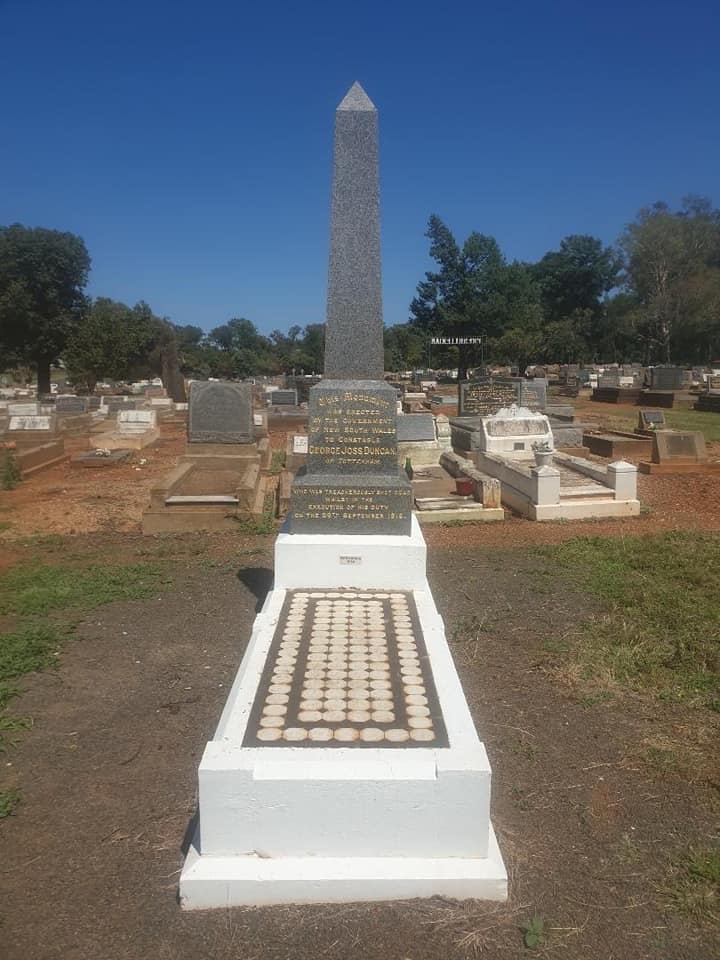
CONSTABLE DUNCAN’S MONUMENT.
The monument to the late Constable Duncan, which has recently been completed, forms a striking object in the local cemetery. It consists of an obelisk of granite, resting on a concrete base, inset with tiles, and rises to a height of about 12 feet.
On the face of the obelisk an inscription sets forth that ” This monument was erected by the Government of New South Wales to Constable George Joss Duncan, of Tottenham, who was treacherously shot dead in the execution of his duty on the 26th September, 1916. ”
It may, however, be mentioned that the total cost of the monument was not borne by the Government. The proceeds of the concert organised by Mrs. J. F. Allen in October last, and totalling some £13 were expended on the base and tiling on which the obelisk rests, although the monument bears on its face no reference to this contribution from the people of Parkes.
Dubbo Dispatch and Wellington Independent (NSW : 1887 – 1932),
Friday 18 May 1917, page 2
LATE CONSTABLE DUNCAN.
A Parkes correspondent says: ” The monument to the late Constable Duncan, which has recently been completed, forms a striking object in the Parkes cemetery. It consists of an obelisk of granite, resting on a concrete base, inset with tiles, and rises to a height of about 12 feet.
On the face of the obelisk an inscription sets forth that ” This monument was erected by the Government of New South Wales to Constable George Joss Duncan, of Tottenham, who was treacherously shot dead in the execution of his duty on 26th September, 1916. ”
The correspondent, however, goes on to say that £13 of the cost was contributed by the Parkes people.
https://trove.nla.gov.au/newspaper/article/228640365
Leader (Orange, NSW : 1912 – 1922),
Monday 11 June 1917, page 3
THE LATE CONSTABLE DUNCAN.
Messrs McMurtrie and Co., .monumental masons, of Summer street; have received the following letter, from the “Inspector General of Police :
” I beg to convey to you.an expression of the appreciation of this department, with regard to me manner in which you have carried out the work entrusted to you, of erecting a monument over the grave of the late Constable George Joss Duncan, at Parkes, and to thank you for the generous treatment you have given the matter in carrying out certain details beyond those originally specified,at your own expense.
Your obedient servant.
JAMES MITCHELL,
Inspector General of Police.”
https://trove.nla.gov.au/newspaper/article/117827763
Sun (Sydney, NSW : 1910 – 1954),
Wednesday 19 March 1919, page 8
I.S. MEDALLISTS
Police and Prisons Officials DISTINGUISHED SERVICES
The Governor ( Sir Walter Davidson ) presented Imperial Service Medals to retired members of the police force and prisons department at the police depot this afternoon. Below are summaries of the official records of the services and deeds of the recipients.
SERGT. ROGER MEAGHER. — Served in the Police Force of New South Wales for over 34 years. He took a prominent part in the investigation and arrest of the offenders for the murder of Constable Duncan at Tottenham.
https://trove.nla.gov.au/newspaper/article/222639309
The Braidwood Review & District Advocate
Tuesday 3 January 1928 page 4 of 8
STRANGE COINCIDENCE
When Constable Ford murdered Mrs. Laws and then shot himself at Leichhardt recently, he completed a tragic triangle of death. He was the third constable who has served at Grenfell to die by violence.
Constables Claude Bovard and George J. Duncan were the other two. Over ten years ago Ford and Bovard served together at Grenfell, and Duncan was stationed there soon after they left.
http://trove.nla.gov.au/ndp/del/article/119404489
Forbes Advocate (NSW : 1911 – 1954),
Tuesday 26 May 1914, page 3
FALL FROM A HORSE.
CONSTABLE DUNCAN INJURED.
A rather serious accident happened to Constable George Joss Duncan, at Bogan Gate, on Friday.
The trooper was riding a rather vicious horse, and taking fright somewhere close to Bogan Gate, the animal bolted. After a long run, the mounted trooper and horse both came to grief, and the horse, in falling, rolled over the rider.
The constable was picked up, and as he was suffering from concussion of the brain and other injuries, he was taken to Parkes Hospital, where he regained consciousness on Sunday.
Two of the first men to come to the constable’s assistance, were a pair he had locked up the previous evening for imbibing too freely.
On inquiries being made at Parkes Hospital to-day, it was gleaned that Constable Duncan is making good progress.
https://trove.nla.gov.au/newspaper/article/100299415
Hello,
My name is Rob Duncan.
My Great Uncle is Constable George Joss Duncan, Tottenham. Police Honour Role 1916.
I request the support of Australian Police web site to re-examine with modern forensic science the 32 calibre bullets taken from George’s back to determine if both Roland & Michael Herbert Kennedy were actually responsible for the assassination of Mounted Constable Duncan.
This would involve a simple examination of the 1916 Trial exhibits to compare both bullets taken from Constable George Duncan’s back on either side of his spine.
If the bullets don’t match this will clearly historically prove the older brother Michael Herbert Kennedy was also responsible for my Great Uncle’s death.
Michael Herbert Kennedy was tried separately and found not guilty because his younger 20 year old brother took the wrap for him.
Frank Franz the other convicted killer was the only crown witness to ever be executed. He pleaded his innocence claiming the IWW Kennedy Brother’s threatened his life. Frank Franz fired a 38 calibre rifle whose bullet went through the window sash then embedded into far wall, not striking the Constable who was seated with his back to the closed window writing a report at 9pm.
Inspector Joseph Develin maintained till his retirement “declares the confession written by Franz was one of the most complete and honest he has ever read.”, which clearly implicates Michael Herbert Kennedy as one of the shooters.
(Please reference “Two Murders, How Inspector Develin Solved Them He retired Yesterday” , Sunday Times, 20/11/1927) for further details.
The trial exhibits were displayed in the Police Museum in 1920-1930s and are stored in there archive including window with bullet holes, winchester repeating rifles , bullets and bullet in bone fragment of my Great Uncle.
Thank-you for your comprehensive research on George’s brutal Assassination.
My family always referred to it as an Assassination not murder.
It is now considered Australia’s first Political Assassination and Australia’s first Terrorism Act Against a Police Officer.
Currently these brutal cowardly IWW union killers are being romanticised as the next Ned Kellys.
George Duncan is blamed for his own death by these IWW fantasists and his honour and sacrifice disrespected.
It is a tragic Grim’s fairytale for the Duncan family who have remained silent for 103 years.
We have never being contacted by the NSW Police for any Blue Ribbon event, memorial dedications or anniversaries.
In the early 1930’s, my Father Gordon Stewart Duncan was fostered by Sergeant Walter R. Follent , later Inspector Follent in the early 1930’s because he was George Duncan’s nephew in a Glebe Orphanage. Gordon would later serve his country as a Military Policeman in Occupational Japan at the end of WWII.
We have never been approached by any Professional Historian for the Duncan’s family viewpoint or perspective.
Current book publication of this topic ” Murder in Tottenham First Political Assassination” does not even include a picture of a uniformed Constable Duncan or his Memorial, instead the three Murderers are featured on the front cover and within the covers again and again. It should be re-titled “Murderers in Tottenham” if ever reprinted.
This is deplorable for the Duncan family.
The NSW Police Museum website section affectionally titled “The Wobblies” referring to violent IWW is questionable. The “Murder In Tottenham” chapter fails to include a photograph of my Great Uncle, Tottenham Police Hut with bullet holed window or George’s memorial instead shows one of the Winchester Rifles used in the Assassination. Why?
This completely de-humanises this fallen Police Officer and is disrespectful to his memory.
This is disgraceful as it is offensive to the Duncan family.
A photograph of Constable George Duncan in his Mounted Constable Uniform is readily available through the National Library’s TROVE newspaper search engine. Its not rocket science.
George lasted three days at Tottenham in September 1916. He was ordered to single handedly restore law and order to this isolated copper mining town and arrest control from the IWW Union thugs during WWI.
George deserves to be awarded a posthumous Bravery Award in my opinion.
He was a well respected 25 year old Constable with three years of service before his horrific death.
The Tottenham Outrage is now often referred to as “Ned Kelly’s Ghost.”
This is BULLSHIT !
I wish to stop the Romanticism of these Tottenham Cop Killers.
Looking forward to your support in my mission
Yours Sincerely
Robert Stewart Duncan
29 July 2019
William BOWEN
William BOWEN
( late of Dungog )
New South Wales Police Force
Regd. # ‘Q‘ 5316
For the purposes of this website ‘Q‘ represents those Police joining between 1 March 1862 ( commencement of NSWPF ) – 23 February 1915 ( Commencement of NSWPF current numbering system )
Rank: Probationary Constable – appointed 14 January 1887
Sergeant 1st Class – appointed ? ? ?
Stations: Gloucester, Paterson, Minmi, and other places & Dungog ( 9 years to death ) ( Port Stephens LAC )
Service: From 14 January, 1887 to 4 March 1916 = 29+ years Service
Awards: ?
Born: ? ? 1859 at Uralla, NSW
Died on: Saturday 4 March 1916
Cause: Assault – Murder?
Event location: Dungog, NSW
Event date: ? January 1916
Age: 55
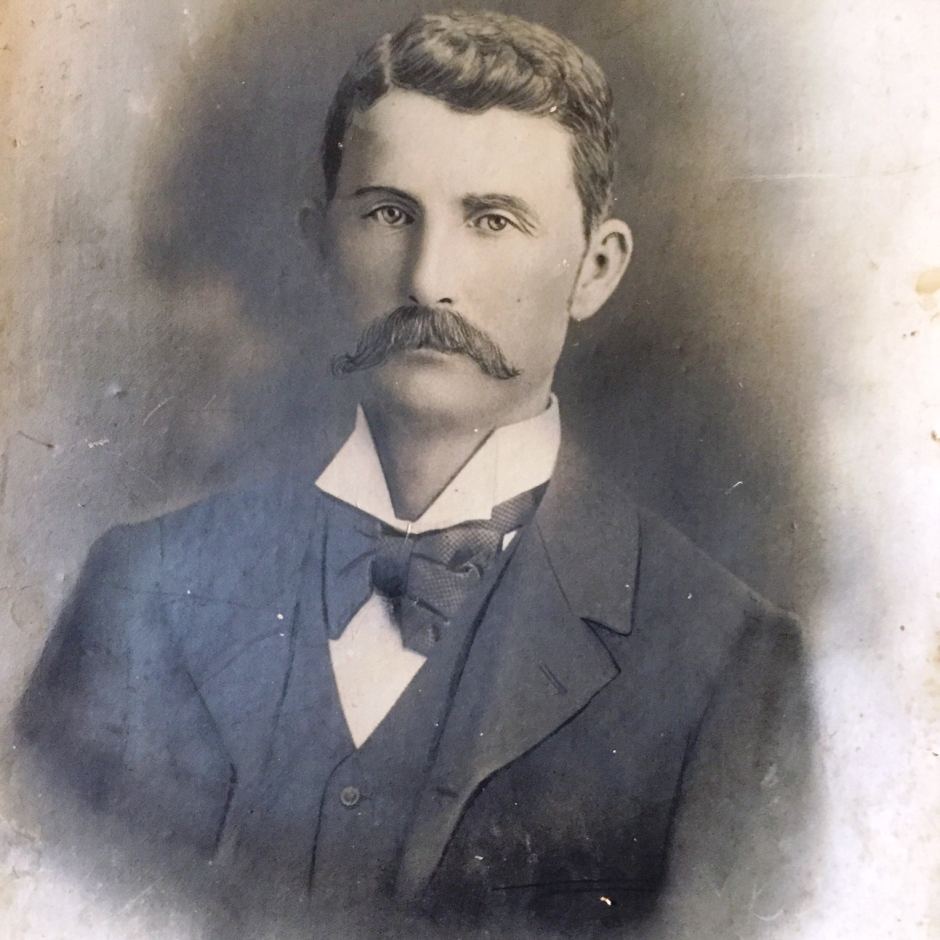
Funeral date: Sunday 5 March, 1916
Funeral location: Church of England cemetery, Dungog, NSW
Buried at: Church of England cemetery with his only son & youngest daughter, Alma
Dungog Cemetery,
Tabbil Creek, NSW,
3 references for the grave
Latitude: -32.419403
Longitude: 151.738657
GPS: -32 25.16418, 151 44.31976
-32.418649, 151.738825
Memorial: Memorial & Plaque unveiling at Dungog Police Station on 4 March 2016
WILLIAM IS mentioned on the National Police Wall of Remembrance
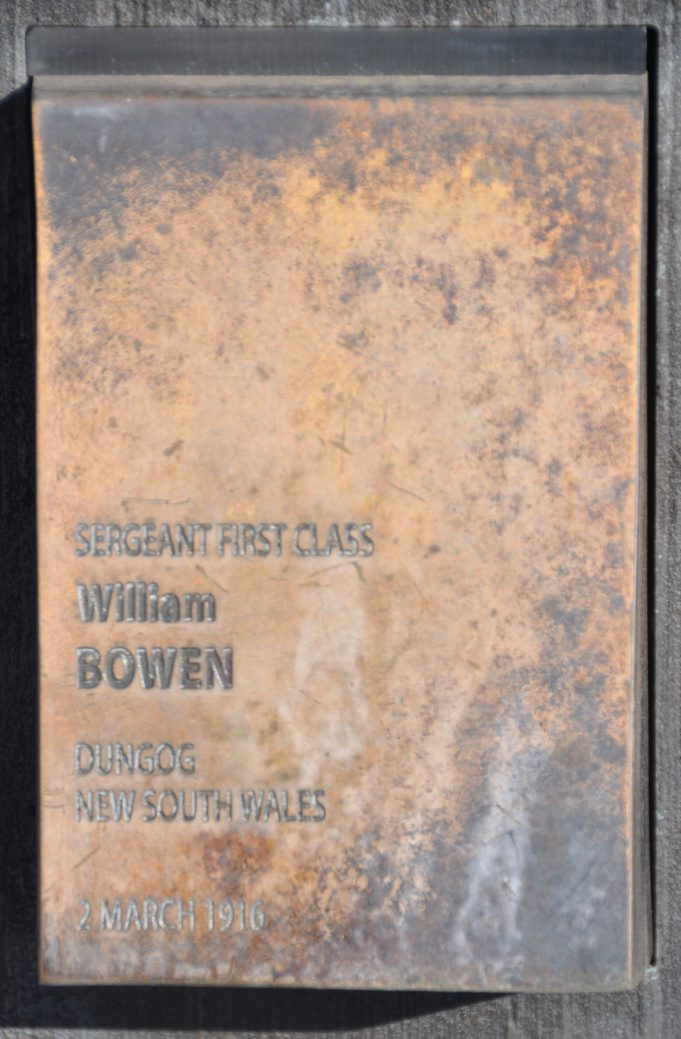
The sergeant suffered serious internal injuries at Dungog when he was assaulted after detaining a mentally ill man in January, 1916. The sergeant had been called to the Dungog Hospital in relation to a violent and disturbed man. He arrested the man and took him to the local police station. Shortly after their arrival at the station the man again went berserk, kicking the sergeant and attacking him with a chair. The sergeant was taken to hospital for treatment and was eventually admitted to Sydney’s St Vincent’s Hospital where he died.
The Sydney Morning Herald of 7 March, 1916 reported news from Dungog to the effect that “The funeral of Senior Sergeant Bowen, of Dungog, who died at St. Vincent’s Hospital. Sydney, on Saturday, took place here yesterday, being one of the largest that have taken place at Dungog.”
The sergeant was born in 1859 and joined the New South Wales Police Force on 14 January, 1887. At the time of his death he was stationed at Dungog.
** officially recorded as Thursday 2 March 1916 but correct death date appears to be Saturday 4 March 1916. Date of Death on the grave stone also is 4 March 1916.
Dungog Chronicle
Tuesday 7 March 1916 p 2 of 6
Death.
Senior Sergeant Bowen
It is with deep regret that we record the death of Senior-Sergeant William Bowen, of Dungog. It will be remembered that deceased, who had been ill a short time, was taken to Sydney on Friday last ( 3 March 1916 ) to consult a specialist. He was accompanied by Mrs Bowen, and was conveyed to St. Vincent’s Hospital, and several specialists, including Sir Alex. McCormack, were called in consultation, but these were unable to diagnose the cause of the trouble, and an operation was recommended, as soon as he was strong enough to bear it, but the patient did not rally, and he passed away early on Saturday morning ( 4 March 1916 ). Such a sudden ending was totally unexpected, although it was noticed that the Sergeant had been failing for some time past. He thought he was a victim to acute dispepsia, but there was evidently something more seriously wrong.
Deceased was born at Uralla, 56 years ago, and had been 30 years in the service, the past nine years he had been stationed at Dungog. Previously he had been at Gloucester, Paterson, Minmi, and other places.
He was a very painstaking, conscientious officer, who discharged his duties with the utmost impartiality. He was very considerate to the men under him, and only those who were acquainted with him intimately knew what a very kind and thoughtful man he was, ever cheerful under the most adverse circumstances, and apparently never harboring an ill-thought about anybody. He will be hard to replace.
He leaves a sorrowing widow and three daughters ( Mrs J. Hunt, Mrs O. E. Carter, and Miss Myra Bowen ) to mourn their loss, to whom we extend our sincere sympathy.
His remains were brought from Sydney on Saturday ( 4 March 1916 ) and interred beside those of his only son ( who was killed at Minmi a few years ago ) and his youngest daughter Alma, in the Church of England cemetery.
The funeral took place on Sunday afternoon ( 5 March 1916 ) and was one of the largest ever seen in Dungog. The pall bearers were Sergt. Haynes ( Paterson ), Constable Capp ( Gresford ), Constable Vaughan ( Clarence Town ), and Constables Parker and Bates ( Dungog ).
The chief mourners were his two brothers, Tim ( Uralla ), and John ( Newcastle ), his brother-in-law Mr Reece ( Homebush ), and Mr O. E. Carter ( son-in-law ). Local justices and townspeople followed the chief mourners, walking, and then came a long cavalcade of vehicles and horsemen. The burial service was conducted by the Ven. Archdeacon Luscombe, who paid a fitting tribute to the memory of deceased at the graveside. Amongst the numerous wreaths sent was a beautiful one from the bench of magistrates and one from the local police.
I have been unable to find any reference to the assault upon William Bowen within Trove as of 15 Jan. 2016.
Cal
NSW Registry of BDM
Birth = 6811/1858 ( possibly )
Death = 359/1916


** The person responsible for the assault upon the Sgt was Mentally Ill and sent to the asylum in Newcastle several days after the assault / death.
A Commemoration Day and Plaque Unveiling at Dungog Police Station will happen at 11am on Friday 4 March 2016 for Senior Sergeant William BOWEN.
Police Court On Monday last, before Mr McDougall, S.M., John Dwyer, of Dungog, was charged with stealing about 40 pairs of *naves ( *possibly the central part of a wheel; hub ), valued at £10, the property of Mrs K. B. Walker. Sgt. Bowen represented, the police prosecution ; Mr Borthwick appearing for the accused. Dwyer pleaded guilty and was fined £10, with a fortnight to pay. in default two months in Maitland goal. The fine would be reduced to £5 if the naves were returned to the owner within a week.
Two Men Shot
BULLAHDELAH SENSATION.
Superintendent Childs, of the West Maitland police, received a message from the police at Bullahdelah on Tuesday, giving brief particulars of a sensational shooting incident at the Crawford River.
The message, which came from Constable Sturgiss, stated that Walter John Edwards, 35 years of age, had shot Frederick Soorley, wounding him in the back. He also shot his father, Henry Edwards.
Edwards, who was stated to be apparently insane, is at large, armed with a shot gun. He is described as being 5ft 7in. high, of medium build and having a fair moustache.
Upon receipt of the message, the Superintendent immediately despatched information to all police stations in the locality.
Later.
Superintendent Childs received a telegraphic message from the police at Bullahdelah, stating that the man Walter John Edwards, who was wanted in connection with the shooting sensation at Crawford River, had been arrested between Bullahdelah and Bungwahl. After the shooting, Edwards cleared off, armed with a shot gun. He was charged with shooting with intent to murder, and with maliciously wounding. Arrangements were also made to prefer a charge of lunacy against him. He is stated to have previously been under mental treatment.
Another message from Bullahdelah states that Mr Edwards, sen., was not shot, but was attacked with a tomahawk. The insane man was found hiding in blackberry bushes and they were set alight. He then came out and was captured. Edwards had put his gun down and could not find it again, otherwise there might have been a casualty amongst the captors. The news of the shooting spread rapidly and upset the whole district. People from the Crawford River and other parts left their homes and went to Bullahdelah for safety. The news of the capture of Edwards was a great relief all round.
It will be remembered that Edwards was in Dungog Hospital some years ago and caused a sensation. He went partially insane and smashed up things generally. When the police were securing him at the Hospital he savagely assaulted the late Sgt. Bowen, breaking his hand with a chair.
REMINISCENCES BY WALLY IRWIN
‘DODGER’ EDWARDS
………….
May I refer to another Edwards, an old schoolmate, ‘Dodger’ Edwards ( Walter John EDWARDS ). He was a super lad also. There were 50 odd pupils at school at Bendolba and some of them up to 18 years of age. Not one of them ever brought down Dodger in a game of football. When the ball went to Dodger it was a ‘try.’ Most times the football was made of rags. Our coach then was Mr. Gardiner, our schoolteacher. I think he replaced Mr. Lord, father of Mr. Dick Lord, of Dungog.
In later years, Dodger left our district and went to Gloucester to live. One evening he left Gloucester River to come over to Salisbury on horse back. He got bushed between Whispering Gully and Flag Staff. He unsaddled his horse and to this day the horse was never found. But ‘Dodger‘ came through. I think the trials experienced slightly derainged his mind.
The late Sgt. Bowen was called to the hospital and nearly met his death from a blow that Dodger gave him by hitting him over the head with a chair.
Some two years later, the late Anthony Hudson, his son Tony, and the late Les Middlebrook and I were out beyond Flag Staff and a horse neighed. Old Tony said: ‘Did you hear that,’ We all did, and we were sure there was a horse somewhere. It was over three weeks before we got that horse to mate up with ours. Eventually we succeeded in bringing that horse back. He was a real outlaw, but it was Les Magennis who mastered him. I think this horse was sold later to a circus. I have never solved the problem; was the horse Dodger’s, or whose was It?
…….
http://trove.nla.gov.au/ndp/del/article/140534498
Dungog Senior Sergeant William Bowen

BELINDA-JANE DAVIS
A Dungog policeman who suffered serious injuries on the job and died a century ago will be remembered in a special ceremony.
Senior Sergeant William Bowen suffered serious internal injuries when a mentally ill man kicked him and attacked him with a chair at Dungog Police Station in December 1915.
He had arrested the man at Dungog Hospital a short time earlier, after reports the man was being violent and disturbing staff and patients.
Sergeant Bowen, 56, was taken to hospital for treatment, but never fully recovered from the incident.
His failing health led him and his wife to travel to St Vincent’s Hospital in Sydney on March 3 to see a specialist.
Several specialists, including Sir Alex McCormack, assessed him but were unable to diagnose his condition.
They suggested an operation when he was feeling stronger but Sergeant Bowen continued to deteriorate that day and died in hospital unexpectedly the next morning.
NSW Police Force Commissioner Andrew Scipione and deputy commissioner Catherine Burn are expected to attend a ceremony at Dungog Police Station on March 4 at 11am, which will mark 100 years since Sergeant Bowen’s death.
NSW Deputy Premier Troy Grant and Dungog community groups will also attend and witness a plaque being unveiled, which will commemorate his service.
The Dungog Chronicle recorded Sergeant Bowen’s death on March 7, 1916, saying he would be “hard to replace”.
“He was a very painstaking, conscientious officer, who discharged his duties with the utmost impartiality,” the article said.
“He was very considerate to the men under him, and only those who were acquainted with him intimately knew what a very kind and thoughtful man he was, ever cheerful under the most adverse circumstances, and apparently never harboring an ill-thought about anybody.”
Sergeant Bowen’s body returned to Dungog on March 4 and he was buried in the town’s Church of England Cemetery on March 5 alongside his only son, who was killed in an accident at Minmi a few years earlier, and his youngest daughter Alma, who died of an illness.
It was one of the largest funerals the town had ever seen.
He was survived by his wife, three daughters, Mrs J Hunt, Mrs O.E Carter and Miss Myra Bowen, his two brothers John and Tim, and his brother-in-law Mr Reece and son-in-law Mr O.E. Carter.
Dungog police Senior Constable Mitch Parker said Sergeant Bowen, who was born in Uralla in 1859, joined the police force on January 14, 1887 and spent 29 years serving the region at Gloucester, Paterson, Minmi, Dungog and other stations.
He spent nine years in Dungog before his death.
Senior Constable Parker urged anyone who wanted to pay tribute to Sergeant Bowen’s service to attend the ceremony.
The story Policeman who died a century ago to be remembered first appeared on The Maitland Mercury.
DUNGOG MARKS POLICEMAN’S DEATH 100 YEARS ON
Amanda Douglas March 4, 2016
His name adorns the National Police Memorial, but until recently, the death of Dungog policeman William Bowen a century ago went unrecognised in the town he called home.

The restored headstone at Sgt William Bowen’s grave site
Posted
Restoration work has been completed on the grave site of Sgt William Bowen, who died on March 4, 1916 after being attacked on duty at Dungog in the NSW Hunter Valley.
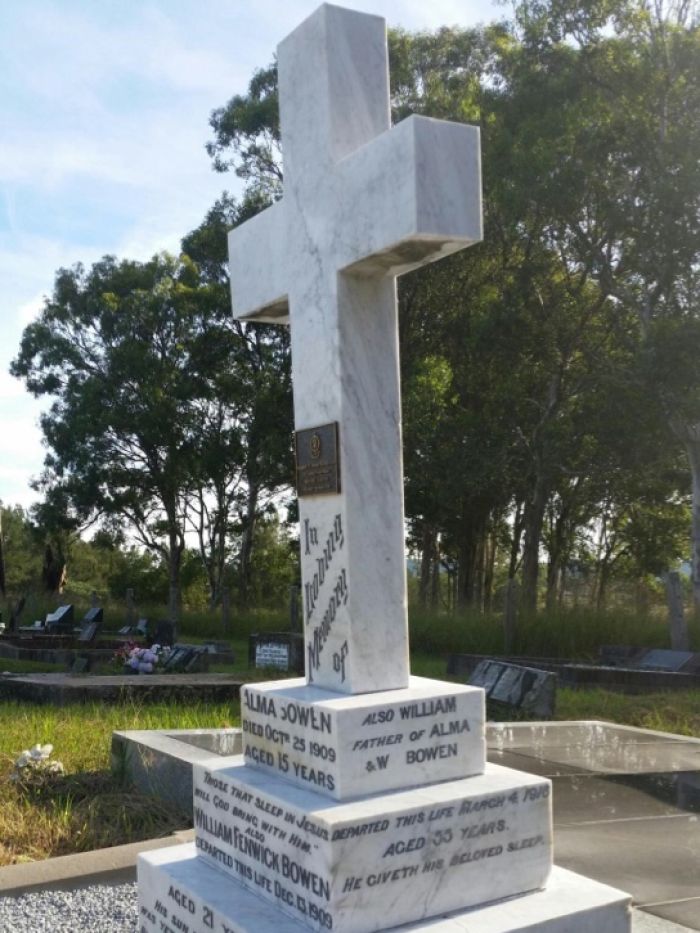
Commemorating 100yr anniversary of officer’s death in the Hunter
The New South Wales Police Commissioner Andrew Scipione will be in the Hunter Valley today to commemorate the 100-year anniversary of the death of a Dungog police officer.
Sergeant William Bowen died on March the 4, 1916, three months after he was attacked by a mentally ill man who had barricaded himself inside Dungog hospital.
Today the commissioner will attend the unveiling of a plaque in his honour.
The man had barricaded himself in the committee room, ordered that all patients be killed in the hospital, and then armed himself with surgical instruments.
Snr Constable Mitch Parker, Dungog Police
Dungog police officer, senior constable Mitch Parker, said sergeant Bowen suffered serious injuries as he bravely tried to protect the Dungog community in December 1915.
“There was a patient of the Dungog hospital who had smashed a number of windows and items within the nurses quarters and a wardsman attempted to restrain him and he got viscously assaulted,” he said.
“Police were sent for and the sergeant, who was living in the police lock-up which we still have today, went up the hill to the hospital.
“By this stage the man had barricaded himself in the committee room and he ordered that all patients be killed in the hospital, and then armed himself with surgical instruments of the day — mostly steel and glass.
“Sergeant Bowen, who was 55 years of age at the time, had been in the police for 30 years, forced his way into the room.
“He successfully arrested and apprehended the male, notwithstanding some injuries himself,” he said.
“They brought him back down to the police lock-up and his health just deteriorated from there.
“Several months later he was sent to St Vincent’s Hospital and was seen by a world-renowned surgeon. Unfortunately he passed away in St Vincent’s Hospital before they could ascertain what was wrong with him.”
Senior constable Parker said as part of today’s commemoration, restoration work had also been carried out on sergeant Bowen’s grave.
“With assistance from the Commissioner’s office, the NSW Police Force and Police Association of NSW, we’ve had the original stone-makers who created the gravesite back in the day have restored it.
“It’s quite a long story, but the sergeant’s been put to rest beside his 15-year-old daughter and 20-year-old son who died five years prior, in pretty horrific circumstances themselves.
“So his grave has been redone and we’ve got the plaque unveiling here at the station,” he said.
“There’ll be the police commissioner coming up, and other important people from different agencies, community groups, schools.
“There’ll also be a lot of retired police from the area, who’ve worked here, finished their service and remained in the area.”
Edwin Stuart HICKEY
Edwin Stuart HICKEY
New South Wales Police Force
Sergeant 2nd Class
Officer In Charge – Pymble Police Station
Shot – Murdered
Pitt Water Rd, St Ives
Joined NSW Police Force in 1881 or 1891
Died 1 May, 1913
52 old
Funeral date: ?
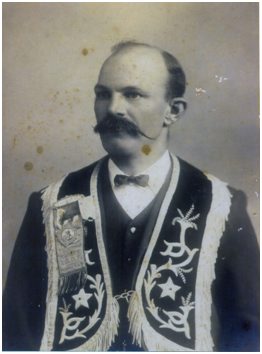
Photo supplied by Val Fearby
The sergeant was shot to death at the Sydney suburb of St Ives while trying to arrest an offender named Brown on warrants. On the day of his death the sergeant and Constable Barclay attended the offender’s home and while inside the dwelling, told Brown he was under arrest. He began to resist violently before drawing a revolver and shooting Sergeant Hickey three times. The offender made good his escape however was arrested a short time later by Constable Barclay. The sergeant’s wounds unfortunately proved to be severe and he died a short time later at the Royal North Shore Hospital. The offender’s son was also shot in the arm during the incident.
The sergeant was born in 1861 and joined the New South Wales Police Force on 29 October, 1881. At the time of his death he was stationed at Pymble.
[blockquote]Hickey has been in charge of the Pymble Police Station for over twenty five years
http://trove.nla.gov.au/ndp/del/article/102941208?searchTerm=%22police%20sergeant%20kill%22&searchLimits=[/blockquote]
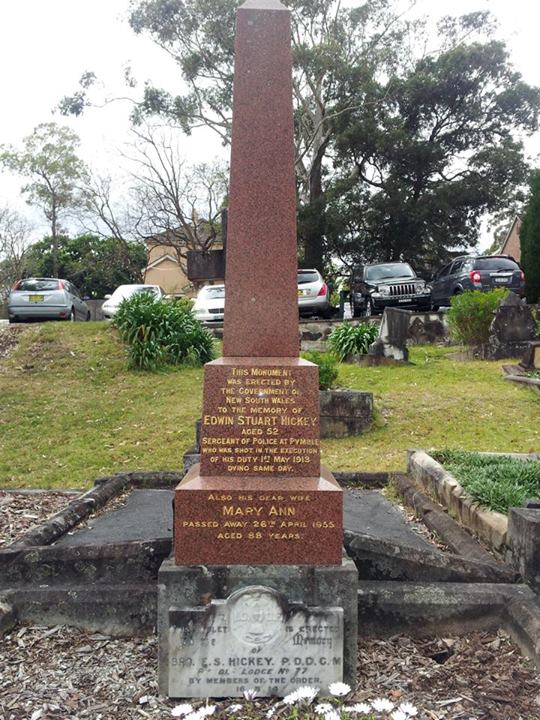
St John’s ( Anglican ) Cemetery, 754 Pacific Hwy, Gordon, NSW.
Ref: CC17
CENTRAL CRIMINAL COURT. ( pre murder criminal history )
Thomas Edwin Brown, assaulting a bailiff in the execution of his duty.
The Sydney Morning Herald Friday 2 June 1911 page 4 of 14
ACTION STRUCK OUT. INJUNCTION TO RESTRAIN GRANTED. SYDNEY.
Friday. ( 19 April 1912 )
There was brought before Justice Simpson in the Common Law Chambers to-day a case in which Thomas Edward Brown, of St. Ives, near Gordon, made claim for £20,000 against a big list of defendants, including the Attorney-General (Mr. Wade, M.L.A.), several Supreme Court judges, most of the stipendiary magistrates, the Inspector-Generol (sic) of Police; and the Kuringai Shire Council. Plaintiff complained that various legal proceedings had been maliciously used against him, and, that he had been deprived of legal rights. Counsel representing defendants asked that plaintiff’s declaration be struck out, and that plaintiff be restrained from further proceedings of a like character against them. It was pointed out that Justice Ferguson had previously struck out an action by plaintiff against some of the present defendants.
Justice Simpson granted the application and the injunction as asked for on behalf of the defendants.
Examiner ( Launceston, Tasmania ) Saturday 20 April 1912 Page 8 of 12
A SHOOTING TRAGEDY.
SERGEANT OF POLICE KILLED,
AN ARREST MADE.
SYDNEY, May 1. ( Thursday )
A police official was the victim of a shooting tragedy which took place this morning at St. Ives, an orchadists settlement on the north coast railway line.
It appears, that Sergeant Hickey, who for upwards of 20 years has been in charge of the police-station at Pymble, accompanied by Constable Barclay, proceeded to the residence of Thomas Edwin Brown an orchardist residing on Pitt water-road, St. Ives. The mission of the police was to arrest Brown on two commitment warrants. One warrant, it is stated, was in connection with the non-payment of costs in an appeal case, and the other is related to the non-payment of a small fine and costs in connection with a traffic summons case.
The police found the man they were looking for in his orchard, where he was working with his sons. They indicated to him the nature of their business, and then invited Sergeant Hickey and his companion up to the house, and, turning to one of his sons, said, “You had better come, too.” They all went to Brown’s residence on the opposite side of the orchard.
Brown and his son entered the door, followed by Sergeant Hickey, with Constable Barclay in the rear. Barclay states that no sooner had they got inside than Brown, sen., without warning, produced a revolver, and fired point blank at Sergeant Hickey. He fired altogether four shots. Three of them took effect in the Sergent altogether and in the scuffle which immediately followed a fourth shot lodged in the arm of Brown’s son, who had intervened to prevent further shooting.
Sergeant Hickey fell to the floor, and never spoke.
Constable Barclay immediately ran for assistance, and he met two men named Rogers and McIntosh, and told them what had happened. They ran down to Brown’s house, and then they found Sergeant Hickey lying on the floor in an unconscious condition. They conveyed him to the local police station, and he was quickly conveyed to the Royal North Shore Hospital, but be died a few minutes after admission.
Later young Brown who also had been shot, was brought to the institution, and admitted with a bullet wound in his arm.
After informing the two men, Rogers, and McIntosh, of the shooting, Constable Barclay discovered that Brown, sen., had left the house, and was down the Gordon road. He went in pursuit, and, finding Brown, covered him with his revolver, and ordered him to surrender and to throw up his arms. Brown surrendered quietly, and Constable Barclay, finding, by searching him, that Brown was not then in the possession of firearms, arrested and escorted him to North Sydney, where he was locked up on a charge of shooting.
The late Sergeant Hickey was a greatly esteemed officer. He was on the eve of retiring from the service, which he joined in 1891.
The Mercury ( Hobart, Tasmania ) Friday 2 May 1913 Page 5 of 8
Police Sergeant Shot.
An Orchard Tragedy
SYDNEY, May 1.
A shocking tragedy was enacted at St. Ives this morning. In attempting to serve two committment, warrants an an orchardist residing at Pymble, Sergeant Edward Hickey was fired on, and so badly wounded that he died shortly after admission to the hospital.
The man who to alleged to have done the shooting has a large-sized orchard off Pittwater Road, St. Ives, which runs from Pymble right through to Pittwater. He has been associated a good deal with law matters, and although regarded as an eccentric, has never been looked upon as being dangerous or likely to be subject to outbursts of violence. He is alleged to have produced a revolver and fired four shots. Three of the bullets lodged in Hickey’s body, and he fell to the ground mortally wounded.
Constable Barclay went in search of the orchardist, and having secured him, handcuffed him, and took him to the police station. Later on he was brought down to the North Sydney Police Station, and charged with murder. He gave his name as Thomas Edwin Brown.
Cairns Post ( Qld ) Friday 2 May 1913 Page 5 of 8
The Clarence and Richmond Examiner of 17 May, 1913 printed the following article relating to the inquest into the sergeant’s death.
SYDNEY, Thursday — An inquest was commenced concerning the shooting of Sergeant Hickey at St Ives. Thomas Edwin Brown, who was charged with murder, was present in custody. Constable Barclay deposed that Sergeant Hickey informed Brown that he had two commitment warrants and that unless Brown paid the money he would place him under arrest and convey him to Darlinghurst Gaol. Brown remarked that warrants were illegal and as witness reached the dining-room door of Brown’s house the latter said, “Go back, you can’t come in here; it’s illegal. Sergeant Hickey closed with Brown, who immediately fired three shots at him. Witness drew a revolver and stated that unless Brown put his hands up he would put a hole through him and Brown put them up, at the same time remarking, “I’m sorry, I am prepared to die.” When asked why he shot Sergeant Hickey he replied that he was driven to it. The Coroner found that the deceased died from a revolver wound feloniously inflicted on him by Brown who was committed for trial on a charge of murdering him.
THE ST. IVES TRAGEDY.
BROWN APPEALS FOR BAIL.
THE APPLICATION REFUSED.
Sydney, Wednesday Afternoon. ( 14 January 1914 )
Thomas Edward Brown, charged with the murder last year at St. Ives of Sergeant Hickey, made application this morning, to Mr. Justice Gordon in the Supreme Court for bail. Brown has already been tried once, but a new trial was granted by the High Court, and has now been in gaol nine months.
Mr. d’Apice appeared for the Crown to oppose the application, and Brown appeared in person. Brown said he would like the application to stand over until later in the day, as on coming to the court he had met some of his children and had been considerably upset.
His Honor refused to grant any adjournment.
Brown then submitted that bail should be granted, so that he might have the fullest opportunity of preparing, his defence. He had been placed in the section of the gaol allotted to murderers.
His Honor said, the Crown case was thoroughly known; therefore, it was much easier for the accused to prepare his reply in the second case. Even if the Crown consented, his Honor said he did not know that he should consent to the prisoner’s release. He therefore, refused the application.
Mr d’Apice said the gaol authorities would give the prisoner every opportunity for the preparation of his defence.
The prisoner, was then recommitted to gaol and removed in custody.
Barrier Miner ( Broken Hill, NSW ) Thursday 15 January 1914 page 6 of 8
NEW SOUTH WALES
RECENT CASE REVIVED.
SYDNEY. April 27.
Thomas Edwin Brown, of St Ives, orchardist, who was recently acquitted on a charge of having murdered by shooting Police Sergeant Hickey, has been adjudged insane by a special court of inquiry. He has consequently been ordered to be detained in an Asylum. Notice of appeal has been given on Brown’s behalf.
The Brisbane Courier ( Qld ) Tuesday 28 April 1914 Page 7 of 10
QUESTION OF SANITY
THE BROWN CASE.
DEEMED TO BE INSANE.
A special Court to consider the question of the sanity of Thomas Edwin Brown, of St. Ives, who was acquitted at the Central Criminal Court last month on a charge of having murdered Sergeant Hickey, but who was detained on his release on a charge of insanity, was held at the Reception House at Darlinghurst on several days this month. Mr. J. McKensey, deputy stipendiary magistrate, presided, and at the final sitting on Saturday last, Brown was deemed to be insane.
The exhibits in the case consisted of a number of voluminous documents, in the majority of which Brown mentioned grievances which he considered that he had. One of these was a petition addressed to Lord Chelmsford, asking for the appointment of a Royal Commission to inquire into his case. It consisted of 10 pages of typewritten matter, and was forwarded on March 18, 1912. In it Brown said that the legal process of the State was denied to him, and that he intended to protect himself, family, and property from injury by “these blackmailers of the Crown.” He also went on to say that he would not be responsible for any consequences of his acts, “but will claim to be exonerated from blame from this date during this state of siege, irrespective of evidence taken, as they now concoct evidence for an excuse to punish with, for any act which may be done in a mistaken apprehension of danger or otherwise.”
Mr. Garland, K.C., instructed by Mr. Robinson, appeared on behalf of the Crown; and Mr. Ralston, K.C., instructed by Mr. McElhone, on behalf of Brown.
Dr. Palmer, First Government Medical Officer at Sydney, said that he had known Brown since May 2 last year, and had frequent opportunities of observing him and conversing with him. “I am of the opinion that he is insane,” said the doctor. “For the purpose of making a certificate to that effect I examined him separately. His form of insanity is called paranoia, or systematised delusions. In my opinion the only proper care and control of a person so suffering is to be had in an institution. The chief characteristic of that variety of insanity is that the person suffering is potentially homicidal. For the sake of others, as well as himself, he should be detained in an institution.”
In answer to Mr. Ralston, witness said that Brown had been tried three times for murder, but the Crown or anyone else did not raise the question of his sanity. He was of the opinion of his examination of Brown was right that he would not get better. His insanity might become modified, and perhaps take on a different form. He was sound physically, and had never complained of sickness. The delusion he suffered from was that a combination of public officials was persecuting him.
Dr. Andrew Davidson said that he had had a large experience in mental cases, and for three years was medical superintendent at Callan Park Asylum. He had seen Brown on a number of occasions, and was of the opinion that he was suffering from chronic systematised insanity. His form of insanity was one that generally became worse. In certain cases it was dangerous. “The fact that Brown was arrested for being insane would not necessarily worry him,” said the doctor. “A sane individual would, to a certain extent, be worried. He does not wear such a worried expression now as he did.”
Dr. Eric Sinclair, Inspector-General of Insane for 16 years, said that he had seen Brown, and also some of the letters which he had written, and was of the opinion that he was insane. “The probabilities that his delusions will continue are very strong, indeed,” said witness. “As far as we know medically, they will continue, but one hesitates to say for certaln what will happen in the future. If it were proved that his delusions have disappeared now, it is obvious that he is not insane at the present time. Assuming on April 2, that Brown had informed Dr. Palmer that he was going to America, as he could not get justice here, I would be inclined to consider that was an indication that the delusions had not disappeared.”
Dr. Chisholm Ross said that after seeing Brown and some of the documents written by him, he should say that the man thought that he was being persecuted. “I say that, if he was not insane, he was preparing for persecutionary paranoia,” continued the doctor. “Cases of this disease are persistent, and as a rule persons suffering from it recover very rarely, if at all. If not under restraint they are a danger to themselves and others.”
In reply to Mr. Ralston, Dr. Ross said that he had been dealing with mental cases for 30 years. He gave a certificate that Brown was a fit subject for examination. He did not give a certificate of his insanity. He had not seen any indication in Brown of paranoia, or any other form of insanity. He was unable to give a certificate that Brown was insane.
Drs. Alfred Walter Campbell and George Edward Ronnie declared that Brown was insane.
David Ross Jamieson, Acting Under-Secretary in the Department of Justice, said that Brown called on him at his office, and said that he wished to make a complaint about the administration of justice. He handed witness a document, and, when it was returned to him he (Brown) said “I can’t get justice from anybody; the Judges won’t hear me; the Stipendiary Magistrates won’t hear me; and the Chamber Magistrates will not issue process for me. I can’t get assistance or protection from the police, and am in fear. I have a weapon and will have to use It.” He was told to complain to the Inspector-General of Police if the police refused to assist him, and he left the room.
Evidence for the Crown having closed, Mr. Ralston submitted that Brown was illegally before the Court, as he had been illegally arrested, and that there was no evidence adduced to prove that Brown was found under circumstances indicating that he was likely to commit some offence against the Law. He considered that the inquiry was a nullity, and that Brown should be discharged.
Mr. McKensey said that it was not for him to decide whether Brown was legally or illegally arrested, and overruled the objection.
On behalf of Brown, Dr. Richard Arthur said that he had a conversation with Brown which lasted an hour and a half, and he saw no signs of mental aberration after he had used a number of methods to prove his mental unsoundness. He had heard some of the documents read, and he still adhered to his opinion. The statements made were severe, but they were not in any way exceptional.
Dr. Sydney Jamieson said that when he saw Brown on March 30 he mentioned the question of his having the idea that he was being persecuted, and his attempts to stop those supposed persecutions, but Brown laughed and treated it as a matter of levity. He said: “It is quite true, I signed those documents.” He was then asked by witness if he still thought that he was being persecuted, and he replied: “I wouldn’t say that, but I think that at the time I was very much upset, and my views on what I then wrote are different now.” “I could find no evidence of insanity,” said the doctor.
To Mr. Garland, witness said: “The impression he left with me was that at one time he had seriously entertained these views but that his subsequent experience had modified them; that accumulated experience had altered his views. If a man starts an action against 62 persons as Brown did it is evidence of wild notion. Whether it is paranoia or not depends on whether it is founded on delusion or fact. If his charges against all these officials and sects are baseless then he is a paranoic. I found no evidence of it in my examination. If I knew that the charges he made against the late Chief Justice (Sir Frederick Darley) and others were baseless I would admit that he is a paranoic.”
Dr. J. B. Nash said that he examined Brown, and could find nothing mentally wrong with him, and the documents read did not alter his opinion in the slightest. He had not examined any paranoic that he knew of.
Dr. A. Murray Oram said that after an examination of Brown he could not say that he was insane. It was quite possible that Brown had paranoia, “I say he was not sane in March, 1913, when he drew the document up,” concluded the doctor.
Thomas Henley, M.L.A., said that he had known Brown for 20 years, and had never detected any evidences of insanity.
Peter Christian Bjornstad, Acting Superintendent at the Reception House, said that Brown now appeared to be perfectly normal.
Dr. A. C. Cahill, called by the Bench, said that he was unable to certify as to Brown’s sanity or insanity because Brown declined to converse on subjects which would throw a light on his mental condition. When Brown wrote the passages charging the late Chief Justice and others with conspiracy, he was suffering from paranoia, a complaint which generally tended to get worse.
Dr. W. W. J. O’Rielly said that he had known Brown for 18 years and he had always acted as a sane man.
Dr. A. E. Perkins, on affirmation, said that he had examined Brown and considered that he was sane.
James Weymark, a wholesale fruiterer said that he had transacted business for Brown for a number of years and had never detected any signs of insanity.
Brown, sworn, said: “I would like to say a lot. The Crown drew the inference when the documents were being read, that because I asked that one of them be continued, I still persisted in my opinions; but that I deny. The statements made in those documents were written under circumstances which would make them excusable, considering that I was not well-educated and had to seek the assistance of others. I was not conversant with the meaning of all the words. I meant by ‘conspiracy’ a succession of acts which caused me to be imprisoned. Those acts were, upon appeal to the High Court, ruled to be illegal. In the language of those documents describing the various sects, I had no intention to have it believed that that was so in the generally-accepted expression of the term. But what I really meant to show was that persons of each of the orders or sects had taken part in this matter in which I had appealed. The same descriptions of persons have repeatedly assisted me in my troubles. These documents were written at a time when I was in great trouble. I was constantly being arrested. My house was being searched by day and by night, and often when I left home to go to the market I would be arrested and put in gaol. The matters I have complained of were, briefly, the result of judgments of the various Courts which have since been upset on appeal.
Through the experience I have gained since I have been in prison, I am convinced that my proceedings were altogether wrong and unwarranted.”
Brown then narrated his experiences since he was arrested on the lunacy charge, and outlined his actions in the Courts.
After other evidence was given and addresses by counsel, Mr. McKensey said: “I am satisfied that Brown is insane and is not under proper care and control, and is a proper person to be taken charge of and detained under care and treatment. I therefore direct that Brown be removed to the Hospital for Insane, at Parramatta.”
The Sydney Morning Herald Wednesday 29 April 1914 Page 11 of 26
THE PREVENTION OF MADNESS
The extraordinary divergence of medical opinion as to the sanity or insanity of Thomas Edwin Brown, who was charged with having murdered Constable(sic) Hickey, and was acquitted, but afterwards detained on grounds of insanity, cannot be passed over without comment. The evidence of no less than 13 doctors was taken in the case; and the conclusion of six of them was completely opposed to the conclusion of the other seven.’ We offer no judgment on the result the magistrate appears to have been convinced that those who said that Brown was suffering from a dangerous delusion were right, and the man goes back into detention. But what we do say is that it is high time that the medical men of this country were given such a training in the diagnosis of madness that such a conflict of evidence should in future be put almost beyond the bounds of possibility. The public, in a case of this sort, does not know which set of doctors was right; it has not the knowledge to enable it to form an opinion on that point. What it does want is the assurance that its medical men will in future obtain such training in this important department of modern medicine as will make impossible the occurrence of any of the terrible mistakes for which the absence of such training leaves only too obvious an opening.
The men who have upon them the responsibility of deciding whether a citizen is sane or insane get very little preparation for that responsibility. Indeed, there is not a single clinic in Australia where they could get a thorough training in this branch of medicine if they wished to. There are numerous schools where students in other countries are obtaining this experience, in hospitals at Berlin, Vienna, Genoa, Kiel, Glossen, at Michigan University, at the Johns Hopkins Hospital, at Baltimore, and elsewhere. But the Australian student, whose duty it will be in general practice to recognise the early mental or nervous symptoms of insanity, is practically without opportunity of qualifying himself to do so. That is simply because we are not sufficiently abreast of modern medicine to have provided institutions where the prevention of insanity is carried on, and can be studied. The cure of insanity might not be a department of medicine at all, for all the attention that is paid to it within the borders of New South Wales. Every medical man knows of the progress that has been made in the treatment of insanity elsewhere; how special hospitals and homes have been established for the treatment of it in the earlier stages, when it is often perfectly preventable; how an international committee has been formed to advance the knowledge and treatment of the curable insanity; how special branches of the outpatient departments of more than one of the London hospitals have been established to deal with it. In Australia, except in a very few cases, insanity cannot be treated until it has reached a stage at which treatment is no longer of much use. In one or two institutions founded for another purpose an attempt is being made, mainly through the energy of individual officials, to separate and cure the early stages of insanity. But there is no organised attempt to prevent insanity, and no school where the medical student can learn to recognise it. In a good many cases it really rests in the first instance with the police whether the patient may or may not receive the necessary treatment. This, it has been cynically remarked, is perhaps, after all, just as well. The average policeman does have some opportunity of seeing early cases of insanity; the average medical student does not.
The Sydney Morning Herald Thursday 30 April 1914 Page 10 of 18
1914.
(SECOND SESSION.)
LEGISLATIVE ASSEMBLY.
NEW SOUTH WALES POLICE DEPARTMENT.
(ANNUAL REPORT FOR THE YEAR 1913.)
Printed under No. 3 Report from Printing Committee, 13 August, 1914
Four (4) constables were discharged on gratuities amounting to £607 10s., and gratuities amounting to £2,192 18s. 4d. were awarded to the widows of seven (7) members of the Force, in addition to which £94 was allowed for funeral expenses. In the case of the widow of the late Senior-sergeant Edwin S. Hickey, who was killed in the execution of his duty, a pension of £125 per annum was granted for six (six) years, at the end of which period the case will be reconsidered.
Sergeant 2nd Class James McDONNELL
James McDONNELL
New South Wales Police Force
Sergeant 2nd Class
Shot – Murdered
Warren
Died 26 December, 1911
57 old
Funeral
The sergeant was the Officer-in-Charge of the Warren Police Station. About 7.30pm on 26 December, 1911 he attended a street disturbance in the township involving an intoxicated man by the name of Neale, whom he subsequently arrested. While they were walking to the police station, Neale suddenly produced a revolver and shot Sergeant MacDonnell through the heart. Neale was quickly subdued by Constable Mitchell, with the assistance of a number of local men. (He is sometimes referred to as Sergeant John McDonnell/MacDonnell).
The Kalgoorlie Western Argus of 2 January, 1912 reported the incident.
MURDERER REMANDED. Warren (N.S.W.) December 27. A coloured man, John Neal, appeared before the police court today on a charge of having murdered Sergeant John McDonnell, who was shot dead in the street last night while attempting to arrest Neal. McDonnell was shot through the heart and died instantly. He was 57 years of age and leaves a widow and two sons. Neal was remanded for eight days.
The sergeant was born in 1854 and joined the New South Wales Police Force on 6 March, 1878. At the time of his death he was stationed at Warren.
The Burrowa News ( NSW ) Friday 29 December 1911 page 6 of 7
Police Sergeant Killed.
SHOT MAKING AN ARREST.
Sergeant McDonnell, of Warren, was on Tuesday night shot dead by a foreigner known as ‘Sam,’ whom he was endeavouring to arrest. ‘ Sam,’ whose other name has not yet transpired, was in the opinion of the police, behaving riotously and using bad language in the town. Sergeant McDonnell came along at about half-past 7, and was about to arrest the foreigner, when the latter drew a revolver and shot the sergeant through the heart. The sergeant died almost immediately. The foreigner was subsequently arrested by Constable Mitchell, and confined in the Warren Police Station.
John James WALLACE
John James WALLACE
New South Wales Police Force
Metropolitan Police Force ( NSW )
Regd. # ?
Uniform # 64?
Rank: Constable 1st Class
Stations: ?, Newtown Police Station
Service: From 12 July 1894 to 11 February 1806 = 11+ years
Awards: ?
Born: ? ? 1860
Died on: Sunday 11 February 1906
Cause: Shot – Murdered
Event location: King St, Newtown
Age: 41
Funeral date: Sunday 18 February 1906
Funeral location: St Enoch’s Presbyterian Church, Newtown
Buried at: Rookwood Cemetery
GPS of Grave:
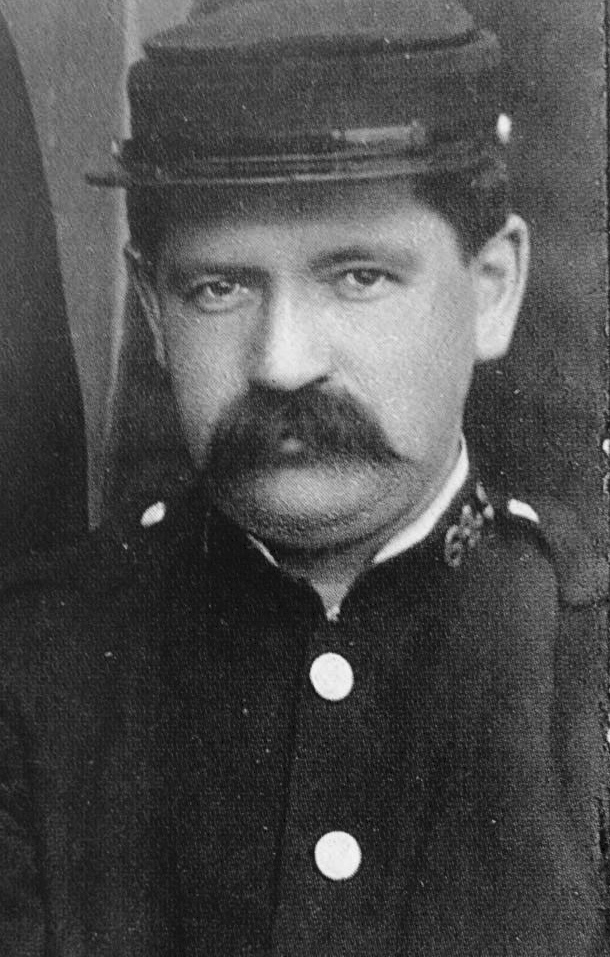
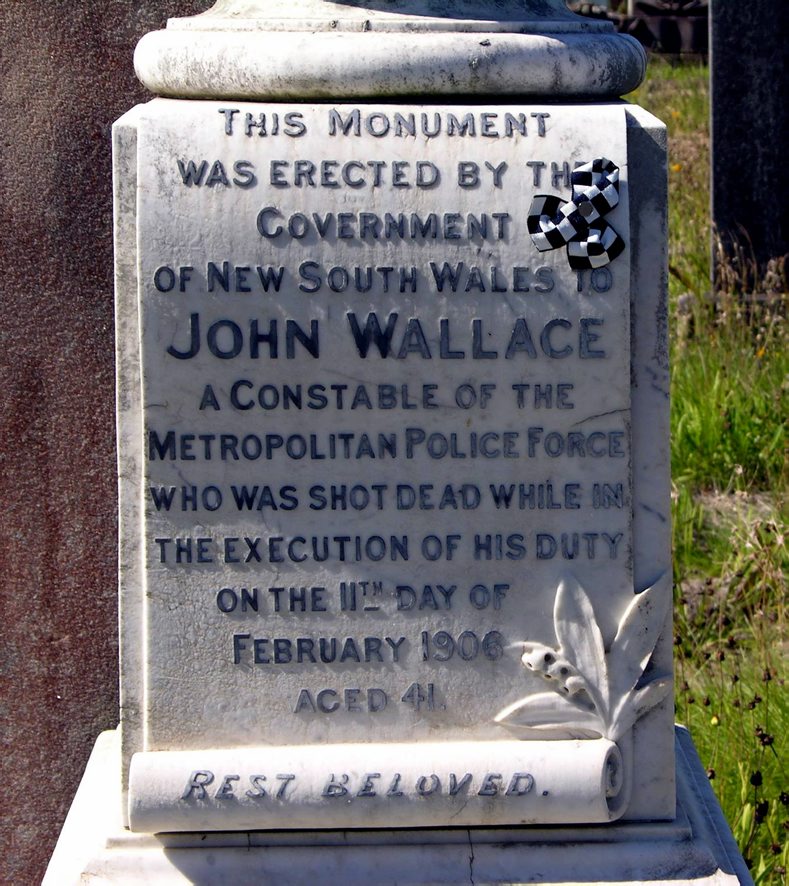
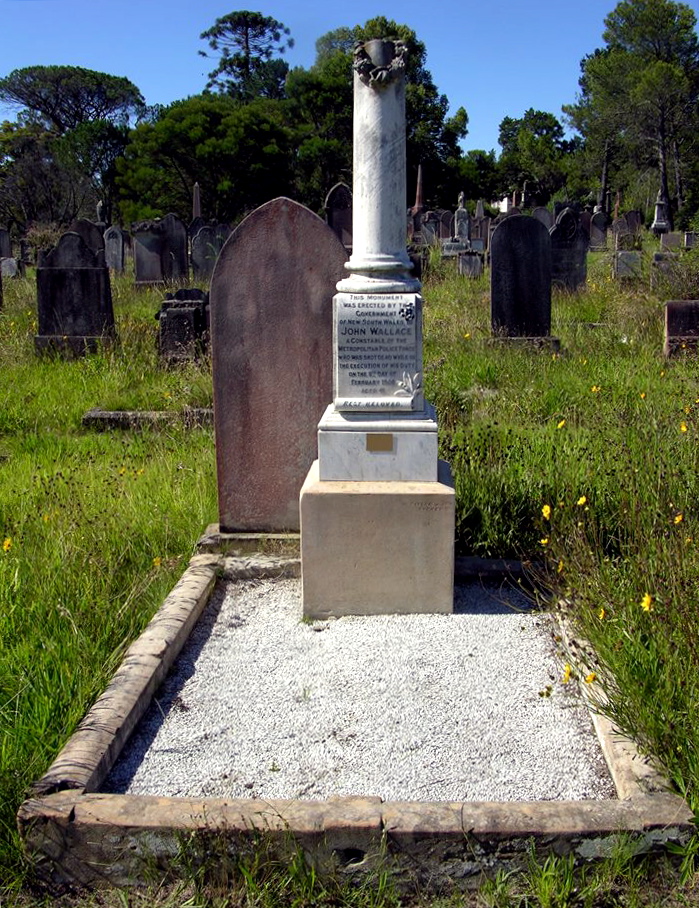
[alert_green]JOHN IS mentioned on the Police Wall of Remembrance[/alert_green]
The constable was shot at a dwelling in King Street, Newtown by the offender Tanna, who had been involved in a domestic dispute. Constable Wallace and Senior Constable Maunsell had attended the dispute and had climbed into the home through a window. Constable Wallace attempted to talk to the offender, who was armed with a rifle and a revolver, in the hallway. The offender suddenly raised the rifle and shot Constable Wallace twice. Tanna was later wounded by police, and committed suicide in the siege that followed.
The Australian Town and Country Journal of 21 February, 1906 carried details of the inquest into the constable’s murder, and the performance of the police involved.
THE NEWTOWN MURDER.
The inquest on the bodies of Constable John Wallace and Willie Yass, or Tanna, the victims of Sunday morning’s double tragedy at Newtown, was concluded at the Coroner’s Court, Sydney, on Wednesday. The Coroner said that from the evidence it seemed that the deceased Tanna was fired at by the police some ten, perhaps twelve, times in the course of the affray, but that he was only hit twice by the police, and that both wounds were superficial. The evidence also disclosed the fact that the cartridges were defective. Inspection had shown that. The Coroner said he mentioned that so that the authorities might, if they thought necessary, take action. He found that Constable John Wallace was wilfully murdered by Tanna, and that Tanna had committed suicide. “I think I may be permitted to add”, said the Coroner, “that the deceased, John Wallace, was a brave man and that he died while and because he was doing his duty. As to his comrades, without making any invidious distinction, I think I may also say that those of them who tried to rescue him, and to dislodge the man who murdered him, earned what most men prize very highly, and that is a reputation for physical bravery.”
The constable was born in 1860 and joined the New South Wales Police Force on 12 July, 1894. At the time of his death he was stationed at Newtown.
NEWTOWN LOCAL AREA COMMAND POLICE COMMEMORATION SERVICE
http://www.parliament.nsw.gov.au/prod/parlment/hansart.nsf/V3Key/LA20130508056
Ms CARMEL TEBBUTT (Marrickville) [7.07 p.m. 8 May 2013]:
Recently at Rookwood Cemetery I attended a memorial service to commemorate police officers from the Newtown local area command killed in the line of duty. The moving service was attended by Deputy Police Commissioner Nick Kaldis, Superintendent Simon Hardman, the commander of the Newtown Area Local Command, many other police representatives, and relatives and descendants of the police officers. Those attendees included Ms Avona Wallace, Mr and Mrs Norman Stephenson, Mrs Lynette Everton and Ms Edna Stevenson. Representatives from the emergency services and community members were also in attendance. The member for Campbelltown, Bryan Doyle, attended representing the Premier.
The five officers being remembered at the ceremony gave their lives to protect the community. They were Constable First Class John Wallace, Constable First Class Ruston Stephenson, Constable Lionel Guise, Detective Inspector Reginald Stevenson and Constable Pashalis Katsivelas. The ceremony to mark the sacrifice of these officers reflected on the enormity of their contribution to the community, as well as the impact of their death on their families. It is often said, and it is true, that police officers leave their homes for each shift uncertain of what any day may bring and whether they will return at the end of the day. We owe these men and women our deepest gratitude for the risks they face and take every day in their job. At Rookwood Cemetery we visited each of the graves of those officers who lost their lives in the line of duty and behind each individual was an illuminating life story.
We began at the grave of Constable First Class Ruston Stephenson, who died 80 years almost to the day of the commemoration. Constable Stephenson joined the Police Force in 1912, and four years later enlisted in the army, later joining the fight in France during the First World War. He was awarded the Distinguished Conduct Medal for conspicuous gallantry in rescuing injured soldiers while under fire. Remarkably, when he returned he rejoined the Police Force and continued to serve until his death on 9 April 1933 after a tragic accident involving a motorcycle at the then Newtown Stadium while performing general duties policing.
We were also told the story of Detective Inspector Reginald Hugh Stevenson — I was honoured on the day to meet his widow, Ms Edna Stevenson, who still had strong memories of the incident that led to Inspector Stevenson’s death. Detective Inspector Stevenson joined the NSW Police Force as a cadet in 1943 at the age of 17. In an act of extraordinary selflessness, Detective Inspector Stevenson was on annual leave on 9 December 1974 when he decided to go to work to assist in the planned arrest of a dangerous offender in Newtown, at the time telling his wife, “I don’t want my boys doing this on their own.” During the operation he was shot in the chest after leading his team in pursuit of the offender.
Detective Inspector Stevenson partially recovered and was awarded the Queen’s Commendation for Brave Conduct and the Queen’s Police Medal for Distinguished Service. However, he died in 1980 of a heart attack, deemed to be the result of the injuries he sustained on duty in 1974. These officers are just a few of many across New South Wales whose lives have been cut short as they have gone about performing their duty. I pay tribute to them all. They will not be forgotten and local events such as this are a powerful reminder of their sacrifice.
I also take this opportunity to acknowledge two Marrickville police officers, Sergeant Stewart and Constable Steele, who on Monday of this week rescued an intellectually disabled person from a house fire in Marrickville. Thankfully, those two officers who took huge risks survived and are quite rightly being hailed as heroes by their colleagues and the community. It is yet another example of the risk our police men and women take every day in order to keep the community safe. I take this opportunity to pay tribute to them.
[divider]
http://trove.nla.gov.au/newspaper/article/14751036
Samuel William LONG
Samuel William LONG
New South Wales Police Force
Regd. # ?
Rank: Constable
Stations: ?, Auburn
Service: From 6 July 1894 to 19 January 1903 = 7+ years Service
Awards: ?
Born: ? ? 1865
Died on: 19 January 1903
Cause: Murdered – shot
Age: ?
Funeral date: ?
Funeral location: ?
Buried at: Rookwood Cemetery, NSW
Memorial at: ?
[alert_green]SAMUEL IS mentioned on the Police Wall of Remembrance[/alert_green]


Funeral location: ?
FURTHER INFORMATION IS NEEDED ABOUT THIS PERSON, THEIR LIFE, THEIR CAREER AND THEIR DEATH.
PLEASE SEND PHOTOS AND INFORMATION TO Cal
In the early hours of 19 January, 1903, Theodore Trautwein, the licensee of the Royal Hotel at Auburn was awakened by a loud noise. The sound had appeared to come from the bar area of the hotel, and taking a revolver with him, Trautwein went to investigate. In the bar he saw and heard a person lying on the floor, apparently in great pain. As other residents of the hotel appeared, a candle was lit and it was found that the injured person was a local constable, Samuel Long. A doctor was called and it was found that the constable had suffered a severe gunshot wound to his head. He died a short time later, unable to identify his attacker. A lengthy investigation eventually revealed that the constable had been shot while trying to apprehend two offenders, Digby Grand and Henry Jones, whom he had caught after they had broken into the hotel. After the shooting the offenders had escaped by horse and sulky, however they were both later arrested, charged and convicted of the murder of Constable Long.
The North Western Advocate of 8 July, 1903 announced the execution of the murderers.
EXECUTION OF AUBURN MURDERERS
Sydney, Tuesday ” The State Cabinet having considered the petition for the respite of Digby Grand and Jones, convicted for murdering Constable Long at Auburn, declined to interfere and the men were hanged this morning at 9 o’clock. ”
The constable was born in 1865 and joined the New South Wales Police Force on 6 July, 1894. At the time of his death he was stationed at Auburn.
The Auburn Murder Trial.
The Sydney Mail 11 February 1903 p 8
At the Central Police Court on Monday, before Mr. E. H. Wilshire, S.M., the hearing of the case in which Digby Grand, 32, alias Newbold, alias Stephens, alias Ward, bootmaker, a native of Victoria ; John Thomas Woolford, 27 butcher ; and Albert Yeomans, 24, horse trainer, were charged with having, in company, feloniously and maliciously murdered Constable Samuel William Long, at Auburn, on January 19 last year, was resumed.
Mr. Cargill, of the Crown Law Office, appeared to prosecute ; Mr. E. R. Abigail appeared for the accused Grand, and Mr. W. Niland for the accused Yeomans.
Mr. Cargill said that there was no further evidence to call against Woolford, and he was discharged.
Joseph Daniel Gallagher and William Gallagher were cross examined by Mr. Abigail and Mr. Niland as their personal habits and connection with the police.
Francis Henry Furnval, qualified medical practitioner, residing at Auburn gave evidence as to having examined the dead body of Constable Long about 2.30 on the morning of the murder.
JONES ARRESTED.
Henry Jones, for whom the Government offered 200 pound reward, was arrested in a terrace house at Ada street, Ultimo, on Tuesday afternoon.
Sergeant Carson and Constable MacKay, plain clothes officers at No. 4 station located the suspect. Sergeant Carson and Constable Clarke went to the front of the house about 2.30pm and Detectives Jones, MacKay, and Lenehan to the rear.
They entered simultaneously, revolvers drawn, and found the man they wanted seated playing cards with other men and women. He differed from the photo we published last week in that he had grown a pointed reddish beard, and with the protection of this disguise was in the habit of going out by night. He admitted his identity on the police entering, revolvers drawn, and attempted no resistance. The inmates of the house said he had been only living with them a week.
He was taken to the Central Police Court and placed in the dock with Grand and Yeomans at 3.30pm. Their trial had been proceeding for an hour before Mr. Wilshire, and Woolford was in the witness box giving evidence, which followed the lines of his confession given by us last week, and which was to the effect that he saw Grand and Jones enter the hotel bar after vainly endeavouring to get him to actively participate, saw Constable Long come along and go through the open door to investigate, heard a shot, and saw Grand and Jones rush out and run away. Jones, described as alias John Maguire, alias Baker, 36, clerk, was charged and remanded for eight days. Grand and he exchanging a few quiet words as he left the dock, and the hearing of the evidence was then resumed.
Denis GUILFOYLE
Denis GUILFOYLE
New South Wales Police Force
Constable 1st Class
Shot – Murdered
Redfern
19 July, 1902
The constable was shot by an offender named Shaw at Redfern whilst attempting to arrest him and another man for passing counterfeit coins. Following an incident involving a storekeeper, Constable Guilfoyle had sought the assistance of an off-duty member, Constable Michael Maher, and after checking several shops the offenders had been in they located them in Shepherd Street. As the two constables approached the offenders, one produced a revolver and shot Constable Maher three times. Shaw then also produced a pistol and shot Constable Guilfoyle twice. Constable Maher later recovered, however Constable Guilfoyle’s wounds proved to be fatal. Shaw then made good his escape, making his way to Victoria.
Constable Guilfoyle was a native of Ireland, having been born at Scariff in County Clare. He arrived in Sydney in 1885 and joined the New South Wales Police Force in November of that year. He did his initial training at the old Belmore Barracks and was first sent to Bathurst, where he remained for about two years. He was then transferred to Redfern in 1887, and was destined to remain attached to that station until his death. He was described as a very powerful, muscular man of nearly 17 stone. Prior to his death the constable had recently been severely injured in an accident and after a spell in hospital had been incapacitated for five or six weeks. He also had the misfortune to recently lose three of his children, one of them being a girl 12 years old. Although he could have retired from the police force on half pay, he apparently preferred to continue to work, and had continued working ‘street duty’ at Redfern and Darlington.
(About 11am on 12 October, 1902 Constable Richard Johnston was off duty at his home at Elwood (Victoria) when a neighbour informed him that a man had attempted to abduct her eight year-old daughter. The constable quickly set off on his bicycle after the suspect and located him a short distance away. When he saw the approaching policeman the offender drew a revolver and shot Constable Johnston, inflicting fatal wounds. The offender then left the scene, only to commit suicide a short time later when confronted by other police. It was later found that the man who had murdered Constable Johnson was the same offender (Shaw) who had murdered Constable Guilfoyle at Redfern (NSW) three months earlier.)
Constable Guilfoyle was born in 1859 and joined the New South Wales Police Force on 7 November, 1885. At the time of his death he was stationed at Redfern.