Henry Stark MURROW
Henry Stark MURROW
New South Wales Police Force
Regd. # 4471
Rank: Senior Constable
Stations: Phillip Street Police Station ( No. 4 Division )
Service: From 9 June 1883 to 5 October 1897 = 14+ years
Awards: ?
Born: 1861 in England
Event date: 4 October 1897
Event location: the vicinity of Argyle Street, The Rocks
Died on: 5 October, 1897 around 12.30am
Cause: Assault – blood clot on the brain
Age: 35
Funeral date: 6 October 1897 @ 3pm
Funeral location: Waverley Cemetery
Buried at: Waverley Cemetery
Memorial: https://www.australianpolice.com.au/eastern-suburb…olice-memorial/
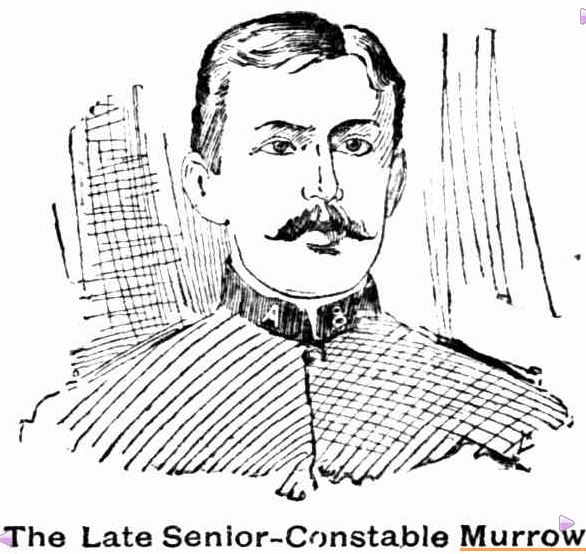
HENRY IS mentioned on the Police Wall of Remembrance
On 4 October 1897 Constable Murrow attempted to arrest a man by the name of Daniel Conway in the vicinity of Argyle Street, The Rocks. During the scuffle the constable fell to the ground, heavily striking his head. Taken to the Sydney Hospital and treated for what was thought to be merely a scalp wound, the constable was allowed to return to his home. Later that night he became very ill and died. It was subsequently found that he had suffered a fractured skull. Although Conway was charged with murder he was later convicted of manslaughter and sent to gaol.
The Sydney Morning Herald of 7 October, 1897 described the constable’s inquest and funeral, concluding with the following:
The funeral of the deceased took place yesterday afternoon. The procession, which included 160 members of the police force in uniform and a number of Freemasons, left the deceased’s late residence, at 117 Underwood Street, Paddington, shortly before 3 o’clock, and proceeded to Waverley Cemetery, where the interment took place. The coffin was covered with floral tributes. The Police Band played the Dead March en route. At the grave a special Masonic service was read, as well as the usual burial service. Amongst the officers of the department who were present were Superintendent Head, Inspectors Bremner, Potter and Lawless, and Sub-inspectors Scott and Elliott. In the funeral procession there were also a large number of civilians.
The senior constable was born in 1861 and joined the New South Wales Police Force on 9 June, 1883. At the time of his death he was stationed at Phillip Street Police Station, Sydney.

Police death in the course of duty
Senior Constable Henry Murrow (1869–1897) of No 4 Station died from an injury received on duty. Born in England, Murrow had settled with his parents in New Zealand where he joined the New Zealand Police Force before moving to Sydney and joining the NSW Police Force in 1883.
On 4 October 1897, Murrow, while on duty in The Rocks was hailed by Jane Jones, publican of the Orient Hotel who was having trouble with a drunken patron, Daniel Conway. Jones asked Murrow to move Conway along. This he did, requesting that Conway go home. Conway left with another man, walking south along George Street, closely followed by Murrow, as witnessed by George Howlett. Nearing the Port Jackson Hotel (now the Russell Hotel) on the corner of Globe Street, Conway’s companion was swearing, at which point Murrow overtook them and clasped his hand on the man’s shoulder. This resulted in a fight during which Murrow struck his head on the woodblock paving of George Street. Howlett intervened, helping Murrow to his feet. Conway then fled back towards Argyle Street and Howlett assisted Murrow to the nearby No 4 Police Station.
Murrow was escorted to Sydney Hospital where wound was dressed. It appeared to be minor so Murrow was dismissed. Meanwhile Conway was delivered into the custody of water police Constable William Cleugh who took him to the Water Police Station in Phillip Street where he was charged with assaulting Morrow while he was on duty.
At 10.30pm at his home at Paddington, Murrow lost consciousness and died around 12.30am. Doctors were summoned and determined that he had concussion, an autopsy confirmed it. Conway, was charged with murder but convicted on the lesser charge of manslaughter and sentenced to six months hard labour at Darlinghurst Gaol.[9]
[9] Daily Telegraph, 7 and 8 October 1897

James BEATTY
James BEATTY
AKA ?
Late of ?
“possible” relation in ‘the job’: ?
NSW Belmore Barracks Class # ? ? ?
New South Wales Police Force
Regd. # ‘P‘ 1162
For the purposes of this website ‘P‘ = represents those Police joining Pre 1 March 1862 before the amalgamated of all other Policing Units in NSW. i.e. Mounted Police, Boarder Police, Native Police, Gold Escort Police, Water Police etc.
Rank: Commenced Training as a Probationary Constable – appointed 5 February 1858 ( aged 22 years, 4 months, 15 days )
Constable – appointed 18 February 1858
Constable 1st Class – appointed ? ? ?
Detective – appointed ? ? ?
Senior Constable – appointed 1 June 1869
Leading Senior Constable – appointed ? ? ? ( N/A )
Sergeant 3rd Class – appointed 1 April 1883
Sergeant 2nd Class – appointed ? ? ?
Sergeant 1st Class – appointed 1 April 1884
Final Rank: = Sergeant
Stations: Darlinghurst ( 3 Division ), Hill End ( Mounted Police Gold Escort ), Lambing Flat, Parramatta ( 1st Class Constable ), Orderly to the Inspector General of Police – Sydney, Parramatta ( Senior Constable ), Windsor ( O.I.C. ), Campbelltown O.I.C., Ryde O.I.C., Penrith O.I.C. ( J District )( Easter 1888 – Death )
Service: From 5 February 1858 to 11 January 1890 = 31 years, 11 months, 6 days Service
Retirement / Leaving age: = 54 years, 3 months, 21 days
Time in Retirement from Police: Zero
Awards: No Find on Australian Honours system
Born: Monday 21 September 1 835 Enniskillen, Northern Ireland
Died on: Saturday 11 January 1890
Age: 54 years, 3 months, 21 days
Organ Donor: N/A
Cause: Murdered – Stabbed – On Duty
Event location: Outside of Penrith Police Station, NSW ( site of the current Station )
Event date: Saturday 11 January 1890
Funeral date: ? ? ? TBA
Funeral location: ? TBA
Funeral Parlour: ?
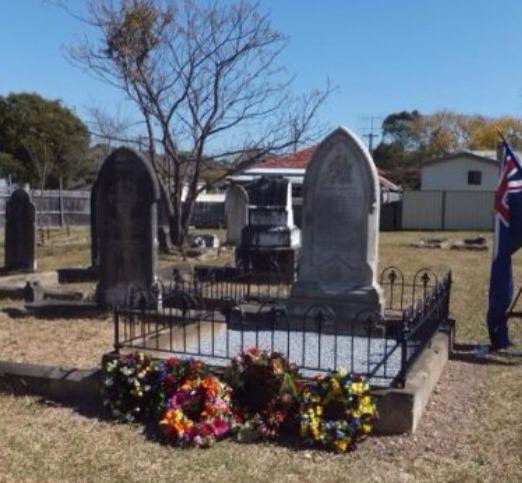
Buried at: St Stephen’s Anglican Cemetery, High St, Penrith, NSW
Grave location: Plot K18
Grave GPS:

Memorial / Plaque / Monument located at: Penrith Police Station, Penrith, NSW
Dedication date of Memorial / Plaque / Monument:
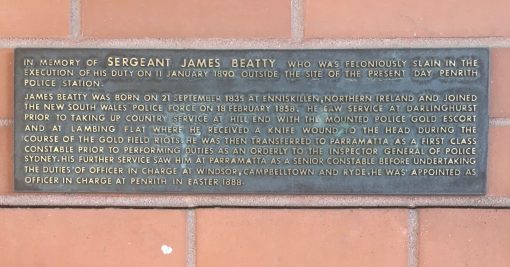
Photo taken by Bruce TURNER AM on Wednesday 191022.
JAMES IS mentioned on the National Police Wall of Remembrance – Canberra
FURTHER INFORMATION IS NEEDED ABOUT THIS PERSON, THEIR LIFE, THEIR CAREER AND THEIR DEATH.
PLEASE SEND PHOTOS AND INFORMATION TO Cal
May they forever Rest In Peace
https://www.facebook.com/groups/AustralianPolice.com.au/
https://www.facebook.com/groups/NSWFallenPolice/
Australian Police YouTube Channel
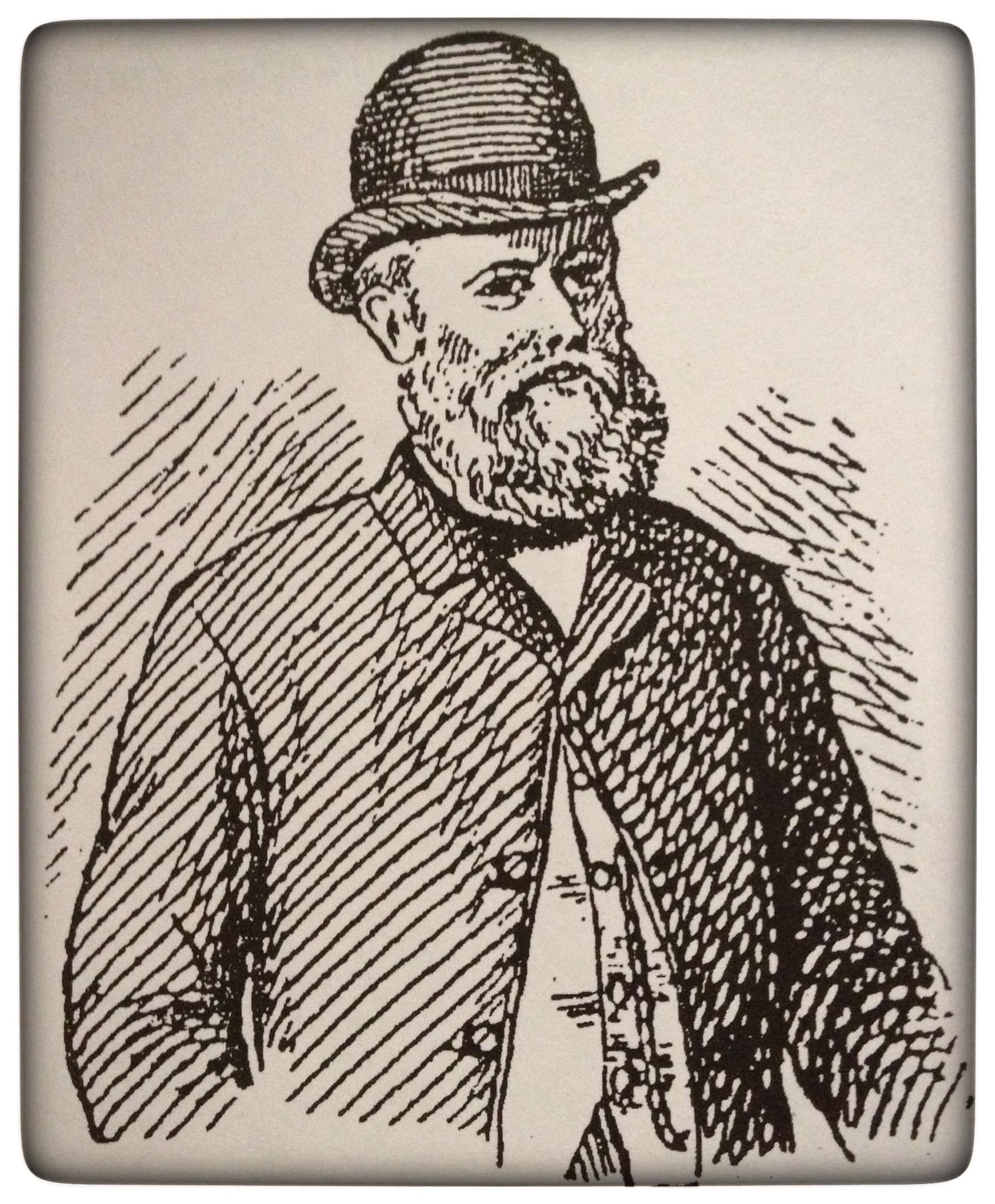
On 11 January, 1890 outside the Penrith Police Station, the sergeant had occasion to speak to an Indian vagrant whom he had earlier asked to leave town.
The man suddenly leapt at Sergeant Beatty, stabbing him five times.
Local people and Constable William Moseley then pursued the offender and cornered him however the man threw a brick which struck the constable in the chest.
Constable Moseley then drew his service revolver and shot the offender, wounding him.
The constable and locals then threw themselves on the offender and he was arrested.
The offender died later that night.
Unfortunately, the wounds inflicted upon Sergeant Beatty also proved to be fatal.
The sergeant was born in 1835 and joined the police force on 5 February, 1858. In 1862 he became a member of the newly-formed New South Wales Police Force. At the time of his death he was stationed at Penrith.
Source: Beyond Courage:
James BEATTY’s mother died five days before his own demise.
James had previously suffered a knife wound to the head during the course of the Gold Field Riots at Lambing Flat, NSW.
The Launceston Examiner of 11 January, 1990 provided the following news of the tragedy.
TERRIBLE TRAGEDY. A terrible tragedy was enacted this afternoon at Penrith. A coloured man, a stranger in the town, was observed by Sergeant Beatty to be throwing stones at passers-by.
The officer warned him to desist, and was in the act of arresting him when he drew a knife and stabbed Beatty in the chest, the weapon going completely through his body.
Beatty called out, and Constable Mosley came to his assistance, armed with a revolver.
Mosley [Moseley] fired at the coloured man, who was in the act of running away, but missed. A second shot, however, took effect, and the fugitive reeled and was about to fall, when a young man named Zolliner [John Zahnliter] seized him.
Both men rolled over on the street, and the coloured man drew the knife again and stabbed Zolliner.
He was ultimately seized and taken to the lock-up.
Sergeant Beatty, who is not expected to recover, has had his dying depositions taken. Zolliner‘s wound is not serious.
www.ccansw.org.au/index.php/newspublicblog/news/blogs/102-general-/1494-sergeant-james-beatty
Col Colman
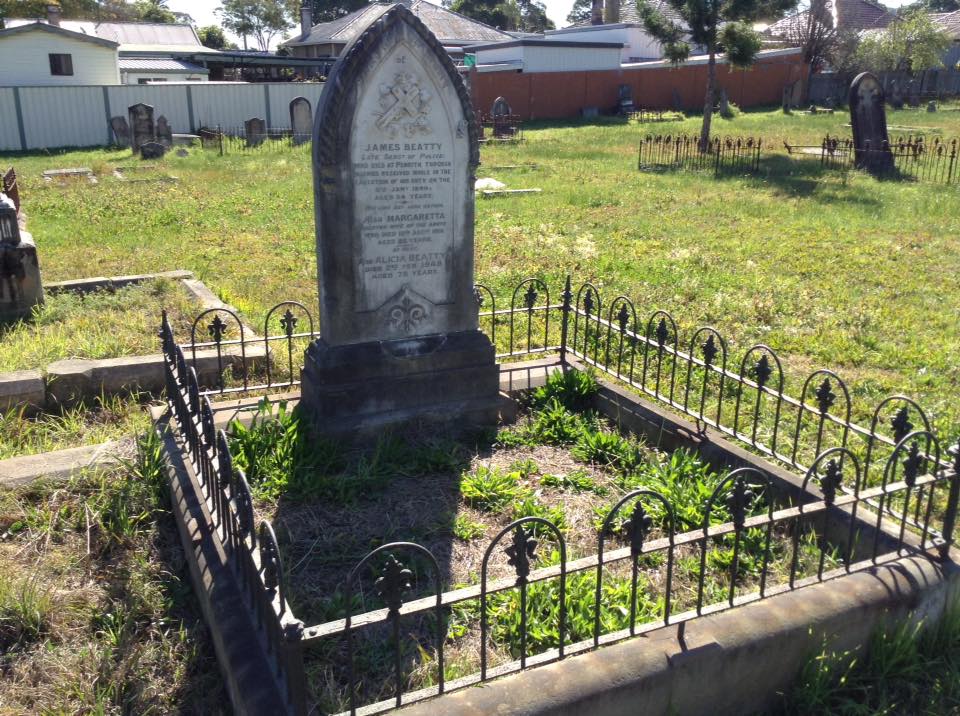
Also visited St. Stephens. Anglican Church High Street Penrith and the Cemetery at the rear to visit the grave site of Police Officer James Beatty. Site was cleaned in 2012 by Police and Penrith Council and is in reasonable condition did a little weeding.
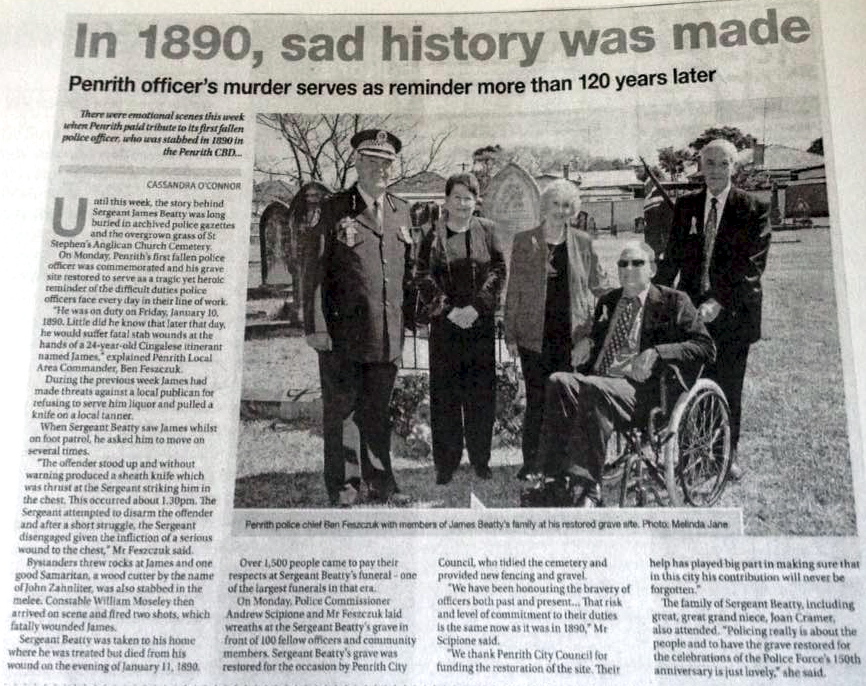
 On 10th January 1890 Sergeant James Beatty, a long serving officer in the NSW Police Force was fatally stabbed in High Street Penrith. Sergeant Beatty was buried with full police honours in St Stephen the Martyr churchyard cemetery, Fulton Lane, Penrith.
“About 1.30pm on 10 January 1890, Sergeant James Beatty had occasion to interact with an itinerant Cingalese named James in High Street, Penrith outside the Convent of the Sisters of St Joseph. During that interaction the Sergeant was stabbed in the chest.
In the meantime, the offender was contained by townspeople pending the arrival of Constable Moseley who shot the offender. A good Samaritan named John Zahnliter was also stabbed during the melee. Sergeant Beatty died of his wound on the evening of 11 January 1890. He was survived by his widow Margaretta, four sons and two daughters.”

St Joseph’s Convent, High Street Penrith (now Officeworks)
Penrith City Council Library Local Studies collection
On 3rd September, 2012, as part of the 150th Anniversary of the NSW Police Force, a commemorative service was held at Sergeant Beatty’s gravesite to honour his sacrifice, the event a joint venture between Council and Penrith Local Area Command.

Sergeant Beatty’s monument was in a dilapidated and damaged state. Council arranged and funded the restoration of the monument to its former glory by master stonemasons, Monuments in Memoriam who are based at Rookwood Necropolis. All restoration work was in accordance with the National Trust of Australia (NSW) Guidelines for Cemetery Conservation, the Burra Charter and Penrith City Council’s LEP.
Since 1982, Penrith City Council has been the trustee of this significant churchyard cemetery which dates from 1838 with full responsibility for its care and maintenance. The Public Domain Amenity and Safety two man cemeteries crew, maintain five cemeteries, Penrith, St Marys, Emu Plains, Castlereagh and St Stephens.
In preparation for the occasion an intensive clean up of the cemetery took place with staff from the City Presentation Group – Parks, Public Domain and Cemetery Operations spending a day in the cemetery. The heritage nature of the cemetery and fragility of the monuments meant that whipper snipers could not be used and all trimming around and inside monuments was by hand.

Fragile heritage cemeteries are protected by the grasses that grow around and inside the monuments. Plans of Management are currently being prepared for the cemeteries under Council’s control and the consultant’s recommendation for St Stephens is that we should avoid overly detailed or manicured works. The Cemetery should look old, avoid pristine maintenance and maintain the wild character of the grasses within the grave enclosures.


The commemorative service to honour the memory of Sergeant James Beatty was attended by Andrew Scipione APM, Commissioner of Police, Nick Kaldas APM, Deputy Commissioner of Police (Field Operations), Ben Feszczuk APM, Local Area Commander, former Commissioner of Police, Tony Lauer APM, Hon David Bradbury MP, Stuart Ayres MP, Beatty family descendants, Councillor Greg Davies, Mayor of Penrith, Councillor Ross Fowler OAM, Alan Stoneham, General Manager, Barry Husking, Director, David Burns, Group Manager – City Presentation, managers Yvonne Perkins and Barbara McGee, council officers and police personnel.
Mary Thorne, Cemeteries Project Officer
Nepean Times (Penrith, NSW : 1882 – 1962),
Thursday 12 February 1948, page 6
Old Tragedy Recalled
DAUGHTER. OF SERGT. BEATTY PASSES.
Miss Alicia Beatty (68), who died on 2nd inst. and was buried in St. Stephen’s cemetery, Penrith on 3rd, was the daughter of Sergt James Beatty, who was fatally stabbed by a Cingalese in High Street, Penrith, on January 10, 1890, an incident that is often referred to by the older generation of the district.
The story, briefly told, is that the Cingalese had been prowling around the town for a few days and on the day of the tragedy was ” moved on ” by the Sergt, who followed him for some distance. The man then sat down on the pavement near the Convent and Sergt. Beatty, not liking his appearance, again ordered him to clear out.
The Cingalese started to his feet and, without any warning, drew a sheath knife and, rushing in, stabbed the Sergeant in the chest.
A man named John Zahnliter tried to disarm the assailant and was stabbed in the side.
The Cingalese was shot by Constable Moseley.
Sergt Beatty and the Cingalese died subsequently of their wounds, and Zahnliter recovered, though he suffered severe physical disability, for which he received a pension, till his death many years afterward.
Miss Beatty was buried alongside her late father and mother, in the old St. Stephen’s cemetery. Mrs. Beatty died on August 12, 1916.
David SUTHERLAND
David SUTHERLAND
New South Wales Police Force
Cousin to Senior Constable William SUTHERLAND, NSWPF ‘Q‘ “Possibly” 4257 ( born 1854 in Scotland & joined NSWPF on 26 Sept. 1882 ) OR 6417 ( BORN 1869 in Scotland & joined NSWPF on 27 May 1892 )
Uniform # A 356
Regd. # ‘Q‘ 5460
For the purposes of this website ‘Q‘ represents those Police joining between 1 March 1862 ( commencement of NSWPF ) – 23 February 1915 ( Commencement of NSWPF current numbering system )
Rank: Constable
Stations: Darlinghurst ( No. 3 Division ) – Death
Service: From 11 October 1887 to 3 June 1889 = 1+ years Service
Awards: ?
Born: ? ? 1863 @ Canterbury, New Zealand
Died on: Monday 3 June 1889
Cause: Shot – Murdered
Event location: MaCleay St, Potts Point, NSW
Age: 25 – unmarried
Inquest date: Thursday 6 June 1889
Funeral date: Wednesday 5 June 1889
Funeral location: ?
Buried at: Waverley Cemetery, cnr St Thomas St & Trafalgar St, NSW
Grave Location: C of E, Sec 9, Grave 941
Memorial at: ?
DAVID IS mentioned on the Police Wall of Remembrance
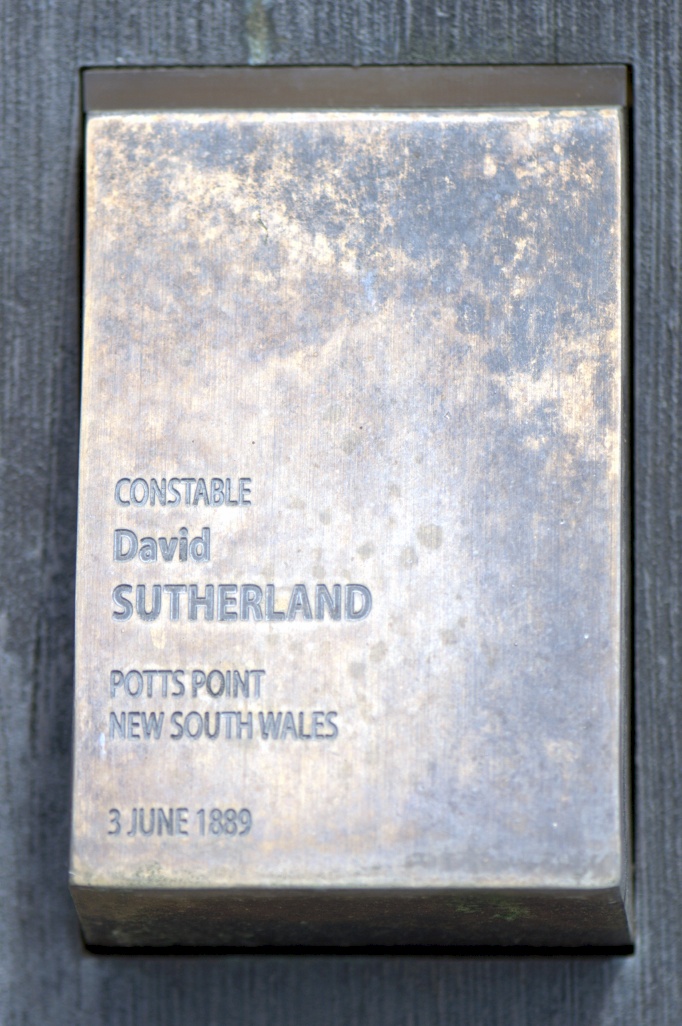
Funeral location: ?
FURTHER INFORMATION IS NEEDED ABOUT THIS PERSON, THEIR LIFE, THEIR CAREER AND THEIR DEATH.
PLEASE SEND PHOTOS AND INFORMATION TO Cal
About 3am on 3 June, 1889 the constable was patrolling MaCleay Street, Potts Point when he saw a man enter a yard and walk to the rear of a dwelling. He detained the man a short time later as he left the premises and spoke to him regarding his actions. When the man attempted to leave, the constable took hold of him and again asked what he was doing. The offender told the constable to let him go or he would shoot him. A struggle ensued and when both men lost their balance, the offender shot the constable in the abdomen.
While they were on the ground the offender again fired at the constable who drew his baton and struck his attacker. Constable Sutherland was then able to take the revolver from the offender, but as he was quickly losing his strength due to his wounds, the offender quickly retrieved the weapon and escaped. He was very soon arrested by Senior Sergeant Robertson and Sergeant Hogan.
Constable Sutherland died later that day, however not before providing his colleagues with a dying deposition and a positive identification of his attacker, John Morrison.
This death was a major factor which led to the general arming of Sydney Police in 1894. Previously, country and mounted police had always been armed, but the Sydney foot police for some reason had not.
The constable was born in 1863 and joined the New South Wales Police Force on 11 October, 1887.
At the time of his death he was stationed at Darlinghurst.
David SUTHERLAND was identified by his Cousin, Constable William SUTHERLAND after the murder.
William SUTHERLAND was later to be murdered in 1901 by a ‘kosh’ on the head.
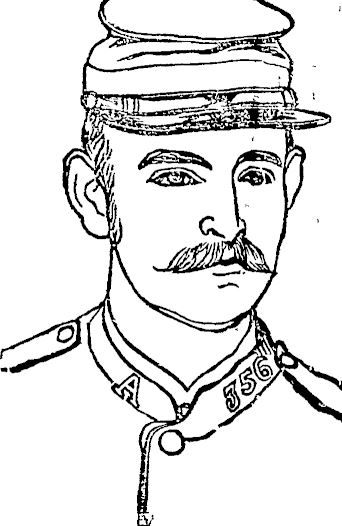
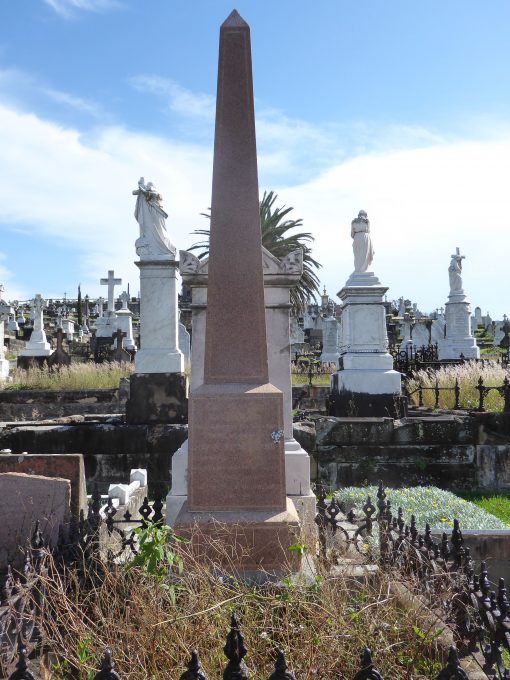
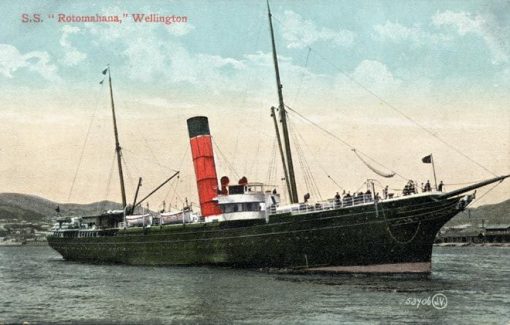
Evening News ( Sydney ) Monday 3 June 1889 p5 of 8
POOR SUTHERLAND WAS INSURED.
Mr. G. F. Murnin, resident secretary of the Australian Widows’ Fund, 263, George-street, informs us that Constable David Sutherland, who was murdered this morning, was insured for £250, the policy having only been taken out in April last.
http://trove.nla.gov.au/ndp/del/article/108894588
Barrier Miner (Broken Hill, NSW : 1888 – 1954),
Wednesday 5 June 1889, page 3
The Murdered Constable.
The Inquest.
SYDNEY, Wednesday.
The inquest on the body of Constable David Sutherland, who was shot by a burglar at Potts Point, was commenced yesterday afternoon.
The prisoner, James Morrison, was in custody, handcuffed.
There was a crowded court.
Morrison is a powerful fellow, 28 years of age, and the mark of a heavy blow over the left eye is still visible.
Constable William Sutherland identified the body as that of his cousin. He was a native of Canterbury, New Zealand. He was a single man. His mother, three sisters, and four brothers were living there.
Medical evidence showed that the bullet severed the main artery of the groin.
Benjamin Backhouse, architect, residing at Potts Point, deposed that he was awakened by the reports of a shot. On hearing the second shot, he also heard cries for help. He then saw a man running away. The man was of similar appearance as prisoner. A fence over which the man scrambled was examined afterwards and showed blood marks.
Further evidence similar to that reported already was also given.
The inquiry is still proceeding.
Melbourne, Wednesday.
The Melbourne police have identified the photograph of James Morrison, who is charged with the murder of Constable Sutherland, as that of a man known to them as Jackson, who has recently done two and a half-years in Victoria for an impudent forgery.
05 Jun 1889 – The Murdered Constable. – Trove
Goulburn Herald ( NSW ) Thursday 6 June 1889 p2 of 4
THE MURDER OF CONSTABLE SUTHERLAND.
We subjoin further particulars of the tragedy in Macleay-street, Potts Point, reported by telegraph in our last issue: It appears that at about 3 a.m. on Monday, as Senior-sergeant Robertson and Sergeant Hogan were standing at the corner of William and Victoria streets, they saw a man walking towards them. He was proceeding at a very quick pace, and noticing that he was very much excited and out of breath, they stopped him. His trousers, coat, and vest were all smeared with blood, and there was a severe wound over his left eye. While they were questioning him Mr. McElhone junior came up, and said that there was at constable lying on the footpath in Macleay street. The senior-sergeant and Mr. McElbone at once took a cab and went to where the constable was reported to be lying, and in the meanwhile the blood-smeared man was conveyed to the Darlinghurst lookup.
Sutherland ( the constable ) was found lying, as indicated by Mr. McElbone, dangerously wounded, but conscious . He was taken to the hospital, where he was found to be wounded in the abdomen, no hope of his recovery being entertained. Sutherland unhesitatingly identified the man who had been arrested, and who gave the name of John Morrison, as the man who had shot him, and Morrison, who had been brought to the hospital for the purpose of identification, responded, ” Well, it’s wrong of you to say that. I did not shoot you.”
Subsequently the deposition of the wounded man was taken, and he succumbed to his injuries shortly before seven o’clock on Monday morning.
The substance of Sutherland’s deposition was as follows: – At half-past 2 a.m., while the constable was standing near the residence of Mr. C. J. Roberts, Chatsworth, he saw a man enter the gates in front of the adjacent house and pass towards the rear of the premises. After the man had been inside the gates for a minute or two some dogs which were there began to bark, and they continued doing so until the man left and walked into the middle of the road. The constable and the man exchanged a “ good-night ” greeting, and the constable observed, ” you’re out early. ” The man then attempted to make off. The officer, however, caught hold of him, and asked what he was doing. The man replied, “ let me go. If you don’t I’ll shoot you, ” and he immediately thrust his right hand into his trousers pocket. A struggle ensued, and just as they were about to fall the man fired his revolver. Whilst on the ground he again fired. The constable, however, could not say whether the latter shot took effect. Before either of them regained his feet the constable drew his baton and gave the man a severe blow on the head. Owing, however, to his weak state the blow was not as severe as he hoped it would be. The constable, though wounded, wrested the revolver from the man, but as he was very weak the other soon got the better of him, and raising himself, snatched back the revolver, and made off. Whilst the injured constable’s depositions were being taken, the prisoner, who had been brought to the bedside of the wounded man, inquired whether the revolver did not go off accidentally. Replying to this the dying man said, ” no, you pointed it direct at me. ”
The next piece of evidence as to the fatal affray is furnished by Mr. Benjamin Backhouse, a gentleman living close to the scene. He was awakened by a pistol-shot, which was followed shortly after by a second report. He then saw a man running at full speed along Rockwell-street, and at the same time heard loud cries for help. He got out of the house in time to see the man who ran down the street scale the fence at the end of the street, and he became lost to view. He then found the wounded constable and afforded him what assistance he could until the arrival of the police and others.
When the scene of the affray was examined later on, a large morticing chisel was found, and this instrument corresponds with a number of marks on premises in the locality. A six-chambered nickel plated revolver was found concealed in the grass in Mr. McElhone’s paddock, close to where Mr. Backhouse saw the man scale the fence. Four of the chambers were loaded, and the remaining two had been discharged. A third article was also discovered, namely, a cloth tweed hat of large size, which gives colour to the report of the captured man having had an associate.
Constable Sutherland was a young and energetic officer, only twenty-five years of age, and unmarried. He had been about twenty months in the force, and was highly spoken of by his superior officers and comrades. Morrison is also a young man of about twenty-five, stiflly built, and described as a cabinet maker by trade. He is said to be a native of England, and was previously unknown to the police. He has a wound over the left eye, such as would be caused by a constable’s baton. When brought before the police court this morning he made no reply to the charge of murder, and has so far maintained silence as to the part he is supposed to have played. He was remanded to the coroner’s court.
The coroner commenced an inquest on Tuesday, when William Sutherland, a police constable stationed at the Glebe, identified the body of the deceased as that of his cousin David Sutherland, who was twenty-five years of age, and a native of Canterbury, New Zealand. He was a single man. He had left £32 in the Savings’ Bank, Oxford-street, Sydney, and a life policy for £250. Deceased had left a mother and a number of brothers and sisters in New Zealand. Evidence was given in substantiation of the facts above detailed, and the inquiry was adjourned to Thursday.
http://trove.nla.gov.au/ndp/del/article/100114828
South Australian Weekly Chronicle ( Adelaide, S.A. ) Saturday 8 June 1889 p21 of 24
THE MURDER OF CONSTABLE SUTHERLAND.
( By Telegraph )
Sydney, June 6.
The coroner’s Inquest relative to the death of Constable David Sutherland, who was shot whilst arresting a burglar at Pott’s Point on Monday morning, was concluded to-day, a verdict of wilful murder being returned against James Morrison, the man who fired the shot.
Morrison will come up for trial at the Quarter Sessions, commencing July 15. Whilst Sergeant Hogan, one of the two officers who arrested Morrison, was giving evidence to-day the prisoner told him that he had better tell the truth. When asked if he had any questions to put to Hogan, Morrison said — ‘ No, your honor. He would only tell lies If I was to. ‘
The coroner, in summing up, said there was a great deal of circumstantial evidence to bear out the statement made by the deceased constable that the fatal shot was wilfully fired. To their verdict the jury added a rider recommending that in future no constables should be allowed to go on night duty in the suburbs or on lonely beats singly, but in pairs, so that in case of emergency they might be in a better position to act. The foreman added that this course would entail an extra expense, but the money would be well spent in the protection thus afforded to life and property.
http://trove.nla.gov.au/ndp/del/article/95148258
The Maitland Mercury and Hunter River General Advertiser ( NSW )
Sat. 8 June 1889
Funeral of Constable Sutherland.
The remains of the late Constable David Sutherland, who met his death early on Monday morning by being shot by a burglar, were conveyed to the Waverley Cemetery on Wednesday afternoon, followed by an imposing procession of the police, the military, and sympathetic citizens.
The funeral was timed (reports the Herald) to leave No. 3 Police Station at 2.30, and almost to the minute the coffin was borne to the hearse by the comrades of the deceased. The streets and roads in the vicinity of the station and Darlinghurst prison were blocked up by some thousands of people, and traffic was consequently suspended along Oxford street as far as the Victoria Barracks, and thence at intervals throughout the route of the cortege. The spectacle was one suggestive of the most marked tribute of respect that could have been paid to the deceased. Four mounted troopers headed the Permanent Artillery Band in the march to the cemetery, followed closely by the hearse and two mourning coaches, carrying the relatives of the deceased; then came upwards of 200 constables four deep, with their officers, Mr. Fosbery, the Inspector – General, Mr. Read, the superintendent, Inspectors Anderson, Larkins, McKay, and Camphin, Sub-inspectors Bremner, Potter, Atwill, Cotter, Long, Hyam, and Lawless. The Permanent Artillery under Major Airey and Lieutenant Kyngdon were next in order, with a body of the Permanent Mounted Infantry on foot, together with the Staff Sergeants and Captains Cuthell and Bayly representing the Permanent Staff. A carriage, containing Sir Henry Parkes and Mr. C. Roberts, M.L.A., was followed by the Mayor’s carriage and a large number of vehicles.
The cemetery was reached shortly after 4 o’clock, and some thousands of persons were in waiting to witness the lowering of the coffin into the grave. The Rev. A. Gardiner was the officiating clergyman, and after reading the burial service he asked to be allowed to utter a few sentences touching the impressive and solemn occasion. It was always, he said, a solemn thing to stand about an open grave and reflect how suddenly the summons of death might come, but there were special circumstances surrounding the present bereavement which tended to make it more solemn and impressive. Probably not many who were gathered around the grave had known David Sutherland, but their hearts were touched with sympathy under the circumstances, and they felt it due to his memory to give him that ennobling mark of respect. There was always something sad about the death of a young man just beginning life, with prospects before him such as the deceased had, but there was something very bad in the terrible consequences which led to his death. He died at his post ; he was faithful even unto death, and perhaps the last words that fell from his lips, like Nelson at Trafalgar, were, ” I have done my duty.”
The fidelity and worth of the people of Sydney had been touched on this occasion by the disaster which overcame the deceased, and yet why should they mourn so much for his departure ? Though young, and called away under such circumstances, it should be remembered that he had faith in God and knew that he was going to a better scene ; he had a knowledge of the divine truth, and hoped in Christ. As for his own part, he would ten thousand times rather be David Sutherland that day lying in his grave than the man who was the cause of his death. Two lessons were taught in the death of the deceased, namely, to be faithful to duty, and to do from day to day what was felt to be right, at any cost. It was gratifying to see the people of Sydney so much moved, because it showed that their hearts were on the right side, and they sympathised with the deceased for his resolution and determination to stand at his post at the cost of his life. It was that spirit that distinguished the British nation more than any other. The benediction was then pronounced by Rev. C. F. Garnsey. The coffin was covered with wreaths of flowers. One came from the ladies of Macleay-street, as a tribute of respect, another from the gardeners of Potts Point, and a third from his comrades.
http://trove.nla.gov.au/ndp/del/article/18972138
The Sydney Mail and New South Wales Advertiser
Sat. 15 June 1889
The Late Constable Sutherland.
The inquest relative to the death of Police-constable David Sutherland was concluded on June 6th. The jury returned a verdict of wilful murder against the prisoner, James Morrison, who was accordingly committed for trial at the next sittings of the Central Criminal Court.
A rider recommending that in the suburbs and on lonely beats, two constables should patrol together was added. The prisoner appeared to feel his position keenly, and towards the conclusion of the inquiry his agitation became apparent. He never asked a question and only spoke twice, on each occasion denying the veracity of a witness.
Sir Henry Parkes has sent the following letter to the Inspector-General of Police with reference to the late Constable David Sutherland: — ” Sir, — You will be good enough to convey to the members of the police force the expression of my deep regret for the loss which the Government has sustained by the murder of Constable David Sutherland. The highest conduct of man in any station of life consists of the fulfilment of trust and the performance of duty. David Sutherland did his duty to the very death. His steady sense of obligation, and his heroic effort to perform his part when his life-blood was ebbing away, furnish an example which could hardly be excelled in front of the enemy on the battle field. His conduct in life and death reflects highest credit upon the force of which he was a member, and will make his memory respected by all good men. ”
In accordance with the request of the Premier the letter has, under the direction of the Inspector General of Police, been recorded in the Orders, and read on parade at the various stations to all of the metropolitan police force, and was published yesterday in the Police Gazette for the Information of the police generally.
http://trove.nla.gov.au/ndp/del/article/161928600
THE ARMING OF POLICE.
The South Australian Register of
6 February, 1894 printed the following.
OBJECTION TO ARMING THE POLICE. Sydney, February 5.
The Inspector-General of Police [Fosberry] says that one objection to arming the police with revolvers is that the use of firearms may become too common, and if the public get familiar with the snap of the revolver a similar state of things to that prevailing in the United States may be brought into existence. Concerning the two men injured the constables are improving in health.
The same newspaper on 27 February, 1894:
REVOLVERS USED BY THE POLICE. Sydney, February 26.
Two police had an exciting contest last night at Redfern, when they were arresting four men on a charge of thieving. Directly the constables sought to detain them a rough-and-tumble fight occurred, a number of roughs seeking to enable the suspects to escape. Eventually two of the four men broke away, and the others were on the point of being rescued when the police drew their revolvers and threatened to fire on the larrikins. The presentation of firearms completely cowed them, and the constables succeeded in conveying two of the men arrested to the station. This is the first occasion on which the police have found it necessary to use revolvers since their issue, and had they not been available the constables would have been severely maltreated.
John MITCHELL
John MITCHELL
New South Wales Police Force
Regd. # Q 3302
( For the purposes of this website ‘Q’ represents those Police joining between 1 March 1862 ( commencement of NSWPF ) – 23 February 1915 ( Commencement of NSWPF current numbering system )
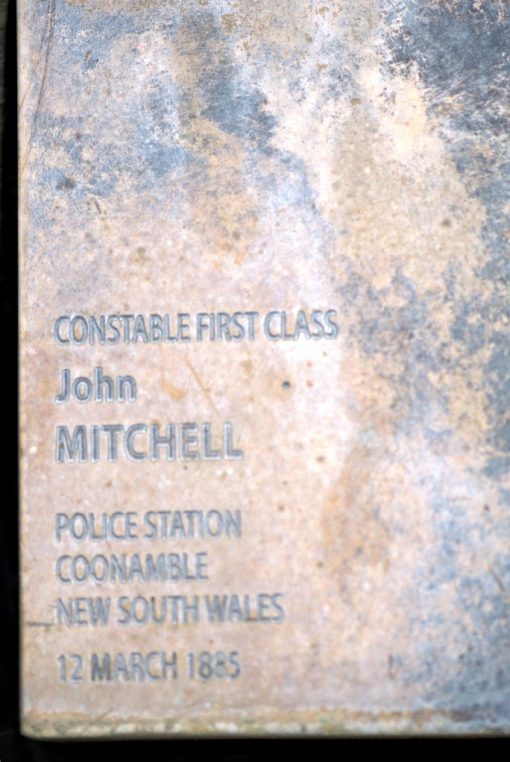
Rank: Constable – appointed 27 September 1878
Constable 1st Class- appointed February 1884
Stations: Bathurst, Coonamble – Death
Service: From 27 September 1878 to 13 March 1885 = 6.5 years
Awards: ?
Born: 18 August 1856 in Uig, Ross & Cromarty, Scotland
Event date: Thursday 12 March 1885
Event location: Gaol, Aberford St, Coonamble ( erected 1877 )
Died on: Friday 13 March 1885
Cause: Shot – Murdered at Coonamble, NSW
Age: 29
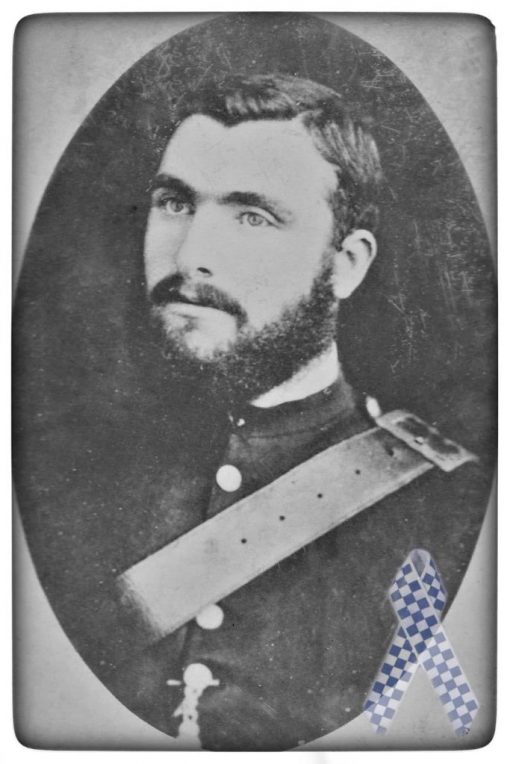
Funeral Date: Sunday 15 March 1885
Funeral location:
Buried at: *Old Coonamble Cemetery, Auburn St, opposite Warrena St, Coonamble, NSW
( This cemetery no longer exists and was turned into a Park around 1970 and the headstones removed. See *below )
JOHN IS Mentioned on the Police Wall of Remembrance
Early in the morning of 12 March, 1885 two prisoners in the lockup at Coonamble overpowered a warder by the name of Michael Langley who had gone into their cell to place leg irons on a third prisoner by the name of Courtney.
He was knocked to the floor and his revolver taken from him.
Hearing the scuffle, Constable Mitchell, acting Gaoler at the time, arose from his bed and ran to the cells to assist.
One of the prisoners, a man named Angel, warned the constable not to come into the cell however Mitchell ignored this and lunged at the prisoner. As he did so he was shot in the chest. He died about 7am the following day.
In a dying deposition given to the Coonamble Police Magistrate on 12 March, Constable Mitchell said, ‘I am acting Gaoler at Coonamble gaol; at about a quarter past six this morning the 12th March inst., I opened the door of the guard room Coonamble Gaol; the Warder just then came into the cell where the convicted prisoners Angel, Thurston, and Courtney were confined; I heard a noise in the cell as if a man was being strangled; I came in and the warder was lying down on the cell floor; Angel was strangling him and Thurston was taking the revolver from him; I made a rush and Courtney knocked me over; Angel then got the revolver and both he and Thurston rushed at the cell door; Angel said “Keep back or I’ll shoot you”; I made a rush to try and get the revolver from Angel when he shot me; they then shut the warder and myself together with Courtney, who did not get away owing to Warder Langley’s threatening to kill him if he moved in the cell and rushed away. “
Both Angel and Thurston managed to escape, however both were later shot to death by police.
James Alfred Courtney, the third prisoner, was later found not guilty of involvement in the murder as he had been found by other police after the murder and escape, still in the cell attempting to assist Constable Mitchell by bathing his wound with cold tea (there was no water in the cell). A recommendation was then made to have his previous sentence reduced.
The constable was born in 1855 and joined the New South Wales Police Force on 27 September, 1878. At the time of his death he was stationed at Coonamble, and had previously been stationed at Bathurst.
*Old Coonamble General Cemetery
The original general cemetery in Coonamble was in operation from 1869 to 1912 when it was deemed to be full and closed to further burials. Many years later (probably around 1970), Council removed the headstones and converted the area into a park.
In the preface to her book, “Coonamble Memorial Wall Pioneer Profiles”, local historian Joan McKenzie explains: “When the old cemetery at the end of Warrena Street was cleared about thirty years ago, a number of headstones were retained and embedded on and around a large mound of earth. In 1993, a Federal Government grant enabled the Shire Council to move those headstones to the cemetery in West Coonamble, which had been established circa 1902. ”
Appropriately, the site chosen by Council to devote to the display of those old stones adjoined the historically significant Sexton’s Hut, erected in 1912. The display was organised into three sections: a covered double-sided memorial wall, a group of sandstone monuments and a group of marble monuments. The work was completed to a high standard and dedicated on 12 September 1993. A list of 611 names of persons whose deaths were registered at Coonamble during the period that the old cemetery was in operation, and known or presumed to have been buried at the old site, was inscribed and mounted on the side of the Sexton’s Hut.
For more information on the Old Coonamble General Cemetery (including listings) click here
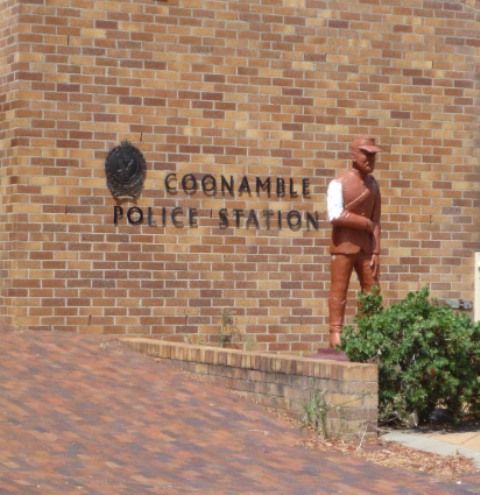

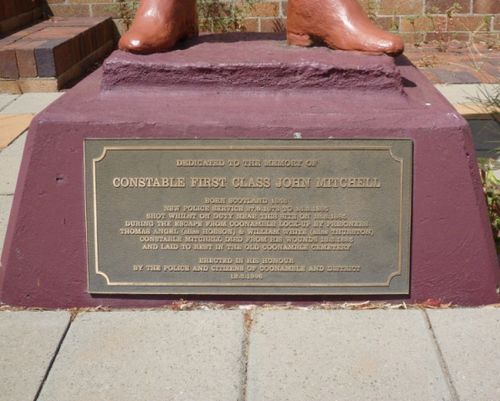
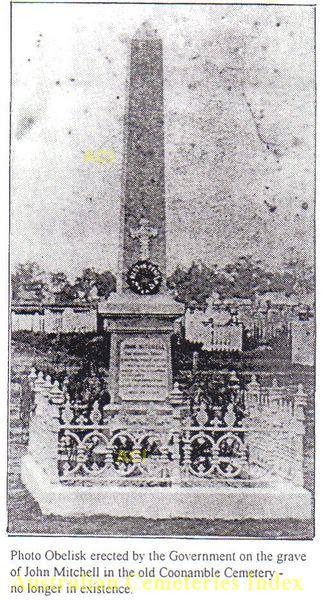
Bathurst Free Press & Mining Journal ( NSW ) Friday 13 March 1885 page 2 of 4
FRIGHTFUL TRAGEDY AT COONAMBLE.
– * –
A CONSTABLE SHOT.
ESCAPE OF PRISONERS.
( BY TELEGRAPH )
[ FROM OUR OWN CORRESPONDENT. ]
Coonamble, Friday.
A shocking tragedy occurred at Coonamble gaol yesterday morning, in a cell where a prisoner named Angel, who had been sentenced to four years for cattle stealing, another prisoner named Courtney, and a prisoner named Thurstone, who had served a sentence at Berrima gaol, were confined.
When the turnkey ( Warder Langley ) entered to leg iron Courtney and Angel, one of the prisoners pounced upon him, and knocked him down and took his revolver. The turnkey called aloud, when Mitchell, a constable, and formerly of Bathurst, hearing the scuffle, rushed out of bed. The prisoner Angel, who had the revolver, told Mitchell not to dare to come in, Mitchell, however, advanced, and Angel fired. The bullet entered Mitchell’s breast just below the heart, and went right through his body and out at the back. Mitchell at once fell, and the three prisoners made their escape with the revolver.
Five miles from town they pulled a boy off his horse, and the escapees got on to the horse, and galloped into the bush. They have been tracked, and hopes are entertained that they will be soon captured. They are armed with revolvers taken from the gaolers.
The tragic affair has cast quite a gloom over the town.
The warder, Mitchell, is still lingering, but no hopes are held out of his recover.
Later.
On the prisoners getting to the gaol yard, they cut Thurstone‘s irons, leaving the sockets on the legs, and crossed the river at the upper end of the scrub, near the old engine, McMahon’s station. The Police Magistrate and trackers on on their tracks.
Constable Mitchell died at 7 am. to-day. Warder Langley is much prostrated, and quite ill from the effects of the encounter, and will not be able to resume his duties for a time.
The South Australian Advertiser Monday 16 March 1885 page 5 of 8
A good deal of excitement prevails at Coonamble consequent upon the death of Mitchell, the gaolor (sic) of the local prison, from the effects of a wound caused by his being shot at by a prisoner named Angel, who recently escaped from gaol with another prisoner named Thurston.
The men Angel and Thurston, who escaped into the bush, have not yet been tracked, although search parties are in pursuit.
The Government has offered £200 reward for their capture.
The Brisbane Courier Tuesday 17 March 1885 page 6 of 8
The troopers sent out in search of the escaped prisoners Angel and Thurstone, who are charged with the murder of gaoler Mitchell at Coonamble, returned last night without finding any trace of the criminals.
Mitchell was buried on Sunday.
Bathurst Free Press & Mining Journal Tuesday 17 March 1885 page 3 of 4
THE TRAGEDY IN COONAMBLE GAOL.
The following, which is a more detailed account of the shooting of the gaoler, Constable Mitchell, and the escape of two prisoners from the Coonamble gaol, is abridged from the Coonamble Independent : —
After the trial of the prisoner Thomas Angel, at the Quarter Sessions, he, together with two other convicted men, Thurston and Courtney, was locked up for the night in a cell in the gaol.
Thurston had riveted irons on, whilst Angel, who it was surmised was shamming illness, and Courtney, were unfettered.
On the following morning, Mitchell gave orders to the warder to leg-iron Courtney, who was told off to act as cook. The warder was in the act of stooping down to leg-iron Courtney when the three prisoners set upon him, got him down, and endeavoured to strangle him. They seized his revolver in the struggle, leaving him powerless and half stunned. Mitchell jumped into the cell to assist the warder, and it is surmised, was tripped up by Courtney. Mitchell regained his feet and Angel was standing at the cell door with the revolver in his hand, Thurston having gone outside, and Courtney being on the inside.
Angel told the warder that if he (the latter) attempted to stir he would blow his brains out. At this juncture Mitchell jumped from Courtney towards Angel, when the latter deliberately shot at Mitchell. The gaoler fell from the effects of the shot, leaving the warder disabled, and Courtney in the cell. The door of the cell was thereupon bolted by either Angel or Thurston on the outside.
Thurston rushed down the passage with a tomahawk in his hand, and Angel went into the guard room. Angel ran quickly to a Mrs. Canham who was present, caught hold of her by the hand, and wanted to lock her up in a cell. She refused to go, when Angel held the revolver to her forehead. After some parleying, Angel let Mrs. Canham’s hand go, and the two men went through the front door.
Drs. Cortis and Tressider, were quickly in attendance, and upon examination it was found that poor Mitchell was shot in the right breast, the bullet having passed clean through his body, coming out at the lower portion of his back.
From the first the case was pronounced hopeless and the deepest sympathy was evinced for the unfortunate gaoler, his wife, and family.
Poor Mitchell, after lingering until Friday morning, succumbed to the effects of the bullet wound, and his untimely end is universally and deeply regretted. He was a thoroughly efficient officer, esteemed at headquarters, and deservedly respected in Coonamble.
He leaves a wife and children totally unprovided for.
Launceston Examiner ( Tasmania ) Tuesday 24 March 1885 page 2 of 4
A verdict of wilful murder has been returned against the escaped prisoner Angel and his companion Thurston, also against another prisoner who was in the cell at Coonamble Gaol when Warder Mitchell was shot.
The two men have not as yet been re-captured, and the Government have offered £200 reward.
Bathurst Free Press & Mining Journal ( NSW ) Wednesday 25 March 1885 page 2 of 8
MURDER OF ACTING-GAOLER MITCHELL —
The following notice appears in Friday’s Gazette:-
Whereas on the morning of the 12th instant, two prisoners, named William White, alias Thurston and Thomas Angel Hobson, escaped from the Coonamble Gaol ; and whereas one of the said offenders, previous to escape, fired at and mortally wounded Constable John Mitchell, the Acting-Gaoler, who has since died; and whereas at a Coroner’s inquest held upon the body of the said John Mitchell, a verdict of wilful murder was returned against the said offenders, William White, alias Thurston and Thomas Angel alias Hobson, and James Alfred Courteney, who was confined in the same cell with the two prisoners who escaped.
Notice is hereby given that a reward of £200 will be paid by Government for such information as shall lead to the apprehension of each of the said offenders, William White alias Thurston and Thomas Angel alias Hobson.
Description of Offenders. —
White alias Thurston, is 29 years of age, 5 feet 9 inches high, medium build, brown hair and eyes ; a native of New South Wales ; a drover.
Angel alias Hobson, is 27 years of age, 5 feet 9 inches high, dark, beard and whiskers, good looking.
The Goulburn Evening Penny Post Thursday 26 March 1885 page 2 of 6
The Coonamble Outrage.
The Dubbo Despatch regrets to say that the men Angel and Thurston, who escaped from Coonamble gaol, and who have been declared by the Coroner’s jury guilty of the murder of Warder Mitchell, are still at large.
Some information regarding their movements has been gathered by Senior-constable Cusack, of Gilgandra.
On Monday he reached a hut in the warrumbungles, and discovered that the two had been there on the previous Saturday night, Thurston only then got the leg-irons off. He had out the connecting chain, and tied up along each leg the piece of chain. It was not, however, till he reached the hut that he managed to get the rivetted rings off his legs, which were in a fearful condition. They were very much swollen.
Thurston was scarcely able to walk, and several times he had to be carried on his companion’s back. Cusack and other troopers are now hunting the pair in the mountains.
The Government has offered a reward of £200 each for the apprehension of Angel and Thurston.
The following is their description: White, alias Thurston, is 20 years of age, 5 feet 9 inches high, medium build, brown hair and eyes, a native of New South Wales, a drover;
Angel, alias Hobson, is 27 years of age, 5 feet inches high, dark beard and whiskers, good looking.
Courtney, who was also included in the coronial jury’s verdict of murder, arrived at Dubbo on Wednesday, and is now in gaol.
Evening News ( Sydney ) Friday 27 March 1885 page 3 of 8
COWRA. March 25.
The Victim of a Ruffian.— The deepest regret and sympathy were evinced here when it became known that Constable Mitchell, formerly lock-up keeper of this town, had been shot dead by one of the prisoners in the gaol at Coonamble, where he was acting gaoler at the time of his melancholy death.
The deceased leaves a wife — very ill at the time of the occurrence — and two little children.
All the particulars of the case are by this time very well known to our readers, so that we will not state them here.
After the perpetration of the cowardly deed, the murderer and one of his accomplices escaped from the gaol, and have since eluded all attempts at capture. A large reward has been offered for their capture.
Bathurst Free Press & Mining Journal Saturday 28 March 1885 page 2 of 12
THE COONAMBLE TRAGEDY.
The following is the principal evidence taken at the inquest on the body of Acting-Gaoler Mitchell, who was shot by the escaped prisoner Angel: —
Michael Langby states, I am warder at the Coonamble Gaol ; I remember the morning of the 12th inst. Thursday ; about a quarter past six o’clock I knocked at the outer gaol door ; the door was opened by the Acting-Gaoler ; received the keys of the cells from him ; put my revolver on me as usual before I entered the cells ; unlocked the door opened it and went in ; Mitchell was then in the passage but had no arms on him; I knelt down to put the leg irons on the prisoner Courteny; the prisoners knocked me down ; the three prisoners in the cell were Angel, Thurston and Courteny ; I could not see who knocked me down because I was kneeling ; they must have stunned me for I don’t recollect hardly what happened for a few minutes after ; when I came to my senses again I was lying on my back; Angel was at the door of the cell with my revolver in his hand, he pointed the revolver at me and said, ‘ I’ll shoot you dead if you stir ;’ with that the gaoler jumped from the corner of the cell to the door ; Mitchell was then in the cell ; saw the shot fired by the prisoner Angel, it took effect on the gaoler Mitchell in the breast; Mitchell stated in the presence of Courtney that Courteny tripped him up before the shot was fired ; Mitchell fell after receiving the shot ; I heard the prisoners Angel and Thurston outside the cell door for a few minutes ; after the prisoner Courteny made some attempt to move near the door ; I was then standing on my feet as Mitchell received the shot ; the other prisoners did not attempt to rescue Courtney, but left him behind ; when Mitchell was shot Angel, Mitchell, Courtney and I were present ; Thurston had gone out into the passage ; when the prisoner Angel went out, he bolted the door and left Mitchell, Courtney and I in the cell ; Mitchell got up once after he was shot and then fell again ; Courtney wouldn’t let me put the leg irons on ; afterwards put on one of the leg irons, and I believe Constable Newby put the other on; saw the wound in Mitchell‘s breast it was such a one as would be made by a bullet.
By a Juror: It might be a quarter of an hour or 20 minutes from the time the cell door was closed upon me before the police came; can’t say which of the three prisoners took the revolver from me; had my senses when the shot was fired ; I saw Angel deliver the shot ; knew the prisoners were dangerous characters; my orders are when I have committed men in charge to put on my side-arms or revolver ; when I first saw Mitchell at the cell he was standing behind the door, in the passage ; I think when Mitchell sprang from the cell he was engaged with Courtney ; I don’t think I did sing out for Mitchell ; I might have done so when I was stunned ; I don’t remember doing so.
James Alfred Courtney, a confinee in Coonamble gaol, deposed to Langley‘s coming into the cell to leg-iron him ; somebody gave Langley a shove behind, and knocked him and me over ; it must have been either Angel or Thurston; I was getting up, when Angel hit me in the eye and knocked me down ; I went to get up again when Langley caught me by the throat and Mr. Mitchell rushed into the cell ; he knocked against me, and sent me flying into the corner of the cell ; saw Angel at the door pointing a revolver at Langley ; Mitchell left me and made a rush at Angel, when the latter fired the revolver ; the shot struck Mitchell in the right breast; Mitchell staggered, and I caught him. ( After some words as to the putting on of the leg-irons, witness continued ) : I went and sat down alongside Mitchell; Mitchell said, ” Courtney, get me some water, for God’s sake ;” afterwards bathed Mitchell‘s head with some tea, and then searched and found where he had been wounded ; Mitchell said ” My God, Courtney, I’m dying ;” the sergeant then came to the cell door, walked in, and asked what was the matter, and Mitchell said ” I’m shot;” Mr. Boyd asked who shot him, and Mitchell replied ” Angel ;”. the other prisoners did not call out after them — they did not speak to me that I know of ; Mr. Mitchell did not say anything to me when he put his hands on me ; he may have said to me ” You vagabond, you’re as bad as any of them ;” I don’t recollect him saying so ; Mr. Mitchell made no remark about the blood on my neck ; I can’t swear he never mentioned anything about throttling me ; am positive Angel struck me in the face ; I did not know the prisoners were going; I was not assisting or abetting in any way in the escape.
By a Juror : The night before the other prisoners were not sleeping together; did not hear any conversation in the night ; I went to sleep; previous to going to sleep heard Thurston say, ” The mountains would be a good place, or the gulf;” heard Thurston say “Oh, curse these irons.”
By the Coroner: the prisoners did not take me into their confidence at all ; they were strangers to me ; did not assist in taking, nor did I see who took the revolver from Langley ; did not intentionally trip Mitchell; the Gaoler and I were good friends ; he was as good as a father to me ; never struck a blow at Mitchell in anyway ; never heard prisoners planning to escape ; the only thing I heard was Thurston saying one day, ” If he goes to sleep we can get away out of the carriage.”
Harry Tressider, legally qualified practitioner residing in Coonamble, deposed having made a post mortem examination of the body of deceased and as to the cause of death by the bullet wound. ‘The death of Mitchell was consequent upon a gunshot injury.
James Newby, Constable of the Police deposed : I remember Thursday, the 12th inst., on the morning of that day when opening the cell door, heard a great row inside and asked what was up. Saw prisoner Courtney standing in the middle of the floor unironed. Afterwards completed putting on the irons in consequence of Langley‘s being much exhausted; whilst I was putting on the irons Constable Mitchell crawled over to me on his hands and knees and took hold of me by the hand, I said, ” Who shot you;” the prisoner Courtney said, “It was a cruel b — — y thing of Angel to shoot him like that,” Mitchell said ” You vagabond, you’re as bad as any of them you held the old man’s feet;” Mitchell said, ” When I came in the door was open, they had the old man down and Thurston trying to strangle him, Angel was trying to get the revolver from him, I rushed and struck at Thurston, and when I did this man knocked me down (meaning prisoner Courtney) ; he said we both fell and got our holts in the corner and I throttled him; the next thing I heard, was somebody saying if you move I’ll shoot you; on looking up I saw Tom Angel with the revolver pointing, I jumped up and rushed at him and as I rushed at him I was shot.
Prisoner Courtney was sitting down 3 or 5 feet from me during the conversation which lasted 2 or 3 minutes ; I looked at Courtney‘s neck to see if he had been throttled and I saw three distinct marks as if done by finger nails on his neck and I said, ” You did throttle the wretch. “ I then left and went to the door and saw Warder McGuier ; Prisoner never tried to contradict Mitchell‘s statement about knocking him down.
The dying declaration of John Mitchell, taken before the P.M. Coonamble, 12th March instant. ‘I am acting Gaoler at Coonamble gaol; at about a quarter past six this morning the 12th March inst., I opened the door of the guard room Coonamble Gaol ; the Warder just then came into the cell where the convicted prisoners Angel, Thurston, and Courtney were confined ; I heard a noise in the cell as if a man was being strangled ; I came in and the warder was lying down on the cell floor ; Angel was strangling him and Thurston was taking the revolver from him ; I made a rush and Courtny knocked me over; Angel then got the revolver and both he and Thurston rushed at the cell door; Angel said ” Keep back or I’ll shoot you ;” I made a rush to try and get the revolver from Angel when he shot me; they then shut the warder and myself together with Courtney, who did not get away owing to Warder Langley’s threatening to kill him if he moved in the cell and rushed away. “ After the Coroner’s address to the jury, explaining the law as applicable to the case, a verdict was returned by the jury as follows : ‘ That the deceased John Mitchell came to his death on Friday, the 13th inst., from the effects of a gun shot wound inflicted on him by Thomas Angel, and we also find that William Thurston and James Alfred Courtney were accomplices in the act, and therefore find a verdict of wilful murder against the three of them.’
[ The murderers are still at large. Ed. B.F.P ]
The Sydney Morning Herald Tuesday 31 March 1885 page 7 of 12
A man was arrested at Granville last evening by Constables Harrison and Wilson on suspicion of being Angel, the Coonamble gaol escapee, who shot Warder Mitchell on the 12th instant. The man corresponds in almost every particular with the description given of Angel. He is very reticent, however, and, in reply to the questions of the police, he merely slated that he was a shearer. He will be brought up before the local Bench to-morrow.
The South Australian Advertiser dated 13 April, 1885 described the shooting and capture of the murderers.
CAPTURE AND DEATH OF THE COONAMBLE MURDERERS. Sydney, April 13.
The Coonamble murderers were captured on Friday night by Sergeant Burns and Constable McKinley at Mr. Stewart’s store, Green’s Swamp. On the arrival of the police at the door of the store Thurston immediately shot Stewart dead. Constable McKinley and Sergeant Burns then fired simultaneously, and killed Thurston and severely wounded Angel, who has since been removed to the Gulgong lockup. Medical assistance was immediately obtained. Inquests will be held to-morrow. Later intelligence has just been received stating that the prisoner Angel died on Sunday morning in gaol. Both prisoners were fully identified. The tragedy caused great excitement.
Edward Mostyn WEBB-BOWEN
Edward Mostyn WEBB-BOWEN
New South Wales Police Force
Regd. # ?
Rank: Senior Constable
Stations: ?, Gundagai
Service: From 11 March 1875 to 23 November 1879 = 4+ years Service
Awards: ?
Born: ? ? 1851
Died on: Sunday 23 November, 1879
Cause: Murdered – Shot
Event location: McGlede’s farm, Wantabadgery, NSW
Age: 27 – 28
Funeral date: ?
Funeral location: ?
Buried at: Gundagai Cemetery
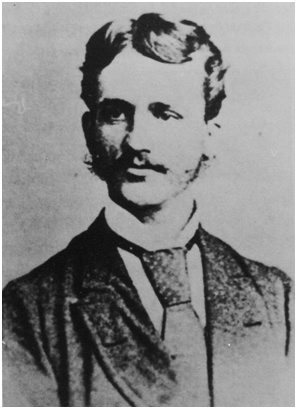
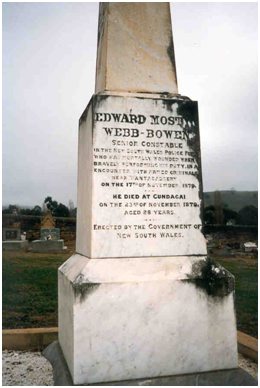
In November, 1879 a gang of young bushrangers led by Andrew Scott (Captain Moonlite) attacked MacDonald’s farm at Wantabadgery Station, holding the occupants captive for two days and nights. After eating and drinking, the gang moved to a nearby pub, The Australian Arms Hotel, and more hostages were taken. Eventually one of the captives, Alexander MacDonald, escaped, rode to Wagga Wagga and alerted the police. A party of mounted police were quickly dispatched to the area & arrived at 4am and a gun battle ensued. During a lull in the shooting, while the police retired to await reinforcements, the gang managed to escape.
They then rode to nearby McGlede’s Farm where they again took siege in the farmhouse from the increasing numbers of police who attended from as far away as Gundagai and Adelong. Again a shootout ensued between the two sides. At one stage, one young offender, Gus Wernicke, moved into the yard in an attempt to shoot the police horses and was quickly shot to death. In a further exchange of fire another bushranger, James Nesbitt, was also shot and killed by Senior Constable Webb-Bowen. During this last exchange, Webb-Bowen was also shot in the throat. This wound also proved to be fatal.
The Sydney Morning Herald of 4 December, 1879 reported that “The funeral of Constable Bowen was very largely attended, and partook of a military character. His widow, with her only child, will, we believe, leave for Pembrokeshire, England, where her late husband’s relatives reside. A subscription has been started to present the constables with a substantial reward of their bravery, and of the great service they have done to society.”
At the trial of Scott and his gang for the murder of Constable Webb-Bowen, Mr. Justice Windeyer concluded sentencing by informing him that “Fortunately, your career of crime was promptly cut short by the courage, the vigilance, and the energy of our police, who are entitled to all praise from every man in the community for the prompt manner in which they arrested and brought you to justice. You young men have had an appeal made on your behalf. But I cannot forget that most of the cruel as well as some of the most bloodthirsty crimes which have been committed by the bushranging class in this country have been committed by young men like yourselves, and the question in your case is — what is mercy? Not only to you, but to the youth that are growing up amongst us; and I have been pained to find, through a long experience in our criminal courts that crime amongst our young men is becoming far more frequent than it was. The recommendation in your favour, of course, I will convey to the Executive, but I would remind you that the shadow of death is upon you. Whether it will pass away is not for me to say. The victim of your murder, shot down by you, when in the execution of his duty, will live in the memory of all who admire devotion to the cause of duty and manliness, whilst your fate will only give an additional warning to the reckless criminal that the way of transgressors is hard, and that a felon’s death and an ignominious grave await those who commence a career of crime. It is useless to moralise further on your case.
The senior constable was born in 1851 and joined the New South Wales Police Force on 11 March, 1875. At the time of his death he was stationed at Gundagai.
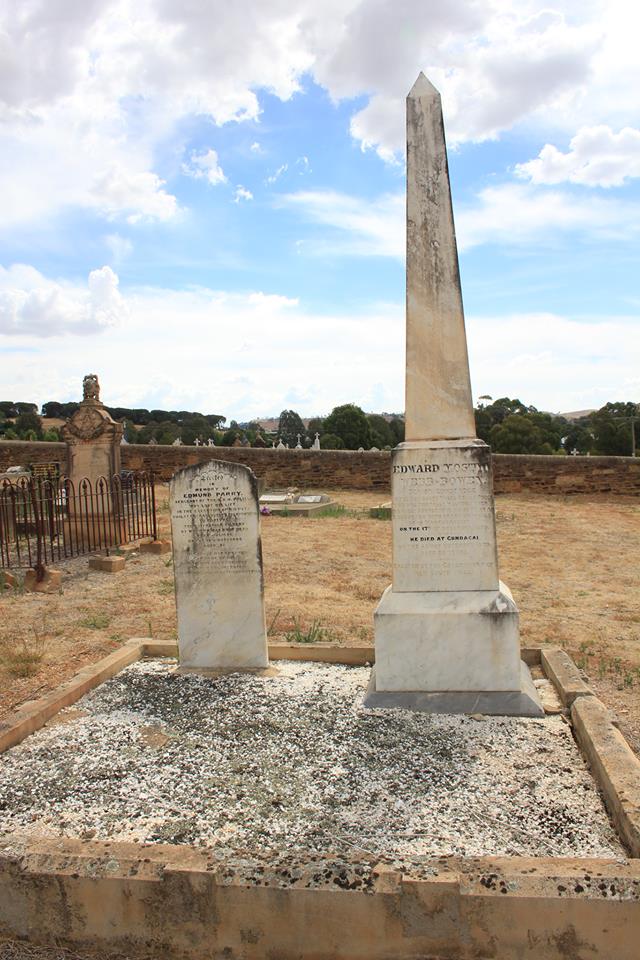
http://www.dailyadvertiser.com.au/story/2025629/hero-of-wantabadgery-should-be-remembered/?cs=148
Thursday, 16 January 2014:
TWO Riverina police commands will honour the “Hero of Wantabadgery” – one of their own killed in the exchange of gun fire more than a century ago.
Senior Constable Edward Mostyn Webb-Bowen, known as Edward Bowen, was shot in the neck and died on November 23, 1879 as a result of the wound he sustained.
Now, the Wagga and Cootamundra local area commands (LAC) are working together to restore his grave at Gundagai cemetery.
Staff from the Wagga LAC will meet with Wantabadgery residents on February 1 to discuss ideas regarding a plaque, headstone or statue to honour Sen Con Webb-Bowen.
Wagga police duty officer, Inspector Stephen Radford, labelled the police-led community project – headed by Constable Max Burmeister, who resides in Wantabadgery – as exciting.
“We hope to raise awareness about those who were defending our community and values at a time when bushrangers were a real threat,” Inspector Radford said.
“Unfortunately history has tended to forget the true heroes of this era and instead the names of outlaws such as Captain Moonlight and the Ben Hall Gang, (which are) responsible for the deaths of police officers, hold more recognition than those that did the right thing.
Inspector Radford said the project aimed to help change the imbalance.
Senior Constable Webb-Bowen’s death came after Captain Moonlight and his gang held up Wantabadgery Station one evening in mid-November.
A number of people were taken hostage, and that number increased when the gang moved to the nearby Australian Arms Hotel.
Officers from Wagga police arrived in the early hours of the morning and gunfire was exchanged.
They retreated, waiting for reinforcements from Gundagai, and later visited a farm nearby where they found Captain Moonlight and his gang.
For further information about the project, email waggabowen@police.nsw.gov.au or call Wagga police on 6922 2599.

OFFICIAL OPENING – UNVEILING OF MEMORIAL – SUNDAY 13TH SEPTEMBER 2015
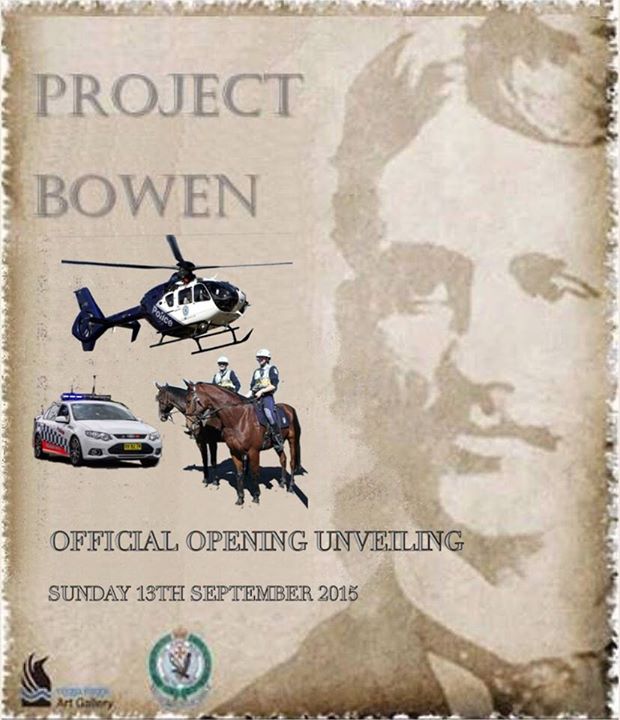
Hero of Wantabadgery – Senior Constable Edward Webb-Bowen honoured.
Wagga Wagga LAC – NSW Police Force, is honouring the ‘Hero of Wantabadgery’ Senior Constable Edward Mostyn Webb-Bowen who died in an exchange of gun fire in November 1879.
During an evening in mid November 1879, ‘Captain Moonlite’ and his gang held up Wantabadgery Station and took a number of hostages. After eating and drinking, the gang moved to a nearby pub, The Australian Arms Hotel, and more hostages were taken.
At 4am, officers from Wagga Police arrived and gunfire was exchanged with the gang. Officers retreated and waited for reinforcements from Gundagai. On arrival of Gundagai Police, the officers attended nearby McGlede’s farm and found ‘Captain Moonlite’ and his gang.
Shots were exchanged and Senior Constable Webb-Bowen was shot in the neck. On Sunday 23rd November 1879, Senior Constable Webb-Bowen, known as Edward Bowen, died as a result of the gunshot wound.
Project Bowen, was established in 2012 by the Wagga Wagga Police and Wantabadgery community to raise awareness and funds to build a monument to remember Bowen.
Following an, archaeological survey, art exhibition, art auction, generous donations from individuals and local businesses the monument was completed His grave in Gundagai was also restored.
The monument now proudly stands adjacent to the Wantabadgey MacDonald Memorial Hall in Jewnee Street, Wantabadgery.
The memorial will be officially opened at 11:00am on Sunday 13th September 2015 by the Wagga Wagga Local Area Commander Bob Noble.
The opening will include; a display of modern and historic police vehicles, police command bus, police helicopter, horses and re-enactors. People are encouraged to attend in period 1870’- 80’s attire.
Opportunities will be provided to speak to police including the; PolAir – NSW Police Force Airwing, Police Dog Unit – NSW Police Force, Traffic and Highway Patrol Command – NSW Police Force, Women In Policing and Detectives. Interested members of the public are invited to attend and share in this special occasion.
For further information or if you have any enquiries please contact: Detective Inspector Stephen Radford 02 69222599.
Posted by Sgt Parry Memorial Day on Thursday, 3 September 2015
Thomas Edward WALLINGS
Thomas Edward WALLINGS
New South Wales Police Force
Regd. # ‘ P ‘ 716
( ‘P’ = Pre 1862 when NSWPF “Officially” commenced )
Rank: Mounted Constable – 15 July 1855
Senior Constable – appointed 1 March 1862
Sergeant 2nd Class – appointed 1 June 1868
Senior Sergeant – appointed 1 November 1877
Stations: , Molong ( January 1865 ), Mudgee ( September 1869. Sgt In Charge of Mudgee to Bathurst Gold Escort ), Dubbo – death
Service: From 15 July 1855 to 20 September 1878 = 23+ years Service
Awards: ?
Born: ? ? 1838 in Dubbo ( although other records state a native of England )
Died on: Friday 20 September 1878
Cause: Shot – Murdered
Event location: Marthaguy Creek, ( near Warren ), NSW
Age: 40
Funeral date:
Funeral location:
Buried at: Old Dubbo Cemetery, Myall St, Manera Hts, Dubbo, Church of England Portion, Section R2
Memorial location:
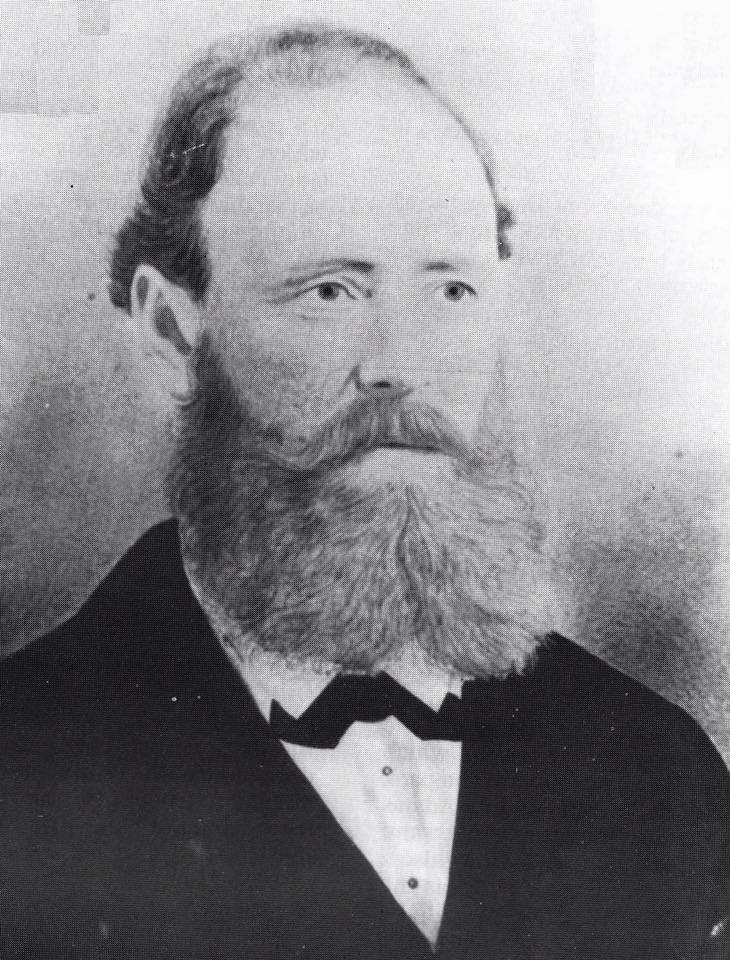
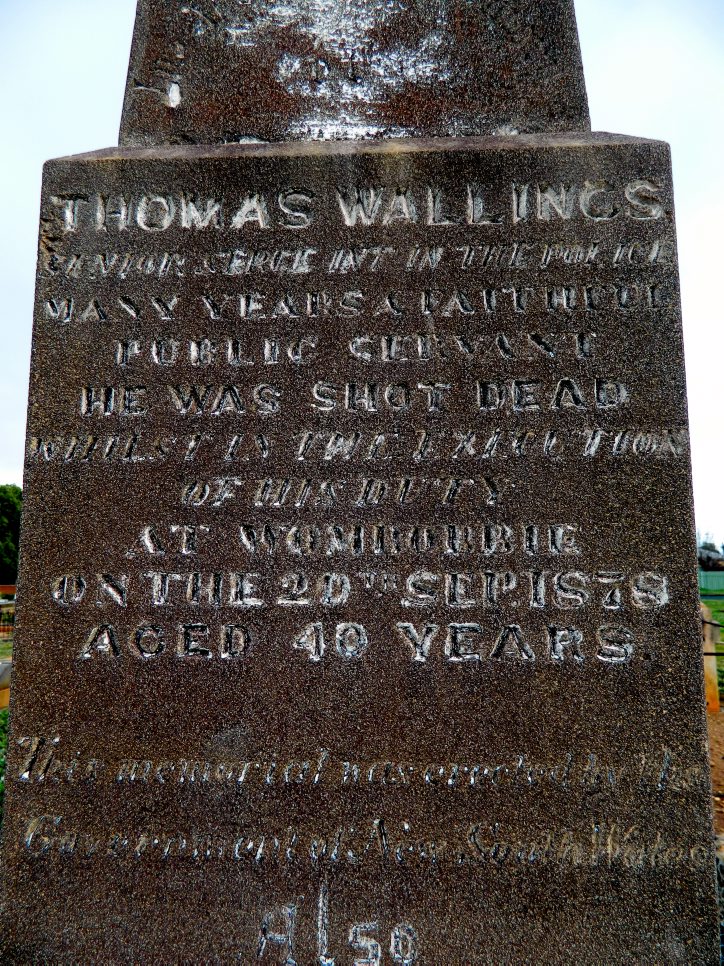
THOMAS WALLINGS
? in the Police
many years a faithful
public servant
He was shot dead
whilst in the execution
of his duty
at Wombobbie
on the 20th Sep. 1878
aged 40 years
This memorial was erected by the
Government of New South Wales
also
Charles C. WALLINGS
died 17th May 1903
aged 30 years
The Lord gave and the
Lord hath taken away.
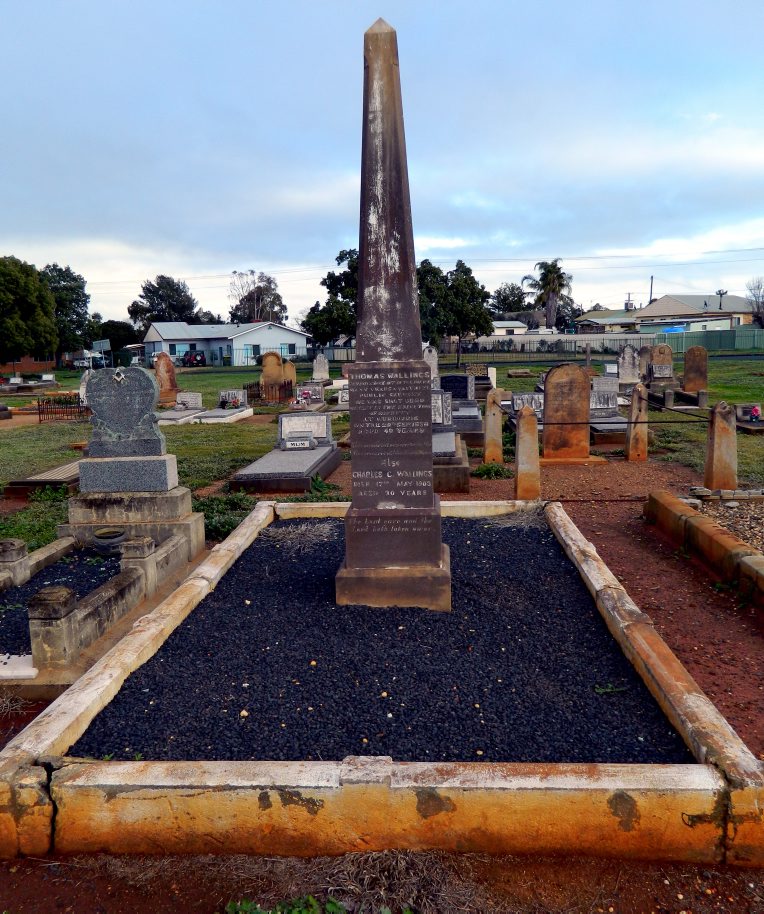
THOMAS WALLINGS
? in the Police
many years a faithful
public servant
He was shot dead
whilst in the execution
of his duty
at Wombobbie
on the 20th Sep. 1878
aged 40 years
This memorial was erected by the
Government of New South Wales
also
Charles C. WALLINGS
died 17th May 1903
aged 30 years
The Lord gave and the
Lord hath taken away.
Thomas IS mentioned on the Police Wall of Remembrance
On the night of Thursday 19 September, 1878 Sergeant Wallings, Senior Constable William Souter and Constable John Walsh were searching for a gang of bushrangers ( Captain Midnight & his gang ) when they set up a bush camp near the Wonbobbie Inn, Marthaguy Creek (near Warren).
The following day ( Friday 20 September ) at 6am the three police rode to the inn where they suspected they might find the bushrangers. Constables Souter and Walsh remained on guard outside while Sergeant Wallings approached the inn. Meanwhile, Constable Souter saw a man about 50 metres away carrying a rifle. He rode over to him and was told he would be shot if he came any closer. Souter called to the other police who rode down to him.
Sergeant Wallings then fired a warning shot and told the man to surrender, however the man replied that he himself would fire if the police came any closer. Sergeant Wallings then advanced on the man and pointed his revolver at him. The man then turned suddenly and dropped to one knee. As he did so, he fired at the sergeant, hitting him in the chest. In the confusion the offender ran a short distance away and took cover from the police. A short gun battle took place, however, the offender, being far better armed with a rifle, compared to the police revolvers, managed to escape. The two constables then directed their attention to assisting the wounded sergeant. The wound suffered by Sergeant Wallings ( shot through the heart and lung ) proved to be severe, and he unfortunately passed away almost immediately.
A few weeks later, the Sydney Morning Herald dated 10 October, 1878 reported the death of the murderer, informing its readers that “News has just reached the metropolis that the man who shot Senior Sergeant Wallings at Dubbo has been killed by the police, shortly after he committed the murder. The cold-blooded villain shot Wallings in the execution of his duty. He was pursued by Sub-Inspector Duffy and Constables Latton and Gray of Bourke, in the most unrelenting manner, and traced to the borders of Queensland, where he made a desperate resistance. The police shot at the horse he was riding and fatally wounded the murderer, whose name is said to be George Gibson. This man’s death is one which has not in any way been regretted by the general community. It was such a death as luckily there is not much necessity for now-a-days. The police deserve the congratulations of the public here for their bravery in this instance, which however, is only of a piece with much the New South Wales police have accomplished in the suppression of crimes of this nature. A movement has been initiated for relieving the widow and eight children of Wallings.
The sergeant was born in 1838 and joined the police force on 15 July, 1855. In 1862 he became a member of the newly-formed New South Wales Police Force. At the time of his death he was stationed at Dubbo. The offender was the bushranger “Midnight“.
George Robert ARMYTAGE & Michael COSTIGAN
George Robert ARMYTAGE
New South Wales Police Force
Constable
&
Michael COSTIGAN
New South Wales Police Force
Constable
Shot – Murdered
Bourke
11 September, 1877
Double Police Murder
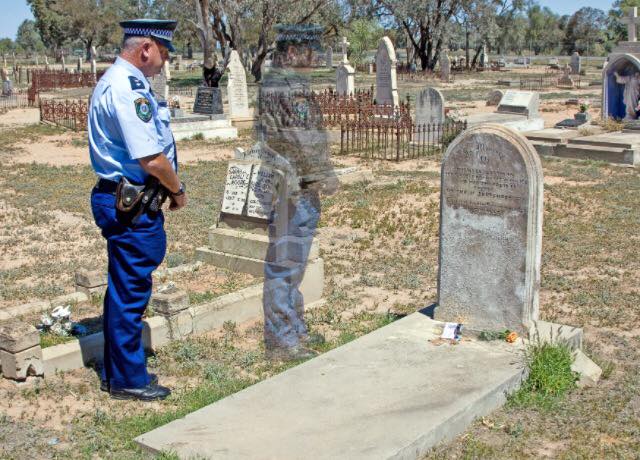
On Tuesday 11 September, 1877 Samuel Getting, a barman at the Royal Hotel in Bourke, was speaking with Constable Michael Costigan in the bar of the hotel. The constable had just paid Getting for his room and board, and after having a drink and chatting with the barman for a short time, he left the bar.
Getting, for some unknown reason, also left the bar about that time and went to his room in the hotel, where he took possession of his rifle. He then left his room and walked to the front of the hotel, where he saw Constable Costigan and Constable George Armytage standing on the verandah, having a conversation. He immediately shot both constables from behind before running into the street and attempting to reload his rifle.
Sub Inspector James Keegan, who was nearby, noticed people running toward the river, and when he asked what was happening he was told that Sam, the barman, had shot two of the police and was running away with a loaded gun in his possession.
He then saw Getting running along the bank of the river with a gun in his hand, being chased by several people. The inspector then went towards these people and told them to move away from Getting so he could speak with him. He then followed Getting for a short distance along the river until he stopped and waited for the inspector to approach. The inspector then spent some time talking with the offender and trying to get him to surrender, all the while edging closer as he spoke.
At a later inquest, the inspector described what happened next.
“I rushed at him, being at this time between 10 and 15 paces from him. The ground was very muddy, and there was a gully between us. I got my hands upon him being beneath the gun, and we both stumbled and nearly fell. He again got a few paces from me, turned round, took deliberate aim, and shot at me. He called to me to keep back. I knew I was shot, but it did not weaken me, and I still went forward.
He then raised the gun, holding it by the barrel, and struck me on the head. I put up my arm to ward off the blow, and it bruised my arm very much and cut my head. He struck me several times, and I at length secured the gun. He then ran parallel with the river for a few yards, and as I followed him he suddenly plunged into the river, and kept his head beneath the water until he was drowned. He went but a short distance into the river.
That is his body I have recently seen lying in an outhouse. He had plenty of opportunity of shooting me at first had he so desired, but he did not attempt to do so until I sought to arrest him. When he shot at me, one shot struck me near the eye, two shots went into my coat, two entered my chest, and two others grazed it.
The Deceased…was a man of very good character and very good behaviour, and I can ascribe no motive for his acts. He said he had no intention of doing what he did, and that he had loaded the gun to go out for some duck shooting.”
Constable Costigan was born in 1853 and joined the New South Wales Police Force on 11 September, 1873. At the time of his death he was stationed at Bourke.
Constable Armytage was born in 1855 and joined the New South Wales Police Force on 4 May, 1877. At the time of his death he was stationed at Bourke.
Grave Location/s:

ARMITAGE: 30 06′ 03S / 145 56′ 12E
Old C of E, Bourke
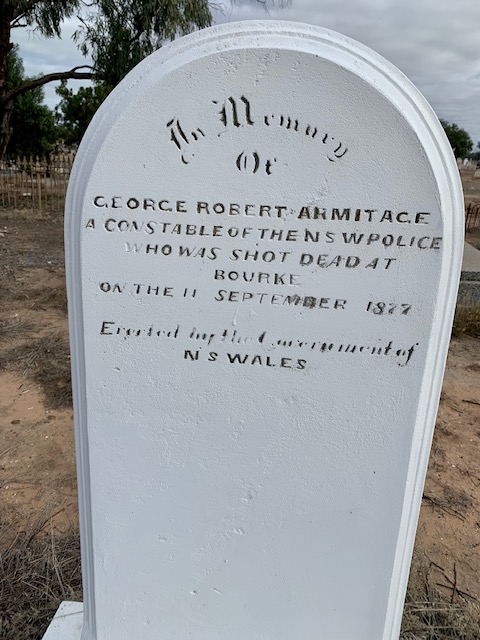
Photo: Alan BLAKE # 19779
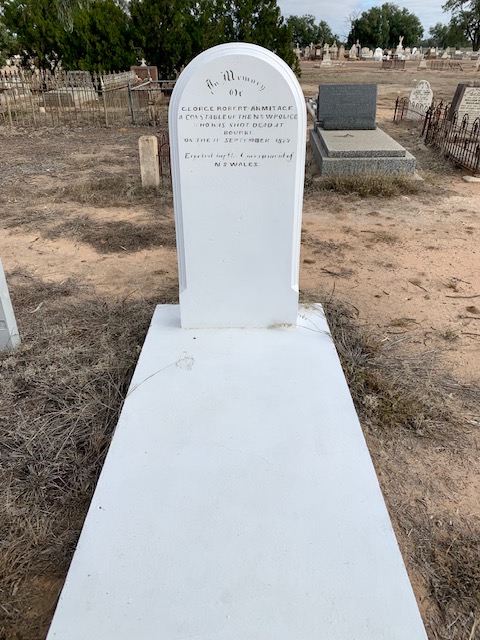
Photo: Alan BLAKE # 19779

COSTIGAN: 30 06′ 05S / 145 56′ 14E
Old Catholic, Bourke
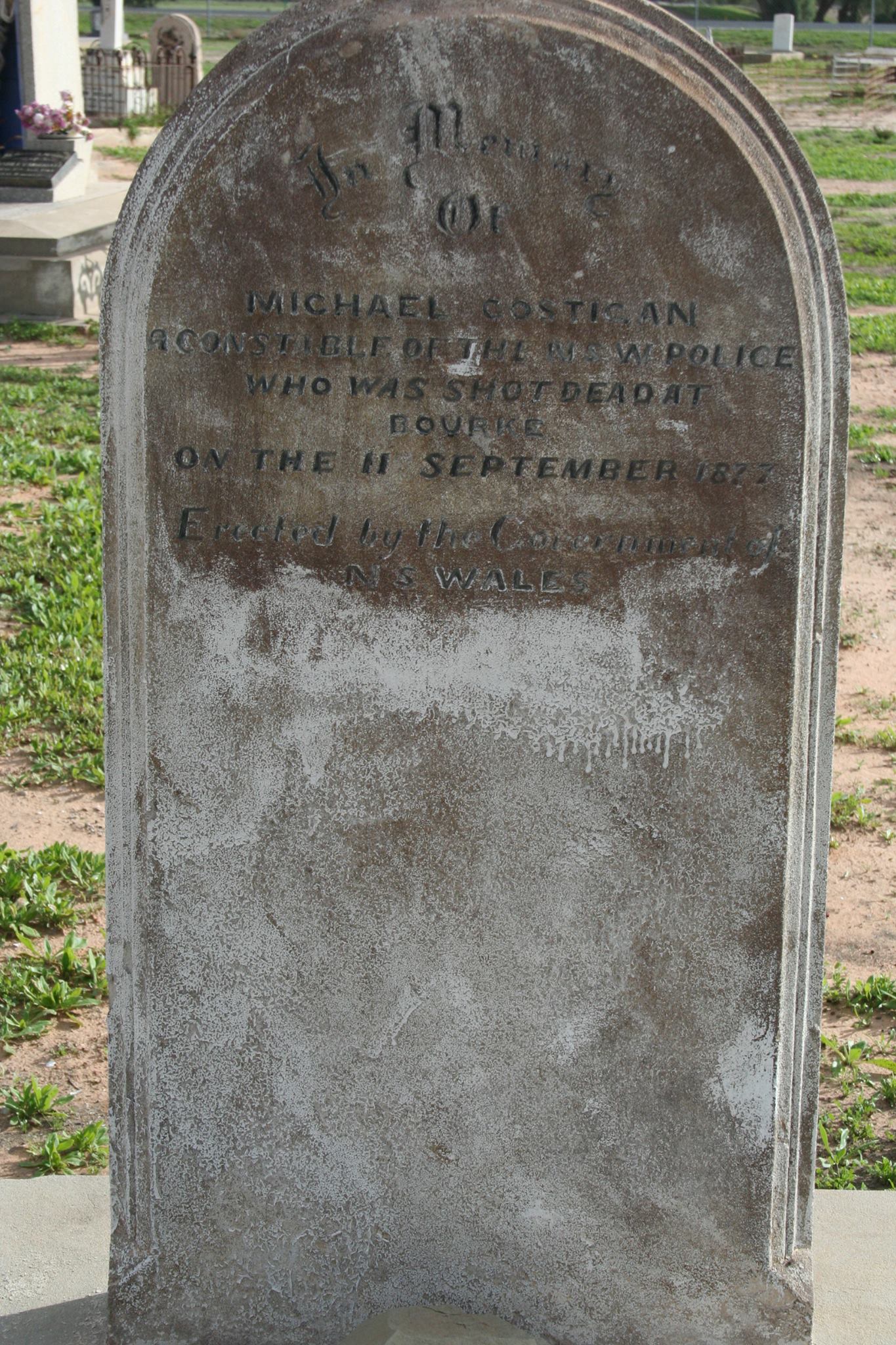
Photo: Ken Owen
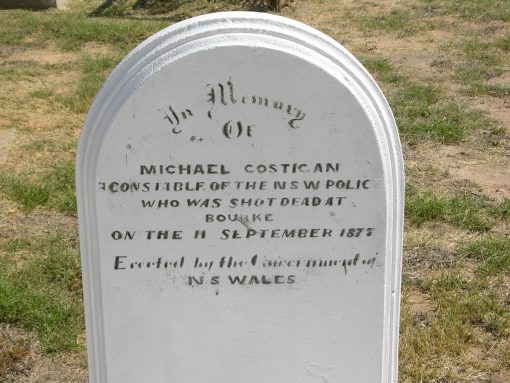
Photo: Ken Owen
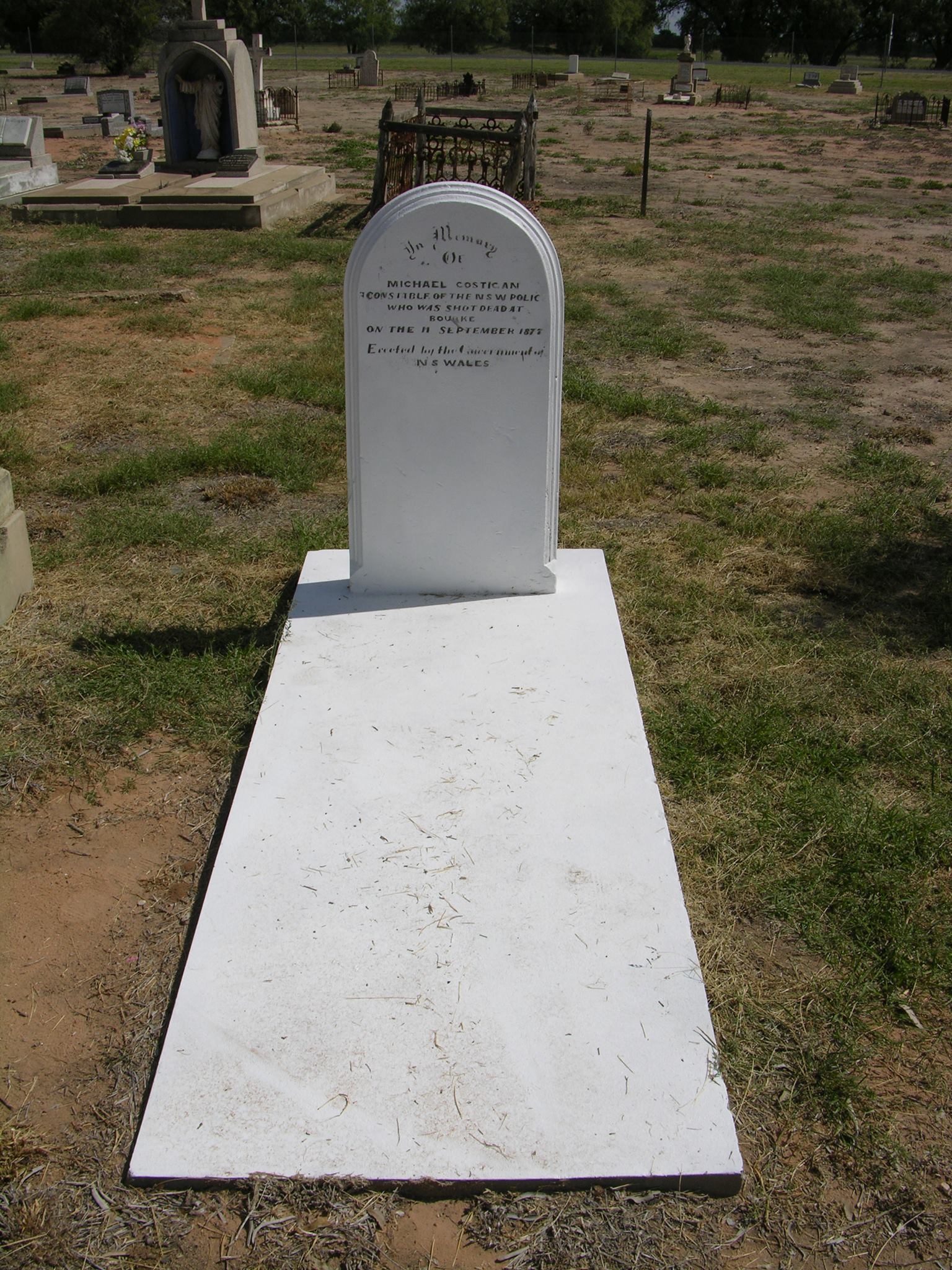
Photo: Ken Owen
John Vance BLAIN
John Vance BLAIN
New South Wales Police Force
Regd. # 2481
Rank: 1st Class Constable ( Foot Policeman – not mounted )
Description: 5′ 11.5″ tall, blue eyes, fair hair, fair complexion. Single. Previously a farmer. He was Protestant.
Stations: Darlinghurst
Service: From 26 December 1874 to 20 June 1877 = 2+ years Service
Awards: a valuable gold watch and chain for the gallant capture of a convicted burglar, named Wright
Born: ? ? 1850 in Ireland
Event date: Thursday 22 March 1877
Died on: Monday 11 June 1877 @ Wooloomooloo
Cause: Assault with a Police Baton & other assaults
Age: 26
Funeral date: Tuesday 12 June 1877 @ 2.15pm
Funeral location: Graveside
Buried at: Rookwood Cemetery
Memorial location:
[alert_red]JOHN is NOT mentioned on the Police Wall of Remembrance * BUT SHOULD BE
Just after 4pm on Thursday 22 March, 1877 Constable Blain was on duty in Bourke Street, Wooloomooloo when he saw two men carrying a “bundle” in Forbes Street. He called on them to stop, however they ignored him and ran off, quickly pursued by the constable. One of the men then stopped and threw himself at Constable Blain, whose baton unfortunately had dropped to the ground during the chase. As he grappled with one offender, another took up the dropped baton and struck the constable several severe blows to the head, inflicting terrible wounds. Blain bravely held his ground however, and succeeded in handcuffing one of his assailants before staggering a short distance to the home of Dr Pattison. The doctor assisted the stricken Blain and also quickly sent a message to the police for assistance.
Constable Williamson ( possibly Williams ) soon attended and spoke to Constable Blain, who told him that he had arrested and handcuffed one of his attackers before walking to the doctor’s home. Williamson then attended the site of the incident where he indeed found one of the offenders (John Wright) lying handcuffed and bleeding in the street. The courageous Blain had in fact arrested one of his own murderers (a rare accomplishment), as his injuries were to prove fatal.
Prior to his death the Mercury newspaper of Friday 23 March, 1877 reported the story of Constable Blain’s encounter with the offender John Wright and his unknown accomplice.
The article indicated that “The constable who was so barbarously assailed is suffering greatly from the wounds he received. His extraordinary courage and resolution in securing the man in the manner he did is worthy of lasting record.” And thus it is.
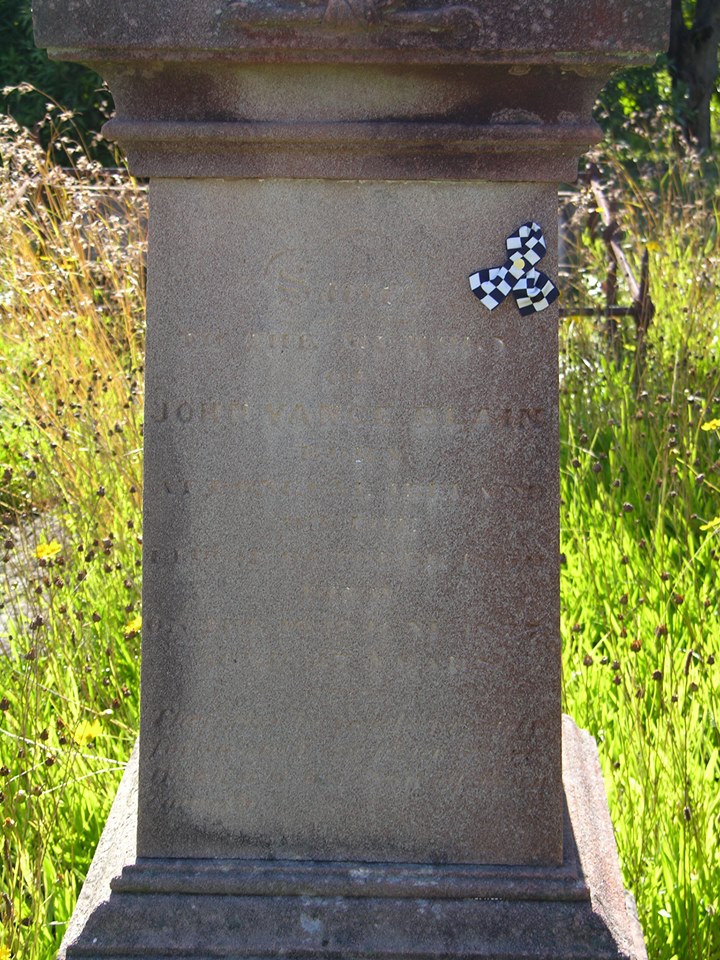
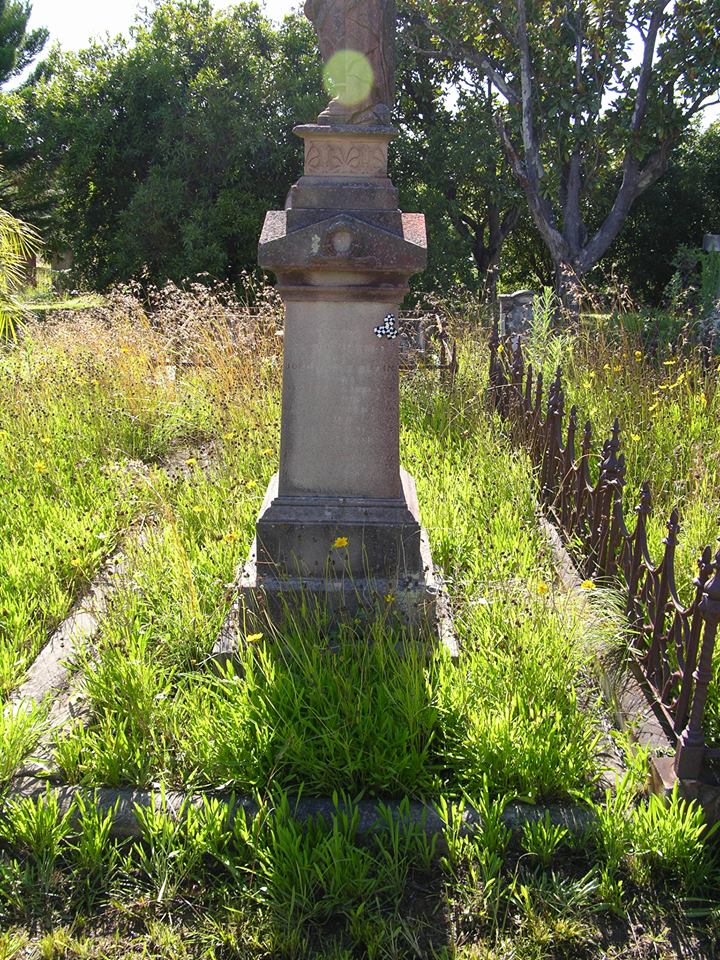
His headstone at Sydney’s Rookwood Cemetery reads: “A record of his brave conduct for arresting and bringing to justice a notorious burglar at whose hands he received such savage injuries as to ultimately cause his death”.
The constable was born in 1850, and at the time of his death he was stationed at Darlinghurst.