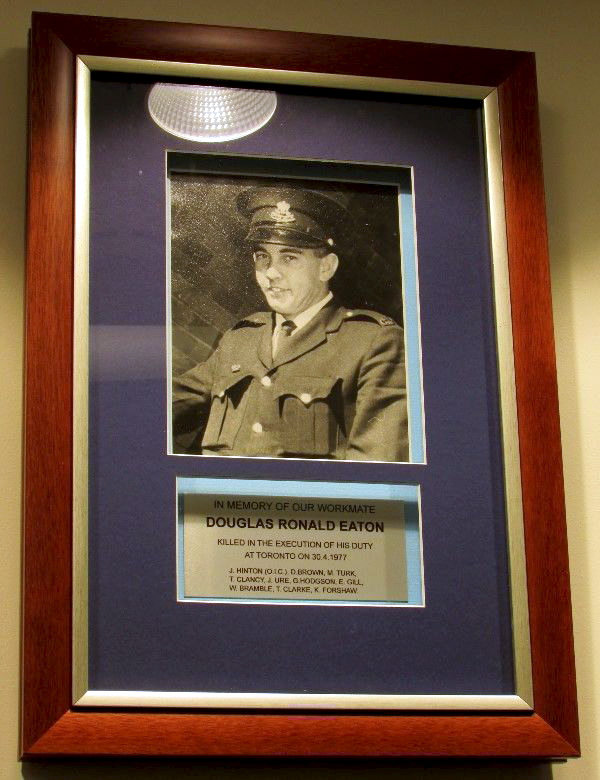
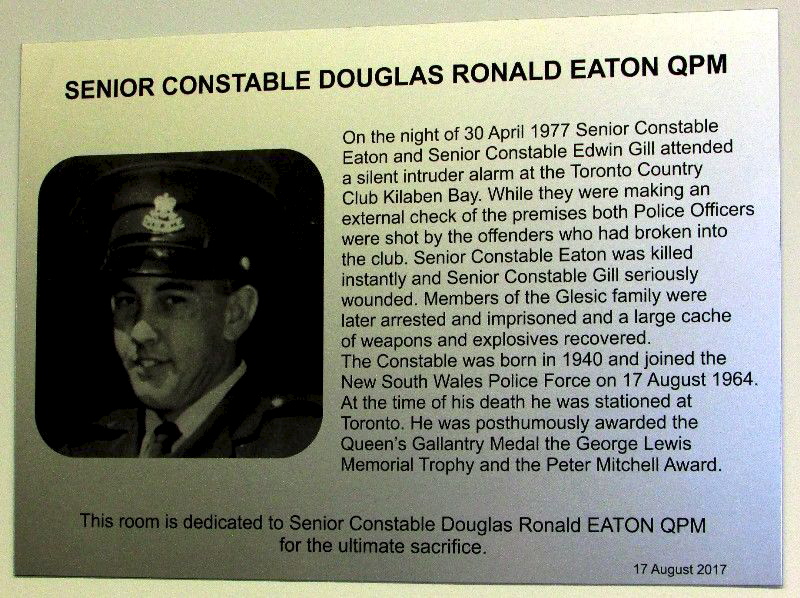
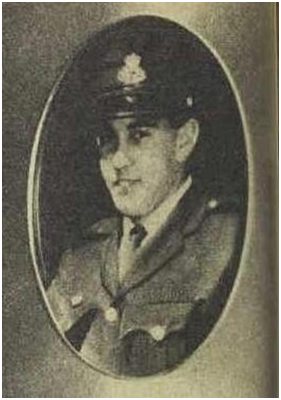
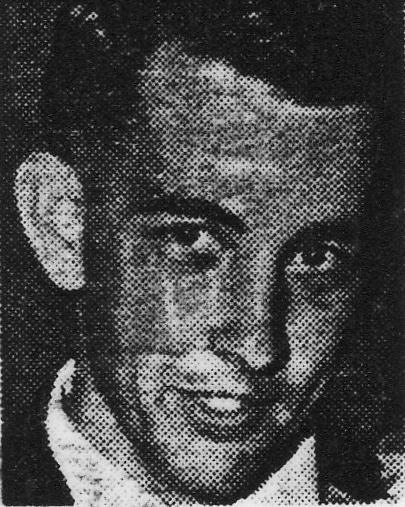
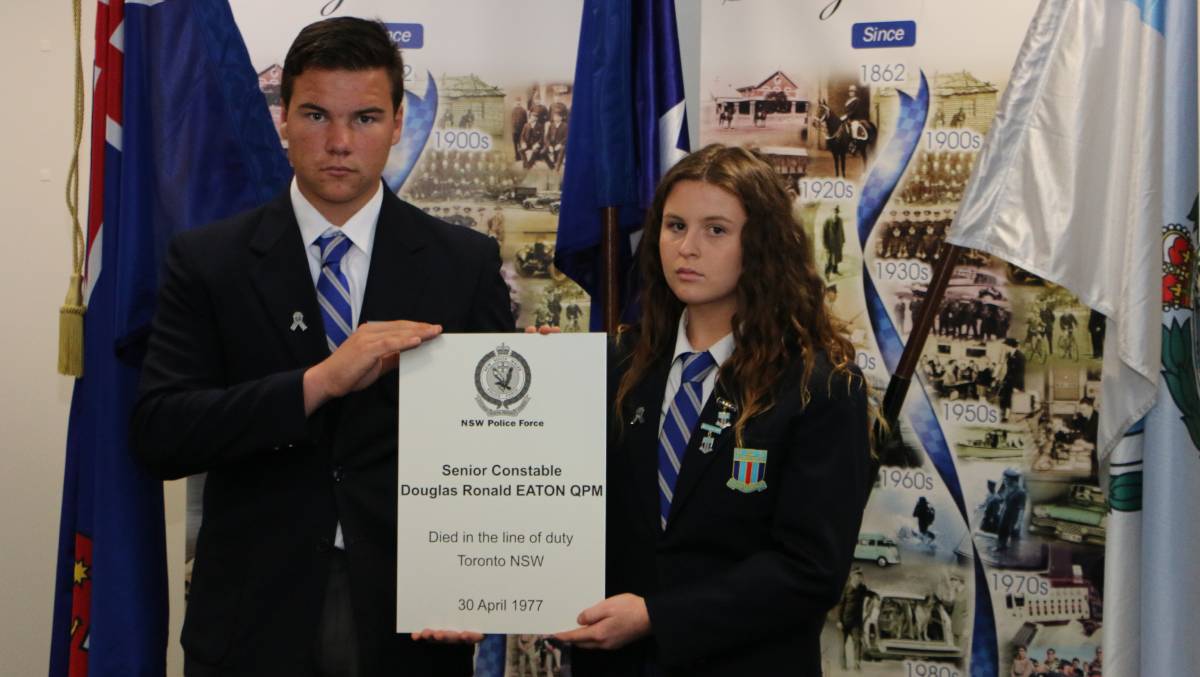
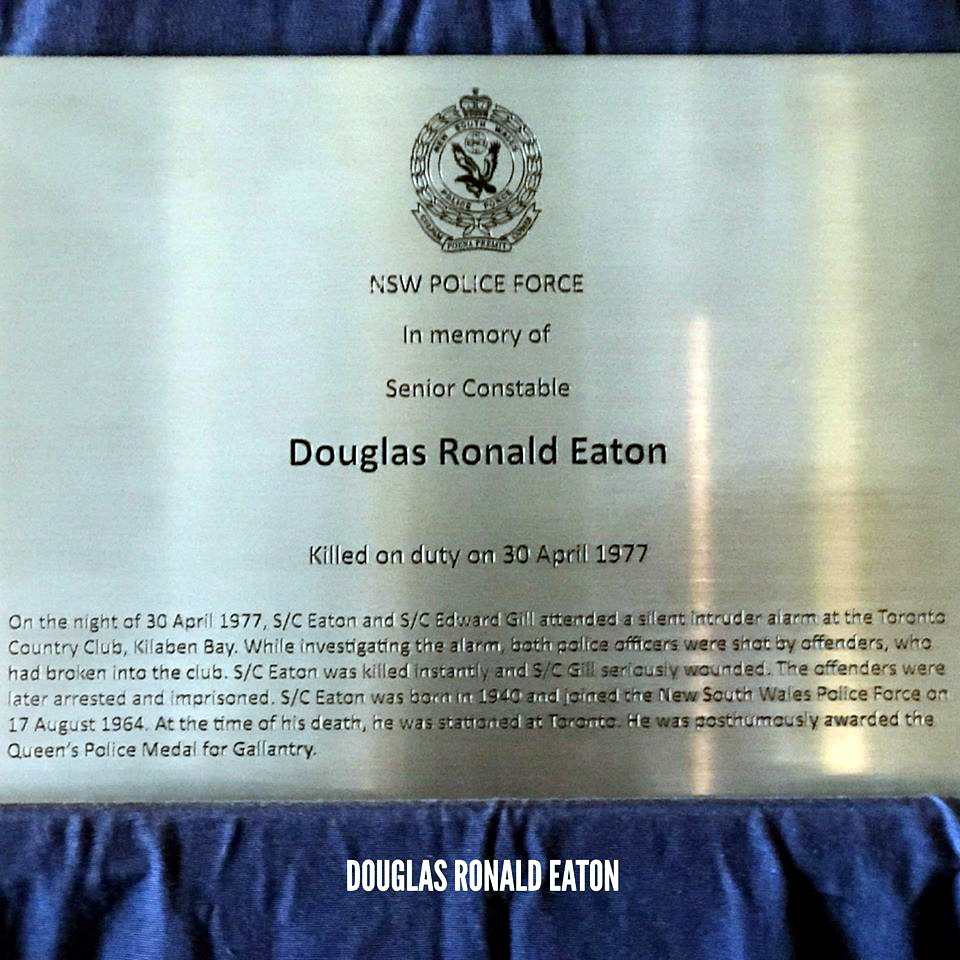
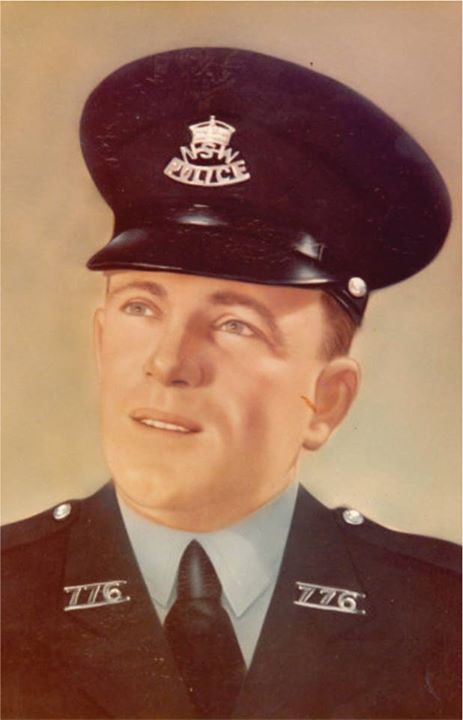
On the night of 30 April, 1977, Senior Constable Douglas Ronald Eaton # 11167 and Senior Constable Edward Gill # 11512 (Edwin Jackson GILL)attended a “silent” intruder alarm at the Toronto Country Club, Kilaben Bay. While they were making an external check of the premises both police officers were shot by offenders who had broken into the club. Senior Constable Eaton was killed instantly and Senior Constable Gill was seriously wounded. Members of the Glesic family were later arrested and imprisoned and a large cache of weapons and explosives recovered.
The constable was born in 1940 and joined the New South Wales Police Force on 17 August, 1964. At the time of his death he was stationed at Toronto. He was posthumously awarded the Queen’s Gallantry Medal, the George Lewis Memorial Trophy and the Peter Mitchell Award.
Canberra Times (ACT : 1926 – 1995),
Thursday 5 May 1977, page 15
Crash kills two policemen
SYDNEY: Two policemen were fatally injured on Tuesday night in a car crash near Newcastle while returning from the funeral of a colleague who was shot dead on Saturday.
Police said a car carrying five’ policemen from Cessnock, overturned after apparently failing to negotiate a bend near Kurri Kurri.
Those killed were Senior-Constable Raymond Scorer, 31, of Aberdare, and Senior-Constable Alan Thompson, 30, of Cessnock. Each was married, with two children.
They had attended the funeral of Senior-Constable Doug Eaton, who was shot dead at a golf club at the weekend.
The three other policemen are in a satisfactory condition in Cessnock Hospital.
SYDNEY: About 400 police in Newcastle overwhelmingly supported a call yesterday to protest on Wednesday over the release from jail this week of two brothers sentenced to life imprisonment for the murder of a police officer during an armed robbery in Newcastle in 1977.
The brothers, Danny and Wally Glesic, had each served 12 years for the murder of Constable Doug Eaton.
A Police Association spokesman said officers felt “severely betrayed” by Corrective Services Minister Michael Yabsley over the release.
NEWCASTLE: Three men were committed for trial after a hearing in Newcastle Court on a charge of having murdered a policeman.
The men were also committed for trial on a charge of having attempted to murder another policemen.
Before the court were Mr Nikola Glesic, 41, Mr Wally Vladik Glesic, 20, and Mr Danny Mladen Glesic, 19, all unemployed, of Corranbong.
They were each charged with having murdered Senior Constable Douglas Ronald Eaton at Toronto on April 30 and having feloniously wounded Constable Edwin Jackson Gill with intent to murder him.
At the conclusion of the Crown case yesterday, the public solicitor, Mr G. Graham, for the defendants, said he did not wish to address the court.
Mr Radford, SM, said he was of the opinion that the evidence of the prosecution established a prima facie case against each defendant on each charge. The three pleaded not guilty and reserved their defence.
Mr Radford committed them for trial at New castle Supreme Court on September 26 and refused bail.
The three were remanded to Newcastle Court on October 24 on a further charge of having, on April 30, broken into the store of Toronto Country Club Ltd and stolen six bottles of spirits, three bottles of Coca Cola and a carton of beer.
SYDNEY: A man had admitted shooting a policeman at a Toronto country club in April, it was alleged in Newcastle Court of Petty Sessions yesterday.
Detective Sergeant C.W. Hodgkinson, of Sydney Homicide Squad, was giving evidence during the second day of committal proceedings against Mr Nikola Glesic, 41, Mr Wally Vladik Glesic, 20, and Mr Danny Mladen Glesic, 19, all unemployed, of Cooranbong, near Newcastle.
All three are charged with having murdered Constable Douglas Ronald Eaton at Toronto, 20 kilometres south-west of Newcastle, on April 30, and feloniously wounded Constable Edwin Jackson Gill with intent to murder him at the same time and place.
Constables Eaton and Gill had been answering a burglar alarm at the Toronto Country Club when the shooting occurred.
Sergeant Hodgkinson told Dr R. L. Radford, SM, he had gone to the Glesic property with other police on Monday, May 2. Police had taken possession of a number of firearms at the property.
The defendants allegedly told police they had been at home on the night of the shooting.
A ballistics report from Sydney had shown that a shotgun, a pistol and a revolver found at the property had been used at the shooting.
Sergeant Hodgkinson said that Mr Nikola Glesic, told of this, had said, ” I shoot one policeman. I am deeply sorry. I love this country “.
Earlier in the hearing, Sergeant A. McDonald, also of the Sydney Homicide Squad, gave evidence that he had said to Mr Wally Glesic at Toronto police station on May 2, ” Since I talked to you last I have found a 9mm pistol and a 44.40 carbine.
” I have reason to believe these weapons were used in the shooting of two police at the Toronto Country Club last Saturday night “.
Mr Wally Glesic had allegedly said, ” Yes, it was us that shot them. What I told you before was all lies “.
SYDNEY: A man and his two sons charged with the murder of a policeman at Toronto last Saturday were further charged in Newcastle Court yesterday on two counts of attempted armed robbery.
The additional charges allege the men, Mr Nikola Glesic, 45, Mr Wally Bladik Glesic, 20, and Mr Danny Mladen Glesic, 19, all unemployed, of Cooranbong, were armed with weapons in two attempted robberies, alleged to have occurred at Morisset on April 3 and April 24.
At a hearing in Wallsend Court on Tuesday, the men were each charged with having murdered Senior Constable Douglas Ronald Eaton at Toronto on April 30 and having wounded Senior Constable Edwin Jackson Gill ( # 11512 ) with intent to murder him at the same time and place.
Mr Power remanded the three men to the Newcastle Court on July 4 and refused bail.
NEWCASTLE; A father and two sons, already committed for trial on a charge of having murdered a policeman were committed on further charges of attempted armed robbery, when they appeared in Newcastle Petty sessions yesterday.
Mr Nikola Glesic, 41, Mr Wally Vladik Glesic, 20, Mr Danny Mladen Glesic, 19, all unemployed, of Maitland Road, Cooranbong, were charged with having assaulted Mr Howard James Hallett and Mr Reginald Ernest Davis with intent to rob them, with two shotguns and an automatic pistol at Morrisset on April 24.
Mr Nikola Glesic and Mr Danny Glesic were also charged with having assaulted Mr Ernest David Heaton and Daphne Hope Heaton, with intent to rob them while armed with two shot guns at Morrisset on April 3.
Mr Radford, SM, committed the three men for trial at Newcastle District Court on August 2 and refused bail. All three pleaded not guilty.
Yesterday’s committal completed 4½ days of hearing evidence against the Glesics on a number of charges, including the murder of Senior Constable Douglas Ronald Eaton, and the attempted murder of Constable Edwin Jackson Gill, at the Toronto Country Club on April 30.
NEWCASTLE: A Newcastle Supreme Court jury convicted yesterday a man and his two sons on charges of having murdered a police constable and having wounded another policeman with intent to murder him.
The three men changed their pleas to guilty on each charge when the trial entered its second day this morning.
Mr Justice Slattery remanded the three men, Mr Nikola Glesic, 41. Mr Wally Vladik Glesic, 20. and Mr Danny Mladen Glesic, 19, all of Cooranbong, for sentence today.
When the trial resumed shortly before 11am yesterday the Public Defender, Mr E. J. Shields, for the accused, asked that the charges be read again to each of the accused.
The three men then pleaded guilty to charges of having murdered Mr Douglas Ronald Eaton at or near Kilaben Bay on April 30 and having wounded Mr Edwin Jackson Gill with intent to murder him at Kilaben Bay on the same date.
Mr Justice Slattery told the jury ” The Crown case against each of the accused is a very strong one. The final decision is yours because each of the accused has been placed in your hands even though they pleaded guilty “.
The jury retired at 11.15am to consider its verdict and found each of the accused guilty on each charge when they returned at 11.40 am.
The prosecutor said he intended to present further charges against the three men today and asked the court to remand them for sentence.
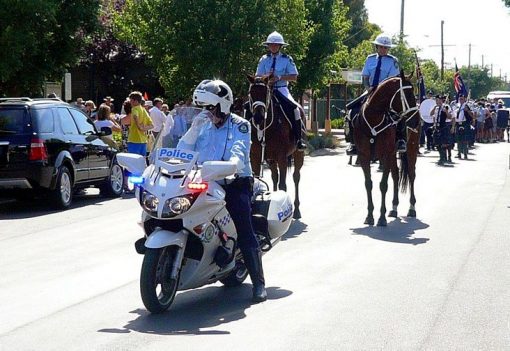
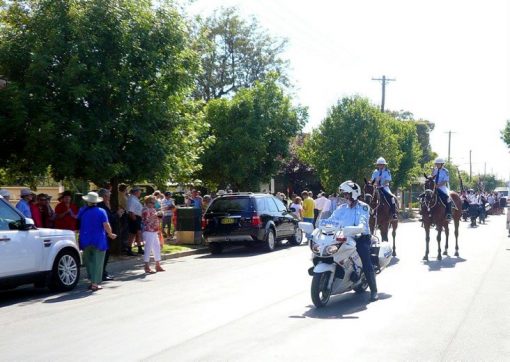
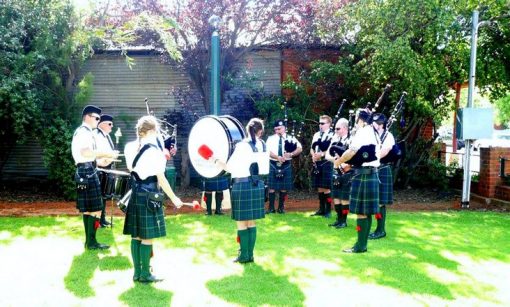
Commemoration of 40th anniversary of officer killed on duty
Sunday, 30 April 2017 04:43:08 PM
**Editor’s note: Images of the plaque have been placed on the NSWPF Facebook page**
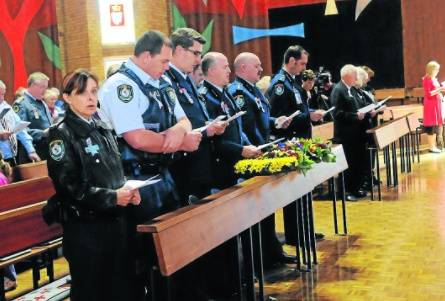
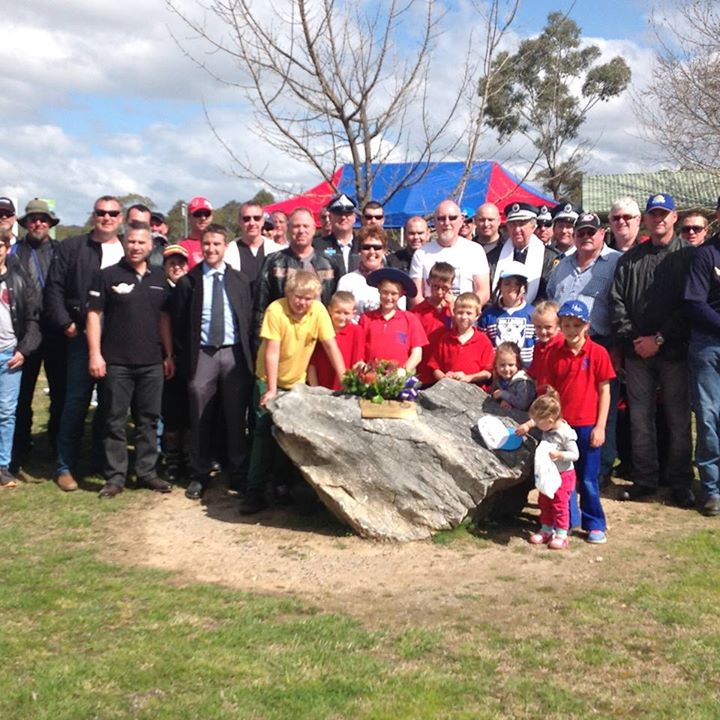
Police and community members have commemorated the 40th anniversary of the death of Senior Constable Douglas Eaton QPM, unveiling a memorial plaque in honour of the officer, who was killed on duty in the Lake Macquarie region in 1977.
On the evening of Saturday 30 April 1977, Senior Constable Douglas Ronald Eaton QPM, and Senior Constable Edward Gill, attended a ‘silent’ intruder alarm at the Toronto Country Club, Kilaben Bay.
Whilst making external checks of the premises, the officers were ambushed and shot by three male offenders who had broken into the club.
Senior Constable Eaton was killed instantly and Senior Constable Gill was seriously wounded. The offenders were later arrested and imprisoned with a large cache of weapons and explosives located.
The community in which he lived and the wider police community rallied around the officer’s young family at the time, raising over $50,000 for the education of his two school aged children, Michael and Sharon.
Officers are quoted at the time fondly recalling a group of school children attending the station with their lunch money to donate to the Eaton fund.
Over $6000 was donated across the counter at the police station, including from persons who the deceased officer had previously arrested.
Ultimately about $24,000 was raised in the Lake Macquarie/Newcastle area at the time, with an additional $27,000 received from police all over Australia at Police Headquarters in Sydney.
Superintendent Brett Greentree, Commander of Lake Macquarie Local Area Command, says these donations were considered a measure of the fine man Douglas Eaton QPM was.
“Douglas was an exemplary husband, father, community man and police officer, giving of his time to assist anyone in the community who required his assistance, from those he counselled through various problems to the widows and elderly who affectionately referred to him as ‘Mr Fixit’.
“His widow raised her two children to remember the brave man that their dad was, proudly insisting on there being no place for hatred in their home.
“Michael is now a Sergeant working general duties at Coffs/Clarence Local Area Command”, Superintendent Greentree said.
To add to the tragedy, three days after the death of Senior Constable Eaton, Cessnock officers Senior Constable Alan Thompson and Senior Constable Ray Scorer were killed in a car accident on Tuesday 3 May 1977 returning from their colleague’s funeral.
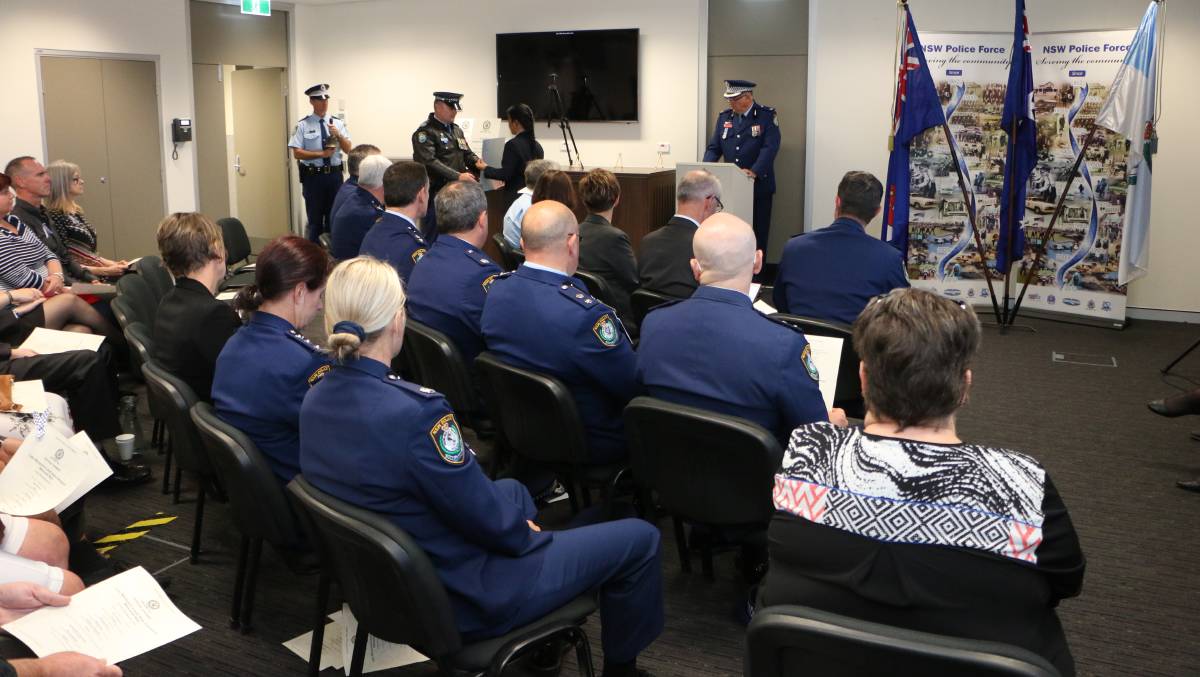
At 11.30am today (Sunday 30 April 2017), Senior Constable Eaton QPM was honoured at a dedication service with a memorial plaque commemorating his sacrifice.
The service was attended by Superintendent Greentree, Acting Deputy Commissioner Field Operations Jeff Loy APM, Police Minister Troy Grant, as well as family and friends of Douglas Eaton QPM.
Police Minister Troy Grant, said it was an honour to attend the service, and pay his respects to his family, which includes Sergeant Mick Eaton.
“Senior Constable Douglas Eaton QPM epitomised a community policemen. He was senselessly murdered 40 years ago leaving his young wife, two children and a community devastated,” Mr Grant said.
“Senior Constable Eaton’s legacy of service lives on, as does his example for all police officers who come after him in the Lake Macquarie and Toronto area.
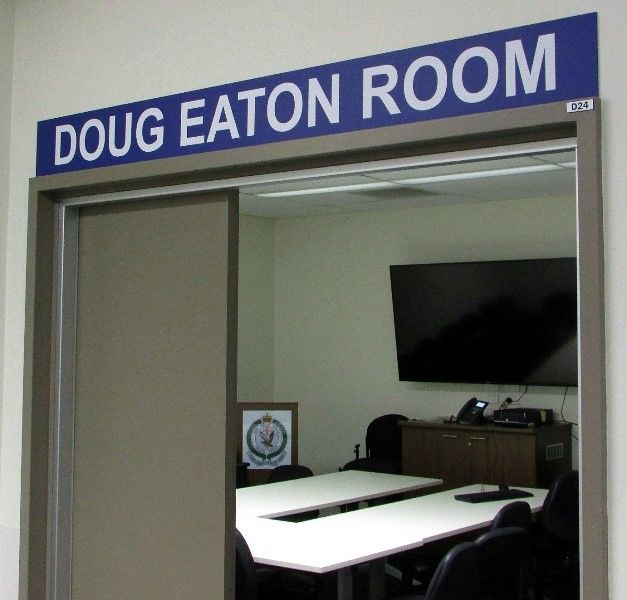
“The new Toronto Police station, to be opened in the next few weeks, will appropriately contain a training room dedicated in his memory.”
National Police Remembrance Day ceremony in Lake Macquarie
David Stewart
September 29 2017 – 4:27PM
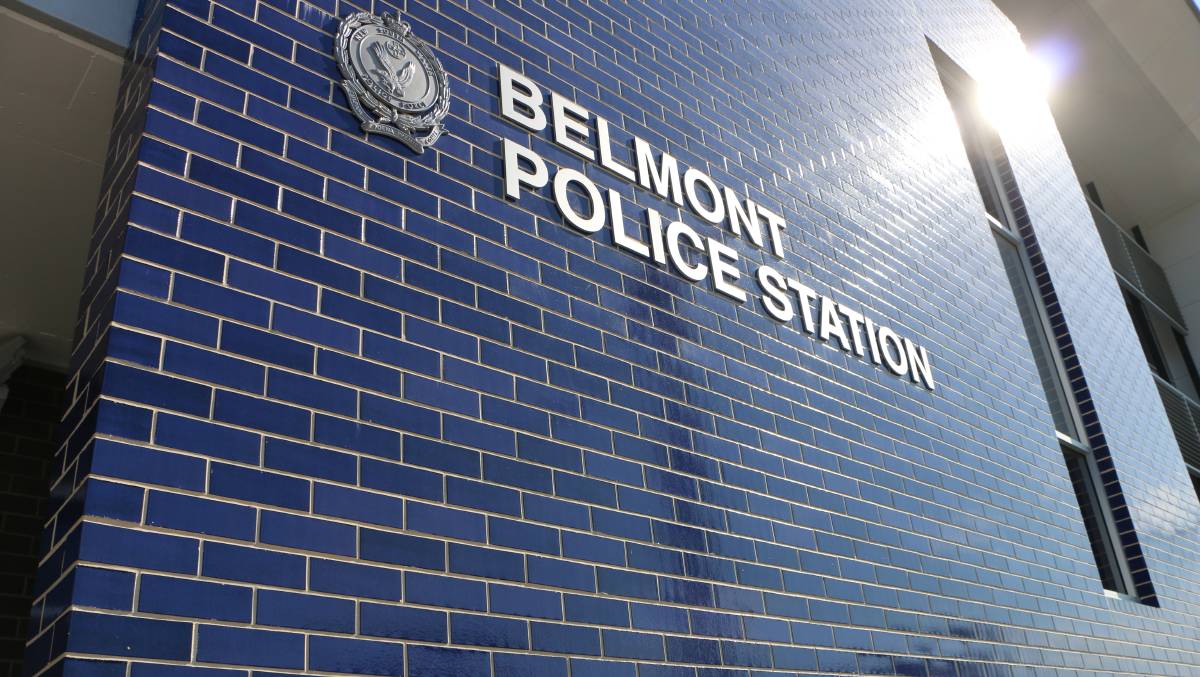
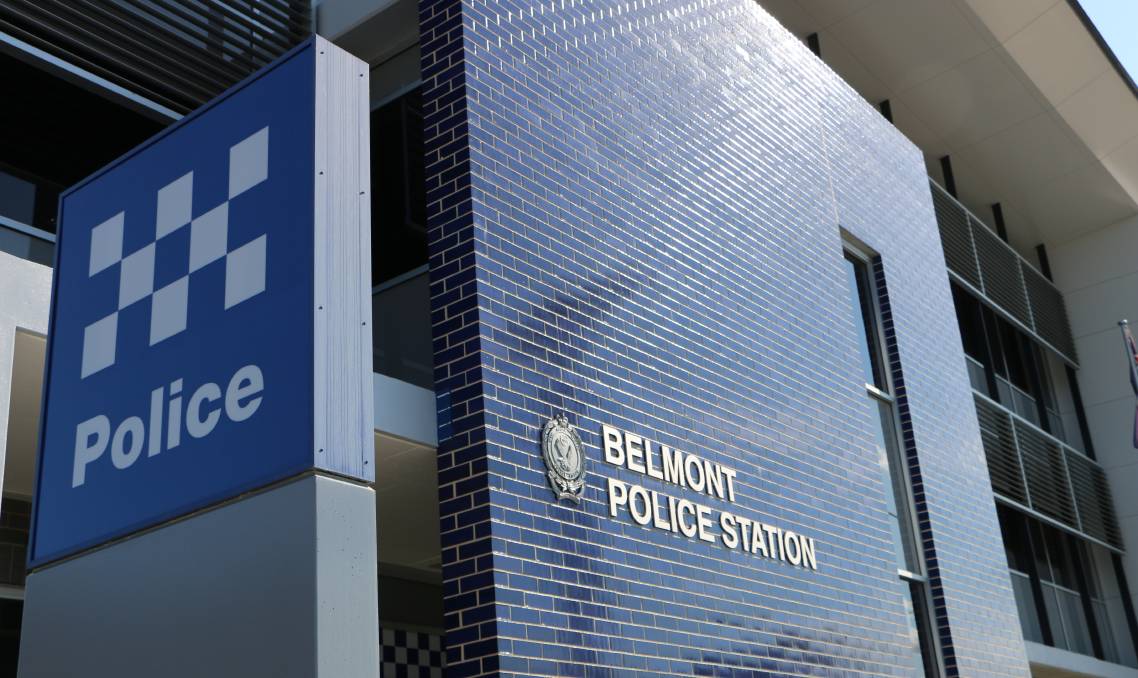
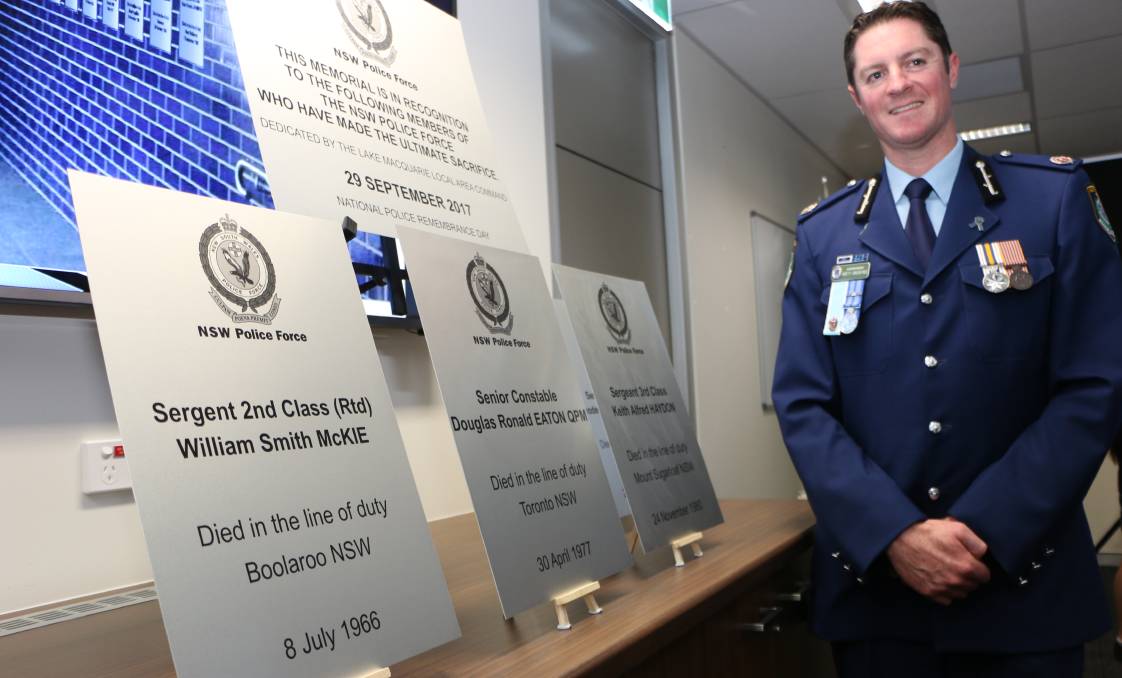
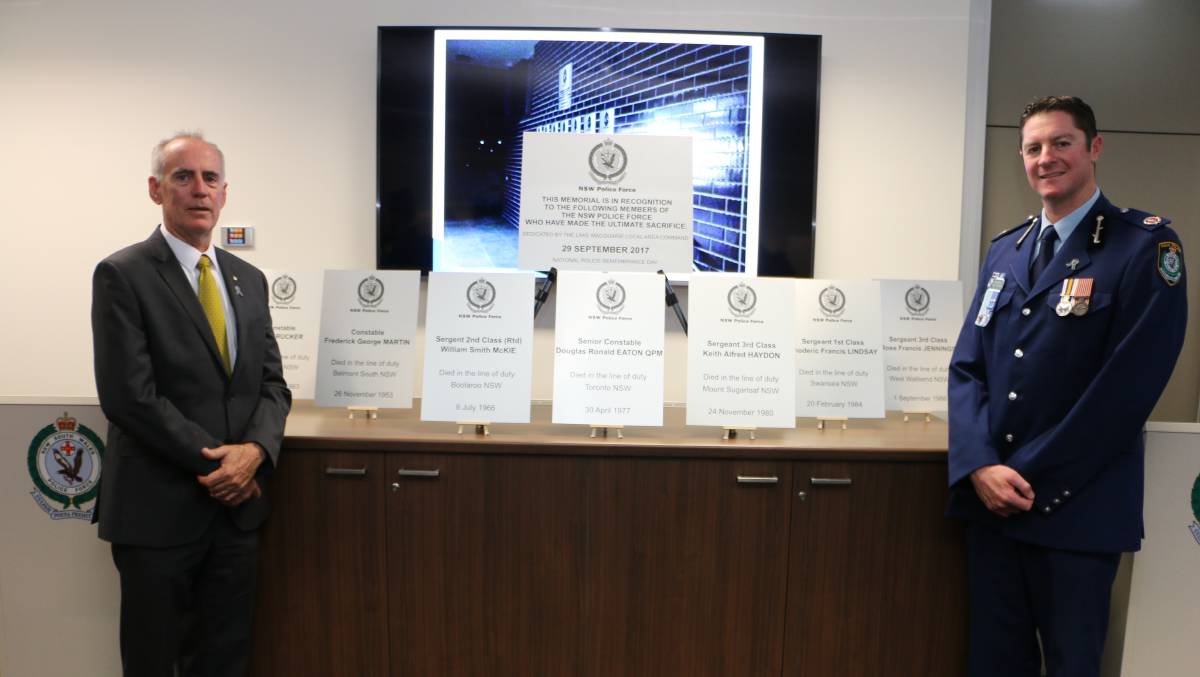
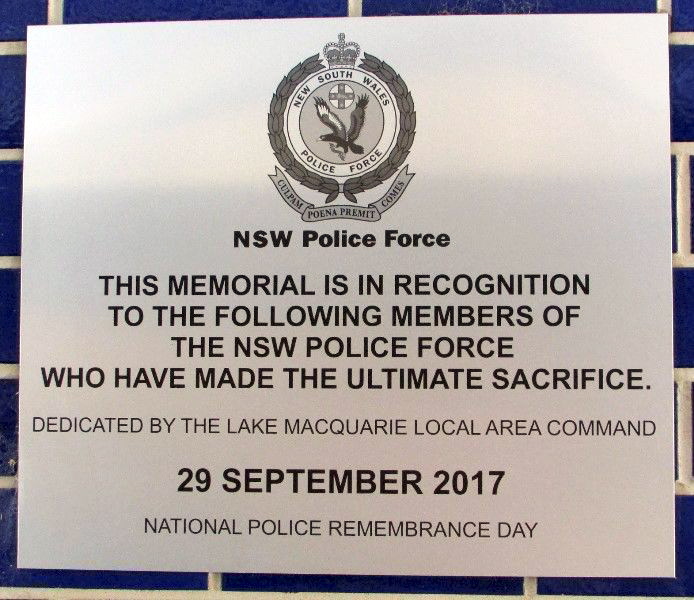
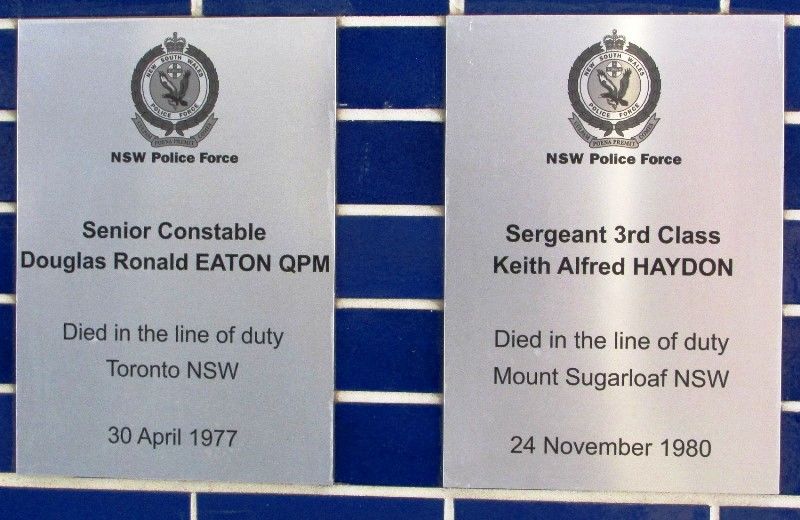
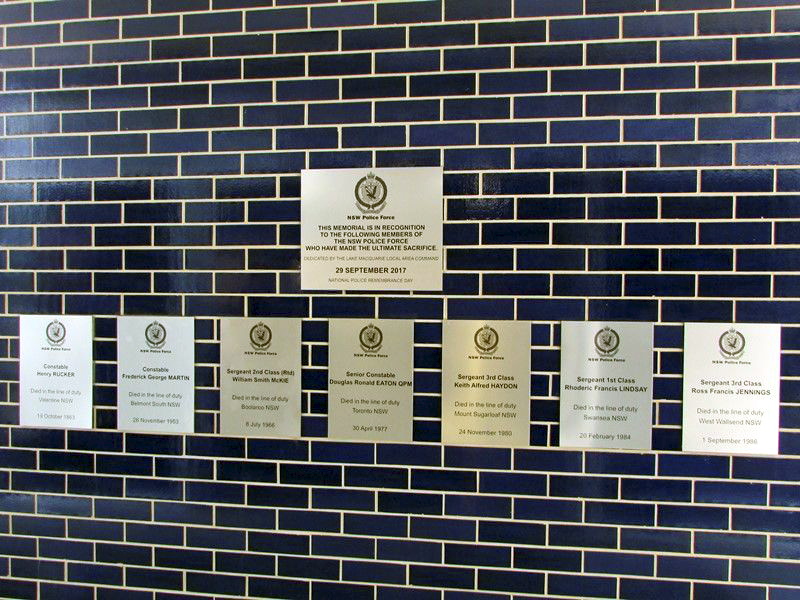
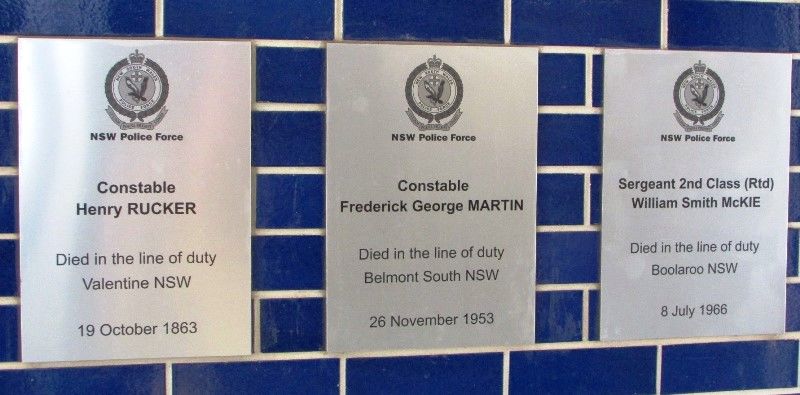
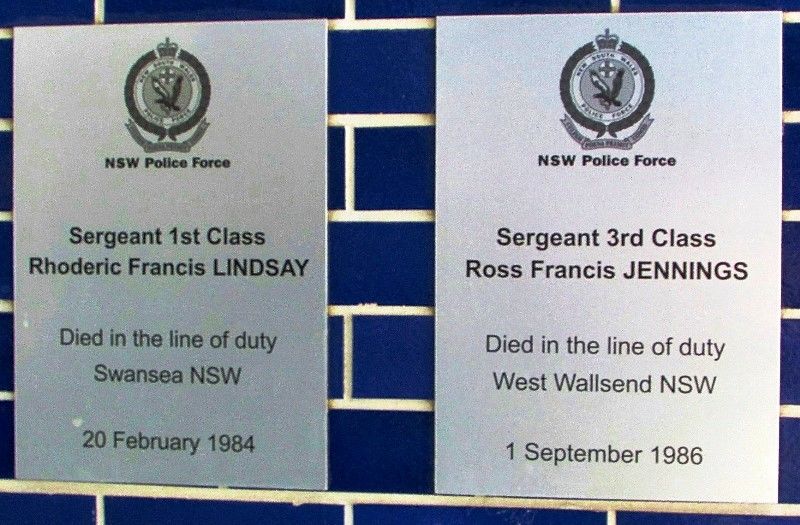
POLICE from Lake Macquarie Local Area Command have unveiled plans for a memorial wall at Belmont to honour the seven local officerskilled in the line of duty since 1863.
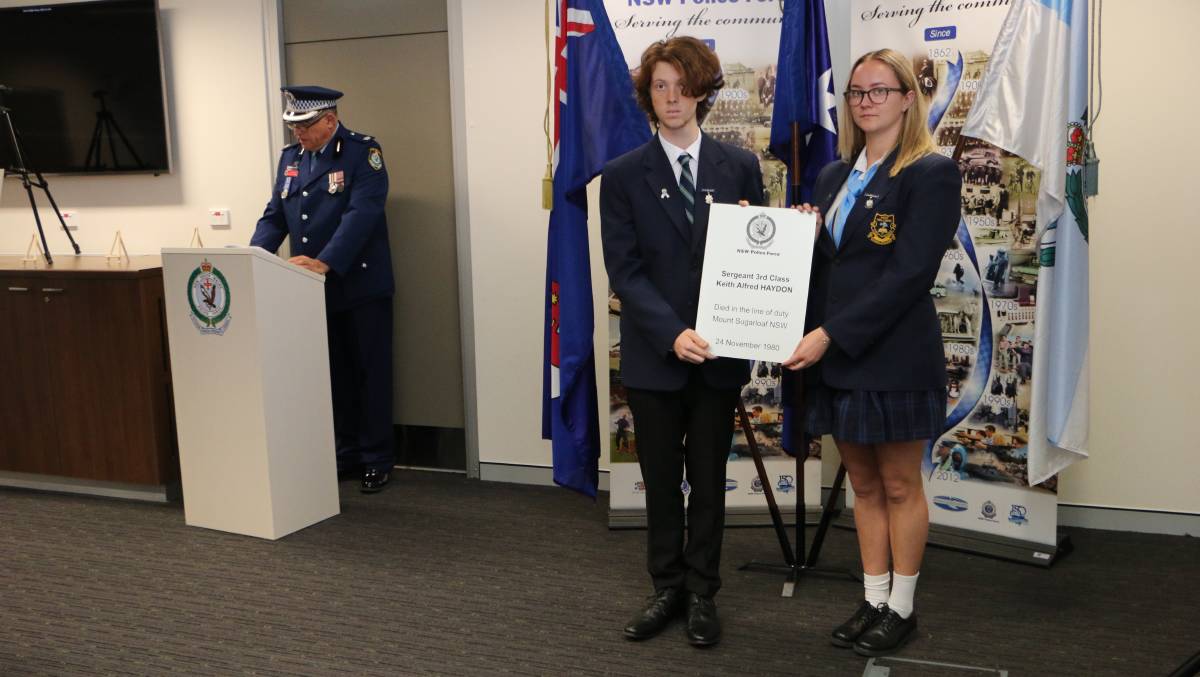
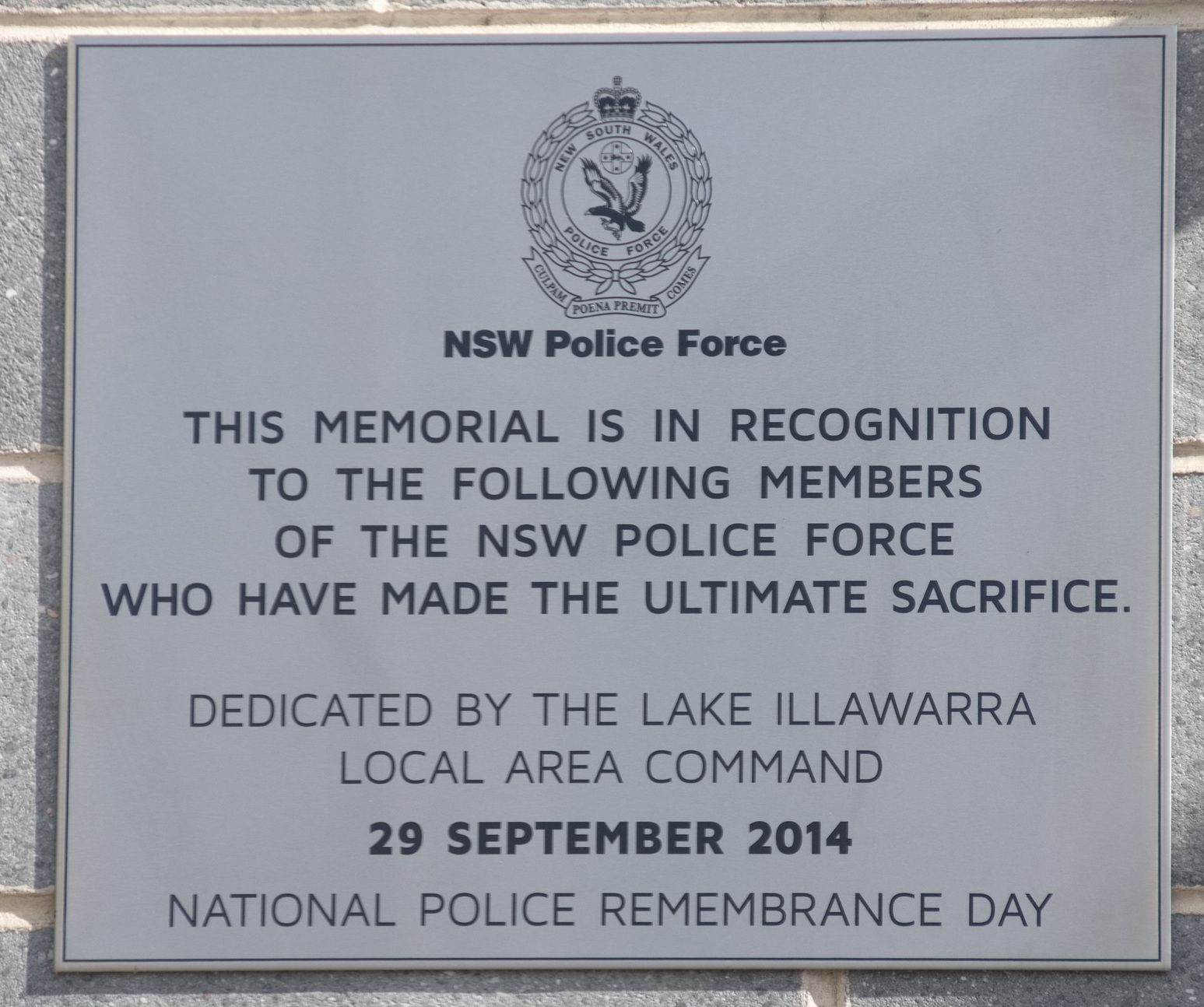
Plaques commemorating the seven officers were dedicated to the wall in a ceremony at Belmont police stationthis afternoon, National Police Remembrance Day.
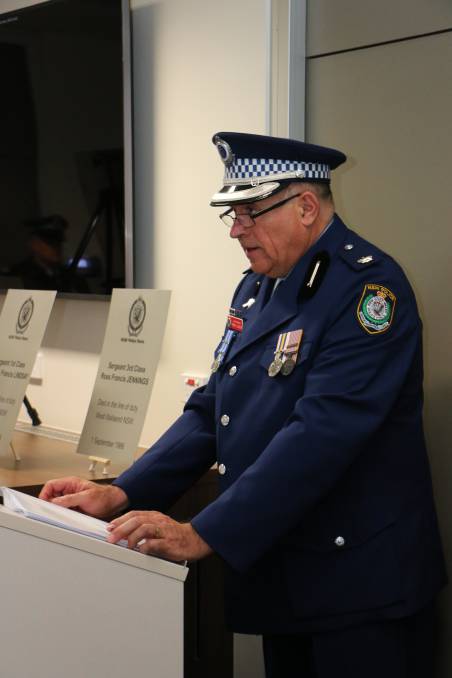
Chief Inspector Murray Lundberg of Lake Macquarie LAC presided over a private ceremony attended by police, local high school students, and the families of the fallen officers.
“This is a time for reflection on the ultimate sacrifice that police officers can give in the execution of their duty,” Chief Inspector Lundberg said.
Acting Assistant Commissioner Brett Greentree, the Northern Region Commander, said the wall of remembrance, to be created on the distinctive blue wall at the entrance to the police station, would be striking.
“It will be a sight to treasure,” Acting Assistant Commissioner Greentree said.
“I want the officers, as they are walking out the front doors of this police station, to stop and reflect on the names, stop and reflect on the sacrifice.”
He said he hoped that the inaugural plaques to be installed on the wall were also the last.
“My dream is that we never, ever, add another name to this wall. I hope and pray that our wall is now complete.”
Acting Assistant Commissioner Greentree reached out to the families of the fallen officers.
“No commemoration or recognition can make good the loss that is unfairly carried by family members,” he said.
“I can only offer you my heartfelt condolences. Please know that your loved ones, who are no longer with us, will always be remembered.”
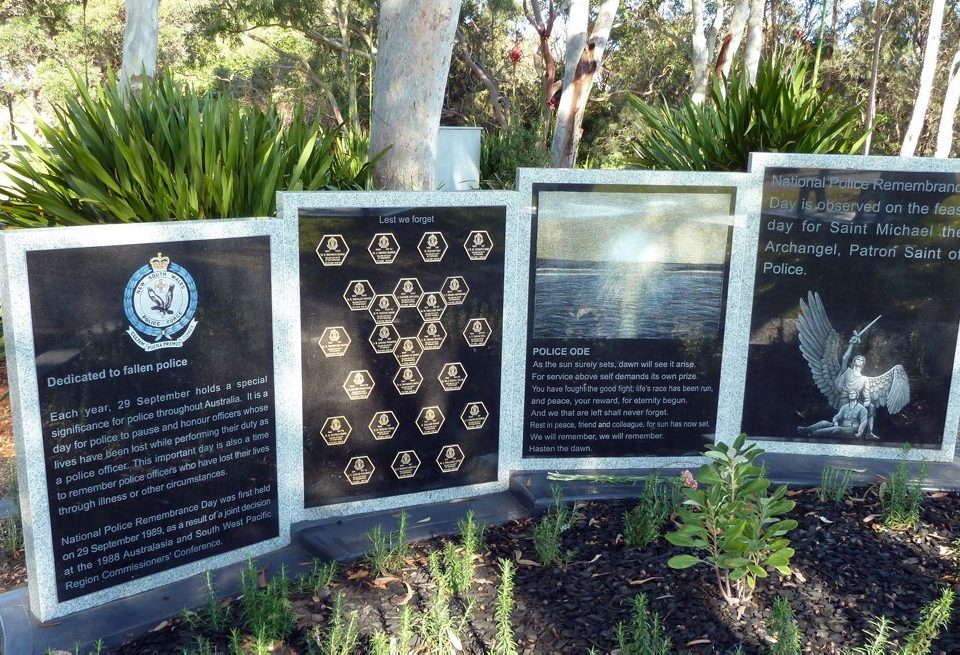
Across NSW, ceremonies were held to commemorate the service and sacrifice of the 269 officers who have lost their lives in the line of duty, and through injury or illness, since the formation of the NSW Police Force in 1862.
Senior Constable Douglas Eaton
The Doug Eaton Room in the Toronto Police Station commemorates Senior Constable Douglas Eaton.
On the evening of Saturday 30 April 1977, Senior Constable Eaton, and Senior Constable Edward Gill, were called to a ‘silent’ intruder alarm at the Toronto Country Club at Kilaben Bay. Whilst making external checks of the premises, the officers were ambushed and shot by three male offenders who had broken into the club. Senior Constable Eaton was killed instantly and Senior Constable Gill was seriously wounded.
The offenders were later arrested and imprisoned after a large cache of weapons and explosives was located.
Address:
139 Cary Street, Toronto Police Station, Toronto, 2283
State:
NSW
Area:
AUS
GPS Coordinates:
Lat: -33.012433
Long: 151.592924 Note: GPS Coordinates are approximate.
Dedication
Actual Monument Dedication Date:
Thursday 17th August, 2017
Front Inscription Doug Eaton Room Plaque : Senior Constable Douglas Ronald Eaton QPMOn the night of 30 April 1977 Senior Constable Eaton and Senior Constable Edwin Gill attended a silent intruder alarm at the Toronto Club Kilaben Bay. While they were making an external check of the premises both police officers were shot by the offenders who had broken into the club.Senior Constable Eaton was killed instantly and Senior Constable Gill seriously wounded. Members of the Glesic family were later arrested and imprisoned and large cache of weapons and explosives recovered.The Constable was born in 1940 and joined the New South Wales Police Force on 17 August 1964. At the time of his death he was stationed at Toronto. He was posthumously awarded the Queen`s Gallantry Medal the George Lewis Memorial Trophy and the Peter Mitchell Award.This room is dedicated to Senior Constable Douglas Ronald Eaton QPM for the ultimate sacrifice.17 August 2017
Each September we pause to remember and pay tribute to the police men and women who have been killed on duty while serving to protect our local communities. Since the inception of Police Remembrance Day 254 members of the NSW Police Force have died on the front line protecting our values and our way of life. I recently had the privilege of attending a ceremony at Toronto Country Club where a plaque was unveiled to commemorate the fortieth anniversary of an event that still holds strong in the memories of many in my community.
Late in the evening of 30 April 1977 Senior Constable Doug Eaton and Senior Constable Edward Gill were called to a silent intruder alarm at the country club, which is located in a quiet and isolated part of Kilaben Bay. While they were making external checks of the building they were ambushed by three armed men who had broken into the club. Senior Constable Eaton was killed by one of the gunmen and Senior Constable Gill was seriously wounded. The club was an old fibro clubhouse that had been popular with the locals, but its isolated location had made it a regular target for thieves. On this night 41-year-old Nikola Glesic and his sons Wally and Danny had broken into the clubhouse and were about to leave with a few bottles of scotch, a bottle of wine and a few bags of potato chips when the senior constables arrived. They fired at the officers from behind nearby bushland.
Senior Constable Eaton was just 36 years old when he died, leaving behind his wife, Judy, and young children Sharon and Michael. Senior Constable Gill later recovered from serious wounds. What followed was an extraordinary show of community strength, yet more grief was to come. Three days later, in a bitter irony, Cessnock officers Senior Constable Alan Thompson and Senior Constable Ray Scorer were killed in a car accident while returning to their station after the funeral of their colleague. Senior Constable Eaton was very well known and highly regarded in the area, having lived and served locally for the previous 13 years. The community, shocked and angry, established a memorial appeal for the Eaton children.
Sergeant Joe Hinton, who ran Toronto police station at the time, said he had never seen anything like it. He recalled people streaming into the station to donate whatever they could afford to make sure the Eaton children were able to continue with their education. He recalled, “One chap who had been arrested and charged by Senior Constable Eaton weeks prior sent a card to the station expressing his sadness at Doug’s death and saying how courteous Doug had been the night he was charged. He also sent a $50 donation.” About $24,000 was raised in the area, while a further $27,000 was sent from all over Australia to police headquarters in Sydney. It was an extraordinary gesture.
“He was a special type of fellow, and an outstanding policeman, exemplary husband, father and community man,” Sergeant Hinton said. Those qualities live on through his wife, Judy, and through Sharon and Michael. Michael is now a police sergeant working general duties in the Coffs-Clarence Local Area Command. I have known Judy for many years now. She is a stalwart member of Morisset Lions Club and is involved in many community activities. She is held in very high esteem by those who know her but without a doubt she still carries the scars of that horrible night 40 years ago. I am certain Doug would be very proud of his wife and children.
Senior Constable Eaton was posthumously recognised with a Queen’s Police Medal. Last month’s commemoration included the unveiling of a plaque at Toronto Country Club which will forever preserve his memory, as well as his dedication to the local community. The service was organised by local area commander Superintendent Brett Greentree, who was joined by the Acting Deputy Commissioner of Field Operations for the NSW Police Force, Jeff Loy, and most significantly the Minister for Police, Troy Grant, who is in the Chamber this evening. I should also point out that the Minister joined me at Morisset late last year to open a new police station in my electorate. He will be back in the electorate in the coming weeks to officially open the new station at Toronto, which includes a training room that will be named in honour of Senior Constable Doug Eaton.
The Minister is always welcome in the electorate of Lake Macquarie, and I thank him for his and the Government’s interest in providing better facilities and general support for our police in Lake Macquarie. Police work is all too often dangerous, and protecting our community requires a constant vigil. While I acknowledge senior constables Eaton, Gill, Thompson and Scorer today, I also acknowledge all those men and women who serve every day to keep our communities safe.
Daniel HillRemember hearing about this one whilst at the Academy…in a cruel twist of fate when the offenders were later arrested, a search of one of their wallets revealed a shooters licence (which he’d probably used to purchase the gun which killed Constable Eaton & wound the other officer) which had ironically been issued by Doug Eaton…(what are the odds).
Lot: Estate 1150, Memorial Rock, Peace 2, BWL Pools area.
Memorial ID 149049228
Lat/Long: -33.78922, 150.84705
Memorial located at:
1/ Pinegrove Memorial Park, Eastern Creek
2/ Blacktown Police Station. Memorial photos was in the foyer, then the boss’s foyer & now in the corridor between the front counter & muster room.
3/ Plinth at the entrance to the Memorial Rose Garden, NSW Police Academy, Goulburn.
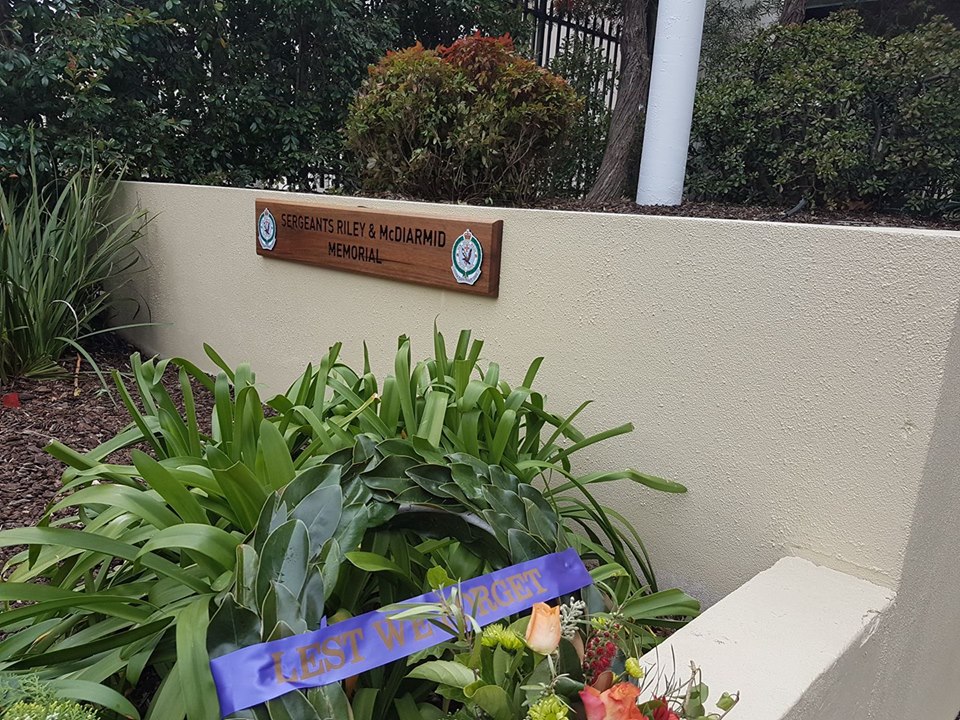
4/ Memorial Gardens at the front of Blacktown Police Station – Dedicated in September 2017.
Sgt William Riley
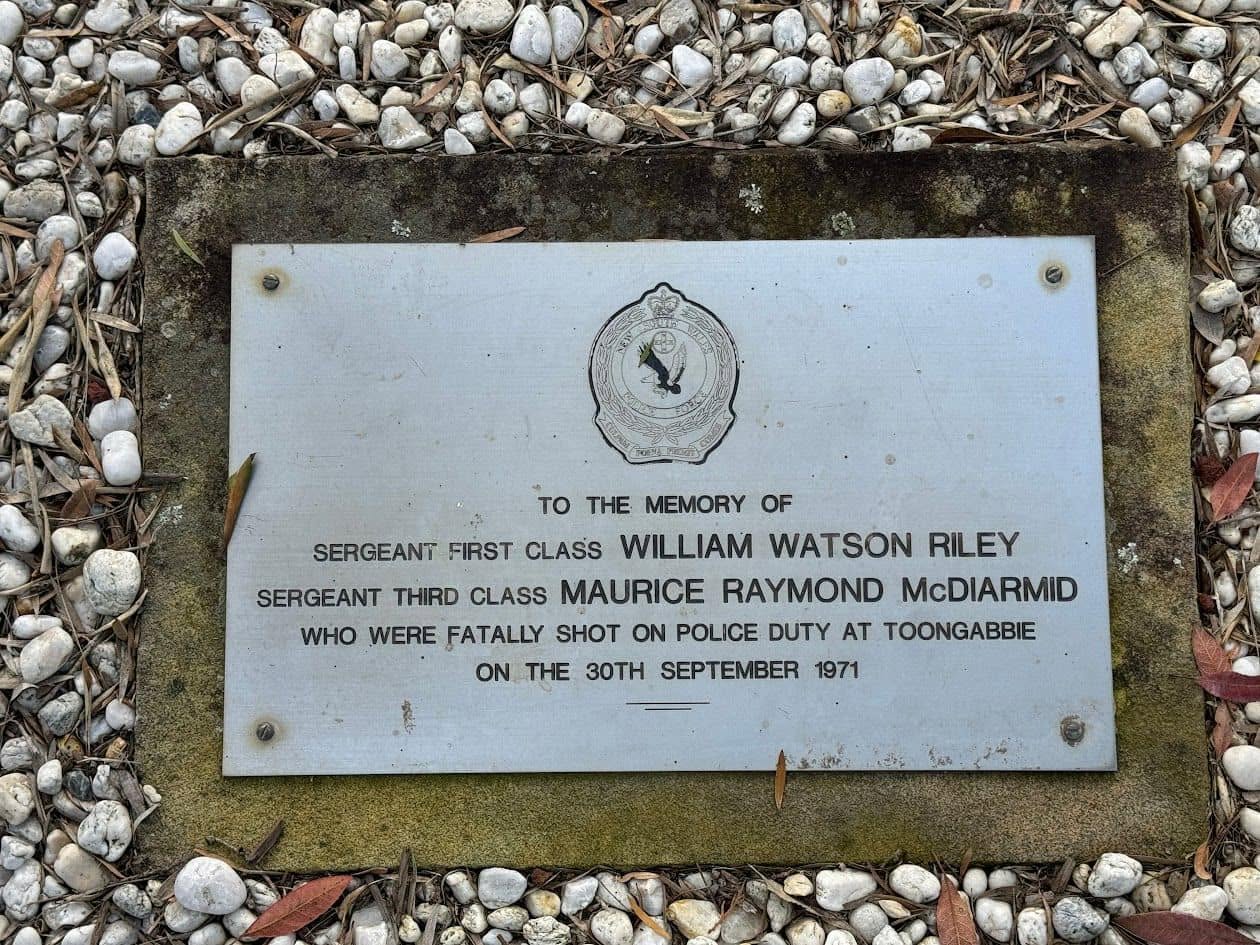
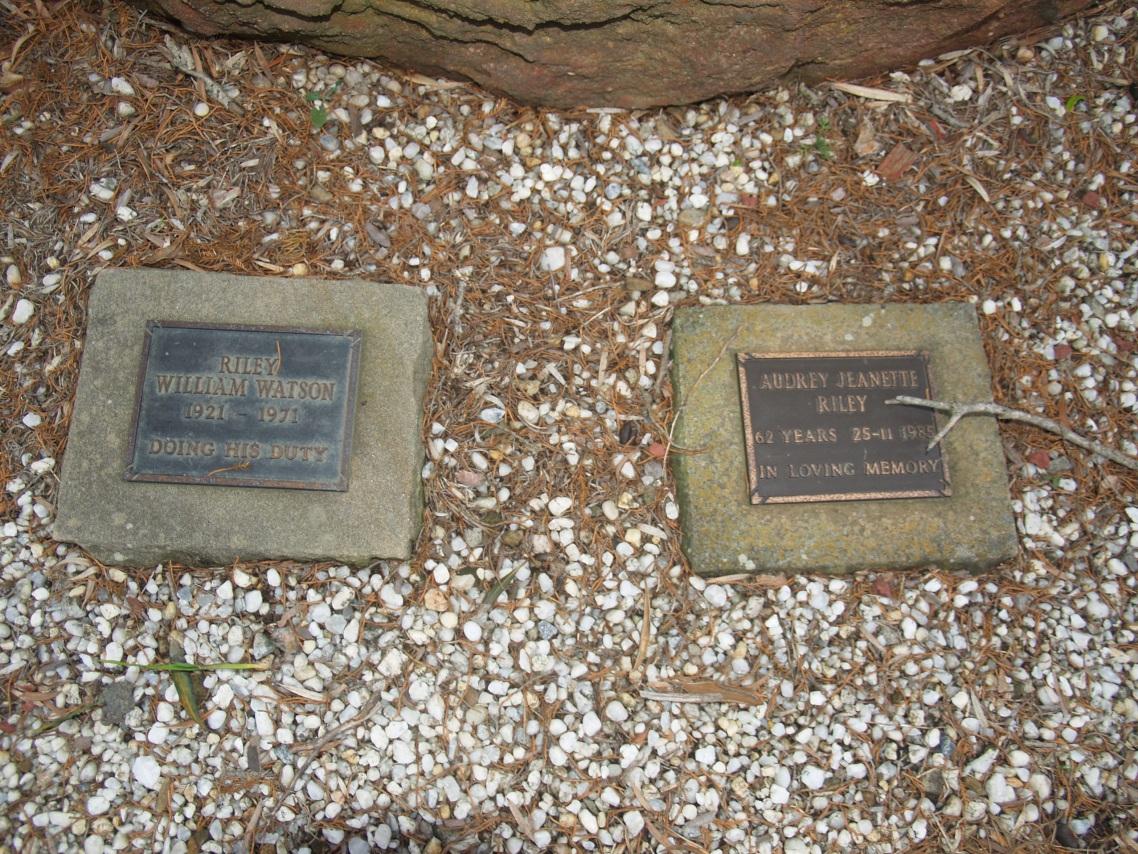
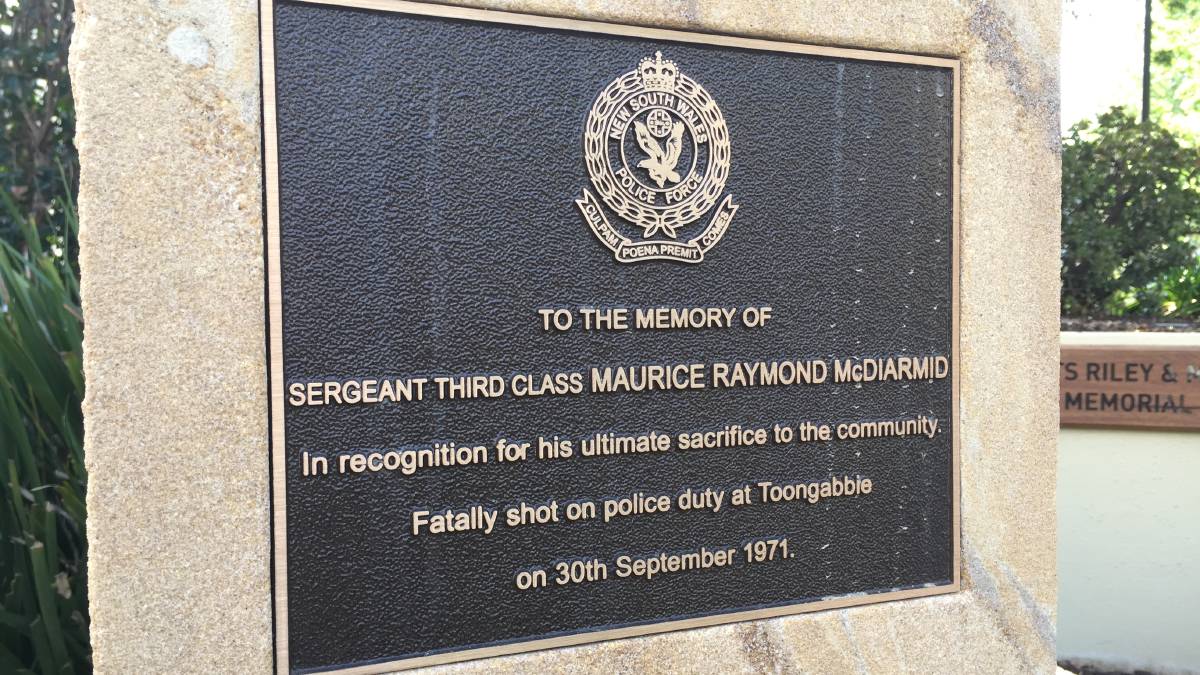
Inscription: To the memory of Sergeant First Class William Watson RILEY, Sergeant Third Class Maurice Raymond McDIARMID who were fatally shot on Police Duty at Toongabbie on the 30th September 1971
Inscription: To the memory of Sergeant First Class William Watson RILEY, Sergeant Third Class Maurice Raymond McDIARMID who were fatally shot on Police Duty at Toongabbie on the 30th September 1971
WILLIAM IS mentioned on the National Police Wall of Remembrance ( photo needed )
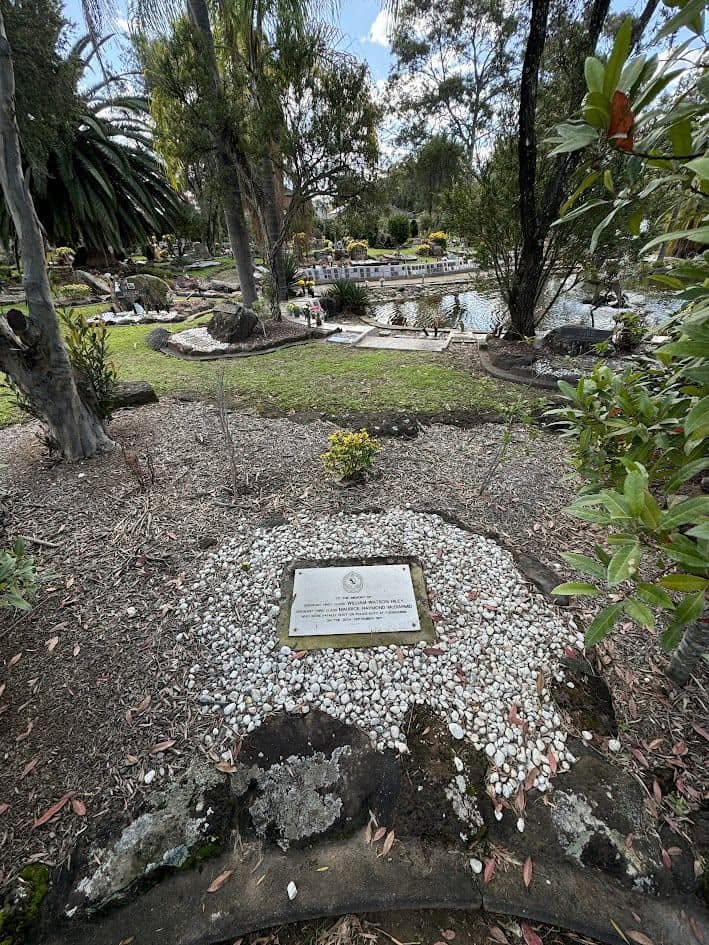
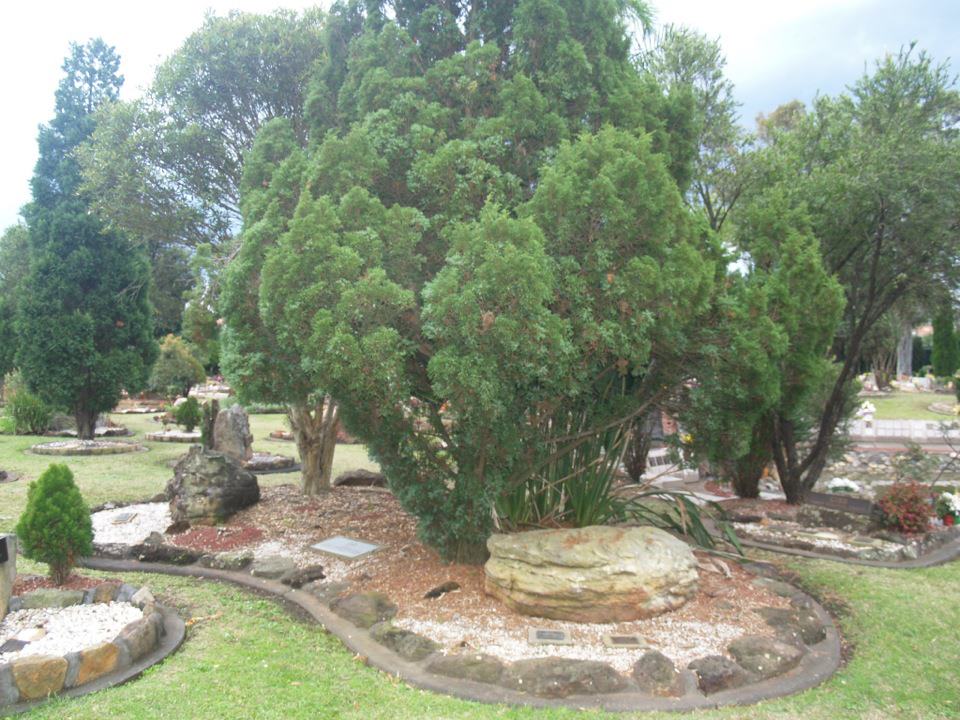
This whole garden is a memorial to both McDIARMID & RILEY. RILEY is in the foreground with McDIARMID being in front of the darker bolder to the left.
On 30 September, 1971, Sergeant 2nd Class Riley and Senior Constable McDiarmid attended a dwelling in Mimosa Avenue, Toongabbie to investigate a report that a man had shot and killed his brother at that address. On arrival the police saw the offender RonaldClarke who quickly ran to the rear of the house. Senior Constable McDiarmid followed him while the sergeant entered through the front door. As the senior constable entered through the back door the offender opened fire with a shotgun, inflicting a fatal wound. It appears the offender then went back through the house where he also shot and killed Sergeant Riley. Although the senior constable was still alive when other police arrived he died a short time later in an ambulance on the way to hospital. The offender was shot and killed by police ( Cst 1/c Alf GREGORY ) the same day.
William Riley was born in 1921 and joined the New South Wales Police Force on 3 December, 1945. At the time of his death he was stationed at Blacktown. He was posthumously promoted to Sergeant 1st Class.
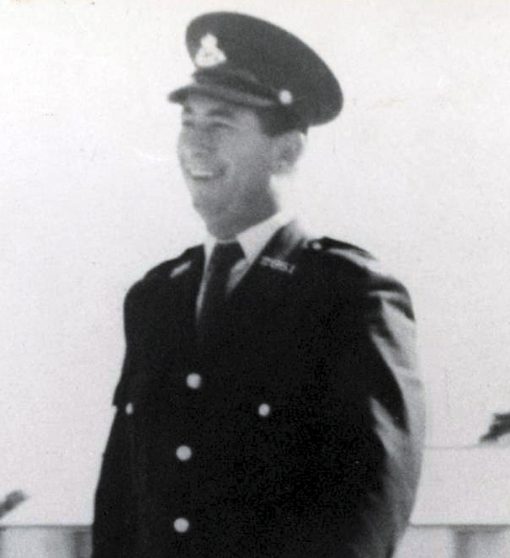
Maurice McDiarmid was born in 1932 and joined the New South Wales Police Force on 9 July, 1956. At the time of his death he was stationed at Blacktown. He was posthumously promoted to Sergeant 3rd Class.
George Lewis Memorial Trophy
This trophy for the year 1971, which is for the most courageous act performed by a member of the New South Wales Police Force, was awarded posthumously to the late Sergeant 1st Class W. W. Riley and the late Sergeant 3rd Class M. R. McDiarmid who were stationed at 27 Division.
The trophies were presented to Mrs Riley and Mrs McDiarmid at the Police Academy during 1972.
PETER MITCHELL TRUST AWARDS
The ten awards under this Trust for the year 1971 were made to the following police, the trophies being presented at the Police Academy during 1972:
Most Courageous Act Posthumously awarded to the late Sergeant 1st Class W. W. Riley and the late Sergeant 3rd Class M. R. McDiarmid in conjunction with the George Lewis Memorial Trophy.
SYDNEY, Monday. — At the Pine Grove Memorial Park near Rooty Hill today, Bishop Hulme-Moir, chaplain of the NSW Police Force, dedicated a plaque in memory of Sergeant Maurice McDiarmid and Sergeant William Riley, who were shot when attempting to arrest an armed man at Toongabbie on September 30 last year.
SYDNEY, Wednesday. – The NSW Government agreed today to make, as “an act of grace”, lump-sum payments of $12,500 to each of three police officers’ widows.
“The Premier, Sir Robert Askin, said the payments would be in addition to the pensions and dependant’s allowances already paid out of the police superannuation and reward fund.
The three policemen involved in the payments are Senior Constable W. E. King, who was murdered at East Gresford police station on August 13 last year, and Sergeants W. Riley and M. McDiarmid, who were shot by a man at Toongabbie on September 30 last year.
Sir Robert said members of the police force had always been specifically excluded from the definition of “worker” under the Workers Compensation Act.
He said the Commissioner of Police, Mr Allan, had brought to the notice of the Government that, in certain matters of workers’ compensation, police were in an anomalous position in relation to other Crown employees.
Sir Robert said a full examination would be made of overall benefits of workers’ compensation available to police.
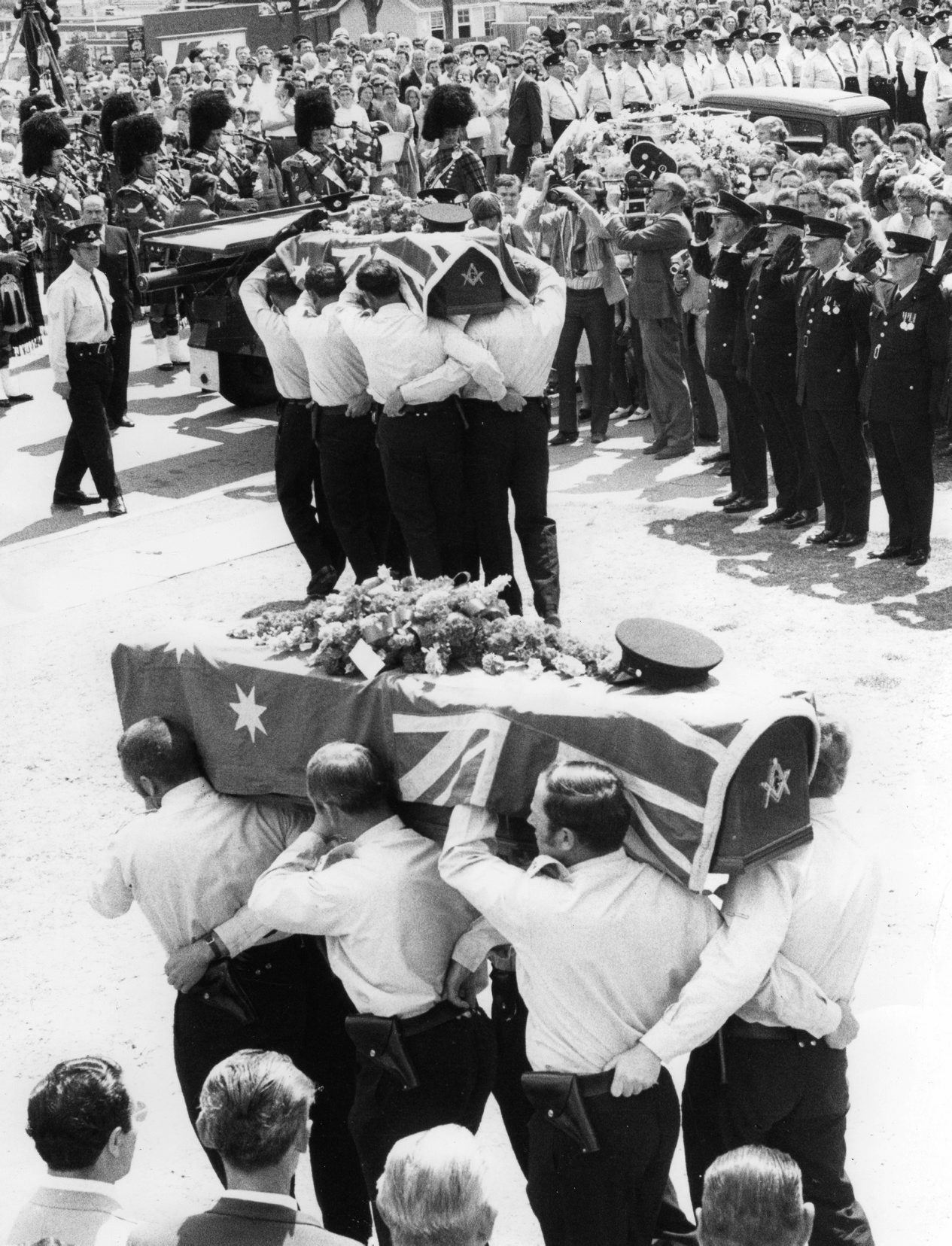
SYDNEY, Tuesday. -More than 400 policemen attended the funeral this morning of the two policemen shot by a man in Toongabbie last Thursday. Both men, Sergeant William Watson Riley and Senior Constable Maurice Raymond McDiarmid, were given full police honours at their funeral.
William RILEY’s son, Ian, also joined the NSW Police Force as a NSW Police Cadet, # 1953, on 17 August 1964, and was Sworn In on 14 December 1966 by Assistant Commissioner Joe BUCK in his office in the old Police Headquarters in Hunter St, Sydney, alongside of NSW Police Cadet Kevin TANT, Cadet # 1838.
William RILEY’s daughter, Jeanie, also joined the NSW Police Force in 1978 but had resigned several years later. Jeanie had Regd. # 18503. Was a Probationary Constable on 2 April 1979 and a Senior Constable on 2 April 1988.
Canberra Times (ACT : 1926 – 1995),
Friday 1 October 1971, page 1
Shooting in Sydney Brothers, two police die
SYDNEY, Thursday. – Two policemen and two other men were shot dead in the outer western Sydney suburb of Toongabbie today.
The policemen were shot while investigating a report of rape and murder.
Earlier, Mr Warren Clark about 22, died in his bed. Police said his elder brother, Ronald. 23, had shot him through the head with a .22 calibre repeater rifle.
A young woman, living in the house in Mimosa Ave, Toongabbie, with Mr Warren Clark, told police that Mr Ronald Clark had awakened her and then shot his brother.
The woman alleged that Mr Ronald Clark then raped her and forced her to accompany him in his car.
After driving her around for several hours, he had released her at Blacktown.
The woman went to Blacktown police station.
She was in a hysterical condition.
Sergeant Second-Class William Riley, 50, and Senior-Constable Morrie McDiarmid, 39, left the station immediately to go to the house.
While they were on their way the police radio directed other police to the house.
The next-door neighbour, in Mimosa Ave, Toongabbie, Mrs Ethel Roberts, 54, said she first knew something was wrong when a police officer ran down a driveway at the side of her house.
He began kicking on the door of the house next door.
“He eventually forced the door and went inside”, she said.
“All was quiet for perhaps two minutes, then three shots rang out.
“I ran to the front porch as a young blond man ran from the house with a rifle in his hand, entered a car and screeched off down the road”‘. Mrs Roberts said.
“After he drove off, I saw a policeman’s blood stained hand grasping the back steps of the house”.
Stem flow of blood
“I ran to the road where a woman was delivering bread and told her to call an ambulance”.
Another neighbour, Mrs Dawn Harris, was called by Mrs Roberts, who was trying to stem the flow of blood from Constable McDiarmid.
“When I reached the house a policeman was propped against the back steps”, Mrs Harris said.
“His mouth and part of his face were torn and shredded from the shotgun blast.
“Another policeman was lying dead on the ground.
“In a bedroom in the house another man covered with a sheet was also dead and blood could be seen everywhere”.
Police said later they believe Sergeant Riley died immediately when he was shot at point-blank range with a shotgun.
Constable McDiarmid was taken by ambulance to Blacktown Hospital. He died shortly after arrival.
Meanwhile an all-points bulletin was broadcast over the VKG police network for all cars to be on the lookout for a bright blue 1950 sedan.
The broadcast warned, ‘This man is dangerous. He has a .22 rifle, a shotgun and two police pistols”.
“We have sighted him”, one car replied. “He is going toward Hillview”.
“We have stopped the car”, was the officer’s next report.
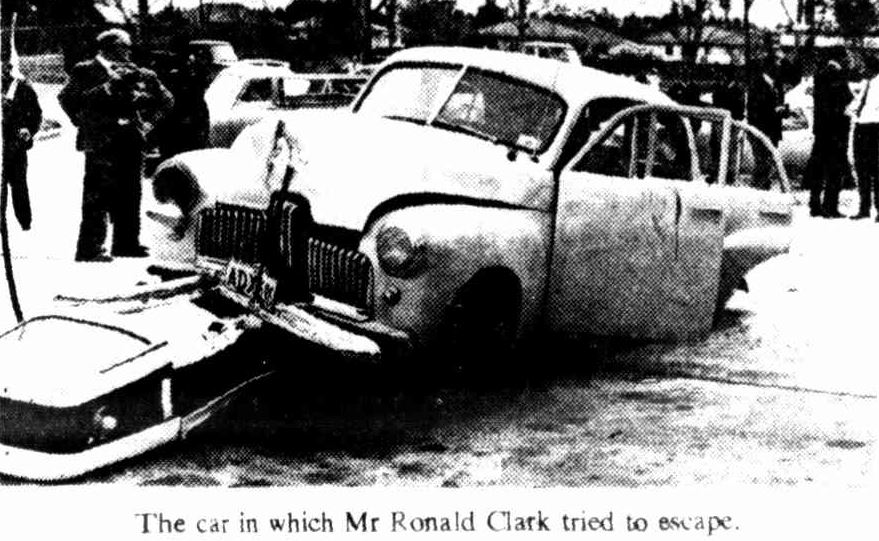
Constable Alfred Gregory and Constable Les Crawford said later they had rammed the suspect’s car with their police van.
The sedan got out of control and crashed into a bowser at a service station.
Constable Gregory jumped out of the van. As he approached the car he saw Mr Clark take one of the police pistols from the seat and transfer it to his right hand.
Three shots from pistol
Constable Gregory fired three shots from his pistol.
One of his shots struck Mr Clark in the side of the head, killing him.
In the car, police found several Commonwealth Bank cash bags, a blood stained nightgown and two suitcases containing mostly women’s clothing.
Two police revolvers, a .22 repeater rifle and a sawn-off shotgun were also recovered.
Tonight forensic and ballistic experts were still examining them.
The policemen killed are each survived by a widow and two children.
Sergeant Riley joined the force in 1945 and Constable McDiarmid in 1956.
A CIB spokesman said this afternoon the families were eligible for a special allowance paid to police killed while on duty.
He said that the lack of witnesses, particularly when the two policemen were shot, was hampering investigations.
Government Gazette of the State of New South Wales (Sydney, NSW : 1901 – 2001),
Friday 28 April 1972 (No.44), page 1544
RE the estate of WILLIAM WATSON RILEY, late of St Marys, in the state or New South Wales, police sergeant, deceased. —
Probate of the will dated 21st June, 1951, granted by the Supreme Court of New South Wales on the 7th day of April, 1972.—
Pursuant to the Wills, Probate and Administration Act, 1898 -1954, Testator’s Family Maintenance and Guardianship of Infants Act, 1916 -1954, and Trustee Act, 1925 -1942, the Public Trustee, the executor of the will of the said William Watson Riley, who died on the 30th day of September, 1971, hereby gives notice that creditors and others having any claim against or to the estate of the said deceased are required to send particulars of their claims to the said Public Trustee at his Branch Office hereunder mentioned, on or before the 28th day of June, 1972, at the expiration of which time the said Public Trustee will distribute the assets of the said deceased to the persons entitled, having regard only to the claims of which he then has notice.
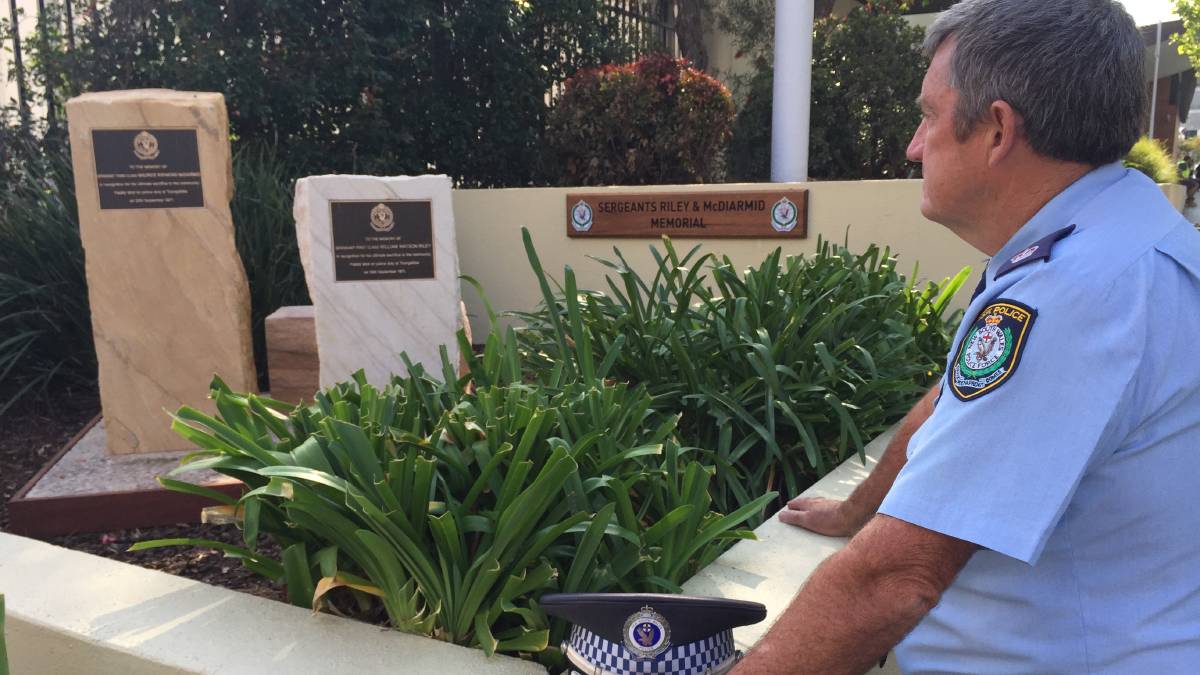
NOT FORGOTTEN: Blacktown Police Chief Inspector Bob Fitzgerald pays his respects at a memorial to slain officers Sergeant 1st Class William Riley and Sergeant 3rd Class Maurice McDiarmid. Picture: Harrison Vessey
A solemn memorial stands to remind Blacktown police officers of the price paid by two of their colleagues.
William Riley and Maurice McDiarmid were both killed in the line of duty on September 30, 1971, while trying to apprehend a murder suspect in Toongabbie.
They are now remembered by commemorative plaques outside Blacktown Police Station, as well as a plinth at the entrance to the Memorial Rose garden at the NSW Police Academy.
The plinth features two police caps pictured the way they fell when the men were murdered, and bears the words: “For The People”.
Detective Senior Sergeant Adam Wilson, Probationary Constable Peta Kendall, Acting Inspector Lauren Martin and Chief Inspector Bob Fitzgerald.
Chief Inspector Bob Fitzgerald said the permanent memorials were important for police and the community.
“I hope it’s a reminder when you come to work, you do the job to the best of your ability and go home to your family,” he said.
Acting Inspector Lauren Martin said Police Remembrance Day gave every officer a chance to think about those who didn’t make it home.
“It’s good to have a visual reminder so you can reflect on what could happen when you come to work,” she said.
Sergeant 2nd class Riley and Senior Constable McDiarmid were attending a home in Mimosa Avenue, Toongabbie, following reports a man had raped a woman and shot her lover, who was also his brother.
The offender, Ronald Clarke, shot and killed both officers as they attempted to surround him. He was shot and killed by police in Hillview later that day.
“It is a very sad day for all those who believe in upholding the law and order,” Police Commissioner Norman Allen said at the time.
Both officers were posthumously promoted for their outstanding courage and devotion to duty.
More than 400 officers attended their funeral in Blacktown. They were laid to rest at Pinegrove Cemetery with plaques bearing the inscription: “Doing His Duty”.
SYDNEY, Friday. — A Sydney coroner has commended two policemen who chased and stopped “an armed and desperate man“.
The man, Mr Ronald Desmond Clarke, had earlier shot and killed two other policemen after having killed his own brother in Toongabbie on September 30.
The coroner, Mr J. Parnell, SM, found on Wednesday that Mr Clarke in turn died in a car of cerebral lacerations and gun shot wounds to the brain inflicted by a person defending himself.
Constable A. C. Gregory, giving evidence at the inquest into the deaths of the four men, said that he and Constable L. ( Les ) A. Crawford in a police truck had rammed Mr Clarke‘s car, causing him to lose control.
Constable Gregory had seen Mr Clarke transfer a gun from his left hand to his right. The gun had been pointing at the policeman’s face and the constable had fired “one shot towards his shoulder“.
“The impact of this bullet appeared to throw him towards the passenger side of his car, but he still had the revolver, which he now held in both hands, levelled at my face“, Constable Gregory said.
“He appeared to be endeavouring to discharge the gun and it was then that I fired two quick shots at him“.
The four men who were killed were Sergeant First Class William Watson Riley, 50, and Sergeant Maurice Raymond McDiarmid, 39, of Blacktown, and Ronald Desmond Clarke, 20, and Warren John Clarke, 22, both of Toongabbie.
( Both policemen were promoted posthumously. Sergeant Riley was raised from second-class to first class, and Sergeant McDiarmid from senior constable to sergeant third class. )
Mr Parnell found that Mr Warren John Clarke died from gunshot wounds inflicted by his brother, Mr Ronald Desmond Clarke.
He found also that Sergeant Riley died from a fractured skull and lacerations to the brain, and Sergeant McDiarmid died in an ambulance between Toongabbie and Blacktown Hospital.
Both died as a result of bullet wounds inflicted by Clarke.
He said Mr Ronald Clarke, a professional criminal, had shot his brother, Warren Clarke, after having raped his brother’s de facto wife.
reported the murders of the two police in graphic detail.
“SYDNEY, Thursday – Two policemen and two other men were shot dead in the outer western Sydney suburb of Toongabbie today. The policemen were shot while investigating a report of rape and murder. Earlier, Mr Warren Clark about 22, died in his bed. Police said his elder brother, Ronald. 23, had shot him through the head with a .22 calibre repeater rifle. A young woman, living in the house in Mimosa Ave, Toongabbie with Mr Warren Clark, told police that Mr Ronald Clark had awakened her and then shot his brother. The woman alleged that Mr Ronald Clark then raped her and forced her to accompany him in his car. After driving her around for several hours, he had released her at Blacktown. The woman went to Blacktown police station. She was in a hysterical condition. Sergeant Second-Class William Riley, 50, and Senior-Constable Morrie McDiarmid, 39, left the station immediately to go to the house. While they were on their way the police radio directed other police to the house.
“The next-door neighbour, in Mimosa Ave, Toongabbie. Mrs Ethel Roberts, 54, said she first knew something was wrong when a police officer ran down a driveway at the side of her house. He began kicking on the door of the house next door. “He eventually forced the door and went inside”, she said. “All was quiet for perhaps two minutes, then three shots rang out. I ran to the front porch as a young blond man ran from the house with a rifle in his hand, entered a car and screeched off down the road”, Mrs Roberts said. “After he drove off, I saw a policeman’s blood stained hand grasping the back steps of the house. I ran to the road where a woman was delivering bread and told her to call an ambulance”. Another neighbour, Mrs Dawn Harris, was called by Mrs Roberts, who was trying to stem the flow of blood from Constable McDiarmid. “When I reached the house a policeman was propped against the back steps”, Mrs Harris said. “His mouth and part of his face were torn and shredded from the shotgun blast. Another policeman was lying dead on the ground. In a bedroom in the house another man covered with a sheet was also dead and blood could be seen everywhere”.
“Police said later they believe Sergeant Riley died immediately when he was shot at point-blank range with a shotgun. Constable McDiarmid was taken by ambulance to Blacktown Hospital. He died shortly after arrival.
“Meanwhile an all-points bulletin was broadcast over the VKG police network for all cars to be on the lookout for a bright blue 1950 sedan. The broadcast warned, ‘This man is dangerous. He has a .22 rifle, a shot gun and two police pistols”. “We have sighted him”, one car replied. “He is going toward Hillview“. “We have stopped the car”, was the officer’s next report. Constable Alfred Gregory and Constable Les Crawford said later they had rammed the suspect’s car with their police van. The sedan got out of control and crashed into a bowser at a service station. Constable Gregory jumped out of the van. As he approached the car he saw Mr Clark take one of the police pistols from the seat and transfer it to his right hand. Constable Gregory fired three shots from his pistol. One of his shots struck Mr Clark in the side of the head, killing him.
“In the car, police found several Commonwealth Bank cash bags, a blood stained nightgown and two suitcases containing mostly women’s clothing. Two police revolvers, a .22 repeater rifle and a sawn-off shotgun were also recovered. Tonight forensic and ballistic experts were still examining them. The policemen killed are each survived by a widow and two children. Sergeant Riley joined the force in 1945 and Constable McDiarmid in 1956.”
The Canberra Times of the 25 May, 1972 briefly recorded the awarding of bravery medals to both men, reporting that “Sergeant William Riley, 50, and Sergeant Maurice McDiarmid, 39, who were shot dead while trying to arrest a man at Toongabbie last year, have been posthumously awarded the Queen’s Police Medal for gallantry”.
The sergeant was born in 1921 and joined the New South Wales Police Force on 3 December, 1945. At the time of his death he was stationed at Blacktown. He was posthumously promoted to Sergeant 1st Class. He is listed in the official New South Wales Police Honour Roll.
POLICE KILLED OR WHO DIED FROM INJURIES RECEIVED IN THE EXECUTION OF THEIR DUTIES
On 13th August, 1971, Senior Constable William Edward King, who was then the officer-in-charge of police, East Gresford, was shot dead at East Gresford Police Station by a man who fired upon him with a rifle.
On 29th August, 1971, Constable 1st Class Patrick Mark Hackett died from injuries received in a motor accident at Polis, Cyprus, whilst performing duty with the New South Wales Police component of the Australian Police Contingent of the United Nations Peace Keeping Force.
On 30th September, 1971, Sergeant Second Class William Watson Riley and Senior Constable Maurice Raymond McDiarmid, both then attached to Blacktown Police Station, were shot dead in a house at Toongabbie which they had entered to arrest a man who a short time before had murdered his brother and raped a woman in the same house.
A police funeral with full ceremonial honours was accorded these deceased officers at which appropriate tributes were paid.
In recognition of their outstanding courage Sergeant Riley and Senior Constable McDiarmid were posthumously promoted by me to Sergeant 1st Class and Sergeant 3rd Class respectively. In addition, I submitted recommendations to the Premier for favour of consideration of Royal Awards being granted in both cases.
To assist the widows of the deceased police the Premier approved the payment to each of them of the sum of $12,500 as a gratuity. This payment did not in any way affect their entitlements to payments under the provisions of the Police Regulation (Superannuation) Act.
Grave location: Anglican Monumental. Sect Aj – 0126
Memorial located at:
1/ Sgt. Howe’s name is mounted on the Memorial Wall at the NSW Police Memorial situated in the Tranquil Gardens, Woronora Memorial Park Cemetery, 121 Linden St, Sutherland.
It is important to know that in mid September each year, since 2015, 11 other NSW Police Officers killed on duty in the Sutherland / St. George PAC and 13 Police Officers killed in other PAC’s (Sgt 3/c Howe – Oaklands) and laid to rest within the WMP Cemetery are remembered.
Ron Alexander – Chairman NSW Police Memorial Service Committee – WMP.
2/ Memorial located at Oaklands Police Station, NSW – Dedicated on 19 December 2014
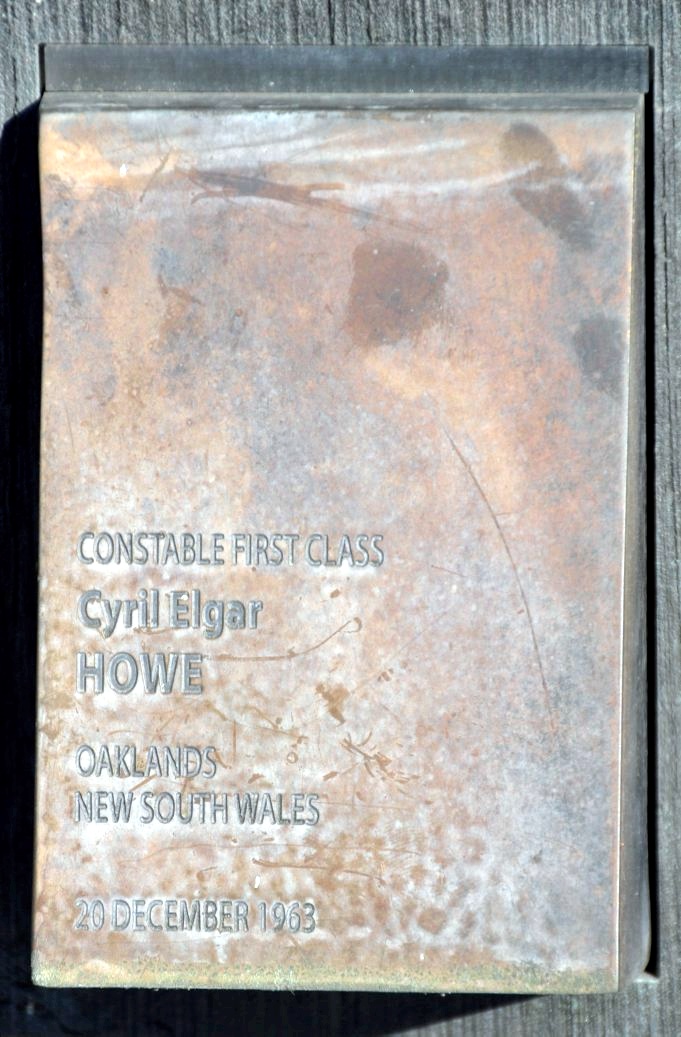
Touch plate at the National Police Wall of Remembrance, Canberra
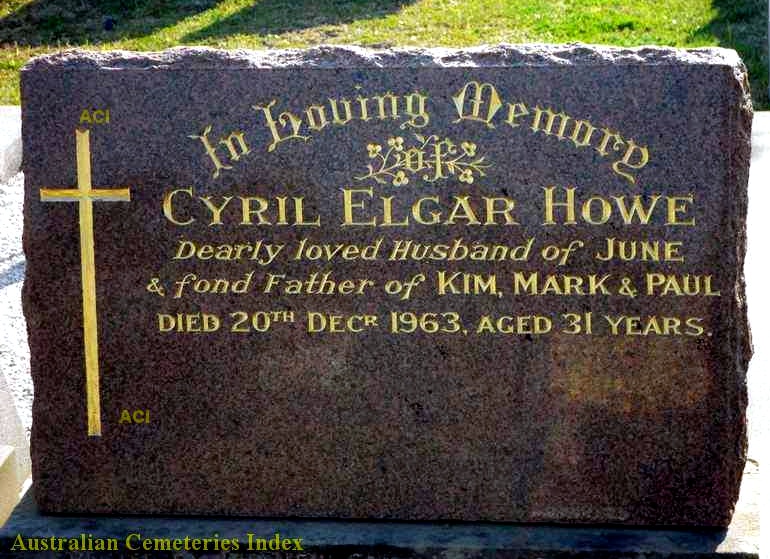
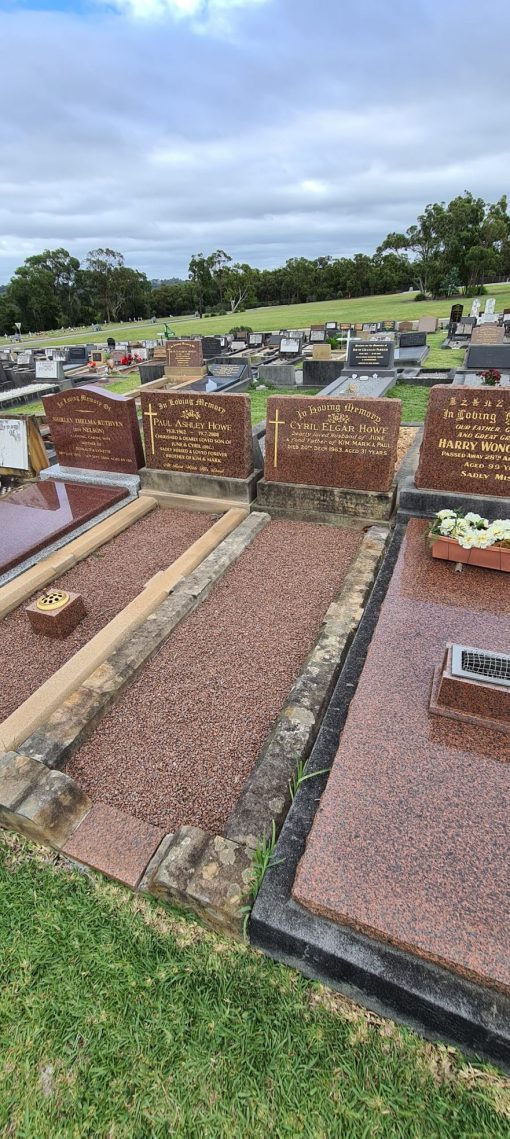
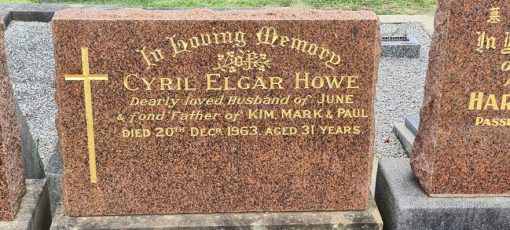
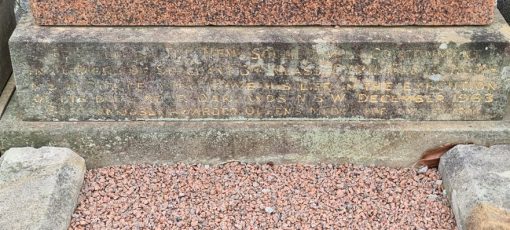
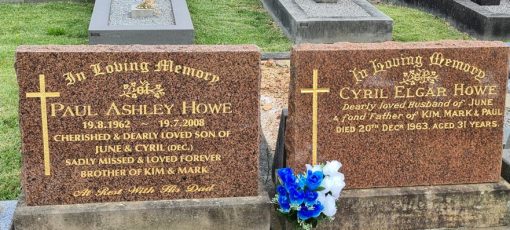
Paul, one of Cyrils’ sons, is buried alongside of his father. Cyrils’ wife, June, having died in September 2020, is buried with Cyril. ” Together forever “
CYRIL IS mentioned on the Police Wall of Remembrance
Funeral location: TBA
FURTHER INFORMATION IS NEEDED ABOUT THIS PERSON, THEIR LIFE, THEIR CAREER AND THEIR DEATH.
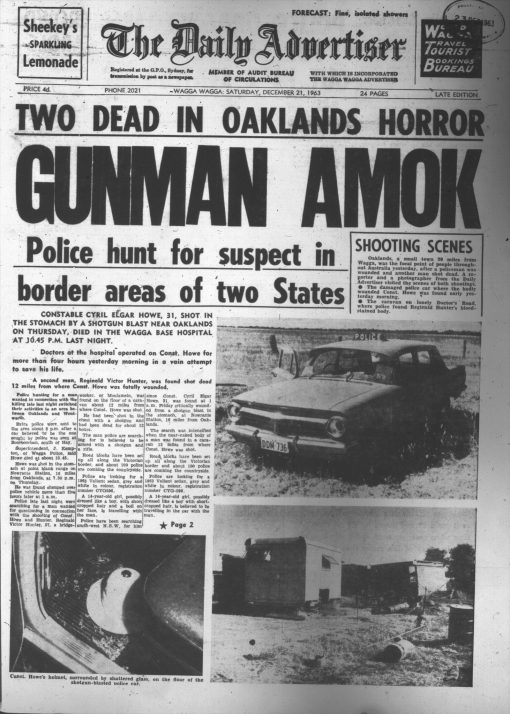
On the evening of 19 December, 1963 Constable Howe detained an offender named Little near Oaklands and spoke to him regarding a stolen cheque book. He then directed the offender to drive his vehicle to the local police station while he followed in the police vehicle.
En route the offender sped away, and was pursued by Constable Howe for several kilometres. When the offender eventually stopped, the constable approached his vehicle. The offender, who had taken cover behind his vehicle door (the doors opened backwards from hinged centre pillars), then produced a shotgun and shot Constable Howe.
The constable crawled back to the police vehicle where he took cover, and although seriously wounded, returned fire until his automatic pistol jammed. He then sought further cover by crawling underneath the police vehicle, where he cleared his pistol and fired another shot before it again jammed. The offender then fired at the police vehicle, shooting out the headlights, steering, and the police sign from the top, before escaping.
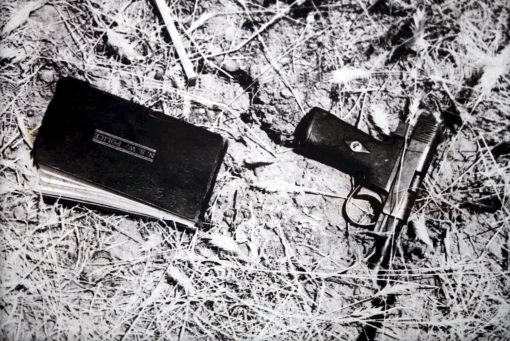
Constable Howe then wrote “LITTLE SHOT ME” in the back of his police notebook ( in ink, and not blood, as sometimes stated ) before dragging himself into the police vehicle.
Constable Howe then wrote the offender’s name several times in his police notebook before dragging himself into the police vehicle.
He was only able to drive it a few metres before it ran into a roadside ditch.
After being found, the constable was able to detail the events leading to the shooting.
He was taken to the Wagga Base Hospital, however despite a five-hour operation he died at 10.45pm on 20 December, 1963.
Constable 1st Class Howe was posthumouslypromoted to Sergeant 3rd Class and awarded the Queen’s Police Medal for Gallantry ( QPM ), and the Peter Mitchell Award.
The offender later committed suicide.
The circumstances surrounding Sergeant Howe’s death ( pistol repeatedly jamming ) led to the introduction of Smith & Wesson .38 calibre 6 shot revolvers as general service issue to New South Wales Police. These, in turn were replaced by Glock semi-automatic pistols in the late 1990s.
The sergeant was born in 1932 in Arncliffe, NSW, and joined the New South Wales Police Force on 1 April, 1957. At the time of his death he was stationed at Oaklands.
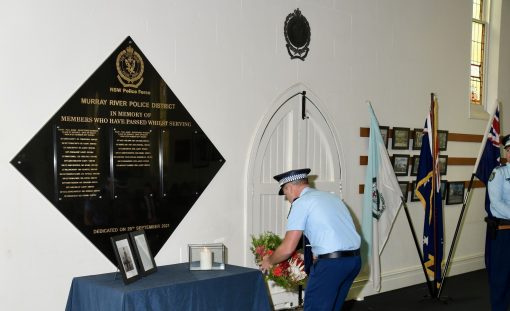
Today (Wednesday 20 December 2023) marks the 60th anniversary of the tragic loss of Constable 1st Class Cyril Howe of Oaklands Police Station – now part of the Murray River Police District – in the state’s south.
On Thursday 19 December 1963, Constable Howe was assisting neighbouring police in relation to the theft of a cheque book by a 47-year-old man.
Constable Howe located the man travelling along a local road – in what was later established to be a stolen car with five young children.
After a pursuit of the vehicle, the man shot and seriously injured Constable Howe whilst using the children as a human shield which prevented the officer from effectively returning fire.
Despite being critically wounded Constable Howe wrote the assailants name in his notebook.
Constable Howe died the following day at Wagga Wagga Base Hospital.
An inquest into the incident commended Constable Howe’s actions where the coroner noted, “Howe displayed tremendous strength, courage and presence of mind. Considering the shocking wounds he received, and the terrible agony he was in, his actions after being shot leave no doubt in my mind that he was one of the bravest Policemen ever to wear the Queen’s uniform.”
Constable Howe was posthumously promoted to Sergeant 3rd Class and awarded the Police Medal for Gallantry.
To commemorate this event, a service was held at the Albury Police Station Conference Room.
The Commander of Murray River Police District, Superintendent Paul Smith APM, said that despite the passage of time, the events of that day serve as a reminder to a current generation of officers as to the dangers police face.
“Sergeant 3rd Class Cyril Howe displayed extraordinary bravery and fortitude when confronted with an armed and dangerous offender,” said Superintendent Smith APM.
“He refused to shoot at the offender for fear of striking one of the children, and then wrote the offenders name in his notebook.”
“Along with being an exceptional police officer he was also a father to three young children. It’s terribly sad what happened.”
Police and the community will come together on December 19 to mark the 50th anniversary of the murder of Oaklands police officer Sgt Cyril Howe.
Sgt Howe was stationed at Oaklands when he was gunned down in December, 1963.
His murder resulted in one of the biggest man hunts in the local area with many people from Yarrawonga and Mulwala involved in the search for his killer.
Since plans began for a commemorative march to honour the 50 year anniversary of Sgt Howe’s untimely death, local police have collected a variety of newspaper articles, telling the story of that fateful day in 1963.
On December 20, 1963 Sgt Howe was patrolling in Oaklands when he stopped a car driven by William Little who was a suspect for a stealing matter.
Sgt Howe requested Little to drive back to the Oaklands Police Station where he intended to question him further.
Little drove his car towards the police station with Sgt Howe following.
Upon getting close to the police station Little attempted to drive away and was pursued by Sgt Howe.
Little crashed his car into a ditch while attempting to escape.
Sgt Howe got out of his police car and approached Little’s car.
At this time Little produced a shotgun shooting Sgt Howe at close range in the stomach.
Sgt Howe returned to his car and fired a number of shots from his pistol.
Sgt Howe whilst dying on the side of the road was able to write Little’s name in his notebook indicating Little was responsible for the shooting.
Sgt Howe later died at Wagga Hospital from his wounds.
Little then went to a nearby property where he shot and killed Reginald Hunter a 57 year old bridge builder. Little then stole Hunter’s car.
The next six days saw a massive man hunt for Little with many local people assisting in the search along with offering accommodation for police who had been brought into the area to look for Little.
Article Name:Honouring Sgt Cyril Howe
Publication:The Free Press (Corowa)
Start Page:12
End Page:12
Ron Bloxham 20 December 2015 re the death of Sergeant Cyril Edgar HOWE. This was a matter I was involved in then when I was stationed at Finley.The offender Little’s car was located at Finley. On the 19th December 2013 I attended the Ceremony and the dedication of the impressive plaque that is now located in the front area of the Oaklands Police Station. I played golf with Cyril a few times and his wife was a brilliant golfer if I remember right she was the only female golfer then playing off scratch. She now lives at Kooralbyn near Beaudesert Qld. Here are a couple of photos from that day. Great effort by the troops after so long a time R.I.P. Cyril.
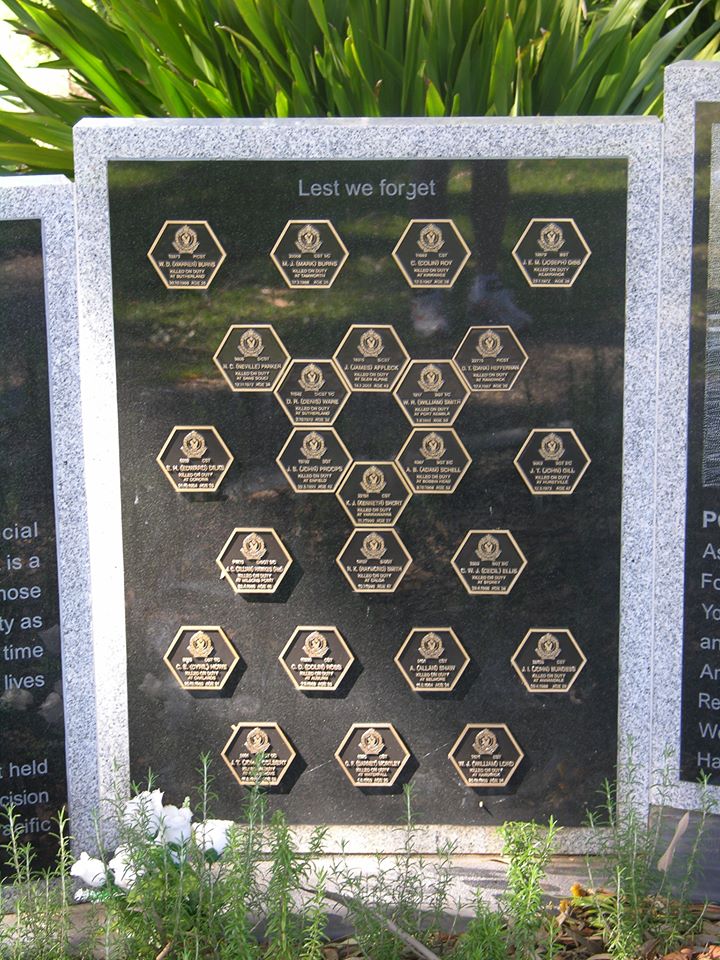
NSW Police Force 9 April 2015 NSW Police Commissioner Andrew Scipione has officially dedicated a new memorial honouring fallen officers in the St George and Sutherland Shire. The Commissioner was joined by local police, families, friends, and colleagues, for the dedication of the NSW Police Memorial, led by Police Chaplain, Reverend David Warner, at Woronora Cemetery today (Thursday 9 April 2015). The memorial honours 24 NSW Police officers who have died on duty while serving in the St George, Sutherland and Miranda Local Area Commands or who were cremated or laid to rest at Woronora Cemetery. Commissioner Scipione said the plaques and memorial wall is a perfect way to honour local officers who have made the ultimate sacrifice. “The NSW Police Memorial at Woronora Cemetery is our first collective police tribute in a private cemetery,” Commissioner Scipione said. “As we unveil the plaques today, we reflect on the lives and achievements of the officers who died while serving this community. “One of the toughest challenges for police is starting work each day not knowing what will happen yet understanding they may have to risk their own life to save another. “It is with great pride I dedicate this memorial and honour the officers, whose names are inscribed, remembering their selfless sacrifice and courage. They will not be forgotten,” Commissioner Scipione said. The names of the 24 local fallen officers, who died on duty since 1862, are inscribed on the wall of the memorial. An additional two colonial police killed in 1845, prior to the inception of the NSW Police Force, will also be remembered in the form of separate plaques. The NSW Police Memorial is a joint project of Woronora General Cemetery and Crematorium, Southern Metropolitan Associates Branch of the Police Association of NSW and the NSW Police Force. Officers honoured on NSW Police Memorial at Woronora Cemetery: Sergeant 1st Class William Smith, killed on duty at Port Kembla on 1 September 1951, age 53 Constable Garnet Mortley, killed on duty at Waterfall 1 June 1953, age 25 Constable Edward Dilks, killed on duty at Corowa on 21 October 1954, age 28 Sergeant 2nd Class Cecil Ellis, killed on duty at Sydney on 29 April 1956, age 58 Constable William Lord, killed on duty at Randwick on 23 December 1958, age 24 Constable Colin Robb, killed on duty at Auburn on 7 September 1963, age 28 Constable 1st Class Cyril Howe, killed on duty at Oaklands on 20 December 1963, age 31 Constable Allan Shaw, killed on duty at Belmore on 11 May 1964, age 24 Constable Colin Roy, killed on duty at Kirrawee on 12 May 1967, age 28 Sergeant 2nd Class Adam Schell, killed on duty at Bobbin Head on 8 October 1968, age 52 Probationary Constable Warren Burns, killed on duty at Sutherland on 30 October 1968, age 25 Detective Senior Constable Denis Ware, killed on duty at Sutherland on 2 October 1970, age 32 Constable Joseph Gibb, killed on duty at Miranda on 23 January 1972, age 28 Senior Constable Neville Parker, killed on duty at Sans Souci on12 November 1972, age 34 Sergeant 2nd Class John Gill, killed on duty at Hurstville on 12 May 1973, age 47 Sergeant 1st Class John Colbert, killed on duty at Kingsgrove on 11 March 1979, age 58 Detective Sergeant Jillian Hawkes, killed on duty at Milsons Point on 22 April 1986, age 46 Probationary Constable Dana Heffernan, killed on duty at Randwick on 17 April 1987, age 20 Constable 1st Class Mark Burns, killed on duty at Tamworth on 17 March 1988, age 25 Constable John Burgess, killed on duty at Annandale on 27 April 1989, age 29 Constable Kenneth Short, killed on duty at Yarrawarra on 11 July 1990, age 27 Sergeant John Proops, killed on duty at Enfield on 22 May 1993, age 42 Senior Sergeant Raymond Smith, killed on duty at Calga on 13 July 1998, age 47 Senior Constable James (Jim) Affleck, killed on duty at Glen Alpine on 14 January 2001, age 43 Colonial police honoured: Corporal Stephen Kirk, killed on duty at Heathcote on 12 November 1845, age 32 Trooper Luke Dunn, killed on duty at Heathcote on 21 November 1845, age 3.
Canberra Times (ACT : 1926 – 1995),
Friday 5 June 1964, page 6
Above: Mrs. Howe and her children. Mark, 4, Paul, 2, and Kim, 5, proudly examine the medal after the presentation.
SYDNEY, Thursday. – A police sergeant, shot dead by a crazed gunman at Oaklands last year was today posthumously awarded the Queen’s Police Medal for gallantry.
The policeman, Cyril Edgar Howe, although extensively wounded and in great pain, wrote the name of his killer in his notebook.
When he was found by police, Sgt. Howe gave them full particulars of the incident before being taken to hospital, where he died following an emergency operation.
The State Governor, Sir Eric Woodward today presented the award to Sergeant Howe‘s widow, Mrs. June Howe at an impressive Government House ceremony.
Sir Eric said Sgt. Howe displayed devotion to duty, fortitude and courage of an extremely high order.
The Queen’s Commendation for Brave Conduct was presented to Constable William Terence Johnston.
Constable Johnston risked his life in the sea at Bombo Beach, Kiama, to rescue a fisherman washed off the rocks.
WAGGA , Sunday. — More than £2,000 has been subscribed to appeals for the family of the late Cyril Howe, the Oaklands police officer shot by a killer on December 20 at Oaklands.
The Bushfire Brigade, of which Const. Howe was captain, has opened an appeal, to close on January 21. Tonight the secretary, Mr. D. J. Kerr, reported that a little more than £300 had been received to date, including a £200 gift from the Nowranie Pastoral Co.
This weekend Wagga radio station 2WG conducted an appeal which has raised £1,726.
People from all parts of the Riverina telephoned, promising money.
Gifts ranged from as high as £30 to 2/6 given from a child’s money box.
SYDNEY, Friday. -The Police Association of N.S.W. will press the Police Department to replace all Webley and Scott issue automatic pistols following the death last week of Constable Cyril Howe at Oaklands.
The secretary of the association, Mr. F. C. Laut, said today his organisation had been pressing for a replacement of this type of pistol “for many years”.
Two police officers had lost their lives in recent years when using these pistols, he said.
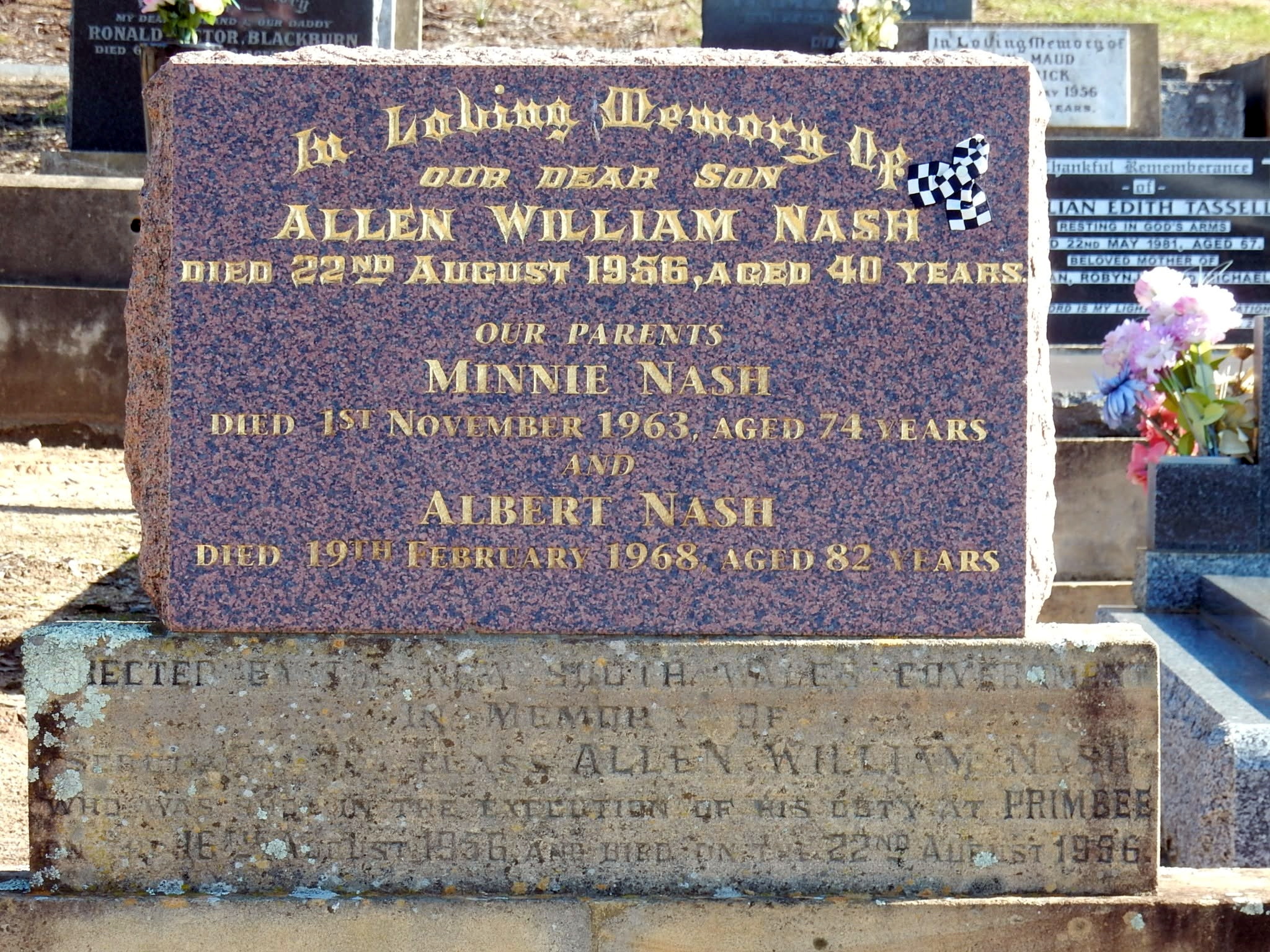
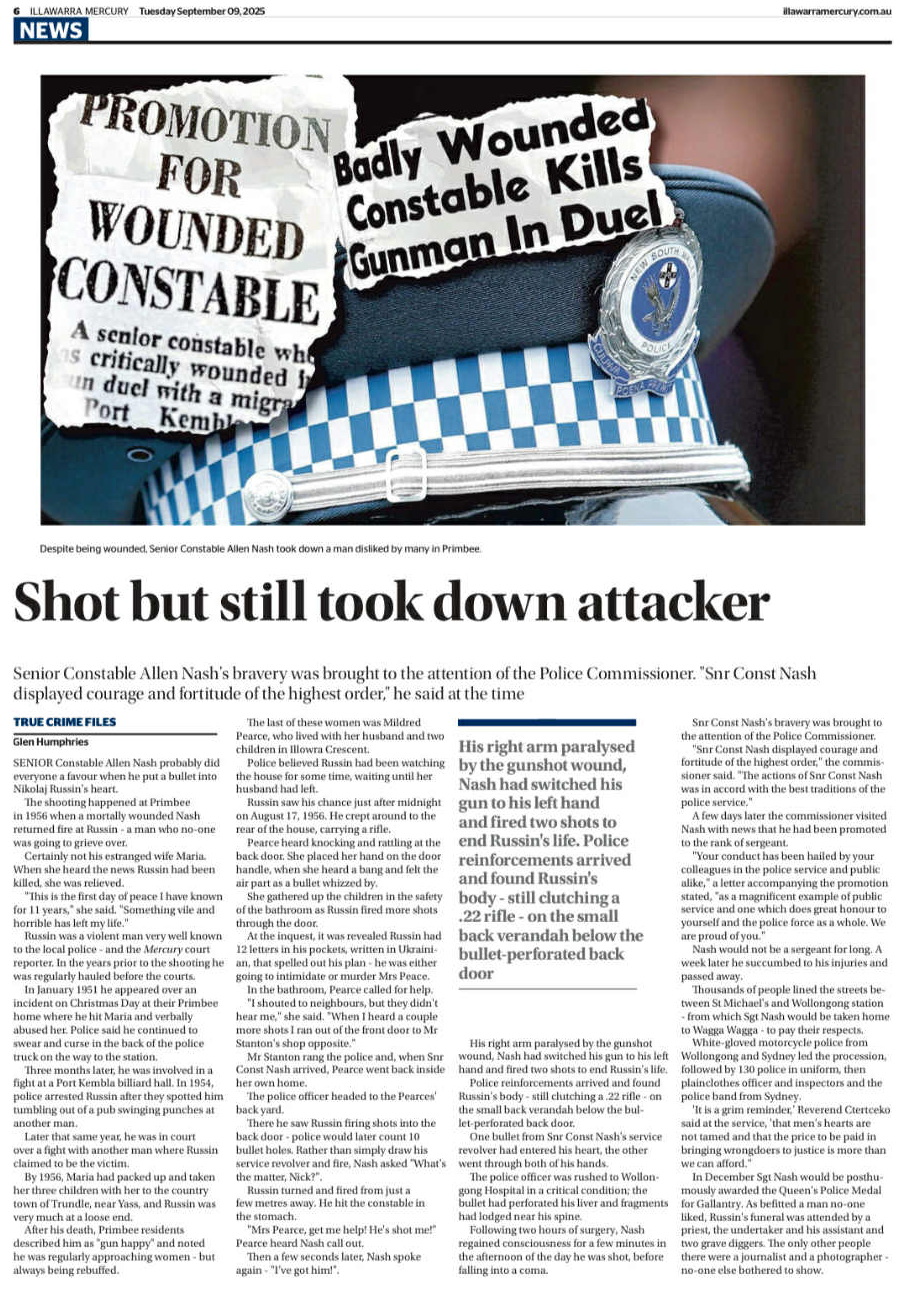
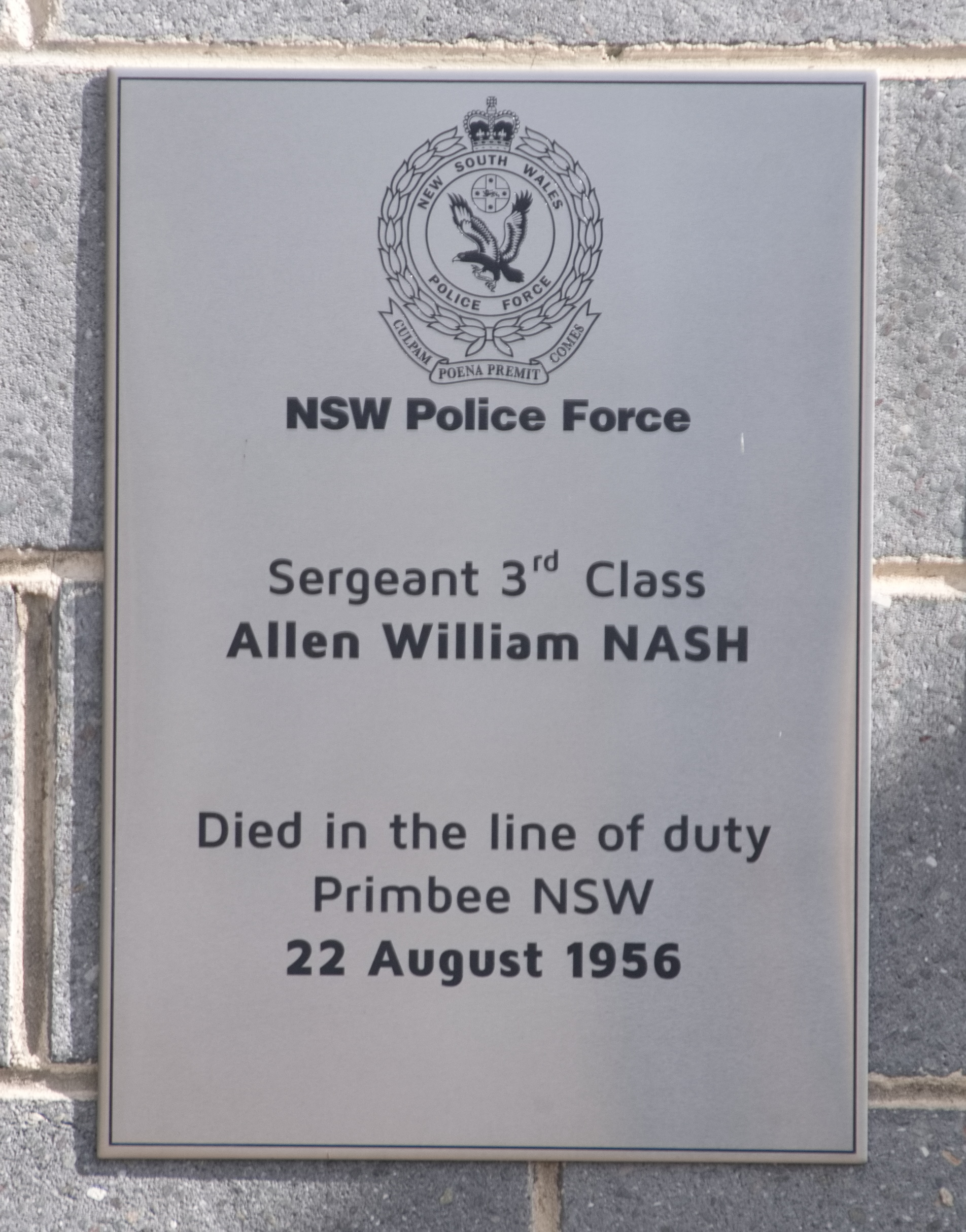
Both had fired their pistols twice and the mechanisms had jammed at the third shot. They were Constable Howe and Sergeant Nash, who lost his life several years ago at Wollongong.
Mr. Laut emphasised that the failure of the pistols could not necessarily be claimed to have been the cause of the officer’s deaths.
The department, however, apparently admitted a flaw in the issue type of pistol when it permitted officers to arrange for “personal replacements” of weapons.
Mr. Laut said the association had “pinned its hopes” on an Italian made .38 calibre automatic pistol.
Officers had to carry pistols when on duty and could be called to use them at any time.
WAGGA, Thursday. – A week-long hunt for a man and a girl ended tragically today in a fowlhouse at Oaklands, a small village near Wagga.
As five police approached him, the man, William Stanley Little, shot 14-year-oldSusan Lyons and then killed himself.
The fowlhouse in which the double shooting took place was only 50 yards from the house in which Little had been living with Susan Lyon‘s mother for several weeks.
The hunt for Little began last Thursday night when the bodies of Constable Cyril Howe, 31, and a bridge worker, Reginald Hunter, 57, were found within a few miles of Oaklands.
This morning Little made a surprise return to the hut where he had been living.
Police, under Det. Const. W. Sheather, made a routine check of the house today and noticed that a pound of butter had been moved since they checked last night.
Det. Sheather ordered an inspection of all huts and sheds around the house.
As the five policemen began searching a shotgun blast rang out from the fowlhouse.
Police took cover behind a car and then fired three shots over the top of the fowlhouse.
Another single shotgun blast followed.
The police closed in on the shed and Det. Sheather opened the door.
He found the girl dead and Little critically wounded.
Little died before any medical help could be given.
The chief of the C.I.B., Supt. R. Walden, said later the man had shot Susan Lyons and then committed suicide.
“Neither the girl’s death nor the man’s injury was caused by our men,” he said.
Post-mortem
A post-mortem examination was today made in Urana of the bodies of Little and the girl.
A coroner’s inquest will be held, but no date has yet been fixed.
Police believe she had been held captive by Little since last Thursday night.
Police several times had expressed fear that the girl would be held hostage by the man.
“The whole Riverina is seething,” Supt, Kempton, in charge of Wagga district, said tonight.
“Everyone is appalled by the girl’s death.”
The Commissioner of Police, Mr. Allan, tonight expressed his sincere appreciation of police efforts in the hunt.
“All police showed a keenness to see this matter through, which did them great credit,” he said.
“They worked hours and in conditions above and beyond those of the normal requirements of their duty.”
“Maximum temperature for the search area has not fallen below 100 degrees for the past seven days.”
Mr. Allan also thanked private citizens for their part in the search.
Co-operation
Four planes were donated by district graziers to help the search.
Local polo players risked prize ponies to search through dangerous country for the killer.
“This shall be remembered as a typical example of public co-operation with the Police Department in the interests of law enforcement,” Mr. Allan said.
The hunt for Little began when the body of Const. Cyril Howe was found in his police car just off the Oaklands – Jerilderie road.
Before he collapsed, Const. Howe scribbled the name of his assailant in his notebook.
Several hours later, police found Reginald Victor Hunter‘s body in his caravan, 12 miles away.
Like Const. Howe, Hunter has been killed by a shotgun blast.
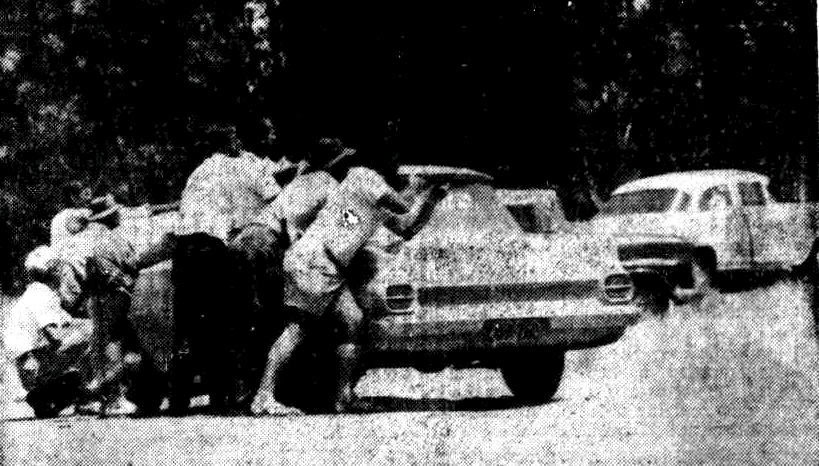
This picture was taken yesterday only seconds before police fired warning shots over a fowlhouse near Oaklands after they heard the first of two shot gun blasts. They later found William Stanley Little inside, mortally wounded, and 14-year-old Susan Lyons dead.
WAGGA, Sunday. – Police searching for the shotgun killer of a policeman and a contractor in the southern Riverina believe they will track him down
some time tomorrow.
The search will go on through the night.
“I think we’ll have good news for you by tomorrow night,” Supt. J. C. Kempton said tonight.
Supt. Kempton, in charge of the Wagga Police District, is leading the search for the murderer.
Four hundred men-on foot, on horseback, in cars, trucks and four planes today concentrated the search on the sprawling 15,000-acre Werai Forest, near Deniliquin.
They had to fight their way through thick scrub in temperatures between 106 and 110 degrees.
“The men are weary, but confident they are getting close,” another senior police officer said tonight.
Trapped
All available police have been sent to the forest following a report that a car, believed to be driven by the killer, was seen parked in bushes in the forest yesterday.
Mr. J. Haydon, a station hand from Moulamein, told police he saw the car. Its description answered that of the Valiant in which the killer and a 14-year-old girl escaped.
Searchers late yesterday began a methodical check of the entire forest.
“We started on the outside working in; we believe he is trapped in there,” Supt. Kempton said.
Planes
In another new development today, police discovered that the murderer stole a large quantity of food from one of his victims, bridge contractor Mr. Reginald
Hunter, 57, after he had shot him on Thursday.
The other victim was 30 year-old Oaklands policeman Cyril Howe, who died in Wagga Base Hospital yesterday.
“Hunter’s family checked his caravan today and found that a lot of food and some petrol were missing,” Supt. Kempton said.
The car the wanted man is driving also was stolen from Hunter.
All four planes in the search have been volunteered by district graziers. They are using the main street of the small town of Booroorban, about 200 miles west of Wagga, as a runway.
Disguised
The girl travelling with the killer is believed to be pregnant.
Police fear for her life. They believe she may have been forced to cut her hair and dress as a boy.
The girl is of medium build, five feet tall, with brown hair and hazel eyes. She has a boil on the right side of her face.
She was dressed as a boy in a brown shirt, black jumper and khaki trousers.
Before he collapsed Const. Howe was able to scrawl the name of his attacker in his notebook.
In the massive search that followed, police found the body of Hunter in a caravan about half a mile from the spot where Howe was fatally wounded.
He had shotgun wounds in the chest and police believe he died instantly. A doctor said he had been dead for about 12 hours.
The fugitive is believed to be armed with a .22 rifle as well as the shotgun.
I have some information prior to Cyril joining the police force.
Cyril was engaged to my mother. It would have been late 1950’s I guess.
Cyril worked as a volunteer ambulance officer around the Rockdale area I believe.
The engagement was broken off because my grandfather had spent 12 months in Glen Innes prison for stealing some years earlier and that would have impacted Cyrils’ chances of getting into the force.
I do have another photo somewhere, would need to hunt it down.
Constable Cyril Howe was stationed at Oakland’s at the time of his passing.
I believe it was 19 December 2013, when I was LAC of Albury we held a 50 year memorial service at Oakland Police Station for Cst Howe which his wife and daughter attended. They unveiled a memorial plaque and I presented them with framed memorial photos.
It was the first time his wife had returned to Oakland’s since the day he died.
The community And former officers attached to the Murray River area came out to remember him in huge numbers. Many were present in the town on that day or on duty in other nearby locations and reflected on what happened. It is such a shame that it takes the death of one of our fine officers for the government and organisation to act and move onto a different weapon. Again a shame that it was one not designed for the first responders, and again not appropriate in the circumstances until we finally were issued with the glocks.
I was very proud to stand with his wife and daughter and have Constable Howe recognized in this way.
I recently noticed that the picture of that day and the presentation is currently on the NSW Police Legacy home page.
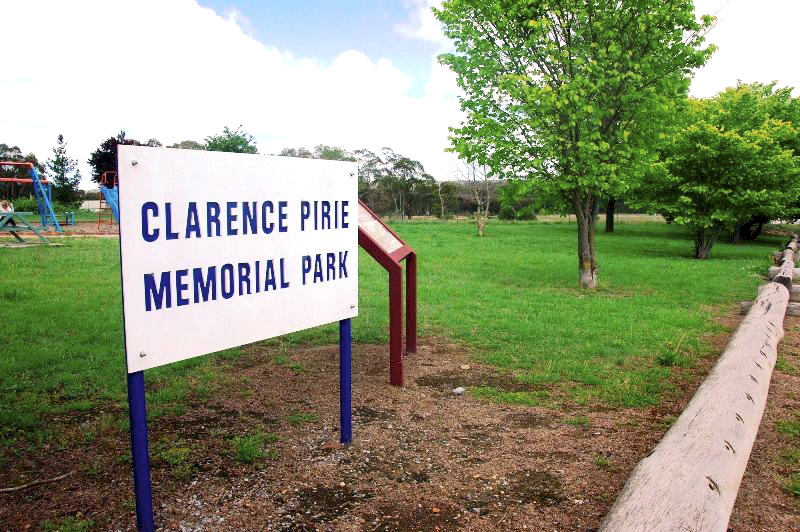
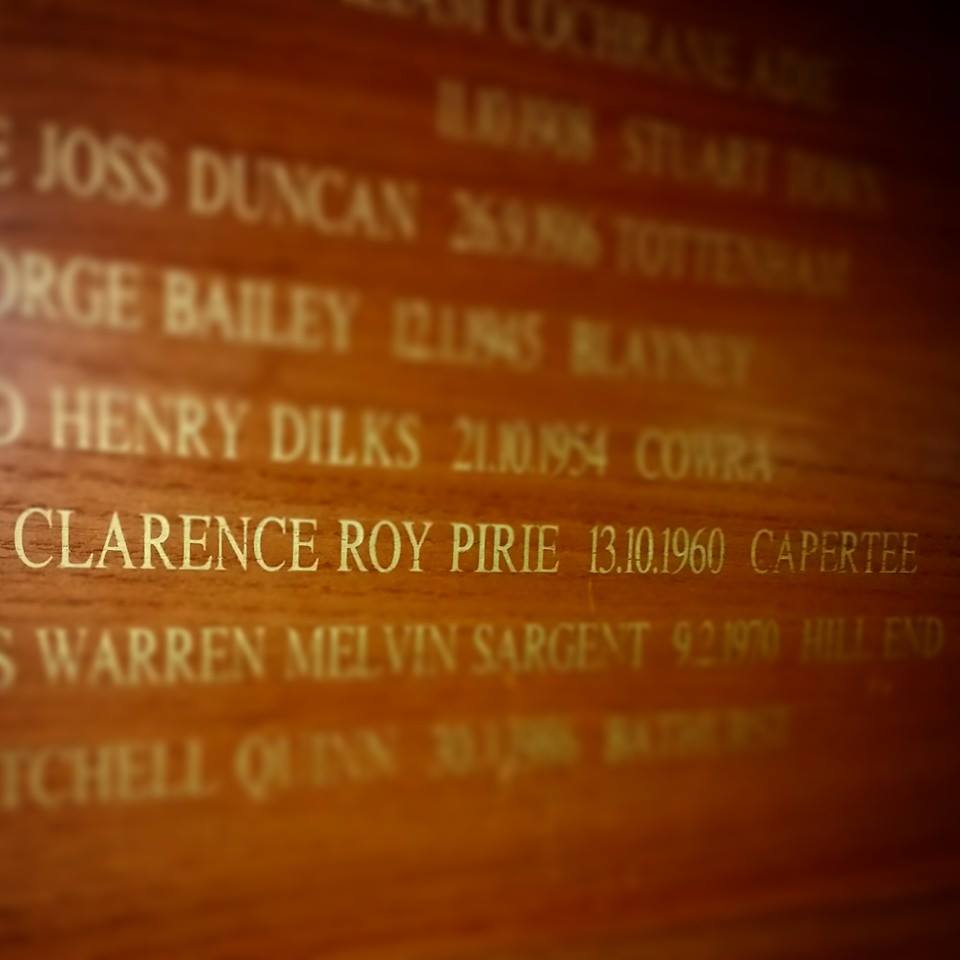
Memorial located at: 1/ Glen Davis Rd, Capertee – the Clarence Pirie Memorial Park
Lat: -33.143736 Long: 149.983791
2/ a Wall Plaque at Chifley L.A.C.
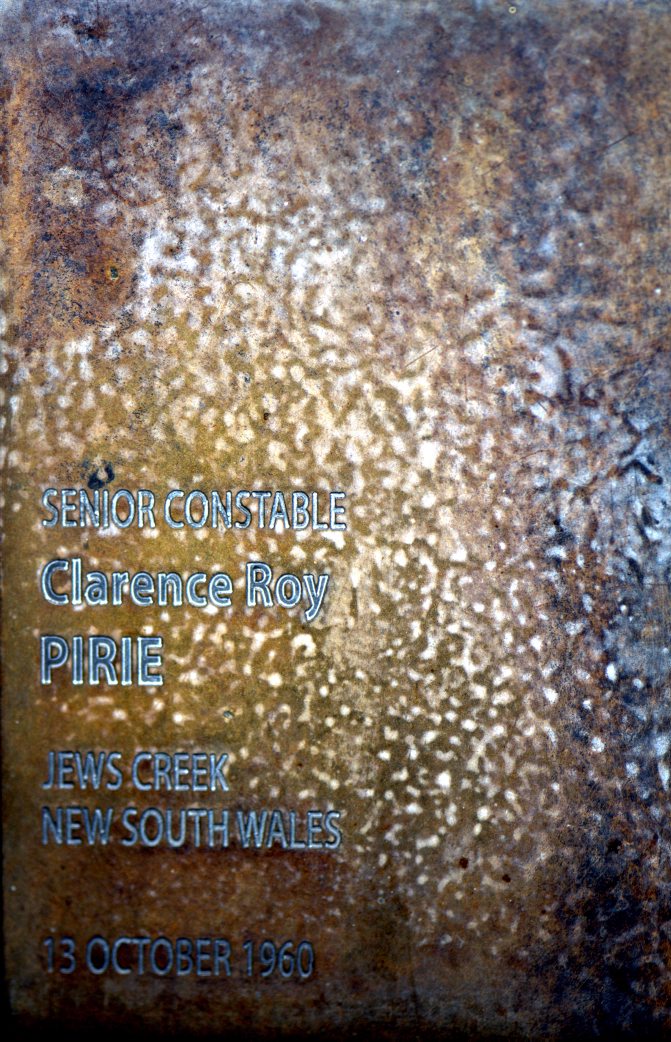
SenCon Clarrie Pirie ( 1960 )
Clarence Roy PIRIE – Touch Plate at the National Wall of Police Remembrance, Canberra
CLARENCE IS mentioned on the Police Wall of Remembrance
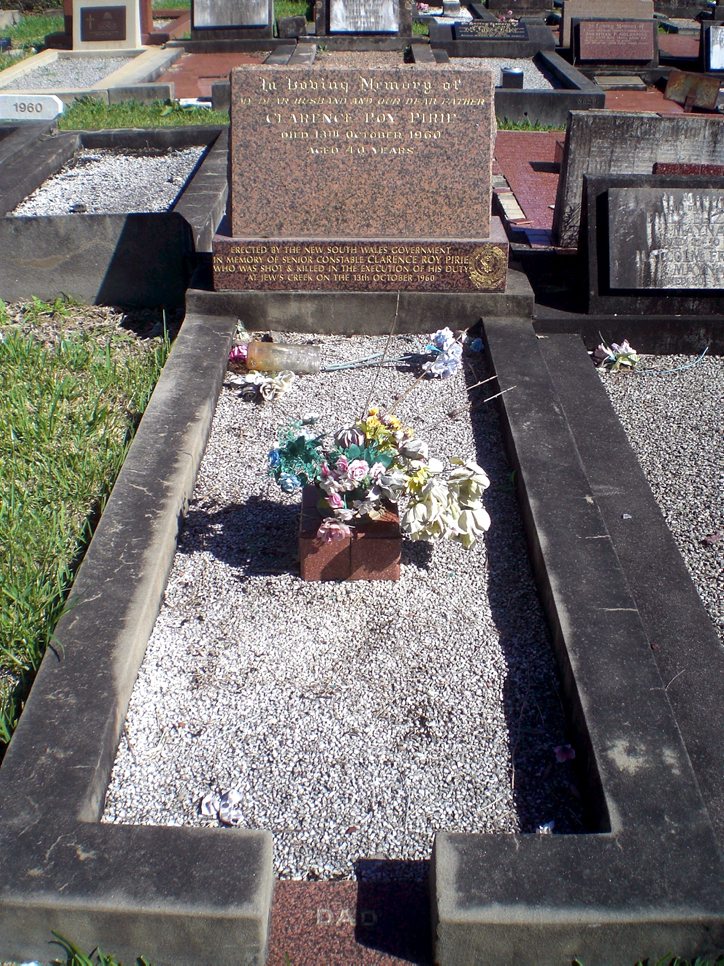
Grave location: Rookwood Cemetery, NSW
Zone E, Section 19, Grave 3661
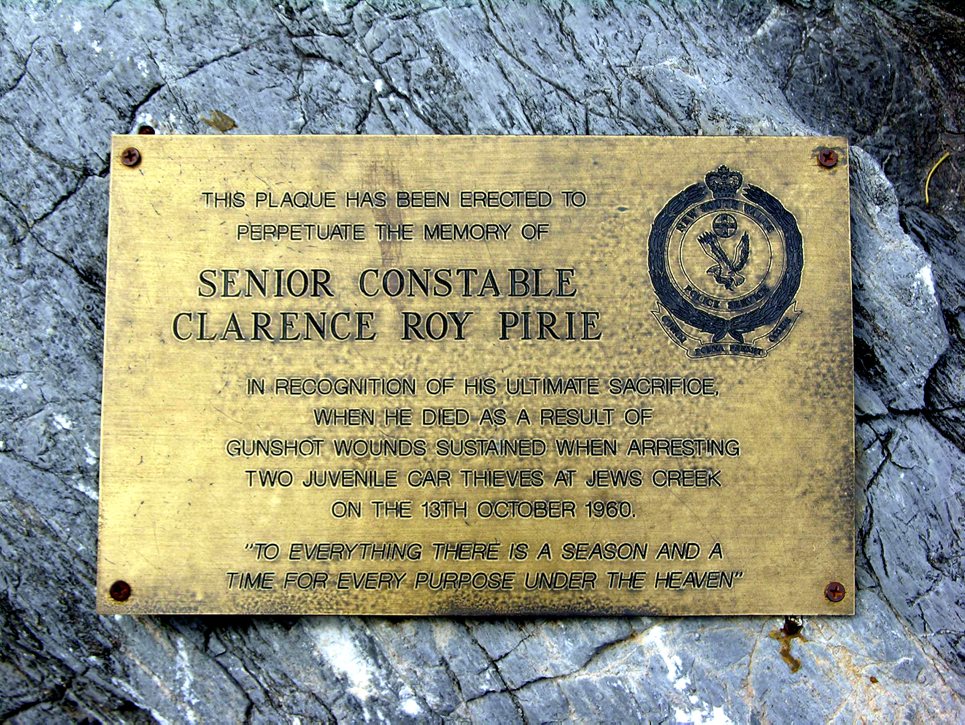
INSCRIPTION: In Loving Memory of my dear husband and our dear father Clarence Roy PIRIE died 13th October 1960 aged 40 years. Erected by the New South Wales Government in Memory of Senior Constable Clarence Roy PIRIE who was shot & killed in the Execution of his Duty at Jew’s Creek on the 13th October 1960. Police Crest.
FURTHER INFORMATION IS NEEDED ABOUT THIS PERSON, THEIR LIFE, THEIR CAREER AND THEIR DEATH.
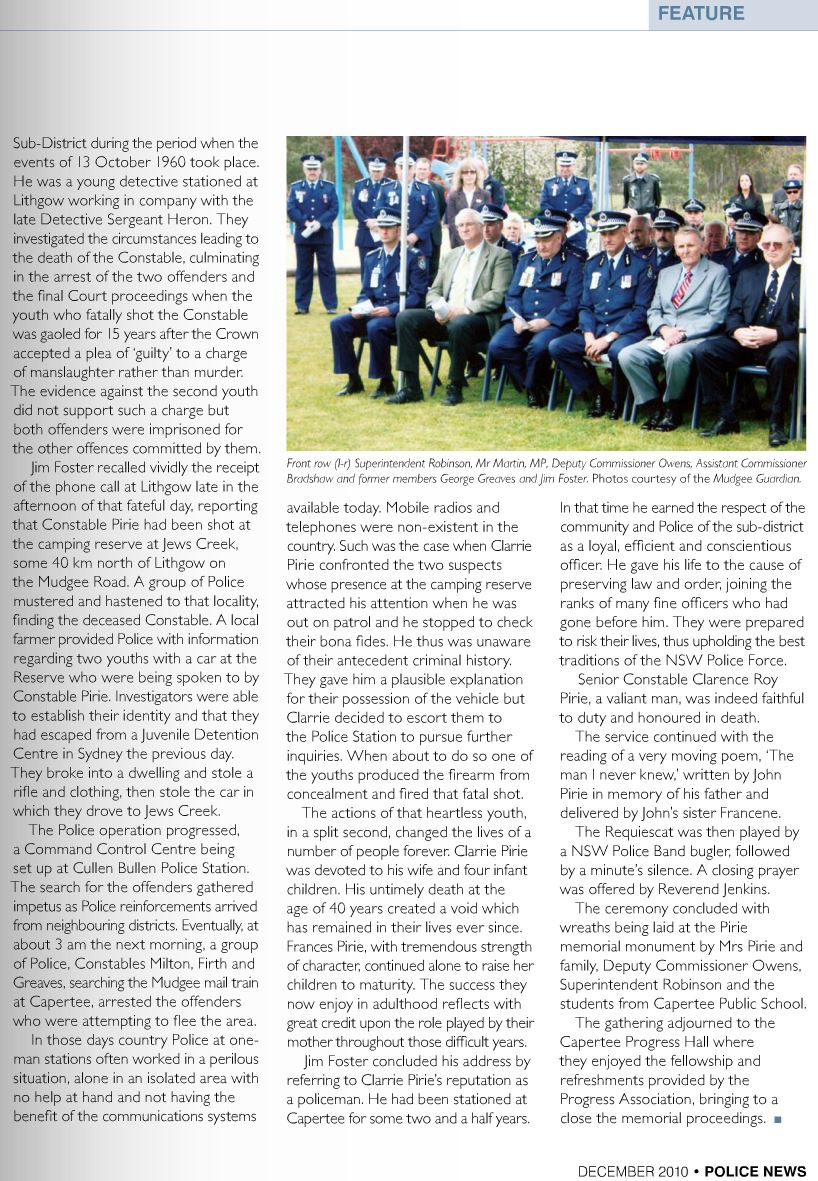
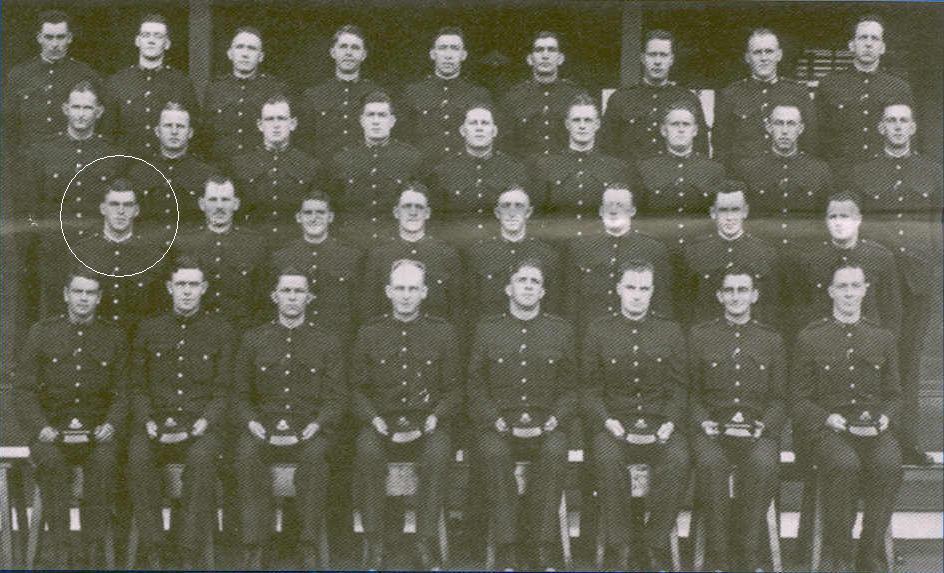
Senior Constable Clarrie Pirie was the Officer-in-Charge of the Capertee Police Station from 1958 until his death on 13 October, 1960. On that day he was informed by Lithgow Police that two male offenders had abandoned a stolen car at Cudgigong, north of Capertee.
While patrolling the area Senior Constable Pirie found two fourteen year-olds with a vehicle at a roadside camping area at Jews Creek, ten miles south of Capertee. These however were not the two offenders the police were searching for and as such Constable Pirie did not know that on the previous day the pair had escaped from the Yasmar children’s detention centre ( Lidcombe ) and had broken into a dwelling where they stole several items of property and the vehicle before driving to the Jews Creek area.
As the constable was talking to the young offenders one of them suddenly produced a .22 rifle and shot Constable Pirie. He died a short time later. Both youths were captured the following day.
The senior constable was born in 1920 and joined the New South Wales Police Force on 15 September, 1947.
At the time of his death he was stationed at Capertee.
Knew Clarie well when I was at Cowra and Clarie was LUK at Young, I was transferred on the PSB at Lithgow and Clarie was transferred to Capertee so I used to see a lot him as the Highway Patrol done daily runs to Capertee.
I took the phone call at Lithgow from a chap from Cullen Bullen to say Clarie had been shot, then drove Insp. Eli Hanson and Det S/Cst Jimmy Foster to the Scene at Jew’s Creek.
Never will forget that day.
His Youngest son John was a Police Support Officer and KAC Manager at Orange.
( Eli HANSON, NSWPF # 2207, Retired in 1962 and died in January 1973 ( aged 71 years, 0 months, 2 days ) )
Police Remembrance Day – 29 September 2022
A message received from one of the daughters of Roy & Frances PIRIE on 21 September 2022:
Dear Greg, Not sure if you are the right person to find out some info on Police Memorial Day Services in the Young area.
I live near Young & would really like to be able to pay my respect to my Dad who was killed on duty in 1960. It’s my only way to keep my memory going & now my Mum has passed, I’m feeling the sadness even more.
My Dad was Constable Clarence Roy Pirie who was shot & killed at Capertee.
I usually find out after the event that there had been a service around Young so what I’m hoping is that someone could let me know beforehand so I could attend.
Sorry to trouble you but just reaching out.
Yours respectfully,
Francine Pirie.
/////////////////////
Hello Francine.
Good choice picking me. lol.
I have tried to phone Young ( without success ) but I have just spoken with the District Commander, Supt. Paul Condon, and he confirms that there WILL be a Service in Young.
He is now on the phone to obtain the ‘where and when’ for us.
/////////////////////
omg, bless you & thank you x
I am on NSW Fallen Police ( FB Group ) so that’s how I got you so; thanks again.
////////////////////
There is a Service at Young Police Station ( only a small Service though ) at 11am on Thursday 29 September. The troops there will be expecting you.
////////////////////
Greg thank you from the bottom of my heart.
I’ll be there
x
////////////////////
You are very welcome Francine.
xoxox
Cal
///////////////////
Dear Greg,
Thank you so much for organising my attendance yesterday.
The staff at Young Police Station were amazing. The young Police Officers were so interested in my family’s story.
Thank you for the link as I read through the article I read things I didn’t know about. Many tears have been cried but I still believe it’s been a healing time for me even though it’s been 62 years.
Sometimes you need a reason & yesterday was a good reason to grieve, not only for my Dad but for all the other families who have lost their loved one.
Again Greg, thank you from my heart as this would not have happened if you hadn’t gone to the trouble to organise this for me.
God bless you
Francine Pirie
xx
The Result
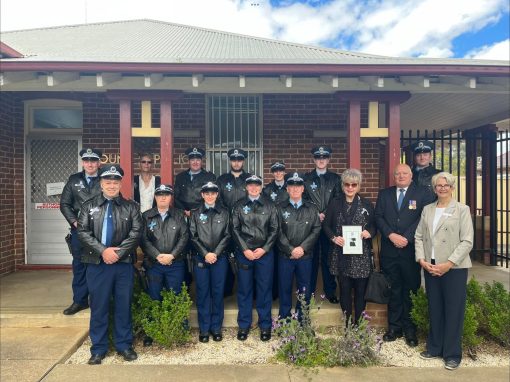
Young Police – Remembrance Day – 2022 – Francine Pirie – Holding picture – Daughter of Clarence Pirie – killed 13 Oct 1960
Great effort from Young Police and Supt. Paul Condon, Goulburn
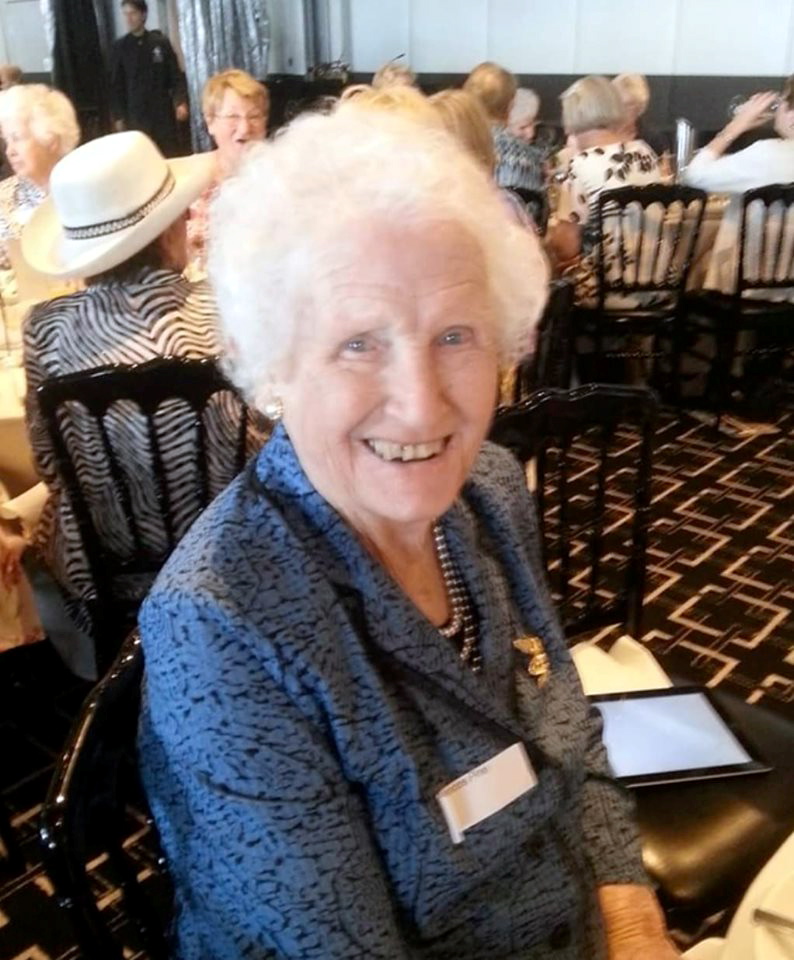
Mrs Frances Josephine PIRIE sadly passed away last night ( Friday 12 October 2019 ) aged 94 years – 5 days shy of her 95th birthday.
Wife of Senior Constable Clarence Roy PIRIE of the Capertee Police.
Almost 59 years to the day, Frances and Clarey are together again.
Knew Clarie well when I was at Cowra and Clarie was LUK at Young, I was transferred on the PSB at Lithgow and Clarie was transferred to Capertee so I used to see a lot him as the Highway Patrol done daily runs to Capertee.
I took the phone call at Lithgow from a chap from Cullen Bullen to say Clarie had been shot, then drove Insp. Eli Hanson and Det S/Cst Jimmy Foster to the Scene at Jew’s Creek.
Never will forget that day.
His Youngest son John was a Police Support Officer and KAC Manager at Orange.
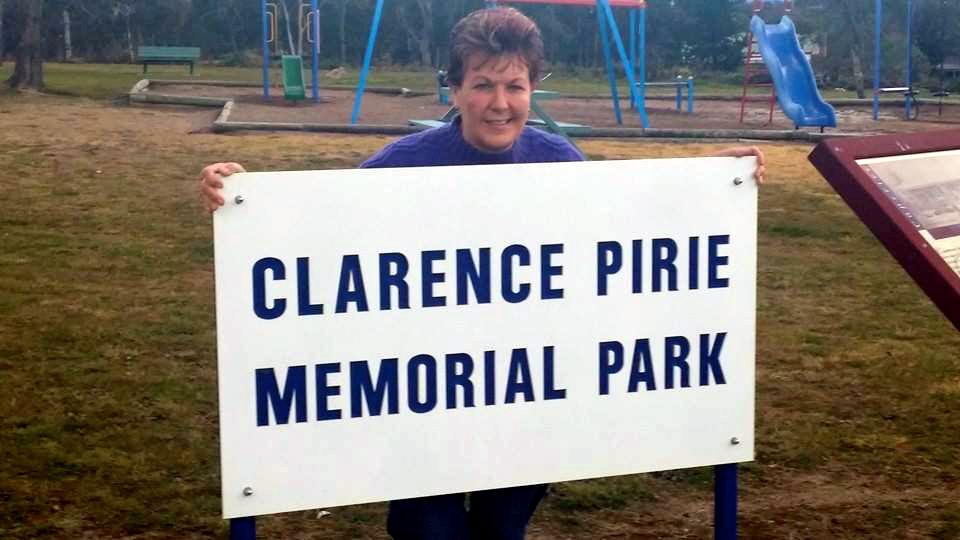
Almost all visitors to Capertee will notice the large memorial park in the middle of the village close to the Glen Davies turnoff. This recreational area, which includes a car park, childrens’ playground and toilets, is officially named after Clarence Pirie a notable policeman who was stationed in the community during the late 1950s and early 60s. While many police have served the Capertee district well over the years Pirie deserves lasting recognition as he gave his life to protecting the community.
Senior Constable Clarence (Clarie) Roy Pirie was born in Paddington, Sydney, in 1920. During World War 2 he joined the army and served in New Guinea. After the war, in 1947, he joined the New South Wales Police Force, and from 1959 to 1960 he was the Officer-in-Charge at Capertee Police Station.
On the 13th October 1960 he was asked to look out for two male offenders who had abandoned a stolen car north of Capertee.While patrolling the area the following day, Pirie found two 14 year-olds with a vehicle at a roadside camping site at Jews Creeks south of Capertee. According to police records, these were not the suspects who had abandoned the vehicle the previous day but two escapees from the Yasmar juvenile detention centre in Haberfield, Sydney. While interviewing the youths one of them suddenly produced a stolen .22 rifle and shot the officer twice. The Senior Constable died of his wounds at the scene a short time after. The two youths were arrested the following day and were later imprisoned. Pirie was survived by his wife Frances and four young children.
The memory of Clarie Pirie as well as the many other police who have been killed in the line of duty is commemorated each year on Police Memorial Day which is held near the end of September.
INSCRIPTION: This plaque has been erected to perpetuate the memory of Senior Constable Clarence Roy PIRIE in recognition of his ultimate sacrifice when he died as a result of gunshot wounds sustained when arresting two juvenile car thieves at Jews Creek on the 13th October 1960. “to everything there is a season and a time for every purpose under the heaven”
SYDNEY, Thursday: – Police were to-night conducting one of the largest manhunts ever in the Central Western district for two youths who are alleged to have shot dead Senior Constable Clarence Roy Pirie, 40, of Cullen Bullen.
The constable was chasing two youths on the Capertee Cullen Bullen Road early to- night.
Pirie, a father of four, was believed to have been killed with a .22 rifle.
Police from Lithgow, Bathurst, Mount Victoria, Kandos, Rylstone, Katoomba, Oberon, Orange and other centres are searching dense bush near Jews Creek.
Police from other Central Western stations and from Sydney will join the searchers to-morrow.
The searchers are heavily armed with rifles and riot guns.
Other specialised weapons will arrive from Sydney to-morrow.
At 9 a.m. to-day a stolen car was found abandoned at Cudgegong.
Two youths were seen to leave the car and police in the area were alerted.
Constable Pirie sighted two youths in a second stolen car on the Lithgow-Mudgee Road near Jew’s Creek.
Overturned
The stolen car overturned at high speed about a half mile farther on.
Two youths scrambled from the wreck and fled into the bush.
Constable Pirie followed them.
Police believe that the elder youth, realising that Pirie was following them, turned and fired the shot which fatally wounded the policeman.
LITHGOW, Tuesday:- A 14-year-old Sydney boy was remanded in Lithgow Children’s Court to-day on a charge of murdering a policeman.
He was remanded till November 1 without bail and will be detained in custody until that date.
The boy was charged with having murdered Constable Clarence Roy Pirie at Jews Creek camping reserve on October 13.
Police prosecutor Sergeant J. S. Smith said the youth charged with murder had escaped from a Sydney boys’ home on October 12 and together with another boy had stolen a car.
The car was allegedly parked at Jews Creek’ Camping reserve the next day.
When Const. Pirie approached the vehicle he was allegedly shot dead.
The Canberra Times Tuesday 7 March 1961 page 3 of 20
SYDNEY, Monday: — Christopher Lindsay, 15, went to gaol to-day for 15 years for killing a policeman last year.
Mr. Justice Else Mitchell described the fair-haired, well-dressed boy as a “young gangster.”
Lindsay, of Alice Street, Newtown, did not appear to be emotionally upset at the sentence.
He turned to court officials who led him from the dock to the cells below.
The sight of the boy being led away brought an outburst of sobbing from the public gallery.
Lindsay last week had pleaded not guilty to having murdered Constable Clarence Roy Pirie, 39, at Jews Creek Camping Reserve off the Mudgee Road near Cullen Bullen on October 13 last.
The Crown accepted Lindsay’s plea of guilty of man slaughter.
Lindsay – standing in the dock of Central Criminal Court with hands clasped in front of him – heard Mr. Justice Else Mitchell say that the deposition and Lindsay’s own signed statement left slender ground for the lesser offence.
“Before committing this crime, you had shown a refusal both in England and in this country to conform with the laws which are made for the good of society.
“From the record, it is clear that the processes of the habitation and reform which are provided by the country here have made no impact on your attitude or conduct.
“In pursuit of this anti-social conduct you twice escaped from Yasma shelter, where you were being detained awaiting trial for various charges, and on the second occasion in company with a confederate, younger than yourself, stole a rifle, food, other goods and then a motor car in which you travelled to the scene of the crime.
“When you were in fear of apprehension by a constable of the police for the theft of the car you did not hesitate to shoot him because as you said ‘You did not want him to catch you with the car.’
“Your subsequent conduct and your attempt to evade capture though perhaps natural do not appear to have been accompanied by any manifestation of c0ntrition or remorse, a fact which seems to me all the more serious in view of Dr. McGeorge’s conclusion that you are not suffering from any mental or psychiatric disorders.
“A substantial sentence appears to be necessary not only for the reasons I mentioned but as the only possible way in which you may begin to understand your obligations to society.”
SYDNEY, Friday:— The Full Supreme Court to-day dismissed a school boy’s appeal against a 15-year sentence for the manslaughter of a policeman.
The boy, Christopher Lindsay, 15, appealed against the severity of the sentence.
Mr. Justice Else-Mitchell, in Central Criminal Court, had sentenced Lindsay to 15 years gaol for the manslaughter of Constable
Clarence Roy Pirie, at Jew’s Creek, last October.
Pirie was questioning Lindsay on a car theft at the time.
Lindsay to-day conducted his own case before the Full Bench — comprising the Chief Justice, Mr. Justice Evatt, Mr. justice Herron and Mr. Justice Hardie.
He handed the bench a written statement, headed —’ “No Discourtesy.”
The statement read: “I respectfully submit that His Honour, at the time of imposing the severe sentence for manslaughter, regarded the offence as tantamount to murder.
“I further most respectfully submit the crime was not premeditated.
“The whole tragedy took place in a matter of seconds.
“At no time did I intend this man’s death.
“I respectfully submit that a 14-year-old youth to be sentenced to 15 years imprisonment for a crime he did not intend, is too severe.”
Mr. Justice Else-Mitchell, reported to the Full Court, that Lindsay’s offence was hardly distinguishable from murder.
However, he had felt that he was bound by the Crown’s acceptance of the manslaughter plea.
Lindsay originally had been charged with murder.
Mr. Justice Else-Mitchell said it had been submitted he should not impose a crushing sentence.
He also was mindful of the danger with a youthful offender — that the imposition of a heavy gaol sentence often could produce more harm than good.
The Full Court ruled unanimously against Lindsay’s appeal.
It added that Lindsay’s crime called for the greatest condemnation.
PERSONAL LOSS: Inspector Greg Pringle and police administration manager John Pirie have personal experience of the loss of someone close on Police Remembrance Day. Photo: JUDE KEOGH 0926police2
REPRESENTATIVES from Orange Police Station will today attend a national memorial in Canberra for Police Remembrance Day.
For Inspector Greg Pringle and Canobolas Local Area administration manager John Pirie, the day bears a special significance.
John Pirie was just coming up to his fifth birthday when his 40-year-old father Senior Constable Clarence Roy Pirie was shot at point-blank range and killed near Capertee.
It was on October 13, 1960, that Mr Pirie’s father was patrolling when he came across a stolen vehicle. He stopped the vehicle and spoke to two youths inside, but one of them pulled a gun on Snr Const Pirie and shot him.
Inspector Pringle’s experience is in contrast, but he agrees the grief that comes with losing a colleague on the job remains for many years.
“I was with highway patrol working out of Cootamundra in 1988. I had a cup of tea with a fellow officer Constable Kurt Schetor before we headed off to patrol in separate directions,” Insp Pringle said.
Ten minutes later the then Constable Pringle received a call to respond to a crash and he arrived to find his friend and colleague was in involved in a head-on crash with a truck.
“I did my best but I couldn’t revive him,” he said.
Insp Pringle said many police officers carried a burden of grief with them for colleagues who died on the job.
“In many ways it is harder to deal with your own grief,” he said.
“When you are a police officer your ‘tank’ is full of other people’s grief because that’s part of the job. But it doesn’t leave much left.”
Officers from Canobolas Local Area Command will not be marking Police Remembrance Day in Orange this year.
Instead, this year’s service will be held at Cowra which is part of the Canobolas Local Area Command.
A brother and sister came to yesterday’s National Police Remembrance Day ceremony to remember their dad who was killed in the line of duty 50 years ago.
REMEMBER THEM: Police, emergency services personnel and community members gathered in All Saints’ Cathedral yesterday to mark National Police Remembrance Day. Photo: PHILL MURRAY 092901prem
Three generations of Clarence Roy Pirie’s family came together in All Saints’ Cathedral to honour the police officer who was shot and killed by two escapees at Capertee on October 13, 1960.
At the time her father was killed MaryAnne Ford was just three years old – her brother Ron Pirie was seven. There were two more siblings Francine who was not yet two and John who was five. After the police officer’s death, their mum was left to raise the young family alone. Although MaryAnne remembers little of her dad she still treasures the plastic ‘policeman plod’ doll that he gave her before he died. It is something concrete to remember him by.
“The day I got married I left my bouquet on his grave,” she said.
Ron said although he has blocked out a lot of his memories of that sad time there are things that he does remember – like being put in the wooden slab lock up when he was naughty.
Although yesterday’s national remembrance day was to remember all police who lost their lives, for Clarence Pirie’s family it was very personal.
Apart from MaryAnne and Ron, Clarence’s granddaughters Ruth Ford and Kellyanne Howarth were at the special ceremony along with his three-month-old great grandson Jaydon.
They said the ceremony was both moving and beautiful.
“It was hard, but it was good,” Ron said with tears in his eyes.
He paused then and shook his head. “You know it never goes away.”
Slain policeman remembered
DON MAHONEY
15 Oct, 2010 08:40 AM
When Senior Constable Clarence (‘Clarrie’) Roy Pirie went to work on the morning of the October 13, 1960, he fully expected to go home to his wife Frances and their four young children at the end of the day.Sadly, 40-year-old Senior Constable Pirie lost his life that day at Jews Creek, when he was shot by one of two escapees from a juvenile detention centre.
Senior Constable Pirie’s family returned to Capertee this week to remember the events that turned their lives upside down for all time.
On Thursday morning Senior Constable Pirie’s wife Frances, with her children, grandchildren and some great-grandchildren, joined senior police including Deputy Commissioner Dave Owen, Assistant Commissioner Steve Bradshaw, Chifley Area Command Superintendent Michael Robertson, Member for Bathurst Gerard Martin, and many members of the police force at Clarrie Pirie Memorial Park in Capertee to mark the 50th anniversary of his death.
A service was conducted by Police Chaplin Mark Jenkins from the Anglican Diocese of Bathurst and was addressed by the Superintendent Robertson, Mr Martin and Detective Superintendent Jim Foster who investigated Senior Constable Pirie’s death.
“Senior Constable Pirie paid the ultimate sacrifice and was the sixth of eight police officers [in the Chifley command] to lose their life upholding the law,” Superintendent Robertson said.
“Those who follow [in the police force] serve to do his memory proud and he lives on through this park, which was named in his honour.
“The debt owed by society to Senior Constable Pirie cannot be measured and we will always ensure that he is remembered.”
Member for Bathurst Gerard Martin related how Clarrie Pirie served with the Australian Armed Forces in New Guinea during World War II and how he met his wife in military service.
“He undertook a very challenging front line career, which can be extremely dangerous,” Mr Martin said, speaking on behalf of Police Minister Michael Daley.
“His loss will always be a tragedy and compares to the recent death of trainee detective William Crews, the former Glen Innes who lost his life in the line of duty last month.”
Detective Superintendent Jim Foster told how Senior Constable Pirie had joined the police force in 1947 and served at Parramatta and Young before being transferred to Capertee in 1958.
“Those were difficult times with no two-way radios or mobile phones, but the community spirit was evident as we investigated the case,” Detective Foster said.
“The Postmaster at Cullen Bullen kept the phone lines open after the 6pm regular closing time so that we had communications.
“The only police photographer was hours away and a local chemist took the photos we needed to record evidence.
The offenders were arrested at 3am on October 14 as they were attempting to board the Mudgee Mail train at Capertee.”
Detective Superintendent Foster said Senior Constable Pirie was faithful to his duty as a police officer and earned the respect of the Capertee community and the police in the then Lithgow sub-district.
Mrs Pirie said her husband’s attention to detail in his work as a police officer was incredible.
“He knew just about every car that passed through town,” she said.
“Strange cars always attracted his attention.”
Perhaps that attention to duty led him to investigate the stolen vehicle driven by the two escapees, that he saw at Jews Creek that day 50 years ago.
Mrs Pirie, now in her 80s, said her husband’s death changed her life forever as she struggled to raise four children.
“At the time of Clarrie’s death Ron was 8, John 5, Mary Anne 3 and Francene 2,” she said.
“I received a small police pension but had to go out and work to be able to raise and educate them.
“I had to remove our personal effects from the police house at Capertee soon after Clarrie’s death and we moved to Young.”
The ceremony concluded with wreaths being laid by Mrs Pirie and family, Assistant Commissioner David Owen, Superintendent Michael Robertson and the students from Capertee Public School.
John Pirie Wall to Wall – Ride for Remembrance – 2014 I was immensely proud, felt hugely honoured and felt very humbled that the Wall to Wall riders from the Western Region led by Geoff McKecknie stopped at Capertee today. I would also like to express my gratitude to Paul Bousfield and the Capertee Community, especially the school children and those that help with providing lunch for the riders.
by Det. Supt. ( Retired ) Jim FOSTER ( R.I.P. 9 July 2019 )
( 2014 ) The offender, Christopher Lindsay ( assuming he served the full 15 years, would have been 30 years of age when released from gaol in 1975. Assuming he is still alive today, he would now be around 69 years old.
I did a cursory search for him, via Google, but it is a common name and pursued it no further.
Cal
Clarence Roy PIRIE’s Daughter, Maryanne – July 2014 in the park dedicated to her father killed 54 years earlier.
[blockquote]Stopped at my Dad’s park and had a cuppa a few days ago, often wonder how different our lives would have been if he hadn’t been killed. I will, in my elderly mother’s honor, ride the Wall to Wall ( of Remembrance ) this September.[/blockquote]
Clarence Roy PIRIE 13.10.1960 Wall Plaque, Chifley L.A.C.
Rank: Commenced with Class ??? at Redfern Police Academy on Monday 3 July 1939 ( Aged 23 years, 0 months, 15 days )
Probationary Constable – appointed
Senior Constable – posthumously promoted to Sergeant 3rd Class
Service: From 3 July 1939 to 22 August 1956 = 17+ years Service
Stations: ?, Pt Kembla – Death
Awards: Queen’s Police Medal for Gallantry – granted 28 December 1956
Peter Mitchell Trophy and the George Lewis Trophy
Cause: Shot – Murdered
Event location: Primbee, NSW
Born: Sunday 18 June 1916 in Parkes, NSW
Died: Wednesday 22 August 1956 in Wollongong, NSW
Age: 40 years, 2 months, 4 days
Date of Event: Thursday 16 August 1956
Date of Death: Wednesday 22 August, 1956 at 5.25pm in Wollongong Hospital, NSW
Funeral date: Saturday 25 August 1956 – Wagga Wagga
Allen is buried in the Wagga Wagga Cemetery, Kooringal Rd, Kooringal, NSW.
His grave is located in the Anglican Section K – 5-0077
Senior Constable ( Sergeant 3rd Class ) Allen William NASH, Shot at Primbee on 16 August 1956 and died on 22 August 1956. 1939 Police Academy class photo with NASH being first on the left in second row from front ( circled ).
Allen William NASH
Allen William NASH
Allen IS MENTIONED on the National Police Wall of Remembrance, Canberra
On 16 August, 1956 Senior Constable Nash was on duty at the Port Kembla Police Station. Following the receipt of a message of shots fired at a Primbee dwelling occupied by a woman and two children, Senior Constable Nash left to attend to the complaint.
On arrival he found the offender Russinnear the back verandah of the house and spoke to him. Russin, however simply raised the rifle he was carrying and shot the constable. The bullet unfortunately passed through Nash’s abdomen, damaging his spine and causing him to drop his pistol. With his right arm paralysed, Nash picked up the pistol with his left hand and, although in great pain, managed to fire two shots. One shot hit the offender in the hands, and the other penetrated the heart, killing him.
Senior Constable Nash was posthumously awarded the Queen’s Police Medal for Gallantry, the Peter Mitchell Trophy, and the George Lewis Trophy.
Commissioner Delaney also promoted him sergeant 3rd class on the day before he died from his wounds.
The sergeant was born in 1916 and joined the New South Wales Police Force on 3 July, 1939. At the time of his death he was stationed at Port Kembla.
Source: Beyond Courage by Retired Sgt Danny WEBSTER, NSWPF.
‘More than I expected’: Fallen police officer honoured by Goulburn cadets
Updated August 27 2026 – 11:37am, first published 11:00am
In 1956 Senior Constable Allen Nash was fatally wounded in a Primbee backyard after responding to a call of someone firing into the house.
It was someone whose life he had saved not all that long ago.
The policeman heard Nikolaj Russin screaming out and found him in a Port Kembla hotel being attacked by another man.
Goulburn police cadets on the Patch Run to honour fallen Port Kembla policeman Allen Nash. Supplied pictures
The attacker was about to cut his throat open with a broken bottle over a debt.
Snr Const Nash intervened and saved the man’s life.
The next time the pair crossed paths, Russin shot the policeman
Nikolaj Russin was in the backyard of the Primbee house, trying to get inside, likely with the aim of murdering Mildred Pearce and her two children who were huddled inside.
Rushed to hospital, Senior Constable Nash passed away a week later. Shortly before his death, the police commissioner visited and promoted him to the rank of sergeant.
‘More than I expected’: Fallen police officer honoured by Goulburn cadets
Since 2020, police cadets are required to complete a five-kilometre run around the academy before they graduate and are given their light blue “student” shoulder patches.
Called the Patch Run, each year it honours a police officer who was killed in the line of duty; for the run on August 26, 2025, Sgt Nash was honoured.
The event included a video of Sgt Nash’s story and the involvement of his family.
His nephew Ken Nash had come down from Ipswich to witness the Patch Run at Goulburn and be presented with a copy of his uncle’s plaque at the National Police Memorial in Canberra.
“It was very, very emotional,” Mr Nash said.
“It was great what they’ve done for him. It was terrific. It was more than what I really expected.
Sergeant Allen Nash’s nephew Ken Nash with the plaque presented to him at Goulburn Police Academy. Supplied picture
“I was talking to Alan’s police partner there, he’s 93, and he was telling me the times that I was on the beat with Allen – he said that man never took a back step.”
Mr Nash said Russin was “such a hated man, he was full of trouble”.
“Allen had saved his life, and so I think that’s why he thought he could just walk around to the back of the house.
“He called him Nick apparently. He walked around the back and he said, ‘what do you think you’re doing, Nick?’.”
THURSDAY 4 SEPTEMBER 2014 RETIRED POLICE DAY HELD AT LAKE ILLAWARRA POLICE STATION, OAK FLATS.
THURSDAY 4 SEPTEMBER 2014 RETIRED POLICE DAY HELD AT LAKE ILLAWARRA POLICE STATION, OAK FLATS.
THURSDAY 4 SEPTEMBER 2014 THE 3RD RETIRED POLICE DAY – LAKE ILLAWARRA POLICE STATION, OAK FLATS. THURSDAY 4 SEPTEMBER 2014 LAKE ILLAWARRA POLICE STATION, OAK FLATS. MEMORIAL WALL PLATES FOR THE 8 IDENTIFIED POLICE ( INCLUDING STUDENT POLICE OFFICER ROBERT BROTHERSON ) WHO HAVE DIED, ‘ON DUTY’ WHO HAVE BEEN STATIONED IN THE WARILLA / LILAC LOCAL AREA COMMAND OVER THE YEARS.
Police Remembrance Day: Lake Illawarra sergeant Allen William Nash honoured
JOSHUA BUTLER
Kenneth Nash (left) at the Police Remembrance Day ceremony on Monday. Picture: ANDY ZAKELI.
Almost 60 years on, Kenneth Nash still misses his uncle Allen.
Sergeant Allen William Nash, aged 40, was killed in the line of duty by a gun-wielding offender at Primbee in 1956.
Sgt Nash was one of eight officers stationed in the Lake Illawarra local area command who were recognised with memorial plaques on a wall of honour outside Lake Illawarra police station on Monday, as part of Police Remembrance Day commemorations.
Dozens of current and retired officers, families, friends, politicians, councillors and members of the public gathered at Oak Flats for a ceremony to unveil the memorial wall, and honour past and present officers.
Kenneth Nash travelled from Brisbane for the ceremony, laying a wreath below his uncle’s name.
‘‘We came to Port Kembla some time ago to see where he was, and they had a plaque on the wall at the station,’’ Mr Nash said.
‘‘They called us and asked if we could come for the ceremony.’’
On August 16, 1956, Sgt Nash, stationed at Port Kembla, responded to shots fired at a Primbee house.
Finding a man on the verandah, Sgt Nash attempted to speak to the man but was shot through the abdomen, the bullet piercing his spine and paralysing his right arm.
Sgt Nash then shot the offender with his left hand. He died not long after.
Sgt Nash was posthumously awarded the Queen’s Police Medal for Gallantry, the Peter Mitchell Trophy, and the George Lewis Trophy.
‘‘He wasn’t even supposed to be on duty that day, he was covering for someone else,’’ Mr Nash said.
‘‘Having a recognition like this, it’s everything for us. He had a lot of siblings but only one or two are left. This plaque means people won’t forget about him.’’
Mr Nash carries with him a cigarette case Sgt Nash had in his jacket on the day he died, and counts a cutlery set sent to his uncle by Queen Elizabeth herself as a prized family heirloom.
Since 1862, more than 250 NSW Police officers have died in the line of duty.
WOLLONGONG, Thursday. — A critically wounded police constable shot dead his beserk attacker in a gun duel at Wollongong early to-day.
Doctors at Wollongong Hospital are fighting to save the life of the policeman, Allen Nash, 40, of Wentworth Street, Port Kembla, who was shot through the groin by a .22 bullet.
The bullet pierced his liver and lodged near his spine.
Doctors said to-night they had performed an emergency operation on Constable Nash, but his condition was still critical. The dead man is Czech migrant, Nokolaj Russin, steelworker, of Shellharbour Rd, Primbee.
As Constable Nash lay wounded he shot Russin through the heart.
Police described Russin as a woman-basher.
Before Constable Nash fought the duel with him, Russin had terrorised a housewife and her family for an hour.
The woman is Mrs. Mildred Pearce, who lives with her husband and two children aged three and six in Allowra Crescent, Primbee.
She said that shortly before midnight Russin forced attentions on her.
When she refused him admission to the house he went berserk and fired a fusillade of shots, which shattered a window of her bedroom.
Residents said to-day they knew Russin as a gun happy lover who had approached many women in the Primbee area, but had been rejected.
Police said he was estranged from his wife, who lives in Trundle with her 10 year old son.
They believe Russin watched the Pearce home until Mr. Pearce went to work. When Mrs. Pearce was alone, he went to the rear of the house and tried to enter.
Just after midnight Mrs. Pearce was awakened by rifle shots and heard Russin‘s voice as he called out. As she went to open the back door, a bullet whizzed past her head. She went back to the bedroom and locked her children in the bathroom.
“I shouted to neighbours, but they didn’t hear me and when I heard a couple more shots I ran out of the front door to Mr. Stanton‘s shop opposite,” she said.
Mr. B. Stanton rang Port Kembla police and when Constable Nash arrived in a police truck, Mrs. Pearce said she went back into the house.
She heard more shots and Constable Nash called out “Mrs. Pearce, get me help. He’s shot me“.
Then Nash said “I’ve got him“.
A few minutes later Detective Sergeant Davenport and Detectives Marrott, Knott and Morgan, of Wollongong, arrived.
They found Russin dead. He was still clutching a .22 repeating rifle, on the small back verandah below the bullet-perforated back door.
Russin had been shot through the heart by one bullet from Nash‘s service pistol and a second shot had passed through both of his hands.
Nash told police that as he walked to the back verandah he saw Russin firing shots into the back door.
Russin turned and at a range of only a few feet, shot him in the stomach. Nash fired two shots and then his pistol jammed.
An examination of the house showed ten shots had been fired into the back door and bullets were buried into the wall inches from where Mrs. Pearce had been standing.
WOLLONGONG, Sunday,— The Police Commissioner, Mr. C. J. Delaney, to-day visited wounded police hero, Allan Nash, and promoted him from the rank of senior constable to third-class sergeant.
Sergeant Nash, 40, was promoted for bravery and devotion to duty.
He was wounded before he shot dead a beserk Czech migrant at Primbee last Thursday.
The migrant, Nokolaj Russin, had fired shots at a woman and her children and had terrorised them, for an hour before Nash tackled him.
Doctors at Wollongong Hospital said to-night that although Nash was still in a critical condition he had a fighting chance.
Mr. Delaney and several high police officers visited sergeant Nash to-day.
About 16 friends and relatives of Sergeant Nash including his parents, who came from Wagga waited outside the hospital but were not allowed to see him.
Mr. Delaney read a letter to Nash telling him of his promotion.
Part of the letter read: “Your conduct has been hailed by colleagues and the public alike as a magnificent effort.
“We of the police force are proud of you.”
Sergeant, Nash thanked Mr. Delaney for the tributes.
WOLLONGONG. Wednesday. — Sergeant Allan Nash, 40, of Port Kembla, died in Wollongong Hospital this afternoon, a week after a beserk Czech migrant critically wounded him with a .22 rifle.
Sergeant Nash had a relapse at 3 pm. and died at 5.25 pm.
When he was admitted to hospital, he was suffering from a bullet wound in his liver.
He rallied soon after admittance and doctors yesterday said his condition, although still critical, was improved.
The Police Commissioner, Mr. Delaney, visited Sergeant Nash on Sunday and promoted him from a Senior Constable to Sergeant Third Class.
Mr Delaney told Nash the Police Force and the public regarded him as a hero after shooting dead the man who shot him.
The man, Nojolsi Russin, 40, of Port Kembla, had terrorised a woman and her family at Primbee with a .22 rifle before Sergeant Nash challenged him.
SYDNEY. August 22. – Sergeant Allen Nash, 40, police hero in a gun duel with a crazed Czech gunman near Port Kembla last week, died this afternoon in the Wollongong Hospital, after nearly a week fighting for his life.
He was critically wounded by the gunman before he shot him dead.
The gun duel was mentioned in the Wollongong Court to-day, when a 33-year-old man was freed of a charge of occasioning bodily harm.
Ladeus Skora, labourer, of Primbee, near Port Kembla, was charged with occasioning actual bodily harm to Nikolaj Russin, the gunman whom Nash shot dead.
It was alleged that during an argument at a Port Kembla hotel, on July 23, Skora had jabbed Russin in the face and neck with a broken beer glass.
Detective J. Gudgeon told the court he knew Russin as a violent man before Nash had shot him.
GEORGE MEDAL?
The Police Commissioner ( Mr. C. J. Delaney ), said tonight the late Sgt Nash would probably be recommended for the George Medal – the highest civilian award for gallantry.
A doctor at the Wollongong Hospital said tonight that Sgt Nash had displayed ” magnificent courage ” in his fight for life.
SYDNEY, August 16. -Port Kembla police hero, Constable Allen Nash, would almost certainly be recommend for the George Medal, a senior police official said to-day.
Nash is in hospital critically wounded after shooting dead crazed Czech gunman. Nikolaj Russin, in gun duel on Thursday.
The police official said the Police Department was waiting until Constable Nash was off the danger list before interviewing him about the shooting.
Until Constable Nash gave a report on the shooting, the question of an award could not be considered.
Doctors at Wollongong Hospital said today Nash had rallied slightly during the night, but it would be several days before they could know if he would survive.
PROMOTED
Nash was yesterday promoted from senior-constable to sergeant, 3rd class.
The Police Commissioner (Mr Delaney) told him of his promotion when he visited his bedside today.
Mr Delaney told him that the promotion was in recognition of his courage and devotion to duty.
Nash smiled at the news and said weakly: “Thank you, sir!” He was very weak and could not say anything more.
SYDNEY, Wednesday: Police hero Sergeant Alan Nash died in Wollongong Hospital at 5.30 p.m. to-day.
Sergeant Nash was critically wounded last Thursday in a gun battle at Primbee with crazed Czech migrant Nicholaj Russin, whom he shot dead. Mr. Delaney, Police Commissioner,
promoted him from senior constable last Saturday in recognition of his bravery.
Mr. Delaney said to night: “It was with profound regret that I learned of the death of Sergeant Nash. “He gave his life in the service of the community, and was a classic example of a courageous police officer.”
CURTAIN FALLS IN GUN DUEL DRAMA SYDNEY, Wednesday:
A migrant was discharged in Wollongong Court today on a charge of assaulting Nicholaj Russin, who was shot dead last week in a gun duel with Sergeant Nash, who died today.
He was Ladeus Skora, 35, laborer.
Police said he jabbed a broken beer glass in Russin’s face in a Port Kembla hotel on July 23.
‘Beer glass’
Constable J. M. Gudgeon said Skora told him: “I lent Russin £30, but when I asked him for the money: he said, ‘You will not get a penny,’ and abused me.”
Skora denied he had broken a glass and jabbed Russin with it. He said he hit Russin with a full glass of beer.
Gudgeon said Russin had been known to him as a man given to violence.
Commenting, “No jury on earth would convict on the evidence,” Mr. Lake, S.M., discharged Skora.
WOLLONGONG, Friday; -More than 130 police to-day escorted a coffin bearing the body of police hero; Sergeant Allen Nash, 40, to Wollongong Railway station to-day.
Sergeant Nash’s body will be taken to Wagga and buried there with full police honours to-morrow.
Sergeant Nash was wounded in a gun duel with Czech migrant Nikolai Russin near Port Kembla last week and died in Wollongong Hospital two days ago.
Although critically wounded Nash shot Russin dead.
The Deputy Commissioner of Police, Mr. George Smith, represented the Commissioner, Mr. Delaney, at the funeral, service to-day.
The Minister without portfolio, Mr. Gollan, represented the Premier, Mr, Cahill.
Sergeant Nash’s father, Mr. Albert Nash, of Wagga and other relatives also attended the service.
SYDNEY, Friday: More than 15,000 people attended the funeral at Wollongong today of police hero, Sergeant Alan Nash.
Members of Parliament marched in the funeral procession, which was given full police honors. [ Sergeant Nash was shot last week in a gun battle with a crazed man, whom he shot dead. ]
His body was taken today to Wollongong railway station.
SYDNEY, Friday: Police sergeant Nash’s pistol jammed during a duel with a Ukrainian migrant, Wollongong coroner was told today.
Mr. W. Musgrave, Coroner, was conducting an inquest on Sergeant Allan William Nash, 39, of Port Kembla, and Nikolaj Russin, 34, of Primbee.
Both were fatally shot in a gun duel at Wollongong on August 15.
Detective-constable W. Ross, C.I.B, ballistics expert, told the coroner that 50% of N.S.W. police used the same type of pistol Nash used, which was obsolete.
He said Nash’s pistol had failed to fire four times in a test when 50 shots were fired.
Mr. Musgrave said this type of pistol should be re placed.
He said most Australians respected the police force, who rarely had to draw their batons or pistols.
“A few quiet words is all that is necessary at most times,” he said.
“Some recent arrivals in Australia, unfortunately, carry life cheaply, and although they are in the minority, it is a matter members of the force should keep in mind.”
Mr. Musgrave found Sgt. Nash died as the result of complications following gun shot wounds inflicted by Russin.
He said Sgt. Nash had “upheld the valor and tradition of the N.S.W. police force.”
He found Russin died when justifiably shot by Sgt. Nash in self-defence.
Det.-sgt. J. Davenport said when, with Det. V. Marrott, he interviewed Nash in hospital soon after the shooting Nash told him he had been called to the home of Mrs. Mildred Pearce, at Primbee, where Russin was firing shots at the back door.
Sergeant Allan Nash, formerly of Wagga, has been posthumously awarded the Queen’s Police Medal for gallantry.
Sgt. Nash, 40, who was stationed at Port Kembla, was fatally wounded in a gun battle with a beserk Czech, Nokolaj Russin, at Primbee, near Port Kembla, early on August 16, after the man had terrorised a married women and her family with a rifle.
Sgt. Nash, although shot in the stomach, shot the .22 rifle from Russin’s hand and then shot him through the heart.
Canberra Times (ACT : 1926 – 1995),
Saturday 28 December 1963, page 6
Police Seek New Pistol
SYDNEY, Friday. -The Police Association of N.S.W. will press the Police Department to replace all Webley and Scott issue automatic pistols following the death last week of Constable Cyril Howe at Oaklands.
The secretary of the association, Mr. F. C. Laut, said today his organisation had been pressing for a replacement of this type of pistol “for many years”.
Two police officers had lost their lives in recent years when using these pistols, he said.
Both had fired their pistols twice and the mechanisms had jammed at the third shot. They were Constable Howe and Sergeant Nash, who lost his life several years ago at Wollongong.
Mr. Laut emphasised that the failure of the pistols could not necessarily be claimed to have been the cause of the officer’s deaths.
The department, however, apparently admitted a flaw in the issue type of pistol when it permitted officers to arrange for “personal replacements” of weapons.
Mr. Laut said the association had “pinned its hopes” on an Italian made .38 calibre automatic pistol.
Officers had to carry pistols when on duty and could be called to use them at any time.
( Class # 001 was in March 1947 – so Eric pre dates that. )
Regd. # 2382
Rank: Commenced Training on ? ? ?
Probationary Constable – appointed Wednesday 16 March 1927
Constable 1st Class – appointed 23 April 1938
Constable 1st Class – posthumously promoted to Sergeant 3rd Class
Stations: No. 4 Division from 14 June 1927,
The Rocks in 1928, then Gundagai, Narrandera & other rural stations.
Moruya 1938 then Blayney from 4 January 1945
Service: From 16 March 1927 to 12 January 1945 = 18 years Service
Awards: * George Cross ( GC ) awarded, Granted 20 October 1946 – posthumously
also the George Lewis Trophy.
Bravery Commendation re arrest at Batemans Bay in 1940.
Highly Commended and awarded six months seniority for Conspicuous Bravery for the rescue of survivors, at sea, off Moruya on the 3 August 1942, after a fishing trawler had been attacked by a Japanese submarine. Also received a Certificate of Merit from Royal Shipwreck Relief and Humane Society of NSW.
Born: Sunday 14 October 1906 at Tenterfield
Died: Friday 12 January 1945
Age: 38 years, 2 months, 29 days old
Cause: Shot – Murdered
Event location: Outside of Exchange Hotel, Adelaide St, Blayney, NSW
Funeraldate: Monday 15 January 1945
Funerallocation: Buried in Rookwood Cemetery, Lidcombe, NSW
Eric George BAILEY and his son – John “Jack” BAILEY ( NSWPF # 6293 )
ERIC IS mentioned on the Police Wall of Remembrance
Touch plate at National Police Wall of Remembrance, Canberra
Memorial location: Below plaque is located at the location of the murder.
On 4 January 1945, Constable 1st Class Bailey commenced duty at Blayney Police Station. On his 8th day at that station, he was dead.
On a hot summer evening, eight days later, while on duty in Adelaide Street, he was informed that a drinker at the Exchange Hotel was displaying a revolver.
Shortly after 8pm on 12 January 1945, Constable 1st Class Bailey spoke to a man, Cyril Norman, who was dressed in an American Naval Uniform outside the Exchange Hotel, Blayney. The constable told the man that he intended to search him and his belongings regarding his alleged possession of a revolver. The man suddenly produced the revolver and shot Constable Bailey in the stomach. The constable then took hold of the offender and during the ensuing struggle two more shots were fired and the offender was wounded in the wrist. Three railway employees quickly came to the constable’s aid and the offender was handcuffed and detained until the arrival of Constable Grady. Bailey told Grady: ” He shot me through the back. Don’t let him get away …I had a go. I didn’t squib it “.
The wound suffered by Constable Bailey proved to be severe and he died on admission to the Orange Base Hospital with his wife by his side. He had in fact arrested his own murderer.
Allegations were later made suggesting that the offender was a contract killer sent to murder another local policeman, Constable Stan Grady, who had been enthusiastically investigating sly grog sellers and SP bookies in the area. The offender was said to have inadvertently shot Constable Bailey, whom he mistook for Grady, who was off duty at the time. When shot, Constable Bailey was in mounted police uniform, and until that day Stan Grady had been the onlymounted constable in Blayney, thus the offender’s error. The offender, well-known Sydney criminal Cyril Norman – alias Thomas Couldrey – was convicted and sentenced to death.
Norman was charged with the murder of Bailey and that of Maurice Hannigan, a Sydney shopkeeper from whom he had stolen guns and ammunition. Although he was convicted, the death sentence was later commuted to life imprisonment.
Bailey was posthumously awarded the George Cross, instituted in 1940 by King George VI and intended primarily for civilians, which recognized ‘acts of the greatest heroism or of the most conspicuous courage in circumstances of extreme danger’.
The first Australian policeman to be so honoured, he was also posthumouslypromoted sergeant 3rd class and awarded the George Lewis trophy in 1945 for the most courageous act by a policeman.
Bailey was accorded an official police funeral in Sydney and was buried in the Anglican section of Rookwood cemetery. His daughter and son John, who was to join the New South Wales police at the age of 16, also survived him.
( John ‘Jack’ George BAILEY, NSW Police Cadet # 0613, Regd. # 6293 )
28 May 2020
Maz HerrmannHis son John “Jack” Bailey an ex cadet was our boss at Albury during the 80s and the day he retired I spoke to him that evening and said “Jack what are you fkn doing at work; today is your last day”? He said “I’m just tidying up some things before I go.
I knew Jack when he was a Snr Sgt at Wollongong and I was the Inspectors Clerk in 1977-1980.
I joined the cops the following year 1981 – then I had to call him Sir!
He was definitely an old school copper – enough said.
announced the presentation of Sergeant Bailey’s George Cross by Sir William McKell.
GEORGE CROSS AWARD – INVESTITURE BY MR. McKELL.
Mrs. F. M. Bailey, of Cleveland Street, Moore Park, widow of Police Sgt. Eric G. Bailey, yesterday received the George Cross awarded to her husband for holding a man who had fatally wounded him until assistance arrived, at Blayney in January, 1945. The decoration was made at an investiture held by the Governor General, Mr. McKell, at Government House.
Sergeant Bailey was born in 1906 and joined the New South Wales Police Force in 1927. At the time of his death he was stationed at Blayney. He was posthumously promoted to Sergeant 3rd Class ( Although his grave states Sgt 2/c ) and awarded the George Cross and the George Lewis Trophy.
* Eric BAILEY is the ONLY Australian Police Officer to be awarded the Imperial Honour, namely the George Cross Medal.
Eric George Bailey (1906-1945), policeman, was born on 14 October 1906 at Tenterfield, New South Wales, ninth child of Arthur Peter Bailey, compositor, and his wife Jane, née Bush, both native-born. Eric worked as a postal assistant before joining the New South Wales Police Force on 16 March 1927. After training, he was transferred to Sydney’s No.4 Division on 14 June, and sent to The Rock in 1928; he then served at Gundagai, Narrandera and other rural stations. Bailey was confirmed an ordinary constable on 16 March 1928. He married Florence May O’Connor at Mount Carmel Catholic Church, Waterloo, on 24 November that year.
Promoted constable 1st class on 23 April 1938, Bailey was next stationed at Moruya on the south coast. In 1940 he arrested a criminal at Batemans Bay and was commended for bravery, cool-headedness and devotion to duty. Learning that a fishing trawler had been attacked by a Japanese submarine off Moruya on 3 August 1942, he and Sergeant Horace Miller set out at night in a pleasure launch in heavy seas to assist with the rescue of the survivors. Bailey was highly commended and awarded six months seniority for conspicuous bravery; he also received a certificate of merit from the Royal Shipwreck Relief and Humane Society of New South Wales.
On 4 January 1945 Bailey was transferred to Blayney, south-west of Bathurst. On a hot summer evening eight days later, while on duty in Adelaide Street, he was informed that a drinker at the Exchange Hotel was displaying a revolver. When Bailey questioned the offender, Cyril Norman, and declared that he would search his room, Norman drew a revolver and shot him. In the ensuing struggle two more shots were fired, but Bailey managed to handcuff Norman and restrain him until Constable Grady arrived. Bailey told Grady: ‘He shot me through the back. Don’t let him get away . . . I had a go. I didn’t squib it’. Fatally wounded by the first shot, Bailey died hours later on 12 January 1945 in Orange Base Hospital, his wife at his side.
Norman was charged with the murder and that of Maurice Hannigan, a Sydney shopkeeper from whom he had stolen guns and ammunition. Although he was convicted, the death sentence was later commuted to life imprisonment.
Bailey was posthumously awarded the George Cross, instituted in 1940 by King George VI and intended primarily for civilians, which recognized ‘acts of the greatest heroism or of the most conspicuous courage in circumstances of extreme danger’. The first Australian policeman to be so honoured, he was also posthumously promoted sergeant 3rd class and awarded the George Lewis trophy in 1945 for the most courageous act by a policeman. Bailey was accorded an official police funeral in Sydney and was buried in the Anglican section of Rookwood cemetery. His daughter and son John, who was to join the New South Wales police at the age of 16, also survived him.
Select Bibliography
I. Bisset, The George Cross (Lond, 1961)
L. Wigmore (ed), They Dared Mightily (Canb, 1963)
Police News (Sydney), Feb 1945, p 7, Sept 1945, p 9, Oct 1947, p 44
Sydney Morning Herald, 14, 20 Jan, 8, 22 Feb, 5 Aug 1945, 30 Oct 1946, 11 Sept 1947
Sun (Sydney), 17 Jan 1979
service records of E. G. Bailey (police registry, New South Wales Police Dept, Sydney).
Citation details
Christa Ludlow, ‘Bailey, Eric George (1906–1945)’, Australian Dictionary of Biography, National Centre of Biography, Australian National University, http://adb.anu.edu.au/biography/bailey-eric-george-9403/text16527, published first in hardcopy 1993, accessed online 6 January 2015.
Inquiries into the murder of Maurice Joseph Hannigan (68), who was battered to death in a King-street shop last week, have extended to a town in western NSW.
Detectives from the CIB are in the town, and sensational developments are expected.
New evidence was obtained following a gun duel between Stephen Henry Cunningham, who committed suicide after shooting two detectives at Redfern on Saturday.
Detectives left for the country on Sunday, and it is likely that their inquiries will solve more than one recent major crime.
Wounded Detectives
Condition of Sergeant V. Hughes, one of the wounded detectives, continues to improve daily, and doctors are hopeful now that he will recover. Detective-Sergeant V. Turner, the other shooting victim, is improving rapidly.
Commissioner of Police ( Mr. W J. MacKay ) yesterday promoted both sergeants, and also promoted posthumously Constable Eric George Bailey, who was fatally shot at Blayney on Friday night.
( For the purposes of this website ‘Q’ represents those Police joining between 1 March 1862 ( commencement of NSWPF ) – 23 February 1915 ( Commencement of NSWPF current numbering system)
Rank: Probationary Constable – appointed Saturday 4 January 1913 – Mounted Constable
Stations: Forbes, Bogan Gate, Grenfell, Tottenham ( by 3 days )
Service: From 4 January 1913to 26 September 1916 = 3+ years Service
Awards: No find on It’s An Honour
Born: 1891 in Scotland
Died on: Tuesday 26 September 1916 a few minutes after 9pm. The eve before his marriage.
Cause: Shot – Murdered at Tottenham
RESULT: Offender Frank FRANZ & Ronald Nicholas KENNEDY were hanged at Bathurst Gaol at 9am on Wednesday 20 December 1916
Age: 25 – 27
Funeral date: Sunday 1 October 1916
Funeral location: ?
Buried at: Parkes Cemetery, Want St, NSW
Plot Presbyterian, Row M
Memorial location: Parkes Cemetery, Want St, Parkes, NSW
Lat: -33.137193
Long: 148.192287 Note: GPS Coordinates are approximate.
George IS mentioned on the Police Wall of Remembrance
” This monument has been erected at Parkes by the Government of New South Wales to the memory of Constable Duncan, who was murdered at Tottenham while in the execution of his duty on September 26, 1916 “
Inscription: ” This monument was erected by the Government of New South Wales to Constable George Joss Duncan, of Tottenham, who was treacherously shot dead in the execution of his duty on 26th September, 1916. “
Touch Plate in Canberra
The constable was shot at the Tottenham Police Station by offenders Roland Kennedy (20) and Frank Franz (28). The offenders were members of the “Industrial Workers of the World” organisation during World War 1 and were incensed at the constable’s arrest of one of their members the previous day. While the constable was sitting typing at his desk in the station the offenders crept up to a small window behind him, aimed their rifles and shot him from close range. He died a few minutes later. Both offenders were arrested and hanged at Bathurst Gaol. A third accused, Michael Kennedy, was acquitted.
The Kalgoorlie Western Argus of 3 October, 1916 printed the following brief account.
A CONSTABLE MURDERED – Sydney, Sept. 27.
Confirmation has been received by the Inspector-General of Police, that Constable George Joseph Duncan, stationed at Tottenham about fifty miles from Trangie, was shot dead last night. Yesterday afternoon, Duncan was at Dandaloo and there arrested a German whom he lodged in the lockup there. After his return last evening, two shots were heard by the neighbours and Duncan was found lying dead in his office. He had apparently been working at a typewriter when the shots were fired. Detectives have been sent from Sydney to make investigations. Duncan was 25 years of age.
The constable was born in 1891 and joined the New South Wales Police Force on 4 April, 1913. At the time of his death he was stationed at Tottenham.
Tottenham Police Station 26 September 1916
Information sheet which was on display for the NSWPF 150th anniversary in 2014
The Sydney Morning Herald
Thursday 28 September 1916 page 8 of 12
CONSTABLE SHOT.
TRAGEDY AT TOTTENHAM.
The Inspector-General of Police M.G. Mitchell, received a telegram yesterday evening stating that Constable George Joseph Duncan was found dead in the office of the Tottenham Police station at about 9 o’clock on Tuesday night. The information was communicated to headquarters by Constable McIntosh, who is stationed at Trangie, about 45 miles from Tottenham.
According to the telegram, two neighbours made the discovery. They heard a couple of shots fired, and on entering the lockup found Duncan dead. The position of the body made it apparent he had been using a typewriter when the shots were fired.
On Tuesday afternoon Duncan arrested a man whom he took to the Dandaloo Police Station, a distance of about 1 1/2 miles. After lodging the prisoner in the cell he returned to Tottenham.
Up to the present no clue has been found ; and yesterday morning two detectives were sent from Sydney to make investigations.
Duncan, who was 25 years of age joined the Service in 1913. He had previously been stationed at Forbes, Bogan Gate, and Grenfell.
The Inspector-General of Police (Mr. Mitchell) has authorised the issue of a reward of £200 for information leading to the discovery of the murderer of Mounted-constable George Joseph Duncan, whose dead body was found in his office at Tottenham on Tuesday.
Dubbo Dispatch and Wellington Independent (NSW : 1887 – 1932),
Tuesday 10 October 1916, page 1
TOTTENHAM MURDER
FULL STORY OF A FOUL CRIME.
BY SERGEANT MEAGHER.
Sergeant Meagher, after nearly a fortnight spent at Tottenham in investigating the murder of Constable Duncan, attending the inquest, etc., has returned to Dubbo.
Interviewed at his residence on Sunday, Sergt. Meagher supplied particulars of the crime, as learnt by him and his fellow officers, and elicited at the inquest.
Sergt. Meagher states that on the night of the murder he received instructions from Inspector Peterswald ( John Peterswald # Q5489 ) to go to Tottenham.
He proceeded to Trangie by the midnight goods train, which was late in arriving at Dubbo. He waited at Trangie till daylight, and got into communication with Tottenham, learning that Sergeant Scott, of Narromine, had just arrived after an awful night in the rain and mud. The night was pitch dark.
He rang up Dr. Bertram, of Trundle, who set out for Tottenham, but his car became bogged six miles from his destination.
The doctor then set out on foot and walked three miles, when he had the good fortune to get a lift in a sulky.
Without X-rays the doctor was unable to locate the bullet that had entered the body on the right side of the back.
Arrived at Tottenham after much tedious travelling owing to the soft state of the country, Sergt. Meagher, with Sergt. Sawtell (Warren), Sergt. Scott (Narromine), Constables Sykes (Nevertire), McIntosh (Trangie), McLean (Narromine), and Lewis (Dandaloo), made every possible inquiry and search of the police station and surroundings.
They located the suspects, measured up the building for the purpose of making a plan.
Subsequently Inspector Whitfield arrived from Forbes, and two detectives (Messrs. Davelin and Downey) from Sydney, and the suspects were brought to the station.
Constable McLean, having been stationed at Tottenham previous to the deceased, was of great assistance in the investigations.
The three accused and two others were brought to the station in strict silence without causing the slightest excitement in the village. “That, I am pleased to know,” said Sergt. Meagher, “gave general satisfaction to the public, and it was pleasing to hear the appreciative reference to the sound judgment and discretion of the police. It was a difficult task on account of the wet and cold weather, and the inadequacy of the arrangements for the housing of the suspects.
Two of those were kept in a wooden cell in the yard, and two others, were guarded day and night in the office.
The station is only a small structure— two rooms — and it was difficult for the police to converse without the prisoners hearing them.
The residents, however did everything possible to help the police, and,” said Sergt. Meagher with much earnestness, “we are all very thankful to the hotel keeper, Mr. Veech, and his good wife and staff, who did everything possible for our comfort and convenience. The meals and beds were excellent, and we were attended to in a way that warrants every gratitude, especially on account of the bad weather Mr. and Mrs. Veech had also to contend with.” Continuing, Sergt. Meagher stated that the late Constable Duncan had his life assured with the A.M.P. for £250. He was 27 years of age, a native of Scotland, and had only taken over Tottenham from Constable McLean (now of Narromine) on the 23rd ultimo— three days before he was foully murdered.
An attempt was made to dig a grave for his body at Tottenham, but it filled with water as fast as it was dug out.
“Sergeant Sawtell,” says Sergeant Meagher, “is deserving of all praise for the way he attended to the guarding of the prisoners in relays— and keenly alert to seize any little word or look, or piece of evidence to sheet home the guilt.
Sergt. Sawtell‘s good services will no doubt be a matter the inspector will not miss. The police worked together in a way that reflects the highest credit on themselves and the department. It was also very pleasing to observe that there was a total absence of any ill-feeling amongst the police towards the accused men, not withstanding the strain in full view of a murdered comrade in a small room with them from Wednesday to Friday morning, it was a great relief when the body passed out of our sight, seeing that we were not able to attend the funeral, which took place at Parkes, and we hope, and request, that Inspector Whitfield will be good enough to put the inward feeling of us all in the service with a view of a small coin being asked from all to mark the last resting place of poor Constable Duncan.
THE ACCUSED.
The three men detained in custody and subsequently committed for trial at Bathurst were Michael Herbert Kennedy, Roland Kennedy (brothers), and Frank Franz.
Preliminary to the crime certain events happened which are worth mentioning.
Deceased has only been three days in Tottenham.
Charles Martin, a German, was charged with having firearms in his possession, and at Dandaloo was fined £3 and costs by Mr. Gates, relieving P.M. of Dubbo.
George Wann, a German, the man arrested by deceased on the night before the tragedy, for obscene language and resistance to arrest, was taken by deceased to Dandaloo the next morning and lodged in the lockup — he pleaded guilty before Mr. Gates, P.M., and was fined £1 and £2 with costs.
Deceased was hooted by a number of men when he arrested Wann and he spoke to Roland Kennedy when he returned from the lookup, and was heard to say to Kennedy that it was no laughing matter.
A summons was found in the police office, but not declared or signed—no doubt it was prepared at Dandaloo. There was also an entry of the matter in deceased’s pocket book.
On returning from Dandaloo that evening deceased asked after Roland Kennedy, and Kennedy, hearing of this, went from the residence of his father into the street and inquired for deceased, but didn’t see him.
After returning from Dandaloo deceased went to Mr. Travers’ place— where he had his meals—for tea.
To Mrs. Travers he said: “I am sopping wet; I will put my horse in the stable and come back for tea.”
He said he was tired, and the roads were in a dreadful state. He asked about Roland Kennedy, but did not see him. After going to the station, subsequent to his having his tea, deceased took off his wet uniform, and put on an old singlet, blue police jumper, socks, and dry shoes, and sat at the typewriter with his back to the office window.
He was making out a monthly return of diseased cattle, and was shot before he had completed it, as three letters, the last on the paper, were struck together.
The window is a two sash, with two panes of glass in each. There was a hole one could put the tip of a finger into in the left-hand corner, and there was a large piece broken out of the other pane. There was another bullet hole in the bottom frame, six inches below the line of the other two shots, and six inches to the right. That bullet passed through and out of the weatherboard wall on the opposite side of the room and could not be traced, except that it struck the ground ten yards from the hole in the wall.
The bullet was a 32 calibre, and that is the bore of the rifle owned by Frank Franz, who, at the inquest, said he fired that shot only. It didn’t hit deceased.
Roland Kennedy said he fired the shot that left the small hole in the window at the con-stable. That would have hit the constable on the right side. He fired a 32. That shot, if the one that entered the right side of deceased’s back, fractured two ribs, passed upwards through the lung, and came out about his neck, just above the breastbone. The bullet could not be found.
Roland Kennedy said that Franz fired the other shot at the constable, the shot that broke the pane, and then stepped to the right in front of him (Roland Kennedy) and fired the shot that passed through the bottom of the frame.
Roland Kennedy pulled the trigger a second time, but the cartridge missed fire.
It was afterwards discovered that Roland Kennedy had a cartridge in his vest at the residence of his parents, the cap of which was dinted, and the bullet still in it.
Franz said that the two Kennedys stood side by side, and one counted three as a signal for all three— the two Kennedys and himself— to fire together through the window at the back of deceased.
Franz also said that after the word three both the Kennedy fired a volley, but he (Franz) didn’t fire.
The Kennedy then turned to him and ordered him to fire, and he, being frightened that they would shoot him, fired the shot that hit the bottom of the frame.
Franz then pointed to a spot at the boundary post of the fence and said, “I stood there when I fired” — that was 11 feet from the window.
The spot where Kennedy said Franz stood was about half that distance.
Both spots were in a line of the bullet’s course, but there were no powder marks on the window, as there were in the case of the other two shots, the showing that this shot was fired at a distance.
Michael Kennedy said he was not at the shooting, nor was he a party to the arrangement to shoot the constable.
Roland Kennedy said that his brother was not at the shooting, but he was at the verandah of their father’s residence when it was arranged to shoot deceased.
Roland Kennedy further stated that he said to his brother “Come on,” and Michael Kennedy said, “It is no good to me; I am a married man, with a wife and two children.”
Roland Kennedy also said that his brother advised them to let it alone.
According to Roland Kennedy’s statement, when Franz was told that deceased was home from Dandaloo, he (Franz) said, “The —— is back; we will stone the b— — and he picked tip stones and put them in his pocket. Roland Kennedy then said to Franz: “It’s no good stoning him; let us shoot him.” Franz then said — according to Roland Kennedy, “I will go and get my rifle.” Franz did so, and he and Kennedy shot the constable.
Against this, Franz said the two Kennedy and he were on the verandah at old Mr. Kennedy’s residence, and the two Kennedy’s said, “We will shoot the policeman; get your rifle.”
He, being afraid of them went home and had his tea, but his wife objected to him going out again, and cried.
He stopped three-quarters of an hour, put his rifle out through the window when she was not looking, and at last got her consent to go out.
He had been served with a small debt summons and a summons by Const. McLean for riotous behaviour.
Franz said he wanted to see Herb Kennedy, who was regarded as a bush lawyer, to get advice about the summonses.
He went out and met the two Kennedys on the verandah of their father’s residence, and the three of them then went to the police station, sneaked up, and the deceased was shot as described.
They ran away — R. Kennedy and Franz in one direction and Herb Kennedy in another — in the grass so as to make no tracks.
There was no tracker to be got, and a half caste, who was in Tottenham, refused to try to track.
Another, seven miles away, was sent for, but he would not come.
The weather was wet, and the roads in a dreadful state, and the indistinct tracks at the window in the grass could not be followed.
Mr. Kennedy, senior, 80 years of age, passed away during the trouble.
His unhappy son saw him before he died, but he didn’t know of their trouble.
He and his wife were drawing the old age pension, and lived 50 yards away from the hotel, facing a street.
The old man had been a stock dealer and master butcher at Parkes and Peak Hill ; also a storekeeper.
The accused said they were I.W.W. men, but they didn’t believe in taking life.
They were committed for trial by the coroner, Mr. James Patterson, the owner of the local paper, on a charge of wilful murder.
PLEA OF GUILTY WITHDRAWN. ACCUSED FOUND GUILTY DEATH SENTENCE PASSED
Roland Nicholas Kennedy and Frank Franz were arranged before the Chief Justice (Sir William Cullen) and a jury at the Bathurst Circuit Court yesterday charged with having at Tottenham on September 26 last murderedConstable George Joss Duncan. Both accused are comparatively young men. Kennedy is sturdily built, dark complexioned (he had about a week’s growth of beard), and intelligent looking. As he entered the dock his eyes wandered around the court room and there was indications that he realised the gravity of the situation. In fact there was a trace of a smile as he stood up preparatory to answering the charge. The other accused, Franz, is fair complexioned, and the usual bush worker type. He is about 5ft in height, of medium build, and a demeanor that by no means indicated the strong will power of the alleged partner in crime.
The court room throughout the day was thronged with interested spectators, whilst during the morning two young women occupied seats in the body of the court, both of whom appeared to be little concerned about the fact that perhaps on the issue of the proceedings depended the lives of two — perhaps three — men.
Mr. Wilfrid Blackett, K.C. and Mr. D. S. Edwards, instructed by Mr. E. A. Withey, of the Crown Law Office, appeared for the Crown. Kennedy was defended by Mr. N. Pilcher, of Sydney, whilst Mr. E. R. Abigail appeared in the interests of the accused Franz.
The first to be called upon to plead was Franz, who replied ” Not guilty ” in a firm voice. Then Kennedy created somewhat of a sensation by pleading guilty in a firm voice and with a broad smile. Immediately Mr. Pilcher asked his Honor not to accept the plea of guilty, and Sir William Cullen then explained to the accused that the charge was a serious one and that the only way in which it could be properly investigated was by a plea of not guilty. Then all the circumstances would be brought out.
Kennedy: I can hardly hear what your Honor is saying.
The Chief Justice repeated his advice, whereupon Kennedy said: And if I plead guilty all the circumstances will not be brought out.
The Chief Justice: That is so.
Kennedy: Then I’ll withdraw my plea and plead not guilty.
The jury were then empanelled, the first to be called being Mr. W. Boyd. Franz freely exercised his right to challenge, and ordered six jurors to stand aside. Kennedy, on the other hand, accepted all the jurymen as they were called without demur.
THE CASE OUTLINED.
Mr. Blackett outlined the case for the Crown. He said that Tottenham was situated about 52 miles from Trangie. On September 25 last Constable Duncan arrested a man, a member of the I. W.W., for having used abusive language. A crowd collected and there was some hooting and general disorder. However, he arrested the man and took him to Dandaloo, about 13 miles. On his return he interviewed accused Kennedy and told him that he would take proceedings , against him for having used abusive language on the next night, September 26, Constable Duncan’s dead body was found near a wire fence just outside the police station door with two bullets in the back. A third bullet was found in a panel of the wall of the room. The Crown theory was that the two accused and another, man, Herbert Kennedy, agreed to shoot the constable at a given signal. Two were to fire, whilst a third was to reserve his shot in the event of the shots not having the desired effect. The three stood outside the window of the police station, where Constable Duncan was sitting with his back towards them engaged at the typewriter. When the shots were fired the constable rose and staggered towards the door. This was when the third shot was fired, and the Crown contended that the third shot was fired as arranged, but missed Duncan and entered the wall just above his head. The chief evidence against the accused was statements made by each. Franz said that he was terrorised into participating in the shooting by the Kennedys, who threatened to shoot him. Kennedy, in his statement, stated that Franz planned the murder and threatened to shoot him if he did not go with him. He made no reference at all to his brother being present. However, the Crown would contend that all were equally guilty of the crime.
‘The Crown does not suggest, added Mr. Blackett, ” that this foul murder was committed out of revenge for the arrest or threatened arrest. Such would be too trivial. It does suggest, however, that these men were members of the I.W.W. and had their minds inflamed and saturated by the pernicious literature of that body and which was found at their residences. Boys, after reading Deadwood Dick stories, commit crime, and in the same manner this murder was committed by men after reading the pennicious literature regarding the objects and methods of an organisation to which no law abiding citizen would attach himself. ”
Mr. Blackett also pointed out that the two bullets found in Duncan’s body were 32 calibre, similar to those from the rifle found at Kennedy’s, whilst the bullet in the panel was of 38 caliber, and used in rifles similar to that owned by Franz.
THE EVIDENCE.
Detective Patrick Joseph Downey, of Sydney, stated that he went to Tottenham shortly after the murder. During his investigations he interrogated Ronald Kennedy, who denied any connection with the murder. He admitted he had a 32 caliber Winchester rifle and that he and his brother were members of the I.W.W. He stated, however, that they did not advocate the destruction of life and property. He took Kennedy to the inspector of police and had Franz’s statement read to him. Kennedy laughed during, the first part of the statement, but became white and broke out into a perspiration when the circumstances of the actual shooting were being read. In reply to witness, Kennedy said it was. ” all a lie. ” Franz, at his (witness’s) request, then recognised Ronald Kennedy as the man mentioned in his statement. When he formally charged Kennedy with the present charge the latter said, ” Well, fix me up : I wish you would take me out and shoot me. ” He put Kennedy in the cell and afterwards heard him crying. Later he heard a man named Martin, who also occupied the cell, say to Kennedy, ” I always knew that you were a headstrong young man, but I did not think you would take up a rifle and shoot a man down like this. ” Afterwards, in company with Inspector Whitfield, he took the accused to the window of the lockup and asked him to mark the positions where he considered that the three men stood. He then took Franz to the lockup and asked him to do likewise. While Franz was present Kennedy pointed out the hole in the window which, he said, had been caused by his bullet. He (witness) then examined the window and performed experiments ( in company with Inspector Whitfield ) which went to show that Franz’s statement, that three men were present when the murder took place, was correct.
Inspector Whitfield stated that he saw Franz at the police station on September 28, when the accused said that he was born in Wellington ; that his mother was a Scotch woman and his father of German descent. In regard to the arrest of Wann, accused said that he had not become excited when Wann was arrested. On the day after the murder Franz approached him, telling him that he had something to tell him and that he could not refrain from doing so any longer. Continuing, Franz said; ” The Kennedys shot the constable ; I was there also and fired a shot. ” He took the accused to the lockup, where he made a statement.
Constable Stewart. L. McIntosh, stationed at Trangie, stated that he examined the police station at Tottenham on September the 28th and described the condition in which he found the room in which the Constable was murdered.
William Henry, a tinsmith residing about 15yds from the police station at Tottenham stated that at about ? o’clock on the evening of September 26th. he was lying in bed when he heard two shots, as if from a double barreled gun. The first shot was much the louder. Only a second lapsed between the reports of the two shots. It was impossible to reload the rifle during the interval between the shots.
Thomas Johnson, dentist of Peak Hill, said that on the evening of September 26th. he was sitting at his table in Tottenham when he heard two shots. He walked outside and thought he heard moanings, which he thought was caused by cows. The first of the two shots was much louder than the second.
To Mr. Abigail : He was engaged in mechanical work when he heard the shots. There were two distinct shots.
Augustus Loftus Travers Smelter, residing at Tottenham also heard the report of the two shots when he was occupied at his home. It would have been absolutely impossible for anyone to reload a rifle during the interval between the two shots.
Annie Woods, who resides with her parents in Tottenham, corroborated the evidence of the previous witnesses regarding the quick succession of the two shots.
Herbert Oswald Rudd, a laborer, of Tottenham, stated that on the night of the murder he met Franz, who told him that the policeman had been shot and added, ” We shot him. ” Franz also told him that there had been three shots, to which he (witness) only replied, ” Did you? ” Franz replied, ” Yes ; but don’t you tell the Kennedys. ”
Mr. Abigail : Although you had heard from Franz that the Kennedys and he had shot the constable you did not inform the authorities ? — No. When did you tell them ?— When they asked me. You robbed a drunken man, didn’t you? — He wasn’t drunk; I just picked the money up from the ground. And divided it amongst your friends ?- Yes.
You used to live in the same house as one of mates at Tottenham, didn’t you? — Yes. And in a lapse of forgetfulness you walked off with his clothes?— Yes. What did that cost you?— £3 at the Police Court.
Stephen Horton, laborer; and photographer residing at Tottenham gave formal evidence in connection with photographs taken at the Tottenham Police Station.
George Fishpool, mining manager of Tottenham, stated he saw Constable Duncan arresting a man in front of Beach’s hotel on the evening of September 25. A crowd assembled on the occasion and hooted. The constable returned, spoke to the Kennedy’s and Roland Kennedy laughed. He did not hear the conversation between the constable and the Kennedys.
Margaret Eva Traters, married woman, residing at Tottenham gave evidence of having last seen, the deceased early on the evening of September 26.
Dr. Thomas D. Betram of Tottenham stated that on September 27 he made a post mortem examination of the body of the deceased and found two bullet wounds in the back and one on the front of the body. The organs were in a healthy condition. He found in one of the lungs fragments of glass and ribs.
To Mr. Abigail : He believed that the two bullets that entered the body were of 32 calibre and the one that struck the sash of the window, of 38 calibre. He knew a 32 calibre bullet, at sight.
Dr. William Boazmam of Parkes also gave formal evidence.
Constable James Sykes, stationed at Nevertire, stated that he arrived at the Tottenham Police Station on September 27 and saw the body of constable Duncan lying there and he removed garments from the body 0f the deceased and obtained pieces of glass and bone from Dr. Bertram.
To Mr. Abigail: He was of opinion that the hole in the sash was made by a 38 calibre bullet.
Frank Franz, 23 years old said that he had been employed in the Tottenham district for some considerable time. He was born in Wellington his father was of German descent and his mother was a Scotch woman, he last saw his father about 10 years ago. He had never been taught the German language. About a month ago he was asked to join the I. W. W. by the Kennedys. They told him that any man who did not belong to the organisation was no good, but a rotter and a —–.
He had had no transactions with any one in connection with joining the I. W. W. , but had given his subscriptions to the Kennedys, in the stated. He had received literature, but did not understand the rules of the organisation. He had received a book of membership tickets, but had not used them. He did not believe in the destruction of life. At the time constable McLean was leaving Tottenham he had a conversation with the Kennedys who, referring to McLeans successor, Duncan stated that he was a —– and would have to be stopped. He did not reply to this remark. He had never fallen out with Duncan. He had never spoken to him with the exception of one occasion when he bade him good-day. The first conversation he had had, in regard to shooting the policeman, was with the Kennedys, on the day of the murder. He had met the Kennedys on Hudson’s verandah when Roland Kennedy said ” ain’t this constable a —— ; we’ll shoot him.” He the ( accused) had had a few drinks that day, but did not reply. In the evening he again saw Roland Kennedy at the Kennedys house. He had gone there to get some comic papers but he did not have them. Roland Kennedy on this occasion said ” you ought to bring your rifle up ; me and Herb is going to shoot the policeman. ”
As he was going they told him not to forget to bring his rifle up or they would blow his –— head off. He went home and sneaked the rifle through the window, not allowing his wife to see him. The rifle was of 38 calibre. He subsequently left home and went to the Kennedys. Both Roland and Herb Kennedy told him to fire at the constable or they would shoot him. They then left for the police station. When within 20 yards of the station, they stopped, Accused became frightened and lagged behind. The Kennedys whispered something that was, to him, unaudable and they walked on. The Kennedys walked up to the window of the police station and he stood against a post, that was not quite in front of the window. He could see the policeman, who was using his type writer. The Kennedys took aim, and as soon as the constable sat erect they fired simultaneously. The deceased, when shot, fell to his right and disappeared. The accused then fired while the policeman was still out of sight.
He then went home. He put the rifle in the back room an went to bed. Be could not sleep that night. He got up next morning and put the rifle under some bags. He next saw Roland Kennedy at a hotel. Kennedy told him not to get drunk and not to ” split, ” or he would blow his brains out.
On Thursday he stayed at home, and on Friday he saw the Inspector of Police and made the statement. The first statement he made was untrue, and he was frightened, at first, to alter it. That was why he had to see the Inspector alone. He had never intended to shoot the policeman, and only accompanied the Kennedys because he was frightened that they would shoot him. They had told him they would do so. He did not say to Rudd that they had stopped the policeman.
Mr. Blackett, in his cross-examination of the accused, endeavoured to connect the murder with his association with the I. W. W. but in answer to Mr. Blackett, the accused said that his connection with the I. W. W. had no bearing on the murder, at all. He had known the Kennedys before he joined the I. W. W. and although he subscribed to the I. W .W paper, he did not read it. He had not paid his subscriptions for three or four months.
He did not believe in the destruction of life. He could not explain why he said the I. W. W. had led him astray, but supposed it was on account of his association to the Kennedys. After a short retirement the jury returned a verdict of ” guilty ” in both cases.
When asked if he had anything to say why sentence should not be passed upon him, Kennedy replied in the negative, and added, ” I must thank the jury for their verdict. ”
Franz asked why Herbert Kennedy had not been tried with Roland Kennedy and himself? His Honor explained that this was not the time to answer such questions as this.
Franz further stated that the jury had not returned a proper verdict.
The sentence of death was passed by his Honor without comment.
The Tottenham murderers; Frank Franz and Ronald Nicholas Kennedy, were executed in Bathurst Gaol at 9 o’clock on Wednesday morning. Mr ?. M. Wilshire, of Sydney, represented the sheriff. No one but the gaol officials and press representatives was present.
In tragic irony for such an occasion, the day was a beautifully fine and peaceful one. The sun shone in all the splendour of mid-summer, and the birds sang and chirped in the trees in pure joy of the life around them.
There was nothing outside the grim-looking walls of the gaol to indicate that on the inside the tragedy of, two misguided, misspent lives was about to come to a sharp and awful conclusion.
A period of only 35 seconds elapsed from the time the men left the condemned cell till the bolts were drawn, death in each case being instantaneous.
Kennedy hobbled, or it would; be more correct to say that he danced, on to the scaffold, and, as he turned and faced those present, he laughed somewhat hysterically, though his voice was firm enough when he exclaimed: ” Good-bye, boys.”
Franz showed unmistakable traces of fear. His legs trembled, and his face twitched nervously. As the hangman adjusted the caps over the eyes of the men, his lips moved as if he was about to say something, but the bolt was withdrawn, and both men died instantly.
At the conclusion of the trial, and after sentence of death had been pronounced, the condemned man Kennedy turned to Franz and said, ” I’m satisfied so long as you get the same length of rope as I do.” Since then there had been a strong feeling of antagonism between the pair, but prior to the execution the men were brought together, and shook hands.
Franz was a married man, with a wife and two small children. He was a native Wellington, N.S.W.. and 25 years of age.
He was a first offender.
Kennedy was a single man, a native of Peak Hill, and only 20 years of age. He has a mother and several brothers living. The murder was his first offence also.
Since their conviction both men gave little trouble. Kennedy, though, at times, would show signs of breaking down, but succeeded in maintaining his expressed determination to die gamely. However, he, as well as his confederate in crime, clung to the hope of a reprieve up till Tuesday, but the hope was shattered by the decision of the State Cabinet that day.
Franz always protested his innocence, and complained that he had not received a fair trial. He felt his position keenly, and at times would completely break down, and weep bitterly. Both men passed their time reading and writing, and eagerly accepted the spiritual ministrations offered them.
Both men saw their relatives and friends for the last time on Tuesday night. Each passed a fair night, awoke early, and partook of a light breakfast. Just prior to execution, they expressed themselves as perfectly resigned, and fully prepared to die.
Franz‘s last words before he left the cell were in regard to his wife and children. He also expressed thanks for the manner in which he had been treated by the gaol authorities.
Kennedy also expressed his thanks to the latter, and said he was prepared to accept the punishment for his crime.
The murder for which the men paid the extreme penalty of the law was described by Sir William Cullen, Chief Justice, who presided at the trial, as the most callous and cruel in the annals, of Australian crime.
On September 25, Constable George Duncan, who had only arrived at Tottenham on the day previous, arrested a friend of Kennedy’s on a charge of having used indecent language.
According to a statement made by Franz, the murder was planned at the residence of the two Kennedys, and it was agreed that the two Kennedys and Franz should visit the lockup that night, and shoot Duncan. This was done, and, an Duncan was engaged at a typewriter, he was shot twice in the body from the rifles of the men, who stood at the window, and aimed at a distance of only about 8ft. The third bullet struck a partition just above where the constable was sitting. Duncan staggered outside to the wire fence, where his dead body was found a few minutes later by residents, who were attracted by the rifle reports.
Franz was responsible for the arrest of the two Kennedys, under whose threats he alleged he was forced to participate in the deed. Franz and Roland Kennedy were tried together, and convicted, whilst Michael Joseph Kennedy, an elder brother, was tried the following day, and acquitted, the case being withdrawn from the jury by the Chief Justice, on the ground that the Crown had failed to corroborate the evidence of the accomplice, Franz.
It is a noteworthy fact that Franz was the first Informer in New South Wales to suffer the death penalty.
Both bodies were buried in the Bathurst cemetery. It is understood that the relatives of Kennedy applied for the body to be taken to Sydney for burial, but the request was refused by the authorities for certain reasons.
Previous hangings at Bathurst gaol were:- Bertie Glasson, in 1893, for murdering Mr J. W. Phillips, bank manager, Carcoar, and Miss L. Cavanafh. In 1804, Frederick Dennis, alias Paton, was hanged for shooting J. W. Hall, at Fifield.
The monument to the late Constable Duncan, which has recently been completed, forms a striking object in the local cemetery. It consists of an obelisk of granite, resting on a concrete base, inset with tiles, and rises to a height of about 12 feet.
On the face of the obelisk an inscription sets forth that ” This monument was erected by the Government of New South Wales to Constable George Joss Duncan, of Tottenham, who was treacherously shot dead in the execution of his duty on the 26th September, 1916. ”
It may, however, be mentioned that the total cost of the monument was not borne by the Government. The proceeds of the concert organised by Mrs. J. F. Allen in October last, and totalling some £13 were expended on the base and tiling on which the obelisk rests, although the monument bears on its face no reference to this contribution from the people of Parkes.
Dubbo Dispatch and Wellington Independent (NSW : 1887 – 1932),
Friday 18 May 1917, page 2
LATE CONSTABLE DUNCAN.
A Parkes correspondent says: ” The monument to the late Constable Duncan, which has recently been completed, forms a striking object in the Parkes cemetery. It consists of an obelisk of granite, resting on a concrete base, inset with tiles, and rises to a height of about 12 feet.
On the face of the obelisk an inscription sets forth that ” This monument was erected by the Government of New South Wales to Constable George Joss Duncan, of Tottenham, who was treacherously shot dead in the execution of his duty on 26th September, 1916. ”
The correspondent, however, goes on to say that £13 of the cost was contributed by the Parkes people.
Messrs McMurtrie and Co., .monumental masons, of Summer street; have received the following letter, from the “Inspector General of Police :
” I beg to convey to you.an expression of the appreciation of this department, with regard to me manner in which you have carried out the work entrusted to you, of erecting a monument over the grave of the late Constable George Joss Duncan, at Parkes, and to thank you for the generous treatment you have given the matter in carrying out certain details beyond those originally specified,at your own expense.
Police and Prisons Officials DISTINGUISHED SERVICES
The Governor ( Sir Walter Davidson ) presented Imperial Service Medals to retired members of the police force and prisons department at the police depot this afternoon. Below are summaries of the official records of the services and deeds of the recipients.
SERGT. ROGER MEAGHER. — Served in the Police Force of New South Wales for over 34 years. He took a prominent part in the investigation and arrest of the offenders for the murder of Constable Duncan at Tottenham.
When Constable FordmurderedMrs. Laws and then shot himself at Leichhardt recently, he completed a tragic triangle of death. He was the third constable who has served at Grenfell to die by violence.
Constables Claude Bovard and George J. Duncan were the other two. Over ten years agoFord and Bovard served together at Grenfell, and Duncan was stationed there soon after they left.
A rather serious accident happened to Constable George Joss Duncan, at Bogan Gate, on Friday.
The trooper was riding a rather vicious horse, and taking fright somewhere close to Bogan Gate, the animal bolted. After a long run, the mounted trooper and horse both came to grief, and the horse, in falling, rolled over the rider.
The constable was picked up, and as he was suffering from concussion of the brain and other injuries, he was taken to Parkes Hospital, where he regained consciousness on Sunday.
Two of the first men to come to the constable’s assistance, were a pair he had locked up the previous evening for imbibing too freely.
On inquiries being made at Parkes Hospital to-day, it was gleaned that Constable Duncan is making good progress.
Hello,
My name is Rob Duncan.
My Great Uncle is Constable George Joss Duncan, Tottenham. Police Honour Role 1916.
I request the support of Australian Police web site to re-examine with modern forensic science the 32 calibre bullets taken from George’s back to determine if both Roland & Michael Herbert Kennedy were actually responsible for the assassination of Mounted Constable Duncan.
This would involve a simple examination of the 1916 Trial exhibits to compare both bullets taken from Constable George Duncan’s back on either side of his spine.
If the bullets don’t match this will clearly historically prove the older brother Michael Herbert Kennedy was also responsible for my Great Uncle’s death.
Michael Herbert Kennedy was tried separately and found not guilty because his younger 20 year old brother took the wrap for him.
Frank Franz the other convicted killer was the only crown witness to ever be executed. He pleaded his innocence claiming the IWW Kennedy Brother’s threatened his life. Frank Franz fired a 38 calibre rifle whose bullet went through the window sash then embedded into far wall, not striking the Constable who was seated with his back to the closed window writing a report at 9pm.
Inspector Joseph Develin maintained till his retirement “declares the confession written by Franz was one of the most complete and honest he has ever read.”, which clearly implicates Michael Herbert Kennedy as one of the shooters.
(Please reference “Two Murders, How Inspector Develin Solved Them He retired Yesterday” , Sunday Times, 20/11/1927) for further details.
The trial exhibits were displayed in the Police Museum in 1920-1930s and are stored in there archive including window with bullet holes, winchester repeating rifles , bullets and bullet in bone fragment of my Great Uncle.
Thank-you for your comprehensive research on George’s brutal Assassination.
My family always referred to it as an Assassination not murder.
It is now considered Australia’s first Political Assassination and Australia’s first Terrorism Act Against a Police Officer.
Currently these brutal cowardly IWW union killers are being romanticised as the next Ned Kellys.
George Duncan is blamed for his own death by these IWW fantasists and his honour and sacrifice disrespected.
It is a tragic Grim’s fairytale for the Duncan family who have remained silent for 103 years.
We have never being contacted by the NSW Police for any Blue Ribbon event, memorial dedications or anniversaries.
In the early 1930’s, my Father Gordon Stewart Duncan was fostered by Sergeant Walter R. Follent , later Inspector Follent in the early 1930’s because he was George Duncan’s nephew in a Glebe Orphanage. Gordon would later serve his country as a Military Policeman in Occupational Japan at the end of WWII.
We have never been approached by any Professional Historian for the Duncan’s family viewpoint or perspective.
Current book publication of this topic ” Murder in Tottenham First Political Assassination” does not even include a picture of a uniformed Constable Duncan or his Memorial, instead the three Murderers are featured on the front cover and within the covers again and again. It should be re-titled “Murderers in Tottenham” if ever reprinted.
This is deplorable for the Duncan family.
The NSW Police Museum website section affectionally titled “The Wobblies” referring to violent IWW is questionable. The “Murder In Tottenham” chapter fails to include a photograph of my Great Uncle, Tottenham Police Hut with bullet holed window or George’s memorial instead shows one of the Winchester Rifles used in the Assassination. Why?
This completely de-humanises this fallen Police Officer and is disrespectful to his memory.
This is disgraceful as it is offensive to the Duncan family.
A photograph of Constable George Duncan in his Mounted Constable Uniform is readily available through the National Library’s TROVE newspaper search engine. Its not rocket science.
George lasted three days at Tottenham in September 1916. He was ordered to single handedly restore law and order to this isolated copper mining town and arrest control from the IWW Union thugs during WWI.
George deserves to be awarded a posthumous Bravery Award in my opinion.
He was a well respected 25 year old Constable with three years of service before his horrific death.
The Tottenham Outrage is now often referred to as “Ned Kelly’s Ghost.”
This is BULLSHIT !
I wish to stop the Romanticism of these Tottenham Cop Killers.
Looking forward to your support in my mission
Yours Sincerely
Robert Stewart Duncan
29 July 2019
David SUTHERLAND
27/10/2012
David SUTHERLAND
New South Wales Police Force
Cousin to Senior Constable William SUTHERLAND, NSWPF ‘Q‘ “Possibly” 4257 ( born 1854 in Scotland & joined NSWPF on 26 Sept. 1882 ) OR6417 ( BORN 1869 in Scotland & joined NSWPF on 27 May 1892 )
Uniform # A 356
Regd. # ‘Q‘ 5460
For the purposes of this website ‘Q‘ represents those Police joining between 1 March 1862 ( commencement of NSWPF ) – 23 February 1915 ( Commencement of NSWPF current numbering system )
Rank: Constable
Stations: Darlinghurst ( No. 3 Division ) – Death
Service: From 11 October 1887to 3 June 1889 = 1+ years Service
Awards: ?
Born: ? ? 1863 @ Canterbury, New Zealand
Died on: Monday 3 June 1889
Cause: Shot – Murdered
Event location: MaCleay St, Potts Point, NSW
Age: 25 – unmarried
Inquest date: Thursday 6 June 1889
Funeral date: Wednesday 5 June 1889
Funeral location: ?
Buried at: Waverley Cemetery, cnr St Thomas St & Trafalgar St, NSW
Grave Location: C of E, Sec 9, Grave 941
Memorial at: ?
DAVID IS mentioned on the Police Wall of Remembrance
Touch plate at the National Police Wall of Remembrance, Canberra
Funeral location: ?
FURTHER INFORMATION IS NEEDED ABOUT THIS PERSON, THEIR LIFE, THEIR CAREER AND THEIR DEATH.
About 3am on 3 June, 1889 the constable was patrolling MaCleay Street, Potts Point when he saw a man enter a yard and walk to the rear of a dwelling. He detained the man a short time later as he left the premises and spoke to him regarding his actions. When the man attempted to leave, the constable took hold of him and again asked what he was doing. The offender told the constable to let him go or he would shoot him. A struggle ensued and when both men lost their balance, the offender shot the constable in the abdomen.
While they were on the ground the offender again fired at the constable who drew his baton and struck his attacker. Constable Sutherland was then able to take the revolver from the offender, but as he was quickly losing his strength due to his wounds, the offender quickly retrieved the weapon and escaped. He was very soon arrested by Senior Sergeant Robertson and Sergeant Hogan.
Constable Sutherland died later that day, however not before providing his colleagues with a dying deposition and a positive identification of his attacker, John Morrison.
This death was a major factor which led to the general arming of Sydney Police in 1894. Previously, country and mounted police had always been armed, but the Sydney foot police for some reason had not.
The constable was born in 1863 and joined the New South Wales Police Force on 11 October, 1887.
At the time of his death he was stationed at Darlinghurst.
David SUTHERLAND was identified by his Cousin, Constable William SUTHERLAND after the murder.
William SUTHERLAND was later to be murdered in 1901 by a ‘kosh’ on the head.
Evening News ( Sydney ) Monday 3 June 1889 p5 of 8
POOR SUTHERLAND WAS INSURED.
Mr. G. F. Murnin, resident secretary of the Australian Widows’ Fund, 263, George-street, informs us that Constable David Sutherland, who was murdered this morning, was insured for £250, the policy having only been taken out in April last.
The inquest on the body of Constable David Sutherland, who was shot by a burglar at Potts Point, was commenced yesterday afternoon.
The prisoner, James Morrison, was in custody, handcuffed.
There was a crowded court.
Morrison is a powerful fellow, 28 years of age, and the mark of a heavy blow over the left eye is still visible.
Constable William Sutherland identified the body as that of his cousin. He was a native of Canterbury, New Zealand. He was a single man. His mother, three sisters, and four brothers were living there.
Medical evidence showed that the bullet severed the main artery of the groin.
Benjamin Backhouse, architect, residing at Potts Point, deposed that he was awakened by the reports of a shot. On hearing the second shot, he also heard cries for help. He then saw a man running away. The man was of similar appearance as prisoner. A fence over which the man scrambled was examined afterwards and showed blood marks.
Further evidence similar to that reported already was also given.
The inquiry is still proceeding.
Melbourne, Wednesday.
The Melbourne police have identified the photograph of James Morrison, who is charged with the murder of Constable Sutherland, as that of a man known to them as Jackson, who has recently done two and a half-years in Victoria for an impudent forgery.
Goulburn Herald ( NSW ) Thursday 6 June 1889 p2 of 4
THE MURDER OF CONSTABLE SUTHERLAND.
We subjoin further particulars of the tragedy in Macleay-street, Potts Point, reported by telegraph in our last issue: It appears that at about 3 a.m. on Monday, as Senior-sergeant Robertson and Sergeant Hogan were standing at the corner of William and Victoria streets, they saw a man walking towards them. He was proceeding at a very quick pace, and noticing that he was very much excited and out of breath, they stopped him. His trousers, coat, and vest were all smeared with blood, and there was a severe wound over his left eye. While they were questioning him Mr. McElhone junior came up, and said that there was at constable lying on the footpath in Macleay street. The senior-sergeant and Mr. McElbone at once took a cab and went to where the constable was reported to be lying, and in the meanwhile the blood-smeared man was conveyed to the Darlinghurst lookup.
Sutherland ( the constable ) was found lying, as indicated by Mr. McElbone, dangerously wounded, but conscious . He was taken to the hospital, where he was found to be wounded in the abdomen, no hope of his recovery being entertained. Sutherland unhesitatingly identified the man who had been arrested, and who gave the name of John Morrison, as the man who had shot him, and Morrison, who had been brought to the hospital for the purpose of identification, responded, ” Well, it’s wrong of you to say that. I did not shoot you.”
Subsequently the deposition of the wounded man was taken, and he succumbed to his injuries shortly before seven o’clock on Monday morning.
The substance of Sutherland’s deposition was as follows: – At half-past 2 a.m., while the constable was standing near the residence of Mr. C. J. Roberts, Chatsworth, he saw a man enter the gates in front of the adjacent house and pass towards the rear of the premises. After the man had been inside the gates for a minute or two some dogs which were there began to bark, and they continued doing so until the man left and walked into the middle of the road. The constable and the man exchanged a “ good-night ” greeting, and the constable observed, ” you’re out early. ” The man then attempted to make off. The officer, however, caught hold of him, and asked what he was doing. The man replied, “ let me go. If you don’t I’ll shoot you, ” and he immediately thrust his right hand into his trousers pocket. A struggle ensued, and just as they were about to fall the man fired his revolver. Whilst on the ground he again fired. The constable, however, could not say whether the latter shot took effect. Before either of them regained his feet the constable drew his baton and gave the man a severe blow on the head. Owing, however, to his weak state the blow was not as severe as he hoped it would be. The constable, though wounded, wrested the revolver from the man, but as he was very weak the other soon got the better of him, and raising himself, snatched back the revolver, and made off. Whilst the injured constable’s depositions were being taken, the prisoner, who had been brought to the bedside of the wounded man, inquired whether the revolver did not go off accidentally. Replying to this the dying man said, ” no, you pointed it direct at me. ”
The next piece of evidence as to the fatal affray is furnished by Mr. Benjamin Backhouse, a gentleman living close to the scene. He was awakened by a pistol-shot, which was followed shortly after by a second report. He then saw a man running at full speed along Rockwell-street, and at the same time heard loud cries for help. He got out of the house in time to see the man who ran down the street scale the fence at the end of the street, and he became lost to view. He then found the wounded constable and afforded him what assistance he could until the arrival of the police and others.
When the scene of the affray was examined later on, a large morticing chisel was found, and this instrument corresponds with a number of marks on premises in the locality. A six-chambered nickel plated revolver was found concealed in the grass in Mr. McElhone’s paddock, close to where Mr. Backhouse saw the man scale the fence. Four of the chambers were loaded, and the remaining two had been discharged. A third article was also discovered, namely, a cloth tweed hat of large size, which gives colour to the report of the captured man having had an associate.
Constable Sutherland was a young and energetic officer, only twenty-five years of age, and unmarried. He had been about twenty months in the force, and was highly spoken of by his superior officers and comrades. Morrison is also a young man of about twenty-five, stiflly built, and described as a cabinet maker by trade. He is said to be a native of England, and was previously unknown to the police. He has a wound over the left eye, such as would be caused by a constable’s baton. When brought before the police court this morning he made no reply to the charge of murder, and has so far maintained silence as to the part he is supposed to have played. He was remanded to the coroner’s court.
The coroner commenced an inquest on Tuesday, when William Sutherland, a police constable stationed at the Glebe, identified the body of the deceased as that of his cousin David Sutherland, who was twenty-five years of age, and a native of Canterbury, New Zealand. He was a single man. He had left £32 in the Savings’ Bank, Oxford-street, Sydney, and a life policy for £250. Deceased had left a mother and a number of brothers and sisters in New Zealand. Evidence was given in substantiation of the facts above detailed, and the inquiry was adjourned to Thursday.
South Australian Weekly Chronicle ( Adelaide, S.A. ) Saturday 8 June 1889 p21 of 24
THE MURDER OF CONSTABLE SUTHERLAND.
( By Telegraph )
Sydney, June 6.
The coroner’s Inquest relative to the death of Constable David Sutherland, who was shot whilst arresting a burglar at Pott’s Point on Monday morning, was concluded to-day, a verdict of wilful murder being returned against James Morrison, the man who fired the shot.
Morrison will come up for trial at the Quarter Sessions, commencing July 15. Whilst Sergeant Hogan, one of the two officers who arrested Morrison, was giving evidence to-day the prisoner told him that he had better tell the truth. When asked if he had any questions to put to Hogan, Morrison said — ‘ No, your honor. He would only tell lies If I was to. ‘
The coroner, in summing up, said there was a great deal of circumstantial evidence to bear out the statement made by the deceased constable that the fatal shot was wilfully fired. To their verdict the jury added a rider recommending that in future no constables should be allowed to go on night duty in the suburbs or on lonely beats singly, but in pairs, so that in case of emergency they might be in a better position to act. The foreman added that this course would entail an extra expense, but the money would be well spent in the protection thus afforded to life and property.
The Maitland Mercury and Hunter River General Advertiser ( NSW )
Sat. 8 June 1889
Funeral of Constable Sutherland.
The remains of the late Constable David Sutherland, who met his death early on Monday morning by being shot by a burglar, were conveyed to the Waverley Cemetery on Wednesday afternoon, followed by an imposing procession of the police, the military, and sympathetic citizens.
The funeral was timed (reports the Herald) to leave No. 3 Police Station at 2.30, and almost to the minute the coffin was borne to the hearse by the comrades of the deceased. The streets and roads in the vicinity of the station and Darlinghurst prison were blocked up by some thousands of people, and traffic was consequently suspended along Oxford street as far as the Victoria Barracks, and thence at intervals throughout the route of the cortege. The spectacle was one suggestive of the most marked tribute of respect that could have been paid to the deceased. Four mounted troopers headed the Permanent Artillery Band in the march to the cemetery, followed closely by the hearse and two mourning coaches, carrying the relatives of the deceased; then came upwards of 200 constables four deep, with their officers, Mr. Fosbery, the Inspector – General, Mr. Read, the superintendent, Inspectors Anderson, Larkins, McKay, and Camphin, Sub-inspectors Bremner, Potter, Atwill, Cotter, Long, Hyam, and Lawless. The Permanent Artillery under Major Airey and Lieutenant Kyngdon were next in order, with a body of the Permanent Mounted Infantry on foot, together with the Staff Sergeants and Captains Cuthell and Bayly representing the Permanent Staff. A carriage, containing Sir Henry Parkes and Mr. C. Roberts, M.L.A., was followed by the Mayor’s carriage and a large number of vehicles.
The cemetery was reached shortly after 4 o’clock, and some thousands of persons were in waiting to witness the lowering of the coffin into the grave. The Rev. A. Gardiner was the officiating clergyman, and after reading the burial service he asked to be allowed to utter a few sentences touching the impressive and solemn occasion. It was always, he said, a solemn thing to stand about an open grave and reflect how suddenly the summons of death might come, but there were special circumstances surrounding the present bereavement which tended to make it more solemn and impressive. Probably not many who were gathered around the grave had known David Sutherland, but their hearts were touched with sympathy under the circumstances, and they felt it due to his memory to give him that ennobling mark of respect. There was always something sad about the death of a young man just beginning life, with prospects before him such as the deceased had, but there was something very bad in the terrible consequences which led to his death. He died at his post ; he was faithful even unto death, and perhaps the last words that fell from his lips, like Nelson at Trafalgar, were, ” I have done my duty.”
The fidelity and worth of the people of Sydney had been touched on this occasion by the disaster which overcame the deceased, and yet why should they mourn so much for his departure ? Though young, and called away under such circumstances, it should be remembered that he had faith in God and knew that he was going to a better scene ; he had a knowledge of the divine truth, and hoped in Christ. As for his own part, he would ten thousand times rather be David Sutherland that day lying in his grave than the man who was the cause of his death. Two lessons were taught in the death of the deceased, namely, to be faithful to duty, and to do from day to day what was felt to be right, at any cost. It was gratifying to see the people of Sydney so much moved, because it showed that their hearts were on the right side, and they sympathised with the deceased for his resolution and determination to stand at his post at the cost of his life. It was that spirit that distinguished the British nation more than any other. The benediction was then pronounced by Rev. C. F. Garnsey. The coffin was covered with wreaths of flowers. One came from the ladies of Macleay-street, as a tribute of respect, another from the gardeners of Potts Point, and a third from his comrades.
The inquest relative to the death of Police-constable David Sutherland was concluded on June 6th. The jury returned a verdict of wilful murder against the prisoner, James Morrison, who was accordingly committed for trial at the next sittings of the Central Criminal Court.
A rider recommending that in the suburbs and on lonely beats, two constables should patrol together was added. The prisoner appeared to feel his position keenly, and towards the conclusion of the inquiry his agitation became apparent. He never asked a question and only spoke twice, on each occasion denying the veracity of a witness.
Sir Henry Parkes has sent the following letter to the Inspector-General of Police with reference to the late Constable David Sutherland: — ” Sir, — You will be good enough to convey to the members of the police force the expression of my deep regret for the loss which the Government has sustained by the murder of Constable David Sutherland. The highest conduct of man in any station of life consists of the fulfilment of trust and the performance of duty. David Sutherland did his duty to the very death. His steady sense of obligation, and his heroic effort to perform his part when his life-blood was ebbing away, furnish an example which could hardly be excelled in front of the enemy on the battle field. His conduct in life and death reflects highest credit upon the force of which he was a member, and will make his memory respected by all good men. ”
In accordance with the request of the Premier the letter has, under the direction of the Inspector General of Police, been recorded in the Orders, and read on parade at the various stations to all of the metropolitan police force, and was published yesterday in the Police Gazette for the Information of the police generally.
OBJECTION TO ARMING THE POLICE. Sydney, February 5.
The Inspector-General of Police [Fosberry] says that one objection to arming the police with revolvers is that the use of firearms may become too common, and if the public get familiar with the snap of the revolver a similar state of things to that prevailing in the United States may be brought into existence. Concerning the two men injured the constables are improving in health.
The same newspaper on 27 February, 1894:
REVOLVERS USED BY THE POLICE. Sydney, February 26.
Two police had an exciting contest last night at Redfern, when they were arresting four men on a charge of thieving. Directly the constables sought to detain them a rough-and-tumble fight occurred, a number of roughs seeking to enable the suspects to escape. Eventually two of the four men broke away, and the others were on the point of being rescued when the police drew their revolvers and threatened to fire on the larrikins. The presentation of firearms completely cowed them, and the constables succeeded in conveying two of the men arrested to the station. This is the first occasion on which the police have found it necessary to use revolvers since their issue, and had they not been available the constables would have been severely maltreated.
John MITCHELL
27/10/2012
John MITCHELL
New South Wales Police Force
Regd. # Q 3302
( For the purposes of this website ‘Q’ represents those Police joining between 1 March 1862 ( commencement of NSWPF ) – 23 February 1915 ( Commencement of NSWPF current numbering system )
Rank: Constable – appointed 27 September 1878
Constable 1st Class- appointed February 1884
Stations: Bathurst, Coonamble – Death
Service: From 27 September 1878 to 13 March 1885 = 6.5 years
Awards: ?
Born: 18 August 1856 in Uig, Ross & Cromarty, Scotland
( This cemetery no longer exists and was turned into a Park around 1970 and the headstones removed. See *below )
JOHN IS Mentioned on the Police Wall of Remembrance
John MITCHELL – National Police Wall of Remembrance, Canberra – 2015
Early in the morning of 12 March, 1885 two prisoners in the lockup at Coonamble overpowered a warder by the name of Michael Langley who had gone into their cell to place leg irons on a third prisoner by the name of Courtney.
He was knocked to the floor and his revolver taken from him.
Hearing the scuffle, Constable Mitchell, acting Gaoler at the time, arose from his bed and ran to the cells to assist.
One of the prisoners, a man named Angel, warned the constable not to come into the cell however Mitchell ignored this and lunged at the prisoner. As he did so he was shot in the chest. He died about 7am the following day.
In a dying deposition given to the Coonamble Police Magistrate on 12 March, Constable Mitchell said, ‘I am acting Gaoler at Coonamble gaol; at about a quarter past six this morning the 12th March inst., I opened the door of the guard room Coonamble Gaol; the Warder just then came into the cell where the convicted prisoners Angel, Thurston, and Courtney were confined; I heard a noise in the cell as if a man was being strangled; I came in and the warder was lying down on the cell floor; Angel was strangling him and Thurston was taking the revolver from him; I made a rush and Courtney knocked me over; Angel then got the revolver and both he and Thurston rushed at the cell door; Angel said “Keep back or I’ll shoot you”; I made a rush to try and get the revolver from Angel when he shot me; they then shut the warder and myself together with Courtney, who did not get away owing to Warder Langley’s threatening to kill him if he moved in the cell and rushed away. “
Both Angel and Thurston managed to escape, however both were later shot to death by police.
James Alfred Courtney, the third prisoner, was later found not guilty of involvement in the murder as he had been found by other police after the murder and escape, still in the cell attempting to assist Constable Mitchell by bathing his wound with cold tea (there was no water in the cell). A recommendation was then made to have his previous sentence reduced.
The constable was born in 1855 and joined the New South Wales Police Force on 27 September, 1878. At the time of his death he was stationed at Coonamble, and had previously been stationed at Bathurst.
The original general cemetery in Coonamble was in operation from 1869 to 1912 when it was deemed to be full and closed to further burials. Many years later (probably around 1970), Council removed the headstones and converted the area into a park.
In the preface to her book, “Coonamble Memorial Wall Pioneer Profiles”, local historian Joan McKenzie explains: “When the old cemetery at the end of Warrena Street was cleared about thirty years ago, a number of headstones were retained and embedded on and around a large mound of earth. In 1993, a Federal Government grant enabled the Shire Council to move those headstones to the cemetery in West Coonamble, which had been established circa 1902. ”
Appropriately, the site chosen by Council to devote to the display of those old stones adjoined the historically significant Sexton’s Hut, erected in 1912. The display was organised into three sections: a covered double-sided memorial wall, a group of sandstone monuments and a group of marble monuments. The work was completed to a high standard and dedicated on 12 September 1993. A list of 611 names of persons whose deaths were registered at Coonamble during the period that the old cemetery was in operation, and known or presumed to have been buried at the old site, was inscribed and mounted on the side of the Sexton’s Hut.
Statue of Constable Mitchell who was shot while trying to prevent the escape from gaol of bushrangers Angel and Thurston in 1885. Front Inscription Dedicated to the memory of Constable First Class John Mitchell. Born Scotland 1856. NSW Police Service 27.9.1878 to 13.3.1885. Shot whilst on duty near this site on 12.3.1885 during the escape from Coonamble lock-up by prisoners, Thomas Angel (alias Hobson) and William White (alias Thurston). Constable Mitchell died from his wounds 13.3.1885 and was laid to rest in the old Coonamble Cemetery. Erected in his honour by the police and citizens of Coonamble and District 12.3.1996. Actual Monument Dedication Date: Tuesday 12th March, 1996 GPS of monument: Lat: -30.952500 Long: 148.388056 Note: GPS Coordinates are approximate. Unveiled by his great grandson.
John Mitchell – Photo Obelisk erected by the Government on the grave of John Mitchell in the old Coonamble Cemetery – no longer in existence.
Bathurst Free Press & Mining Journal ( NSW ) Friday 13 March 1885 page 2 of 4
FRIGHTFUL TRAGEDY AT COONAMBLE.
– * –
A CONSTABLE SHOT.
ESCAPE OF PRISONERS.
( BY TELEGRAPH )
[ FROM OUR OWN CORRESPONDENT. ]
Coonamble, Friday.
A shocking tragedy occurred at Coonamble gaol yesterday morning, in a cell where a prisoner named Angel, who had been sentenced to four years for cattle stealing, another prisoner named Courtney, and a prisoner named Thurstone, who had served a sentence at Berrima gaol, were confined.
When the turnkey ( Warder Langley ) entered to leg iron Courtney and Angel, one of the prisoners pounced upon him, and knocked him down and took his revolver. The turnkey called aloud, when Mitchell, a constable, and formerly of Bathurst, hearing the scuffle, rushed out of bed. The prisoner Angel, who had the revolver, told Mitchell not to dare to come in, Mitchell, however, advanced, and Angel fired. The bullet entered Mitchell’s breast just below the heart, and went right through his body and out at the back. Mitchell at once fell, and the three prisoners made their escape with the revolver.
Five miles from town they pulled a boy off his horse, and the escapees got on to the horse, and galloped into the bush. They have been tracked, and hopes are entertained that they will be soon captured. They are armed with revolvers taken from the gaolers.
The tragic affair has cast quite a gloom over the town.
The warder, Mitchell, is still lingering, but no hopes are held out of his recover.
Later.
On the prisoners getting to the gaol yard, they cut Thurstone‘s irons, leaving the sockets on the legs, and crossed the river at the upper end of the scrub, near the old engine, McMahon’s station. The Police Magistrate and trackers on on their tracks.
Constable Mitchell died at 7 am. to-day. Warder Langley is much prostrated, and quite ill from the effects of the encounter, and will not be able to resume his duties for a time.
The South Australian Advertiser Monday 16 March 1885 page 5 of 8
A good deal of excitement prevails at Coonamble consequent upon the death of Mitchell, the gaolor (sic) of the local prison, from the effects of a wound caused by his being shot at by a prisoner named Angel, who recently escaped from gaol with another prisoner named Thurston.
The men Angel and Thurston, who escaped into the bush, have not yet been tracked, although search parties are in pursuit.
The Government has offered £200 reward for their capture.
The Brisbane Courier Tuesday 17 March 1885 page 6 of 8
The troopers sent out in search of the escaped prisoners Angel and Thurstone, who are charged with the murder of gaoler Mitchell at Coonamble, returned last night without finding any trace of the criminals.
Bathurst Free Press & Mining Journal Tuesday 17 March 1885 page 3 of 4
THE TRAGEDY IN COONAMBLE GAOL.
The following, which is a more detailed account of the shooting of the gaoler, Constable Mitchell, and the escape of two prisoners from the Coonamble gaol, is abridged from the Coonamble Independent : —
After the trial of the prisoner Thomas Angel, at the Quarter Sessions, he, together with two other convicted men, Thurston and Courtney, was locked up for the night in a cell in the gaol.
Thurston had riveted irons on, whilst Angel, who it was surmised was shamming illness, and Courtney, were unfettered.
On the following morning, Mitchell gave orders to the warder to leg-iron Courtney, who was told off to act as cook. The warder was in the act of stooping down to leg-iron Courtney when the three prisoners set upon him, got him down, and endeavoured to strangle him. They seized his revolver in the struggle, leaving him powerless and half stunned. Mitchell jumped into the cell to assist the warder, and it is surmised, was tripped up by Courtney. Mitchell regained his feet and Angel was standing at the cell door with the revolver in his hand, Thurston having gone outside, and Courtney being on the inside.
Angel told the warder that if he (the latter) attempted to stir he would blow his brains out. At this juncture Mitchell jumped from Courtney towards Angel, when the latter deliberately shot at Mitchell. The gaoler fell from the effects of the shot, leaving the warder disabled, and Courtney in the cell. The door of the cell was thereupon bolted by either Angel or Thurston on the outside.
Thurston rushed down the passage with a tomahawk in his hand, and Angel went into the guard room. Angel ran quickly to a Mrs. Canham who was present, caught hold of her by the hand, and wanted to lock her up in a cell. She refused to go, when Angel held the revolver to her forehead. After some parleying, Angel let Mrs. Canham’s hand go, and the two men went through the front door.
Drs. Cortis and Tressider, were quickly in attendance, and upon examination it was found that poor Mitchell was shot in the right breast, the bullet having passed clean through his body, coming out at the lower portion of his back.
From the first the case was pronounced hopeless and the deepest sympathy was evinced for the unfortunate gaoler, his wife, and family.
Poor Mitchell, after lingering until Friday morning, succumbed to the effects of the bullet wound, and his untimely end is universally and deeply regretted. He was a thoroughly efficient officer, esteemed at headquarters, and deservedly respected in Coonamble.
He leaves a wife and children totally unprovided for.
Launceston Examiner ( Tasmania ) Tuesday 24 March 1885 page 2 of 4
A verdict of wilful murder has been returned against the escaped prisoner Angel and his companion Thurston, also against another prisoner who was in the cell at Coonamble Gaol when Warder Mitchell was shot.
The two men have not as yet been re-captured, and the Government have offered £200 reward.
Bathurst Free Press & Mining Journal ( NSW ) Wednesday 25 March 1885 page 2 of 8
MURDER OF ACTING-GAOLER MITCHELL —
The following notice appears in Friday’s Gazette:-
Whereas on the morning of the 12th instant, two prisoners, named William White, alias Thurston and Thomas Angel Hobson, escaped from the Coonamble Gaol ; and whereas one of the said offenders, previous to escape, fired at and mortally wounded Constable John Mitchell, the Acting-Gaoler, who has since died; and whereas at a Coroner’s inquest held upon the body of the said John Mitchell, a verdict of wilful murder was returned against the said offenders, William White, alias Thurston and Thomas Angel alias Hobson, and James Alfred Courteney, who was confined in the same cell with the two prisoners who escaped.
Notice is hereby given that a reward of £200 will be paid by Government for such information as shall lead to the apprehension of each of the said offenders, William White alias Thurston and Thomas Angel alias Hobson.
Description of Offenders. —
White alias Thurston, is 29 years of age, 5 feet 9 inches high, medium build, brown hair and eyes ; a native of New South Wales ; a drover.
Angel alias Hobson, is 27 years of age, 5 feet 9 inches high, dark, beard and whiskers, good looking.
The Goulburn Evening Penny Post Thursday 26 March 1885 page 2 of 6
The Coonamble Outrage.
The Dubbo Despatch regrets to say that the men Angel and Thurston, who escaped from Coonamble gaol, and who have been declared by the Coroner’s jury guilty of the murder of Warder Mitchell, are still at large.
Some information regarding their movements has been gathered by Senior-constable Cusack, of Gilgandra.
On Monday he reached a hut in the warrumbungles, and discovered that the two had been there on the previous Saturday night, Thurston only then got the leg-irons off. He had out the connecting chain, and tied up along each leg the piece of chain. It was not, however, till he reached the hut that he managed to get the rivetted rings off his legs, which were in a fearful condition. They were very much swollen.
Thurston was scarcely able to walk, and several times he had to be carried on his companion’s back. Cusack and other troopers are now hunting the pair in the mountains.
The Government has offered a reward of £200 each for the apprehension of Angel and Thurston.
The following is their description: White, alias Thurston, is 20 years of age, 5 feet 9 inches high, medium build, brown hair and eyes, a native of New South Wales, a drover;
Angel, alias Hobson, is 27 years of age, 5 feet inches high, dark beard and whiskers, good looking.
Courtney, who was also included in the coronial jury’s verdict of murder, arrived at Dubbo on Wednesday, and is now in gaol.
Evening News ( Sydney ) Friday 27 March 1885 page 3 of 8
COWRA. March 25.
The Victim of a Ruffian.— The deepest regret and sympathy were evinced here when it became known that Constable Mitchell, formerly lock-up keeper of this town, had been shot dead by one of the prisoners in the gaol at Coonamble, where he was acting gaoler at the time of his melancholy death.
The deceased leaves a wife — very ill at the time of the occurrence — and two little children.
All the particulars of the case are by this time very well known to our readers, so that we will not state them here.
After the perpetration of the cowardly deed, the murderer and one of his accomplices escaped from the gaol, and have since eluded all attempts at capture. A large reward has been offered for their capture.
Bathurst Free Press & Mining Journal Saturday 28 March 1885 page 2 of 12
THE COONAMBLE TRAGEDY.
The following is the principal evidence taken at the inquest on the body of Acting-Gaoler Mitchell, who was shot by the escaped prisoner Angel: —
Michael Langby states, I am warder at the Coonamble Gaol ; I remember the morning of the 12th inst. Thursday ; about a quarter past six o’clock I knocked at the outer gaol door ; the door was opened by the Acting-Gaoler ; received the keys of the cells from him ; put my revolver on me as usual before I entered the cells ; unlocked the door opened it and went in ; Mitchell was then in the passage but had no arms on him; I knelt down to put the leg irons on the prisoner Courteny; the prisoners knocked me down ; the three prisoners in the cell were Angel, Thurston and Courteny ; I could not see who knocked me down because I was kneeling ; they must have stunned me for I don’t recollect hardly what happened for a few minutes after ; when I came to my senses again I was lying on my back; Angel was at the door of the cell with my revolver in his hand, he pointed the revolver at me and said, ‘ I’ll shoot you dead if you stir ;’ with that the gaoler jumped from the corner of the cell to the door ; Mitchell was then in the cell ; saw the shot fired by the prisoner Angel, it took effect on the gaoler Mitchell in the breast; Mitchell stated in the presence of Courtney that Courteny tripped him up before the shot was fired ; Mitchell fell after receiving the shot ; I heard the prisoners Angel and Thurston outside the cell door for a few minutes ; after the prisoner Courteny made some attempt to move near the door ; I was then standing on my feet as Mitchell received the shot ; the other prisoners did not attempt to rescue Courtney, but left him behind ; when Mitchell was shot Angel, Mitchell, Courtney and I were present ; Thurston had gone out into the passage ; when the prisoner Angel went out, he bolted the door and left Mitchell, Courtney and I in the cell ; Mitchell got up once after he was shot and then fell again ; Courtney wouldn’t let me put the leg irons on ; afterwards put on one of the leg irons, and I believe Constable Newby put the other on; saw the wound in Mitchell‘s breast it was such a one as would be made by a bullet.
By a Juror: It might be a quarter of an hour or 20 minutes from the time the cell door was closed upon me before the police came; can’t say which of the three prisoners took the revolver from me; had my senses when the shot was fired ; I saw Angeldeliver the shot ; knew the prisoners were dangerous characters; my orders are when I have committed men in charge to put on my side-arms or revolver ; when I first saw Mitchell at the cell he was standing behind the door, in the passage ; I think when Mitchell sprang from the cell he was engaged with Courtney ; I don’t think I did sing out for Mitchell ; I might have done so when I was stunned ; I don’t remember doing so.
James Alfred Courtney, a confinee in Coonamble gaol, deposed to Langley‘s coming into the cell to leg-iron him ; somebody gave Langley a shove behind, and knocked him and me over ; it must have been either Angel or Thurston; I was getting up, when Angel hit me in the eye and knocked me down ; I went to get up again when Langley caught me by the throat and Mr. Mitchell rushed into the cell ; he knocked against me, and sent me flying into the corner of the cell ; saw Angel at the door pointing a revolver at Langley ; Mitchell left me and made a rush at Angel, when the latter fired the revolver ; the shot struck Mitchell in the right breast; Mitchell staggered, and I caught him. ( After some words as to the putting on of the leg-irons, witness continued ) : I went and sat down alongside Mitchell; Mitchell said, ” Courtney, get me some water, for God’s sake ;” afterwards bathed Mitchell‘s head with some tea, and then searched and found where he had been wounded ; Mitchell said ” My God, Courtney, I’m dying ;” the sergeant then came to the cell door, walked in, and asked what was the matter, and Mitchell said ” I’m shot;” Mr. Boyd asked who shot him, and Mitchell replied ” Angel;”. the other prisoners did not call out after them — they did not speak to me that I know of ; Mr. Mitchell did not say anything to me when he put his hands on me ; he may have said to me ” You vagabond, you’re as bad as any of them ;” I don’t recollect him saying so ; Mr. Mitchell made no remark about the blood on my neck ; I can’t swear he never mentioned anything about throttling me ; am positive Angel struck me in the face ; I did not know the prisoners were going; I was not assisting or abetting in any way in the escape.
By a Juror : The night before the other prisoners were not sleeping together; did not hear any conversation in the night ; I went to sleep; previous to going to sleep heard Thurston say, ” The mountains would be a good place, or the gulf;” heard Thurston say “Oh, curse these irons.”
By the Coroner: the prisoners did not take me into their confidence at all ; they were strangers to me ; did not assist in taking, nor did I see who took the revolver from Langley ; did not intentionally trip Mitchell; the Gaoler and I were good friends ; he was as good as a father to me ; never struck a blow at Mitchell in anyway ; never heard prisoners planning to escape ; the only thing I heard was Thurston saying one day, ” If he goes to sleep we can get away out of the carriage.”
Harry Tressider, legally qualified practitioner residing in Coonamble, deposed having made a post mortem examination of the body of deceased and as to the cause of death by the bullet wound. ‘The death of Mitchell was consequent upon a gunshot injury.
James Newby, Constable of the Police deposed : I remember Thursday, the 12th inst., on the morning of that day when opening the cell door, heard a great row inside and asked what was up. Saw prisoner Courtney standing in the middle of the floor unironed. Afterwards completed putting on the irons in consequence of Langley‘s being much exhausted; whilst I was putting on the irons Constable Mitchellcrawled over to me on his hands and knees and took hold of me by the hand, I said, ” Who shot you;” the prisoner Courtney said, “It was a cruel b — — y thing of Angel to shoot him like that,”Mitchell said ” You vagabond, you’re as bad as any of them you held the old man’s feet;”Mitchell said, ” When I came in the door was open, they had the old man down and Thurston trying to strangle him, Angel was trying to get the revolver from him, I rushed and struck at Thurston, and when I did this man knocked me down (meaning prisoner Courtney) ; he said we both fell and got our holts in the corner and I throttled him; the next thing I heard, was somebody saying if you move I’ll shoot you; on looking up I saw Tom Angel with the revolver pointing, I jumped up and rushed at him and as I rushed at him I was shot.
Prisoner Courtney was sitting down 3 or 5 feet from me during the conversation which lasted 2 or 3 minutes ; I looked at Courtney‘s neck to see if he had been throttled and I saw three distinct marks as if done by finger nails on his neck and I said, ” You did throttle the wretch. “ I then left and went to the door and saw Warder McGuier ; Prisoner never tried to contradict Mitchell‘s statement about knocking him down.
The dying declaration of John Mitchell, taken before the P.M. Coonamble, 12th March instant. ‘I am acting Gaoler at Coonamble gaol; at about a quarter past six this morning the 12th March inst., I opened the door of the guard room Coonamble Gaol ; the Warder just then came into the cell where the convicted prisoners Angel, Thurston, and Courtney were confined ; I heard a noise in the cell as if a man was being strangled ; I came in and the warder was lying down on the cell floor ; Angel was strangling him and Thurston was taking the revolver from him ; I made a rush and Courtny knocked me over; Angel then got the revolver and both he and Thurston rushed at the cell door; Angel said ” Keep back or I’ll shoot you ;” I made a rush to try and get the revolver from Angel when he shot me; they then shut the warder and myself together with Courtney, who did not get away owing to Warder Langley’s threatening to kill him if he moved in the cell and rushed away. “ After the Coroner’s address to the jury, explaining the law as applicable to the case, a verdict was returned by the jury as follows : ‘ That the deceased John Mitchell came to his death on Friday, the 13th inst., from the effects of a gun shot wound inflicted on him by Thomas Angel, and we also find that William Thurston and James Alfred Courtney were accomplices in the act, and therefore find a verdict of wilful murder against the three of them.’
The Sydney Morning Herald Tuesday 31 March 1885 page 7 of 12
A man was arrested at Granville last evening by Constables Harrison and Wilson on suspicion of being Angel, the Coonamble gaol escapee, who shot Warder Mitchell on the 12th instant. The man corresponds in almost every particular with the description given of Angel. He is very reticent, however, and, in reply to the questions of the police, he merely slated that he was a shearer. He will be brought up before the local Bench to-morrow.
The South Australian Advertiser dated 13 April, 1885 described the shooting and capture of the murderers.
CAPTURE AND DEATH OF THE COONAMBLE MURDERERS. Sydney, April 13.
The Coonamble murderers were captured on Friday night by Sergeant Burns and Constable McKinley at Mr. Stewart’s store, Green’s Swamp. On the arrival of the police at the door of the store Thurston immediately shot Stewart dead. Constable McKinley and Sergeant Burns then fired simultaneously, and killed Thurston and severely wounded Angel, who has since been removed to the Gulgong lockup. Medical assistance was immediately obtained. Inquests will be held to-morrow. Later intelligence has just been received stating that the prisoner Angel died on Sunday morning in gaol. Both prisoners were fully identified. The tragedy caused great excitement.
Our Sydney correspondent telegraphed last night : –Mrs. Georgina Mitchell, matron of the Central Police Station, Sydney, died suddenly on Monday night. She was a recognised fingerprint authority, and had a remarkable memory for prints. Her husband, Constable John Mitchell, was shot dead by two prisoners, Angel and White, when they were escaping from “Coonamble Gaol in 1885.”
Richmond River Herald and Northern Districts Advertiser (NSW : 1886 – 1942),
Friday 11 April 1919, page 4
Tragic Memories Recalled.
DEATH OF MRS. MITCHELL.
The sudden collapse and death last Monday night of Mrs. Georgina Mitchell, matron at the Central Police Station, while she was collecting a parcel at the parcels office on the Central Railway Station, removes an interesting figure in the gaol history of New South Wales. Most of Mrs. Mitchell‘s services was in the position of matron at the old Water Police Station, in Phillip Street, which she occupied for a great number of years.
She was a recognised fingerprint authority, and always assisted the police in the taking of the prints of criminals convicted at the Water Police Court.
It is said that her memory for prints was remarkable.
When the Water Court was abandoned, Matron Mitchell was transferred to the Central Station.
Mrs. Mitchell‘s husband was Constable John Mitchell, acting gaoler at Coonamble lock-up, whose murder in 1885 was a very tragic incident in a sensational escape from the cells made by two notorious criminals, Angel and White.
This affair involved two cold blooded murders.
Mitchell was called into the cell in which the two prisoners were confined on the pretext that one of them was ill. The constable was bending over the man, who was shamming sickness, when the other knocked him down, and, snatching his revolver from his belt, shot him dead. The ruffians then secured the keys of the gaol, and, having let themselves out, took to the bush.
When they reached a store near Mudgee, which they intended to stick up, the men were not a little surprised to find the police awaiting their arrival, and, thinking that the storekeeper had given the warning, they shot him dead too. The police opened fire on the murderers, one of whom was despatched with a bullet, while the other was captured by Senior Sergeant Day, who afterwards became Inspector-General of Police, after he was wounded. He died the following day. Mrs. Mitchell was 58 years old. One of her sons is a member of the postal detective staff at the G.P.O., and another is Ald. J. G. A. Mitchell, of Coraki, G.M. of the North Coast District M.U., I.O.O.F., to whom the sympathy of many friends will go out in his bereavement.
After migrating to Australia some time before about 1876, John Mitchell spent the first few months in Queensland before moving to New South Wales where he spent the remaining years of his life.
He worked as a coachman before joining the Foot Police on 27 September 1878. When 25 years old he married Georgina Diehm (24) at Lidsdale, Wallerawang. John Mitchell was promoted to Constable First Class on February 1884. He was transferred to Coonamble to replace the lockup keeper who had died from heatstroke on 7 January. On 12 March 1885 he was shot when trying to prevent the escape from gaol of bushrangers Angel and Thurston. He died the next day. With his wife and two children – three year old John George Alexander and six month old William James McRae – John Mitchell had been living in the residential portion of the building which had been erected in Aberford Street in 1877 as the Court House/Watch House. At that time and until 1886, it served as the Police Station as well as lockup keeper’s residence attached to the gaol.
A statue of John Mitchell, standing on a pedestal in front of the Police Station in Aberford Street, Coonamble, was unveiled by his great grandson on 12 March 1996. Police and civic dignitaries, Coonamble citizens and Mitchell family descendants were present at the ceremony. John Mitchell was shot in the building which stood on the site in 1885. The plaque reads:
Dedicated to the memory of Constable First Class John Mitchell, Born Scotland 1856
NSW Police Service 27.9.1878 to 13.3.1885
Shot whilst on duty near this site on 12.3.1885 during the escape from Coonamble lock-up by prisoners
Thomas Angel (alias Hobson) and William White (alias Thurston).
Constable Mitchell died from his wounds 13.3.1885 and was laid to rest in the old Coonamble Cemetery
Erected in his honour by the police and citizens of Coonamble and District 12.3.1996.
Georgina Diehm was born 16 February 1860 at Swyers Swamp, NSW, daughter of Johann Georg Michael Diehm and Maria Eva Flegler (see separate file in First Families 2001).
Georgina married her husband John Mitchell at Lidsdale in 1880. After only five years of marriage, she was widowed. She raised her two sons alone and most of spent the remaining years of her life in Sydney.
You and Your Family:
I am Kathy Pearson, nee Dwyer, wife of Bruce Pearson who is the great grandson of John and Georgina. We have three adult children and three grandchildren. My email address is kathypea@yahoo.com.au and we live in Cundletown, NSW. Apart from the first generation of children of each couple, I have entered only my, or Bruce’s, direct line of descent, for the purpose of protecting the privacy of those relatives who may not wish to have their details included. However, if any other descendants of these couples wish to have their families included, please contact me.
See also Margaret Bohan; Annie Clement; William Clement; Melina Clothier; Sarah Coleman; James Colley; Johann Georg Michael Diehm; Oliver Dwyer; Eleanor Ewing; John Farley; Maria Farley; Maria Eva Flegler; Lucy Hetherington; Jemima Hughes; George Hutchinson; Margaret MacFarlane; Donald McDermid; Duncan McDermid; Sarah McDermid; Christopher McRae; Jonathan Pearson; Anne Taylor Pretty; Mary Stewart; Peter Thomas; James Pater Field Walker; Josiah Wesley Walker.
Life Before Australia:
John Mitchell was born in Glasgow in 1856, the son of John Mitchell and Ellen McRae.
Descendants
Children
MITCHELL, John George Alexander 1
MITCHELL, William James McRae 2
Grandchildren
MITCHELL, Minnie Florence 1
Great Grandchildren
PEARSON, Bruce Trevor 1
NB: Superscript behind each descendant name represents the lineage number of that descendant.
This family information was last updated by KATHY PEARSON on the 11 February, 2001.
( ‘P’ = Pre 1862 when NSWPF “Officially” commenced )
Rank: Mounted Constable – 15 July 1855
Senior Constable – appointed 1 March 1862
Sergeant 2nd Class – appointed 1 June 1868
Senior Sergeant – appointed 1 November 1877
Stations: , Molong ( January 1865 ), Mudgee ( September 1869. Sgt In Charge of Mudgee to Bathurst Gold Escort ), Dubbo – death
Service: From 15 July 1855 to 20 September 1878 = 23+ years Service
Awards: ?
Born: ? ? 1838 in Dubbo ( although other records state a native of England )
Died on: Friday 20 September 1878
Cause: Shot – Murdered
Event location: Marthaguy Creek, ( near Warren ), NSW
Age: 40
Funeral date:
Funeral location:
Buried at: Old Dubbo Cemetery, Myall St, Manera Hts, Dubbo, Church of England Portion, Section R2
Memorial location:
Thomas WALLINGS
INSCRIPTION: THOMAS WALLINGS ? in the Police many years a faithful public servant He was shot dead whilst in the execution of his duty at Wombobbie on the 20th Sep. 1878 aged 40 years This memorial was erected by the Government of New South Wales also Charles C. WALLINGS died 17th May 1903 aged 30 years The Lord gave and the Lord hath taken away.
INSCRIPTION: THOMAS WALLINGS ? in the Police many years a faithful public servant He was shot dead whilst in the execution of his duty at Wombobbie on the 20th Sep. 1878 aged 40 years This memorial was erected by the Government of New South Wales also Charles C. WALLINGS died 17th May 1903 aged 30 years The Lord gave and the Lord hath taken away.
Thomas IS mentioned on the Police Wall of Remembrance
On the night of Thursday 19 September, 1878Sergeant Wallings, Senior Constable William Souter and Constable John Walsh were searching for a gang of bushrangers ( Captain Midnight & his gang ) when they set up a bush camp near the Wonbobbie Inn, Marthaguy Creek (near Warren).
The following day ( Friday 20 September ) at 6am the three police rode to the inn where they suspected they might find the bushrangers. Constables Souter and Walsh remained on guard outside while Sergeant Wallingsapproached the inn. Meanwhile, Constable Souter saw a man about 50 metres away carrying a rifle. He rode over to him and was told he would be shot if he came any closer. Souter called to the other police who rode down to him.
Sergeant Wallings then fired a warning shot and told the man to surrender, however the man replied that he himself would fire if the police came any closer. Sergeant Wallings then advanced on the man and pointed his revolver at him. The man then turned suddenly and dropped to one knee. As he did so, he fired at the sergeant, hitting him in the chest. In the confusion the offender ran a short distance away and took cover from the police. A short gun battle took place, however, the offender, being far better armed with a rifle, compared to the police revolvers, managed to escape. The two constables then directed their attention to assisting the wounded sergeant. The wound suffered by Sergeant Wallings ( shot through the heart and lung ) proved to be severe, and he unfortunately passed away almost immediately.
A few weeks later, the Sydney Morning Herald dated 10 October, 1878 reported the death of the murderer, informing its readers that “News has just reached the metropolis that the man who shot Senior Sergeant Wallings at Dubbo has been killed by the police, shortly after he committed the murder. The cold-blooded villain shot Wallings in the execution of his duty. He was pursued by Sub-Inspector Duffy and Constables Latton and Gray of Bourke, in the most unrelenting manner, and traced to the borders of Queensland, where he made a desperate resistance. The police shot at the horse he was riding and fatally wounded the murderer, whose name is said to be George Gibson. This man’s death is one which has not in any way been regretted by the general community. It was such a death as luckily there is not much necessity for now-a-days. The police deserve the congratulations of the public here for their bravery in this instance, which however, is only of a piece with much the New South Wales police have accomplished in the suppression of crimes of this nature. A movement has been initiated for relieving the widow and eight children of Wallings.
The sergeant was born in 1838 and joined the police force on 15 July, 1855. In 1862 he became a member of the newly-formed New South Wales Police Force. At the time of his death he was stationed at Dubbo. The offender was the bushranger “Midnight“.