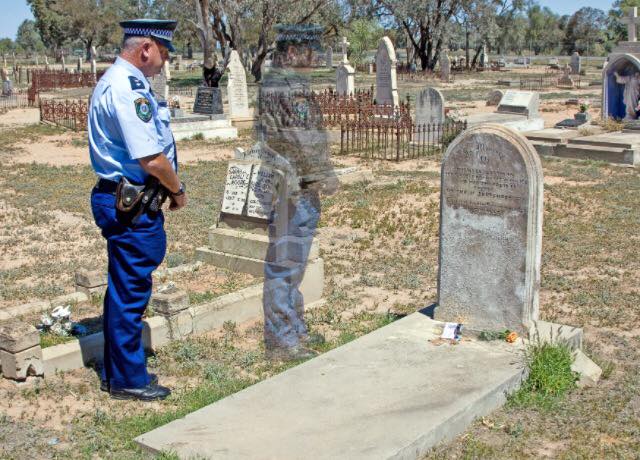
On Tuesday 11 September, 1877 Samuel Getting, a barman at the Royal Hotel in Bourke, was speaking with Constable Michael Costigan in the bar of the hotel. The constable had just paid Getting for his room and board, and after having a drink and chatting with the barman for a short time, he left the bar.
Getting, for some unknown reason, also left the bar about that time and went to his room in the hotel, where he took possession of his rifle. He then left his room and walked to the front of the hotel, where he saw Constable Costigan and Constable George Armytage standing on the verandah, having a conversation. He immediately shot both constables from behind before running into the street and attempting to reload his rifle.
Sub Inspector James Keegan, who was nearby, noticed people running toward the river, and when he asked what was happening he was told that Sam, the barman, had shot two of the police and was running away with a loaded gun in his possession.
He then saw Getting running along the bank of the river with a gun in his hand, being chased by several people. The inspector then went towards these people and told them to move away from Getting so he could speak with him. He then followed Getting for a short distance along the river until he stopped and waited for the inspector to approach. The inspector then spent some time talking with the offender and trying to get him to surrender, all the while edging closer as he spoke.
At a later inquest, the inspector described what happened next.
“I rushed at him, being at this time between 10 and 15 paces from him. The ground was very muddy, and there was a gully between us. I got my hands upon him being beneath the gun, and we both stumbled and nearly fell. He again got a few paces from me, turned round, took deliberate aim, and shot at me. He called to me to keep back. I knew I was shot, but it did not weaken me, and I still went forward.
He then raised the gun, holding it by the barrel, and struck me on the head. I put up my arm to ward off the blow, and it bruised my arm very much and cut my head. He struck me several times, and I at length secured the gun. He then ran parallel with the river for a few yards, and as I followed him he suddenly plunged into the river, and kept his head beneath the water until he was drowned. He went but a short distance into the river.
That is his body I have recently seen lying in an outhouse. He had plenty of opportunity of shooting me at first had he so desired, but he did not attempt to do so until I sought to arrest him. When he shot at me, one shot struck me near the eye, two shots went into my coat, two entered my chest, and two others grazed it.
The Deceased…was a man of very good character and very good behaviour, and I can ascribe no motive for his acts. He said he had no intention of doing what he did, and that he had loaded the gun to go out for some duck shooting.”
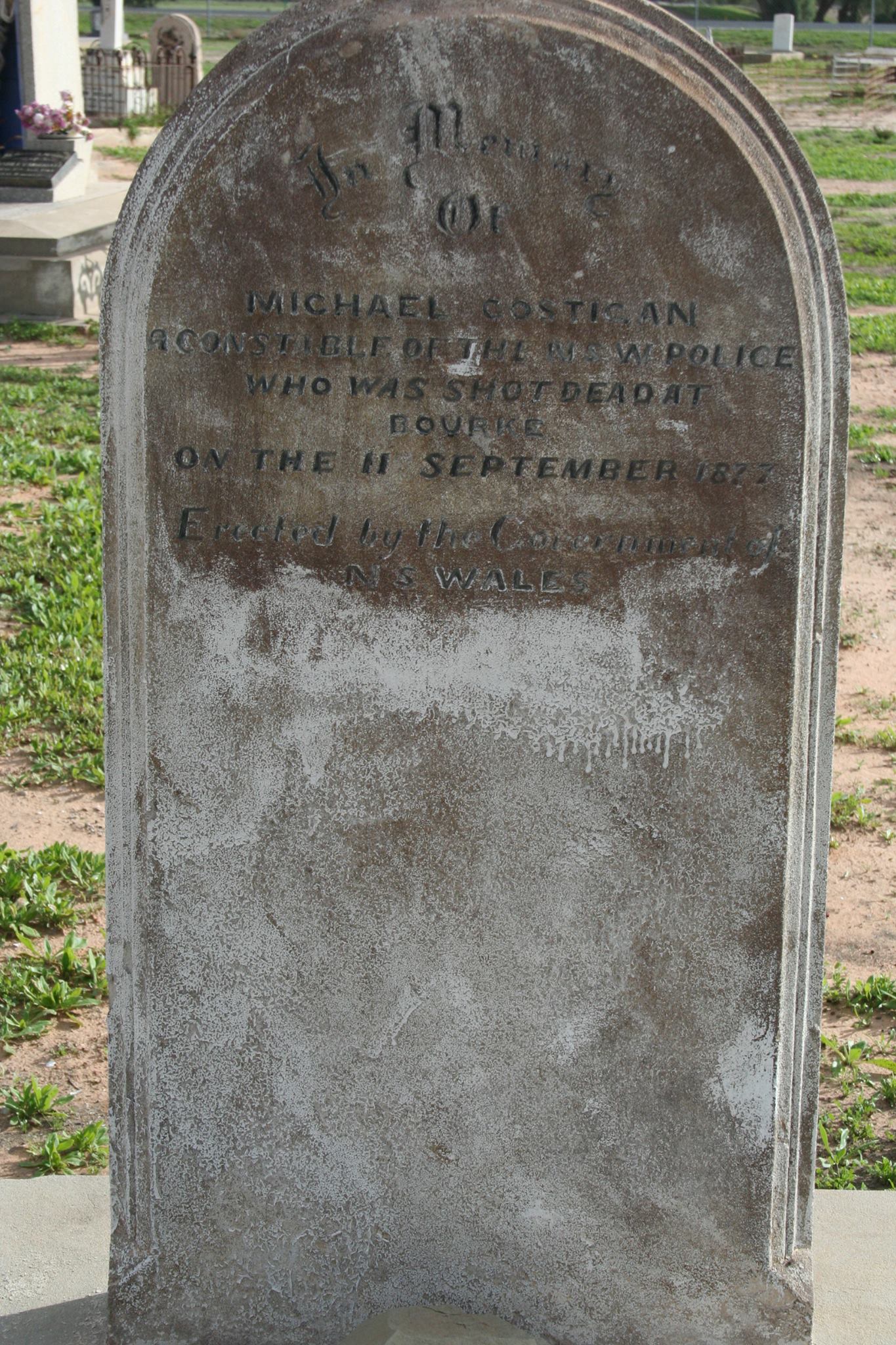
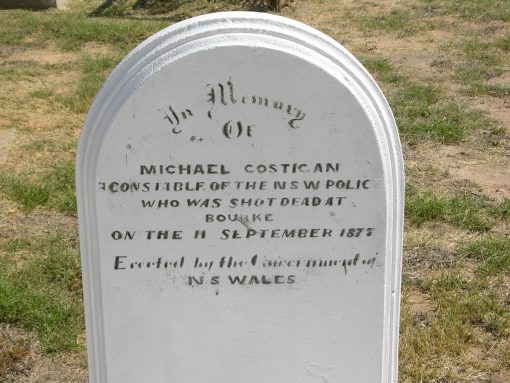
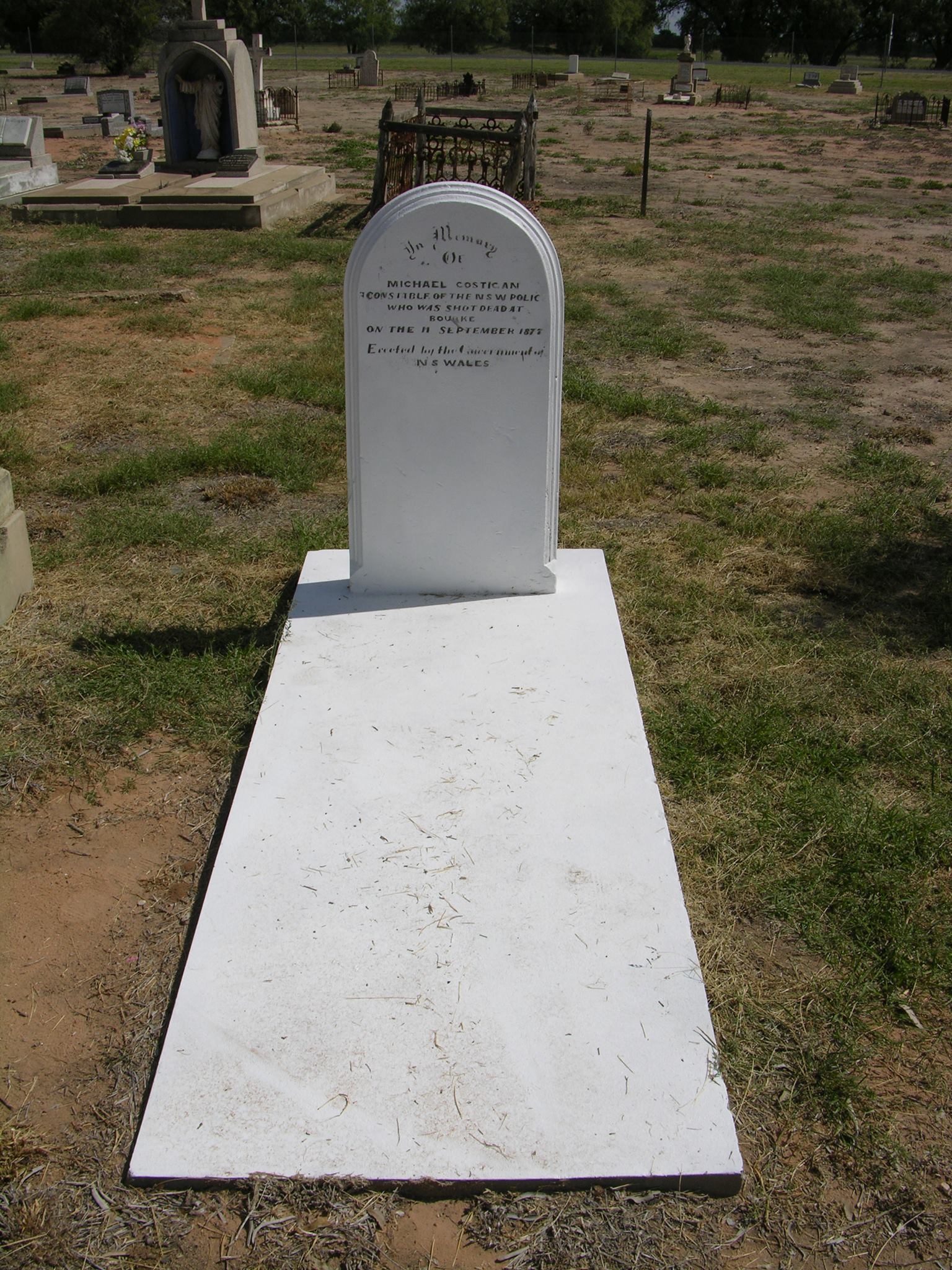
Constable Costigan was born in 1853 and joined the New South Wales Police Force on 11 September, 1873. At the time of his death he was stationed at Bourke.
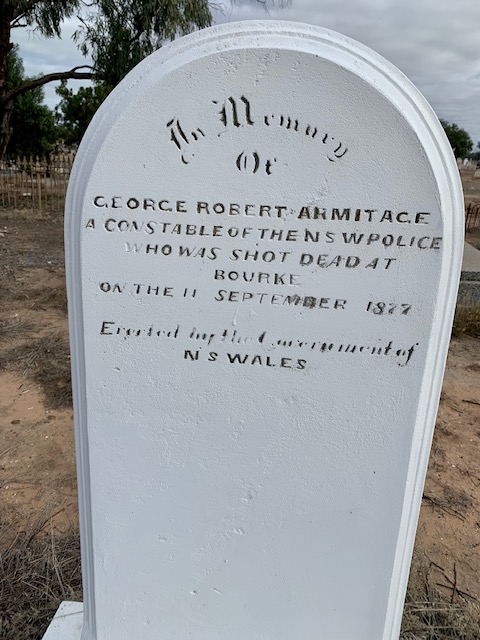
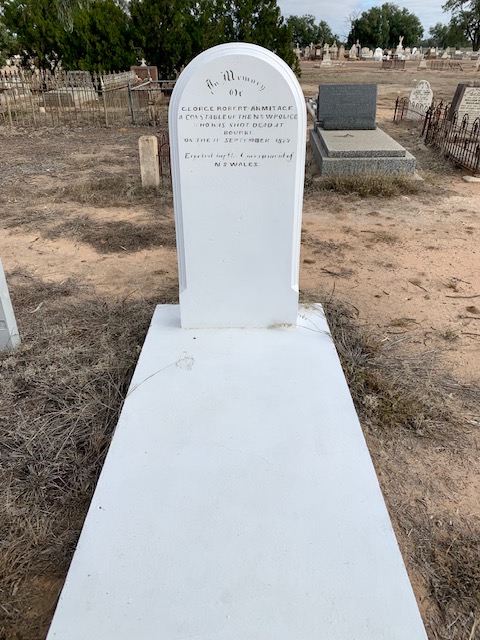
Constable Armytage was born in 1855 and joined the New South Wales Police Force on 4 May, 1877. At the time of his death he was stationed at Bourke.
Grave Location/s:
ARMITAGE: 30 06′ 03S / 145 56′ 12E
Old C of E, Bourke
As seen in June 2022. Photo: Alan BLAKE # 19779
As seen in June 2022. Photo: Alan BLAKE # 19779
COSTIGAN: 30 06′ 05S / 145 56′ 14E
Old Catholic, Bourke
as seen in April 2007 Photo: Ken Owen
as seen in April 2014 Photo: Ken Owen
as seen in April 2014 Photo: Ken Owen
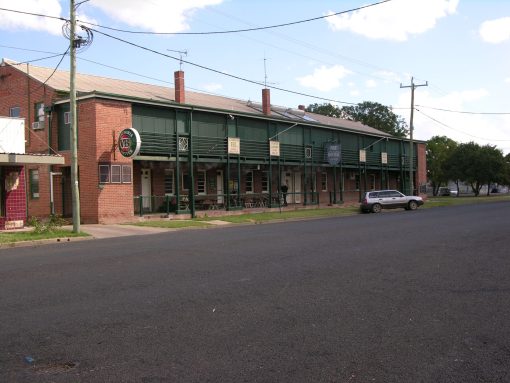
Location of Old Royal Hotel
32 Mitchell St, Bourke, 2840
GPS: -30.088854, 145.936134
2014: Port of Bourke Hotel which was formerly the Old Royal Hotel where these murder took place.
For the purposes of this website ‘Q‘ represents those Police joining between 1 March 1862 ( commencement of NSWPF ) – 23 February 1915 ( Commencement of NSWPF current numbering system )
Rank: Constable – appointed 7 January 1863
Senior Sergeant – appointed ? ? ?
Final Rank: Senior Sergeant
Stations: ?, Cowra – Death ?
Service: From 7 January 1863 to 1 May 1872 = 9+ years Service
Awards: ?
Born: ? ? 1840, Wick, Scotland
Died on: 1 May 1872
Cause: Shot – Murdered
Event location: Binni Creek, Cowra, NSW
Age: 31
Funeral date:
Funeral location:
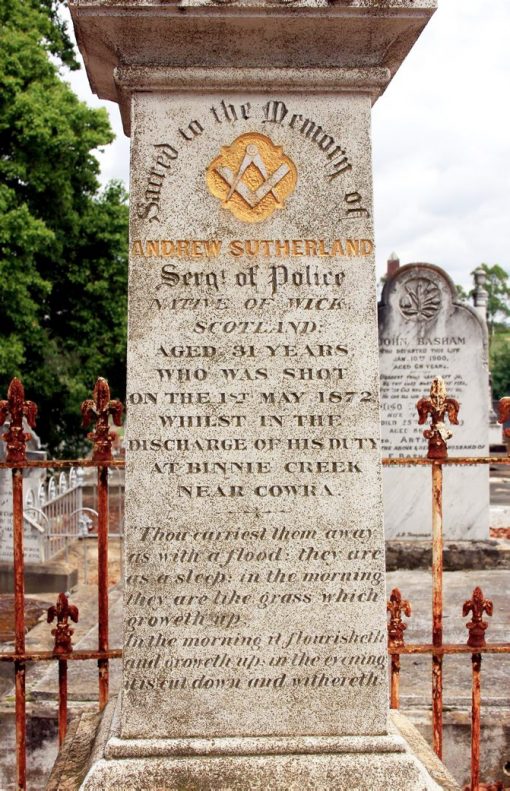
Buried at: Anglican section of the Young General cemetery
Memorial at: Cowra Police Station, 88 Brisbane St, Cowra, NSW
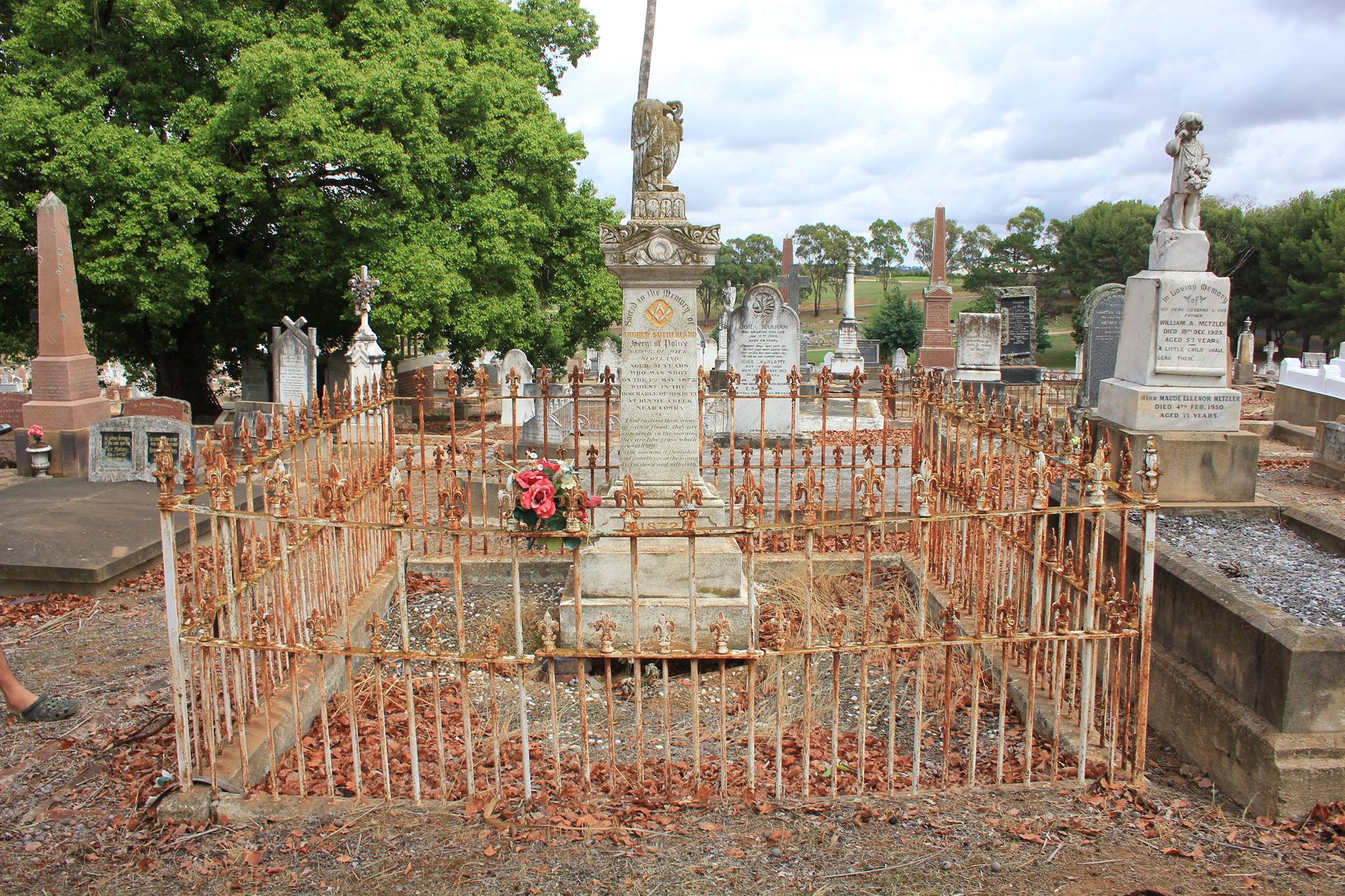
INSCRIPTION: Sacred to the Memory of Andrew SUTHERLAND Sergt. ( Sergeant ) of Police Native of Wick, Scotland. Aged 31 years Who was shot on the 1st May 1872 whilst in the discharge of his Duty at Binnie Creek near Cowra. ” Thou carriest them away as with a flood ; they are as a sleep ; in the morning they are like grass which groweth up. In the morning it flourisheth and groweth up ; in the evening it is cut down and withereth.”
ANDREW IS mentioned on the Police Wall of Remembrance
On 1 May, 1872 the sergeant was returning to Cowra from Bathurst Court.
During his journey he was told that two men who were wanted for robbery, George Gray and William Bristow, were at Daniel Horan‘s hut at Binnie Creek, twelve miles from Cowra.
The sergeant rode over to investigate and as he neared the door of the dwelling the offenders suddenly emerged and shot him to death.
The Clarence and Richmond Examiner dated 7 May, 1872 provided a brief account of the tragedy, which tends to suggest that the offenders were known to the sergeant.
SERGEANT SUTHERLAND SHOT DEAD BY BUSHRANGERS –
CARCOAR ” Thursday – I regret to have to announce that Sergeant Sutherland, of the Cowra police force, was shot dead last evening, by bushrangers, at a place about five miles from Cowra.
It appears that two armed men called on a settler named Daniel Oram, whose house is distant about two miles from Cowra and demanded food, which he placed on the table for them.
Sergeant Sutherland, who was going home from the Bathurst Assizes, rode up to the door during the meal, and was dismounting, when one of the men stopped to the door, gun in hand, and said, “I have been looking for you, you wretch,” and then shot him through the heart, causing instant death.
The men then went off and Oram started to Cowra, and upon arriving there, informed the police, who are now in pursuit of the murderers.
The fate of the unfortunate but brave officer is universally regretted. He leaves a wife, and had only been married a few months.
The sergeant was born in 1839 and joined the New South Wales Police Force on 5 January, 1863.
At the time of his death he was stationed at Cowra.
The Queenslander
Sat. 9 Aug 1873 p 10
ST. GEORGE.
(FROM OUR OWN CORRESPONDENT.) July 31.
We have also to record the arrest of a man named Frank Riley alias George Gray by Sergeant Cranney, on the charge of murdering Senior-sergeant Andrew Sutherland, of the New South Wales force, at Hordern’s hut, Beni Creek, on the 1st of May, 1872.
The prisoner had been staying in town for some few weeks, and left accompanied by another man with the avowed intention of going to the Surat races, but parted with his comrade about three miles from Weribone, his comrade going on into Surat, while he went out into the bush to camp.
Sergeant Cranney, in the meantime, appearing to have some clue to his identity, followed the pair, and finding that only one had reached Surat, returned on his tracks, and camped in the bush for two nights endeavouring to ascertain the whereabouts of the prisoner.
Becoming faint from fasting, he went to Weribone Station for food, and just dropped on to the man he was looking for, and who had also been there on the same errand. The officer arrested him at once, and prisoner was taken to Surat and remanded to Roma, and we believe by this time is on his way to Brisbane.
This is the second arrest of New South Wales offenders made by Sergeant Cranney during the past few months, the other being that of James Madgwick, whose capture and exploits were narrated in your columns a short time since. Sergeant Cranney was also the officer who arrested the notorious Patrick Collins.
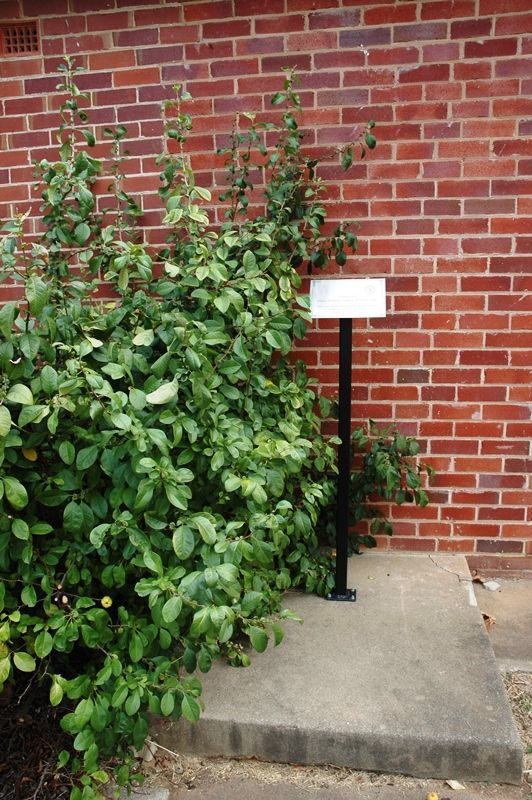
A plaque commemorates Sergeant Andrew Sutherland who was fatally shot in the line of duty as a New South Wales Police officer.
Sergeant Second Class Andrew Sutherland was shot whilst on duty at Binni Creek near Cowra on May 1, 1872. On May 1, 1872 he was returning to Cowra from Bathurst Court. En route he was told two offenders wanted for robbery, George Gray and William Bristow, were at Daniel Horan’s hut at Binni Creek, 12 miles from Cowra.
The Sergeant rode over to investigate and as he approached the door of the dwelling, two offenders emerged and shot and killed him. Gray and Bristow were subsequently arrested but both were later released without charge. No-one was ever convicted of the crime.
Actual Event Start Date: 01-May-1872
Actual Event End Date: 01-May-1872
Actual Monument Dedication Date: 01-March-2012
Front Inscription:
In memory of
Senior Sergeant Andrew SUTHERLAND
who was fatally shot whilst on police duty
at Binni Creek near Cowra
on the 1st May 1872.
The Portland Guardian and Normanby General Advertiser of 20 May, 1872 reported on the magisterial inquiry which was held at the Cowra courthouse before Mr G. Campbell J.P, “touching the death of Andrew Sutherland, who was shot dead by a ruffian at the residence of Daniel Horan a farmer living on Binni Creek…” One witness to the murder, Mrs Eliza Seery, gave the following evidence.
“I am the wife of James Seery, and reside at Binni Creek.
About 4 o’clock in the evening of Wednesday, the 1st inst., two men rode up to Horan’s hut on two dark looking horses.
Mrs Horan and I were in the hut at the time. They bid me good day, and asked if I had seen a bay horse, to which I replied “No”. One then said to the other, “We’ll get down and have a light”. The taller man was the spokesman.
He remarked that the weather was very dry.
The dogs began to bark. I went out to see what they were barking at, and observed Sergeant Sutherland riding towards the place.
The tall man asked me who was coming, and I answered, “Sergeant Sutherland”. The smaller man then walked outside, and Sutherland called him to the corner of the hut.
After talking to the sergeant for a short time, the man came towards the door, when I heard Sutherland ask him who was inside.
Sutherland then rode up to the door, and told the man who was inside to come out, or he would shoot the two of them.
The tall man, who was in the hut, said, “I won’t” and went towards the door.
The sergeant then got off his horse, when the tall man fired at him.
He said, “I’ll shoot”, before he shot at the sergeant.
Directly after the shot was fired, Sutherland, let his horse go, and ran towards a tree standing near the hut.
The man followed Sutherland and fired two shots, one after the other, as quick as he could.
The Sergeant, whose back was towards the man who shot at him, fell before he got to the tree. He fell directly after the last shot was fired.
There were only three shots fired.
The man was within a yard or two of Sutherland when the last two shots were discharged. This man brought Sutherland’s horse, and rode him away immediately after firing the last shot.
I did not see the smaller man of the two after the first shot was discharged.
I ran to the Sergeant when he fell, and asked if he was dead. He made no reply.
He was not quite dead, but never spoke.
Mrs Horan came directly after, and I told her to run for some water. She got some water, which she poured over the Sergeants mouth. He died while I was standing by him. He was lying partly on his side, and partly on his back.
Horan came up, and asked what was the matter. I told him the sergeant was shot dead.
Horan reported the murder to the police.”
The Brisbane Courier of 11 August, 1873 was to later report on the arrest of one of the offenders by Queensland Police Sergeant Cranney.
“We have also to record the arrest of a man named Frank Riley alias George Gray by Sergeant Cranney, on the charge of murdering Senior-sergeant Andrew Sutherland, of the New South Wales force, at Hordern’s [sic] hut, Beni [sic] Creek, on the 1st of May, 1872.
The prisoner had been staying in town for some few weeks, and left accompanied by another man with the avowed intention of going to the Surat races, but parted with his comrade about three miles from Weribone, his comrade going on into Surat, while he went out into the bush to camp.
Sergeant Cranney, in the meantime, appearing to have some clue to his identity, followed the pair, and finding that only one had reached Surat, returned on his tracks, and camped in the bush for two nights endeavouring to ascertain the whereabouts of the prisoner.
Becoming faint from fasting, he went to Weribone Station for food, and just dropped on to the man he was looking for, and who had also been there on the same errand.
The officer arrested him at once, and prisoner was taken to Surat and remanded to Roma, and we believe by this time is on his way to Brisbane.”
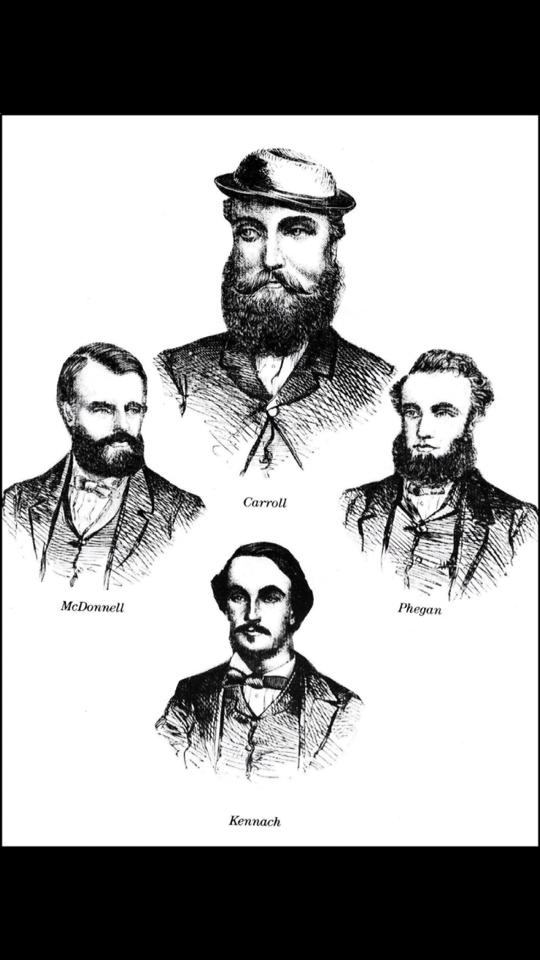
John CARROLL, Patrick KENNAGH, Eneas McDONNELL, John PHEGAN
Carroll Kennagh McDonnell Phegan – Special Constables – NSWPF – Murdered – 9 Jan 1867 – Facial Drawings
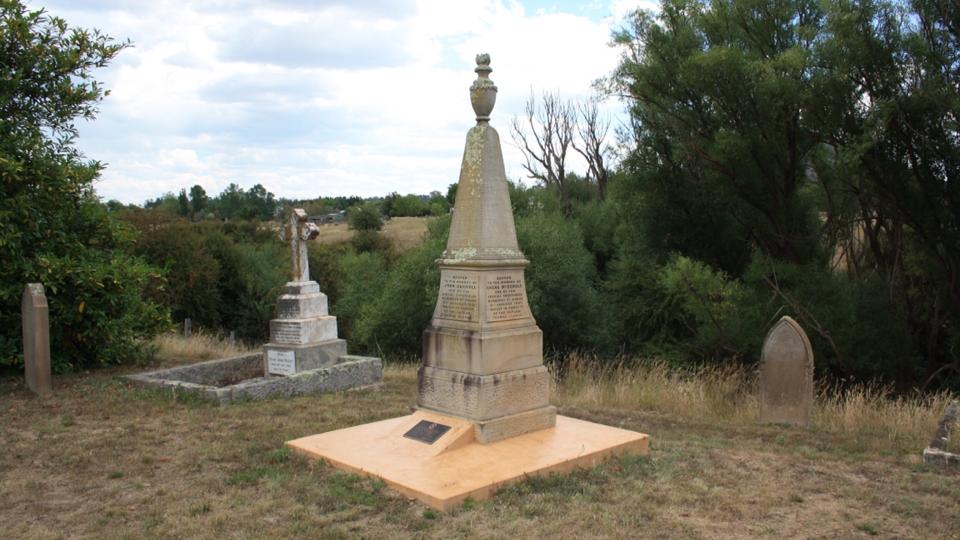
Carroll Kennagh McDonnell Phegan – Special Constables – NSWPF – Murdered – 9 Jan 1867 – Grave stone
John Carroll (a senior warder at the Darlinghurst Gaol) was the leader of a group of four men sworn in as special constables to search for and capture the Clarke Gang of bushrangers. The patrol consisted of Carroll, Patrick Kennagh, Eneas McDonnell and John Phegan. They were well-armed and in January, 1867 had for some time been posing as surveyors in the Braidwood area in an attempt to discover the whereabouts of the bushrangers. On the afternoon of 9 January the four men were walking through an area of very dense bush on Jinden Station, having left their horses behind on that day for some reason, when they were ambushed.
Witnesses apparently twice heard shooting in the area at that time but did not investigate until the following day. In a clearing in the bush McDonnell and Phegan were found, shot to death, and about 800 metres away Carroll and Kennagh were found, also shot to death. Carroll was found lying on his back with a neatly folded handkerchief on his chest with a one-pound note pinned to it. A large sum of money he was carrying in his pocket had not been touched. The wounds suffered by Carroll and Kennagh suggest that not only were they murdered, but that they were actually “executed”. It is generally thought (and also often disputed) that their attackers were members of the Clarke Gang, however this has never been proved.
The Sydney Morning Herald of 12 January, 1867 informed its readers of the following.
BRAIDWOOD – MURDER OF THE SPECIAL CONSTABLES.
Friday: The four special constables – Carroll, MacDonald, Fagan, and Kennagh – sent here to capture Clarke’s gang, were on a visit to a station at Jinden, when they heard that Clarke would be at a place two miles distant from there, the constables went on foot with the intention of endeavouring to capture him, and, it is presumed, were met by a lawless mob and shot dead. It is said that Carroll’s legs had been broken, and his feet turned to his head. The mournful news reached Braidwood last night, and caused universal indignation, and cast a gloom over the entire population. Mr. Griffin and Superintendent Orridge are now holding an inquiry.
Like Carroll, Kennagh and McDonnell were prison warders (McDonnell was also an ex-policeman), while Phegan had been chosen for the search because, as a former associate of the Clarkes, he knew the Braidwood area well. They had been authorised by Colonial Secretary Henry Parkes to undertake a “secret expedition for the capture of the bushranger Thomas Clarke and his associates.” They had been promised wages, reward money (if successful) and significant positions in the Public Service for their endeavours. This situation, of course, was not popular at the time with substantive New South Wales police officers. A monument was later erected in the memory of these men at the Braidwood Cemetery (and inexplicably, McDonnell is referred to as Eneas ‘McDonald’).
These murders represent the highest number of police ever killed in a single incident of this type in Australian history. It is only surpassed by the spearing of patrols of Native Mounted Police in Queensland in the 1860’s. (Ned Kelly killed three Victorian police officers in a single incident at Stringybark Creek in 1878).
Special Constable McDonnell was born in 1817,
Special Constable Carroll in 1829,
Special Constable Phegan in 1837, and
Special Constable Kennagh in 1841.
Clarence and Richmond Examiner & New England Advertiser ( NSW ) Tuesday 12 February 1867 page 3 of 8
Meetings of sympathy with the families of the special constables recently murdered continue to be held, and much indignation is expressed at the rottenness and inefficiency of our expensive military police force. A commission, with a great preponderance of officialism in it, has been appointed, to inquire into the circumstances of the late murders of the special constables, and the state of the Braidwood district. The public have little confidence in the fitness of the commissioners.
Police and Bushranger descendants tour bushranger sites in district
Braidwood was overflowing with people during the weekend from visitors who had come to town for all sorts of events and celebrations.
The Police and Bushrangers Descendants who travelled from all over NSW and some from QLD came to enjoy the company of like-minded people and to learn more about the local Braidwood bushrangers and the policeman who were involved in their capture in April 1867.
The group was lucky to have many distinguished historians and authors who facilitated as commentators, guest speakers and experts. This was a well-run event.
The group would like to thank Paul and Annette Briggs and family who spent many long hours scheduling and organising the experience. As a result, all of the participants enjoyed their time in the Braidwood District. Paul Briggs is a descendant of Lionel Pottinger, one of the Special Police sent after the Clarkes.
The group gathered at the Braidwood Services Club on Friday night for dinner followed by a briefing on the weekend and guest speakers from within the group before their early start the next morning.
About 80 people, including local guests, gathered at the Garan Vale Woolshed at 8.15am on Saturday morning ready to depart for their day tour of the significant sites of the Connell and Clarke bushrangers in the Ballallaba, Krawarree, Jinden and Kain areas of the district.
The first interesting site was the Clarke residence on the Cooma Rd adjacent to Brick Kiln Creek where Jack and Mary Clarke (parents of Tom and John Clarke) lived. Peter Smith and Paul Briggs spoke and recited information about this site. Along the way Paul Hart provided information about several curious sites along the road, including Mrs Appleby’s store and house, the Willis homestead, Bendora and bridle tracks including the Rugby Track.
The group viewed the Nithsdale homestead and the surrounding property where the oldest of the Clarke children were born, during the 1840’s. This was also the location of the local Ballallaba police Station. Along the road, the tour mangers pointed out the Coles, the Church, the school, the Berriman and Connells family home sites.
The areas and locations of the Griffin brothers were also pointed out. These three brothers had substantial involvement in the Bushranging episode during the 1860s.
The site of a well known and notorious landmark, ‘Michael O’Connell’s Traveller’s Home Hotel,’ opposite Jim O’Connell’s house was pointed out. A few stories were told and a visit to the Gundillion cemetery provided a few photo opportunities of Michael O’Connell’s gravestone.
Morning tea was abundantly provided by the good hosts of the Deua Tin Huts. A few more stories were exchanged and were appreciated by all.
The group was eager to travel to Khan Yunis to locate the site of Berry’s Hut where the Clarke bushrangers were finally taken by a small but dedicated group of troopers in 1867.
A substantial luncheon was provided by the Gundillion Progress ladies at the local hall. After a delicious lunch, the group travelled to Jinden to visit the property of Janette and John Hindmarsh where the temporary burial site and the site of the killing of the four unfortunate Special constables was pointed out to the large group.
On travelling back to Braidwood the tour travelled along the Jerrabatgulla Road visiting the house site of Michael Connell senior and ‘Gilston‘, the family home of the Hart family. This is where Charlotte Hart, the wife of Tom Clarke grew up and lived. The group was bailed up by a couple of bushrangers who travelled on the bus to Braidwood ensuring that all travellers behaved themselves.
On arriving in Braidwood a quick stop at the local Braidwood Cemetery allowed the group to visit the final resting place of the Four Specials. The large memorial that was built to remember them was regarded with much interest.
On Saturday night a marvellous dinner and singalong was had at the Garan Vale Woolshed. Peter Smith led the vocals on several songs from the bushranging era to demonstrate how the community supported and even sympathised with the bushrangers during that chapter of Australia’s history, like this verse from the Kelly’s Byrne and Hart “..As high above the mountains so beautiful and grand, Our young Australian heroes in bold defiance stand, In bold defiance stand, my boys, the heroes of today, So let us stand together boys, and shout again, “Hurray!””
The weekend was topped off on Sunday with an interesting tour of the local Historical Museum and a tour of the Bedervale Homestead. Many thanks to Jill Clarke for her notes from the tour.
On the morning of 3 February, 1865 Constable Ward was returning to Coonabarabran from a prisoner escort to Mudgee. Near the locality known as Barney’s Reef he was informed that a Chinese gold miner, Sam Poo, thought to be mentally unbalanced, started sticking up people on the road to Mudgee. He also kidnapped and raped a young woman. Ward was told that Poo was nearby in the scrub. After a short search Constable Ward located the offender’s camp and approached him. When the offender saw the constable he ran into the bush. Ward rode after him, and when he caught up, called on him to stand and drop his weapon ( a cut down shotgun ). Sam Poo aimed at the trooper and said “You policeman – me fire”.
The Trooper leapt from his horse and tried to use the animal as cover as he drew his Colt navy revolver. Ward‘s hesitancy in shooting the Chinaman proved to be fatal for him, for Sam Poo fired, hitting the policeman in the pelvic area. Ward fell to the ground, discharging one shot from his Colt in the process. He then fired twice more at the Chinaman, who was running away through the bush.
The trooper lay bleeding on the ground until he was found by Mr M J F Plunkett, the squatter on whose run the shoot out had taken place. Plunkett arranged for Ward to be taken to his homestead, and sent for the doctor who lived 50 miles away. The doctor arrived the next day, but examination showed that Ward was beyond medical help.
The trooper told Mr Plunkett that he knew he was dying and asked what would become of his wife and family. Later he dictated a full statement about his encounter with Sam Poo to the squatter. Ward said he was a member of the Church of England, and asked Plunkett to pray for him. This the squatter did using a book of Common Prayer. The trooper then asked the squatter to send for his wife and family. However, John Ward died shortly after giving his request, passing away on 4th February 1865. His family arrived at the homestead after he had been buried.
A meeting was held in Mudgee, where a large sum of money was raised for Senior-Constable John Ward’s widow and children. This support acknowledged the supreme sacrifice the trooper had made in the performance of this duty.
The murderer, Chinese bushranger Sam Poo, thought to be mentally unbalanced, was later captured and hanged, as described by the Clarence and Richmond Examiner of 2 January, 1866.
EXECUTION, AT BATHURST: Wednesday’s Free Press states that on the previous day, the Chinese convict Sam Poo, who at the last assizes was convicted of the murder of constable Ward, suffered the extreme penalty of the law, within the precincts of the gaol. In the absence of any of his countrymen outside the prison walls, three Chinese prisoners, who are at present confined in Darlinghurst Gaol, were brought to see the end of Sam Poo, there were also about a dozen other persons present besides the police and the officers of the gaol. The wretched man, who, ever since his apprehension has been quite weak in intellect, appeared perfectly unconscious of his fate, and until his arms were pinioned by the executioners, stood in the door of his cell clapping his hands. The ceremony of pinioning over, he was led to the gallows without speaking a word, or even lifting his head. The rope was fixed, the bolt drawn and Sam Poo ceased to exist. The body was, after the lapse of little more than half an hour, cut down, and taken away for burial.
The senior constable was born in England in 1829 and joined the police force on 1 February, 1858. In 1862 he became a member of the newly-formed New South Wales Police Force as a mounted trooper. At the time of his death he was stationed at Coonabarabran.
He was described as 29 years old, 5′ 10 1/2″ tall, had brown hair and blue eyes and his complexion was fair. Ward was promoted to Senior Constable on 1st May 1863.
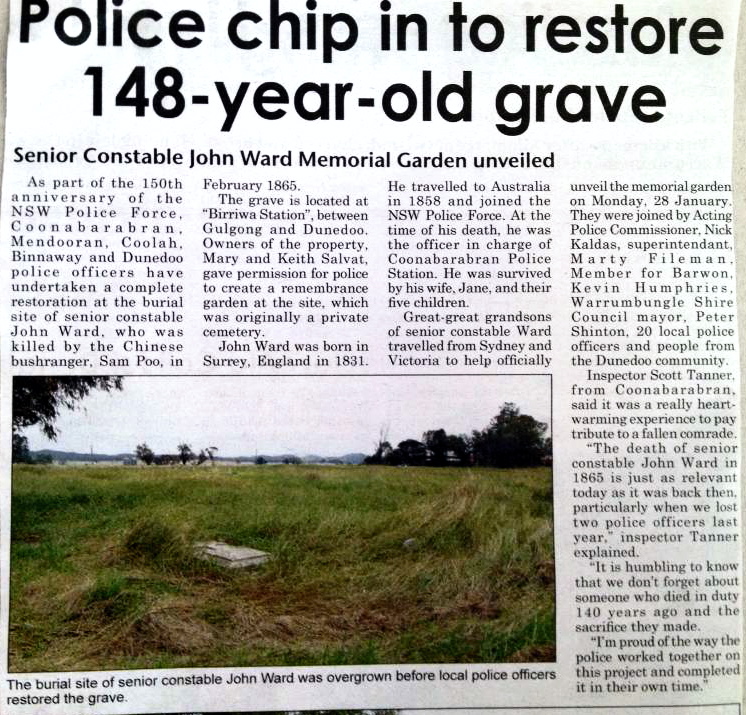
IT’S not unusual that the state’s most senior policemen, the mayor and local MP would turn out on Monday to attend the memorial service for an officer lost in the line of duty.
Senior Constable John Ward was shot at point blank range and died the next day from his appalling injuries. The dignitaries stood in silence enduring steady rain as the prayers and dedications were delivered at Birriwa Station near Coonabarabran.
What makes the scene rather remarkable is that the officer’s blood was spilt almost one and a half centuries ago.
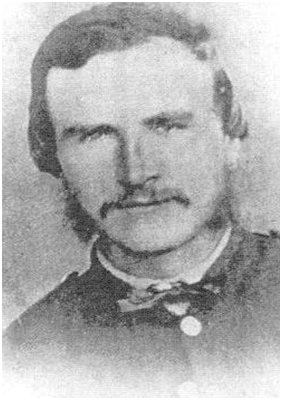
Senior constable John Ward. Photo: Supplied
Gun drama … Australia’s only Chinese bushranger Sam Poo. Photo: Supplied
Sam Poo, who committed the murder, achieved fleeting infamy as Australia’s only Chinese bushranger.
The gold prospector, apparently weary of thin pickings on the Talbragar claims, decided to switch jobs and take up bushranging. Fellow diggers were alarmed by news a man reported to look like a Chinaman had stuck up a woman and her little girl on the Mudgee Road. There were more reports of a Chinaman ”bailing up” travellers.
Ward, married with five children and with five years’ experience in the police force, was soon on his trail. On seeing his man after some hard riding, he called out ”Put down that gun.”
Poo responded: ”Me fire: you policeman.” And he did.
A stockman took the officer to his homestead. The nearest doctor travelled 80 kilometres to tend to him, arriving the next day.
By then Ward was reportedly beyond the reach of human aid and died soon after.
Two weeks later three constables aided by a ”smart half-caste Aboriginal stockman and tracker Harry Hughes” found Poo hiding in scrub. The fugitive was shot in the neck. He recovered at Mudgee Hospital and was later convicted of murder. He was hanged at Bathurst Jail in 1866.
Fast forward to the service last week, part of the NSW Police Force recognition of the sacrifice made by officers over 150 years of policing.
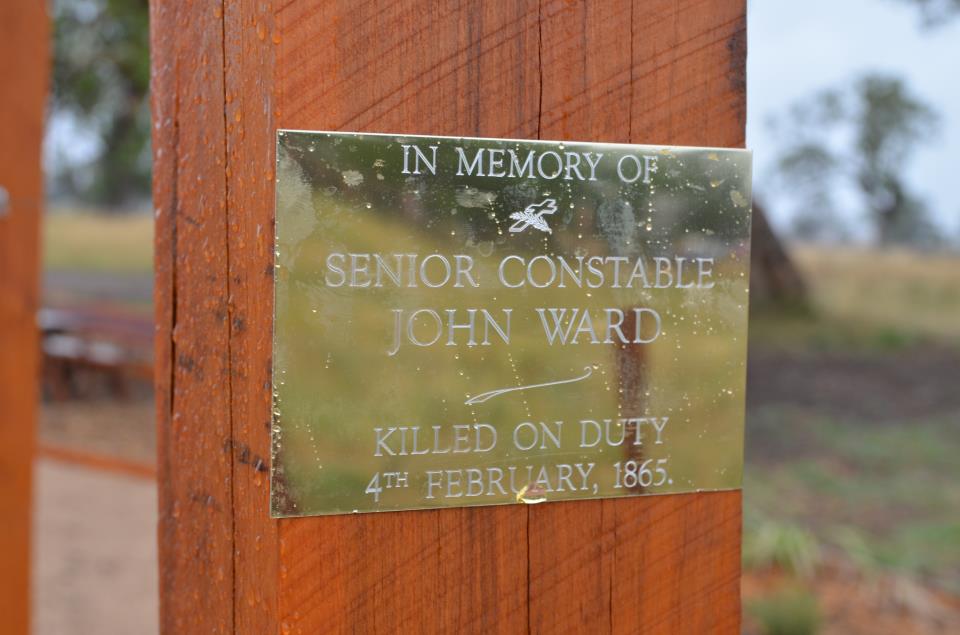
Inspector Scott Tanner, of the Mudgee area command, said: ”We were looking at how to mark the 150 years of policing. We have a plaque in Coonabarabran police station to John Ward and then there was the loss of Dave Rixon [the senior constable shot dead in Tamworth last March] so we started thinking about how to also remember John Ward – he walked the same streets that we walk today. When I first came here I lived in the house he had lived in.”
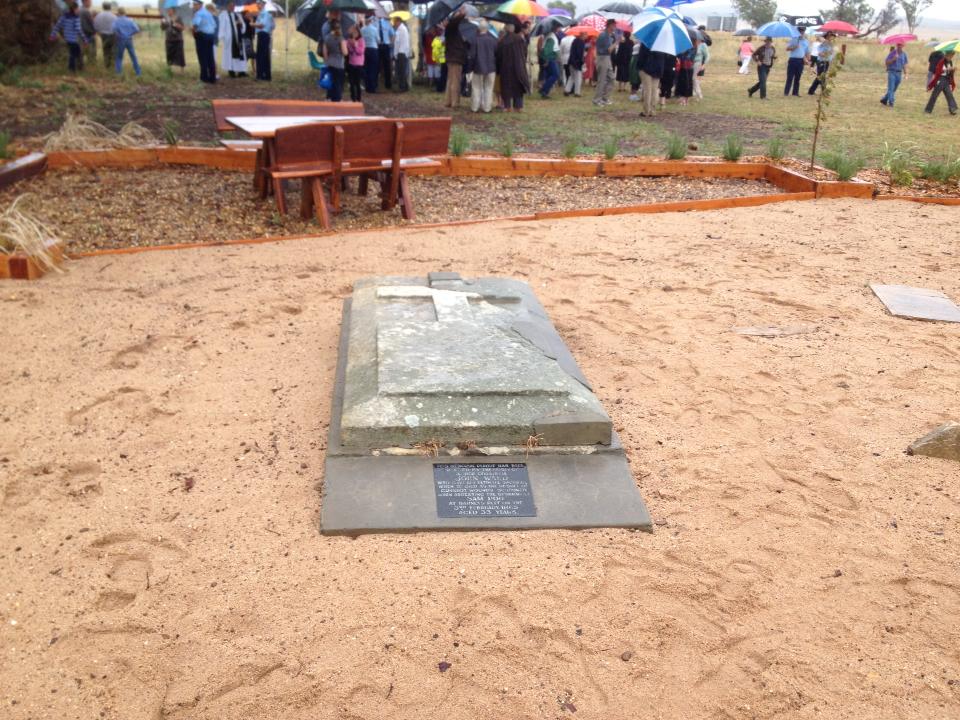
https://www.facebook.com/groups/514697128544865/ The grave of Senior Constable John Ward who was the OIC of Coonabarabran in 1865. Below are a few photos of the official opening in 2012 after restoration ( the 150th birthday of NSW Police ). Acting Commissioner Nick Kaldas, Ass Com McKechnie and descendents of the Ward family attended.
Homestead’s website to preserve history
SAM PAINE
The owners of Birriwa Homestead, Mary and Keith Salvat, are working to rediscover and preserve the history of the sandstone house.
The property, on the Dunedoo side of Birriwa, has a long and rich history and often attracts visitors who remember visiting the house as children.
Mrs Salvat said she wanted to use a new website being established at www.birriwahomestead.org to collect the stories surrounding the homestead, the balls it hosted and the families who lived or worked there.
Mrs Salvat said she wanted to create an opportunity for families with connections to the house to reach each other and share stories that could otherwise be lost.
“We’re just beginning a journey of rediscovering the history,” she said.
The website is under development, and currently consists of a form that can be used to submit stories to be published on the website, or to ask to be alerted when the site launches.
“It’s a very democratic website. Everyone owns their own intellectual property,” Mrs Salvat said.
“The purpose is really to act as a library – a 21st Century library.”
She said a house was bricks and mortar, but at the same time, it contained a subtle energy left by the people who had lived there or developed a connection with the place.
The Salvats have owned Birriwa Homestead for 15 years, and maintained and restored it while living in Sydney before moving there permanently in 2009.
They are often visited by descendants of the families who owned the house in the past – the Lanes, Cowards, Lowes and McMasters – including a 90-year-old woman who remembered playing in the garden as a very small child.
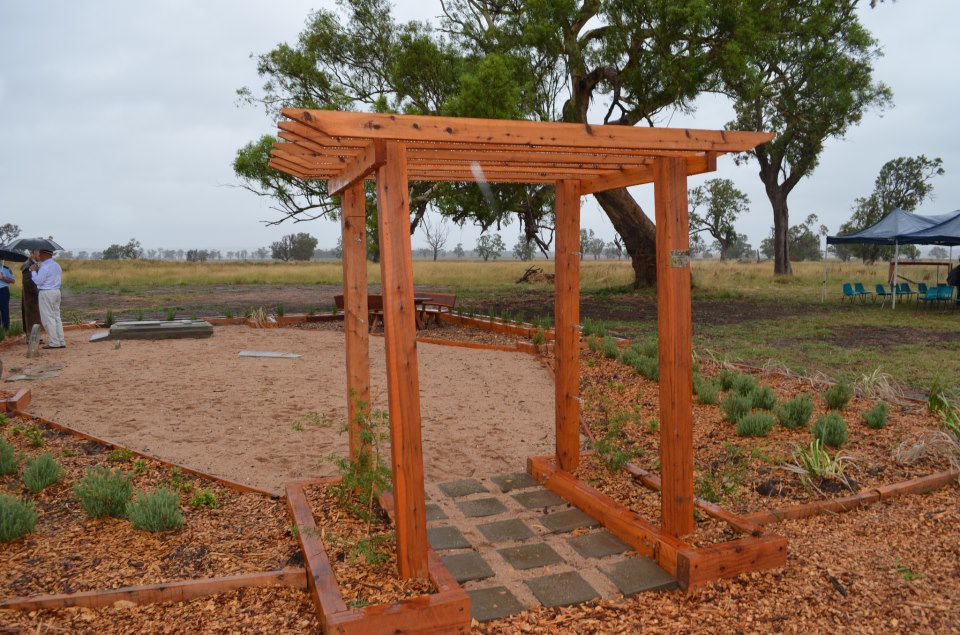
The property was opened on Monday for the dedication of a memorial garden surrounding the grave of Senior Constable John Ward, who was shot by a bushranger at Birriwa in 1865.
As well as police and descendents of Senior Constable Ward, guests included people who were raised at the homestead, a former Birriwa jackaroo, and a neighbour whose family had lived on the next property for three generations.
The memorial garden includes infant graves alongside the grave of Senior Constable Ward, and others that are unidentified as the stones and crosses have been washed away.
Mrs Salvat said working with the police on the project had been a wonderful experience.
“They were very respectful and incredibly well-mannered,” she said.
“This has been a beautiful journey for me and my husband over the last 12 months.”
Mr Salvat said the memorial garden made the grave site more approachable for members of the public who wouldn’t like to intrude on a private residence, while the planned website would allow visitors to read about the memorial before visiting.
Mrs Salvat plans to invite people with relatives buried at Birriwa Homestead to visit the property in autumn to plant trees that can bear plaques naming the people interred there.
In late September, 1864 the sergeant was camped in the bush with three troopers near Albury during a search for bushrangers, when two men, one of whom the bushranger Daniel Morgan, crept up and fired several shots into the police tent. One shot hit the sergeant, entering his shoulder and exiting through his back. Despite these wounds the sergeant was able to return fire, forcing the offenders to retreat and escape. Sergeant Smyth was soon treated by a doctor however he died of the effects of the wound within a couple of days. The vicious Morgan was shot to death by a farmhand in April, 1865.
The Empire newspaper dated 5 October, 1864 printed the following brief account of the incident.
DEATH OF SERGEANT SMYTH – It is with deep regret that we have to record the death of Senior-Sergeant Smyth, at Albury, on Thursday night, from the wound he received in the cowardly night attack a few weeks back at Doodle Cooma Swamp. It was at first hoped that the unwearied care of Dr Wilkinson would have brought him round; but haemorrhage having set in, little hopes were entertained of his recovery, and he gradually sank until he yielded up his brave spirit on Thursday night. He was a very deserving officer, possessed of more than average intelligence and shrewdness, which eminently fitted him for a police officer. His courage was unquestionable. Previous to his being stationed at Albury he was at Lambing Flat, on leaving which town be was presented with an address by the inhabitants, expressive of their appreciation of his valuable services in the repression of crime on that large goldfield.
The McIvor Times and Rodney Advertiser of 23 September, 1864 printed a detailed account of the incident.
“THE BUSHRANGER MORGAN.
A party of police, consisting of Senior Sergeant Smyth, Senior Constable Baxter, Constables Connor, and Maguire, and a blackfellow named Jimmy Reed, were camped on Sunday night at Dougal’s [sic] Swamp, near Keighran’s station. They had just got tea, and were lying in the tent yarning, as is usually done by persons camped out. They had no sentry on guard – that duty being delayed until they “turned in” for the night. Suddenly their discourse was cut short by a volley being fired into the tent amongst them. Sergeant Smyth immediately jumped to his feet, calling on his men to follow him – he firing two shots in the direction he fancied the volley came from. The men who rushed out of the tent immediately after him, scoured the bush in every direction, as well as the darkness would allow them, but failed to find any traces of the ruffians; but, from the tracks discovered at daylight next morning, they must have overrun the bushrangers in the dark.
“They remained in the scrub about an hour, when they, after some consultation, deemed it better to return to the tent, which, considering that the night was dark, arid the surrounding scrub would completely shelter the attacking party, was, to say the least, attended with some danger. Baxter and Connor crawled on their hands and knees to the tent, and found Smyth lying on his back dangerously wounded, and fast bleeding to death. They took everything out of the tent and, having covered poor Smyth up in the few blankets they had, they managed to convey him to Keighran’s station, he still bleeding and suffering great pain, where they remained until daylight. Constable Baxter and the blackfellow then took up the track near the tent, and started to follow the ruffians up. The other two constables proceeded to the Ten Mile Creek, to give information and obtain medical aid for Smyth.
“Superintendent McLerie who was proceeding to Sydney on sick leave, happened to be at that place; and he immediately ordered his buggy to be taken off its springs, and the body to be used as a stretcher to convey Smyth to Ten Mile Creek. From the position of the bullet holes in the tent, there cannot have been less than five bushrangers. There are seven bullet holes in the tent; the bullets were picked up inside of it, some of them belonging to a large bore pistol. Constable Connor had a very narrow escape. He was lying down, leaning on his elbow, in the tent, when one of the balls went through the sleeve of his coat, inflicting a slight wound about two inches above the elbow joint. Superintendent McLerie has deemed it necessary to return to Albury for the present. Sub-inspector Morrow and a party of police have started from Albury in pursuit of the bushrangers; and Sub-inspector Zouch has left Wagga Wagga on similar duty.
“A strange incident occurred in connection with this cowardly attack. Shortly after the party were camped, two men came up and were admiring the site chosen for the camp, remarking that they could not have chosen better. They are well known as bush “telegraphs,” being the two men to whose house Sergeant Carroll traced Morgan some time back. Sergeant Smyth’s wound is a very dangerous one. The ball entered immediately above the nipple of the left breast, following the course of the ribs, and came out under the left shoulder-blade; so that, while the wound may not be considered mortal, yet fatal results may ensue from it. The people are greatly excited on this murderous attack, which in cold-blooded treachery far surpasses the Lachlan escort robbery.”
The Empire newspaper dated 5 October, 1864 printed the following brief account of the death of the sergeant.
“DEATH OF SERGEANT SMYTH
It is with deep regret that we have to record the death of Senior-Sergeant Smyth, at Albury, on Thursday night, from the wound he received in the cowardly night attack a few weeks back at Doodle Cooma Swamp. It was at first hoped that the unwearied care of Dr Wilkinson would have brought him round; but haemorrhage having set in, little hopes were entertained of his recovery, and he gradually sank until he yielded up his brave spirit on Thursday night. He was a very deserving officer, possessed of more than average intelligence and shrewdness, which eminently fitted him for a police officer. His courage was unquestionable. Previous to his being stationed at Albury he was at Lambing Flat, on leaving which town he was presented with an address by the inhabitants, expressive of their appreciation of his valuable services in the repression of crime on that large goldfield.”
In April 1865 the vicious and cowardly bushranger Morgan was shot to death by a farmhand in at Peechelba Station, near Wangaratta (Vic).
The sergeant was born in 1830 and joined the police force on 8 February, 1858. In 1862 he became a member of the newly-formed New South Wales Police Force. At the time of his death he was stationed at Albury.
It’s taken 153-years but moves are finally underway to give some restitution to Senior Sergeant Thomas Smyth, who was murdered by notorious bushranger ‘Mad Dog’ Dan Morgan in the hills near Henty in 1864.
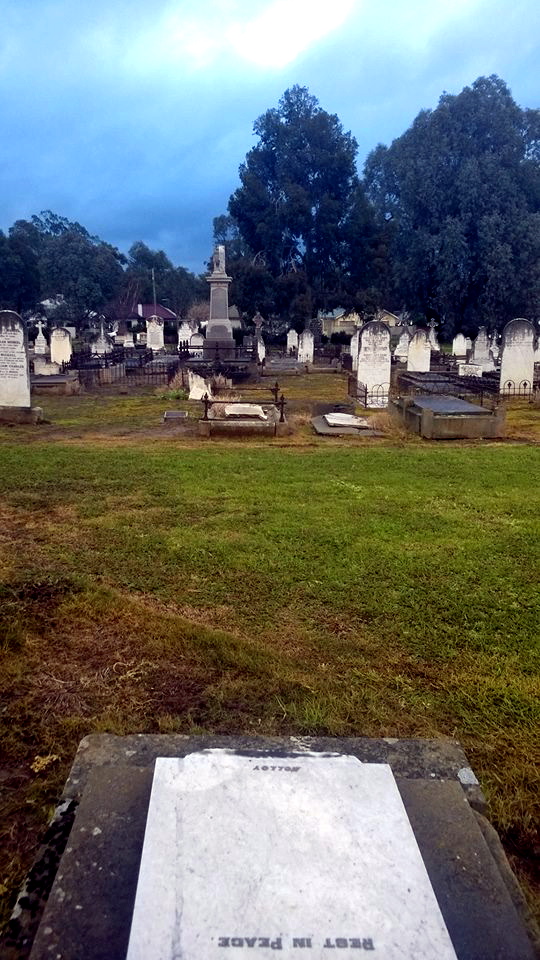
Sergeant Smyth’s unmarked grave is now set to receive a memorial headstone to rectify what is believed to have been an administrative oversight lost in the 1951 transferral of Albury’s three cemeteries from church to council.
Police officers, both active and retired, had bemoaned as “a sad end and undignified burial” of Senior Sergeant Smyth after he was shot trying to recapture the bushranger, who had been terrorising the region.
In 1864, ‘Mad Dog’ Morgan had recently committed his second and third murders before he arrived in the Henty area. Widespread fear and an outcry from the press at the time saw the reward for Morgan’s capture raised to £1000, and parties of special police were sent to track and capture him.
On September 4, Senior Sergeant Smyth had set up camp with three troopers in the Henty hills, when Morgan and another man crept up and fired several shots into the police tent, hitting the sergeant in the shoulder and exiting through his back. Morgan later said he had been watching the camp for some time.
Despite his wounds, the sergeant ran out of the tent and returned fire, forcing the offenders to retreat. The wounded officer then collapsed. He was transferred to Kiamba and then Albury where doctors claimed he was recovering, before he hemorrhaged several times.
The Empire newspaper dated October 5, 1864 reported that “he yielded up his brave spirit on Thursday night. He was a very deserving officer, possessed of more than average intelligence and shrewdness, which eminently fitted him for a police officer. His courage was unquestionable”.
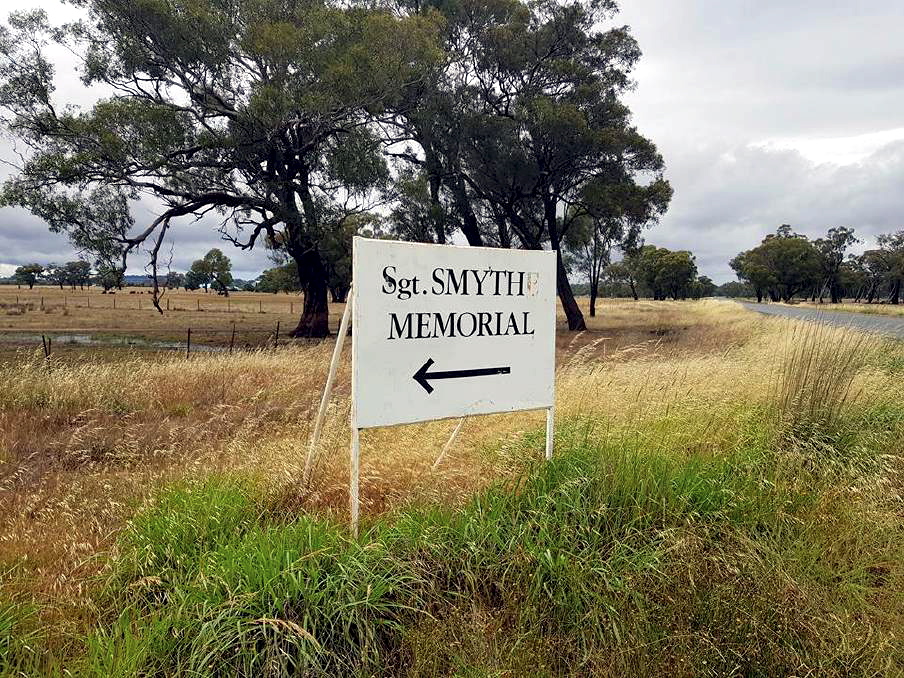
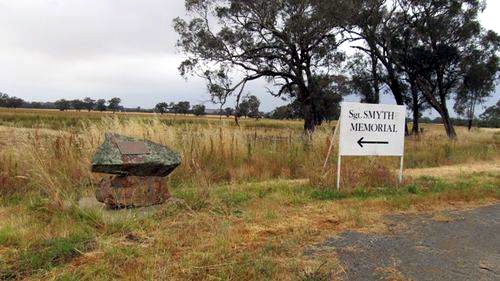
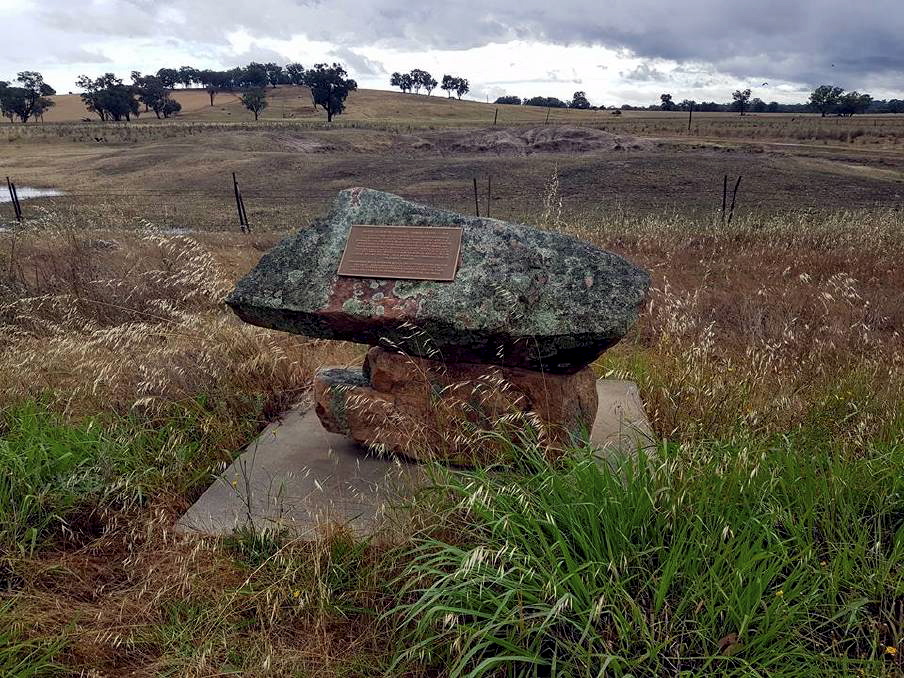
Senior Sergeant Smyth was buried in an unmarked grave in an Albury cemetery, however there is a memorial stone on Pleasant Hills Road just outside Henty.
NSW Police is hoping to rectify other unmarked police graves. Dan Morgan was holding hostages when he was shot dead in Victoria by a farmhand in April,1865.
This excerpt is from an Australian Government site about bushrangers:
“Daniel Morgan brought discredit to the popular ‘currency heroes’ by his mixture of violence, abuse and seemingly meaningless murders. Morgan claimed his innocence at his first conviction in 1854, at the diggings near Castlemaine, which he said was ‘framed‘ by a squatter. During his time at Pentridge Prison, he developed a violent dislike for police. Upon his release, he began a campaign against society at large and the police in particular.
Morgan once took issue with an overseer’s wife when the man was away on business, demanding money from her as he forced her against a blazing fire until she suffered severe burns to her legs. Morgan also tried to burn squatter Isaac Vincent by setting fire to his woolshed after he had tied Vincent to a nearby fence. After Morgan bailed up coaches, he would stampede the horses – sending them and their drivers to destruction.
Eventually he was shot and captured in 1865 after being outwitted by a nursemaid and station hand at Peelhelba Station near Wangaratta, owned by the McPhersons.”
MEMORIAL: Senior Sergeant Thomas Smyth will get a memorial headstone on his unmarked grave in Albury, after he was shot by bushranger Dan Morgan in 1864.
MEMORIAL: The memorial stone to Senior Sergeant Thomas Smyth is two kilometres west of Henty on Pleasant Hills Rd (the Lockhart road).
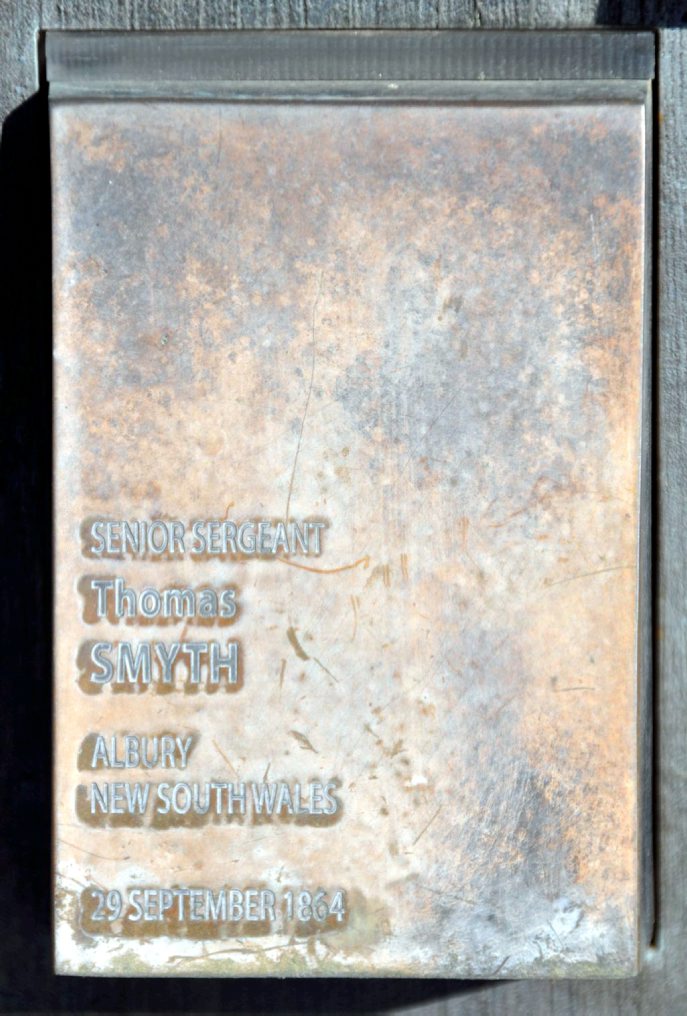
DETAIL: The plaque detailing the death of Senior Sergeant Thomas Smyth after he was shot by bushranger ‘Mad Dog’ Dan Morgan in September 1864.
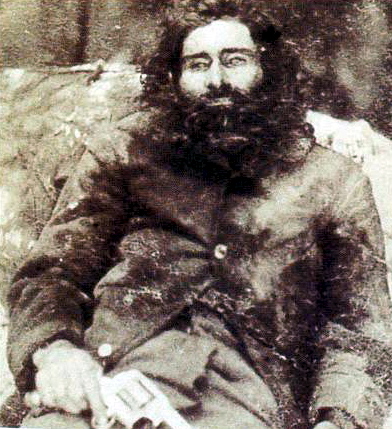
MURDERER: A post-mortem photograph of notorious bushranger ‘Mad Dog’ Dan Morgan who murdered several people, including Senior Sergeant Thomas Smyth.
On 22 December, 1857 Trooper Codrington rode out to meet the gold escort from the Turon Valley. His duties included escorting the gold and mail being carried either by coach or packhorse down the steep Wyagdon Hill and into Bathurst. After he was reported missing, a search was conducted and his body, shot through the heart, was found off the side of the Bathurst – Turon Road in a ravine at the top of Wyagdon Hill. Bushes were found nearby piled on the roadside and it is thought that the bushrangers who probably killed the trooper had hidden at that spot to await and rob the escort. No other satisfactory reason could be found for the murder, although the escort passed the spot unmolested on that day. Local legend has it that the trooper was killed by an old enemy who then returned to England after the murder, however this remains unsubstantiated.
In late 1860 John Higgins (alias John Davis) appeared before the Albury Police Court charged with “having, on the 22nd day of November [sic], 1857, shot one Robert Codrington, a mounted trooper, in the District of Sofala, Bathurst”. He was found not guilty. An alleged witness to the murder was Richard Henry Mills Sampson, who was a man known for giving false evidence in a previous, unrelated trial. His statement, which may or may not be truthful, was as follows:
At that time I was going from Louisa Creek to Bathurst to spend Christmas. I there met the prisoner with three other men, two of them were travelling with the deceased trooper. I rode up sharply, and was immediately covered by a gun by one of the men. The prisoner, whom I now distinctly recognise, shot the trooper Codrington, and afterwards proposed to shoot me. A man named Cole, whom I have known for years, was one of the party…[and he] said I would not blab. The murder took place about 3 o’clock in the afternoon. I was about 50 yards from them when I first saw them. The prisoner said several times, “Shoot him,” and called the others cowards. He then shot Codrington himself, and was the only one of the party who had a gun. I did not see what they did with the body.
The constable was born about 1832 and joined the Gold Escort about 1854. At the time of his death he was stationed at Cheshire Creek Barracks (Bathurst/Peel area).
Robert IS mentioned on the National Police Wall of Remembrance
Location of ( Wiagdon ) Wyagdon: [codepeople-post-map]
Born in Madras ( India ) in 1836 to Robert Codrington and Louisa. Robert Dowker married Louisa Kershaw on 5 April 1856 and had a child – Robert William, born 27 November 1856 or 1857 & died 2 April 1930 in NSW. Robert Dowker CODRINGTON passed away on 22 Dec 1858
My great great grandfather, Robert Dowker Codrington, a gold trooper (mounted policeman) who was shot at Kelso in about 1856. He migrated to Australia in 1853 from England.
HORRIBLE MURDER. Intelligence reached town on Thursday morning, that one of the Gold Escort named Robert Codrington, stationed at Wyagden, had been found murdered under Wyagden Hill. On further enquiry we found that the report was too true. It seems that it had been customary that the trooper stationed at this place, should go out to meet the escort on its return from Sofala, and it is supposed that some party or parties, aware of this circumstance, availed themselves of the opportunity to commit this horrible crime, evidently with the ulterior intention of attacking the Gold Guard. The ill fated man, who had been missing since Tuesday morning, his horse having returned to the Police Station without him, was discovered after a lengthy search by Sergeant Giles, lying headforemost down the hill, with his arms outstretched, and his feet carefully placed together. The body was in a state of partial decomposition, but the marks of a bullet shot through the stomach were plainly apparent, and the arms, including a carbine and pistol, and all the accoutrements had been removed. The deceased was twenty years of age, bore an excellent character, was the son of a commissioned officer in the Indian army, and was a young man of remarkably fine presence. We regret to add that he leaves a wife and child to mourn his untimely fate. Expresses have been sent out in various directions in quest of the guilty parties, and no pains will be spared to bring the perpetrators of this heinous crime to justice.
Bushranging. – Accounts have reached town of the wilful murder of trooper Robert Codrington, of the Mounted Police, on the 22nd instant, near Wyagden, when on the way to meet the gold escort. The return of Codrington’s horse, without either rider or trappings, was the first intimation that anything had happened, and on instituting a search the body of the poor fellow was found, having fiveshotandslugwounds in his body, which would cause instant death. His arms ( firearms ) and accoutrements are missing.
(From a Correspondent of the Bathurst Free Press.)
Our quiet neighbourhood has been thrown into a state of great excitement, in consequence of Trooper Codrington, of the Gold Police being shot, at the top of Wyagden Hill.
It appears that Robert Codrington, trooper in the Gold Police, left the Police Barracks, at Cheshire Creek, where he was stationed, about 8 o’clock on Tuesday morning last, for the purpose of meeting the Gold Escort coming from Sofala; and by his not returning that day, some excitement was caused ; it was conceived that he had ‘received some fresh orders, and had gone on to Sofala. On the Wednesday morning his horse was discovered at the stable, with the saddle on, but without his bridle. So soon as this was known, a search was commenced along the road, but no traces could be discovered. Night coming on, instructions were given, that as many horsemen as could be procured, should be ready by daylight the following morning to renew the search. Just as we were on the point of starting from Wyagdon, our doubts were set at rest, by the arrival of Sergeant Major Giles, of the Gold Police, who communicated that the body of Robert Codrington had been found in a gulley on the top of Wyagden Hill. We immediately hastened to the spot, and found that the trooper bad been shot on the road, and the body dragged down the gulley some distance. The scene was most heartrending, and became still more so by the presence of his wife, a fine young woman in the bloom of life, with her baby about twelve months old, who had hastened to the spot so soon as the bad tidings had been made known to her, anxious to see the last of her affectionate husband.
On the arrival of Dr. Andrews from Sofala, who had been sent for, an inquiry was instituted in the presence of J. B. Suttor and Hugh Bridson, Esquires, magistrates.
It was found necessary to remove the body to the nearest public-house, for the purpose of a post-mortem examination. Evidence was taken to show that the deceased had been shot, and that six buck shots had passed through the heart. From inquiry it would appear that a plot had been made to waylay the mail, for the purpose of robbing it, and Codrington happening to pass up first, he was shot by the supposed robbers, and while they were getting him out of the way, the mail must have passed down in safety. It was quite evident from the way the bushes were placed, forming a sort of ambush just on the top of the first point, where the mailman always pulled up to put on the drags, and the guards generally get off, that the intention must have been to have shot the guards, for the purpose of robbing the mail only ; as one pound two shillings was found in Codrington’s pockets, which was all the money he was supposed to have had about him. The carbine and pistols were taken away.
The unfortunate victim of this lawless outrage was a young man of high respectability, and descended from a very high family, who have always stood foremost in the defence of their country ; and he was very much respected in this neighbourhood.
We very much regret that the serious illness of Mr. Johnson, the Gold Commissioner, has prevented his ready aid and presence on this melancholy occasion.
Every praise is due to Sergeant Major Giles and his troopers, in making every exertion to discover the body ; and it is to be hoped that his well-known experience will enable him and his troopers to discover the perpetrators of this awful murder.
After this tragical sacrifice to mistaken policy and economy, it is to be hoped that the Government will see the necessity of increasing the gold police force, as well as the rural police in the neighbourhood of the diggings.
At a Public Meeting held at the ” Carrier Inn, ” Bathurst, W. Hall Palmer, Esquire – P.M. in the Chair, it was proposed by W. H. Suttor, Esquire, seconded by W. Lee, Esquire :-
” 1st. That the recent barbarous murder of Trooper Codrington, at Wyagden, imperatively calls for some movement upon the part of the public in the district, having for its object, the discovery of the murderer or murderers. Carried. Proposed by A. Campbell, Esquire, seconded by J. B. McGuyigan, Esquire.
” 2nd. That a public Subscription be at once set on foot, the amount of which shall be offered as a reward to any person or persons who shall give such information as shall lead to the conviction of the parties concerned in the perpetration of the murder. Carried. Proposed by R. Y. Cousins, Esquire, seconded by Mr. D. Kenna.
” 3rd. That John Blight Suttor, Esquire, be requested to act as Treasurer, and A. G. Shadforth, Esquire, as Secretary, and that they shall at as earl a date as practicable, cause to be published in such of the colonial newspapers as they may deem advisable, the amount of the reward offered. Carried.