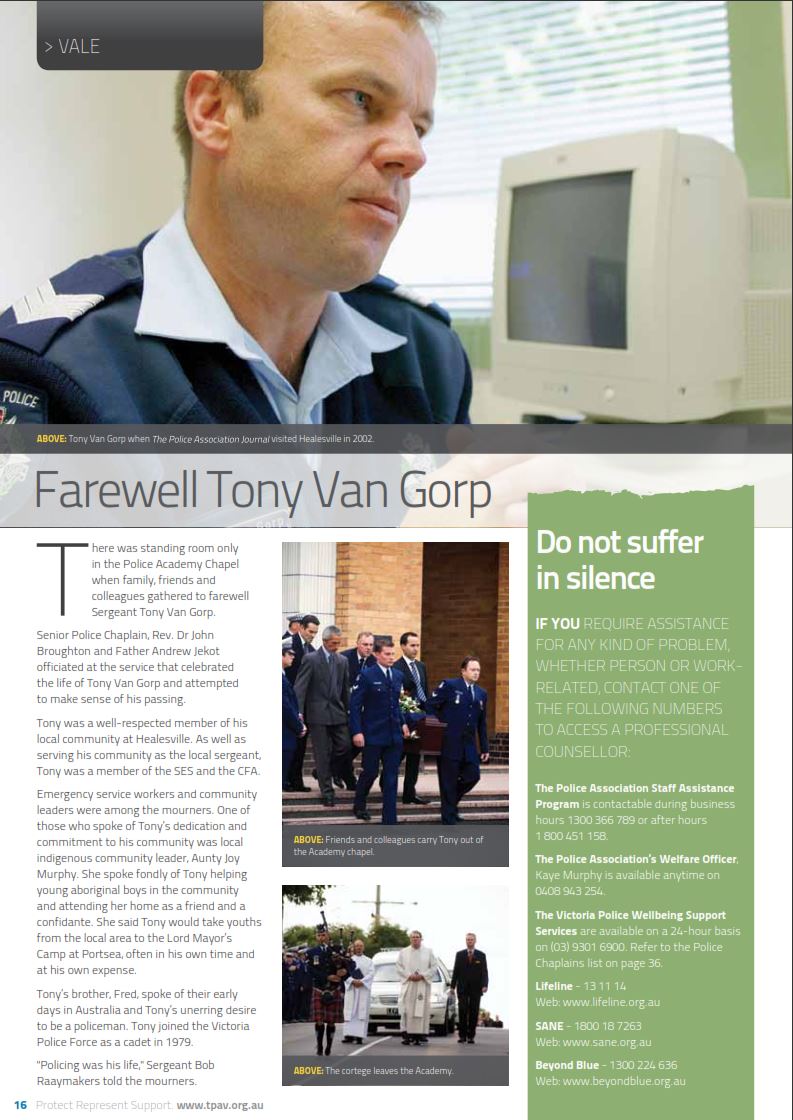
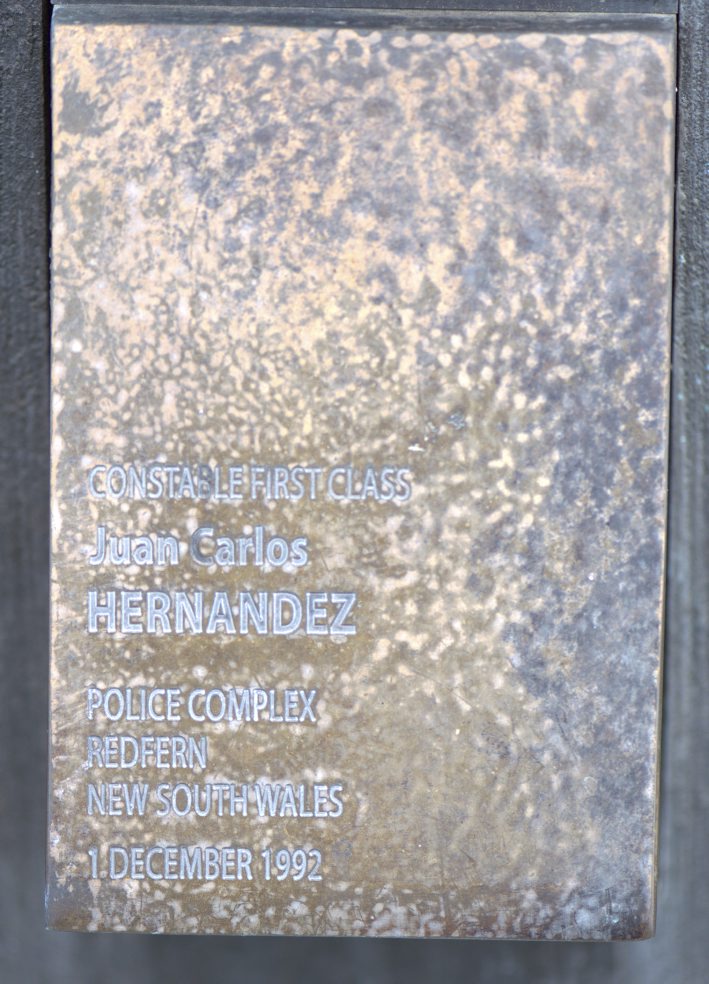
Anthony ‘ Tony ‘ Van GORP

Anthony ‘ Tony ‘ Van GORP

Victoria Police Force


Joined as a Victoria Police Cadet in 1979


Sergeant – Resigned March 2010


30 years service


Stationed at Healesville, Victoria


Suicide – Service Firearm

47 old

Died  22 March 2010

As of 10 January 2021 – Tony is NOT mentioned on the Police Wall of Remembrance
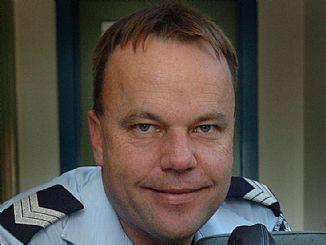
 

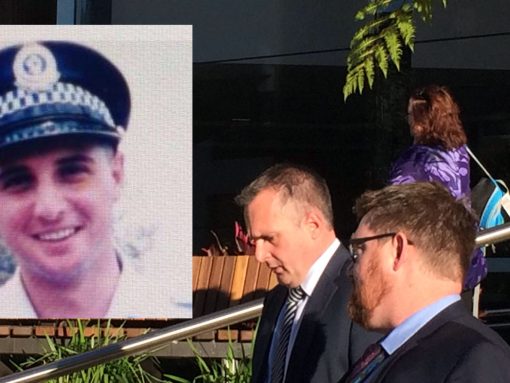
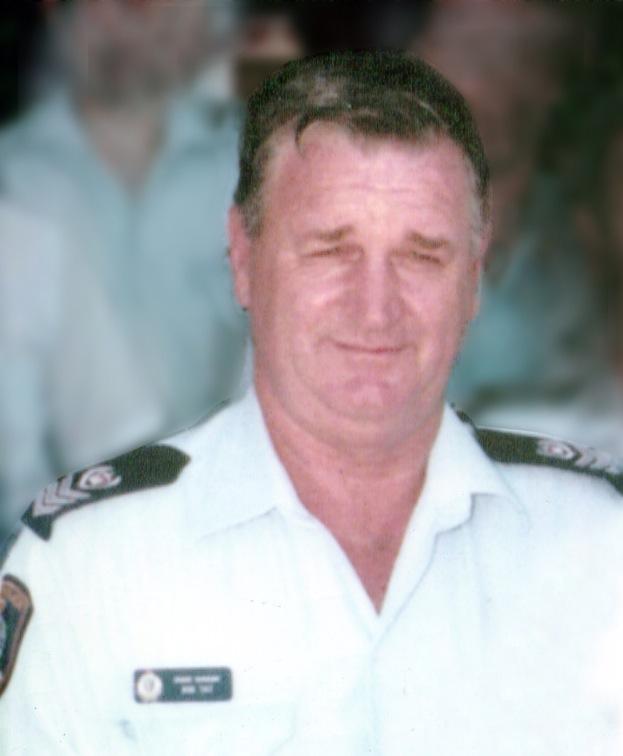
Sgt Anthony van GORP, VicPol


Tony van GORP - Facebook photo
Tony van GORP – Facebook photo


Location of Healesville Police Station:

[codepeople-post-map]

[google-map-v3 shortcodeid=”62cd8c83″ width=”350″ height=”350″ zoom=”12″ maptype=”roadmap” mapalign=”center” directionhint=”false” language=”default” poweredby=”false” maptypecontrol=”true” pancontrol=”true” zoomcontrol=”true” scalecontrol=”true” streetviewcontrol=”true” scrollwheelcontrol=”false” draggable=”true” tiltfourtyfive=”false” enablegeolocationmarker=”true” enablemarkerclustering=”false” addmarkermashup=”false” addmarkermashupbubble=”false” addmarkerlist=”37 Harker St, Healesville, Victoria{}shooting.png{}Healesville Police Station” bubbleautopan=”true” distanceunits=”km” showbike=”false” showtraffic=”false” showpanoramio=”false”]


Policeman shot, killed by own gun at Healesville police station

http://www.heraldsun.com.au/news/policeman-shot-by-own-gun-at-healesville-police-station/story-e6frf7jo-1225844032667

UPDATE 5.36pm: A POLICEMAN found shot dead with his own gun at an outer Melbourne station was under investigation.

The officer-in-charge is believed to have been shot by his own gun at Healesville police station in Melbourne’s outer east about 9.30pm.

Victoria Police named him as Sergeant Anthony Vangorp.

Paramedics arrived to find the sergeant had suffered a gunshot wound to the head and had died at the scene.

A police gun was found nearby.

Emergency crews could not revive him.

The officer, who had more than 30 years’ experience in the force, had been under investigation and tendered his resignation on Friday after a probe into “disciplinary issues”.

The resignation took effect yesterday, and it is believed the officer took his own life after returning to collect his belongings last night.

Other officers at the station had left on an urgent job, leaving him at the station alone, before returning to make the shock discovery.

There are no suspicious circumstances, but Assistant Commissioner Ken Lay told Radio 3AW that investigators would examine how the former officer was able to get access to a police-issue firearm.

He said the death had come as a shock to his colleagues, and that he was well liked and respected.

It is understood the member leaves behind a female partner.

“This is pretty horrible for the local police, for the member’s family and for the broader community,” Mr Lay said.

“He was a well-known member up there. Overall, it’s a pretty sad event,”

He said the officer had spent much of his time in the eastern region in his “30-odd years” of service.

Mr Lay confirmed police management had been talking with the officer last week about “a number of issues”.

But he would not reveal details of the investigation “out of respect to the member, his family and the staff out there”, other than to confirm that it was not a corruption investigation.

He would not comment on suggestions that the officer was going to be sacked if he did not resign.

The homicide squad, ethical standards department and the Coroner are investigating, with police expected to prepare a report for the Coroner.

For more information on depression and to seek help on suicide prevention, please contact Lifeline on 13 11 14 http://www.lifeline.org.au, SANE Helpline on 1800 18 SANE (7263) http://www.sane.org and Beyond Blue on 1300 224 636 http://www.beyondblue.org.au.

with Matthew Schulz


Police officer found dead in station

Posted by: 3AW Radio | 23 March, 2010 – 9:48 AM

http://www.3aw.com.au/blogs/3aw-generic-blog/police-officer-found-dead-in-station/20100323-qrxj.html

THOMAS HUNTER: The police officer found dead at a station in Melbourne’s outer east last night has been named as Sergeant Anthony Vangorp.

The 47-year-old officer in charge had been under investigation for ‘‘serious discipline matters’’ in the week before his death, Victoria Police confirmed in a statement.

Two officers returning from divisional van duties found Sergeant Vangorp’s body at the Healesville police station about 9.30pm.

He had a gunshot wound to the head, believed to have been inflicted by a police gun, which was found at his side. His death is not being treated as suspicious.

Sergeant Vangorp, a 30-year veteran of the force, was alone in the three-member station at the time.

Deputy Commissioner Ken Lay said Sergeant Vangorp had tendered his resignation last week after being questioned by police management about “a number of issues’’, but not corruption.

He said the sergeant’s resignation became effective yesterday, and an investigation into his death would probe how he had access to a weapon.

‘‘He was actually there [at the police station] collecting his belongings,’’ Mr Lay told radio station 3AW.

‘‘He had spoken to a couple of members who were at the station while he was doing that. They had to sneak out and do a quick job. When they came back they, unfortunately, found what they found.

‘‘This is pretty horrible for the local police, for the member’s family and for the broader community. He was a well-known member up there.’’

It is understood Sergeant Vangorp had two adult children.

For help or information visit beyondblue.org.au, call Suicide Helpline Victoria on 1300 651 251, or Lifeline on 131 114.


Blog comments Your Say

  • This is just sad. Sad for his family, sad for his friends, his workmates, for the Police Force and anyone involved. This will seriously change many lives and leave very deep scars and pain for many years to come. My heart go out to his family, friends and to our members, just keep holding that thin blue line…
    Current Member Thursday 8 April, 2010 – 2:16 PM
  • This is just a complete tragedy for the family left behind, including the members. How dare force command act the way they have and wipe the blood from their hands without conscience. Unfortunately, this is not the only member to take his life due to the actions of the force in the last 6 months… so sad, condolences to the family.
    disillusioned tjf Friday 26 March, 2010 – 12:47 AM
  • This is a sad ingigdment on our community, police force and government. Although never a servicing officer I have over the years known many servicing officers and I refuse to use the term “members” as members belong to clubs! This is a true reflection of the political involvement into our once respected police force in Victoria and confirms the assumptions of many that our former and current Chief commiissioner and deputies are nothing more than puppets of the state. Mr. Overland is an appointed CC of the current state government as was his predecessor along with his deputies also, Mr, Lay although a well liked man is unfortunately a yes man that has risen to his current position by his inability to stand his ground on issues where he know’s wrong is being done. Yet he fully accepts his position and standing in the communmity regardless of the current situation within Victoria Police. It is a sad fact that we have so much violence on our streets, disrespect of community and police yet nothing is being proactively done to rectify the issues, just more spin.
    Police force or political representatives?

    Shane Thursday 25 March, 2010 – 9:56 PM
  • this is more politically correct rubbish from the higher up officials , Police officers are just Human and should be able to look at emails as long as they are Not outside the Law that applies to each and everyone of us , No wonder police are leaving faster than they can recruit them
    Wayne Harris Wednesday 24 March, 2010 – 5:47 PM
  • This is just another disgrace by Victoria Police. I was a member for 42 and a half years, I was pushed out the door. I suffered from Post traumatic disorder which came about after being involved in a number of serious incidents over the years including being shot at and other serious issues. I spoke to Christine NIXON prior to my departure about two issues that are close to me. the first being the treatment of our Indigenous Population by Victoria Police, and the second being the treatment of members and the lack of welfare support. Christine did not want to know about anything about it. My issues came to a head after I was forced by an Officer to Lock up a current serving member, who was also a mate of mine, after he found himself in a situation with serious mental health issues brought about by some tragic issues that he had been involved in as part of his work. Vale Tony VAN GORP, a mans man, and another senior member crunched by an unjust employer.
    Brian McCALLUM Wednesday 24 March, 2010 – 5:03 PM
  • This is a disgrace! The Vic Police force is leaving this poor mans family in a shadow of doubt. If all he did was misuse emails why on earth was he forced to resign?? Is this more of passed leaders culture surfacing here??
    alexas Wednesday 24 March, 2010 – 2:02 PM

I think police command have to come clean with this. I smell fish and they should be up front for the sake of the public and the family

  • Julie- Bayswater Wednesday 24 March, 2010 – 2:25 AM
  • My thoughts to the family and even more to the members on duty who are going to be disected and thrown out by ESD who will investigate this incident along with the homocide squad but for them 10 minutes. ESD is the biggest department in the Victoria police and you could easily put an extra 500 police on the street if you cut ESD by 1/3Seious misconduct can be a police officer getting a parking ticket or a speeding fine in his/her private vehicle susequently receiving 2 penalties civil and internal.Police management and ESD have no idea about staff management. ESD has and will always be seen as a path to promotion take down and discredit as many police as you can regardless of the parking ticket and you will fly through the ranks. Someone in ESD is now going to be the next chief commissioner for his tact on this.
    Martin – Chiangmai Wednesday 24 March, 2010 – 2:06 AM
  • So sad Tony. Condolences to your family and collegues. I just hope that your death is not in vain and that a full enquiry into the circumstances of your death are conducted in a proper manner. Those that are responsible for the “Witch-Hunt” that led to this tragedy should hang their heads in shame. ESD should not be investigating this matter. They were the ones who led the investigation into your ALLEGED misdemeanours and should not be allowed to be involved into what will ultimately be another cover-up. The comments by Mr LAY were extremely inappropriate, suggesting that you were under investigation for serious discipline matters. Let him explain what this means, as I believe the community has a different idea.
    Concerned Citizen Tuesday 23 March, 2010 – 8:43 PM


Cop mourned

http://mountainviews.starcommunity.com.au/mail/2010-03-30/cop-mourned/

By Kath Gannaway
THE death of Sergeant Tony Van Gorp last week sent shockwaves through the Healesville community.
Tributes have flowed for the popular, community-minded policeman who as officer in charge at Healesville for the past 15 years, played an active role in many community organisations, particularly local schools.
Sgt Van Gorp, 47, was found dead on Monday night (22 March) by two colleagues when they returned to the Healesville police station at around 9.30pm.
Victoria Police confirmed his death just after midnight, stating that a gun was found at the scene and that there were no suspicious circumstances. It was soon also confirmed that he had had taken his own life.
The Melbourne media went into meltdown, and the rumour mill in Healesville followed suit, as it was revealed that Sgt Van Gorp was under investigation for misuse of the police email system.
Speculation was fuelled by the fact that Sgt Van Gorp had tendered his resignation on 18 March after receiving a Section 68 notice from Chief Commissioner Simon Overland.
The notice was one of only two issued by Mr Overland following investigations by the Ethical Standards Department for what were said to be “serious discipline matters”.
A close friend of Sgt Van Gorp has told the Mail he believed the letter was an ultimatum – resign or be sacked.
Much of the reporting on the police email crackdown last week revolved around other investigations being conducted by the ESD relating to racist and pornographic emails which Mr Overland said would shock the community.
He went on record on Thursday however as saying that the email for which he had delivered the section 68 to Sgt Van Gorp was neither racist, nor illegal.
Mr Overland has strongly rejected accusations that the Section 68 was a heavy-handed approach saying the email was sufficiently ‘serious’ to warrant the action.
He gave no indication as to the direction the ESD investigations into Sgt Van Gorp’s matter would now take, or if and when the exact nature of the email would be made known.
More stories on pages 8 and 9


Anthony van GORP 2 - VicPol - Suicide 22 March 2010


Police officer’s suicide may have been avoided over email scandal

Simon Overland

Simon Overland has been implicated in the investigation over a police officer’s suicide. Picture: Greg Scullin Source: Herald Sun

UPDATE 3pm: POLICE command says action taken to discipline an officer who later took his own life was “right and proper”.

The Office of Police Integrity is investigating claims that senior police – including Chief Commissioner Simon Overland – overlooked legal advice about how to discipline a police officer who later killed himself.

Healesville sergeant Tony Vangorp fatally shot himself after he was told to expect a Section 68 notice during Operation Barrott, an OPI-Ethical Standards Department probe into pornographic, racist and homophobic emails circulating among police.

The rarely used 68s are rubber-stamped by the Chief Commissioner and demand recipients show cause why they should not be sacked.

The Victorian Government Solicitor’s office is believed to have issued formal advice to senior police that 68s would be inappropriate in those cases. Internal police lawyers gave top brass similar legal advice.

The OPI has been told police may have misapplied their powers by issuing no-confidence notices during the email scandal that swept the force last year.

The officers implicated are Supt Lisa McMeeken, Assistant Commissioner Luke Cornelius and Mr Overland.

Police Association boss Greg Davies said he was amazed to hear of the allegations Mr Overland had disregarded advice.

“If that’s right and if those actions have contributed in any way, shape or form to the death of Tony Vangorp the Chief Commissioner surely cannot remain in office, then there’s only one person that’s made that decision in blatant disregard for internal and external legal advice that said don’t do it,’’ Snr-Sgt Davies said.

But in a statement released today, a Victoria Police spokesperson said police were confident they had followed proper procedure.

“Victoria Police is confident that the steps taken in relation to Sgt Tony Van Gorp in March last year were right and proper. These included, in recognition of the strong public interest in the matter from the outset, asking OPI to actively oversight our investigations,” the statement said.

“However we do not believe that the interests of the Van Gorp family are well served by further speculation and unseemly criticism in the media.

“The coronial process, in which we have confidence, must be allowed to run its course.”

The spokesperson said police would await the findings of the coronial inquest before making any further comment.

Mr Overland said today he did not ignore legal advice about issuing a disciplinary notice to Sgt Van Gorp.

“If there is an OPI investigation into that, that’s fine and I welcome that,’’ he said.

“I have absolutely nothing to fear or hide in relation to that particular case.’’

Mr Overland said he was the only person who could issue the rarely used Section 68 notice, and legal advice surrounding them was often contradictory.

He said Sgt Van Gorp resigned after the notice was issued.

Premier Ted Baillieu said today Mr Overland had his full support.

“I haven’t seen the issue in detail but the answer is yes (I have faith in Mr Overland),” he said.

The Herald Sun understands that another 68 issued under Barrott – to a senior detective in Geelong – has been withdrawn.

Senior police were advised that a Section 69 notice, which refers suspect officers to a disciplinary hearing, would be a more suitable way to deal with those caught up in Barrott.

Eight officers were sacked and about 13 others fined or demoted after they were found with vile emails on their computers last year. Several have lodged appeals.

An OPI spokesman last night said the office was “actively oversighting Operation Barrott and associated matters”.

Sgt Van Gorp, a 30-year police veteran, shot himself at his police station last March. His death is before the Coroner’s Court.

Of the six 68s issued in Victoria, only one has not been overturned.

In advising against 68 notices, one government solicitor cited a precedent involving a fraud squad member disciplined with a 69 notice for having similarly offensive emails on his computer.

Anyone with personal problems can call Lifeline on 131 114; Victorian Statewide Suicide Helpline on 1300 651 251; or Mensline Australia on 1300 789 978.

crawfordc@heraldsun.com.au
– with Amelia Harris, Stephen McMahon


Questions remain

By Kath Gannaway
Sgt van Gorp took his own life five days after receiving a rarely invoked Section 68 notice in relation to a probe into emails circulating among police.
The Section 68 notice demands that the recipient show cause why they should not be sacked.
Victoria Police issued a statement last week in response to claims made in the Herald Sun that the Office of Police Integrity was investigating whether senior police, including Chief Commissioner Simon Overland, had overlooked legal advice about the use of the Section 68.
Another option would have been a Section 69, which refers the recipient to a disciplinary hearing.
Sgt van Gorp’s brother, Fred van Gorp told the Mail he was pleased to hear the OPI was investigating the circumstances around the way his brother was disciplined.
“It is what we were hoping for from the start,” he said.
“The Section 68 is for criminals; police who have committed criminal activity, and what I am gathering from all this is that he should have got a Section 69 instead of the Section 68.”
Victoria Police however say they are confident the steps taken were “right and proper”.
“These included, in recognition of the strong public interest in the matter from the outset, asking OPI to actively oversight our investigations,” the statement said.
“The coronial process, in which we have confidence, must be allowed to run its course.”
Mr van Gorp however said he had not been advised as to whether the police report into his brother’s death had been handed over to the Coroner.
“I have been ringing the police for the last 17 months to find out and we’re still waiting,” he said.
A spokesperson for the Coroner’s Court told the Mail on Friday they could not do anything until the police had finished their part.
“We have not received anything from the police yet that has been logged as at Mid-March,” she said.
Detective Inspector John Potter of the Homicide Squad confirmed on Monday that the brief of evidence was finished, but said it was still under review.
He said that review was an internal police mechanism involving both the OPI and the Ethical Standards Department.
Det Insp Potter said the brief should be with the Coroner by early next month.


Inquest

http://mountainviews.starcommunity.com.au/mail/2011-12-06/inquest/

By Kath Gannaway
Sgt van Gorp, 47, took his own life at the Healesville police station on 22 March 2010.
He had resigned from Victoria Police five days earlier, after he was issued with a Section 68 notice of no confidence by then Commissioner of Police Simon Overland.
Sgt van Gorp was under investigation at the time for misuse of the police email system.
Mr Olle told a packed court at a mention hearing on Wednesday 30 November that an inquest into Sgt van Gorp’s death “ … would appear to be the antithesis of what Sergeant van Gorp would have wanted in life”, but did not elaborate on the basis for that statement.
He said the hearing was to help determine whether it was necessary or appropriate to conduct an inquest.
He said the police investigation brief submitted to him was thorough, containing 64 statements and addressing, among other matters the circumstances in which Victoria Police made decisions to serve the Section 68 notice.
He noted that Victoria Police had subsequently made changes to the process involved in serving no-confidence notices.
Mr Olle allowed 14 days for submissions.
“Subject to submissions from interested parties in this matter urging a different view, it appears that the facts and circumstances are clear and that the conduct of an inquest would be beyond the scope of my statutory obligations,” he said.
Sgt Van Gorp’s partner Gayle Shelley and his brother Fred van Gorp were in the court, but declined to comment on the matter pending further submissions.
A further hearing will be held on 16 December.


Van Gorp inquest call

By Kath Gannaway and Melissa Meehan
THE Police Association is pushing for an inquest into the apparent suicide of Healesville Sergeant Tony van Gorp.
Theo Cassamatis, representing both the Police Association and partner Gayle Shelley and brother Fred van Gorp, told the Melbourne Coroners Court on Friday that the court brief was just the beginning of the story.
He said without an inquest, the true circumstances of Sgt van Gorp’s death at Healesville Police Station in March last year and the reasons for the way he was treated would not be revealed.
“Unless that question is answered, as to why this man was targeted, whatever amendments are put in place that they are as susceptible to failure or error as those in place when Tony van Gorp was issued with the Section 68 notice,” Mr Cassamatis said.
“The answer why can only be achieved by interrogating those who have made statements.”
Mr Cassamatis dismissed what he called a misconception that an inquest is not what Sgt van Gorp wanted.
“The circumstances surrounding his death have already been aired,” Mr Cassamatis said.
“The people of Healesville know all too well why he ended his life.”
Dr Ian Freckleton SC, representing the Chief Commissioner made the point that some things may come out that could reflect badly on Sgt van Gorp but acknowledged that other than the email incident he had a flawless 32 year history in the force.
Coroner John Olle said he would take both arguments into consideration and come back with a decision in the new year.
Sgt van Gorp’s partner Gayle Shelley and his brother Fred were among family members at the hearing.


Van Gorp inquest call

By Kath Gannaway and Melissa Meehan
THE Police Association is pushing for an inquest into the apparent suicide of Healesville Sergeant Tony van Gorp.
Theo Cassamatis, representing both the Police Association and partner Gayle Shelley and brother Fred van Gorp, told the Melbourne Coroners Court on Friday that the court brief was just the beginning of the story.
He said without an inquest, the true circumstances of Sgt van Gorp’s death at Healesville Police Station in March last year and the reasons for the way he was treated would not be revealed.
“Unless that question is answered, as to why this man was targeted, whatever amendments are put in place that they are as susceptible to failure or error as those in place when Tony van Gorp was issued with the Section 68 notice,” Mr Cassamatis said.
“The answer why can only be achieved by interrogating those who have made statements.”
Mr Cassamatis dismissed what he called a misconception that an inquest is not what Sgt van Gorp wanted.
“The circumstances surrounding his death have already been aired,” Mr Cassamatis said.
“The people of Healesville know all too well why he ended his life.”
Dr Ian Freckleton SC, representing the Chief Commissioner made the point that some things may come out that could reflect badly on Sgt van Gorp but acknowledged that other than the email incident he had a flawless 32 year history in the force.
Coroner John Olle said he would take both arguments into consideration and come back with a decision in the new year.
Sgt van Gorp’s partner Gayle Shelley and his brother Fred were among family members at the hearing.


Tony’s truth unheard

http://mountainviews.starcommunity.com.au/mail/2012-02-21/tonys-truth-unheard/

By Kath Gannaway
THE two people closest to Tony van Gorp, his partner Gayle Shelley, and his brother Fred van Gorp, have maintained a dignified silence over the past two years.
Behind the scenes, they’ve grieved, fought for justice and the reputation of the Healesville police sergeant, and for changes to Victoria Police disciplinary processes to ensure what happened in Healesville on 22 March, 2010, never happens again.
The grieving is their own, but they had hoped that the inquest they and the Victorian Police Association were calling for would deliver the answers and changes they and other police wanted.
As they sat in the Coroner’s Court in Melbourne on Wednesday, 15 February Ms Shelley bowed her head several times as Coroner John Olle read out his decision. Fred van Gorp looked resigned; perhaps even defeated.
With his decision the Coroner put an end to any resolution on the question of accountability of the Chief Commissioner of Police at the time, Simon Overland, and the right or wrong of issuing the Section 68.
“He had 31 years’ experience, but it didn’t seem to account for anything in terms of what happened. Tony was just backed into a corner; he felt like he had nothing else,” Ms Shelley said.
“I was with him when he went to the (Police) Association. He lived on his public image, it was part of him, and when he got the notice, he realised he had let people down, and I suppose he let himself down,” she said.
“He knew there would be consequences … everybody makes mistakes but it (the Section 68) was designed for criminal (behaviour) and what Tony did certainly was not criminal,” she said, adding that she felt those issues have been brushed under the carpet.
Nonetheless, with their usual dignity, they say they have accepted the Coroner’s decision, but hope with the ongoing investigation the Coroner will at the very least address what they believe was a critical failure by Victoria Police – the lack of welfare provided to Sgt van Gorp after the delivery of the Section 68.
Admitting disappointment, he said however the Coroner’s response was a balanced one.
“Hopefully any future findings will ensure this never happens to another police officer again and that anyone put in that position gets adequate support and counselling,” Mr van Gorp said.
“We know now that we are not going to get an inquest, and perhaps we can move on a little bit from there,” he said.
In response to the Coroner’s comment that his findings would include Sgt van Gorp’s presence at the police station on the night of his death, both Ms Shelley and Mr van Gorp reflected with the benefit of hindsight, and say no-one could have known what was coming.
“Tony and Gayle had been planning on going on trips, and he was planning a fishing trip the next day … we didn’t expect it.
“It was a unique position (at Healesville police station) as officer in charge for 15 years, and while that’s probably something that needs to be addressed in the future, I don’t hold anyone (at Healesville) responsible for what happened on that night,” he said.
Ms Shelley said his colleagues had gone through great personal hardship over Sgt van Gorp’s death. “No-one is to blame there,” she said.
Readers seeking support and information about suicide prevention can contact Lifeline on 13 11 14 or SANE Helpline on 1800 18 SANE (7263).


Inquest denied

By Kath Gannaway
THERE will be no inquest into the death two years ago of Healesville Police Sergeant Tony van Gorp.
Sgt van Gorp, 47, was found dead at Healesville Police Station on 22 March, from a self-inflicted gunshot wound. He was under investigation in relation to misuse of the police email system and had been issued with a Section 68 (no-confidence) notice by the then Chief Commissioner of Police Simon Overland, five days before his death.
Sgt van Gorp’s partner Gayle Shelley and the Police Association had sought an inquest as part of Coroner John Olle’s ongoing investigation, partially to determine why Sgt van Gorp had been singled out by Commissioner Overland for what was seen as harsh and unusual treatment, and to restore his reputation.
Coroner John Olle ruled on Wednesday, 15 February, at the Coroner’s Court in Melbourne that the matters raised were beyond his jurisdiction in terms of an inquest and said he was satisfied that the cause and circumstances of Sgt van Gorp’s death could be established without one.
Coroner Olle said he had considered submissions from Ms Shelley and the Police Association (the applicants), as well as from the Chief Commissioner of Police in making his decision.
He said the basis for the applicants’ submission included a need to determine why the Chief Commissioner had considered dismissal as the appropriate action, to dispel claims that new procedures since introduced were appropriate and to bring about changes to legislation, including the removal of Section 68 notices.
While the submission made by the Chief Commissioner of Police neither argued for or against an inquest, it contended that an examination of the Chief Commissioner’s powers of dismissal were outside the scope of the coroner’s jurisdiction and that there was no evidence of systematic defects which needed to be explored as part of an inquest.
In relation to Sgt van Gorp’s reputation, he said the reputation of an individual was outside both the scope and legitimate purpose of an inquest, and outside the control of the coronial process.
“How matters are reported in the media cannot be controlled and have the potential to be very disturbing and intrusive to family members,” he said.
He said having examined the 963-page brief of evidence, he found no evidence to suggest that anyone who knew Sgt van Gorp thought less of him as a result of his behaviour.
While Ms Shelley said she was sceptical about the submissions put forward by the Commissioner of Police, and that she felt the issues around the Section 68 notice had been swept under the carpet, she said she accepted the decision.
Police Association secretary Greg Davies said the association was still vehemently opposed to the Section 68 process and had been in negotiations with the government in terms of a range of issues that needed to be addressed by the government, rather than by police. He said those negotiations were continuing.
He noted that the coroner had said his preliminary view was that the facts and circumstances of Sgt van Gorp’s death were clear and that an inquest was beyond his statutory obligations.On the matter of whether there was a systematic defect (in issuing the section 68) Mr Davies said the door was not closed on that question.
“He (the Coroner) is not saying there is no systematic defect, but that there is no systematic defect that requires an inquest. He may determine independently of an inquest that there is, or he may not,” he said.
He said the association accepted the coroner’s decision and would wait on the outcome of the investigation to see what end result would be. Readers seeking support and information about suicide prevention can contact Lifeline on 13 11 14 or SANE Helpline on 1800 18 SANE (7263).
>>> For more on Van Corp inquest issue see Page 3.


Partner wins compensation over police sergeant’s suicide

The former de-facto wife of a respected 30-year policeman who shot himself at work has won a six-figure compensation payout from Victoria Police’s WorkCover insurer.

One of Sergeant Tony Van Gorp’s children will also receive compensation after police settled both claims before a contested County Court trial this week.

Sergeant Van Gorp died on March 22, 2010, at the Healesville Police Station five days after he was served with a notice of proposed dismissal for misconduct.

Then chief commissioner Simon Overland issued the notice after Sergeant Van Gorp, 47, was found to have received, stored and sent pornographic and inappropriate emails.

Gayle Shelley told Fairfax Media she was relieved the case was resolved, but was “extremely disappointed” that Mr Overland “elected to single Tony out so dramatically”.

“Tony was a dedicated member of the Victoria Police Force for 30 years and we now want to honour the work that he did and the person who he was,” she said.

A coroner later found that “everyone, including police colleagues, appeared to agree with (Sergeant Van Gorp) that the (notice) was ‘heavy handed’ for the behaviour he engaged in”.

In his findings last May, published today by The Age for the first time, the coroner John Olle said that in the days before his death he was very well supported by family, friends and colleagues.

Sergeant Van Gorp had regarded his behaviour as stupid but thought the notice was “heavy handed”, Mr Olle said.

He said it was clear he was “suffering” from the abrupt end of his career – his resignation was accepted and effective on March 27 – but no one, including a doctor and a psychologist, believed he was at risk of self harm.

He found that the “evidence suggests that Victoria Police were aware” the effect of the notice of Sergeant Van Gorp would be “shocking”.

Mr Olle further said that central to his actions on the night of his death was that he believed “people would think less of him “over the notice but that his perspective “on this matter was not supported by the evidence …”

Ms Shelley, who had been Sergeant Van Gorp’s partner since 2004, sued after Victoria Police’s insurer rejected her initial claim.

A major dispute between the parties centred on the appropriateness of the dismissal procedure, whether it caused or contributed to any mental injury and exposed Sergeant Van Gorp to the risk of harm.

Ms Shelley’s lawyer, Craig Sidebottom, of Slater & Gordon, told Fairfax Media that the “manner in which Victoria Police dealt with Tony was both unprecedented and heavy handed”.

“The power of dismissal that resided in s68 of the Police Regulation Act should have only be exercised by the Chief Commissioner very sparingly and ought be reserved for cases involving major corruption or criminal offence.

“Section 68 is a draconian provision. There were far better alternatives available to the Chief Commissioner when dealing with these issues.”

A police spokeswoman told Fairfax Media that ‘‘as Victoria Police is not a party to the proceedings, it is not for us to comment’’.

‘‘Tony Van Gorp’s death was a tragedy and Victoria Police extend our sympathy to his family and friends,’’ the spokeswoman added.


Read more: http://www.theage.com.au/victoria/partner-wins-compensation-over-police-sergeants-suicide-20130409-2hjhz.html#ixzz3JPzfcVgA

Partner wins compensation over police sergeant’s suicide

Date  

Steve Butcher

 EXLUSIVE

The former de-facto wife of a respected 30-year policeman who shot himself at work has won a six-figure compensation payout from Victoria Police’s WorkCover insurer.

One of Sergeant Tony Van Gorp’s children will also receive compensation after police settled both claims before a contested County Court trial this week.

Sergeant Van Gorp died on March 22, 2010, at the Healesville Police Station five days after he was served with a notice of proposed dismissal for misconduct.

Then chief commissioner Simon Overland issued the notice after Sergeant Van Gorp, 47, was found to have received, stored and sent pornographic and inappropriate emails.

Gayle Shelley told Fairfax Media she was relieved the case was resolved, but was “extremely disappointed” that Mr Overland “elected to single Tony out so dramatically”.

“Tony was a dedicated member of the Victoria Police Force for 30 years and we now want to honour the work that he did and the person who he was,” she said.

A coroner later found that “everyone, including police colleagues, appeared to agree with (Sergeant Van Gorp) that the (notice) was ‘heavy handed’ for the behaviour he engaged in”.

In his findings last May, published today by The Age for the first time, the coroner John Olle said that in the days before his death he was very well supported by family, friends and colleagues.

Sergeant Van Gorp had regarded his behaviour as stupid but thought the notice was “heavy handed”, Mr Olle said.

He said it was clear he was “suffering” from the abrupt end of his career – his resignation was accepted and effective on March 27 – but no one, including a doctor and a psychologist, believed he was at risk of self harm.

He found that the “evidence suggests that Victoria Police were aware” the effect of the notice of Sergeant Van Gorp would be “shocking”.

Mr Olle further said that central to his actions on the night of his death was that he believed “people would think less of him “over the notice but that his perspective “on this matter was not supported by the evidence …”

Ms Shelley, who had been Sergeant Van Gorp’s partner since 2004, sued after Victoria Police’s insurer rejected her initial claim.

A major dispute between the parties centred on the appropriateness of the dismissal procedure, whether it caused or contributed to any mental injury and exposed Sergeant Van Gorp to the risk of harm.

Ms Shelley’s lawyer, Craig Sidebottom, of Slater & Gordon, told Fairfax Media that the “manner in which Victoria Police dealt with Tony was both unprecedented and heavy handed”.

“The power of dismissal that resided in s68 of the Police Regulation Act should have only be exercised by the Chief Commissioner very sparingly and ought be reserved for cases involving major corruption or criminal offence.

“Section 68 is a draconian provision. There were far better alternatives available to the Chief Commissioner when dealing with these issues.”

A police spokeswoman told Fairfax Media that ‘‘as Victoria Police is not a party to the proceedings, it is not for us to comment’’.

‘‘Tony Van Gorp’s death was a tragedy and Victoria Police extend our sympathy to his family and friends,’’ the spokeswoman added.

http://www.theage.com.au/victoria/partner-wins-compensation-over-police-sergeants-suicide-20130409-2hjhz.html


George Herbert GRAY

George Herbert GRAY

Late of Loch Maree St, Kingsford, NSW

New South Wales Police Force

Regd. #  ?

Rank:  Constable – appointed ? ? ?


Stations: , Darlinghurst – death


ServiceFrom ? ? ?     to  6 April 1938 = ? years Service


Awards:  No find on It’s An Honour


Born: ? ? 1907 – 8 in England ( Emigrated to Australia in 1927 )

Died on:  Wednesday  6  April 1938 about 6.45am in the bathroom

Cause:  Illness – Depression – Suicide – firearm – Service Pistol

Event location:  Home – Loch Maree Street, Kingsford, NSW

Age:  30


Funeral date:  Friday  8 April 1938

Funeral location: “Hundreds lined the pavements of George street and Railway square this afternoon to watch the funeral led by 30 uniformed police and the Police Band leave Wood Coffill’s chapel for Botany cemetery’


Buried at:  Botany Cemetery, 12 Military Rd, Matraville, NSW

Grave Location:  ADDD Anglican  FM  DDD, Position 208


George is NOT mentioned on the Police Wall of Remembrance  BUT SHOULD BE


Some articles state that the suicide was on the 6 April whereas other articles state the suicide was on the 7 April

Constable Gray was found shot dead at his home in Loch Maree Street, Kingsford, a few hours before he was to have appeared at the City Coroner’s Court to give evidence about the death of Mrs. Dorothy Alice Graveur on Christmas Eve, 1937.

It is almost certain that the constable committed suicide after worrying himself about his temporary absence from his post in Oxford Street, Paddington when Mrs Graveur was killed by a motor cycle.

Constable Gray was not held responsible for his absence by the Police Department, but he had convinced himself that the accident wouldn’t have happened had he been present at the time. The continual worry about the death had also begun to affect his health, and after a minor operation on his throat he was to have been transferred to a station on the South Coast.

At the inquest on 23 April, 1938 the constable’s wife Mrs. Marjorie Gray gave evidence to the effect that just before going to bed on the night before his death her husband had been reading some papers relating to the inquest into the death of Mrs Graveur, due to be held the following day. She said he seemed worried about the case.

About 6.45 am she was awakened by a shot, and she quickly informed a constable who lived two doors away. Her husband’s body was found in the bathroom with his service pistol nearby.

In a note addressed to Marjorie, found beside his body, Constable Gray had described himself as a failure, and said that he could not stand the worry and shame he had brought on himself.

At the time of his death the constable was aged 30 years and was stationed at Darlinghurst.


Cootamundra Herald ( NSW )      Friday 8 April 1938       page 1

CONSTABLE SUICIDES

No Reason Given

SYDNEY, Friday. ,

Detectives are at a loss to explain the Suicide of Constable George Herbert Gray, 30, at Kingswood, except for the fact that he was extremely grieved over the death of Dorothy Alice Graveur, 45, who was killed in a motor cycle accident in Oxford street on Christmas Eve.

Gray was on point duty near the spot, and during his temporary absence on a personal matter, the woman was killed. A departmental inquiry absolved him of the responsibility, but the woman’s death worried him, as he believed the accident would not have occurred if he had been there.

After the event he became ill, and was transferred to the South Coast with his wife and children to give him a chance to recover.

His tonsils were recently removed, and early this week he said his health was much improved.

Before shooting himself with his service revolver, Gray wrote an affectionate letter to his wife, but did not give any reason for his act.

At the conclusion of the inquest concerning Mrs. Graveur, the coroner returned a verdict of accidental death.


Riverine Grazier ( Hay, NSW )

Friday 8 April 1938       page 2

A Peculiar Development.

SYDNEY, Friday.

Constable George Herbert Gray (30) who was found dead at his home, Kingsford, yesterday, with a bullet in the temple, was to have been the principal witness at the inquest into the death of the two women who had been killed in separate accidents by a motor cycle, ridden by Thomas R. Curyer, of Paddington.

The police say that Gray has been worried for some time over the case. A revolver was found lying beside him.

Further Particulars. SYDNEY, Friday Noon

Detectives are at a loss to explain the suicide of Constable G. H. Gray (30), at Kingsford, except for the fact that he was extremely grieved over the death of Dorothy Alice Graviur (45), who was killed in a motor cycle accident in Oxford St., on Xmas Eve.

Constable Gray was on point duty near the depot., and during his temporary absence on a personal matter, the woman was killed.

The departmental inquiry absolved him of responsibility, but the woman’s death worried him, as he believed the accident would not have occurred if he had been there.

http://trove.nla.gov.au/newspaper/article/137364204?searchTerm=%22george%20herbert%20gray%22&searchLimits=sortby=dateAsc#


Lithgow Mercury ( NSW )

Friday 8 April 1938      page 4

SAD SUICIDE

Of Sensitive Police Officer

SYDNEY, This Afternoon.

Const. George Herbert Gray ( 30 ) who committed suicide at his home at Kingsford yesterday is believed to have been worried over the fact that, while he was temporarily away from point duty a woman was killed in a motor cycle accident. Gray’s death was revealed yesterday at the inquest on the woman. He was absolved by the departmental inquiry, but he became ill, and arrangements were made for his transfer to the country. Gray left an affectionate letter to his wife, but gave no reason for shooting himself.

http://trove.nla.gov.au/newspaper/rendition/nla.news-article220879858.txt


Advertiser ( Adelaide, SA )

Saturday 9 April 1938      page 26

SUICIDE OF POLICE CONSTABLE

Worry About Work Thought To Be Reason SYDNEY, April 8.

Worry about his temporary absence from his post, is believed to have been the reason why Constable George Herbert Gray, 30. committed suicide yesterday. Gray was found dead by his wife at his home in Loch Maree street Kingsford, several hours before he was to have appeared at the City Coroner’s Court to give evidence about the death of a woman.

revolver was lying beside him with a note addressed to his wife, in which he regretted that he had to leave her.

Police officials believe that Gray committed suicide after worrying himself about his temporary absence from his post when Mrs. Dorothy Alice Graveui of Glenore road, Paddington, was killed by a motor cycle in Oxford street near Dowling street, Darlinghurst, on Christmas Eve.

Gray was not held responsible for his temporary absence by the Police Department, but it is believed that he thought the accident might not have happened if he had been present.

Worry affected his health. After a minor operation to his throat he was to have been transferred with his wife and three children to a station on the south coast.

The Deputy Commissioner of Police ( Mr. T. Lynch ) said today that Gray had a good record in the Police Force.

http://trove.nla.gov.au/newspaper/rendition/nla.news-article30859622.txt


Labor Daily (Sydney, NSW : 1924 – 1938),

Saturday 9 April 1938, page 7

FAMILY’S SAD PLIGHT

DEATH OF POLICE OFFICER

Wife Almost Penniless 1 3 CHILDREN

In the tragic death of Constable George Herbert Gray, 30, of Darlinghurst Police Station, on Wednesday has left his young wife and three small children in a sad plight.

They are practically penniless, and Mrs. Gray, who is an Englishwoman, has only one relative — her mother – in this country, and she, too, is not well off.

Constable Gray was found dead at his home in Kingsford on Wednesday. There was a bullet wound in his temple and a revolver was found nearby.

Overcome with grief, Mrs. Gray, for the present, is staying with neighbours, who are also caring for the children.

The children, all girls, aged 2, 5, and 7 years, respectively, nave not yet been informed of their father’s death. They were told that “Daddy” was In hospital.

Will Be Cared For

The grant that Mrs. Gray will receive from the Government will only be small, but, according to police officers, she will be “looked after.”

Already many officers have intimated their intention of contributing to a distress fund, and it is anticipated that a considerable sum will be subscribed.

Neighbors say that Mr. and Mrs. Gray were a most devoted couple.

It was explained yesterday that Gray was greatly worried over a motor cycle accident in Oxford Street, Paddington, on Xmas Eve last when Mrs.

Dorothy Alice Graveur, 45, of Paddington, was fatally injured.

Gray was on point duty near the scene of the crash, but at the time he had left his post temporarily. It was while he was away that the accident had occurred.

Gray, according to his colleagues, although he was not held responsible for the accident, believed that the woman would not have been killed if he had been there.

The late constable, who was born in England, came to Australia about 1927, and after working on the buses for a period, obtained an appointment in the police force.

His bride, then a young girl of 20, came out from England soon afterwards and they were quietly married at a suburban church.

Led by the Police Band, the funeral left parlors in George Street, City, yesterday afternoon for Botany cemetery.

Deceased had no relatives in Australia, and besides his wife and her mother, the chief mourners at the funeral were his fellow police officers, who formed a large contingent.

https://trove.nla.gov.au/newspaper/article/239995462


Newcastle Sun ( NSW )

Friday 22 April 1938         page 8

TORTURED BY HIS SENSE OF DUTY

SUICIDE OF A CONSTABLE SYDNEY, Friday.

Tortured by the fear that, he had failed in his duty and had wrecked his career, Constable George Herbert Gray, 30, shot himself with his own service revolver on April 7, the morning when he was to have given evidence at an inquest, the City Coroner ( Mr. Oram ) found to-day. ‘It was most tragic, as he had done his duty properly and was regarded as a most capable officer,’ said Mr. Oram.

‘There is no doubt that Gray was worried very much by the inquest, which concerned a woman who had been killed in a motor cycle accident. It preyed on Gray’s mind that he did not report the motor cyclist for a breach, as the same motor cyclist was involved in another accident a few days later when a girl was killed. ‘The sad and painful fact is that Gray had no cause at all for worry as at the Inquest, It was found that the first mishap was entirely an accident and there was no reason why the motor cyclist should have been reported.

A finding of suicide was returned, Mr. Oram said.

http://trove.nla.gov.au/newspaper/rendition/nla.news-article166709759.txt


Daily Advertiser (Wagga Wagga, NSW : 1911 – 1954),

Monday 25 April 1938, page 7

CONSTABLE’S SUICIDE

WORRY OVER CORONER’S INQUIRY | SYDNEY, Saturday.

A finding of suicide was returned by the City Coroner (Mr. E. T. Oram), at the conclusion of an Inquest into the death of George Herbert Gray, aged 30 years a police constable, who was found dead on April 6, the day on which he was to have appeared as a witness in a Coroner’s Court inquiry.

In returning his finding the Coroner said that Gray‘s death was a very sad and painful matter. There was no doubt that he had worried about the outcome of an inquiry into the death of a woman in which a motor cyclist had been involved.

A few days after the death of the first woman the same motor cyclist had been involved. ” There was no need for deceased to have worried as he did, said the Coroner, ” for the inquiry into the first accident showed that there was no action on the part of the motor cyclist which should have been reported by Gray. The action which the constable took was correct and his death is most unfortunate.

Marjorie Iris Gray, wife of the deceased, said that her husband, before retiring to bed on April 5, was reading some papers referring to a Coroner’s inquiry to be held the following day. He seemed worried about the case.

About 6.45 a.m. on April 6 she was awakened by a shot and she informed a constable who lived two doors away. Her husband’s body was found in the bathroom with his service pistol near by.

Sergeant L. G. Salkeld ( Leslie George SALKELD NSWPF # Q 9438 ) said that deceased had a good reputation in the police force and witness could not understand why he should have taken his life. In a note which witness found beside the body, Gray had described himself as a failure, and said that he could not stand the worry and shame he had brought on himself. .

https://trove.nla.gov.au/newspaper/article/143723052


NSW BDM

Marriage:  902/1929   Marjorie I MERSH.  Married in the District of Ashfield

Death:  10969/1938     Father = Wilfred   Mother = Emma


Sydney Morning Herald

Saturday 18 January 1936      page 16

BIRTHS.

GRAY – January 16 Netherleigh private hospital, Randwick to Marjorie wife of George Herbert Gray of Beauchamp Road Matraville – a daughter

( Patricia Margaret ) Both well

http://trove.nla.gov.au/newspaper/article/17222662?searchTerm=%22george%20herbert%20gray%22&searchLimits=sortby=dateAsc#


The Daily Telegraph

Saturday 23 July 1938     P 10

LEGAL NOTICES

5/- per inch dally.

IN THE SUPREME COURT OF NEW SOUTH WALES — PROBATE JURISDICTION — IN THE MATTER of the Estates of the undermentioned deceased persons, and in the matter of the Wills, Probate, and Administration Act. 1898 -1932; the Public Trustee Act, 1913 – 1938; and the Testator’s Family Maintenance and Guardianship of Infants Act, 1916. NOTICE IS HEREBY GIVEN that the Public Trustee has this day filed in the Registry of this Honourable Court his elections to administer the Estates of the following deceased persons: —……..

GEORGE HERBERT GRAY, late of Loch Maree Street, Kingsford, In the State of New South Wales, Police Constable, who died 7th April, 1938. Intestate.

https://trove.nla.gov.au/newspaper/article/247345909


Kerry John WEEKES

Kerry John WEEKES

New South Wales Police Force

Redfern Police Academy Class # 116

Regd. #  13419


Rank: Probationary Constable – appointed 16 September 1968

Constable – appointed ? ? ?

Constable 1st Class – appointed 16 September 1973

Senior Constable – appointed 16 September 1977

Sergeant 3rd Class – appointed 8 September 1984

Sergeant 3rd Class ( Traffic Sergeant )


Stations?, 21 Division, Petersham ( 1975 ), 8 Division ( late 1970’s ), Balmain, Leichhardt, Fairfield ( 34 Division ) – Death


Service:   From pre September 1968 ? to  17 April 1987 = 19+ years Service


Awards: National Medal – granted 19 November 1984 ( SenCon )


Born: Tuesday  21 December 1948

Age:  38 yrs  3 mths  27 days

Died on :  Friday  17 April 1987 ( Good Friday )

Cause:  Suicide via Service Pistol .38 Smith & Wesson revolver

Event location:  Traffic Office, 2nd floor, west building of old Fairfield Police Stn, Smart St, Fairfield ( 34 Division )


Funeral date: ?

Funeral location: Orange, NSW

Buried at: Orange General Cemetery, Lone Pine Ave, Orange, NSW.

Grave: Anglican Lawn, Section D, Plot 5


KERRY is NOT mentioned on the Police Wall of Remembrance  * BUT SHOULD BE


Sergeant Kerry WEEKES was a Traffic Sergeant at Fairfield Police Station when, in 1987, he shot himself with his service revolver whilst inside the Traffic Office of that building.

Fairfield Police Station, at that time, comprised to two buildings on either side of the driveway which passed between the two buildings.

The Traffic Office was on the second floor on the western side of the driveway and was at the rear of that building overlooking the rear car park.

This original version of the Fairfield Police Station was demolished and later replaced with the current station we see upon Smart St, Fairfield, today.

No other information is available at this time ( 2014 – 2020 )


Kenneth Frederick HENDERSON

Kenneth Frederick HENDERSON

Late of ?

New South Wales Police Force

[alert_yellow]Regd. #   14078[/alert_yellow]

Rank: Probationary Constable – appointed 26 March 1970

Constable 1st Class – appointed 26 March 1975

Sergeant – appointed 20 November 1985

Detective Chief Inspector – Death

Stations: ?, Charlestown – Death

Service: From ? ? pre March 1970? to 25 October 2001 = 31+ years Service

Awards:  National Medal – granted 14 July 1977

1st Clasp to National Medal – granted 2 December 1995

Born:  6 January 1950, Waratah, NSW

Died on: Thursday  25 October 2001

Age:  51

Cause: Suicide – Firearm – Service revolver – within Charlestown Police Station ( in the outside toilets )

Event location:  Charlestown Police Station, 25 Smith St, Charlestown

Event date:  Thursday  25 October 2001

Funeral date:  Wednesday 31 October 2001

Funeral location:  Newcastle Christ Church Cathedral, 52 Church St, Newcastle

Funeral Parlour: ?

Buried at: Buried at Belmont Cemetery, Green St, Belmont

Memorial located at: ?

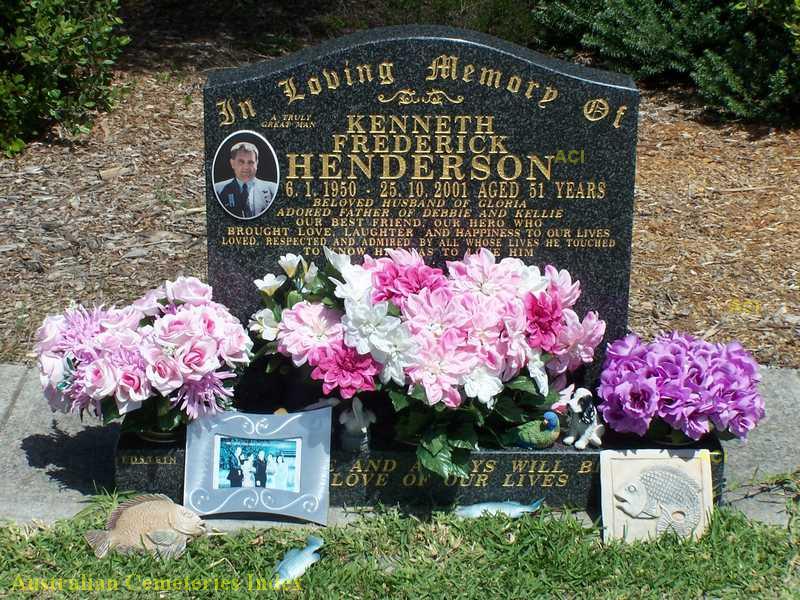
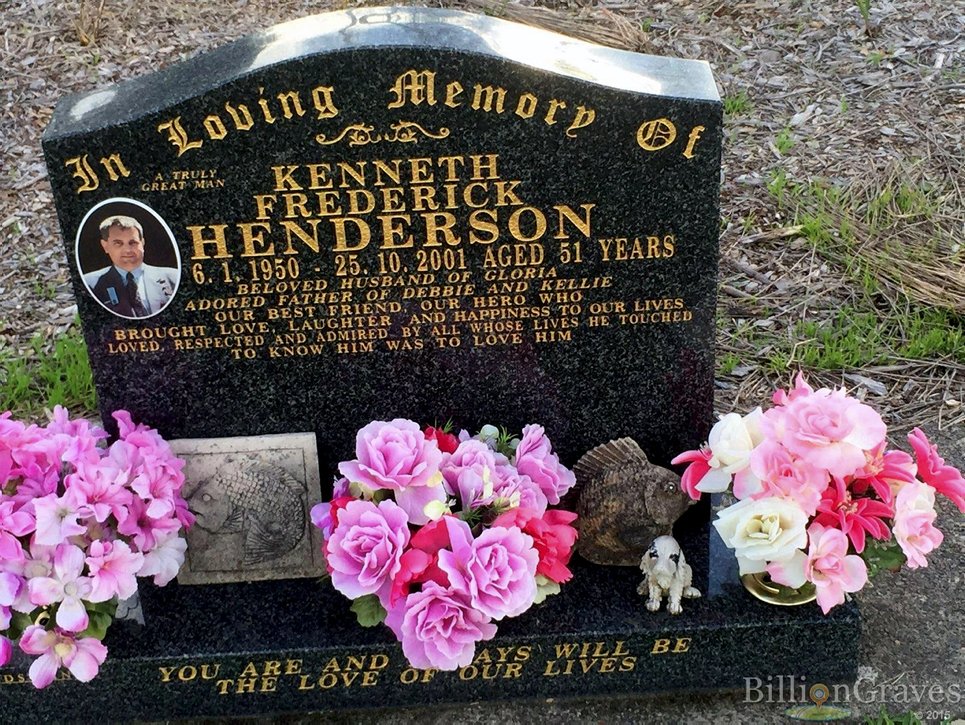
INSCRIPTION: IN LOVING MEMORY OF KENNETH FREDERICK HENDERSON 6.1.1950 - 25.10.2001 AGED 51 YEARS Beloved husband of Gloria Adored father of Debbie and Kellie Our best friend, our hero who brought love, laughter and happiness to our lives Loved, respected and admired by all whose lives he touched to knhow him was to love him Your are and always will be the love or our lives

Kenneth Frederick HENDERSON

[alert_red]KEN is NOT mentioned on the Police Wall of Remembrance * BUT SHOULD BE


Grave’s approximate location [codepeople-post-map]


FURTHER INFORMATION IS NEEDED ABOUT THIS PERSON, THEIR LIFE, THEIR CAREER AND THEIR DEATH.

PLEASE SEND PHOTOS AND INFORMATION TO Cal


May they forever Rest In Peace


Detective Chief Inspector Ken HENDERSON, 51 old, committed suicide by using his service firearm inside the grounds of Charlestown Police Station in October 2001.

Ken was being harassed and ultimately threatened by SCIA during their malicious reign with a personal exposure that would, no doubt, hurt his family. Nothing to do with misconduct on his behalf, just a maliciously attempt to hurt him and his family.

He took his life with his service revolver at the rear toilets of the police station immediately after receiving a phone call from SCIA.

It is believed that no Inquest was held into his suicide.


Three investigated police attempt suicide

By Candace Sutton
March 2 2003
The Sun-Herald


Three police officers investigated by the controversial Operation Florida corruption probe have attempted suicide, The Sun-Herald has learnt.


This follows the death in 2001 of Detective Chief Inspector Ken Henderson, a highly commended officer regarded as a top criminal investigator. Henderson, 51 and a 30-year veteran of NSW Police, shot himself at work in 2001.

There was no suggestion that he was tainted by corruption.

Three officers who came under the operation’s scope have since tried to end their lives.

Senior police officers named on a controversial warrant issued as part of Operation Florida have engaged prominent barrister Tom Hughes, QC.

The warrant, ordered by former assistant commissioner Mal Brammer, was issued the day before the 2000 Olympics began and had 116 names on it.


Those named included a barrister, a journalist and five of Crime Agencies’ nine superintendents. A Police Integrity Commission investigation of the warrant has since found two of the names on it were unsupported by applications or affidavits, which PIC inspector Merv Finlay described as “a minor irregularity”


Why cops took their eye off the streets

March 2 2003

An internal police investigation targeting corruption has claimed victims who weren’t even in its sights, Candace Sutton writes.


On a spring day in September 2000, when a rape gang was carrying out its evil in south-western Sydney, police among the highest echelons of the NSW force were intent on issuing a warrant for a listening device to eavesdrop on fellow officers.

It was a peculiar sort of warrant, with 116 names on it.

The names included those of drug dealers, armed robbers, a barrister, a journalist and five of Crime Agencies’ nine superintendents. Two names were unsupported by the affidavits usually needed for such a warrant.

It was the day before the Olympic Games opening ceremony and with the warrant’s issue, Operation Florida was born, one of the NSW Crime Commission and the Police Integrity Commission’s most explosive joint investigations.

The existence of the rape gangs was only beginning to be known by NSW police and the existence of the warrant was a secret to all but a few deep within the police service.

Like its namesake in the US, is there something rotten in the state of Florida?

The destruction the operation has wreaked in its path – the suicide of one police officer and the attempted suicide of three other officers who were subjects of the investigation – is compounded by the fact that one of Florida’s principal investigators and the man whose work instigated the operation are now themselves under a cloud.

Detective Chief Inspector Ken Henderson, 51, died by his own hand on his service revolver at his own police station at Charlestown.

Just what Florida achieved in uncovering corruption – and it did reveal serious breaches among officers in Sydney’s Northern Beaches – must be affected by these events. Mal Brammer has been accused of conducting malicious investigations in another operation.

During his time in charge of Internal Affairs, Mr Brammer was responsible for gathering the initial evidence for what became the Florida inquiry.

Brammer, who had left the police service for the Independent Commission Against Corruption, resigned from that job last week and faces accusations that he used “malicious and unfounded investigations against individuals”.

Brammer‘s right-hand man in Operation Florida, John Dolan, is suspended from the police service and has to show why he should not be dismissed. ( 181D )

This week the good citizens of NSW might wonder whether what is, at best, the super-zealotry of the police watchdogs, has overridden the force’s principal function: to control crime. Has there been an abuse of power? After all, who’s watching the watchers?

Dolan was allegedly caught drink-driving behind the wheel of a State Crimes Commission car at Killarney Vale, near Wyong, while on holiday, on December 28, 2001. He was charged with having a prescribed concentration of alcohol of .075.

The matter went before the court three times, although Dolan never appeared and a doctor’s certificate said the officer was “unfit to work or attend court or to read and complete documents until further notice”.

The matter was then dropped.

The drink-driving charge was incurred at the height of the Florida probe and there must have been a fear it could affect the integrity of the investigation, a joint effort between the police service, the NSW Crime Commission and the Police Integrity Commission which absorbed considerable resources of all the agencies. Dolan, 43, a senior sergeant, is suspended on superintendent’s pay, though as an acting superintendent he had not passed the examinations for that rank.

Dolan has followed Brammer throughout 15 years in the force, from the Drug Enforcement Agency through drug taskforces to Internal Affairs, and on to Florida. Now Florida itself is being investigated.

A brief of evidence on Ken Henderson’s death will be placed before the coroner soon, although there is concern that only local Gosford police investigated, whereas a policeman’s suicide usually warrants a top-level inquiry.

The listening-device warrant is now the subject of planned legal action by commissioned officers whose names were on the list.

The warrant has been explained on 60Minutes by former police commissioner Peter Ryan, who said an Operation Florida operative was to wear the listening device at a function at which the 116 names were to attend.

The police planning legal action over the warrant say all officers were on duty, and therefore attending no common social functions, during the Olympics.

Police Integrity Commission inspector Merv Finlay, who investigated complaints about the warrant, conceded there was a “minor irregularity”, given two names on the warrant were not named in any application or affidavit.

Senior police officers say the force is sick of the approach taken by some PIC investigators.

“The vast majority of police have no sympathy for officers like [corrupt Manly detectives] Matthew Jasper and David Patison, but we do ask investigators to follow the rules,” an officer said.

Several meetings at State Crime Command have moved to address the issue. A unanimous motion at the biannual conference directed the Police Association executive to pursue the matter hotly.

As for the citizens of NSW, those with their names on the warrant list have asked for access to the affidavits supporting the warrant.

Two years after the now-discredited counter-terrorist squad, the Special Branch, was disbanded, Premier Bob Carr trumpeted the fact that he was opening the secret police files to any citizen who had one.

To date, however, access to the affidavits for the Florida warrant has been denied.

http://www.smh.com.au/articles/2003/03/01/1046407802938.html


Mud sticks to the edges of city on the lake

Anne Davies and Andrew Clennell
November 18, 2006

THE latest child sex charges against the former Labor minister Milton Orkopoulos and his campaign worker Pat Roughan have focused attention on Lake Macquarie Council and the effectiveness of local police.

The council has had its fair share of scandals.

In 1996 a former mayor, Doug Carley, was convicted of indecently assaulting a 15-year-old boy. Carley maintains his innocence, saying he did not have the money to contest the offence. He also suffers from bipolar disorder, which colleagues believe was relevant to his case.

In 2002 a former Labor councillor, Chris Foteff, left after gay and bestiality pornography was discovered on his council-supplied computer.

It was found only after the council engaged PricewaterhouseCoopers to follow the porn trail, which led to the recovery of 5000 images deleted from Foteff‘s laptop, including 10 of naked children and about 250 of acts of bestiality.

An earlier police investigation found no images that warranted prosecution. It appears the police decided not to send the computer to Sydney for technical analysis, relying only on what they could retrieve and copy themselves.

An internal police investigation ordered by the then commissioner, Peter Ryan, cleared them of any wrongdoing.

Mr Foteff, who had followed Orkopoulos onto the council as a Labor councillor, has always maintained his innocence and said he was the victim of a set-up.

But reopening the investigation after the PricewaterhouseCoopers report proved difficult because the officer who initially investigated the pornography find, Detective Chief Inspector Ken Henderson, committed suicide in October 2002.

The Mayor of Lake Macquarie, Greg Piper, recalls that police could not prove beyond reasonable doubt that the images on Mr Foteff‘s computer were of “under-age” men and they were also restricted by a statute of limitations.

It was reported at the time that Inspector Henderson shot himself with his service revolver at Charlestown police station soon after receiving a mysterious phone call.

He had recently returned from a trip to Sydney on official police business, believed to be connected to a Police Integrity Commission inquiry. There was no suggestion that Inspector Henderson was under investigation for corrupt conduct but because there was no inquest it remains a mystery.

Cr Piper said he did not believe that those incidents or the charges against Orkopoulos had harmed the council’s reputation, although the incidents were “unfortunate”. “The reality is, they have occurred over a long period of time,” he said, and if people “cast back and clump them together” it made the situation look worse than it was.

However, there had been other complaints about police inaction on child sexual assaults at the Lake Macquarie Local Area Command. In March 2001, Senator Bill Heffernan read a letter from a Charlestown woman into Hansard, detailing her concern about the lack of action taken by police against the abusers of her sons.

That the abuse had occurred was not questioned; her nine-year-old son required surgery after the abuse.

“No charges have ever been laid,” she wrote. “After three years of investigation from the Ombudsman’s office, Mr Bruce Barber [sic], finally intervened and asked for an investigation as to why no interviews and charges have ever been laid in relation to this.”

The mother, who has since moved to Queensland, said Inspector Henderson had been in charge of her son’s case.

http://www.smh.com.au/news/national/mud-sticks-to-the-edges-of-city-on-the-lake/2006/11/17/1163266787603.html


DNA On Killer’s Trail

Newcastle Herald

Tuesday July 24, 2001

JASON BARTLETT

RAPID advances in DNA technology could hold the key to catching the killer of Swansea High schoolgirl Bree Jones.

Police have reopened the case more than six years after Bree’s body was carried from the Caves Beach house where she had been dead for hours.

Two Lake Macquarie detectives are again working full-time to solve the mystery that has haunted parents across the region since June 3, 1995.

Bree, 16, a Year 10 student, was found dead in a house at Caves Beach after someone drugged her with methadone to have sex with her.

The case spawned two separate inquests, in which coroner Col Elliott called for perjury charges to be laid against several witnesses, and scrutiny of the State’s methadone program.

Parents shuddered as the story unfolded and they realised what had happened to Bree could as easily happen to their children.

Bree fell in with the wrong crowd, rebelled against her parents, ran away from home and paid the ultimate price.

Her mistake was putting her trust in her new `friends’, people who were apparently willing to stand by as one of their number preyed on the teenager for sex.

Bree Jones died half a kilometre from the Caves Beach home where she had lived happily with her parents, brother and four sisters until a week before the tragedy.

`There were 14 people there when she died but no-one knew what happened,’ her father, Wayne Jones, said.

`They knew of course but no-one would say anything.’

As the facts surrounding Bree’s death emerged, her parents’ anger and the frustration of the investigating officers grew.

Left-handed Bree bore injection marks in her left arm where someone, allegedly a man who wanted sex, had injected her with methadone in the early hours of June 3.

`They were trying to get her out of it so they could have sex with her,’ the mother of one of the people at the party told Mr Elliott.

The dose of methadone killed the teenager.

She slipped into unconsciousness and died.

No-one called the ambulance until 1.47pm that day, hours after Bree’s death.

No-one has come forward with exact details about her last hours.

The sperm, scientific police took from her body revealed she had had sex in the 24 hours before her death.

It may now play a pivotal role in the investigation.

Police were increasingly frustrated by the web of lies spun around the late-night party and what had happened to Bree.

Stories changed constantly, infuriating them and Mr Elliott, who recommended several witnesses be charged with perjury.

`The lies that have been told to police and the perjury committed in court have not helped the investigation,’ he said when handing down his closing statement in Wallsend Coroners Court in March 1999.

The coroner found that Bree had died from a lethal injection of methadone.

He was unable to establish who was responsible.

He did recommend the case be reopened.

`In the circumstances of this case, where a child has been overdosed with a lawful drug to obtain a sexual advantage and has consequently died, the pursuit of any person responsible and any person lying should be relentless,’ Mr Elliott said.

It was one more disappointment for the Jones family, who had watched helplessly after a man charged with manslaughter and supplying drugs to Bree went free in 1997 after the Department of Public Prosecutions dropped the case.

For her family one of the worst things about the case remains that no-one tried to save Bree.

One man, 20 at the time of Bree’s death, told the inquest he had seen her about 6am on June 3, lying in bed with a 29-year-old man.

`She had saliva coming out her mouth and her breathing wasn’t clear,’ the man said.

He did not try to wake her but got his surfboard and left the house.

`I didn’t realise she was in danger of losing her life,’ the 20-year-old said.

The same witness, who admitted lying to police constantly in the three years since Bree’s death, said the party goers had got together the next night for a `conference’ to get their `stories straight’.

Bree remains alive to those who knew her best.

`She was full of fun, loved life, just tried to make everyone happy,’ her mother, Maree, said.

`Her sisters still talk about her all the time.

`There’s not a day goes by when her name’s not mentioned in this household.’

It has been a terrible time for the Jones family.

A few years after Bree’s death, her only brother, Jabe, needed a kidney transplant.

Wayne Jones was happy to help his son.

It is this spirit that has kept the Jones family united in its search for justice.

`Like most 16-year-olds, Bree loved life,’ Mr Jones said.

`She was probably a bit braver than she should have been at that age and got into a situation she couldn’t control.

`She’d been a good kid all her life then hit a stage where she was giving us a bit of trouble.

`Bree got in with the wrong crowd and began to mix with older people that were just a bit too clever for her.

`We are very hopeful the new inquiry will lead to something and that articles like this will jog a conscience and get someone to come forward.’

The investigating officers believe advances in DNA technology, coupled with new legislation passed through State Parliament this year, could mean the unsolved tag being taken off the Bree Jones files.

`The major reason we’ve reopened the case is that it was a recommendation from the coroner,’ Lake Macquarie crime manager Detective Inspector Ken Henderson said.

`But now hopefully we can enact the new DNA legislation and take samples directly from the suspects.

`Before we had to charge the suspect with an actual offence related to the case before we could take samples but now we don’t have to do that.

`The new legislation gives us the light at the end of the tunnel.’

Though hoping the new inquiry, now under way, will lead somewhere, Mr Jones intends to keep searching for his daughter’s killer.

`Time can be your best friend or your worst enemy,’ the 49-year-old said.

`I’m going to live a long life just to get to the end of all this.’

http://www.webconference.com.au/web-conference-articles/2001/7/24/dna-on-killers-trail/


iii. KEN HENDERSON

Detective Inspector Ken Henderson was attached to Newcastle. In 2001 he took his own life. At the time a number of officers under his control were involved in Police Integrity Commission matters. It was later established that Henderson was not subject to investigation. The family remains at a loss as to why he took his own life. He had not received any treatment nor consulted any medical providers concerning any stress he may have suffered.

http://unionsafe.org.au/wp-content/uploads/2012/09/NileInquirySubmission.doc


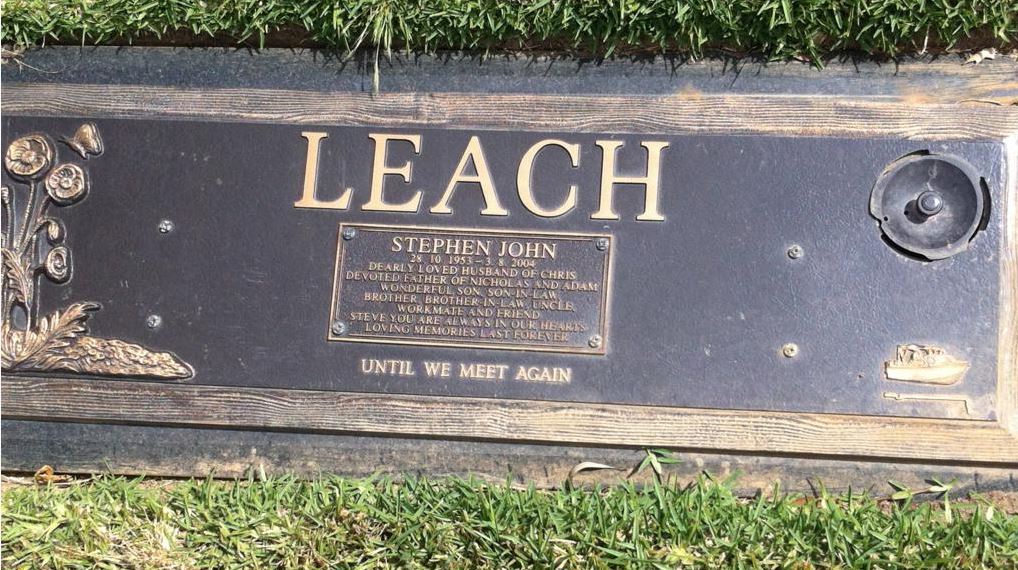
Stephen John LEACH

Stephen John LEACH

AKA  Steve


New South Wales Police Force

Joined NSWPF via Police Cadets on 24 November 1966

Redfern Academy Class # 132

Cadet # 2538

Regd. # 15543


Rank:  NSW Police Cadet – commenced training at Redfern Police Academy 24 November 1969 ( aged 16 years & 27 days )

Probationary Constable – appointed 28 October 1972 ( aged 19 years )

Constable – appointed

Constable 1st Class – appointed 28 October 1977

Detective – appointed

Senior Constable – appointed

Sergeant 3rd Class – appointed 21 February 1988

Sergeant 2nd Class – appointed

Final Rank:  Detective Sergeant


Stations: ?, Homicide Squad – Headquarters – Parramatta


ServiceFrom 24 November 1969  to  3 August 2004 = 34 years, 8 months & 10 days Service


Awards:  National Medal – granted 14 December 1988 ( Det Sgt )

1st Clasp to the National Medal – granted 28 May 1999 ( Det Sgt )

Commissioner’s Commendation ( posthumously ) ” In recognition of his tenacity, dedication and commitment “

Cause:  Depression – Suicide – Service firearm – In armoury

Event Location:  NSW Police HQ, Parramatta – In the armoury

Event date:  Tuesday  3 August 2004 ( Off Duty )


Born: Wednesday  28 October 1953

Died: Tuesday  3 August 2004

Age:  50 years, 9 months & 6 days


Funeral? August 2004

Grave stone location: Castlebrook Memorial Park

Location: Stations of the Cross
Section: Cross
Lot: 40
Lat/Long: -33.69279, 150.92183

Steve LEACH

And in August 2004, Detective Sergeant Steve Leach killed himself with his pistol at police headquarters at Parramatta.

http://www.smh.com.au/news/national/suicidal-officer-with-a-gun-but-this-time-tragedy-averted/2007/04/30/1177788058862.html


Stephen John LEACH - grave stone
Stephen John LEACH – grave stone.
Castlebrook Memorial Park Cemetery & Crematorium
Castlebrook Memorial Park, Windsor Rd, Rouse Hill, NSW


Steve is NOT mentioned on the Police Wall of Remembrance in Canberra

( checked 040822 )


NSW Police Academy Detectives' Course 1 of 1981 2 February - 24 April 1981 Back Row ( L - R ): G. KIPPAX, G. GREEN, B. RITCHIE, A. LONGSON, T. GRIFFITHS, C. ILES, K. FITZGERALD, S. LEACH, G. DUCKER, B. REID, Third Row: B. PASSLOW, J. GARVEY, K. O'BRYAN, E. FREEMAN, G. DISKIN, G. SMART, B. PECK, S. ST JOHN, J. KHALIFEH, A. PEARMAN, J. INNES, D. CHAPMAN. Second Row: D. LINDSAY, R. BOWLES, G. MARTIN, B. DICKSON, I. CAMERON, G. ACTON, F. VENTURI, P. DUNN, M. McGANN, J. RAND, P. LONG, Steve PACKER, A. THOMAS Front Row: I. MURRAY, G. THOMPSON, R. JENKINS ( Inst. ), R. CLAMP ( Inst. ), P. MEEHAN ( Inst. ), N. GOULD ( Director ), L. BAKER, ( Inst. ), R. MYATT ( Inst. ), P. WALTER ( Inst. ), C. McDONALD, I. McDONALDNSW Police Academy

Detectives’ Course 1 of 1981

2 February – 24 April 1981Back Row ( L – R ):

G. KIPPAX, G. GREEN, B. RITCHIE, A. LONGSON, T. GRIFFITHS, Colin ILES # 15334, K. FITZGERALD, Stephen LEACH # 15543, G. DUCKER, B. REID,

Third Row:

Barry PASSLOW # 14109, J. GARVEY, K. O’BRYAN, E. FREEMAN, G. DISKIN, G. SMART, B. PECK, S. ST JOHN, J. KHALIFEH, A. PEARMAN, J. INNES, D. CHAPMAN.

Second Row:

D. LINDSAY, R. BOWLES, G. MARTIN, B. DICKSON, I. CAMERON, G. ACTON, F. VENTURI, P. DUNN, Michael McGANN # 16758, J. RAND, P. LONG, Steve PACKER, A. THOMAS

Front Row:

I. MURRAY, G. THOMPSON, R. JENKINS ( Inst. ), R. CLAMP ( Inst. ), P. MEEHAN ( Inst. ), N. GOULD ( Director ), L. BAKER, ( Inst. ), R. MYATT ( Inst. ), P. WALTER ( Inst. ), C. McDONALD, I. McDONALD


Policeman shot dead at station

August 3, 2004 – 7:33PM

One of NSW top police investigators was found shot dead in the state’s police headquarters today, shattering his family, friends and colleagues around the world.

Detective Sergeant Steve Leach, 51, an internationally recognised officer who helped investigate former Yugoslav president Slobodan Milosevic on behalf of the United Nations, was found with a single gunshot wound to the head shortly before midday.

Among his local achievements, Det Sgt Leach was instrumental in the arrest of backpacker murderer Ivan Milat and the investigations into missing Sydney school girl Samantha Knight.

NSW Police Commissioner Ken Moroney rushed to Parramatta upon hearing the news and, while he declined to speculate on the cause of death, said it was not believed to be suspicious.

The detective sergeant was not working today, having returned to NSW from The Hague in the Netherlands only in recent months.

Det Sgt Leach had been on sick leave after sustaining an undisclosed physical injury while overseas, but he had been due to recommence his employment with the NSW Police soon.

The Commissioner said investigations into the death had begun using a specialist team from Bankstown police, who would prepare a report for the Coroner.

“These are very tragic circumstances not only for the officer concerned and his family but equally as important, for his colleagues,” Mr Moroney said.

“I’m sure he will be remembered not only in the coming days . . . but certainly in years to come as one of the most experienced detectives we have (had) here in NSW, and we are the poorer for his loss today.”

Mr Moroney said the married officer had two children who, along with his colleagues, were “understandably very distraught” at the news of his passing.

“He was a very popular colleague and highly respected, not only in terms of his detective skills but certainly the specialist skills that he brought to criminal investigations here in NSW,” he said.

The officer’s colleagues at the NSW State Crime Command in Parramatta were being counselled by police chaplain Barry Dwyer.

Another police officer also was mourned today – Senior Constable Ian Ross Dennis, based in Walgett, north-west NSW, who died in hospital after a short battle with an illness, aged 47.

Mr Moroney paid tribute to both officers, saying they had been outstanding servants of the police force.

“It’s important on these occasions that we honour and acknowledge that service and that commitment,” he said.

“It’s a very sad day for the organisation to lose officers of this calibre who have selflessly served the people of this state to the very best of their skill and ability.

“And that’s all I could ever ask them to do.”

http://www.theage.com.au/articles/2004/08/03/1091476465269.html?from=storylhs


Detective who shot himself bore grief of many

By Les Kennedy
August 4, 2004

Homicide Detective Steve Leach, left, and another detective escort the backpacker killer Ivan Milat from his home in 1994. Photo: Rick Stevens
Homicide detective Steve Leach, left, and another detective escort the backpacker killer Ivan Milat from his home in 1994. Photo: Rick Stevens


There are few moments of joy in the life of a homicide investigator, and most of those are with their families.

Steve Leach had borne the grief of many, but yesterday it was the turn of his colleagues to face his own violent death.

Detective Senior Sergeant Leach, one of the state’s most experienced homicide detectives, took his life with his own handgun in the heart of the new NSW Police headquarters in Parramatta.

Nobody, it appears, saw such a tragedy coming.

Sergeant Leach had been on sick leave since early June, the result of a car accident in Europe that left him with leg injuries.

He had recently applied to be pensioned off as hurt on duty but those who encountered him recently had found him apparently cheery and looking forward to an early retirement.

He was still on sick report when he walked into the police building yesterday. He went into the soundproof weapons storage room; no one had been expecting him and no one heard the shot. Another officer found his body about noon.

When family, friends and colleagues looked at the life of Steve Leach, they saw an extraordinary career that began when he joined the force as a 16-year-old cadet in 1969.

He was a second-generation cop. Over 35 years, he played a role in some of the state’s most notorious cases and found his way as far afield as Bosnia, where he investigated war crimes.

Along the way he offered support to the families of victims and perpetrators alike. He even lent his shoulder to Shirley Soir, the sister of the backpacker killer Ivan Milat, who collapsed while sitting next to him in court on the day in May 1994 that her brother was charged with seven murders.

Ten days earlier, the burly detective had walked into police history as one of two detectives who arrested Milat at his Eagle Vale home.

In that case he led the search for the weapon, a Ruger 10/22, of which there were more than 100,000 imported into Australia.

He was often given tough tasks, such as the long investigation into the disappearance of the Bondi schoolgirl Samantha Knight.

In recent years, he was seconded to the European War Crimes Tribunal in The Hague. His team in the Netherlands charged the former Yugoslav president, Slobodan Milosevic, whose war crimes trial is still before the international court.

Sergeant Leach spent more than two years walking through massacre sites and talking to survivors.

He came back to Sydney last year, returning to the homicide squad and recalling good times in Europe with his wife Christine, a schoolteacher.

He was chuffed that one of his two sons had also joined the police force, while the other had signed up for the army.

The Police Commissioner, Ken Moroney, remembered a detective of impeccable character.

“I’m sure he will be remembered, not only in the coming days … but certainly in years to come, as one of the most experienced detectives we have [had] here in NSW, and we are the poorer for his loss today.”

http://www.smh.com.au/articles/2004/08/03/1091476494599.html


Colleagues grieve for a lauded detective

By Les Kennedy
August 4, 2004


Homicide detective Steve Leach, left, takes Ivan Milat into custody in 1994.

Apart from time spent with their families, there are few moments of joy in the lives of homicide investigators.

They see the grief of others and are expected to bear their own feelings inwardly. Steve Leach had borne the grief of many – until yesterday. Now his colleagues are facing the tragedy of his own violent death.

Detective Senior Sergeant Leach, one of the Australia’s most experienced homicide detectives, took his life with his own handgun in the heart of the new NSW Police Headquarters in Parramatta.

It seems nobody saw it coming. When family, friends and colleagues looked at the life of 51-year-old Senior Sergeant Leach, what they saw was an extraordinary career that began when he joined the force as a 16-year-old cadet in 1969.

He was a second-generation police officer who, over 35 years, played key roles in some of Australia’s most high-profile and most horrific cases.

His talents were also sought internationally. He was seconded to the European War Crimes Tribunal in The Hague to investigate the killing fields of Bosnia, and was instrumental in the arrest of former Yugoslav president Slobodan Milosevic, who is facing genocide charges.

But the hard-nosed detective also had a gift for empathy and gave his support to the families of victims and perpetrators alike.

He even lent his shoulder to Shirley Soir, the sister of Ivan Milat, who collapsed while sitting next to him in court on the day in May 1994 when her brother was charged with the murders of seven backpackers.

Ten days earlier, he walked into police history as one of two detectives who arrested Milat.

He was often asked to investigate cases where the trails had seemingly run cold, such as the 1986 disappearance of Bondi schoolgirl Samantha Knight. But by the time his team had secured the conviction of Michael Guider, Senior Sergeant Leach was in Bosnia, walking through massacre sites, talking to survivors.

He returned to Sydney last year, speaking only of the good times in Europe with his wife Christine, a school teacher. He was chuffed that one of his two sons had joined the force, while the other had joined the army.

But he had been on sick leave since early June after injuring his legs in a car crash in Europe. He had recently applied to be pensioned off as hurt on duty, but had appeared upbeat planning for his early retirement.

Senior Sergeant Leach was on leave when he arrived at police headquarters yesterday, went into the sound-proof weapon storage room and took his gun. No one heard the shot. Another officer found his body at noon.

One shocked colleague and mate said: “There you go, buddy. The futility of it all. We are all feeling that empty feeling. Why?”

Those needing assistance can reach Suicide Helpline Victoria on 1300 651 251, Lifeline on 131 114 (both 24-hour lines), SANE on 1800 688 382 or Kids Help Line on 1800 551 800.

http://www.theage.com.au/articles/2004/08/03/1091476497108.html


Top cop found shot dead

August 4, 2004 — 5.09am

One of NSW’s top police investigators was found shot dead in the state’s police headquarters today, shattering his family, friends and colleagues around the world.

Detective Sergeant Steve Leach, 51, an internationally recognised officer who helped investigate former Yugoslav president Slobodan Milosevic on behalf of the United Nations, was found with a single gunshot wound to the head shortly before midday.

Among his local achievements, Det Sgt Leach was instrumental in the arrest of backpacker murderer Ivan Milat and the investigations into missing Sydney school girl Samantha Knight.

NSW Police Commissioner Ken Moroney rushed to Parramatta upon hearing the news and, while he declined to speculate on the cause of death, said it was not believed to be suspicious.

The detective sergeant was not working today, having returned to NSW from The Hague in the Netherlands only in recent months.

Top cop found shot dead


Steve Leach Memorial

by Kevin Caruso

Detective Sergeant Steve Leach, from Sydney, Australia, was a well-known, veteran police officer with 35 years of experience.

Steve Leach was so highly respected by his fellow officers that they referred to him as “a policeman’s policeman.”

He was assigned some of Australia’s most horrific crimes. And he arrested serial killer Ivan Milat (see picture above), who murdered seven people between 1989 and 1992.

He also worked in Serbia and Montenegro from 2000 to 2003 as an investigator for the European War Crimes Tribunal, in which he had to view sites where massacres occurred, and then interview survivors.

Steve was an extremely strong man, both physically and mentally, and handled all of his assignments with the highest levels of integrity, courage, intelligence, and competence.

He was also highly ambitious and believed that he should have received a higher rank than detective sergeant.

And he was frustrated by what he believed was a ridiculous and unfair promotion system in which he and other officers were forced to engage in “role play” during their promotion examinations.

In March, Steve applied for a newly created position as inspector at the coroner’s office, but the job was given to a much younger officer who had only a fraction of Steve’s experience.

Steve was furious and appealed the decision.

Unbelievably, Steve lost the appeal.

And soon afterwards, he became depressed.

On August 2, 2004, Steve, who was off-duty at the time, calmly walked into the police station, went to the armory room, obtained his service handgun, and shot himself in the head.

He was 51.

Steve’s fellow police officers were shocked, and immediately blamed the idiotic promotion system.

One outraged officer did not mince words when he described the promotion system as “bullshit.” He went on the say, “The promotions system is the only thing that was upsetting this very calm, [great police officer]. The current system is promoting people with just 12 years of experience over someone with 35 years of experience – this just destroys people like Steve Leach.”

Steve was one of the greatest police officers in Australia’s history.

Everyone loved and respected him.

And he made the streets safer because of his hard work.

He was a dedicated, superstar cop who loved his job and who loved to help people.

He was a hero.

http://www.suicide.org/memorials/steve-leach.html


A rank way to treat the cops Transcript
ADAM SHAND: Steve Leach was the model of what a detective should be – tough, uncompromising in his pursuit of crime, but fair and compassionate. He kept his own counsel as he served others right up to the day he took his own life.
KEN MORONEY, NSW POLICE COMMISSIONER: A very sad day for the organisation to lose officers of this quality and this calibre who’ve selflessly served the people of this state to the very best of their skill and ability.
ADAM SHAND: In 31 years of service, Steve Leach had worked some of NSW’s most difficult cases. He had seen the dark side of humanity, arresting backpacker murderer Ivan Milat, and solving the abduction of school girl Samantha Knight. In Leach’s death, his comrades saw their own images. At his funeral, the priest said that no-one should speculate on Leach’s own untold story.
GARY HESKET, FORMER NSW DETECTIVE: I looked in the church. I could see a lot of young police there with promotion on their shoulders. I saw a lot of older police there, experienced heads. And not at the same level. “Don’t speculate”, I thought to myself. I thought, “That’s just saying we should never ever speak about this matter ever again.”
ADAM SHAND: No-one will ever know why, at the age of 51, Steve Leach lost hope that day. But many senior detectives can trace their own disillusion back to the massive changes introduced after the Wood Royal Commission into police corruption in the mid-1990s. The Commissioner recommended a complete overhaul of the force’s management style. A new promotion system was introduced that no longer ensured progress through the ranks based on years of service.
MARK FENLON, FORMER POLICE SERGEANT: It’s had a huge detrimental effect on morale. It’s had a huge detrimental effect upon police officers with experience who have been disenfranchised by the process. Who have been and are continue to seek exit from the police force at the earliest opportunity. And this has left a huge void in the organisation in terms of experience, in terms of training and development of younger police, in terms of expertise to deal with crime, which can’t be replaced.
ADAM SHAND: Gary Hesket left the force a year ago after three decades in the job. He keeps up with his mates through his role in as a trainer in the police rugby league competition.
GARY HESKET: This is good for the camaraderie, the esprit de corps. It’s the best things they could do after working in the police environment they’re in – get out here and have a game amongst each other.
ADAM SHAND: You pick up the paper and see Steve Leach has committed suicide. What did that mean to you when you heard that?
GARY HESKET: The first question I asked was, “Was he passed over for promotion?” And the word that came back to me was ‘yes’.
ADAM SHAND: Like Steve Leach, Gary Hesket devoted his life to catching villains. He was a natural-born detective, voted policeman of the year in 2001 by his local community in western Sydney.
GARY HESKET: Then you’re told, “Well, Gary, if you want to be promoted, the best thing you can do is forget about police work, find a desk somewhere and hide and do yourself a degree or diploma because that’s the only way you’re going to get promoted in the future of NSW Police.”
ADAM SHAND: Hesket says many of his generation of detectives have simply been dumped on the scrap heap.
GARY HESKET: But at the end of the time when you put in 35 years, where is your reward? Where is your reward?
ADAM SHAND: On the day his family and comrades farewelled Steve Leach, NSW Police Commissioner Ken Moroney awarded him a ribbon recognising his achievement in solving 15-year-old mystery of Samantha Knight’s disappearance.
GARY HESKET: And he did a magnificent job and he solved it, and now, posthumously, Mr Moroney is giving him a medal for that. Why wasn’t he given a medal when the case was solved, while he was alive?
ADAM SHAND: When Leach was seconded as a war crimes investigator to the former Yugoslavia, he won praise for a difficult job. On his return to Australia, he expected a promotion to finish his career as a commissioned officer.
MICK KENNEDY, FORMER NSW DETECTIVE: And the reason he couldn’t get promoted was he could do the job but he couldn’t pretend he could do the job. He couldn’t get through the assessment stuff, I suppose, or the role play nonsense. I was a detective for 20 years in the NSW Police…
ADAM SHAND: These days Mick Kennedy is researching trends in modern policing for a PhD. He believes the root of the crisis facing Steve Leach’s generation is a lack of support for field officers.
MICK KENNEDY: He didn’t kill himself because he was working in the evils and the horrors of criminal investigation, because that’s part and parcel of the work that you can deal with. You insulate yourself from it, you deal with that. But all of the time that you’re dealing with those murky, dirty hands areas of working it needs to be constantly reinforced that you’re dependent upon your organisation to support you in times of crisis or when things go bad.
ADAM SHAND: When Kennedy faced his own crisis, he found there was no-one to turn to.
MICK KENNEDY: I was in this house some years ago and I had my 38 on the bed and I was in despair over a range of issues. And I was thinking seriously, “Well, the best thing I could do is to kill myself”, so I ring the police medical officer and I got through to a woman who couldn’t speak English. I was on the phone with her for 20 minutes telling her that I was considering shooting myself and I’d like to speak to someone about it. In the end, I hung up in disgust because I couldn’t speak to anyone. Now I thought, “God, almighty! I can’t even try to attract attention. No-one’s interested! No-one really cares”, you know?
ADAM SHAND: Faced with growing criticism, the NSW Government asked former Assistant Commissioner Geoff Schuberg to investigate the promotions system. He found many detectives had lost their sense of purpose in the job.
GEOFF SCHUBERG, FORMER ASSISTANT COMMISSIONER: And one of the great problems in the system was that a number of police were applying for positions outside their area of expertise and winning them and they were put in a position where they were supervising and managing police when they had no experience or previous qualifications to do so.
ADAM SHAND: Promotion, it seemed to Schoenberg, had become more important to the rank and file than the job itself.
GEOFF SCHUBERG: Police really took their eye off the game of catching crooks and the promotions race seemed to be the main topic of the day, where people simply talked about positions that were being advertised, positions which they were applying for. There was a lot of resentment. There was a lot of drop in morale because of people who were applying for positions and couldn’t even get interviews. And I think that’s still very much the case.
ADAM SHAND: Crime reporter Steve Barrett has been watching this generation of police officers for over 20 years. He’s seen the job consume too many of them.
STEVE BARRETT, CRIME REPORTER: There was another detective inspector up at one of the stations in the Newcastle area who, with his service pistol, shot himself in the police station. Till this day, that family doesn’t know what happened to that person, why he took his own life. And you really have got to say to yourself, “What is this all about? Why is this happening?”
ADAM SHAND: The Wood Royal Commission identified this generation of detectives as fertile ground for corruption, and set about purging its ranks.
STEVE BARRETT: I mean, there was some very good work done by the Royal Commission but there was also some work where evidence was put before the Commission which was just, quite frankly, not true. And there was bad collateral damage and when you look at what’s happened, you think to yourself, “Well, a lot of police did down tools.” There’s no doubt about that. Then you see all these gangs growing up around Sydney – and I suppose it’s bit like if you don’t weed the garden, you’re going to get weeds.
MARK FENLON: And this is reflected in the crime clear-up rates for NSW. They’re the lowest in the country. Around about 12 percent of robberies are being solved within the first 90 days of the offence occurring. 5 percent of break and enters within the same period. It’s scandalous. That’s how this policy is impacting and has impacted and will continue to impact on policing in this State.
ADAM SHAND: Old-style cops say policing has become a numbers game these days. In crime statistics, a bust for a broken window counts for the same as a murder. The critics say it is the same wherever the police have moved from a paramilitary-based model free enterprise-style management – commanders are forced to strive for quantitative outcomes like managers in a boardroom.
MICK KENNEDY: The problem is that productivity is measured, in policing terms, in terms of arrests, and they say, “That’s great.” But it’s about trivial arrests. What they do, you get a senior commander and have a meeting and he humiliates everybody by yelling at them and screaming at them, “Why aren’t your – why aren’t your arrest rates up? How come my stolen vehicles is down?” You say, “We don’t have any staff. I’m not interested in that!” And it’s humiliating, and it’s a humiliating process and it is a degrading.
ADAM SHAND: Kennedy says the older detectives often find the pressure intolerable as they watch younger colleagues ride a desk to the top. He says the promotions system rewards those that work it. You gather merit points from education and role playing sessions where officers must show a grasp of the new language and politics of community policing. For an undercover detective, this is the theatre of the absurd.
MICK KENNEDY: I had been doing undercover work for far too long. I had a twitch. I had a stutter. My hair was dropping out. I had psoriasis all over my hands and I have no doubt if I had have killed myself some idiot would say, “But, mate, he was just a bit tired, We didn’t know he had any real problems.”
ADAM SHAND: Former sergeant Mark Fenlon served for 20 years. He left the force reluctantly after a distinguished career.
MARK FENLON: I had to get out of policing. I blew the whistle on promotions corruption in 1999. Nothing was done in relation to the complaints I made. The promotions system, it’s allowed people who haven’t got the qualifications, the experience, to gain promotion to gain positions – senior positions within the organisation – to lead the organisation.
ADAM SHAND: Although his complaints were investigated, the system remains relatively unchanged and Mark Fenlon says its major faults are beginning to show.
MARK FENLON: No better example than recently would be Redfern, where there were two images that is stuck in my mind. One was of police being directed to line up across a street and be subjected to bottles being thrown at them, Molotov cocktails being thrown at them. The other image is that there were perhaps half-a-dozen senior officers in the background in the background with mobile phones to their ears looking for a direction, looking for some guidance in relation to what to do with the situation.
RON STEPHENSON, FORMER POLICE SUPERINTENDENT: In my day – and I’m not blowing my trumpet – but if you were placed in that situation, if you were in arm’s length away from some of the offenders, they’d be in the back of the truck and charged with assault, indecent language, offensive behaviour, whatever the matter was.
ADAM SHAND: Inspector Ron Stephenson was the officer in charge the day, in 1984, when two bikie gangs, the Bandidos and the Comancheros, squared off in the car park of the Viking Tavern, in Milperra. Seven people already lay dead and experience told Stephenson that, without quick thinking, the murderers would walk free.
RON STEPHENSON: A decision would be made that they’d be rounded up, interviewed, and charged. They were only charged that day with offensive behaviour and cause of fray but, three weeks later, after we’d worked out the full picture, we raided simultaneously 43 homes, arrested 43 bikers and charged them with 301 charges of murder.
ADAM SHAND: But just how you restore confidence in a force that has lost so much in terms of experience is another matter. More than half of NSW police have been in the job for less than five years. Training simulation exercises like this one are now a key measure of competence and suitability for promotion.
STEVE BARRETT: I can tell you about another guy who was the boss of homicide for five years. In the north-west of Sydney. And he had to go to an assessment testing centre for a day, where they role play. And, I don’t know – because he wasn’t a good actor, he didn’t get promoted. Now, he just walked away. He’s gone. So all this experience over years and years and years of hard slog for the taxpayer of NSW has just gone like that.
ADAM SHAND: But NSW Police Minister John Watkins denies the service is in crisis, that many more officers like Steve Leach are at risk. He insists morale in the force is at its highest since the Wood Royal Commission clean out.
JOHN WATKINS, NSW POLICE MINISTER: The separation rate for NSW Police is the lowest it’s been for eight years and the actual resignation rate is the lowest it’s been for 10 years. It’s a very stable force in NSW and morale is the highest it’s been for a generation.
ADAM SHAND: But the Minister does accept the need for a review of the promotions system. He chairs a working party of detectives which is discussing the problem.
JOHN WATKINS: There was a working party, the Schuberg working party, that’s reported to me. I’ve given that to the Anderson working party to report to me by the end of this year for legislative changes to be put in place so a new promotions system can be up and running from 1 July, 2005.
ADAM SHAND: Victoria Police Service has also established a merit-based promotion system, which favours education over experience. There are morale issues in Victoria as a result, but the greater problem is a war on corruption.
CHRISTINE NIXON, CHIEF COMMISSIONER, VICTORIA POLICE: I did come to Victoria Police with an understanding there was corruption here. It’s the kind of attitude Victoria Police had that they didn’t have corruption really was a bit of a myth.
ADAM SHAND: Unlike NSW, where the Royal Commission fast-tracked a clean out of bent coppers, Chief Commissioner Christine Nixon’s management team is driving reform.
CHRISTINE NIXON: In policing, there will always be corruption. What you have to do is figure out where the high-risk areas are, where the likelihood of that corruption is to occur and to try change the systems and practices or, in fact, focus on people who might be working in those areas.
ADAM SHAND: Nixon has identified so-called legends in the force which, she says, have set bad examples for young officers. Though he left the force nearly 20 years ago, Brian Murphy is still Victoria’s most feared and revered officer – a legend amongst crims and coppers. Back in 1971, Murphy was charged with the killing of a suspect in custody. Although he was acquitted, he found the incident gave him an unhealthy reputation amongst some junior officers.
BRIAN MURPHY, FORMER VICTORIAN POLICE OFFICER: There would be a lot of young people think, “Well, Murphy did it and got away with it. I’ll try do what he did or what he was involved in, something similar.” And it’s not always a good thing.
ADAM SHAND: Should you have been gone back in the force, do you think?
BRIAN MURPHY: From time to time I think that it was most probably a bad move that I did go back in, but I couldn’t think of doing anything else than police work.
ADAM SHAND: When Murphy returned to duty he was given a new role. Leading a small team known as “Murphy’s Marauders”, he took on the villains in their own pubs, sending a message of fear through the underworld. It was an old-school, often violent, method that, although successful, is certainly not endorsed in today’s force.
BRIAN MURPHY: If somebody is arrested and he received a certain amount of corporal punishment, it would most probably be as a result of an assault on the policeman first. And policemen are permitted, the same as anybody else in the community, to prevent an assault, to use force, more than what is being used on them.
ADAM SHAND: Some Victorian police feel the pendulum has swung too far. Officers now feel powerless in the face of criminals who have exploited the new, sensitive approach to police enforcement.
CHRISTINE NIXON: I guess I don’t quite see that and I have a lot of contact with police. Australia has this kind of way of seeing villains as the heroes – Ned Kelly, I suppose, Roger Rogerson in NSW, and Brian Murphy is another. I don’t think they see them as the heroes, the real heroes in policing. I think they see them as people who just behaved and were of their time. What we have to do now is live within the legal boundaries.
ADAM SHAND: But Brian Murphy believes some officers are being used as political pawns as management seeks to reassure the public of the integrity of the service. He could see the writing on the wall and took early retirement. He finds himself counselling many young officers unsure of their future career direction.
BRIAN MURPHY: And a lot of them have left the job and rue the day they ever left because it’s a big, hard, cold world out there and the wages they were getting on numerous occasions they’ve found wanting and they get outside. They haven’t got the camaraderie, they haven’t got the protection of the government behind them.
ADAM SHAND: Maybe the job isn’t what it used to be, and many would say that’s a step forward. But men like Gary Hesket feel they’ve been let down by an administration that’s changed the rules in the middle of the game.
GARY HESKET: At the end of my days, for all the hard work you did, they take your badge, they take your ID. There’s nothing. You’re stripped. At the end of your days, who are you? You’ve given all these years of service. You just walk away and there’s this wealth of experience just sitting out there just wasting away and dying away.Click here for a printer-friendly version.http://sgp1.paddington.ninemsn.com.au/sunday/feature_stories/transcript_1687.asp

RIP Detective Senior Sergeant Leach

Silver Member

http://www.smh.com.au/articles/2004/…476494599.html

http://www.news.com.au/common/story_…55E421,00.html

An unbelievably tragic death.

He brought Ivan Milat to justice. He worked on the disappearance of nine-year-old schoolgirl Samantha Knight and the death of Sydney mother Zoe Zou, who died last November. He recently spent two years walking through massacre sites and talking to victims of Slobodan Milosevic for the European War Crimes Tribunal in The Hague.

Offline Quote
04-08-2004, 10:44 AM   #2
♥♥ pEeK-a-bOo ♥♥
i know.. i heard bout that yesterday
noone knows why he done it.. and his got a family and kids too… so sad….
my condolence goes out to them all..R. I . P.
Offline Quote
04-08-2004, 10:54 AM   #3
Platinum Member

It is very very sad that such an important man within the Australian justice system has gone.

I can’t imagine the things he must have seen over his 35 years as a policeman. Obviously it was to much for him in the end.

RIP


Offline Quote
04-08-2004, 11:01 AM   #4
New Member
i just read about this. how tragic. he helped so many people by bringing people like ivan milat to justice, and it just got too much. it’s awful. my heart goes out to his family, friends and colleagues.
Offline Quote
04-08-2004, 11:02 AM   #5
Banned

It is so sad and the worst part is the not knowing.

Perhaps we could also say RIP to Senior Constable Ian Ross Dennis?

http://www.police.nsw.gov.au/media/d…ectionID=media

Another fine Police Officer taken from us too early. If only there were more out there like him.

Offline Quote
04-08-2004, 11:12 AM   #6
Bronze Member
Zoe Zou was my friend. I hope this doesn’t effect the trial of the accussed.
Offline Quote
04-08-2004, 11:12 AM   #7
Bronze Member

Edit: double post

<font size=-1>[ This Message was edited by: Sambellina on 2004-08-04 12:13 ]</font>

Offline Quote
04-08-2004, 11:13 AM   #8
Wildlife Warrior – Sadly Missed
corrupt maybe?
Offline Quote
04-08-2004, 11:15 AM   #9
Gold Member

I saw him talk about the backpacker murders in Adelaide when I was in first year doing a forensic and analytical chemistry course and he inspired me to finish my degree. I am quite that he’s gone – he was an amazing speaker and a tenacious investigator.

E

Offline Quote
04-08-2004, 11:16 AM   #10
The heart ages last . .

What this the one who dies under sus circumstances?

It is so sad how all these people who do wonderful things for their community usually don’t have outlets for how they are feeling/coping with everything they have seen.

__________________
Her Most Noble Lady Nightshade the Precocious of Kesslington under Ox – Going to Paris for my birthday!!


04-08-2004, 11:20 AM   #11
Platinum Member

It just about breaks my heart to read things like this…

As someone who dreams of becoming a police officer one day, I’m glad to know that there are such fine members of the police force within Australia and to know that their hard work and compassion in the job has assisted so many people and has set a respected precedent for future officers.

It’s important to commend and appreciate our nation’s police officers to help dispell the hostile attitude many members of public have against police officers – we often quickly forget that there are real people and families beneith the blue uniform.

My dad was friends with a member of the Victorian Police force who was killed while on duty, it’s upsetting to remember the sadness that his death had on our family as his friends, let alone what it must be like for immediate family..

My heart and prayers go out to both families – especially Snr Det. Leach’s son.

Offline Quote
04-08-2004, 11:29 AM   #12
Platinum Member
Quote:
On 2004-08-04 12:12, Sambellina wrote:
Zoe Zou was my friend. I hope this doesn’t effect the trial of the accussed.

How heart-breaking for you… I do doubt that it will effect the outcome of the case – but most likely a collegue of Snr Det. Leach will be presenting any facts and evidence.


Offline Quote
04-08-2004, 12:03 PM   #13
14860649
thats awful.
R.I.P
Offline Quote
04-08-2004, 12:12 PM   #14
Silver Member
Quote:
On 2004-08-04 12:02, sultry wrote:
It is so sad and the worst part is the not knowing.Perhaps we could also say RIP to Senior Constable Ian Ross Dennis?http://www.police.nsw.gov.au/media/d…ectionID=mediaAnother fine Police Officer taken from us too early. If only there were more out there like him.

Thank you very much for that link.

I can’t believe the police force lost two such fine men in the space of only a few hours.

Offline Quote
05-08-2004, 09:23 AM   #15
Banned
Quote:
On 2004-08-04 12:13, Emily-May wrote:
corrupt maybe?

Do you mean maybe he was corrupt or he saw too much corruption? Regardless, it’s tragic the amount of police officers who end up comitting suicide because of the stress involved with their job or the ‘inner workings’ of police culture. A truly fine police officer who potentially saved a lot of people’s lives

Offline


Further readinghttp://researchdirect.uws.edu.au/islandora/object/uws%3A3679/datastream/PDF/view


[codepeople-post-map] Location of Cremation plaque


First published 13 January 2014.

Updated 26 July 2025 with Class photo, and links, of Detective course.


Patrick John CLEARY

Patrick John CLEARY

AKA  ? 

Late of Mt. Colah, NSW  


“possible” relation in ‘the job’:    ?


NSW Goulburn Police Academy –  Class #  DPP 03 ( Class 277 )


New South Wales Police Force


Regd. #  34??? 


Rank:  Commenced Training at Goulburn Police Academy on Monday ? ? ?

Probationary Constable- appointed Friday 3 September 1999 ( aged 20 years, 4 months, 24 days )

Constable – appointed ? ? ?

Constable 1st Class – appointed ? ? ? 

Detective – appointed ? ? 2004 ( YES )

Senior Constable – appointed ? ? ? 

Leading Senior Constable – appointed ? ? ? ( N/A )


Final Rank: =  Detective Senior Constable


Stations:  ?, Chatswood JIRT office – Death


Service: From  ? ? 1999   to  24 November 2005   6 years Service


Retirement / Leaving age: =  30 years, 8 months, 20 days

Time in Retirement from Police:  0


Awards:  No Find on Australian Honours system


 Born:  Tuesday 4 March 1975

Died on Thursday 24 November 2005 during the morning

Age:  30 years, 8 months, 20 days

Organ Donor:  Y / N / ?


Cause:   Depression – Suicide – Departmental Firearm

Event location: at Chatswood JIRT office – opposite Chatswood Police Station, NSW

Event date:   Thursday 24 November 2005


Funeral date? ? ?

Funeral location

LIVE STREAM    PIN:  TBA   Email:  TBA


( click here to see Cornona19 Virus Pandemic rules – this will be a limited numbers Funeral )

any Future Wake location??? 

any Future Wake date???

( Due to current Govt. restrictions on ‘Gatherings’ due to Corona19 Virus Pandemic, some families may wish to have a Memorial Service / Wake with friends and family at a later date )


Funeral Parlour: ?

Buried at:   Northern Suburbs Memorial Gardens & Crematorium,

Grave:  Portion:  North East Terrace,  Garden Plinth, Row:  5,   Plot: 86 ?

GPS:  -33.793889  –  151.154167

Patrick John CLEARY, Patrick CLEARY, Pat CLEARY: In Loving Memory of Patrick John CLEARY 4 March 1975 - 24 November 2005. Loved and remembered by Family and Friends. May you Rest In Peace.
Photo Credit: Lynn Lucas – Sept. 2022


Memorial / Plaque / Monument located at?

Dedication date of Memorial / Plaque / Monument: Nil – at this time ( April 2022 )

Patrick CLEARY, Pat CLEARY


PAT is NOT mentioned on the NSW Police Wall of Remembrance  * BUT SHOULD BE ( last checked 3 Aug. 2025 ) 

PAT is NOT mentioned on the National Police Wall of Remembrance, Canberra ( last checked 130922 / 170723  / 3 Aug. 2025 )  *NEED MORE INFO

PAT IS NOT mentioned on the Sydney Police Centre Memorial Wall, Surry Hills ( Sept. 2022 / 170723 / 3 Aug. 2025 )


FURTHER INFORMATION IS NEEDED ABOUT THIS PERSON, THEIR LIFE, THEIR CAREER AND THEIR DEATH.

PLEASE SEND PHOTOS AND INFORMATION TO Cal


May they forever Rest In Peace

https://www.facebook.com/groups/AustralianPolice.com.au/ 


https://www.facebook.com/groups/NSWFallenPolice/ 

Australian Police YouTube Channel


At Chatswood police station in November 2005, Detective Senior Constable Patrick Cleary shot himself dead before colleagues arrived for work.


Patrick is NOT mentioned on the Police Wall of Remembrance


Again a policeman clocks on, kills himself

By Les Kennedy
November 25, 2005

What possesses some people to do the unspeakable to little children – even their own?

Patrick Cleary was a police officer who plunged into the dark secrets of families to catch sex offenders or those who preyed on and cruelly abused children.

Yesterday, barely six years after joining the NSW Police Service, and three years after becoming a detective, the 31-year-old was found shot dead in an apparent suicide.

The Police Operations Commander, Deputy Commissioner Andrew Scipione, said the death marked a sad day for the NSW Police. At least three other officers in the past four years have taken their own lives in stations with their own service weapons.

“Today is a very tragic day for the NSW Police Force. We have lost a very, very good officer,” Mr Scipione said. “At this stage I might indicate that there appear to be no suspicious circumstances and it has just been a terrible, terrible tragedy. I am told he was a first-class officer, and that is a real loss to us.”

Detective Cleary, who grew up on Sydney’s northern beaches, had since July been in charge of the Chatswood Joint Investigation Response Team, comprising four detectives and four investigators from the Department of Community Services.

The unit had responsibility for investigating all child abuse cases from North Sydney to Hornsby, on Sydney’s outskirts.

The tight-knit unit which dealt with the stuff of nightmares – little children recounting their ordeals at the hands of abusers – coped by reassuring themselves that whatever the outcome, even traumatic family separations, they were protecting the weak.

But police said yesterday that no one recognised the emotional turmoil within Detective Cleary.

His death, which has shocked officers in all nine metropolitan joint investigation response teams as well as the 60-officer Child Protection and Serious Sex Crimes Squad at Parramatta, is the subject of an intensive investigation by a critical incident team from the homicide squad.

But Mr Scipione, who addressed Detective Cleary’s distraught colleagues, said the death was not being treated as suspicious.

He said the officers and the DOCS investigators who worked with Detective Cleary were receiving counselling.

Those in the response teams received counselling every three months to determine how they were coping, but this would now be reviewed.

“No one ever knows why these tragedies happen. We may never know,” he said.

Detective Cleary’s widowed mother was comforted by the head of the Child Protection and Serious Sex Crimes Squad, Helen Begg, who broke the news to her at her home yesterday.

Police said it appeared Detective Cleary had arrived early for work, disconnecting the alarm to the office.

He had been dead for up to an hour before his body was found. There was a single gunshot wound to the head.

A co-worker found him in a room away from his office at 8.45am. Lying beside his body was his Glock semi-automatic service pistol. There was no note.

Police said Detective Cleary had graduated from the police academy in September 1999.

For the three years he worked at Dee Why and Manly police before joining the Chatswood JIRT team as a Senior Constable.

“He dealt with the problems of fragile young people, taking it in. It’s not a good thing,” one officer said yesterday.

http://www.smh.com.au/articles/2005/11/24/1132703316805.html?from=rss


Newcastle Anglican diocese business manager John Cleary’s work is his late detective brother’s legacy


JOHN Cleary carried a photo of his late brother Pat with him as he gave evidence on Wednesday about the Anglican Church’s shocking history of child sexual abuse in the Hunter region.

Patrick CLEARY - NSWPF - Suicide - 24 November 2005 ( in uniform ). His brother - John CLEARY in striped tie.
Patrick CLEARY – NSWPF – Suicide – 24 November 2005 ( in uniform ). His brother – John CLEARY in striped tie.


Nothing further, than what is recorded above, is known about this person at the time of publication and further information and photos would be appreciated.

**********


Cal
13 January 2014

Updated 3 August 2025 – Still NOT mentioned on any Police Memorial Wall.


Rachael Gai WILSON

Rachael Gai Wilson

Constable

New South Wales Police Force

Class 266

Registered #:  ?????

Died at Rydalmere, NSW,

Service:  From ? ? 1996 to 22 September 1999 = 3 years Service

24 old

Suicide – shot – Service Pistol to chest

Stationed:  Mt Druitt, Quaker’s Hill, Seven Hills, Penrith, Ermington Police Station – Plain clothes – Anti Theft Squad – Death

Funeral:  Winston Hills on 28 September 1999

Rachael Gail WILSON, Rachael WILSON

Rachael was a plain clothes constable performing proactive duties at Ermington, NSW.


Rachael suffered psychological injuries which were later declined by the insurer.

She slipped into a greater depression and subsequently died from a self inflicted gun shot wound from her own Service weapon, whilst On Duty, after she drove to Eric Primrose Reserve, Rydalmere.


A beautiful smile no longer shines, but her light lives on in the hearts of her loved ones and friends.

May Rachael forever Rest In Peace.


Morgan James HILL

Morgan James HILL

New South Wales Police Force

Goulburn Police Academy Class # ???

Regd. # 40683


Rank:  Commenced Training at Goulburn Police Academy on ? ? ?

Probationary Constable – appointed ? ? ?

Constable – appointed ? ? ?

Constable 1st Class – appointed ? ? ?


Final Rank:  Constable 1st Class


Stations:  Waverley


Awards:  Commissioner’s Unit Citation for actions on Sunday  11 December 2005


Service:  From  29 April 2005  to  27 March 2009 = 3+ years Service


Born:  Tuesday  25 January 1983

Died:  Friday  27 March 2009

Age:  26 years, 2 months, 2 days old

Cause:  Severe PTSD – Suicide – self inflicted gunshot wound, with Service Glock, at Fishermans Rd, Malabar


Funeral date:  Thursday 2 April 2009

Funeral location:  Our Lady of Sacred Heart Church, 193 Avoca St, Randwick

Grave location:  Ashes Interned at Botany Cemetery on 25 January 2010

RC6 – Roman Catholic FM 6 – 560


Constable Morgan James HILL - Suicide - 27 March 2009. Morgan HILL

Morgan HILL - NSWPF - Suicicded 27 March 2009


Morgan commenced his shift at Waverley Police Station at 8pm on the evening of 27 March 2009.

At 8.39pm, at Fisherman’s Road, Malabar, in his private vehicle, Morgan ended his life whilst suffering severe depression induced by the effects of anti-depressant medication he had been prescribed.


Morgan was born on 25 January 1983 and joined the New South Wales Police Force on 29 April, 2005.

He was 26 years of age at the time of his death by suicide and stationed at Waverley, Eastern Suburbs Local Area Command.


Morgan is NOT mentioned on the Police Wall of Remembrance But Should be

MORGAN ( as of 2017 ) IS mentioned on the NSW Police Wall of Remembrance


* Stemming from the continued work of the wives of four Fallen NSW Police to Suicide – those four names will now be included in the newly refurbished NSW Police Wall of Remembrance, Sydney, as of 2017

Congratulations to those family members who fought the fight to right this wrong.

*

Commissioner Scipione has telephoned each of us today to advise that our loved ones names are being added to the replacement NSW Police Force Wall of Remembrance, to be unveiled in the next few weeks.

We would like to thank everyone who has offered support over a long and difficult journey and truly hope this sets a precedent for all police departments, not only in Australia but the global policing community.

It is so very important to remember that policing can and often does have a detrimental effect on those who serve.

We believe that the inclusion of suicide deaths, stemming from a work related psychological injury, is the most compassionate way of showing that the police hierarchy truly cares.

The following names will be added:

Detective Sergeant Ashley Bryant

Sergeant Tom Galvin

Senior Constable Scott Nicholson

Constable Morgan Hill

#OneWallForAll


Support Aussie Cops
6 hrs · ( Thursday  24 March 2016 )

7 years ago this Easter Sunday, on 27 March, we lost our only brother and son, Morgan Hill. He took his life on duty that night. I would never wish this type of grief on another family. What has made it worse than losing Morgan though is being subjected to the stigma attached to suicide. With every year that goes by this is reinforced by NSW Police that Morgan’s death (and many before and since) are not worthy of the respect they deserve, because of HOW they died. But…we will continue to highlight this injustice and the shame is not on Morgan or our family…it is actually on YOU – the high ranking officials of the NSW Police Force – and leaders of any Force – that perpetuates this stigma by specifically excluding them from your Wall of Remembrance!


Constable Morgan James HILL – Suicide – 27 March 2009 – Coroners report – 9 Sept 2011

The response, from the Commissioner of Police, to the above Coroners report:

On 2 April 2012, Police Commissioner AP Scipione APM advised the Coroner as follows:

“The NSW Police Force established a Self Harm Prevention Advisory Panel (the Panel) in 2010, following a recommendation of the Deputy State Coroner Dillon in 2009 arising from the death of Sgt Ian Muir. The role of the Panel was recently reviewed and amendments are currently being made to its charter to oversight the NSW Police Force response to Recommendations in all coronial matters involving self-harm by police officers.”

http://www.lsb.justice.nsw.gov.au/agdbasev7wr/_assets/lsb/m500001l1/coronersrecommendationsjune2011to%20december%202011.doc


In Loving Memory of Officer Morgan Hill, Australia, 2009

Morgans Hill

Twenty six years old that day
the sun refused to shine.
On a back street in Australia
in the year two thousand nine.

Haunted by his killer
named PTSD.
He longed just for peace of mind
he longed to just be free.

He told them of the pain inside
it hurt too much to bear.
They put him on restricted duty
to show how much they care.

They followed their procedure
and showed him what they think.
He could return to work again
once cleared by their shrink.

Just a short time later
from all he had endured.
Glory hallelujah
the shrink said he was cured.

Just four short days later
he could not bear the load.
He parked his car in silence
just right off the road.

He should have been dreaming dreams
of children or a wife.
The sun moved quietly behind the clouds
and Morgan took his life.

The bright eyed little boy they knew
his sisters there were four.
Left with such an emptiness
not like it was before.

So they do the best they can
they loved him like no other.
But not a day passes by
they don’t think about their brother.

Edwin C Hofert


I’d just like to say that it’s my hope sometime down the road after Code Nine has met with much success and people are being helped instead of silenced. I hope I never have to write another poem like this again. Because ending stories like this is what they’re all about. Please remember Mr Hills family and friends in prayer and ask that they be comforted by the memories they treasure. And not haunted by the way his life so suddenly ended. Thanks to all of you for praying. Sincerely Edwin C Hofert

This poem is one of a series of poems written by me for Code Nine Officer Needs Assistance And is intended to honor the fallen officers and their families that are to be featured in the finished documentary. As well as all others.

To learn more about Code Nine and their efforts to fight against PTSD go to
https://www.facebook.com/profile.php…

https://www.facebook.com/HeartWhispererfanclub.edhofert/timeline


Morgan Hill - Commissioners Unit Citation re 2005 Cronulla Riots
Morgan Hill – Commissioners Unit Citation re 2005 Cronulla Riots

NSW Police Force

Commissioner’s Unit Citation

Awarded to Constable Morgan Hill


Awarded for outstanding bravery and devotion to duty as a member of the New South Wales Police Force response to civil disorder within the Miranda, Eastern Beaches, St George, and Campsie Local Area Commands.

On Sunday, 11 December 2005, a protracted public order management policing operation commenced in response to a major civil disorder situation in the Cronulla area.  The ensuing violent civil disorder continued in Cronulla and other areas, including Maroubra, Brighton, and Campsie, until Tuesday, 13 December 2005, when the situation was brought under control, with peace and good order restored by members of the Force.

The dedication and devotion to duty rendered by these police who were on the frontline throughout this protracted and dangerous policing response and operation exemplifies the courage, expertise, professionalism and commitment of the New South Wales Police Force.

While protecting members of the community and property from rioters, officers were subjected to various forms of assaults and missile attacks.  These members of the Force, many of whom sustained injury, remained steadfast in the performance of their duty.

Constable Hill warrants due recognition for his courage and meritourious service during this period of civil unrest and thus is highly commended.


A P Scipione APM

Commissioner of Police


Dated 18 September 2008 but NOT signed.


‘Despite the above Commendation being dated 18 September 2008 ( 6 months before Morgan’s death ), the Certificate was handed to the family Posthumously on the very same day that they were also handed documentation stating that Morgan was NOT going to be mentioned on the Wall of Police Remembrance due to the fact he suicided.

These documents were not given to the family until late 2010.’


Today Tonight TV programme  Channel 7, aired this show on Wednesday  23 July 2014.

The below comments were copied and pasted from the TodayTonightadelaide website on 23 March 2016


http://www.todaytonightadelaide.com.au/stories/police-suicide


  • Jean Simpson says: The Government should be looking at a change in the whole health system , to ask the question why are so many young , old , just so many of the population coming down with Depression , (The Back Dog) . Definitely more counselling services. As well as the government ,we should all try to be more considerate , compassionate to all in society , there is so much suffering out there , and so many issues to deal with today than there was a few years ago. Teresa Cranes comments about the corruption , threats and underhanded dealings within the force has been talked about for as long as i can remember. It makes me really sad to see the young adults of today joining the force with all good intent , with a passion to help our society , only to find that they go to work each day fighting against an epidemic of corruption within there own work place. Like Teresa on this page i knew of an elderly Sergeant who has now retired , because he was told to take an early retirement . To find someone in the force that is not corrupt would be a hard task. How does the average person tell who is who anymore? So sorry for the ones that are trying to make this world a better place , for the opinion of a lot of people is that unfortunately they get tarred with the same brush , one can only imagine the affect on the innocent ones , Wow what a fight they have on there hands ! Love and light to all .
  • :
  • Amanda Schultz says: Teresa Crane you got it spot on! My dad took hi s life in 1981, right in those good old corrupt years! Made a boss aged 32. Took his life aged 37. Left a wife and three daughters. What else do you do when your “boys” are on the take and the bosses buried their heads? I think there needs to be Royal Commissions to make the brass accountable and expose those we know were hypocrites and criminals. SA Police took a good man and destroyed him and his family….we live with it everyday.
  • :
  • Peter Roberts says: Very interesting story and definitely needs looking into
  • :
  • Heather Johns says: It’s unfortunate that they aren’t required to debrief or to talk about an issue without being labelled. It is not just police, fire, ambos, we see it a huge amount in defence too. Why can’t we remove the stigma of PTSD & depression & help those in need as they are helping us? Where is the government funding for more counselling services?
  • :
  • Ross Beckley says: Great story and thanks for making this public. All emergency service personnel are suffering silently and their organisational management need to start addressing these concerns raised in this story.
  • :
  • Trevor Hardy says: SAPOL officers need to find themselves a good private psychologist and see them regularly. You can work through problems and if SAPOL are going to continue to sweep the problems under the carpet, then members need to do it for themselves. Or quit. No job in this Universe is worth killing yourself over.
  • :
  • Jessica Courtney Evans says: Yep…. Someone I’m my family was an officer in nz and took his own life. It’s tragic and awful. They need more support….
  • :
  • Tanya Eldridge-Tregenza says: It’s no bloody secret it’s been happy for a long time.
  • :
  • Lynette Millowick says: Missed out on story was working
  • :
  • Clare Heiss says: Oh poo!! Was really looking forward to seeing it! Thanks for letting us know though!
  • :
  • Today Tonight Adelaide says: Unfortunately we cannot load the video until it has aired in Perth – at the moment it looks like it may run tomorrow so the video won’t be online until Monday morning
  • :
  • Berrick Boland says: Today Tonight, rocks.
  • :
  • Lauren Busbridge says: Same with paramedics!!!!!
  • :
  • Today Tonight Adelaide says: The video will be uploaded tomorrow
  • :
  • Clare Heiss says: I can’t find the story in this link @TodayTonight
  • :
  • Ann Krieg says: PTSD needs to be told and understood. We need to know what and how it happens and to whom. The service men, whether police, or army or navy or air, or whether it is from work and a bad boss or bad experience from an accident, we need to know. 🙂
  • :
  • Berrick Boland says: The Forgotten 300 Facebook page come on and like us for the families of PTSD and Police suicide victims.
  • :
  • Anne Heinrich says: Well I am only one of many people I know who admire the police for their kindness and care of those in need, their patience and persistence and tenacious spirit to keep people alive! Maybe if more people told them so (and I include the media) they might feel more appreciated and needed. Don’t give up guys- there are lots of us who think you’re great!
  • :
  • Sandy McLellan says: I have known many Policeman, but one in particular tells me of the many who simply cannot cope with the ghastly things they have to deal with. We have NO idea how bad it is, very sad. They put their lives on the line for us all the time. Maybe they need much more support on the job and from us, the public.
  • :
  • Tony Crowley says: They should cover SAPOL . We are not clean either
  • :
  • John Hirst says: Be good to see it’s getting some publicity and not ‘swept under the carpet’. Lost a few good colleagues from this and there are so many more stepping close to the line with little or no support from the employer. Tony Crowley for your info.


Posted  Monday  20 June 2016:

CORONERS COURT

Morgan James Hill:

Deputy State Coroner Mitchell On 9 September 2011 at Glebe and Parramatta

FINDINGS.

I find that Morgan Hill who was born on 25 January 1983 died at Fishermans Road Malabar NSW at about 8.39 pm on 27 March 2009 of a gunshot wound to the head, self inflicted while suffering severe depression.

RECOMMENDATIONS;

That a psychiatrist or psychiatrists be employed in the Health and Well being Unit of Welfare Safety Command or retained so as to ensure qualified psychiatric oversight of all police fitness assessments where mental health or emotional stability are an issue.

2.  That appropriate criteria be developed and established to guide and inform police medical officers in assessing the fitness of police officers for various duties within the police force and the fitness of police officers to have possession of a firearm.

3. In particular, that the criteria so developed and established provide that fitness for duty and to carry a firearm is not merely a matter of the absence of a diagnosable psychiatric condition or mental illness.

4. That police medical officer be encouraged to explore with police officers referred by commanders for a fitness assessment the history of that officer and any current or recent medical diagnoses and treatment plan or plans and the identity of that officer’s medical practitioner and to seek the consent of the police officer to that medical practitioner providing appropriate medical information to the police medical officer and that unwillingness to provide that consent be among the matters to be reported to the referring commander.

5. That psychologists assisting in the preparation of fitness assessments be accorded independence from police medical officers.

6. That police medical officer be reminded of the provisions of the Health Records and Information Privacy Act 2002 and, so far as the provision of information to commanding officers is concerned, be encouraged to act in accordance with its terms.

7. That the practice of placing reliance on psychological tests in the preparation of fitness assessments be reviewed by an independent expert.

8.  That the freedom of commanding officers to make their decisions as to the removal or restoration of firearms informed by considerations other than those dealt with by police medical officers be encouraged.

9. That commanding officers be reminded of their entitlement to the provision of information pursuant to the Health Records and Information Privacy Act 2002.

10. That consideration be given to the establishment of a mentoring system of young officers by more senior officers with a view to the guidance, support and oversight of the performance of those young officers.

RESPONSE

On 2 April 2012, Police Commissioner AP Scipione AMP advised the Coroner as follows:

“The NSW Police Force established a Self Harm Prevention Advisory Panel (the Panel) in 2010, following a recommendation of the Deputy State Coroner Dillon in 2009 arising from the death of Sgt Ian Muir.

The role of the Panel was recently reviewed and amendments are currently being made to its charter to oversight the NSW Police Force response to Recommendations in all coronial matters involving self-harm by police officers.

”Please click here to link to a table which sets out the full Police Force response to the recommendations made by Coroner Mitchell. (Unavailable)


Denise Hodder This is hideous that these precious lives are lost and no one in power seems to care ….?

Like · Reply · 5 · 15 hrs


Clare Heiss I can tell you, as Morgan’s sister, whom attended this inquest for the two weeks duration it ran, that our family have not once heard about any follow up to these recommendations. Furthermore my parents were invited to be on the “self harm committee” when it began, BEFORE the inquest mind you, but attended maybe two meetings and as far as we know either does not exist anymore or is called something else, but either way we have not been asked to continue to be a part of the panel in terms of reviewing the recommendations made by then Coroner Scott Mitchell (now deceased) nor any ongoing consultation as a family who have lost a police officer to suicide.

Like · Reply · 9 · 15 hrs


Barbara June Sounds like a continuing disgrace of the well known…. I am sorry for your families sad sad loss Clare Heiss….

Like · Reply · 2 · 8 hrs


Benyameen Levinstein Total Negligence!

Really feel for your family loss Clare Heiss

Like · Reply · 2 · 6 hrs


Janet Hill We were invited to present at the inaugural Self Harm Prevention Committee in Dec 2009.

Like · Reply · 2 · 13 hrs


Berrick Boland What happened to the so-called committee now?

Like · Reply · 1 · 13 hrs


Clare Heiss Exactly

Like · Reply · 1 · 13 hrs


Dimmy Nicholson It’s just mind numbing to think despite these findings your family have not been kept up to date regarding any changes!!!! ???

Like · Reply · 6 · 13 hrs


Clare Heiss What changes?!! ?

Like · Reply · 1 · 13 hrs


Dimmy Nicholson Clare Heiss exactly my point!! That’s why no contact because there is no changes 🙁

Like · Reply · 2 · 13 hrs


Barbara June Continuing to be continued!


Kimberley Galvin The panel.. As its called.. Please show me any person who knows who was on it? Or been contacted by the ( panel)

Like · Reply · 3 · 7 hrs


Derek Smith Disgraceful they are! ?? Sorry for your losses.

Like · Reply · 2 · 7 hrs


Robert Wayne TAIT

Robert Wayne TAIT

aka  Bob


New South Wales Police Force


Joined via the NSW Police Cadets on 24 February 1964

NSW Police Academy – Redfern – Class 106

Cadet # 1927

Regd. #  11786


Rank: NSW Police Cadet – commenced 24 February 1964 ( aged 16 years, 11 months, 5 days )

Probationary Constable – appointed 19 March 1966 ( aged 19 years, 0 months, 0 days )

Constable – appointed 19 March 1967

Constable 1st Class – appointed ? ? ?

Senior Constable – appointed 19 March 1975

Sergeant 3rd Class – appointed 27 March 1982

Inspector – death


Stations?, Northern District ( 1966+ ), ?, Narrabri – Patrol Commander


Awards:  National Medal – granted 23 October 1981 ( SenCon )

1st Clasp to the National Medal – granted 28 May 1992 ( SenSgt )


ServiceFrom  24 February 1964  to  29 March 1996 = 32 years, 1 month, 5 days Service

Age at Leaving:  49 years, 0 months, 10 days

Time in Retirement:  0


Born:  Wednesday 19 March 1947

Died:  Friday 29 March 1996

Age:  49 years, 0 months, 10 days

Cause: Illness – Depression – Suicide – Service revolver – In a Police Station

Event location: Narrabri Police Station, NSW


Funeral: Narrabri Lawn Cemetery, Gunnedah Rd ( Kamilaroi Hwy ), Narrabri, NSW

Grave:  Portion A2, Row Q

Cremated: ?

Robert is NOT mentioned on the Police Wall of Remembrance * BUT SHOULD BE


Inspector Robert Wayne TAIT - Illness - 290396

Robert Wayne TAIT headstone - Narrabri Lawn Cemetery. Portion A2, row Q
Robert Wayne TAIT headstone – Narrabri Lawn Cemetery. Portion A2, Row Q

Robert Wayne TAIT - Grave
Robert Wayne TAIT – Grave

Robert Wayne TAIT - Memorial Stone outside of Narrabri Police Station. Rob's mother also planted an Olive Tree there at the same time. 29 September 2002
Robert Wayne TAIT – Memorial Stone outside of Narrabri Police Station. Rob’s mother also planted an Olive Tree there at the same time. 29 September 2002


In 1996 Inspector Bob Tait was the officer in charge of police at Narrabri. On the morning of Friday 29 March of that year he ended his own life at the Narrabri Police Station.


The Northern Daily Leader of 30 March, 1996 reported the death.

Stunned colleagues and the Narrabri community are this morning trying to come to terms with why such a respected policeman would kill himself. Inspector Robert Tait, 49, went to work yesterday morning, where he had been serving as the patrol commander, walked into an unoccupied office, took his service revolver and ended his life.


The inspector joined the New South Wales Police Force on 24 February, 1964 as a cadet, and was sworn in on 19 March, 1966. At the time of his death he was stationed at Narrabri, where he was the patrol commander.


Class 106 - Redfern Police Academy - Sworn In 4 April 1966. This Group are the Cadets from that Class.Rear ( L - R ): Alan CHAMPION # 11922, Tony ANTUNAK # 11920, H.M. ' Max ' McKINNON # 11919, Ray ADAMS # 11785, Maurie GREEN # 11784, Mal BRAMMER # 11921, Mick JONES # 11783 Front ( L- R ): Phil MARTIN # 11788, Keith BYRNES # 11787, Mick BAMENT # 11917, Robert TAIT # 11786, Jim WOODEN # 11918, Lee RANKIN # 11924
Class 106 – Redfern Police Academy – Sworn In 4 April 1966. This Group are the Cadets from that Class.
Rear ( L – R ):
Alan CHAMPION ( R.I.P. ) # 11922, Tony ANTUNAK # 11920, H.M. ‘ Max ‘ McKINNON # 11919, Ray ADAMS # 11785, Maurie GREEN # 11784, Mal BRAMMER # 11921, Mick JONES # 11783
Front ( L- R ):
Phil MARTIN # 11788, Keith BYRNES # 11787, Mick BAMENT # 11917, Robert TAIT # 11786, Jim WOODEN ( R.I.P. ) # 11918, Lee RANKIN # 11924


http://www.smh.com.au/news/national/holding-judgement/2007/06/08/1181089328815.html?page=fullpage

June 9, 2007

It took up 451 hearing days, heard from 902 public witnesses and cost an estimated $64 million. Malcolm Brown reports on the Wood royal commission, 10 years on.


It began on June 15, 1995, when an unnamed Annandale detective jumped to his death from the seventh floor of a building, apparently through fear of the Wood royal commission. The detective’s suicide was followed by those of Ray Jenkins, a dog trainer (July 10), and Inspector Robert Tait, the acting patrol commander at Narrabri ( March 29, 1996 ). Nineteen days later a former Wollongong alderman, Brian Tobin, gassed himself.

On May 8 the same year, Peter Foretic gassed himself the day after giving evidence about paedophile. On September 23, Detective Senior Constable Wayne Johnson shot himself and his estranged wife after being adversely named in the royal commission. On November 4, David Yeldham, a retired judge about to face the royal commission on questions of sexual impropriety, killed himself. A month later Danny Caines, a plumber and police confidant, committed suicide at Forster, on the North Coast.

Altogether, 12 people enmeshed in the Wood royal commission took their own lives. Scores of others were so profoundly affected by proceedings that their supporters and families believe it shortened their lives. A former detective, Greg Jensen, suffered a recurrence of the stomach cancer that ultimately ended his life, while another former detective, Ray McDougall, who faced the threat that commission investigators might expose his extramarital affair if he did not co-operate, succumbed to motor neurone disease.

There is no doubt that the Royal Commission into the NSW Police Service, headed by the Supreme Court judge James Wood, purged the force of a roll call of rotters. A total of 284 police officers were adversely named, 46 briefs of evidence were sent to the Director of Public Prosecutions and by 2001 nine officers had pleaded guilty to corruption offences and three not guilty. Seven police officers received jail sentences, including the former Gosford drug squad chief Wayne Eade and a former chief of detectives, Graham “Chook” Fowler.

Several high-profile police ended their careers in disgrace, including Ray Donaldson, an assistant commissioner, whose contract was not renewed, and Bob Lysaught, the commissioner’s chief of staff, whose contract was torn up. Charges against 14 officers were dismissed because of irregularities in search warrants and their execution.

That left the question of what to do with police who were on the nose but who could not be brought to account by normal means. The solution was the creation of section 181B of the Police Service Act, under which the police commissioner could dismiss an officer on the basis of what had come out of the royal commission. Section 181D allowed the police commissioner to serve an officer with a notice indicating that he “does not have confidence in the police officer’s suitability to continue as a police officer”. The officer could show cause as to why he should be retained, and if dismissed could appeal to the Industrial Relations Tribunal.

In the wake of the two legislative changes, 380 officers were targeted for dismissal or internal investigation. By March 1998, 19 police officers had been dismissed under section 181B and three under 181D. Another had been dismissed under a separate provision of the act, 14 had resigned, four had been medically discharged and 15 had been given performance warning notices. Others were under consideration, and as the Police Integrity Commission – a legacy of the royal commission which became a permanent watchdog – has demonstrated, even officers who had been corrupt many years before were not necessarily in the clear.The former independent MP John Hatton, who was instrumental in setting up the royal commission, said he thought the Police Integrity Commission was the royal commission’s “greatest achievement”. The Child Protection Enforcement Agency, which launched a purge of sex offenders, is another positive legacy of the royal commission.But 10 years on, was the exercise worth it?To some there were considerable benefits. Some appalling malpractice – known as “process” or “noble cause” corruption – prompted Wood to wonder at one point about the quality of a lot of police evidence he had accepted over the years.Despite this, many officers still believe the royal commission was too puritanical. They claim the investigators, not able to grapple with the really big issues, jumped on anything they could: “They had to have runs on the board,” says Michael McGann, who as a policeman in 1984 participated in the so-called Kareela Cat Burglar case, in which police used mace on an uncooperative thief and sex offender. To some critics this treatment did no serious harm and only required a word of caution. But under the spotlight of the royal commission 12 years later, it ended the careers of high-flying police such as John Garvey, Brian Harding and Steve York.A decade later, Harding works in corporate security but insists that the real sting was that the investigators had fabricated evidence. When that finally came out, he says, the group received a confidential settlement, but it did little to redress the feelings of outrage.

Another former policeman, Dr Michael Kennedy, says the commission was a political response to the police commissioner, Tony Lauer, bringing about the downfall of the then police minister, Ted Pickering.

The attorney-general, ministry and judiciary took little responsibility for the state of the force, Kennedy says, while the responsibility of the police rank-and-file grew to “the size of a Pacific driftnet”. “I don’t think the royal commission contributed anything to the reform process except to provide a template for double standards,” he says.

Chook Fowler put $200 into his pocket from Louis Bayeh. Chook was a lazy, good-for-nothing drunk. But he was put into the same category as Ray Williams and HIH.”McGann says that against the string of petty corrupt activities uncovered, “you have to look at what the government did and did not do with gambling and vice, over the decades. There have been direct links to Parliament for 50 or 60 years. That is hypocrisy.”The critics’ view is that the royal commission has left a demoralised police force, tarnished and rudderless, with limited operational effectiveness and the problem of corruption unsolved. Seven police officers have taken their lives since 2001, including two this year.”It highlights the fact that the structure no longer takes in the needs of the NSW police force,” says Mike Gallacher, the Opposition police spokesman, and a former internal affairs police officer.Gallacher believes, as does the NSW Police Commissioner, Ken Moroney, that the tentacles of corruption no longer spread to embrace entire squads or larger units. But it does not prevent low-level incidents of corruption and there are continuing nests of corruption.In its most recent report, the Police Integrity Commission said it had undertaken 21 major investigations in 2005-06. These dealt with extortion, theft, unauthorised disclosure of confidential government information and perverting the course of justice, police brutality and the handling of $250,000 stolen from automatic teller machines. The then police integrity commissioner, Terry Griffin, said there had been 51 investigations in the 12 months, compared with 44 in 2004-05, and the 1141 written complaints represented a 15 per cent increase.Moroney says all these reports are disappointing, but one of the significant statistics was the number of police who were reporting on other police. “You go back a decade and the number of informants who were police was 5 to 10 per cent,” he says. “In the Ombudsman’s last report, that figure was 49 per cent.”The mechanism for dealing with internal complaints has been expedited: “I have not been afraid to use a section 181D notice,” Moroney says.He believes there is a different mentality in the force. A video of the royal commission had been shown at a recent reunion dinner of the old criminal investigation branch. “It is part of our history. But the interesting thing is that when Chookie came onto the screen, everyone booed. That was a signal to the Fowlers and the Eades that those found to have acted corruptly would not be accepted.”
However, Moroney accepts that corruption is not a thing of the past. “In the contemporary period, there are huge monies to be made from the illicit drug environment. You are talking in some cases of millions of dollars. It is the greatest menace in society today. And the greatest menace to officers is drug money. That is why rotation of officers out of specialist squads on a regular basis is important.”Taking over as commissioner five years ago, he had brought a low-key “Uncle Ken” influence, sorely needed, and had had to balance the principles of police accountability against the public demand for law and order, and the task has been awkward.A senior counsel told the Herald this week that the focus on integrity, scrutiny of professional standards and attacks by defence lawyers meant that talented police prepared to do the dirty work were deterred. “In the old days the best and the brightest went into plain-clothes,” he said. “But when the police perceive that when they have to go the extra yard [to get convictions], they are crucified – ‘Why should I go to plain-clothes when I can just get some uniform job with a 12-hour shift, and a second job?”‘Clive Small, a former assistant commissioner who set up crime agencies and established the child protection unit, says that after so many detectives were disgraced in the royal commission, the police force sought to take the spotlight off detectives and put more of the onus of responsibility for crime control onto local area commands. Crime agencies had a continual battle to keep up to strength. Regionalising responsibility for crime control reflected a lack of understanding. “A lot of crime spreads through the metropolitan area, across the state and across the nation,” he says.Kennedy, now a university lecturer, says the “business model” approach is incompatible with good police work. “We cannot expect police to behave like they are in the private sector, where competence is measured in terms of productivity,” he says.Kennedy attended the recent CIB reunion dinner and sat at a table with former drug squad detectives who remained friends of Wayne Eade. He takes issue with Moroney‘s claim that people at the dinner made catcalls when Fowler came on screen. “No one supported Chook,” he says. “But the animosity of the crowd was directed straight at Justice Wood and his commission.”Clive Small, who was also at the dinner, says: “I think it is really a matter of interpretation who they were booing. There were things the royal commission did not take care about. There was a lot of collateral damage. And the implementation [of its recommendations] has been pretty ordinary.”

CRUSADER WHO MADE THE CALL

JOHN HATTON well remembers the audience on May 11, 1994, when he made his speech calling for a royal commission into the NSW Police Service. MPs were listening, of course, but it was a gallery above him, packed with the “top brass of the police force – the commissioner himself, the deputy commissioner, superintendents – they were an intimidating force on the Parliament”.

“They thought they could stare down the Labor Party support for my motion,” Hatton, now retired, says. “It was probably the best indicator of the way in which the police force thought they could control the agenda.”

Hatton won the day, putting paid to a claim by then police commissioner, Tony Lauer, that “systemic corruption” was “a figment of the political imagination”. Hearings started on November 24, 1994, and Justice James Wood delivered his final report on August 26, 1997.

Ten years later, Hatton believes he was vindicated. He says Wood was “the right man” to head the commission and the recruitment of interstate police was crucial, along with the decision to use phone taps and surveillance.

The 11 volumes of material Hatton gave the royal commission had been accumulated over 14 years, he says, from the time he had first spoken up. He had received information on illegal gambling, drug trafficking and police involvement with the mafia.

There had been earlier moves to address police corruption, including inquiries by the Independent Commission Against Corruption, but these had only scratched the surface. “I can remember on one occasion I reported a death threat which had to do with the McKay murder in Griffith and 48 hours later the bloke who had given the information was threatened by a shotgun at his door in Queensland,” Hatton says.

The royal commission came into being because Hatton and other independent MPs held the balance of power in Parliament. The Labor Party may have had high public motives, but also saw a chance to attack the Fahey government. Labor stipulated that an inquiry into police protection of paedophiles, previously in the hands of the ICAC, become part of the royal commission.

The process of gathering information was helped greatly by Trevor Haken, a detective who became an informer and covert investigator as part of a deal to avoid being prosecuted himself.

Hatton says Haken‘s entry was “out of the blue”. Though useful, in the long term it had had a detrimental effect on the fight against corruption. Living in fear and watching his back, Haken had provided “the greatest disincentive for someone coming forward to finger corruption in the system”.

Malcolm Brown


i. ROBERT TAIT

Inspector Tait was a member stationed at Narrabri in 1996. Tait received a letter from the Royal Commission, which set out:

This is to notify you that evidence will be adduced shortly from a witness who is to be called to give evidence before the Royal Commission into the NSW Police Service to the effect that you did fail to report or investigate complaints of criminal conduct.

There is ample evidence to support the change in TAIT ‘s demeanour and behaviour following receipt of this letter. He was seen by the Police Psychologist and his own Doctor but on the 26-3-96 he shot himself in his office with his service revolver. He left a note clearly indicating how tortured he had become as a result of being named.

http://unionsafe.org.au/wp-content/uploads/2012/09/NileInquirySubmission.doc


Juan Carlos HERNANDEZ

Juan Carlos HERNANDEZ

AKA CARL, CARLOS, BOMBHEAD & ROCKY
Late of ?  


NSW Goulburn Academy Class #  226

New South Wales Police Force

Probationary Constable # 98201

Regd. #  23642

Uniform #  1583   


Rank:  Commenced Training at the Goulburn Police Academy on 18 February 1987

Probationary Constable – appointed 15 May 1987

Constable – appointed 15 May 1988

Constable 1st Class – appointed


Final Rank = Constable 1st Class


Stations: ?, Paddington ( 10 Division ), State Protection Group Sydney ( SPG ) – Death

Service: From 18 February 1987 to 1 December 1992 = 5+ years Service   


Awards: No find on It’s An Honour


Born28 July 1959

Died on:  Tuesday  1 December 1992 @ St Vincent’s Hospital, Darlinghurst

Age: 33 years,  4 months,  3 days

CauseAccidentally Shot at Redfern SPG

Event location:  Redfern Police Academy

Event date:  Tuesday  1 December 1992


Funeral date:  4 December 1992

Funeral location: ?

Wake location: ?

Funeral Parlour: ?

Buried at:  Cremated.  Ashes collected.  Eastern Suburbs Memorial Park, Matraville

Memorial located at: ?


Juan Carlos HERNANDEZ

CARL IS mentioned on the Police Wall of Remembrance


Funeral location: TBA


FURTHER INFORMATION IS NEEDED ABOUT THIS PERSON, THEIR LIFE, THEIR CAREER AND THEIR DEATH.

PLEASE SEND PHOTOS AND INFORMATION TO Cal


In 1992 Constable Hernandez was a member of the State Protection Group and a qualified firearms instructor. He was accidentally shot in the chest while testing police in their annual firearms proficiency tests at the Redfern Police Complex. Following emergency surgery Constable Hernandez died at St Vincent’s Hospital, Darlinghurst the same day as the accident.


The constable was born in 1959 and joined the New South Wales Police Force on 18 February, 1987. At the time of his death he was attached to the State Protection Group.


Touch Plate at the National Police Wall of Remembrance, Canberra - HERNANDEZ
Touch Plate at the National Police Wall of Remembrance, Canberra

Kelvin Harband‎NSW Fallen Police New Member · 13 hrs · Juan Hernandez was accidentally shot in the chest while doing firearms training as an Instructor at the Redfern Police Academy on 1 December 1992. Emergency surgery was unable to save his life and he passed on that same day. Juan and I went through the Academy together in 1987 and he will always be remembered and a great bloke whose life was cut way to short by the tragic accident. Juan is in the middle squatting down in this photo which was taken on the day of our attestation.
Photo credit: Kelvin Harband‎   NSW Fallen Police New Member ·    Juan Hernandez was accidentally shot in the chest while doing firearms training as an Instructor at the Redfern Police Academy on 1 December 1992. Emergency surgery was unable to save his life and he passed on that same day. Juan and I went through the Academy together in 1987 and he will always be remembered and a great bloke whose life was cut way to short by the tragic accident. Juan is in the middle squatting down in this photo which was taken on the day of our attestation ( 15 May 1987 ).


Carl is also credited with designing the TOU insignia – which was maintained in respect to his.


Canberra Times (ACT : 1926 – 1995),

Tuesday 1 December 1992, page 4

IN BRIEF

Policeman shot dead

SYDNEY: A police weapons training instructor was fatally wounded by another officer during a gun training session yesterday.

Constable Juan Carlos Hernandez, 33, an instructor with the elite State Protection Group, died in hospital several hours after being shot in the chest at the old Police Academy at Redfern.

Constable Hernandez was supervising about 15 officers at a training session when a .38 calibre police-issue revolver discharged, wounding him in the chest.

https://trove.nla.gov.au/newspaper/article/126959025


[blockquote]

Carl.

Juan Carlos Hernandez,
Carl was how I knew you,
I will never forget,
What you helped me through.

To walk into a room,
When I was very young,
My first days in the job,
To see death, just wrong.

I was only 19 years old,
In the job for a few weeks,
In morbid fascination,
What no one really seeks.

I stood in disbelief,
Waiting for him to breath,
But he did not move,
It was hard for me to believe.

As we left the room,
You stopped me for a while,
And asked if I was ok,
Then you gave me a smile.

A smile because you knew,
It was not one of joy,
To tell me it would be ok,
I was no longer just a boy.

Death I had just seen,
Even if for the first time,
With the strength you showed me,
I would be just fine.

In shock a few years later,
I heard you had been lost,
In a twisted circumstance,
Your family paid the cost.

You were loyal to the end,
That is what I heard,
You were the ultimate Man,
So to deny your last words, absurd.

You died loving what you did,
A Policeman you will always be,
Did not matter your end,
You are now free.

I can’t believe,
It’s over 20 years,
Since I sat with you,
Had a few beers.

For years you have rested,
In the ultimate peace,
Having died in the line of duty,
But your memory does not cease.

You will never be forgotten,
Not while I still stand,
I will never ever forget,
When as a 19 year old you held my hand.

Thank you
Brother in Blue.

Died in the line of duty
1st December 1992.

[/blockquote]

Penned by Brendo Greysie ( 2014 )


Police Attestation Ceremony

Speakers Cusack The Hon Catherine; Gallacher The Hon Michael
Business Questions Without Notice, QWN
POLICE ATTESTATION CEREMONY
Page: 22733

The Hon. CATHERINE CUSACK: My question is addressed to the Minister for Police and Emergency Services. Will the Minister inform the House about the newest recruits to the New South Wales Police Force?

The Hon. MICHAEL GALLACHER: I thank the honourable member for her question. Last Friday, 23 August 2013, it was my great pleasure to attend the attestation ceremony for class 319 at the Goulburn Police Academy. I assure members that the calibre of probationary constables coming through the doors of the academy to pursue challenging and rewarding careers as police officers in this State remains very high indeed. They passed the stringent physical and academic tests, and have demonstrated the commitment and character befitting their new role. These qualities were no more visible than when the commissioner’s valour award was presented to Senior Constable Justin Knight on the parade ground last Friday. The award was conferred for conspicuous merit and exceptional bravery when an offender armed with a sawn-off rifle fired at Senior Constable Knight with intent to murder on 20 January 2007 at Eveleigh Street, Redfern—the Block.

In the course of pursuing a suspect, Constable Knight alighted from his vehicle and pursued an offender on foot, calling for him to stop. The offender produced a sawn-off rifle and, despite the risk, Constable Knight continued to follow him. The offender fired a number of shots at Constable Knight, narrowly missing him. The constable felt one of the projectiles go past his arm and thought that he had been shot. Being aware of the sensitivity of the local community towards police and despite the escalated danger, Constable Knight did not respond by firing his service firearm. The offender fled the scene, but was later identified and charged with attempted murder of a police officer. The offender was subsequently convicted.

I ask members to reflect on those circumstances and whether we would have acted with the same level of commitment, bravery and judgement as Constable Knight on that occasion. Too often the community reacts to instances where police officers have been accused of wrongdoing, but the events of that night in 2007 remind us of the challenges and risks faced by officers of the NSW Police Force, in this case potentially quite deadly. I am confident that Senior Constable Knight’s example will flow through to the 161 probationary constables who attested and have joined a force with record authorised strength in this State.

A number of the new police officers deserve special mention. The winner of the Robert Brotherson award for the highest level of academic achievement was Probationary Constable Natalie Martin. The winners of the Steven Roser memorial award for the highest male and female achievers in physical training were Probationary Constable Mitchell Thompson and Probationary Constable Guilhermina El-Mir. The Juan Carlos Hernandez award, given to the student with the highest marksmanship score, went to probationary constables David Edwards, Anton Sahyoun and Shanahan Toering—all three tied for that award. Probationary Constable Toering also received the award for the highest achiever in the Simulated Policing Acquiring Competence program.

One of the many proud parents at the attestation was Detective Superintendent Arthur Katsogiannis, whose son Daniel is now a probationary constable and commences his career at City Central Local Area Command. It was terrific to see 23 members of the attestation of class 319 identified as Aboriginal and Torres Strait Islanders, of which 16 were graduates of the Indigenous Police Recruiting Our Way [IPROWD] program that I have spoken about in this forum. Congratulations to them. I had the pleasure of witnessing the graduation of 13 dog teams from the State Protection Group Dog Unit. Some were general purpose dogs and others, obviously, were sniffer dogs. That is good news for Byron Bay and its former mayor, the Hon. Jan Barham. The attestation parades provide an opportunity— [Time expired.]

The Hon. CATHERINE CUSACK: I ask a supplementary question. Will the Minister elucidate his answer?

The Hon. MICHAEL GALLACHER: I pay respect to the following five officers who retired from the NSW Police Force, taking with them collectively 190-plus years: Superintendent Ben Feszczuk, Detective Superintendent Col Dyson, APM, Superintendent Ray Filewood, Detective Inspector Dennis Clarke, APM, and Inspector Leslie Dickens. All five officers led the parade on Friday. It was an incredibly proud moment for them, their families and the communities they have represented in just short of 200 years of policing. As I said to the graduating class, “If you want to look for role models, look at these five as a classic example of what you can give back to a community that will give you so much more.”


https://www.parliament.nsw.gov.au/prod/parlment/hansart.nsf/V3Key/LC20130827015


NSW Police Force Newly Attested Officers

Speakers Cusack The Hon Catherine; Gallacher The Hon Michael
Business Questions Without Notice, QWN
NSW POLICE FORCE NEWLY ATTESTED OFFICERS
Page: 20006

The Hon. CATHERINE CUSACK: My question is addressed to the Minister for Police and Emergency Services. Will the Minister inform the House about the newest recruits to the NSW Police Force? The Hon. MICHAEL GALLACHER: On 3 May it was a great pleasure to attend the attestation ceremony for class 318 at the Goulburn Police Academy, and I can assure the House that the calibre of probationary constables coming through the academy to pursue a challenging and rewarding career as a New South Wales police officer remains high. All attesting officers have made it through physical and academic tests, and, most importantly, they have demonstrated the commitment and character of people prepared to ensure the safety and security of the community they will serve. The 202 probationary constables who attested have joined a police force now boasting a record authorised strength of 16,176. As members opposite know full well, we have been increasing the authorised strength of the NSW Police Force since we took office. After the further increase this month of 80 positions from the May class, we have boosted the authorised strength by 370, and we are on our way to increasing the force by a total of 859 positions, to a record authorised strength of 16,665 officers in August 2015. This month 50 additional positions were added to the Police Transport Command, bringing its authorised strength to 401. We have also added 30 positions to the authorised strength of the Traffic and Highway Patrol Command, bringing it to 1,295. That makes an increase of 50 new authorised positions to this command, and that is halfway to our commitment to increase the strength of the command by 100. While another 202 probationary constables have been drawn to this career, I am equally pleased with how many officers stay in this exciting and rewarding profession. Indeed, there is such demand for a career in policing that the NSW Police Force has implemented a freeze on new applications. Members opposite have mischievously tried to claim that this is a sign of cuts to the Police Force. That is as far from the truth as members opposite could possibly get. Thanks to the Government making the necessary reforms to the Death and Disability Scheme set up by members opposite and restoring the confidence of serving police officers by ensuring that they will have the back-up they need, I am advised that attrition within the Police Force is currently averaging about 40 officers a month, down from the average of 70 under the previous administration. Therefore, it stands to reason that if fewer officers are leaving the force, fewer replacements are needed. Under Labor, the NSW Police Force was faced with more than 800 officers on long-term sick leave and officers leaving the force at such a rate that police could not recruit fast enough to plug the holes. Placing a temporary freeze on new applications will ensure that potential applicants do not need to spend application fees, which easily total $500, including on such items as medical certificates, when there is a substantial wait before their application can be considered. We are getting on with the job of ensuring that the NSW Police Force is better resourced, better equipped and better supported than ever before. Members opposite are peddling misinformation and seeking to undermine the community’s confidence in a police force experiencing record numbers. A number of the new police officers deserve special mention. The winner of the Robert Brotherson Award for the highest level of academic achievement was Probationary Constable Thomas Stillwell. The winners of the Steven Roser Memorial Award for the highest male and female achievers in physical training were Probationary Constable Adam Splithof and Probationary Constable Caitlin Billingham. The Juan Carlos Hernandez Award, given to the student with the highest marksmanship score, went to Probationary Constable Matthew Skellern. [Time expired.]

The Hon. CATHERINE CUSACK: I ask a supplementary question. Will the Minister elucidate his answer?

The Hon. MICHAEL GALLACHER: I am sure that all members would like to hear about these outstanding young probationary constables, including Probationary Constable Nathan Dechaufepie, who was the recipient of the Simulated Policing Acquiring Confidence Award. These officers can be proud of their achievements. Their families can be proud of them and, most importantly, their communities are proud of them. I am sure that the House will join me in wishing our newest police officers all the very best for their careers in the NSW Police Force.


Speakers MacDonald Mr Scot; Gallacher The Hon Michael
Business Questions Without Notice, QWN
POLICE GRADUATIONS
Page: 416

The Hon. SCOT MacDONALD: My question is addressed to the Minister for Police and Emergency Services. Will the Minister inform the House of the results of the latest police attestation?

The Hon. MICHAEL GALLACHER: I apologise to the House for my inability to be here last Friday. I had a very important role to fulfil as the Minister for Police and Emergency Services at the graduation of class 312 at the Police Academy in Goulburn. It was my first in my new role as Minister for Police and Emergency Services. One of the first things I had an opportunity to announce down there was clarification of the uncertainty that exists around the name of the organisation.

The Hon. Duncan Gay: It was well received.

The Hon. MICHAEL GALLACHER: It was well received. It will now return to its former name of the New South Wales Police Academy, not the police college. That announcement was very well received by the sworn officers. The attestation certainly brought back memories of when I was in a similar position, standing on the parade ground at Redfern more than 30 years ago. Whilst a lot of things have changed in policing, a lot of things have not. Obviously the equipment, the cars and the uniform have changed, but certainly one thing that has not changed is the high calibre of probationary constables coming through the academy. They are required to pass through a tough course, both physically and academically, to prove they can cut the mustard as officers in the New South Wales Police Force. Who knows, even Eric Roozendaal might apply to join the New South Wales Police Force—although he may not pass the integrity test.

They are men and women who are prepared to do their best for the people of this State and who will undertake this job on a daily basis, often in the most difficult of circumstances. The 111 probationary constables who attested at the ceremony have joined more than 15,000 officers in the Police Force. They come from all walks of life. Over 22 per cent of those who attested are women. Forty per cent come from outside metropolitan Sydney. Sixteen were born overseas, in countries such as Russia, Germany, Malaysia, China and even Botswana. They speak Arabic, Greek, Cantonese, Armenian, Dari, and Khmer. They will be posted to 59 local area commands across the State, from Albury in the south, to Richmond in the north, from Barrier in the west to the heart of Sydney. Forty-four of the officers have been assigned to non-metropolitan or rural regions.

Irrespective of where they have been posted they are on the front line. They stand between the community and the dangers of crime and other antisocial behaviour. A number of these new police officers deserve special mention. Firstly, the winner of the Robert Brotherson Award for the highest level of academic achievement was Probationary Constable Stephanie Hill. The winners of the Steven Roser Memorial Award for the highest male and female achievers in physical training were Probationary Constable John Feuerstein and Probationary Constable Sandra Chaban. The Juan Carlos Hernandez Award, given to the student with the highest marksmanship score, was Probationary Constable James Patrick. Probationary Constable Jessica Agland was the recipient of the Simulated Policing Acquiring Confidence Award.

I met some of the officers on Friday and I can confidently say that the New South Wales Police Force has a strong future. These officers can be proud of their achievements. Their family and friends can be proud of them for all the hard work they have put in to get there. The people of New South Wales can be proud of these people for choosing a selfless profession, dedicating their working lives to ensuring the safety and protection of the community. I am sure all members of the House will join me in wishing our newest police officers all the very best for their careers in the New South Wales Police Force.