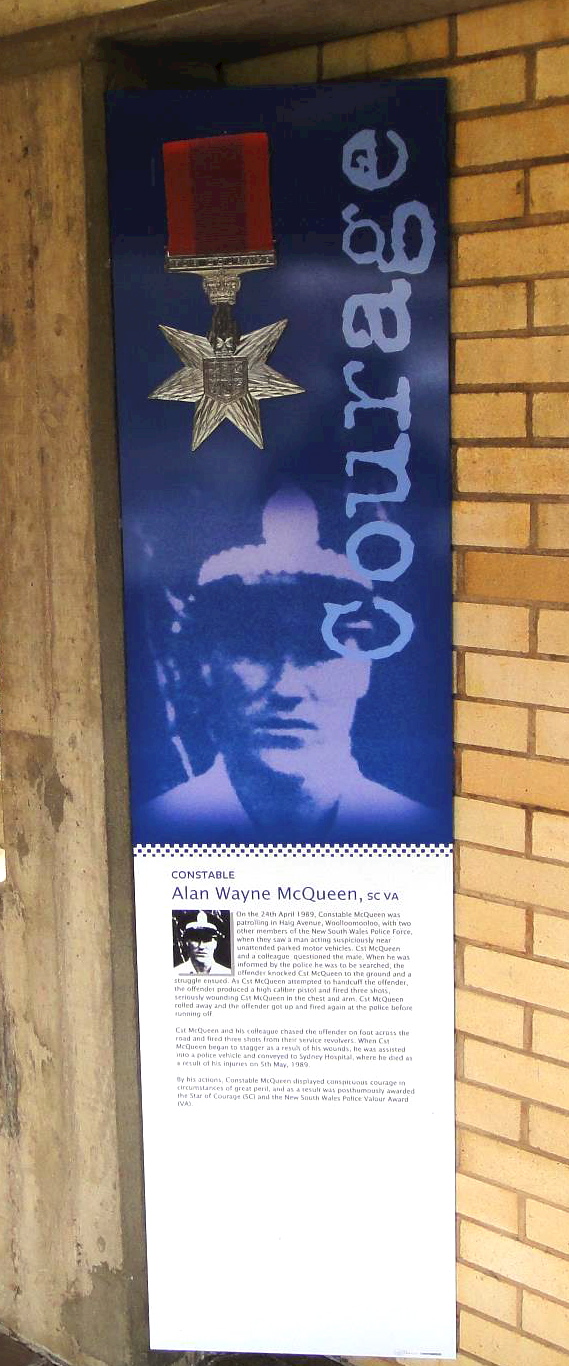
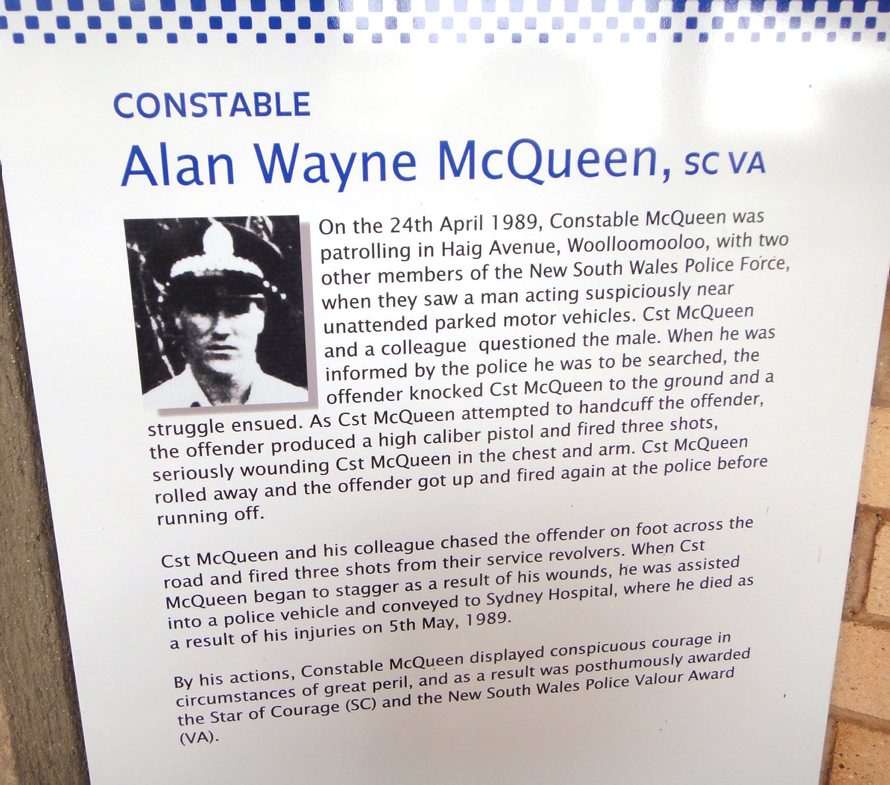
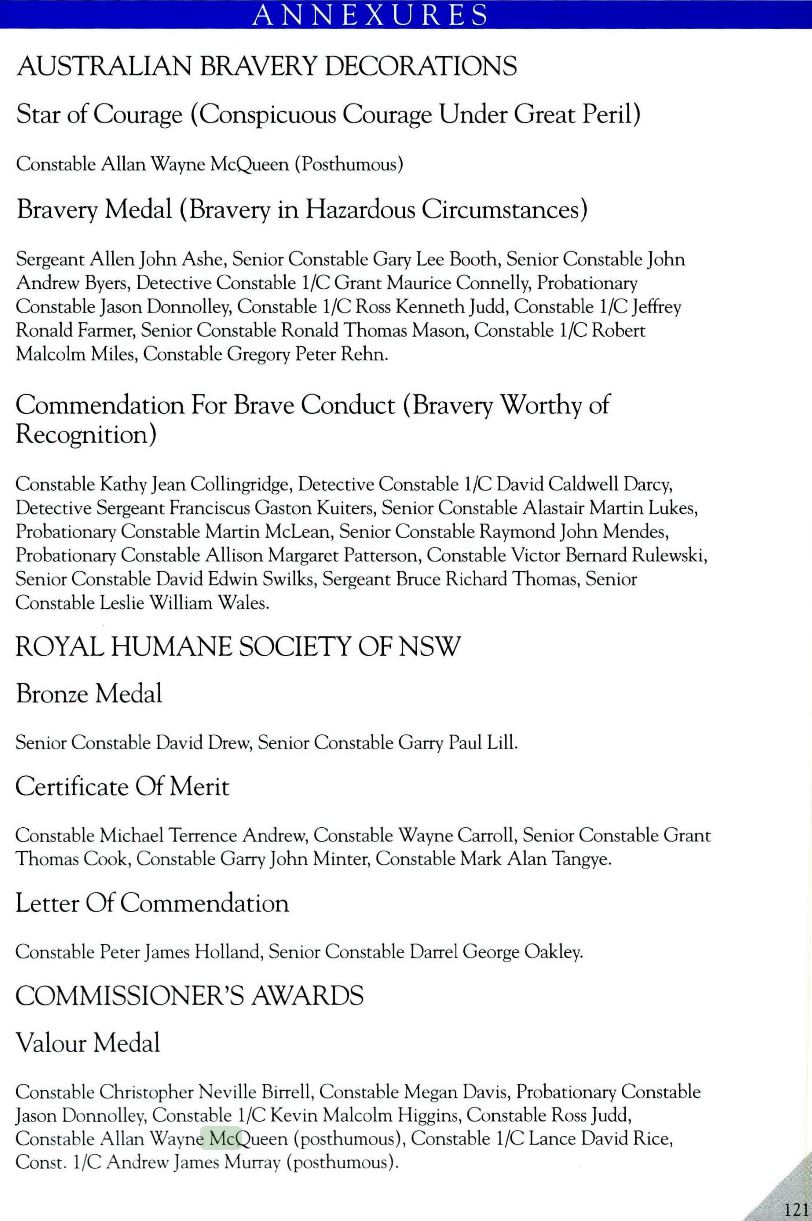
Commissioners Valour Award ( VA ) ( Posthumously )
Born: Friday 1 June 1962
Died On: Friday 5 May 1989
Event: Shot – wounded – Murdered
Event location: Woolloomooloo, NSW
Event Date: Monday 24 April 1989
Died: Friday 5 May 1989 ( 9 days after event )
Cause: Murdered – shot twice
Age: 26 yrs 11 mths 4 days
Funeral date: Tuesday 9 May 1989
Funeral location: St Mary’s Anglican Church
Buried at: Cremated. East Ballina Cemetery, McQueen Family Wall, Sec: Niche, Lot # 2
GPS: 28*51’47″S / 153*35’26″E
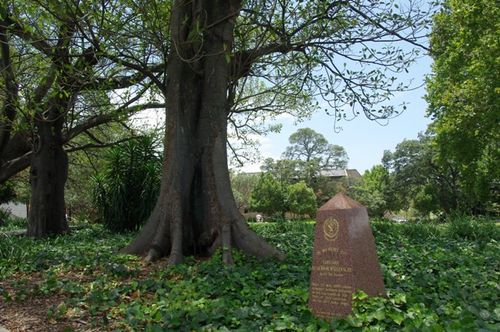
Memorial: 1/ Yurong Parkway, Phillip Park , Sydney, 2000
GPS: Lat: -33.872583 / Long: 151.213778
2/ Sydney Police Centre, McQueen Room, 151 – 241 Goulburn Street, Surry Hills.
3/ Police Launch McQueen???.
Allan’s touch plate was polished today, this 27th anniversary, 5 May 2016, by a mate, Craig Coleman, at the National Police Wall of Remembrance, Canberra.
ALLAN IS mentioned on the Police Wall of Remembrance
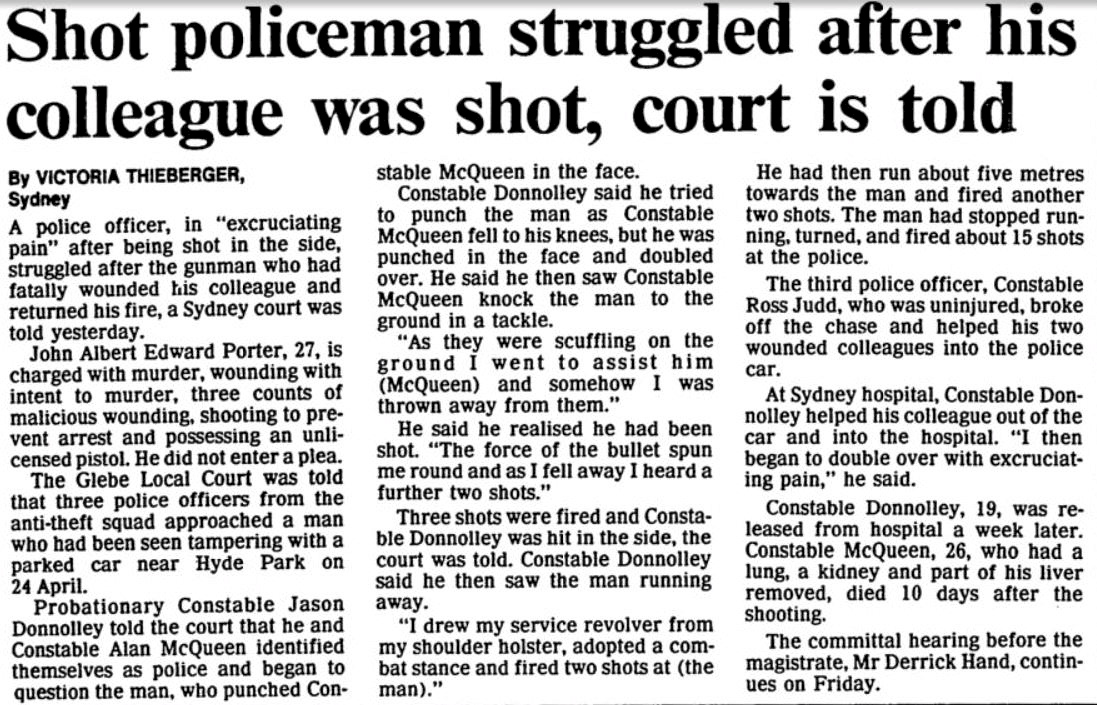
On the morning of 24 April, 1989 Constable McQueen, Constable 1st Class Ross Judd and Probationary Constable Jason Donnelly were patrolling the Woolloomooloo area. All were members of the District Anti-Theft Squad. About 11.35am they saw the offender Porter, apparently attempting to break into a motor vehicle. While Constable Judd parked the police vehicle, Constables McQueen and Donnelly went to speak to the offender. As he was being detained, the offender produced a concealed weapon and shot Constable McQueen twice in the chest and Constable Donnelly in the abdomen. Both constables then chased the offender, who continued firing at them, until both collapsed from their wounds. Constable Ross Judd also pursued and fired at the offender before returning to assist his colleagues. He then carried both wounded constables to the police car and drove them to the Sydney Hospital.
Constable Donnelly was to recover from his wounds however Constable McQueen had sustained extensive internal injuries and died on 5 May, 1989. The offender was later arrested by Queensland Police.
The Canberra Times of 12 July, 1990 reported on the result of the trial of the offender.
CONVICTION IN POLICE DEATH SYDNEY:John Albert Edward Porter has been found guilty of the murder last year of Sydney police constable Allan McQueen. A Supreme Court jury deliberated for nearly 10 hours before finding Porter, 28, guilty of shooting the policeman on April 24 last year. Porter was remanded in custody for sentencing on August 3. The jury also found Porter guilty on one count of shooting with intent to cause grievous bodily harm and three counts of shooting to avoid arrest. He was found not guilty on a sixth charge of attempting to murder Constable Jason Donnelly.
Justice Badgery-Parker had directed the jury to find Porter not guilty on the charge of attempting to murder Constable Donnelly. Porter had pleaded not guilty to all charges.
Friends and relatives of Constable McQueen sat comforting each other in the public gallery as the verdict was returned. Constable McQueen, 26, died in St Vincent’s Hospital nine days after the April 24 shooting.
The constable was born in 1962 and joined the New South Wales Police Force on 27 June, 1987. At the time of his death he was attached to the Sydney
Date: 24 August 1989. Memorial unveiled on corner of Haig Ave & Boomerang St, sydney.
November 2013
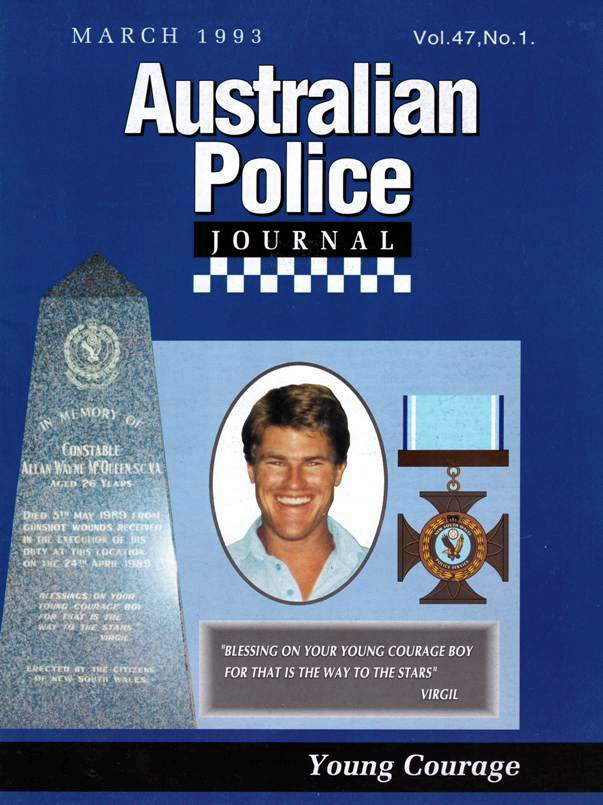
Constable Allan Wayne McQueen
Constable Allan Wayne McQueen : November 2013
Photographs supplied by Peter F Williams
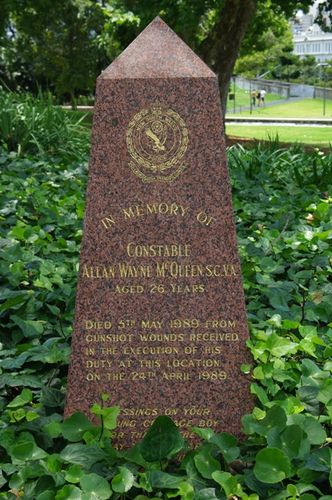
Memorial erected in memory of Constable Allan James McQueen who was shot in the line of duty and died from his injuries on the 5th May 1989.
On the morning of 24 April 1989, Constable McQueen, Constable 1st Class Ross Judd (MV, BM ), and Probationary Constable Jason Donnelly (MV, BM ) were patrolling the Woolloomooloo area. All were members of the District Anti-Theft Squad. About 11.35am they saw the offender Porter apparently attempting to break into a motor vehicle. While Constable Judd parked the Police vehicle Constables McQueen and Donnelly went to speak to the offender. As he was being detained the offender produced a concealed weapon and shot Constable McQueen twice in the chest and Constable Donnelly in the abdomen. Both Constables then chased the offender who continued firing at them until both collapsed from their wounds. Constable Ross Judd also pursued and fired at the offender before returning to assist his colleagues. He then carried both wounded Constables to the Police car and drove them to the Sydney Hospital. Constable Donnelly was to recover from his wounds however Constable McQueen had sustained extensive internal injuries and died on 5 May 1989. The offender was later arrested by Queensland Police.
Front Inscription
IN MEMORY OF
CONSTABLE
ALLAN WAYNE McQUEEN S.C.,V.A.
AGED 26 YEARS
DIED 5TH MAY 1989 FROM
GUNSHOT WOUNDS RECEIVED
IN THE EXECUTION OF HIS
DUTY AT THIS LOCATION
ON THE 24TH APRIL 1989
Location
Address:
Yurong Parkway, Phillip Park , Sydney, 2000
State:
NSW
Area:
AUS
GPS Coordinates:
Lat: -33.872583
Long: 151.213778 Note: GPS Coordinates are approximate.
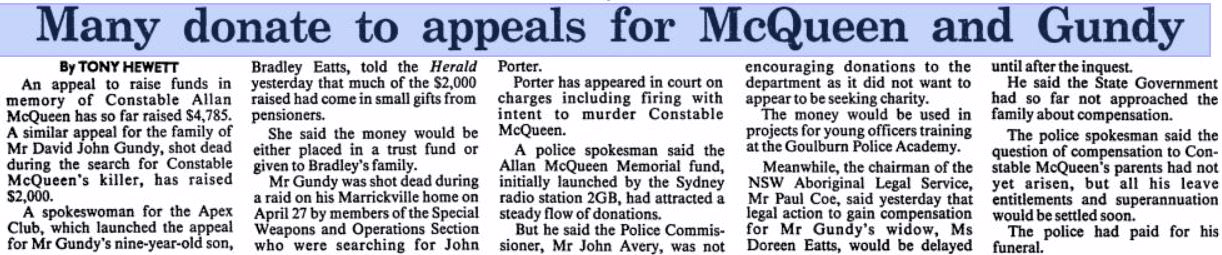
By LINDSAY SIMPSON ” Chief Police Reporter As one of “Big Al’s” best mates read a moving eulogy, burly police officers, hats in hands, bowed their heads and cried. Big Al was Constable Allan Wayne McQueen, the well-mannered policeman from Kyogle who died in the line of duty, shot trying to apprehend a suspected car thief in Sydney.
Constable McQueen, who had been in the force two years, had been picked to work with the Anti-theft Squad a training ground for young officers on their way to becoming detectives. Big Al, who spent three years trying to become a police officer, was known by that name “not so much because of his height but because of his heart”, said Cheryl Coleman, whose husband had shared a house with Constable McQueen in Coffs Harbour.
As Senior Constable Steve Tedder, who gave one of the eulogies said, “Big Al had the basic love and desire to become a police officer”. In 1986, while running his own cleaning business in Coffs Harbour, he built his own house and several local police officers became his flatmates. At that stage he had five jobs and was studying at night for his HSC English in an attempt to become a police officer. About this time, before he was even in the force, he saved a man’s life. The man had quarrelled with his girlfriend outside a local night club and had head-butted a pane of glass. The glass had cut his throat and Al tore his shirt off and stemmed the flow of blood while waiting for the ambulance.
Big Al. who trained as a boxer and played Rugby League, was not always the muscle builder he was at the time he joined the force. His former Rugby League coach at Kyogle High School, Mr Stan McBride, said that in the 14-year-old competition he had been the second smallest kid in the group.
Ballina townspeople also came to the funeral service. One local, Mrs Val Studdert, said she had never met Allan McQueen but had come out of respect for what he had done. “If we don’t have law and order, we have nothing,” she said.
The pallbearers wore pistols. Perhaps that’s the way it has to be these days, but they touched the pretty white wooden church in the green countryside with vulgarity. They were big, strong young men and their bulky police uniforms made them bigger, so that when they came to the narrow church door carrying their mate’s coffin, they could barely squeeze through. In any case, the coffin seemed too narrow for a young man as big as Allan McQueen.
Nearly 300 police went to his funeral in Ballina yesterday along with his mother and father, Mr John and Mrs Shirley McQueen, and 300 family and friends. They spilled out of St Mary’s Anglican Church into a church hall, where the service was shown on video, and out of the hall on to the grass, where they listened through loudspeakers.
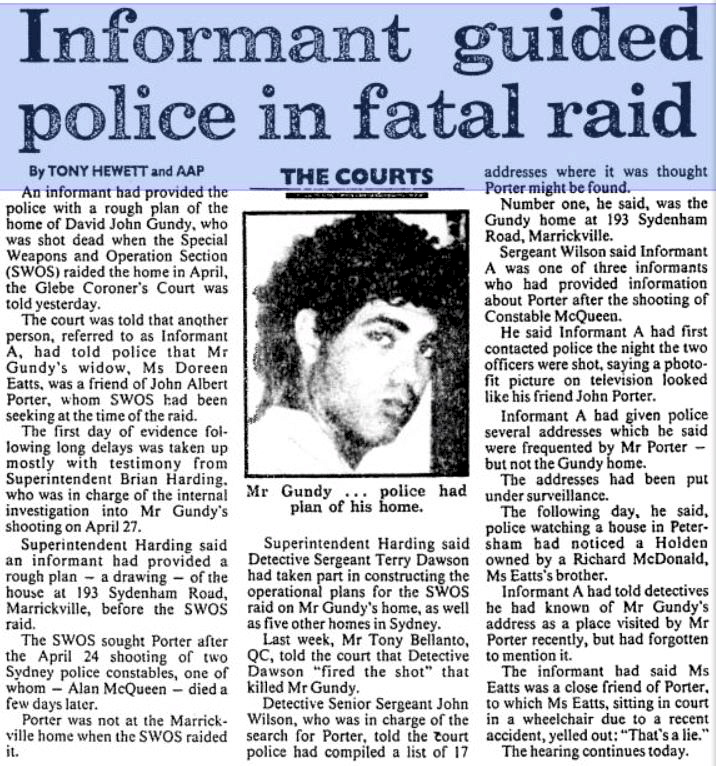
If we are to still violence, we must cherish life. Yesterday, 26-year-old Allan McQueen’s life was cherished. Today, others will cherish the life of 32-year-old David Gundy, the unarmed man killed in a police raid following Constable McQueen’s mortal wounding. Spring had sung in both men for only a while before life escaped them in violence. Senior Constable Graham White told the mourners that Allan McQueen had been a man of honour, love and integrity and a man whose word could be relied upon. He did not search for riches but for life itself, said Constable White. “Today he would be saying, ‘Let’s get on with it. Let’s not have all this fuss and bother’.”
Detective Senior Constable Steve Tedder said that the day McQueen received the letter of his acceptance into the force, “his face lit up as if Manhattan had lit up”.’ Constable Tedder lived with Constable McQueen in Manly and called his mate “Big Al”. “What a joy he was to live with,” he said. Constable McQueen had made more friends in 18 months in Manly than Constable Tedder had in 28 years.
Colleagues of slain policeman Allan McQueen weep as he is laid to rest in Ballina yesterday. One of his favourite expressions was: “Not a problem“. Another was: “I’m here for a good time, not a long time.” Constable Tedder said it was somehow appropriate that Allan McQueen began his long battle for life on April 24, the day before Anzac Day. That was the day Allan McQueen became a hero. Police Commissioner John Avery said Constable McQueen had exhibited the qualities of a police leader of the future. “His father said it was a waste of a fine young life, and I agree,” said the Commissioner. “His was an unforgettable example of courageous service that will enshrine his name in the annals of the history of NSW.” Mr Avery quoted Virgil: “Blessings on your young courage, boy, for that is the way to the stars.”
Outside the church, a senior policeman said: “There’s a finality to heroism.” Mr Athol McQueen, a cousin and the boxer who knocked down champion Joe Frazier in the 1964 Olympic Games, said: “I hope there are more young blokes around like him.”
” The police band played a funeral march for their colleague, past Sunnyhaven Flats. The open-faced country folk let the tears run down their cheeks. As the cortege passed a place called Camelot, on the way to the Lismore Crematorium and another place called Goonellabah, an old woman stood at the roadside and said : “Poor little fellow.” At the crematorium flowers spelled out the letters NSWP -New South Wales Police on the hillside.
A young policeman picked up a rose and handed it to a young woman. , ‘ Mr John McQueen wipes away a tear as he stands with his wife Shirley at their son’s funeral.
PARTY AT COFFS HARBOUR WITH LOCAL POLICE. BACK ROW: DALE COLEMAN, GRAHAM WHITE, MARK JONES, GREG CALLANDER. FRONT ROW: CRAIG COLEMAN, ALLAN McQUEEN, JOHN KERLATEC. 2 JUNE 1986
First published 5 January 2014
Updated 7 June 2025 with new photo ( 1986 )
Sharon Louise WILSON
27/10/2012
Sharon Louise WILSON
late of Uralla, NSW
New South Wales Police Force
Goulburn Academy Class # 236
Regd. # 25???
Rank: Commenced Training at Goulburn Police Academy on Sunday 8 May 1988 ( aged 19 years, 7 months, 16 days )( spent 2 months, 21 days at Academy )
Probationary Constable – appointed Friday 29 July 1988 ( aged 19 years, 10 months, 7 days )
Stations: Leeton
Awards: ? Nil
Born: Sunday 22 September 1968
Died: Wednesday 30 November 1988
Age: 20 years, 2 months, 8 days
Service: 8 May 1988 to 30 November 1988 = 6 months, 22 days Service
Cause of death: Accidentally Shot – by colleague – Service weapon
Location of incident: inside Leeton Police Station, NSW
Memorial 1: Memorial Tree planted at NSW Police Academy, Goulburn
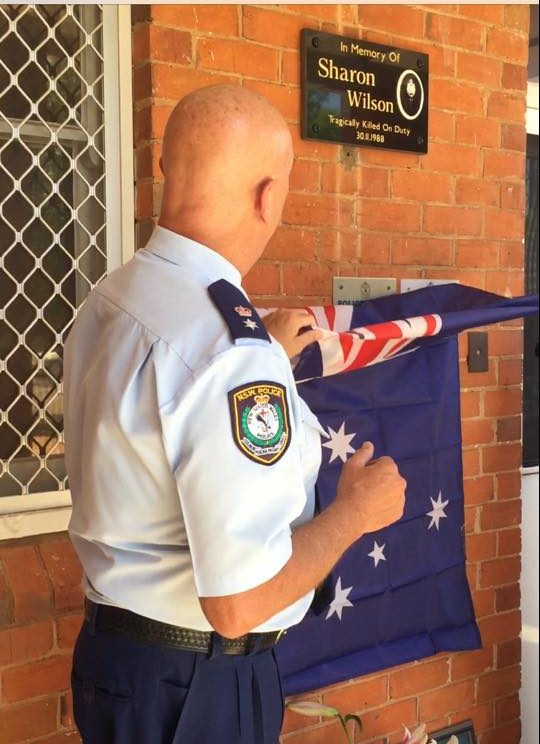
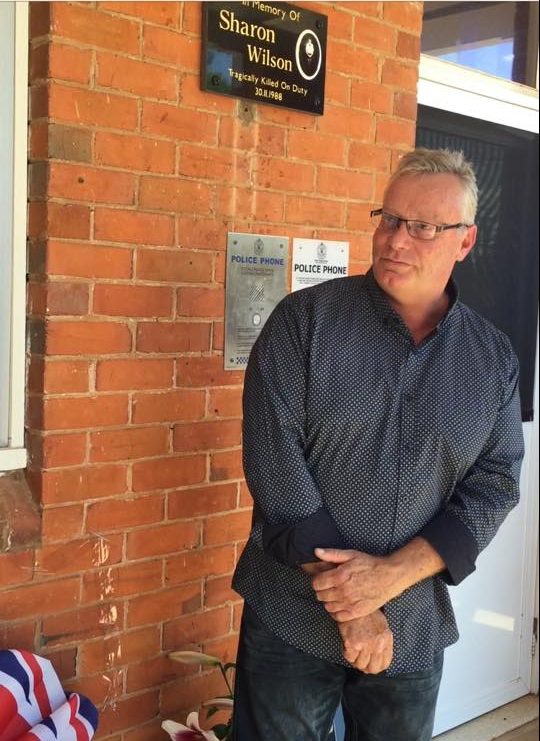
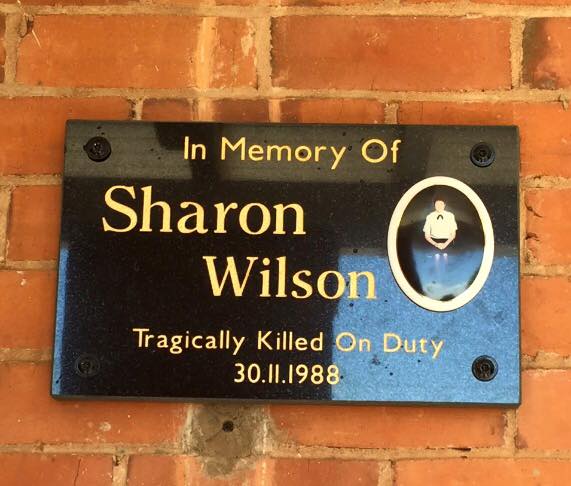
Memorial 2: Memorial plate on the front outside wall of Leeton Police Station. Dedication done on 30 November 2015. Photos below.
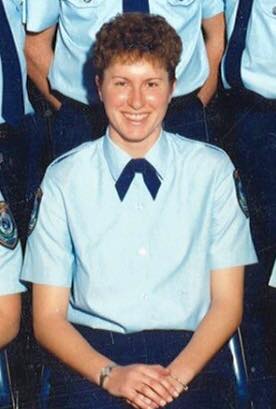
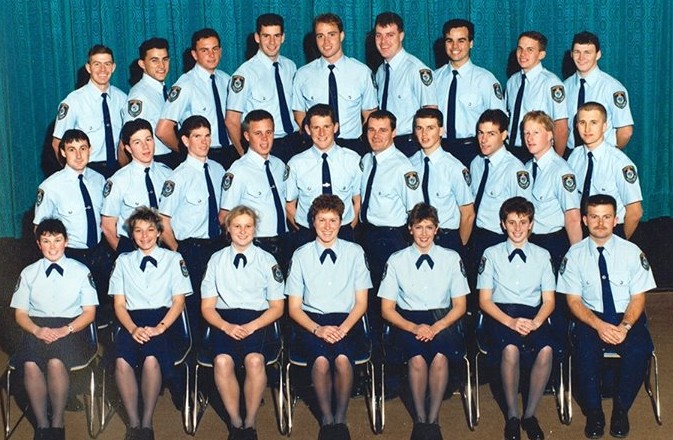
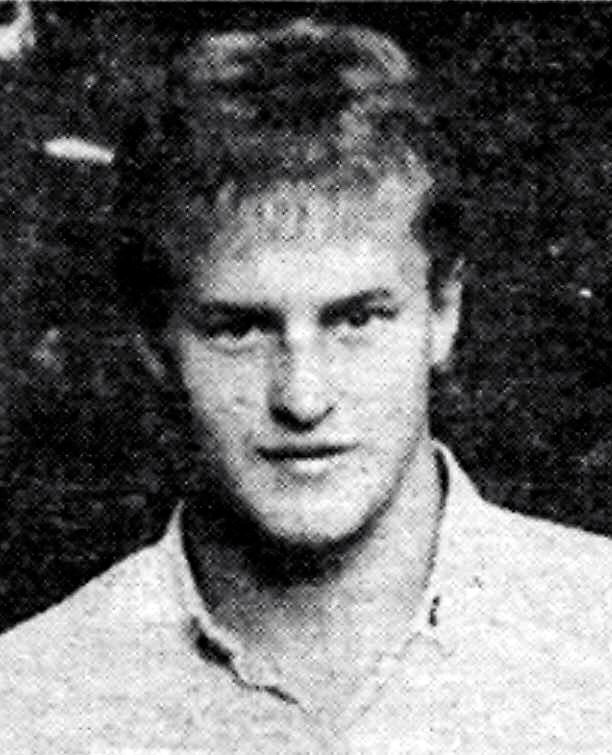
Sharon Louise WILSON – centre, front row. Class 215
About 2.15pm on 30 November, 1988 Constable Wilson was on duty at the Leeton Police Station when she suffered a severe gunshot wound to the head when another member’s service revolver discharged. Although treated at the scene by colleagues until the ambulance arrived, she passed away at the Wagga Base Hospital at 5.45pm the same day.
The constable was born in 1968 and joined the New South Wales Police Force on 9 May, 1988. At the time of her death she was stationed at Leeton.
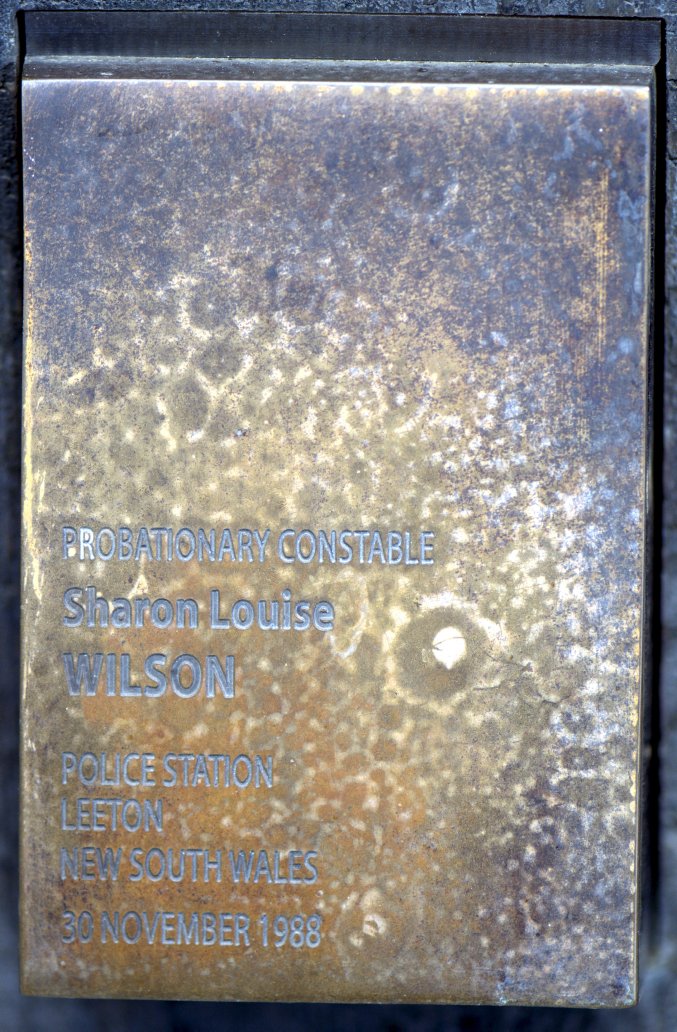
Touch plate at the National Police Wall of Remembrance, Canberra
Sharon is mentioned on the Police Wall of Remembrance
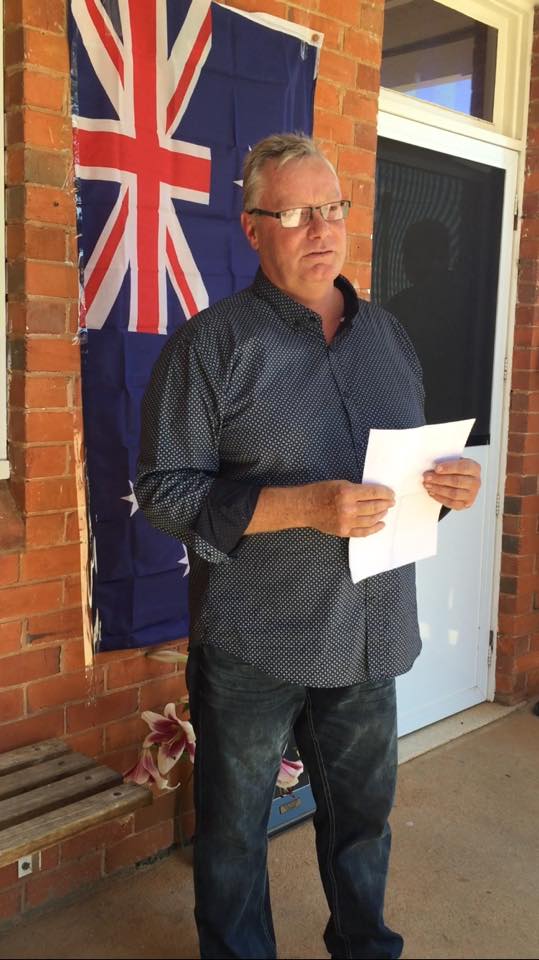
Alan Cope ( # 23769 ? ) thanks guests for attending. Alan spoke about Sharon Wilson and her short time in Leeton.
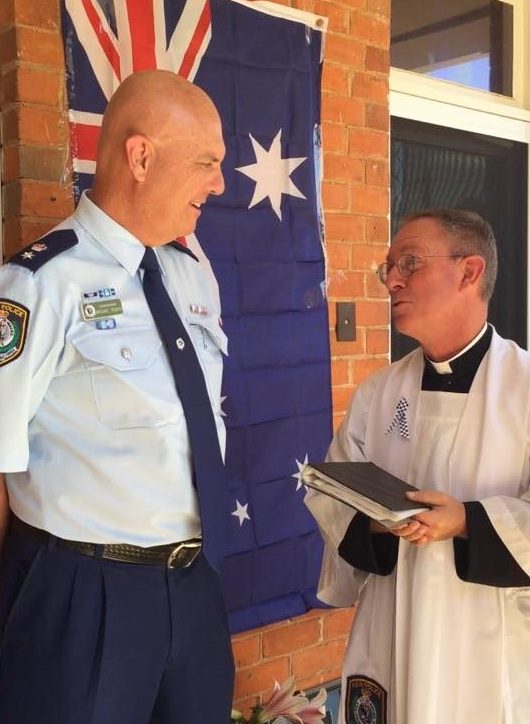
Superintendent Mick Rowan # 22980 ? ) with Father Robert offer kind words. — with Robert Patrick Murphy
Superintendent Mick Rowan unveiled the new memorial plaque.
Alan Cope closes the ceremony. Monday 30 November 2015
Dedicated: Monday 30 November 2015
2 December 1988
“CHARGES POSSIBLE OVER SHOOTING
SYDNEY: The NSW Police Commissioner, John Avery, will decide whether charges should be laid against a constable allegedly involved in the shooting death of her 20 year-old colleague on Wednesday.
A police spokesman said yesterday a team of detectives was waiting to interview the young officer over the death of policewoman Sharon Wilson at the Leeton Police Station, in the state’s Riverina district.
He said results of the investigation would be forwarded to Mr Avery for consideration.
A police spokesman said the detectives — including two from Sydney’s Internal Affairs department, two from homicide, a ballistics expert and a police psychologist — were waiting to talk to the 19-year-old constable.
Probationary Constable Wilson was shot in the head by one bullet from a service revolver while on duty at Leeton Police Station, at 2.15pm on Wednesday.
She was rushed to Wagga Base Hospital, but died 3 1/2 hours later.
The policewoman awaiting questioning had been treated for shock and was being cared for by friends and welfare personnel, the spokesman said.
Detectives hoped to talk with her last night.
Miss Wilson, of Uralla, in the Northern Tablelands, was well known in the small community. She was regarded as a fine athlete and her 188cm frame was well known in the local basketball league.
Miss Wilson was studying visual arts at the Riverina Murray Institute of Higher Education in Wagga.
Her body will be transported to her home at Uralla, where a funeral will be held at 1pm on Monday.”
SYDNEY: Junior police officers could be made to leave their guns at work after a young constable accidentally killed his best friend while cleaning his service revolver at home on Monday.
An internal police investigation into the shooting would look at the controls on probationary constables’ possession of weapons, the NSW Minister for Police, Ted Pickering, said yesterday.
Constable Andrew Pearce, 20, was cleaning his .38 service revolver in the bedroom of his Greystanes home in Sydney’s west at noon on Monday when the gun discharged and hit his friend Andrew James McDonald in the chest.
Mr McDonald, a 20-year-old bank teller from Greystanes, died an hour later in Westmead Hospital.
The incident was the second fatal shooting by a probationary constable in the past four months.
Last November Probationary Constable Sheree Schneider, 19, ( ProCst # 60370 ) accidentally shot Constable Sharon Wilson in the head at Leeton police station in the Riverina region. The young constable now faces a manslaughter charge.
Acting Police Commissioner Angus Graham refused yesterday to comment on Monday’s shooting and was unable to say whether Constable Pearce, an officer with one year’s service, would be charged over the incident.
He said the fatal shooting was the subject of a full investigation by the police’s Internal Affairs Department.
“When we have these incidents we always review our arrangements,” he said.
A policewoman fatally wounded a colleague with a shot from her service revolver which she believed was empty, the Leeton Local Court, in south-west NSW, heard yesterday.
Sheree Ann Schneider ( ProCst # 60370 ), 20, of Pine Avenue, Leeton was charged with the manslaughter of Constable Sharon Louise Wilson, 20, at Leeton Police Station on November 30 last year.
Constable Wilson died of head injuries at the Wagga Wagga Base Hospital as a result of the shooting.
Constable Harvey McRae told the court that he was sitting at a computer terminal when he heard the firing pin of a police revolver strike the empty chamber. Constable Wilson had said, “Oh God, don’t do that. You scared the living daylights out of me”.
He said Schneider pointed the revolver toward Constable Wilson and said: “No, it’s empty, see?” The gun then discharged.
Schneider said she went into the sergeant’s office and re-loaded her gun. The court heard that four live bullets and one spent one were later removed from the revolver.
ALBURY: A policewoman who fatally shot a colleague has been cleared of manslaughter after a hearing in the Albury District Court. Sheree Ann Schneider, 20, of Pine Ave, Leeton, was charged with the manslaughter of Sharon Louise Wilson, 20, of Leeton, who died from injuries received in the shooting.
Constable Wilson was shot in the head while speaking on the telephone in the communications room of Leeton police station on November 30 last year.
Miss Schneider gave evidence at the committal hearing on Friday.
She said she had gone to the sergeant’s office where she had unloaded her special issue five-shot .38 service revolver. She told the court she was sure five bullets had fallen from the revolver’s cylinder and into her hand.
Miss Schneider said she had left the bullets in the office and returned to the inquiry counter area.
Thinking the gun was empty, she “dry fired” it.
Miss Schneider said Constable Wilson had become frightened and said: “Oh God, don’t do that. You scared the living daylights out of me.”
She had said to Constable Wilson: “No, it’s empty, see” and then pulled the trigger “to reassure her she had nothing to worry about.” The gun had discharged.
Asked by her counsel, Mr John Dailly, what she had thought when the gun discharged, she said: “I couldn’t believe it! I was sure I had counted five bullets.”
It was not until she had returned to the sergeant’s office that she realised she had made a mistake.
Although Miss Wilson had been shot, Miss Schneider said she was unaware at the time the gun had been pointing at her colleague.
Miss Schneider said she had returned to help Miss Wilson, who lay on the floor bleeding profusely from a wound to the left temple.
She said she placed both hands over the wound to try to stop the bleeding.
The court was told Miss Schneider had received 200 minutes pistol training at the police academy and had been issued with the smaller five-shot revolver after failing her first shoot with the larger six shot model.
Mr Dailly said the shooting had been an accident.
“It was totally unintended, unexpected and unforeseen,” he said.
In discharging Miss Schneider, Magistrate Barry Wooldridge said she had made a “great mistake” when counting the bullets. But the fact remained that there was no intent on Miss Schneider‘s part, no animosity between the two and no evidence she had deliberately pointed the gun at Constable Wilson.
SYDNEY: The Director of Public Prosecutions said yesterday he would review a magistrate’s decision to dismiss a manslaughter charge against a police woman who shot dead a fellow officer.
The director, Reg Blanch, QC, said he would direct Constable Sheree Schneider to stand trial if he found that Leeton Magistrate Barry Wooldridge had made an error in judgement.
Constable Schneider, 20, shot dead Sharon Wilson, also 20, with a service revolver at Leeton police station on November 30. She said she thought the revolver was empty.
Mr Blanch said he would make a decision in four to eight weeks. Constable Schneider, suspended with pay, was to answer a charge on August 31 of using a firearm with disregard for safety.
Schneider Case
In New South Wales, at Leeton police station on 30-Nov-1988, a junior policewoman produced a pistol and shot dead another officer. Sheree Ann Schneider claimed it was an accident. Satisfied the pistol was unloaded, she pulled the trigger without looking where the gun was pointed. The charge of Felonious Assault was dismissed in the lower court on 28th July 1989 under section 41 (vi) – the presiding officer ruled that no jury would convict. Use Of A Firearm In Disregard For Another Persons Safety was dismissed on 27th April 1990. The female did not even lose her job, presumably her fellow officers hope she will be more careful in future.
Court Ignores Duty
It is axiomatic with all weapons training that they never be pointed at anyone unless they are intended to be used —even in jest. Deliberately pulling the trigger without looking where the .38 pistol was pointed was criminal irresponsibility. Sharon Wilson was killed as the result of criminal negligence; a failure that should not be tolerated from any citizen, much less a police officer. Not knowing the gun was loaded is no excuse for anyone, least of all a trained professional. For the courts to fail to penalise this action is to commit more crimes; the denial of the importance of duty and the magnitude of taking a life.
The Law Repeats The Role Of Indulgent Parents
Schneider escaped penalty by adopting the infantile excuse that she was merely the hapless victim of the inadequate police weapons training program; that this was accepted by the authorities is not an aberration. Trial for murder is no longer a matter of resolving fact; it has become a re-enactment of the spoilt child caught by their indulgent parents; if the miscreant can deflect blame while generating sympathy then all is forgiven.
Rank: Commenced Training at Goulburn Police Academy on 18 August 1986
Probationary Constable – appointed 7 November 1986
Final Rank: Probationary Constable
Stations: Pennant Hills October 1986 to 3 June 1987
Awards: Nil
Service:
From 18 August 1986to 3 June 1987 = 11 months
Born: ? ? 1966
Died: Wednesday 3 June 1987
Age: 20
Cause: Illness – Suicide by Service firearm
Location: at Lane Cover River Park, Lane Cove.
Funeral date: ?
Funeral location:
Eastwood
Grave Location:Cremated
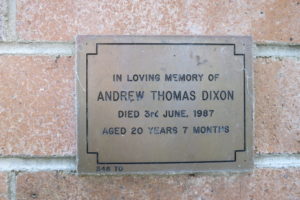
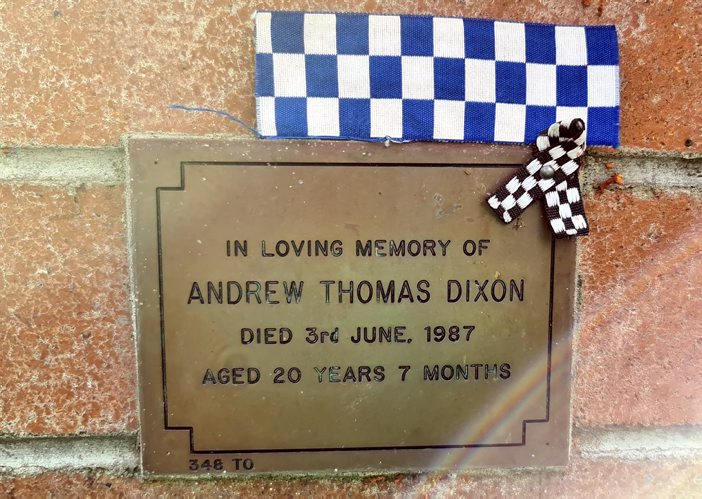
Memorial plaque at Northern Suburbs Crematorium, Delhi Road, North Ryde, NSW
Niche: Row ‘TO’, plaque # 348
Touch plate at the National Police Wall of Remembrance, Canberra.
Andrew Thomas DIXON. Plaque condition as of 8/9/2020
ANDREW IS mentioned on the Police Wall of Remembrance
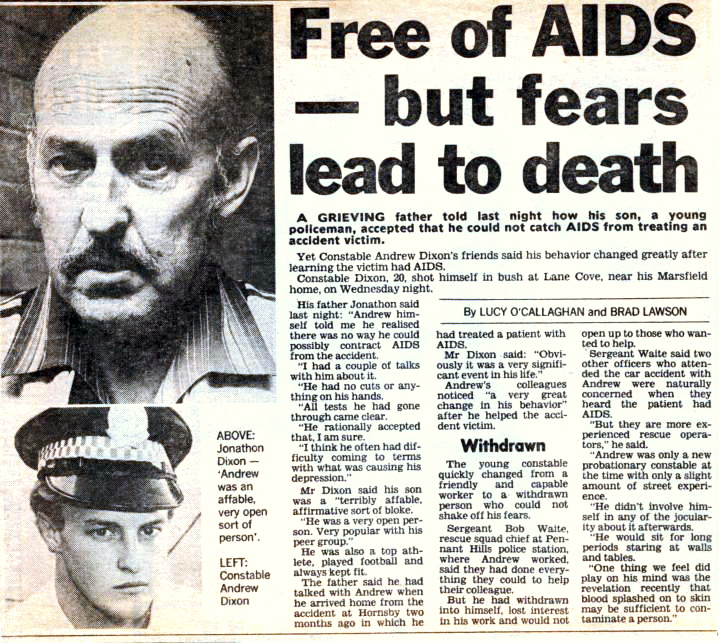
In April, 1987 Constable Dixonand other police attended a serious motor vehicle accident at Mt Colah. A person trapped in the vehicle became violent when released and Constable Dixon assisted in restraining him. During the struggle the constable was covered in a considerableamount of the injured person’s blood. It was later discovered that this person suffered from HIV/AIDS. Due to stress and concern over the disease, Constable Dixon drove to the Lane Cove River Park on 3 June, 1987 and committed suicide.
The constable was born in 1966 and joined the New South Wales Police Force on 18 August, 1986. At the time of his death he was stationed at Pennant Hills.
From Kevin Banister – I remember this very well. I was working at Pennant Hills when Andrew arrived as a fresh faced Probationary Constable. He was a fine young man built like a brick s**thouse. When he was told that the accident victim had HIV/AIDS he began to withdraw very quickly. All at the station were concerned for his welfare and tried to help where possible.
On the afternoon of 3/06/87 Andrew had worked morning shift and I was on afternoon shift. At the hand over Andrew said goodbye with a smile on his face and went home, or so I thought. I was not aware that he was supposed to be attending the PMO (Police Medical Officer) for an appointment after work. I got a call from his mother just before sundown to say that Andrew had not come home and were concerned for his welfare. Pennant Hills was a Rescue Squad/General duties station at the time and I was the senior operator rostered on. I made a number of phone calls including to the Lane Cove station and Marrickville Rescue base. Not long after we received info that Andrew’s car had been located in a dead end street off Delhi Road beside the Lane Cove river.
As a result I and my offsider Bob Hanson attended in the Rescue vehicle. Numerous other Police vehicles arrived along with the Water Police. I organised a number of search parties and headed into the scrub towards the river. Reached the riverbank and saw that the Water Police had also began a search in the area we were in. Again, a short time later I and my offsider found the body of Andrew with his service revolver by his side. I indicated to the Water Police to come over (not using the radio) and told them that they were no longer required. The boat crew saluted and left the scene. A discrete message was sent to the command post as I knew that his parents were at the post and could hear the radio transmissions.
When we emerged from the bush with Andrew’s body many of the Police were in tears as he was a local boy and well known. His funeral was standing room only and the street blocked off for the overflow. During the period of the time of the accident and Andrew’s death he had a number of blood samples taken, but due to the technology of the time he was told that it could be some time before they knew if he had became infected. About a month after his death we were informed that he had not become infected. R.I.P. my friend.
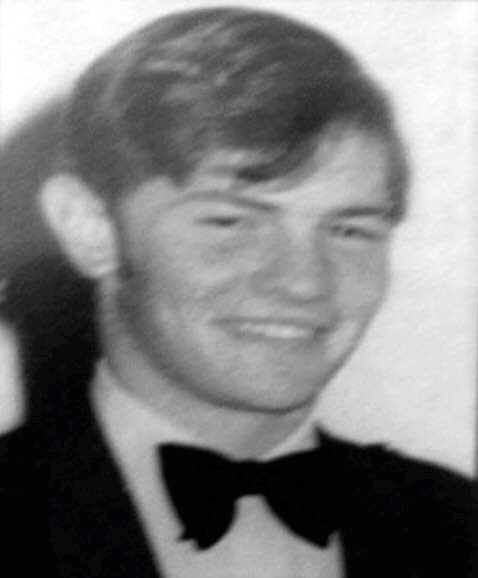
Paul Mitchell QUINN
27/10/2012
Paul Mitchell QUINN
New South Wales Police Force
Redfern Police Academy Class # started with 156 – may have ended with 163
Cadet #: 3358
Regd. # 18605
Rank: NSW Police Cadet – commenced Training at Redfern Police Academy on Monday 4 July 1977 ( aged 17 years, 1 months, 28 day )
Probationary Constable – appointed 29 May 1979 ( aged 19 years )
Constable – appointed ? ? ?
Constable 1st Class – appointed 29 May 1984
Final Rank: Constable 1st Class – posthumously promoted to Sergeant 3rd Class
Stations: Casino & Bathurst – Death
Service: From 4 July 1977 to 30 March 1986 = 8 years, 8 months, 26 days
Awards: No find on It’s An Honour
Born: Sunday 29 May 1960
Died on: Wednesday 30 March 1986
Cause: Murdered. Shot through neck during arrest
Event location: , Perthville, NSW
Age: 25 years, 10 months, 1 day
Funeral Date: ?
Funeral Location: ?
Buried at: ?
Grave location: Maranatha, Sec: Mar2, Row: A, Grave: 112
Memorials: 1/ Chifley LAC has the ‘ Paul Quinn Award ‘ for the most outstanding Officer each year. Paul is Remembered within the Chifley LAC.
2/ Paul Mitchell Quinn – stone monument near the murder scene
3/ Mt Panorama ( Bathurst ) Police Compound – dedicated to Sgt Paul Quinn
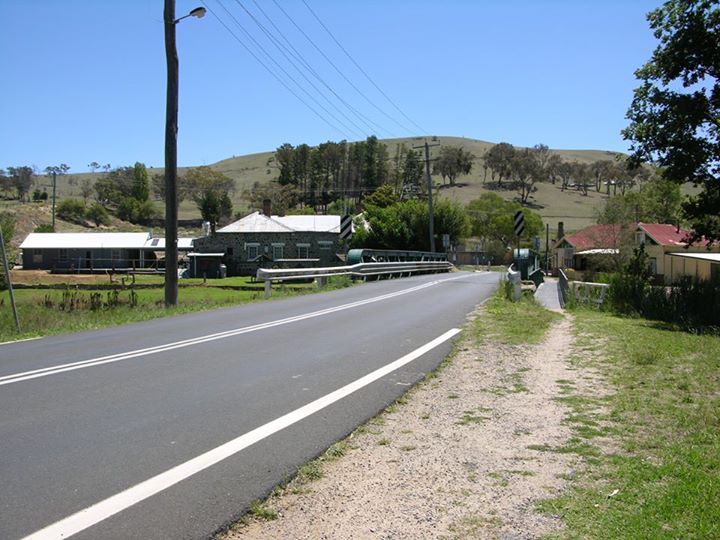
Paul Mitchell Quinn – monument near the murder scene
Paul Mitchell Quinn – murder scene
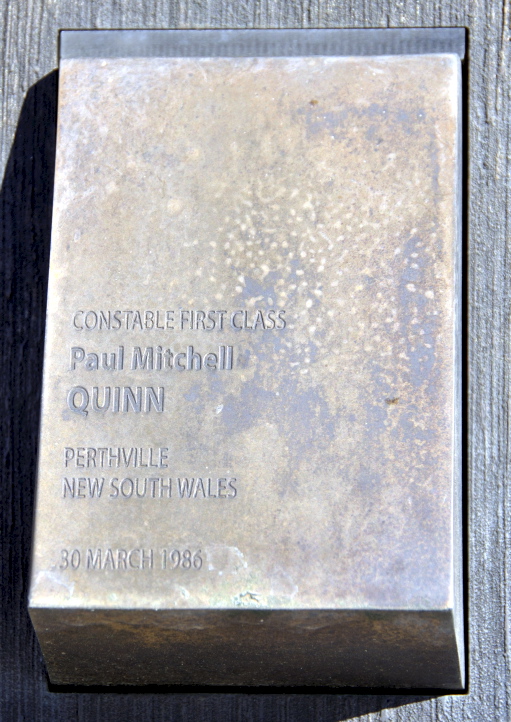
Police Wall of Remembrance – touch plate for Paul Mitchell QUINN – Canberra
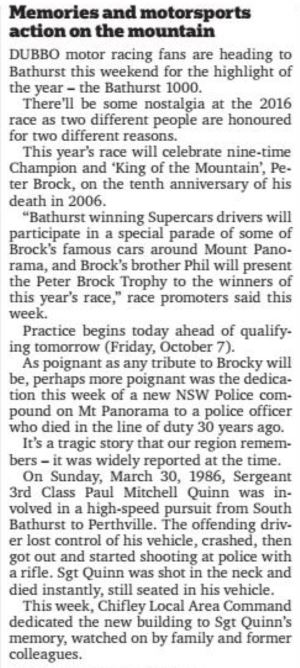
Dubbo Photo News, page 3, Oct 6 – 12, 2016
Late in the afternoon of 30 March, 1986 Constable 1st Class Quinn was involved in the high speed pursuit of a vehicle from South Bathurst towards Perthville.
At Perthville the offender lost control of the vehicle and collided with a bridge railing at the intersection of Bridge Street.
The offender then leapt from the vehicle with a .303 rifle and began to fire at the police who had been chasing him.
Constable Quinn was hit in the neck and killed instantly and Constable Ian Borland was seriously wounded.
The offender, Horan, was shot several times by police before being arrested and charged.
Fortunately Constable Borland recovered from his injuries. Constable Quinn was posthumously promoted to Sergeant 3rd Class.
The sergeant was born in 1960 and joined the New South Wales Police Force as a Cadet on 4 July, 1977. At the time of his death he was stationed at Bathurst.
Other Police who assisted with this incident at the time of the shots being fired were Senior Constable John Andrew BYERS BM.
Chifley LAC has the ‘ Paul Quinn Award ‘ for the most outstanding Officer each year. Paul is Remembered within the Chifley LAC.
Childhood pain relived as policeman’s killer poised for release
January 14, 2004
The day Constable First Class Paul Quinn was buried with full police honours, his daughter Rebecca turned four. After a funeral that closed streets in the policeman’s home town of Bathurst, his five-year-old son, Chris, was still asking relatives when Daddy would be coming home.
Lost innocence . . . Chris and Rebecca Quinn aged five and four.
Yesterday the siblings sat together in distress again as the man who killed their sole-parent father was declared ready to return to the community after serving almost 18 years in jail.
Chris has had trouble with the law, but has shown talent as a lightweight boxer. Rebecca runs a coffee shop and turns 22 in a couple of months.
Supporting them was Inspector Ian Borland, who was seriously wounded the day Constable Quinn was killed and still works in Bathurst near where the pair encountered Patrick Francis Horan on Easter Sunday 1986.
The policeman and the Quinn siblings had been told Horan would be granted parole at his third attempt, but the decision moved Chris to climb over the public gallery and storm out the Hospital Road courtroom door.
Weeping outside, he was embraced by Inspector Borland, who still has bullet fragments in his body.
Inspector Borland, the Quinns and the NSW Police Association wanted to keep Horan, 63, locked up until he was dead.
John Watts, for Inspector Borland and the Quinns, had argued that Horan‘s lack of insight into his psychiatric problems and his refusal to acknowledge he had been the aggressor when Constable Quinn was killed made a “potent mix”.
But the Parole Board found Horan, a paranoid schizophrenic, was unlikely to pose a risk to others if he took his medication and that “the jail system is not a substitute for the treatment of people suffering from mental illness”.
Horan‘s prison behaviour had been exemplary and he successfully completed unsupervised work release. He had the family support of a brother and was engaged in “the admirable hobby of bee-keeping”, the board found.
Horan had not been taking his medication when his mother called police about his erratic and violent behaviour on the afternoon of March 30, 1986. One of the officers to respond to the call was Constable Quinn, then 25 and on duty at Bathurst for only his fifth shift since being transferred from Casino, to be near his parents.
After a pursuit that ended 10 kilometres south of Bathurst at Perthville, Constable Quinn got out of his car and ran towards Horan, who shot him in the left clavicle with a .303-calibre rifle.
The officer’s colleagues returned fire as Horan adopted what he described as a Rambo position and emptied the 10-round magazine in his .303.
Constable Borland, then 36, was shot in both legs and a hand, while Horan, who was hit by at least seven of 18 shots fired by police, continued shooting at five other officers.
Constable Quinn was posthumously promoted to sergeant.
In the Supreme Court sitting at Bathurst, Horan pleaded not guilty to murder but guilty to manslaughter on the grounds of diminished responsibility due to mental illness.
Justice Kep Enderby sentenced him to life, with separate terms for wounding with intent to murder Constable Borland and shooting with intent to murder other police.
In March 1998 Justice Peter Hidden set a minimum term of 16 years, which expired in 2002, and a maximum of 22. The crown did not appeal.
Horan will be released next Wednesday, under conditions that include his accepting psychiatric treatment and not entering Chifley Local Area Command, where Inspector Borland works.
ANOTHER LIFE LOST: Chifley Local Area Command Acting Inspector Lionel White ( # 24873 ) said police in Bathurst have been personally affected by the death of Constable William Crews in Sydney on Wednesday night. Photo: BRENDAN ARROW 091010
POLICE in the ChifleyLocal Area Command have been personally affected by the death of trainee detective William Crews.
The 26-year-old died in a Sydney hospital after he was shot while carrying out a drug operation on Wednesday night with seven other officers from the Middle Eastern Organised Crime Squad in Bankstown, in Sydney’s south-west.
The officers were fired upon outside the targeted property in Cairds Avenue about 9pm. Constable Crews was hit in the head and neck.
Philip Nguyen, 55, has since been charged with shooting with intent to murder and discharging a firearm with intent to cause grievous bodily harm.
Geehad Ghazi, 27, has been charged with possession of an unauthorised firearm.
Yesterday, Acting Inspector Lionel White said the tragic situation in Sydney had personally impacted on a number of officers who knew Constable Crews.
“It is a very shocking situation, a couple of the officers here at the Bathurst Police Station knew him and have been left very upset by the situation,” he said.
“Some of the officers worked with him and trained with him before he became a detective.
“For those officers, we are offering them support and counselling during this tough time.”
Reminding people of those officers who lost their lives in the Bathurst area in the line of duty is a memorial board naming the 13 policemen who have died in the line of duty.
Since Trooper Robert Lovell McDougall died in 1853 near Sofala, 12 officers have fallen in the line of duty in Bathurst area with Sergeant Paul Mitchell Quinn the last, on the March 30, 1986.
Acting Inspector White said the latest death in Sydney brought to the forefront the difficult circumstances that police can find themselves in daily.
“On top of the very mundane things we do every day this is a stark reminder of the dangers police officers can face while in the front line,” he said. “This very much reminded us of the risk officers sometimes have to take while in the line of duty.
The State government has logged objections to Patrick Horan a NSW prisoner’s planned release, convicted of the manslaughter of a police officer and seriously wounding another. Justice Minister John Hatzistergos says the NSW Parole Board intends to grant parole to Patrick Francis Horan, who committed the crimes near Bathurst in NSW’s central west in 1986.
Horan‘s 22-year sentence expires on March the 29th, 2008 but his 16-year non-parole period lapsed on March the 29th last year. Hatzistergos says he’s discussed the matter with Police Minister John Watkins, who he says is also shocked at the board’s intention to release Horan.
In relation to convicted offenders:
(1) What is the status of attempts by Patrick Francis Horan, who killed one police officer and wounded another, to obtain parole?
(2) What action have you taken to ensure that Patrick Francis Horan remains in jail?
Answer—
(1) I am advised by NSW Police that the review hearing on Mr Horan‘s application for parole has been adjourned by the Parole Board until 13 November 2003 pending reports from Corrective Services Health and the Serious Offender’s Review Board.
(2) I have expressed my concerns in writing to the Parole Board in relation to the release of Mr Horan.
Free… but banned from Bathurst By Brooke Newstead Jan. 14, 2004, 6:38 a.m.
POLICE killer Patrick Francis Horan will walk free next week.
However, he will not be allowed to return to Bathurst for at least five years.
The NSW Parole Board yesterday granted Horan full parole with the condition that he is not to enter the Chifley Local Area Command district.
His release date is set for January 21 and he will remain on parole for five years.
Horan was originally sentenced to life plus 125 years after shooting dead Bathurst police officer Sergeant Paul Quinn and injuring then Senior Constable Ian Borland at Perthville in 1986.
On November 13, 2003, he was granted day release and after being released for just seven day-release days since that date, he will now be allowed to fully integrate back into the community.
Subsequent conditions imposed by the Parole Board state Horan must undergo regular psychiatric assessment and counselling.
He is also never to approach any of the victims of the fateful night during which he shot dead Sergeant Quinn.
A prisoner advocacy group has welcomed news convicted police killer Patrick Francis Horan will walk free in a week.
Horan, who suffers from paranoid schizophrenia, has served the minimum 16-years sentence for the manslaughter of Bathurst police officer Sergeant Paul Quinn and the wounding of his partner, Inspector Ian Borland.
The New South Wales Government has criticised the granting of parole and promised to reform the composition of the parole board.
But a spokesman for Justice Action, Brett Collins, says it was obvious 17 years ago the man had mental health problems and his case needed special treatment.
“Instead we have a tragic situation where we have a policeman killed and another one disabled,” he said.
“Now for the police to actually present themselves at this stage as vengeful, as angry … when it’s clearly a mental health issue, one which requires compassion and requires understanding, it’s a shame.
“It’s not what we should expect from the police force and we certainly should expect better than that from the State Government.”
Mr Collins says it is important in this case to listen to the experts.
“So if you don’t listen to them and if in fact you still at the end of it as a government or as a police association are still saying at the end of it we are still angry, we still have hate, we want vengeance then that’s a misleading situation,” he said.
“We should accept the fact that the institution is there for the purpose of making a decision and accept the judgment of the umpire and give support to them.”
Horan is to be released next Wednesday on the condition he does not enter the Chifley local area command where Inspector Ian Borland works, for the next five years.
It is expected convicted police killer Patrick Francis Horan will issue a statement this afternoon after being released from Sydney’s Long Bay Jail.
Horan shot and killed Sergeant Paul Quinn during an incident in the State’s central west 17 years ago.
He served his minimum of 16 years in jail for killing Sergeant Quinn and injuring then Senior Constable Ian Borland outside of Bathurst in 1986.
Horan fired at police with a rifle after a high-speed car chase.
Corrective Services says Horan will read a statement to the media at the jail’s boomgate, just after his release at 3:00pm AEDT today.
The department cannot say where Horan will be moving, or what possible security arrangements have been made on his behalf.
The parole board has ruled that Horan will not be able to return to the Chifley local area command, where surviving officer Inspector Boland is still serving.
The board says Horan is not a danger to the public, provided he takes regular medication to treat his paranoid schizophrenia.
PROUD MOMENT: The parents of the late Sergeant Paul Quinn, Brian and Barbara, with the inaugural winner of the Paul Quinn Award, Acting Sergeant John Gallop ( # 35307 ). Photo: BRIAN WOOD 051712
SERGEANT Paul Quinn epitomised everything a police officer should be and yesterday the inaugural award named in his honour was presented at the Chifley Local Area Command’s medal ceremony.
Sergeant Quinn made the ultimate sacrifice when, on March 30, 1986, he was shot in the line of duty trying to arrest Patrick Francis Horan at Perthville.
Sergeant Quinn’s parents, Brian and Barbara, attended the ceremony, with Mrs Quinn presenting the recipient, Acting Sergeant John Gallop ( # 35307 ), with the prestigious award.
Local Area Commander, Superintendent Michael Robinson ( # 24785 ) said he approached the Quinn family with the idea of a perpetual award, after marking the 25th anniversary of Sergeant Quinn’s death last year.
“With the consent of Brian and Barbara, the Chifley Local Area Command has introduced a new award – the Paul Quinn Memorial Officer of the Year Award,” he said.
“It is a prestigious award which from now on will be a permanent part of the history of this command.”
Supt Robinson said what will make this award so special is the fact it will be awarded to an officer who has been nominated by his or her colleagues.
He said the award will focus on the officer who continually achieves; the person who epitomises the traits of excellence in policing.
“It’s not about a single effort – the best job, the most difficult or dangerous job,” Supt Robinson said
“This award targets officers who consistently perform to a high level; the officer who gets the job done, who goes the extra yard for the good of the community whether it’s for victims, witnesses, hunting down offenders or proactively engaging in the workplace.”
Presenting the award, Mrs Quinn described the day as both “proud and sad”.
“It never goes away,” she said.
Recipient, Acting Sergeant John Gallop said he was humbled by the award.
“It’s a massive honour to be judged by your peers,” he said.
“But I can’t help feel there are people more deserving,” he said.
Horan was released by the Parole Board on the evidence of a social worker who’s evidence was preferred over a forensic psychiatrist and Ron Woodham, who the Judge described as a public servant when dismissing his forty years experience dealing with the worst of the worst.
As the social worker approached the witness box to give evidence she stopped, hugged and kissed Horan. She has five years experience with Corrective Services.
There were six QC‘s representing many people including the Commissioner of Police, Corrective Services Commissioner, The Justice Minister, Attorney General, the Premiers Department, Ian Borland and Paul’s kids. All those representations were completely ignored in favour of her evidence.
Even worse, the Commissioner of Police’s representative on the Board voted to let him out. He went along with the unanimous decision of the Board.
To his good credit John Hatszistigos got rid of the Judge the next day.
Decision was unable to be reversed, C.O.P. did nothing about his representative as he is independent of the Commissioner?
Horan served nineteen years of a cumulative sentence of life plus a hundred and twenty seven years.
Hi Greg, just a quick note on the great work that you and your pages do, and that of the Wall to Wall Ride.
You keep the memories of those we have lost, very much alive.
On the Wall ride, all the individual groups and sometimes the whole ride, travel to places where our kin have lost their lives, and stop or salute to remember them.
Kudos to NSW for the great job they do on the memorials on the highway, and congratulations to ACT for the best procession on record.
Even a far away place like Perthville near Bathurst was visited and a token of remembrance 30 years on, was placed and left.
Remembrance is not a burden, its an obligation you can choose to carry… Lest we forget!
Rank: Commenced with Class ??? at Redfern Police Academy on Monday 3 July 1939 ( Aged 23 years, 0 months, 15 days )
Probationary Constable – appointed
Senior Constable – posthumously promoted to Sergeant 3rd Class
Service: From 3 July 1939 to 22 August 1956 = 17+ years Service
Stations: ?, Pt Kembla – Death
Awards: Queen’s Police Medal for Gallantry – granted 28 December 1956
Peter Mitchell Trophy and the George Lewis Trophy
Cause: Shot – Murdered
Event location: Primbee, NSW
Born: Sunday 18 June 1916 in Parkes, NSW
Died: Wednesday 22 August 1956 in Wollongong, NSW
Age: 40 years, 2 months, 4 days
Date of Event: Thursday 16 August 1956
Date of Death: Wednesday 22 August, 1956 at 5.25pm in Wollongong Hospital, NSW
Funeral date: Saturday 25 August 1956 – Wagga Wagga
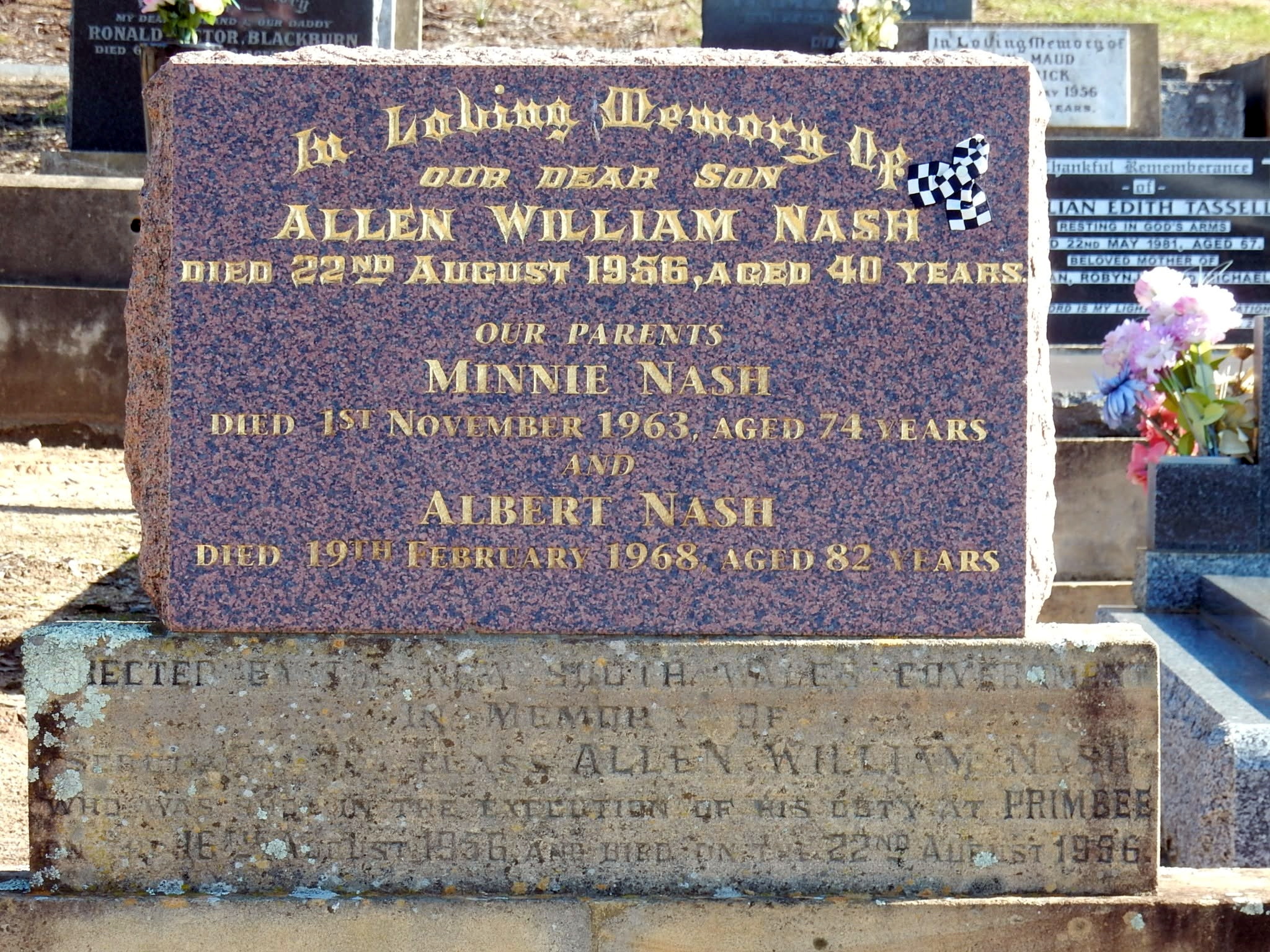
Allen is buried in the Wagga Wagga Cemetery, Kooringal Rd, Kooringal, NSW.
His grave is located in the Anglican Section K – 5-0077
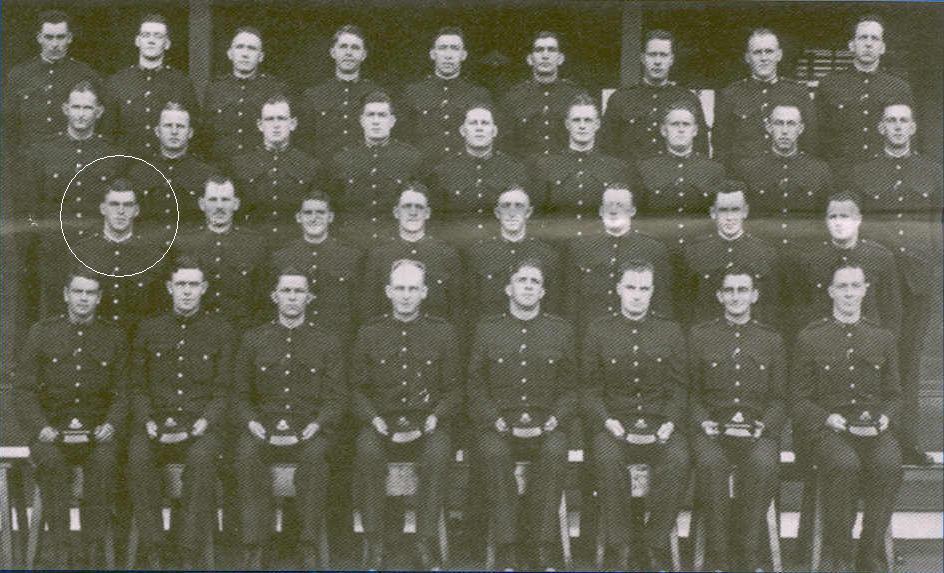
Senior Constable ( Sergeant 3rd Class ) Allen William NASH, Shot at Primbee on 16 August 1956 and died on 22 August 1956. 1939 Police Academy class photo with NASH being first on the left in second row from front ( circled ).
Allen William NASH
Allen William NASH
Allen IS MENTIONED on the National Police Wall of Remembrance, Canberra
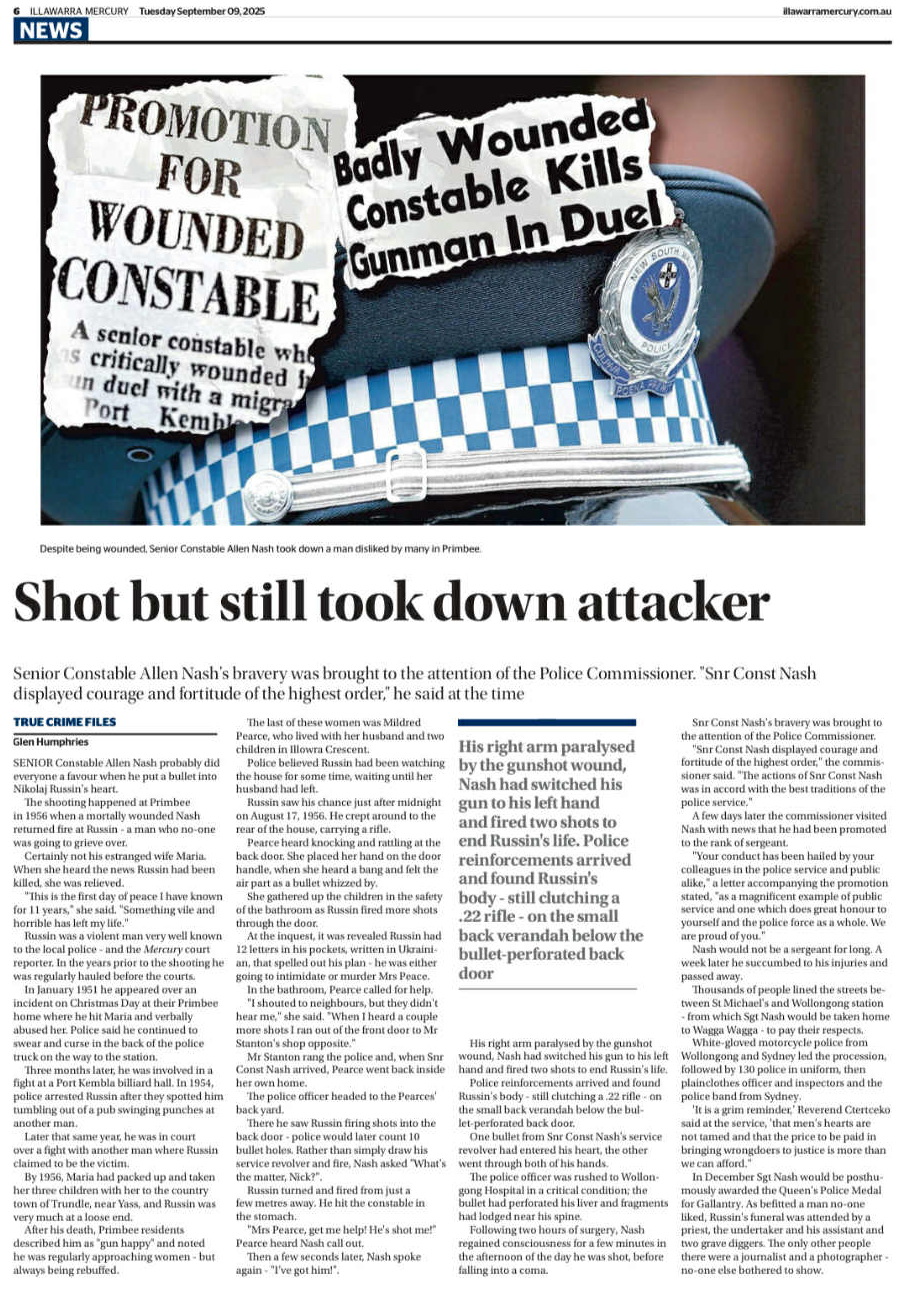
On 16 August, 1956 Senior Constable Nash was on duty at the Port Kembla Police Station. Following the receipt of a message of shots fired at a Primbee dwelling occupied by a woman and two children, Senior Constable Nash left to attend to the complaint.
On arrival he found the offender Russinnear the back verandah of the house and spoke to him. Russin, however simply raised the rifle he was carrying and shot the constable. The bullet unfortunately passed through Nash’s abdomen, damaging his spine and causing him to drop his pistol. With his right arm paralysed, Nash picked up the pistol with his left hand and, although in great pain, managed to fire two shots. One shot hit the offender in the hands, and the other penetrated the heart, killing him.
Senior Constable Nash was posthumously awarded the Queen’s Police Medal for Gallantry, the Peter Mitchell Trophy, and the George Lewis Trophy.
Commissioner Delaney also promoted him sergeant 3rd class on the day before he died from his wounds.
The sergeant was born in 1916 and joined the New South Wales Police Force on 3 July, 1939. At the time of his death he was stationed at Port Kembla.
Source: Beyond Courage by Retired Sgt Danny WEBSTER, NSWPF.
‘More than I expected’: Fallen police officer honoured by Goulburn cadets
Updated August 27 2026 – 11:37am, first published 11:00am
In 1956 Senior Constable Allen Nash was fatally wounded in a Primbee backyard after responding to a call of someone firing into the house.
It was someone whose life he had saved not all that long ago.
The policeman heard Nikolaj Russin screaming out and found him in a Port Kembla hotel being attacked by another man.
Goulburn police cadets on the Patch Run to honour fallen Port Kembla policeman Allen Nash. Supplied pictures
The attacker was about to cut his throat open with a broken bottle over a debt.
Snr Const Nash intervened and saved the man’s life.
The next time the pair crossed paths, Russin shot the policeman
Nikolaj Russin was in the backyard of the Primbee house, trying to get inside, likely with the aim of murdering Mildred Pearce and her two children who were huddled inside.
Rushed to hospital, Senior Constable Nash passed away a week later. Shortly before his death, the police commissioner visited and promoted him to the rank of sergeant.
‘More than I expected’: Fallen police officer honoured by Goulburn cadets
Since 2020, police cadets are required to complete a five-kilometre run around the academy before they graduate and are given their light blue “student” shoulder patches.
Called the Patch Run, each year it honours a police officer who was killed in the line of duty; for the run on August 26, 2025, Sgt Nash was honoured.
The event included a video of Sgt Nash’s story and the involvement of his family.
His nephew Ken Nash had come down from Ipswich to witness the Patch Run at Goulburn and be presented with a copy of his uncle’s plaque at the National Police Memorial in Canberra.
“It was very, very emotional,” Mr Nash said.
“It was great what they’ve done for him. It was terrific. It was more than what I really expected.
Sergeant Allen Nash’s nephew Ken Nash with the plaque presented to him at Goulburn Police Academy. Supplied picture
“I was talking to Alan’s police partner there, he’s 93, and he was telling me the times that I was on the beat with Allen – he said that man never took a back step.”
Mr Nash said Russin was “such a hated man, he was full of trouble”.
“Allen had saved his life, and so I think that’s why he thought he could just walk around to the back of the house.
“He called him Nick apparently. He walked around the back and he said, ‘what do you think you’re doing, Nick?’.”
THURSDAY 4 SEPTEMBER 2014 RETIRED POLICE DAY HELD AT LAKE ILLAWARRA POLICE STATION, OAK FLATS.
THURSDAY 4 SEPTEMBER 2014 RETIRED POLICE DAY HELD AT LAKE ILLAWARRA POLICE STATION, OAK FLATS.
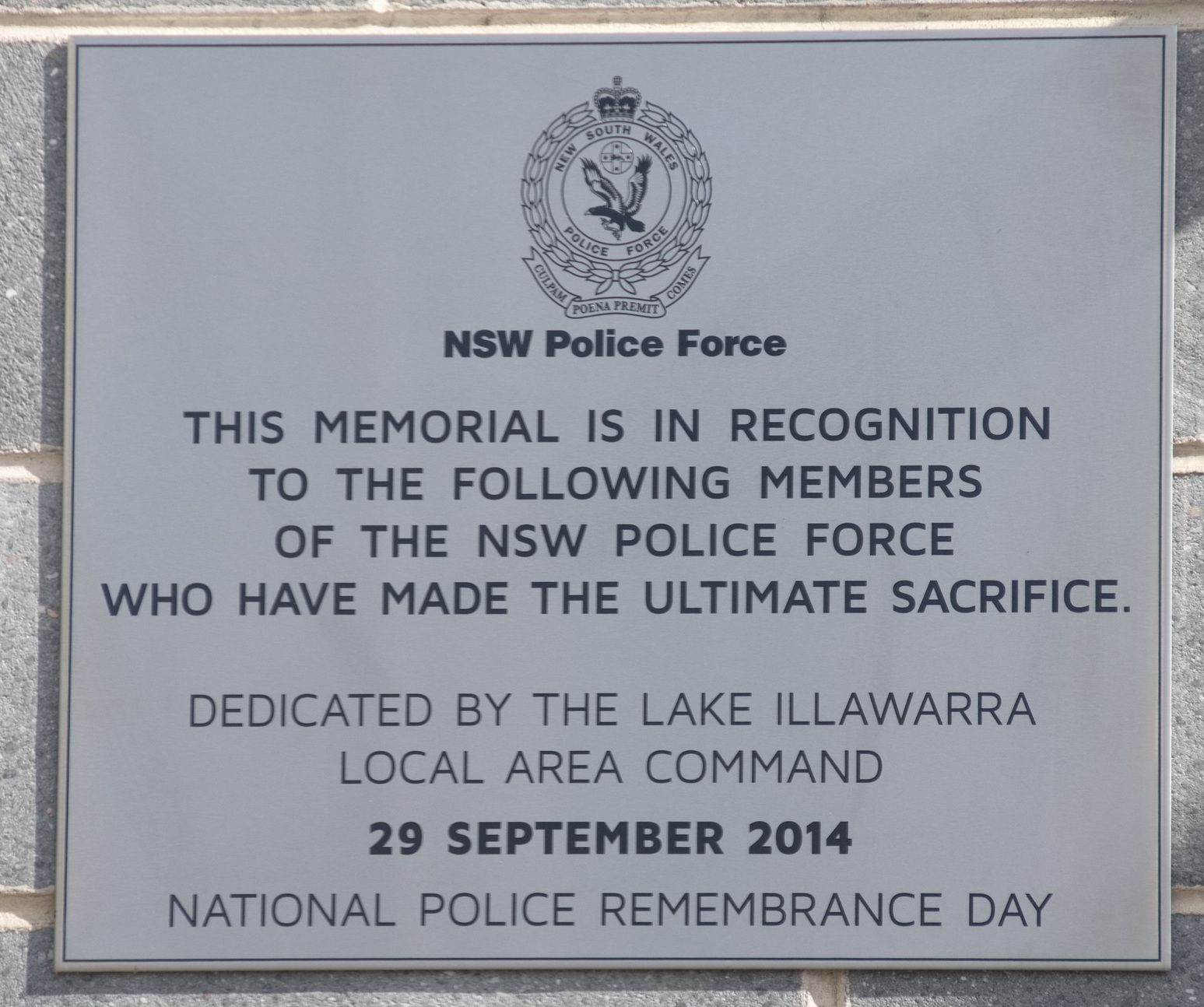
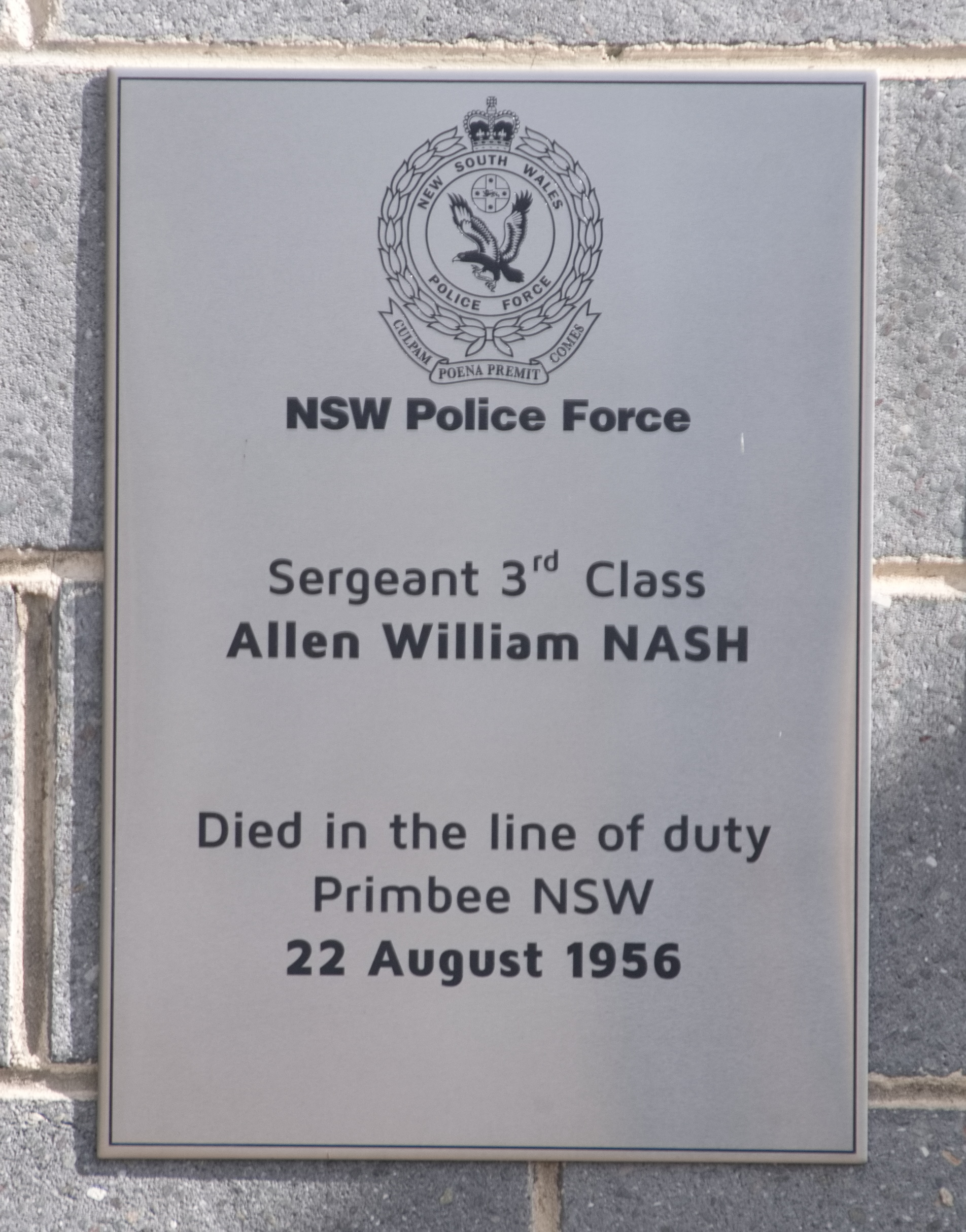
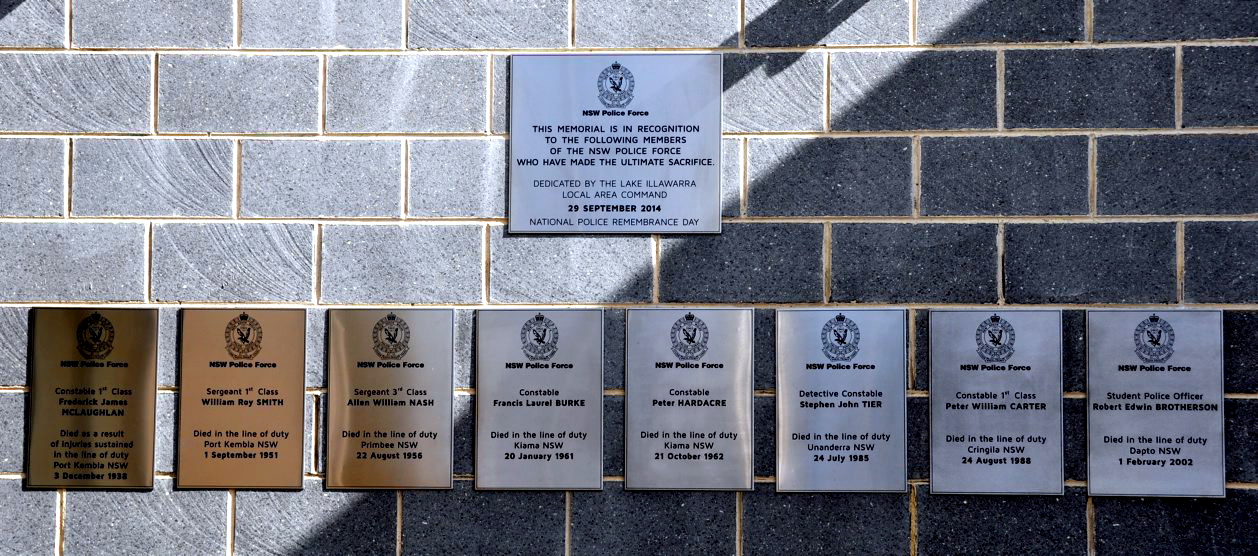
THURSDAY 4 SEPTEMBER 2014 THE 3RD RETIRED POLICE DAY – LAKE ILLAWARRA POLICE STATION, OAK FLATS. THURSDAY 4 SEPTEMBER 2014 LAKE ILLAWARRA POLICE STATION, OAK FLATS. MEMORIAL WALL PLATES FOR THE 8 IDENTIFIED POLICE ( INCLUDING STUDENT POLICE OFFICER ROBERT BROTHERSON ) WHO HAVE DIED, ‘ON DUTY’ WHO HAVE BEEN STATIONED IN THE WARILLA / LILAC LOCAL AREA COMMAND OVER THE YEARS.
Police Remembrance Day: Lake Illawarra sergeant Allen William Nash honoured
JOSHUA BUTLER
Kenneth Nash (left) at the Police Remembrance Day ceremony on Monday. Picture: ANDY ZAKELI.
Almost 60 years on, Kenneth Nash still misses his uncle Allen.
Sergeant Allen William Nash, aged 40, was killed in the line of duty by a gun-wielding offender at Primbee in 1956.
Sgt Nash was one of eight officers stationed in the Lake Illawarra local area command who were recognised with memorial plaques on a wall of honour outside Lake Illawarra police station on Monday, as part of Police Remembrance Day commemorations.
Dozens of current and retired officers, families, friends, politicians, councillors and members of the public gathered at Oak Flats for a ceremony to unveil the memorial wall, and honour past and present officers.
Kenneth Nash travelled from Brisbane for the ceremony, laying a wreath below his uncle’s name.
‘‘We came to Port Kembla some time ago to see where he was, and they had a plaque on the wall at the station,’’ Mr Nash said.
‘‘They called us and asked if we could come for the ceremony.’’
On August 16, 1956, Sgt Nash, stationed at Port Kembla, responded to shots fired at a Primbee house.
Finding a man on the verandah, Sgt Nash attempted to speak to the man but was shot through the abdomen, the bullet piercing his spine and paralysing his right arm.
Sgt Nash then shot the offender with his left hand. He died not long after.
Sgt Nash was posthumously awarded the Queen’s Police Medal for Gallantry, the Peter Mitchell Trophy, and the George Lewis Trophy.
‘‘He wasn’t even supposed to be on duty that day, he was covering for someone else,’’ Mr Nash said.
‘‘Having a recognition like this, it’s everything for us. He had a lot of siblings but only one or two are left. This plaque means people won’t forget about him.’’
Mr Nash carries with him a cigarette case Sgt Nash had in his jacket on the day he died, and counts a cutlery set sent to his uncle by Queen Elizabeth herself as a prized family heirloom.
Since 1862, more than 250 NSW Police officers have died in the line of duty.
WOLLONGONG, Thursday. — A critically wounded police constable shot dead his beserk attacker in a gun duel at Wollongong early to-day.
Doctors at Wollongong Hospital are fighting to save the life of the policeman, Allen Nash, 40, of Wentworth Street, Port Kembla, who was shot through the groin by a .22 bullet.
The bullet pierced his liver and lodged near his spine.
Doctors said to-night they had performed an emergency operation on Constable Nash, but his condition was still critical. The dead man is Czech migrant, Nokolaj Russin, steelworker, of Shellharbour Rd, Primbee.
As Constable Nash lay wounded he shot Russin through the heart.
Police described Russin as a woman-basher.
Before Constable Nash fought the duel with him, Russin had terrorised a housewife and her family for an hour.
The woman is Mrs. Mildred Pearce, who lives with her husband and two children aged three and six in Allowra Crescent, Primbee.
She said that shortly before midnight Russin forced attentions on her.
When she refused him admission to the house he went berserk and fired a fusillade of shots, which shattered a window of her bedroom.
Residents said to-day they knew Russin as a gun happy lover who had approached many women in the Primbee area, but had been rejected.
Police said he was estranged from his wife, who lives in Trundle with her 10 year old son.
They believe Russin watched the Pearce home until Mr. Pearce went to work. When Mrs. Pearce was alone, he went to the rear of the house and tried to enter.
Just after midnight Mrs. Pearce was awakened by rifle shots and heard Russin‘s voice as he called out. As she went to open the back door, a bullet whizzed past her head. She went back to the bedroom and locked her children in the bathroom.
“I shouted to neighbours, but they didn’t hear me and when I heard a couple more shots I ran out of the front door to Mr. Stanton‘s shop opposite,” she said.
Mr. B. Stanton rang Port Kembla police and when Constable Nash arrived in a police truck, Mrs. Pearce said she went back into the house.
She heard more shots and Constable Nash called out “Mrs. Pearce, get me help. He’s shot me“.
Then Nash said “I’ve got him“.
A few minutes later Detective Sergeant Davenport and Detectives Marrott, Knott and Morgan, of Wollongong, arrived.
They found Russin dead. He was still clutching a .22 repeating rifle, on the small back verandah below the bullet-perforated back door.
Russin had been shot through the heart by one bullet from Nash‘s service pistol and a second shot had passed through both of his hands.
Nash told police that as he walked to the back verandah he saw Russin firing shots into the back door.
Russin turned and at a range of only a few feet, shot him in the stomach. Nash fired two shots and then his pistol jammed.
An examination of the house showed ten shots had been fired into the back door and bullets were buried into the wall inches from where Mrs. Pearce had been standing.
WOLLONGONG, Sunday,— The Police Commissioner, Mr. C. J. Delaney, to-day visited wounded police hero, Allan Nash, and promoted him from the rank of senior constable to third-class sergeant.
Sergeant Nash, 40, was promoted for bravery and devotion to duty.
He was wounded before he shot dead a beserk Czech migrant at Primbee last Thursday.
The migrant, Nokolaj Russin, had fired shots at a woman and her children and had terrorised them, for an hour before Nash tackled him.
Doctors at Wollongong Hospital said to-night that although Nash was still in a critical condition he had a fighting chance.
Mr. Delaney and several high police officers visited sergeant Nash to-day.
About 16 friends and relatives of Sergeant Nash including his parents, who came from Wagga waited outside the hospital but were not allowed to see him.
Mr. Delaney read a letter to Nash telling him of his promotion.
Part of the letter read: “Your conduct has been hailed by colleagues and the public alike as a magnificent effort.
“We of the police force are proud of you.”
Sergeant, Nash thanked Mr. Delaney for the tributes.
WOLLONGONG. Wednesday. — Sergeant Allan Nash, 40, of Port Kembla, died in Wollongong Hospital this afternoon, a week after a beserk Czech migrant critically wounded him with a .22 rifle.
Sergeant Nash had a relapse at 3 pm. and died at 5.25 pm.
When he was admitted to hospital, he was suffering from a bullet wound in his liver.
He rallied soon after admittance and doctors yesterday said his condition, although still critical, was improved.
The Police Commissioner, Mr. Delaney, visited Sergeant Nash on Sunday and promoted him from a Senior Constable to Sergeant Third Class.
Mr Delaney told Nash the Police Force and the public regarded him as a hero after shooting dead the man who shot him.
The man, Nojolsi Russin, 40, of Port Kembla, had terrorised a woman and her family at Primbee with a .22 rifle before Sergeant Nash challenged him.
SYDNEY. August 22. – Sergeant Allen Nash, 40, police hero in a gun duel with a crazed Czech gunman near Port Kembla last week, died this afternoon in the Wollongong Hospital, after nearly a week fighting for his life.
He was critically wounded by the gunman before he shot him dead.
The gun duel was mentioned in the Wollongong Court to-day, when a 33-year-old man was freed of a charge of occasioning bodily harm.
Ladeus Skora, labourer, of Primbee, near Port Kembla, was charged with occasioning actual bodily harm to Nikolaj Russin, the gunman whom Nash shot dead.
It was alleged that during an argument at a Port Kembla hotel, on July 23, Skora had jabbed Russin in the face and neck with a broken beer glass.
Detective J. Gudgeon told the court he knew Russin as a violent man before Nash had shot him.
GEORGE MEDAL?
The Police Commissioner ( Mr. C. J. Delaney ), said tonight the late Sgt Nash would probably be recommended for the George Medal – the highest civilian award for gallantry.
A doctor at the Wollongong Hospital said tonight that Sgt Nash had displayed ” magnificent courage ” in his fight for life.
SYDNEY, August 16. -Port Kembla police hero, Constable Allen Nash, would almost certainly be recommend for the George Medal, a senior police official said to-day.
Nash is in hospital critically wounded after shooting dead crazed Czech gunman. Nikolaj Russin, in gun duel on Thursday.
The police official said the Police Department was waiting until Constable Nash was off the danger list before interviewing him about the shooting.
Until Constable Nash gave a report on the shooting, the question of an award could not be considered.
Doctors at Wollongong Hospital said today Nash had rallied slightly during the night, but it would be several days before they could know if he would survive.
PROMOTED
Nash was yesterday promoted from senior-constable to sergeant, 3rd class.
The Police Commissioner (Mr Delaney) told him of his promotion when he visited his bedside today.
Mr Delaney told him that the promotion was in recognition of his courage and devotion to duty.
Nash smiled at the news and said weakly: “Thank you, sir!” He was very weak and could not say anything more.
SYDNEY, Wednesday: Police hero Sergeant Alan Nash died in Wollongong Hospital at 5.30 p.m. to-day.
Sergeant Nash was critically wounded last Thursday in a gun battle at Primbee with crazed Czech migrant Nicholaj Russin, whom he shot dead. Mr. Delaney, Police Commissioner,
promoted him from senior constable last Saturday in recognition of his bravery.
Mr. Delaney said to night: “It was with profound regret that I learned of the death of Sergeant Nash. “He gave his life in the service of the community, and was a classic example of a courageous police officer.”
CURTAIN FALLS IN GUN DUEL DRAMA SYDNEY, Wednesday:
A migrant was discharged in Wollongong Court today on a charge of assaulting Nicholaj Russin, who was shot dead last week in a gun duel with Sergeant Nash, who died today.
He was Ladeus Skora, 35, laborer.
Police said he jabbed a broken beer glass in Russin’s face in a Port Kembla hotel on July 23.
‘Beer glass’
Constable J. M. Gudgeon said Skora told him: “I lent Russin £30, but when I asked him for the money: he said, ‘You will not get a penny,’ and abused me.”
Skora denied he had broken a glass and jabbed Russin with it. He said he hit Russin with a full glass of beer.
Gudgeon said Russin had been known to him as a man given to violence.
Commenting, “No jury on earth would convict on the evidence,” Mr. Lake, S.M., discharged Skora.
WOLLONGONG, Friday; -More than 130 police to-day escorted a coffin bearing the body of police hero; Sergeant Allen Nash, 40, to Wollongong Railway station to-day.
Sergeant Nash’s body will be taken to Wagga and buried there with full police honours to-morrow.
Sergeant Nash was wounded in a gun duel with Czech migrant Nikolai Russin near Port Kembla last week and died in Wollongong Hospital two days ago.
Although critically wounded Nash shot Russin dead.
The Deputy Commissioner of Police, Mr. George Smith, represented the Commissioner, Mr. Delaney, at the funeral, service to-day.
The Minister without portfolio, Mr. Gollan, represented the Premier, Mr, Cahill.
Sergeant Nash’s father, Mr. Albert Nash, of Wagga and other relatives also attended the service.
SYDNEY, Friday: More than 15,000 people attended the funeral at Wollongong today of police hero, Sergeant Alan Nash.
Members of Parliament marched in the funeral procession, which was given full police honors. [ Sergeant Nash was shot last week in a gun battle with a crazed man, whom he shot dead. ]
His body was taken today to Wollongong railway station.
SYDNEY, Friday: Police sergeant Nash’s pistol jammed during a duel with a Ukrainian migrant, Wollongong coroner was told today.
Mr. W. Musgrave, Coroner, was conducting an inquest on Sergeant Allan William Nash, 39, of Port Kembla, and Nikolaj Russin, 34, of Primbee.
Both were fatally shot in a gun duel at Wollongong on August 15.
Detective-constable W. Ross, C.I.B, ballistics expert, told the coroner that 50% of N.S.W. police used the same type of pistol Nash used, which was obsolete.
He said Nash’s pistol had failed to fire four times in a test when 50 shots were fired.
Mr. Musgrave said this type of pistol should be re placed.
He said most Australians respected the police force, who rarely had to draw their batons or pistols.
“A few quiet words is all that is necessary at most times,” he said.
“Some recent arrivals in Australia, unfortunately, carry life cheaply, and although they are in the minority, it is a matter members of the force should keep in mind.”
Mr. Musgrave found Sgt. Nash died as the result of complications following gun shot wounds inflicted by Russin.
He said Sgt. Nash had “upheld the valor and tradition of the N.S.W. police force.”
He found Russin died when justifiably shot by Sgt. Nash in self-defence.
Det.-sgt. J. Davenport said when, with Det. V. Marrott, he interviewed Nash in hospital soon after the shooting Nash told him he had been called to the home of Mrs. Mildred Pearce, at Primbee, where Russin was firing shots at the back door.
Sergeant Allan Nash, formerly of Wagga, has been posthumously awarded the Queen’s Police Medal for gallantry.
Sgt. Nash, 40, who was stationed at Port Kembla, was fatally wounded in a gun battle with a beserk Czech, Nokolaj Russin, at Primbee, near Port Kembla, early on August 16, after the man had terrorised a married women and her family with a rifle.
Sgt. Nash, although shot in the stomach, shot the .22 rifle from Russin’s hand and then shot him through the heart.
Canberra Times (ACT : 1926 – 1995),
Saturday 28 December 1963, page 6
Police Seek New Pistol
SYDNEY, Friday. -The Police Association of N.S.W. will press the Police Department to replace all Webley and Scott issue automatic pistols following the death last week of Constable Cyril Howe at Oaklands.
The secretary of the association, Mr. F. C. Laut, said today his organisation had been pressing for a replacement of this type of pistol “for many years”.
Two police officers had lost their lives in recent years when using these pistols, he said.
Both had fired their pistols twice and the mechanisms had jammed at the third shot. They were Constable Howe and Sergeant Nash, who lost his life several years ago at Wollongong.
Mr. Laut emphasised that the failure of the pistols could not necessarily be claimed to have been the cause of the officer’s deaths.
The department, however, apparently admitted a flaw in the issue type of pistol when it permitted officers to arrange for “personal replacements” of weapons.
Mr. Laut said the association had “pinned its hopes” on an Italian made .38 calibre automatic pistol.
Officers had to carry pistols when on duty and could be called to use them at any time.
Updated 10 September 2025 with new hyperlink to NPM website and fresh news article together with Memorial plaques outside of Oak Flats Police Stn.
Updated on 27 August 2026 with new News articles in Remembrance.
John H. A. MILLAR
27/10/2012
John H. A. MILLAR
New South Wales Police Force
Sergeant
Stations: Sydney?, Holbrook ( about 2 years ), Wagga Wagga ( about 8 months ),
Officer In Charge, Corowa Police Station ( from 1947 )
Illness – Suicide
Corowa
1 August, 1948
Sergeant Millar died from a self-inflicted bullet wound on Sunday 1 August, 1948 at Corowa police residence. No further details are known.
The West Australian dated 2 August, 1948 reported the death as follows.
POLICE SERGEANT FATALLY SHOT SYDNEY, Aug. 1: Sgt. John H. A. Millar (56), whose recent absence from his police duties was being investigated by a high-ranking officer, died in the Corowa hospital last night after he had been found with a revolver wound in the head at his home, adjoining the local police station. An inspector from Albury was walking around the side of Sgt. Millar’s home when he heard a shot and rushed inside to find him lying on the floor dying. Sgt Millar was said to have been extremely worried recently over his official duties.
The sergeant was aged 56 years at the time of his death and was stationed at Corowa.
The Sydney Morning Herald Monday 2 August 1948 page 4 of 12
POLICEMAN’S DEATH
Shot In Head
Sergeant John H. A. Millar, 56, who had been in charge of the Corowa police station for two years, died in the Corowa Hospital on Saturday night from a bullet wound in the head.
A police report states that, soon after Inspector Yardy arrived at the police station to investigate a report that Sergeant Millar had been missing from the station for a few days, he heard a shot.
Going round to the quarters occupied by Sergeant Millar, Inspector Yardy found him lying on the floor. A police revolver was near Millar. He had been shot through the head.
Sergeant Millar was rushed to hospital, but died a short while after admission.
Sergeant Millar’s wife, who was in Sydney, returned to Corowa last night.
Sergeant Millar was a prominent bowler, and was popular in the town.
The Argus ( Melbourne ) Monday 2 August 1948 page 5 of 12
POLICE SERGEANT
FOUND SHOT
SYDNEY, Sun( 1 August ): Sergeant J. H. A. Millar, 56, sergeant in charge of Corowa police station, was found shot in his home behind the station late yesterday afternoon. He died soon after reaching Corowa Hospital.
He was found by Police Inspector Yardley, of Albury, who had gone to Corowa to investigate a report that Sergeant Millar had been missing from the station for several days.
Inspector Yardley heard a shot as he neared the station. He found Millar lying on the floor with a revolver beside him.
Daily Advertiser ( Wagga Wagga, NSW ) Monday 2 August 1948 page 2 of 6
FORMER WAGGA POLICEMAN FOUND DYING AT COROWA
A former Wagga police sergeant, who was found at the rear of the Corowa police station on Saturday night with a bullet wound through his head, died shortly after being admitted to the Corowa Hospital.
HE was Sergeant John A. Millar, 52, offlcer-in-charge of the Corowa Police Station.
Millar was found by Inspector Yardy, who had gone from Albury to Corowa to investigate a report that Millar had been missing from the police station for a few days.
Millar had not been on duty for three days.
Inspector Yardy, accompanied by Sgt. McGuiness, of Albury, arrived at Corowa on Saturday afternoon and interviewed Millar at his home, which adjoins the police station.
Shot Heard
Millar was resting at the time, but agreed to accompany the two police officers to the station.
He went outside for a few minutes and a shot was heard.
Inspector Yardy rushed out the back and found Millar lying on the ground with a bullet wound through his head.
Millar is said to have been worried a good deal lately over his police duties.
As soon as news of the tragedy was received, Superintendent Parmenter, of Wagga, left for Corowa and took over inquiries with Inspector Yardy and Detective Munro, of Albury.
Inspector Parmenter will return to Wagga today after the funeral at Corowa, which he will attend.
Millar’s wife, who was holidaying in Sydney, returned to Corowa yesterday, accompanied by her son, who is a member of the police force.
Was at Holbrook
Sgt. Millar was well-known in Riverina. He took up duty at Holbrook after being transferred from Sydney and was stationed there about two years before coming to Wagga.
After about eight months service at Wagga, he was transferred to Corowa last year as officer-in-charge.
Grave Location: Roman Catholic Monumental Section 3 – Plot: 0493
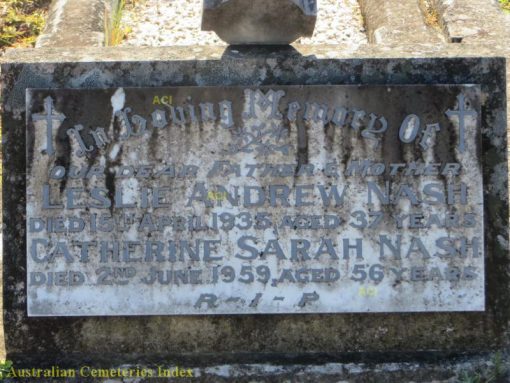
In Loving Memory of our dear father and mother. Leslie Andrew NASH, Died 15 April 1935 aged 37 years. Catherine Sarah NASH, Died 2 June 1959, aged 56 years. R.I.P.
Coroners Inquest: Tuesday 30 April 1935
LESLIE is NOT mentioned on the National Police Wall of Remembrance ( 2021 ) * BUT SHOULD BE
Constable Nash is thought to have been shot to death, possibly while on duty, on 15 April, 1935. It was thought that he had committed suicide however little is known about this incident and to some extent it remains a mystery.
The Hurstville Propeller newspaper dated 18 April, 1935 published the following article.
CONSTABLE FOUND SHOT AT HURSTVILLE POLICE STATION.
First-Class Constable Leslie Andrew Nash, station officer at the Hurstville Police Station, was found dead at the station early on Monday morning. Constable Nash commenced duty at 5 a.m. Constable Harvey left the station and when he returned Nash was missing. A search revealed his body in the bathroom attached to the station. Nash’s service revolver was nearby.
The Sydney Morning Herald of 16 April, 1935 added a bit more to the story.
POLICEMAN FOUND SHOT.Constable Leslie Andrew Nash, 38, was found dead in the bathroom at the Hurstville Police Station yesterday morning with a bullet wound in his head. A revolver was found nearby. Nash was to have sat for an examination yesterday morning and had been in ill-health for some time. For the last eight years, Nash, who was a first class constable with 14 years service, had been stationed at Hurstville and was well liked and respected in the district. He had previously been stationed at Sutherland. He is survived by a widow and five children.
The constable was born in 1897 and joined the New South Wales Police Force on 5 April, 1921. At the time of his death he was stationed at Hurstville.
Newcastle Morning Herald & Miners’ Advocate
Tuesday 30 April 1935 P9
WORRIED OVER LECTURES
Constable Committed Suicide
SYDNEY, Monday,
Forgetting what he had been told at lectures, Constable Leslie Nash, 37, committed suicide at Hurstville Police Station on April 15.
At the inquest today, Constable James Harvey said that Nash told him that he was worrying over a departmental examination that day, and had forgotten what he had been told.
Returning a verdict of suicide, the Coroner said that the case was very sad.
Armidale Express and New England General Advertiser (NSW : 1856 – 1861; 1863 – 1889; 1891 – 1954),
Monday 15 April 1935, page 1
CONSTABLE SUICIDES
Strain of ill-Health Too Great
Sydney, Monday.
Constable Leslie Andrew Nash (38), was found dead at the Hurstville Police Station early this morning with a gun shot wound in the head.
He was acting as station officer. It appears that the man, who had been in ill health, had been told that he would have to undergo a serious operation. Some time later he was missing, and a search resulted in the discovery of his body in the bathroom attached to the station, with a revolver lying nearby.
Constable Leslie Andrew Nash. aged 38, was today found dead at the Hurstville Police Station, where he had performed duty as station officer.
Nash, who has been in ill health and had been told that he would have to undergo a serious operation, began duty at 5 a.m. He asked Constable Harvey to go on an errand, and when Harvey returned Nash was missing.
A search revealed his body in the bath room attached to the station. His service revolver was nearby.
Nash left a widow and four children.
He had been in the force for 14 years and was a first-class constable.
Today he was to have sat for an examination, which his inspector said he would have passed without the slightest difficulty.
NA8H.- H.A.C.B.S. St. DECLAN’S BRANCH, No. 659.- The Officers and Members of the above Branch are requested to attend the Funeral of their late Bro.. LESLIE A. NASH: to leave St. Declan’s Catholic Church. Penshurst, THIS DAY. at 2.30 p.m., for Woronora Cemetery. By road.
The Coroners Inquest returned a verdict of “Effects of a bullet wound in his head, wilfully self inflicted“
Inquest was concluded on 29 April 1935.
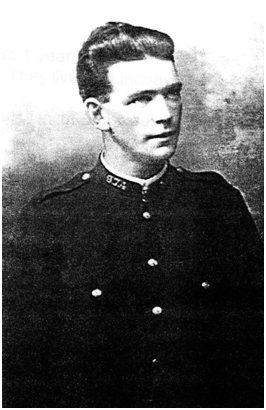
In the attached photo, his Uniform # is 87A or 97A.
The ‘ A ‘ used to depict the District that the member was attached to. ‘ A ‘ District was Sydney – so he may, at the time of the photo being taken, have been stationed at one of the Sydney CBD Stations.
NSWBDM
Birth = 6089/1898 Father = Patrick Mother = Amelia District = Parkes
Marriage = 2105/1925 Bride = McDonnell or MacDonnell District = Kempsey
Death = 7008/1935 Father = Patrick Mother = Amelia District = Hurstville
Leslie was born in 1898, the son of Patrick and Amelia, Leslie married on 10 Jan 1925 to Catherine McDonnell. Leslie was a First Class Constable Leslie passed away 15 Apr 1935 (aged 36)
Sources
NSW BDM
BIRTH NASH LESLIE A 6089/1898 PATRICK AMELIA PARKES
MARRIAGE 2105/1925 NASH LESLIE A MCDONNELL CATHERINE KEMPSEY
DEATH NASH LESLIE A 7008/1935 PATRICK AMELIA HURSTVILLE
RYERSON INDEX
NASH Leslie Andrew Death notice 15APR1935 Death 37 at Hurstville, late of Penshurst Sydney Morning Herald 16APR1935
The Sydney Morning Herald NSW 1842 – 1954
Tue 16 Apr 1935 DEATH NASH-April 15, 1835, suddenly, at Hurstville, Leslie Andrew, of 6 Clarence-street, Penshurst, dearly beloved husband of Catherine and father of Pat, Francis , Alma, John and Peter aged 37 years. Requiescat in pace.
The Sydney Morning Herald NSW 1842 – 1954 Tue 16 Apr 1935 Page 9 FUNERAL NASH.-The Relatives and Friends of Mrs. CATHERINE NA8H and FAMILY are kindly Invited to attend the Funeral of her dearly beloved HUSBAND and their FATHER. First Class Constable Leslie Andrew Nash: which will leave St. Declan’s Church. Penshurst, THIS TUESDAY, at 2.30 p.m., for the Catholic Cemetery. Woronora. Mrs. P. KIRBY and SON. LTD.. Leadlng Funeral Directors. phone, M2221-2. 263 Elizabeth-street, Sydney.
NASH.-‘The Friends of Mr. WILLIAM ROSS are kindly invited to attend the Funeral of his friend, the Late Mr. Leslie A. Nash: lo leave St. Declan’s Church. Penshurst, THIS DAY (Tues day. For further details please see above notice.
NASH.- H.A.C.B.S. St. DECLAN’S BRANCH, No. 659.-The Officers and Members of the above Branch are requested to attend the Funeral of their late Bro.. LESLIE A. NASH: to leave St. Declan’s Catholic Church. Penshurst, THIS DAY. at 2.30 p.m., for Woronora Cemetery. By road. W. J. MEACHMAN. Tres. R. J. MADDEN. Sec.
NASH Leslie Andrew Death notice 16APR1935 Death at Hurstville Sydney Morning Herald 22APR1935
The Sydney Morning Herald (NSW : 1842 – 1954)
Mon 22 Apr 1935 Page 8 Family Notices
DEATH
NASH.—April 16 (suddenly), at Hurstville, Les- lie Andrew, beloved brother, brother-in-law, and darling uncle of Bob, Rene, and Aileen.
Death aged 37 at Hurstville, late of Penshurst
BURIAL Woronora Memorial Park
Sutherland, Sutherland Shire, New South Wales, Australia PLOT RC 3 0493
On a Saturday morning in 1924 Sergeant Ellis of the Brewarrina Police Station ended his life by shooting himself in the chest and head. Little is known of the sergeant and his death other than a brief extract from the local (Brewarrina) newspaper which indicates that: “Sergeant Ellis was up and about on the Saturday morning attending to his duties and seemed as cheerful as ever, and Constable Woodward received a rude shock on going for the sergeant to accompany him to breakfast, to find him lying dead in a pool of blood on the floor. An examination by Dr. Duncan showed that Sergeant Ellis had shot himself twice, over the heart and in the temple. The body of the Sergeant was placed in a lead-lined coffin and forwarded to Singleton yesterday morning for interment”
The NSW Register of Coroners Inquests and Magisterial Inquiries, 1834-1942 indicates that an inquest was held into the sergeant’s death on 12 May, 1924 at Brewarrina. It was found that Sergeant Ellis died at Brewarrina as a result of a “bullet wound in the head wilfully self-inflicted.”
A year after the sergeant’s death the following announcement appeared in ‘In Memoriam’ column of The Argus, dated 9 May, 1925: ELLIS – In fond and loving memory of my dear fiance, Sergeant James Ellis, who died at Brewarrina, N.S.W. on 10th May, 1924. The link that bound us here below still binds my heart to thine. (Inserted by Flora Thomson, Hampton.)
The sergeant was a native of Wyalong and in 1919 was transferred from Broken Hill to Tibooburra as the officer-in-charge of that station. He was then transferred to Brewarrina on 4 March, 1924. He had only been at Brewarrina for two months when he died at the age of 39 years.
Louis Godfrey PETHER
27/10/2012
Louis Godfrey PETHER
Late of ?
New South Wales Police Force
Regd. # ‘Q‘ 6909
For the purposes of this website ‘Q‘ represents those Police joining between 1862 ( commencement of NSWPF ) – 23 February 1915 ( Commencement of NSWPF current numbering system )
Rank: Constable – appointed 16 December 1895
Detective
Sergeant 2nd Class
Final Rank = Detective Sergeant 2nd Class
Stations: ?, North Sydney ( 23 years ), Sydney CIB ( from 1919 – death ) – Death
Service: From 16 December 1895 to 21 August 1923= 27+years Service
Awards: No find on It’s An Honour
Born: ? ? post 21 Aug 1867 in Victoria
Died on: Monday 20 August 1923
Age: 55
Cause: Suicide – Firearm – “possible” Service weapon
Event location: Toilet, Police Headquarters, Sydney
Event date: Monday 20 August 1923
Funeral date: Wednesday 22 August 1923
Funeral location: ?
Wake location: ?
Funeral Parlour: ?
Buried at: Rookwood Cemetery, Rookwood
Zone C, Section 07, Row ?, Grave 883
Interred in the same grave:
Olivia May PETHER, aged 58, Interred on 23 Sept 1927
Memorial located at: ?
Grave of Detective Sergeant 2nd Class Louis Godfrey PETHER & wife – Olivia May PETHER
[alert_yellow]LOUIS is NOT mentioned on the Police Wall of Remembrance[/alert_yellow] *NEED MORE INFO – BUT MOST PROBABLY SHOULD BE
Grave location: TBA
FURTHER INFORMATION IS NEEDED ABOUT THIS PERSON, THEIR LIFE, THEIR CAREER AND THEIR DEATH.
The Examiner newspaper dated 21 August, 1923 reported the following account of the death of Detective Sergeant Pether.
Detective Found Dead, Sydney, Monday.
Detective Sergeant Louis Godfrey Pether was found dead to-day in a lavatory at the police headquarters, Sydney. He had a bullet wound in his head, and an automatic revolver was lying by his side. He was aged 56 years, and had been in the New South Wales Police Force since 1895.
The Sun of 23 August, 1923 shed a little more light on the tragedy.
“DRIVING ME MAD” – Detective Pether’s Suicide
Detective-Sergeant Louis Godfrey Pether committed suicide at Police Headquarters last Monday while suffering from mental aberration. This was the verdict recorded to-day by the City Coroner (Mr. Jamieson).
Pether contracted influenza two years ago and never recovered. Chest trouble developed, and he suffered from defective memory. Early last Monday morning Pether remarked to Detective Bowie that his illness was driving him mad. A few seconds afterwards a revolver shot was heard, and Pether was found unconscious in the basement and bleeding from a wound behind the ear.
Pether died before he reached Sydney Hospital.”
The sergeant was born about 1867 and joined the New South Wales Police Force about 1895. At the time of his death he was attached to the Sydney Criminal Investigation Bureau, and had previously been stationed at North Sydney.
Detective Sergeant Louis Pether was found dead with a bullet wound in his head in the lavatory at police headquarters, Sydney. He had been indisposed for some time, and had been away from duty for several
months. He visited the office this morning to make application for work at a country station. For the last five years, deceased had been attached to the criminal investigation department.
Sydney Morning Herald (NSW : 1842 – 1954), Tuesday 21 August 1923, page 9
FOUND SHOT.
DETECTIVE-SERGEANT PETHER.
Early yesterday morning Detective-Sergeant Louis Godfrey Pether was found lying in the lavatory, at the police headquarters, at the corner of Hunter and Phillip streets, with a bullet wound in his bead. An automatic revolver was lying at his side. The Civil Ambulance conveyed him to the Sydney Hospital, where Dr. Taylor pronounced life extinct.
Detective-Sergeant Pether, “who was 56 years of age, joined the police force in 1895, and for 23 years was stationed at North Sydney. In 1919 he was attached to the Criminal Investigation Branch. For several months past he had been in bad health, and had intended going to the country for a holiday. He was regarded as a capable and conscientious officer.
Suicide while temporarily insane was the Coroners verdict after his inquiry into the death of Detective Pether who was found shot in a lavatory at Police Headquarters on Monday.
Detective Bowie said that he saw Pether near the lavatory, and inquired how he was. Pether replied: “I am bad — bad — bad: it is driving me mad!” witness advised him not to give way and asked him to wait a minute, and they would go together to see the doctor. He returned in a couple of minutes, and could not see Pether. There was a report of a shot in the lavatory, and when the door was forced open, Pether was found with a bullet wound in the head.
Pether was taken to Sydney Hospital, but was dead on arrival.
Subsequently witness discovered some pencilled words in Pether’s hand writing on the wall of the lavatory.
The message was:-
” I could not have been treated with more consideration by the doctor and my officers: but I feel that I am losing my reason, having already lost my memory. ” Underneath were the Initials ‘G.P’
( For the purposes of this website ‘Q’ represents those Police joining between 1 March 1862 ( commencement of NSWPF ) – 23 February 1915 ( Commencement of NSWPF current numbering system)
Rank: Probationary Constable – appointed Saturday 4 January 1913 – Mounted Constable
Stations: Forbes, Bogan Gate, Grenfell, Tottenham ( by 3 days )
Service: From 4 January 1913to 26 September 1916 = 3+ years Service
Awards: No find on It’s An Honour
Born: 1891 in Scotland
Died on: Tuesday 26 September 1916 a few minutes after 9pm. The eve before his marriage.
Cause: Shot – Murdered at Tottenham
RESULT: Offender Frank FRANZ & Ronald Nicholas KENNEDY were hanged at Bathurst Gaol at 9am on Wednesday 20 December 1916
Age: 25 – 27
Funeral date: Sunday 1 October 1916
Funeral location: ?
Buried at: Parkes Cemetery, Want St, NSW
Plot Presbyterian, Row M
Memorial location: Parkes Cemetery, Want St, Parkes, NSW
Lat: -33.137193
Long: 148.192287 Note: GPS Coordinates are approximate.
George IS mentioned on the Police Wall of Remembrance
” This monument has been erected at Parkes by the Government of New South Wales to the memory of Constable Duncan, who was murdered at Tottenham while in the execution of his duty on September 26, 1916 “
Inscription: ” This monument was erected by the Government of New South Wales to Constable George Joss Duncan, of Tottenham, who was treacherously shot dead in the execution of his duty on 26th September, 1916. “
Touch Plate in Canberra
The constable was shot at the Tottenham Police Station by offenders Roland Kennedy (20) and Frank Franz (28). The offenders were members of the “Industrial Workers of the World” organisation during World War 1 and were incensed at the constable’s arrest of one of their members the previous day. While the constable was sitting typing at his desk in the station the offenders crept up to a small window behind him, aimed their rifles and shot him from close range. He died a few minutes later. Both offenders were arrested and hanged at Bathurst Gaol. A third accused, Michael Kennedy, was acquitted.
The Kalgoorlie Western Argus of 3 October, 1916 printed the following brief account.
A CONSTABLE MURDERED – Sydney, Sept. 27.
Confirmation has been received by the Inspector-General of Police, that Constable George Joseph Duncan, stationed at Tottenham about fifty miles from Trangie, was shot dead last night. Yesterday afternoon, Duncan was at Dandaloo and there arrested a German whom he lodged in the lockup there. After his return last evening, two shots were heard by the neighbours and Duncan was found lying dead in his office. He had apparently been working at a typewriter when the shots were fired. Detectives have been sent from Sydney to make investigations. Duncan was 25 years of age.
The constable was born in 1891 and joined the New South Wales Police Force on 4 April, 1913. At the time of his death he was stationed at Tottenham.
Tottenham Police Station 26 September 1916
Information sheet which was on display for the NSWPF 150th anniversary in 2014
The Sydney Morning Herald
Thursday 28 September 1916 page 8 of 12
CONSTABLE SHOT.
TRAGEDY AT TOTTENHAM.
The Inspector-General of Police M.G. Mitchell, received a telegram yesterday evening stating that Constable George Joseph Duncan was found dead in the office of the Tottenham Police station at about 9 o’clock on Tuesday night. The information was communicated to headquarters by Constable McIntosh, who is stationed at Trangie, about 45 miles from Tottenham.
According to the telegram, two neighbours made the discovery. They heard a couple of shots fired, and on entering the lockup found Duncan dead. The position of the body made it apparent he had been using a typewriter when the shots were fired.
On Tuesday afternoon Duncan arrested a man whom he took to the Dandaloo Police Station, a distance of about 1 1/2 miles. After lodging the prisoner in the cell he returned to Tottenham.
Up to the present no clue has been found ; and yesterday morning two detectives were sent from Sydney to make investigations.
Duncan, who was 25 years of age joined the Service in 1913. He had previously been stationed at Forbes, Bogan Gate, and Grenfell.
The Inspector-General of Police (Mr. Mitchell) has authorised the issue of a reward of £200 for information leading to the discovery of the murderer of Mounted-constable George Joseph Duncan, whose dead body was found in his office at Tottenham on Tuesday.
Dubbo Dispatch and Wellington Independent (NSW : 1887 – 1932),
Tuesday 10 October 1916, page 1
TOTTENHAM MURDER
FULL STORY OF A FOUL CRIME.
BY SERGEANT MEAGHER.
Sergeant Meagher, after nearly a fortnight spent at Tottenham in investigating the murder of Constable Duncan, attending the inquest, etc., has returned to Dubbo.
Interviewed at his residence on Sunday, Sergt. Meagher supplied particulars of the crime, as learnt by him and his fellow officers, and elicited at the inquest.
Sergt. Meagher states that on the night of the murder he received instructions from Inspector Peterswald ( John Peterswald # Q5489 ) to go to Tottenham.
He proceeded to Trangie by the midnight goods train, which was late in arriving at Dubbo. He waited at Trangie till daylight, and got into communication with Tottenham, learning that Sergeant Scott, of Narromine, had just arrived after an awful night in the rain and mud. The night was pitch dark.
He rang up Dr. Bertram, of Trundle, who set out for Tottenham, but his car became bogged six miles from his destination.
The doctor then set out on foot and walked three miles, when he had the good fortune to get a lift in a sulky.
Without X-rays the doctor was unable to locate the bullet that had entered the body on the right side of the back.
Arrived at Tottenham after much tedious travelling owing to the soft state of the country, Sergt. Meagher, with Sergt. Sawtell (Warren), Sergt. Scott (Narromine), Constables Sykes (Nevertire), McIntosh (Trangie), McLean (Narromine), and Lewis (Dandaloo), made every possible inquiry and search of the police station and surroundings.
They located the suspects, measured up the building for the purpose of making a plan.
Subsequently Inspector Whitfield arrived from Forbes, and two detectives (Messrs. Davelin and Downey) from Sydney, and the suspects were brought to the station.
Constable McLean, having been stationed at Tottenham previous to the deceased, was of great assistance in the investigations.
The three accused and two others were brought to the station in strict silence without causing the slightest excitement in the village. “That, I am pleased to know,” said Sergt. Meagher, “gave general satisfaction to the public, and it was pleasing to hear the appreciative reference to the sound judgment and discretion of the police. It was a difficult task on account of the wet and cold weather, and the inadequacy of the arrangements for the housing of the suspects.
Two of those were kept in a wooden cell in the yard, and two others, were guarded day and night in the office.
The station is only a small structure— two rooms — and it was difficult for the police to converse without the prisoners hearing them.
The residents, however did everything possible to help the police, and,” said Sergt. Meagher with much earnestness, “we are all very thankful to the hotel keeper, Mr. Veech, and his good wife and staff, who did everything possible for our comfort and convenience. The meals and beds were excellent, and we were attended to in a way that warrants every gratitude, especially on account of the bad weather Mr. and Mrs. Veech had also to contend with.” Continuing, Sergt. Meagher stated that the late Constable Duncan had his life assured with the A.M.P. for £250. He was 27 years of age, a native of Scotland, and had only taken over Tottenham from Constable McLean (now of Narromine) on the 23rd ultimo— three days before he was foully murdered.
An attempt was made to dig a grave for his body at Tottenham, but it filled with water as fast as it was dug out.
“Sergeant Sawtell,” says Sergeant Meagher, “is deserving of all praise for the way he attended to the guarding of the prisoners in relays— and keenly alert to seize any little word or look, or piece of evidence to sheet home the guilt.
Sergt. Sawtell‘s good services will no doubt be a matter the inspector will not miss. The police worked together in a way that reflects the highest credit on themselves and the department. It was also very pleasing to observe that there was a total absence of any ill-feeling amongst the police towards the accused men, not withstanding the strain in full view of a murdered comrade in a small room with them from Wednesday to Friday morning, it was a great relief when the body passed out of our sight, seeing that we were not able to attend the funeral, which took place at Parkes, and we hope, and request, that Inspector Whitfield will be good enough to put the inward feeling of us all in the service with a view of a small coin being asked from all to mark the last resting place of poor Constable Duncan.
THE ACCUSED.
The three men detained in custody and subsequently committed for trial at Bathurst were Michael Herbert Kennedy, Roland Kennedy (brothers), and Frank Franz.
Preliminary to the crime certain events happened which are worth mentioning.
Deceased has only been three days in Tottenham.
Charles Martin, a German, was charged with having firearms in his possession, and at Dandaloo was fined £3 and costs by Mr. Gates, relieving P.M. of Dubbo.
George Wann, a German, the man arrested by deceased on the night before the tragedy, for obscene language and resistance to arrest, was taken by deceased to Dandaloo the next morning and lodged in the lockup — he pleaded guilty before Mr. Gates, P.M., and was fined £1 and £2 with costs.
Deceased was hooted by a number of men when he arrested Wann and he spoke to Roland Kennedy when he returned from the lookup, and was heard to say to Kennedy that it was no laughing matter.
A summons was found in the police office, but not declared or signed—no doubt it was prepared at Dandaloo. There was also an entry of the matter in deceased’s pocket book.
On returning from Dandaloo that evening deceased asked after Roland Kennedy, and Kennedy, hearing of this, went from the residence of his father into the street and inquired for deceased, but didn’t see him.
After returning from Dandaloo deceased went to Mr. Travers’ place— where he had his meals—for tea.
To Mrs. Travers he said: “I am sopping wet; I will put my horse in the stable and come back for tea.”
He said he was tired, and the roads were in a dreadful state. He asked about Roland Kennedy, but did not see him. After going to the station, subsequent to his having his tea, deceased took off his wet uniform, and put on an old singlet, blue police jumper, socks, and dry shoes, and sat at the typewriter with his back to the office window.
He was making out a monthly return of diseased cattle, and was shot before he had completed it, as three letters, the last on the paper, were struck together.
The window is a two sash, with two panes of glass in each. There was a hole one could put the tip of a finger into in the left-hand corner, and there was a large piece broken out of the other pane. There was another bullet hole in the bottom frame, six inches below the line of the other two shots, and six inches to the right. That bullet passed through and out of the weatherboard wall on the opposite side of the room and could not be traced, except that it struck the ground ten yards from the hole in the wall.
The bullet was a 32 calibre, and that is the bore of the rifle owned by Frank Franz, who, at the inquest, said he fired that shot only. It didn’t hit deceased.
Roland Kennedy said he fired the shot that left the small hole in the window at the con-stable. That would have hit the constable on the right side. He fired a 32. That shot, if the one that entered the right side of deceased’s back, fractured two ribs, passed upwards through the lung, and came out about his neck, just above the breastbone. The bullet could not be found.
Roland Kennedy said that Franz fired the other shot at the constable, the shot that broke the pane, and then stepped to the right in front of him (Roland Kennedy) and fired the shot that passed through the bottom of the frame.
Roland Kennedy pulled the trigger a second time, but the cartridge missed fire.
It was afterwards discovered that Roland Kennedy had a cartridge in his vest at the residence of his parents, the cap of which was dinted, and the bullet still in it.
Franz said that the two Kennedys stood side by side, and one counted three as a signal for all three— the two Kennedys and himself— to fire together through the window at the back of deceased.
Franz also said that after the word three both the Kennedy fired a volley, but he (Franz) didn’t fire.
The Kennedy then turned to him and ordered him to fire, and he, being frightened that they would shoot him, fired the shot that hit the bottom of the frame.
Franz then pointed to a spot at the boundary post of the fence and said, “I stood there when I fired” — that was 11 feet from the window.
The spot where Kennedy said Franz stood was about half that distance.
Both spots were in a line of the bullet’s course, but there were no powder marks on the window, as there were in the case of the other two shots, the showing that this shot was fired at a distance.
Michael Kennedy said he was not at the shooting, nor was he a party to the arrangement to shoot the constable.
Roland Kennedy said that his brother was not at the shooting, but he was at the verandah of their father’s residence when it was arranged to shoot deceased.
Roland Kennedy further stated that he said to his brother “Come on,” and Michael Kennedy said, “It is no good to me; I am a married man, with a wife and two children.”
Roland Kennedy also said that his brother advised them to let it alone.
According to Roland Kennedy’s statement, when Franz was told that deceased was home from Dandaloo, he (Franz) said, “The —— is back; we will stone the b— — and he picked tip stones and put them in his pocket. Roland Kennedy then said to Franz: “It’s no good stoning him; let us shoot him.” Franz then said — according to Roland Kennedy, “I will go and get my rifle.” Franz did so, and he and Kennedy shot the constable.
Against this, Franz said the two Kennedy and he were on the verandah at old Mr. Kennedy’s residence, and the two Kennedy’s said, “We will shoot the policeman; get your rifle.”
He, being afraid of them went home and had his tea, but his wife objected to him going out again, and cried.
He stopped three-quarters of an hour, put his rifle out through the window when she was not looking, and at last got her consent to go out.
He had been served with a small debt summons and a summons by Const. McLean for riotous behaviour.
Franz said he wanted to see Herb Kennedy, who was regarded as a bush lawyer, to get advice about the summonses.
He went out and met the two Kennedys on the verandah of their father’s residence, and the three of them then went to the police station, sneaked up, and the deceased was shot as described.
They ran away — R. Kennedy and Franz in one direction and Herb Kennedy in another — in the grass so as to make no tracks.
There was no tracker to be got, and a half caste, who was in Tottenham, refused to try to track.
Another, seven miles away, was sent for, but he would not come.
The weather was wet, and the roads in a dreadful state, and the indistinct tracks at the window in the grass could not be followed.
Mr. Kennedy, senior, 80 years of age, passed away during the trouble.
His unhappy son saw him before he died, but he didn’t know of their trouble.
He and his wife were drawing the old age pension, and lived 50 yards away from the hotel, facing a street.
The old man had been a stock dealer and master butcher at Parkes and Peak Hill ; also a storekeeper.
The accused said they were I.W.W. men, but they didn’t believe in taking life.
They were committed for trial by the coroner, Mr. James Patterson, the owner of the local paper, on a charge of wilful murder.
PLEA OF GUILTY WITHDRAWN. ACCUSED FOUND GUILTY DEATH SENTENCE PASSED
Roland Nicholas Kennedy and Frank Franz were arranged before the Chief Justice (Sir William Cullen) and a jury at the Bathurst Circuit Court yesterday charged with having at Tottenham on September 26 last murderedConstable George Joss Duncan. Both accused are comparatively young men. Kennedy is sturdily built, dark complexioned (he had about a week’s growth of beard), and intelligent looking. As he entered the dock his eyes wandered around the court room and there was indications that he realised the gravity of the situation. In fact there was a trace of a smile as he stood up preparatory to answering the charge. The other accused, Franz, is fair complexioned, and the usual bush worker type. He is about 5ft in height, of medium build, and a demeanor that by no means indicated the strong will power of the alleged partner in crime.
The court room throughout the day was thronged with interested spectators, whilst during the morning two young women occupied seats in the body of the court, both of whom appeared to be little concerned about the fact that perhaps on the issue of the proceedings depended the lives of two — perhaps three — men.
Mr. Wilfrid Blackett, K.C. and Mr. D. S. Edwards, instructed by Mr. E. A. Withey, of the Crown Law Office, appeared for the Crown. Kennedy was defended by Mr. N. Pilcher, of Sydney, whilst Mr. E. R. Abigail appeared in the interests of the accused Franz.
The first to be called upon to plead was Franz, who replied ” Not guilty ” in a firm voice. Then Kennedy created somewhat of a sensation by pleading guilty in a firm voice and with a broad smile. Immediately Mr. Pilcher asked his Honor not to accept the plea of guilty, and Sir William Cullen then explained to the accused that the charge was a serious one and that the only way in which it could be properly investigated was by a plea of not guilty. Then all the circumstances would be brought out.
Kennedy: I can hardly hear what your Honor is saying.
The Chief Justice repeated his advice, whereupon Kennedy said: And if I plead guilty all the circumstances will not be brought out.
The Chief Justice: That is so.
Kennedy: Then I’ll withdraw my plea and plead not guilty.
The jury were then empanelled, the first to be called being Mr. W. Boyd. Franz freely exercised his right to challenge, and ordered six jurors to stand aside. Kennedy, on the other hand, accepted all the jurymen as they were called without demur.
THE CASE OUTLINED.
Mr. Blackett outlined the case for the Crown. He said that Tottenham was situated about 52 miles from Trangie. On September 25 last Constable Duncan arrested a man, a member of the I. W.W., for having used abusive language. A crowd collected and there was some hooting and general disorder. However, he arrested the man and took him to Dandaloo, about 13 miles. On his return he interviewed accused Kennedy and told him that he would take proceedings , against him for having used abusive language on the next night, September 26, Constable Duncan’s dead body was found near a wire fence just outside the police station door with two bullets in the back. A third bullet was found in a panel of the wall of the room. The Crown theory was that the two accused and another, man, Herbert Kennedy, agreed to shoot the constable at a given signal. Two were to fire, whilst a third was to reserve his shot in the event of the shots not having the desired effect. The three stood outside the window of the police station, where Constable Duncan was sitting with his back towards them engaged at the typewriter. When the shots were fired the constable rose and staggered towards the door. This was when the third shot was fired, and the Crown contended that the third shot was fired as arranged, but missed Duncan and entered the wall just above his head. The chief evidence against the accused was statements made by each. Franz said that he was terrorised into participating in the shooting by the Kennedys, who threatened to shoot him. Kennedy, in his statement, stated that Franz planned the murder and threatened to shoot him if he did not go with him. He made no reference at all to his brother being present. However, the Crown would contend that all were equally guilty of the crime.
‘The Crown does not suggest, added Mr. Blackett, ” that this foul murder was committed out of revenge for the arrest or threatened arrest. Such would be too trivial. It does suggest, however, that these men were members of the I.W.W. and had their minds inflamed and saturated by the pernicious literature of that body and which was found at their residences. Boys, after reading Deadwood Dick stories, commit crime, and in the same manner this murder was committed by men after reading the pennicious literature regarding the objects and methods of an organisation to which no law abiding citizen would attach himself. ”
Mr. Blackett also pointed out that the two bullets found in Duncan’s body were 32 calibre, similar to those from the rifle found at Kennedy’s, whilst the bullet in the panel was of 38 caliber, and used in rifles similar to that owned by Franz.
THE EVIDENCE.
Detective Patrick Joseph Downey, of Sydney, stated that he went to Tottenham shortly after the murder. During his investigations he interrogated Ronald Kennedy, who denied any connection with the murder. He admitted he had a 32 caliber Winchester rifle and that he and his brother were members of the I.W.W. He stated, however, that they did not advocate the destruction of life and property. He took Kennedy to the inspector of police and had Franz’s statement read to him. Kennedy laughed during, the first part of the statement, but became white and broke out into a perspiration when the circumstances of the actual shooting were being read. In reply to witness, Kennedy said it was. ” all a lie. ” Franz, at his (witness’s) request, then recognised Ronald Kennedy as the man mentioned in his statement. When he formally charged Kennedy with the present charge the latter said, ” Well, fix me up : I wish you would take me out and shoot me. ” He put Kennedy in the cell and afterwards heard him crying. Later he heard a man named Martin, who also occupied the cell, say to Kennedy, ” I always knew that you were a headstrong young man, but I did not think you would take up a rifle and shoot a man down like this. ” Afterwards, in company with Inspector Whitfield, he took the accused to the window of the lockup and asked him to mark the positions where he considered that the three men stood. He then took Franz to the lockup and asked him to do likewise. While Franz was present Kennedy pointed out the hole in the window which, he said, had been caused by his bullet. He (witness) then examined the window and performed experiments ( in company with Inspector Whitfield ) which went to show that Franz’s statement, that three men were present when the murder took place, was correct.
Inspector Whitfield stated that he saw Franz at the police station on September 28, when the accused said that he was born in Wellington ; that his mother was a Scotch woman and his father of German descent. In regard to the arrest of Wann, accused said that he had not become excited when Wann was arrested. On the day after the murder Franz approached him, telling him that he had something to tell him and that he could not refrain from doing so any longer. Continuing, Franz said; ” The Kennedys shot the constable ; I was there also and fired a shot. ” He took the accused to the lockup, where he made a statement.
Constable Stewart. L. McIntosh, stationed at Trangie, stated that he examined the police station at Tottenham on September the 28th and described the condition in which he found the room in which the Constable was murdered.
William Henry, a tinsmith residing about 15yds from the police station at Tottenham stated that at about ? o’clock on the evening of September 26th. he was lying in bed when he heard two shots, as if from a double barreled gun. The first shot was much the louder. Only a second lapsed between the reports of the two shots. It was impossible to reload the rifle during the interval between the shots.
Thomas Johnson, dentist of Peak Hill, said that on the evening of September 26th. he was sitting at his table in Tottenham when he heard two shots. He walked outside and thought he heard moanings, which he thought was caused by cows. The first of the two shots was much louder than the second.
To Mr. Abigail : He was engaged in mechanical work when he heard the shots. There were two distinct shots.
Augustus Loftus Travers Smelter, residing at Tottenham also heard the report of the two shots when he was occupied at his home. It would have been absolutely impossible for anyone to reload a rifle during the interval between the two shots.
Annie Woods, who resides with her parents in Tottenham, corroborated the evidence of the previous witnesses regarding the quick succession of the two shots.
Herbert Oswald Rudd, a laborer, of Tottenham, stated that on the night of the murder he met Franz, who told him that the policeman had been shot and added, ” We shot him. ” Franz also told him that there had been three shots, to which he (witness) only replied, ” Did you? ” Franz replied, ” Yes ; but don’t you tell the Kennedys. ”
Mr. Abigail : Although you had heard from Franz that the Kennedys and he had shot the constable you did not inform the authorities ? — No. When did you tell them ?— When they asked me. You robbed a drunken man, didn’t you? — He wasn’t drunk; I just picked the money up from the ground. And divided it amongst your friends ?- Yes.
You used to live in the same house as one of mates at Tottenham, didn’t you? — Yes. And in a lapse of forgetfulness you walked off with his clothes?— Yes. What did that cost you?— £3 at the Police Court.
Stephen Horton, laborer; and photographer residing at Tottenham gave formal evidence in connection with photographs taken at the Tottenham Police Station.
George Fishpool, mining manager of Tottenham, stated he saw Constable Duncan arresting a man in front of Beach’s hotel on the evening of September 25. A crowd assembled on the occasion and hooted. The constable returned, spoke to the Kennedy’s and Roland Kennedy laughed. He did not hear the conversation between the constable and the Kennedys.
Margaret Eva Traters, married woman, residing at Tottenham gave evidence of having last seen, the deceased early on the evening of September 26.
Dr. Thomas D. Betram of Tottenham stated that on September 27 he made a post mortem examination of the body of the deceased and found two bullet wounds in the back and one on the front of the body. The organs were in a healthy condition. He found in one of the lungs fragments of glass and ribs.
To Mr. Abigail : He believed that the two bullets that entered the body were of 32 calibre and the one that struck the sash of the window, of 38 calibre. He knew a 32 calibre bullet, at sight.
Dr. William Boazmam of Parkes also gave formal evidence.
Constable James Sykes, stationed at Nevertire, stated that he arrived at the Tottenham Police Station on September 27 and saw the body of constable Duncan lying there and he removed garments from the body 0f the deceased and obtained pieces of glass and bone from Dr. Bertram.
To Mr. Abigail: He was of opinion that the hole in the sash was made by a 38 calibre bullet.
Frank Franz, 23 years old said that he had been employed in the Tottenham district for some considerable time. He was born in Wellington his father was of German descent and his mother was a Scotch woman, he last saw his father about 10 years ago. He had never been taught the German language. About a month ago he was asked to join the I. W. W. by the Kennedys. They told him that any man who did not belong to the organisation was no good, but a rotter and a —–.
He had had no transactions with any one in connection with joining the I. W. W. , but had given his subscriptions to the Kennedys, in the stated. He had received literature, but did not understand the rules of the organisation. He had received a book of membership tickets, but had not used them. He did not believe in the destruction of life. At the time constable McLean was leaving Tottenham he had a conversation with the Kennedys who, referring to McLeans successor, Duncan stated that he was a —– and would have to be stopped. He did not reply to this remark. He had never fallen out with Duncan. He had never spoken to him with the exception of one occasion when he bade him good-day. The first conversation he had had, in regard to shooting the policeman, was with the Kennedys, on the day of the murder. He had met the Kennedys on Hudson’s verandah when Roland Kennedy said ” ain’t this constable a —— ; we’ll shoot him.” He the ( accused) had had a few drinks that day, but did not reply. In the evening he again saw Roland Kennedy at the Kennedys house. He had gone there to get some comic papers but he did not have them. Roland Kennedy on this occasion said ” you ought to bring your rifle up ; me and Herb is going to shoot the policeman. ”
As he was going they told him not to forget to bring his rifle up or they would blow his –— head off. He went home and sneaked the rifle through the window, not allowing his wife to see him. The rifle was of 38 calibre. He subsequently left home and went to the Kennedys. Both Roland and Herb Kennedy told him to fire at the constable or they would shoot him. They then left for the police station. When within 20 yards of the station, they stopped, Accused became frightened and lagged behind. The Kennedys whispered something that was, to him, unaudable and they walked on. The Kennedys walked up to the window of the police station and he stood against a post, that was not quite in front of the window. He could see the policeman, who was using his type writer. The Kennedys took aim, and as soon as the constable sat erect they fired simultaneously. The deceased, when shot, fell to his right and disappeared. The accused then fired while the policeman was still out of sight.
He then went home. He put the rifle in the back room an went to bed. Be could not sleep that night. He got up next morning and put the rifle under some bags. He next saw Roland Kennedy at a hotel. Kennedy told him not to get drunk and not to ” split, ” or he would blow his brains out.
On Thursday he stayed at home, and on Friday he saw the Inspector of Police and made the statement. The first statement he made was untrue, and he was frightened, at first, to alter it. That was why he had to see the Inspector alone. He had never intended to shoot the policeman, and only accompanied the Kennedys because he was frightened that they would shoot him. They had told him they would do so. He did not say to Rudd that they had stopped the policeman.
Mr. Blackett, in his cross-examination of the accused, endeavoured to connect the murder with his association with the I. W. W. but in answer to Mr. Blackett, the accused said that his connection with the I. W. W. had no bearing on the murder, at all. He had known the Kennedys before he joined the I. W. W. and although he subscribed to the I. W .W paper, he did not read it. He had not paid his subscriptions for three or four months.
He did not believe in the destruction of life. He could not explain why he said the I. W. W. had led him astray, but supposed it was on account of his association to the Kennedys. After a short retirement the jury returned a verdict of ” guilty ” in both cases.
When asked if he had anything to say why sentence should not be passed upon him, Kennedy replied in the negative, and added, ” I must thank the jury for their verdict. ”
Franz asked why Herbert Kennedy had not been tried with Roland Kennedy and himself? His Honor explained that this was not the time to answer such questions as this.
Franz further stated that the jury had not returned a proper verdict.
The sentence of death was passed by his Honor without comment.
The Tottenham murderers; Frank Franz and Ronald Nicholas Kennedy, were executed in Bathurst Gaol at 9 o’clock on Wednesday morning. Mr ?. M. Wilshire, of Sydney, represented the sheriff. No one but the gaol officials and press representatives was present.
In tragic irony for such an occasion, the day was a beautifully fine and peaceful one. The sun shone in all the splendour of mid-summer, and the birds sang and chirped in the trees in pure joy of the life around them.
There was nothing outside the grim-looking walls of the gaol to indicate that on the inside the tragedy of, two misguided, misspent lives was about to come to a sharp and awful conclusion.
A period of only 35 seconds elapsed from the time the men left the condemned cell till the bolts were drawn, death in each case being instantaneous.
Kennedy hobbled, or it would; be more correct to say that he danced, on to the scaffold, and, as he turned and faced those present, he laughed somewhat hysterically, though his voice was firm enough when he exclaimed: ” Good-bye, boys.”
Franz showed unmistakable traces of fear. His legs trembled, and his face twitched nervously. As the hangman adjusted the caps over the eyes of the men, his lips moved as if he was about to say something, but the bolt was withdrawn, and both men died instantly.
At the conclusion of the trial, and after sentence of death had been pronounced, the condemned man Kennedy turned to Franz and said, ” I’m satisfied so long as you get the same length of rope as I do.” Since then there had been a strong feeling of antagonism between the pair, but prior to the execution the men were brought together, and shook hands.
Franz was a married man, with a wife and two small children. He was a native Wellington, N.S.W.. and 25 years of age.
He was a first offender.
Kennedy was a single man, a native of Peak Hill, and only 20 years of age. He has a mother and several brothers living. The murder was his first offence also.
Since their conviction both men gave little trouble. Kennedy, though, at times, would show signs of breaking down, but succeeded in maintaining his expressed determination to die gamely. However, he, as well as his confederate in crime, clung to the hope of a reprieve up till Tuesday, but the hope was shattered by the decision of the State Cabinet that day.
Franz always protested his innocence, and complained that he had not received a fair trial. He felt his position keenly, and at times would completely break down, and weep bitterly. Both men passed their time reading and writing, and eagerly accepted the spiritual ministrations offered them.
Both men saw their relatives and friends for the last time on Tuesday night. Each passed a fair night, awoke early, and partook of a light breakfast. Just prior to execution, they expressed themselves as perfectly resigned, and fully prepared to die.
Franz‘s last words before he left the cell were in regard to his wife and children. He also expressed thanks for the manner in which he had been treated by the gaol authorities.
Kennedy also expressed his thanks to the latter, and said he was prepared to accept the punishment for his crime.
The murder for which the men paid the extreme penalty of the law was described by Sir William Cullen, Chief Justice, who presided at the trial, as the most callous and cruel in the annals, of Australian crime.
On September 25, Constable George Duncan, who had only arrived at Tottenham on the day previous, arrested a friend of Kennedy’s on a charge of having used indecent language.
According to a statement made by Franz, the murder was planned at the residence of the two Kennedys, and it was agreed that the two Kennedys and Franz should visit the lockup that night, and shoot Duncan. This was done, and, an Duncan was engaged at a typewriter, he was shot twice in the body from the rifles of the men, who stood at the window, and aimed at a distance of only about 8ft. The third bullet struck a partition just above where the constable was sitting. Duncan staggered outside to the wire fence, where his dead body was found a few minutes later by residents, who were attracted by the rifle reports.
Franz was responsible for the arrest of the two Kennedys, under whose threats he alleged he was forced to participate in the deed. Franz and Roland Kennedy were tried together, and convicted, whilst Michael Joseph Kennedy, an elder brother, was tried the following day, and acquitted, the case being withdrawn from the jury by the Chief Justice, on the ground that the Crown had failed to corroborate the evidence of the accomplice, Franz.
It is a noteworthy fact that Franz was the first Informer in New South Wales to suffer the death penalty.
Both bodies were buried in the Bathurst cemetery. It is understood that the relatives of Kennedy applied for the body to be taken to Sydney for burial, but the request was refused by the authorities for certain reasons.
Previous hangings at Bathurst gaol were:- Bertie Glasson, in 1893, for murdering Mr J. W. Phillips, bank manager, Carcoar, and Miss L. Cavanafh. In 1804, Frederick Dennis, alias Paton, was hanged for shooting J. W. Hall, at Fifield.
The monument to the late Constable Duncan, which has recently been completed, forms a striking object in the local cemetery. It consists of an obelisk of granite, resting on a concrete base, inset with tiles, and rises to a height of about 12 feet.
On the face of the obelisk an inscription sets forth that ” This monument was erected by the Government of New South Wales to Constable George Joss Duncan, of Tottenham, who was treacherously shot dead in the execution of his duty on the 26th September, 1916. ”
It may, however, be mentioned that the total cost of the monument was not borne by the Government. The proceeds of the concert organised by Mrs. J. F. Allen in October last, and totalling some £13 were expended on the base and tiling on which the obelisk rests, although the monument bears on its face no reference to this contribution from the people of Parkes.
Dubbo Dispatch and Wellington Independent (NSW : 1887 – 1932),
Friday 18 May 1917, page 2
LATE CONSTABLE DUNCAN.
A Parkes correspondent says: ” The monument to the late Constable Duncan, which has recently been completed, forms a striking object in the Parkes cemetery. It consists of an obelisk of granite, resting on a concrete base, inset with tiles, and rises to a height of about 12 feet.
On the face of the obelisk an inscription sets forth that ” This monument was erected by the Government of New South Wales to Constable George Joss Duncan, of Tottenham, who was treacherously shot dead in the execution of his duty on 26th September, 1916. ”
The correspondent, however, goes on to say that £13 of the cost was contributed by the Parkes people.
Messrs McMurtrie and Co., .monumental masons, of Summer street; have received the following letter, from the “Inspector General of Police :
” I beg to convey to you.an expression of the appreciation of this department, with regard to me manner in which you have carried out the work entrusted to you, of erecting a monument over the grave of the late Constable George Joss Duncan, at Parkes, and to thank you for the generous treatment you have given the matter in carrying out certain details beyond those originally specified,at your own expense.
Police and Prisons Officials DISTINGUISHED SERVICES
The Governor ( Sir Walter Davidson ) presented Imperial Service Medals to retired members of the police force and prisons department at the police depot this afternoon. Below are summaries of the official records of the services and deeds of the recipients.
SERGT. ROGER MEAGHER. — Served in the Police Force of New South Wales for over 34 years. He took a prominent part in the investigation and arrest of the offenders for the murder of Constable Duncan at Tottenham.
When Constable FordmurderedMrs. Laws and then shot himself at Leichhardt recently, he completed a tragic triangle of death. He was the third constable who has served at Grenfell to die by violence.
Constables Claude Bovard and George J. Duncan were the other two. Over ten years agoFord and Bovard served together at Grenfell, and Duncan was stationed there soon after they left.
A rather serious accident happened to Constable George Joss Duncan, at Bogan Gate, on Friday.
The trooper was riding a rather vicious horse, and taking fright somewhere close to Bogan Gate, the animal bolted. After a long run, the mounted trooper and horse both came to grief, and the horse, in falling, rolled over the rider.
The constable was picked up, and as he was suffering from concussion of the brain and other injuries, he was taken to Parkes Hospital, where he regained consciousness on Sunday.
Two of the first men to come to the constable’s assistance, were a pair he had locked up the previous evening for imbibing too freely.
On inquiries being made at Parkes Hospital to-day, it was gleaned that Constable Duncan is making good progress.
Hello,
My name is Rob Duncan.
My Great Uncle is Constable George Joss Duncan, Tottenham. Police Honour Role 1916.
I request the support of Australian Police web site to re-examine with modern forensic science the 32 calibre bullets taken from George’s back to determine if both Roland & Michael Herbert Kennedy were actually responsible for the assassination of Mounted Constable Duncan.
This would involve a simple examination of the 1916 Trial exhibits to compare both bullets taken from Constable George Duncan’s back on either side of his spine.
If the bullets don’t match this will clearly historically prove the older brother Michael Herbert Kennedy was also responsible for my Great Uncle’s death.
Michael Herbert Kennedy was tried separately and found not guilty because his younger 20 year old brother took the wrap for him.
Frank Franz the other convicted killer was the only crown witness to ever be executed. He pleaded his innocence claiming the IWW Kennedy Brother’s threatened his life. Frank Franz fired a 38 calibre rifle whose bullet went through the window sash then embedded into far wall, not striking the Constable who was seated with his back to the closed window writing a report at 9pm.
Inspector Joseph Develin maintained till his retirement “declares the confession written by Franz was one of the most complete and honest he has ever read.”, which clearly implicates Michael Herbert Kennedy as one of the shooters.
(Please reference “Two Murders, How Inspector Develin Solved Them He retired Yesterday” , Sunday Times, 20/11/1927) for further details.
The trial exhibits were displayed in the Police Museum in 1920-1930s and are stored in there archive including window with bullet holes, winchester repeating rifles , bullets and bullet in bone fragment of my Great Uncle.
Thank-you for your comprehensive research on George’s brutal Assassination.
My family always referred to it as an Assassination not murder.
It is now considered Australia’s first Political Assassination and Australia’s first Terrorism Act Against a Police Officer.
Currently these brutal cowardly IWW union killers are being romanticised as the next Ned Kellys.
George Duncan is blamed for his own death by these IWW fantasists and his honour and sacrifice disrespected.
It is a tragic Grim’s fairytale for the Duncan family who have remained silent for 103 years.
We have never being contacted by the NSW Police for any Blue Ribbon event, memorial dedications or anniversaries.
In the early 1930’s, my Father Gordon Stewart Duncan was fostered by Sergeant Walter R. Follent , later Inspector Follent in the early 1930’s because he was George Duncan’s nephew in a Glebe Orphanage. Gordon would later serve his country as a Military Policeman in Occupational Japan at the end of WWII.
We have never been approached by any Professional Historian for the Duncan’s family viewpoint or perspective.
Current book publication of this topic ” Murder in Tottenham First Political Assassination” does not even include a picture of a uniformed Constable Duncan or his Memorial, instead the three Murderers are featured on the front cover and within the covers again and again. It should be re-titled “Murderers in Tottenham” if ever reprinted.
This is deplorable for the Duncan family.
The NSW Police Museum website section affectionally titled “The Wobblies” referring to violent IWW is questionable. The “Murder In Tottenham” chapter fails to include a photograph of my Great Uncle, Tottenham Police Hut with bullet holed window or George’s memorial instead shows one of the Winchester Rifles used in the Assassination. Why?
This completely de-humanises this fallen Police Officer and is disrespectful to his memory.
This is disgraceful as it is offensive to the Duncan family.
A photograph of Constable George Duncan in his Mounted Constable Uniform is readily available through the National Library’s TROVE newspaper search engine. Its not rocket science.
George lasted three days at Tottenham in September 1916. He was ordered to single handedly restore law and order to this isolated copper mining town and arrest control from the IWW Union thugs during WWI.
George deserves to be awarded a posthumous Bravery Award in my opinion.
He was a well respected 25 year old Constable with three years of service before his horrific death.
The Tottenham Outrage is now often referred to as “Ned Kelly’s Ghost.”
This is BULLSHIT !
I wish to stop the Romanticism of these Tottenham Cop Killers.
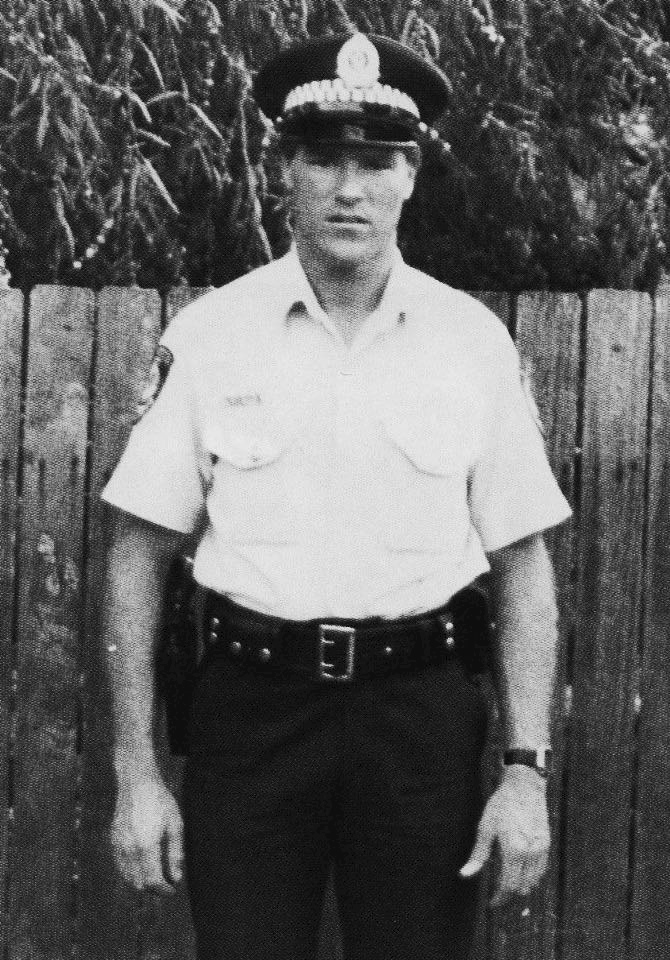
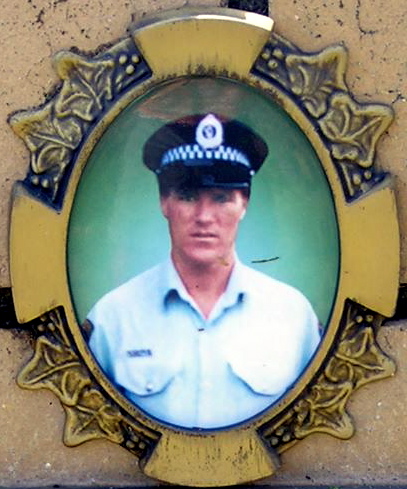
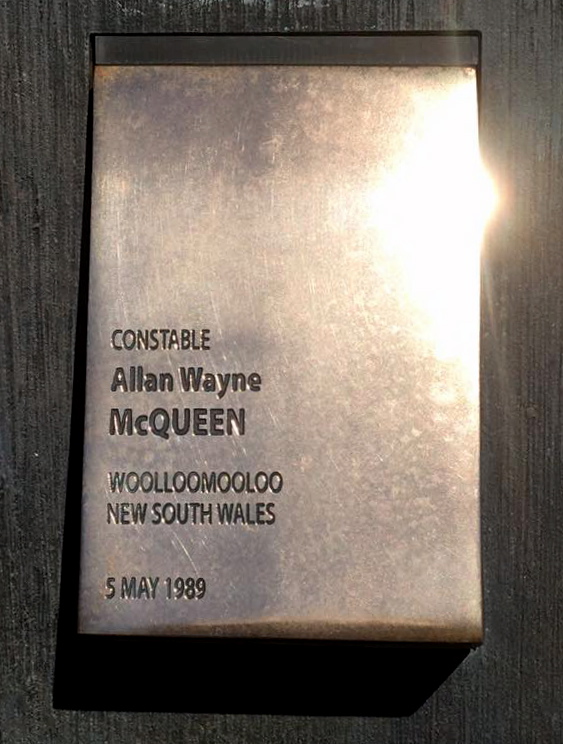
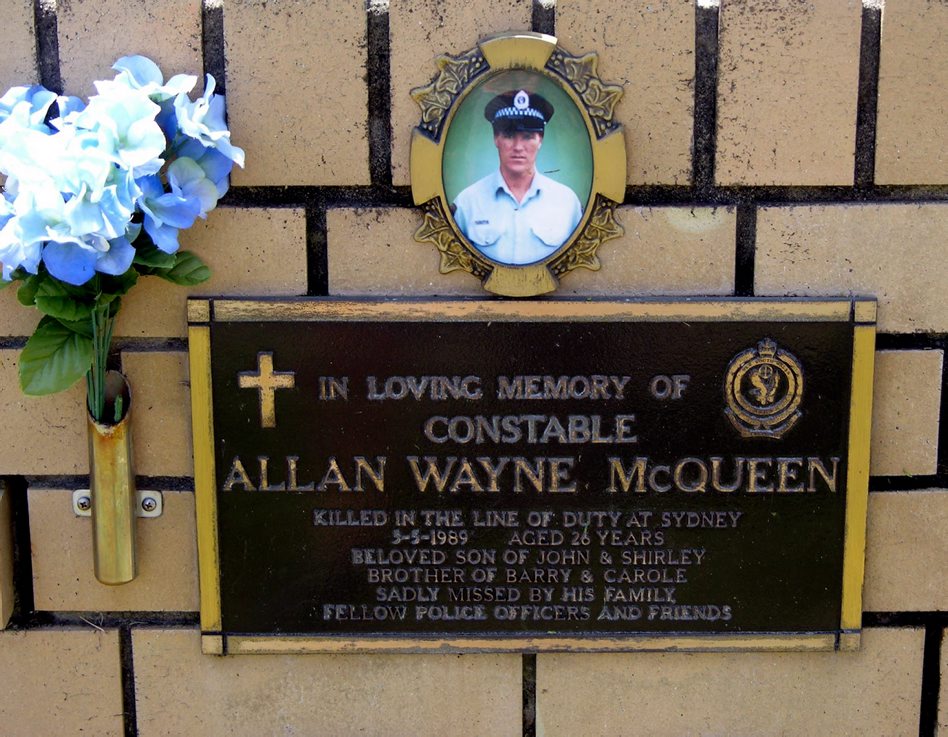
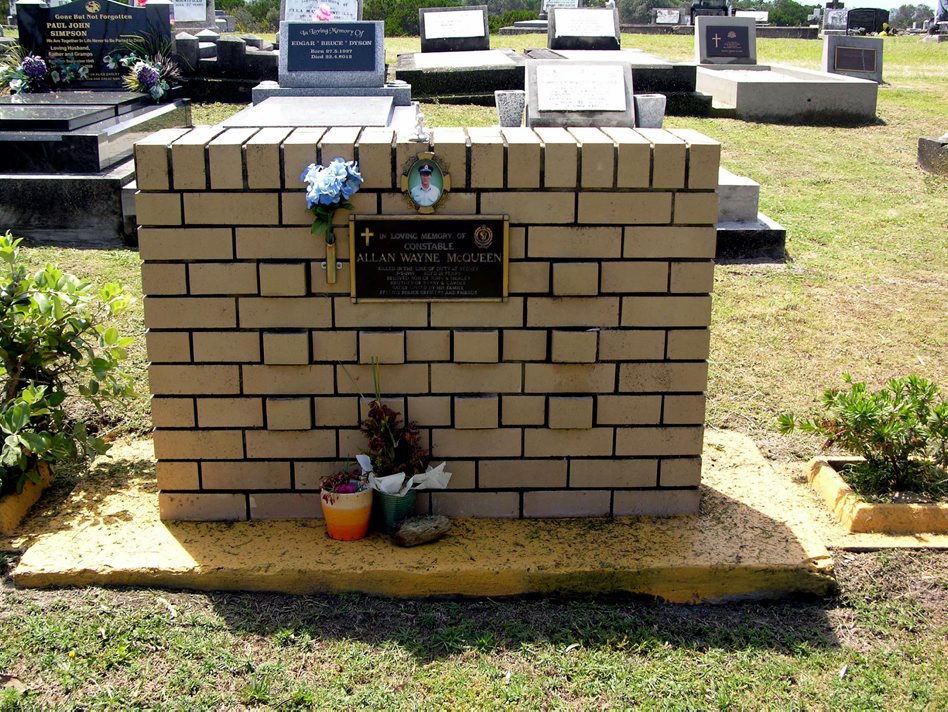

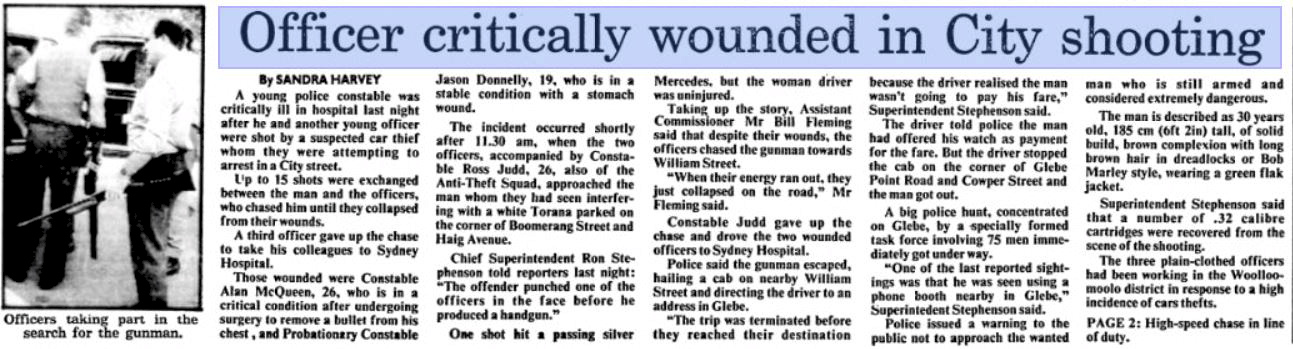
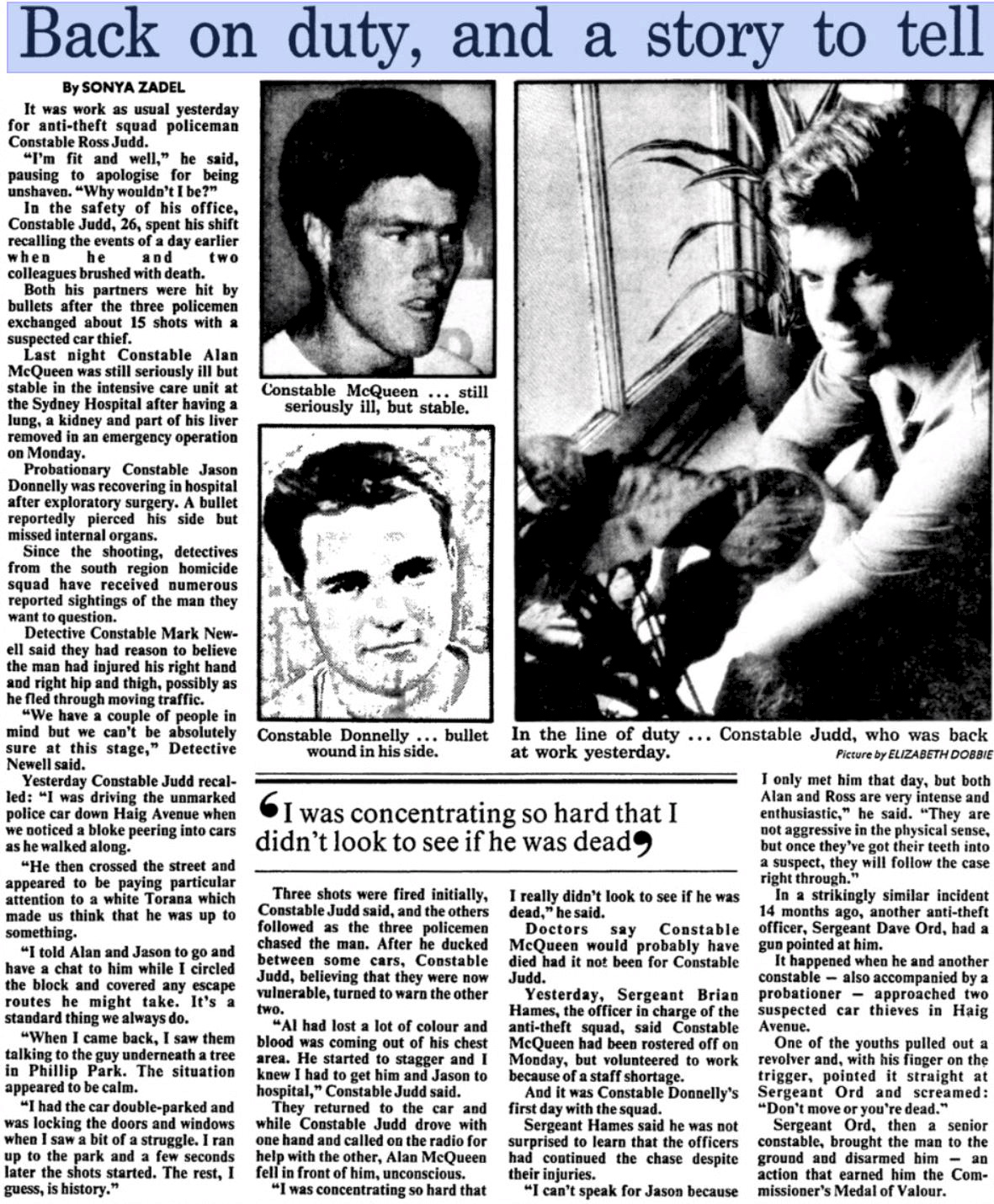
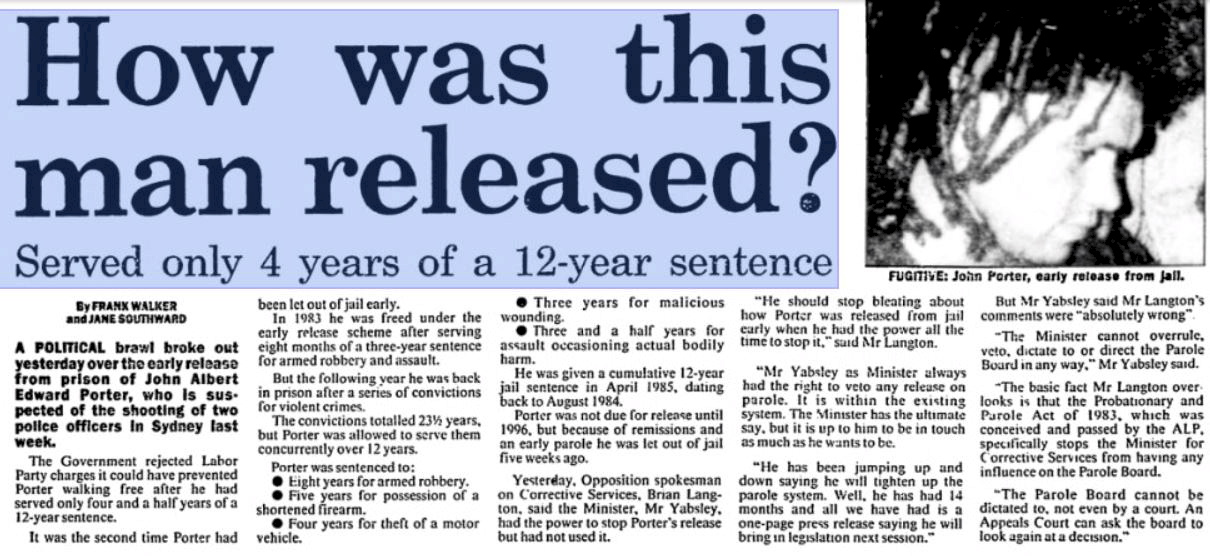
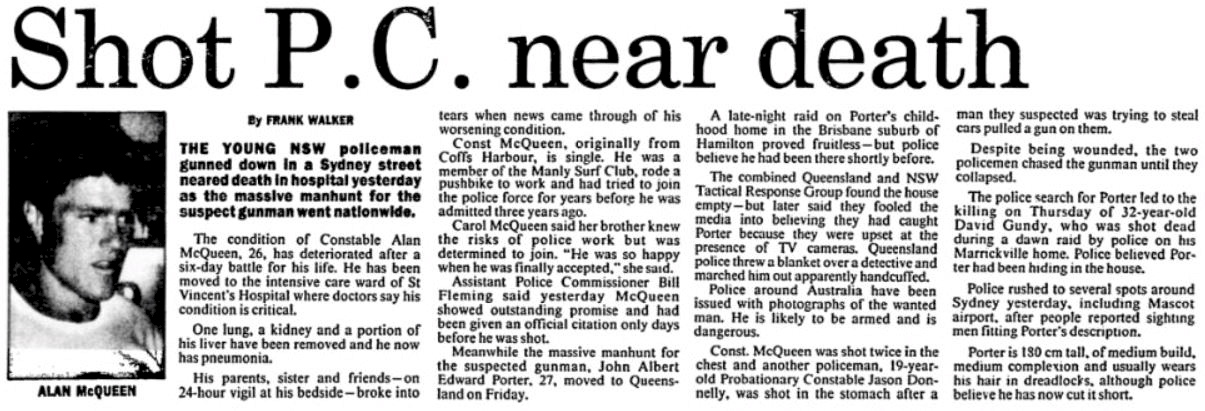
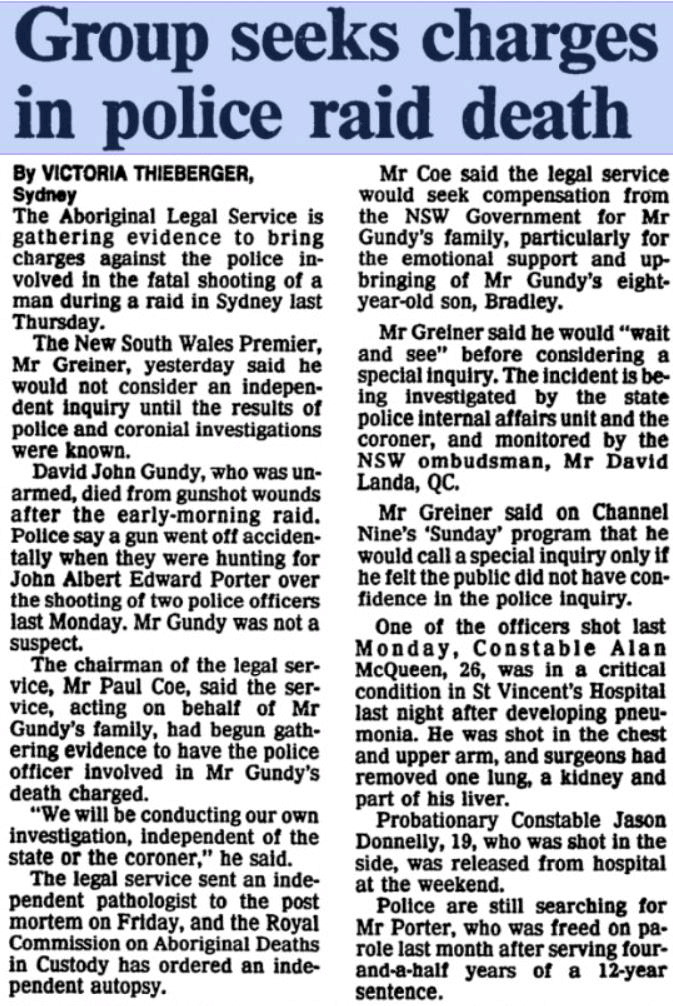
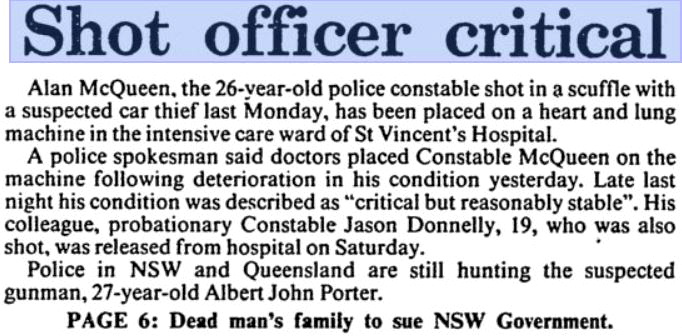
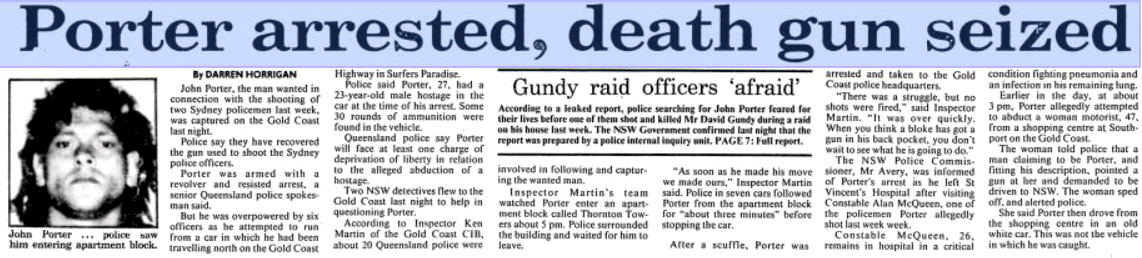
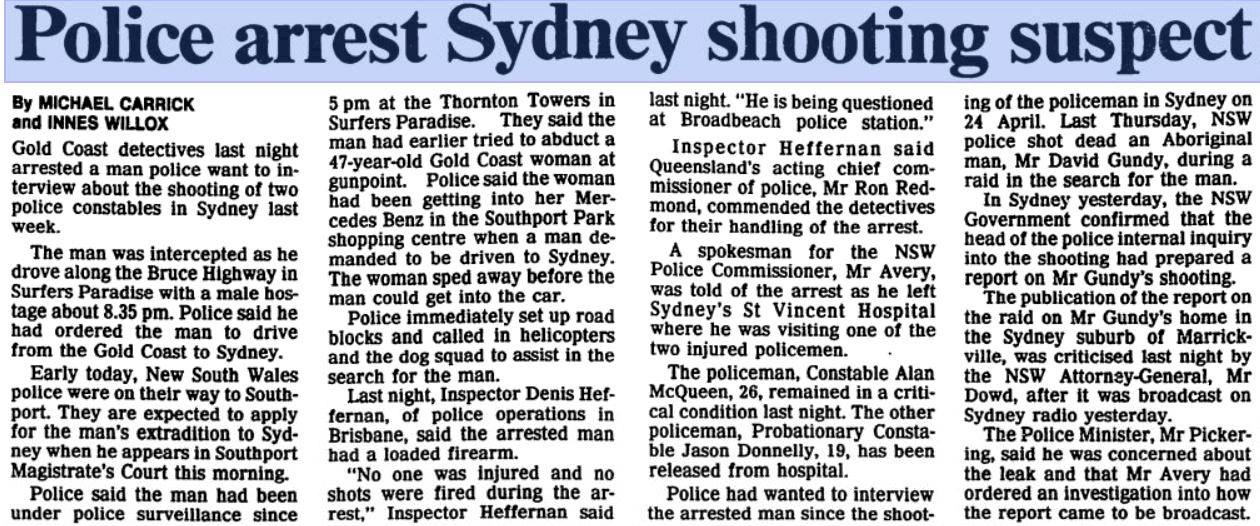
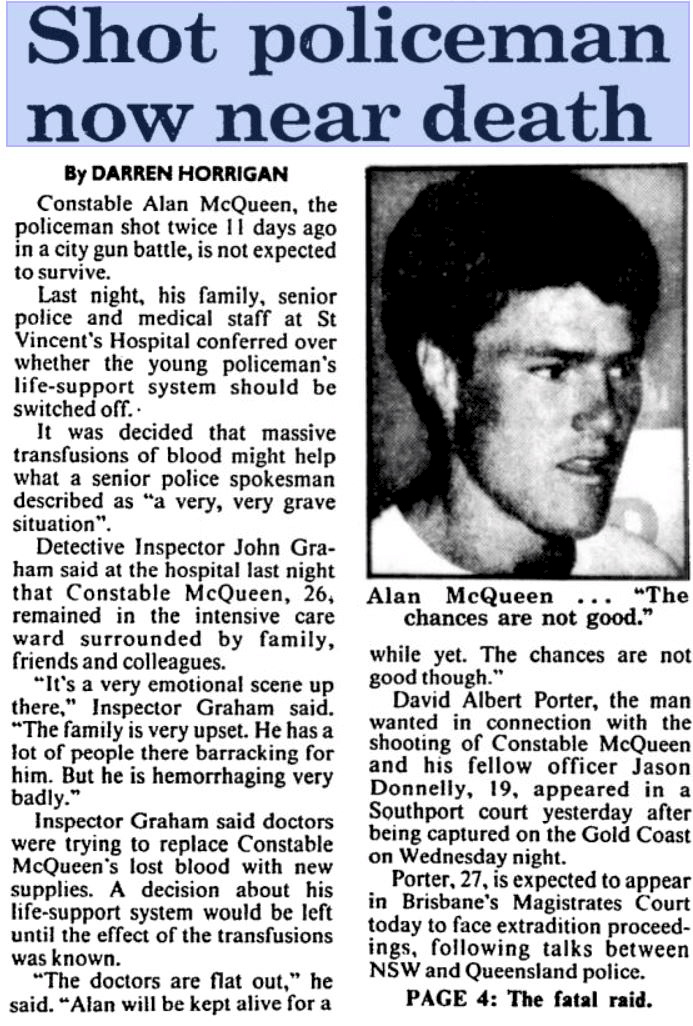
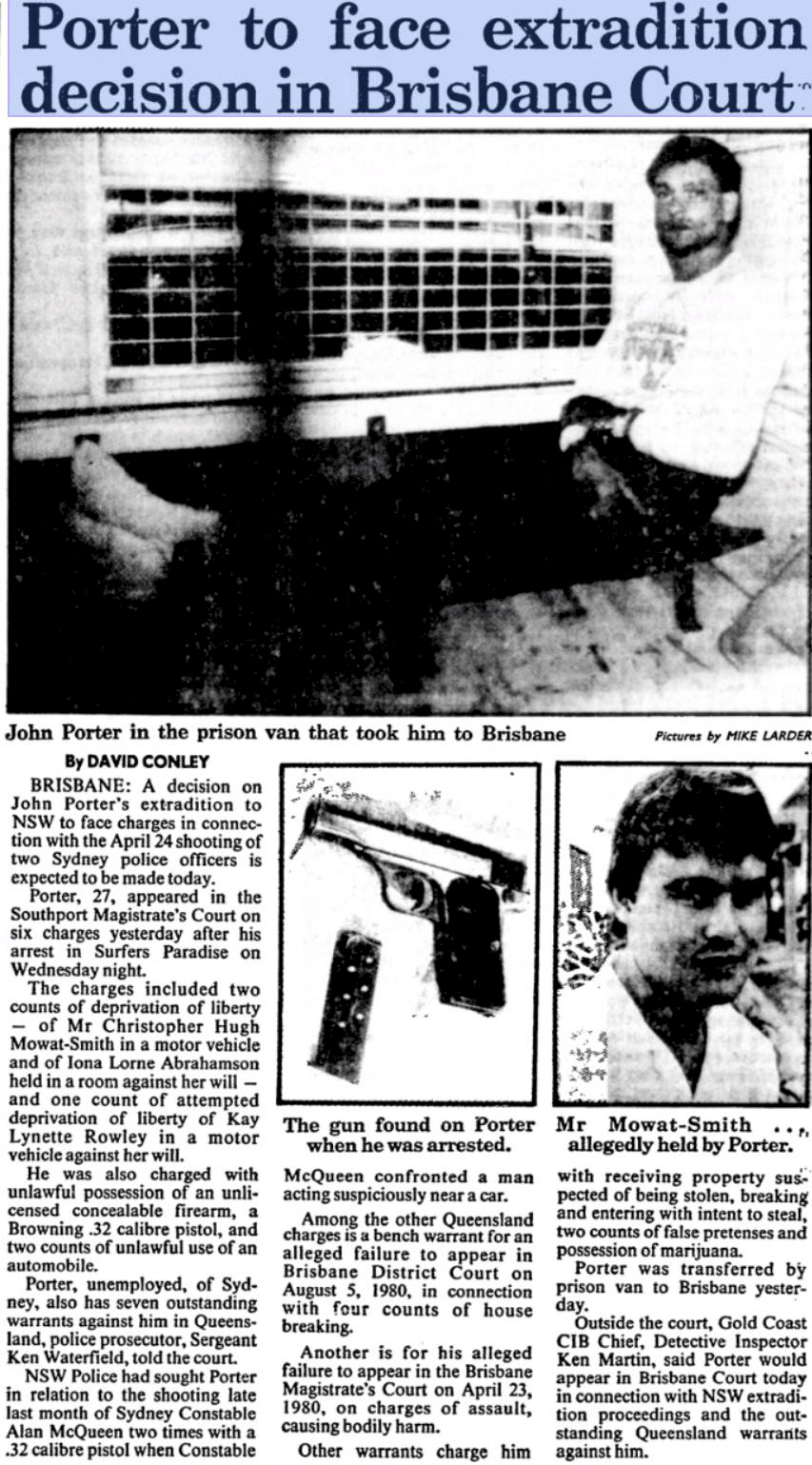

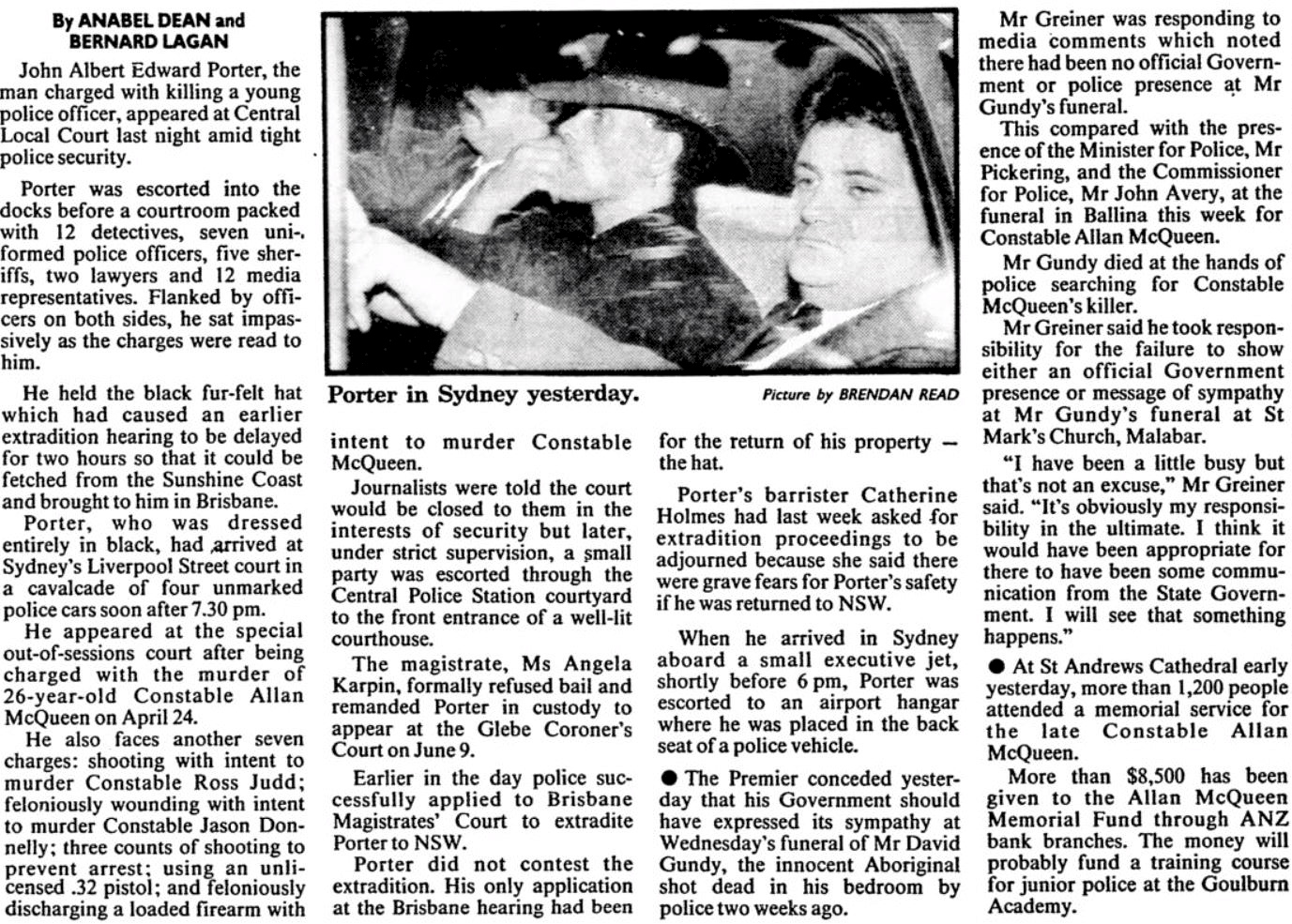 The Sydney Morning Herald 12 May 1989 p2 of 74