Edgar John WILLIAMS
Edgar John WILLIAMS
New South Wales Police Force
Sergeant 2nd Class
Served for over 25 years
Motor Vehicle Accident
Coolah
Died Saturday 28 August, 1926
Funeral ?
About 2pm on 28 August, 1926 Sergeant Williams was a passenger travelling with two other men in a vehicle returning from the Dunedoo Court. Along the Leadville Road the vehicle skidded, left the roadway and somersaulted, ejecting all three men. The sergeant was killed instantly, while the other two men were seriously injured in the accident. The Mercury newspaper dated 30 August, 1926 briefly reported the accident.
MOTOR CAR SOMERSAULTS – POLICE SERGEANT KILLED.
SYDNEY. ( Saturday ) August 28 – A shocking motoring accident occurred on the Leadville Road, three miles from Coolah, about 2 o’clock this afternoon. A car was returning from the Dunedoo Police Court, with Harold Fraser (driver), Fred Haynes and Sergeant Edgar John Williams, when it skidded. The front wheels locked and the car ran off the road. It turned a complete somersault, and the occupants were thrown out. Sergeant Williams was killed almost instantly. Haynes and Fraser were injured.
The sergeant was born in 1873 and joined the New South Wales Police Force on 21 May, 1900. At the time of his death he was probably stationed at Louth.
Sergeant Williams was a member of the police force for over 25 years, and was just due for six months long service leave. He was a second class sergeant for nearly eleven years. He had also served at Cobar and Louth. He is survived by Mrs. Williams, three daughters and one son.
Recorder ( Port Pirie, S.A. ) Monday 30 August 1926 page 1 of 4
FATAL CAPSIZE.
Police Sergeant Killed.
SYDNEY, Sunday. ( 29 Aug. )
Sergeant Edgar Williams, of the Coolah police, was killed instantly in a car capsize yesterday, three miles from Coolah, near Mudgee.
Williams and Frederick Haynes were (returning) turning from the Dunedoo Court in a car driven by Harold Fraser, 25, when for some unknown reason the car turned over, and Williams was pinned underneath and crushed to death. He leaves a widow and four children. Haynes was unhurt, while Fraser was Injured in the back
There is some confusion in relation to the correct date of death.
Newspaper articles have him being killed on Saturday 28 August 1926 but his grave stone states the date of death as 29 August 1927. ???
Further investigations continuing as to the correct date of death – July 2014.

Arthur Charles HUMPHRIES
Arthur Charles HUMPHRIES
New South Wales Police Force
Constable
Motor Vehicle Accident
Darlinghurst
7 April, 1925
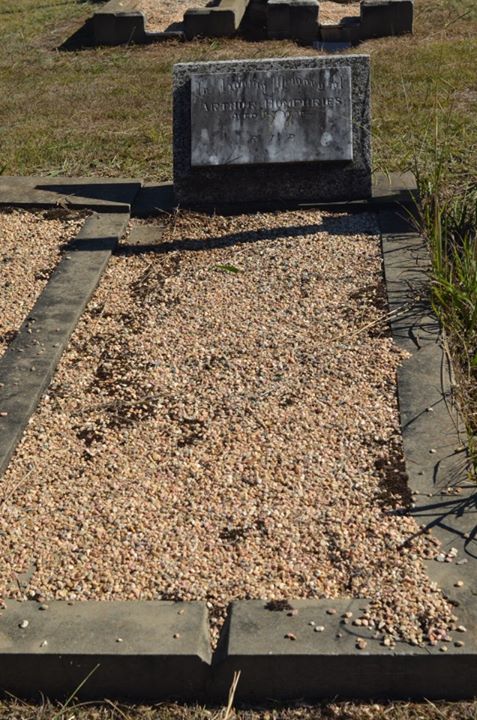
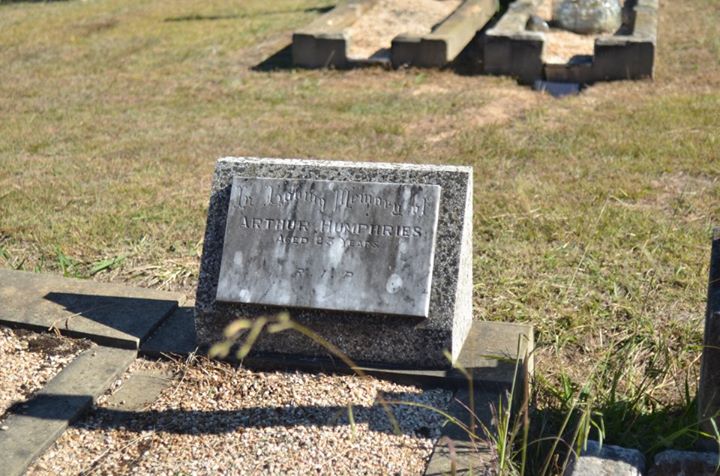
On Sunday 5 April, 1925 the constable was riding his motor cycle in Darlinghurst when the cycle collided with a brick wall at the intersection of Bourke and William Streets. He sustained a fractured skull and broken collar bone and was conveyed to the Sydney Hospital in a ( as reported in The Sydney Morning Herald ) critical condition but another newspaper article in the Singleton Argus, dated 11 April, states that he was treated and allowed to leave hospital to return home and that he was talking to a friend at 6pm when he collapsed and upon his second admission to hospital, it was discovered that he had a fractured skull.
He died on Monday, 6 April, 1925. It is not known if this death occurred on duty.
The Sydney Morning Herald dated 6 April, 1925 reported that “Severe injuries were sustained by Arthur Charles Humphries aged 23 years, a police constable stationed at Darlinghurst, who resides at 20 Hoddle Street, Paddington, when he lost control of his motor cycle yesterday and was thrown against a brick wall. The injured constable was riding the cycle in Bourke Street, East Sydney. He was thrown with great force against the wall, and suffered a fractured skull and a fractured collarbone. He was taken to Sydney Hospital where his condition last night was reported to be extremely critical.”
The NSW Register of Coroners Inquests and Magisterial Inquiries, 1834-1942 indicates that an inquest was held into the constable’s death at the Sydney City Coroner’s Court on 14 April, 1925 where it was found that the death was caused from “injuries accidentally received through being thrown from his motorcycle.”
The constable was born in Goulburn in 1903 and at the time of his death was stationed at Darlinghurst.
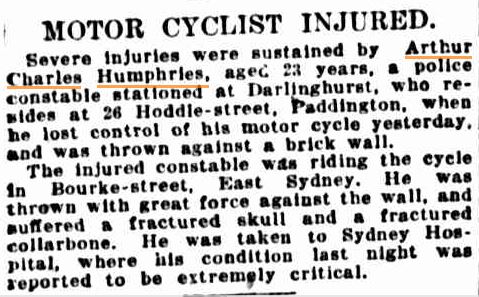
Monday 6 April 1925
page 12 of 20
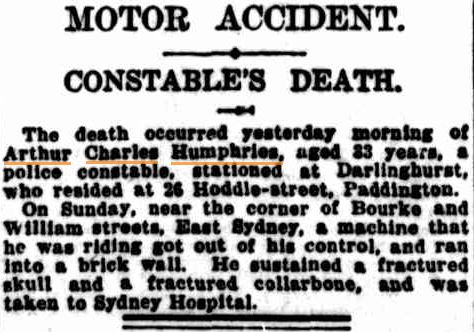
Tuesday 7 April 1925
page 11 of 20
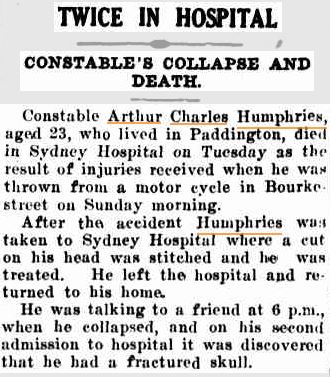
Saturday 11 April 1925
page 6 of 8
Location of Grave:
[google-map-v3 shortcodeid=”a8086026″ width=”350″ height=”350″ zoom=”12″ maptype=”roadmap” mapalign=”center” directionhint=”false” language=”default” poweredby=”false” maptypecontrol=”true” pancontrol=”true” zoomcontrol=”true” scalecontrol=”true” streetviewcontrol=”true” scrollwheelcontrol=”false” draggable=”true” tiltfourtyfive=”false” enablegeolocationmarker=”true” enablemarkerclustering=”false” addmarkermashup=”false” addmarkermashupbubble=”false” addmarkerlist=”-34.914981, 149.430336{}5-default.png{}Grave site” bubbleautopan=”true” distanceunits=”km” showbike=”false” showtraffic=”false” showpanoramio=”false”]
Harry LEEDS
Harry LEEDS
( late of ” Innisfail “, Penkivil St, Willoughby )
New South Wales Police Force
Regd. # ?
Rank: Constable
Uniform #: 122
Stations: Goulburn, Araluen, Crookwell, North Sydney, Phillip Street Police Station, George St North Police Station – Sydney
Service: From 28 May 1907 to 21 August 1924 = 17+ years Service
Awards: ?
Born: ? ? 1885 at Trial Bay
Died on: Thursday 21 August 1924 – on his way to Duty
Cause: Tram Accident at McMahon’s Point
Age: 47
Funeral date: Friday 22 August 1924
Funeral location: “Innisfail”, Penkivil St, Willoughby ( home ) & graveside
Grave location: Catholic section, Northern Suburbs Cemetery, Plassey Rd, Macquarie Park, NSW
Roman Catholic Section, Row F4, Plot 0004
GPS: -33.790327, 151.139568
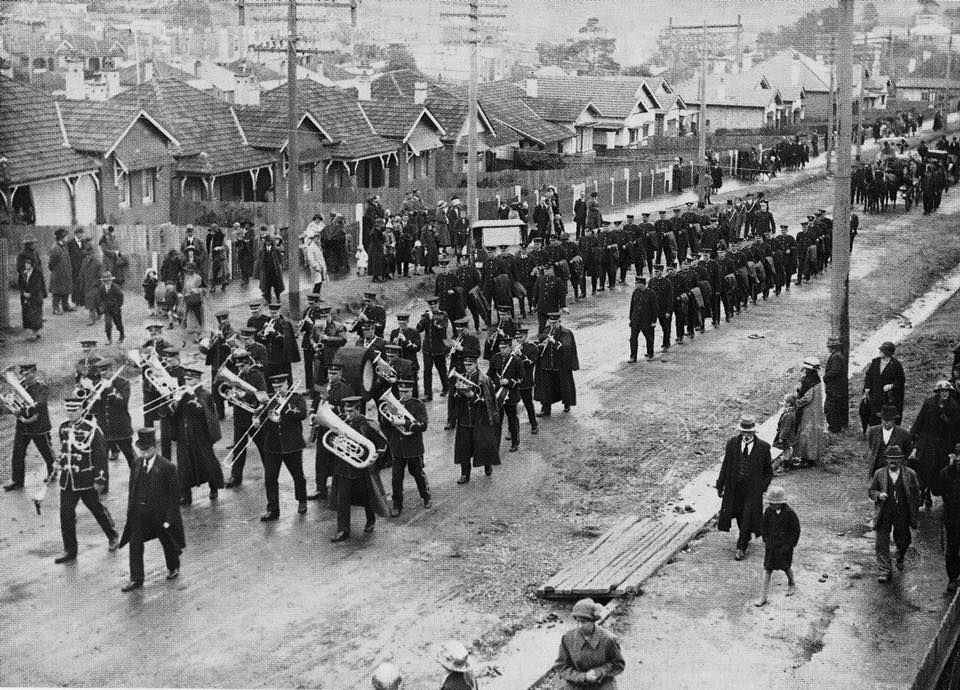
[alert_red]HARRY is NOT mentioned on the Police Wall of Remembrance * BUT SHOULD BE
Constable Harrie Leeds was killed in a tramway accident at McMahon’s Point, Sydney on Thursday 21 August, 1924. Another man was also killed and several people were injured in the incident. Incredibly, the Inspector General of Police Mr James Mitchell did not consider this death to be “killed on duty”. This decision was later the subject of numerous unsuccessful representations by the Police Association of New South Wales. It was at the very least the death of a constable travelling to work, regardless of other factors and disputed facts.
The publication “Serving the Force”, 75 Years of the Police Association of New South Wales 1921 – 1996 briefly describes how Constable Leeds bravely leapt onto the running board of a runaway tram as it sped through McMahon’s Point. The constable was trying to help stop the tram and had been yelling to passersby to keep clear. Unfortunately, the tram hit an obstacle and the constable was thrown to his death. He was not classified as being killed on duty and his wife and five children received a pittance of a pension because he had only been in the force a short time. [17 years is probably not a “short time”]
One of the bewildering issues with this event is the fact that there were and are many versions of it, as indicated in an article in the Sydney Morning Herald dated 22 August, 1924, which reported that “Constable Harry Leeds, who lived at Willoughby, was on his way to duty when he met his tragic and shocking death. Of the circumstances in which he lost his life there are different versions. One story is that he was pluckily assisting to try to avert the disaster when he was crushed. It is stated, again, that he was on the leading car, and that as he jumped on to the roadway when the cars tore across the rails the rear car hit him and pinned him helplessly underneath it. He was dead when his body was recovered after much effort.”
And again, the Sydney Morning Herald dated 2 October, 1924 reported a lengthy description of the coroner’s findings, including the following extract.
Herbert Gillies Ruthven, a passenger on the tram, described his experience. He said that shortly before the smash he had been conversing with the deceased Leeds. Leeds seemed frightened when the tram had gathered speed while descending the other declines on the route from Victoria Avenue. [Ruthven] had said to him, “How about getting off here, Leeds, and walking down?” That was when the tram stopped at East Crescent Street. Just then the tram started, and the constable did not reply. Witness next saw him crouching in a hesitating manner as if he were about to take the risk of jumping from the tram. He was still on the footboard when the tram first left the rails.
The constable was born in 1885 at Trial Bay, New South Wales and joined the New South Wales Police Force on 28 May, 1907. At the time of his death he was stationed at George Street North Police Station. He lived at Willoughby and had previously served at Goulburn, Araluen, Crookwell, North Sydney and Phillip Street Police Stations.
The Sydney Morning Herald Friday 22 August 1924 page 9 of 16
CASUALTY LIST.
KILLED.
HARRY LEEDS, 47, of Penkivil-street, Willoughby, a police constable attached to the George-street North station.
FREDERICK MAURICE LAMBERT, 30, engineer, of the corner of Alleyne and Mann streets, Willoughby.
http://trove.nla.gov.au/ndp/del/article/16172768
The Sydney Morning Herald Friday 22 August 1924 page 7 of 16
FUNERALS:
LEEDS – The Relatives and Friends of the late Constable HARRY LEEDS are invited to attend his Funeral ; to leave his late residence, Innisfail, Penkivil-street, Willoughby, THIS FRIDAY, at 2pm, or Catholic Cemetery, Northern Suburbs.
WOOD COFFILL LIMITED, Funeral Directors.
*
LEEDS. – The Relatives and Friends of Mrs. ALICE E. LEEDS and FAMILY are invited to attend the Funeral of her beloved HUSBAND and their FATHER, Harry ; to leave Innisfail, Penkivil-street, Willoughby, THIS FRIDAY, at 2pm for Catholic Cemetery, Northern Suburbs.
*
LEEDS – Relatives and friends of Mr. HARRY LEEDS, Senior, and Miss ELSIE LEEDS, of Parramatta, are invited to attend the Funeral of his beloved SON and her BROTHER, Harry ; to leave Innisfail, Penkivil-street, Willoughby, THIS FRIDAY, at 2pm, for Catholic Cemetery, Northern Suburbs.
*
LEEDS.- The Friends of Mr. and Mrs. NEIL BOYLE, Mr. and Mrs. FRANK PALMER, Mr. and Mrs. Neil LEEDS, Mr. and Mrs. RICHARD LEEDS, of Summer Hill, are invited to attend the Funeral of their beloved BROTHER, Harry Leeds ; to leave Innisfail, Penkivil-street, Willoughby, THIS FRIDAY, at 2pm, for Catholic Cemetery, Northern Suburbs.
*
LEEDS – The Friends of Mrs. O’REGAN, ELLA & DONA HOWE, of Cairo-Street, North Sydney, are invited to attend the funeral of their beloved SON-IN-LAW and BROTHER-IN-LAW, Harry Leeds ; to leave Innisfail, Penkivil-street, Willoughby, THIS FRIDAY, at 2pm, for Catholic Cemetery, Northern Suburbs.
*
LEEDS. – The Friends of Mr. and Mrs. J. T. LEVITT and FAMILY, of Ashfield, are invited to attend the Funeral of their beloved BROTHER-IN-LAW and UNCLE, Harry Leeds; to lave Innisfail, Penkivil-street, Willoughby, THIS FRIDAY, at 2pm for Catholic Cemetery, Northern Suburbs.
WOOD COFFILL LIMITED
*
LEEDS – N.I.O.O.F., LOYAL PERSEVERANCE LODGE – The Sisters and Brothers of the above lodge are invited to attend the Funeral of the late Brother H. LEEDS; to leave his late residence, Innisfail, Penkivil-street, Willoughby, at 2pm TODAY.
http://trove.nla.gov.au/ndp/del/article/16172685#pstart1225241
Evening News ( Sydney ) Friday 22 August 1924 page 7 of 12
LAST TRIBUTE TO CONSTABLE LEEDS
A large crowd attended the funeral of Constable Harry Leeds, one of the victims of the North Sydney tramway smash, to-day. It was striking tribute to a popular officer.
The cortege, which left his home in Penkivil-street. Willoughby, for the Northern Suburbs cemetery, was headed by the Police Band playing the Dead March. About a hundred police representative of the whole metropolitan division, besides a number of tramway men marched in procession. The principal mourners were the widow and five young children, Mrs. Boyle, Mrs. Benn, Mrs. Davison, Mrs. Dickman, Mrs Palmer and Miss Elsie Leeds (sister). Mr. Harry Leeds (father). Messrs. Neil and Richard Leeds (brothers). Among those present were Mr. James Mitchell, Inspector-General of Police, Inspector Souter, North Sydney, Mr. G. Holt. District Superintendent of Tramways, North Sydney – (representing the Tramway Department), Mr. Charles Thackeray (representing the Police Association). Many beautiful wreaths were sent by the police. Including several from C.I. Branch and No. 4 Division.
http://trove.nla.gov.au/ndp/del/article/119977024
The Sydney Morning Herald Saturday 23 August 1924 page 16 of 26
LATE CONSTABLE LEEDS.
IMPRESSIVE FUNERAL.
The funeral of Constable Harry Leeds, who was killed in the tram accident at McMahon’s Point, took place yesterday afternoon in the Roman Catholic portion of the Northern Suburbs cemetery.
A large crowd assembled in the vicinity of the late Constable Leed’s home in Penkivil- street, Willoughby, and, as the coffin was placed in the hearse, the crowd stood bare-headed, while Inspectors Beatty (George-street North station), to which Constable Leeds was attached and Souter (North Sydney) stood at the salute, at one side, and members of the Loyal Perseverance Lodge (Independent Order of Oddfellows) stood at the other side.
The Police Band, with muffled and draped drums, led the procession, and following the band, there came between 50 and 60 non-commissioned officers and men of the police force, representing 15 divisions. Marching immediately in front of the hearse were the Inspector-General of Police (Mr. James Mitchell) and Inspector Souter. The pall-bearers were Constables Cole, Hansen, Malcolm (No. 6 Division), and Jackson, Kerr, and Reece (No. 4 Division). Following the hearse were the mourning coaches conveying members of the family and other relatives of the deceased, then came members of the Loyal Perseverance Lodge, and about 30 motor cars and other vehicles, conveying friends of the late constable.
The route from the late Constable Leeds’s home to the cemetery was between three and four miles, and practically all the way crowds gathered to view the procession. A large number of people had assembled at Mowbray-road, and as the procession passed into the main street of Chatswood to the strains of the Dead March the scene was a solemn and striking one. The sidewalks of the thoroughfare were crowded, the men standing bare-headed, and the police on street duty standing at the salute as the hearse passed. After crossing the railway line at Chatswood the Police Band and members of the force opened out and halted while the procession passed through. Motor buses conveyed the band and police to the entrance to the cemetery, and on arrival of the hearse and mourners the procession was again formed and marched to the grave. The Rev. Father J. Wall officiated at the graveside, the service being simple but impressive.
The principal mourners were Mrs. Leeds (widow) and five young children, Messrs. Harry Leeds (father), Neil and Richard Leeds (brothers), and Mrs. Boyle, Mrs. Palmer Mrs. Benn, Mrs. Davidson, Mrs. Dickman, and Miss Elsie Leeds (sisters).
Others present Included Mr. G. Holt, District Superintendent of Tramways, North Sydney (representing the Tramway Department), District-officer F. A. Tuck, Crow’s Nest (representing the New South Wales Fire Brigade), Mr. Charles Thackeray (representing the Police Association), ex-Inspector J. Fullarton, Aldermen J. S. Muir, W. L. M. Fry, E. J. Parkes (Willoughby Council), and Messrs. G. A. Bailey (town clerk), Hughes (health Inspector), and Murdock (building Inspector), H. B. Perringnon (Department of Labour and Industry), T. Proctor, H. C. Coulter, P. K, Gorrick, and E. Hewitt.
POLICE TO HELP WIDOW.
At North Sydney Police Court yesterday appreciative remarks regarding the late Constable Leeds were made by Mr. Daley and Mr. Thomas on behalf of the legal profession. Mr. Daley said that he had known Constable Leeds for 15 years, and he was an efficient, courageous, and loyal officer.
Inspector Souter expressed regret on behalf of the police force, and said that it was unfortunate that Constable Leeds had left a widow and five young children. He was sure, however, that the police as a body would not fail to alleviate the suffering of the late constable’s relatives.
http://trove.nla.gov.au/ndp/del/article/16179465
The Catholic Press ( Sydney ) Thursday 4 September 1924 page 25 of 52
Tram Accident Victim.
CONSTABLE HARRY LEEDS.

THE LATE CONSTABLE LEEDS.
The recent tram accident at North Sydney was the cause of the death, of Constable Harry Leeds. Constable Leeds was one of the most popular men in the metropolitan area, and news of his death came as a severe shock to his colleagues. He joined the force in 1907, and was appointed to Goulburn, where he was married, and transferred to Araluen. From there he was sent to Crookwell, and later on to North Sydney, where he did duty for a number of years; but for the past five years he was connected with George-street North Police Station.
On the 22nd ult., at the North Sydney Police Court, Mr. Daley and Mr. Thomas, on behalf of the legal profession, paid a tribute to the worth of Constable Leeds, and offered their deep sympathy to his relatives. Inspector Souter said they could ill afford to lose such men of long service and experience. Constable Leeds leaves a widow and five young children, the youngest being a boy only six months old.
The funeral was an impressive tribute to the memory of deceased. The Police Band, under Bandmaster Hawkins and Drum-Major Flynn, together with a squad of sergeants and constables, drawn from the whole of the 15 divisions of the Metropolitan Police Force, led the cortege, and six police pals of the dead man carried the coffin, laden with wreaths. The hearse, too, was piled with wreaths.
The Inspector-General of Police (Mr. Mitchell) walked in the cortege, accompanied by Inspectors Beatty and Souter. The pall-bearers were Constables Cole, Hansen, Malcolm (No. 6 Division), Jackson, Kerr, Reece (No. 4 Division). Also in the cortege were Mr. G. Holt (District Superintendent, North Sydney), representing the Government Tramways Department), District Officer F. A. Tuck (representing New South Wales Fire Brigades), Mr. C. Thackeray (representing Mr. B. Fortesene and Police Association), Alderman Muir (representing the Mayor and Alderman of Willoughby). First-Class Constable Walsh marshalled the cortege to the Catholic portion of the Northern Suburbs Cemetery. The streets through which the cortege passed were lined on each side with thousands of people, who stood with bowed heads. Arriving at the cemetery, the police formed an avenue, through which the cortege passed, and Rev. Father J. Wall, of Ryde, officiated at the graveside.
While the coffin was being lowered, the Police Band played ‘Abide With Me.’
The chief mourners were: The widow and five children, Mr. Harry Leeds (father), Neil and Richard (brothers), Mesdames Boyle, Benn, Davison, Dickman, Miss Elsie Leeds (sisters) Mrs. O ‘Regan, Mrs. Levett, Miss Howe, Miss O’Regan (mother and sisters of the widow). — R.I.P.
http://trove.nla.gov.au/ndp/del/page/14054317
Freeman’s Journal ( Sydney ) Thursday 4 September 1924 page 19 of 48
THE LATE CONSTABLE HARRY LEEDS.
Constable Leeds, the victim of the recent tram accident at North Sydney, was one of the most popular men in the metropolitan area, and news of his death came as a severe blow to his colleagues.
He joined the police force in 1907 and was appointed to Goulburn, where he married. He was transferred to Araluen, and from there he went to Crookwell, and later on to North Sydney, where he did duty for a number of years. For the past five years he had been connected with George-street North Police Station.
On August 22, at the North Sydney Police Court, Mr. Daley and Mr. Thomas, on behalf of the legal profession, paid a tribute to the worth of Constable Leeds, and offered their deep sympathy to his relatives. Inspector Souter said they could ill afford to lose men of such experience and long service.
Constable Leeds leaves a widow and five young children, the youngest being a boy only six months old.
The funeral, which took place on Friday, August 22, was an impressive tribute to the memory of deceased. A large concourse of people gathered at ‘Innisfail,’ Penkivil-street, Willoughby, and genuine sorrow was manifested, particularly among those who knew the bond of affection which existed in the domestic life. At 2 p.m. the Police Band, together with a squad of sergeants and constables drawn from the whole of the fifteen divisions of the metropolitan police force, formed up outside, and six police pals of the dead man carried the coffin, laden with wreaths. The hearse was piled with wreaths. As the coffin was borne out, Inspectors Beatty (George-street North) and Souter (North Sydney) stood at the salute at one side, and six members of the Loyal Perseverance Lodge (I.O.O.F.) with bowed heads at the other.
The Inspector-General of Police (Mr. Mitchell) walked in the cortege, accompanied by Inspectors Beatty and Souter. The pall-bearers were Constables Cole, Hansen, Malcolm (No. 6. Division), Jackson, Kerr, and Reece (No. 4 Division). Also in the cortege were Mr. G. Holt (District Superintendent of North Sydney; representing Government Tramways Department), District Officer F. A. Tuck (representing N.S.W. Fire Brigades), Mr. C Thackeray (representing Mr. B. Fortescue and the Police Association), Alderman Muir (representing the Mayor and aldermen of Willoughby); Mr. Scott Fell was also represented.
First-Class Constable Walsh marshalled the cortege to the Catholic portion of the Northern Suburbs Company. The Police Band, under Bandmaster Hawkins, with Drum-Major Flynn at its head, led off with the ‘Dead March in Saul.’ The Loyal Perseverance Lodge (N.I.O.O.F.), with N.G. Bro. C. Bolger and Secretary Bro. Dimond, were also in the procession. The streets, through which the cortege passed, was lined on each side with thousands of people, who stood with bowed heads and tear-dimmed eyes. Arriving at the cemetery, the police formed an avenue through which the cortege passed, and the Rev. Father J. Wall, of Ryde, officiated at the graveside. While the coffin was being lowered the Police Band played ‘Abide With Me.’ The chief mourners were the widow and five children, Mr. Harry Leeds (father), Messrs. Neil and Richard (brothers), Mesdames Boyle, Benn, Davison, and Dickman, Miss Elsie Leeds (sisters), Mrs. O’Regan, Mrs. Levett, Miss Howe, Miss O’Regan (mother and sisters of the widow). — R.I.P.
http://trove.nla.gov.au/ndp/del/article/123253389
Evening News ( Sydney) Monday 29 September 1924 page 5 of 10
McMAHON’S PT. SMASH
The Coroner’s inquiry into the cause of the McMahon’s Point tram crash on August 21, in which Constable Harry Leeds and Frederick Maurice Lambert were killed, has been fixed for next Wednesday at 10 a.m.
http://trove.nla.gov.au/ndp/del/article/119969446
The Sydney Morning Herald Tuesday 30 September 1924 page 6 of 15
TRAM DISASTER.
The City Coroner’s inquest into the deaths of Constable Harry Leeds, and Frederick Maurice Lambert, in the tram disaster at McMahon’s Point on August 21 is listed to be held tomorrow.
http://trove.nla.gov.au/ndp/del/article/16161767
Newcastle Morning Herald & Miners’ Advocate Thursday 2 October 1924 page 5 of 8
SYDNEY TRAM SMASH. CORONER’S VERDICT :
The Sydney Coroner to-day held an inquiry, into the deaths of Frederick Lambert, aged 39, an engineer, of Willoughby, and Constable Harry Leeds, aged 47, of Willoughby, who were killed in the tram smash at McMahon’s Point, North Sydney, on the morning of August 21. It was through the alleged failure of the brakes that a double-set ran down the steep incline towards McMahon’s Point, but when rounding a curve the front car left the rails and crashed into a house. The rear car piled itself up on to the first car, and in the smash Lambert and Leeds were killed, and a number of other passengers injured.
Edward Chambers, electrical subforeman in the Tramway Department, said that on August 20 the two cars, 544 and 543, went into traffic at 6.20a.m., and arrived back at 8.57a.m., and were booked up as ” O.K. ” On August 21, at 1a.m., they were again booked up as ” O.K. ” At 5.49a.m. they went into traffic again, and were in good order. At 7.50a.m. he saw them at McMahon’s Point, after the accident. It was driver’s duty to report any defects in the running of a car.
Thomas Elias James, the driver of the car, was then called. He said that when they left Willoughby on the fatal trip for McMahon’s Point, he found that the controller was jambed (sic), and he could not move it one way or another. He then drove the tram from the rear of the car, and left Conductor Cowan in charge of the air brake in the front. As they neared the long hill near the terminus, he felt the car getting out of control. He attempted to use the third emergency, but found it could not be used, owing to the air control being on. He was absolutely helpless to do anything. Witness considered he had taken the best course in giving Cowan control of the air brake, as it was a very foggy morning. He attributed the accident to the greasy condition of the rails.
Conductor James Cowan, who stuck to the front of the car throughout, and who suffered severe concussion when it left the rails and crashed into the wall, was the next witness.
Mr. D. R. Hall, his solicitor, explained that his memory, so far as the accident was concerned, was an absolute blank, and he was still a very sick man. Consequently he was only asked a few questions. He told the coroner that he could not remember anything of the run down the hill or the final crash.
“I would like to say how greatly I and the public admire him for sticking to his post right up to the end,” said the coroner, as Cowan was assisted from the box. “I an sure he will have the good wishes of the court for his speedy recovery, and its admiration for the way in which he retained his position, in the face of what looked like certain death.”
Edward Wills, chief inspector, said that the working orders put the driver in charge of the tram, and the only part of his duty he could delegate to a conductor when he had to drive from the rear was the operation of the bell and the sand. Wills maintained that the driver delegated his powers to the conductor, and thereby broke the regulations. The conductor, in this case, was in charge of the tram.
The Coroner: A man might easily make a mistake about the meaning of this rule.
Mr. Hall: A department whose motto is “Safety first” might have expressed it in more simple English and more clearly.
The coroner returned a verdict of accidental death.
http://trove.nla.gov.au/ndp/del/article/137776451
Joseph John HUSH
Joseph John HUSH
Late of Edward Street, Willoughby
New South Wales Police Force
Regd. # ‘Q‘ 8759
For the purposes of this website ‘Q‘ represents those Police joining between 1862 ( commencement of NSWPF ) – 23 February 1915 ( Commencement of NSWPF current numbering system )
Rank: Probationary Constable – appointed 9 January 1908
Final Rank = Constable 1st Class
Stations: ?, Chatswood – Death
Service: From ? ? pre January 1908? to 6 November 1919 = 11+ years Service
Awards: No find on It’s An Honour
Born: ? ? 1880
Died on: 6 November 1919
Age: 39
Cause: Motor Vehicle Accident –
Event location: Chatswood
Event date: 6 November 1919
Funeral date: ? ? ?
Funeral location: ?
Wake location: ?
Funeral Parlour: ?
Buried at: ?, Waverley
Memorial located at: ?
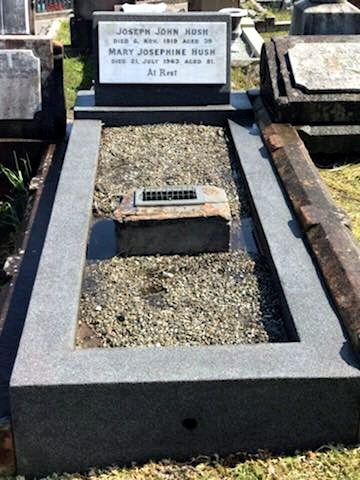
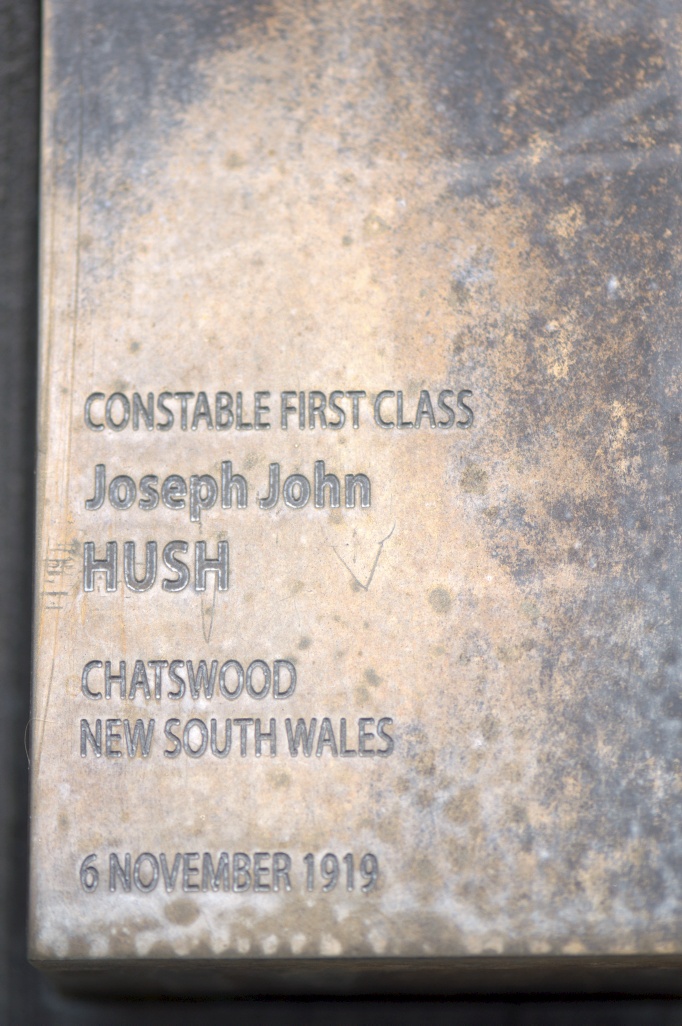
[alert_green]JOSEPH IS mentioned on the Police Wall of Remembrance[/alert_green]
Funeral location: TBA
FURTHER INFORMATION IS NEEDED ABOUT THIS PERSON, THEIR LIFE, THEIR CAREER AND THEIR DEATH.
PLEASE SEND PHOTOS AND INFORMATION TO Cal
May they forever Rest In Peace
On 6 November, 1919 Constables Joseph Hush and Arthur ( Arthur Alfred Jacob )Willmott ( Q 9019 ) went to Roseville where they made enquiries into a robbery. On completion of these enquiries at about 5pm, they accepted a lift back to their station with a lorry driver. They had almost reached the Chatswood Police Station when a tyre on the vehicle blew out, causing it to overturn. Both constables were trapped beneath the vehicle and seriously injured. Both were conveyed to the Royal North Shore Hospital where Constable Hush unfortunately succumbed to his injuries. Constable Willmott recovered from his injuries.
The Sydney Morning Herald of 7 November, 1919 reported that ” Constable Hush, who was 39 years of age, had been in the police service for nearly 12 years. He was known as a steady, reliable man, who had performed good work on many occasions. He lived in Edward Street, Willoughby, and leaves a wife and six children. “
The constable was born in 1880 and joined the New South Wales Police Force on 9 January, 1908. At the time of his death he was stationed at Chatswood.
Evening News (Sydney, NSW : 1869 – 1931), Saturday 11 March 1916, page 6
ANSWER THE CALL.
RECRUITING IN SYDNEY. FRIDAY’S ENROLMENT. MEN READY FOR TRAINING.
The following men submitted themselves for enlistment yesterday at Victoria Barracks :—
Joseph John Hush, police constable, Myrtle street, North Sydney.
Hilary Patrick McGroder, police constable, Doris-street, North Sydney.
https://trove.nla.gov.au/newspaper/article/115836178
No find with WWI records at this time.
Ramsay DOBBIE
Ramsay DOBBIE
Late of Ulmarra
New South Wales Police Force
Regd. # ‘ Q ‘6811
For the purposes of this website ‘Q‘ represents those Police joining between 1862 ( commencement of NSWPF ) – 23 February 1915 ( Commencement of NSWPF current numbering system )
Rank: Mounted
Probationary Constable – appointed 4 February 1895
Constable – appointed 4 February 1896
Constable at Thackaringa ( Broken Hill District ) in December 1898. Still there Feb 1899
Constable 1st Class – appointed 1 February 1899
Constable 1st Class at Alstonville in October 1903
Senior Constable – appointed 1 May 1906
Was a Senior Constable in 1906 at Hillgrove. Still there in Oct 1912
( there was no such Rank as Sgt 3/c prior to 24 February 1915 )
Sergeant 2nd Class – appointed 1 February 1915
Was a Sergeant at Coffs Harbour in May 1916
Sergeant 2nd Class at Coffs Harbour in April 1916
Sergeant 2nd Class – Death
Stations: White Cliffs ( 1898 ), Thackaringa ( 1898 ), Grafton ( Feb 1900 ), Alstonville ( Oct 1903 ),
Burraga ( Oct 1904 ), Hillgrove ( Oct 1912 ), Coffs Harbour ( 1916 ), and only stationed at Ulmarra a few months ( from at least September 1917 ).
Service: From 4 February 1895 to 11 December 1917 = 23+ years Service
Awards: No find on It’s An Honour
Born: 30 March 1870 in Victoria
Died on: Tuesday 11 December 1917 about 8.15pm
Age: 47
Cause: Vehicle collision – Sulkie – Internal injuries
Event location: River St, Ulmarra between the Post Office and past the Masonic Hall
Event date: Tuesday 11 December 1917 about 5pm
Funeral date: Wednesday 12 December 1917 @ 3pm
Funeral location: Ulmarra General Cemetery
Buried at: Ulmarra General Cemetery, Coldstream Rd, Ulmarra, NSW
Grave location: 29°39’00″S 153°03’53″E
Memorial located at: ?
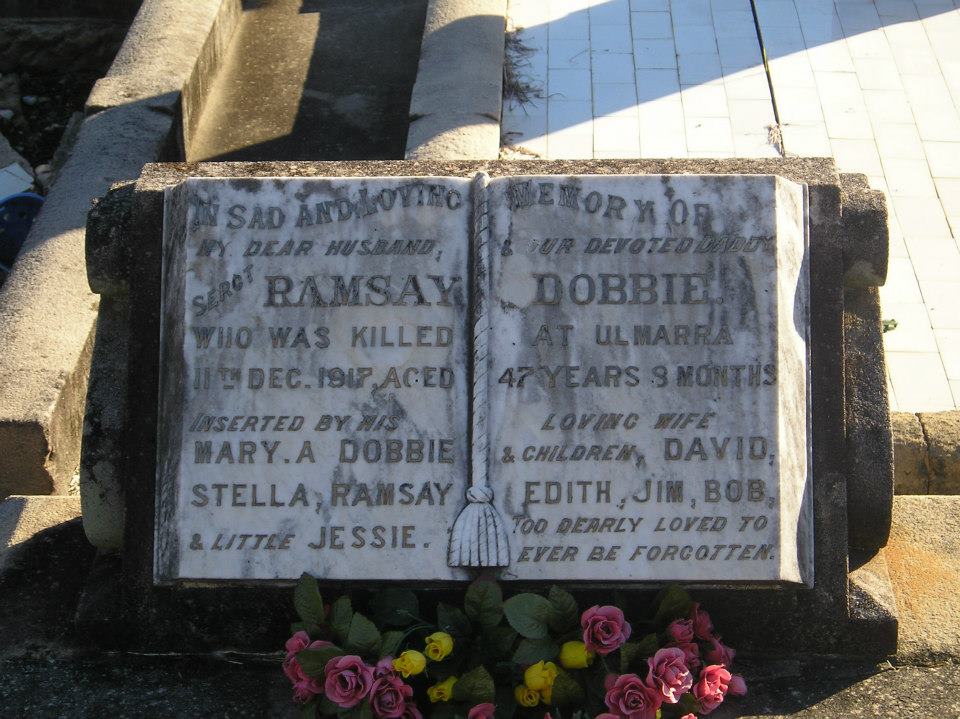
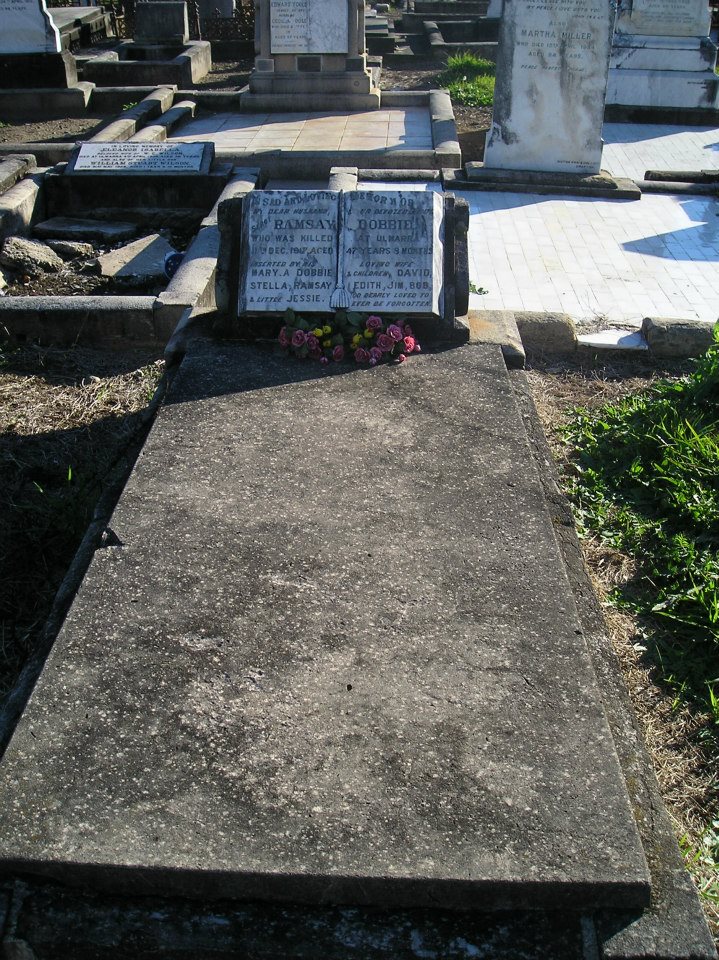
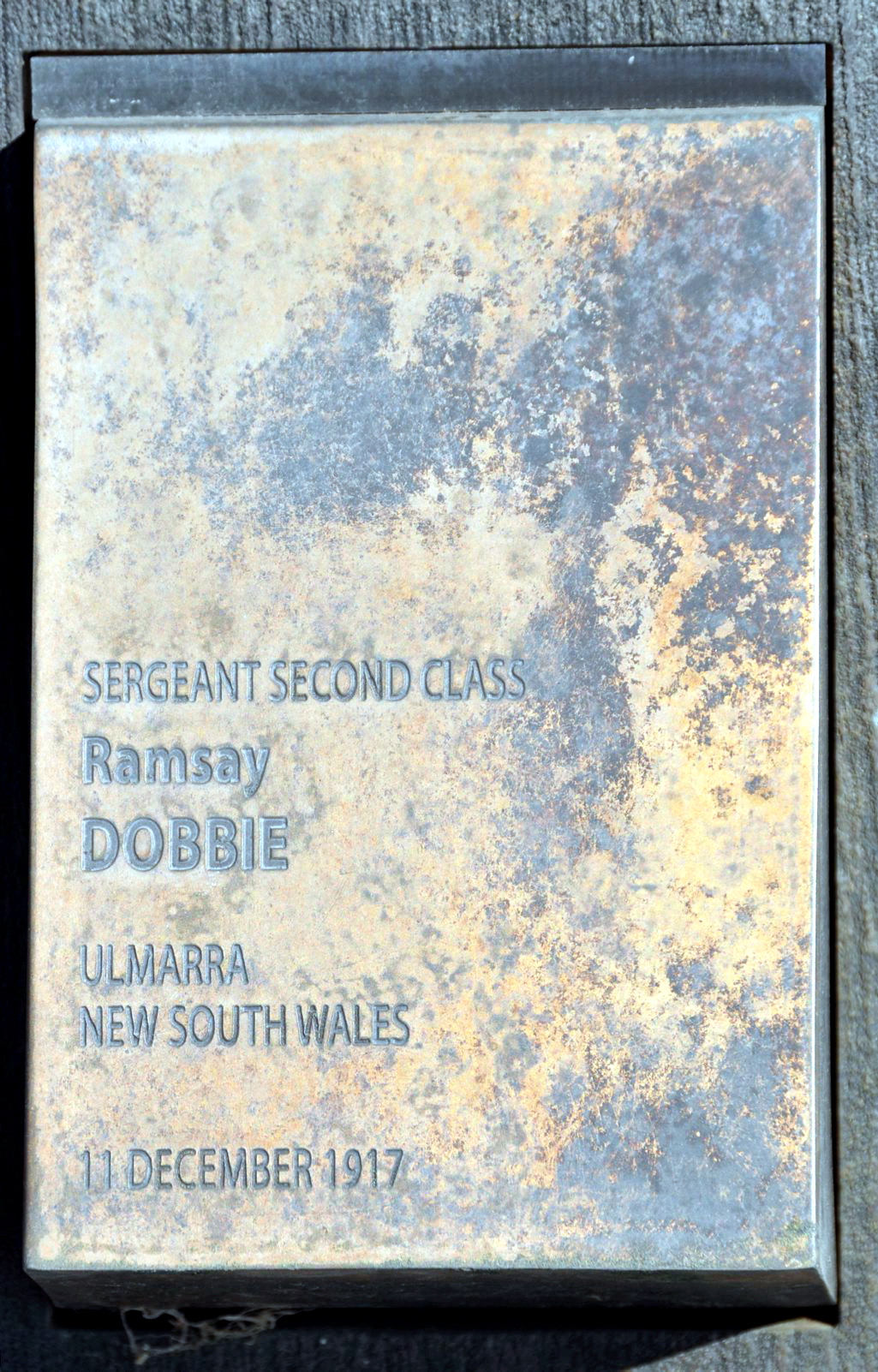
[alert_green]RAMSAY IS mentioned on the Police Wall of Remembrance[/alert_green]
FURTHER INFORMATION IS NEEDED ABOUT THIS PERSON, THEIR LIFE, THEIR CAREER AND THEIR DEATH.
PLEASE SEND PHOTOS AND INFORMATION TO Cal
May they forever Rest In Peace
The sergeant suffered serious internal injuries while trying to apprehend the offender McClennan at Ulmarra. He had been called to a complaint of Unseemly Words (offensive language) in the street at Ulmarra involving an intoxicated male. As the sergeant approached the offender, whom he found sitting in a sulky, the offender whipped the horses into a gallop. The sergeant caught hold of the sulky and climbed aboard, however the offender then jumped clear. As the sulky rounded a corner it collided with a pole, throwing the sergeant to the ground and causing severe internal injuries. He died a short time later.
The Barrier Miner dated 12 December, 1917 reported the following.
At Ulmarra yesterday, Sergeant Ramsay Dobbie was killed. He was endeavouring to arrest a man who had been arguing with some conscriptionists, when the man drove off in a sulky. The sergeant 1880got into the vehicle from the rear. The man jumped out, throwing down the reins. The horse commenced to gallop, and dashed the sulky against a telegraph post with great force. The sergeant was thrown out; several ribs were fractured and his chest crushed. He died in about three hours. Sergeant Dobbie was 47 years of age, and leaves a widow and seven children.
The sergeant was born in 1870 and joined the New South Wales Police Force on 4 February, 1895. At the time of his death he was stationed at Ulmarra.

Attended the service today to mark the Centenary of the on duty death of Sgt Ramsay Dobbie on 11 December 1917, at Ulmarra General Cemetery.
Several descendants of Sgt Dobbie were present and members of the Coffs Clarence Command who organised the service to ensure Sgt Dobbie is appropriately remembered.
The grave site was recently restored, with additional monument stone. Our thanks to John McDiarmid for carrying out this work.
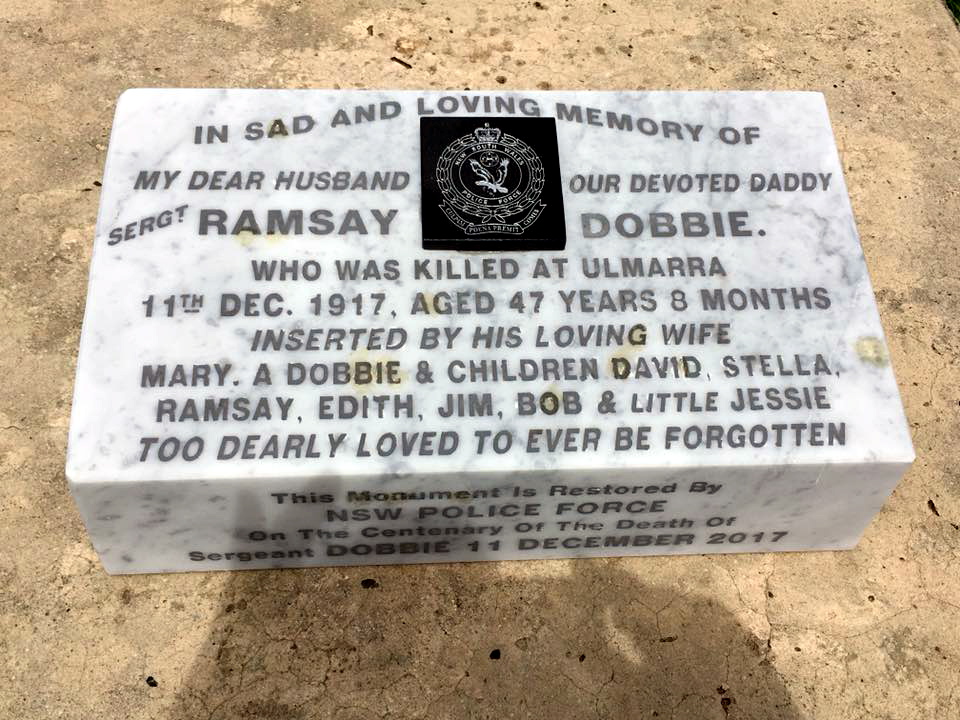
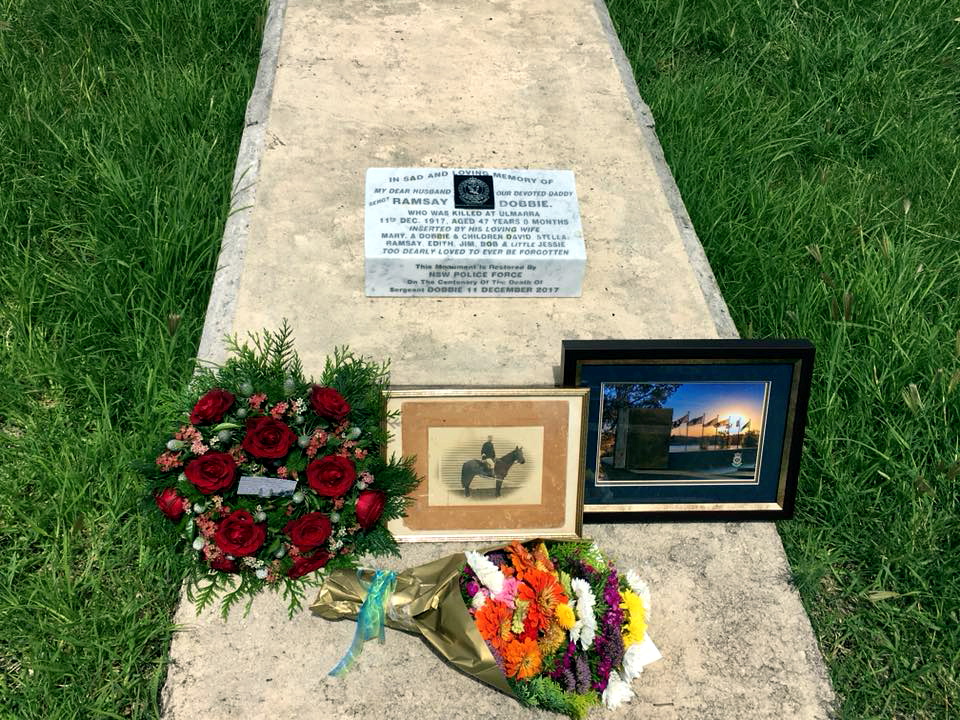
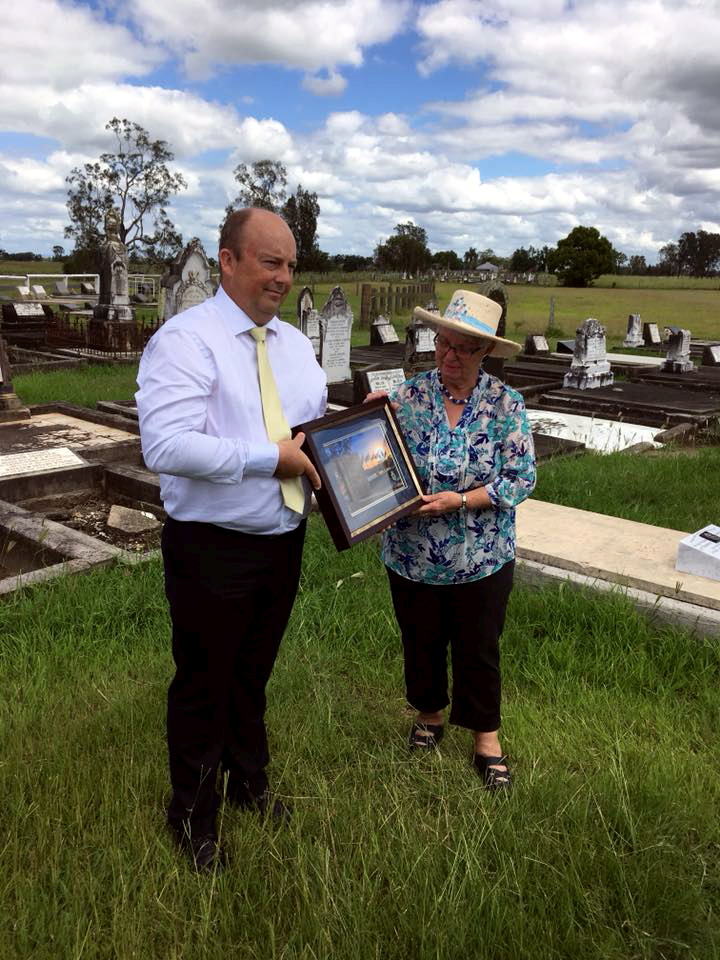
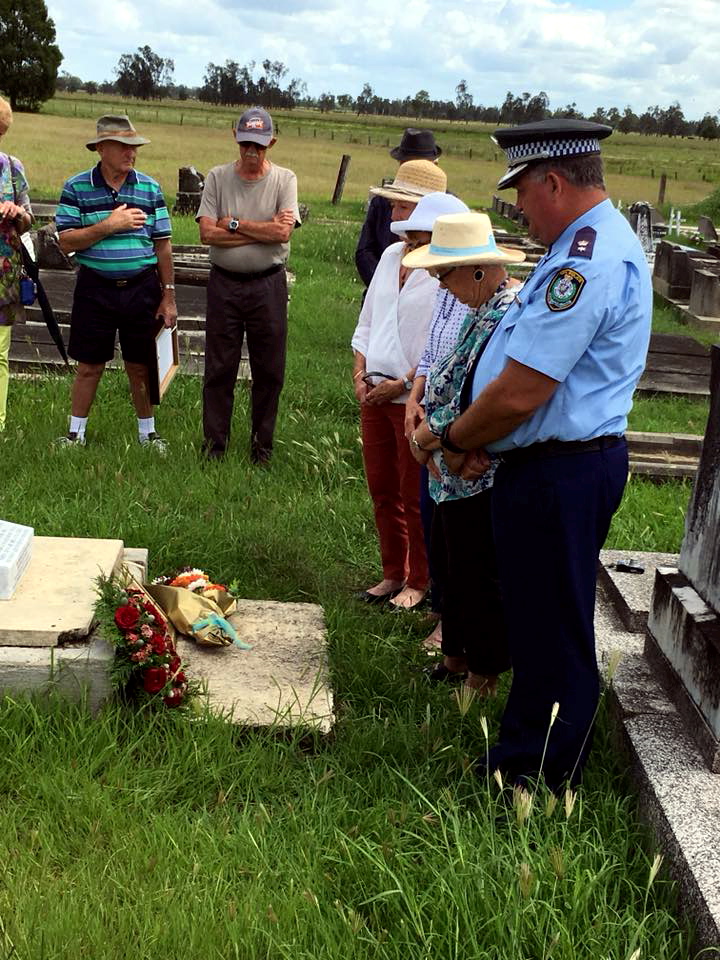
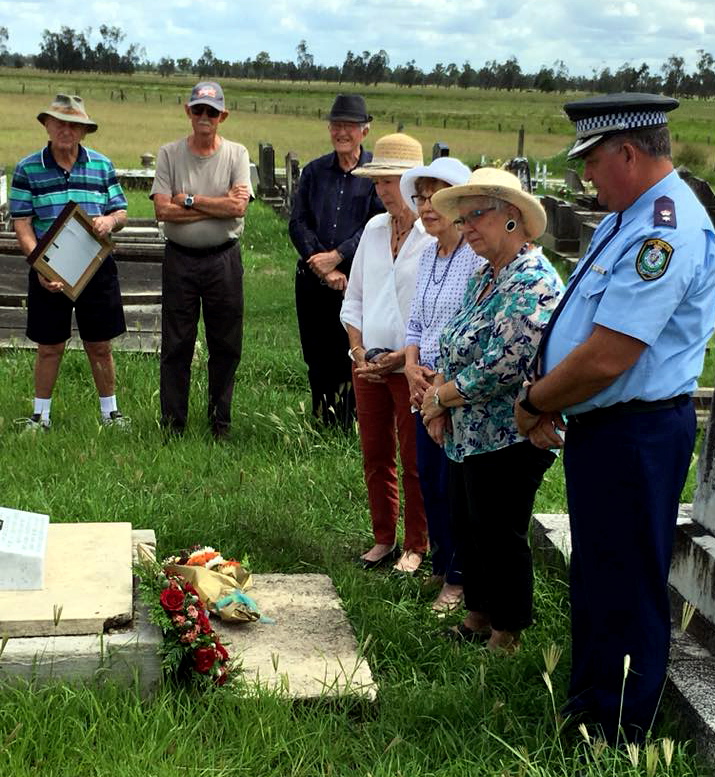
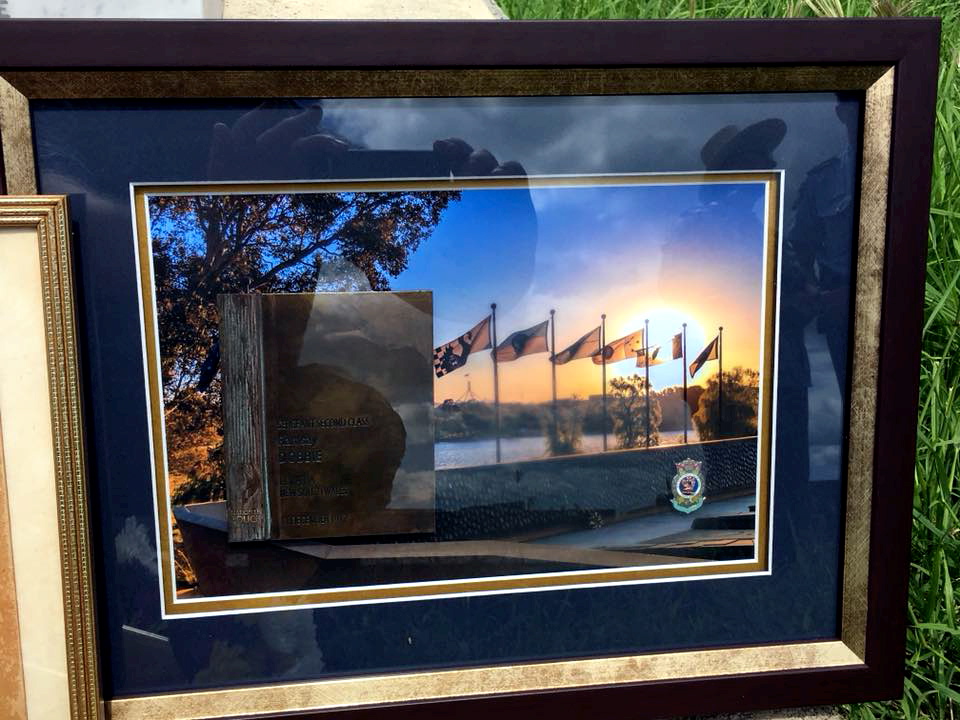
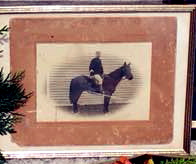
At the time of joined the NSW Police Force, Ramsay was described as:
6′ 1/4″ tall, 11 stone 8 lb, Grey eyes, light brown hair, “fresh” complexion, Native of Victoria, Single at the time of Joining the NSWPF, later married twice, previous calling is hard to decipher but similar to Kai? houseman, Presbyterian, ‘District Sent to’ – South Western.
‘Cause of Leaving Police “Killed in execution of duty”. Date of leaving Police 11.12.1917
Daily Examiner (Grafton, NSW : 1915 – 1954), Wednesday 12 December 1917, page 2
FUNERAL NOTICES.
DOBBIE. — The friends of the late Sergeant Ramsay Dobbie are respectfully invited to attend his funeral, to leave his late residence, Ulmarra, at 3 o ‘clock THIS DAY (Wednesday), for Ulmarra Cemetery.
H. H. SANDERS,
Phones 27 and 68.
Undertakers.
http://trove.nla.gov.au/newspaper/article/195823550
Daily Examiner (Grafton, NSW : 1915 – 1954), Thursday 11 December 1919, page 4
IN MEMORIAM.
DOBBIE.— In sad but loving memory of my dear husband, and our darling devoted daddy, Sergeant Ramsay Dobbie, who was killed in the execution of his duty at Ulmarra, 11th December, 1917, aged 47 years and 9 months.
Too dearly loved, too sadly missed, To ever be forgotten.
Inserted by his loving wife, Mary and children, David, Stella, Ramsay, Edith, Jim, Bob, and Jessie.
http://trove.nla.gov.au/newspaper/article/194701698
Daily Examiner (Grafton, NSW : 1915 – 1954), Wednesday 11 December 1918, page 2
IN MEMORIAM.
DOBBIE. — In sad but loving memory of my dear husband and our darling, devoted daddy, Sergeant Ramsay Dobbie. who was killed in the execution of his duty at Ulmarra, 11th December, 1917, aged 47 years and 9 months, The shock was great, the blow severe, To part with one we loved so dear. ‘Tis sad, but true — we wonder why — The good are always first to die.
Inserted by his loving wife, Mary, and children, David, Stella, Ramsay, Edith Jim, Bob, and Jessie.
http://trove.nla.gov.au/newspaper/article/195553006
NSWBDM – Birth – NO FIND
NSWBDM – Marriage 1 = 2102/1898 Bride = MACKENZIE, Annie Beatrice District = Wilcannia Died 19 March 1899
NSWBDM – Marriage 2 = 1043/1902 Bride = McALPIN, Mary Ann District = Casino
NSWBDM – Death = 17097/1907 Father = James Mother = Janet J District = Ulmarra
Armidale Chronicle (NSW : 1894 – 1929), Saturday 22 December 1917, page 2
Sergt. Dobbie’s Death.
CORONER’S INQUEST
The inquest into the cause of the death of the late Sergeant Ramsay Dobbie was opened at Ulmarra on Tuesday afternoon before the Coroner. Mr. McGuren appeared for William McLennan, who was present in custody.
Sergeant Swan was the first witness. He deposed as follows:— I was present when the Coroner viewed the body of Ramsay Dobbie. a police sergeant. From what I can learn, on the 11th inst. a man. William F. McLennan, now in Court, and his brother, Donald, had some altercation with the Mayor of Ulmarra, Ald. G. W. Fitzgerald. Fitzgerald had complained to the deceased sergeant in reference to the insulting and abusive language of William McLennan. Deceased made an attempt to arrest McLennan for Insulting words or behaviour. Upon the sergeant’s approach McLennan, on being spoken to, put his horse into a fast gallop, upon which the deceased caught hold of the back of the sulky, running along a few paces, still holding the sulky, and attempted to get in the sulky to arrest McLennan.
On turning a sharp curve at the end of River-street the pace was so great the sulky was capsized, the horse being then in a gallop, the sergeant being thrown against a telephone post, and so seriously injured, that he died. I went to McLennan‘s residence, and saw William McLennan I said, “I want you, McLennan.” He said. “Yes, I believe you do. What is the charge?” I replied, “I am going to charge you with causing the death of Sergeant Dobbie.” He said, “I am very sorry. Sergeant: I was drunk, and don’t know what happened.
Mary Dobbie. widow of the deceased, gave formal evidence regarding deceased’s family history. She heard loud talking in the street near the post office, where one man was in a sulky without a hat on, whilst another man was on horseback. She recognised the man now in custody as the person she saw in the sulky. At this time she saw her husband walk over to the sulky, the driver shaking the reins and forcing the horse into a gallop. As the vehicle passed where she was at her home, the sergeant was holding on to the back of the sulky. She came out to the street, and McLennan immediately passed her walking back up the street. Deceased was at first conscious. He said, “Mr. Fitzgerald gave McLennan in charge, and I was going to arrest him, and when he saw me coming and I got alongside of McLennan, he ( McLennan ) drove off. When McLennan saw me getting over on to the seat he threw the reins on the horse and jumped out.” He said no more.
Dr. S. L. Cook gave evidence. It was found that seven ribs on the left side were fractured, the pleura torn, the left lung perforated by the broken ribs. The spleen had also been ruptured. The other organs were healthy and uninjured. Death was due to shock and the injuries mentioned.
C. W. Fitzgerald, .J.P., Mayor of Ulmarra, deposed: On the 11th instant I was at Ulmarra. I saw William McLennan that afternoon as I rode into Coldstream at about 5 p.m. He was in front of O’Brien’s hotel, in company with his brother Donald, and Chas. Lee, and Thos. Mawhinney.
As I turned into the street I heard William McLennan talking excitedly, but could not hear what he was saying. When I got within 100 yards I heard McLennan say, “I’ll talk to the Puddicombes ; I’m Irish and I don’t give a **** for them.” I then heard him say, “Who is this Fitzgerald? I will talk to him.” I then went on to the public wharf, being on horseback at the time. I could then hear Mr. Lee trying to quieten McLennan. I almost got past the group where McLennan was when the latter said, “Oh ! I want to have a talk to you.” I rode on, making no reply. McLennan said, “I’m a Catholic and not-a ****** turncoat like you.” I turned round and said, “Now, you be very careful, young man, or you’ll get yourself into trouble.” I rode on, Donald McLennan saying “I’ll fight you, you ****. ” He then said, “I’ll throw you into the —— river.” I then continued on to the wharf, where I remained a few minutes. Returning up the street, Donald McLennan was in front of Spring’s Hotel, and William some 75 yards further away.
I came down towards the post office, where I spoke to C. Goode and E. Cameron. After speaking for a few minutes, Sergeant Dobbie joined us. I said to Dobbie that he should be down the town, where the McLennans had possession, and were using Insulting and obscene language. In reply to his question, I said Donald and William McLennan were there. He asked if I was sure Donald was in town and I replied that I was certain, because he had been challenging me. Later, Mr. Cameron said, “There’s Donald crossing the road now.” The sergeant later came into the post office. A few minutes later William McLennan again drove up and exclaimed excitedly, ” I want to have a word with you” ( the witness ), I replied, “No, you don’t, Billy, I won’t talk to you;” McLennan said, ” You’ll have to talk to me.” I again said I would have nothing to say to him. He jumped up in the sulky and said I was not ***** well game to talk to him. I said, “Go about your business. ” He said I was trying to send him away to the war, but was not game to go myself.
Sergeant Dobbie then came out of the post office and endeavoured to catch hold of McLennan‘s horse. McLennan, on seeing the sergeant close to the horse, sat down in the sulky and hit the horse with the reins and started off down past the police station. Dobbie caught the back of the sulky with his right hand and then with both hands. McLennan looked back and, seeing the sergeant hanging on to the sulky, furiously flogged the horse with both reins. After going a little over a chain the sergeant placed both feet on the back springs. The pace of the horse still quickened as they approached the corner, until the horse was in a furious gallop. When within a few yards of the corner Dobbie sprang into the sulky which then turned the corner and was lost to sight. I then heard a crash, immediately before which I started to move. I was about 150 yards from the corner.
To the Coroner: McLennan was either in a great rage or drunk.
Witness, continuing, said he passed McLennan coming back, on foot. He ( McLennan ) then said: ” He’s done through you ; my horse is gone ; go up that way and you’ll get him.” I hurried on and saw Sergeant Dobbie lying on the ground against a telegraph post on the left side, of the road. I jumped off my horse and saw Dobbie appeared badly injured. A number of people were around him.
Percy O. Jones deposed: I know William McLennan and saw him at Betallick’s store about 4.30 or 5 p.m. on the 11th instant. McLennan came in and said, ” I want a hat, I’ve done mine. I’ve left the big fellow asleep round the corner. ” He then bought a hat. He was under the influence of drink.
To the Coroner: I previously heard of the accident and took it that the words “big fellow” referred to the deceased sergeant.
The Court, at 7 p.m., was adjourned until 10 a.m. on Wednesday, at Grafton.
http://trove.nla.gov.au/newspaper/article/19189071
Daily Examiner (Grafton, NSW : 1915 – 1954), Thursday 20 December 1917, page 6
LATE SERGEANT DOBBIE.
ADJOURNED CORONER’S INQUEST. ENDS IN A COMMITTAL.
An inquiry into the circumstances surrounding the death of the late Sergeant Ramsay Dobbie, which was adjourned from Ulmarra on the previous day, was re-opened at the Grafton Coroner’s Court yesterday morning before Mr. J. L. Shropshire, Coroner.
Sergeant Swan conducted proceedings on behalf of the police, while Mr. F. McGuren (McGuren and Pollack) appeared for William Freeman McLennan, who was present in custody.
Dr. T. J. Henry, Government Medical Officer, stated that on the 11 th inst., about 5.45 p.m. he received a telephone call from Dr. Cook at Ulmarra, asking him to go down and see Sergeant Dobbie. Witness arrived at the residence at 6.45, and saw the sergeant lying on a bed in the front room, with Dr. Cook in attendance.
Witness said to Sergeant Dobbie: “What has happened to you?” and he replied: “I was thrown from a sulky.” Witness was unable to obtain any further statement, as it obviously gave him great pain to breathe, and he was suffering from the effects of shock to such an extent that he could only speak a few words at intervals, although he was perfectly conscious.
Pointing to his left side, he said: “All the trouble is there.” Witness placed his hand on the left side of deceased’s chest, and found that several ribs were fractured, and there was a crack in the tissue, showing that the lung had been pierced and air had escaped into the tissues. There were no marks of violence visible, with the exception of bruising about the waist.
Dr. Cook and witness administered several drugs to stimulate the heart and ease the pain. The dressings usually used in cases of broken ribs were then applied. Deceased rallied after about an hour, and witness then went for tea.
In answer to a call witness returned with Dr. Cook, and Sergeant Dobbie complained of suffocation and that the bandage was too tight. Witness diagnosed this as internal haemorrhage. The bandage was released in the hope that some relief might be given. Deceased rapidly became weaker, and died about 8.15. Deceased was conscious till, about five minutes of the end.
Next morning with Dr. Cook witness conducted a post-mortem examination at the Ulmarra Court-house. The left lung was lacerated in several places, and witness found that the lacerations corresponded with fractures of seven ribs.- Witness came to the conclusion that death was due to the injuries to the lung and spleen. The injuries were consistent with the deceased’s statement that he had been thrown from a sulky.
Witness was told by an eye witness that deceased had struck the telegraph post with his left side, and seemed to double round it.
By Mr. McGuren: I made an examination of William McLennan on Friday, 14th inst., at the Grafton Gaol. I found that he had a small abrasion on the back of the left ear. The skin had been torn, and the abrasion was about the size of a sixpence. He also had two bruises on the left hip, and requested me to look at his mouth. I did so, and found indication of a tooth having been drawn from the upper jaw on the left side. He also showed me his trousers, and on the outside of the left leg were some greenish marks, such as might be made by contact with grass. The marks are consistent with a fall from a vehicle.
To Sergeant Swan: These marks and bruises could be caused by anyone falling about under the influence of liquor.
To the Bench: In my opinion deceased was mentally capable of making a statement to within five minutes of his death, He was so lethargic from the shock that unless spoken to he rarely made any remark, and it was obviously impossible to interrogate him.
Henry Moran, a carrier, residing at Ulmarra. said that he knew the deceased, and William McLennan. On the 11th inst., a little after five o’clock, witness saw a sulky with a horse attached going down Coldstream-street without a driver. The sulky had turned right over and was being dragged along wheels upwards. Witness caught the horse and stopped him. The horse was then taken out of the shafts and the sulky righted. The horse was then put back in.
Donald McLennan came along shortly afterwards, followed by William McLennan. The latter said, ” My sulky is broken, and I can blame ‘ Fitz ‘ for that. ” Witness understood him to mean Mr. Fitzgerald, the Mayor of Ulmarra. Witness advised William McLennan not to drive but to give the reins to ” Donny. ” . They both got in and drove away. William McLennan appeared to be excited, and under the influence of drink. When the horse was pulled up the reins were found entangled in the lamp on the driving side of the sulky.
By Mr. McGuren: The reins were pulled tight, and the horse was going very steady, The horse appears to be a very flighty animal.
Sergeant Swan, again in the box, gave evidence to the effect that from inquiries made he elicited the information that when at the post office on the day in question, Sergeant Dobbie was in uniform.
By Mr. McGuren: I have known William McLennan for seven or eight years. I have always found him steady and a hard worker, and have never seen him under the influence of liquor. I give him a good character.
The police intimated that this was all the evidence they had to put forward.
THE FINDING.
The Coroner found that Ramsay Dobbie, then a sergeant of police in the New South Wales force at River-street, Ulmarra, in the Grafton Police District, in the State or New South Wales, on the 11 th day of December, 1917, died from injuries received on the same day through being thrown from a sulky attached to a horse then and there being negligently and recklessly driven along the aforesaid River-street, Ulmarra, by William Freeman McLennan, and he further found that in the manner aforesaid the said William Freeman McLennan did feloniously slay the said Ramsay Dobbie while in the execution of his duty as police officer as aforesaid.
The Coroner then proceeded to read out the committal in terms of which the case would be heard in Sydney.
Mr. McGuren objected, and stated that accused was a poor man, and would be at a big disadvantage in regard to his witnesses.
The Coroner said that he was looking at the matter from the view of expedition.
If, as Mr. McGuren had suggested, the case was committed to the next sessions at Grafton, the accused would have to wait until 9th April. ‘ Sergeant Swan said that one of his witnesses was on the point of leaving the district and would be unable to wait for the sessions.
Mr. McGuren intimated his willingness to allow the witnesses’ depositions to be put in at the trial.
Sergeant Swan: If the case is committed to the Grafton sessions the authorities will take the same action as they did in the last case.
Mr. McGuren: That was altogether different. The accused was unable to get bail.
The Coroner ( to Mr. McGuren ): Suppose it is sent to Sydney, then you can make representations to the Attorney-General.
Mr. McGuren: I would prefer it to be the other way.
The Coroner ( to Sergeant Swan ): You can make application to the Inspector-General of Police to have the case taken to Sydney. Accused was committed to the next Grafton Quarter Sessions, to be held on April 9, 1918.
Bail was allowed, self in £200, and two sureties of £100 each, or one in £200.
The sureties were forth coming.
http://trove.nla.gov.au/newspaper/article/195823704
Daily Mail (Brisbane, Qld. : 1903 – 1926), Thursday 11 April 1918, page 3
Grafton tragedy.
Accused acquitted.
GRAFTON, Wednesday.— At the quarter session to-day, William Freeman McLennan was charged with feloniously slaying Ramsay Dobbie, a sergeant of police, at Ulmarra, on December 11.
Accused was acquitted.
Warwick Examiner and Times ( Qld ) Saturday 15 December 1917 page 6 of 8
Police Sergeant Killed Near Grafton.
An unfortunate tragedy occurred at Ulmarra on Tuesday afternoon, by which Sergt. Ramsie Dobbie lost his life. It is alleged that an individual was using strong language towards the conscriptionists, and information was sent to the Sergeant, who attempted to arrest the offender, but the latter got into a Sulky and drove off. The Sergeant endeavoured to climb into the back of the vehicle, and eventually did so. The offender then jumped out, throwing the reins on the horses back. The animal went off at a gallop and dashed against a telephone post with terrific force. Sergeant Dobbie was thrown out, sustaining several fractured ribs and injuries to his chest, and he succumbed three hours after. He leaves a widow and seven children. The eldest is only 13. He was a very popular officer, and had been only a few months at Ulmarra, having come from Coff’s Harbour, and formerly from Hill Grove. He was 47 years of age.
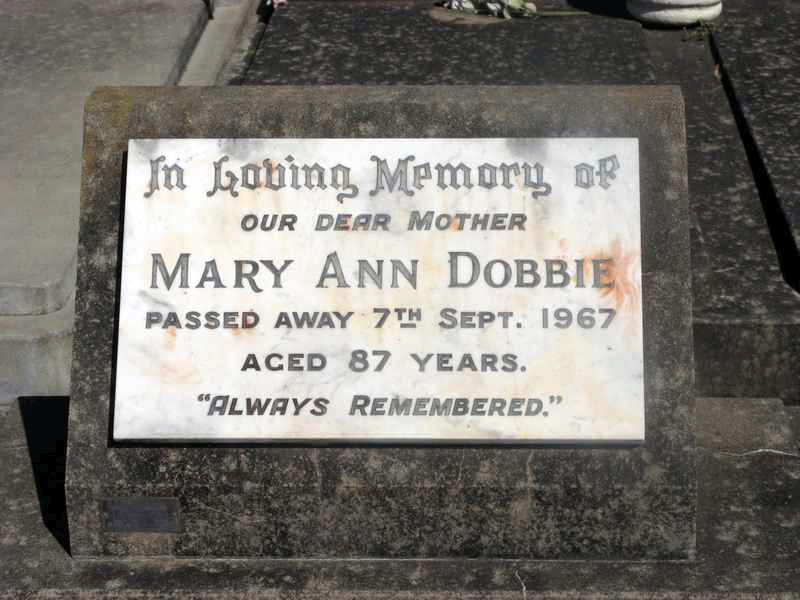
Mary Ann DOBBIE ( nee McALPIN ) – Wife to Ramsay, passed away 7 September 1967 – aged 87 years. Buried at Grafton General cemetery, Villiers St, Grafton.
Ramsay Vickers DOBBIE – son to Mary & Ramsay. Storeman – late of Alice St, Turramurra. Died 21 February 1953 Buried at Grafton General cemetery, Villiers St, Grafton.
Stella DOBBIE – daughter to Mary & Ramsay. Died 1961 – aged 58 years. Buried at Grafton General cemetery, Villiers St, Grafton.
WEDDING: At St. Andrew’s Presbyterian Church on Saturday, November 4, 1939, Jessie Mary, youngest daughter of the late Sergt. Ramsay Dobbie and of Mrs. M. Dobbie, 48 Clarence St, Grafton, to Percy Samuel, youngest son of Mr. and Mrs. Samuel.
http://trove.nla.gov.au/newspaper/article/191660470
Richmond River Express and Casino Kyogle Advertiser (NSW : 1904 – 1929), Friday 14 December 1917, page 4
AN ULMARRA FATALITY.
An unfortunate tragedy, resulting in the death of Sergeant Ramsay Dobbie, occurred at Ulmarra on Tuesday afternoon. It seems that a man named W. McLennan, a resident of the Coldstream, aged about 30, who was said to be more or less under the influence of liquor, had during the afternoon been waging wordy combat on certain conscription advocates. About 5 p.m. he appeared in front of the post office in a sulky and again verbally attacked some well known residents standing there. His language was very lurid and Sergt. Dobbie hearing it, hurried out of the Police Station near by. As soon as he saw the sergeant approaching him, McLennan whipped his horse and drove off, but the sergeant, after calling on McLennan to stop, caught hold of the sulky and commenced to climb in as it was careering down the road. It is said that McLennan then jumped from the sulky, and before he could get possession of the reins and pull up the horse Dobbie was dashed against a telegraph post as the vehicle swung round the corner in the narrow roadway. Quite a number of horrified residents witnessed the whole affair and medical assistance was speedily forthcoming, but the sergeant, whose left side was frightfully smashed,, died about three hours later.
Deceased, who was a most efficient and popular official, had only been stationed at Ulmarra for a few months, having been transferred there from Coff’s Harbor. He was 47 yours of age and leaves a wife and seven children ( ranging from 15 years down to a few months old ), for whom the deepest sympathy is expressed, McLennan was arrested at his home at Lower Coldstream on Wednesday, and on the same day was brought before the Ulmarra Police Court. Sergeant Swan gave evidence that he visited defendant’s residence, and with Constables Walklate and Warburton, arrested accused. McLennan replied : ” I am very sorry, Sergeant, I was drunk at the time and do not know what happened.” He then brought McLennan to Ulmarra, McLennan was then charged with, that on the 11th December at Ulmarra he caused the death of Sergeant Ramsay Dobbie. Accused applied for bail. Sergeant Swan said he would strenuously oppose the application. A man had been killed, and it was his duty, in the circumstances, to object to bail, The bench refused the application, and accused was then remanded to the Ulmarra Police Court on Tuesday next.
http://trove.nla.gov.au/newspaper/article/121281342
Barrier Miner (Broken Hill, NSW : 1888 – 1954), Monday 19 March 1900, page 2
IN MEMORIAM.
DOBBIE. – In loving memory of my dear wife, Annie Beatrice Dobbie, who died March 19, 1899 ; also my dear little daughter, Beatrice Irene, who died March 28, 1899.
As the ivy clings to the oak, My memory clings to thee.
Inserted by her loving husband and father, Ramsay Dobbie.
http://trove.nla.gov.au/newspaper/article/44252826
Thomas SMITH
Thomas SMITH
Senior Constable
Horse Accident
Euston
19 April, 1910
On the 18 April, 1910 the mounted constable made a patrol to the police paddock, and while he was returning his troop horse began to buck. The horse then bolted and Senior Constable Smith was thrown violently against a tree, sustaining severe internal injuries. Knowing he would not be found before it became dark, he began to walk towards town. When he had travelled a short distance he was found by some men who helped him into Euston in a barrow. A doctor arrived from Balranald that night and after examining the injured man made arrangements to have him taken to hospital. Unfortunately the vehicle conveying the injured constable to hospital broke down and he passed away.
The Register newspaper of 25 April, 1910 reported that ” Regret is expressed at Wentworth ” at the sudden death of Senior Constable Smith, officer in charge of the police at Euston, 80 miles from Wentworth. The constable, it appears was thrown from his horse, which had stumbled and rolled on his chest. At first his symptoms were not considered serious but as the day advanced and while the constable was being driven to Balranald for medical treatment, he expired. He has left a widow and six children. The late constable was highly esteemed in the district, and was a general favourite.
The senior constable was born in 1871 and joined the New South Wales Police Force on 11 February, 1897. At the time of his death he was stationed at Euston.
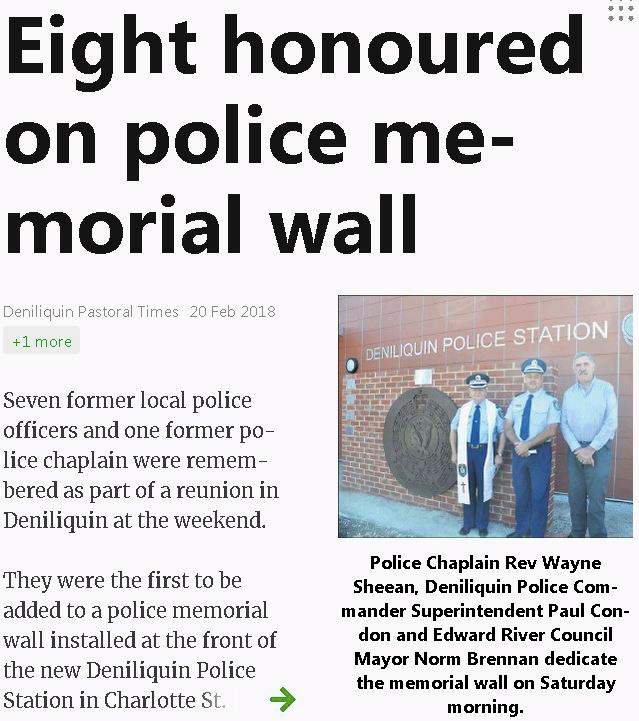
2/1/2019, Deniliquin Times.
Eight honoured on police memorial wall’ –
Rev David Bond.
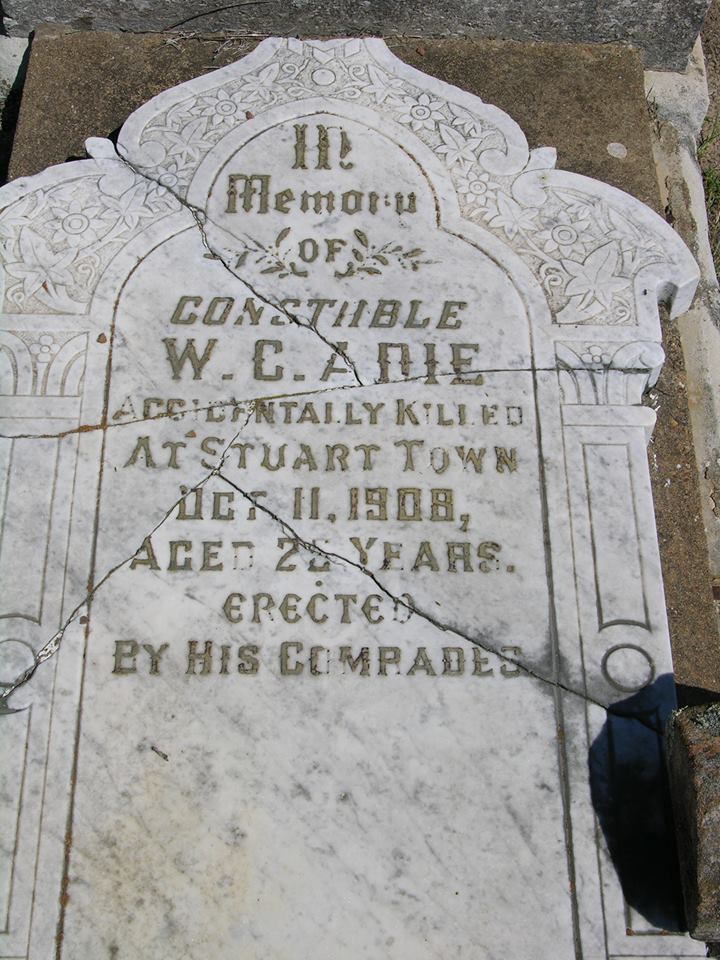
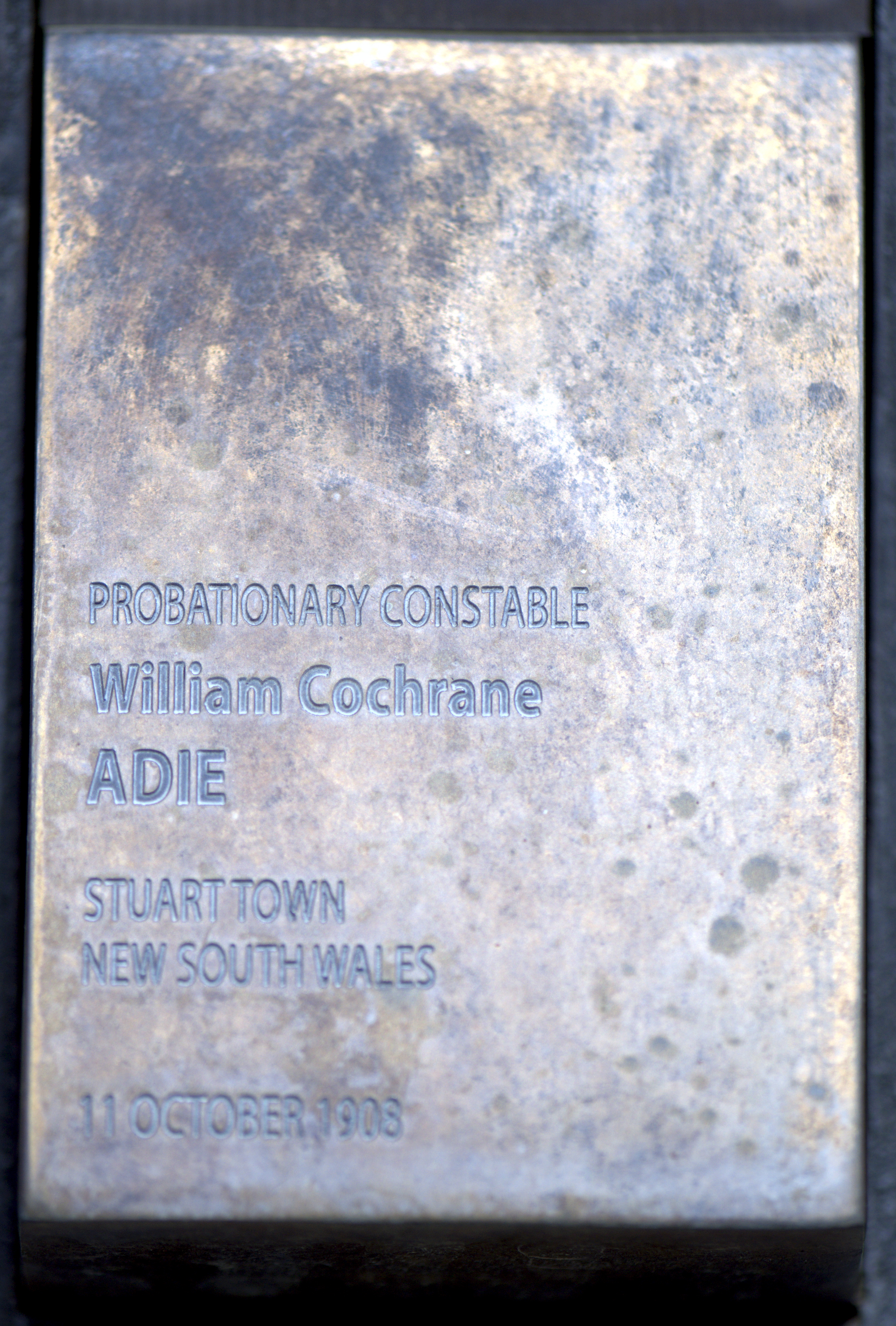
William Cochrane ADIE
William Cochrane ADIE
New South Wales Police Force
Regd. # ?
Rank: Probationary Constable – Mounted Constable
Stations: ?, Stuart Town
Service: From 17 December, 1907 to 11 October 1908 = 9+ months Service
Awards: ?
Born: ? ? 1883
Event date: Saturday 10 October 1908
Died on: Sunday 11 October 1908
Cause: Horse accident
Event location: Stuart Town, NSW
Age: 25
Funeral date: Monday afternoon 12 October 1908
Funeral location: ?
Buried at: Stuart Town Cemetery, Wallaroi Rd,
Protestant section ‘ A ‘
[alert_green]William IS mentioned on the Police Wall of Remembrance[/alert_green]
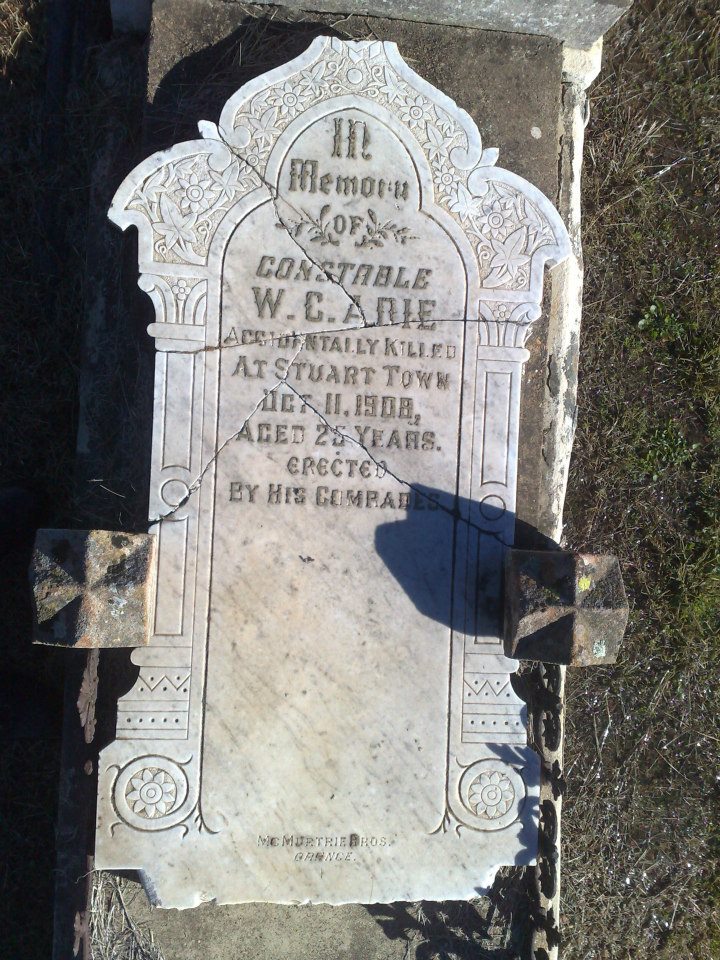
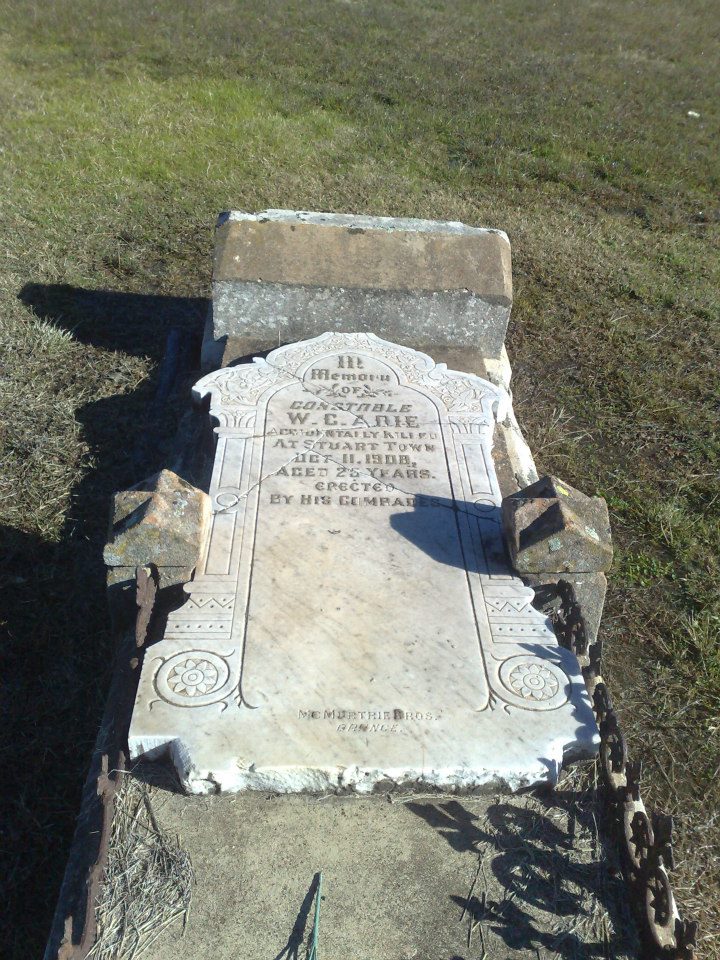
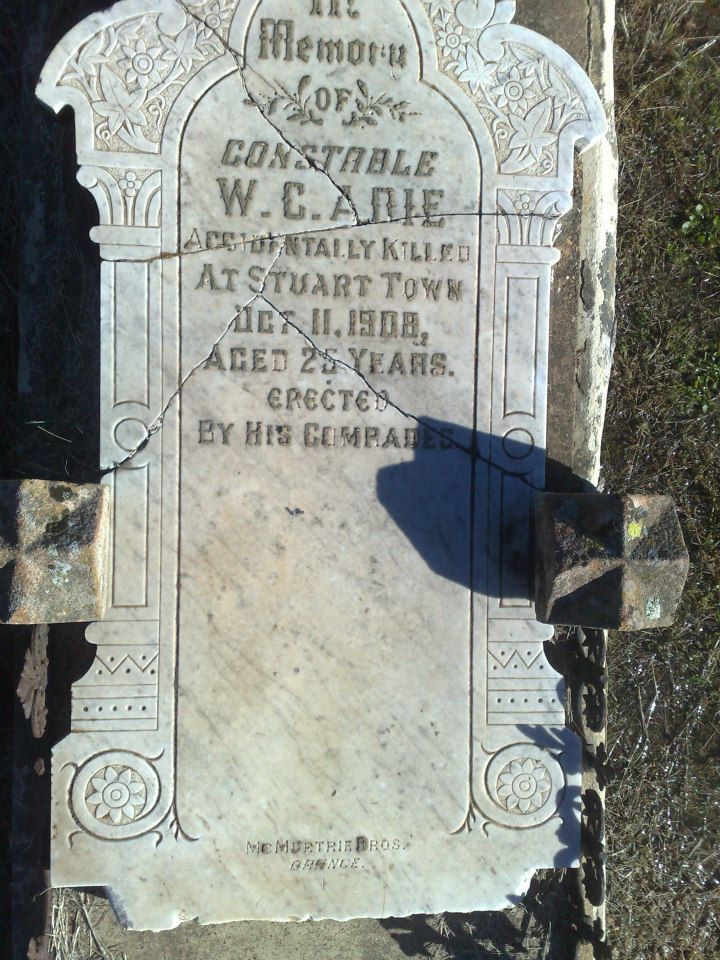
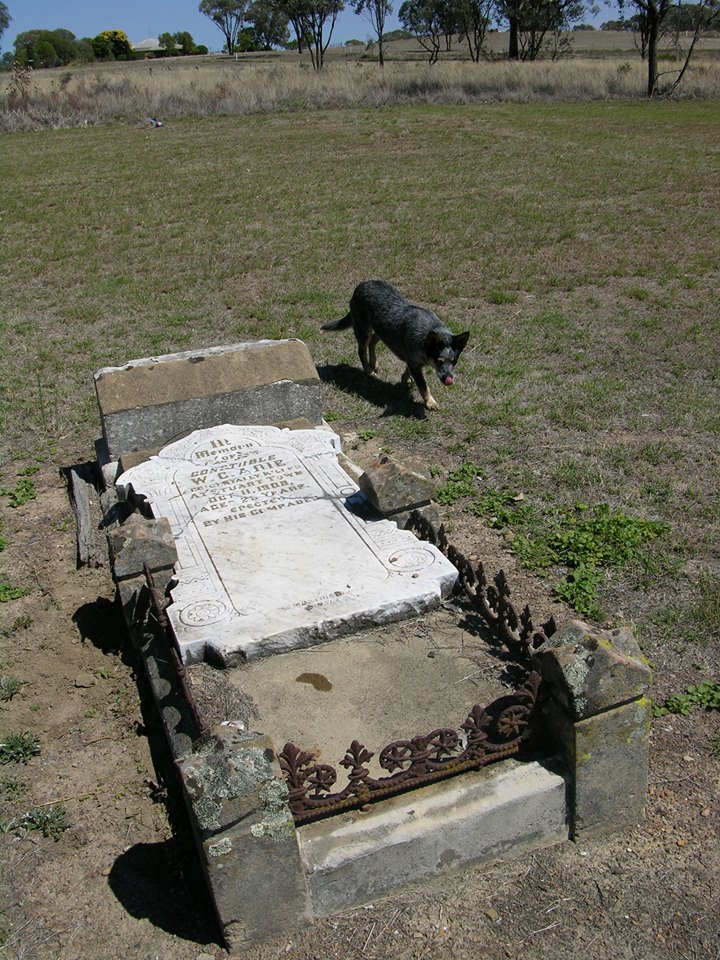
On Saturday 10 October, 1908 Mounted Constable Adie set out on a patrol of the town and surrounds. By the following day he had not returned as expected and Senior Constable McConville set out to find him. After being informed that an unattended troop horse had been seen in the bush Senior Constable McConville investigated and found the unfortunate Constable Adie seriously injured. It appeared that the young constable had been thrown from his horse the previous day and had lain seriously injured throughout the night. He died while being taken back to Stuart Town for medical attention. The constable’s horse was described in the Melbourne Argus of 14 October, 1908 as being “a particularly savage animal”.
In addition to this, the Sydney Morning Herald of 26 October, 1908 reported the following.
DANGEROUS POLICE HORSES – A SERIOUS ALLEGATION.
WELLINGTON, Saturday – The recent death of Constable Adie, of Stuart Town, who was killed by being thrown from his horse, is causing considerable discussion in the district in regard to the dangerous character of some of the horses supplied to police officers. The animal which killed Constable Adie is well known for its vicious propensities. It nearly killed Constable Cameron when he was at Stuart Town, and last Christmas it threw Senior Constable McConville’s brother, and nearly killed him. There are several other police horses in the district which the constables only ride at the risk of their lives, and every time they go out into lonely bush tracks they are exposed to the terrible fate of the late Constable Adie, who was not found until the day after he had been thrown and seriously injured.
The constable was born in 1883 and joined the New South Wales Police Force on 17 December, 1907. At the time of his death he was stationed at Stuart Town.
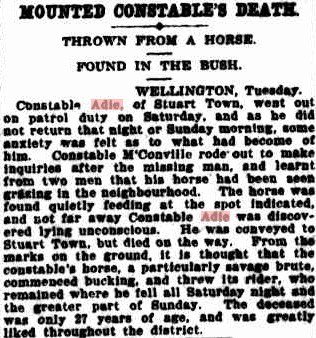
Wagga Wagga Express Thu. 15 Oct. 1908 p4 of 4
Constable Adie, of Stuart Town, was thrown from his horse on Saturday last, and died on Sunday afternoon. He went out on Saturday morning and did not return. Two men saw his horse saddled and bridled on Saturday morning grazing in the bush, but no notice was taken of the matter.
On Sunday morning Constable McConville found Adie lying in a creek unconscious. He died 20 minutes later, without medical aid.
Deceased was 27 years of age, unmarried, and had been for 12 months in the force.
http://trove.nla.gov.au/ndp/del/article/145407114
Wellington Times ( NSW ) Thu. 15 Oct. 1908 p4 of 8
IS IT MANSLAUGHTER ?
The terrible accident which resulted in the death of Constable Adie at Stuart Town, directs attention to a matter that requires the serious attention of the police authorities. The animal which the unfortunate constable was riding when he met his death was well known in the district as being a dangerous one for any man to ride, and it has been rather good luck than other wise that it has not been responsible for a fatality long ago. This is not the only case in the district in which constables are compelled to ride horses that are a constant source of danger to them, and when a man is killed in consequence, are not those responsible for supplying such horses morally guilty of his death ?
Of course the men who have these horses do not care to object, for the reason that it would look as if they lacked courage, and prejudice them in the eyes of their officers, but surely there should be some care taken to see that a horse is fit to ride before it is handed to a constable.
The mounted men in the police force have to make many journeys on lonely tracks, and if they meet with an accident days may elapse before they are found. Under these circumstances it is only reasonable to expect that they would be supplied with reliable horses and not with outlaws that it would take the skill of an expert rider like Billy Waite to handle. To virtually compel a constable to ride a horse about the bush that is a menace to his life, is positively criminal, and the untimely death of Constable Adie should lead to an alteration in the system which, in his case, has had such a deplorable result.
http://trove.nla.gov.au/ndp/del/article/141594443
Wellington Times ( NSW ) Thu. 15 Oct. 1908 p4 of 8
CONSTABLE ADIE’S DEATH.
THE INQUEST.
The death of Constable Adie, who was killed by being thrown from his horse, was the subject of an inquiry held by the Coroner ( Mr. R. Read ) at Stuart Town on Monday. Senior-Constable McConville gave evidence that at about 10 a.m. on Saturday last the deceased left the police station on bush patrol. He was instructed to patrol the Mookerawa as far as the Enterprise dredge, and return that evening or the following morning.
On Sunday morning, as the constable had not returned, he went out and met a man named Patrick Quiley, who, in reply to questions, stated that he had not seen Constable Adie anywhere, and that the constable did not stay at Marning’s the previous night. Questioned further Quiley stated that he had heard that the constable’s horse was seen near Hop Wah’s place on Saturday evening feeding, with a saddle and bridle on. Witness then went to the Mookerawa and saw William Cohen, who said that he had not seen Constable Adie, but that the children had seen his horse feeding near Hop Wah‘s. He asked Cohen to try and find the constable, and then rode on to Hop Wah‘s, where he found the horse feeding with the saddle and bridle on. The bridle was tied to the breastplate. He carefully examined the saddle and found a spur mark from the near right side right across the seat. From the mark on the saddle his opinion was that the constable had fallen from the off side. He secured the horse and started to make a search by the river.
When returning with several others, who were assisting in the search, he met Harry Boehme, who told him that Constable Adie had been found in the Mookerawa Creek. He hurried to the spot and saw the constable, who was alive but unconscious, and was breathing heavily. There was a piece of skin off the right temple, and the skull appeared to be dented in.
When he saw the constable the latter had been moved about 15yds from where he was found. Witness carefully examined the place where the constable was picked up for bloodstains, but could find none.
The deceased wore elastic side boots, and there was no chance of his being hung up in the stirrup. The spur was still on, but the other one was missing.
From the horse’s tracks he thought that something had startled the animal causing him to buck. The horse was a dangerous one and would always buck if anything went wrong. Otherwise he was quiet enough.
Deceased was not a good horseman, but he was a careful, steady rider. The creek was dry where the constable was found, and his head apparently struck a stone where he fell. A stone that was sticking out looked as if it had been shifted.
A man named Edwards told him that he had tied the bridle to the breastplate on Sunday morning, as he saw the horse feeding with the bridle trailing on the ground.
William Cohen, miner, residing at Mookerawa, deposed to finding the constable about two or three yards from the track, which was considered a short cut.
John Marning, grazier, gave evidence that at about 4 o’clock on Saturday afternoon he was mustering cattle about a quarter of a mile from his place when he met Constable Adie. They rode along together for about a mile and a half, and on parting shook hands.
They parted about 5½ miles from Stuart Town. Deceased’s horse was then going quietly. He did not see deceased again until called upon to drive him to Stuart Town the following day.
The Coroner found that death was caused by injuries accidentally received in a fall from a horse.
http://trove.nla.gov.au/ndp/del/article/141594487
Wellington Times ( NSW ) Thu. 15 Oct. 1908 p5 of 8
( From a Correspondent. )
The funeral of the late Constable Adie, whose death was reported last issue, took place on Monday afternoon. A great number of people from both town and district attended the funeral, which was a long one considering that Mr. Adie has only been in our midst for a short time. It is believed that he had not a relative in the State.
http://trove.nla.gov.au/ndp/del/article/141594488
Wellington Times ( NSW ) Thu. 15 Oct. 1908 p5 of 8
He was conveyed into town, but expired shortly after. The funeral took place on Monday. An inquest was held on Monday before Mr. Robt. Read, coroner, when a verdict of accidentally killed through falling from his horse was returned.http://trove.nla.gov.au/ndp/del/article/141594489
Wellington Times ( NSW ) Mon. 19 Oct. 1908 p3 of 4
I will make reference to the horse that was the cause of Constable Adie’s death, in Thursday’s issue of the Times.
A special memorial is to be preached to-night (Sunday) in the Church of England by Mr. Champion in memory of Constable Adie, who was killed last week, by being thrown from his horse.
http://trove.nla.gov.au/ndp/del/article/141600341
Wellington Times ( NSW ) Thu. 22 Oct. 1908 p3 of 8
We were all deeply grieved when we heard of poor Constable Adie’s death. He was a very promising young officer, and the general feeling here was one of deepest regret. Some very just strictures were passed anent the inquest. Why was no doctor present ? When one doctor could not be obtained, why was not another sent for ? No medical man saw Constable Adie after he started out on his last ride. Everything points to the manner of his death, but a man discharging his duties as he did makes enemies. Where a policeman meets his death like that, the most searching inquiry should be ordered. Then all in the district knew what kind of a horse he rode, and it was almost criminal to require him to use it. Your remarks on the same matter last week were just, and to the point.
http://trove.nla.gov.au/ndp/del/article/141603267
Wellington Times ( NSW ) Thu. 22 Oct. 1908 p5 of 8
As I said, I will refer to the horse that killed Constable Adie in this issue of the Times. I have known the horse, also Constable McConville’s, which were purchased for police mounts at the same time from Katella. Both were colts at the time, and very wild and vicious at that.
They had to be taken to Orange or Wellington to be shod, the local shoeing smiths could not manage them until they were shod several times. When the police had occasion to use them after a few days spell, they could be seen racing them around the paddock for some time with saddles and bridles on, but whether it was to put life into them or take it out of them, I am not sure ; but I think it was the latter.
Constable McConville is a very good horseman, otherwise perhaps he would have met with an accident ere this.
During Constable Cameron’s sojourn here he got a spill from the horse which accounted for Constable Adie’s death, and which very nearly sent him to glory.
Then, during last Christmas holidays Constable McConville’s brother, who was on a visit, got a spill from the same horse, which also could have had a fatal ending, as he was rendered unconscious for some time.
So you can see that he can buck when he likes, and it is only a first class rider that should have the handling of such a brute. It is not the class of horse fit for a new-chum trooper — such as was poor Adie — to ride. It is only a pastime for this horse to buck, and seems an easy matter for it to get rid of its burden at will.
It is hoped that the next man sent to fill the gap made by such a brute is able to take out of this horse what the other troopers could not.
http://trove.nla.gov.au/ndp/del/article/141603256
Mudgee Guardian & North-Western Representative ( NSW ) Thu. 29 Oct. 1908 p 26 of 28
A special memorial service was preached in the Stuart Town Church of England, in memory of Constable Adie, who was killed by being thrown from a horse.
http://trove.nla.gov.au/ndp/del/article/157670013
Wellington Times ( NSW ) Thu. 3 Dec. 1908 p5 of 8
WILLIAM COCHRANE ADIE, late of Stuart Town, Constable of Police, deceased.
All persons having claims against the above estate are requested to forward the same, verified by affidavit, to the undersigned, on or before the thirty-first day of December, 1908.
T. W. GARRETT,
Curator of the above estate.
Chancery Square, Sydney, 1st Dec., 1908.
http://trove.nla.gov.au/ndp/del/article/141511275
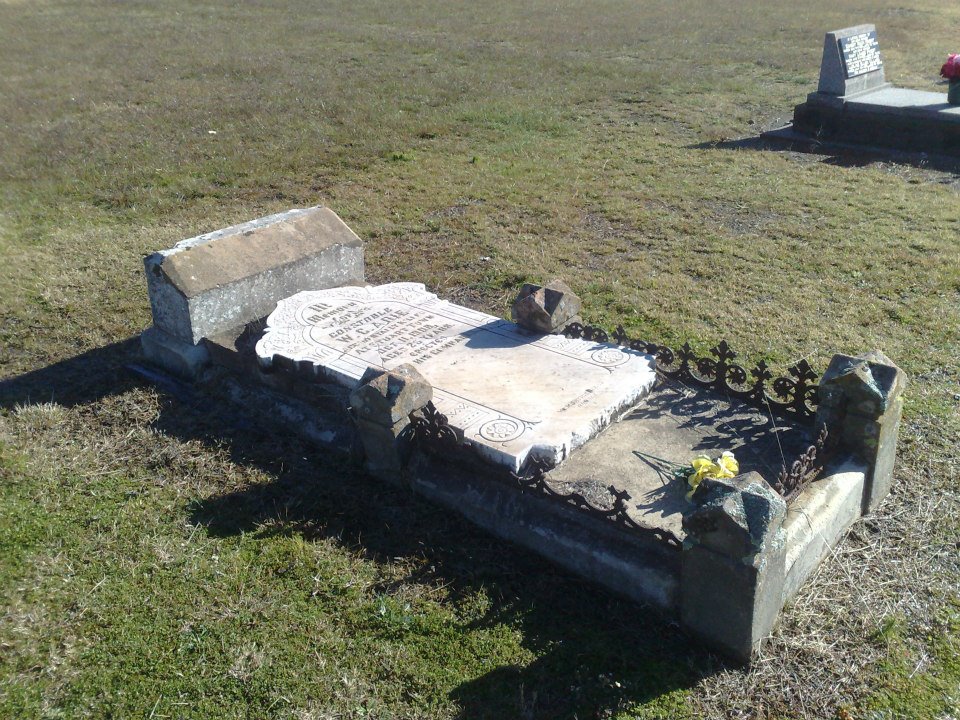
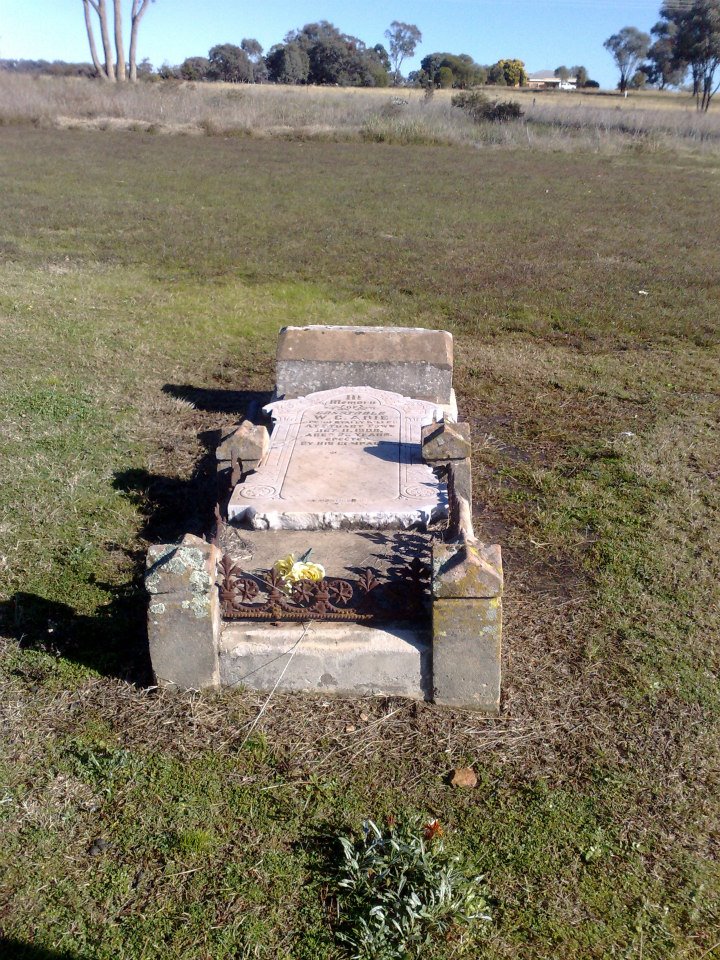
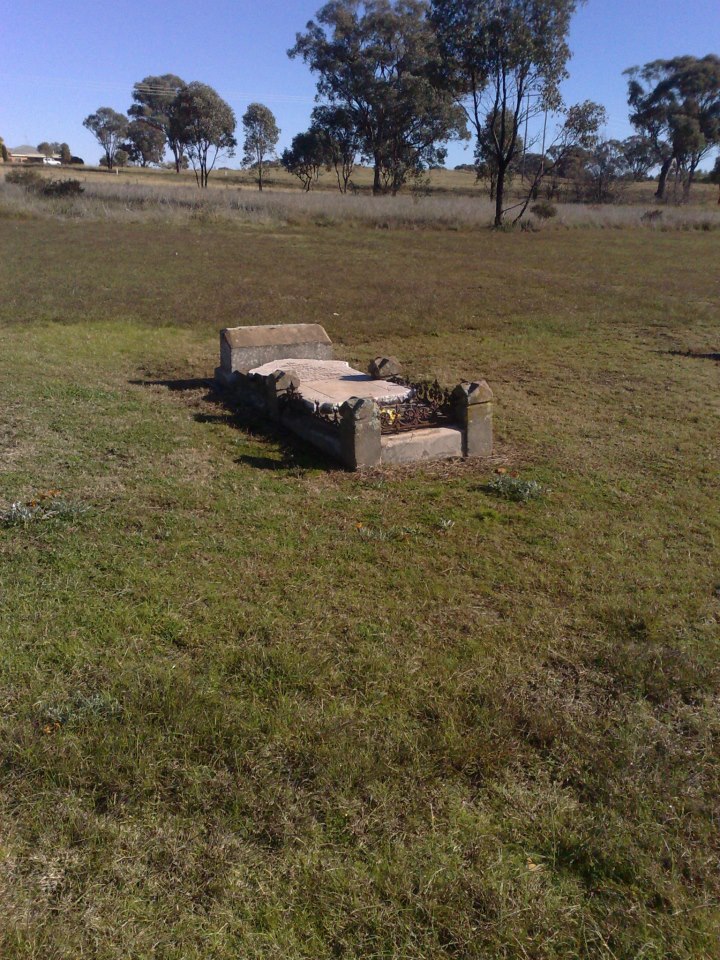
William JUSTIN
Constable 1st Class William JUSTIN
New South Wales Police Force
Horse Accident
Thuddungra
8 March, 1905
On the day of his death Constable Justin was patrolling about ten miles from Thuddungra (Young district) when his horse became skittish and began to buck. The constable was driven into a wire fence by the animal, where he sustained severe injuries to his face and hands. He was found some three hours after the incident by some girls going home from school, and was quickly taken to the home of a Mr Webb. He was taken to Young Hospital the next day however he unfortunately passed away.
The constable was born in 1859 and joined the New South Wales Police Force on 19 November, 1881. At the time of his death he was stationed at Young.


*
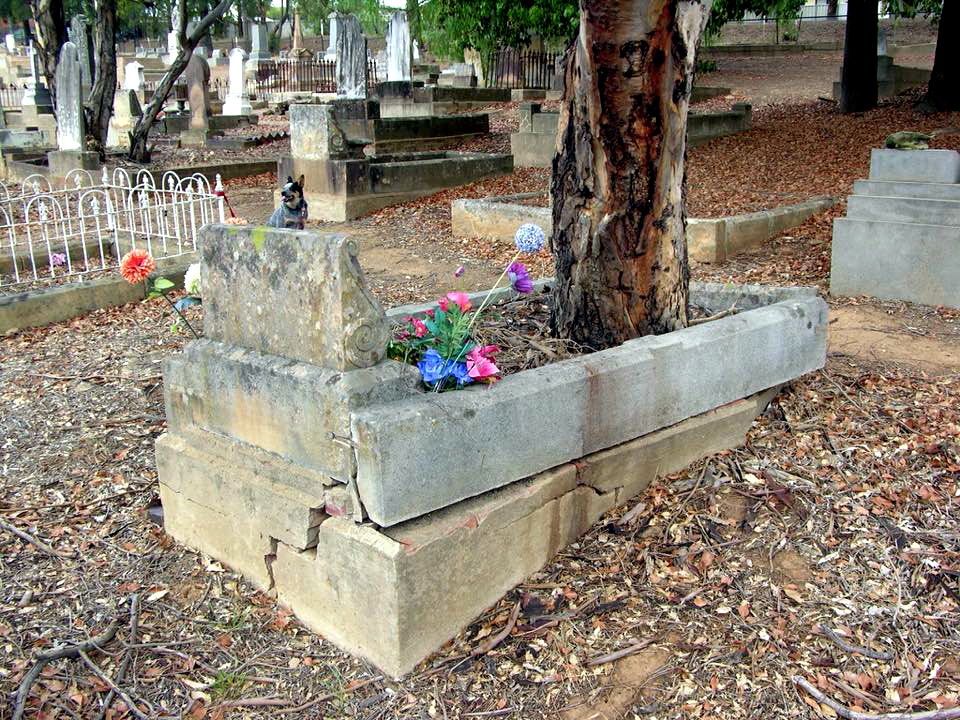
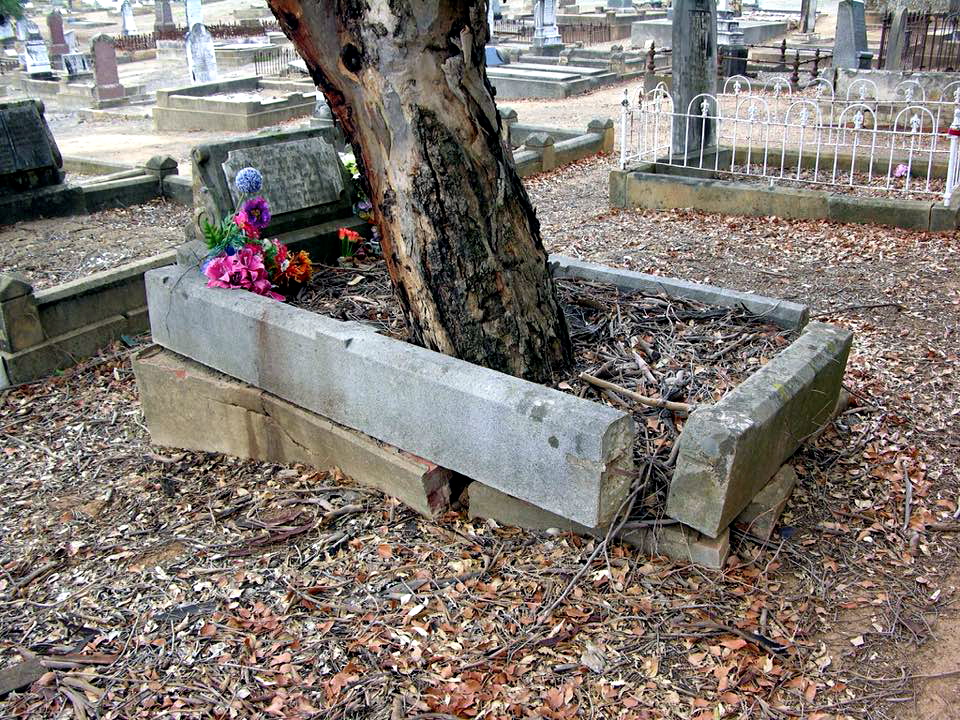
As you can see from these and previous photos of this grave, there is a bloody huge gum tree growing right on top of him. There is a remembrance day ribbon pinned to the tree and the flowers and trinkets have obviously been placed in recent years.
*
Eucser Haze added 3 new photos.
Please take the time to read a little about NSWPF history, or at least just have a look at the state of a grave that belongs to an officer killed in the line of duty, Cst 1/c William Justin. Yes- that is a large tree growing through the centre of the grave.
I’m at a loss to understand how the grave of a Police officer, who died in the service of this state, can be allowed to reach this condition. I seriously wonder what his family and colleagues would think of us.
Remembered…
Constable 1st Class William JUSTIN
Young Police
Horse Accident – 8 March, 1905
Resting Place – Young General Cemetery, Young
In early March, 1905 Constable Justin was patrolling about ten miles from Thuddungra (Young district) when his horse became skittish and began to buck. The constable was driven into a wire fence by the animal, where he sustained severe injuries to his face and hands. He was found some three hours after the incident by some girls going home from school, and was quickly taken to the home of a Mr Webb. He was taken to Young Hospital the next day however he unfortunately passed away. The Shoalhaven Telegraph dated 29 March, 1905 reported the following some weeks later.
“DEMISE OF FIRST-CLASS CONSTABLE JUSTIN.
[Written by Daniel McMillan, an old and sympathetic Friend.]
A great gloom was cast over this neighbourhood and surrounding district on Monday week last, when the sad news became known that First-class Constable Justin had succumbed to injuries which he received through being thrown from his horse whilst on duty the Wednesday previous, some 20 miles from Young, at which place he has been stationed for a considerable time. It would appear from the evidence adduced that while Mr Justin was in the act of shutting a gate, which was a complicated one, his horse, being a spirited animal, started to buck, and ran away, causing the rider to lose his balance and fall to the ground. The unfortunate man, being dragged a considerable distance by the stirrup, was brought into contact with a barb-wire fence, thence with a tree. It is also surmised that the horse kicked him on the head. He was found in an unconscious state some hours, it is supposed, after the accident occurred. At the time of the accident Constable Justin was over 20 miles away from his home. He was found by a Mr Webb, a farmer residing some distance away from the scene of the untoward incident, who took him to his home, and did all that he could to relieve the sufferer until medical aid was obtained, From the first but little hope was entertained of his recovery. He only regained consciousness for a few minutes before his death, which sad event took place on the Saturday evening following, at 8 o’clock. Mr Justin, who was, it may be said, in the prime of life, being only 45 years of age at the time of his death, was the eldest son of the late Mr W. Justin, so long and favourably known in connection with the Harbors and Rivers Department; he was born in Sydney, and whilst only a child removed with his parents to Shoalhaven, where his aged mother still re sides, with several other members of the family. The deceased, at the early age of 21, joined the police force, with which he had been associated ever since, and during his 24 years’ service he had been stationed at many places in New South Wales, including Goulburn, Braidwood, Myrna, Queanbeyan, Frogmore, Young, and other stations. In referring to the deceased gentleman, an up-country paper says: ‘He was the popular constable, who was loved and respected by all, and will be greatly missed.’ The same can be said by everybody at every place where he has been. Besides a wife and 5 children, the deceased leaves a mother, 2 brothers, and 4 sisters, together with a large circle of friends and acquaintances, to mourn their loss. The funeral, which took place at Young on Sunday week, was largely attended…”
The constable was born in 1859 and joined the New South Wales Police Force on 19 November, 1881. At the time of his death he was stationed at Young. He is listed in the official New South Wales Police Honour Roll.

James BREMNER
James BREMNER
( late of 264 Bourke Street )
New South Wales Police Force
Regd. # ?
Rank: Inspector
Stations: ?, No. 3 Division Darlinghurst ( O.I.C. for 17 years )
Service: From ? ? about 1864 to 2 January 1901 =
Awards: ?
Born: ? ? 1841
Died on: Wednesday 2 January 1901
Cause: Horse accident – pedestrian
Event date: Tuesday 1 January 1901
Event location: Centennial Park
Age: ?
Funeral date: Thursday 4 January 1901
Funeral location: Presbyterian portion of Waverley Cemetery
Buried at: Presbyterian portion of Waverley Cemetery
General Vault, Section 16
Memorial at: ?
JAMES IS mentioned on the Police Wall of Remembrance
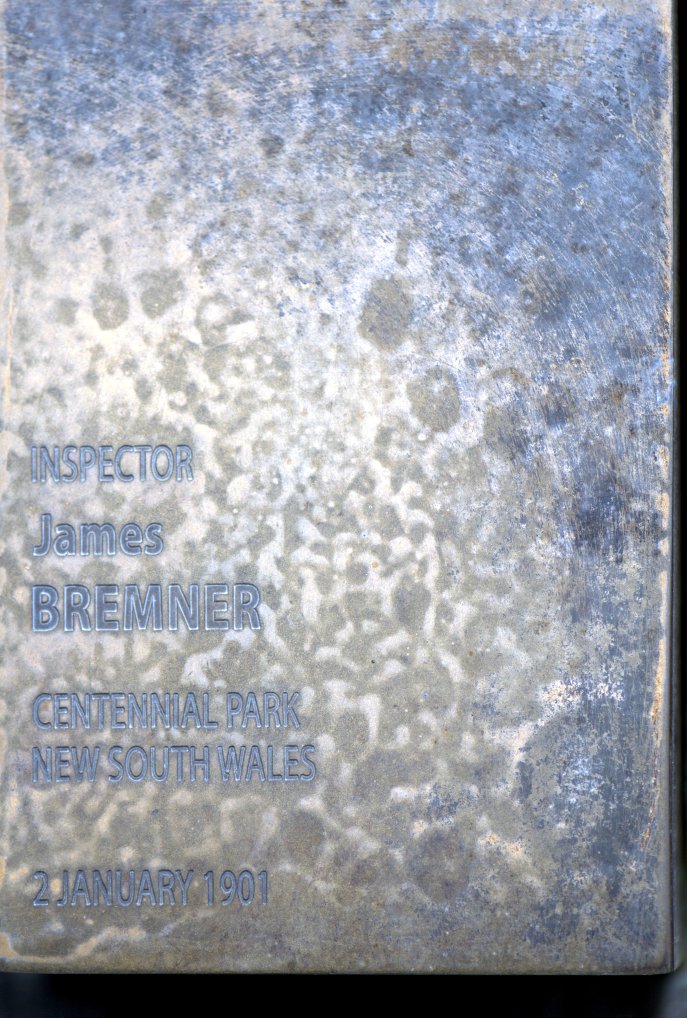
FURTHER INFORMATION IS NEEDED ABOUT THIS PERSON, THEIR LIFE, THEIR CAREER AND THEIR DEATH.
PLEASE SEND PHOTOS AND INFORMATION TO Cal
The inspector was knocked down and killed by a military horse during Commonwealth of Australia celebrations at Centennial Park, Sydney ( 1 January 1901 ). At the time he was supervising 200 police who were maintaining order amongst a large crowd awaiting the Commonwealth Day Procession. As the procession began, a trooper’s horse took fright and bolted into the crowd. Inspector Bremner was knocked down, sustaining severe spinal injuries. He was conveyed to St Vincent’s Hospital where he died at 2.15am the following morning. He had been due to retire a few weeks earlier but stayed on to assist with the Commonwealth of Australia celebrations.
The inspector was a well-known policeman in Sydney. He had arrived in Sydney from the north of Scotland some 37 years earlier and had almost immediately joined the police (about 1864). He had been the officer-in-charge of No. 3 Division for seventeen years, supervising the police stations at Randwick, Waverley, Botany and Woollahra. He was apparently a huge man of about twenty stone in weight. He left behind a widow but no children.
The Sydney Morning Herald of 4 January, 1901 reported on the very impressive funeral which was afforded the inspector.
FUNERAL OF THE LATE INSPECTOR BREMNER.
The funeral of the late Inspector James Bremner, who died at St Vincent’s Hospital on Wednesday from injuries received in the discharge of his duties during the swearing in ceremony of the Governor General at the Centennial Park on the previous day, took place yesterday afternoon. The interment was made in the Presbyterian portion of Waverley Cemetery. The cortege left the late residence of the deceased, 264 Bourke Street, at 3pm. The popularity and respect in which the deceased officer was held were marked by the large presence of all classes of the community, who assembled at the place of departure and along the whole line of route. Moreover, numerous evidences of mourning were displayed throughout Oxford Street. At Darlinghurst Law Courts voluntary guards of honour were formed by the bandsmen of the Irish Rifles and St George s Regiment, who were playing in the neighbourhood. Opposite Marshall’s Brewery a number of blue-jackets who were returning from the review lined up and saluted the coffin as it passed. Passing Centennial Park the same tribute of respect was paid by the troops encamped there…
The inspector was born in 1841 and joined the New South Wales Police Force about 1864. At the time of his death he was the Officer-in-Charge of No.3 Division (Darlinghurst).
Francis William GRUNDY
William Francis GRUNDY
New South Wales Police Force
Constable
35 old
Horse Accident
Holbrook
20 March, 1898
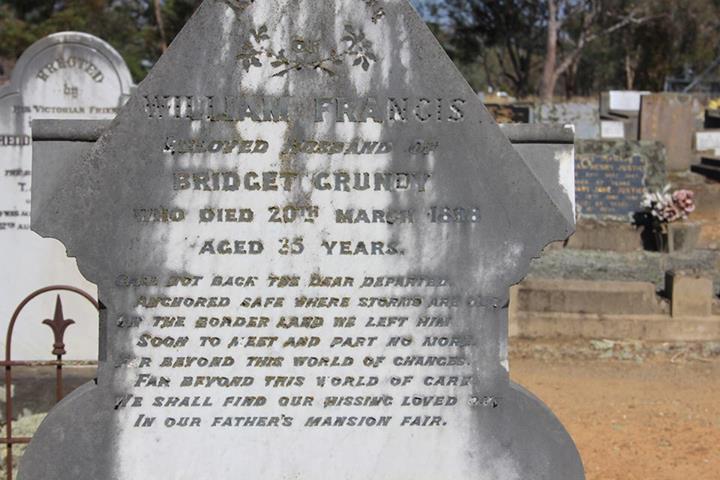
Inscription reads:
[blockquote]
‘Care not back the dear departed Anchored safe where storms are o’er On the border land we left him Soon to meet and part no more Far beyond this world of changes Far beyond this world of care We shall find our missing loved one In our Father’s mansion fair’.[/blockquote]
The constable was critically injured when he fell from his horse about 18 miles from Holbrook on the 15 March, 1898. He was later found by the Tarcutta mailman and taken to Holbrook in an unconscious condition, where he passed away on the 20 March 1898. The Argus newspaper of 1 April, 1898 carried the following brief story. ALBURY, Thursday. An inquest was held yesterday at Germanton into the circumstances attending the death of Constable Grundy, who succumbed to injuries received by a fall from his horse. Allegations were made that the Deceased was compelled to ride a horse which had fallen with him on other occasions. The evidence of the officer in charge of the Germanton Station to a great extent bore out the allegations. He stated that the horse was notoriously unsafe, and that Grundy had complained that it would break his neck some day. When advised to report the animal he said that it was no use doing so as he would only get another just as bad. Deceased was thrown off the horse while proceeding at night along a road beyond Germanton, he then being in search of sheep stealers. The superintendent of police gave evidence denying that the horse was unsafe. He admitted that the horse was timid and required careful handling. A verdict was recorded that Deceased met his death by injuries received by being thrown from his horse. At the time of his death the constable was stationed at Germanton (now Holbrook).