‘Heartbreaking’: Suicide suspected reason for police officer death in South Australia
A respected female police officer was found dead at a police station. Now her cause of death has been revealed.
Sofia Dmitrieva
3 min read
January 10, 2024 – 4:19PM
A respected female police officer found dead at a police station in South Australia is believed to have taken her own life in the women’s bathroom of the building.
The officer was found at Port Adelaide police station on Monday afternoon and police have previously confirmed the death was not being treated as suspicious.
The detective brevet sergeant, aged in her 30s, is believed to have taken her own life between 2pm and 3pm on Monday, 7News reports.
Online reports from eyewitnesses claim police officers inside the station at the time heard a loud bang within the building leading to the discovery of her body.
The Indigenous mother of two’s name and photos have not been revealed due to cultural reasons.
The woman moved from Whyalla to Adelaide, where she initially worked as a community constable. The role involved her helping police engage with First Nations and culturally diverse communities.
She was nominated for the City of Port Adelaide Enfield’s 2012 Aboriginal and Torres Strait Islander Awards for her work within the First Nations community.
“(I) would like to help turn around the public’s perception of police officers from a negative to a positive,” she wrote as part of her nomination for the Person of the Year award.
“I love the variety in my work and I love getting the opportunity to help people by making the best out of a bad situation.
In her nomination blurb she also wrote about her passion for serving the community with her ultimate goal to see the Aboriginal community represented more in SA Police.
“She has shown a genuine concern and passion for the community in general and has had life experience which she shares openly with her peers,” the nomination reads.
“She stands up for what she believes in and is very passionate about her cultural heritage.”
In 2015 the woman was sworn in as a full-time police officer and was assigned to the family violence unit at Port Adelaide Police Station.
Four years later she married her wife, who is also a South Australian police officer.
The deceased police officer was the granddaughter of a celebrated Aboriginal writer and poet who had more than 61 works published throughout their career, Daily Mail Australia reports.
The grandmother is considered to be a “pioneer in First Nations Australia literature in South Australia”, becoming the first ever published Aboriginal female writer within the state, winning awards for her contribution to the arts.
South Australia Premier Peter Malinauskas said several tragedies had unfolded in South Australia recently and they were confronting.
“Anytime we see a tragedy of this nature involving anyone in our community it hurts,” Mr Malinauskas said.
Friends and fellow police officers have posted tributes to the officer on social media and expressing their shock over her sudden death.
“I just wish I could see and hear you one more time. You were loved by us all, miss you forever,” one person wrote on Facebook.
“R. I. P beautiful soul. If only we could hear her laugh again,” a second person said.
“Absolutely gutted … going to miss your bright bubbly face,” another said.
Condolences from strangers have also been coming in, with people thanking the police officer for her work.
“R.I.P. your shift is over, thank you for you service. Condolences to your family
I’m sorry, my thoughts and sympathies are with those grieving,” one person wrote
“My condolences to her family, friends and work colleagues…..Its sad to see a beautiful angel returning where she’s from. Hope her family, friends and colleagues are OK too,” another person commented.
The Acting Commissioner of Police Linda Williams has advised a Commissioner’s Inquiry will be undertaken into the circumstances surrounding this matter.
A coronial investigation also will be conducted into the tragedy.
A respected police officer told a colleague ‘everything would be ok’ just hours before she was found dead inside Port Adelaide‘s police station.
A police commissioner’s inquiry and a coronial investigation have now been launched after the officer died at the station, in the city’s northwest, between 2pm and 3pm on Monday.
Daily Mail Australia can reveal the female police officer was a mum of two and Aboriginal.
She married her wife, who is also a South Australian police officer, in late 2019.
Police have confirmed the death is not being treated as suspicious but have not revealed the cause.
They have also requested media outlets not to publish the name or photos of the officer in question due to ‘cultural reasons’.
Reports from eyewitnesses online claim officers at the station heard a loud bang within the building before they discovered her body.
Devastated friends and colleagues have paid tribute to the tribute to the officer who was nominated for ‘Aboriginal Person of the Year’ in 2012 for her work within the First Nations community.
She was remembered as a ‘beautiful person’ who had an ‘infectious, loud laugh’ which could be heard ‘right across the station’.
One workmate said the officer told her ‘It will be OK, bestie’ during one of their last conversations on Monday.
‘You said it a thousand times to me over the years,’ her colleague wrote.
‘It doesn’t feel like anything will ever be OK again.
‘I am shattered. I loved you so much, but you knew that.
‘I will miss you forever.’
Another colleague recalled how kind she was when she first arrived at Port Adelaide and was struggling to adjust.
After the officer invited her out to socialise, they quickly bonded over their similarities – their ‘terrible memories, distractibility and having both lost their fathers.
‘The first day I met you your kindness and caring nature shone through. You went out of your way to make us and the kids feel welcome with invitations to kindergym and the park,’ she said.
‘I loved working in the same office as you. Your laugh, the lolly jar addiction, your big caring heart and your cracking sense of humour, always taking the piss.
‘I loved your passion for your people. You were a proud First Nations woman and I loved your stories of your beloved ‘Gary’.
‘I learnt so much from you. You were such a light in my life.
‘I wish you knew how much you are loved.’
A third cop said the officer affectionately dubbed her and another colleague as the ‘angels’.
She said she would miss the officer’s bright bubbly face and hearing her say ‘well, well, well… if it isn’t the angels’ when she would walk by.
A former colleague added the officer’s ‘pain is now gone’ and she will never be forgotten by those she left behind.
‘Fly high and free sister in blue,’ she said.
‘Big hugs and love to your heartbroken family, RIP lovely.’
The tragedy has rocked the South Australian police community, which is still reeling just two months on from the alleged on-duty fatal shooting of Brevet Sergeant Jason Doig ( killed 17 November 2023 ) and alleged hit-and-run death of SA Police Commissioner’s son, Charlie Stevens.
Counselling support services have been offered to the officer’s colleagues.
Acting Commissioner Linda Williams has announced the woman’s death will be subjected to a police inquiry as well as a coronial investigation.
‘The tragedy at Port Adelaide is something that will impact so many people – family and friends, but also the entire police family and indeed the wider community,’ South Australia Police Association president Mark Carroll said.
‘Our colleague’s death will be investigated so that we can understand the cause of this devastating incident.
The state’s Police Minister Joe Szakacs also shared his grief in a statement.
‘My heartfelt condolences go to the family, friends and colleagues of the police officer,’ Mr Szakacs said.
‘Her tragic passing will be felt deeply, and grieved widely. I ask everyone to keep the police family in their thoughts.’
Tributes poured out for police officer found dead at South Australian police station
Loved ones and co-workers of a female police officer found dead at a police station, prompting an inquiry.
Madeleine Achenza
less than 2 min read
January 9, 2024 – 2:14PM
Loved ones and colleagues have paid tribute to a female police officer who was found dead at a South Australian police station.
The officer was found at Port Adelaide police station on Tuesday afternoon and the death is not being treated as suspicious.
Friends and fellow police officers have posted tributes to the officer on social media and expressing their shock over her sudden death.
“Absolutely gutted … going to miss your bright bubbly face,” one person wrote on Facebook.
“RIP you were such a lovely person, can’t believe it,” a second person said.
“You were so special, so kind and someone I truly cherished throughout my time in the job,” another said.
Police Minister Joe Szakacs said her death would be “felt deeply” and “grieved widely” by the policing community.
“My heartfelt condolences go to the family, friends and colleagues of the police officer,” he said.
“Her tragic passing will be felt deeply, and grieved widely.
SA police have described it as a “tragic incident” and support is being provided to all police employees.
The Acting Commissioner of Police has advised a Commissioner’s Inquiry will also be undertaken into the circumstances surrounding this matter.
This death will also be subject to a coronial investigation.
Nothing further, than what is recorded above, is known about this person at the time of publication and further information and photos would be appreciated.
The headstone for Constable John Woods is at the top end of the Old Police paddock, (don’t know who might own it now), which faces Roseberry Street, just off the junction of Dalmorton Street ( Woodenbong, NSW ).
His listed cause of death was Rheumatic Fever at age 29 on 21-2-1893. (The Warwick Argus, Tuesday 28-Feb. 1893)
He was the first Constable appointed to Woodenbong in 1887.
He married Sarah Margaret Fletcher at Killarney, Qld on the 22-Nov. 1892.
His Parents were John & Eliza Woods of ‘ Jacqua ‘, O’allen Ford Rd, Bungonia, NSW.
John & Eliza are buried at Windellama Anglican Cemetery and John has a commemorative plaque installed on his parents headstone.
There is a ‘ discrepancy ‘ with the surname as some family went by Woods and the rest by Wood.
Described as being born in 1862, 5′ 10″ tall, grey eyes and light brown hair with a ‘fresh’ complexion.
A native of N.S.W., was single when he joined the Police and was previously employed as a farmer.
Woodenbong Police Station was in existence by 1888 as recorded in the NSW Legislative Assembly Distribution of Police Force on 31st December 1888.
In 2006 the Woodenbong Police Station was located in the Richmond Local Area Command in the Northern Region. Its address was Unumgar Street, Woodenbong. (1)Endnotes(1) NSW Police Website http://www.police.nsw.gov.au/about_us/structure/operations_command/local_area_commands/northern_region/richmond (accessed 30 October 2006).
Inscription: In Loving remembrance of John Woods Died 21 February 1895 aged 30 years A precious one from us is gone. A voice we loved is stilled. A place is vacant in our home Which never can be filled.
Colin Thomas GIBBONS
12/01/2024
Colin Thomas GIBBONS
AKA Gibbo, Col
Late of Mudgee
NSW Redfern Police Academy Class # 106
New South Wales Police Force
Regd. # 11906
Rank: Commenced Training at Redfern Police Academy on Monday 21 February 1966 ( aged 24 years, 4 months, 6 days )
Probationary Constable – appointed 4 April 1966 ( aged 24 years, 5 months, 20 days )
Constable – appointed 4 June 1967
Constable 1st Class – appointed 27 August 1974
Senior Constable – appointed 27 August 1978
Final Rank = Senior Constable
Stations: ?, South Coast District ( 1967 ), Mudgee ( 1977 – 1981 ), Cronulla, George St North, Bega, Eden, Batemans Bay
Service: From 21 February 1966 to4 April 1985 ( Resigned ) = 19 years, 1 month, 14 days Service
Age at Resignation: 43 years, 5 months, 20 days
Time in Retirement: 34 years, 1 month, 27 days
Awards: National Medal – granted 15 November 1982 ( SenCon )
Born: Wednesday 15 October 1941
Died on: Thursday 30 May 2019
Age: 77 years, 7 months, 15 days
Cause: Pancreatic Cancer
Event location: Dubbo – Lourdes Private Hospital
Event date: Thursday 30 May 2019
Funeral date: Friday 7 June 2019 @ 11am
Funeral location: St Luke’s Anglican Church, Bayly St, Gulgong, NSW
Wake location: Gulgong RSL, NSW
Funeral Parlour: Macquarie Valley Funerals & Monuments, Mudgee 6372 2331
Good evening caught up with an old Mudgee stalwart Colin Thomas Gibbons at Lourdes Hospital at Dubbo Col is in a bad way and his family are with him worked at Mudgee during early 80’S and he was one of the last old school coppers when telling hoodlums to get home their reply was yes Mister Gibbons he was very active with The Mudgee VRA and his family were overwhelmed today to have the Commissioner of the VRA MR Mark Gibson visit Col and his family today and I thank you Sir for your visit. May our thoughts and prayers be with Col and his family
Col Gibbons / Gibbo / Dad / Pop / Grandpa
“A silent #Mudgee legend gave his time to save many a life as a #police office and active member of the volunteer #rescue squad today bids us farewell” Over the past months our dad has fought the biggest fight of his life. A fight that sadly came to an end this morning with his true loves, mum and his kids by his side. Next week will give us all the opportunity to celebrate Cols amazing life and I encourage all those that know our family to come along and show your support to mum (Ella) Saraha-Jane, Johnny, Susan, Sharron (Gibbo) and our extended family.
God Bless You Big Fella – May You Continue to protect us from above
Colin is mentioned on p 52 of this document. Details of previous North East Wiradjuri People claims.
First published Thursday 30 May 2019.
Updated 25 February 2025 and tidied up.
William Leonard ESPIE
12/01/2024
William Leonard ESPIE
aka Bill, ‘Buckshot’, ‘The Wasp’
New South Wales Police Force
Uniform # 1868
Regd. # 10092
Rank: Commenced Training at Redfern Police Academy, with Class 088, on Monday 14 August 1961 ( aged 27 years, 0 months, 7 days )
Probationary Constable – 14 September 1961
1st Class Constable – appointed 1 April 1967
Senior Constable – appointed 1 April 1971
Sergeant 3rd Class – appointed 1 February 1978
Sergeant 2nd Class – 31 August 1984 ( Central Police Station )
Sergeant 1st Class – 9 August 1986
Chief Inspector – February 1989 ( Fairfield & Cabramatta )
Chief Inspector – Patrol Commander ( Cabramatta ) until Optional Retirement in April 1991
Stations: Central ( No. 1 Division ), Darlinghurst ( No. 3 Division ) to Liverpool ( 22 Division ) in November 1963, Merrylands ( 26 Division ), Cabramatta, Fairfield, Cabramatta ( 34 Division ) – Optional Retirement
Service: From 14 August 1961 to ? April 1991 ( Optional Retirement ) = 31? years of Service
Awards: Queen’s commendation for Brave Conduct – granted19 October 1965 ( rescue of two people from their burning vehicles after a collision – whilst standing in fuel )
Commissioner’s Commendation – rescue – 1965 ( rescue of two people from their burning vehicles after a collision – whilst standing in fuel )
Peter Mitchell Award, a perpetual trophy, for selfless & brave conduct – 1965 ( as above )
George Lewis Trophy “for the most courageous act by a member of the NSW Police Force in 1965” ( as above )
Australian Defence Medal
Commissioner’s Commendation – for pursuing & arresting an armed prison escapee – 1971
Commissioner’s Commendation – pursuit and arrest of an offender of a fatal shooting at Cabramatta – 1977
1st Clasp to National Medal – granted 7 November 1988 ( SenSgt )
Australian National Police Service Medal
Born: Tuesday 25 June 1935 in Alice Springs, N.T.
Died on: Thursday 22 September 2011
Cause: Dementia
Age: 76 years, 2 months, 28 days
Funeral date: Wednesday 28 September 2011 @ 10.30am
Funeral location: SOUTH CHAPEL, ROOKWOOD CREMATORIUM, ROOKWOOD
Buried at: Cremated
1976 Bill Espie standing next to Father Smith celebrating his 50 years of ordination – Charlie Perkins on far left next to Mrs Smith – Noel Hampton and David Woodford on far right
Memorial location 1: NSW Police Academy, Goulburn
Memorial 1 description: Framed picture & literature in relation to Bill’s Service
Memorial date: 29 October 2015 @ 1pm
Former Det Sgt Peter Croucher & Former Sgt Sue Bytheway
Memorial location 2: Hartley St School Museum, 39 Hartley St, Alice Springs, N.T.
Memorial 2 description: Plaque
Memorial date: 29 July 2017
BILL is NOT mentioned on the Police Wall of Remembrance * NOT JOB RELATED
Bill Espie reading his Queen’s Commendation for Brave Conduct.
Former Police Commissioner Ken Moroney
Former Detective Sergeant Peter Croucher
WEDNESDAY 28 SEPTEMBER 2011
CREMATION CEREMONY FOR RETIRED CHIEF INSPECTOR WILLIAM ‘BILL’ LEONARD ESPIE. Born 250635 – 220911
SERVICE AT THE SOUTH CHAPEL, ROOKWOOD CREMATORIUM, ROOKWOOD, 10.30AM.
POLICE FUNERAL.
RETIRED POLICE COMMISSIONER KEN MORONEY GIVING THE EULOGY.
Bastion of culture and community October 15, 2011 .
Bill Espie was one of several talented Aboriginal men born in the Northern Territory in the mid- to late 1930s who went on to make, each in his own way, his mark on Australia and to contribute to the progress of his people. Espie was the first, destined for an exemplary police career in which he became the highest-ranking police officer of Aboriginal descent in all the Australian police forces. He was followed by Charlie Perkins, who became a famous activist; Professor Gordon Briscoe, an academic and activist for his people; the artist John Moriarty; Vince Copley, chairman of Indigenous Cricket; and Brian Butler, in Aboriginal aged care.
William Leonard Espie was born in Alice Springs on June 25, 1935, one of seven children to a mixed-race Arunta woman, Edith Espie, who was part of the stolen generation, and Victor Cook, a European who had moved from South Australia to work in Alice Springs as a labourer.
Espie’s sister Ellen said the family lived in a good house in Alice Springs and their parents did their best for them. Like Perkins and Briscoe and several others, Espie came under the benign influence of an Anglican priest, Father Percy Smith, who arranged for the boys to go to St Francis House at Semaphore in Adelaide, an indigenous boys’ home.
Espie, known then as Buckshot by the boys, went to school in Port Adelaide and showed himself to be an outstanding tennis player, facing at one time Lew Hoad and Ken Rosewall. He completed his Intermediate Certificate, then trained as a maintenance fitter.
In 1955, he joined the Australian Army, became a sapper in the engineers and was appointed a field engineer. He served at Marginal during the atomic testing. Along the way, he married Irene Zachary and served in the army until 1961. At 26, Espie decided to go to Sydney. He entered the NSW Police Force as a recruit and did his training at the Redfern academy, where he was noted as ”a good all-rounder”.
He became a probationary constable on September 18, 1961. Assigned for 12 months to Darlinghurst, he experienced a profound culture shock – the place could have not been more different from Alice Springs – but he managed the situation and was then transferred to Liverpool.
During the following 16 years, he was to serve there, at Merrylands and Cabramatta.
Espie quickly came to notice for his discipline and attitude to his work. Former police commissioner Ken Moroney said: ”It was in these early formative days of his career that Bill deservedly earned the respect not only of his senior officers and peers but, as important, of the community in which he worked. Long before the words ‘community-based policing’ became the fashion of the day, Bill Espie’s life skills and worldly experiences had seen him well versed in the importance of effectively communicating with people at all levels. What you saw was what you got and there were no in-betweens. You knew exactly that he meant what he said and he said what he meant.”
What Espie did in practical terms did not escape official notice either. In March 1965, he went to the scene of a collision and found both vehicles burning fiercely. Without hesitation, he went in and rescued a trapped man from each of the burning cars. For that, he earned a Commissioner’s Commendation and the Queen’s Commendation for Brave Conduct.
Commissioner Norman Allen also awarded him the Peter Mitchell Award, a perpetual trophy, to recognise his selfless and brave conduct. On top of that, he received the George Lewis Trophy ”for the most courageous act by a member of the NSW Police Force in 1965”.
In 1971, he received another Commissioner’s Commendation for pursuing and arresting an armed prison escapee.
A further Commissioner’s Commendation came in 1977 when he received a report of a man leaving a crime scene following a fatal shooting at Cabramatta. He was able to secure the crime scene and pursue the man, whom he arrested. The man was charged with murder and prosecuted.
In December 1980, Espie was awarded the National Medal for service and was later awarded the First Clasp of the National Medal.
Transferred to Central Police Station in the city, he became a sergeant second class in 1984 and sergeant first class in 1986. Arranging a transfer back to Fairfield, he continued performing well and, in February 1989, became a chief inspector. He served as patrol commander at Cabramatta until his retirement in April 1991.
Bill Espie is survived by his long-term partner, Maureen Ola, brothers Robert and Linton, sisters Ellen and Peg, his children Marita, William junior, Bettina and John, 11 grandchildren, great grand-daughter Sienna and nephews and nieces.
Bill Espie: Police hero from Alice Springs
By JOHN P McD SMITH
Bill Espie, born in Alice Springs in 1935, holds the unique distinction of being the highest-ranking Aboriginal police officer in any Australian police force.
In March 1965 he attended a two vehicle collision with both vehicles on fire.
He rescued a man from each burning car, putting his own life at distinct risk.
For this act of bravery Bill was awarded the Queen’s Commendation for Brave Conduct as well as the Commissioner’s Commendation.
1965 Newspaper clipping reporting on Bill Espie’s heroic act to save two men for which he was awarded the Queen’s Commendation for Brave Conduct
Bill’s mother Edie Espie was one of a group of Aboriginal women in Alice Springs who wanted their children to have a better chance in life.
Others like her were Hetti Perkins, Dido Cooper, Tilly Tilmouth, Melva Palmer and Millie Woodford who accepted assistance from Father Percy Smith to help further the education of their children at St Francis’ House in Adelaide.
All these mothers had one thing in common, and that was their determination to do the best for their children. They were strong women.
Bill Espie’s nickname was “Buckshot” or “The Wasp”. All the Aboriginal boys who lived at St Francis’ House had nicknames.
Peter Tilmouth was called “Truck” because every Saturday he would go with the local greengrocer doing deliveries in his truck.
David Woodford was known as “Woody”.
This is Bill Espie’s account of his life. He passed away on September 22, 2011.
John P McD Smith
1976 Bill Espie standing next to Father Smith celebrating his 50 years of ordination – Charlie Perkins on far left next to Mrs Smith – Noel Hampton and David Woodford on far right
This story involves three components, St Francis House, Father Smith and Mrs Smith and me.
The identity of “me” is not important as “me” could well have been any number of young Aboriginal children who grew up in Alice Springs in the thirties.
My Aboriginal mother, through no fault of her own, could not have raised me in the way that she would have wished, due mainly to economic and social barriers.
Fancy phrases of course, but simply meaning being poor and not being fully accepted in the community.
My mother had a choice; bring me up herself in an environment which offered no more than a twenty percent chance of being successful, or to let me grow up under the watchful eye of Father Smith who was the first resident Anglican priest in Alice Springs in 1933.
No doubt at great pain my loving mother chose the latter.
After spending a few years at St John’s Hostel in Alice Springs, I travelled with five other young Aboriginal boys to St Francis’ House a Semaphore.
This was to be my home for the next seven or eight years, again for most of the time under the care of Father and Mrs Smith.
It was to become my fortress, my haven against an outside community who did not fully accept persons of Aboriginal descent.
It was also to become a place where friendships would flourish, ambitions take shape and my character develop. It was a place where I would gain an education so that I may at least obtain future employment.
Looking back one would ask, how? How could a big rambling one-hundred-year-old house containing some twenty or so young Aboriginals, who came from far and wide, possibly help me in achieving my goals?
I expect the logical answer would have been: “I really don’t know.”
Perhaps calling this beautiful old house “St Francis’ House” might help in some way, but we all know that names alone will not press the magic button. The next obvious question was of course: “Well, what was it then that made this house so successful?” A place where I would achieve some of my ambitions.
The accolades must of course go in the main to Father and Mrs Smith who brought about the concept of St Francis’ House by an overwhelming desire to help young Aboriginal children take their place amongst the general community with pride and qualifications to reach attainable goals both in the present and future.
Their private lives were non-existent due of course to their dedication in what they were doing was justified and correct. It was this dedication and commitment that made St Francis’ House a success.
Of course there were other factors that must be considered when judging the overall effectiveness of St Francis’ House.
Those factors were “the boys”, the occupants or to be more explicit the Aboriginal boys themselves.
The same boys who slept three, four, five in a room; and if it was a ghost story night or someone had imagined seeing the ghost of Captain Hart (the original owner) wandering the halls prior to bedtime, then it was six to a bed – not unreasonable I would think!
These same boys depended on each other for guidance, support, company; but most of all I think each and every one craved for that family environment, and because of the actions of Father and Mrs Smith it was achieved.
The individual personalities of each of the boys also contributed towards the overall aura of the house. Their continuing effort to “fit in” within the community and their sense of humour in day to day activities made life unique and gave the house a “soul”.
Even though the function of this house has long since gone one would still hope the “soul” still haunts the corridors, hallways and rooms we affectionately remember as St Francis House … who knows?
Group of boys ready in Alice Springs in 1944 – Bill Espie, John Palmer (Back), Noel Hampton, Charles Perkins, Malcolm Cooper (standing in front or Mrs Smith), Mrs Isabel Smith, Father Percy Smith
John P McD Smith picks up the story.
1950s Aboriginal Football Team Alice Springs: Bill Espie in back row 4th from left
After completing his Intermediate Certificate at Le Fevre Boys High School Bill Espie trained as a maintenance fitter. For a short time he returned to Alice Springs to be with his family, but he soon realised that there wasn’t much of an employment future for him there.
In 1955 he joined the Australian Army and was appointed a field engineer.
He served at Maralinga. The world was opening up to him.
After his marriage to Irene Zachary, Bill decided to go to Sydney where he was accepted into the NSW Police Force.
He trained at the Redfern academy becoming a probationary constable in 1961. During his career Bill served at Darlinghurst, Liverpool, Merrylands and Cabramatta.
He became an effective communicator as a police officer and was very good at dealing with different types of people and situations.
After rescuing the two men Bill merely said: “There wasn’t time to think, I just had to get the men out.” They were saved from a firey death.
His commendations, which also included the Peter Mitchell Award, in 1971 Bill received another Commissioner’s Commendation for pursuing and arresting an armed escapee.
Towards the end of his career Bill was awarded the National Medal for meritorious service to which later was added the First Clasp.
By 1986 Bill was a sergeant first class. Then in 1989 he became a Chief Inspector and served as patrol commander at Cabramatta until his retirement.
Chief Inspector Bill Espie
He deeply appreciated the chance he was given in life, which was manifested by his exemplary service. Much of his memorabilia is on perpetual display at the NSW Police Academy at Goulburn. He passed away in September 2011.
John P McD Smith is the son of Father Percy Smith (1903-82), first resident Anglican priest in Alice Springs in 1933. John has written his father’s biography, “The Flower in the Desert.”]
Posted: April 5, 2019 at 8:48 am
4 Comments (starting with the most recent)
NB: If you want to reply to a previous comment, start your comment with this notation: @n where n is the number of the comment you want to reply to.
Dwayne
Posted April 11, 2019 at 9:20 am
Enjoyed this story and the footy team photo is great. Would love to know who some of the other players are – if anyone around town knows.
James T Smerk
Posted April 5, 2019 at 4:12 pm
What a bloke. A life well lived.
Nathan
Posted April 5, 2019 at 9:51 am
Bill lived a life of service to the community. I think his own words are very strong: “My mother had a choice; bring me up herself in an environment which offered no more than a twenty percent chance of being successful, or to let me grow up under the watchful eye of Father Smith.”
Inspiration
Posted April 5, 2019 at 9:49 am
What a great story, Father Smith did a lot for the local Indigenous people here in the Alice.
My brother was one who went to Adelaide, Peter Tilmouth.
All the boys taken, all became great mates.
The Espie family was well respected here in the Alice and what an honour to have this man Bill Espie recognised, letting others know of his achievements. A story worth mentioning.
Constable William Leonard Espiewas awarded the Queen’s Commendation for Brave Conduct and Departmentally commended for initiative and courage displayed in effecting the rescue of two men from motor vehicles which had collided at Cabramatta on the 18th March, 1965. Both vehicles were burning fiercely and one was in immediate danger of exploding when the Constable, standing in burning petrol, succeeded in extricating the two men from their respective vehicles. Within seconds of the rescue one vehicle became a blazing inferno.
Bill Espie was born in Alice Springs. He was in the Army for six years and remained in Sydney upon completing his service. He joined the Police Force in 1961.
Interviewed by Shirley McLeod 5th September 2005
Shirley McLeod: Good morning Bill. Bill Espie: Good morning Shirley.
Thank you very much for giving us your valuable time.
Bill Espie: My pleasure.
Shirley McLeod: First of all I’d like to ask you, what’s your full name?
Bill Espie: My full name is William Leonard Espie, E-S-P-I-E.
Shirley McLeod: And what suburb do you live in?
Bill Espie: I live in Croydon.
Shirley McLeod: Croydon, right. I’ll just go a little bit into your early life. I see here that you were born in Alice Springs, were you?
Bill Espie: Yeah I was, yes. I was born, strange as it may seem, in a tent outside the Alice Springs hospital back in 1935.
Shirley McLeod: And what were your parents doing there?
Bill Espie: Mum was a general hand, a cook, she had many jobs. When she grew up there as a young girl, there was about a hundred people in Alice Springs and that was about it. So — my father was a grader driver in the bush.
Shirley McLeod: Right. Now, you went to Alice Springs Primary School and then you went to La Favure Tech College, that’s in Alice Springs is it?
Bill Espie: No, the Tech College is in Adelaide. The schooling in Alice Springs was very limited when I was growing up. You only had a primary school, no high school.
Shirley McLeod: And what, you would have gone to it at the age of 15 or 14?
Bill Espie: 15, 16… 15.
Shirley McLeod: And what did you do at Tech?
Bill Espie: It was a different type of Tech as they know now. It was just a high school but they called it a Technical College.
Shirley McLeod: Well we had some in Sydney, Technical College. We had North Sydney Technical, Boys Technical High School I think it was called.
Bill Espie: Usually you had to get your intermediate at those schools.
Shirley McLeod: Yes. So you did that in Adelaide?
Bill Espie: Did that in Adelaide.
Shirley McLeod: And you stayed there and you got the equivalent to your intermediate certificate?
Bill Espie: Yes.
Shirley McLeod: And what did you do after that?
Bill Espie: Well then I went back to Alice, worked as a fitter in the Department of Roads for four years prior to joining the Army.
Shirley McLeod: And where did you join up in the Army?
Bill Espie: I joined in Adelaide. So I went from — stayed in Adelaide for a couple of years and then I was fortunate enough to go to Maralinga where the atom bomb tests and came back to Sydney and stayed here for the rest of my six years.
Shirley McLeod: Right. What sort of work were you doing in the Army?
Bill Espie: I was in the engineers. So it’s like an Engineering Corp that I was in.
Shirley McLeod: All right, well we’ll get to the Police Force. Why did you decide to join Police Force?
Bill Espie: Again, it was just a change of direction. Six years in the army seemed to be long enough for me. And it wasn’t quite what I wanted so someone suggested to me why don’t you join the Police Force, well, I will. So I joined the police and never regretted it.
Shirley McLeod: Where did you join up?
Bill Espie: At Bourke Street in the City.
Shirley McLeod: Is that where the Mounted Police are now?
Bill Espie: Yes.
Shirley McLeod: I’ve been there a couple of times. And you did your training there didn’t you in those days?
Bill Espie:Yes, I done six weeks. I was lucky to get in actually because when I, when I came to the office, the sergeant that was behind said to me, ‘hop up on the scales.’ I was three pound light. And he says, ‘we can’t take you.’ And I said, ‘well I’m fit enough, I just left the Army.’ He said, ‘no you gotta have the right weight.’ but he said, ‘I’ll tell you what you do.’ He said, ‘come back and see me at 3 o’clock,’ this was obviously in the morning, it was in morning. ‘Come back and see me, but in the meantime go down to that fruit shop down in Bourke Street and eat 20 bananas.’ This is a true story. ‘Eat 20 of bananas,’ and he said, ‘then go to a tap and a drink as much water as you can until you start to be sick.’ I thought he was joking. He said, ‘do it if you want to join the Police Force.’ So I did, I ate 20 bananas, this was over about a two-hour period. Drank so much water out of this tap, I was bloated, looked like I was pregnant, went back and seen the sergeant and I tipped the scales at three and a quarter pound. He said, ‘you’re in.’
So — and the bananas (.. unclear ..) with me for a fortnight.
Shirley McLeod: Oh dear. So you did your training and Bourke Street.
Bill Espie:Bourke Street.
Shirley McLeod: And how long were you training there?
Bill Espie:Well in those days it was six weeks initial training and then one day a week for a year. So that’s the way they used to do it back in ‘61.
Shirley McLeod: And the initial training was also shooting?
Bill Espie:You’re shooting, and law…
Shirley McLeod: Hmm. And typing?
Bill Espie:And typing down at Harris Street in the Ultimo, typing. With your fingers underneath a cover that you couldn’t see and couldn’t cheat. But they didn’t want much, only wanted — can’t remember now — but it was some paltry amount of 20 words a minute or something like that.
Shirley McLeod: You’ve done your training, where was your first posting?
Bill Espie:Darlinghurst. I spent two years at Darlinghurst initially.
Shirley McLeod: Was that a culture shock to somebody from…?
Bill Espie:That was a, well I was going to say terrible culture shock, but it wasn’t, it was an interesting culture shock. Being smothered in Alice Springs in the quietness of the bush and then hitting Darlinghurst — when Darlinghurst was Darlinghurst — it was a shock but a nice one. For me it was interesting.
Shirley McLeod: Where was the Police station in Darlinghurst?
Bill Espie:Right opposite the Court of Sessions Court in Taylor Square.
Shirley McLeod: All right. Cabramatta. How did feel, the first time you came to Cabramatta, you’ve come from Fairfield anyway so you knew it fairly well. Cabramatta didn’t have such a bad name in those days did it?
Bill Espie:No, I think no. It had a, you know, it was just a normal suburb. Policing wise it was just a normal suburb. Because when I first came there were a lot of nationalities, English, Spanish you know. They had a big — in Aleck Street Cabramatta, they had a big migrant hostel where there was quite a number of nationalities living there.
Shirley McLeod: They were a mixed nationality then, were they? What year would that have been about ‘57?
Bill Espie:That was in ‘65, ‘63-‘65. There must have been 10, 12 nationalities living in the hostel. They had the old army huts for accommodation.
Shirley McLeod: Did you have problems there, did the police, were the police called in there very often?
Bill Espie:Strange as it may seem, no. No, it was well run. The people were intermingling with one another. Occasionally you’d get a fight caused by different nationalities, but very rare, very rare.
Shirley McLeod: But Cabramatta was, in later years became very much different and you were here working at the time that the south-east Asian migrants came in here.
Bill Espie:No I was here for… didn’t… in the last three years of my working with the police, that’s when they were here in Cabramatta. Say from — I didn’t take too much notice of it because I wasn’t, until I became the officer in charge, I wasn’t sort of really aware of the extent that we had. So that was in 19… say, 1987, ‘88. It was starting to become noticeable that it was gonna be an Asian suburb so to speak.
Shirley McLeod: How did that affect you?
Bill Espie:I don’t think it really affected me that much because we, we didn’t get an over problem for the first couple of years. There were minor skirmishes, minor problems that could be solved there and then on the spot. Didn’t hit the news as much as it did when the drugs were involved in Cabramatta. So we hardly ever hit the newspapers for the first two or three years that I knew. And then all of a sudden it started to change. That’s when them drugs started to come in and I was lucky enough you know, I retired prior to that occurring.
I was at Cabramatta when we only had a little call box you know, a little seven by seven (feet) box.
Shirley McLeod: Where was that?
Bill Espie:There were four of us stationed.
Shirley McLeod: There was one at Fairfield like that before the police station was built. There was one here at Cabramatta too?
Bill Espie:Yes. Cos when I first came in ‘63, you might know — one the people you’ve interviewed, Baz Lawler — he was there a (.. unclear ..)..
I haven’t interviewed him yet, I’m going to.
Bill Espie:And, it was a little call box, seven by seven (feet). And when it rained you’d get wet, it would come in underneath the floorboards, you know. We were in that for about two or three years. But there was only four of us then, that was in ‘63 to about ’70, then the police started to come and things started to improve. The more police came the more improvements we had.
Shirley McLeod: Have you had, I suppose you’ve had some very funny incidents over your many years as a policeman. Can you remember anything specifically?
Bill Espie:Oh yes.
You don’t have to mention names if you don’t want to, just incidents.
Bill Espie:I think the funniest episode was I was on my way to work when I lived in Liverpool and coming to the intersection, this car was on my right and I noticed two people sitting in the car with ski masks on. And being very astute I thought, well that’s funny, it’s hot (laughs). So, they had, they were both holding what appeared to be shot guns and I stopped to give way to ‘em, because I couldn’t believe my eyes. This was about 10 to 3 (2:50pm) in the afternoon, going to work, afternoon shift. So they turned the corner and stopped a hundred yards up the road outside the Post Office and they both bounded out and sure enough, they both had shot guns. So, I had an old car, an old the Gemini that could hardly run and it was famous around the police and they all knew it was mine. So I stopped just behind this car containing the crooks, so to speak and I said, I’ll nab thee when you come out of the Post Office. But I had another bad habit of leaving my gun at home and I realised when I stopped my car and took position behind my car, I didn’t have a gun. So I said, I’m not going to be a fool, I’ll race across the street and ring for the police to come. By this time they’d come out of the Post Office with bags. So I got… raced back to my car, they had an old car as well and they couldn’t start it.
Shirley McLeod: You hadn’t fixed it?
Bill Espie:No, but they couldn’t start their car. Their car was an old bomb too. You know, real brainy armed robbers. So I said, I’ll have thee now. Then their car roared into life, so I got back into my car, I said, I’ll follow you. My car wouldn’t start because it was a bomb.
Shirley McLeod: Sounds like comic capers.Bill Espie:Comic capers. And finally it kicked over, their car kicked over, they put it into gear and somersaulted, you know how you jack-knife down the street? And here are these two crooks getting away from me, jack-knifing down the street. I’m in my car jack-knifing after them, we must have done it at no more than 10 kilometres an hour. And in the end my car just blew — just stopped. The engine blew it was so old. They went down the street getting away from me and when they got to the corner they put the old forefinger up into the sky towards me and turned the corner. I was more insulted by the actions of the finger than the robbing.
From Peter Croucher The original Cabramatta Police Station in 50s 60s early 70s. It was a call box in it’s time with barely enough room for three police. When I was stationed there in 1968, Sgt Bill Turner was the boss, Bill Espie, pictured above, had not long received the Police Medal for Bravery. If we were lucky to have an afternoon shift, the day shift would walk outside to let the others in. If it rained we’d sit on the bench desk with our feet on the chair so’s we could keep our feet dry from the rain water running across the floor. Peter Croucher
Bill [William Leonard] Espie, one of several talented Aboriginal men born in the Northern Territory in the mid to late 1930s who went on to make, each in his own way, a mark on Australia and to contribute to the progress of his people, has died in hospital, aged 76.
Espie was the first of these men destined for an exemplary career: he became the highest-ranking police officer of Aboriginal descent in all the Australian police forces.
He was followed by Charlie Perkins, who became a famous activist and then public service bureaucrat; Professor Gordon Briscoe, an academic and activist for his people; the artist John Moriarty; Vince Copley, chairman of Indigenous Cricket; and Brian Butler, in Aboriginal aged care.
Espie was born in Alice Springs, one of seven children to a mixed-race Arunta woman, Edith Espie, and Victor Cook, a European who had moved from South Australia to work in Alice Springs as a labourer.
His sister Ellen said the family lived in a good house in ”the Alice” and their parents did their best for them. Like Perkins and Briscoe and several others, Espie came under the benign influence of an Anglican priest, Father Percy Smith, who arranged for the boys to go to St Francis House at Semaphore in Adelaide, an indigenous boys’ home.
Espie, known then as Buckshot by the boys, was educated at Le Fevre High School, where he was a good sportsman, playing soccer, football and excelling at tennis, playing against state champions. He was even used in practice hit-ups against world champions such as Lew Hoad and Ken Rosewall.
He completed his intermediate certificate, then trained as a maintenance fitter. In 1955, he joined the Australian Army, became a sapper in the engineers and worked as a field engineer. He served at Maralinga during the atomic tests. Along the way, he married Irene Zachary, and served in the army until 1961.
At age 26, Espie decided to go to Sydney. He entered the New South Wales Police Force as a recruit and did his training at the Redfern academy, where he was noted as ”a good all-rounder”. He became a probationary constable on September 18, 1961.
Assigned for 12 months to Darlinghurst, he experienced a profound culture shock – the place could have not been more different from Alice Springs – but he managed the situation and was later transferred to Liverpool. During the following 16 years, he was to serve there, at Merrylands and Cabramatta.
Espie quickly came to notice for his discipline and attitude to his work. Former police commissioner Ken Moroney said: ”It was in these early formative days of his career that Bill deservedly earned the respect not only of his senior officers and peers but, as important, of the community in which he worked. Long before the words ‘community-based policing’ became the fashion of the day, Bill Espie’s life skills and worldly experiences had seen him well versed in the importance of effectively communicating with people at all levels. What you saw was what you got and there were no in-betweens. You knew exactly that he meant what he said and he said what he meant.”
What Espie did in practical terms did not escape official notice, either. In March 1965, he went to the scene of a collision and found both vehicles burning fiercely. Without hesitation, he went in and rescued a trapped man from each of the burning cars – earning a Commissioner’s Commendation and the Queen’s Commendation for Brave Conduct.
Commissioner Norman Allen also awarded him the Peter Mitchell Award, a perpetual trophy, to recognise his selfless and brave conduct, and he received the George Lewis Trophy ”for the most courageous act by a member of the NSW Police Force in 1965”.
In 1971, he received another Commissioner’s Commendation for pursuing and arresting an armed prison escapee.
A further Commissioner’s Commendation came in 1977 when he received a report of a man leaving a crime scene after a fatal shooting in Cabramatta. He was able to secure the crime scene and pursue the man, whom he arrested. The man was charged with murder and prosecuted.
In December 1980, Espie was awarded the National Medal for service and was later awarded the First Clasp of the National Medal.
Transferred to Central Police Station in Sydney, he became a sergeant second class in 1984, and sergeant first class in 1986. Arranging a transfer back to Fairfield, he continued performing well and, in February 1989, became a chief inspector. He served as patrol commander at Cabramatta until he retired in April 1991.
Espie is survived by his long-term partner, Maureen Ola, children Marita, William jnr, Bettina and John, 11 grandchildren, a great-granddaughter, his brothers Robert and Linton, sisters Ellen and Peg, and nephews and nieces.
ALEXANDER is NOT mentioned on the Police Wall of Remembrance * NOT JOB RELATED
Funeral location:
Alexander “Tracker” Riley, NSW Police sergeant
[No reference to this photograph in the article on the opening of the boomerang factory in Dawn, Nov-Dec 1966, pp. 7-10]
Alexander “Tracker” Riley, NSW Police sergeant
Published in Dawn, Jan 1967, pp. 1-2
GPO original locations or series – St73786
From NSW Govt Printer series – Chief Secretary’s Department
Alexander “Tracker” Riley, NSW Police sergeant
Ref. Dawn, Jan 1967, pp. 1-2
Alexander “Tracker” Riley speaks with Parliamentary Select Committee
Alexander “Tracker” Riley, NSW Police sergeant & Ethel Riley.
Published in Dawn, Jan 1967, pp. 1-2
GPO original locations or series – St73790
Alexander Riley (1884-1970), by unknown photographer, 1966
Alexander “Tracker” Riley, NSW Police sergeant
Ref. Dawn, Jan 1967, pp. 1-2 & Jan 1971, p. 16
GPO original locations or series – St73788
Alexander RILEY KPFSM & wife, Ethel RILEY, Grave
Alexander RILEY KPFSM & wife, Ethel RILEY, Grave map
The Governor ( Lord WAKEHURST ) awarding the King’s Police Medal to Sergeant Blacktracker Alexander RILEY KPFSM today. The Daily Mirror, Friday 17 September 1943. Page 5
Alexander Riley, 86, was a legendary Wiradjuri tracker and a trailblazing figure in the New South Wales Police Force. Stationed primarily in Dubbo for nearly 40 years, he became one of the most respected law enforcement figures in Australian history.
Riley was famous for his “legendary skills” and ability to read the land, in 1923 He tracked and helped capture the younger brother of the notorious Jimmy Governor. His painstaking investigation led to the arrest of serial killer Albert “Mad Mossy” Moss, who had reputedly killed up to 13 people. In 1940 When a two-year-old went missing, Riley correctly predicted where the child would be found, though his advice was initially ignored by other searchers. This case later inspired the film One Night the Moon.
In August 1941, Riley became the first Aboriginal person to achieve the rank of Sergeant in the NSW Police Force.
In 1943, he was awarded the King’s Police and Fire Service Medal for Distinguished Service. He was the first Aboriginal Australian to receive this prestigious award.
He joined the force in 1911 and served until his retirement in 1950. Despite his high rank and decades of service, he was denied a police pension upon retirement because trackers were classified as “special constables” rather than permanent employees.
Outside of police work, he was a talented athlete and boxer, often coaching children in athletics in the Dubbo district.
Alexander “Alec” Riley died on October 29, 1970, in Dubbo, New South Wales, at the age of 86. He was buried with full police honors in the local Old Dubbo Cemetery following Anglican rites.
Alexander Riley (1884-1970), tracker, was born on 26 May 1884 at Nymagee, New South Wales, son of John Riley, labourer, and his wife Mary, née Calligan. Alec was part-Aboriginal and worked as a stationhand. On 11 June 1911 he joined the New South Wales Police Force as a tracker and was based at Dubbo. His tracking skills helped to break a cattle-thieving ring in 1913. He also assisted in the recapture of two escapees from the Dubbo gaol. Although he resigned from the police force on 31 August 1914, he was reappointed on 1 January 1918.
On Christmas Eve that year, after following her footprints across rough and barren terrain, Riley found a barefooted 6-year-old girl who had been lost for twenty-four hours in the mountains near Stuart Town. He helped to apprehend George Earsman in 1921; Earsman was later sentenced to death for the murder of Alexander Matheson. In the early 1920s Riley was credited with the capture of the ‘last of the bushrangers’, Roy Governor, a younger brother of the notorious Jimmy Governor. Roy, an expert bushman, had evaded thirty policemen and ‘blacktrackers’ for three months until Riley discovered that he tied pieces of sheepskin—wool-side down—to his feet to disguise his tracks.
At the Presbyterian manse, Wellington, on 14 June 1924 Riley married 26-year-old Ethel Taylor. He was a well-known horseman in the Dubbo district, appearing at many country shows and with the travelling rodeo of the Police Boys’ Clubs.
In 1939 Riley helped in the arrest of Andrew Moss, who had reputedly killed thirteen people over twenty years. It had taken him more than twelve months of ‘painstaking investigation to run this man to earth’. Moss was charged with three murders, convicted and sentenced to death, but his sentence was commuted to life imprisonment. That year Riley was officially commended for ‘his excellent tracking work which led to the recovery of property to the value of approximately £80, stolen from a store at Trangie, and also for the arrest of the offenders responsible for the robbery’. In 1940 he was able to demonstrate that the death of a child, whose remains were found in a gorge near Bugaldie, was the result of an accident rather than foul play.
When he was promoted sergeant on 5 August 1941 Riley was the first Aborigine to gain that rank in the New South Wales Police Force. Again officially commended for finding a missing man in April 1942, he was awarded the King’s Police and Fire Services Medal for Distinguished Service in January 1943. He lived all his working life at the Talbragar Aboriginal Reserve, by the Macquarie River, near Dubbo, and was permitted to remain there with his wife after his retirement from the police force on 13 July 1950. Survived by his five sons and three daughters, he died on 29 October 1970 at Dubbo and was buried with Anglican rites in the local cemetery. In 1996 Michael Riley made a short documentary film, Blacktracker, about his grandfather and his ‘legendary skills and deep humanity’. It was screened by the Australian Broadcasting Commission in September 1997.
Alexander (Alec) “Tracker” Riley was born on 26 May 1884 at Nymagee N.S.W., son of John Riley, a labourer, and his wife Mary, nee Calligan.
He worked as a stationhand before joining the New South Wales Police Force as a tracker on 11 June 1911, and was based in Dubbo.
His tracking skills helped to break a cattle-stealing ring in 1913, and he found a bare-footed 6 year old girl who had been lost in the mountains for twenty-four hours near Stuart Town on Christmas Eve in 1918. He also assisted in the capture of two escapees from Dubbo Gaol, and in locating many other offenders, missing people, and stolen property, during his career.
He married Ethel Taylor at Wellington in 1924. He was promoted to Sergeant on 5 August 1941, and was the first Aborigine to gain that rank in the New South Wales Police Force. His excellent tracking skills lead to him being awarded the King’s Police and Fire Services Medal for Distinguished Service in January 1943.
An article titled “A Black-Tracker tells his story”, published in The Sunday Herald on 9 July 1950 (p. 9 http://nla.gov.au/nla.news-article18480263) reports that “Alex Riley is generally considered the State’s most outstanding black-tracker”, and that he “has tracked down and rescued more than 20 lost people in as many years”.
He was also an excellent horseman, and over the years trained footballers, cyclists, athletes, swimmers, and boxers in the Dubbo district.
He lived all his working life, and after his retirement from the police force on 13 July 1950, at the Talbragar Aboriginal Reserve near Dubbo. He died on 29 October 1970 at Dubbo.
The Tracker Riley Cycleway around the Macquarie River at Dubbo was named in his honour and is 1 year old today.
Black Tracker is a 1990s ABC documentary about the late police officer and tracker Sergeant Riley produced by the late Michael Riley. At its wrap up there is a beautiful piece of classical music which then lasts throughout the credits. The name of the music is not in the credits. …
Mark Olive aka “The Black Olive” is back to show us how to do a picnic with a twist.
Transcript
RACHAEL MAZA, PRESENTER: Hi, welcome to Message Stick. I’m Rachael Maza. This week’s show is a special tribute to Indigenous film-maker and artist Michael Riley, who passed away after battling a long illness He was 44. Michael produced some beautiful films for us over the years, and we’d like to replay one of them. It’s called ‘Blacktracker’. This is dedicated to Michael Riley.
‘BACKTRACKER’ OPENING SUPER: From the early 1800s, Aboriginal people have been used as guides and trackers by the police force. This century, one of the most highly was Sergeant Tracker Alexander Riley of Dubbo, NSW.
‘SYDNEY MORNING HERALD’ REPORTER FROM 1949: “Ex-Sergeant Tracker Alex Riley of Dubbo has done more to solve major crime, recapture jailbreakers and save lives than any other coloured man in this State. Almost everyone in Dubbo knows Alex Riley, who retired several years ago after 40 years service in the NSW Police Force. ‘A white man,’ they’ll tell you, when they talk about him. Alex Riley smiles when he hears it. He understands that a compliment is intended. And he’s tolerant. Here is his story, as he told it to me.”
‘SYDNEY MORNING HERALD’ REPORTER RECOUNTING RILEY’S WORDS: “‘Credit for any skill I had as a tracker goes to a tribe of full-blooded blacks who roamed the bush near Condobolin 60 years ago. We lived at the mission station, but I liked to hunt with the full-bloods. When I was eight years of age, they started to teach me how to track. They first showed me how to recognise the hooves of the police horses by the way they were shod. They always knew when a trooper was in the area. I was horse-breaking until I joined the Police Force at the age of 26 years. I got most satisfaction out of finding people who were missing or lost. Catching criminals was interesting, but it never really appealed to me. Now that I’m out of the force, I’ll stick to bush work. But if they want me back on any job, I’ll help in any work except investigation of crime.'”
‘SYDNEY MORNING HERALD’ REPORTER: “On Christmas Eve of 1918, a six-year-old girl was lost in rugged bush and barren mountains near Stuart Town. Alex Riley arrived on the scene at daylight.” Later that day, he found the exhausted child in a gully, bogged to her waist in thick mud. He gave her milk from a bottle he always carried when searching for lost people.”
BERNADETTE YHI RILEY, GREAT GRANDDAUGHTER OF ALEX RILEY: I first started to research about Alec Riley in 1989 – he’s my great-grandfather – when I’d gone to visit my grandmother with some friends and one of my friends had a child and we were looking for things to do, so I decided to take my friend’s son to Old Dubbo Gaol. And while we were there, I was remembering back from when I was a child, being at the Old Dubbo Gaol, and I remember this particular photograph of my great-grandfather being in the gaol, and I took my friend’s son around to show him this photograph and tell him that that was my great-grandfather and that he was an Aboriginal tracker, but that was all I knew about him. I didn’t really know that much about his life or his exploits or his special talents that he had. So after thinking about it, I went back to Sydney and I was looking through books to see if there was anything about him, because there’s things in books about other Aboriginal leaders and Aboriginal people that have worked in al
sorts of different areas. So I just assumed that there would be something about Tracker Riley. There was a few articles in the local newspaper and there were some articles in a Sydney-based paper, like, one article. I was really astonished to find that a journalist from England and America had come here because they’d heard of him and they did a story about him, but not many people in Australia ever had much time to write a story about the things that he did. So I rang my grandmother and I said, “Oh, Nan, I’ve decided that I’d like to write a book about Grandfather Riley and let people know of his life and his exploits.” And not only that, I was more motivated to do it because it was such a positive story, because he was such a positive person and he’d done so many good things and I just thought that we need some more positive stories and I thought that his life would provide that. When I first started to research about Grandfather Riley, I got to interview a lot of my own family and I got to interview a lo
of Kooris from around New South Wales. And I interviewed the local police. And I got to interview ex-Detective Sergeant Claude Oakman, who’s now retired and has a lot of fond memories of Grandfather Riley and worked with him quite closely on a number of very important cases.
CLAUDE OAKMAN, EX-SUPERINTENDENT, DUBBO REGIONAL POLICE FORCE: I came to Dubbo in January 1940, on transfer, and Alec was there then, of course. I came as the mounted man and given a Harley Davidson motorcycle and sidecar. Had to do all the country inquiries. And that’s where Alec came over with me and we did a lot of the travelling and visiting at the different farms and stations and properties, and Alec showed me the area, introduced me – he knew practically every one of them – and introduced me to the homesteaders and the farmers and the graziers. And from there on, we were friends…
BERNADETTE YHI RILEY: Everybody, like all the Kooris and all the non-Aboriginal people, all said virtually the same thing about Grandfather Riley. They said that when he was tracking that the reason why he found people so quickly and he was so good at finding people, was not only the physical tracking, but it was the mental stuff – he had a sixth sense, perhaps.
CLAUDE OAKMAN: He was more than a tracker. As far as abilities were concerned…where he learnt them I don’t know, but he knew every bird and beast, knew their calls, what they did, how they reacted. He could track any signs, see any signs…marks, footprints. Show him a pair of shoes and he could say whether that was the same mark, tracks, that he was looking for, or not. But in doing that, he had the knowledge of what those tracks meant. He could read tracks. And he could deduce from that what that person was doing, whether he was running, walking, whether he was ill, whether he was hurrying away, fatigue had set in. And he read that and that was part of his tracking. And to start off and follow a track, he would go, quite often, 100, 200, 300 yards and not see a sign and then came onto some tracks. But he had that happy knowledge or ability of finding which way that person or thing that he was tracking was travelling. Where he would go if he was lost, if he was injured, thirsty or dying – it was a different set-up to a man that was trying to escape and going straight. And he would follow those tracks from intuition and I don’t know of any other person that could do that. I’ve seen other trackers and they could follow tracks and the average bushman could follow tracks. But to come to an area… I mean, he might see… They talk about ants – he might see ant tracks there – where they’ve been – and he could read those. But I mean, he could also read whether they’d been disturbed recently or hadn’t been disturbed for some time.
BERNADETTE YHI RILEY: I think one of the most disturbing cases that Grandfather Riley was ever involved in was the case of Desmond Clark. Desmond Clark was a 2\-year-old boy that went missing in the Pilliga Scrub. They had a 750-man search party trying to find Desmond and they couldn’t find him anywhere. So the superintendent, he found Tracker and got Tracker to come out to this property. But when he got to the property, the old cocky who owned the property turned around and said to Tracker Riley he didn’t want any blacks on his property…and wouldn’t allow him to participate in the search for his 2\-year-old grandson. So Grandfather Riley had no choice. He had to go back to Dubbo He hounded the superintendent to let him go out there because he believed that he knew which direction the boy was going in. Because it was coming on nightfall and there was a full moon that night, the child would be walking towards the light. But of course, nobody bothered to search in that particular direction and Desmond Clark was never found. About 12 months later, Desmond Clark’s grandfather died and Tracker Riley went back out to the Pilliga. And he decided to follow through on his theory about the young boy following the moon. And within 12 hours, he found the boy’s remains in a chalk pit. But the most startling point of it all was that his remains were only 500m from the actual homestead and the search party of 750 people had been looking in the wrong direction. And that, for him, was very disturbing. And although he never complained to anybody or said anything, my Aunty Ruby said that there was a change in his behaviour and that indeed, he was very upset, because Grandfather Riley believed wholeheartedly that if he was allowed on that property, he would’ve been able to save that boy’s life. So I suppose that just shows you how powerful racism can be.
CLAUDE OAKMAN: Alec was very reserved about his talking of work done and to whom the benefit arose. With the police that worked with him, some gave him full credit, others took all the credit, I’m sorry to say, but Alec never complained. To the turns that he’d done for the public in possibly tracking stock, recovering of stock, recovering of property, I think Alec combined with the police that were there to do that and he never, ever got the same credit as the policeman, which he should have done. But because he was a tracker, he missed out on that and bypassed a lot of commendation that he should’ve got.
‘SYDNEY MORNING HERALD’ REPORTER FROM 1949: “Riley was present when Andrew Moss was arrested at Dubbo in 1939. Moss was subsequently sentenced to death for murder. He was charged with murdering three men. Moss was supposed to have killed 13. His own boast was that he had ‘done the baker’s dozen’.”
BERNADETTE YHI RILEY: What about when Grandfather tracked down Andrew Moss, when he could tell which way the sulky went by the twigs?
RUBY McGUINNESS, ALEX RILEY’S DAUGHTER: Yeah, between… Well, you know, like, the sticks were broken on the side of where he went in…round about and that, where he felt, you know, these people would be. And it was in a creek down on Narromine Road, out the Narromine Road. And Dad sifted the… There was a fire, see? And he sifted all the ashes and he found all the human bones, belonged to this bloke that he murdered for his sulky and his horse.
BERNADETTE YHI RILEY: Well, he said he killed 13, the baker’s dozen. The most sensational case that Tracker Riley was ever involved in was the case of Andrew Moss. Andrew Moss killed three people and was finally charged in 1939. But to actually catch Andrew Moss, Grandfather Riley had to track a distance of around 200km radius. He went to places such as Narromine, Dubbo, Gilgandra, Peak Hill, and he was quite instrumental in the capture of Andrew Moss. He led the police to Andrew Moss and he was also instrumental in getting Andrew Moss charged with murder, because all of the evidence was circumstantial and Tracker Riley, not only was he a good tracker but he was also an excellent witness in court. I think the most difficult person that Tracker Riley ever had to track down was Roy Governor. Roy was the youngest brother of Jimmy and Joe Governor. In fact, he was four years old when Jimmy and Joe were involved with the Breelong Massacre.
‘SYDNEY MORNING HERALD’ REPORTER FROM 1949, RECOUNTING RILEY’S WORDS: “‘For three months, I hunted Governor through the scrub, from hideout to hideout. I followed him by a peculiar track. I noticed a strand of string had marked each pad, so I knew it was a human wearing a foot pad to cover tracks. I first surprised him in a hideout and as he fled into the scrub, I saw the foot pads were made of sheepskin. I also recognised him as one of the Governors and saw that he was armed.'”
‘SYDNEY MORNING HERALD’ REPORTER FROM 1949: “Police fire was concentrated on the hideout and Governor fell with a bullet through the back. It penetrated his chest and chopped the top off a lung. After a Dubbo doctor had saved his life, Governor was sentenced to death at the Dubbo Supreme Court. The sentence was commuted to life.”
BERNADETTE YHI RILEY: What about when Grandfather resigned from the Police Force and he was a sergeant and everything and he didn’t get the pension? They didn’t give him any money when he left the Police Force.
RUBY McGUINNESS: No, they didn’t give him anything. They didn’t recognise him for anything. When he retired, they gave him a dinner.
SHIRLEY MATTHEWS, ALEX RILEY’S GRANDDAUGHTER: Farewell dinner.
RUBY McGUINNESS: Farewell dinner and a gold watch and that’s what he got.
SHIRLEY MATTHEWS: That was from the people he worked with in the Police Force.
RUBY McGUINNESS: They gave him nothing in Dubbo.
SHIRLEY MATTHEWS: He wasn’t recognised. Apparently he wasn’t recognised as a policeman. Even though they made him sergeant and he got the King George Medal, he still wasn’t recognised. So…
RUBY McGUINNESS: As a policeman.
BERNADETTE YHI RILEY: They wouldn’t give him a pension or…
RUBY McGUINNESS: He only got the Old Age Pension. That’s all he got. When he retired, he and Mum, he didn’t get anything else.
BERNADETTE YHI RILEY: The Police Pension.
RUBY McGUINNESS: No.
BERNADETTE YHI RILEY: Because he contributed…
RUBY McGUINNESS: He didn’t get that.
BERNADETTE YHI RILEY: And he contributed to that Police Fund – it said on his record.
RUBY McGUINNESS: Of course he would’ve been. Of course he did.
BERNADETTE YHI RILEY: Claude, when Alec was awarded the medal in 1943, the King’s Medal…?
CLAUDE OAKMAN: King’s Police and Fireman’s Service.
BERNADETTE YHI RILEY: Yeah, For Distinguished Services.
CLAUDE OAKMAN: Mmm.
BERNADETTE YHI RILEY: How did he feel about that, getting that award?
CLAUDE OAKMAN: Alec was very proud. I was very proud and pleased that he got it. It was not for one individual episode or service, it was for continued service for a number of years and efficient service throughout that period. And in addition to efficient service, it was for good conduct as well. That he lived a very fine and steady way of life, helping other people and always ready to help the police, as well as the public. He was well liked by the public.
BERNADETTE YHI RILEY: What did all the Kooris think of him being a policeman?
RUBY McGUINESS: Well, all the Dubbo people, everybody that knew him, they thought it was great. They said he should have…
BERNADETTE YHI RILEY: Yeah.
RUBY McGUINESS: ..got this medal. But…he was a great old man, you know, although he was my father. And…he was very clever.
BERNADETTE YHI RILEY: What about Grandfather’s funeral?
RUBY McGUINESS: They gave him a State funeral, the police.
SHIRLEY MATHEWS: They had the parade of police.
RUBY McGUINESS: Yeah, they had the parade and everything like that.
BERNADETTE YHI RILEY: There was a few hundred people there.
RUBY McGUINESS: There would’ve been more than that. There was people outside the church. Many people came from everywhere, you know, who knew him.
BERNADETTE YHI RILEY: Did the police offer to help with the funeral?
RUBY McGUINESS: They did, but the boys didn’t want that.
BERNADETTE YHI RILEY: How come?
RUBY McGUINESS: No. They said they wanted to do that for their father, for our father.
BERNADETTE YHI RILEY: When I first started researching about Tracker Riley, I was motivated because it was such a positive story. It wasn’t a story about assimilation and it wasn’t a story about oppression. It was a story about an Aboriginal man who achieved in times of extreme adversity with the Government policy and law of the day and the racism that was around, which, of course, we all know still is, but back in those times it was really quite overt. I mean, he was living in an era where the Government was taking Aboriginal children away from their mothers, where they had assimilation policies going, where they had Aboriginal reserves being set up all around the place, and Aboriginal people were being treated really badly in those days, and he created a lot of goodness and he changed a lot of people’s views. He educated a lot of non-Aboriginal people. And then, for me, I started to realise that it was more than just a positive story. It was more a story about our culture and how rapidly our culture is diminishing. Every time we lose one of our old people, we lose knowledge and we lose experiences and I feel that as young Aboriginal people, that we have a responsibility to find out our roots and to find out as much as we can and preserve it, because if we don’t do that and we don’t pass that on to our children, then we’re just as responsible as the Government of that era of cultural genocide.
‘BACKTRACKER’ CLOSING SUPER: During Tracker Riley’s time with the NSW Police Force, 1911-1950, he was instrumental in solving over seven murder cases and finding numerous people lost in the bush. A great many people owe their lives to his exceptional tracking skills.
Service: From 1 April 1987 to 3 August 2004 = 17 years, 4 months & 2 days Service
Awards: No Find on Australian Honours
Born: Friday 9 November 1956
Died: Tuesday 3 August 2004
Cause: Illness – possibly cancer???
Age: 47 years, 8 months, 25 days
Funeral date: ?
Buried at: Walgett in the R.C. section of Walgett Cemetery. plot 117K
Memorial: Annual ‘E A’ Dennis Memorial cricket match
………Another police officer also was mourned today – Senior Constable Ian Ross Dennis, based in Walgett, north-west NSW, who died in hospital after a short battle with an illness, aged 47.
Mr Moroney paid tribute to both officers, saying they had been outstanding servants of the police force.
“It’s important on these occasions that we honour and acknowledge that service and that commitment,” he said.
“It’s a very sad day for the organisation to lose officers of this calibre who have selflessly served the people of this state to the very best of their skill and ability.
NSW Fallen Police FaceBook GROUP: 25 November 2014
Ian BorlandIan started out as a probationary constable at Bathurst where he worked for several years before he transferred. Prior to entering the Police he worked for the now defunct Evans Shire Council as s Grader driver. He was brought to Bathurst from Walgett to play rugby league for Bathurst St Patrick’s Club. He was also an accomplished boxer. He fought for the Australian attire at Exhibition Hall, Brisbane where he was beaten on points and collapsed after the bout. It was discovered he had glandular fever and blood poisoning yet he fought the full twelve rounds. After the bout he was not offered a rematch. He and his wife Anne were tireless workers within the aboriginal community here in Bathurst.
Castlereagh’s Cricketing Comrades celebrate ten years of restoring community spirit
– ‘EA’ Dennis Memorial Shield –
Castlereagh LAC Police and the Walgett Community took to the field on 26 October 2014 to commemorate the 10th Annual ‘E A’ Dennis Memorial cricket match.
The celebrated event was initiated in 2004 to honour the memory of the late Senior Constable Ian Dennis, an Aboriginal police officer formerly based at Walgett and Lightning Ridge.
As the temperature soared to 39.2 degrees, players from both sides demonstrated enthusiastic cricketing skills and a strong sense of community spirit. “The match is all about building better relationships between our police and our community. We all want the best for our community, and if we work together we have a better chance of reducing crime and re-offending”, said annual match organiser and Castlereagh LAC Aboriginal Community Liaison Officer (ACLO) Graham Ruttley.In a close-fought battle reminiscent of Ashes tests from yesteryear, the 20/20 match resulted in a hotly contested draw.
The much-admired Senior Constable Dennis died in 2004. He is survived by his wife Ann Dennis, and their three children. Ann Dennis said Ian would be proud of the comradeship and encouragement displayed on the pitch.“I can’t believe it is ten (10) years since Ian had died. Ian had overcome many obstacles and challenging adversity to fulfil his dream of becoming a Police Officer with the NSW Police Force. This cricket match provides the only opportunity in our community for Aboriginal people to engage in a different more positive way with local police officers,” said Ann Dennis.
“I would also like to take this opportunity to thank the Castlereagh LAC for their continued support. It is through the hard work, persistence and dedication of the Police ACLO Graham Ruttley, that this is an overwhelming success. Castlereagh LAC Superintendent James Stewart believes that Ian’s legacy recognises the importance of Police being seen as part of their community. “Ian is often remembered by townspeople and police as being community minded, dedicated to his family and a good Police Officer. The EA Dennis Memorial Shield is a fitting way to recognise his contribution to the community of Walgett, and for Police to be seen as part of the community.”
The event is integral to improving communication and understanding between Castlereagh LAC police and the Walgett Aboriginal Community. It aligns with the Aboriginal Strategic Direction (ASD) 2012-2017, through the promotion of Aboriginal community ownership and involvement. It addresses all four of the priority areas as outlined in the ASD 2012-2017 document; particularly Priority 2 (Improve Communication and Understanding between police and Aboriginal People), by fostering the belief that police are an essential part of the community, and offering positive role models and connections for troubled youth and families.
The match is supported by an ASD Crime Prevention Grant as a key initiative to address the over-representation of Aboriginal people in the criminal justice system.
The match is strongly tied to Goals 16 and 17 of the NSW 2021 (State Plan), through its focus on preventing and reducing crime, and decreasing juvenile and adult re-offending. “Sport is an essential part of our community. Through sport we can cross cultural and societal gaps, and encourage participation and integration. Events like the ‘EA’ Dennis cricket match can lead to better understanding, cooperation and partnerships within our local community,” said Castlereagh LAC Crime Coordinator, Sergeant Lisa Jones.
A respected and admired policeman described as “a role model for the Aboriginal community” has died in hospital.
Senior Constable Ian Ross Dennis was admitted to Sydney’s Prince of Wales Hospital on Monday but died from a viral infection yesterday morning .
The 47-year-old father of three was born and raised in Walgett, and after joining the force he served in country communities including Dubbo and Lightning Ridge.
Mr Dennis started off his career as a panel beater in Walgett before he went to work in Bathurst as a plant operator for Evans Shire Council.
He stayed there for 13 years, until at the age of 30 he decided to become a police officer.
Mr Dennis proudly graduated from the NSW Police College in Goulburn in 1987.
“To lose an officer not only of Senior Constable Dennis’ calibre, but a man of his integrity, is a terrible loss,” NSW Police Commissioner Ken Moroney said.
Castlereagh Local Area Commander Superintendent Stan Single also paid tribute to a colleague and good mate.
“He was a wonderful character and was always happy, always there with a joke,” Superintendent Single said.
“Senior Constable Dennis was an excellent role model for the Aboriginal community.
When he first joined the force Mr Dennis was a general duties officer at Bathurst until December 1992.
In July 1997 Mr Dennis moved to Dubbo and was among our local ranks for three years until early 2000.
He then moved to Lightning Ridge for two years and eventually returned to Walgett police station, where he was serving until his death.
Mr Dennis is survived by his wife Anne, their sons Damian and Timothy, a daughter Geraldine and two grandchildren.
Tributes are being paid to a Walgett-based policeman who died in hospital in Sydney yesterday after a viral infection.
Senior Constable Ian Ross Dennis, 47, had been admitted to the Prince of Wales Hospital in July.
Senior Constable Dennis worked as a panel beater and plant operator in Bathurst before joining the police force where he served in Tamworth, Lightning Ridge, Dubbo and Walgett.
Castlereagh local area commander Superintendent Stan Single says Senior Constable Dennis was an excellent role model for the Aboriginal community.
He participated in the Walgett community, spending a lot of time with the town’s young people.
Senior Constable Dennis was married with three children.


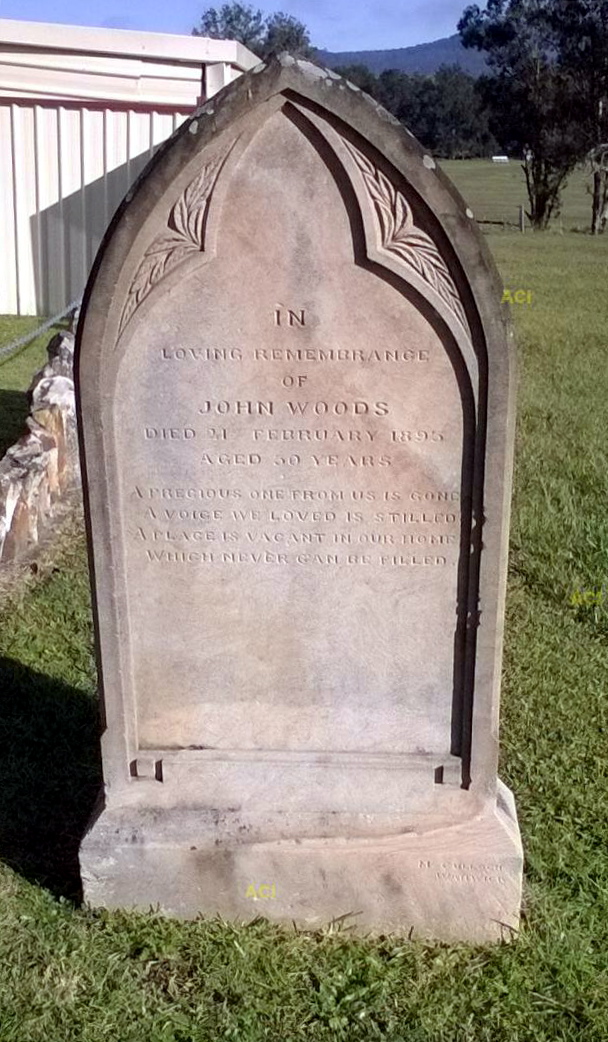
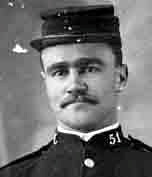
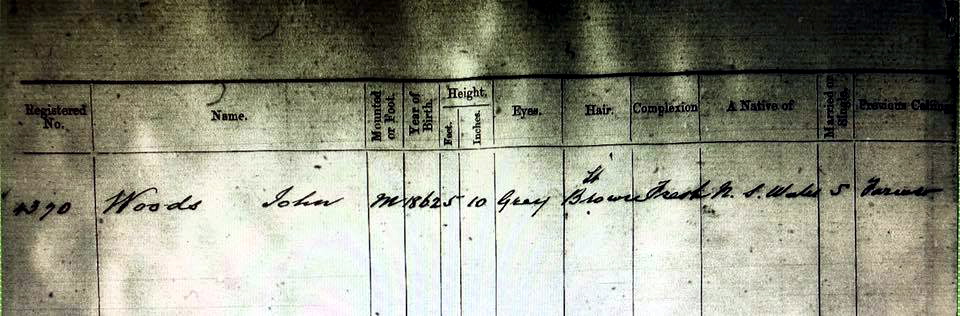

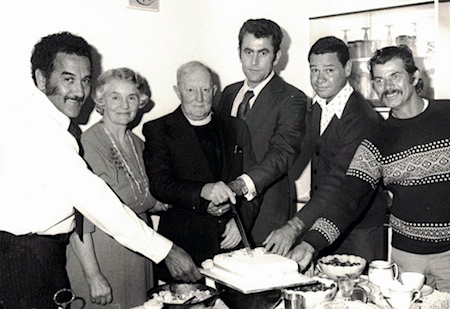
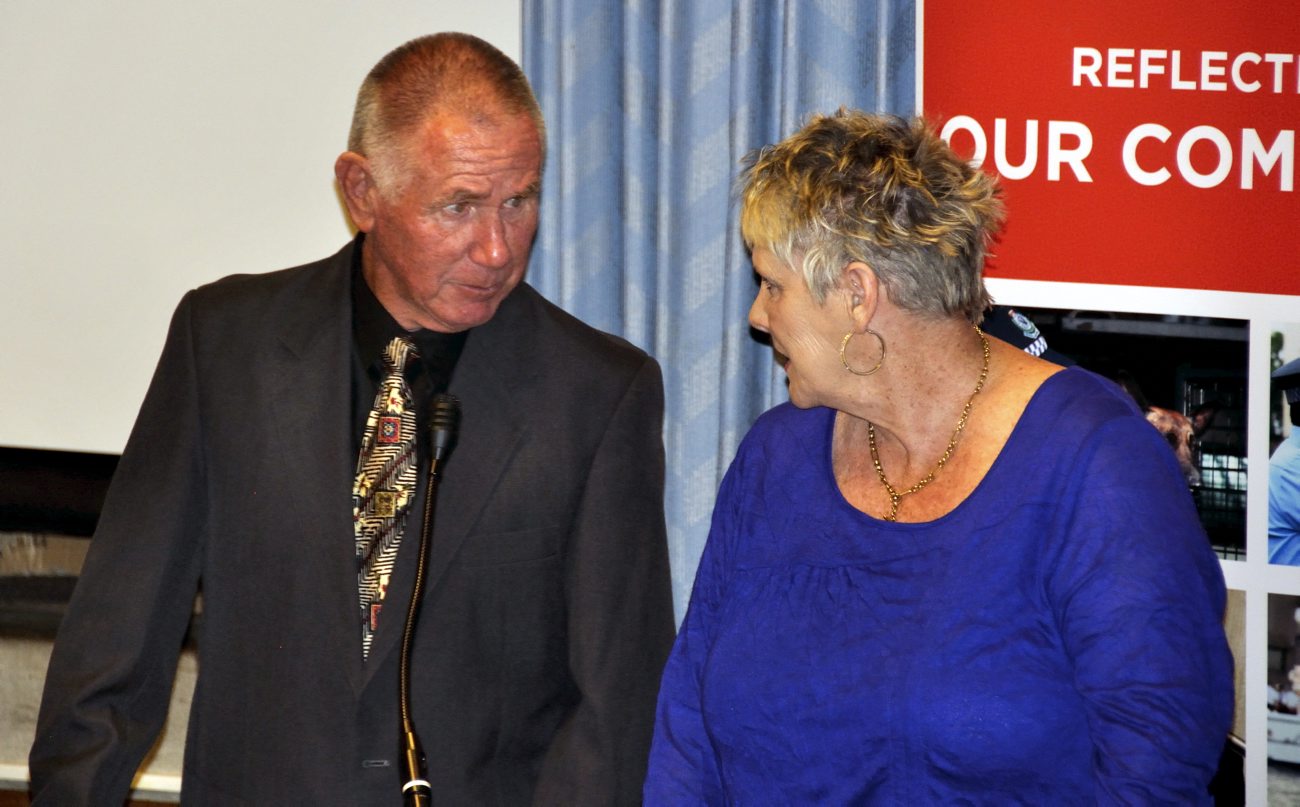


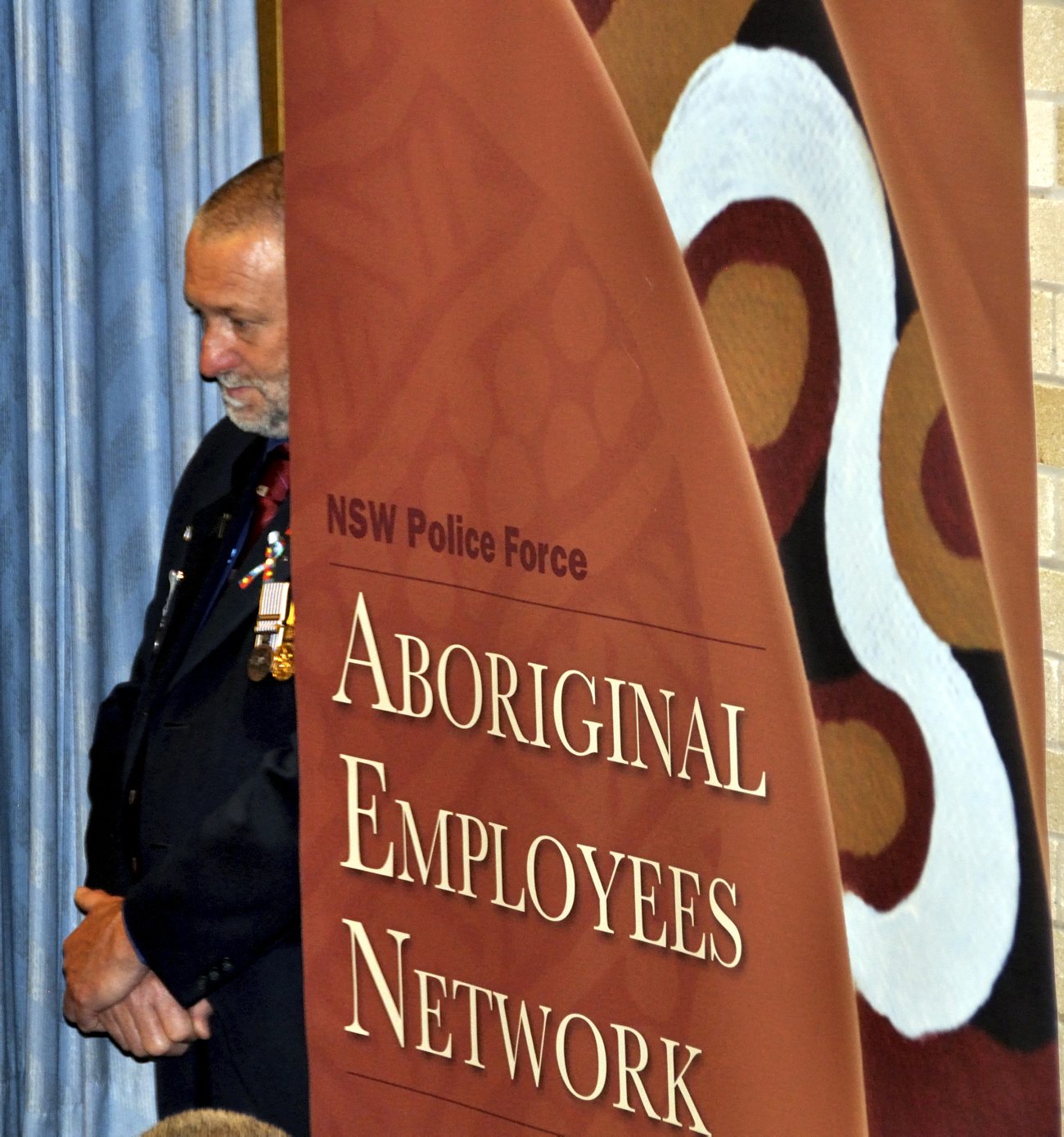


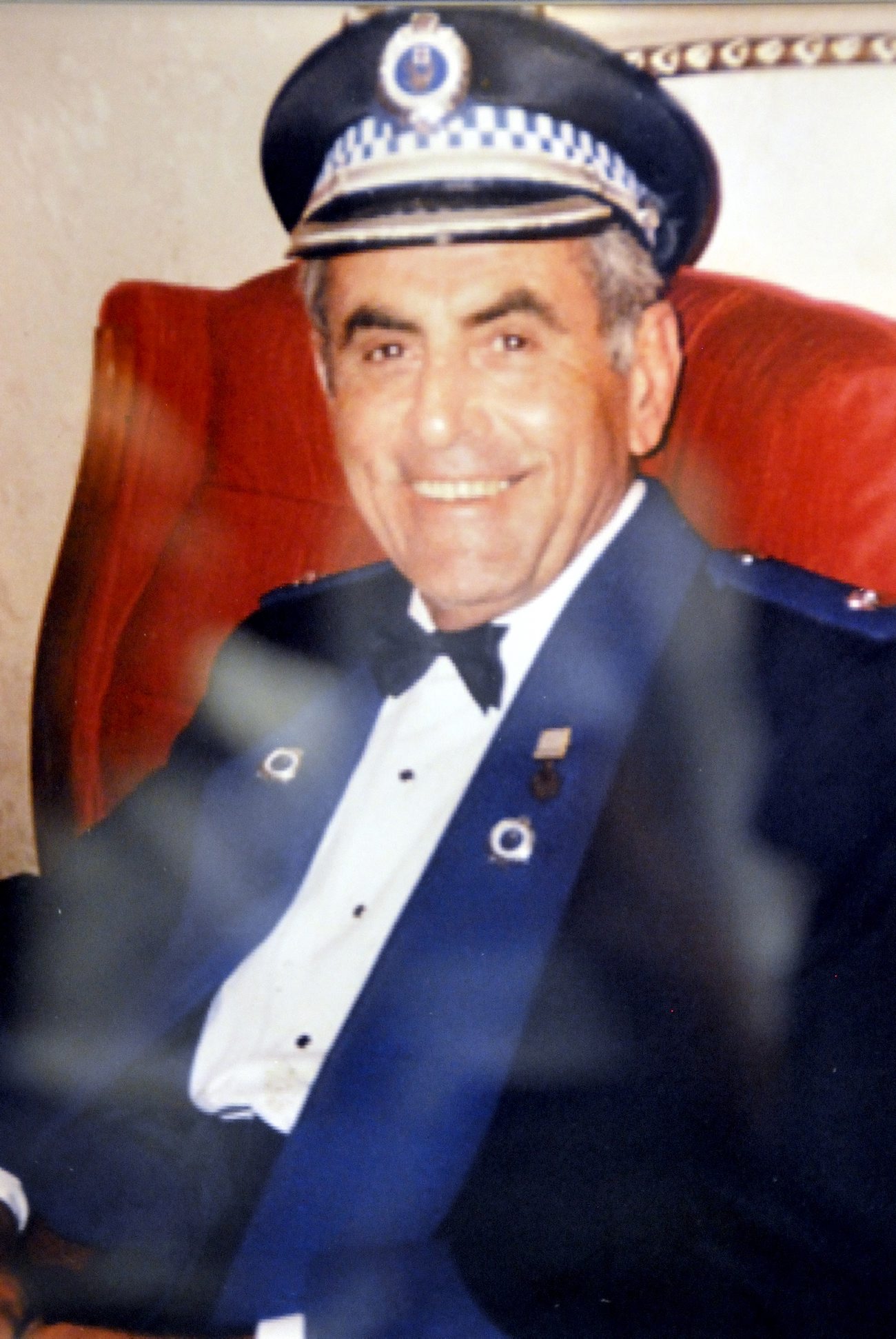
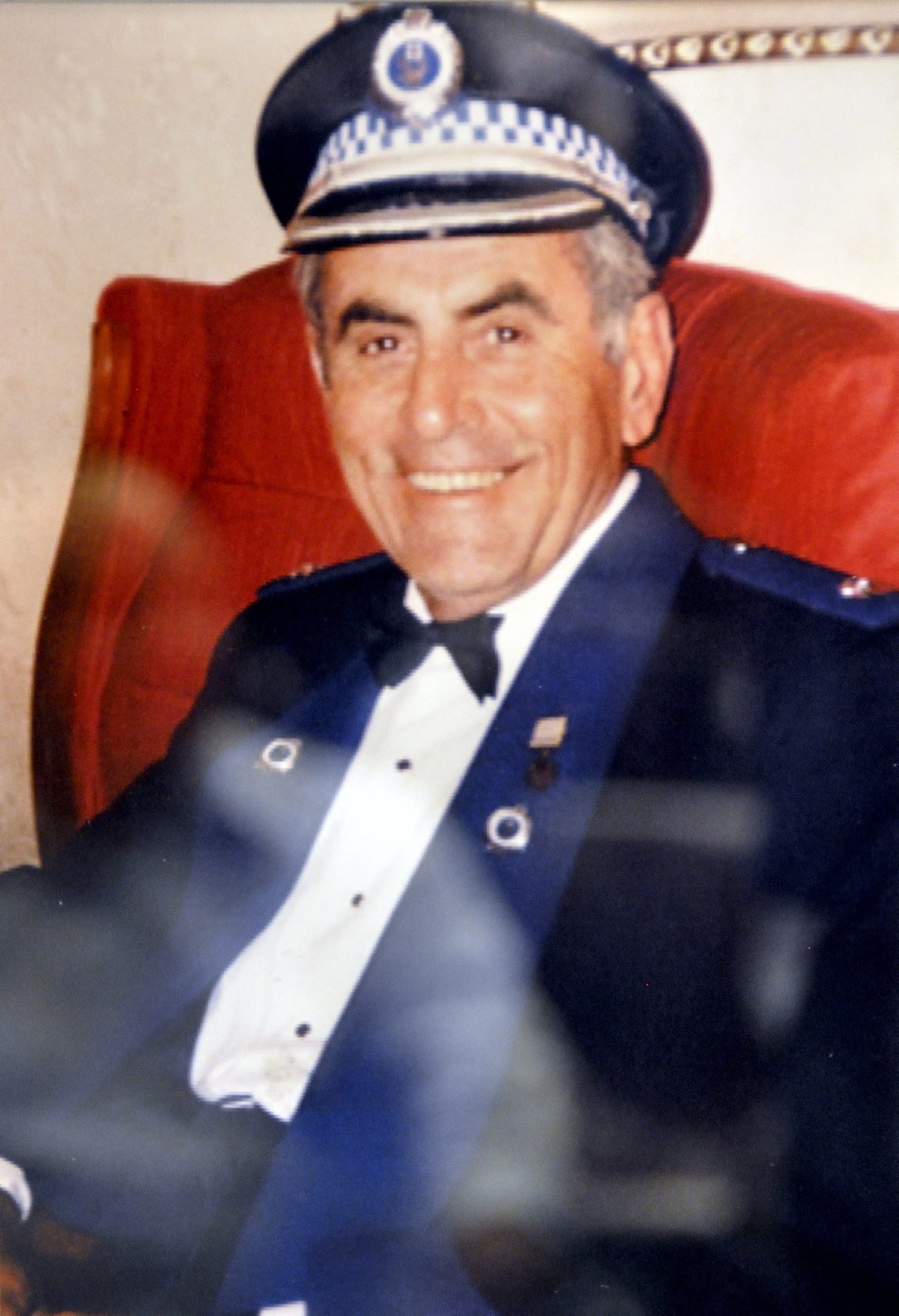


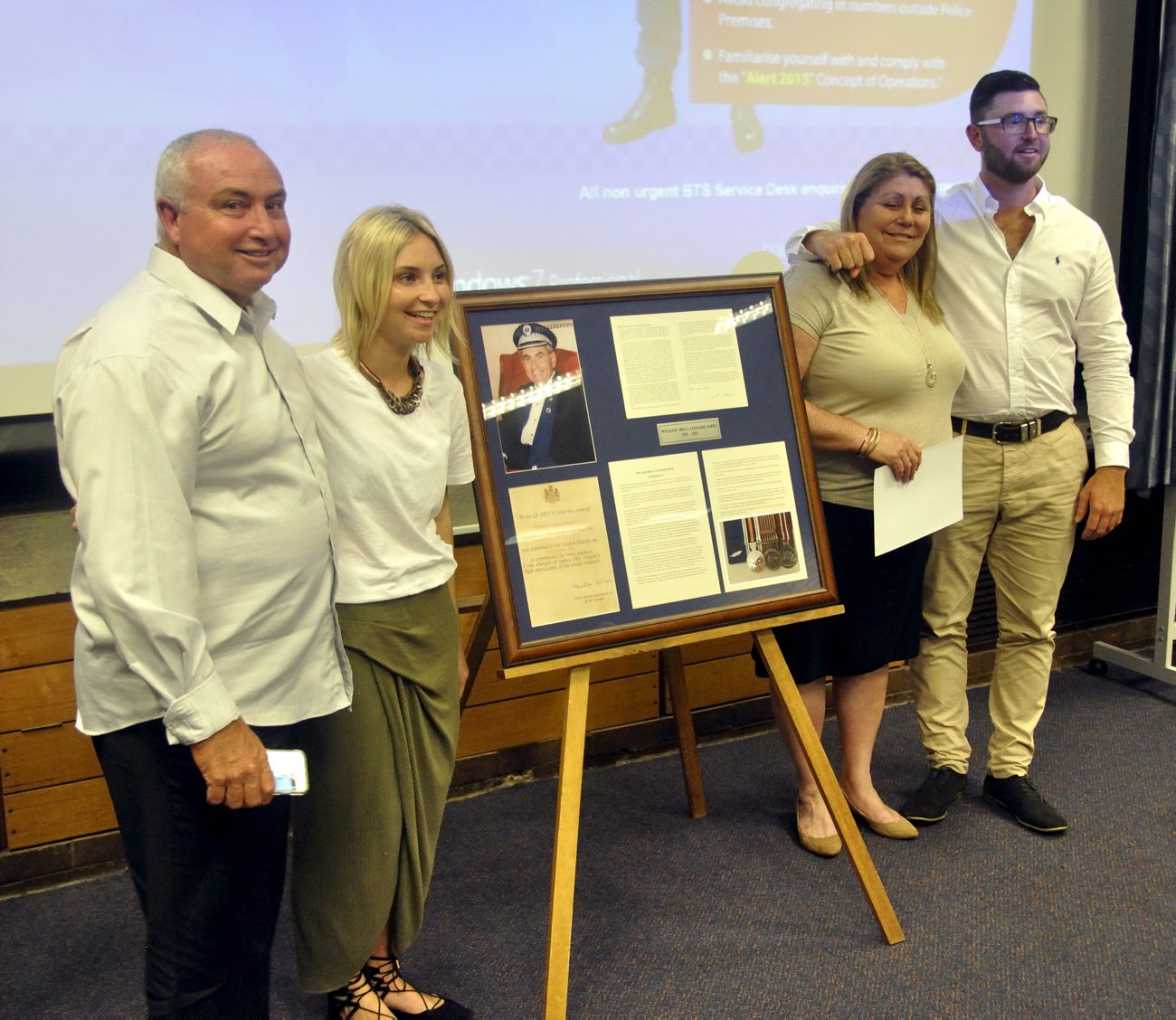


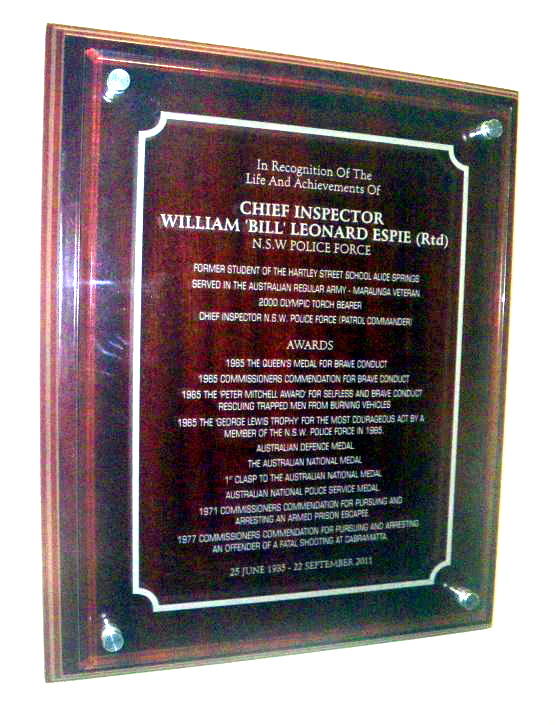
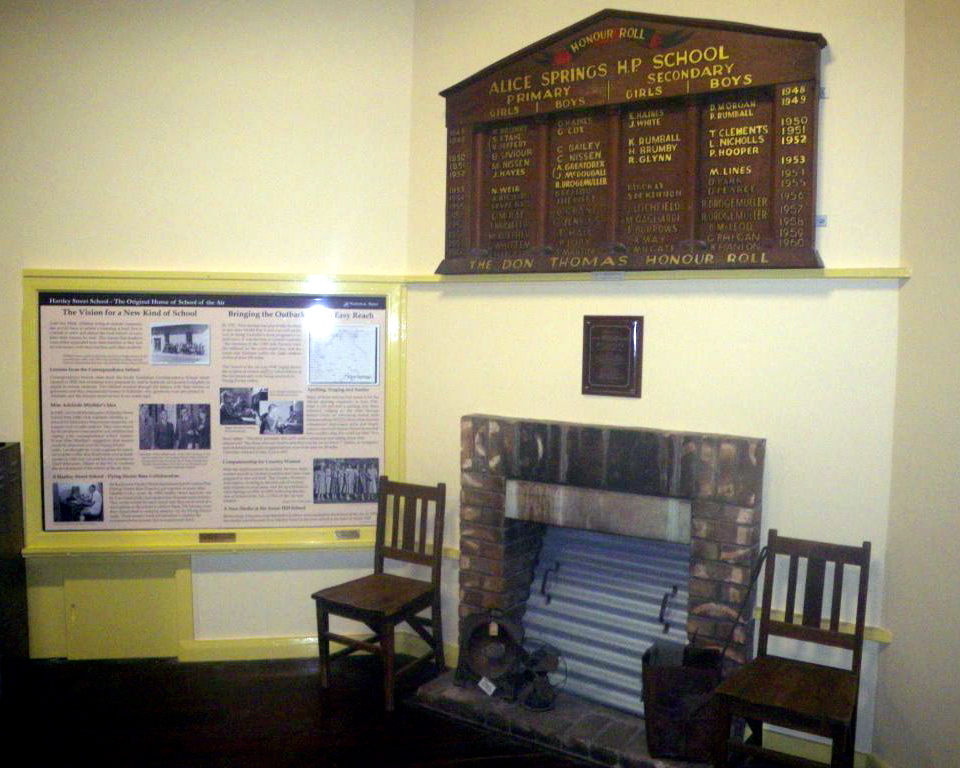
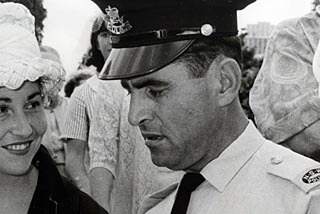
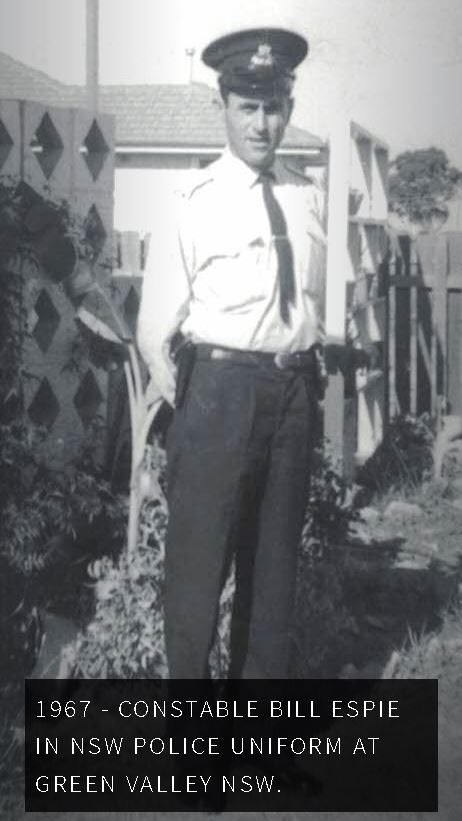
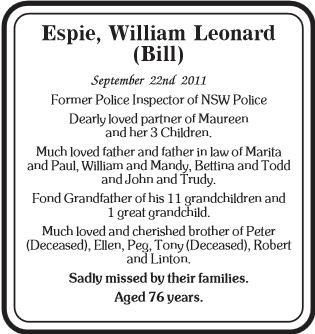
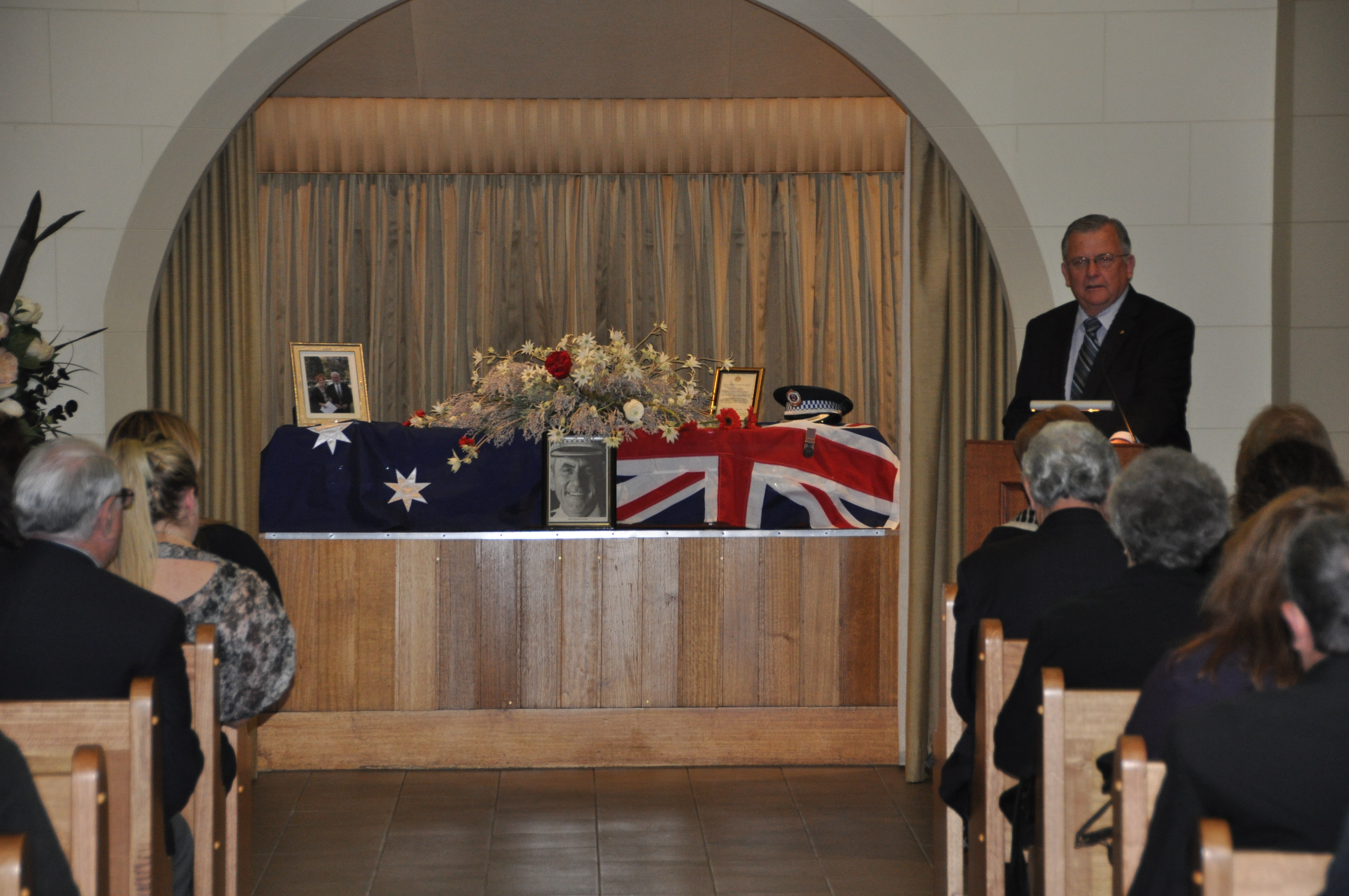
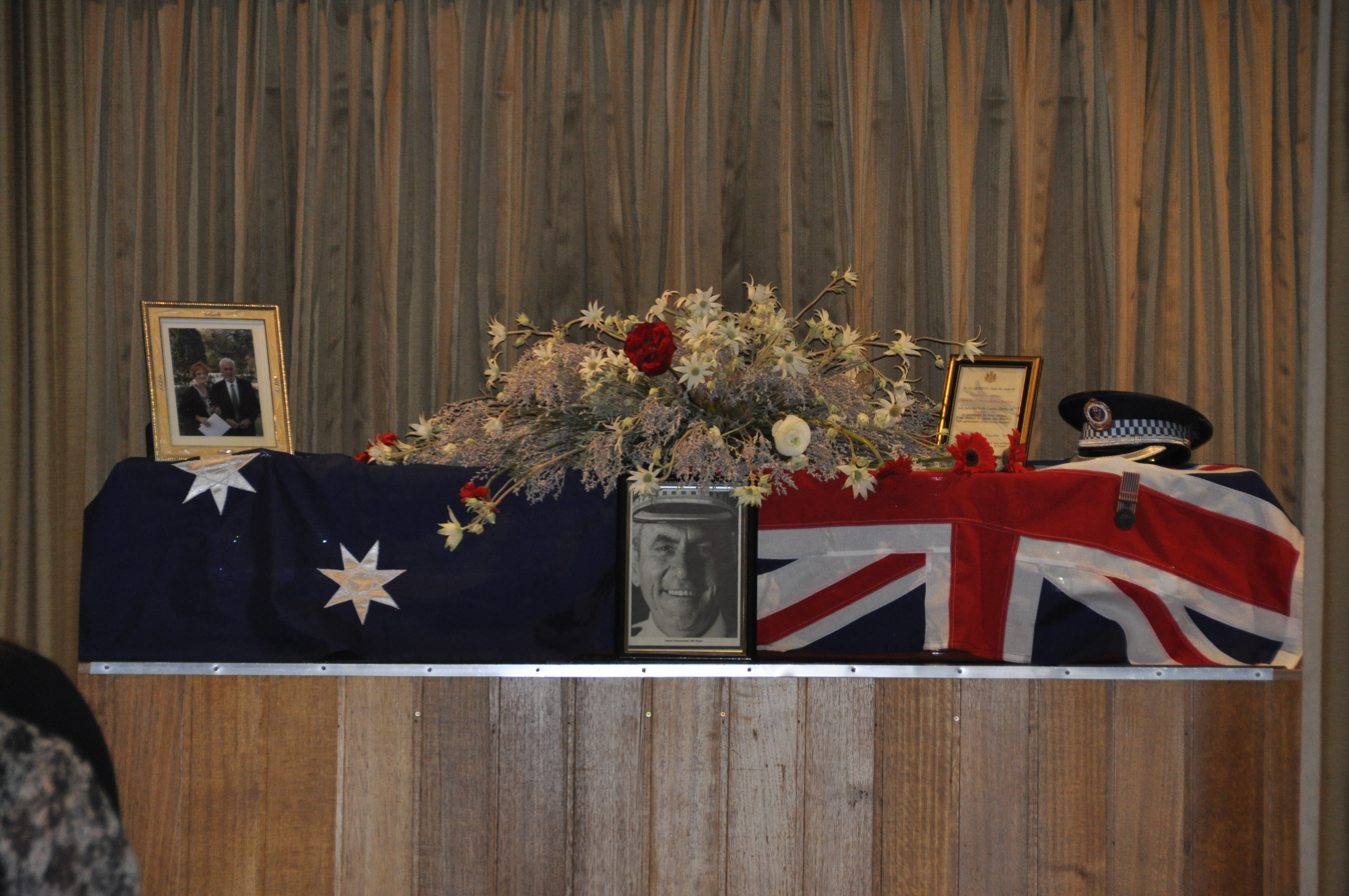
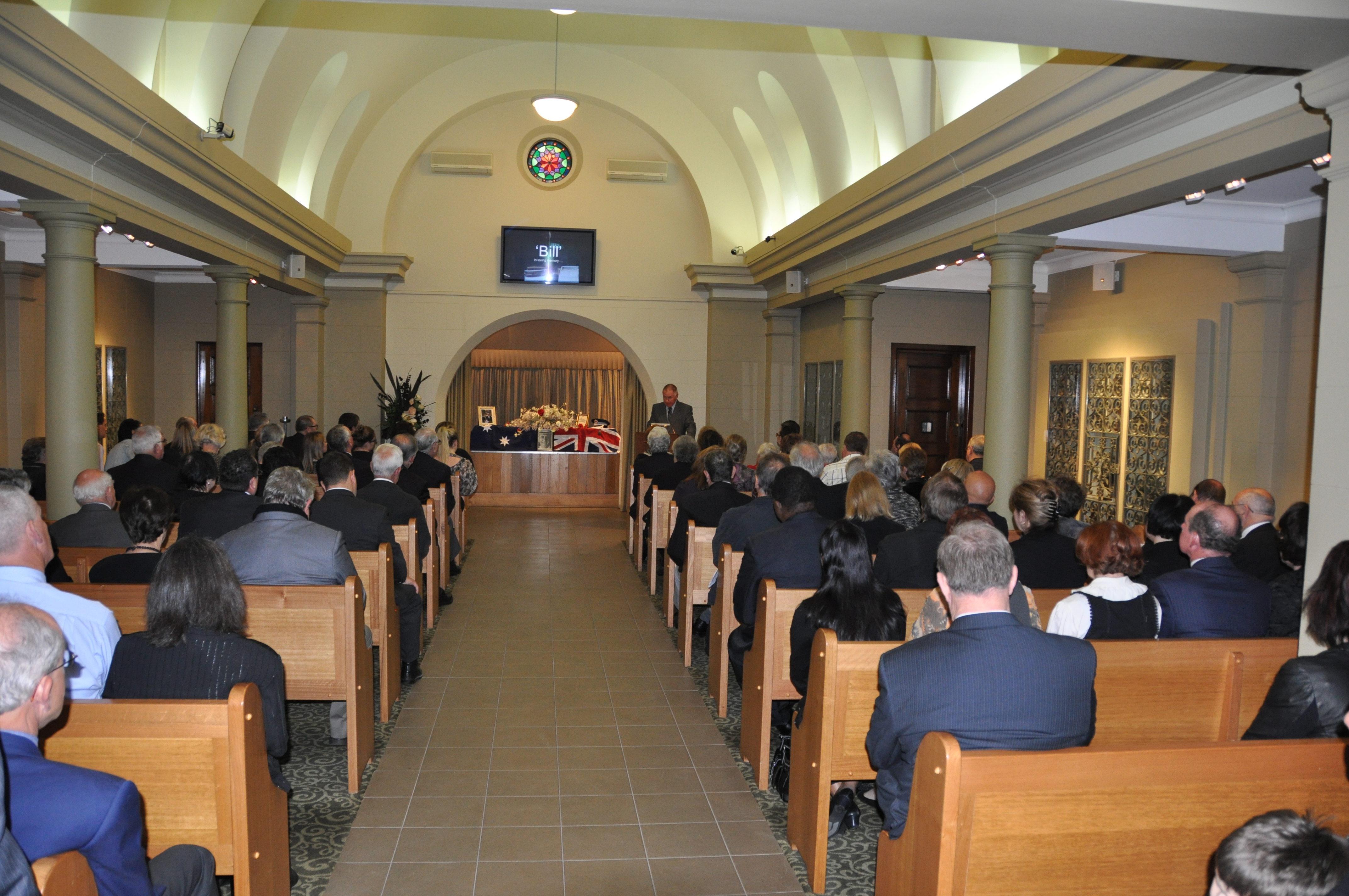
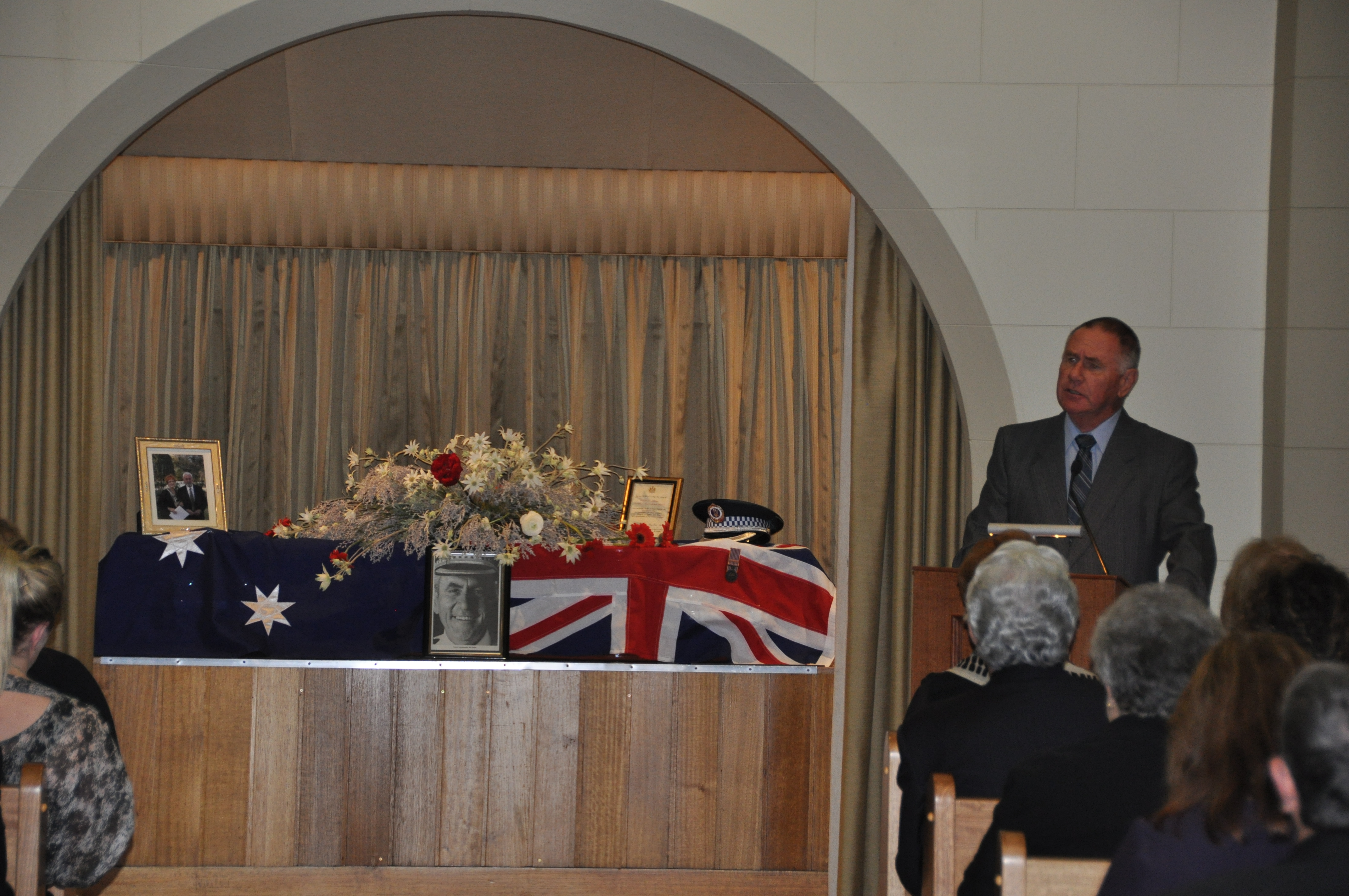
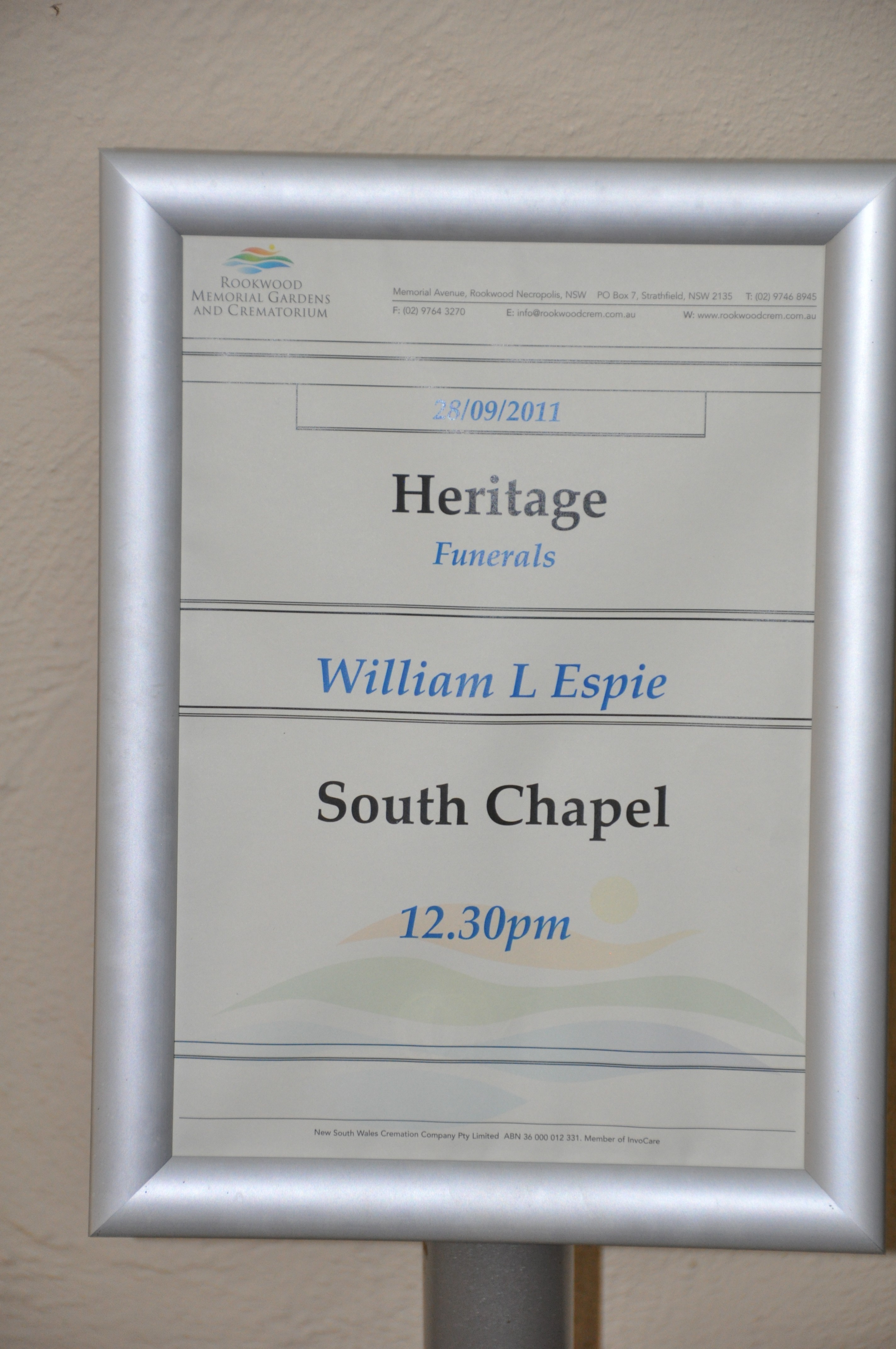
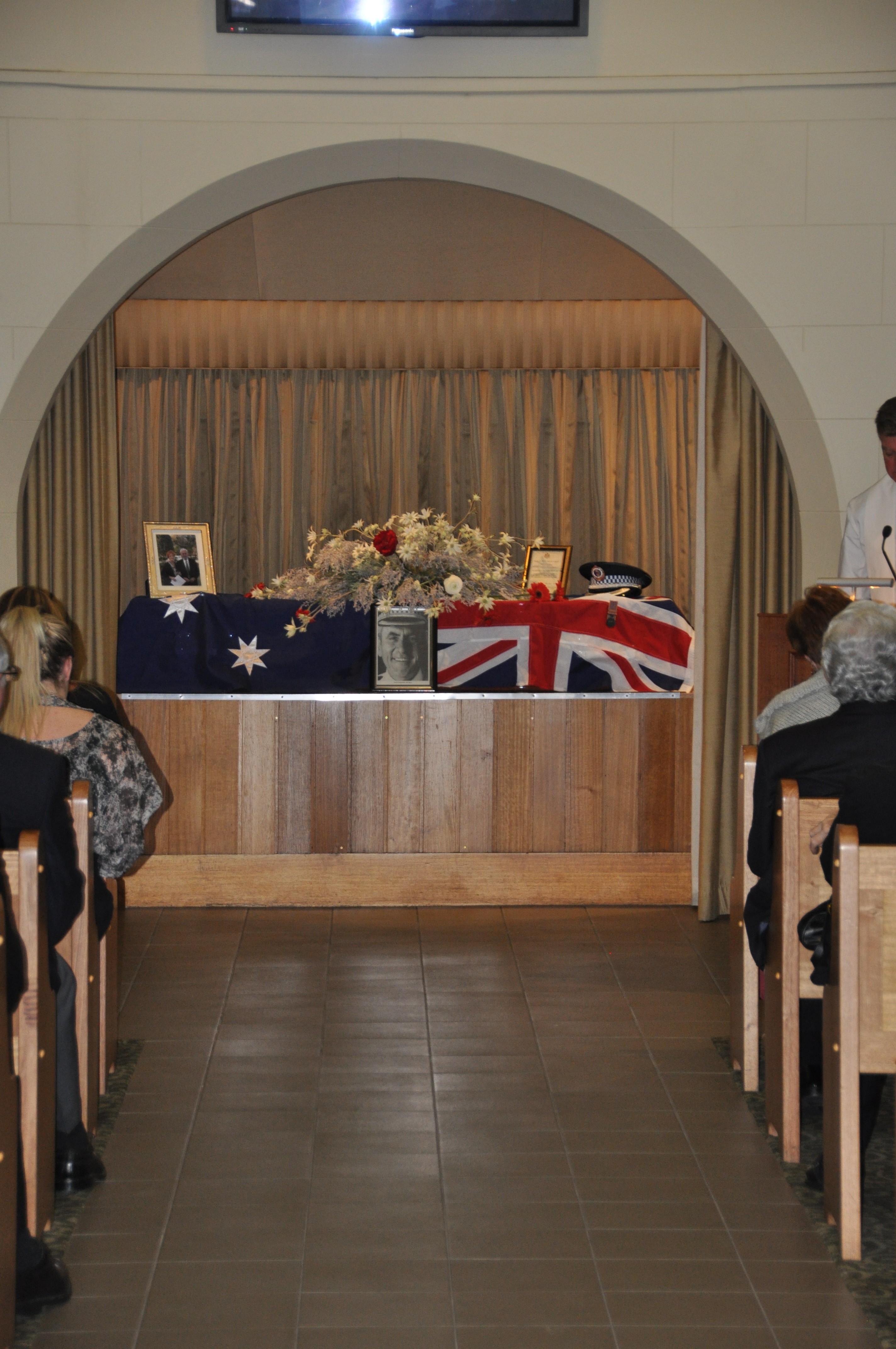
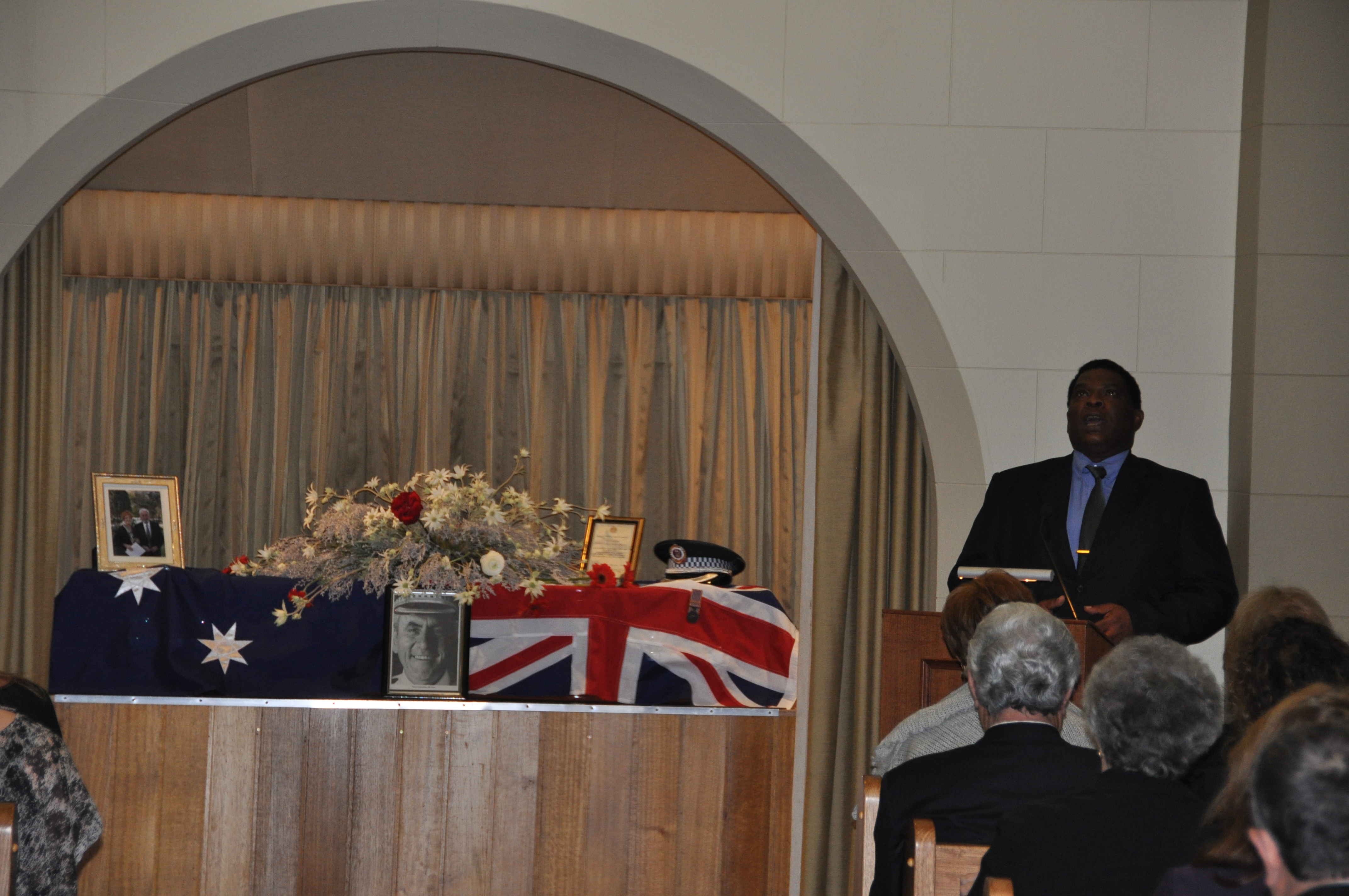
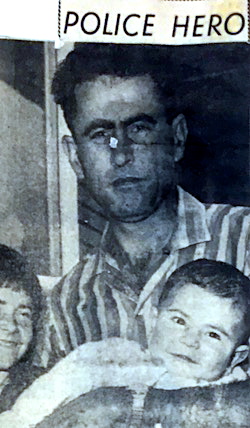

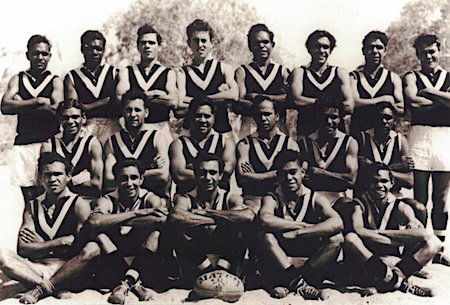
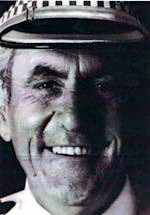
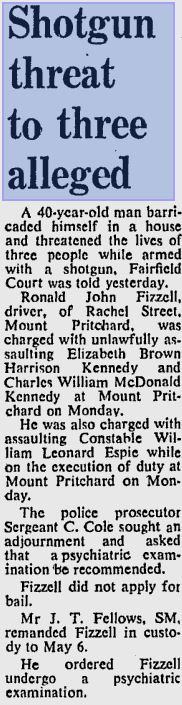
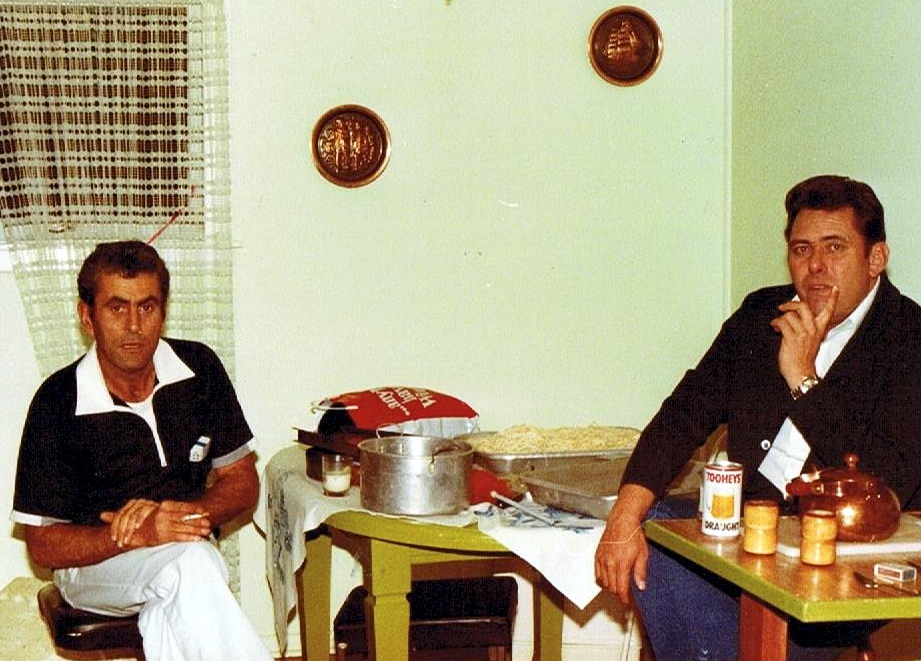
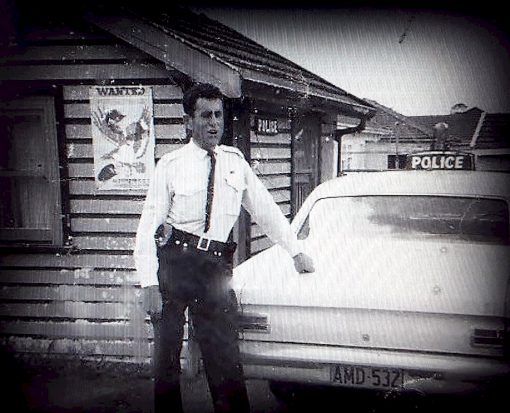
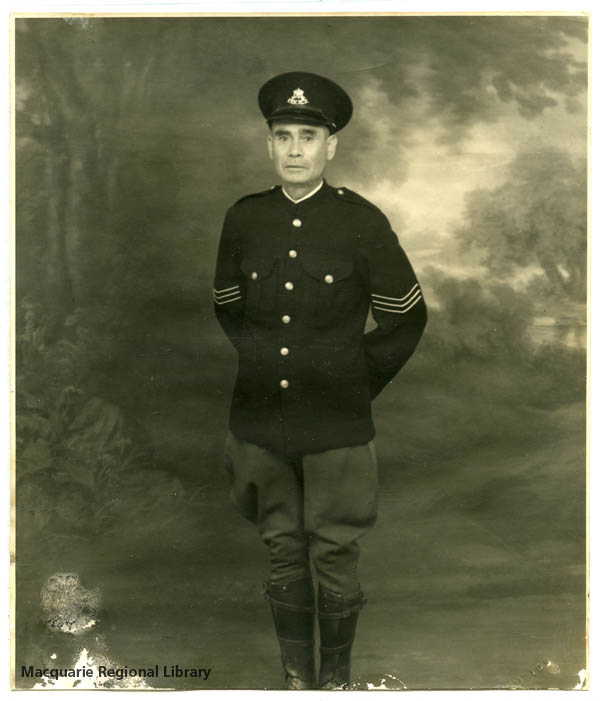


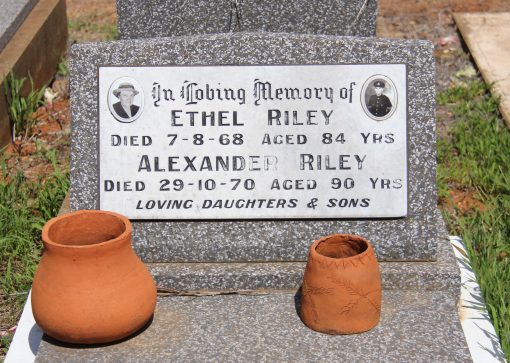
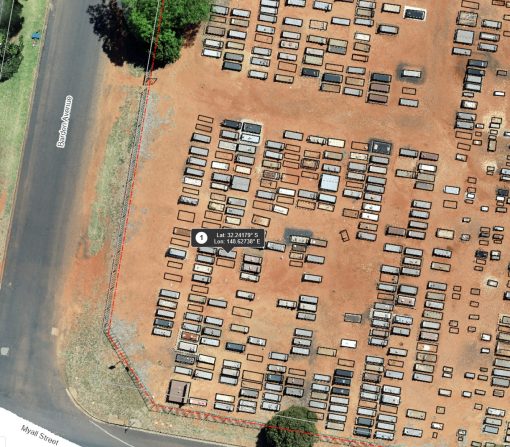
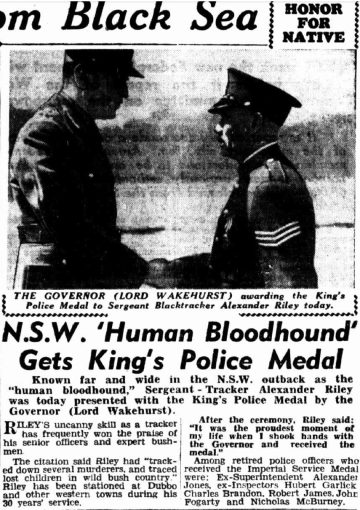

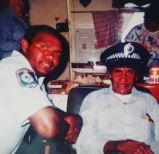
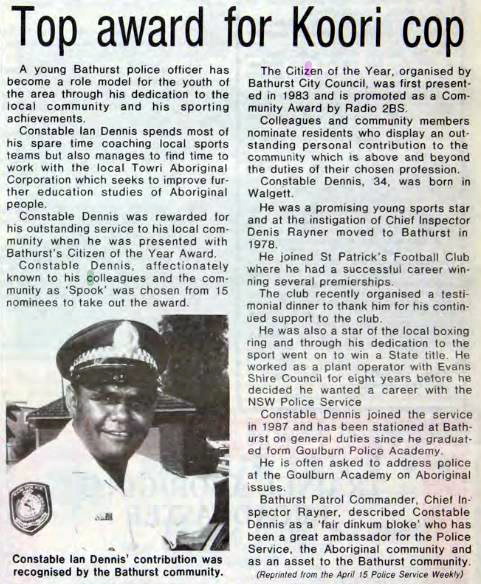
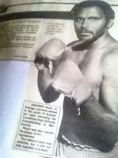

4 Comments (starting with the most recent)
NB: If you want to reply to a previous comment, start your comment with this notation: @n where n is the number of the comment you want to reply to.
Enjoyed this story and the footy team photo is great. Would love to know who some of the other players are – if anyone around town knows.
What a bloke. A life well lived.
Bill lived a life of service to the community. I think his own words are very strong: “My mother had a choice; bring me up herself in an environment which offered no more than a twenty percent chance of being successful, or to let me grow up under the watchful eye of Father Smith.”
What a great story, Father Smith did a lot for the local Indigenous people here in the Alice.
My brother was one who went to Adelaide, Peter Tilmouth.
All the boys taken, all became great mates.
The Espie family was well respected here in the Alice and what an honour to have this man Bill Espie recognised, letting others know of his achievements. A story worth mentioning.