Raymond Douglas MILLINGTON

Raymond Douglas MILLINGTON  


AKA Raymond MILLINGTON, Ray MILLINGTON  

* Nickname: Millo, Paddo    

Late of   ?  


Relations in ‘the job’   ?  


“possible” relation in ‘the job‘:  

S. MILLINGTON, NSWP ‘Q‘ 5073  ( 1885 )   ?   

J. MILLINGTON, NSWPF # 4898   ?   

W. MILLINGTON, NSWPF # 10007   ?   

L. MILLINGTON, NSWPF # 13086   ?   

J. MILLINGTON, NSWPF # 18069   ?   

Rod MILLINGTON, NSWPF # 25432   ?   

Ben MILLINGTON, NSWPF # 34892  ?  


NSW Police College, Penrith –  Class #    ?  ?  ?  

 2nd last Class to be Sworn In at the Penrith Police college, NSW  


New South Wales Police Force    


Regd. #   7642     


Rank:  Commenced Training at Penrith Police Academy on Monday 26 October 1953 ( aged   21  years,   5  months,   11  days )

Probationary Constable – appointed ? November 1953  ( aged   21  years,   months,   days )    

Constable – appointed   ? November 1954   

Constable 1st Class – appointed   ? October 1959   

Detective – appointed   ? October 1961   

Senior Constable – appointed  26 October 1964   

Leading Senior Constable – appointed   ? ? ?  ( N/A )  

Sergeant 3rd Class – appointed 1 January 1969  

Sergeant 2nd Class – appointed 31 January 1977  

Sergeant 1st Class – appointed   ? December 1979  

Inspector – appointed 26 May 1983   

Chief Inspector – appointed  6 November 1985   


Final Rank: =  Detective Chief Inspector   


Stations:  Daceyville ( 15 Division )( GDs )( ProCst ), Randwick ( 15 Division )( GDs ), Randwick ( 15 Division )( ‘A’ List ; precursor to becoming a Detective ),  Vice Squad ( Training )( Sept 1956 – Oct. 1958 ), Redfern ( 7 Division )( Relieving and Testing Duties )( Oct. 1958 – Feb. 1959 ), Paddington ( 10 Division )( C.I. Duties )( Feb. 1959 – Jan. 1961 ),  Liverpool ( 22 Division )( Dets )( Jan. 1961 – Jan. 1971  ),Merrylands ( 26 Division )( Dets )( Jan. 1971 – Mar. 1974 ), Fairfield ( 34 Division )( Dets )( Mar. 1974 – Dec. 1975 ), Central ( 1 Division )( Det )( Dec. 1975 – Jan. 1979 ), Hurstville ( 31 Division )( Dets – Divisional Det. Sgt )( Jan. 1979 – Jan. 1980 ), Bankstown ( 19 Division )( Det. Sgt 1/c )( Chief of Dets )( Jan. 1980 – Sept. 1981 ),  ‘ G ‘ District – Assistant to the Det. Insp. ( Sept. 1981 – June 1983 ), ‘ H ‘ District – District Detective Inspector – ( June 1983 –  ), Bureau of Crime Intelligence ( B.C.I. )( c1986 )( Det C/Insp ) – Retirement  


Service ( From Training Date ) period: From 26 October 1953      to       5 April 1988  ( optional Retirement )   =    34  years,    5  months,  10 days Service    

Time employed ( Paid ) with NSW PoliceFrom:  26 October 1953    to  5 April 1988 ( optional Retirement )    =     34  years,    5  months,  10 days Service    


 Time in Retirement from Police:     37  years,   3  months,  14  days    

Age at Retirement / Leaving: =     55  years,   10  months,  14  days    


Awards:  No Find on the Australian Honours system – however;  

won the Sir Robert Askin Memorial Award  

Commended for his part played in the search for Monica Schofield, missing from Heathcote Hostel from the 17th June, 1963, and in relation to inquiries which resulted in the arrest of her attacker, Barry Rodrick, and his subsequent conviction for murder.

Signed N. T. W. Allan. Commissioner of Police.

Raymond Douglas MILLINGTON 03 - NSWPF 7642 - Died 19 July 2025


 Born:   Sunday 15 May 1932   

Died on:  Saturday 19 July 2025   

Age:   93  years,   2  months,   4  days  


Organ Donor:  No – Age restrictive     


Cause Natural – Old Age  

Event location:     ?  

Event / Diagnosis date   ?  


Funeral date:  Thursday 31 July 2025 @ 12.30pm   

Funeral location:  South Chapel, Forrest Lawn Memorial Park, Camden Valley Way, Leppington, NSW

Liverpool PAC will provide an Official Police Guard of Honour


LIVE STREAM  can be found HERE    link expired before I had the chance to record it. 


Wake location:   ?  TBA  

Wake date:    ???


Funeral Parlour:   Simplicity Funerals, Bankstown, NSW


Buried at:     ?  


Grave LocationSection:          Row?         Plot

Grave GPS?,         ?  


Memorial / Plaque / Monument located at   ?  


Dedication date of Memorial / Plaque / Monument: Nil – at this time ( July 2025 )    


RAY is NOT mentioned on the Police Wall of Remembrance * NOT JOB RELATED    


FURTHER INFORMATION IS NEEDED ABOUT THIS PERSON, THEIR LIFE, THEIR CAREER AND THEIR DEATH.

PLEASE SEND PHOTOS AND INFORMATION TO Cal


May they forever Rest In Peace

https://www.facebook.com/groups/AustralianPolice.com.au/ 

https://www.facebook.com/groups/NSWFallenPolice/ 

Australian Police YouTube Channel


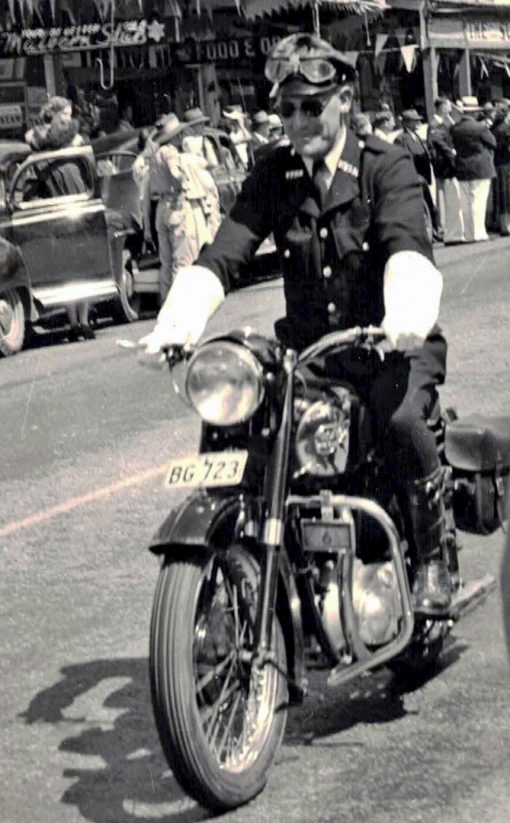
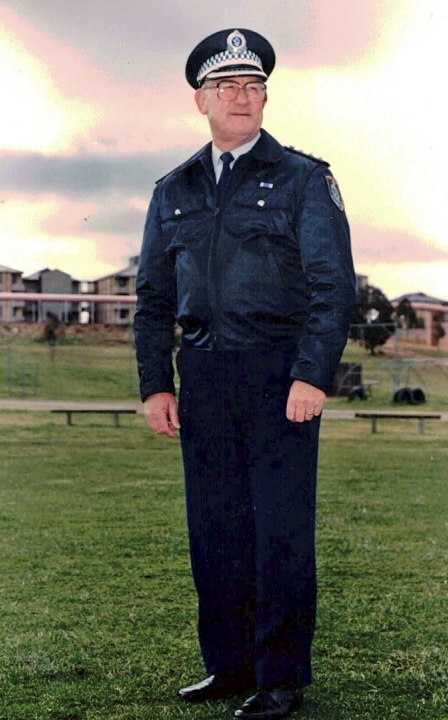
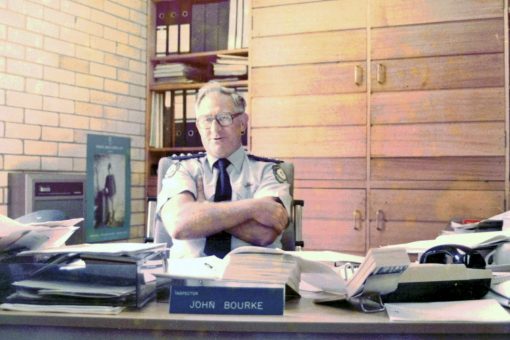
Raymond Douglas MILLINGTON 01 - NSWPF 7642 - Died 19 July 2025


Raymond Douglas MILLINGTON 02 - NSWPF 7642 - Died 19 July 2025


Ray was the President of the Cabramatta Golf Club for 7 years.

He was a well known sportsman, footballer and Policeman.


On Saturday, 19 July 2025, retired Chief Inspector Raymond Douglas Millington 93 , past away after a short illness.

Ray was an outstanding man! A very good detective, outstanding Policeman and accomplished athlete, he played 1st grade rugby Union for Easts, 1st grade rugby league for Easts, he was an excellent basket ball player and was in the graded finals for selection for the 1956 Olympics!

Ray was a man of old fashion principles and integrity, he excelled as a policeman, teacher and a friend.

Ray worked at Central Dets in the 70’s and at Bankstown in the late 70’s where he was the boss.
He was a man of wisdom, intelligence and compassion.

He recently was awarded a special commendation where he and 3 other persons were recognised as being the only sportsman too play 1st grade in 3 disciplines, rugby Union, rugby and AFL, on the Sydney Cricket Ground. An amazing feat for an amazing man.

Australia has lost a great Aussie!


1953 October: Liverpool Police Officer – Probationary Constable Raymond. D. Millington a former Driver’s Assistant, Cabinet Maker, Tally Clerk and Labourer entered the Police College at Penrith and commenced his Initial Training.

This was the second last class to be attested at the Penrith College.

Then four weeks later, in 11/1953 he was attested as a Probationary Constable and stationed at No. 15 Division (Daceyville) on General Duties.

In 5/1954 he was transferred to Randwick Police Station (a sub-station of No. 15 Division) on General Duties, and after a short time he went onto the ‘A’ List, where in 10/1954 he was promoted to the rank of Constable.

In those days a prospective Detective was transferred either to the Vice Squad or No. 21 Division for Criminal Investigation Training.

In 9/1956 he was transferred to the Vice Squad. In 10/1958 he was transferred to No. 7 Division (Redfern) on Relieving and Testing Duties.

In 2/1959 he was transferred to No. 10 Division (Paddington) on Criminal Investigations, where in 10/1959 he was promoted to the rank of Constable 1/c.

Then in 1/1961 he was transferred to No. 22 Division (Liverpool) on Criminal Investigation Duties, where in 10/1961 he was designated a ‘Detective’. Around this
period Liverpool stretched from Guildford to Bargo, and the Police Station located within No. 22 Division were Liverpool (Head Station), Fairfield, Cabramatta, Guildford, Ingleburn, Campbelltown, Camden, The Oaks and Picton.


1961 January: Liverpool Police Officer – Detective Constable 1/c. Raymond D. Millington was transferred to No. 22 Division (Liverpool) on Criminal Investigation Duties, where in 10/1964 he was promoted to the rank of Detective Senior Constable.

In 7/1968 he was one of the Criminal Investigators involved in investigating the Wally Mellish Glenfield Siege.

In 1/1969 he was promoted to the rank of Detective Sergeant 3/c.

In 1/1971 he was transferred to No. 26 Division (Merrylands) on Criminal Investigation Duties.

In 3/1974 he was transferred to No. 34 Division (Fairfield) on Criminal Investigation Duties.

In 12/1975 he was transferred to No. 1 Division (Central) on Criminal Investigation Duties, where in 1/1977 he was promoted to the rank of Detective Sergeant 2/c.

In 1/1979 he was transferred to No. 31 Division (Hurstville) at the Divisional Detective Sergeant, where in 12/1979 he was promoted to the rank of Detective Sergeant 1/c.

In 1/1980 he was transferred to No. 19 Division (Bankstown) as the Divisional Detective Sergeant.

In 9/1981 he was transferred to ‘G’ District as the Assistant to the Detective Inspector, where in 5/1983 he was promoted to the rank of Detective Inspector.

In 6/1983 he was transferred to ‘H’ District as the District Detective Inspector.


SourceLiverpool Police History time line by Joe Stanioch.


Bankstown Detectives: Back Row ( L - R ) Det SenCon E. HAWRYSIUK, P.C.Cst 1/c I.B. KEENAN, P.C. SenCon STANIOCH, Det SenCon M.A. DONOVAN, P.C. Cst 1/c M. P. McGANN, Det SenCon U. BRAMANN, Det SenCon G.C. PRENTICE, Cst 1/c R.N. RYAN. Second Row ( L- R ) P.W Det SenCon M.A. WESTAWAY, Det SenCon Trevor Lyle BEAUMONT # 14058, P.C. Cst G.Md. ABEL, P.C. Cst 1/c J. KHALIFEH, P.C. Cst A.J. BICKHOFF, Det SenCon A.A. TOWNSEND, P.C. SenCst K.J. PLATT, P.C. Cst 1/c TUNNICLIFFE, P/W Cst 1/c G. M. LAPHAM. Front Row ( L - R ) Det Sgt 3/c A.R. LYTHALL, Det Sgt 3/c W. J. HADLEY, Det Sgt 3/c R.F. WEBSTER, Det Sgt 2/c R.N. MURRAY, Det Sgt 1/c R.D. MILLINGTON, Det Sgt 3/c R.E. LYNCH, Det Sgt 3/c J.D.G. BARTLETT, Det Sgt 3/c M. COUGHLIN.

Bankstown Detectives: C1979

Back Row ( L – R )
Det SenCon E. HAWRYSIUK, P.C.Cst 1/c I.B. KEENAN, P.C. SenCon Joe STANIOCH, Det SenCon M.A. DONOVAN, P.C. Cst 1/c Michael P. McGANN # 16758, Det SenCon Ulrich BRAMANN # 14184, Det SenCon G.C. PRENTICE, Cst 1/c R.N. RYAN.

Second Row ( L- R )
P.W Det SenCon M.A. WESTAWAY, Det SenCon Trevor Lyle BEAUMONT # 14058, P.C. Cst G.Md. ABEL, P.C. Cst 1/c J. KHALIFEH, P.C. Cst A.J. BICKHOFF, Det SenCon A.A. TOWNSEND, P.C. SenCst K.J. PLATT, P.C. Cst 1/c TUNNICLIFFE, P/W Cst 1/c G. M. LAPHAM.

Front Row ( L – R )
Det Sgt 3/c Allan R. LYTHALL # 9291, Det Sgt 3/c W. J. HADLEY, Det Sgt 3/c Ray F. WEBSTER # 10213, Det Sgt 2/c R.N. MURRAY, Det Sgt 1/c Ray D. MILLINGTON # 7642, Det Sgt 3/c R.E. LYNCH, Det Sgt 3/c J.D.G. BARTLETT, Det Sgt 3/c M. COUGHLIN.


The Glenfield Siege, 50 years ago….
In July 1968, small-time criminal Wally Mellish held his girlfriend Beryl Muddle and her child hostage in a fibro house in Sydney’s southwest. The bizarre turns of the eight-day siege captured the attention of Australians and made headlines around the world.
THE SYNOPSIS: Small-time criminal Wally Mellish, 22, was living in a house in Glenfield Road with his girlfriend Beryl Muddle, 19, and her 11-week old son when police arrived to talk about local car thefts.
Mellish told them to “go to hell”, fired a shot in the air and for the next eight days the house was surrounded.
Mellish forced Police Commissioner Norman Allan to arrange for his wedding to Beryl and to be best man. Allan provided the ring and the police canteen the wedding breakfast. Mellish forced police to give him an Armalite rifle and ammunition.
When the siege ended Mellish was taken by Commissioner Allan to Ingleburn Army Camp to enlist for service in Vietnam but he was rejected and committed to Morisset Psychiatric Hospital. No charges were ever laid. The marriage was annulled.
DAY ONE: July 2, 1968: On a cold winter’s morning local detective Ray Millington knocked on the door of the fibro cottage to talk to Mellish about car thefts. He was told to “go to hell” and a shot was fired.
Riot Squad police surrounded the house. Mellish threatened to kill Beryl and the child and more shots were fired. Detective Superintendent Don Fergusson, chief of the CIB, and Long Bay Jail chaplain the Rev Clyde Paton negotiated a truce.
Earlier, a detective in the house talking to Mellish was ordered out by Commissioner Allan when he phoned to talk to Wally.
DAY TWO: Commissioner Allan took personal charge and organised the wedding of the year. He got special dispensation to avoid the statutory seven-day waiting period. Rev Paton married Wally and Beryl with Allan as best man and Fergusson as a witness. Allan brought five rings so one would fit.
The mobile police canteen provided a curry wedding breakfast washed down with Coca-Cola. Mellish laid down his weapons for the wedding but Allan and Fergusson honoured their promise and didn’t grab him. The world began to follow the Glenfield Siege.
DAY THREE: Allan admitted to astonished pressmen that Mellish had been given an Armalite rifle and 200 rounds of ammunition because he wanted to match the fire-power of the police. Allan denied he was a hostage, claiming Mellish threatened the life of his wife and child. Police also gave Mellish food and a radio. Allan said Mellish claimed to have hand grenades and this was supported by Beryl.
DAY FOUR: Police stopped serving food to Mellish but continued to provide for the child. Plans to dope Mellish’s food were ruled out. Mellish would only communicate with Rev Paton. The use of tear-gas was ruled out because of the effects on the baby.
DAY FIVE: Mellish again refused food and cigarettes as police tried to wait him out. Police Association began to question handling of the siege by Commissioner Allan. Power to the house was cut and searchlights installed.
DAY SIX: As the waiting game continued, police defied orders and rained rocks on the tin roof of the house. “If we have to be awake so does he,” one detective said. Riot police were openly contemptuous of Mellish reading papers in full view of the siege house. Dr Tom Lonie, superintendent of Morisset Hospital where Mellish had been a patient, spoke to him.
DAY SEVEN: Mellish reported to be twice on the verge of surrendering after telephone talks with Rev Paton but was still in the house at the end of the day. Police Association censured Commissioner Allan for handing over the Armalite rifle.
DAY EIGHT: After 174 hours, on a sunny afternoon at 3.09 pm. Wally and Beryl walked out of the house with the baby. Wally went to Ingleburn and then to Morisset in Allan’s car. Police and press packed their gear and Glenfield returned to its quiet state.
THE AFTERMATH: The next day Beryl announced she was seeking to annul the wedding. Commissioner Allan, Rev Paton and Superintendent Fergusson were decorated for their bravery. Rev Paton moved into obscurity


^     ^     ^     ^    


Glenfield Siege. Liverpool Police attended premises in Glenfield Rd, Glenfield, the home of Wally Mellish (23old), to enquire about some stolen car parts and also execute an arrest warrant for car theft, initiating the siege.

After Detective Raymond Millington from Liverpool knocked on the front door he was told to “go to hell” and Mellish fired a shot in the air and the house was then surrounded for the next eight days.

NSW Police Commissioner Norman. T. W. Allan personally negotiated with a petty criminal Wally Mellish who defied police in a siege by holding his girlfriend Beryl Muddle and their 11 week old baby as hostages.

Having persuaded Mr Allan to arrange his marriage to Beryl and to provide the wedding ring and the feast, Mellish refused to surrender as promised.

Mr Allan acceded at gunpoint to the Mellish demand to be furnished with an Armalite rifle and 200 bullets.

The marriage celebrant Rev Clyde Paton persuaded Mellish to surrender 5 days later.

He was sent to the Morisset Mental Hospital. Soon after release from the Hospital, Mellish was arrested for demanding money with menaces, in an unrelated matter, and subsequently jailed for 3 years.

Detectives who complained about not been able to arrest Mellish following the siege were transferred to Uniform Duties by the Commissioner.

Commissioner Allan rewarded himself and Rev Paton with the Queen Medal for Bravery.

No charges were ever laid, and the marriage was annulled.

^     ^     ^     ^


Former Liverpool Police Officers – Detective Inspector Raymond. D. Millington was the Detective Inspector at ‘H’ District Office. He and Detective Chief Inspector Jim Loomes were chosen to commence an investigation into allegations of corruption ( bribery for early prisoner releases ) by former NSW Corrective Services Government Minister Rex Jackson.

Their initial investigation later lead to a Royal Commission, which resulted in Jackson’s conviction in 9/1987 and serving a term in prison. He was released from prison in late 1990. The Royal Commission also exposed a number of other high profile persons acting corruptly.


^    ^    ^    ^


Scholastic Achievement: Sir Robert Askin Memorial Award. This award was presented annually for attainment during the Senior Police Course. Detective Inspector Raymond. D. Millington, who was attached to the Bureau of Crime Intelligence at the time, was the recipient.


SourceLiverpool Police History time line by Joe Stanioch.


The three-code pioneer who paved the glittering path for Folau and Hunt

Footy fans everywhere are familiar with the code-hopping stories of Israel Folau and Karmichael Hunt. But the pair were beaten in playing all three football codes by a Sydney policeman sixty years earlier.

Ed Carmine


It was a balmy Brisbane night. The kind of night that has citronella candles flickering right along the river.

Israel Folau knew the kind well, never once batting his eyelids as the Lang Park crowd milled around him, many still in singlets and thongs.

But while the multi-million-dollar dynamo was on familiar ground, he was entering new territory. All 102 kilograms of him.

With two seasons as a Brisbane Bronco already under his belt, Folau’s bus ride down Caxton Street that night was filled with a smorgasbord of familiar sights and sounds. Maroon-clad fanatics downing mangos in the swamp. Saturday night specialists sipping on whiskey apples at Lefty’s. The riff-raff congregating suspiciously outside of Honey B’s.

Only this time, none of the locals would be cheering his name. Even if every last one of them had turned up, and paid up, to see him.

Sweaty shoulder to sweaty shoulder, 35,081 made their way through the Lang Park turnstiles on the 23rd of February, 2013. 35,081 were on hand to witness history.

Or so they had been told.

Spruiked as the first man to play Australian rules football, rugby league and rugby union at the highest levels possible in this country, Folau made his return to Suncorp Stadium after 905 days. His hand poised to re-write the history books.

Despite earning detractors along the way, the gravity of the then-33-year-old’s achievement couldn’t be understated. Folau’s ability to hop from the Melbourne Storm to the Broncos (NRL), then over to the GWS Giants (AFL) and jump into place with the New South Wales Waratahs (Rugby Union) had kids weaving several dreams into a singular naptime.

No longer were aspirations of becoming a Kangaroo, a Wallaby, or an All-Australian mutually exclusive.

Two years on from his rugby union debut, Folau would be joined in this rare club by Karmichael Hunt, after the Auckland-born, Australian representative made his way from Brisbane to Biarritz, then to the Gold Coast Suns and onto the Queensland Reds’ roster in 2015, all while changing gears – and gear – with relative ease.

Yet, for these Polynesian superstars to stake their claim across all three codes, earning a chance to stroll contentedly down streets paved with gold, their path first needed paving.

For eight years, footy fans from all three codes have been under the impression that Folau was the first man to spin a Steeden, shoot a Sherrin, and grab a Gilbert professionally, to be paid for the honour.

But what if this collective belief was wrong?

What if the history books had been etched incorrectly?

What if we told you that more than six decades ago, it took a Sydney copper to sprint, so Folau and Hunt could stroll?

As the maxim goes, truth is often stranger than fiction. But for Raymond Douglas Millington, this strange truth is his life’s work.

Not that many had noticed.

Unless you are a nonagenarian that packed scrums around suburban Sydney, chased leather in inner Melbourne, or featured in the Harbour City’s first-grade competition during the 1950s, it is unlikely you have ever heard the name, Ray Millington.

However, for the vast uninitiated, the New South Welshman – all 76 kilograms of him – became the first name to sit at the table of three when he completed the trifecta way back in 1957.

A feat completed to absolutely no acclaim.

Take a beat and check out Ray’s entry in any edition of The Encyclopedia of AFL Footballers. You will find it is only marginally larger than a jelly baby. Folau and Hunt’s by comparison? Theirs are more like mini Mars bars.

“I’ve had a pretty colourful sporting career,” Millington wryly told Zero Hanger from his home in Sydney’s West.

Now less than a month shy of his 91st birthday, and over 63 years since he hung up his boots for good, Ray Millington no longer moves like the whippet-like competitor he once was.

“I’m getting old. I say that every day and I don’t like it very well, but it creeps up on you and you have no alternative,” he admitted through a fatigued drawl.

“Don’t rush yourself, mate. It’s all I can say to you.”

But as whippet-like competitors of any age are prone to, Ray still has plenty to say.

Precursor to Pendles

You could be forgiven for believing that for someone to play VFL football, top-grade rugby union and pull on the Sydney Roosters‘ famous Tricolours in one lifetime, they must be a near-supernatural entity, an all-conquering athlete touched by the gods themselves.

Part Scott Pendlebury, with a touch of James Tedesco, and just a sprinkle of Roy Hobbs in there for good measure. What most would call a natural.

However, if you took the short odds to back Millington in as the most gifted galloper in the race, the bookie would be holding your hard-earned. That ticket would be worthless.

“No, no, no,” Ray rebuffed. “I was never a natural. I had to work pretty hard to get to where I got.”

Raised in the country surrounds of Grose Wold – an 80-minute drive north-west of Sydney’s centre – Ray spent the early years of his childhood playing cricket and rugby league with the 10 others in the school yard of his one-horse town. A town where, ironically, most blokes earned a crust as horse studs.

But with the Curtin government committed to sending fit men to war following the German’s march into France, the Millington family traded the sticks for the tight-knit, double-terraced streets of Paddington in 1942, after Ray’s father was asked to make the barracks on Moore Park Road home.

With rations, blackouts, and tightened purse strings the norm, 10-year-old Ray wandered to the end of the road and changed the course of his life.

Once located less than a Phil Manassa run from the SCG’s stately Members’ stand, the Moore Park Playground was filled with kids of the depression honing their sporting skills from dawn until dusk, each enjoying unfettered access to enough poles, goals, nets, bats, and balls to keep dreamers of every persuasion in business.

“The playground was only about three or four hundred yards from where I lived, so I’d go there straight after school and stay there until around 7 o’clock at night,” Ray recalled.

“We played cricket, rugby league, basketball, rugby union, tennis, baseball, and whatever else.”

It was on this field of dreams that Ray was moulded into the precursor to Scott Pendlebury, with his own basketball background fostered under the watch of Australian hoops royalty.

“We were always bouncing basketballs or swinging bats or something. That was seven days a week. That’s how I got my start,”

“We had a very, very, very good supervisor in Ray Rosbrook. His skills as a sports coach were of an international standard. He was a superb head coach of the New South Wales basketball team.”

The playground’s posts and courts are long gone now. Each removed or sealed over with bitumen and marked into multiple gridlocked lanes. These days, the junction of Moore Park Road and Dowling Street acts as the mouth to the Eastern Expressway – a route used by tens of thousands of Sydneysiders every day, and avoided by hundreds of thousands more.

“The place I lived in Paddington just sold for $3.5 million,” Millington sighed. “Such is progress, I guess.”

Like present-day developers, progression would soon become the name of Ray’s game, with all roads soon leading to the SCG’s greener pastures, and the playground fading fast in his rearview mirror.

Collate the history books, and they will say that Ray was the first person to play any form of Aussie Rules, rugby union, and rugby league on the cricket ground. Still, his first mark at the venue came without a ball at all.

During the summer of 1950, a time in which Menzies was still moving furniture into the lodge, Ray took on all comers during the NSW Junior Athletics carnival, heading home as state champion in javelin, hammer throw, and the pole vault.

A burly lad, by then on the verge of adulthood, Ray’s crowning vault wasn’t without misfortune, as he flew for the heavens, crashlanding like an ungainly Roy Cazaly.

Raymond Douglas MILLINGTON 05 - NSWPF 7642 - Died 19 July 2025
An 18-year-old Ray Millington tumbling from his pole at the SCG – February 25, 1950. Photo – supplied

“I’ve got a photograph of that. Me going through the air, arse upside down,” Millington said with a prideful chuckle, recalling with ease the events of an afternoon that unfolded more than 70 years ago.

“I think the bar was at about 10′ 6 – over three metres in today’s measurements – and the pole broke. In those days, the sandpit was just two inches of sand thrown on the grass.”

It was this size and courage that had served him well as he wandered into view of Australia’s own game. His sticky hands and high leap were more than handy, too.

“I wasn’t a natural, but just having a basketball in your hand every day gave you that hand-eye coordination and that’s why I adapted to Aussie Rules a lot easier than most,” he explained.

“I had good hands, very good hands, and because I used to compete in athletics carnivals, I could jump.”

“Learning to kick came with difficulty, but back then it wasn’t much of an issue, as everyone just went back and laced off big torpedo punts.”

Originally turning out for the now-defunct Dellmuth Football Club, Ray stab-passed his way around the ovals of suburban Sydney, eventually lining up with Eastern Suburbs – a club once home to Swans co-captain Dane Rampe and triple premiership Blue, Mark ‘Sellars’ Maclure.

Tasting grand final defeat in his first season at Trumper Park, the 17-year-old with the dukes and the hops had made waves since his rise to the seniors. Waves that would carry him into a sky-blue jumper and a date against a Hall of Fame spearhead.

Wollongong, October 1949 - A combined NSW side before their fixture against VFA premiers Williamstown - a 17-year-old Ray Millington can be found dead centre of the front row - PHOTO CREDIT - NSW Football History Society.
Wollongong, October 1949 – A combined NSW side before their fixture against VFA premiers Williamstown – a 17-year-old Ray Millington can be found dead centre of the front row – PHOTO CREDIT – NSW Football History Society.


“I was selected in a composite New South Wales team in 1949 to play Williamstown, who had just won the VFA competition down in Melbourne,” Ray said.

“We played them at Wollongong and the great Ron Todd was at full-forward for them. They only beat us by six points and I kicked three for the day.”

Ray’s goalkicking prowess would continue throughout the 1950 season, with the Sydney Morning Herald routinely reporting on his ability to “dazzle spectators with high marks and long kicks”.

An 11-goal outing against Balmain in late May saw him skyrocket into the state side, booking a place on the plane for the 1950 State Carnival.

“We went up to Brisbane for about 10 days or so. We played on what’s now the Gabba and beat Canberra and Queensland.”.

With the Waratah stamped on his chest, the pride that filled Ray way back when remains a sensation he can vividly recall today, even if his jaw may have been a bit jutted at the time.

“I was just a kid. I was overawed, but I was up myself…”

“You think that you’re Superman.”

“But I played alright. I played pretty well.”

Man of Steel or otherwise, avenues were beginning to open for the nippy forward with a bloodhound’s sense for goal.

Although the dog days of rationing and blackouts had been shrugged off by the spring of 1950, with the nation now finding itself on the doorstep of economic prosperity, VFL outfits still took a decidedly narrow view when it came to signing talent.

Time and again, the stars and also-rans of the day came from within the near reaches of all 12 clubs, or from the bush just beyond town. But whether city slickers or hayseeds, there was a tie that bound almost every teammate: the ‘Barassi Line’.

More than 30 years on from landing a league side to call their own, Sydney may as well have been on a different planet to Melbourne in those days, with few in the Harbour City caring for a game that remains more religion than sport south of the Murray River.

But this Millington kid had something. Something that was too sharp to ignore. From the sticks to the big smoke; from the playground to national recognition, a chance to travel to football’s Mecca would soon follow.


New South Wales' 1950 State Carnival Side on the tarmac at Mascot Airport - an 18-year-old Ray Millington can be found third from the left - PHOTO CREDIT: NSW Football History Society.
New South Wales’ 1950 State Carnival Side on the tarmac at Mascot Airport – an 18-year-old Ray Millington can be found third from the left – PHOTO CREDIT: NSW Football History Society.


Gorillas and Galloping Greens

1951 was the quintessential ‘almost season’ for the Fitzroy Football Club.

10 wins, six losses, and, peculiarly, two draws, saw the Gorillas – the club’s overtly aggressive mascot between 1939 and 1956 – finish just outside the top four, forcing them to watch on as the hated Pies, Cats, Dogs, and Dons did battle in September.

By then, it had been four years since the Roys had last punched a finals ticket – their last look coming during their preliminary final loss to Essendon in 1947. It had also been eight years since their last premiership – a drought that would remain unbroken throughout their final 45 years of existence.

Though little more than the tracks of a sliding door had kept Fitzroy from a spot in the four, the club’s brass sought an alternative fix for their marginal woes. One that would cost them a mere fraction of the hard-earned spent elsewhere.

In an effort to climb the ladder, the Gorillas looked north, asking a raw utility to trade pre-bohemian Paddington for Fitzroy, a suburb still light years away embracing frothed oat milk in their fairtrade coffees.

“I was approached by the president of the NSW Aussie Rules competition, Les Taylor, at the end of 1951. He must have been approached by Fitzroy because he told me to head down to Melbourne and sign with them,” Ray explained.


News report from The News of Adelaide - January 10, 1952. PHOTO CREDIT: Trove.
News report from The News of Adelaide – January 10, 1952. PHOTO CREDIT: Trove.

“There were articles in the paper down there about how Fitzroy’s officials met me at Essendon Airport because other clubs were interested in signing me. They never told me who those mystery suitors were.

“At that stage, I was the youngest from New South Wales to ever go down to Melbourne. I was only 19 at the time.”

Young, brash, and keen to get his hands dirty, Ray and his wife, Norma, made a home for themselves in the heart of Fitzroy, waking most days to the sound of trams thundering past their front door.

“We lived directly opposite the footy ground In Brunswick Street,” Ray explained.

“That was back when the Harveys were playing cricket with Fitzroy.

“We walked straight out the front gate and across the road into Brunswick Street Oval.”

Across the tram tracks and beneath the shadow of the old railyard silo, Ray rubbed shoulders with a strong and silky ilk, honing his craft alongside Team of the Century members, Bill Stephen and Allan ‘The Baron’ Ruthven, by then a Brownlow medallist and the Roys’ captain-coach.

There was also ‘Butch’ Gale and Norm Johnstone, two men that were more granite than flesh and bone. Around them was place-kicker Tony Ongarello, a dapper gent who would famously hide brandy in his walking stick later in life.


Though the new kid on the block, the teenaged Ray Millington matched it with these champions, seeing scribes from The Age dub him the Roys’ most impressive off-season recruit.

But even after training the house down over the summer, Ray was forced to uphold a time-honoured tradition: earning a spot in the seniors from the reserves.

At 176cm, Ray was deemed too short for a forward post. And though unfamiliar with the rough and tumble of life at the coalface, the Sydneysider was asked to cut his teeth in the middle.

“I used to be the centre-half forward or full-forward up in Sydney, but I was just too short. So, the club threw me in on the half-forward flank instead,” Ray recalled of his perpetually moving magnet.

At 0-2, the Gorillas’ 1952 season wasn’t off to a flier. And, after seeing gun centre-man Don Furness go down with injury, centre half-forward Ron Simpson hit for six with the flu, and their boom recruit earning rave reviews in the twos, Ruthven brought the kid into the big time.

At Princes Park in Round 3 against the capable Ken Hands, Ern Henfry, Bruce Comben and the guile of Ollie Grieve, Ray was quickly swept up in the rise in class, earning a reminder square between the numbers stitched onto his guernsey.

“My first game, I was 19th man and had to go on pretty early,” Ray recollected with ease.

“It would have been in the first quarter. By the time I got to my position, I was shitting myself.

“Here I am, a kid from Sydney playing in the big league in Melbourne, running on in front of the crowd at Carlton.”

“The first mark I went for, big ‘Chooka’ Howell, all six-foot-four of him, took a mark over the top of me and belted the shit out of me.

“I remember thinking, ‘Christ, I’m in A-grade here’.”

Though Ray would make the short walk back down Curtain Street a winner that early-May evening, he would be back kicking the dew off suburban ovals until mid-July.

In those days of ankle-high boots, training on a Thursday and full-to-the-brim ashtrays at half-time, back pocket, of all positions, was a specialist one. And at Brunswick Street Oval, the Roys had the best in the state in Bill Stephen.

A routine Victorian representative, Stephen would again don the Big V in 1952, travelling to face the Croweaters at Adelaide Oval. His void would be filled by the kid used to seeing his magnet flung about. A kid that would help hold the Tigers to just five goals at their Punt Road manor.

Forward, back, or in the guts, with two wins from two starts, Ray had moulded himself into the Roys’ lucky charm. And despite his past in baby blue, he too would familiarise himself with the Big V before too long.

“I made the Victorian seconds team that year,” Ray said.

“We played a combined Victorian country team as a curtain raiser to the major interstate match between Victoria and Western Australia at the MCG.

“They had me running in the centre that day, too.”

Sadly, that afternoon at Melbourne’s Mecca would act as Ray’s crescendo south of the Murray, as circumstances – both at home and across the road – would cap his VFL career at just two senior games.

Though the Gorillas would go on to taste September success that Spring, edging the Blues by a point in a semi-final bout for the ages before going down to the Magpies a week later, Ray would watch each final from the stands.

Still, whispers from the board room led Ray to believe the red carpet would be rolled out for him in 1953.

While the notion of a kid from the wrong side of the border taking the spot of the club’s playing coach and Brownlow medallist seems fanciful, according to Ray, it is one that was squarely on the Roys’ selection table.

“The selectors told me they wanted me to then play in the centre. I had played there all year in the reserves. Unfortunately, ‘Baron’ (Ruthven) was the starting centre,” he said.

“But the rumours were that he would retire and that I would have a genuine opportunity to play firsts in the middle. However, he played on for another two seasons, so I probably would have been left to cool my heels in the reserves.”

Happy news on the home front would help slam the door closed, with Norma falling pregnant and a move back to Sydney proving impossible to deny.

The cruellest blow of upping and leaving after only one winter came when Fitzroy refused to grant Ray a clearance, effectively tying the 20-year-old to the club even after he had left town.

Sporting careers are littered with ‘what ifs’, and although Ray would have plenty more chapters to write by the end of 1952, he remains steadfast in the belief that had he stayed on in Melbourne, he would have stacked up at senior level.

“Oh, yeah. I was told as much,” said Ray when asked whether he could have matched it with the VFL’s stars of the day.

“That’s why Fitzroy held my transfer up. The club didn’t want me to go.

“I was a bit of a victim of circumstance, really.”

Back on familiar ground, Ray returned to Easts for the ’53 season, tasting premiership success, and yet again, earning state honours.

But while the NSW police force recruit’s frame and nous had him dominating defenders at Trumper Park – and even the SCG – on Sundays, the lack of professional pathways placed a use-by-date on his Aussie Rules days.

A date that would have mates from a different code down the road soon calling for a helping hand.

The 1953 NSW carnival team in Brisbane. A more muscular Ray can be found in the front row, fourth from the right. Photo Credit - NSW Football History.
The 1953 NSW carnival team in Brisbane. A more muscular Ray can be found in the front row, fourth from the right. Photo Credit – NSW Football History.


“All my mates were playing rugby union at Randwick, so just to do something, I went out and trialled just to run around,” said Ray of his choice to head down to Coogee Oval.

“I played in two grade trials with them and played pretty well.”

Part Pendlebury, part Tedesco, with a sprinkle of Hobbs and a touch of Serge Blanco, Ray hit the ground running, winning the Galloping Green’s fullback position.

These were the days before Super Rugby clashes and World Cups. There were no central contracts, boot deals or battles across umpteen time zones, only fixtures between suburban Sydney sides. Gordon and Eastwood; West Harbour and Randwick. Fixtures filled to the brim with Wallabies.

At Coogee, Ray would share a dressing room with many of these stars, including those that would eventually have bricks and mortar named in their honour.

“I immediately made the first-grade side at Randwick, and Sir Nicholas Shehadie was captain. He was also the Australian captain. We were full of internationals in the forwards,”

“There were probably four to six internationals in the Randwick side when I played. We didn’t make the four because they were all forwards.”

Ray would also share the sheds with a man who would go on to raise polarising offspring, linking up with the father of Australia’s 30th Prime Minister, Scott Morrison.

“Johnny Morrison was a prop, and in the police force, too,” Ray said.

“He was a good bloke, Johnny. I knew him pretty well.

“He went into politics himself and finished up as the Mayor of Waverley Council.”

Ray’s two seasons at Coogee Oval followed a familiar trend. Not only did he make his presence known, scoring freely by hand and by boot, but he would again shift around the park, plugging holes at centre, first-five and at the back.

His wares wouldn’t go unnoticed by rep selectors either, returning to the SCG to play in a curtain raiser before the eyes of many of his more experienced teammates.

“I got picked for the rugby union city colts. We played Duntroon College on the cricket ground before Australia in Fiji during June of 1954,”

But with the cost of living growing as his young family expanded, Ray eventually made like Morrison junior, trading the amateur 15-man game in for rugby league’s relative riches.

Chooks, pies and Venetian blinds

They say there is no such thing as a free lunch, and with the force providing little for a cop that kept his nose clean, Ray was again left to cash in on his dash and dare.

“My sporting life hit a crossroads in 1956 and the juxtaposition of my sporting interests with the needs of a young family was thrown into clear relief,”

“I was back playing Aussie Rules, but a mate was playing lower-grade rugby league with Eastern Suburbs (nowadays the NRL‘s Sydney Roosters) and receiving a small amount of payment.

“I got nothing in Victoria, and up here, all I got was a pie for lunch or something.”

“I had three children I was raising on a police salary, which was not exactly generous. In fact, you could say it was very poor.”

Lured in by the promise of two pounds (four dollars) for every 3rd-grade appearance, and five (10 dollars) in the reserves, Ray made the short trek back to Moore Park, entering the Roosters’ coop in 1957.

“I hadn’t played rugby league since I was 15, so I was an older recruit with Easts, by then a 25-year-old,” Ray said of his choice to try out a third code.

Though he would spend the vast majority of his first two seasons in Tricolours playing reserve grade, sporadic shots in the firsts  – and the accompanying 17-pound (34 dollars) payday – would arise.

On the 25th of August, 1957, before 11,360 at the old Sydney Sports Ground, Ray made his first-grade debut for the Roosters, running in 13-6 loss to Manly.

Ray’s set was complete. Not that anyone had noted.

But it would take a toe-to-toe battle against one of rugby league’s immortals before Ray’s spot in the seniors became his, and his alone.

“Our first-grade fullback was a bloke named Tony Paskins. He was the captain of New South Wales. He was just a great player,”

“In ’58, we were to play Souths at Redfern Oval and I was down to play second grade. I arrived there and was told Tony was injured and couldn’t play,”

“They threw me the boots and said, ‘Right, you’re playing, Ray’.”

“The fullback for Souths that day was Clive Churchill. That was his last year. It was one of the best games of football I played to the point that at training on the following Tuesday, one of the selectors came over and told me I had held my spot.

“I held it for the rest of the year.”

In all, Ray would don the Roosters‘ famed chevrons during 18 first-grade games, including a match-of-the-day clash at the SCG against the immortal might of Reg Gasnier, Norm Provan, Johnny Raper, and the Dragons pack.

Pies may have been off the menu, with some folding stuff finally coming Ray’s way, but – far from the property portfolios, fast cars, and diamond earrings accrued by Folau and Hunt over the years – Ray’s earnings only covered simple furnishings.

“In 1959, I played a full season of first-grade, earning total payments of 310 pounds (640 dollars in today’s currency) for the year,”

“As a result, we could indulge in Venetian blinds in our house at Mount Pritchard.”

And while his family would be sheltered from the summer sun, the 9-to-5 grind – a grind unfamiliar to those that would walk in his wake – put an end to his playing days for good.

“I couldn’t get to training. I was transferred out West as a detective. It would have been unfair,” he remembered.

“If I was working at 5 o’clock and we had a serious case and I said, ‘Look, fellas, I’ve got to go. I’m going to footy training,’ it would have gone down like a lead balloon.

“It took an hour and a half to get to the old Sydney Sports Ground, so I just packed it in.”

There would be attempts to lace them up again after making contact with clubs closer to home, but just as Ray found when he made the move home from Melbourne, his skillset would come at a price.

“I asked for a transfer from Easts in the hopes of joining Parramatta, but the club put a £300 transfer fee on my head to discourage other clubs from signing me,” He recalled, the last note of dismay still lingering.

There would be no seasons on the Basque coast, nor homecomings before tens of thousands of singlet-clad fans. Ray’s days in the arena were over.

Still, even after all these years, Ray knows his place as a true pioneer, just as he knows where he would be lining up in today’s game.

“Nah, they couldn’t. It’s impossible,” Ray said when asked whether a fourth name could ever repeat his code-hopping deeds.

“The players these days train seven days a week. They do weights and sprints. We never did any of that. If some of the blokes I played with back in the day trained like the players today, they would have succeeded.

“But none of us would survive today. They’re too tough. They’re too quick. Too everything.

“I wouldn’t even be the ball boy these days.”

And though Ray set the table for Folau and Hunt’s future feast, creating legacies and bottom lines that will serve their circles for some time, the man that sat at the table’s head alone for nearly six decades isn’t giving his seat up for anyone.

“Israel Folau couldn’t play Aussie Rules. He was awful. Karmichael Hunt could play a bit, though. He wasn’t a bad footy player,” Ray said without wavering.

“They only went over for a bit of publicity. The Giants wouldn’t have signed Folau if they needed him to actually play footy. He couldn’t catch a ball.

“Still, it’s not bad company for a boy from Paddington, is it?”

Regrets, I’ve had a few

None of us really know our parents. Not in totality, anyway.

We never knew them in the prime of their lives. We vaguely recognise them in fading photographs. More vibrant people, still yet to be burdened with the weight of mortgages, pickups, dropoffs, and tedious parent-teacher evenings.

We know the people in front of us, at least we tell ourselves we do. We know they are the ones that fed, clothed, and put a roof over our heads. We remember them instilling life lessons, either by hook or crook.

But at the end of the day, even the dying ones, we are left only with memories and moments, each thatched together with our own particular cross-stitch. Memories and moments that mean something to us.

And though Ray’s three children – Mark, Peter, and Robyn, now parents and grandparents themselves – knew their father as an Aussie Rules pioneer, a union transplant, a late-in-life league import, and a copper, there are still tales untold within the Millington clan.

“I talk to my kids, and I ask them, ‘Do you know what I did for work?’ They have no idea. Not a clue,” Ray said down the phone line.

“I’ve had an interesting life.”

A beat cop-cum-detective in Sydney’s wild West, taking every grizzly case home to the dinner table was never an option. Even those involving gunfire and shotgun weddings.

Ear massages from defenders, and hip-drop tackles from forwards are one thing, but in 1968, Detective Millington found himself in the line of fire when pulling up one morning to a fibro cottage in the suburbs of Sydney’s sprawling West.

Knocking on the door, Ray found a man inside with a woman, a baby, and a shotgun. The man was Wally Mellish, described as an unintelligent psychopath and the centrepiece of the infamous Glenfield Siege.

Shots were fired, threats were made and while the big guns would replace Ray on the front line, it would take police – including Commissioner Norm Allan – eight days and a wedding before Mellish was removed for sentencing.

After acting as Mellish’s impromptu best man, Commissioner Allan would promptly nominate himself for a Medal of Valour. A film depicting the unbelievable events would eventually be released, but as had become customary, Ray’s role would go uncredited.

Later in life, after his badge and gun were handed back and the golf course lured him like a trout to a fly, Ray would reprise his competitive spirit, shaving stroke after stroke off his golf handicap when playing alongside Norma and his two sons, Mark and Peter.

Although, as Sinatra crooned in his trademark track of a life lived, Ray’s life hasn’t unfolded without regrets on either side of the boundary line.

“I made a lot of mistakes in my life. I should have just played one sport. I played too many.”

“I should have concentrated on those where I had a natural flair. I became quite accomplished at Aussie Rules, but I gave it away at the very time when greater performances beckoned.

“Let me express a heartfelt mea culpa. I regret that my abiding interest in all things sporting meant that my wife and children went through life without my involvement at the level that it should have been.

“In short, I was selfish and I deeply regret this failure. I am sorry.”

Less than a month out from his 91st birthday, the former footballer, the ex-cop, the keen golfer, and the man known simply as ‘Millo’ is still keeping himself busy, taking time to mail this writer snippets and photographs from days gone by; even calling for a friendly chat about the weather.

While Ray’s records can be found etched in several yellowing record books, little has been done to collate them, bringing what is a truly unique journey across codes and lines, both real and imagined, to life.

Still sharp as a tack straight off the production line, Ray could have kept his yarn rolling for some time, however, he has never lost a wink of sleep over the fact that others have been championed for the barriers he hopped first.

“It doesn’t worry me, mate,” Ray Millington declares.

“My days were a long time ago.”


* Story behind any Nickname:    


Nothing further, than what is recorded above, is known about this person at the time of publication and further information and photos would be appreciated.

**********


Cal
25 July 2025 

Updated 28 July 2025 with date calculations.


George Terrence NICOLL

George Terrence NICOLL


AKA Terry NICOLL 

* Nickname:  ?  


Late of Kiama, NSW  


Relations in ‘the job’:

“possible” relation in ‘the job‘:    ?


NSW Police Training Centre – Redfern  –  Class #  051   


New South Wales Police Force


Uniform # 3534

Regd. #  8777  


Rank:  Commenced Training at Redfern Police Academy on Monday ? ? ?     

Probationary Constable – appointed 8 July 1957 ( aged 23 years, 10 months, 16 days )  

Constable – appointed ? ? ?  

Constable 1st Class – appointed 24 August 1963

Detective – appointed ? ? ? ( NO )  

Senior Constable – appointed 1 July 1968

Leading Senior Constable – appointed ? ? ? ( N/A )   

Sergeant 3rd Class – appointed 21 June 1976

Sergeant 2nd Class – appointed 26 May 1983   

Sergeant 1st Class – appointed 31 December 1985


Final Rank: = Senior Sergeant  


Stations Mounted Unit, Eastern Suburbs Stations?, Redfern Police Training Centre ( Lecturer ), ?, Central Police Station – Retirement   


Time employed ( Paid ) with NSW PoliceFrom:   ? ? c1957?   to 22 August 1988 = 31 years, ? months, ? days Service

Service ( From Training Date ) period: From   ? ? c1957?     to   22 August 1988 = 31 years, ? months, ? days Service 


Retirement / Leaving age: =  55 years, 0 months, 0 days

Time in Retirement from Police:  36 years, 3 months, 8 days


Awards:  No Find on the Australian Honours system


 Born: Tuesday 22 August 1933    

Died on:  Sunday 8 December 2024 

Age:  91 years, 3 months, 17 days

Organ Donor:  Y / N /


Cause

Event location:  

Event / Diagnosis date


Funeral date:  Thursday 19 December 2024 @ 2pm 

Funeral location:  H. Parsons Funeral Home, 125 Manning St, Kiama, NSW

Lake Illawarra Police District will provide an Official Police Guard of Honour  

LIVE STREAM can be found HERE


Wake location??? 

Wake date??? 


Funeral Parlour:  H. Parsons Funerals, 125 Manning St, Kiama, NSW


Buried at?

Grave LocationSection:          Row?         Plot?

Grave GPS?,       ?


Memorial / Plaque / Monument located at

Dedication date of Memorial / Plaque / Monument: Nil – at this time ( December 2024 )


TERRY is NOT mentioned on the Police Wall of Remembrance * NOT JOB RELATED


FURTHER INFORMATION IS NEEDED ABOUT THIS PERSON, THEIR LIFE, THEIR CAREER AND THEIR DEATH.

PLEASE SEND PHOTOS AND INFORMATION TO Cal


May they forever Rest In Peace

https://www.facebook.com/groups/AustralianPolice.com.au/ 

https://www.facebook.com/groups/NSWFallenPolice/ 

Australian Police YouTube Channel


14 December 2024
Terry Nicoll
Passed away suddenly on Monday, 9th December 2024. Beloved partner of Gloria. Terry will be sadly missed by his loving family and many dear friends.
Aged 91 Years
Forever in our Hearts
Relatives and friends are invited to attend Terry’s funeral service to be held at H.Parsons Funeral Home, 125 Manning Street, Kiama on Thursday, 19th December 2024 at 2:00 pm.
Terry Nicoll

Terry Nicoll – Funeral Announcement


Kiama mourns the loss of local legend and olympian, Terry Nicoll

11 December 2024, 1:49 PM


Terry Nicoll is onto his next glory, after a lifetime of Olympic triumphs and community service.

Kiama is mourning the passing of one of its most prominent locals, Terry Nicoll, who died on Tuesday 10 December at the age of 90. Terry was a well known member of the community, a decorated athlete, and a man of unwavering dedication and spirit.

Born and raised in outback NSW, Terry’s journey to Olympic glory began amidst the rugged landscape of sheep and cattle stations, where he developed exceptional horsemanship. His natural affinity for riding became the foundation for his success in the modern pentathlon, a challenging event combining fencing, swimming, show jumping, shooting, and running.

Terry’s Olympic story began when Australian swimming coach Forbes Carlisle noticed his potential and encouraged him to train for the Melbourne 1956 Olympics. After refining his skills in fencing and pistol shooting, Terry excelled at the Pre-Olympic Pentathlon trials, earning a coveted spot on the Australian team.

Though his Olympic career was brief, Terry went on to compete in World Championships in Mexico City and Leipzig, continuing to make his mark on the international stage.

After retiring from competitive sport, Terry dedicated himself to public service, joining the NSW Police Force in 1957. Over two decades, he served with distinction – mentoring and inspiring others. He also represented NSW in Police and Emergency Services games, adding to his collection of accolades.

In his later years, Terry and his wife Gloria settled here in Kiama, where he became an integral part of the community. Active in the Kiama Men’s Probus Club and Probus Choir, Terry remained a vibrant and inspiring presence.

Terry Nicoll’s life was a testament to perseverance, discipline, and community spirit. His legacy will endure in Kiama and beyond, inspiring future generations to reach for their dreams. He is survived by his wife Gloria and will be deeply missed by all who knew him.

Kiama mourns the loss of local legend and olympian, Terry Nicoll


Terry NICOLL & wife, Gloria NICOLL


Sergeants Course 1 of 1979 - Class 2 - Feb - March 1979Sergeant's Course class 2 of 1979. Back Row - Darryl Somerville, Len De Audney, Bob Parry, Russell Reid, Ron Bloxham, Peter Woodman, Bob Raymond, Ian Bowyer-Smyth. Middle Row - John Lappan, Des Trute, Cecil Shears, Harry Delaforce, Warren Taylor, Jack Rumley, Don Sykes, Thomas Powick. Front Row - Mervyn Masterton, Terry Nicholl (Instructor), John Symons (Instructor), Bruce Gould (Director), Bryan Binns (Instructor), Peter Moffatt (Instructor), Graham Frazer, Michael Milham.
Sergeants Course 1 of 1979 – Class 2 – Feb – March 1979
Sergeant’s Course class 2 of 1979.
Back Row –
Darryl Somerville, Len De Audney, Bob Parry, Russell Reid, Ron Bloxham, Peter Woodman, Bob Raymond, Ian Bowyer-Smyth.
Middle Row –
John Lappan, Des Trute, Cecil Shears, Harry Delaforce, Warren Taylor, Jack Rumley, Don Sykes, Thomas Powick.
Front Row –
Mervyn Masterton, Terry Nicoll (Instructor), John Symons (Instructor), Bruce Gould (Director), Bryan Binns (Instructor), Peter Moffatt (Instructor), Graham Frazer, Michael Milham.


PISTOL INSTRUCTION
In September, 1960, the Police Association made representations to the Police Department that police undergo pistol practice at least once a year. In country districts at the time, pistol practice and instruction was carried out by superintendents’ drivers during station tours. Arrangements were now underway to train some police as pistol instructors for police in the metropolitan area and an order was placed with the Government Printer for 30,000 targets.

Approximately 70,000 rounds of .32 calibre ammunition were needed for 1960-1961 pistol practice. Expenditure for metropolitan pistol practice was expected to be about 900 pounds. This was based on the assumption that each member would fire 10 rounds from a .22 calibre target pistol and 10 rounds from his service pistol.

Instruction classes were to last two hours. The lessons were to cover firearms safety, pistol practice and pistol maintenance. Wynyard Railway pistol range was available to city police on request to the Commissioner of Railways, while police in outer divisions would be able to practice at army establishments and other authorised ranges. \Trainee Police at the Police Training
Centre received pistol practice using target pistols and their service revolvers, with additional practice being undertaken during their refresher course.

Some police who acted as pistol instructors in the late 1950s and early 1960s were,

Constable D.G. McInnes, 7 Division, pistol instructor to police in outer metropolitan police divisions in December, 1954 and January, 1955.

Constable W. Stanford, qualified as a pistol instructor for Parkes District after attending an armoury course from the 2nd to 6th July, 1962.

Constable R.G. Brown, qualified as a pistol instructor for the North Eastern District between 1st and 5th July, 1963.

Constable R. Gilmour, became a pistol instructor for the Dubbo District, after completing a course at the armoury from the 1st July, until the 5th July, 1963.

Constable G.T. Spurr, Broken Hill, attended a course from the 7 June, 1965, and qualified as a pistol instructor for Broken Hill Sub-District.

Constable 1Class Nicoll was required to attend a 5 day pistol instructors course late in June, 1965. Constable Nicoll qualified as a pistol instructor and was required to act as an assistant pistol instructor during metropolitan pistol practice in July, 1965.

Extract from pages 272 & 273 of NSW Police Heritage story.


Constables Nicoll and Michelson, applied for two Department target pistols in 1963. One was a .22 calibre Smith & Wesson K22 revolver and the other was a .22 calibre Hammerli self loading pistol. These pistols were required by Nicoll and Michelson for use in the Modern Pentathlon Championships being held in Melbourne in August, 1963.

In 1964, the two constables again borrowed pistols from the Police Department for use in the championships being held in March of that year.

Another accomplished target pistol shooter was Detective Sergeant 2Class Merchant, of the Scientific Bureau who was captain of the Police team selected to compete in the Dunlop Shield Police Pistol competition.

The competition was held in conjunction with the Queensland Police Centenary in 1964.

The competition was shot over 25 metres and 50 metres, with centre fire and rim fire pistols.

Merchant’s team members used their own .32 calibre service pistols as well as two .22 calibre Ruger self loading pistols and two .38 calibre revolvers.

Target pistol matches were also held between the Police Department and the Commonwealth Bank.

A competition between the two organisations was held on the 2nd May, 1961, at Sydney Pistol Club, La Perouse.

Sydney Pistol Club was established in 1953.

The Commonwealth Bank management approved the donation of a trophy for annual competition between the Police and the Commonwealth Bank.

The pistol competition was seen to be beneficial in providing pistol training for bank employees while at the same time providing a social activity within the bank. There had also been an accident where an employee of another bank was shot because of inadequate pistol training and the pistol match between the Commonwealth Bank and the Police Department was considered a way to improve firearms safety within the banks.

In 1962, another match took place between the Commonwealth Bank and the Police Department at Sydney Pistol Club. Members of the Police team were, Constable 1Class G. Green of 6 Division, Sergeant 3rd class A. Hall of Police Training Centre, Sergeant 3rd Class N. Merchant from the CIB, Sergeant 3rd Class R. Sutherland of the Fingerprint Branch, Sergeant 2nd Class J. W. Christie of the Police Armoury, and a team member named Mills, whose rank at the time is unknown me.

The Commonwealth Bank team consisted of Messrs Roberts, Lee, Harvey, Whiting, Worthington and Doolan. Sergeant Major N. Groth, Eastern Command Provost Corps, was appointed Range Master for the match.

The Police team won the competition and the Managing Director of the bank, Mr. E.B. Richardson, CBE, presented the trophy to the Commissioner of Police, N.T.W. Allan, who accepted the trophy on behalf of the police team. The match was shot over 15 yards with .32 calibre service pistols and consisted of slow fire and rapid fire phases with 10 rounds fired in each phase. During the rapid fire phase of the event, the targets turned away and then turned back to face the shooter for three seconds, similar to the duelling phase in what became the centre fire match in pistol clubs.

Extract from pages 275 & 276 of NSW Police Heritage story.


How Tarzan, Strickland and Cuthbert made sure Terry Nicoll competed at Melbourne 1956

When Melbourne 1956 Olympic modern pentathlete Terry Nicoll was a child in the late 1930s, his father took him to a theatre in Sydney to watch the newsreels. The show included a film about the Berlin Olympics and at the end of it, the greatest athlete in the world Jesse Owens spoke directly into a young Australian boy’s heart.

“I still remember today, that his face came on the screen, and covered the whole screen, and he just simply said: “You win a race, they put a gold medal around your neck, you become the Olympic champion”. That went through me like a knife in my chest, and from then on all I wanted to be was an Olympian,’’ Terry recalled, more than 80 years later.

George Terence ‘Terry’ Nicoll was born and bred in Randwick, Sydney, the eldest of 11 children, and named after his father George, an avid swimmer and captain of the Coogee and Clovelly Surf Clubs.

Terry inherited the competitor’s spirit and recalls racing his brothers and sisters around the block for bragging rights from an early age. He played cricket and rugby at Waverley College, to no great acclaim, but left at 15 to help support his family.

He found work out in north-western NSW, as a stockman on properties around Moree, Mungindi and Collarenebri. In his spare time, he tried his hand on the local rodeo circuit as a bull and bronc rider.

Back in Sydney in his late teens, he joined the Bronte Surf Life Saving Club and began competing there. To improve his swimming, he turned to 1936 Olympian Evelyn Whillier, then coaching at Bronte Baths.

Fellow swimming coach Forbes Carlile turned up one day, having become the first Australian to compete in the Modern Pentathlon at the Helsinki 1952 Olympics. He had heard that young Terry was “a bit of a horseman’’ and promptly recruited him to train for the Modern Pentathlon for the next Olympics in Melbourne.

“He told me about all the events of the modern pentathlon and said that one of them was fencing. I asked him how many chain of fence you had to put up, and he said “Not that kind of fencing – it’s sword-fighting”,’’ Terry recalled.

Another 1952 Olympian John Gibson proceeded to teach Nicoll the art of fencing, equestrian instructor Diana Gould converted him from a rodeo rider into a showjumper, while local distance star Al Lawrence (who won the bronze medal in the 10,000m at the 1956 Olympics) assisted him to develop his running.

He worked nights as a taxi driver to leave the days free for his training.

“Most blokes found the riding the hardest, but for me it was the running,’’ Terry recalled.

Despite taking up Modern Pentathlon little more than three years before the Melbourne Olympics, Terry performed well at the Olympic trials and was one of three men selected to compete at the Games, joining Neville Sayers and Sven Coomer.

However, his long-held dream of becoming an Olympian was almost shattered, along with his nose, when he had a serious horse-riding accident while training in Melbourne just six weeks before the Games.

“The horse shied at a gate post and I came off, and then he kicked me in the face and cut my nose completely in half,’’ Terry said, adding that his helmet had saved him from a worse injury. “I woke up in hospital.’’

He needed surgery to repair his nose and a plaster cast was placed across his face to aid the healing process.

After a few of days he was released from hospital back to the Olympic village and gently began to ease himself back into training.

However, he said it was only with the assistance of Tarzan, and Australia’s wonder women Shirley Strickland (later de la Hunty) and Betty Cuthbert, that he was able to make it to the starting line for the competition.

Terry recalls sitting on the edge of the Olympic pool trying to figure out how he could swim with the plaster on his face, when “an enormous man in a red tracksuit” came up to him and asked if he was that pentathlete and whether he still intended to compete at the Games.

“I told him that I would compete if I could find a way to swim, and he said he was working with the US team and offered to help me,’’ Terry said. “We got in and he helped me work out a way to swim with my head out of the water.’’

It was only when they emerged from the pool that Terry asked for the kind stranger’s name and discovered that he was being coached by the 1924 and 1928 Olympic 100m freestyle champion Johnny Weissmuller, then a Hollywood star after playing Tarzan in a series of popular movies.

Running was also difficult as he could not breathe through his nose, but he said Shirley knocked at his door in the village at 6am every morning to take him for a walk or run, and when she was unable to attend, Betty came with him instead.

By the time the Games began Terry felt he was back in “pretty good shape”. He vividly recalls marching in the Opening Ceremony, before the Duke of Edinburgh, at the Melbourne Cricket Ground.

The Australian team officials had schooled the athletes to tip their hats and turn their eyes right to acknowledge the duke when they marched past him, but with almost 300 athletes in the team, they decided they needed someone in the team to blow a whistle  to signal the salute, and handed the whistle to Terry, placed roughly in the centre of the athlete ranks.

He performed that duty and wishes to this day that he had kept the whistle as a souvenir rather than returning it to the team officials.

When the opening day of competition arrived, he felt ready for the first of his five events – the cross-country riding – but he fell victim to more bad luck when his horse fell after clearing one of the jumps, and then bolted.

The rules required him to remount and complete the course within a timed period, but first he had to chase down his horse and the time ran out before he could finish.

That meant he received no points for the horse-riding event and was effectively eliminated from contention, but he continued through the next four days to complete the other four disciplines, finishing second in the fencing and in the top five in the Swimming, for an overall placing of 35th. His persistence also allowed the Australian Equestrian team to finish 8th overall.

Despite his bad luck, the experience left him “mad keen to go to the next one in Rome”.

In the meantime, he joined the NSW Police and was assigned to the mounted unit where he spent the next six years. His father died during that period, leaving him with “five brothers to try to keep on the straight and narrow’’ and younger siblings who needed financial support.

However, it was another horse-riding accident that ended his chances of going to a second Olympic Games. While riding in Wilberforce, he jumped his horse through a hedge but it was hiding a steel post, and they both fell and slid across a muddy hillside, the horse landing on him.

His competitive fires still burned and he recovered in time to contest the 1962 World Modern Pentathlon Championships in Mexico City, where he finally had the chance to shine and finished tenth in the world. He also competed at the 1965 World Championships in Leipzig, East Germany, and finished 13th. He regards that as the best performance of his career, competing against the might of the European and Eastern Bloc pentathletes.

“The standard was so high – three of the fellas in that field were sub-four minute milers,’’ he said.

At 32, he retired from Modern Pentathlon but found another competitive outlet in Masters Swimming, winning 19 gold medals over the next 30 years. He was also a regular medallist at the Australian and World Police Games into the 1980s.

He frequently helped out with training squads at the Prince Alfred pool near Central Station in Sydney, which is how he was roped into coaching Dawn Fraser for her Masters comeback in 1986.

Stationed for much of his police career in the eastern suburbs of Sydney, he could often be found swimming from Bronte Beach to Wedding Cake Island and back, and was at one stage inspired by his friend, the Channel King Des Renford, to complete an English Channel crossing with him. They started training but Renford’s failing health prevented them from doing the trip.

Terry retired from the NSW Police at 55, having reached the rank of Acting Inspector, and moved to Kiama on the southern NSW coast. But he could be found on his local golf course even as he approached his 90th birthday, his competitive spirit undaunted after a lifetime of sporting achievement.

Nicole Jeffery

How Tarzan, Strickland and Cuthbert made sure Terry Nicoll competed at Melbourne 1956 | Australian Olympic Committee


Terry Nicoll: A Lifetime of Dedication to Sport and Service

Brooke Pittman

25 March 2024, 1:27 PM

G. Terry NICOLL 02 - NSWPF 8777 - Died 10 December 2024


Terry Nicoll is a friendly Kiama local and former Australian Olympian who competed in the 1956 Melbourne Games. He is renowned for his prowess in the modern pentathlon, Terry’’s athletic journey began amidst the vast landscape of outback NSW, where he honed his riding skills while working on sheep and cattle stations.

The modern pentathlon comprises five disciplines; fencing, swimming, show jumping, shooting and running. Terry had a keen interest in horse riding, picking it up from a very young age and carrying it with him throughout his life which helped his performance in the Olympics as a young adult.

Terry’s path to Olympic glory took an unexpected turn when he was approached by Forbes Carlisle, Australia’s esteemed Olympic swimming coach. Encouraged by Carlisle, Terry took his skills from the bush to the pool, embarking on a rigorous training regime in preparation for the games

Terry’s riding skills were exemplary and he took to improving his fencing and pistol shooting skills with determination. His dedication paid off when he clinched victory in the Pre-Olympic Pentathlon trials, securing his spot on the Australian team for the Melbourne Olympics.

Another chance encounter with legendary swimmer Johnny Weissmuller left Terry with the invaluable advice to modify his swim stroke. Terry’s Olympic journey was not without hurdles, and he was unfortunately unable to participate in the subsequent Olympic games. However, as he continued to excel in the world of pentathlon he was then able to compete in the World Championships in Mexico City and Leipzig.

Beyond his sporting achievements, Terry’s commitment to public service and his community is equally commendable. Terry joined the NSW Police Force in 1957, he served with distinction for over two decades, imparting his knowledge and skills as an instructor and mentor. Representing NSW in various Police and Emergency Services games, Terry’s competitive spirit never waned, earning him accolades nationally and internationally.

Now 90 years old, Terry lives in Kiama with his wife Gloria, where he continues to be active in the community. Terry contributes to organisations like the Kiama Men’s Probus Club and Probus Choir and he and his wife love to play golf.

As a symbol of perseverance and dedication, Terry Nicoll’s legacy extends far beyond the Olympic arena, inspiring future generations to strive for excellence in all endeavours.

Terry Nicoll: A Lifetime of Dedication to Sport and Service


Terry NICOLL 03 - NSWPF 8777 - Died 10 December 2024


Terry Nicoll

Biographical information

Roles Competed in Olympic Games
Sex Male
Full name George Terence “Terry”•Nicoll
Used name Terry•Nicoll
Born 22 August 1933 in Sydney, New South Wales (AUS)
NOC Australia

Results

Games Discipline (Sport) / Event NOC / Team Pos Medal As
1956 Summer Olympics Modern Pentathlon AUS Terry Nicoll
Individual, Men (Olympic) 35
Team, Men (Olympic) Australia 8


https://www.olympedia.org/athletes/34597


24 October 2024
Several weeks ago, Paris Olympian Genevieve Janse Van Rensburg had the privilege to meet 1956 Modern Pentathlon Olympian Terry Nicoll at a NSW Olympic function.
Gen got to spend some time learning about Terry’s journey to pentathlon and they discussed how much has changed between their respective Games. How incredible to have the oldest, and one of the youngest athletes in the room to be representatives of Modern Pentathlon.

Terry Nicoll with Genevieve Jase Van Rensburg - Olympians


Terry NICOLL with Ben WATERWORTH - Olympians Association NSW Dinner - 2024
Terry NICOLL with Ben WATERWORTH – Olympians Association NSW Dinner – 2024


Facebook


G. Terry NICOLL 06 - NSWPF 8777 - Died 10 December 2024


G. Terry NICOLL 05 - NSWPF 8777 - Died 10 December 2024

Senior Constable Terry Nicoll, former Olympic and world decathlon contestant. June 25, 1970. (Photo by Alan Gilbert Purcell/Fairfax Media via Getty Images).


Senior Constable Terry Nicoll, former Olympic and world decathlon contestant. June 25, 1970. (Photo by Alan Gilbert Purcell/Fairfax Media via Getty Images).


* Story behind any Nickname:


Nothing further, than what is recorded above, is known about this person at the time of publication and further information and photos would be appreciated.

**********


Cal


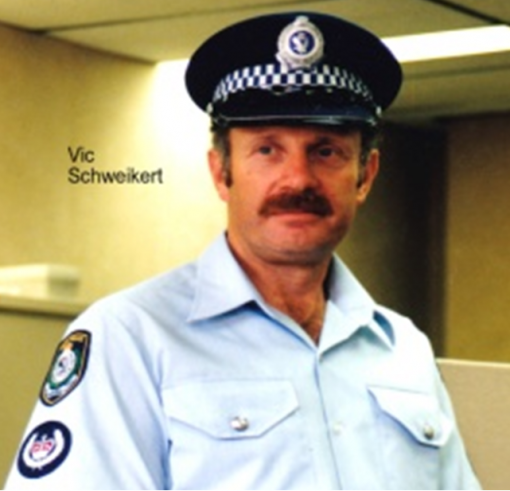
Victor Albert SCHWEIKERT

Victor Albert SCHWEIKERT  


AKA Victor SCHWEIKERT, Vic SCHWEIKERT   

* Nickname:  ?  

Late of  ?   


Relations in ‘the job’:

“possible” relation in ‘the job‘:  Kristian SCHWEIKERT, NSWPF 37501  ?  


NSW Police Training Centre – Redfern  –  Class # 081A     


New South Wales Police Force  


Regd. #  9458   


Rank: Commenced Training at Redfern Police Academy on Monday 2 November 1959 ( aged 22 years, 7 months, 0 days )  

Probationary Constable- appointed Monday 7 December 1959  ( aged 22 years, 8 months, 5 days )   

Constable – appointed 2 November 1960  

Constable 1st Class – appointed 2 November 1965  

Detective – appointed ? ? ?  

Senior Constable – appointed 2 November 1969  

Leading Senior Constable – appointed ? ? ? ( N/A )  

Sergeant 3rd Class – appointed 19 February 1975  

Sergeant 2nd Class – appointed 24 October 1982  

Sergeant 1st Class – appointed 24 December 1985  


Final Rank: =  Senior Sergeant   


Stations Kogarah ( 12 Division )( GDs )( ProCst )( Dec 1959 ), Rockdale( 12 Division )( GDs )( ProCst – Cst )( Feb 1960 ) , Kingsgrove ( 12 Division )( GDs )( Cst )( Jan 1962 ), Bankstown ( 19 Division )(GDs )( Nov 1963 ), Sefton ( 19 Division )( GDs )( Aug 1967 ), Liverpool ( 22 Division )( GDs )( Feb 1970 ), Mossman ( 6 Division )( GDs )( Nov 1975 ), North Sydney ( 6 Division )( Induction, Training & Education Officer )( June 1981 ), NSW Police Academy – ( Field Training Directorate – Co-ordinator )( Sydney Campus – Union Carbine Building in Liverpool St, Sydney ).   


Time employed ( Paid ) with NSW Police:  From: 2 November 1959   to   ? December 1989 ( Optional Retirement ) =  30 years, 0 months, ? days

Service ( From Training Date ) period: From  2 November 1959    to     December 1989 ( Optional Retirement ) = 30 years,  0 months, ? days Service


Retirement / Leaving age: = 52 years, 7 months, 29 days  

Time in Retirement from Police:  34 years, 0 months, 21 days  


Awards:  National Medal – granted 15 September 1980 ( Sgt 3/c )

1st Clasp to National Medal – granted 10 September 1986 ( Sgt 1/c )

Police Diligent and Ethical Service Medal – granted November 2012

Victor Albert SCHWEIKERT, Victor SCHWEIKERT, Vic SCHWEIKERT


 Born:  Friday 2 April 1937

Died on:  Friday 22 December 2023

Age:  85 years, 8 months, 20 days

Organ Donor:  No – Age prohibitive 


Cause:  Pneumonia & other complications

Event location:  Nursing Home, in the Southern Highlands, NSW ( Had been a resident for around 20 months ) 

Event / Diagnosis date ?


Funeral date:  Thursday 4 January 2024

Funeral location ?

LIVE STREAM    ?


Wake location???( Already held )

Wake date???


Funeral Parlour: ?


Buried at?

Grave LocationSection:          Row?         Plot?

Grave GPS?,       ?


Memorial / Plaque / Monument located at ?

Dedication date of Memorial / Plaque / Monument: Nil – at this time ( January 2024 )


VICTOR is NOT mentioned on the Police Wall of Remembrance  *NEED MORE INFO


FURTHER INFORMATION IS NEEDED ABOUT THIS PERSON, THEIR LIFE, THEIR CAREER AND THEIR DEATH.

PLEASE SEND PHOTOS AND INFORMATION TO Cal


May they forever Rest In Peace

https://www.facebook.com/groups/AustralianPolice.com.au/ 

https://www.facebook.com/groups/NSWFallenPolice/ 

Australian Police YouTube Channel


Victor was a Fitter and Turner prior to entering employment with the NSWP.


Prior to commencing employment with the NSWPF, Vic started rowing at Leichhardt Rowing Club in 1953 – 1954; this was the rowing club of his father and brother.


In 1957 Vic raced in the King’s Cup ( the Australian Championships ) held in Brisbane, Qld.

There he rowed in the eight’s oared race, earning 2nd place.

Victor Albert SCHWEIKERT, Victor SCHWEIKERT, Vic SCHWEIKERT

Victor Albert SCHWEIKERT, Victor SCHWEIKERT, Vic SCHWEIKERT Victor Albert SCHWEIKERT, Victor SCHWEIKERT, Vic SCHWEIKERT

In 1959 he participated in the Empire Games ( currently known as the Commonwealth Games ) in the sport of rowing, where he was awarded a Silver Medal after coming second to the Russians.


Victor Albert SCHWEIKERT, Victor SCHWEIKERT, Vic SCHWEIKERT
They were presented with a ‘Silver Medal’ by the Duke of Edinburgh – Prince Phillip. The photo shows the Australian Team receiving their medal.


Vic, in 1959, was selected to row in the Kings Cup, at Perth WA, and after a three mile race on the Swan River, his team came first earning a ‘gold medal’.

Victor Albert SCHWEIKERT, Victor SCHWEIKERT, Vic SCHWEIKERT


Source:  Joe Stanioch – Liverpool Police Time Line ( 1788 – 2022 )

Info – Victor Schweikert and later Mrs Schweikert.


Vale – Victor Schweikert | Leichhardt Rowing Club

Published Fri 05 Jan 2024


Lionel Robberds AM QC (Leichhardt Rowing Club Patron) advises that Victor Schweikert, former National, State and Club representative passed way in recent days (late December 2023).

Vic’s success on the water followed the Leichhardt Eights win over the NSW State crew, when preparing for the 1958 Empire Games at Cardiff in Wales.  Five Leichhardt oarsmen, with Lionel as Coxswain, represented Australia in the Eight, winning the Silver medal.

Vic was also in the 1959 NSW Kings Cup Eight mainly comprised of Leichhardt Oarsmen, winning the Kings Cup for the first time since 1951.

The Schweikert family of Bert, Carl and Eric had been successful Coaches at Leichhardt. It was Eric’s son Victor, who had crewed in the Kings Cup from 1957 to 1957 and again in 1960,

In his younger days Vic had been a member of the winning Shore Eight in the Head of the River going on to win the Australian Schoolboys Championship.

As a former retired Police officer, Vic was a regular attendee at relevant functions for retirees from Police and Rowing.

May he rest in peace.

Barry Moynahan – Leichhardt RC Life Member; Rowing NSW Life Member

News – Rowing NSW


In 1959, a crew made up of LRC and Mosman rowers won the King’s Cup in Perth, by quite a margin as the picture above shows! This was the last time the King’s Cup was raced over 3 miles.

Listen to the ABC call of the race here.


The video of the race

Left to right: Max Annett, Peter Waddington, Ted Curtain, Ken Railton, Victor Schweikert, Graeme ‘Mick’ Allen, John Hudson, Ralfe Currall, next to the coxswain is the emergency, Bruce Evans and on the far right is the manager Frank McLeod.


The crew training in Perth. Bow – Ralfe Currall 2 – John Hudson 3 – Ken Railton, Mosman RC 4 – Victor Schweikert 5 – Graeme ‘Mick’ Allan, Mosman RC 6 – Max Annett 7 – Ted Curtain Stroke – Peter Waddington Coxswain – Lionel Robberds


Left to right: first is Max Annett, beside him is stroke Peter Waddington, then in the blazer is coach Phil Cayzer, then peeking from the rear is the seven man, Ted Curtain. To the left of Ted is the three man Ken Railton from Mosman, beside him and a bit to the front is Victor Schweikert, behind Victor is the five man Graeme ‘Mick,’Allan from Mosman. The coxswain Lionel Robberds, holding the King’s Cup and with a stop watch on his left leg, then on the left of Lionel is bow, Ralfe Currall, then the two man John Hudson, on his left is the reserve Bruce Evans from Mosman RC, on Bruce’s left is the Manager, Frank Mcleod.
Left to right: first is Max Annett, beside him is stroke Peter Waddington, then in the blazer is coach Phil Cayzer, then peeking from the rear is the seven man, Ted Curtain. To the left of Ted is the three man Ken Railton from Mosman, beside him and a bit to the front is Victor Schweikert, behind Victor is the five man Graeme ‘Mick,’Allan from Mosman.          The coxswain Lionel Robberds, holding the King’s Cup and with a stop watch on his left leg, then on the left of Lionel is bow, Ralfe Currall, then the two man John Hudson, on his left is the reserve Bruce Evans from Mosman RC, on Bruce’s left is the Manager, Frank Mcleod.


History – The 50s – Leichhardt Rowing Club


CLASS 081

4 row ( l to r ):
L. C. Bennett; D. W. Stolle # 9460; M. W. Kirk # 9512; R. C. Landers; B. Symons; A. Southall # 9527; John C. Dunbar # 9482; Peter J. Martin # 9528; B. K. Leaney # 9533; D. W. McLaughlin; J. R. Dorsett # 9498; P. W. Medway # 9444; J. McGregor # 9518; F. J. Ryder # 9506; Ray. N. Morris # 9517; P. R. Clemson # 9523; J. O. Parry; P. J. Woodward # 9478; D. C. Newton # 9480; Rod. L. Power # 9477; A. W. McDonald # 9510; B. A. Kearns; P. R. Leembruggen # 9530; R. G. Dunn.
3rd row ( l to r ):
E. H. Williamson # 9507; Syd. K. Isedale # 9490; T. G. Purcell # 9468; Allen J. Murphy # 9509; A. P. Lynch # 9500; R. W. Stone # 9488; M. C. Adams; H. J. P. Munro # 9484; J. E. Hawley # 9522; S. C. Heckenberg # 9487; H. T. Auliff # 9464; Barry A. Melouney # 9492; M. R. Turk # 9526; Anthony C. Frost # 9516; C. A. Hermanson # 9525; Edward ( Ted ) F. Doherty # 9446; W. McCormick # 9529; Ken. J. Williams # 9461; M. C. Moy # 9449; K. G. McNeill # 9455; A. D. Morris # 9469; R. L. Scarf # 9457; J.R. Press # 9462; R. J. Mahoney # 9514.
2nd row ( l to r ):
J. J. McNamara # 9465; T. J. Webber # 9504; B. A. Bennett # 9453; J. F. Bostock # 9535; R. N. Thornett; W. A. Allan; K. J. Hall; Mick R. Hay # 9452; Ken. Waters # 9494 or 9505; Keith Waters # 9494 or 9505; G. N. Crouch # 9532; R. C. Rogerson # 9536; D. S. McAfee # 9459; G. A. Wilson # 9470; B. Garland # 9511; J. Peterlin # 9503; Thom. C. Coleman # 9496; R. J. Canning # 9473; Victor A. Schweikert # 9458; R. Pearson; B. Kerrison # 9485; J. G. Kinnane; L. R. Kriss # 9483.
Front row – seated- ( l to r ):
Sergeant 3/c. Ben Hall; C. C. Greenham; G. R. Gibb # 9445; R. C. Jenner # 9486; J. C. McGingley; Darcy W. Cluff # 9463; R. J. Graham # 9467; David E. Nelson # 9481; F. B. McGoldrick; Ernest G. Mercer # 9515; E. W. Kelly; J. Kelly # 9531; Sergeant 1/c. Sligar # 8146; Sergeant 1/c. Barber # 4474; Sergeant 3/c. Porch; Miss. Sylvia W. Paull # P/W 0038; Mrs. Eileen. M. McLean # P/W 0037; Miss. June W. Fielding # P/W 0039; S. Favot # 9493; J. P. Boon # 9519; L. E. Ervine # 9497; R. T. Milligan # 9479; Denis W. Wardrobe # 9456; D. C. Rugers; H. V. Clarke.


Sgts Course 6 of 1978 - 12 June - 28 July 1978 <p> Back row ( L to R ) –<br /> Bernie Webb; John Walton; Alan Doyle; Peter Lowrey; Phil Loughlin; Laurie Campbell; Ted<br /> Coleman; Bill Ellis # 9559.<br /> <p> Middle Row ( L to R ) –<br /> Vic Schweikert # 9458; John Cummins # 9601; Barrie Sherlock # 9635; Ron Kitson # 9670; Carl Hermanson; Mike Blackburn # 9630;<br /> Ken Williams # 9461; Max Bailey # 9667.<br /> <p> Front row ( L to R ) –<br /> Alan Walker; Nev Bent # 9586; Brian Milward (Instructor) # 9108; Bryan Binns Instructor) # 7953; Harold. E. John Symons (Instructor) # 8331; Denis Bowden # 9384; Pat Cioccarelli # 9580.

Sgts Course 6 of 1978 – 12 June – 28 July 1978

Back row ( L to R )
Bernie Webb; John Walton; Alan Doyle; Peter Lowrey; Phil Loughlin; Laurie Campbell; Ted Coleman; Bill Ellis # 9559.

Middle Row ( L to R )
Vic Schweikert # 9458; John Cummins # 9601; Barrie Sherlock # 9635; Ron Kitson # 9670; Carl Hermanson; Mike Blackburn # 9630; Ken Williams # 9461; Max Bailey # 9667.

Front row ( L to R )
Alan Walker; Nev Bent # 9586; Brian Milward (Instructor) # 9108; Bryan Binns Instructor) # 7953; Harold. E. John Symons (Instructor) # 8331; Denis Bowden # 9384; Pat Cioccarelli # 9580.


Victor Albert SCHWEIKERT, Victor SCHWEIKERT, Vic SCHWEIKERT, Pru GOWARD
REWARDED: Pru Goward pinning the diligent and ethical service medal on Victor Schweikert. Photo by Ben McClellan


Victor Albert SCHWEIKERT, Victor SCHWEIKERT, Vic SCHWEIKERT
QUEEN’S BATON RELAY: Commonwealth Games Queens Baton Relay Wollongong baton bearer Victor Schweikert. Picture: Robert Peet.  2000

Victor Albert SCHWEIKERT, Victor SCHWEIKERT, Vic SCHWEIKERT


* Story behind any Nickname:


Nothing further, than what is recorded above, is known about this person at the time of publication and further information and photos would be appreciated.

**********


Cal
17 January 2024

Updated 21 August 2025


John Kevin BOURKE

John Kevin BOURKE    APM

AKA 

Late of Crescent Head, NSW & Cedar Place Aged Care, Kempsey, NSW   


NSW Police Training College – Penrith  Class #  039


New South Wales Police Force

Regd. #  6837


Service:  From 4 September 1950   to   18 February 1989  =  38 years, 5 months, 14 days Service


Rank:  Commenced Training as Trainee at Redfern Police Academy on Monday  4 September 1950

Probationary Constable- appointed 23 October 1950 ( aged 21 years, 8 months, 3 days )

Constable – appointed ? ? ?

Constable 1st Class – appointed ? ? ? 

Detective – appointed ? ? ? ( YES )

Senior Constable – appointed ? ? ? 

Leading Senior Constable – appointed ? ? ? ( N/A )

Sergeant 3rd Class – appointed 1 July 1967

Sergeant 2nd Class – appointed 1 May 1974

Sergeant 1st Class – appointed 1 December 1977

Inspector – appointed 6 November 1982

Chief Inspector – appointed ? ? ? 


Final Rank = Inspector 

Competed in the Commonwealth Games – Wrestling, Diving 10mtr Platform ( 1950 )( 5th position ), Water Polo – Mens – ( 1950 )( Gold )

Stations?, Traffic Branch – Redfern, Darlinghurst, North Sydney, Katoomba, CIB – North Sydney, Penrith Training College, Redfern Police Academy – Training Detectives & Cadets,  Internal Affairs ( Secondment ), Senior NCO – Taree, Police Academy – Goulburn – Retirement


Retirement / Leaving age: = 59 years, 11 months, 29 days

Time in Retirement from Police: 31 years, 11 months, 29 days


Awards:  Police Service & Good Conduct Medal – granted 7 November 1974

National Medal – granted 21 August 1989 ( Insp. )

Australian Police Medal ( APM ) – granted 26 January 1988 ( Insp. )


 Born:  Wednesday  20 February 1929 

Died on:  Tuesday  16 February 2021 

Age:  91 years, 11 months, 27 days


Cause:  Dementia & Parkinsons Disease

Event location:   ?

Event date ?


Funeral date:  Monday 22 February 2021 @ 10am 

Funeral location:  Robert Walker Funerals Crematorium, Everingham Lane, Frederickton, NSW  

  ( click here to see Cornona19 Virus Pandemic rules – this will be a limited numbers Funeral )

any Future Wake location??? TBA 

any Future Wake date??? TBA

( Due to current Govt. restrictions on ‘Gatherings’ due to Corona19 Virus Pandemic, some families may wish to have a Memorial Service / Wake with friends and family at a later date )

Funeral Parlour: ROBERT B WALKER FUNERALS Kempsey,
South West Rocks & Districts
Ph 6562 4329

Buried at: Cremated 


Memorial / Plaque / Monument located at: ?

Dedication date of Memorial / Plaque / Monument: Nil – at this time ( February 2021 )


 JOHN is NOT mentioned on the Police Wall of Remembrance * NOT JOB RELATED


FURTHER INFORMATION IS NEEDED ABOUT THIS PERSON, THEIR LIFE, THEIR CAREER AND THEIR DEATH.

PLEASE SEND PHOTOS AND INFORMATION TO Cal


May they forever Rest In Peace

https://www.facebook.com/groups/AustralianPolice.com.au/ 


https://www.facebook.com/groups/NSWFallenPolice/ 

Australian Police YouTube Channel 


John Kevin BOURKE, John BOURKE
Constable John BOURKE NSW Police Motor cycle BG-723


John Kevin BOURKE, John BOURKE, Inspector John BOURKE
Inspector John BOURKE – Goulburn Police Academy

John Kevin BOURKE, John BOURKE, Inspector John BOURKE

BOURKE, John Kevin

JOHN KEVIN BOURKE APM

Passed away 16th February 2021
Aged 91 years
Late of Crescent Head.

Beloved husband of Lorna.

Loving father and father in law of Robert and Lee, Glenn, Michael (deceased).

Adored Pop of Daniel, Kate, Scott, Hannah, Misheal and to his

great grandchildren Nate and Isobelle.

Relatives and friends of John are invited to his funeral service at the chapel of Walkers Crematorium & Memorial Gardens Frederickton on Monday 22nd February 2021 commencing at 10.00am, then for cremation.

ROBERT B WALKER FUNERALS Kempsey,
South West Rocks & Districts
Ph 6562 4329


This was published 7 years ago

Bent police officer’s pre-emptive strike

The NSW Ombudsman’s investigation into the likely illegal bugging of more than 100 police officers faces one very substantial challenge.

It was called Operation Mascot and it started in January 1999. The ”white knights” of the NSW Police special crime and internal affairs unit (SCIA), along with the NSW Crime Commission, were chasing corrupt NSW police officers.

The ace up their sleeve was a corrupt detective, code named M5.

Worried about being confronted with his own corruption, M5 had made a pre-emptive strike. He voluntarily went to the crime commission in December 1998 and confessed his misdeeds. Early the next year, with SCIA and the commission working hand in glove, he was sent ”under cover” to covertly record his workmates, some of whom were close friends.

Judging by documents obtained by Fairfax Media, Mascot – which ran for more than two years – was not an investigation that built slowly.

Within a few weeks of M5 going to work, Justice Graham Barr of the NSW Supreme Court had approved a listening device warrant that allowed M5 to bug 119 people, almost all of them serving and former police.

An affidavit was presented to Justice Barr giving the reasons the 119 deserved to have their private conversations covertly recorded.

That affidavit has never been made public so what the judge was told is not known.

But one Operation Mascot affidavit has surfaced. It was granted on September 14, 2000, the day before the start of the Sydney Olympics. Justice Virginia Bell of the NSW Supreme Court – who is now a High Court judge – approved a listening device warrant that allowed M5 to bug 114 people. She approved the use of seven listening devices, some to be worn by M5, others to be placed in his house, car and briefcase.

Among those who were to be recorded were some who were corrupt. But dozens of others who M5 was legally allowed to record were honest police such as then Superintendent Nick Kaldas and Superintendent Bob Inkster. Kaldas is now a NSW Police Force Deputy Commissioner. Inkster is now, somewhat ironically, a senior member of the NSW Crime Commission which was a key player in trying to bug him more than a decade ago.

According to the warrant approved by Justice Bell, Kaldas and Inkster and the other 112 were suspected of a range of offences – money laundering, conspiracy, tampering with evidence.

Essentially, the accusation was that they were corrupt. The Herald makes no suggestion that either man was, or is, corrupt.

Justice Bell approved the bugging on the basis of a 57-page affidavit from the crime commission.

The Herald has seen a copy of the affidavit. It contains allegations of corruption against many police and is, in parts, quite detailed.

Justice Bell, who had been counsel assisting at the Wood royal commission into the NSW Police five years earlier, was told the affidavit was truthful and accurate.

But an investigation by the Herald has uncovered evidence that parts of the affidavit were either fabricated or wrong.

The documents and the evidence gathered by the Herald suggest that from 1997 to 2001 more than 20 NSW Supreme Court judges were lied to or seriously misled by some officers working within SCIA, which was set up in the 1990s by then commissioner Peter Ryan.

Which brings us to the affidavit of September 14, 2000, specifically paragraph 5.33, which comprises only 13 lines.

Much of the affidavit is taken up with details of conversations between M5 and some corrupt colleagues secretly recorded in police stations such as Manly and at pubs, clubs and farewell functions – often while M5 and his mates were engaged in marathon drinking sessions.

The paragraph reads: “On 10 December, 1999, [M5] unexpectedly met with former NSW Police inspector John Kevin Bourke in The Corso, at Manly. Bourke engaged [M5] in conversation regarding assistant commissioner Clive Small. Bourke used words to the effect, ‘I have the best brief on him’.”

The affidavit says Bourke went on to describe Small’s involvement in the corrupt “release of information” to another police officer which resulted in a drug trafficker escaping conviction.

The affidavit continues: “I suspect Bourke has information or evidence which he believes incriminates assistant commissioner Small.

”I suspect Bourke meant to indicate that he would use that information or evidence to protect himself, if necessary, from investigation or prosecution, or both.”

The Herald has tracked down and spoken with Bourke, who was for many years involved in detective training. He retired in 1989. After being read the allegation about his ”meeting” with the detective known as M5 on The Corso, as detailed in the sworn affidavit, Bourke said: “It is very simple for me to answer, that is all nonsense, poppycock, because it never ever occurred.”

In a subsequent email, Bourke said: “The name [M5] is not significant to me. I can confirm with absolute confidence I have never met any such named person on the Manly Corso at any time in my lifetime.”

He added: “I didn’t like Clive’s haircut and I thought he was a bit self-important. But I admired Clive Small for many reasons. I always found Clive a very trustworthy person in my dealings with him.”

He said the claim in the affidavit that he had the conversation was ”based on a fabrication”.

He said he was prepared to give evidence on oath that this was the case.

Bourke said he had no idea how his name could have been put in an affidavit or on a listening device warrant. He had never been contacted by anyone about the alleged meeting on The Corso or the ”allegations” against Small.

Small had a distinguished career in law enforcement. In the late 1970s, he worked on the Woodward royal commission into drug trafficking and then on a long inquiry into the collapse of the Nugan Hand Bank.

As an inspector, and despite considerable pressure from his superiors, he cleared former NSW Police superintendent Harry Blackburn who had been wrongfully charged with multiple rapes in an inept investigation by NSW Police. A subsequent royal commission into the Blackburn case proved him correct.

In the 1990s he was the commander of the taskforce that led to the conviction of backpacker murderer Ivan Milat. After the Wood royal commission into police corruption in the mid-1990s, he was appointed the head of crime agencies and, as such, was the boss of the major squads such as homicide. He was later chief investigator for the Independent Commission Against Corruption.

When the Herald first showed the affidavit to Small he said there was “something clearly wrong” with the document.

Late last week he told the Herald that to the best of his knowledge he had not seen Bourke since the early 1970s. He said he had never been interviewed or spoken to by anyone about the ”allegation” in the affidavit and had no idea which drug case was being referred to.

He said given Bourke’s categorical denial of the affidavit, “it would appear to me a criminal offence has been committed by one of more people or at a minimum, a serious misconduct”.

He said the allegations about misconduct within SCIA had ”been known to both the government and the opposition for about 10 years”.

“I would seek for the matter to be fully investigated immediately. I don’t want this buried for another two years while the ombudsman investigates.”

The Herald has also obtained NSW Police documents which cast doubt on another claim in the same affidavit presented to Justice Bell: that M5 and other officers ”verballed” or made up admissions by a career criminal, Craig Cant, one of three men charged in 1994 with a violent attempted armed robbery.

On page 7 of the affidavit, it says M5 and another police officer “fabricated an unsigned record of interview with Cant”.

The Herald has obtained a copy of M5’s own record of interview with Cant and the brief of evidence in the case. Cant makes no admission to the crime and, in fact, repeatedly denies knowing anything about it.

When M5 puts a number of allegations to Cant and asks if he has anything to say, Cant repeatedly answers “nothing”.

Asked what he wants to say about phone records which showed a call from a co-offender at 4am at the time and date of the offence, Cant replies: “Nothing. Look I don’t want to be rude but how much longer is this going to take?”

In a second interview, he repeatedly answers “no comment”.

The Herald showed a number of the documents to Small. He said it appeared the police, including M5, had evidence against Cant based on phone and motel records, his credit card and driver’s licence which were all admissible in court.

“In the interviews, Cant’s answers are neutral or denials. I don’t see what the ‘verbal’ could be.”

Charges against all three men eventually fell through because of the alleged police fabrications. One of Cant’s co-accused later went to work for SCIA. He told officers within the unit he and Cant and the other man had indeed committed the crime, which involved breaking into a home at 4am and putting pistols to the heads of a young couple.

How it unfolded

On December 16, 1998, an experienced but troubled NSW detective walked into the offices of the NSW Crime Commission in Kent Street and voluntarily admitted to numerous acts of corruption.

According to documents leaked to Fairfax Media, he was under intense pressure. Some colleagues had come under suspicion and the detective, who became known as M5, feared he was in the firing line.

Drinking heavily, “depressed and anxious”, the documents reveal he said he wanted to “unload”. He admitted to corruption going back to the late 1980s and named other serving and former detectives as bent.

But the confession didn’t have the cathartic effect M5 might have hoped for. In fact it made things worse.

M5’s psychiatrist, Michael Diamond, would later write: “It placed extra pressure on him because he had to keep ‘disappearing’ (from his normal police duties) in order to attend these interviews … he felt suicidal”.

According to Mr Diamond, M5 was in intense distress. A concerned relative had him admitted to a psychiatric unit at Manly, where he stayed for 10 days.

What happened next is remarkable. He was sent to work under cover by the ”white knights” in the NSW Police special crime and internal affairs unit (SCIA). They wanted scalps and M5 was ideally placed to produce them.

The documents reveal M5 was debriefed by SCIA in January 1999 – within days of leaving the psychiatric ward – and transferred to Manly detectives. An SCIA officer, Cath Burn, now a deputy commissioner, said M5 “volunteered” to go under cover and record his fellow detectives, some of whom were undoubtedly involved in corruption and later jailed.

But in advice to the human resources branch on September 16, 2003, a solicitor from the NSW Police legal services branch, Alan Bloomfield, recommended M5 be granted a ”hurt on duty” pension because he had been “forced” to co-operate.

Mr Bloomfield said: ”A memo from Supt [Cath] Burn states that he ‘voluntarily’ offered to assist, but in a practical sense, he did not have much choice.”

M5 kept working as a detective from early 1999 until mid-2001. He was also covertly recording his workmates.

The documents reveal that SCIA bugged M5’s house, car and briefcase, and had listening devices on M5.

Much of the recording was done in pubs, clubs and at functions – and during marathon drinking sessions.

When M5 couldn’t take it any longer, he sued for compensation in the form of a ”hurt on duty” pension.

In 2002 Mr Diamond, advising on M5’s claim for compensation, criticised SCIA’s decision to employ him under cover just after he had left a psychiatric institution.

M5 won his claim and it is understood he was also given an ex gratia payment. His payments are believed to total hundreds of thousands of dollars.

He told Mr Diamond he had been used by someone in SCIA to “settle old scores”. One of the “old scores” appears to have been then Superintendent Nick Kaldas. M5 was sent to see him five or six times. Mr Kaldas had had a serious disagreement with a senior SCIA officer, Superintendent John Dolan. Even police within SCIA were seriously concerned at the targeting of Mr Kaldas.

“I smelt a rat,” M5 told his psychiatrist. “I’ve done stuff you wouldn’t do to your worst enemy … I’ve been used.”

Operation Mascot

1350 boxes of documents (handed over by the NSW Police/Police Integrity Commission/NSW Crime Commission)

20 NSW Supreme Court judges (involved in approving the listening device warrants)

7 investigators (working for Operation Prospect)

$3.5m (extra money given to Ombudsman for inquiry)

114 serving and former police officers and civilians named in controversial listening device warrants approved by Justice Virginia Bell

1984 applications for telephone taps by NSW Police, PIC, Crime Commission in 2011-12
(source: Commonwealth Attorney-General’s report)

934 listening device warrants approved for use by NSW Police, PIC, Crime Commission in 2011-12 (source: NSW Ombudsman)

Aggrieved officers doubt ombudsman’s ability to handle inquiry

Bent police officer’s pre-emptive strike


Gordon George AVERY

Gordon George AVERY

AKA George

Late of Woonona, formerly of Hurstville, NSW


Police Training College – Penrith  Class # 002

NSW Police Cadet # 0315

New South Wales Police Force

Regd. #  4704


Obtained the highest mark in his final examination on completion of training with 98.5% on 21 April 1947

Rank:  Commenced Training as Police Cadet on 21 April 1941 ( aged 16 years, 2 months, 10 days )

Probationary Constable- appointed 11 September 1945 ( aged 20 years & 7 months )

Constable – appointed ? ? ?

Constable 1st Class – appointed ? ? ?

Detective – appointed ? ? ?

Senior Constable – appointed ? ? ?

Sergeant 3rd Class – appointed ? ? ?

Sergeant 2nd Class – appointed 25 July 1966

Sergeant 1st Class – appointed 1 April 1970

Inspector 3rd Class – appointed 2 April 1974

Inspector 2nd Class – appointed 6 June 1976

Inspector 1st Class – appointed ? ? ?

Senior Inspector – appointed 19 February 1978 

Superintendent – appointed  19 December 1979 18 November 1979

Senior Superintendent – appointed 12 February 1982

Chief Superintendent – appointed 17 September 1982

Does NOT appear in the 1988 or 1989 Stud Books


Final Rank =  Chief Superintendent ?


Stations?, Newcastle ( Insp 3/c )( 1975 /1976 ), ?

Service:  From 21 April 1941   to   ? ? Post 1982?  =  41+? years Service


Awards:  National Medal – granted 15 November 1982 ( SenSupt )


Born:  Wednesday  11 February 1925 in Moree, Haberfield, NSW

Died on:  Friday  22 September 2006

Age:  81 years, 7 months, 11 days

Cause?

Event location:  Woonona, NSW

Event date ?


Funeral date? September 2006

Funeral location?

Funeral Parlour: ?

Buried at: Bulli Cemetery, Carrington St, Bulli, NSW

Grave location:  Portion SGn ( Seaview Garden ), Row C, Site 90

Memorial / Plaque / Monument located at: ?

Dedication date of Memorial / Plaque / Monument: Nil – at this time ( October 2020 )


Inscription:In loving Memory of Gordon George AVERY.Loved husband of Gwen, a dear father, pa, and great Grandpa.A great Olympic Athlete11 February 1925 - 22 September 2006At peace with GwenGwendoline Elsie AVERY nee Friedwald was born 18 June 1925, Married ‘ George ‘ in 1947 and passed on 26 July 2006 ( 3 months before Gordon ).  Gwen is also buried at the same location.

 GORDON is NOT mentioned on the Police Wall of Remembrance  *NEED MORE INFO


FURTHER INFORMATION IS NEEDED ABOUT THIS PERSON, THEIR LIFE, THEIR CAREER AND THEIR DEATH.

PLEASE SEND PHOTOS AND INFORMATION TO Cal


May they forever Rest In Peace

https://www.facebook.com/groups/AustralianPolice.com.au/

https://www.facebook.com/groups/NSWFallenPolice/

Australian Police YouTube Channel


NSW Police College, Penrith. Police who obtained the highest marks in their final examination on completion of training at the NSW Police College, Penrith. 1947 - 1948
NSW Police College, Penrith. Police who obtained the highest marks in their final examination on completion of training at the NSW Police College, Penrith. 1947 – 1948


Gordon ‘ George ‘ AVERY

Olympic Games, 1948, London, Great Britain

Long Jump – Did not compete

Triple Jump – Position:  2/27   Qual 15.335m; Final 2nd 15.365m

Won the Silver Medal in Triple Jump

National Competition                                        Distance
1947-48 Aust. T & F Long Jump 2 23’1¼”(7.04m)
Triple Jump 1 50’1″(15.26m)
1948-49 Aust. T & F Long Jump 2 23’0½”(7.02m)
Triple Jump 2 48’0½”(14.64m)

https://webarchive.nla.gov.au/awa/20091020193157/http://www.athletics.com.au/history/athletes/athlete403.htm


Still carrying a torch for the Games

Date: 25/01/2000

By ANTHONY DENNIS

A torch aloft. A flickering flame. A solitary runner. For an Olympic movement that has done its level best to dishonour its own stature, what does it say about such an event where three simple symbols can convey as much meaning and emotion as a gold medal?

Since its successful candidature, nearly seven years ago, the 2000 Olympics have been Sydney’s Games. The lighting of the flame in Olympia, Greece, on May 12 will be the single act which converts the Games into a truly national event and celebration of nationhood. Sydney’s Games will, hopefully, become Australia’s Games.

It will be a chance for Sydney, a city that in recent years had become somewhat self-obsessed to the exclusion of the other 15 million Australians – remember them? – to reach out to the rest of the nation.

It will be a rare opportunity, too, for the city to engage with the country and vice-a-versa.

So the torch relay is one of those unique sporting events that manage to surpass sport itself. But, above all, it will be a chance for ordinary Australians to prove how extraordinary they can be.

Nearly four years ago, ordinary Americans took part in the torch relay as it passed through the United States on its way to Atlanta.

The expressions on their faces were a contrast to some of the gold-medal-winning athletes, whose faces were often a portrait of arrogance and domination, especially on the running track where the Olympics go onto what is near enough to a war-footing.

Once participation was enough. Now winning is all. Even the IOC’s elaborate advertising campaign refers to the belief that you don’t win silver, you lose gold.

But the torch relay may be a vestige of the more traditional values of the Games in which participation was paramount.

There is an honesty about the relay that seems to have been lost from the broader event.

Now it’s the turn of Australians like Mr Gordon George Avery, of Bulli, named today as a 2000 torch-bearer. Mr Avery, who turns 75 on February 11, won silver at the 1948 London Olympics in the triple jump.

His thoughts typify the spirit of the relay and the old values of the Games: “The Olympic torch for me is the symbol of the Olympic Games. If you have ever been an Olympian and competed against all these people from other nations you can understand why an Olympian feels like he does.

“We feel like we understand the rest of the world, because we’ve lived and competed on a level playing field with all nations. Often they’re our very best friends without a thought of race, colour or creed.”

John Konrads, an extraordinary Australian whom no ordinary Australian could begrudge carrying the torch, agrees. “The torch is one of the very important elements … it brings the Olympics back to its origins in ancient Greece and relays that heritage to the current Olympic city,” said the 57-year-old who won gold in the 1500m freestyle at the 1960 Rome Games.

“It brings back very fond memories of other Olympic ceremonies I have attended. I will be very proud when I am running with the torch, which will be a permanent souvenir to keep as a family heirloom.”

The organisers like to describe the torch relay as the real start of the Games, but they’re saying so with a degree of desperation now.

The start of the relay can’t come a moment too soon for the IOC and SOCOG, eager to galvanise a jaundiced world and host nation in support of the Olympics.

Even a cynic studying the torch relay’s route around the continent would have to concede that it is brilliantly conceived. It’s a retirees’ blueprint for the ultimate round-Australia trip.

Keep the map. A few of us may choose to use it one day – Mount Isa to Mount Kosciuszko, Broome to Byron Bay, Darwin to Dubbo.

The torch relay is one of the few creations of Nazi Germany that the civilised world has not rejected. Not even the residue of hatred and bitterness from a world war was sufficient for London to abandon the relay at the 1948 Olympics.


[SMH Home]

18 May 2000 – www.smh.com.au/news/0001/25/text/pageone1.html – Trove


Government Gazette of the State of New South Wales (Sydney, NSW : 1901 – 2001),

Friday 10 September 1976 (No.114), page 3817

LOCAL GOVERNMENT ACT, 1919

Appointment of Members of the Parking Advisory Committee for the City of Newcastle.

HIS Excellency the Governor, with the advice of the Executive Council and in pursuance of section 270d of the Local Government Act, 1919, has been pleased to approve the appointment of Inspector 3rd Class John Victor Waring, Department of Police, vice Inspector 3rd Class Gordon George Avery, as a member of the Parking Advisory Committee for the City of Newcastle, for a period expiring on 22nd January, 1978.

D. PAUL LANDA,

Minister for Planning and Environment.

Sydney, 10th September, 1976. (1259)

https://trove.nla.gov.au/newspaper/article/220193436


First published on 9 October 2020

Updated 16 December 2025 with place of birth ( Haberfield ) and additional information – came 1st in his Exams at Penrith College and Plaque to verify this.