Brett leaves behind his wife Debbie of 35 years and 3 children; Mel, Nathan (deceased) and Matt. He also leaves behind 6 grandchildren; Harry, Bella, Jack, Ruby, Layla and Liam.
Brett’s brother Scott is also a serving Police officer with Goulburn HWP.
Brett was also a Retained Fire Fighter with NSWF & R at 305 Station ( Goulburn ) for a while.
FERGUSON, Brett Ronald – passed away peacefully on the 6th September 2018.
Late of Dewhirst Street Goulburn.
Very much loved husband of Debbie.
Cherished & loved father & father in law of Mel & James, Nathan (dec) and Matthew.
Adored pop of Harry, Bella, Jack, Ruby, Layla, Liam.
Loved brother & brother in law of Scott & Tanya, Lesley & Tony & their families.
Loved son of Ron (dec) & Ena.
Aged 56 years.
“Forever in our hearts “
Brett’s relatives and friends are invited to attend his funeral service at NSW Police Academy Chapel, McDermott Drive Goulburn commencing at 11.30am, Wednesday 12th September 2018.
Following the funeral service the cortege will proceed to the Lawn Cemetery Goulburn for Interment.
Flags at Half Mast for the funeral of Brett Ronald FERGUSON
Brett Ronald FERGUSON & his son Matt
Brett Ronald FERGUSON in Fiji
October 9, 2018
Debbie Ferguson, Goulburn, New South Wales
LIGHT A
CANDLE
October 9, 2018
Matt Ferguson
October 9, 2018
Matt Ferguson
October 9, 2018
Matt Ferguson
October 9, 2018
Matt Ferguson, Goulburn
LIGHT A
CANDLE
September 11, 2018
Shane Hunter, Queensland
LIGHT A
CANDLE
September 11, 2018
Brett your the mate that nothing is or was a problem. Your taken way to early before your time. Now you can start to humor every one that you meet in you new journey that your now taking. RIP bro until we meet again and have fun like the night at Tully Park out the front when we were awaiting Deb to pick us up. See you soon best friend. xxx
Embarkation: from Sydney on board HMAT A37 Barambah on 23 June 1916
Age at embarkation: 25
Occupation: Labourer
Address: ‘ Lindburn ‘, Mudgee, NSW
Next of kin: Father, Robert John Yorke, ‘ Lindburn ‘, Mudgee, NSW
Religion: Church of England
Single / Married: Single
Returned to Australia: 5 April 1919
Awards: ?
[/blockquote]
Awards: No find on It’s An Honour
Born: 27 October 1890 at Cooyal, Mudgee, NSW
Died on: Saturday 18 January 1936
Age: 44
Cause: Heart trouble & disabilities sustained at the Great War – WWI
Event location: Home – Morgan St, Adamstown
Event date: Saturday 18 January 1936
Funeral date: Sunday 19 January 1936 @ 2.15pm
Funeral location: Soldiers’ Memorial Hall, Perkin St, Newcastle then Graveside – Sandgate Cemetery via Civic Railway Station
Funeral Parlour: David Lloyd Funeral Director
Buried at: Sandgate Cemetery,
GPS of Grave: -32.867239428, 151.706454238
Anglican 2, Section 139, Lot 78
Memorial located at: ?
JOHN is NOT mentioned on the Police Wall of Remembrance * NOT JOB RELATED
Grave location: [codepeople-post-map]
John Frederick YORKE 27-10-1890 to 18-1-1936 YOU MEET AGAIN. LOVE LFNJDL Eva Mabel ( Lena ) YORKE 2-4-1890 to 14-1-1992 It is not known, by this website, what the acronym means.
FURTHER INFORMATION IS NEEDED ABOUT THIS PERSON, THEIR LIFE, THEIR CAREER AND THEIR DEATH.
Mudgee Guardian and North-Western Representative (NSW : 1890 – 1954), Monday 3 February 1936, page 6
ANOTHER DIGGER PASSES
Constable Yorke Hears Last Call
A GALLANT digger, fine comrade and splendid citizen, in the person of Constable J. F. Yorke, ” went west ” at Adamstown quite recently, and Australia is the poorer by his passing.
Son of Mr Robert J. Yorke, a pioneer settler of the Linburn district, deceased spent his early life among us, and won for himself friends among all classes of the community.
When the war drums sounded he, with other young patriots, sprang to arms, and on the other side he did honor to the country which reared him.
As a machine gunner in the 53rd battalion, he fought with the cool courage of a veteran, and returned to Australia with a proud record of service.
The police force then attracted him, and he linked up with the northern branch.
For about 14 years he fulfilled a public duty with the same splendid spirit which characterised his war service, and earned the respect of those among whom he served and the confidence of his officers. The high esteem in which he was held made itself manifest at his funeral, the sad cortege being one of the most impressive seen in the north for many years.
From the War Memorial Institute, Newcastle, marched over 70 members of the police force, including the officer in charge of the division (also representative of the Commissioner). Inspectors Aspery, McAlpine and Davis, and other prominent officials.
A sorrowing widow and six children are left to mourn a devoted husband and father, and their grief is great. His venerable father, who has borne up with great fortitude under the buffetings of adversity, will have the deepest sympathy of the whole district.
Other members of the bereaved family are Mr Stan Yorke (brother). Mrs Drew (sister,. Home Rule), and Mrs B. Pyne (sister, Sydney).
The ” Guardian ” sympathises with the sorrowing family who, however, will. And some consolation in the knowledge that their loved one was held In such universal respect.
Newcastle Morning Herald and Miners’ Advocate (NSW : 1876 – 1954), Monday 20 January 1936, page 6
POLICE MARCH
Funeral of Constable Yorke
Headed by the band of the 2/35th Battalion, 70 members of the Newcastle police force, led by Constable S. ( Stephen ) Pender, marched yesterday at the funeral of Constable John Frederick Yorke, who died suddenly at his home at Adamstown early on Saturday morning.
The funeral left the Returned Sailors and Soldiers’ Memorial Hall, Perkin-street, yesterday, and proceeded to the Civic railway station, and then to Sandgate Cemetery.
The coffin was draped in the Union Jack.
The chief mourners were the widow, the father, Mr. Robert Yorke, of Linburn, near Mudgee: sisters. Mesdames C. H. Raisin, of Linburn, S. Pyne, of Sydney, Mrs. A. James, mother-in-law, of Home Ride, near Gulgong: Mesdames Esther Simpson. A. James, and Miss T. James sisters-in-law: Mr. Edgar James, brother-in-law of Home Rule; and the Mayor of Paddington (Ald. T. J. Whelan), a close friend.
The pall-bearers were Constables W. S. Brady, H, G. Brady, K. J. Costello. and E. Francis. Detectives E. H. Schumack and C. W. R. McMahon. and Messrs. W. Yates and A. Williams, representing the Adamstown Bowling Club.
Rev. M. M. Redman, of the Church of England, Adamstown, held the graveside service.
The service of the Manchester Unity Independent Order of Oddfellows, of which Constable Yorke had been a member, was read by the Deputy Grand Master ( Bro. G. Kelly ).
Constable Yorke was born at Mudgee 44 years ago.
Death was due to heart trouble and the effects of disabilities sustained at the Great War, where he served three years with the 53rd Battalion.
He is survived by his widow and six children.
Quiet and unassuming, he was popular in the police force which he joined 16 years ago.
He had been stationed at Newcastle for the past 11 years.
Among those present at the funeral were the Officer in charge of the North-Eastern police district (Mr. J. H. White), who represented he Commissioner of Police (Mr. W. J. Mackay): Inspectors J. H. Aspery, A. G. McAlpin. and F. Noble: Messrs. W. Snow, President, and G. Hook, Secretary representing the Friendly Societies’ Association; Mr. J. Tarn, Assistant Clerk of Petty Sessions, representing the staff of the Newcastle Courthouse: and several members of the Adamstown Bowling Club.
For the purposes of this website ‘Q‘ represents those Police joining between 1862 ( commencement of NSWPF ) – 23 February 1915 ( Commencement of NSWPF current numbering system )
Rank: Probationary Constable – Death
Stations: Central – 1 Division – Death
Service: From 17 March 1891to 31 May 1891= 6 WEEKS Service
Awards: No find on It’s An Honour
Born: ? ? c1865 – Ireland
Died on: Sunday 31 May 1891 about 1pm at Sydney Hospital
Age: 25
Cause: Horse accident – struck by horse and run over by buggy
Event location: Goulburn St & George St, Sydney CBD
Event date: Saturday 30 May 1891 about 8am
Funeral date: Wednesday 3 June 1891
Funeral location: Rookwood Necropolis
Funeral Parlour: ?
Buried at: Catholic Section, Sec M1, FF, 144
Grave location: [codepeople-post-map]
Memorial located at: ?
[alert_green]MICHAELIS mentioned on the Police Wall of Remembrance[/alert_green] * Added to National Police Memorial in 2017
FURTHER INFORMATION IS NEEDED ABOUT THIS PERSON, THEIR LIFE, THEIR CAREER AND THEIR DEATH.
Probationary Constable Michael Thomas DeCourcey O’BRIEN
Born c1865 Ireland.
Died 31/5/1891 aged 26. About 8am on Saturday 30 May, 1891 Probationary Constable O’Brien was on duty in the vicinity of Goulburn and George Streets, Sydney when he attempted to stop a runaway horse and buggy. As he did so he was struck by the horse, knocked to the ground, and was run over by the buggy. He was taken to the Sydney Hospital suffering from extensive head injuries however he passed away about 1pm the following day. He was in the Police for only 6 weeks. He was a single man.
A number of newspaper reports state that he had a large funeral attended by many Police from the Inspector General down with a long Police procession leaving from Sydney hospital where he died from his injuries.
According to the SMH 2/6/1891 the funeral was to leave the Sydney Hospital at 1.30pm on 3/6/1891 for the Necropolis (Rookwood). (Catholic Section) O’Brien, Michael Thomas, 03 Jun 1891, 26, SEC*M1*FF**144.
Sydney Morning Herald (NSW : 1842 – 1954), Monday 1 June 1891, page 4
MONDAY, JUNE 1, 1891.
CONSTABLE Michael Thomas O’Brien, who was injured in George-street on Saturday morning whilst attempting to arrest the progress of a runaway horse, died in the Sydney Hospital yesterday afternoon.
Australian Star (Sydney, NSW : 1887 – 1909), Monday 1 June 1891, page 5
the late constable O’Brien.
The Inspector-General of Police has received with extreme concern the report of the death of Constable Thomas De Coursey O’Brien, which adds another number to the honorable list of the police who have sacrificed their lives in the execution of their duty, the force and the public having in this instance lost the services of a promising and efficient officer.
Mr. Fosbery desires that every respect may be shown at the deceased’s funeral by the attendance of as many of his officers and comrades as can be safely spared from duty.
Australian Star (Sydney, NSW : 1887 – 1909), Monday 1 June 1891, page 6
STOPPING A RUNAWAY.
A Constable Injured.
In his efforts to stop a runaway this morning Constable O’Brien, of No. 1 Station, was somewhat seriously injured. He was on duty in George-street, and when passing the tobacco shop of Messrs. Craig and Aitken a horse attached to a cart belonging to the firm bolted; owing to someone throwing a cracker in front of the animal.
Immediately the runaway made off O’Brien started in pursuit; and, catching up to the horse, seized hold of the reins, when, through the animal swerving, the constable was struck in the chest by the shaft and knocked down.
Before the officer could regain his feet the wheels passed over his body, and O’Brien was left lying on the ground seriously hurt. On being admitted to the Sydney Hospital the victim was seen to have received one or two very nasty scalp wounds, in addition to being seriously injured about the chest and body.
Australian Star (Sydney, NSW : 1887 – 1909), Thursday 4 June 1891, page 6
FUNERAL OF THE LATE CONSTABLE O’BRIEN.
The funeral of the late Constable O’Brien, who succumbed in the Sydney Hospital on Sunday to injuries received the previous day, in a plucky attempt to stop a runaway in George-street, took place this afternoon.
Though only a recent addition to the force, O’Brien had placed himself on the most friendly terms with men and officers alike, and the young fellow’s frank and jovial disposition won what it merited — the high esteem and respect of every comrade.
The funeral, which started from the hospital, was numerously attended, and among those who paid the last tribute to the memory of the deceased were the Inspector-General of Police (Mr. E. Fosbery), Mr. Superintendent Read and nearly all the inspectors of the metropolitan divisions.
About 100 constables walked on foot, preceding the hearse, while about an equal number, including commissioned and non commissioned officers, brought up the rear in cabs and other vehicles. Immediately following the hearse were two mourning couches containing the brother and more intimate friends of the deceased.
Constable O’Brien, who was knocked down in attempting to stop a runaway horse on Saturday, and who succumbed to his injuries in the Sydney Hospital on Sunday, was buried at the Roman Catholic Cemetery, Rookwood, today.
The Inspector-General of Police, the superintendent, a number of inspectors, sub-inspectors, and about 150 men attended the funeral, out of respect to the deceased gallant young officer.
For the purposes of this website ‘Q‘ represents those Police joining between 1862 ( commencement of NSWPF ) – 23 February 1915 ( Commencement of NSWPF current numbering system )
Rank: Probationary Constable
Stations: Redfern Police
Service: From 25 January 1900to 21 April 1900= 2+ MONTHS Service
Awards: ?
Born: ? ? 1875 in Wales
Died on: Saturday 21 April 1900
Age: 28
Cause: Accidentally entangled with a rotating circular saw
Event location: Fresh Food and Ice Company Ltd premises, Harbor and Liverpool Streets, Sydney
Event date: Saturday 21 April 1900
Funeral date: ? ? ?
Funeral location: ?
Funeral Parlour: ?
Buried at: Rookwood Necropolis in an unmarked grave
Memorial located at: ?
[alert_red]FRANK is NOT mentioned on the Police Wall of Remembrance * BUT SHOULD BE
[alert_green]FRANKIS mentioned on the Police Wall of Remembrance[/alert_green] as of 2017
Funeral location: TBA
FURTHER INFORMATION IS NEEDED ABOUT THIS PERSON, THEIR LIFE, THEIR CAREER AND THEIR DEATH.
Probationary Constable Frank EVANS
Redfern Police
Industrial Accident
21 April, 1900 – 118 years ago
Resting Place – Unknown
About 6am on 21 April, 1900 the constable was on foot patrol in Liverpool Street, Sydney, near Byrne’s Wharf. He apparently walked into the Fresh Food and Ice Company Ltd premises and while examining large circular saws in operation, his cape was caught by a saw blade and he was dragged onto it and almost cut in half.
The Evening News of 23 April, 1900 reported the constable’s horrific death.
“A POLICEMAN’S AWFUL DEATH.
The City Coroner held an inquest on Saturday, at the South Sydney Morgue, concerning the death of Frank Evans, the unfortunate man who, early on Saturday morning, was almost cut in halves by a circular saw at the premises of the Fresh Food and Ice Company, Limited, Harbor and Liverpool Streets.
“Sergeant J. H. Day, of No. 2 Station, deposed that deceased was a probationary constable attached to the depot. According to the police records, he was 28 years of age, a native of Wales, and a single man, who had no relatives in the colony.
Witness saw him on duty about ten minutes to 5 on Saturday morning in Liverpool Street, near Byrne’s Wharf, and witness then stationed him opposite the premises of the Fresh Food and Ice Company, in Liverpool Street.
An hour later witness saw the deceased lying dead near an ice-cutting machine in the company’s shed. Deceased, in the sergeant’s opinion was a very intelligent man.
John Harnett, the foreman delivery labourer at the ice-cutting shed, said that on Saturday morning he was in charge of the ice-cutting machines. Deceased got on to the platform on which the saws were working, and walked into the sheds, and looked at the machines. He afterwards stooped down, and watched the cutting process.
The witness then gave an account of the accident, practically identical with that already published in Saturday’s ‘News.’
Witness did not allow strangers to go into the premises unless on business, but he took no exception to the deceased doing so, as he was a constable.
Prior to the accident witness had no time to warn Evans of his danger, as everything happened so quickly.
The distance between the two sets of saws was about 6ft.
After further evidence of a corroborative character, the jury returned a verdict to the effect that death was due to injuries received by accidentally coming in contact with a circular saw at the works of the Fresh Food and Ice Company, in Liverpool Street.”
The constable was born in Wales in 1875 and joined the New South Wales Police Force on 25 January, 1900. He was stationed at the Redfern Police Depot.
His death is recorded in the New South Wales Police Gazette of 30 May, 1900.
He is now listed in the official New South Wales Police Honour Roll.
William EIFFE
09/09/2018
William EIFFE
Late of Singleton
New South Wales Police Force
Regd. # P 1154
For the purposes of this website ‘P‘ = represents those Police joining Pre 1862 when NSWPF “Officially” commenced
Rank: Constable
Stations: ?, Singleton
Service: From 11 August 1857to 24 January 1867= 9+years Service
Awards: ?
Born: ? ? 1833 – 1834
Died on: Thursday 24 January 1867
Age: 33 – 34
Cause: Shot – accidental
Event location: between Bendemeer & Tamworth, NSW
Event date: 16 January 1867
Funeral date: Friday 25 January 1857
Funeral location: Old Bendemeer Cemetery
Funeral Parlour: ?
Buried at: Old Bendemeer Cemetery ( private property and unmarked )
Memorial located at: Bendemeer Cemetery, NSW
[alert_green]WILLIAMIS mentioned on the Police Wall of Remembrance – but under an incorrect surname of EFFE which they won’t correct[/alert_green]
FURTHER INFORMATION IS NEEDED ABOUT THIS PERSON, THEIR LIFE, THEIR CAREER AND THEIR DEATH.
Constable William Eiffe memorial unveiled by Oxley police at Bendemeer Cemetery
Breanna Chillingworth
A PERMANENT memorial to recognise a fallen officer has been unveiled near Tamworth on the 150th anniversary of his death.
Constable William Eiffe died from a gunshot wound to the thigh on January 24, 1867, and is buried in an unmarked grave in the Bendemeer cemetery.
Oxley police together with Tamworth Regional Council – who helped to construct the memorial – commemorated his career in the force in a service on Tuesday morning.
”It’s a great part of the local history to have this recorded and I think it brings some interest in the local cemetery and the history of Bendemeer,” Oxley Acting Superintendent Jeff Budd said.
“And, hopefully for centuries to come, people will be able to come here and look at this and remember what has happened in our past.”
The Singleton-based officer was on a police escort on the night before his death when he was accidentally shot in the leg.
“On the evening of Wednesday the 23rd of January, 1867, there was a gold escort moving through the Moonbi Ranges, approximately seven miles from Bendemeer,” Oxley Sergeant Josh McKenzie said.
“A rain show had caused members of the escort to retreat into the carriage, another member of the escort had handed his rifle to Constable Eiffe, he rested the rifle across his thighs with the butt resting against the side of the coach.
“It is thought that the shaking and bouncing of the carriage has caused the rifle to accidentally discharge, shooting Constable Eiffe in the thigh.”
Constable Eiffe was left at Shepherds Hut nearby and the coach returned to Tamworth.
Memorial service: Oxley Acting Superintendent Jeff Budd lays a wreath at the unveiling of the plaque at the Bendemeer cemetery. Photos: Breanna Chillingworth Memorial unveiled: Oxley Acting Superintendent Jeff Budd with Sergeant Josh McKenzie in Bendemeer.
Memorial service: Oxley Acting Superintendent Jeff Budd lays a wreath at the unveiling of the plaque at the Bendemeer cemetery. Photos: Breanna Chillingworth Memorial unveiled: Oxley Acting Superintendent Jeff Budd with Sergeant Josh McKenzie in Bendemeer.
Paying tribute: Senior Oxley police, along with officers from Kootingal, Walcha, Nowendoc and Tamworth, pictured with Tamworth councillor Phil Betts.
Memorial unveiled: Oxley Acting Superintendent Jeff Budd with Leading Senior Constable Ron Stoltenberg and Cr Phil Betts.
William EIFFE Memorial William is actually buried in an unmarked grave.
“Dr Scott of Tamworth was taken to the hut but unfortunately Constable William EIFFE died from the effects of the gunshot wound at noon on the 24th of January, 1867.”
Acting Superintendent Budd said the service was a reminder of how far the force had come in 150 years.
It is thought that the shaking and bouncing of the carriage has caused the rifle to accidentally discharge.
Sergeant Josh McKenzie
“One of the things that would be a tragedy today is for this to occur and his family to not be supported,” he said. “In the days of Constable William Eiffe, his wife and four children would have been destitute without the support we have today and we should be grateful for that.”
Of Note: Searching NSW State Archives & Records on 14 May 2018:
There are NO surnames of FYFFE
There are NO surnames of EFFE
There are NO surnames of EIFFE
There were no Williams born in 1834
There is no Registered number 1154 on that website. There is 1153 ( Beatty ) and 1155 ( Moloney ) but no 1154
A wildcard search on ‘FFE‘ didn’t reveal any similar names or anyone born in 1834 on THAT website.
Danny Webster notes on 24 January 2017:
He is sometimes referred to as “Fyffe” and “Effe”, however the Registers of Police Employment 1847–1885 provides the spelling as “Eiffe”, his registered number as 1154, the fact that he was married at the time of appointment and that he was a former soldier.
The New South Wales Police Gazettes of 5 March, 1862, 3 April, 1867 (£100 gratuity awarded to his wife), and 3 July, 1867 indicate “Eiffe”.
His death was registered at Armidale as “Eiffe”.
He is incorrectly listed in the official New South Wales Police Honour Roll as William “Effe”.
This was originally recorded as:
Constable William FYFFE
Accidentally Shot
Tamworth
24 January, 1867
On 16 January, 1867 Constable Fyffe was performing gold escort duty on a coach travelling between Bendemeer and Tamworth. It is thought that the shaking of the coach caused a rifle to accidentally discharge, shooting the constable. The wounded constable was left in a shepherd’s hut while the coach continued to Tamworth to obtain medical assistance. Dr Scott of Tamworth provided assistance for the constable, however the wound was to prove fatal and he died the following Thursday. He is sometimes referred to as William Effe.
The Sydney Morning Herald dated 25 January, 1867 reported that news from Tamworth had been received that ” Last evening, Constable Fyffe, on gold escort duty, was accidentally shot in the thigh whilst riding in the coach on Moonby Ranges, seven miles from Bendemere. His rifle accidentally discharged, it is supposed, by the shaking of the coach. He was left at a shepherd’s hut. The escort proceeded to Tamworth, and on its arrival there Dr. Scott was immediately started off. Fyffe died from the effects of the wound at noon today. He has left a wife and large family at Singleton.
The constable was born in 1834 and joined the police force on 11 August, 1857. In 1862 he became a member of the newly-formed New South Wales Police Force. At the time of his death he was stationed at Singleton.
At Paterson, on the 6th instant, Mr. John McCrohan, late Chief Constable there, in consequence of a fall from his horse, when proceeding on duty to Maitland, leaving a wife and seven small children, nearly destitute, to deplore his loss.
The deceased, by his vigilance and good conduct, had gained the confidence and respect of the magistracy and settlers of the district, as he previously had done that of the Officers of the 4th of King’s Own Regiment of Foot, from which corps he honorably retired as Quarter-master Serjeant (sic ), in the enjoyment of a pension which ceases with his demise.
The Sydney Herald (NSW : 1831 – 1842), Friday 10 May 1839, page 3http://nla.gov.au/nla.news-article12858096At Paterson, on the 6th instant, Mr. John McCrohan, late Chief Constable there, in consequence of a fall from his horse, when proceeding on duty to Maitland, leaving a wife and seven small children, nearly destitute, to deplore his loss. The deceased, by his vigilance and good conduct, had gained the confidence and respect of the magistracy and settlers of the district, as he previously had done that of the Officers of the 4th or King’s Own Regiment of Foot, from which corps he honorably retired as Quarter-master Serjeant, in the enjoyment of a pension which ceases with his demise.The Sydney Monitor and Commercial Advertiser (NSW : 1838 – 1841), Monday 13 May 1839, page 3http://nla.gov.au/nla.news-article32164046At Paterson, on the 6th instant, Mr. John McCrohan, late Chief Constable there, in consequence of a fall from his horse, when proceeding on duty to Maitland.
Notes
Irishman of the 4th Regiment of Foot in either England, Ireland or France.John was born 1795 Limerick, enlisted at Cueta as a 15 yr old, 25/5/1810. His service was 3 yrs in Portugal & Africa, 2 years in France, 6 yrs 391 days in West Indies (5/4/1819 – 1/4/1826), Married at Chatham in June 1826 and then served 1 year and 3 months in Portugal ( where son John born ) and then 3 years 6 months in NSW. After resigning from the Regiment, John joined the Police Force at Paterson in NSW where he was killed in a horse accident on 6/5/1839.
My name is Jennifer Chantrill. I was born in Adelaide in 1955 ……..
Page 14
My paternal grandmother Veronica Hunt also hailed from interesting stock. She was the great-great granddaughter of Sgt John McCrohon and his wife Amelie Ducroix; John had
served in France and Portugal during the Napoleonic wars, and their first child was born in Portugal. John discharged from the Kings Own 4th Regiment in Sydney and became the Chief Police Constable at Newcastle (NSW).
Their descendent Maxwell McCrohon went to America as a foreign correspondent for the Sydney Morning Herald; he stayed and eventually obtained the post of Chief Editor of the Washington Post in the time of President Ronald Reagan.
I have an unwanted Death Certificate of Emily McCrohon who was the daughter of Sydney Peter McCrohon NSW and Sarah Tindel of Ireland. Emily was born in 1868 Rockhampton Qld.
She unfortunately died aged 23 years in 1891 Petersham NSW.
I had been trying to obtain the death cert of her grandmother, also named Emily McCrohon alias Amelia McCrohon nee Du Croix.
Date and place of birth: May 1795, St John’s Parish, Limerick, Ireland
Names of parents: John McCrohon and Margaret Unknown
Date and place of baptism – Unknown
Details of each of his or her marriages – married Amelia (Emily) du Croix at St Thomas, Winchester Hampshire (Unconfirmed)
Date of marriage: 23/06/1826 (Unconfirmed)
Occupation(s) – Sergeant Major; 4th Regiment of Foot, Lancaster King’s Own Regiment: Served in Portugal and occupied France after Waterloo. Regiment posted to garrison duty in NSW 1832 – 1837 ( Some researchers claim he was a Quartermaster. Not easy to verify as the regimental records were largely destroyed. ) NSW Constabulary: 1837-39. Appointed Chief Constable at Paterson NSW, 23/7/1838
Addresses where they lived: East Maitland, NSW
Date, place and cause of death: May 6, 1839, thrown from his horse on the road between Maitland and Paterson, NSW while on duty.
Date and place of burial. Buried at Glebe Cemetery
Details of will / administration of their estate – Unknown
Memorial inscription – Unknown
tenterfieldjulie
26-11-10, 22:08
Ammanda, I have John’s Military Service Records – he enlisted at Cueta, Africa 25 May 1810 at 15 years of age. His service ended on 8 Feb 1837 in Australia. From 5 April 1819 until 1 April 1826 he served in the West Indies. He was a Sergeant for 8 years and 55 days and Quarter Master Sergeant for 5 years and 106 days.
I was looking for their marriage in Portgual/France, so that information, although unsubstantiated, is news to me. 😀 Thanks Julie
Ammanda Schutz
27-11-10, 13:29
Julie: The information was given to me by a Cantwell researcher. They did not give me any documentation so I cannot verify. According to the researcher John was posted back to England, a base in Hampshire, and he and Emily were married there.
I would be glad of a copy of his service record. Thanks, A
btw did you get my email with the copy of the church register for the Gray/Dillon marriage?
Merry
27-11-10, 16:03
That marriage date would appear to be for this entry, from the FS pilot site:
Groom’s Name: John Mccrohon
Groom’s Birth Date:
Groom’s Birthplace:
Groom’s Age:
Bride’s Name: Emily Banham
Bride’s Birth Date:
Bride’s Birthplace:
Bride’s Age:
Marriage Date: 23 Jun 1826
Marriage Place: Saint Thomas,Winchester,Hampshire,England
Groom’s Father’s Name:
Groom’s Mother’s Name:
Bride’s Father’s Name:
Bride’s Mother’s Name:
Groom’s Race:
Groom’s Marital Status:
Groom’s Previous Wife’s Name:
Bride’s Race:
Bride’s Marital Status:
Bride’s Previous Husband’s Name:
Indexing Project (Batch) Number: M13675-1
System Origin: England-ODM
Source Film Number: 1041222
Reference Number:
Collection: England Marriages, 1538–1973
but the bride has a different surname. Might she have been previously married?
Ammanda Schutz
28-11-10, 00:56
As far as I know Emily was not previously married. It seems to me that the other researcher has made an error. McCrohon is not a common name but one branch of the family moved to England, and still lives there, and this John is probably one of from that group.
Thanks for looking, Merry, and clearing up that question. Back to the drawing board.
tenterfieldjulie
28-11-10, 07:59
Merry, From the marriage reigster, would it be possible to see the original entry, or would you need to buy a certificate, in case there is a mistake with transciption of Emily’s surname?
As he was in the military from age 15, would he have needed Official Permission to marry? Would there be records?
Thanks Ammanda have received the Gray cert I will pm you. Julie
Merry
28-11-10, 11:18
It’s too early for a civil certificate (1837+) but you could get a copy of the Parish Register entry from the Hampshire RO, for a fee!
Otherwise, you should also check the Chaplains Returns marriages (overseas ones and I think they may include some UK army marriages as well) if you haven’t already (they are on FMP 1796-1880, but you’ll need a sub) and bear in mind both their surnames are open to being listed under different letters of the alphabet!!
I’m not sure about the permission bit. Certainly at various times one needed permission from a commanding officer to marry, but I think sometimes it made a difference what rank you were and at what time in history you were marrying. Plus of course, needing permission didn’t mean that permission was always sought!
Merry
28-11-10, 11:21
As he was in the military from age 15, would he have needed Official Permission to marry? Would there be records?
Ammanda, I have John’s Military Service Records
If there was a record of permission, his army papers would be the place to look, so if it’s not there……………..
Ammanda Schutz
28-11-10, 13:05
I found a record of the birth of one child to John McCrohon and Emily
Henry William Mccrohon
11 Apr 1832
St. Mary’s, Chatham, Kent, England
There may be more but it was late when I found this one.
It seems that there was a John and Emily in England and they were still there in 1832.
Thanks for the help. A
Merry
28-11-10, 15:43
I found a record of the birth of one child to John McCrohon and Emily
Henry William Mccrohon
11 Apr 1832
St. Mary’s, Chatham, Kent, England
There may be more but it was late when I found this one.
It seems that there was a John and Emily in England and they were still there in 1832.When did yours go to Australia? I had assumed Henry Wm was theirs, particularly being born in Chatham.Amelia (Emily) du CroixDo you have her birthplace or parentage?
Ammanda Schutz
28-11-10, 21:16
Merry, their first child, John McCrohon Jr, was born in Portugal in 1827.
After that there are two children born, according to one researcher, in England. William Denis McCrohon and Jeremiah Joseph McCrohon. Both of these children are said to have died in 1834. John Sr and his family went with his regiment to NSW in 1832/33.
Therefore the two boys would have died in NSW and I can find no evidence of this in the NSW records after trying all the variations of the spelling of the name McCrohon that I can think of nor can I find any record of their births in England. The next child was born in NSW in 1833, Sidney Peter.
It is possible, I suppose, that the birth of two boys were recorded in some military records.
Seems kind of speculative to me, but once we start looking back in time it is all a bit foggy. Like my brain.
Ammanda Schutz
28-11-10, 21:22
Oh, forgot to respond to the second part of your question. Amelia/Emily du Croix is a bit of a mystery; could be French, maybe from Belguim, no-one knows for certain. No date of birth just a C1798 for the year. Her parents are said to be Sidney Pierre du Croix and Sarah Unknown. That a lot of help, isn’t it?
tenterfieldjulie
28-11-10, 22:02
According to John’s Service Records from the National Archives, it was noted that he served in the West Indies from April 1819 to April 1826. (I think this is noted because in his pension? they were only allocated half pay). The next positive fact is when John Junior is born in Portugal as Ammanda says. John and Emily therefore could have been married in the West Indies, England, Portugal, France or Belgium – if you can find the marriage Merry, you are an absolute genius.
tenterfieldjulie
28-11-10, 22:06
The two boys I believe had headstones in Sydney in an early burial ground , but I think the cemetery has since disappeared. I think someone sent me some details, I’ll email them when I find them Ammanda.
tenterfieldjulie
29-11-10, 06:31
Amanda I will email you.
I found listed in Monumental Inscriptions at Bunnerong (the headstones etc were moved here after the Elizabeth & Devonshire Street Cemeteries were cleared.) Grave No. 1409: William Denis and Jeremiah Joseph McCROHON the sons of Quarter Master Serg’t John & Emily McCROHON of the 4th or Kings Own Reg’t, the former died 18th February 1834 aged 4 years and 10 months, and the latter died 15th June 1834 aged 4 years and 5 days. In 1969 the Headstone was Upright and the Condition Good.
So William was born April 1829 and Jeremiah born June 1830, what a tragedy.
Ammanda Schutz
30-11-10, 02:41
Julie: Thanks for the information. Wonder why there are no records for the deaths. I can’t find their births in England either. More mystery. A
kiterunner
30-11-10, 07:56
Not really a mystery, Ammanda – they were born before civil registration started in the UK and died before civil registration started in NSW, weren’t they?
tenterfieldjulie
30-11-10, 09:12
Yes 1856 in Australia. I compiled a pre-compulsory-registration BDM register for Tenterfield from church records, newspapers, family bibles and family traditions. The earliest being 1844, this area was only opened up in the the late 1830s. Seeing as how the priest/minister carried his notebook in his saddlebag and the areas were huge, it is simply amazing that any records survived. Tenterfield Catholic records were found in Grafton, Armidale and Ipswich.
Ammanda Schutz
01-12-10, 14:24
Now that I have John’s service record (thanks to Julie) and seeing where the Regiment was deployed I have doubts that he met Amelia du Croix in France. He was not at Waterloo and so she probably is not from Belgium. On the other hand there is a prodigious length of time from his deployment with the Army of Occupation in France, 1815 through part of 1818, until his first child is born in 1827.
It seems more likely to me that he met her in the Caribbean where he served for almost seven years; the entire time the Regiment was deployed there. The 4th then came back to England for a short time in 1826 and went straight on to Portugal from December 1826 to July 1827. John Patrick was born there July 27, 1827.
Perhaps we should be looking for Amelia and a marriage in the French West Indies. That covers a lot of islands but at least we can rule out Haiti.
I have given it a go but no joy yet.
tenterfieldjulie
12-03-11, 04:45
Ammanda I was looking through some photos that I took at the Gray reunion at Elsmore. There were printed sheets on the walls on the McCrohons. Some of these sheets were hard to photograph because they were covered in plastic.
Under UK Military Records it had: John McCrohon joined 3rd/East Kent Regt 1806. Lieutenant 1808. Retired injured as captain on half-pay. Father of John & William? Have you heard anything of this? This could explain how John born 1795 Limerick, ended up enlisting at Cueta aged 15, if his father was in the military based in England.
It also had that the second child of John & Emily, William Dennis was born in Scotland April 1829 and third child, Jeremiah Joseph, born England 10 June 1830.
tenterfieldjulie
20-03-11, 08:46
Well you just think you know something and they something else crops up.
Tonight talking to a relie she tells me that she has a record someone gave her from the IGI for John McCrohon’s baptism (from his military records he was born 1795 in Limerick) it is RC Crondon Park, Essex Name John McCrohon (not sure if the surname is spelt like that) parents John and Margaret, baptism 1 March 1807. All I can think is that either he hadn’t been baptised or they didn’t have a record of his baptism for his confirmation. Can anyone view the original record and see if it gives his age?
HarrysMum
20-03-11, 08:53
Is there some way you can connect the Limerick John with Essex John?
tenterfieldjulie
20-03-11, 08:59
Parents names are the same, John and Margaret. There also was a John McCrohon who was in the East Kent Regiment at that time. I haven’t followed through with checking, but I feel this could be why John Junior was enlisting at Cueta aged 15. I just hoped that the baptism register of this John might say his age which the IGI doesn’t.
HarrysMum
20-03-11, 09:00
Do you know what IGI search it was??? I can’t find anything.
tenterfieldjulie
20-03-11, 09:04
No I don’t unfortunately I tried too. M. isn’t computer literate and said it was from the IGI and what did that mean!! The problem with McCrohon is spelt in all sorts of funny ways – I’ve seen McCrone, McCrohan, even Crone and that is in Australia!!
HarrysMum
20-03-11, 09:14
There are 10 people with John McCrohon born 1795 Limerick in ther GR trees. Have you contacted any of them?
tenterfieldjulie
20-03-11, 09:16
No I should but I get a bit wary after what people have said about the unsubstantiated records that people put on there. I think Ammanda has as she has quoted from Allycat.
HarrysMum
20-03-11, 09:19
Some of the same people have Thomas Gray so probably rellies you already know. Any results you get from anyone are unsubstantiated until you’ve found them yourself so that’s not really a problem.
It’s only an issue when you take what others say as gospel without double checking.
That’s from experience….lol
tenterfieldjulie
20-03-11, 09:22
Yo. When I get to the library I will look see. If Jan H. is on there, I was in correspondence with her years ago and she was very good. As are Ian M and Marcel.
HarrysMum
20-03-11, 09:23
I’ll have a look……are you a paid member??? I don’t think you can send messages unless you are.
tenterfieldjulie
20-03-11, 09:26
No I’m not. If I look it at the Library and see what is on there and who is saying it, I can probably get in contact. Especially as there is a reunion at Easter.
HarrysMum
20-03-11, 09:27
One is a McCrohon and one is a Gray who have John McCrohon.
I can send them a message.
tenterfieldjulie
20-03-11, 09:38
Thanks Lib, I will talk to you tomorrow. A bit too tired now to think up what to say lol
kiterunner
20-03-11, 15:58
That baptism on the IGI is an “extracted record” and it gives his age at baptism as 1.
tenterfieldjulie
20-03-11, 20:21
When he enlisted on 24 August 1810 it gave his age as 15 and under age (he officially didn’t get a pension until he turned 18). It gave his date and place of birth 1795 Limerick and this is on the original handwritten records. On the extracted baptism record if he is “our” John McCrohon his age should read 11 not 1?
HarrysMum
20-03-11, 20:40
It does say 1 Julie. You could always order the original from LDS and have a look.
Did I ask before……………..do you know if John had any siblings?
tenterfieldjulie
20-03-11, 20:42
Yes it is worth a try. How did they spell McCrohon please?
How it could be disproved if a marriage could be found in Essex.
HarrysMum
20-03-11, 20:47
McCrohon. There aren’t any others in that batch, but that’s only baptisms and that one could be on the changeover year for that batch…
Have you looked for a marriage in England?
Ammanda Schutz
20-03-11, 21:36
I looked and found nothing.
According to our Brisbane researcher there was a brother William McCrohon, 1807 but no place of birth. It seems that this is a real connection as William also joined the 4th and went to NSW with his family.
There was a John McCrohan born at Colchester 1814, I think. Fairly close by but I don’t know the significance, if there is one. Perhaps the same family and the younger John died.
McCrohan and McCrohon are always being mixed up so the spelling doesn’t signify.
There is a family tree on Ancestry that has a Margaret Manning married to a John McCrohon at about the right time but I can’t link them to us.
Julie, MS gives the marriage for Emily and John at 1818, no documentation.
HarrysMum
20-03-11, 21:52
Oh Ammanda…don’t you just hate it when someone gives you some info and can’t give you the source????? lol
I’ve had so many on my tree particularly from one person who is determined to connect us to royalty I’m sure. She has this beautiful tree without any sources and that’s because they’re aren’t any…………..lol
I think you need to contact the brisbane person and ask for all the sources. Anybody who has done a tree would expect to be asked for that so I can’t see a problem. Then you need to check all their sources yourself.
I’ve been caught badly by not rechecking another person’s work……
Ammanda Schutz
20-03-11, 23:40
Tell me about it. Down the garden path and back again. I am such a believing soul, gullible is probably a better word, that I have had to be burned really badly to learn the lesson.
Julie knows him and he probably will be at the reunion in April so she can talk to him first hand. However, I take your point. If I can find an email address I will whisk one off.
I sound confident but some folk don’t like their research challenged so I have to tread carefully especially as this is the ‘definitive’ work on the McCrohons.
The good thing about the family is that the name is uncommon. The rotten part is that it is spelled in every conceivable way and then some.
HarrysMum
21-03-11, 01:10
Thanks Ammanda……………….not sourced at all really is it???
The index list is just that…I’d like to see some certs and PRs before I’d say anything.
So John and Amelia marry in 1818………..where was that supposed to be??? If John was in the army, why didn’t he need permissiom to marry??? And if he did marry without permission, wasn’t he supposed to re-marry??
Has anyone found his actual records??? That should have exactly where he was and when.
There’s a 9 year gap between the marriage and the first child. Not sure of the significance of that yet….
A lot of the historical parts are general history. I’ve got very similar in my book on the Moores from Ireland.
I’ll print it out and highlight the parts I’m not sure about I think the I might get a better idea.
Ammanda Schutz
21-03-11, 01:56
Well, you have hit upon some of the issues and in short order.
We have his complete military record and can trace him from his earliest date in Ceuta.
I think he chose the 1818 because it was at the end of the time that John was in France with the occupation army. However, the rest doesn’t make any sense to me. Why wouldn’t she go with him to the West Indies? If she was outcast from her family where else would she go?
If the other marriage, Emily Banham, is anything to go by they started having children right away, as any Catholic couple would. Well, not just Catholic at that time. I think Emily had 9 children with John so there was no time to waste.
I had thought that if Emily DuCroix was on one of the French Islands in the Caribbean, after all they French had lost the war and control of their islands, at least nominally, then he could have met and married her there. I found no records to that end.
When the record in Winchester came to light I thought it more than probable. All the elements fit; John was at Chatham after returning from the West Indies and in between being sent back to Portugal. Their first child was born in Portugal in just over a year.
Also, even if Emily Banham was a widow and DuCroix was her maiden name, as the daughter of ‘some high official’ wouldn’t she be educated. She could not sign her name on the register but marked it with an X.
I also wonder how John got to Ceuta? He was obviously educated, could read and write and was a Quarter Master Sergeant. Maybe his father was already in the Military and the reference Julie found to a John McCrohon in the East Kent 3rd Regiment may be right on. The 3rd fought in Spain and Portugal during the war with Napoleon and perhaps his son was with him. Perhaps at Gibraltar just across from Ceuta. Ceuta is still a Spanish enclave in Morocco and was always an occupied military port.
Well, I am raving now. Off to bed.
Thanks for taking a look.
The
tenterfieldjulie
21-03-11, 02:51
Most of “MS” “History of the McCrohon Family in Australia” is I believe based on documentation, but the sources are not quoted. (He refers to study at State Librariers, LDS, State Archives etc) The part about the runaway marriage is I think is a family story, how they supposedly met her in France and had a runaway marriage. We know now that John McCrohon, 4th Foot, married a Emily Banham at St. Thomas Winchester 23 June 1826 (have copy of the marriage registration). Their son John was supposedly born in Portugal 25 July 1827 according to MS, which would fit with the marriage. Whether the birth information was recorded in a Family Bible, we hope to find out. We have the TNA records of John’s Military Records – when, where he joined 4th Foot etc, his ranks and times and places of service, including seven years in West Indies. Some of this MS seems to refer to, but I can see some errors in assumption. I think it would be better to speak to MS privately. I think he is an older person who did this out of respect for an elderly uncle who was related to him by marriage. He has very generously made this information available with no copyright claimed and fair use for non-profit purposes is permitted. His History comprises over 40 pages and so there is a lot of time and effort put into the McCrohon story.
HarrysMum
21-03-11, 03:03
I think talking to him about his sources would be a good idea Julie. Getting info from LDS is a bit dodgy unless you see the actual film. I must admit to not know about submitted entries when i started this lark and that gave me all sorts of trouble.
I’ve also got bad info from the State Library by using others’ trees and stories. One has a bit of wrong info and the next embellishes it and it goes on.
I wonder if the Ducroix story was along the lines of a tryst rather than an actual marriage. Those things can grow legs if people start talking…..lol.
I don’t think Amelia DuCroix and Emily Banham are the same person. Of course I can’t prove that but there are many things pointing that way.
My ggg grandfather’s marriage of 1818 is documented in his records. He was a sergeant at the time. The records also tell when he took leave etc. Although he was in the WI and other places, he managed to get home to ‘pro-create’ every couple of years.
Maybe if you tell him, you’ve been trying to find certain records and ask if he’d help you, at least you’ll know where he got them from.
tenterfieldjulie
21-03-11, 03:35
Well I found my buried records.
Death Registration of John McCrohon 20 June 1900 at Tingha NSW Born Portugal in Aust 58 years, Parents John McCrohon Quartermaster Sergeant in the army, Mother Emily Ducroi (x, more like t, possibly c). When this John’s son (another John died) his obit said he was the son of Mr. & Mrs. Patrick McCrohon who had migrated to Australia from Ireland.
Then the youngest child of John and Emily – Louis Estall died 3 May 1924 parents John McCrohon Miner and Agnes Decrow? (informant his son)
No wonder things are confused…
I.M. another researcher says in 2000: John – Born St. John’s Parish, Limerick July 1795, Brother William born Jan 1807 Crondon Park, Essex. John christened son of John and Margaret Crondon Park Rc 1 March 1807. Military Service – Returned Winchester 1 April 1826. Emily Ducroix Born France ca 1800 Seamstressi n Parish at time of British occupation 1816. First marriage to – Banham? John and Emily married 23 June 1826 at St. Thomas Rc Winchester.
Ammanda Schutz
21-03-11, 12:23
My head is swimming! Lots of information and I wonder where it leads.
Thanks for digging it out of the coffins Julie. lol
A NSW Police critical incident team will investigate the death of one of its own officers after a policeman was found dead near Wagga Wagga.
Concerns were raised for the male officer’s welfare with colleagues heading to the Sturt Highway about 30km from Wagga Wagga on Wednesday afternoon.
The officer’s death is non-suspicious circumstances, and a critical incident team has been formed to investigate the circumstances surrounding the matter.
Police say a critical incident investigation has been launched after the death yesterday of a police officer near the Sturt Highway 30km from Wagga Wagga. “At this time there is no evidence the incident is suspicious.”
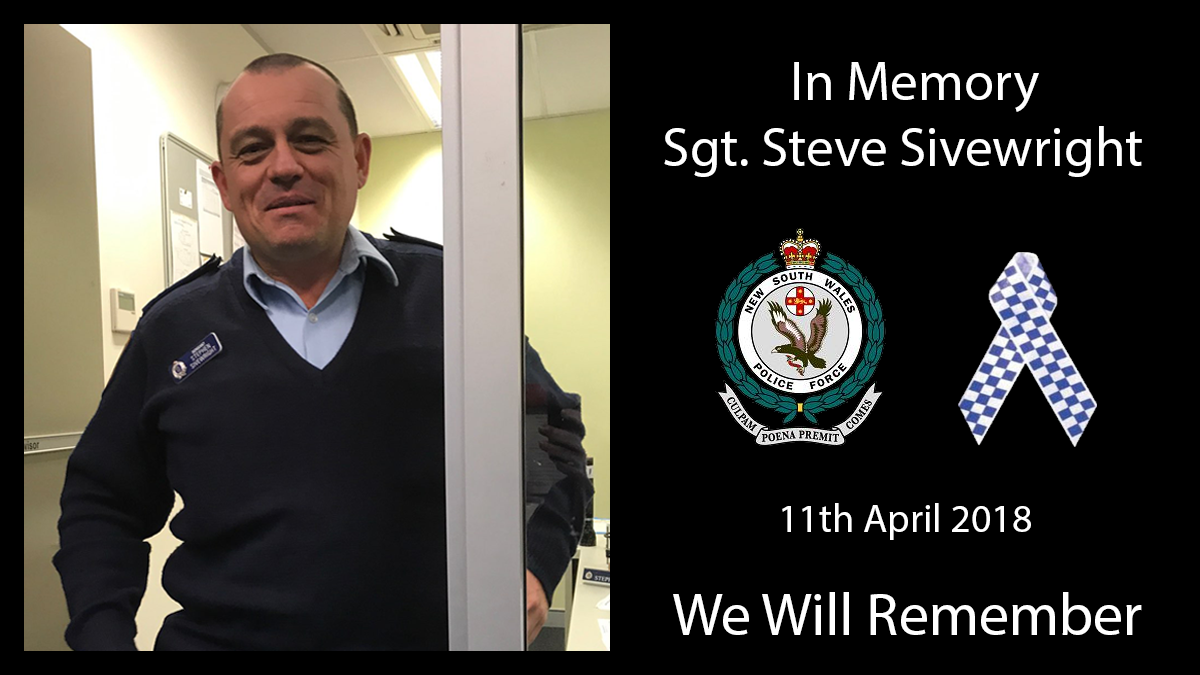
Police Statement: A critical incident investigation has been launched after the death of a police officer near Wagga Wagga. Police were called to the Sturt Highway about 30km from Wagga Wagga around 4.25pm yesterday (Wednesday 11 April 2018) after concerns were raised for the welfare of an officer. Ambulance paramedics responded to the location but were unable to revive the officer. At this time there is no evidence the incident is suspicious. A critical incident team has been formed to investigate the circumstances surrounding the matter.
That investigation will be subject to independent review.
Police disappointed at close of Operation Tortoise
It would have been difficult to escape a random breath test in Wagga across the Easter long weekend.
It follows a Highway Patrol crack down on fatigue, drink and drug-driving.
With thousands hitting the roads for the holiday, Riverina police conducted more than 6600 random breath tests across four days.
These numbers come at the close of Operation Tortoise, with double-demerits in force until midnight on Monday.
Despite the low number of drivers busted drink driving, acting-Senior Sergeant Stephen Sivewright said the behaviour of drivers across the region had been disappointing.
“The message isn’t getting out there,” Sergeant Sivewright said. “People are still speeding.”
He said road users continued to put the lives of their passengers and other people in danger, with more than 200 drivers issued speeding fines.
A further 25 infringements were issued for not wearing seatbelts and 308 drivers were busted for other traffic offences.
“People shouldn’t have to die for drivers to listen,” Sergeant Sivewright said. “This should be a wake-up call.”
His words follow the tragic death of an elderly driver on a Riverina road, near Jindera, on Monday morning.
This death brought the number of fatalities on Riverina roads to six this year.
“That’s ridiculously high,” Sergeant Sivewright said. “Up until March 28, there were 59 fatalities on state roads – a definite increase on last year.”
Police say the results of this year’s initiative to reduce the holiday road toll are concerning.
It follows Wagga Highway Patrol’s launch of Operation Safe Arrival on December 22.
Acting Senior Sergeant Stephen Sivewright on Tuesday said local officers, combined with resources from Sydney, had already performed thousands of random breath tests across Wagga.
The Highway Patrol chief said of more than 8520 tests, ten drivers had been caught drink driving.
In addition, Sergeant Sivewright said 225 drivers had been fined for speeding across the region, which was more than half the combined number of traffic-related offences, during that period.
“We are concerned about the 10 drink driving offences,” Sergeant Sivewright said. “We’d like that to be zero.”
Double demerits will apply from Friday, December 22 with all Traffic and Highway Patrol Command staff on duty until New Year.
Sergeant Sivewright urged Riverina drivers to stick to the speed limit, to make a plan-b and to get to their destination safely.
Highway Patrol want you to survive the drive home this Christmas | Video
Madeleine Clarke
Wagga’s Highway Patrol force are gearing up for the busy Christmas period with Operation Safe Arrival kicking off today.
Double demerits will apply from Friday, December 22 with all Traffic and Highway Patrol Command staff on duty until New Year performing random breath tests, mobile drug testing, speed enforcement and vehicle and driver compliance checks.
Acting Senior Sergeant Stephen Sivewright said the Riverina cluster will be boosted by additional resources from Sydney.
“We’ll have all our vehicles out on the roads during the day and night time so the public can see us.”
The Wagga Command is made up of 20 officers and nine vehicles.
“With more people going away, wanting to get there, they can get distracted by their mobile phones, we’ll be out there trying to deter people from committing offences,” Sergeant Sivewright said.
“For those travelling long distances we hope they have had at least eight hours sleep before they begin their journey, and stop every two hours or when tired.
“Personal responsibility is the key to road safety in NSW. We urge those on our roads over the school holidays, Christmas and the New Year to help us keep everyone safe on NSW roads.”
Last Christmas and New Year period saw 40 people die on Australian roads, up from 34 the year before.
NSW was the worst state for fatalities, claiming 12 of the dead.
I have decided to support NSW Police Legacy’s largest annual fundraiser in remembrance of all deceased NSW Police Force Officers.
I’m raising funds to continue providing essential financial assistance and social programs and experiences to the widows, widowers and dependent children of deceased police officers.
Through here you can easily support this great cause.
I would also really appreciate it if you could share my page above or comment below so more people know about it.
Click ‘Donate Now’ to make a secure online donation.
Thanks so much for your support!
.
Stephen Sivewright
Donated AUD $53.00 online in support of David Clarke
Stephen Sivewright, from Diddine Brahman Stud at South Lismore, was awarded junior and senior reserve champion bull at the Sydney show, making it three out of four Royal Easter Shows he has entered where he has won reserve champion.
“possible” relation in “The Job”: Allan McDIARMID, NSWP # ‘P‘ 0069 – ProCst 26 July 1855
For the purposes of this website ‘P‘ = represents those Police joining Pre 1 March 1862 before the amalgamated of all other Policing Units in NSW. i.e. Mounted Police, Boarder Police, Native Police, Gold Escort Police, Water Police etc.
For the purposes of this website ‘Q‘ represents those Police joining between 1 March 1862 ( commencement of NSWPF ) – 23 February 1915 ( Commencement of NSWPF current numbering system )
Stuart McDIARMID, NSWPF # 32118
Michael McDIARMID, NSWPF # 33566
New South Wales Police Force
Regd. # 8451
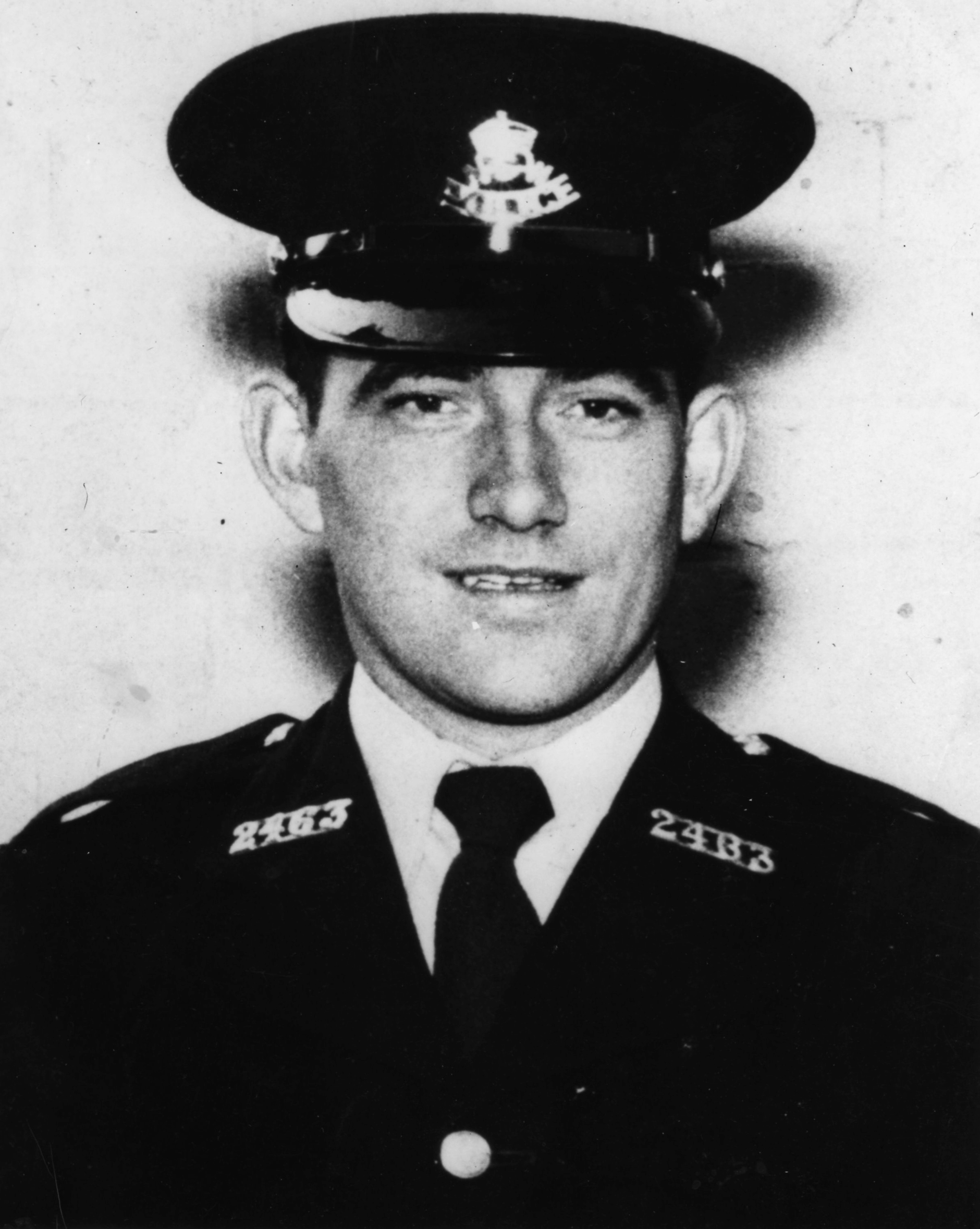
Uniform # 2463
Rank: Commenced Training at Redfern Police Academy on Monday ? ? ?
Probationary Constable – appointed 9 July 1956
Senior Constable – appointed 26 September 1967
Sergeant 3rd Class – posthumously on ?
Stations: ?, Blacktown – Death
Service: From? ? pre July 1956? to 30 September 1971= 15+ years Service
Age at Leaving NSWPF: 39 years, 4 months, 10 days
Time in Retirement: 0
Awards: No find on It’s An Honour but I would suspect that he also received a Queen’s Police Medal for Gallantry
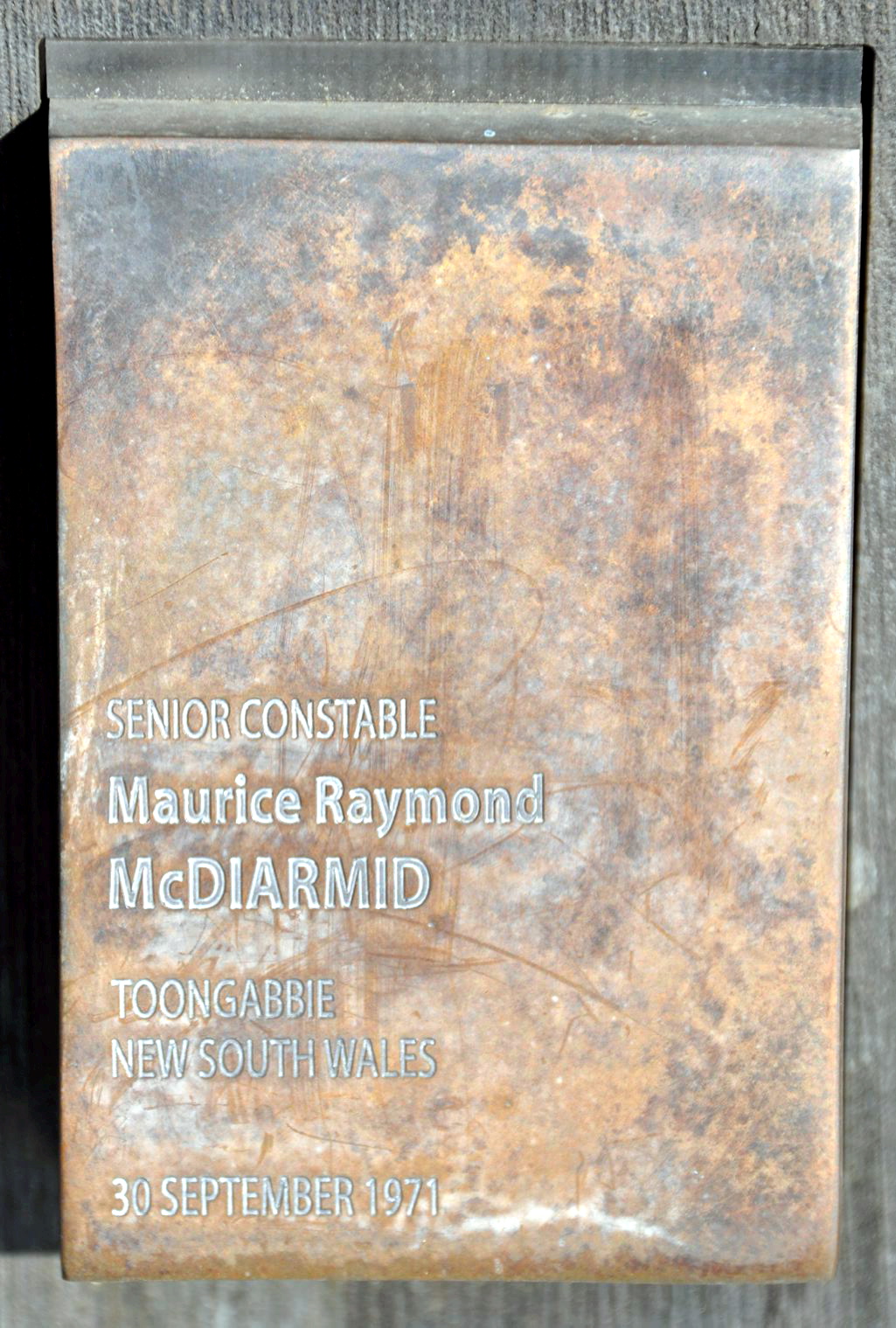
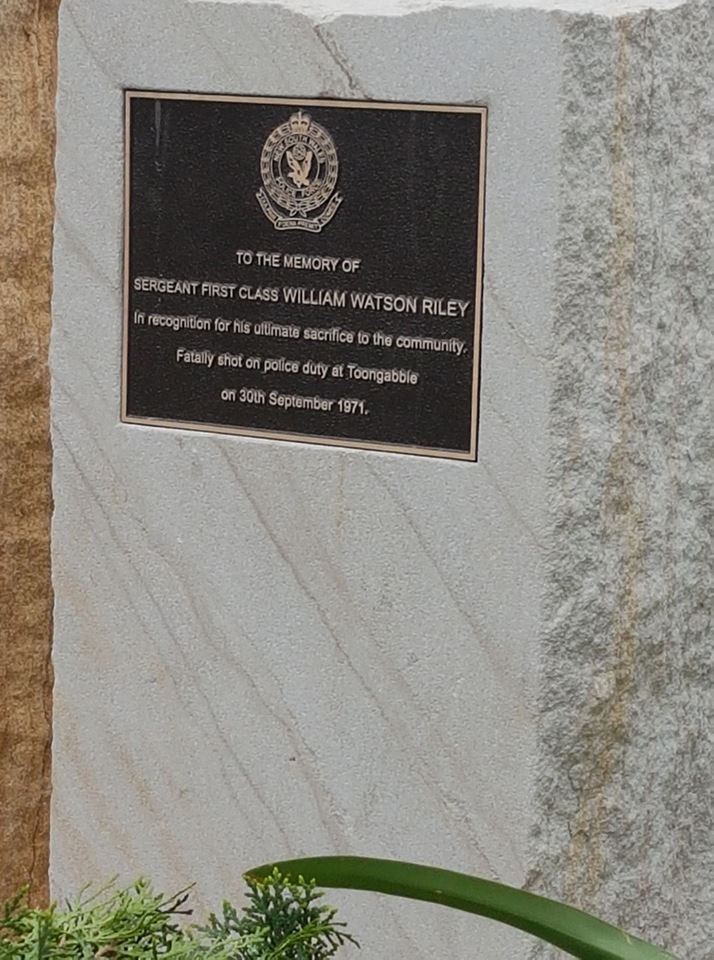
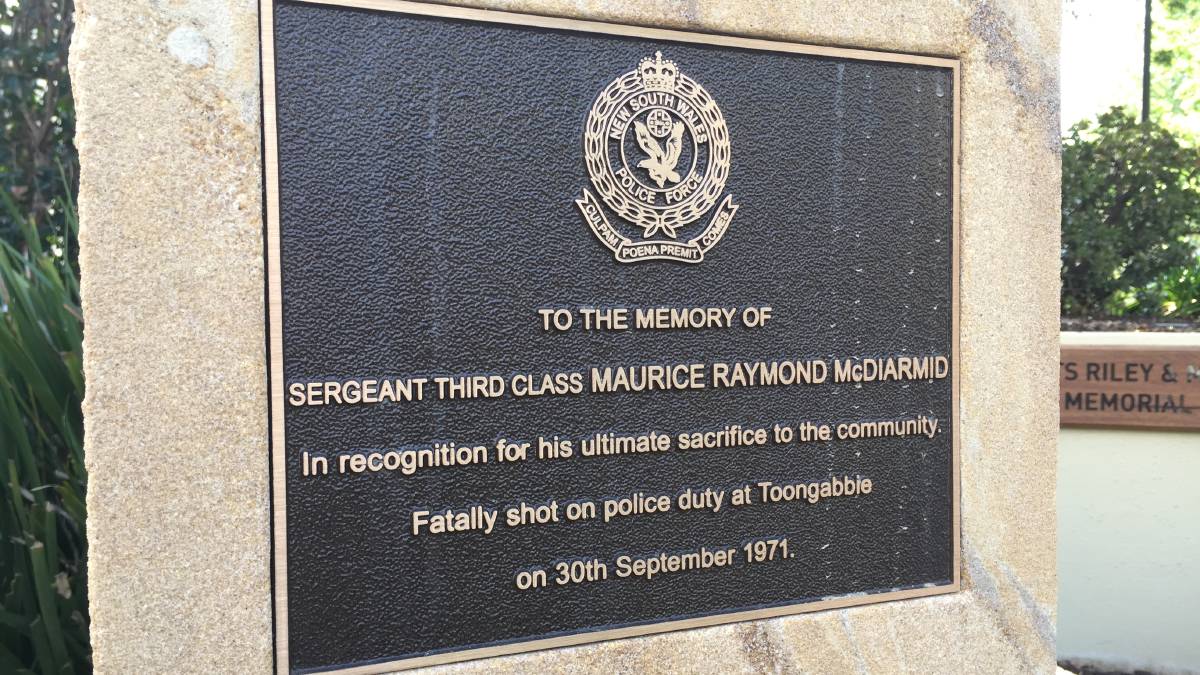
On 30 September, 1971, Sergeant 2nd Class Riley and Senior Constable McDiarmid attended a dwelling in Mimosa Avenue, Toongabbie to investigate a report that a man had shot and killed his brother at that address. On arrival the police saw the offender RonaldClarke who quickly ran to the rear of the house. Senior Constable McDiarmid followed him while the sergeant entered through the front door. As the senior constable entered through the back door the offender opened fire with a shotgun, inflicting a fatal wound. It appears the offender then went back through the house where he also shot and killed Sergeant Riley. Although the senior constable was still alive when other police arrived he died a short time later in an ambulance on the way to hospital. The offender was shot and killed by police ( Cst 1/c Alf GREGORY ) the same day.
William Riley was born in 1921 and joined the New South Wales Police Force on 3 December, 1945. At the time of his death he was stationed at Blacktown. He was posthumously promoted to Sergeant 1st Class.
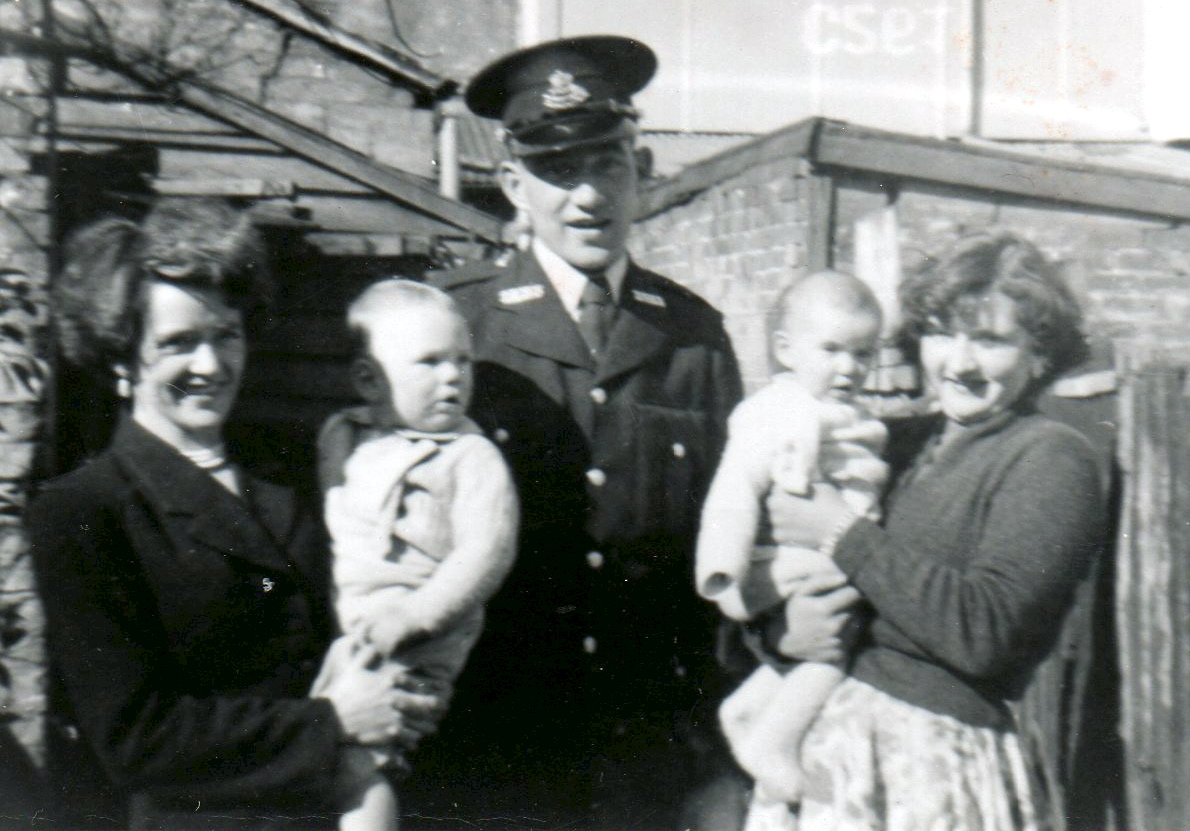
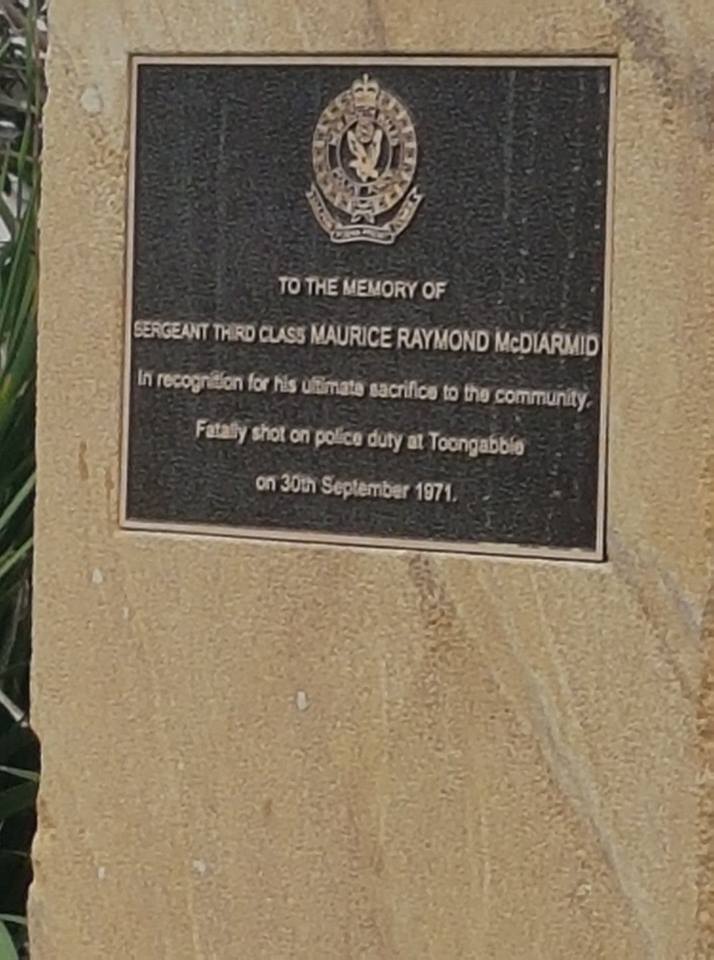
Maurice McDiarmid was born in 1932 and joined the New South Wales Police Force on 9 July, 1956. At the time of his death he was stationed at Blacktown. He was posthumously promoted to Sergeant 3rd Class.
George Lewis Memorial Trophy
This trophy for the year 1971, which is for the most courageous act performed by a member of the New South Wales Police Force, was awarded posthumously to the late Sergeant 1st Class W. W. Riley and the late Sergeant 3rd Class M. R. McDiarmid who were stationed at 27 Division.
The trophies were presented to Mrs Riley and Mrs McDiarmid at the Police Academy during 1972.
PETER MITCHELL TRUST AWARDS
The ten awards under this Trust for the year 1971 were made to the following police, the trophies being presented at the Police Academy during 1972:
Most Courageous Act Posthumously awarded to the late Sergeant 1st Class W. W. Riley and the late Sergeant 3rd Class M. R. McDiarmid in conjunction with the George Lewis Memorial Trophy.
Canberra Times (ACT : 1926 – 1995),
Tuesday 21 March 1972, page 3
Plaque
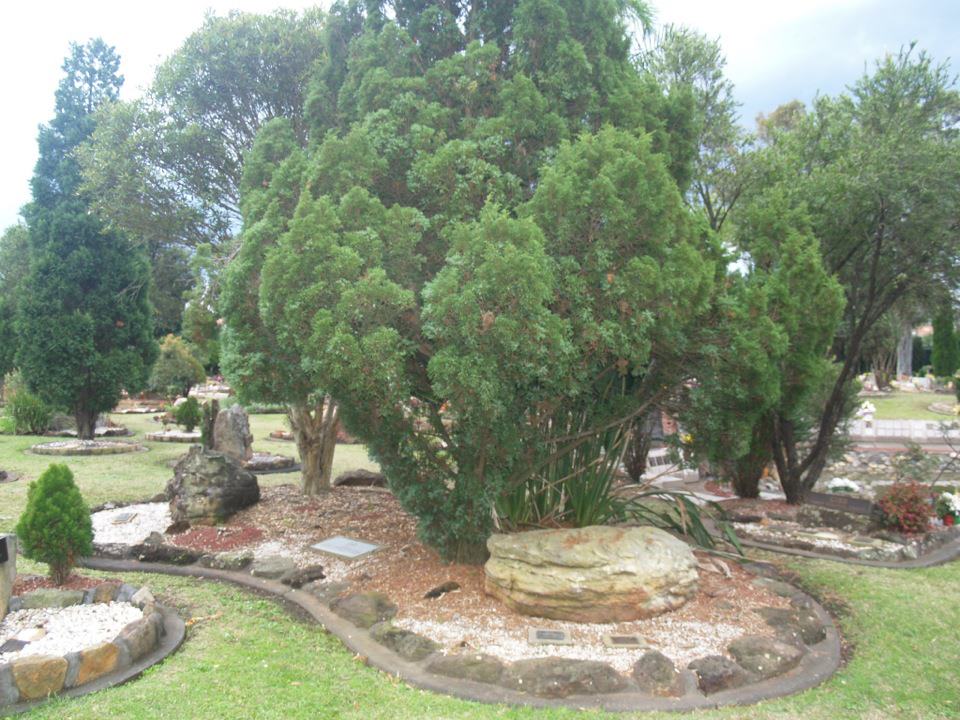
SYDNEY, Monday. — At the Pine Grove Memorial Park near Rooty Hill today, Bishop Hulme-Moir, chaplain of the NSW Police Force, dedicated a plaque in memory of Sergeant Maurice McDiarmid and Sergeant William Riley, who were shot when attempting to arrest an armed man at Toongabbie on September 30 last year.
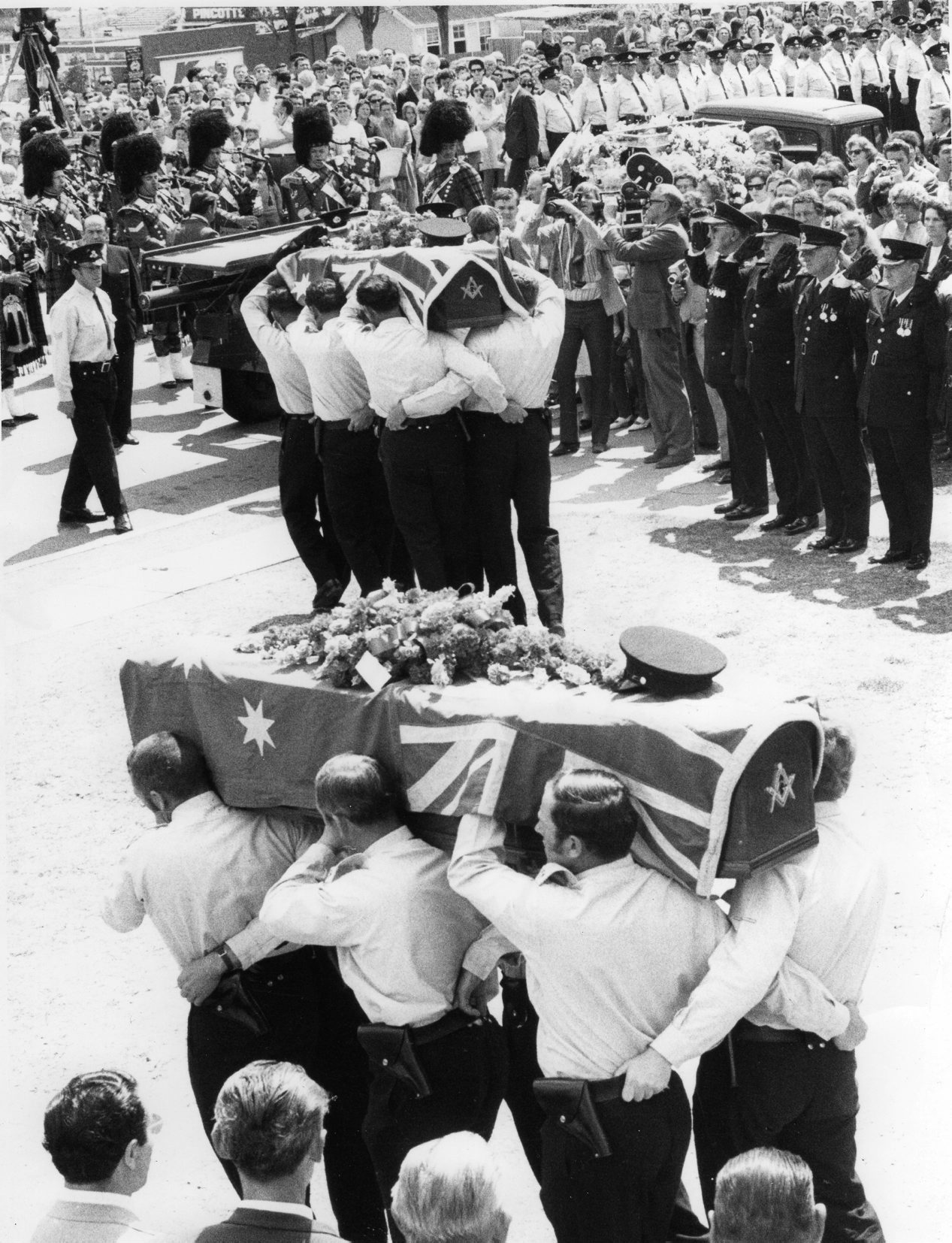
SYDNEY, Tuesday. -More than 400 policemen attended the funeral this morning of the two policemen shot by a man in Toongabbie last Thursday. Both men, Sergeant William Watson Riley and Senior Constable Maurice Raymond McDiarmid, were given full police honours at their funeral.
SYDNEY, Wednesday. – The NSW Government agreed today to make, as “an act of grace”, lump-sum payments of $12,500 to each of three police officers’ widows.
“The Premier, Sir Robert Askin, said the payments would be in addition to the pensions and dependant’s allowances already paid out of the police superannuation and reward fund.
The three policemen involved in the payments are Senior Constable W. E. King, who was murdered at East Gresford police station on August 13 last year, and Sergeants W. Riley and M. McDiarmid, who were shot by a man at Toongabbie on September 30 last year.
Sir Robert said members of the police force had always been specifically excluded from the definition of “worker” under the Workers Compensation Act.
He said the Commissioner of Police, Mr Allan, had brought to the notice of the Government that, in certain matters of workers’ compensation, police were in an anomalous position in relation to other Crown employees.
Sir Robert said a full examination would be made of overall benefits of workers’ compensation available to police.
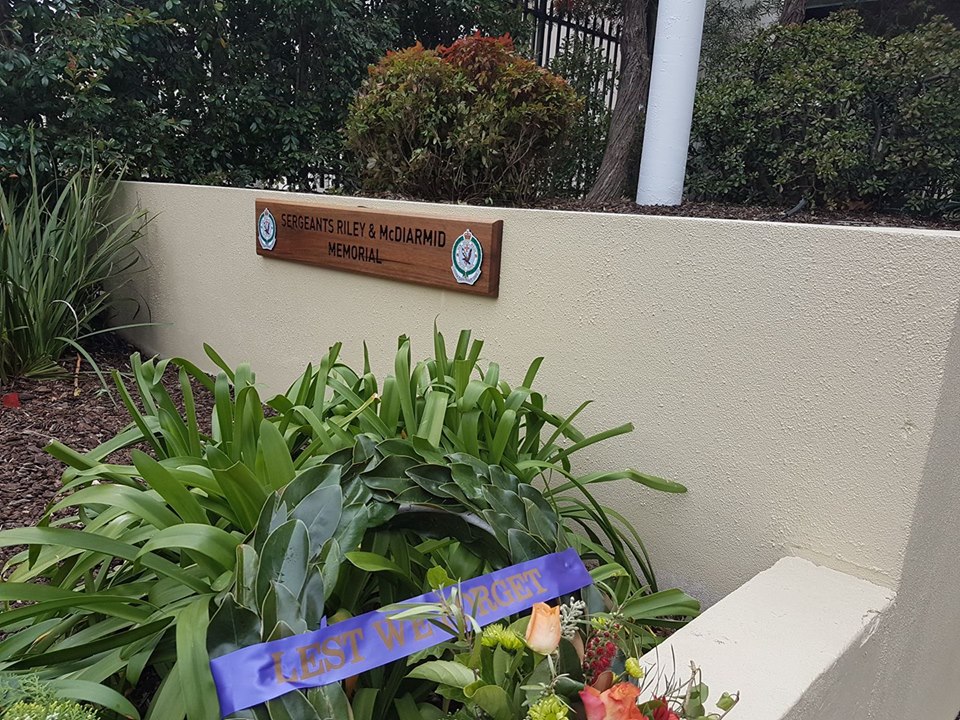
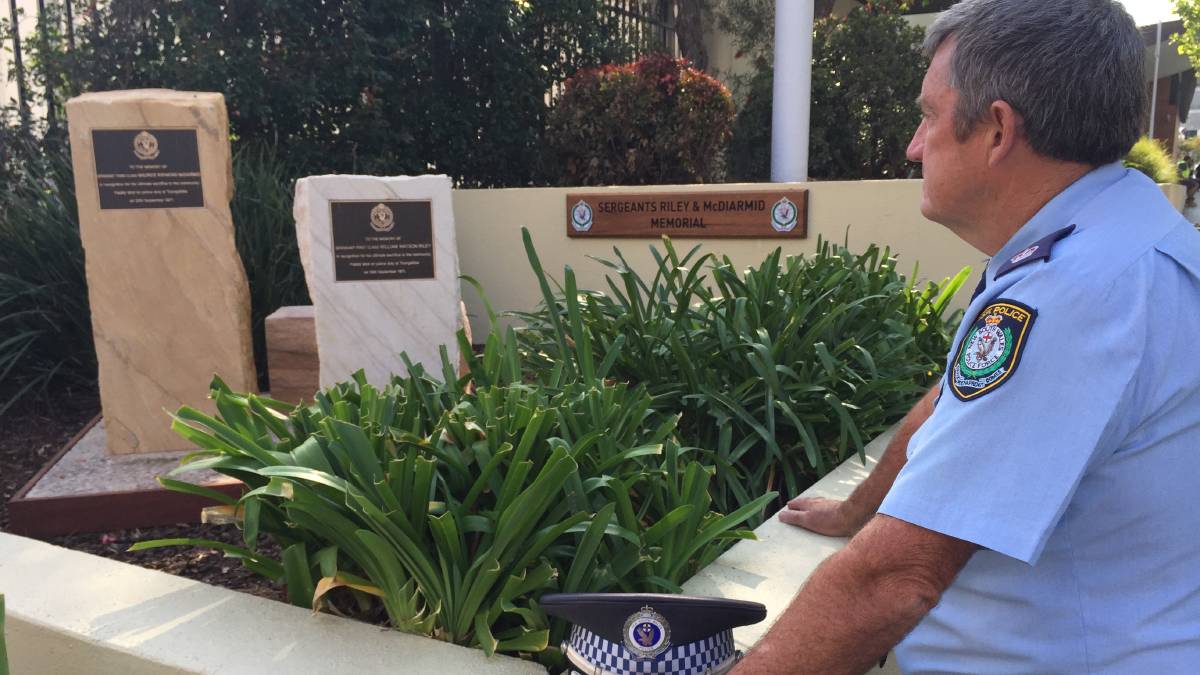
NOT FORGOTTEN: Blacktown Police Chief Inspector Bob Fitzgerald pays his respects at a memorial to slain officers Sergeant 1st Class William Riley and Sergeant 3rd Class Maurice McDiarmid. Picture: Harrison Vesey
A solemn memorial stands to remind Blacktown police officers of the price paid by two of their colleagues.
William Riley and Maurice McDiarmid were both killed in the line of duty on September 30, 1971, while trying to apprehend a murder suspect in Toongabbie.
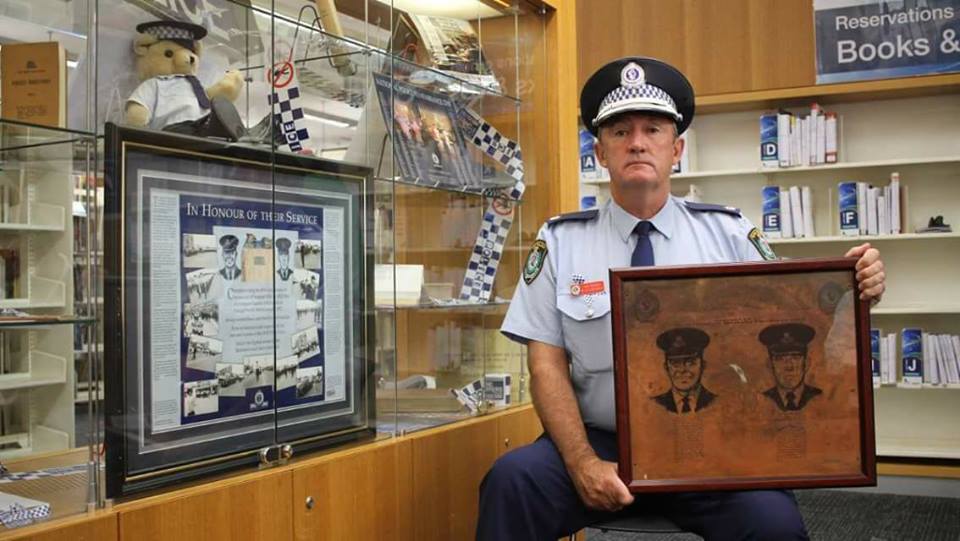
They are now remembered by commemorative plaques outside Blacktown Police Station, as well as a plinth at the entrance to the memorial rose garden at the NSW Police Academy.
The plinth features two police caps pictured the way they fell when the men were murdered, and bears the words: “For The People”.
Detective Senior Sergeant Adam Wilson, Probationary Constable Peta Kendall, Acting Inspector Lauren Martin and Chief Inspector Bob Fitzgerald.
Chief Inspector Bob Fitzgerald said the permanent memorials were important for police and the community.
“I hope it’s a reminder when you come to work, you do the job to the best of your ability and go home to your family,” he said.
Acting Inspector Lauren Martin said Police Remembrance Day gave every officer a chance to think about those who didn’t make it home.
“It’s good to have a visual reminder so you can reflect on what could happen when you come to work,” she said.
Sergeant 2nd class Riley and Senior Constable McDiarmid were attending a home in Mimosa Avenue, Toongabbie, following reports a man had raped a woman and shot her lover, who was also his brother.
The offender, Ronald Clarke, shot and killed both officers as they attempted to surround him. He was shot and killed by police in Hillview later that day.
“It is a very sad day for all those who believe in upholding the law and order,” Police Commissioner Norman Allen said at the time.
Both officers were posthumously promoted for their outstanding courage and devotion to duty.
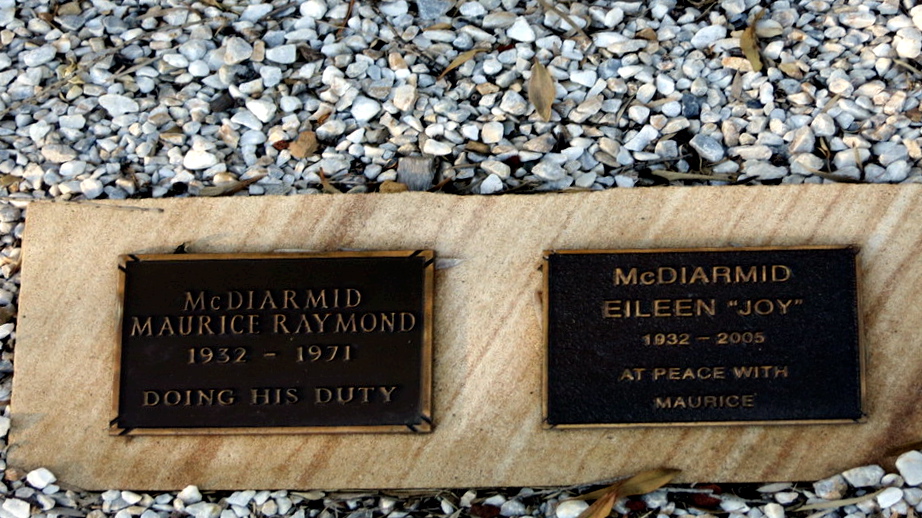
More than 400 officers attended their funeral in Blacktown. They were laid to rest at Pinegrove Cemetery with plaques bearing the inscription: “Doing His Duty”.
SYDNEY, Friday. — A Sydney coroner has commended two policemen who chased and stopped “an armed and desperate man“.
The man, Mr Ronald Desmond Clarke, had earlier shot and killed two other policemen after having killed his own brother in Toongabbie on September 30.
The coroner, Mr J. Parnell, SM, found on Wednesday that Mr Clarke in turn died in a car of cerebral lacerations and gun shot wounds to the brain inflicted by a person defending himself.
Constable A. C. Gregory, giving evidence at the inquest into the deaths of the four men, said that he and Constable L. ( Les ) A. Crawford in a police truck had rammed Mr Clarke‘s car, causing him to lose control.
Constable Gregory had seen Mr Clarke transfer a gun from his left hand to his right. The gun had been pointing at the policeman’s face and the constable had fired “one shot towards his shoulder“.
“The impact of this bullet appeared to throw him towards the passenger side of his car, but he still had the revolver, which he now held in both hands, levelled at my face“, Constable Gregory said.
“He appeared to be endeavouring to discharge the gun and it was then that I fired two quick shots at him“.
The four men who were killed were Sergeant First Class William Watson Riley, 50, and Sergeant Maurice Raymond McDiarmid, 39, of Blacktown, and Ronald Desmond Clarke, 20, and Warren John Clarke, 22, both of Toongabbie.
( Both policemen were promoted posthumously. Sergeant Riley was raised from second-class to first class, and Sergeant McDiarmid from senior constable to sergeant third class. )
Mr Parnell found that Mr Warren John Clarke died from gunshot wounds inflicted by his brother, Mr Ronald Desmond Clarke.
He found also that Sergeant Riley died from a fractured skull and lacerations to the brain, and Sergeant McDiarmid died in an ambulance between Toongabbie and Blacktown Hospital.
Both died as a result of bullet wounds inflicted by Clarke.
He said Mr Ronald Clarke, a professional criminal, had shot his brother, Warren Clarke, after having raped his brother’s de facto wife.
SYDNEY, Thursday. – Two policemen and two other men were shot dead in the outer western Sydney suburb of Toongabbie today.
The policemen were shot while investigating a report of rape and murder.
Earlier, Mr Warren Clark about 22, died in his bed. Police said his elder brother, Ronald. 23, had shot him through the head with a .22 calibre repeater rifle.
A young woman, living in the house in Mimosa Ave, Toongabbie. with Mr Warren Clark, told police that Mr Ronald Clark had awakened her and then shot his brother.
The woman alleged that Mr Ronald Clark then raped her and forced her to accompany him in his car.
After driving her around for several hours, he had released her at Black town.
The woman went to Blacktown police station.
She was in a hysterical condition.
Sergeant Second-Class William Riley, 50. and Senior-Constable Morrie McDiarmid, 39. left the station immediately to go to the house.
While they were on their way the police radio directed other police to the house.
The next-door neighbour, in Mimosa Ave, Toongabbie. Mrs Ethel Roberts, 54. said she first knew something was wrong when a police officer ran down a driveway at the side of her house.
He began kicking on the door of the house next door.
“He eventually forced the door and went inside”, she said.
“All was quiet for perhaps two minutes, then three shots rang out.
“I ran to the front porch as a young blond man ran from the house with a rifle in his hand, entered a car and screeched off down the road”‘. Mrs Roberts said.
“After he drove off, I saw a policeman’s blood stained hand grasping the back steps of the house”.
Stem flow of blood
“I ran to the road where a woman was delivering bread and told her to call an ambulance”.
Another neighbour, Mrs Dawn Harris, was called by Mrs Roberts, who was trying to stem the flow of blood from Constable McDiarmid.
“When I reached the house a policeman was propped against the back steps”, Mrs Harris said.
“His mouth and part of his face were torn and shredded from the shotgun blast.
“Another policeman was lying dead on the ground.
“In a bedroom in the house another man covered with a sheet was also dead and blood could be seen everywhere”.
Police said later they believe Sergeant Riley died immediately when he was shot at point-blank range with a shotgun.
Constable McDiarmid was taken by ambulance to Blacktown Hospital. He died shortly after arrival.
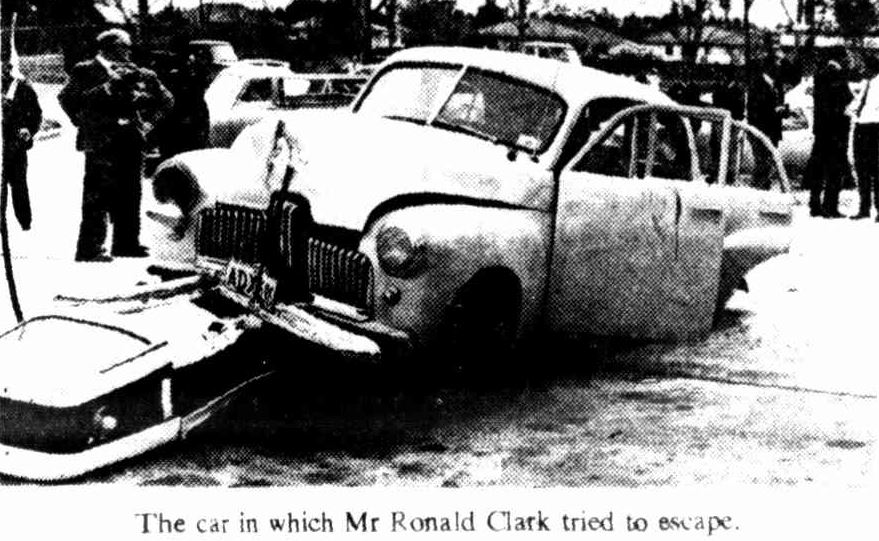
Meanwhile an all-points bulletin was broadcast over the VKG police network for all cars to be on the lookout for a bright blue 1950 sedan.
The broadcast warned, ‘This man is dangerous. He has a .22 rifle, a shotgun and two police pistols”.
“We have sighted him”, one car replied. “He is going toward Hillview”.
“We have stopped the car”, was the officer’s next report.
Constable Alfred Gregory and Constable Les Crawford said later they had rammed the suspect’s car with their police van.
The sedan got out of control and crashed into a bowser at a service station.
Constable Gregory jumped out of the van. As he approached the car he saw Mr Clark take one of the police pistols from the seat and transfer it to his right hand.
Three shots from pistol
Constable Gregory fired three shots from his pistol.
One of his shots struck Mr Clark in the side of the head, killing him.
In the car, police found several Commonwealth Bank cash bags, a blood stained nightgown and two suitcases containing mostly women’s clothing.
Two police revolvers, a .22 repeater rifle and a sawn-off shotgun were also recovered.
Tonight forensic and ballistic experts were still examining them.
The policemen killed are each survived by a widow and two children.
Sergeant Riley joined the force in 1945 and Constable McDiarmid in 1956.
A CIB spokesman said this afternoon the families were eligible for a special allowance paid to police killed while on duty.
He said that the lack of witnesses, particularly when the two policemen were shot, was hampering investigations.
POLICE KILLED OR WHO DIED FROM INJURIES RECEIVED IN THE EXECUTION OF THEIR DUTIES
On 13th August, 1971, Senior Constable William Edward King, who was then the officer-in-charge of police, East Gresford, was shot dead at East Gresford Police Station by a man who fired upon him with a rifle.
On 29th August, 1971, Constable 1st Class Patrick Mark Hackett died from injuries received in a motor accident at Polis, Cyprus, whilst performing duty with the New South Wales Police component of the Australian Police Contingent of the United Nations Peace Keeping Force.
On 30th September, 1971, Sergeant Second Class William Watson Riley and Senior Constable Maurice Raymond McDiarmid, both then attached to Blacktown Police Station, were shot dead in a house at Toongabbie which they had entered to arrest a man who a short time before had murdered his brother and raped a woman in the same house.
A police funeral with full ceremonial honours was accorded these deceased officers at which appropriate tributes were paid.
In recognition of their outstanding courage Sergeant Riley and Senior Constable McDiarmid were posthumously promoted by me to Sergeant 1st Class and Sergeant 3rd Class respectively. In addition, I submitted recommendations to the Premier for favour of consideration of Royal Awards being granted in both cases.
To assist the widows of the deceased police the Premier approved the payment to each of them of the sum of $12,500 as a gratuity. This payment did not in any way affect their entitlements to payments under the provisions of the Police Regulation (Superannuation) Act.
For the purposes of this website ‘Q‘ represents those Police joining between 1862 ( commencement of NSWPF ) – 23 February 1915 ( Commencement of NSWPF current numbering system )
Rank: Constable – Trooper
Stations: ?, Cooma ( about 2 years ), Braidwood from 11 April 1870 – Death
Service: From 21 June 1867to 10 June 1870 = 3 years Service
Awards: ?
Born: ? ? 1842 in Ireland
Died on: Saturday 11 June 1870 @ 3am
Age: 32
Cause: Horse riding accident – Fell and crushed under horse. Coronial Inquest found that the deceased “was accidentally killed by a fall from his horse while in the execution of his duty”
Event location: 3 miles from Braidwood – between Jembaicumbene ( Bell’s Paddock ) & Braidwood
Event date: Thursday 9 June 1870 just before 5pm
Funeral date: Sunday 12 June 1870 – during the afternoon
Funeral location: Roman Catholic Cemetery, Braidwood Cemetery
The Sydney Morning Herald Saturday 11th June, 1870 – Braidwood, Friday – Trooper Coady, yesterday met with an accident, which, it is feared, will prove fatal. When returning from Bell’s paddock, on duty, his horse fell and rolled over him, seriously injuring his spine. He is now lying in hospital. Coady is a single man.
Evening News Monday 13th June, 1870 – Braidwood, Saturday – Constable Coady, died last night from the effects of injuries sustained by his horse falling and rolling over him. Herald
The Goulburn Herald and Chronicle Wednesday 17th June, 1870 – Dreadful Accident – A very serious and distressing accident occurred to Constable James Coady, stationed at Braidwood, who was riding home from Jembaicumbene on Thursday last with Senior Constable Walsh, when his horse fell with him to the ground and rolled over him. It is supposed that the animal put his foot in a hole. Coady was so severely injured as to be left utterly insensible.
Senior Constable Walsh caught Coady’s horse and rode into town (a distance of about three miles), when Senior Constable Duffy sent out a horse and cart, and Coady was brought into town about eight o’clock in the evening.
DR Gentle was immediately called to attend upon him, but has very little hope of his recovery; his spine being broken in several places. Coady has not been long in Braidwood – about three months. He was formerly stationed at Cooma for about two years. The only relative he has in the colony is a brother stationed at Grafton, we are informed. On Friday the unfortunate young man showed no signs of improvement, and his recovery is considered almost impossible – Braidwood Despatch
(A telegram to SM Herald, dated Saturday, says: Constable Coady died last night from the effects of injuries sustained by his horse falling and rolling over him.)
NSW BDM – 1870/3052 – James Cody, aged 32 years, Died Braidwood, NSW; buried in unmarked grave Braidwood Cemetery.
State Records – Registers of Police – Regd # 1801 – James Coady, Date of birth 1842, Ireland, Appointed 21st June, 1867
Manaro Mercury, and Cooma and Bombala Advertiser (NSW : 1862 – 1931), Saturday 25 June 1870, page 3
DEATH OF CONSTABLE COADY.
The accident reported in our ( Braidwood Dispatch ) last issue as having happened to constable Coady on Thursday last, terminated fatally on Saturday morning. The poor young man expired at about 3 o’clock that morning, he having been in a sinking state from the time he was brought home. As we said before, he has only been about three months stationed in Braidwood, having previously been stationed at Cooma for two years. He has no relations in the colony but one brother, who is also in the police force and stationed in the Clarence district ( Grafton ). Deceased during his short sojourn in Braidwood was much respected by the other members of the police force and other persons with whom he had become acquainted. His remains were buried in the Roman Catholic Cemetery on Sunday afternoon, the funeral being attended by the members of the force and a considerable number of the townspeople. His body was interredclose to the graves of the special constables who were murdered at Jinden.
An inquest was held upon the body at the Police Station on Saturday afternoon, before the Coroner and a jury of twelve, when the following evidence was taken :-
Francis Duffy deposed :- I am senior- sergeant of police Stationed at Braidwood. I knew the deceased, James Coady. He was a foot constable, stationed here since the 11th April last. On the 8th instant I directed him, with senior constable Walsh, to proceed the following morning in the execution of warrants. I told him he could either ride my horse or that of constable Bragg, as we would both be engaged at the Police Court next day. Constable Bragg, who was present, said, ” Yes, Coady, you can take my horse if you wish. ” Coady replied, ” I will take the sergeant’s. ”
On the morning of the 9th senior constable Walsh and deceased left here about 9 o’clock. Both were mounted. The deceased was riding my horse. A little after 5 p.m. senior constable Walsh returned to the station and informed me that constable Coady‘s horse ran away with him, fell, and rolled over him, and that he was lying by the side of the road between here and Jembaicumbene. I at once proceeded on foot, and found deceased lying a little way off the road, about four miles from here on the road to Bellevue. Deceased was lying on his back. He was moaning very much. There appeared to be some vomited matter about his head and face, and he smelt very strongly of spirits. At first I thought he was lying in a very drunken fit. On raising him to a sitting posture, he moaned and said, ” Oh, my back ” I spoke to him. He knew me and mentioned my name. His face was cut and bleeding, and I then knew that he was seriously hurt.
Before leaving Braidwood I had given directions for the police dray to follow me. It arrived while I was there, and we had deceased conveyed to the Police Station without delay, where Dr. Gentle attended him the same evening, I believe about 4 o’clock.
James O’Brien deposed :- I am a storekeeper, residing at Bellevue. I saw deceased, James Coady, on Thursday last, about 3 p.m. I saw him first at my store, and we went across the road to Mrs. McManus’ public-house, which is directly opposite. Mrs. McManus is a connection of mine, and I act for her when she is away. On this occasion I went behind the bar and shouted for deceased. He had a nobbler of whiskey. He stopped some little time talking, and then went away. He appeared to me to be sober when he came and seemed sober when he went away. Senior constable Walsh was with him. He could have had some grog before he came over to my store. He came there to get change of a cheque, I think it was a £10 cheque. He wanted me to change it, and take out of it the price of some refreshments he and constable Walsh had had previous to coming over to me. He had nothing after he had the whiskey. The day was a very cold one. The deceased was dressed in the ordinary police uniform, and had no over coat. He left at a canter.
Constable Walsh was about one hundred and fifty yards before deceased, whose horse was very restive while he was mounting. He did not seem a first class rider, and Walsh‘s horse having gone on made his hone restive. He had a revolver in his belt when he went away. It was about ten minutes after I treated the constables that they started.
By the Jury:- They both tried to mount at the same time, but Walsh mounted and rode off quicker than the other. I did not see the constables arrive.
William Walsh deposed :- I am a senior constable of police stationed at Braidwood. I went out to execute some warrants on Thursday, 9th instant. We went to the Chinese Camp, at Jombaicumbene, and arrived there about 10 a.m. We remained at the Camp about five minutes, and then proceeded to a locality known as Moreing’s Flat, where the Chinamen we were in search of were supposed to be. When we got there they had left. We searched the claims and the hut, as I was informed they had been there a short time previous. We then went back to Bell’s Paddock, to a Chinamen’s camp there. I waited there while a Chinaman went to look for those we were in search of. He could not find them. I then wrote a note to Senior constable Stapylton, informing him that there were warrants out for these men, and that they were supposed to be at Major’s Creek. After that, hearing that the men were back in the house we first searched; we went back, but could not find them, as they were not there. We then went towards Braidwood.
We stopped at Mrs. McManus’s public-house at Bellevue, as constable Coady wished to see Mr. O’Brien. Mrs. O’Brien asked us if we would have some dinner. We had some bread and cheese and a glass of ale each. We then went across the street to the store. Constable Coady had some conversation there. I was then going away when Mr. O’Brien asked us to have a drink before we went, as it was very cold. We each had a glass of whiskey, and started for Braidwood.
About a mile and a half this side of Mr. O’Brien’s, constable Coady’s horse went into a gallop. I pulled up, and he pulled in in three or four hundred yards. About three miles and a half this side of Mr. O’Brien’s we went to have a trot. I was trotting, and he was cantering. He kept on the old road, and I went down a new track. The roads are about forty or fifty yards apart. I looked across and saw the horse rising up and Constable Coady on the ground in the middle of the road. I followed and caught the horse and brought him back. I asked the deceased if be was hurt. He did not speak. I bathed his head with water which was close by. I again asked him if he was hurt. He said ‘Yes.’ I asked him where; he said his back. I lifted him on his feet and found he could not stand. He did not try to stand. I laid him down, and kept bathing him. With the assistance of some teamsters who came up I put him on the horse, but he said he could not ride, that his back was broken. I took him down, and carried him about thirty yards off the road to a small ridge. I rode into Braidwood as quickly as possible for assistance, and he was brought in in the police dray.
Cross-examined by the jury :- We had had a glass of grog about five hours before we went to O’Brien‘s. It was at Miller‘s, close to the Chinese Camp to which we first went. There was no appearance on the deceased as if he was at all affected by grog before we began to trot. He was a very poor rider. The horse did hot appear as if it had bolted with him at the time he was thrown. It had bolted with him the previous time. He had trotted with me in the morning when we first went out. All we drank at McManus‘s was a glass of ale and a glass of whiskey each. The road was very rough where the horse appeared to have fallen on deceased. I came to the conclusion that the horse must have rolled over deceased when I saw the saddle marked with the earth. The bar of the bit was bent on the near side, as if the horse had fallen with his head on the ground. There was earth on the bit. The bit produced is the one I speak of. It is bent on the off side. There was some red earth on the horse’s head, on both sides, when I caught him, as if he had rolled over. There were some men breaking stones about a mile or a mile and a half from where the accident occurred. I saw no men nearer. I was not riding with deceased when we passed the men breaking stones. As we passed the men the horse bolted a second time. Deceased appeared to be trying to pull him in. I pulled up, and called to deceased to do the same. The horse galloped pretty smartly when he bolted, but was not at full gallop. He rode with a double-bridle, but I think he used the check rein. When the horse bolted in the morning I was in front. This was before we called at Miller‘s. He did not fall off any of these times, although the horse was galloping quick. I do not think he was rider enough to manage that horse. He waited for me when he pulled up after passing the stone breakers. We went a mile before we again commenced to canter. I was abreast of deceased when his horse fell. I only saw deceased have one glass at Miller‘s; he could have had another glass without me seeing him. I only saw deceased take one glass of ale and one glass of whiskey at McManus‘s. I now recollect that Mrs. O’Brien served him with a glass of brandy or something else before the ale. I saw not the slightest effect of grog upon him after we left McManus‘s. Deceased said that his horse was so lively that he almost jumped from under him. I consider the horse a quiet one. When I went with deceased I told him to bring his revolver and handcuffs with him. When I searched about deceased I found the handcuffs and ammunition pouch, but not the revolver. Deceased told me yesterday morning that he must have dropped the revolver where he fell. I found two belts on deceased when I searched him, but no revolver.
Dr. Gentle deposed that be believed the cause of death was the fracture of the spine. He had no hope of the recovery of the deceased from the time he first saw him. A fall from a horse would cause such a fracture, which might make man vomit.
The jury returned a verdict that deceased was accidentally killed by a fall from his horse while in the execution of his duty.
Maitland Mercury and Hunter River General Advertiser (NSW : 1843 – 1893), Thursday 1 July 1869, page 2
MANNING RIVER.
( From the Manning River News, June 26. )
ACCIDENT AT TAREE:- A rumour has been current for some days past that *Senior Constable John Coady was thrown suddenly to the ground a few nights since by coming in contact with a clothes-line stretched across the Court-yard. He was much bruised by the fall, but is again in the discharge of his ordinary duties.
The fearful results of drunkenness are shown in the following paragraph, taken from the ‘Monaro Mercury ‘ of Friday last : — ‘We never witnessed in Cooma so painful a spectacle or so deplorable an instance of the effects of drunkenness as that brought before the Police Magistrate on Tuesday last. A woman, named Rudd, aged about 30 years, and apparently a strong able person, appeared before the Bench, as an idle and disorderly character.
From the evidence given in support of the charge it would seem that the woman was arrested by sergeant Lenthall, assisted by Constable Coady, in the Market square, on Monday, she then being in a state of intoxication, her daughter, Catharine, sitting near to her.
Both mother and daughter were conveyed to the lock-up, and the police, being aware there were other members of the family, proceeded to where the woman had been in the habit of camping, a short distance from Cooma; Here the officers found a miserably constructed shelter composed of rags and boughs, seated outside of which was the oldest girl, Eliza Rudd, comfortably enjoying a pipe of tobacco, a child about three yearn of age, in a shocking state of filth, lying on the ground close by; within the hut, if it could be so called, they discovered the boy, James Rudd, and to judge from his appearance, soap and water or any cleansing process was an litter stranger to him, and had been so far a considerable time past. The children, together with what few articles of clothing that could be seen, were taken to the lookup.
The case of the children formed the first committal in Cooma under the Industrial Schools Act.
Retired police officer of 41 years Noel Sparks and his wife stumbled across the dilapidated grave of Senior Constable Henry James Fetherston when visiting the Maryborough Cemetery after the 2012 floods to check on Denise’s great-grandmother’s grave.
WHEN Noel Sparks stumbled across the dilapidated grave of a young policeman who died in 1885, he did not know he was starting a journey that would result in the official recognition of the officer’s sacrifice.
Mr Sparks, himself a retired police officer, and his wife Denise visited Maryborough Cemetery in 2012 to check on Denise’s great-grandmother’s grave after the floods.
With a reading from Psalms and verses by Shakespeare on the side of the monument, Mr Sparks knew immediately that Senior Constable Henry James Fetheston ( misspelt – should be Fetherston ), who was just 26 when he died, had been a well-respected member of the community.
He would spend the next five years working towards honouring Snr Const Fetheston‘s sacrifice and helping to ensure the monument marking the young man’s grave would be completely restored to its former glory.
Yesterday ( 11 August 2017 ) a crowd of about 50 police officers, the restoration team, dignitaries and the public gathered to unveil the monument.
Snr Const Fetheston was born in Ireland and was sworn into the the Queensland Police Force in 1878 after migrating to Australia.
In 1879 he was posted to Maryborough.
Snr Const Fetheston was riding through the Police Paddocks in Tinana on February 23, 1885 when his horse bolted.
As he tried to calm him, he was thrown off, landing on a log before being crushed by the falling horse.
He was found at 5am and died at 7am the next day from internal injuries. ( this sentence is poorly worded. He died on 23rd, so either this sentence is wrong or the accident happened at 5am on the 22nd February and died at 7am the next day = 23rd )
Just prior to Police Remembrance Day last year ( 2016 ), his name was added to the Queensland Police Honour Roll and the national police Memorial in Canberra, acknowledging the officer had died while on duty.
After his death the community funded the monument that stands over his grave.
It was estimated that the monument would cost at least $70,000 to build if it was made today.
The well respected young man attended Maryborough’s Anglican church regularly and was a member of the rowing club and a local cricket club.
They sought the help of Warren Harland of Wide Bay Memorials.
“We worked under his direction and Warren was responsible for the restoration of the stone works including the marble and sandstone on the monument,” Noel said.
Senior Constable Henry James Fetherston died from injuries sustained from a horse-riding incident in Maryborough in 22 February 1885. He was 26 years of age and was subsequently buried in the Maryborough Cemetery.
A substantial monument commemorates his death and appears to be in a reasonable state of repair.
The FQPM propose to examine the monument in detail with a view to arranging the cleaning and restoration of the headstone and surrounds.
The President and Secretary were fortunate to meet with retired QPS representatives who have an interest in the restoration of police graves, in particular in the Maryborough area. We spoke with retired QPS member Noel Sparks and his wife, who were keen to coordinate the necessary work on the Fetherston’ grave.
Noel has made a preliminary assessment of the work required and is of the view that the monument has been slightly undermined and requires additional support. The remaining work would include cleaning the monument, painting the iron fence and cleaning the grave surface and perhaps covering with weed mat and decorative stones.
It is believed that much of the restoration can be achieved with volunteer labour and any other work necessary quotes obtained. FQPM would consider any submissions for financial support.
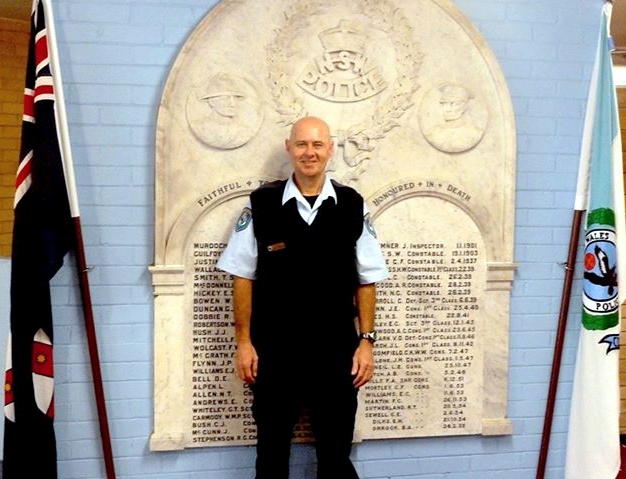
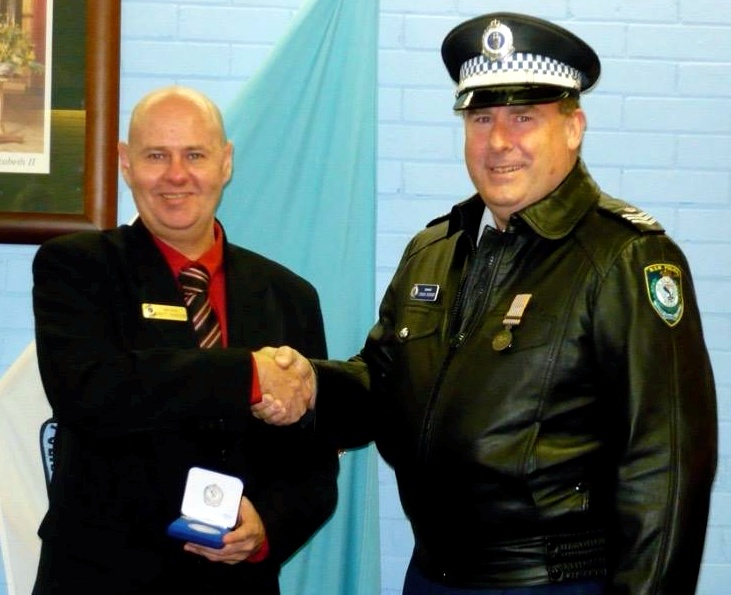

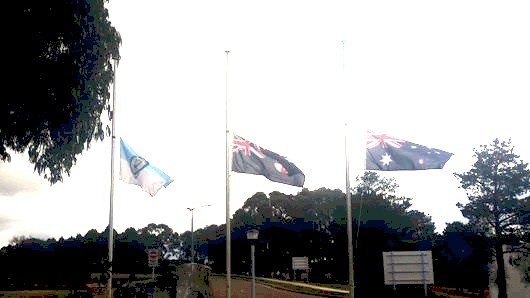
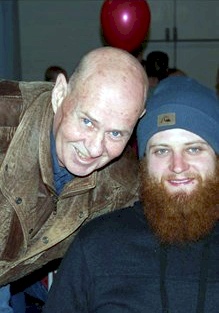
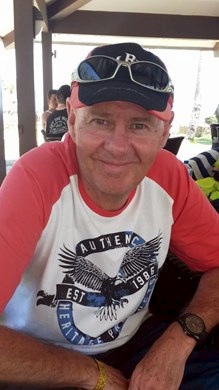


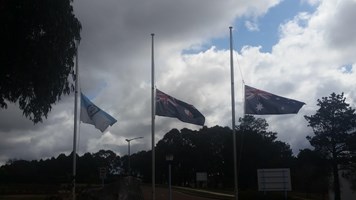

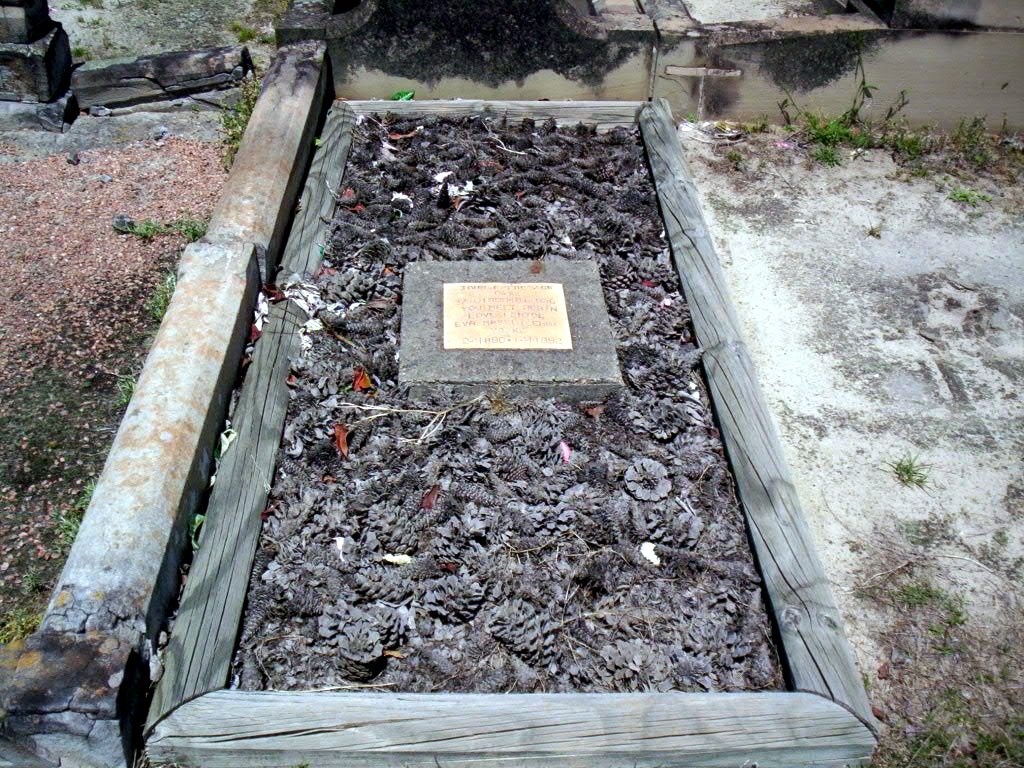
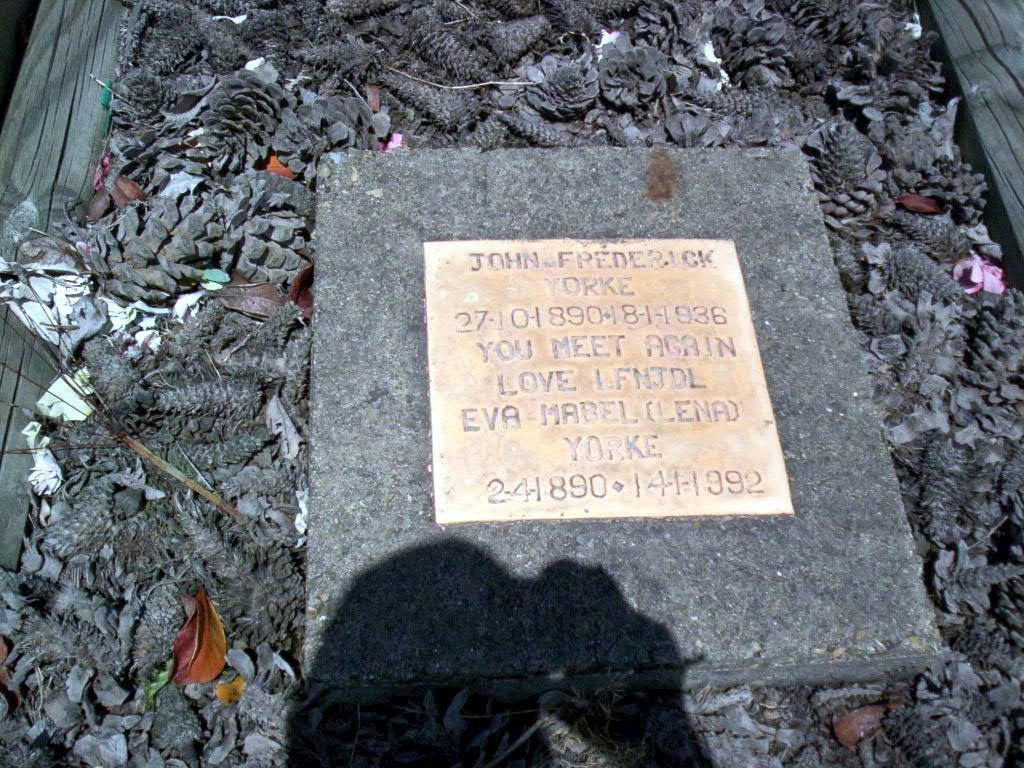


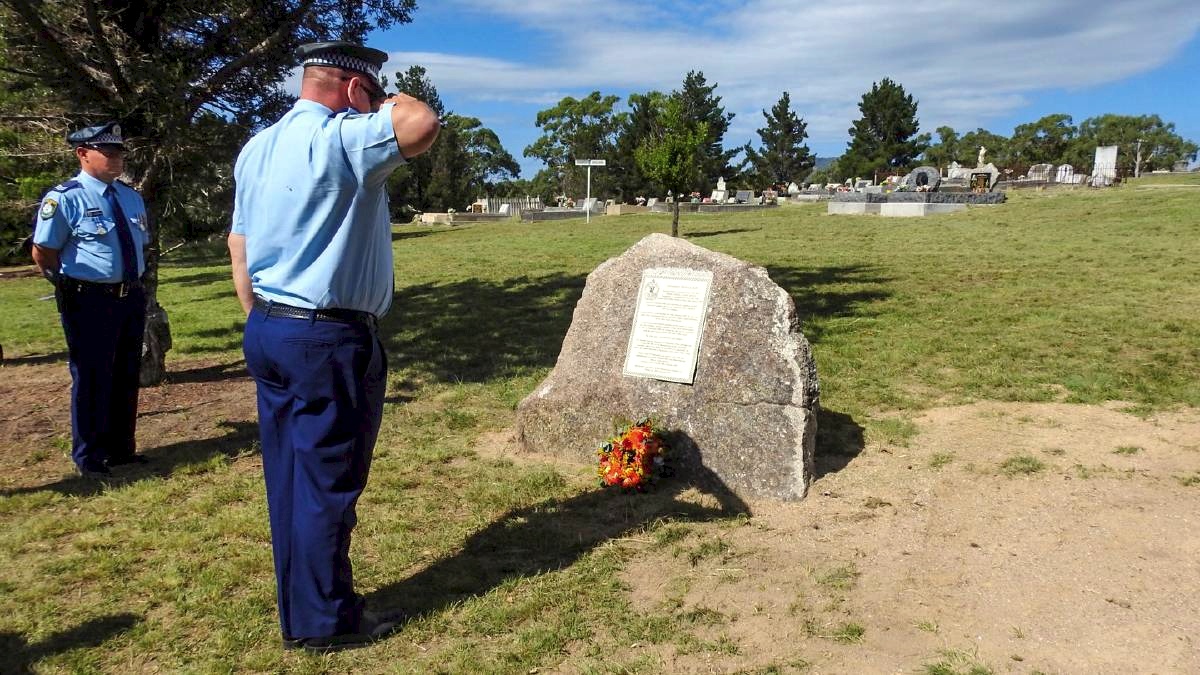
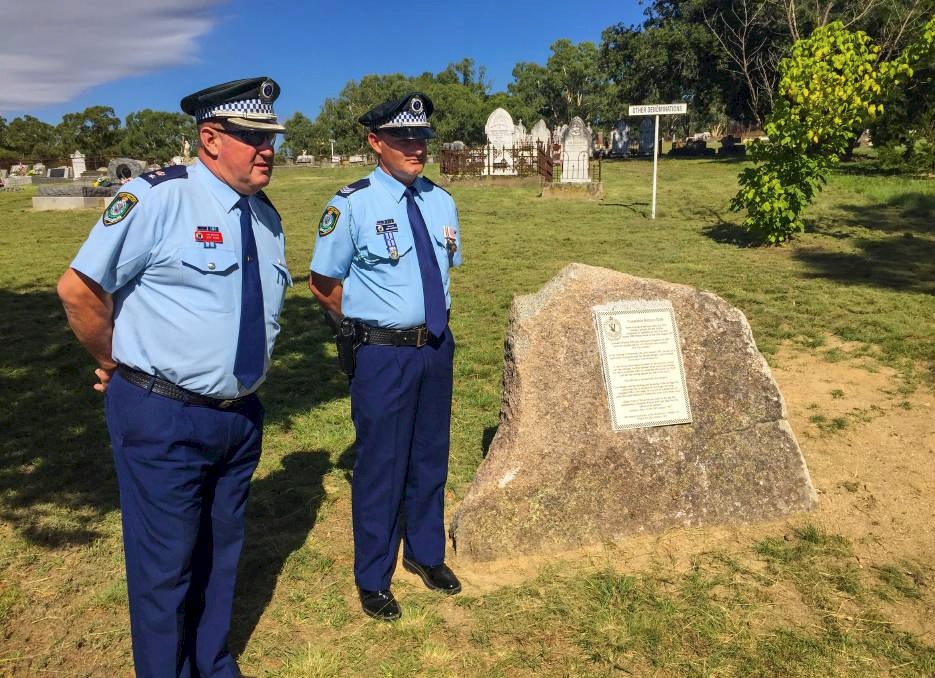
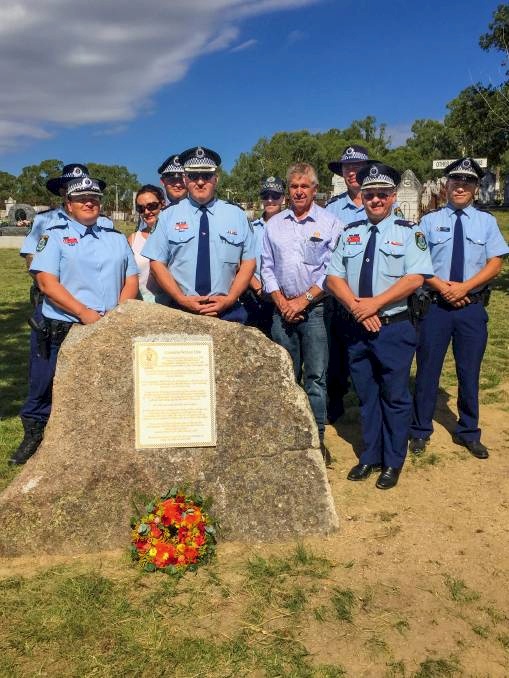

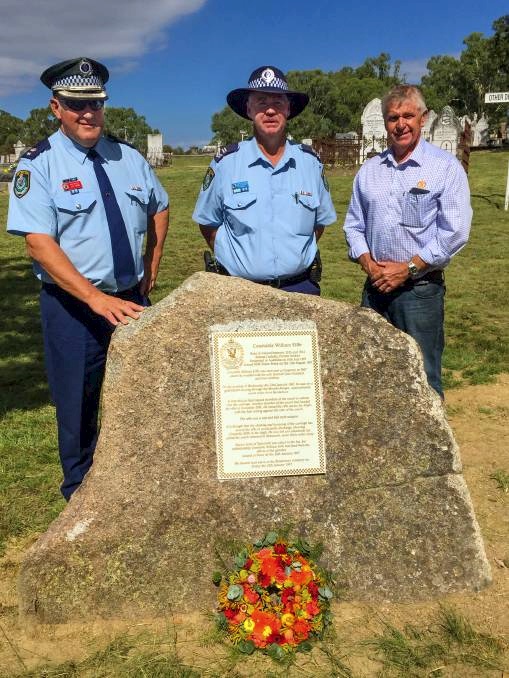
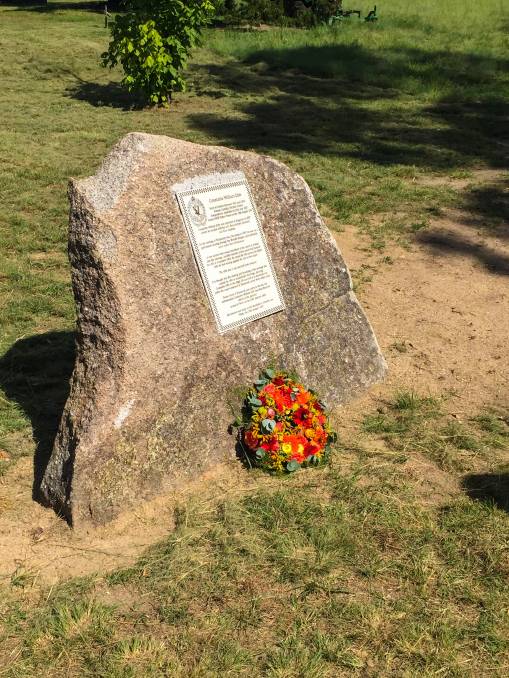
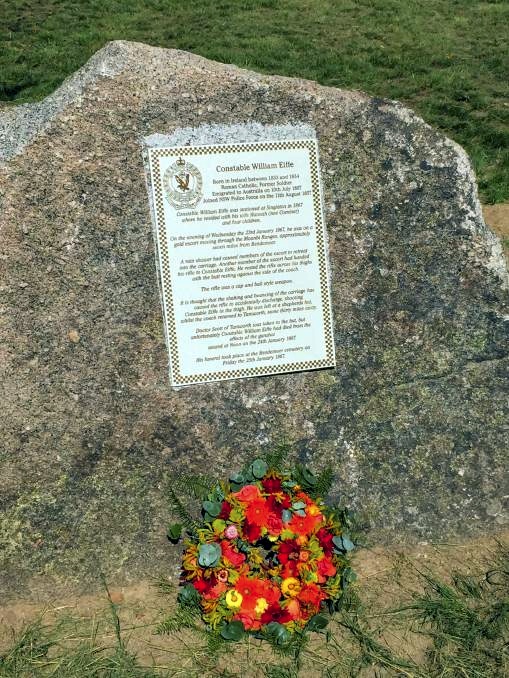
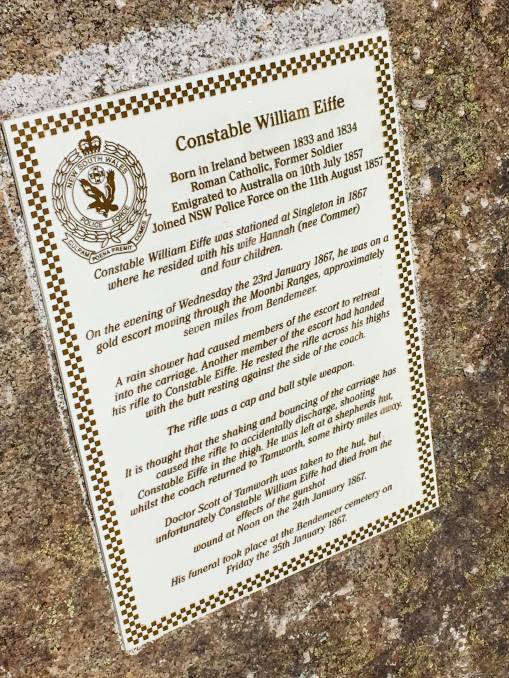
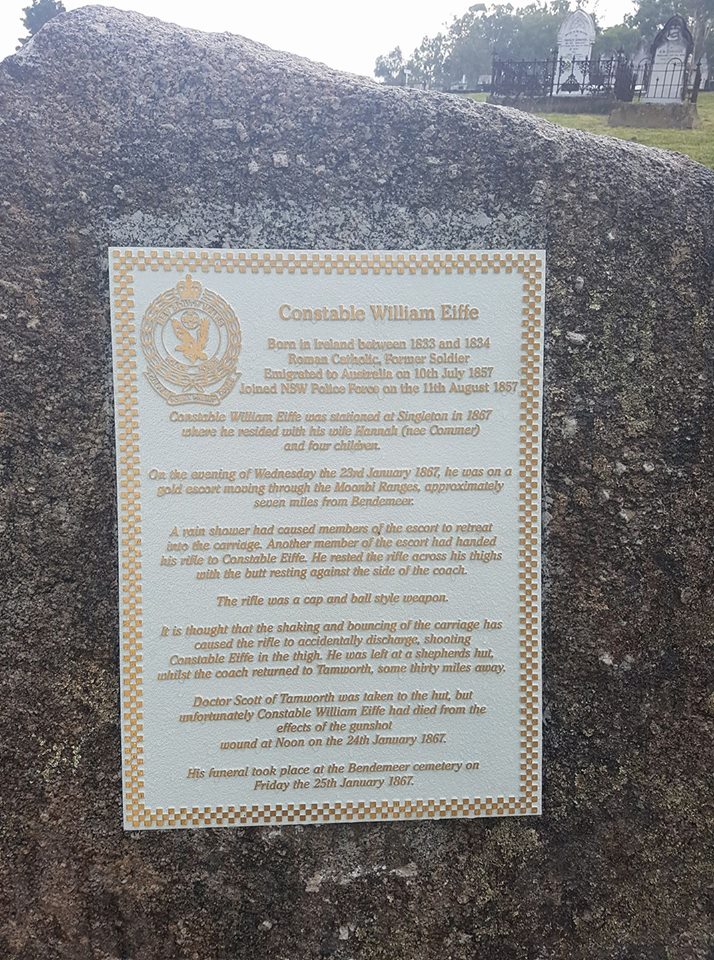
 1795 – 1839 (44 years)