Gabrielle Patricia McDONALD

Gabrielle Patricia McDONALD – nee Eggleston

aka  Gabby

late of Maryland
Wife to Andrew McDonald # 22289


NSW Police Academy Class # 242C

“possibly” a Rejoinee


New South Wales Police Force

Regd. #  26685


Rank:  Commenced training at Goulburn Police Station on Sunday 30 July 1989 ( aged 19 years, 5 months, 5 days )

Probationary Constable – appointed 25 January 1990 ( aged 19 years, 11 months, 0 days )

Constable – appointed  ? ? ?

Detective – appointed  ? ? ? ( YES )

Constable 1st Class – appointed  ? ? ?

Senior Constable – appointed  ? ? ?

Sergeant 3rd Class – appointed  ? ? ?


Final Rank:  Detective Sergeant


Stations?, Inner City ( Sydney ), Newtown Detectives, Balmain ( 8 Division ), Newcastle, Lake Macquarie L.A.C.,  Northern Region Professional Standards


ServiceFrom 30 July 1989   to   3 July 2013 = 23 years, 11 months, 3 days Service


Awards:  No Find on Australian Honours


Born:  Wednesday  25 February 1970

Died on:  Wednesday  3 July 2013

Cause:  Depression – Suicide – hanging – ON DUTY

Previous attempt in 2012 inside Newcastle Police Stn


Age:  43 years, 4 months, 8 days


Funeral date:  Thursday  11 July 2013 @ 11am

Funeral location:  Our Lady of Victories Catholic Church, Sandgate Rd, Shortland


Buried at:  Sandgate Lawn Cemetery, 116 Maitland Rd, Sandgate, NSW


Grave Location:  Lawn Cemetery 1, Row R, Grave 54

GPS:  Lat:  -32.8703445   Long:  151.709213

Gabrielle "Gabby" McDonald
Gabrielle “Gabby” McDonald

GABBY is NOT mentioned on the Police Wall of Remembrance – Canberra 

* BUT SHOULD BE.  Last checked 2 Aug 2019  24 Jan 2024


GABBY IS mentioned on the Police Wall of Remembrance – NSW Domain


Grave location:  [codepeople-post-map]

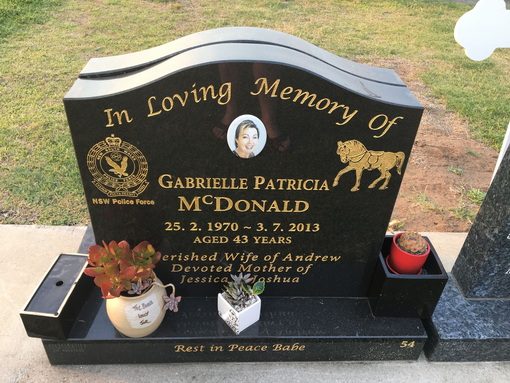
Gabrielle Patricia McDonald NEE Eggleston. Inscription: In Loving Memory of Gabrielle Patricia McDONALD 25.2.1970 - 3.7.2013 Aged 43 years Cherished Wife of Andrew Devoted Mother of Jessica & Joshua Rest in Peace Babe

Andrew McDONALD Gabby EGGLESTON Gabby McDONALD Gabrielle Eggleston Gabrielle Patricia McDONALD
Grave of Gabrielle Patricia McDONALD – nee Gabby Eggleston


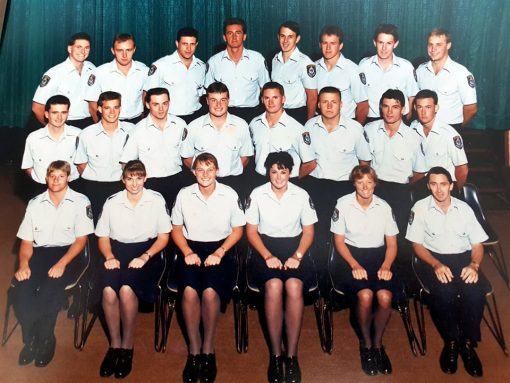
Class 242C- Goulburn - Attested 25 January 1990<b>  <strong>Class 242C  </strong> Goulburn - Attested 25 January 1990<B> Gabby EGGLESTON, Front row, 3rd from right<b>
Class 242C   Goulburn – Attested 25 January 1990            Gabby EGGLESTON, Front row, 3rd from right


Late of Maryland

Gabrielle passed away on 03/07/2013.

Her funeral is proposed to be held at 11am on Thursday 11th Instant at Our Lady of Victories Catholic Church, 262 Sandgate Road, SHORTLAND.

Dearly loved wife of ANDREW, loving mother of JESSICA and JOSH. Loved daughter and daughter-in-law of CARMEL and NORM (dec’d) EGGLESTON, FRAN and WARREN McDONALD.
Sister and sister-in-law of PETER and MAREE, MEL and JULIE, MARIA and MARK, ANDREW and AREEYA, ANGELA and MARK, SUE and STEVE, PATRICK and CAROLINE, NICOLE and NIGEL, GREG and loved aunty of their FAMILIES.

The Relatives and Friends of GABRIELLE are warmly invited to attend her Funeral to be held in Our Lady of Victories Catholic Church, Sandgate Rd, Shortland on THURSDAY 11/7/13 Funeral Liturgy commencing at 11am. An interment will follow at Sandgate Lawn Cemetery.

http://pettigrew.com.au/upcoming-funerals/2013/7/11/mcdonald-gabrielle-patricia-gabby.html


Gabrielle “Gabby” McDonald (1970 – 2013)

In Memoriam

Gabrielle Patricia MCDONALD

Passed away suddenly on 3/7/2013

What would we give to hear your voice and see your face again.

In our hearts is your memory and there you will always be.

Love from Andrew Jessica Joshua your family & friends


Published in The Newcastle Herald on July 3, 2015

– See more at: http://tributes.theherald.com.au/obituaries/theherald-au/obituary.aspx?n=gabrielle-mcdonald-gabby&pid=175205192#sthash.ti7JDssd.dpuf


Family of NSW policewoman who took her own life suing state for millions

Updated

The family of a policewoman who took her own life is suing the state of New South Wales for millions of dollars, for allegedly failing to protect her from harm.

[blockquote]

Key points:

  • Andrew McDonald has filed three negligence claims against the state
  • The claim alleges his wife did not receive adequate care after attending several traumatic incidents
  • It also alleges police failed to investigate a previous suicide attempt

[/blockquote]


Video:    http://www.abc.net.au/news/2016-07-11/family-of-nsw-policewoman-who-took-her-own-life/7587948

Newcastle mother-of-two Sergeant Gabrielle McDonald developed post-traumatic stress disorder (PTSD) and depression after witnessing a string of horrific incidents on the job.

She took her own life on July 3, 2013, the day after a police medical officer had declared her as fit for duty.

Her husband Andrew McDonald has filed three negligence claims against the state of NSW on behalf of himself and his two children, Jessica and Joshua.

His statement of claim, filed to the NSW District Court, said over the course of her career, McDonald attended numerous traumatic incidents, including domestic disputes, assaults, car accidents, suicides and murders.

She was particularly distressed by the drowning of a 17-year-old boy in 2009 and a double road fatality in 2010, but did not receive any counselling, debriefing or monitoring after the incidents, the statement of claim alleges.

In late 2010, she was promoted to Detective Sergeant in the Professional Standards Unit, Northern Region. But she struggled with the heavy workload, which included two stints relieving for her supervisor.

In 2012, McDonald attempted suicide in an office at the Newcastle police station, but police never investigated the incident.

“It’s investigation 101,” Mr McDonald, who was also a police officer, told the ABC.

“That’s what police do and it’s appalling that it was never done.”

Police medical officer found suicide attempt ‘was not genuine’

The day before McDonald took her own life, she was sent to see a police medical officer, Dr Naresh Verma.

Mr McDonald told the ABC, Dr Verma determined her previous suicide attempt was not genuine and he did not believe she had PTSD.

“All the staff thought well, OK, things must be on the improve, maybe Gabrielle is not sick at all, maybe she’s pulling the wool over our eyes and that was clearly wrong,” Mr McDonald said.

Dr Verma did not respond to repeated requests for comment.

The police force determined that McDonald should be transferred to another police station the next day.

According to the statement of claim, she was summoned to a meeting without warning and without a support person to be told she was being moved.

McDonald left the meeting in a distressed state, drove to a state forest and took her life.

Mr McDonald said he had one last telephone conversation with his wife.

“She said I can’t go on any more. I’m not getting better. I’m such a burden. They keep kicking me down at work. All I’m trying to do is keep my hours up. You know, this is hopeless,” he said.

“And I said: ‘You can’t do this’. I pleaded with her and begged her not to.

“She said I love you and the kids. We talked about all the things we’d done together, but nothing I said would make sense to her, she was just that determined to do it”.

McDonald ‘did not receive proper monitoring’

Mr McDonald’s lawyers allege that the police service ought to have known the meeting would cause her distress and that she was at risk of self harm.

They allege the NSW police force was negligent because it failed to maintain a safe system of work to avoid injury to McDonald.

It had also allegedly failed to provide her with adequate training to perform her duties and to take precautions for her safety, “putting her in a position of peril”.

The service is also accused of failing to provide adequate training on how to recognise the symptoms of psychiatric injury.

“The deceased did not receive any or proper monitoring of her condition while she continued to work in a stressful environment,” the claim states.

The claim also alleges the police force had failed to devise a system for the flagging of police officers involved in numerous distressing or traumatic incidents.

As a result of its negligence, McDonald had suffered a major depressive disorder, chronic PTSD, alcohol abuse and death by suicide, it is alleged.

Mr McDonald said he now suffered from an adjustment disorder with depression and anxiety.

He was on track to become a superintendent, before he was medically retired.

He is claiming about $900,000 in future lost earnings, in addition to damages and interest. He is also seeking damages on behalf of his two children.

Damages are limited to $750,000 in the NSW District Court, but it does have the discretion to lift the cap.

In a statement to the ABC, the NSW police force said it could not comment specifically on the tragic circumstances which led to the death of a serving officer.

“NSW police continues to improve its practices and procedures, having made significant advances over many years to minimise the psychological impact of policing duties on our officers, who frequently undertake stressful and difficult work,” the statement said.

“As a major priority, NSW police encourages the reporting of these impacts and offers a range of services to support, guide and educate our staff.

“These support services are comprehensive and effective.

“It is well understood that every officer’s circumstances are unique and most often extremely complex with regard to the impacts of psychological injury.”
http://www.abc.net.au/news/2016-07-11/family-of-nsw-policewoman-who-took-her-own-life-suing-state/7576870


Scott Perrin   18 May 2020
Gabby was my partner Newtown D’s. She was rock solid, loyal and supportive. She spoke her mind and was honest in opinion and views.
Gabby was from the Eggleston family of the Hunter & loved horses and racing. She taught riding to kids with patience & care. Gabby also helped place horses with the Mounted Section NSW Police.
Along with Gabby & Deb Hayton, we had a tough feminine perspective to our office in the 90’s.
Sad to know when she was in need, Gabby felt alone.
Gabby was loved by many and will be missed by all!


James BEATTY

James BEATTY

AKA  ? 

Late of  ? 


“possible” relation in ‘the job’:    ?


NSW Belmore Barracks  Class #  ? ? ? 


New South Wales Police Force


Regd. #  ‘P‘ 1162

For the purposes of this website ‘P‘ = represents those Police joining Pre 1 March 1862 before the amalgamated of all other Policing Units in NSW. i.e. Mounted Police, Boarder Police, Native Police, Gold Escort Police, Water Police etc. 


Rank:  Commenced Training as a Probationary Constable – appointed 5 February 1858 ( aged 22 years, 4 months, 15 days ) 

Constable – appointed 18 February 1858

Constable 1st Class – appointed ? ? ? 

Detective – appointed ? ? ?

Senior Constable – appointed 1 June 1869

Leading Senior Constable – appointed ? ? ? ( N/A )

Sergeant 3rd Class – appointed 1 April 1883

Sergeant 2nd Class – appointed ? ? ?

Sergeant 1st Class – appointed 1 April 1884


Final Rank: =  Sergeant 


Stations Darlinghurst ( 3 Division ), Hill End ( Mounted Police Gold Escort ), Lambing Flat, Parramatta ( 1st Class Constable ), Orderly to the Inspector General of Police – Sydney, Parramatta ( Senior Constable ), Windsor ( O.I.C. ), Campbelltown O.I.C., Ryde O.I.C., Penrith O.I.C. ( J District )( Easter 1888 – Death )


Service: From  5 February 1858   to   11 January 1890   31 years, 11 months, 6 days Service


Retirement / Leaving age: = 54 years, 3 months, 21 days 

Time in Retirement from Police: Zero


Awards:  No Find on Australian Honours system


 Born:   Monday 21 September 1 835  Enniskillen, Northern Ireland

Died on:  Saturday 11 January 1890

Age 54 years, 3 months, 21 days

Organ Donor:  N/A


Cause:  Murdered – Stabbed – On Duty

Event location Outside of Penrith Police Station, NSW ( site of the current Station )

Event date:  Saturday 11 January 1890


Funeral date ? ? ? TBA

Funeral location ? TBA 

James BEATTY
Courtesy of Beyond Courage.

Funeral Parlour: ?

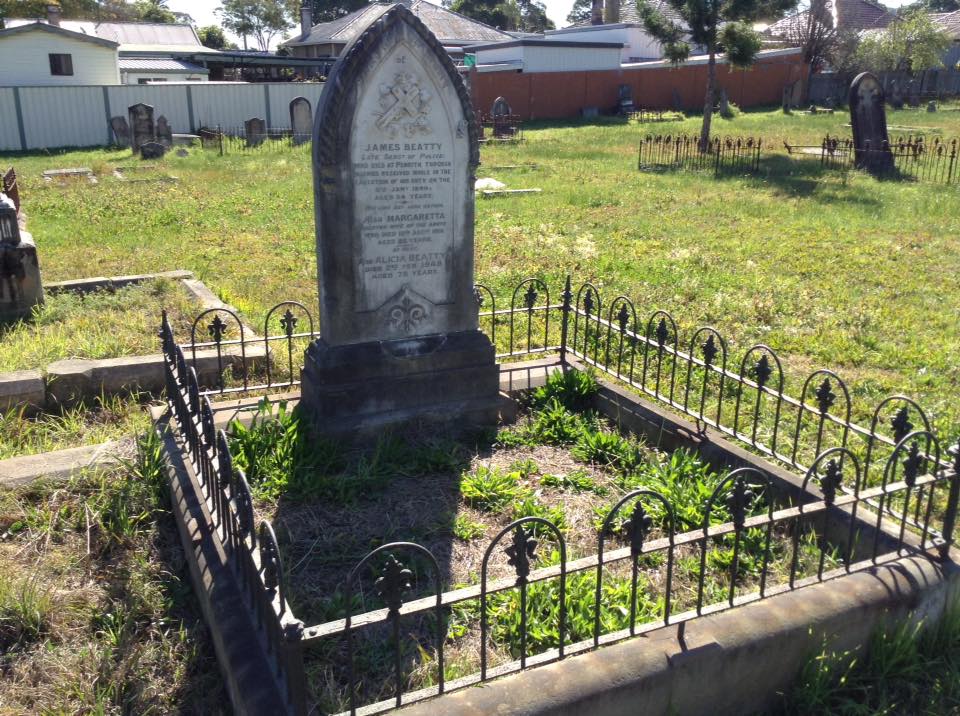
Buried at: St Stephen’s Anglican Cemetery, High St, Penrith, NSW

Grave location:  Plot K18

Grave GPS

James BEATTY


Memorial / Plaque / Monument located at:  Penrith Police Station, Penrith, NSW 

Dedication date of Memorial / Plaque / Monument:

James BEATTY
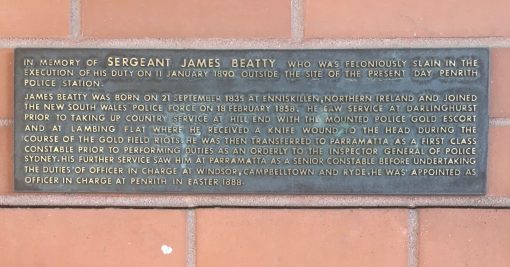
James BEATTY Memorial plaque attached to Penrith Police Station, NSW.
Photo taken by Bruce TURNER AM on Wednesday 191022.


JAMES IS mentioned on the National Police Wall of Remembrance – Canberra


FURTHER INFORMATION IS NEEDED ABOUT THIS PERSON, THEIR LIFE, THEIR CAREER AND THEIR DEATH.

PLEASE SEND PHOTOS AND INFORMATION TO Cal


May they forever Rest In Peace

https://www.facebook.com/groups/AustralianPolice.com.au/ 


https://www.facebook.com/groups/NSWFallenPolice/ 

Australian Police YouTube Channel


On 11 January, 1890 outside the Penrith Police Station, the sergeant had occasion to speak to an Indian vagrant whom he had earlier asked to leave town.

The man suddenly leapt at Sergeant Beatty, stabbing him five times.

Local people and Constable William Moseley then pursued the offender and cornered him however the man threw a brick which struck the constable in the chest.

Constable Moseley then drew his service revolver and shot the offender, wounding him.

The constable and locals then threw themselves on the offender and he was arrested.

The offender died later that night.

Unfortunately, the wounds inflicted upon Sergeant Beatty also proved to be fatal.


The sergeant was born in 1835 and joined the police force on 5 February, 1858. In 1862 he became a member of the newly-formed New South Wales Police Force. At the time of his death he was stationed at Penrith.

Source:  Beyond Courage:


James BEATTY’s mother died five days before his own demise.

James had previously suffered a knife wound to the head during the course of the Gold Field Riots at Lambing Flat, NSW.


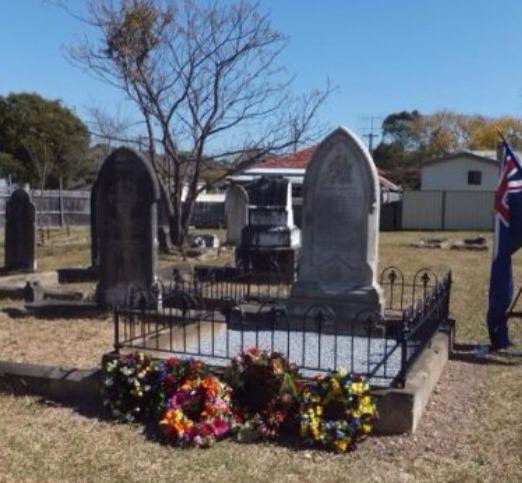
Sgt Beatty's grave, photo courtesy of Windy Gale - FB
Sgt Beatty’s grave, photo courtesy of Windy Gale – FB


The Launceston Examiner of 11 January, 1990 provided the following news of the tragedy.


TERRIBLE TRAGEDY.  A terrible tragedy was enacted this afternoon at Penrith. A coloured man, a stranger in the town, was observed by Sergeant Beatty to be throwing stones at passers-by.

The officer warned him to desist, and was in the act of arresting him when he drew a knife and stabbed Beatty in the chest, the weapon going completely through his body.

Beatty called out, and Constable Mosley came to his assistance, armed with a revolver.

Mosley [Moseley] fired at the coloured man, who was in the act of running away, but missed. A second shot, however, took effect, and the fugitive reeled and was about to fall, when a young man named Zolliner [John Zahnliter] seized him.

Both men rolled over on the street, and the coloured man drew the knife again and stabbed Zolliner.

He was ultimately seized and taken to the lock-up.

Sergeant Beatty, who is not expected to recover, has had his dying depositions taken. Zolliner‘s wound is not serious.


www.ccansw.org.au/index.php/newspublicblog/news/blogs/102-general-/1494-sergeant-james-beatty


James BEATTY


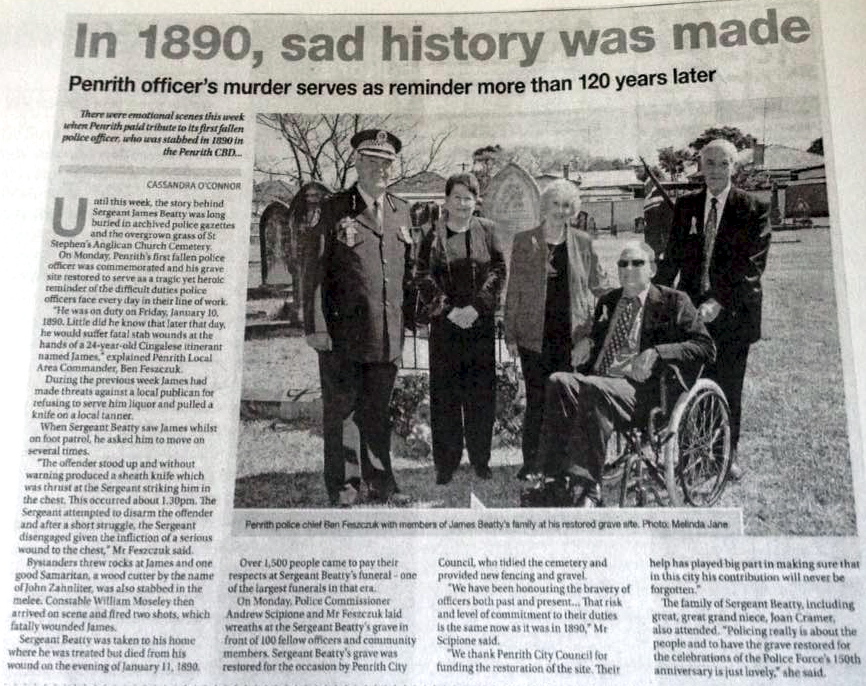
JAMES BEATTY CCANSW html m538d828eOn 10th January 1890 Sergeant James Beatty, a long serving officer in the NSW Police Force was fatally stabbed in High Street Penrith. Sergeant Beatty was buried with full police honours in St Stephen the Martyr churchyard cemetery, Fulton Lane, Penrith.


About 1.30pm on 10 January 1890, Sergeant James Beatty had occasion to interact with an itinerant Cingalese named James in High Street, Penrith outside the Convent of the Sisters of St Joseph. During that interaction the Sergeant was stabbed in the chest.

In the meantime, the offender was contained by townspeople pending the arrival of Constable Moseley who shot the offender. A good Samaritan named John Zahnliter was also stabbed during the melee. Sergeant Beatty died of his wound on the evening of 11 January 1890. He was survived by his widow Margaretta, four sons and two daughters.”

JAMES BEATTY CCANSW html 1de4c748


St Joseph’s Convent, High Street Penrith (now Officeworks)

Penrith City Council Library Local Studies collection

On 3rd September, 2012, as part of the 150th Anniversary of the NSW Police Force, a commemorative service was held at Sergeant Beatty’s gravesite to honour his sacrifice, the event a joint venture between Council and Penrith Local Area Command.

 JAMES BEATTY CCANSW html 29fc9d68

 Sergeant Beatty’s monument was in a dilapidated and damaged state. Council arranged and funded the restoration of the monument to its former glory by master stonemasons, Monuments in Memoriam who are based at Rookwood Necropolis. All restoration work was in accordance with the National Trust of Australia (NSW) Guidelines for Cemetery Conservation, the Burra Charter and Penrith City Council’s LEP.

 Since 1982, Penrith City Council has been the trustee of this significant churchyard cemetery which dates from 1838 with full responsibility for its care and maintenance. The Public Domain Amenity and Safety two man cemeteries crew, maintain five cemeteries, Penrith, St Marys, Emu Plains, Castlereagh and St Stephens.

 In preparation for the occasion an intensive clean up of the cemetery took place with staff from the City Presentation Group – Parks, Public Domain and Cemetery Operations spending a day in the cemetery. The heritage nature of the cemetery and fragility of the monuments meant that whipper snipers could not be used and all trimming around and inside monuments was by hand.

 JAMES BEATTY CCANSW html 679dfee8

Fragile heritage cemeteries are protected by the grasses that grow around and inside the monuments. Plans of Management are currently being prepared for the cemeteries under Council’s control and the consultant’s recommendation for St Stephens is that we should avoid overly detailed or manicured works. The Cemetery should look old, avoid pristine maintenance and maintain the wild character of the grasses within the grave enclosures.

 JAMES BEATTY CCANSW html 5732d80e

JAMES BEATTY CCANSW html m2d3f17c5

JAMES BEATTY CCANSW html m4da135cb

JAMES BEATTY CCANSW html m70d8587

JAMES BEATTY CCANSW html m538d828e

The commemorative service to honour the memory of Sergeant James Beatty was attended by Andrew Scipione APM, Commissioner of Police, Nick Kaldas APM, Deputy Commissioner of Police (Field Operations), Ben Feszczuk APM, Local Area Commander, former Commissioner of Police, Tony Lauer APM, Hon David Bradbury MP, Stuart Ayres MP, Beatty family descendants, Councillor Greg Davies, Mayor of Penrith, Councillor Ross Fowler OAM, Alan Stoneham, General Manager, Barry Husking, Director, David Burns, Group Manager – City Presentation, managers Yvonne Perkins and Barbara McGee, council officers and police personnel.


Mary Thorne, Cemeteries Project Officer


Nepean Times (Penrith, NSW : 1882 – 1962),

Thursday 12 February 1948, page 6

Old Tragedy Recalled

DAUGHTER. OF SERGT. BEATTY PASSES.

Miss Alicia Beatty (68), who died on 2nd inst. and was buried in St. Stephen’s cemetery, Penrith on 3rd, was the daughter of Sergt James Beatty, who was fatally stabbed by a Cingalese in High Street, Penrith, on January 10, 1890, an incident that is often referred to by the older generation of the district.

The story, briefly told, is that the Cingalese had been prowling around the town for a few days and on the day of the tragedy was ” moved on ” by the Sergt, who followed him for some distance. The man then sat down on the pavement near the Convent and Sergt. Beatty, not liking his appearance, again ordered him to clear out.

The Cingalese started to his feet and, without any warning, drew a sheath knife and, rushing in, stabbed the Sergeant in the chest.

A man named John Zahnliter tried to disarm the assailant and was stabbed in the side.

The Cingalese was shot by Constable Moseley.

Sergt Beatty and the Cingalese died subsequently of their wounds, and Zahnliter recovered, though he suffered severe physical disability, for which he received a pension, till his death many years afterward.

Miss Beatty was buried alongside her late father and mother, in the old St. Stephen’s cemetery. Mrs. Beatty died on August 12, 1916.

https://trove.nla.gov.au/newspaper/article/117908662


Miles O’GRADY

Miles O’GRADY

New South Wales Police Force

Regd. #  ?

Rank:  Constable

StationsNerrigundah

ServiceFrom  15 June 1863  to  9 April 1866 = 2+ years Service

Awards  ?

Born? ? 1841

Died on: 9 April 1866

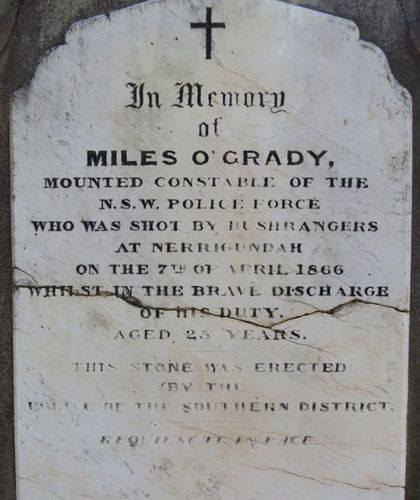
Cause:  Shot – Murdered

Event locationNerrigundah

Age:  25

Funeral date  ?

Funeral location  ?

Buried at  ?

Touch plate at the National Police Wall of Remembrance, Canberra

[alert_green]MILES IS mentioned on the Police Wall of Remembrance[/alert_green]

Miles O'GRADY 1 - NSWPOL - Murdered 9 Apr 1866

Miles O'GRADY 2 - NSWPOL - Murdered 9 Apr 1866

Miles O'GRADY 3 - NSWPOL - Murdered 9 Apr 1866

Miles O'GRADY 4 - NSWPOL - Murdered 9 Apr 1866

On the morning of 9 April, 1866 Thomas Clarke and his gang of bushrangers appeared at Deep Creek near the Gulph Goldfields and spent the day robbing passing travellers. At nearby Nerrigundah, 19 km west of Bodalla, Constable Patrick Smythe was performing his duties alone. Sergeant Nelson Hitch was absent at Braidwood Court and Constable O’Grady was in bed seriously ill with ‘colonial fever‘ (probably cholera). When Clarke learned of the police situation at Nerrigundah he led his gang into the township. Upon their arrival they held up Wallis’ Hotel and Pollock’s Store. Mrs Pollock (wife of the local gold buyer), however, threw the keys to the safe into the street and the gang spent considerable time searching for them in the darkness.

News of the events reached Constables Smythe and O’Grady at the police barracks and, against the wishes of his colleague, Miles O’Grady arose from his sick bed and dressed in his uniform. The two constables then set out to engage the bushrangers although O’Grady was very ill, and was having difficulty walking. As they approached Wallis’ Hotel, the police spotted the bushrangers and O’Grady fired, killing bushranger William Fletcher. In the ensuing gun battle O’Grady was shot in the side and as both police fell back, the gang ran to their horses and escaped. O’Grady was carried to the police barracks where he died a few hours later in great pain.

The Mercury newspaper dated 16 April, 1866 announced the constable’s unfortunate death from the wounds received, informing its readers that “Additional news respecting Clarke’s gang states that they burned down a settler’s homestead near Moruya and robbed Pollock’s station [store?]of £800, and several others of smaller amounts! Constable O’Grady has died of the wounds he received. The ringleader has been identified as Tommy Clarke. The Government is now taking steps to outlaw all connected.”

The constable was born in 1841 and joined the New South Wales Police Force on 15 June, 1863. At the time of his death he was stationed at Nerrigundah.


The Kiama Independent & Shoalhaven Advertiser ( NSW )    Thursday  29 November 1866  p 3 of 4

The Bushranger Thomas CONNELL. – This prisoner, who was arrested by sergeant Byrne on Wednesday last, was charged at the Braidwood police court on Monday with the murder of constable O’Grady, at Nerrigundah, on the 9th of April last, and remanded to Moruya, there to be dealt with. Yesterday morning he was forwarded under escort of the police to Nelligen, en route to Moruya. – Braidwood Dispatch.

http://trove.nla.gov.au/ndp/del/article/106006894


At 1pm on 9 April,2016, a commemorative service and presentation will be held at the re furbished monument at Nerrigundah to commemorate the 150th anniversary of the murder of our brother, Miles O’GRADY, by members of the Clarke gang bushrangers. There will also be a presentation by the Moruya and districts historical society at 2pm. There will be a detachment from the mounted police as well as a flag party.

If interested the contact for this is A/Supt Greg Flood at Far South Coast LAC on 02 44789910.


Bushranger shootout in Nerrigundah commemorated with NSW Police flag ceremony

Posted


http://mpegmedia.abc.net.au/news/video/201605/Nerrigundah%20shootout%20mid.mp4

Well before anyone had heard of Ned Kelly, a gang of bushrangers robbed and murdered across an area from present day Canberra to the south-east coast of NSW.

The Clarke Gang have been dubbed “the bloodiest bushrangers”. They shot and wounded some of their victims, and killed others, and they’re suspected of killing all four of a police special squad sent from Sydney to track them down.

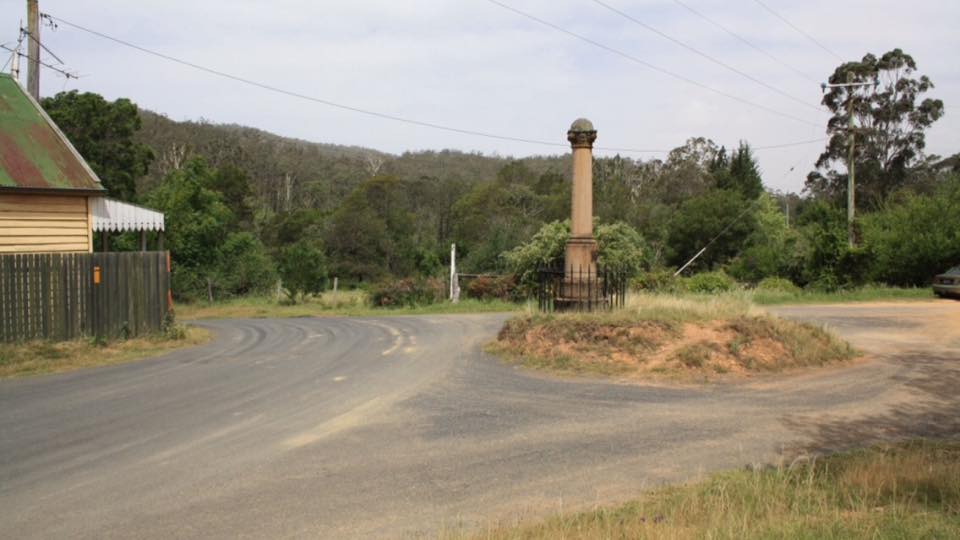
On April 9 1866 they killed Constable Miles O’Grady in a shootout in the then thriving mining town of Nerrigundah, which is now a quiet, isolated settlement of about 30 people, connected to the world by a public telephone.

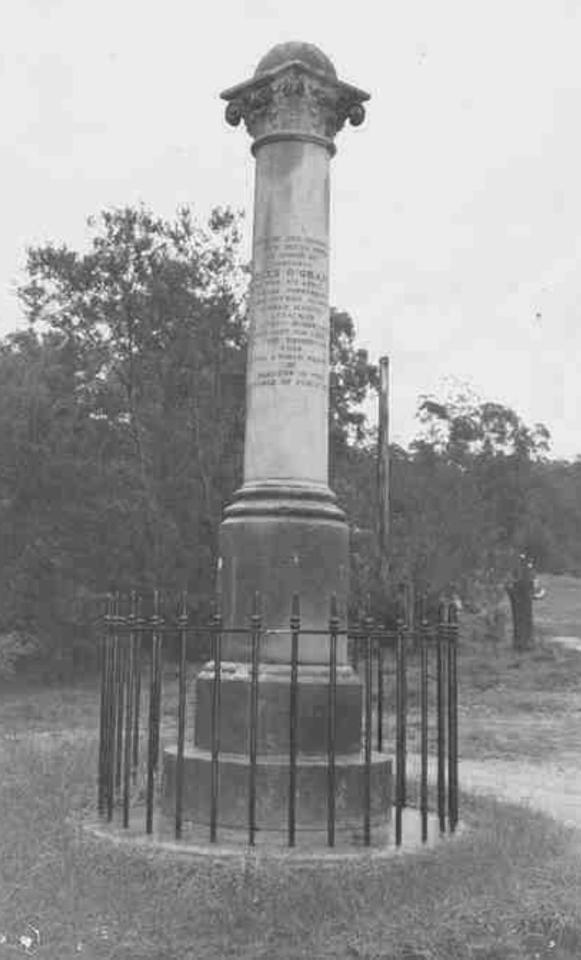
Very little is left now of the many hotels, shops, houses and shacks that supported thousands of miners who came to the town during its 1860s gold rush, but a stone memorial to the murdered policeman stands proud.

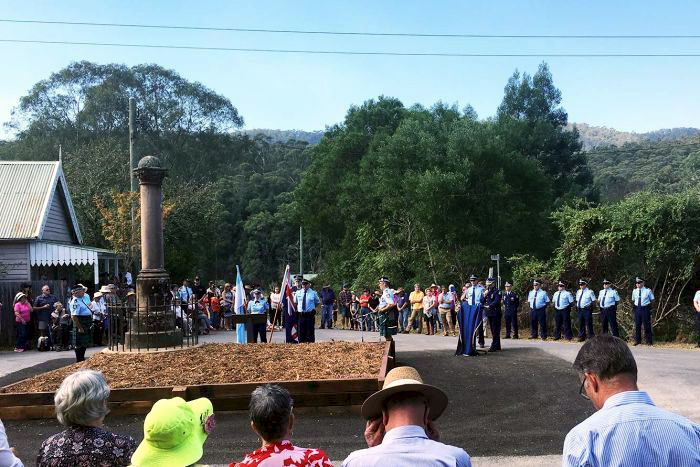
The community and around 200 visitors gathered at that memorial on the 150th anniversary of the shootout to attend a NSW Police flag ceremony to honour Constable O’Grady.

The author of a book about the gang, Peter Smith, said that if bushrangers were measured by how violent they were, and how many people they murdered, then the Clarke Gang were at the top of the scale.

“They were a lawless lot that started off taking horses out of paddocks and returning the horses and claiming the rewards,” said Mr Smith.

“They drifted further into crime, then highway robbery, then full-scale bushranging.”

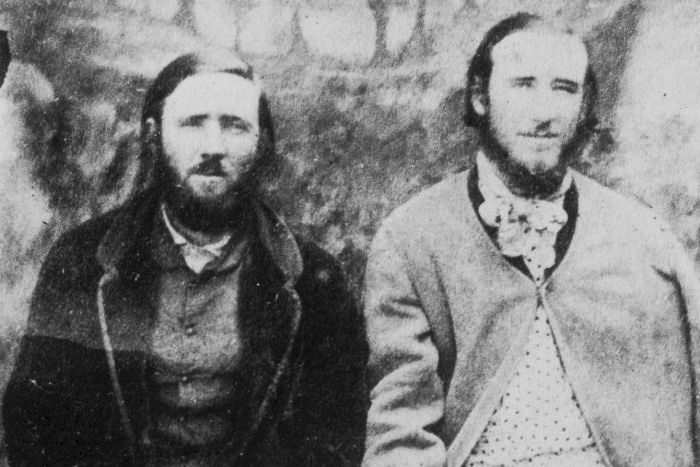
Thomas and John Clarke after their capture a year after murdering Constable Miles O'Grady in Nerrigundah. Prior to their capture they are alleged to have killed four special police sent from Sydney to track them down. They were hanged after a one-day trial. (Supplied: Peter Smith)
Thomas and John Clarke after their capture a year after murdering Constable Miles O’Grady in Nerrigundah. Prior to their capture they are alleged to have killed four special police sent from Sydney to track them down. They were hanged after a one-day trial. (Supplied: Peter Smith)

By the time they rode into Nerrigundah in April 1866 they had a fearsome reputation.

“They were an amalgamation of families that started in the area south of Braidwood,” Mr Smith said.

“The whole area south of Braidwood had a reputation for many years as a lawless area.”

The core of the gang comprised their leader Thomas Clarke and his brother John, together with their uncles, Pat and Tom Connell.

By 1865 Thomas Clarke had warrants issued for his arrest — for crimes that he denied.

He calculated that the police case was weak and he would avoid a conviction and so he surrendered at Braidwood. But the police by now regarded him as a notorious bushranger and were preparing cases that would see him imprisoned for a very long time.

Then when Clarke heard that he would be transferred to Goulburn Gaol and his trial heard there, he escaped from Braidwood Gaol.

“There was no return after that. He had to become a full-time bushranger,” Mr Smith said.

The gang came to Nerrigundah after travelling well south to the Bega races. Horse races were always an opportunity to steal another racehorse or perhaps someone’s winnings.

On their return north they held up the road leading into Nerrigundah, about five kilometres from town, robbing travellers as they came by. They shot and wounded one and beat up another.

Meanwhile, Constable O’Grady was severely ill in bed with what was then called colonial fever, his sergeant was away in Moruya, and the one remaining policeman was a newly arrived recruit, Constable Patrick Smythe.

[blockquote]

Once they were outlawed … they could be shot by anybody. There was no reason to surrender.

Peter Smith, author of The Clarke Gang

[/blockquote][blockquote][/blockquote]

“It’s difficult to know that they really intended to come into Nerrigundah in the first place,” Mr Smith said.

“When they found out that the place was basically unprotected, it’s probably when they thought they’d come into town.”

Leaving two of the gang to guard their captives, the gang rode into town. With them was a new member of the gang, William Fletcher. It was to be his only day as a bushranger.

They rode to one of the hotels and began taking captives and robbing them.

Mr Smith said the hotel was across the road from Pollocks Store where there was “probably 200 or 300 ounces of gold, which in present days would be worth a million dollars or more”.

Word got to O’Grady on his sick bed a little further down the road, and with Constable Smythe they made their way up the road to confront the bushrangers.

The publican of one of the other nearby hotels, Mrs Jones, tried to stop O’Grady as he was so ill he was staggering.

His response was, “I will do my duty.”

The two Constables confronted the gang outside the hotel. The bushranger William Fletcher was the first to be shot, and then Constable O’Grady was shot, and the gang fled the town.

“Once they’d murdered a police constable they were outlawed,” Mr Smith said.

“Once they were outlawed it meant that they had no rights. They could be shot by anybody. Basically they were already condemned to death. There was no reason to surrender. They were committed.”

The Clarke Gang would eventually be tracked down but not until after more robberies and more killings. Tommy Clarke and his brother John would get a one-day trial and then were hanged.

Ever since that day in Nerrigundah, Constable Miles O’Grady has been a police hero.

Speaking after the NSW Police flag ceremony, Detective Superintendent Kevin McNeil said, “The poignant moment in his death is when O’Grady is staggering and Mrs Jones says ‘Don’t go’ and he says ‘I will do my duty’. And from that point on he’s doing his duty for the people of New South Wales”.

“He knew what he was confronting. This Clarke Gang was very famous. He knew all about the Clarke Gang. Later on they killed four police at Jinden Station near Braidwood. That’s how violent they were.

“That was the moment, yet he still went out there because other people were at risk, to protect their life and property.”


NSW Police conduct a flag ceremony on the 150th anniversary of the shootout in which Constable Miles O'Grady was murdered at Nerrigundah. (ABC: Bill Brown)
NSW Police conduct a flag ceremony on the 150th anniversary of the shootout in which Constable Miles O’Grady was murdered at Nerrigundah. (ABC: Bill Brown)  April 2016

http://www.abc.net.au/news/2016-05-03/nerrigundah-clarke-gang-ogrady-bushranger-shootout/7379516