Valma TAYLOR, only daughter of Mr. and Mrs. Alf Taylor, of Bodalla and Constable Cuthbert Farnsworth, youngest son of Mr. and Mrs. C. Farnsworth, of Springwood, are receiving congratulations on their engagement. Both are well known in Wollongong.
Nothing further, than what is recorded above, is known about this person at the time of publication and further information and photos would be appreciated.
Nothing further, than what is recorded above, is known about this person at the time of publication and further information and photos would be appreciated.
Nothing further, than what is recorded above, is known about this person at the time of publication and further information and photos would be appreciated.
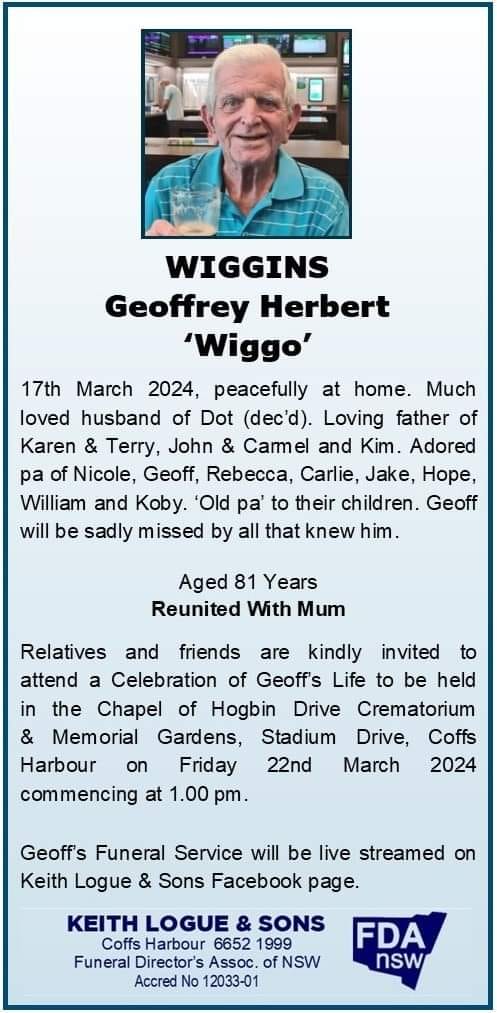
* Story behind any Nickname: WIGGO – Play on surname.
Nothing further, than what is recorded above, is known about this person at the time of publication and further information and photos would be appreciated.
Time employed ( Paid ) with NSW Police: From: ? October 1933 to ? March 1944 = 10 years,
Service ( From Training Date ) period: From ? October 1933 to? March 1944 = 10 years, Service
Retirement / Leaving age: = ?
Time in Retirement from Police: ?
Awards: No Find on Australian Honours system
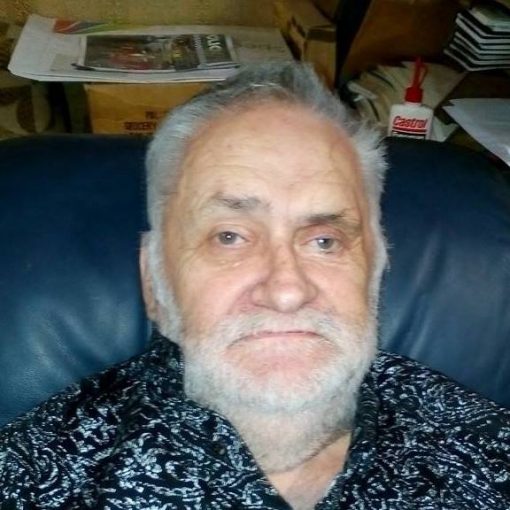
Photo taken around 1987 when Erle was 76 years old.
Born: Thursday 9 February 1911
Died on: Sunday 11 March 1990
Age: 79 years, 1 month, 2 days
Organ Donor: Y / N / ?
Cause: ?
Event location: ?
Event / Diagnosis date: ?
Funeral date: ? ? ?
Funeral location: ?
LIVE STREAM?
Wake location: ???
Wake date: ???
Funeral Parlour: ?
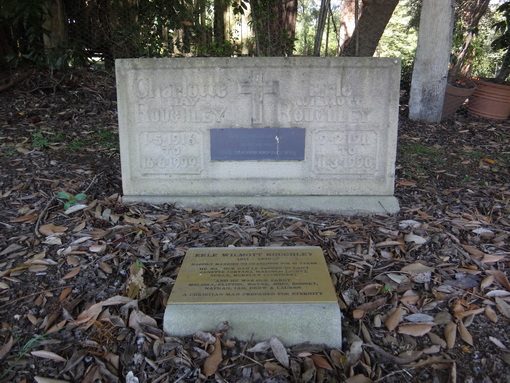
Buried at: Dural Uniting Church Cemetery, Derriwong Rd, Dural, NSW
Grave Location: Section: Row: A Plot: 1A
Grave GPS: ?, ?
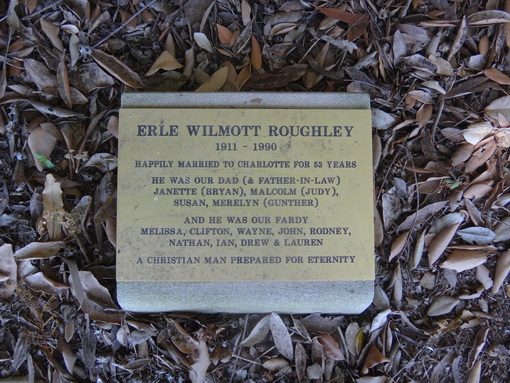
Memorial plaque inscription: Erle Wilmott Roughley 1911 – 1990 Happily married to Charlotte for 53 years He was our Dad (and father-in-law) Janette (Bryan), Malcolm (Judy), Susan, Merelyn (Gunther) And he was our Fardy Melissa, Clifton, Wayne, John, Rodney, Nathan, Ian, Drew and Lauren A Christian man prepared for Eternity
Headstone inscription: Charlotte May Roughley 1 – 5 – 1918 to 16 – 6 – 1999 Erle Wilmott Roughley 9 – 2 – 1911 to 11 – 3 – 1990 Much loved mother and father Marney and Fardey Thank God at every remembrance of you
Memorial / Plaque / Monument located at: ?
Dedication date of Memorial / Plaque / Monument: Nil – at this time ( March 2024 )
ERLE is NOT mentioned on the Police Wall of Remembrance *NEED MORE INFO
FURTHER INFORMATION IS NEEDED ABOUT THIS PERSON, THEIR LIFE, THEIR CAREER AND THEIR DEATH.
Liverpool Police Officer – Probationary Constable Erle (Earl) Wilmott Roughley a former Orchardist entered the Police Depot at Redfern and commenced his Initial Training.
In 10/1933 he was attested a Probationary Constable.
In 3/1934 he was transferred from the Depot to No. 1 Division on General Duties, where in 10/1934
he was promoted to the rank of Constable.
In 8/1935 he was transferred to No. 16 Division (Hornsby) on General Duties.
In 1/1936 he was transferred to Liverpool, working General Duties at the Warwick Farm Police Call-Box.
Later (date not specified) he was transferred to the Fairfield Police Call-Box on General Duties. During 1/1943 he was promoted to the rank of Constable 1/c.
He was then exited from the Police Force in 3/1944, after serving the NSW Community for a period of 10 years.
Source: Liverpool Police Time Line ( 1788 – 2022 ) by Joe Stanioch, NSWPF # 14194
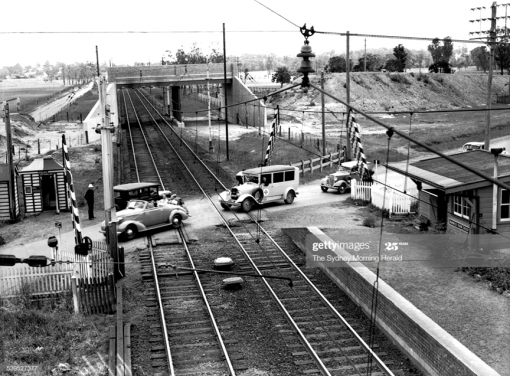
This amazing photograph was taken on the 29 November 1937. It depicts the Warwick Farm Railway Station vehicle level crossing, with the overhead road bridge (Hume Highway) under construction.
In the photo a local Liverpool Ambulance is seen crossing the railway line.
On the left side of the railway track you can see “ The Warwick Farm Police Call Box and a Police Officer “ standing outside, wearing his white helmet and watching the traffic.
The Police Officer was not identified.
Three Police Officers known to be stationed at the call box were Constable Nixon, Probationary Constable John. A. Gallaher and Probationary Constable Erle (Earl) W. Roughley.
They had the use of a Police Motorcycle with sidecar.
Warwick Farm Police Call Box – 29 November 1937
Source: Liverpool Police Time Line ( 1788 – 2022 ) by Joe Stanioch, NSWPF # 14194
Sydney Morning Herald (NSW : 1842 – 1954),
Saturday 22 August 1953, page 26
WASHING MACHINE. Rex, Automatic, boil, spin dry, in perfect order; original price. £136; for quick sale. £75. Inspection without obligation, ERLE ROUGHLEY. Orange Grove, Main Road, Dural.
Constable Ted Roughley has been transferred from Fairfield to Liverpool ( as motor cyclist ); and Constable Tom Moffitt, of Kogarah, has taken his place. Constable Roughley will be missed in Fairfield.
The name ‘Ted‘ was used in numerous articles of this Constable in the Trove search.
Biz (Fairfield, NSW : 1928 – 1972),
Thursday 16 May 1940, page 8
SHOP BURGLED.
A very retentive mind enabled Constable E. Roughley to make a quick arrest in connection with a shop window robbery in Ware Street, Fairfield, last Sunday night.
Constable Roughley warned several youths off the street at 10 p.m. and noticed one lad take a long black comb from his pocket to do his hair.
Later on passing Mr. W. E. Simpson’s store in Ware Street, he found a window broken and picked up a comb nearby.
At 11p.m., on patrolling the district, he questioned a youth sleeping under a verandah.
The lad went to comb his hair but found his comb missing. The constable produced the comb and arrested the youth, who will appear at Liverpool Police Court to answer the charges.
Several cycle accessories were stolen from the window.
Evidence that he considered his mother had committed adultery in 1929, was given by a son to-day in the Divorce Court.
He was Constable Earl Roughley, 29, stationed at Fairfield. He said he would not say that his mother had treated him well.
William Lindley Marcroft, 58, petitioned for a divorce from Mary Stalker Marcroft, on the ground of her alleged desertion.
Mrs. Marcroft denied wilful desertion, and, in a cross-petition, alleged that, between February 1, 1931, and May 24, 1938, Marcroft committed adultery with Mrs. Essie Roughley. This was denied by Marcroft and Mrs. Roughley.
The parties were married in 1903.
“Holding Hands”
Constable Roughley, said in evidence that he had been subpoenaed to attend court.
Marcroft visited their home at Dural, from 1924, he said. Some times his mother and Marcroft went out in a car together.
Marcroft frequently changed his clothes at the home, and often used their bathroom. If he stayed the night, he used to sleep on a couch in the dining room.
Witness’s mother slept in the front bedroom.
One morning, Roughley said, he saw Marcroft sitting at the side of a bed occupied by his mother. They were talking and holding hands.
Once, his mother asked the children to call Marcroft “father.” Witness left the home in Dural in 1929.
Dr. Louat (for Marcroft): I suggest that your bad relations with your mother arose over a dispute about land left in your father’s will? — No.
Do you consider that up to 1929 your mother committed adultery?— Yes. You do? — On their actions, yes.
Recalled to the box. Marcroft denied all of the allegations against him by Roughley.
The hearing was adjourned until Monday. Dr. Frank Louat (J. H. Yeldham), for Marcroft; Mr. E. Little (Meagher, Sproule and Co.), for Mrs. Marcroft.
Flourishing what appeared to be a revolver, a man held up a 16-years-old girl in Smithfield road, Fairfield, last night.
Police were told that when the girl said, “Look out – here comes my father,” the man decamped.
Directed by Detective-Sergeant McCarthy (Parramatta), police from Liverpool and Cabramatta, and two wireless patrols, combed the thick scrub in the vicinity, but were unable to find the man.
The girl was returning home from her work in the city.
She had walked about half a mile from the railway, and, when near a dark portion of the road, was confronted by a man.
He presented something resembling a revolver, police state, and ordered her to leave the footpath. This she did.
She then said, “Look out – here comes my father.” At this the man quickly disappeared into the scrub.
Running to her home a few hundred yards away, the girl told her father of the incident, which he immediately reported to Constable Roughley at the Fairfield call-box.
The man was described as being young, and having dark hair.
” You’re a good liar – and a rather bad one also,” Magistrate C. Pickup told Frederick Anderson (45) at the Liverpool Police Court on Friday.
Charged, with having on January 23 stolen a loaf of bread, a plum pudding, 1lb. of sausages and 1lb of chops from Liverpool State Hospital, Anderson claimed that the victuals had been given him in a bag by a stranger.
He was fined £3.
Constable Roughley (Liverpool) said that on Thursday morning, after a conversation with Charles Bathie, an attendant at the hospital, he made a search of the grounds around the hospital and after making an examination of the adjoining property, went to a swamp near the Warwick Farm level crossing. ” As I got out on to the Liverpool road, I saw the defendant, walking along the road, and stopped him,” said the constable. ”
He was carrying with him a sugar-bag, and in answer to my questions, he told me that the bag contained food which he had bought. ”
Roughley said that he took defendant back to the Liverpool State Hospital, where Bathie identified him as having stolen some food. He added that, although not sober, defendant, who smelt very strongly of liquor, was not drunk.
Charles George Bathie gave evidence of having ordered defendant off the hospital premises. Defendant said, ” I’ll go when I get my bag. It’s up along the wall. ” Bathie said that after examining the bag he told defendant that its contents were the property of the institution, but defendant refused to hand it over, saying that it belonged to him. Witness next saw him with Constable Roughley.
Bathie identified the articles of food found in defendant’s possession as the property of the hospital. Their value was approximately 3/-.
Anderson said he lived in Bathurst Street, Sydney, and that he came to Liverpool to draw his war pension. He collected it, met a few friends and had a few drinks. About ten o’clock he saw a man in a sulky driving along Macquarie street – the main street. The stranger said, “Are you on the track, digger?” and he replied, “Yes.” The other man said, “Well, here’s something that might be handy to you,” handed him a sugar bag and drove on. ”I didn’t have a look at what it was,” said Anderson. “I took it for granted it was food.”
The magistrate: How were you dressed? – Like I am now. And where were you walking? – On the footpath. You had nothing in your hand? – Nothing. ” I owed a few small debts at the hospital,” said Anderson, “and I walked over there. I left my bag while I went to look for those from whom I had borrowed money when I was an inmate.”
The magistrate said that he could see no reason why defendant should have been mistaken for a swagman. “I have no doubt whatever about this,” he said in convicting.
Nothing further, than what is recorded above, is known about this person at the time of publication and further information and photos would be appreciated.
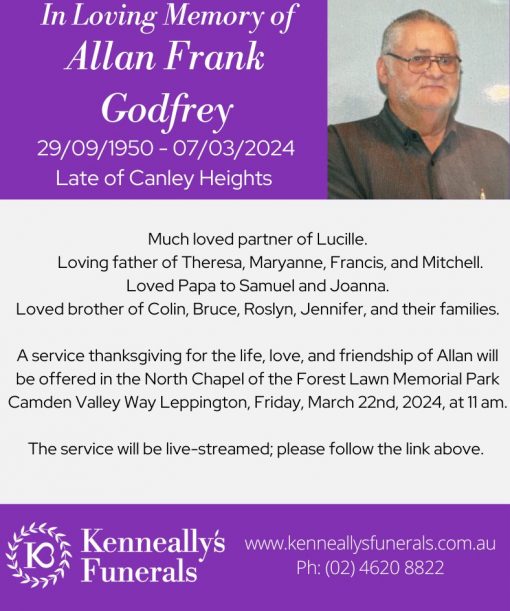
In 2017, Allan underwent open heart artery by pass surgery.
Prior to joining the NSWPF – Allan was an Apprentice Motor Mechanic and Mechanic for 6 years.
At the time of joining the NSWPF, Allan was described as:
5′ 9 1/4″ tall, 13 stone, 2 lb in weight, with brown eyes, black hair, dark complexion.
He passed his Constable 1st Class course on 27 August 1974.
He passed his Sergeant 3rd Class exam on 9 May 1983.
He held a NSW Drivers licence and was Certified to drive the GD cars, Ute and light trucks on the 30 June 1972.
He also was Certified to drive the Police Boys Club omnibus on 21 September 1972 and Ride Solo Police cycles on 23 February 1973.
Probationary Constable Allan. F. Godfrey
A former Motor Mechanic entered the Police Academy at Redfern and commenced his Initial Training, as part of Class 131.
He was attested on 6/1972 and stationed at No. 3 Division (Darlinghurst) on General Duties, and where he was promoted 6/1973 to the rank of Constable.
In 12/1973 he transferred to the Traffic Branch as a Solo Motor Cyclist and Traffic Signals Sections.
Then in 4/1974 he was transferred to No. 8 Division, Annandale (a substation of Balmain) on General Duties and where he was promoted 3/1978 to the rank of Constable 1/c.
Then in 9/1979 to Glebe Police Station on similar duties. In 2/1982 he was transferred to Liverpool on General Duties, where he was promoted 6/1981 to the rank of Senior Constable.
He remained at Liverpool until 1988.
Source: Liverpool Police History by Joe Stanioch, NSWPF # 14194
Liverpool General Duties Police were incensed by claims of the NSW Minister for Police, Mr Peter Anderson MP, that there were too many police (at Liverpool).
According to the Liverpool Branch Secretary of the NSW Police Association, Senior Constable Allan. F. Godfrey, of the 108 General Duties police listed at Liverpool, 28 are not involved in day to day law enforcement.
S/C Godfrey said that of the 28:-
* Three police were on permanent sick report awaiting discharge from the Force.
* One Officer was shot in the execution of his duty over 12 months ago.
* One Officer was under suspension.
* Six were involved in prisoner security at the Liverpool District Courts.
* Two were attending Penrith Court for the Milperra bikie court hearings.
* Two were guarding Family Law Court Judges on the North Shore.(following bombings)
* Five were involved in Warrants and Summonses.
* One was assigned to the Criminal Information Unit.
* Five were on restricted duties.
The remaining 80 Police attend court cases, prisoner escorts, internal affair and ombudsman’s enquiries and training courses. With such exclusions there are only about 40 police left to perform day to day duties in Liverpool and Green Valley.
These police are rostered over three shifts, seven days a week. In reality of the 108 General Duties police named on the roster, there were only three cars crews and four station staff per shift at Liverpool. Green Valley has only one Officer in the Station and one car crew per morning and afternoon shift. Green Valley was closed between 11pm and 7am each day.
Over night the sub-station area was patrolled by Liverpool, and the Green Valley vehicles are housed at Liverpool Police Station.
Source: August 1985. Liverpool Leader Newspaper via Liverpool Police History by Joe Stanioch, NSWPF # 14194
No to Strike.
Police from Liverpool, Fairfield and the Macarthur District held a mass meeting, attended by in excess of 150 police, who unanimously decided to endorse the NSW Police Association’s call for the immediate increase of 2000 police in the state.
The Secretary of the Liverpool Branch, Sergeant Allan. F. Godfrey said that “all stations in the ‘I’ District were short of manpower”.
Source: May 1986. Liverpool Leader Newspaper via Liverpool Police History by Joe Stanioch, NSWPF # 14194
New Liverpool Police delegate to the NSW Police Association conference was Allan. F. Godfrey.
Source: 1987. Liverpool Police History by Joe Stanioch, NSWPF # 14194
Liverpool Police Officer – Sergeant 3/c. Allan. F. Godfrey returned to Liverpool LAC on General Duties until 9/1993 when he was transferred to Beat Policing at Green Valley LAC.
He retired from the NSW Police in 1996 after 24 years of service to the NSW Community.
Source: 1987. Liverpool Police History by Joe Stanioch, NSWPF # 14194 – via Allan Godfrey.
* Story behind any Nickname:
Nothing further, than what is recorded above, is known about this person at the time of publication and further information and photos would be appreciated.
Formerly a very able police officer (Traffic Sgt.) after leaving the service Mal enjoyed a completely different life as a market gardener/horticulturist.
He had a wonderful sense of humour, and possessed a great fondness for the humour and drama he found in Australian poetry ( at the drop of a hat he would happily recite large ‘çhunks’ of Banjo Patterson, etc without once referring to a book).
Multi-talented, he played the ukulele and could turn his hand to most other things.
Always kind and generous with his tíme he was indeed a lovely man and like many others I know, I cherished his friendship.
Condolences to Jude, siblings Merelyn, Janette, Susan together with family and friends.
* Story behind any Nickname:
Nothing further, than what is recorded above, is known about this person at the time of publication and further information and photos would be appreciated.
Gwen was 1 of 3 NSW Police Women who obtained their Diploma in Criminology from Sydney University.
Gwen was accepted into the Detectives Training Course – later to become the 1st NSW Police Woman.
Gwen is reputed to have been a competitive Fencer ( Sword ) in her youth.
Class 082 where Sworn In on the 4 April 1960. They walked into Redfern Police Academy on Monday 29 February 1960 to start their Training. The infamous Sgt. Ben Hall can be seen in the front row. The first ever (N.S.W.P) female detective (Gwen Martin P/W 0041) was in this class. The other female in this Class was Carol TUBNOR nee Carol GARRAD – P/W 0040
Police Legacy – 16 October 2019
Yesterday we played host to a meeting of the Retired Police Association, and had the pleasure of being introduced to Inspector Gwen Martin (retd), a trailblazing policewoman who joined the NSW Police Force in 1960 – one of three women in a class of ninety.
She’s been retired for nearly thirty years now, but has many fond and colourful memories of her time in the Force (some of which we couldn’t possibly repeat in a public forum 😱😂)
Gwen worked in many different capacities – everything from traffic control to the drug squad – before undertaking the Detectives’ Training Course in 1971, finishing 4th in the class.
From there she moved to Parramatta, working her way up through the ranks before becoming the first female member of the Police Association to be elected to the Executive, and eventually attaining the rank of Inspector at the Police Internal Affairs Branch, remaining there until her retirement in 1990.
Gwen, we salute you, and the example you have given for so many young women joining the NSW Police Force!
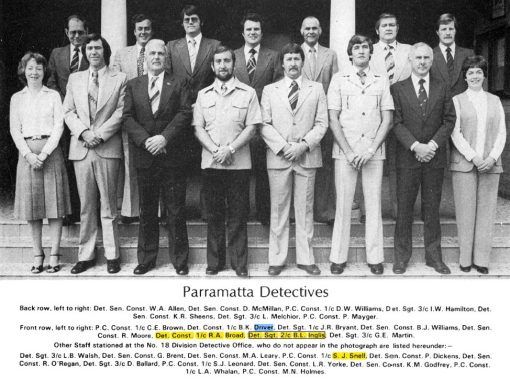
PARRAMATTA DETECTIVES
Back Row ( L – R )
W.A. ALLEN # 14367, D. McMILLAN, D.W. WILLIAMS # 14959, I.W. HAMILTON # 10159, K.R. SHEENS # 11044, L. MELCHIOR # 9268, P. MAYGER # 17359
Probably the Police Womens Office – C.I.B., Sydney
Canberra Times (ACT : 1926 – 1995),
Saturday 7 August 1971, page 3
Detectives
SYDNEY, Friday. — Sergeant Dell Fricker and Senior Constable Gwen Martin graduated today with 26 males after a three month course to become Sydney’s first women Detectives.
Nothing further, than what is recorded above, is known about this person at the time of publication and further information and photos would be appreciated.
Nothing further, than what is recorded above, is known about this person at the time of publication and further information and photos would be appreciated.
Coroner urges six-monthly welfare checks after inquest into four police suicide deaths
Posted
In short: A Hobart coroner who investigated the deaths of four police officers who took their own lives has recommended Tasmania Police conduct mandatory half-yearly well-being screenings for PTSD.
What’s next? The Police commissioner says work will continue with the police association to implement changes
The family of one of four Tasmanian police officers who died by suicide between 2016 and 2020 say they hope the findings of a coronial inquest may prevent a similar tragedy in the future.
Coroner Simon Cooper has handed down his findings into the deaths of Constable Paul Hunt, Senior Sergeant Paul Reynolds, Constable Simon Darke and Sergeant Robert Cooke, recommending a swathe of welfare supports be implemented.
WARNING: This story touches on themes of depression and suicide.
During last year’s hearings, the court was told how overworked officers were self-medicating with alcohol and drugs, and of significant shortfalls in welfare support — particularly in areas such as fatigue management and protocols around interactions with the Professional Standards Command.
In his findings, Coroner Cooper, acknowledged the fact that these men were all serving police officers was “only part of the whole picture” of their lives, but he said he had “no doubt” that “Sergeant Cooke‘s police service was the direct cause of his death“.
But he said the provision of welfare support and whether it was adequate was a “central consideration at the inquest.”
He called for Tasmania Police to immediately develop and implement a fatigue management policy saying it was essential it was “addressed urgently”.
The inquest heard Robert Cooke had reportedly worked “16-hour continuous shifts for four weeks” during the Central Highlands bushfires in 2019.
This had left him “exhausted and barely functioning towards the end of the third week”.
“Tasmania Police had no fatigue management policy at any time, up to and including as recently as when the evidence at the inquest was publicly taken at the end of 2022,” he said.
“The absence of any fatigue management policy was, I consider, a direct factor in Sergeant Cooke’s death.”
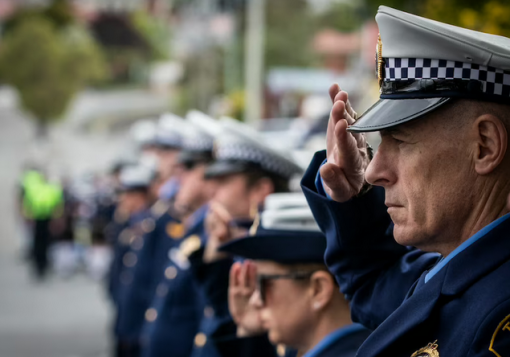
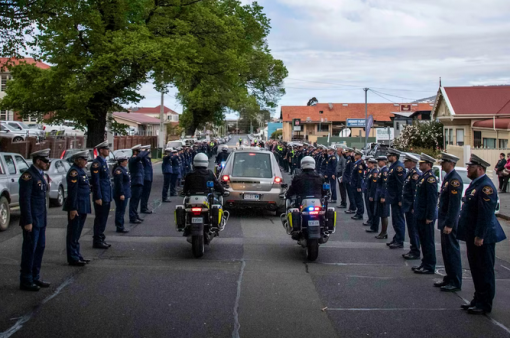
Tasmania Police officers salute at Robert Cooke’s funeral in 2020 .(ABC News: Luke Bowden)
The coroner also recommended six-monthly screenings of all operation police officers for post-traumatic stress disorder.
“Sergeant Cooke obviously suffered from the effects of PTSD for a long time before it was diagnosed,” he said.
“Every health care professional who gave evidence … unanimously agreed that his PTSD was entirely attributable to his service as a police officer.
“Every health care professional also agreed that earlier detection of PTSD increases the chances of successful treatment and recovery.”
Tasmania Police investigating the feasibility of “introducing a points system”, whereby an officer’s exposure to severe incidents would be tracked, was also recommended.
When a “critical points threshold” was reached, an automatic referral to a psychologist should be triggered, Coroner Cooper said.
The coroner also called for better support for officers under investigation for misconduct — including ensuring that those who had their phone seized by Professional Standards be given a replacement mobile pre-programmed with well-being support numbers.
“The death of any member of the community by suicide is a tragedy,” Coroner Cooper said.
“The suicide of serving police officers, whatever their individual circumstances, is particularly tragic for serving members of the police force and the community at large.
“My sincere hope is that some improvements and learnings can emerge from the deaths of Constable Hunt, Senior Sergeant Reynolds, Constable Darke and Sergeant Cooke.”
Sergeant Robert “Cookie” Cooke was well-regarded among his Tasmania Police colleagues.(ABC News: Luke Bowden)
Families welcome findings
In a statement, Robert Cooke‘s mother Lyn and sister Michelle said they were satisfied with the findings, particularly the recommendations for a fatigue management policy and screenings for PTSD stress disorder.
“The family miss Rob terribly and hope the findings and increased support for mental health may prevent similar events in the future,” they said.
“[Our] thoughts are with all the families involved in this inquest.”
Commissioner committed to ‘safe model of policing’
Police Commissioner Donna Adams acknowledged it was a difficult time for the families and colleagues impacted by the coronial report.
She said improvements had already been made within Tasmania Police.
Strategies included “a strong peer support group, and a critical stress program” to ensure officers could access the help they needed.
But she said changes wouldn’t end there — and that Tasmania Police would work with the Police Association to examine the coroner’s recommendations.
Police Minister Felix Ellis said the government had allocated funding to “Tasmania Police and the Department of Police, Fire and Emergency Management’s nation-leading wellbeing program”.
“Police officers, by the nature of the job, are exposed to some pretty difficult and extraordinary circumstances, so providing that support is important,” he said.
“We want to work to make sure that policing continues to be a career or choice, and that we’re supporting our officers if they do find themselves facing challenging circumstances.”
An inquest examining the deaths by suicide by four police officers in Tasmania has heard how overworked officers were self-medicating with alcohol and drugs, were poorly served by under-trained welfare staff, with one officer enduring horrific nightmares of what he had seen in the line of duty.
WARNING: This story touches on themes of depression and suicide.
The three-weeks of hearings learned about one instance where an officer went from being a happy-go-lucky family man who was exceptionally good at his job, to an absolute wreck who couldn’t get out of bed before his eventual death by suicide.
Sergeant Robert Cooke — affectionately known as “Cookie” — had been diagnosed a year before he died in October 2020 with post-traumatic stress disorder, which was attributed to years of cumulative trauma and over-work.
Before he was placed on leave, the veteran officer of 30 years was in charge of Oatlands police station, in rural central Tasmania, which meant he was regularly on-call and would often take sole responsibility for an incident.
The inquest was given evidence that Sergeant Cooke had worked 16-hour continuous shifts for four weeks during fires in the Central Highlands in 2019, and was experiencing increased anxiety, including nightmares of the dead and burnt bodies he had seen throughout his career.
Sergeant Robert “Cookie” Cooke was well-regarded among his Tasmania Police colleagues.(ABC News: Luke Bowden)
Clinical psychologist Jacqueline Prichard — who was treating Sergeant Cooke — said he could sometimes go from one traumatic incident to the next or straight into shift work before he would have had the opportunity to fully process the initial trauma.
“Your brain naturally resolves trauma in your sleep patterns in the three days following a traumatic incident, which is why it is important to get at least eight hours of sleep in the subsequent nights,” Ms Prichard said.
“If there’s no chance for sleep, or to think about the traumatic incident, then it becomes stored within the brain and can be as vivid as it was on the day.”
The inquest also heard there was a tendency among some police officers to abuse alcohol after a serious incident, which can also be disruptive to a person’s sleep pattern.
“If officers could clean out each trauma as they occurred, so they weren’t getting the cumulative effect, that would help,” Ms Prichard said.
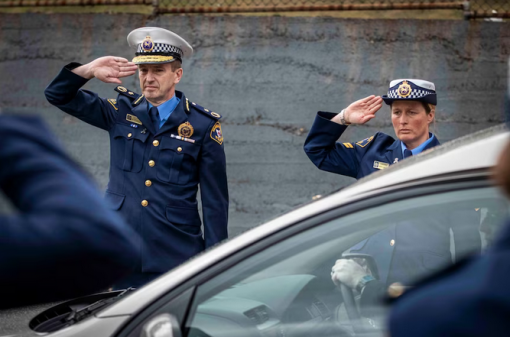
Former Tasmania Police commissioner Darren Hine and Senior Constable Jenny Carlisle salute the hearse at Sergeant Cooke’s funeral in 2020.(ABC News: Luke Bowden)
Sergeant Cooke‘s then-partner, Senior Constable Elizabeth Carlisle, said well-meaning but under-trained people in welfare roles at Tasmania Police had a negative impact on his mental health.
Senior Constable Carlisle told the inquest she did not believe a welfare officer supporting the 49-year-old in the lead-up to his death had any formal training in assisting someone with post-traumatic stress disorder (PTSD).
“Welfare officers back then were not equipped to deal with someone as unwell as Sergeant Cooke … but they are significantly better trained now,” she said.
Abused during bushfire evacuations
The deaths of Senior Sergeant Paul Reynolds, Constable Simon Darke and Constable Paul Hunt, between 2016 and 2020, have also formed part of the inquest that ended in Hobart on Friday.
Shanna Sweeney, said she contacted police after Constable Darke threatened suicide in 2011 but did not believe her concerns were taken seriously.
She said that Constable Darke was concerned he could be punished if he was seen as being vulnerable.
The inquest also heard evidence from Constable Darke’s father, Graham, who told the court the long hours during the 2019 bushfires and run of night shifts at a Hobart police station became too much for his son.
“He mentioned he had copped a lot of abuse when he asked people to leave their homes during the fires. He then went onto night shift by himself,” Mr Darke told the inquest.
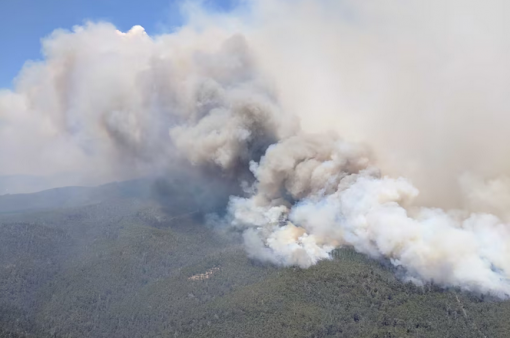
The catastrophic 2019 bushfires in Tasmania were cited several times during the inquest.(Supplied: Tasmania Fire Service)
The inquest was also told the Department of Police, Fire and Emergency Management had made significant changes to the welfare protocol as a direct consequence of Constable Hunt‘s suicide in 2016.
Constable Hunt took his own life on the same day he received an unannounced visit from Professional Standards Command (PSC) personnel over allegations that he used his police badge and other people’s driver’s licence numbers to obtain codeine and pseudoephedrine-based medications from pharmacies in Hobart.
The court was told that the 32-year-old had his personal phone confiscated and did not have a support person present at the meeting with officers from PSC when he was officially stood down from his role.
Tasmania Police officers salute at Robert Cooke’s funeral in 2020.(ABC News: Luke Bowden)
Police Inspector John Ward told the inquest that he saw the benefit of putting a system in place where a risk assessment is carried out before an officer is approached about an investigation involving them.
“I was aware that Constable Hunt had been suffering from a medical condition, but didn’t realise he was experiencing suicidal thoughts,” he said.
At the time, he was facing allegations that he had sent and received child exploitation material, and that he had groomed young men.
Director of wellbeing support at Tasmania Police, Matthew Richman, told the court, the organisation has looked at what additional early intervention opportunities could be implemented as a direct consequence of Senior Sergeant Reynolds‘ death.
“Every aspect of policing has changed dramatically from when Senior Sergeant Reynolds started his career to the time of his death, but I think there is an opportunity to rethink our wellbeing check approach,” he said.
The inquest was told it is now standard procedure for a Tasmania Police officer to be offered a replacement mobile phone if their personal one is confiscated as part of an investigation.
It also heard that significant improvements had been made regarding welfare after the deaths of the four officers, including de-stigmatising post-traumatic stress disorder and other mental health conditions.
The inquest was told that, while Tasmania Police has made improvements in staff rosters and resourcing, it is facing an 18-month delay in the publication of a fatigue-management policy.
Work is continuing between the department, the Police Association of Tasmania and the University of Tasmania to research and identify areas that regulate workloads.
Former commissioner Darren Hine said a lot of improvements had been made over the years and Tasmania Police had dramatically increased the number of welfare officers after a funding submission to the government.
“The area of welfare and mental health will never be finished. It is a growing body of knowledge and it’s something we should never stop learning about,” Mr Hine said.
Coroner Simon Cooper is expected to hand down his findings next year.
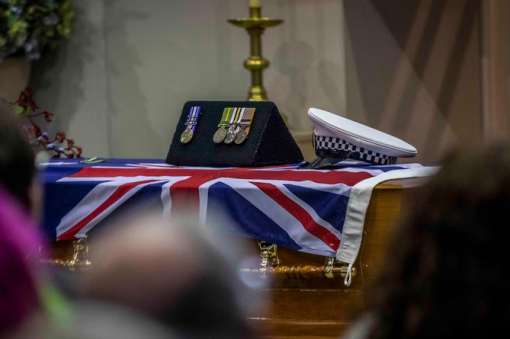
The funeral motorcade for Tasmania Police officer Robert Cooke in 2020.(ABC News: Luke Bowden)
Nothing further, than what is recorded above, is known about this person at the time of publication and further information and photos would be appreciated.

 PARRAMATTA DETECTIVES