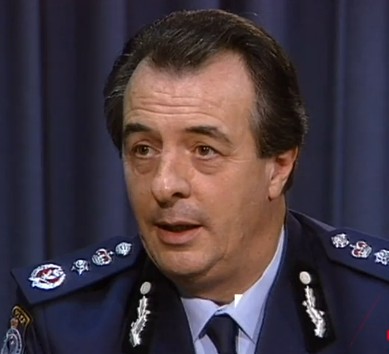
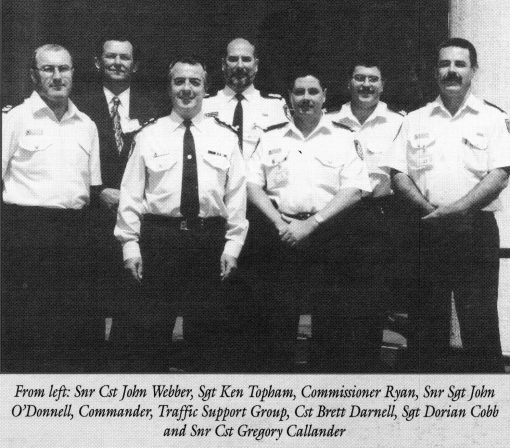
Commissioner of Police Peter James RYAN, QPM BA Msc OstJ
30 August 1996 – 17 April 2002
Peter RYAN
Appointed Commissioner, NSW Police Force, on 30 August 1996.
Career
Commissioner Ryan is a widely experienced career police officer whose duties have included both uniform and detective work.
NSW Police Force
Mr Ryan took up his appointment as Commissioner at the height of the Wood Royal Commission into police corruption ( 1994 – 1997 ). His brief was to weed out the corrupt, lazy and inept and to put into place reforms that will deliver a professional and honest police service, both responsive and responsible to the community it serves.
Reform continues to be implemented in a series of well planned stages. These began with the complete restructuring of the Force and the appointment, in most areas, of new commanders.
The next phase has been one of consolidation, combined with the development and implementation of improved policing procedures.
Results
One of the benchmarks for reform is the reduction of crime. Commissioner Ryan has set for the Service the goal of bringing down the rates of crime in categories including assault, robbery, stealing, motor vehicle theft and stealing from motor vehicles.
The Future
As well as structures, personnel and processes, Commissioner Ryan is working to reform the technical side of the Force, introducing the latest in scientific, forensic, computing, communication and training techniques and facilities.
Initiatives such as the Police Assistance Line and ‘MINERVA’ simulation training system have been recognised as the best in the country.
Commissioner Ryan is also working towards the establishment of National DNA and fingerprint databases, a crime faculty and a forensic institute for NSW.
His vision is for a Police Force that is corruption resistant, working smarter and achieving world’s best practice in all areas.
History
Peter James Ryan was born in Lancaster, England on 18 May 1944.
Ryan joined Lancashire Police in the United Kingdom in 1963. His career prior to NSW Police includes National Director Police Training at Bramshill, UK from 1993 to 1996 and Chief Constable at Norfolk Police from 1990 to 1993.
Peter Ryan resigned from office with the NSW Police Force on 17 April 2002.
OUTSIDE OF THE SYDNEY POLICE CENTRE, SURRY HILLS. 1999
* Story behind any Nickname:
Nothing further, than what is recorded above, is known about this person at the time of publication and further information and photos would be appreciated.
For the purposes of this website ‘P‘ = represents those Police joining Pre 1 March 1862 when NSWPF “Officially” commenced.
Service: Irish Constabulary ( from 1 March 1841 – 24 December 1845, Resigned ) = 4+ years Service,
English Constabulary ( London Police from 11 May 1846 – ? ) = 7+ years Service
Emigrated to Australia, aboard the ship Bangalore, in 1854 aged 32, arriving 13 January 1855 at Port Jackson, NSW.
NSW Police Ranks – Service 1: 13 January 1855 – Constable
? February 1855 – Sergeant
? ? 1857 – acting Inspector
Resigned 11 May 1857 = 2+ years Service
Service 1: NSW Police Force ( Colonial Constabulary 13 January 1855 – 11 May 1857 ) Sydney, Penrith ( for 6 – 7 years ), City Police ( Sydney )
NSW Police Ranks = Service 2: ? – 1882 Sergeant
Service 2: ( Rejoinee – NSWPF ) – ( 4 October 1859 – May 1882 )?, Sgt – Summons Room of Water Police Court, Sydney – Retirement = 13 years Service
‘the below article, dated 2 May 1882, states he rejoined the NSW Police on 4 October 1869 but NSW State Archives has him joining on 4 October 1859 ( 10 years earlier & being born in 1822, not 1823 )
Total of 37+ years Service
Awards: ?
Born: ? ? 1822, Arnay, Co. Fermanagh, Ireland
Died on: Saturday 17 March 1900 at his residence ‘Avoca’, 103 Arthur St, Nth Sydney
Cause: Illness – ?
Age: 77
Funeral date: Monday 19 March 1900 @ 3pm
Funeral location: his residence ‘Avoca’, 103 Arthur St, Nth Sydney, NSW
Buried at: Gore Hill Cemetery, Pacific Hwy, St Leonards, NSW
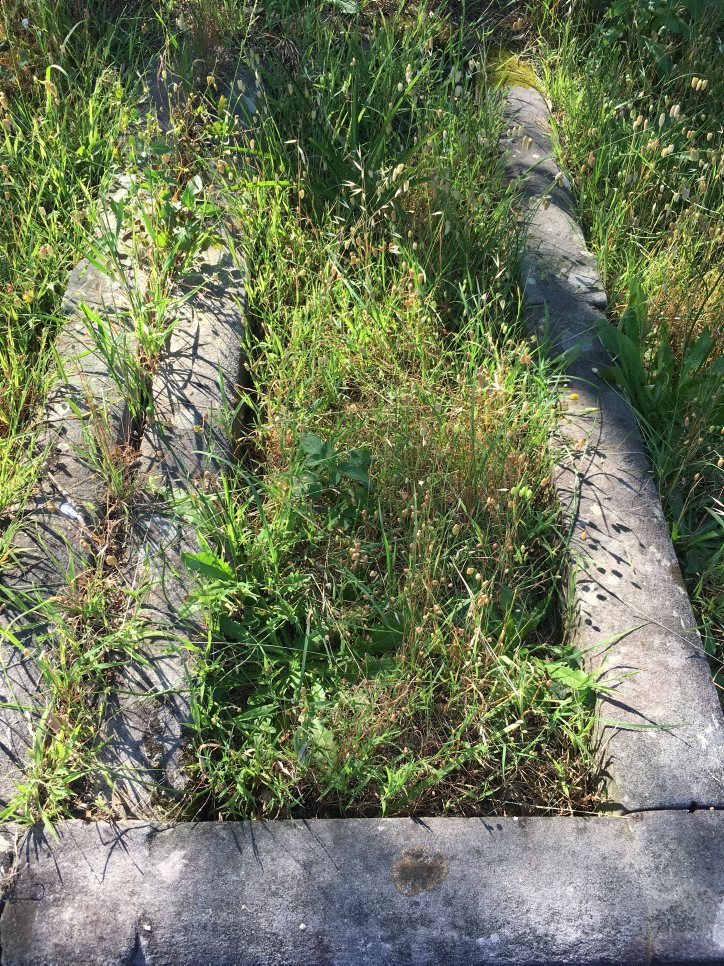
Inscription Location of grave but no tombstone visible Additional Information from Gore Hill Cemetery Graves Index: Tubman, Henry – Age 77, buried 19/03/1900. Other notes: North Sydney. Tubman, Faith – Age 77, buried 11/11/1926. Other notes: [none] Welsman, Clifford Robert Henry – Age 18, buried 21/06/1941. Other notes: 67 Dalton Street Mosman. Welsman, Stephen – Age 55, buried 08/11/1943. Other notes: (Ashes). 67 Dalton Road Mosman. Welsman, Ethel Frances – Age 73, buried 24/11/1964. Other notes: (ashes). 251 Ben Boyd Road Neutral Bay.
Memorial at: ?
HENRY is NOT mentioned on the Police Wall of Remembrance *NEED MORE INFO
FURTHER INFORMATION IS NEEDED ABOUT THIS PERSON, THEIR LIFE, THEIR CAREER AND THEIR DEATH.
THE FRIENDS of Sergeant TUBMAN are respectfully invited to attend the Funeral of his late beloved WIFE, to move from his residence, 111 Prince-street, a quarter to 2 p.m., THIS DAY, the 8th instant, for the Necropolis.
THE FRIENDS of Mr. HENRY TUBMAN, Sergeant of the Sydney Police, are respectfully invited to attend the Funeral of his deceased WIFE, Maria Anne Tubman; to move from his residence, No. 111 Prince-street, THIS (Thursday) AFTERNOON, at a quarter before 2 o’clock, for the Necropolis.
J. and G. SHYING and CO., Undertakers, 719, George-street S.
We learn that Sergeant Henry Tubman, of the City Police Force, is about to retire upon an allowance granted under the provisions of the superannuation Act. It is probably that there are few persons who have had so much experience of the police force, and fewer still who as policemen have been witness of so many stirring events as has Sergeant Tubman. That officer has worn the uniform of a protector of life and property for more than 39 years.
During that period he has served in the Irish, the English, and the colonial constabulary, and been a witness of some of the scenes of strife engendered in Ireland by the agitation for the repeal of the Union, a spectator when O’Connell addressed an assemblage of 150,000 people, one who was armed with a sawback cutlass at the time of the Chartist riots, and a witness of the opening of the first International Exhibition in London in 1851.
SergeantTubman joined the Irish constabulary as a constable on the 1st March, 1841, and was first called upon to do duty at proceedings in connection with a general election held at Erldunda. The election lasted three days, and as the question of the repeal of the Union was agitating the people’s minds there was a considerable amount of excitement attended by riotous proceedings.
Constable Tubmanresigned on the 24th December, 1845, and joined the London police force on the 11th May of the following year. He was amongst those who had to do duty during the period that the Chartistsgave so much trouble. As it was thought that the Chartists contemplated a wholesale slaughterof the police force, the constables were armed with sawback cutlasses, and were employed on duty in pairs.
In the year 1854 some difficulty was experienced in Sydney in retaining constables, owing to the attractions which the newly discovered goldfields then presented. The local Government sent to England for a number of men, who had had previous experience as constables, and against whom there were to be no marks for drunkenness. It was also stipulated that any men to be sent to the colony must have borne an excellent character.
Forty-six men were selected, amongst whom was 32 year old Constable Tubman. They came to Sydney by the ship Bangalore, which arrived in Port Jackson on the 13th January, 1855. Three weeks after his arrival Mr. Tubman was promoted to the rank of sergeant, and two years later he was raised to the rank of acting inspector.
Mr. Tubman retired from the force by resignation on the 11th May, 1857, but he rejoined on the 4th October, 1869. For the last five or six years he has hold the position of sergeant in charge of the summons room of the Water Police Court, where his courteous demeanour has secured him many friends.
Sergeant Tubman, who ¡s now upwards of 60 years of age, retires on an allowance of 5s. 10d. per day, which is equal to two-thirds the amount of his daily pay.
We understand that provision has also been made for the immediate retirement of’ Senior-constable John Carton, the trooper who has been stationed at Manly Beach for the last 15 or 16 years.
At the ST. LEONARDS POLICE COURT, yesterday, before Mr. G. W. F. Addison, S.M., J. O. Phillips, summoned by the Inspector of Nuisances for the Borough of St. Leonards, for using on his premises nightsoil brought from elsewhere without permission, was fined 40s., and complainant’s costs £1 11s. 6d., levy and distress, or 14days.
John McClinchy, summoned by Henry Tubman, Inspector of Nuisances for the Borough of Victoria, for obstructing him when acting under the authority of the Nuisances Prevention Act, was fined £3, and costs 7s., levy and distress, or one month.
Anton Ham was ordered to pay 10s. per week for 12 months towards the support of his wife, the first payment to be made at St. Leonards police station on Monday next, with 5s. 10d. costs.
Mr. Henry Tubman, late Inspector of Nuisances to the Borough of East St. Leonards, has been re-appointed, out of 120 applicants to the position, at a salary of £150 per annum. He was inspector to that borough, and also to the borough of Victoria, at each place receiving a salary of £80 per annum. He will, of course, resign his position at Victoria.
TUBMAN.—The Friends of Sergeant JOHN THOMPSON are kindly invited to attend the Funeral of his late FATHER-IN-LAW, Henry Tubman, ex-Sergeant of Police ; to leave his late residence, 103 Arthur-street, North Sydney, at 3 p.m. THIS DAY, for Gore Hill Cemetery.
TUBMAN.— The Friends of the late Mr. HENRY TUBMAN, ex-Sergeant of Police, are kindly invited to attend his Funeral ; to move from Avoca, 103 Arthur- street, North Sydney, THIS MONDAY, at 3 o’clock, for the Gore Hill Cemetery.
Mrs. P. KIRBY and SON,
Undertakers,
7 Elizabeth-st., and 113 Miller-st., N. Syd. Tel., 875.
An ex-senior sergeant of police and a pensioner in the person of Mr. Henry Tubman died at his residence, Arthur-street, North Sydney, on Saturday last.
The deceased, who was well advanced in years, had seen considerable service in the force. There was a large attendance of police officers at the funeral on Monday, the Police Band being also present.
TUBMAN — At his residence, ‘ Avoca,’ Arthur street, North Sydney, Henry Tubman, ex Senior-sergeant of Police, aged 77 years. Dearly beloved father of Mrs A. H. McEachern, of David street, Albury.
The subject of the appended paragraph from Sydney paper was the ‘father-in-law of Mr. A H. McEachern, of Albury ; — Henry Tubman, an ex-police sergeant, died on Saturday at North Sydney at the age of 77 years. The deceased appears to have been ill for a considerable time, and had had consequently a protracted confinement to his house. A few years ago Mr. Tubman filled the office of inspector of nuisances to the East St. Leonards Council, and about the period of the amalgamation of the Council he was one of the unsuccessful candidates.
The funeral on Monday was attended by several members of the local police force.
Tubman joined the Royal Irish Constabulary when 18 years of age, thence he passed to the London Police. In 1854, the Government of New South Wales called for volunteers from the London Police, and Tubman was one of those accepted. He came here in the ship ‘ Bungalore,’ in company with the present Superintendent Reid.
Being a steady and zealous officer, he rose in the force, and became inspector about the year 1856. He was transferred to Penrith, and after six or seven years’ service, returned to Sydney until May, 1882, when he retired on a pension.
“He leaves behind a widow & 4 children”. This shows that me ‘may have’ remarried after the death of his wife, Maria Anne Tubman, in January 1880, whilst living at 111 Prince St. The ‘second wife’ may ‘possibly be’ Faith TUBMAN who either died on, or was buried on, the 11 November 1926 in a grave next to Henry. Methodist 1, A, 149 of Gore Hill Cemetery, NSW.
The St. Leonards circuit has recently lost by death two of its most venerable church members. The first to lay down the burden of life was Mr. Thomas Swinger, ……….
The next to be removed Henry Tubman, from the Church Militant to the Church Triumphant, was Mr. Henry Tubman, one of the oldest members of the St. Leonards Church, and a trustee for the Parraween property. He died at his residence in Arthur Street, North Sydney, on Wednesday, 17th. March, in his 78th. year, and his body was laid in the grave in the beautiful cemetery at Gore Hill, on Monday, 19th. ultimo.
For six long months he was afflicted, but his fortitude and submission to the Divine will were unfailing. He loved prayer, reading of the Scriptures, and the visits of Christian friends. In the last hours of his life he suffered greatly, death was hard work to him physically but his faith did not fail him. His lips were often seen to move in prayer, and the Lord in whom he trusted fulfilled his promise and did not leave nor forsake him in his mortal struggle.
Mr. Tubman was a retired sergeant of the Police Force of the Colony, having joined it upwards of 40 years ago, and was at one time a well known member of our church in the Bourke Street and York Street circuits. He had resided at St. Leonards for the past 18 years.
In THE SUPREME COURT OF NEW SOUTH WALES – Probate Jurisdiction. – In the Will of HENRY TUBMAN, late of North Sidney, in the colony of New South Wales, Gentleman, deceased.- Application will be made after fourteen days from the publication hereof that Probate of the late Will of the abovenamed deceased may be granted to FAITH TUBMAN and HUGH ABERCROMBIE, the Executor named in the said Will, and all notices may be served at the office of the undersigned.
TUBMAN.-In loving remembrance of our dear husband and father, Henry Tubman, who died 17th March, 1900, at his residence, 103 Arthur-street, North Sydney. Inserted by his affectionate wife and children.
TUBMAN- In affectionate remembrance of our dear husband and father Henry Tubman, died 17th March, 1900. Inserted by his affectionate wife and children.
TUBMAN.-In loving memory of our dear husband and father, Henry Tubman. who died March 17. 1900, at North Sydney. Inserted by his affectionate wife and children.
McEACHERN.— March 22, 1909, at Manly, of Bright’s disease, Rebecca Emily Estella, dearly loved third daughter of Archibald H. and Rebecca McEachern, of Albury, and granddaughter of the late Henry Tubman, Esq, of North Sydney, aged 23 years.
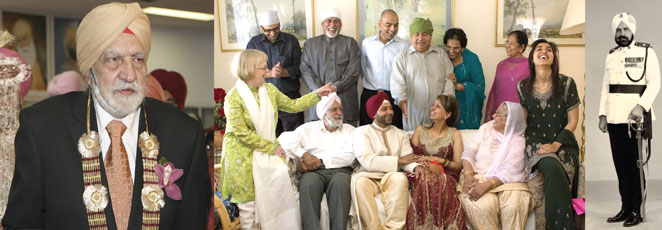
Stations: ? Prosecution, Criminal Investigation Department ( C.I.D. ), Flying / Jungle Squad, O.I.C. of Police District ( OCPD ), Officer Superintending of Police Circle
Service: From? ? 1932to? ? 1969 = 37 years Service
Awards: ?
Born: 13 February 1913 Gaggarwal near Morinda in Punjab
Died on: Wednesday 31 December 2015 peacefully @ 3.30pm
Cause: ?
Age: 102
Funeral date: 6 January 2016 from 2.30pm – 4pm
Funeral location: Chapel of Reflection at Springvale Botanical Cemetery, 600 Princes Highway, Springvale, Victoria
Buried at: ?
Memorial at: ?
FURTHER INFORMATION IS NEEDED ABOUT THIS PERSON, THEIR LIFE, THEIR CAREER AND THEIR DEATH.
Passed away peacefully at 3.30 p. m. on Dec. 31, 2015 aged 102.
Beloved husband of Harbajan Kaur and much loved father of Gerry, Sukhvinder and Jagdeep.
An officer and a gentleman. The quintessential man who served his country (Royal Malaysian Police 1932 – 1969), the community, and God.
A dedicated family man who was one of a kind.
A special soul that no one can replace. He was deeply loved by all who had the pleasure to meet him and he will never leave the minds and hearts of those he came across. A smiling face, a gentle nature and a heart of gold.
SENIOR CITIZEN DIARY Reflections From A Melburnian Centenarian Didar Singh
14 February 2013
This February, Sardar Didar Singh will turn 100 years old, a notable milestone few of us are able to achieve. We walk down memory lane with a man whose life has spanned three countries – India, Malaysia and now Australia.
Born in the village of Gaggarwal, near Morinda, in Punjab on 13 February 1913, it was the time when the British ruled India giving it independence in as late as 1947. So, war and peace were very much part of the social fabric Didar Singh grew up in. Singh was just four when his mother passed away, the First World War had begun and his father Harnam Singh was serving in the Middle East as he was in the private army of the Maharaja of Patiala, the Patiala Lancers. Singh was left in the care of his elder sister, Tej Kaur. Upon his father’s return, he was back living with him and his brothers. When his father retired, he went back to farming.
Singh received his initial education at the village school in Gaggarwal. “We walked ten km everyday rain, hail or shine,” says Singh. The pursuit of education saw him shift to Middle school in Khant, then to Kainor Khalsa College, Chamkaur Sahib Khalsa College, and finally City High School in Patiala. After completing high school in Patiala, Didar Singh returned to his village and briefly helped his father with the farming and planting an orchard.
Singh’s memory of his father is that of a strict disciplinarian given his military background. “It was military discipline at home too and everything had to be done a certain way, if not we would get a caning,” he recalls. The children took part in all the domestic chores including looking after the animals, cleaning the cow dung in the sheds, milking the buffalos, drawing the plough across the fields with the oxen and extracting water from the well. Far from the days of electricity, running water or automobiles, says Singh.
It was also during this time when he had completed high school that a person from the village had come back home on leave from overseas. This person convinced Singh that he could get a job as an office clerk as he was now well versed in Punjabi, Urdu and English. The person also persuaded Singh’s friend Amar Singh who had not gone to school that he could work in the mines. They were both assured of jobs in the east. Colloquially, the east was known as ‘Chine’ – anything past Calcutta or Kolkata as is now known.
It was a decision that would herald another journey in his long life. With his father’s blessings and financial help, Didar Singh took a train from Punjab to Calcutta. From there he boarded a steamer with the best room on the ship – on the deck and open to the elements. Few days later, he arrived in the Island of Penang in Malaysia. After being in quarantine for a few days, he learnt from the Punjabis living in Penang that the state of Kedah were recruiting people for their police force. Each State in Malaysia had its own police force.
Not wanting to lose any opportunity, Singh travelled to Alor Setar, the capital of Kedah and found himself among a queue of 30-40 Punjabis hopefuls. He had already passed the medical and physical tests. He remembers vividly how the recruiting officer Commissioner J.P. Pennefather-Evans walked up and down the line scrutinising the next batch of police officers. Singh took the opportunity to hand him a letter written in English at which the Commissioner asked in Punjabi ‘who had written this letter’. When Singh replied that he had written it himself, Commissioner Evans proceeded to look at his hands. Fortunately for Singh, his hands were very rough from the agricultural work he had done back home and, thus on this basis, he was recruited. Out of the hopefuls, only 10 were selected.
Singh’s initial duties were to guard members of the Royal family of Kedah. “They preferred Sikh guards as they would not interfere with their women and were excellent guards,” he says. During his night shifts, he used to study under the street lamps. He had a pocket dictionary and used to read books and newspapers to better his English. He also studied and learnt Malay. Clearly, a self-made and self-taught man, it was his drive to excel that would see him rise to the rank of Deputy Superintendent of Police during the British times.
Singh went on to serve in different divisions in the police, including prosecution (where he had to learn Criminal Procedure Act, Evidence Law and other legal subjects); the Criminal Investigation Department (CID); Flying/Jungle Squad (after WWII there was a problem with communists in Malaya. The Flying squads were the first ones sent in at any sign of trouble and they had to conduct jungle warfare with the communists). Singh rose through ranks. He not only became a gazetted officer, a Deputy Superintendent of Police but was also Officer In Charge of Police District (OCPD) and Officer Superintending of Police Circle (which included several districts) in various states of Malaysia, gaining fame and respect in not just Malaysia but Singapore and India as well.
Singh retired from the services in 1969 and spent time in India. By then Malaysia was also undergoing its own transition in history. The government was heading towards racial bias and non-Malays were beginning to be treated as second class citizens.
Moving to Australia in 1986 was a decision based on giving his children a better education and future. And while he enjoys life in Australia, he reminisces about life in Malaysia fondly as he was at the prime of his career and had it all – a good life, fame and challenges.
“The times have changed, of course,” says Singh, adding, “Compared to the hard life we had to endure, the lifestyles of people have changed, children enjoy comforts and many things are taken for granted. But it is a progress that we take in our stride and I am always amazed by the rapid change and progress mankind is making.”
A strong believer of Waheguru, Singh has lived life according to its diktats especially in the true style of a Sikh “rehat maryada”. Hard-work (kirat karni), prayer (naam japna), voluntary service (seva), communal life, and daswand (donating 10 per cent of your earnings), have been the principles of his life. He has served in Gurudwara committees across Malaysia and has been integral part of the Sikh Community in Melbourne as well. He was Chairperson of the Blackburn Gurudwara Committee, during 1999-2000 at the age of 86.
For all his time in Malaysia or Australia, Singh has never forgotten his roots and never misses a chance to pay homage to his village whenever he is in India. He also built a school and funded generously towards the building of a Gurudwara in his village.
Singh’s knowledge, humility and integrity shine through his personality. Little wonder, why he is such a respected member of the Indian community. “To be able to live in harmony, we have to treat everyone equally no matter who you are,” he says. Pearls of wisdom from a centenarian.
By Indira Laisram
Ponnambalam MAHENDRAN
(Brute / Pat).
Retired DIG of Police,
Sri Lanka
Died: 2 February 2012
Sydney, NSW.
Dearly beloved husband of Dr Lalitha (nee Appiah), loving father of Vishanthri, Rathy and Neelan, father-in-law of Sam Hayne-Keon, Ian Brandes de Roos and Kate, beloved grandfather of Arujuna, Sachin, Nikhil, Oliver, Saratha, Abilasha, Indie and Finn, brother of late Kulendran, Nagendran, Anna and of Rajendran (UK), Sunthari (Sydney), Theva (Sydney), Indra (Sri Lanka), Yogu (Japan) and Wije (San Francisco), passed away in Sydney on February 2, 2012.
Funeral Saturday (February 4, 2012); viewing at Guardian Funerals, Blacktown Chapel, cnr of Sunnyholt Road and First Avenue, Blacktown, from 9am to 11am, followed by Hindu Rites from 11am to 1pm. Cortege leaves for Pinegrove Memorial Park, Minchinbury, for cremation at 1.30pm. Donations in lieu of flowers to Adventist Aged Care, 56 Elsom St, Kings Langley, NSW 2147.
Published in The Sydney Morning Herald on Feb. 3, 2012
MAHENDRAN,
Ponnambalam
(Brute / Pat).
Retired DIG of Police,
Sri Lanka.
Dearly beloved husband of Dr Lalitha (nee Appiah), loving father of Vishanthri, Rathy and Neelan, father-in-law of Sam Hayne-Keon, Ian Brandes de Roos and Kate, beloved grandfather of Arujuna, Sachin, Nikhil, Oliver, Saratha, Abilasha, Indie and Finn, brother of late Kulendran, Nagendran, Anna and of Rajendran (UK), Sunthari (Sydney), Theva (Sydney), Indra (Sri Lanka), Yogu (Japan) and Wije (San Francisco), passed away in Sydney on February 2, 2012.Funeral Saturday (February 4, 2012); viewing at Guardian Funerals, Blacktown Chapel, cnr of Sunnyholt Road and First Avenue, Blacktown, from 9am to 11am, followed by Hindu Rites from 11am to 1pm. Cortege leaves for Pinegrove Memorial Park, Minchinbury, for cremation at 1.30pm. Donations in lieu of flowers to Adventist Aged Care, 56 Elsom St, Kings Langley, NSW 2147.
Published in The Sydney Morning Herald on Feb. 3, 2012
– See more at: http://tributes.smh.com.au/obituaries/smh-au/obituary.aspx?n=ponnambalam-mahendran&pid=155738397#sthash.8enMFQRc.dpuf