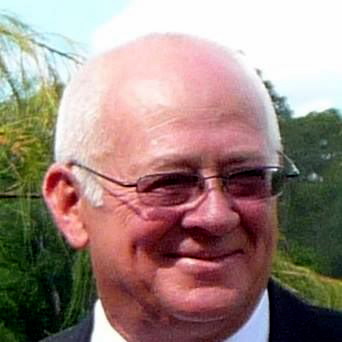
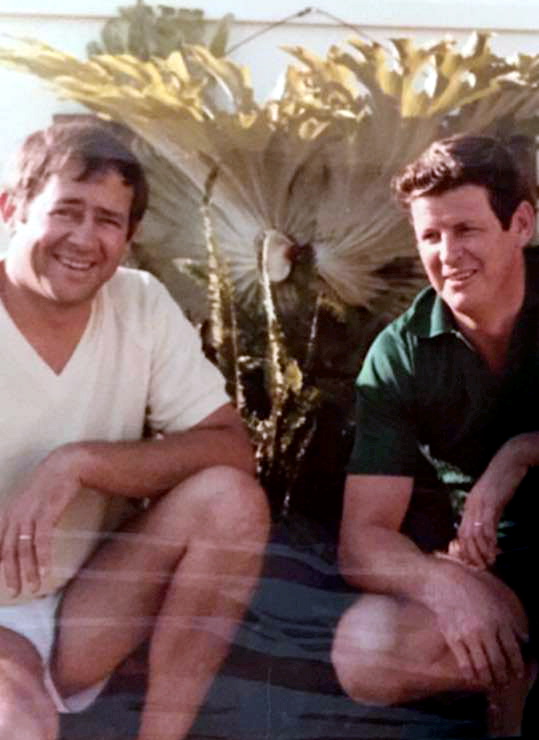
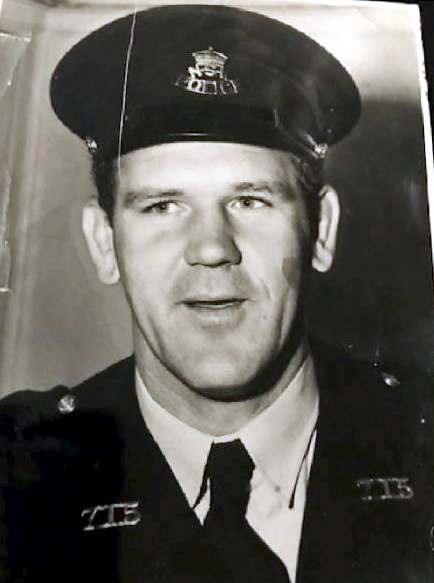
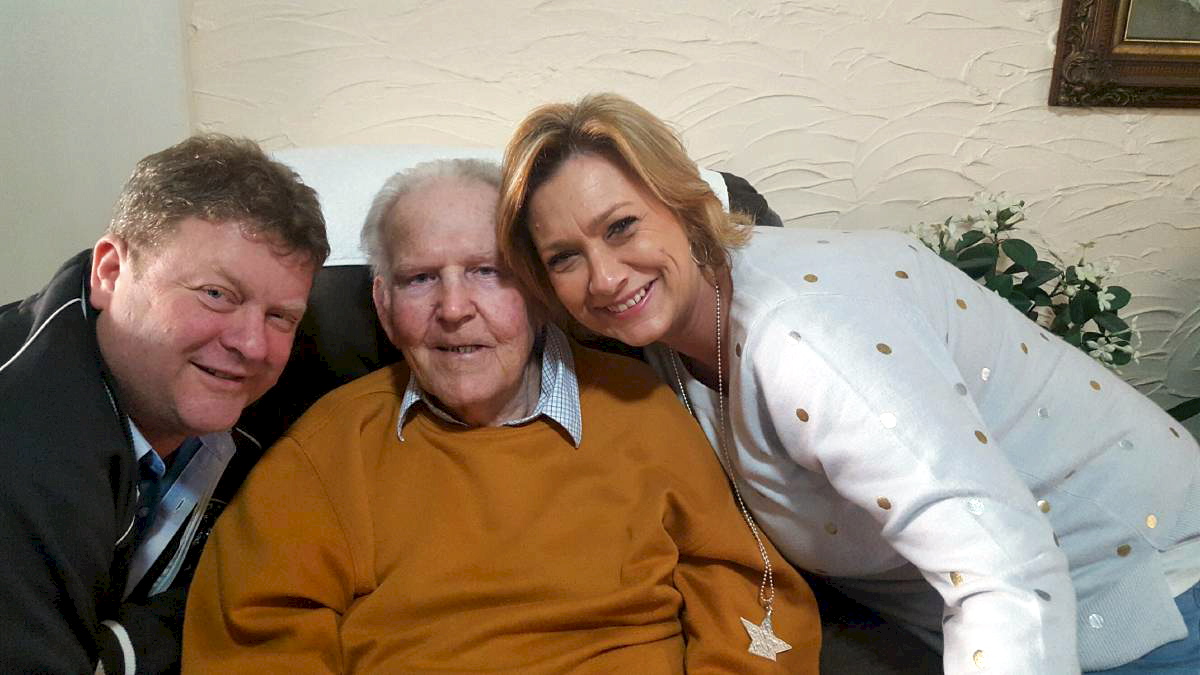
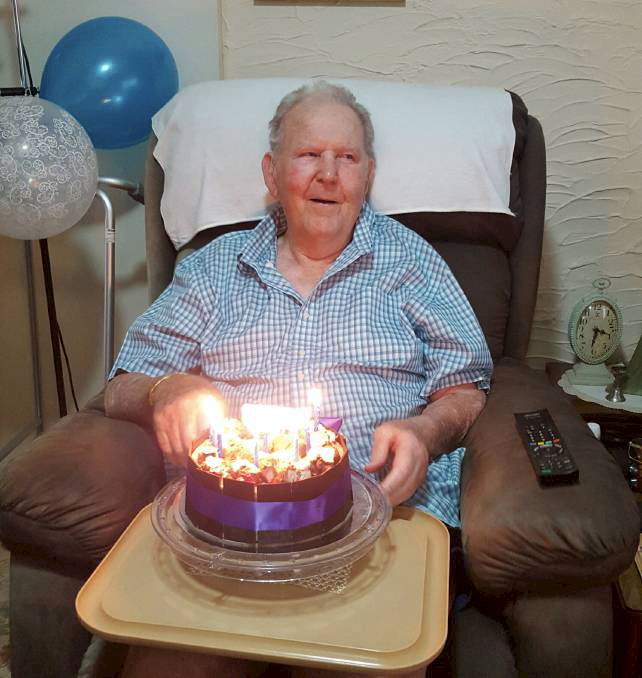
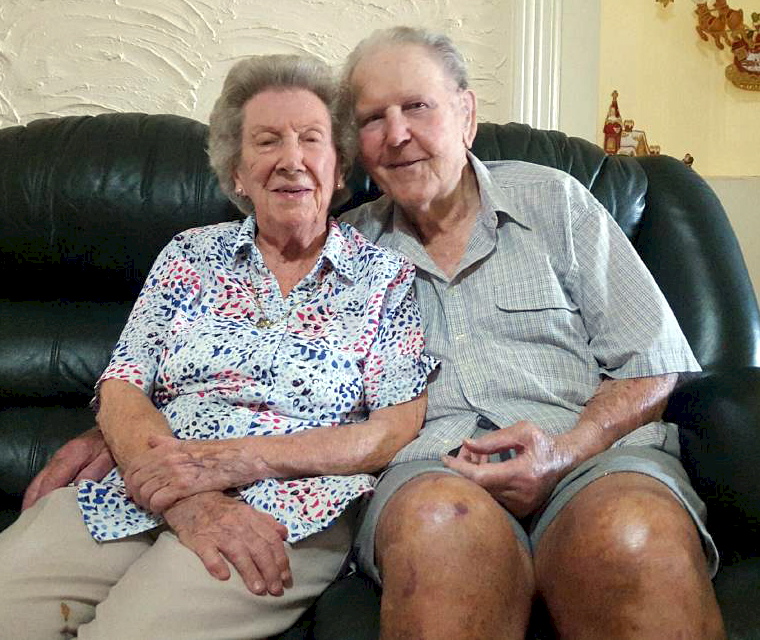
Lifelong St George resident John William Baxter died peacefully in his sleep at his Rockdale home on Saturday morning aged 92.
‘Jack’ was well-known in the community for his love of golf and played at Kogarah Golf Club every week until he was no longer able.
Mr Baxter was born in Bexley on January 24,1926 as the fifth of six children.
He attended Hurstville Boys High School before enlisting in the Royal Australian Air Force at age 18.
Mr Baxter served in the RAF for two years achieving the rank of Leading Aircraftman (LAC).
He saw action in Borneo, where he was wounded by a gunshot to the leg and spent six months recovering in Jervis Bay.
Mr Baxter met his future-wife Valerie soon after and the pair were married January, 1957.
He served in the NSW Police Force for 35 years, retiring in 1981 after being injured in a serious car accident. The sergeant served at Regent Street, Philip Street, Darlinghurst and Maroubra commands.
Mr Baxter also played rugby union with St George Rugby Union Football Club (now known as Southern Districts), delivering a man of the match performance – his final appearance in the league – in the club’s then only premiership victory, against Gordon.
The football highlights didn’t end there, with the forward captaining a NSW Police side against the New Zealand police team in a 1958 interdominion.
Mr Baxter was also known to play a friendly spot of tennis with local legend Ken Rosewall.
He also coached junior cricket at Arncliffe Cricket Club in the 1970s.
Mr Baxter was a voracious reader and his love of books was rivalled only by his joy in sharing a glass of wine with his wife.
The Baxters raised their children in the same Rockdale house they lived in for 53 years.
Mr Baxter is survived by two children, three grandchildren and two great-grandchildren.
He will be farewelled in a funeral service at Rockdale Guardian Funerals (374 Princes Highway, Banksia) at 10.30am on Friday, February 9.
Sue BUCKLEY
17/02/2018
Sue BUCKLEY
aka Sue BUCKLEE
Late of ?
partner to Max LAMOND # 6522 ( R.I.P. 8 December 2024 )
New South Wales Police Force
Regd. # Police Woman 015
Rank: Probationary Constable – appointed Monday 1 September 1952 ( aged
Constable – appointed ? ? ?
Constable 1st Class – appointed ? ? ?
Senior Constable – appointed 1 October 1963
Final Rank: ?
Stations: ?, Newcastle – School lecturing, Plain Clothes ( Not a designated Detective )
Service: From 1 September 1952to? ? ? = ? years Service
MAHONEY, Eric Simon.
15th June 1957
12th February 2018
Late of Menai
Cherished son of Les and Maureen (deceased). Loving brother of Lyn, Janet, Paul and Terrey. Eric’s wife Deb. Devoted father of Luke, Jacob and Kaitlin.
Aged 60 Years
Forever In Our Hearts
Eric’s family and friends are invited to attend his funeral service to be held in the South Chapel, Woronora Crematorium Linden Street Sutherland at 11.00am on Wednesday 21st February 2018.
.
February 16, 2018
Thinking of some wonderful memories we all had together, the BBQs, the kids, the fishing, and the somewhat exaggerated fishing stories.
Great memories and some sad times too.
A sad,sad loss.
Neil Campbell
.
Published in The Sydney Morning Herald on Feb. 16, 2018
On Wednesday we celebrated the life of Eric Mahoney. It was great to catch up to work mates from years gone by.
I was speaking to Eric’s father who said it made him very happy to see many if Eric’s work mates at the funeral and wake. I cannot write in words the emotion in his words.
Whilst at the wake we were discussing the celebrants words, ” we have now, we do not know what lays ahead, miso take the time to catch up with family and friends.”
The location we came up with is the Wollongong surf leisure resort. This is a resort with cabins, caravans and camping options. Across the road is the Towradgi beach hotel which has a good bistro/restaurant.
The plan is to book in at the resort for Saturday 26th May, catch up in the afternoon and cross the road to the hotel for dinner.
The accommodation has various options, sharing will cost $50 for the night.
There is plenty of time to organise this day, not compulsory to stay over and I’m sure if the Occasion arises there will be some where to put your head down if you do stay.
Hope to see as many old friends as possible.
Stay well and take care ????
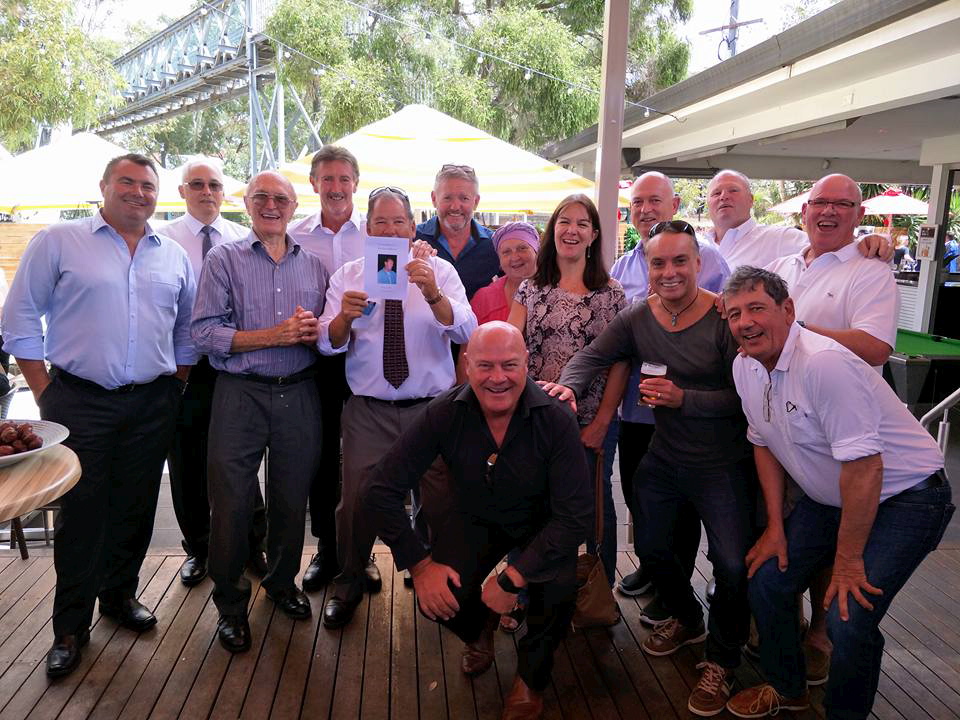
Old 12 Division boys at Eric’s funeral. Kogarah/Rockdale plus Eric’s dad farewell to a good bloke Ekka at the Bangor tavern 21/2/2018. A day of special memories. Also in the photo is Manny Rivera, Eric’s Dad, Dave Little and Lenny Ware.
Allan James FULLER
17/02/2018
Allan James FULLER
Late of Tamworth
New South Wales Police Force
Regd. # ????
Rank: Constable
Stations: ?, Warialda, Tamworth – death
Service: From? ? 1945 to 2 July 1950= 5 years Service
Awards: No find on It’s An Honour
Born: ? ? 1923?
Died on: Sunday 2 July 1950
Age: 27
Cause: Motor Vehicle Accident – Motor Cycle Rider – Off Duty – At fault
Event location: New England Hwy near the intersection of Gurnsey St, Scone, NSW
Event date: Sunday 2 July 1950
Funeral date: Tuesday 4 July 1950
Funeral location: Bede’s Church of England, Scone, NSW @ 3.30pm
Buried at: Church of England portion, Werris Creek Cemetery, Werris Creek Rd
Memorial located at: ?
ALLAN is NOT mentioned on the Police Wall of Remembrance *NOT JOB RELATED
Funeral location: TBA
FURTHER INFORMATION IS NEEDED ABOUT THIS PERSON, THEIR LIFE, THEIR CAREER AND THEIR DEATH.
Newcastle Morning Herald and Miners’ Advocate (NSW : 1876 – 1954), Monday 3 July 1950, page 1
Eight Killed In Road Accidents Eight people were killed i road accidents in New South Wales and Victoria at the weekend.
Constable Allan James Fuller, 27, of Tamworth, was fatally injured yesterday when his motor-cycle and a lorry collided on the New England Highway, Scone. Fuller, a married man with one child ( daughter ), was on week-end leave and was riding his own machine.
There was a large attendance at the police funeral at Werris Creek on Tuesday of Constable Allan James Fuller, who was killed when his motor cycle collided head on with a motor truck near Scone on Sunday week.
The service. held at St. Bede’s Church of England, was conducted by the Rev. W. J. Pritchard.
The coffin was draped with the Australian flag, on which deceased’s cap had been placed.
After the service at the church, a squad of police led by three police cyclists, marched ahead of the hearse through the main business section of the town.
From there the marchers went by car, and with the cyclists still in the lead the cortege moved on to the Church of England portion of the Werris Creek Cemetery.
At the graveside the Werris Creek Band played the hymn, ‘Abide With Me.’
There was a large attendance of police officers from all parts of the North and North-West.
They included the Inspector-in-Charge of Tamworth sub-district ( Mr. G. Smith ), who deputised for the Superintendent of the Northern Police Administrative District ( Mr. C. J. Delaney ), Sergeant E. Lambert and Constable W. Matheson ( Quirindi ), Constable W. Brett ( Willow Tree ), Constable R. Gibson ( Murrurundi ) , and Sergeant H. Jerome and Constable B. .Shannon and Constable R. Paff ( Werris Creek ). Tamworth District Ambulance Service was represented .by Messrs H. J. Rowland and H. W. Kearns.
Werris Creek sporting bodies and business houses were represented.
The police cyclists were Constables Lawler, Aldred and Elliott. Pall-bearers were Constables Nicholson, Ralph, Holmes and Watkins.
The District Coroner, Mr. N. Hunt, held an inquiry into the death of Allan James Fuller (27), of Tamworth Police, who was killed almost instantly on 2nd July last, when his motor cycle crashed into a truck being driven by Athol Hope, carrier, of 9 Barber-street, Gunnedah.
Evidence revealed that the deceased’s cycle had struck a bump in the highway near the intersection of Gurnsey-street, causing the cycle to veer over on to the other side of the road.
Sergeant T. Newell, of Muswellbrook Police, assisted the Coroner at the inquiry, while Mr. R. S. Watson represented Mr. Hope and the Government Insurance Office. Mr. A. A. McLellan, solicitor, of Scone, appeared to watch the interests of the Scone Municipal Council. The widow of the deceased and members of his family were also present in Court throughout the proceedings.
CONSTABLE’S EVIDENCE
Constable William Charles Black told the Coroner he went to the scene of an accident on the New England Highway near the intersection of Guernsey-street on the afternoon of 2nd July, at about 2.45 p.m. Saw a Harley Davidson motor-cycle lying on its side on the bitumen, five feet in and about 14ft. 8ins. from the kerb. At the rear and near side of the motor cycle was a pool of blood. The deceased had been removed prior to witness’s arrival. Also saw a motor lorry, heavily loaded with beer, drawn over to the side of the highway. The driver gave his name as Athol Hope, of Gunnedah.
Noticed some marks on the right mudguard and right hand side of the bumper bar, as well as other marks on the body of the lorry and driver’s cabin.
Constable Black said he inspected the road and found several depressions right at the bend of the road and on the north-eastern side, extending on to the edge of the bitumen. There were also marks resembling skids on the northern side from the blood.
Later, in company with the deceased’s brother and the Coroner, visited the Scott Memorial Hospital, where deceased was identified.
Answering Sergt. Newell, Constable Black stated the marks on the motor lorry could have been caused by the vehicle coming into collision with the cycle on the roadway.
Sergt. Newell: What was the condition of the roadway? — At the point of impact the road surface was level, but for a distance of 8 or 10 feet from this point the road north of the impact and extending further north to the curve on the north-eastern side, that is right on the inside of the bend, the road surface is very uneven.
Witness marked several identification spots on photographs of the scene of the accident, and these were later tendered as exhibits.
Answering Mr. Watson, Constable Black stated the cycle was the private property of the deceased. The point of impact would be on Hope’s side of the road. It is possible that the deceased did not know there was a curve in the road ? — Yes, it is possible he did not know, much about the locality. I don’t know, and I had never met him. He was stationed at Tamworth. As an experienced traffic constable, is there anything that makes this roadway abnormal or dangerous? — Only that it is very deceptive upon approach from the north. It is actually a worse bend than it appears from 100 or 200 yards away. Do the depressions you referred to add to the danger of the curve? — Yes, considerably with a motor cycle, but I don’t know about a four-wheeled vehicle. Is there any warning of this curve approaching it from the North? – No. Do you consider it a curve which should have the normal traffic warning ? — It would be a benefit to have such a warning.
Constable Black, through Mr. Watson‘s examination, stated there was a 30-miles-per-hour sign about 40 yards away from the scene of the accident. Most motorists slowed down after passing such a warning, and witness was of the opinion the sign would be placed to better advantage if moved further north in order to give motorists time to slow down before reaching the curve in the highway. Answering Mr. McLellan, Constable Black stated it was a fact that a good deal of traffic went straight down Guernsey-street from the main road, due to the closing of traffic from the highway at certain times by the railway crossing gates. Replying to Sergeant Newell, witness stated the brakes on the truck involved in the collision had been tested and found to be in perfect condition. They conformed with the standards required.
BROTHER’S EVIDENCE
George Fuller, of Werris Creek, brother of the deceased, stated he had identified the body of the deceased on July 3 last. Had not seen the deceased for a fortnight prior to the accident, but at that time his late brother had been in good health and spirits. The deceased had been in the Police Force for five years, was 27 years of age, and at the time of the accident was going to visit his wife’s mother at Branxton. Could not say whether he had passed through Scone before, or whether his life was insured. Could not say whether the deceased had known the roadway through previously travelling over it.
LORRY DRIVER’S STORY
Athol Hope, carrier, residing at 9 Barber-street, Gunnedah, told the Coroner that at about 2 p.m. on July 2 he was travelling in his lorry with a load of beer on board. Passing through Scone, he had travelled from Swansea that day. Went over the railway crossing and was proceeding to go around a curve in the highway when he heard and saw a motor cycle coming. ” It was roughly a hundred yards away when I first saw it, before I approached the turn. I was travelling slowly — about 10 miles an hour— and the cycle was coming towards the curve. ”
Sergt. Newell: Did you form any opinion as to the position of yours and the other vehicle as to approached the curve? — When I was approaching the carve, I saw the cycle would have difficulty in getting around the curve. As the cycle came on to the curve it hit a rut in the road and the front wheel went up in the air. I saw it happen distinctly and it then came straight towards my truck. The way I saw it, the front wheel seemed to jump straight towards me. The bike hit the front portion of my truck. Would say the rider had no control over the machine. I stopped my truck after the impact.
Sergt. Newell: Did the rider of the cycle try to do anything to avoid the collision? — No. There was no way of getting the cycle under control. When he hit the rut he came straight towards me. It all happened so suddenly I had no time to do anything. I walked back to where the deceased was lying, but he did not speak.
Answering Mr. McLellan, witness said it would be hard to estimate how far away the cycle was when witness first saw it. It would be hard to estimate the cycle’s speed, but thought it would be travelling at about 50 miles an hour.
Replying to Mr. Watson, witness said he agreed with Constable Black that the deceased was travelling on the wrong side of the road at the point of impact. Witness’s vehicle was on its correct side, with the off-wheels off the bitumen. Thought there should be a ‘Curve’ sign to the north of the bend in the road.
PHOTOGRAPHER’S EVIDENCE
John Arthur Smith, engraver and photographer, residing at 100 Main-street, Scone, gave evidence of having taken certain photographs of the road at the scene of the accident. These photographs were then tendered and marked as exhibits one to four.
MEDICAL EVIDENCE
Dr. A. B. Cuthbert, fully qualified medical practitioner and resident of Scone, gave evidence of having made an examination of deceased at the Scott Memorial Scone Hospital on the afternoon of July 2. The deceased had died a short time before and found extensive lacerations of the right hand side of the jaw bone and down under the neck and to the sternum. The lacerations involved injury to the main vessels of the neck, the bleeding from which was the cause of death. Death had not been instantaneous, but within a few minutes of receiving the injuries. It was quite probable the deceased had been unconscious from the time of receiving the injuries.
ADDRESSES
Mr. McLellan and Mr. Watson addressed the bench at length as to their views on how the accident occurred.
Mr. McLellan stated there was evidence which pointed to the fact the deceased was travelling at a speed in excess of the safe speed he might have travelled at, taking into account the condition of the roads. It was a fact that roads were not in the first-class order they were in some years ago. The deceased, travelling at an excess speed, plus the fact of his cycle striking a rut at this speed, was sufficient to cause the accident.
Mr. Watson was also of the opinion that the deceased was travelling at an excess speed — probably that of 50 miles an hour. Had the road been in good order, that speed, when slowed down to the 30-miles-an-hour limit past the speed sign, would have been quite all right, but for the fact of hitting a rut caused the cycle to deviate off the correct side. The other fact pointed out by Mr. Watson was the driver of the lorry was on his correct side and travelling at a slow speed. His client, Mr. Hope, was in no way to blame for the occurrence.
CORONER’S REMARKS AND FINDING
From the Bench, the Coroner stated that he accepted the evidence of Mr. Hope, the only witness to the tragic happening, as being a truthful version of the accident. ” His evidence, with that of Constable Black, and the very helpful photographs, for which the Court is indebted to Mr. Smith, complete with inspections of the location of the accident, appears to me to make it clear that the front wheel of the motor cycle, driven by the deceased, struck an uneven patch on the roadway, obviously the result of necessary repair work thereon. This apparently caused the cycle to come into contact with the lorry driven by Mr. Hope.
I am satisfied that this lorry was being driven in a lawful manner on the correct side of the road, in accordance with the traffic laws, and at a most reasonable speed, having regard to the locus. There can be no blame attached to the driver of the lorry.
‘It is always difficult to speculate on the speed of a moving vehicle, particularly one which is moving towards you, but the balance of probabilities lead me to infer that the deceased was travelling at a speed somewhat greater than the 30 miles an hour, having regard to the results.
In considering the speed, one must have in mind the fact that the evidence discloses that the deceased was an experienced and efficient driver of motor cycles, both in his private capacity and as a police officer. I lean to the hypothesis submitted by Mr. Watson that the deceased was travelling at a speed which would ordinarily be perfectly safe under normal circumstances, but which by reason of the deceptive nature of the turn and the condition of the roadway, formed a combination of factors which occasioned the accident. ” It is the considered opinion of this Court that a recommendation should be conveyed to the appropriate authorities that all possible expedition be given to the eradication of the uneven patches on the roadway surface in the immediate vicinity of the intersection. I may say that I am mindful of the difficulties which present-day conditions place on such a proposition. I would further recommend that consideration be given by the appropriate authority to the removal of the existing 30 miles an hour sign to a position some distance further on the northern side of the curve ; that the yellow line be repainted and that if found possible, a ” Curve ” sign be placed adjacent to the turning. While the existing warnings are adequate for normal circumstances, I feel that if this were done, it would make an efficient contribution to the road safety which every member of the public desires, ” concluded the Coroner.
The Coroner then read his finding, that the deceased had met his death as a result of haemorrhage, due to injuries he accidentally received when the cycle he was riding collided with a motor lorry.
Mr. Hunt extended his thanks to the Police, counsel, and also the sympathy of the Court to the relatives of the deceased, as also did Sergeant Newell, Mr. McLellan and Mr. Watson.
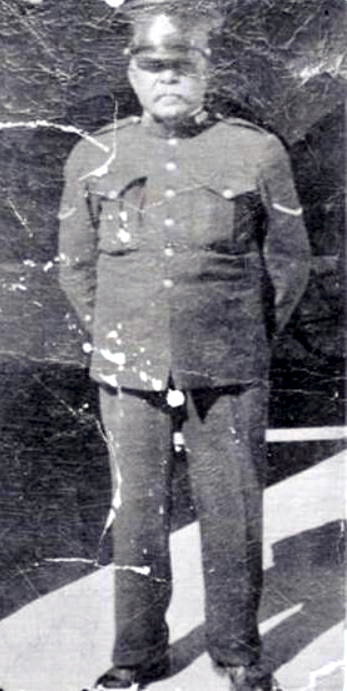
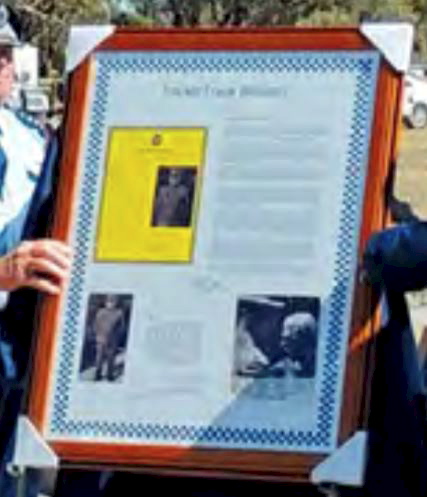
A contemporary of Alex Riley, Frank Williams was a tracker who also received numerous accolades throughout his career. Williams was born in the country between Gundabooka and Toorale in the 1870s to Edward Williams and an Aboriginal woman named Fanny Hippi. He is associated with the Ngemba speaking peoples south of Bourke. After working as a labourer, he was appointed as the tracker at Dubbo on 1 March 1915, the first year of Riley’s temporary absence of the force.[1] He transferred to Byrock the following year before resigning on 16 May 1919. He re-joined just over 12 months later and was stationed at Byrock until March 1938 when he took up the tracker’s job at Bourke. Another 12 years on the job followed before Williams retired in May 1950, two months before Alex Riley left the force.
Frank Williams told his daughter Grace that after his mother died when he about six years old, he “stopped with his grandmother”, who is known only as Maude. He said that they:
…used to lie on skins. They used to have like a humpie, built right down, real traditional. He said this ‘walkabout’ that they reckon they used to do, he said they usen’t to. The only time they moved around was when they changed their camps, and that was for cleanness. They would shift around and get fresh ground.[2]
Maude, who had “up alongside her nose… a bone needle from a fish”, taught Frank about tracking.[3] She knew how to “sew the possum skins and make little possum skin bags to carry water in”. Grace Williams said that:
Dad used to go about with her and she used to show him a lot. She showed him how to track, so he ended up being a good tracker.[4]
A case which Williams received some press coverage at the time was the murder of Robert Whye (aka Bobbie Burns), a ten year old Aboriginal boy, on the banks of the Barwon River near Brewarrina Aboriginal Mission. The culprit was an older Aboriginal man from Brewarrina named Charlie McDonald and Williams was faced with the prospect of tracking his countryman. But his decision was made somewhat easier by the fact that he had strong familial ties to the victim.
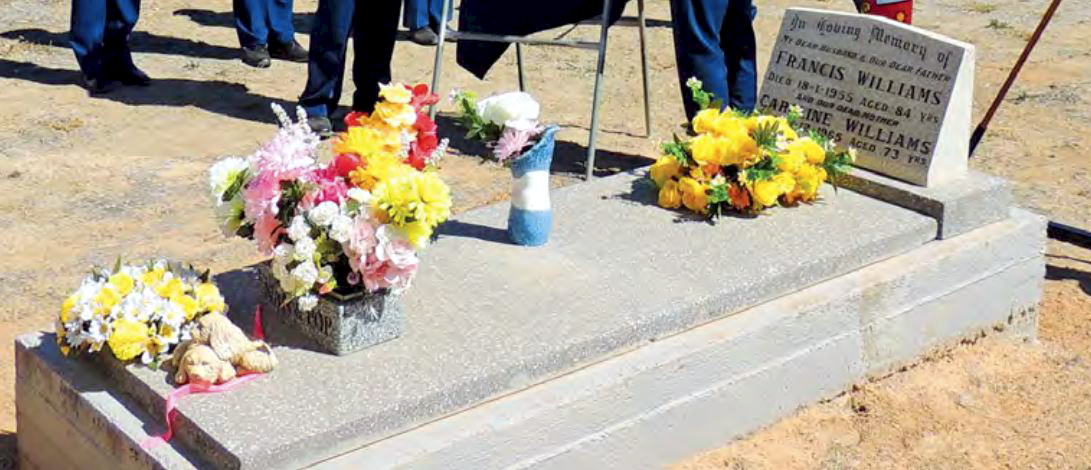
In June 1906, Frank Williams married Caroline Parker (aka Caroline Whye) at Brewarrina.[5] Caroline was the daughter of Sam Parker of Coopers Creek, South Australia, and Caroline Hilt of Brewarrina, a fluent speaker of the Wailwan dialect of Ngiyampaa. She passed her linguistic knowledge on to her daughter and both were significant informants about Ngiyampaa language and culture for R.H. Mathews.[6] Caroline Hilt’s first marriage was to Alfred Whye, non-Indigenous, and her children to Cooper sometimes carried this surname.[7]
The young victim, Robert Whye, was born at Warren in 1919 to George Whye and Jane Francis McIntrye. His maternal grandmother was Caroline Hilt, making Caroline Parker his aunt, and in cultural terms, his mother. Although Charlie McDonald was from Brewarrina, it is not clear how he is related to the other families from the district. In a broad sense, Frank Williams was not stepping outside the bounds of tradition is seeing that McDonald was captured and punished for the murder. Other prominent members of the Brewarrina Aboriginal community were prepared to give evidence against McDonald, including Christy Warraweena (a Ngiyampaa speaker) and John Wilson (a cousin of Frank Williams). Other witnesses were children who were probably playing with Whye when he disappeared. In an interesting twist from the Governor episode, one of the witnesses was Annie Coombes, the daughter of Jack Coombes of Wollar and Lottie Governor (Jimmy and Joe’s sister). Her parents were part of the Wollar community which was removed to Brewarrina Aboriginal Station. They married at Brewarrina in October 1900 while the chase was still on and Annie was born about 10 years later. The following year she married Tom Wellington who was also a witness against McDonald.[8]
The pursuit itself was a difficult one. Rain soon after the murder obliterated most of the tracks, which at one stage led within less than a kilometre of Brewarrina Aboriginal Station. Although not mentioned in the press, Williams was assisted for some of the search by Alex Riley. But it was Williams alone who led the other police to a lonely shearer’s hut on Caringle Station where McDonald was arrested. Convicted of the murder at Dubbo, he was incarcerated in Goulburn Gaol where he passed away in 1928.[9]
Family was an important part of Frank Williams’ life and he and Caroline had 12 children and many grandkids. Cecily Hampton recently recalled spending the weekends with her grandfather:
I used to go out with grandfather a lot, especially on weekends. On Sundays we’d got out and kill a kangaroo and always bring back the tail. We never brought anything else back, just the tail. Granny would make a big pot of kangaroo tail soup. Oh it was beautiful. I used to always follow grandfather around! He used to sit down out the back and we’d talk about all sorts of things. He would show me how to draw figures in the dirt, things like lizards and frogs, you name it, and he could draw it.[10]
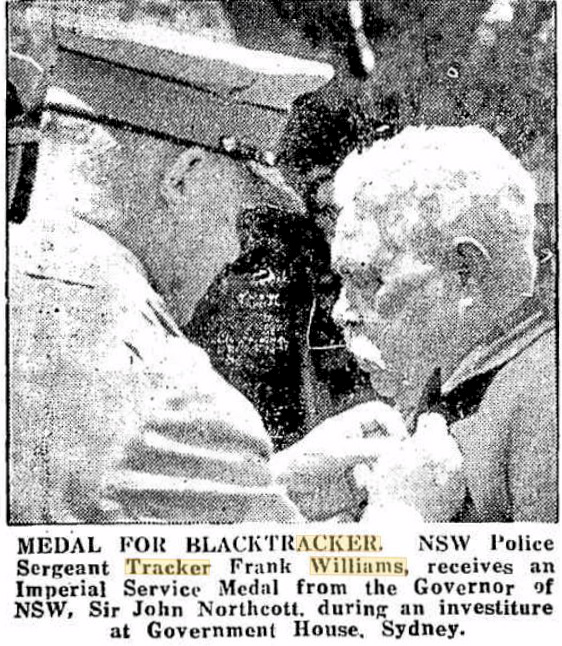
Williams was probably taught to track in a similar manner by his grandmother Maude. He was keen to pass the knowledge on: his son Sydney Williams also worked as a tracker. Frank Williams retired in 1950, having been promoted to the rank of Sergeant and given the King’s Medal in 1943.
References
1.
↑
Police Salary Register 1915 SRNSW 3/2995 Reel 1974. The family also believe that Williams was casually employed as a tracker at Mount Drysdale near Cobar before moving to Dubbo. The salary register does not record
2.
↑
Cowlishaw 2006: 10.
3.
↑
This information is significant given that there are no known examples of Aboriginal women working for NSW Police. It clearly demonstrates that Aboriginal women, not surprisingly, had the skills to track people in the bush.
4.
↑
Cowlishaw 2006: 11.
5.
↑
MC of Francis Williams and Caroline Parker 1906/006754.
6.
↑
R.H. Mathews Papers NLA MS 8006. Series 3. Folder 7. Notebook 7b Untitled:114.
7.
↑
See DC of Caroline Parker 1917/003971.
8.
↑
Tindale Brewarrina Genealogy, 1938; MC of Thomas Wellington and Annie Coombes 1927/009958; DC of Robert Whye 1926/001079.
9.
↑
Sydney Morning Herald 1 January 1926: 5; New South Wales Police Gazette 6 January 1926: 9; Sydney Morning Herald 8 January 1926: 11; Tracker Riley file, Macquarie Regional Library, Dubbo.
JAMES is NOT mentioned on the Police Wall of Remembrance *NEED MORE INFO
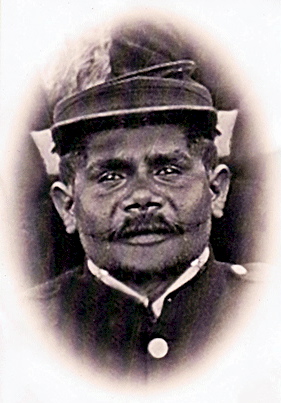
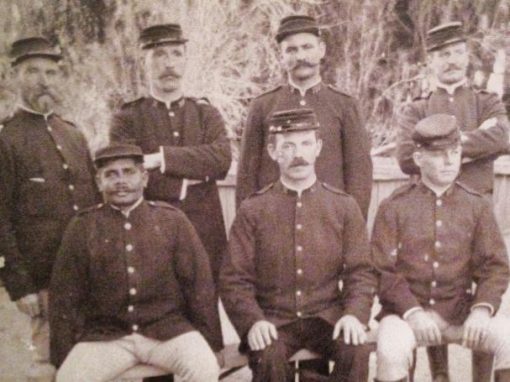
James Gillis McDONALD AKA JIMMY ‘ Tracker ‘ McDONALD is seated – 1st on left together with unknown Police – presumably who were Stationed at Mudgee, NSW.
Jimmy’s leather ‘shin guards’ have been donated, by Peter McDonald, to the NSW Police Museum. Nerida Campbell, the curator, has authenticated them and they will be on display soon ( May 2023 ).
FURTHER INFORMATION IS NEEDED ABOUT THIS PERSON, THEIR LIFE, THEIR CAREER AND THEIR DEATH.
Mudgee Guardian and North-Western Representative (NSW : 1890 – 1954), Monday 19 April 1937, page 4
DEATH
Mr. J. G. McDonald
THE death of Mr. James Gillis McDonald (66), of Perry street. Mudgee, occurred on Friday night. The late Mr. McDonald, who had been a tracker in the police department for 40 years, passed away in his sleep. Born at Cobbora, he had lived in the Mudgee, Wollar, and Rylstone districts all his life.
In his younger days he was a noted athlete, boxer, and swimmer, and had won the famous Botany foot running handicap.
A well respected citizen, his passing will be mourned by many. A widow and eleven children survive.
The funeral was held yesterday afternoon, the interment being carried out in the Salvation Army portion of the Mudgee Cemetery by Messrs. J. C. Swords and Son.
The rites were conducted by Major Gibson.
Among those at the funeral were members of the local police force, who also acted as pall-bearers.
McDONALD ( nee Cubbins )— On the 7th August, suddenly, Catherine ( Kate, relict of James Gillies McDonald, of 459 Drummond street, Carlton, ( Victoria ) beloved mother of Norman, Elsie, and Kathleen, aged 48 years.
Mudgee Guardian and North-Western Representative (NSW : 1890 – 1954), Thursday 20 October 1904, page 21
LOCAL BREVITIES.
Mr. James Gillis McDonald and Miss Harriet May Cooper were joined in wedlock’s holy bonds, the Rev. T. D. Evans officiating. Miss May Bailey was bridesmaid and Mr. Robert Bailey was groomsman.
Mudgee Guardian and North-Western Representative (NSW : 1890 – 1954), Monday 14 July 1902, page 2
An Object of Suspicion.
A Mudgee Visitor’s Experience
On Friday the Mudgee police received word that a burglary had been committed near Wellington, and a description of the bold bad men was sent here by wireless telegraphy or some other up-to-date means.
The local suppressors of crime and bad language were soon all alert, and on Friday evening Constable Tully and James Gillies McDonald, the well known tracker, had their cunning constabulary optics on a couple of strangers who had driven over from Wellington that day and were stopping at a local hotel.
The rules and regulation provide that a constable shall always act with caution, and therefore Constable Tully did not rush affairs but engaged a room at the hotel and, presumably, sat up all night with one eye on the back door and the other on the front.
The name of the unconscious object of constabulary cunning was Mr. W. V. Bradley, the representative of the Two Bays Nursery Co., Melbourne.
After consuming a very gratifying breakfast he strolled outside his hotel, and was accosted by a man who was a stranger to him, and asked him some tricky little questions as to who he was, where he came from, and where he contemplated going to. Mr. Bradley stated that he was going to the post office, and the stranger at once revealed his official identity, and intimated that the requirements of justice necessitated that the visitor should be searched, for he was suspected of being mixed up in a burglary near Wellington.
Mr. Bradley said he had not the least objection to being searched, and informed the constable that his Gladstone bag was upstairs and contained the usual assortment of clothes soiled and otherwise, and that he had £60 in notes in his pocket, and a fully loaded revolver, which he playfully introduced to the notice of the guardian of the peace.
Constable Tully carefully examined the socks, bicycling knickers, etc., and then sadly abandoned the case as far as Mr. Bradley was concerned. So far as we have heard the genuine desperado has not yet been arrested, but the police are keeping a very wide eye open.
Hi, My name is Jule and I am the great granddaughter of Jimmy McDonald. He was a tracker for the police and I am trying to find information on him.
I know he married Harriot Cooper. I do remember her but I would like to know where is is buried. Thank you I really enjoyed reading your site too. Jules.
I also think he had a police funeral – Jule.
Yes Jule. His family have also seen a photo of him in a NSW Police publication. they are finding out more information – editor.
Mickel Cowie answers: I don’t know anything about Tracker but have noticed that his name has been mentioned in a judgement re Warrabinga-Waradjurie that is accessible via Google using that as the search . Jules could read the judgement and contact the people who have made the claim. Mickel
Jimmy McDonald
My name is Edwin McKenzie and I am the grandson of Jimmy ” Tracker ” McDonald and Harriet Cooper. I’m 65 now, living in Cairns and moving to Brisbane at the end of June – I would love to find out as much as I can about my family and descendants before I die. I would appreciate any information or leads you can give me. Edwin McKenzie
Jimmy McDonald is also my Great Grand Father, my Grandmother (His daughter) Alice Valerie Honeysett (nee McDonald). Jimmy is buried in Mudgee Cemetery in the Salvation Army section. There is still family in the area. The direct Children of Jimmy & Harriet McDonald are: Jimmy, Edie, Doobie, Davey, Jeanie, Donnie, Gertie, Valerie, Dawn, Malcolm McDonald 80 still living in Toronto. I have a photo of them all together which I would be happy to share if you wish. Who are your parents, we must be cousins? Regards, Marina Honeysett
Answering Jules re Jimmy McDonald – he is buried in the Salvation Army section of Mudgee cemetery Row B Plot 50. (unmarked still I think) He lived at 13 Perry St where the RTA now stands and was the last tracker at Wollar between about 1906 to 1919 living there in the trackers hut, then at Rylstone. his obituary. – Anonymous
20/4/1937 (mon) Death – Mr J G McDonald – The death occurred of Mr James Gillis McDonald (66) of Perry St. Mudgee occurred on Friday night. The late Mr McDonald who had been a tracker in the police dept. for 40 years, passed away in his sleep. Born at Cobbora he had lived in the Mudgee, Wollar and Rylstone districts all his life. In his younger days he was a noted athlete, boxer, and swimmer and had won the famous Botany foot-running handicap. A well respected citizen, his passing will be mourned by many. A widow & eleven children survive. Funeral took place Salvation Army section Mudgee cem. Among those at the funeral were members of the local police force, who also acted as pall bearers.
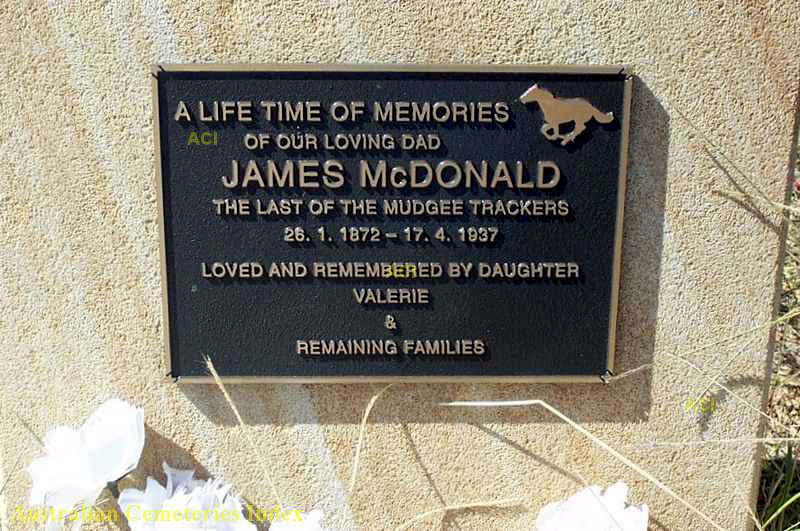
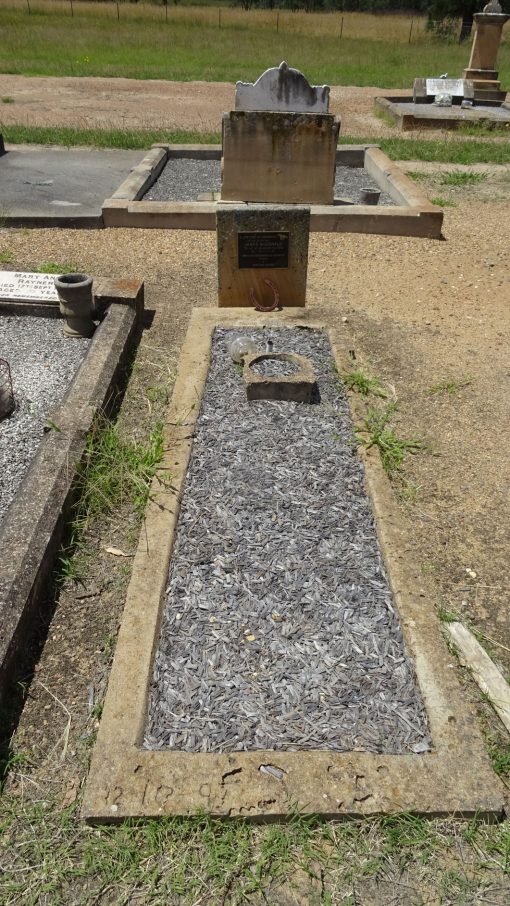
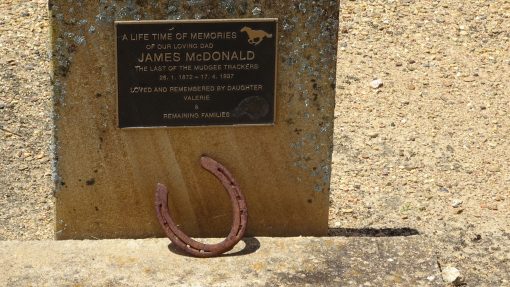
Dear Diane, thanks for your email and yes I do have that information. James is buried in the Salvation Army section of the Mudgee cemetery and he has a plaque which was put there by his daughter Valerie . It is available on the Mudgee cemetery website.
Please pass on email address to Jule , I too am a great grand daughter of Jim McDonald. His son James Henry Crawford McDonald is my grandfather Tanya Scrivener
My name is Edwin McKenzie and I am the grandson of Jimmy “Tracker” McDonald and Harriet Cooper. I’m 65 now, living in Cairns and moving to Brisbane at the end of June – I would love to find out as much as I can about my family and descendants before I die. i would appreciate any information or leads you can give me.
James McDonald
Thank you for your great site . Thanks to you I have found more relatives and some I didn’t know I had And I plan to catch up with all of them Congrats on a great site Jule
Profile last modified 2 Nov 2016 | Created 22 Oct 2016
This page has been accessed 1,016 times.
Biography
True story of Jimmy Governor by Moore & Williams Children of James & Harriet McDonald were as follows Edith – James – Gertie – Hubert – Alice – Davi- Sylvia – Eugene and Donald (twins) – Dawn – Malcolm. Also two who may have died young.
Around the Black Stump.
James Gillis McDonald A well known bush tracker, was born at Laheys Creek on 26-1-1872.
His mother being Eliza McNabb, and his father Thomas McDonald, who was employed by James Falconer as a shepherd.
After his wife’s death Thomas McDonald went to Queensland, leaving his young son James with the Falconers. He was reared by the Falconers growing up with their children Mark & Mary.
The Lady Bushranger.
Page 70.
Sergeant Buckley of Rylstone, his reputation began the day he arrived, for he had brought his milking cow with him.
During the trip the cow produced twin calves, one of which he gave to his tracker Jimmy McDonald, who owned a rogue cow.
Jimmys cow was the terror of the town and was nothing short of a blooming menace, always breaking into everyone’s garden. Yet she fulfilled a much needed role by providing milk for Jimmys extensive brood.
Although Jimmy was a full blood Aborigine his wife was not, and their twelve happy children came in varied colours. Jim could see the humour when he chuckled, with my kiddies, it’s never any use killing a fowl, it would have to be a centipede because everyone begs for a leg.
NSW Aboriginal Trackers James McDonald was the tracker at Wollarah when the Governor brother were on the run. He lived in a four room hut in the police paddock. James knew Jimmy and didn’t shoot him when he had the chance.
Interview with Malcolm McDonald 2012.
Jimmy once fired a warning shot at James which struck his saddle, the children later played with saddle when growing up.
Aboriginal Trackers 1893.
Coolah.
Aboriginal Trackers 1894 – 1901.
Mudgee Jimmy Mack and others.
Aboriginal Trackers 1898 – 1899.
Tambar Springs.
Jimmy Mack and others.
Wages for black trackers varied from four to seven pounds a month.
Mudgee Guardian & North Western Representative 11-11-1918
Police tracker James McDonald stationed at Wollar, who has been doing police duty at Gulgong. Whilst sweeping the yard at the police station here a few days since, picked up a nice nugget of gold , weighing ?? wts.
Mudgee Guardian & North Western Representative 1-7-1920.
Police tracker McDonald, for many years stationed at Wollarah, who recently retired from the service, has it will be learnt with satisfaction rejoined it. Tracker McDonald will resume duty on July 10th. He will be stationed at Rylstone, which will henceforth be the tracker station and depot for the Mudgee Police District.
Mudgee Guardian & North Western Representative 19-4-1937
Death of Mr J McDonald (66) of Perry Street Mudgee occurred on Friday night.
The late Mr McDonald who had been a tracker in the police Dept. for 40 years passed away in his sleep.
Born at Cobbora, he lived in the Mudgee, Wollarah & Rylstone district all his life.
In his young days he was a noted athlete, Boxer, swimmer and he won the famous Botany foot running handicap.
A well respected citizen, his passing will be mourned by many.
A widow & 11 children survive.
Funeral Salvation Army section of Mudgee cemetery. Many at the funeral were members of the local police force, who acted as pall bearers.
James parents Thomas & Eliza McNabb ?????
Sources
Notes from Mr Roy Cameron. Historian of Coolah
BDM Index
DEATH 11485/1937
Mudgee Guardian & North Western Representative 11-11-1918 Mudgee Guardian & North Western Representative 1-7-1920- Mudgee Guardian Newspaper 19-4-1937. Page 4.
The Lady Bushranger , page 70-71. by Pat Studdy-Clift.
NSW Aboriginal Trackers Pathfinders saw.org.au/… List of Black Trackers Coolah & other areas by Roy Cameron Around the Black Stump, page 330. by Roy Cameron
Information from Jeannette Evans, ( on 12 March 2021 ), granddaughter of Tracker McDonald, says that the family have a letter, written by Jeff Falconer, whose family raised Tracker McDonald, and the letter states that Tracker McDonald was given a lifelong job by the Governor after saving two small girls from a bolting horse.
Walter Williams, a Bundjalung man, was born at Bonalbo in the 1890s to Lansbury Williams, a renowned stockman and tracker, and Emily Charles. Lansbury Williams probably spoke the Gidhabal dialect of Bundjalung. Walter was also the great-grandson of King Bobby and Queen Jinny Little who both had strong ties to Yulgilbar Station on the Clarence River. Before taking the job as the tracker at Casino in about 1919, he worked as a bush labourer and horse breaker. On one occasion, he drove 200 horses to Tabulam before breaking them all. He was a master horseman.
Walter took over as the Casino tracker from his father-in-law Denny Joseph. He continued to break horses for the police. His other main jobs as the tracker were to look for people lost in the bush and trailing herds of lost or stolen cattle. His tracking career was sadly cut short in 1930 when he suddenly passed away suffering from pneumonia, a condition he had first suffered from in 1919. He was survived by his wife, Violet Joseph, and four children.[1]
Bundjalung News 01/11/1977; Death Certificate of Walter Williams 1930/005249; Casino and Kyogle Courier and North Coast Advertiser 26 February 1919:
Casino and Kyogle Courier and North Coast Advertiser (NSW : 1904 – 1932), Wednesday 5 March 1930, page 2
CASINO BLACK TRACKER DIES.
The black-tracker, Walter Williams, who was attached to the Casino Police station, and who had been ill for the past few weeks, died on Sunday, after a severe bout of pneumonia and pleurisy. The deceased was 38 years of age, and besides his wife and family, leaves other relatives in the Tabulam district. . ” Walter Williams was a loyal and conscientious worker. ” said Sergeant S. L. McIntosh, when referring to Tracker Williams‘ death. ” He was with the police for 12 years, ” he added, ” and was most loyal in his work. ”
Clive Andrew Williams (1915?-1980), Aboriginal leader, was born probably on 22 February 1915 at Casino, New South Wales, second of five children of Walter Williams, an Aboriginal tracker, and his wife Violet, née Joseph, from Queensland. Clive attended the public school and was one of few Aborigines accepted at Casino Intermediate High School. At the age of 15 he began work on the railways at Coonabarabran. He returned to Casino where he was employed in the butter factory. While still a young man, Williams planned to travel to Bellbrook on the Macleay River to participate in an initiation ceremony. He found, to his disappointment, that the ceremonies had recently been discontinued, as they had among his own Bundjalung people on the Richmond and Clarence rivers.
At St John’s Presbyterian Church, Coraki, on 26 April 1941 Williams married Ida Drew, who had been taken from her parents by the Aborigines Protection Board. He built a rough dwelling and continued to work in the Casino butter factory. The family then lived for a time on the Aboriginal reserve, but in 1962 moved to a cottage in the town. In the mid-1960s Williams accepted accommodation at Tranby Co-operative College for Aborigines at Glebe, Sydney, where his work with Rev. Alfred Clint and the Co-operative for Aborigines Ltd was highly regarded. He gained employment with the Department of Main Roads and brought his growing family to their new home at Rozelle.
Having joined the Aboriginal-Australian Fellowship, Williams attended the annual conferences of the Federal Council for the Advancement of Aborigines and Torres Strait Islanders. Before the 1967 referendum, he helped in the successful campaign for the removal of the two offensive clauses in the Constitution relating to Aborigines. A member of the executive committee of the Aboriginal Education Council, he was involved with the early leadership training schools and other community development programmes. His wise counsel was appreciated.
In the 1960s the Commonwealth government was promoting the doctrine of ‘assimilation’, while Aboriginal organizations, especially F.C.A.A.T.S.I., wanted increased recognition of Aboriginal identity. Caught between two worlds, Williams was fiercely proud of his Aboriginal heritage but remained gentle and non-aggressive. In 1967 he took the leading role in a film, One Man’s Road, produced by the Commonwealth Film Unit for the Department of Interior; in it he and Ida told of their life and struggles. He was dismayed to discover that the Department of Territories used the film as propaganda to promote assimilation.
Williams and his family returned to the North Coast where he quickly became involved with the community. He was a leader among a group of Aboriginal elders who worked with the administrators of the Northern Rivers College of Advanced Education towards the recognition of the interests of the Bundjalung and other Aboriginal communities in the area. Suffering from hypertension, Clive Williams died of myocardial infarction on 1 December 1980 at his Lismore home and was buried in Goonellabah cemetery. His wife, and their three sons and six daughters survived him.
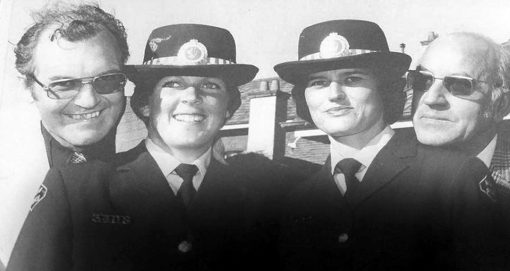
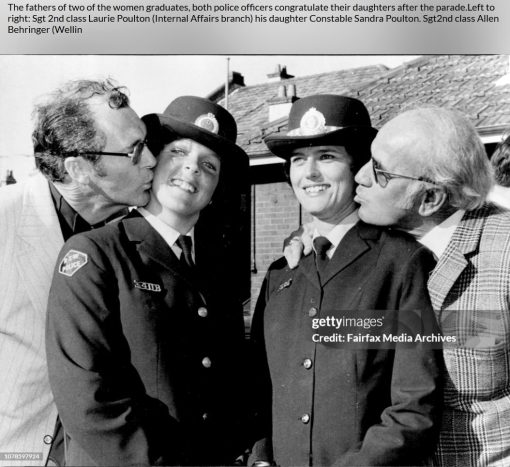
The fathers of two of the women graduates, both police officers congratulate their daughters after the parade.
Left to right: Sgt 2nd class Laurie Poulton( # 7590 ) (Internal Affairs branch) his daughter Constable Sandra Poulton ( # 17749 ). Sgt 2nd class Allen Behringer ( # 5216 )( Wellington ) & daughter Denise Behringer ( # 17718 ). Class 156.
The fathers of two of the women graduates, both police officers congratulate their daughters after the parade.Left to right: Sgt 2nd class Laurie Poulton ( # 7590 ) (Internal Affairs branch) his daughter Constable Sandra Poulton ( # 17749 ). Sgt 2nd class Allen Behringer ( # 5216 )( Wellington ) & daughter Denise Behringer ( # 17718 ). Class 156 – 12 September 1977.
The fathers of two of the women graduates, both police officers congratulate their daughters after the parade.
Left to right: Sgt 2nd class Laurie Poulton ( # 7590 ) (Internal Affairs branch) his daughter Constable Sandra Poulton ( # 17749 ). Sgt 2nd class Allen Behringer ( # 5216 )( Wellington ) & daughter Denise Behringer ( # 17718 ). Class 156.
Government Gazette of the State of New South Wales (Sydney, NSW : 1901 – 2001),
Friday 24 February 1978 (No.24), page 642
Department of the Attorney-General and of Justice
HIS Excellency the Governor, with the advice of the Executive Council, approved of the following appointments:
The undermentioned members of the Police Force to be Inspectors under the Liquor Act, 1912, the Licensing District preceding their names, for the dates specified, viz.:—
Wellington. — Sergeant 2nd Class Allen John Behringer, stationed at Wellington, in lieu of Sergeant 1st Class Ronald George Gardner, from 4th December, 1977, to 17th December, 1977, inclusive.
Three thousand people fought and struggled to enter the Hall of Industries at the Showground today. Two nurses and two ambulance officers were rushed to the spot and treated 30 people who collapsed.
There were no serious cases, said Superintendent O’Sullivan, of Central District Ambulance. Large early-morning crowds had banked up and the crush occurred when opening of the hall was delayed for half an hour. Those early in the Hall of Industries queue arrived at 8.30 am. By 9.30 am, when the shutters were eventually pulled up, between 3000 and 4000 people were awaiting admittance. As the rollers moved, the crowd cheered and surged forward. Police standing along the doorway to regulate the crowd were swept backwards. Police re-formed, but again were swept aside by the milling crowd. Men, women and children pushed and struggled to enter the hall, which is the main one on the ground selling sample bags. Women and children were battered against the sides of the doors as they struggled to get in and the crowd behind pushed forward. It was the worst demonstration by a Show crowd since the opening last Saturday.
Situation “ugly”
Police, who finally opened the shutters, . described the crush as “ugly.” Constable Behringer, of Bondi, said: “When the shutters were opened, pressure from the huge crowd was terrific. “I picked up several children who fell to the floor, to prevent them being trampled upon and possibly seriously injured. ” I also helped several elderly women to safety.”
Police said even before they opened the hall, they admitted several old people and young children through a trapdoor. RAS secretary Colonel Somerville said: “Delay in opening the hall was because we had to clean it.” The late opening caused congestion which lasted for more than an hour. The huge hall was packed to capacity by a slow-moving mass of men, women and children, majority of them bent of buying samples. When the crowd stampeded into the Hail, many made for a stand selling chocolate samples.
In 20 minutes the stand had sold out. The crowd then turned and made for the exits, but was met by a further crush of people coming in the door. In the melee, sample bags were torn from the hands of some who got them, while others were trampled underfoot. Police formed a cordon around the stand and diverted crowds from it.
As the crowd increased throughout the day, it was a crush almost everywhere at the Show.
By early afternoon ambulance officers and nurses treated more than 100 men, women and children who had collapsed.
TONIGHT’S RING PROGRAMME
7.0: Mile record attempt. 7.30 Trotting. 7.45: Hunting 8.30: Trotting, 8.45: Polo 9.15: Special attractions. Woodchopping: 11 am to 7.20 pm