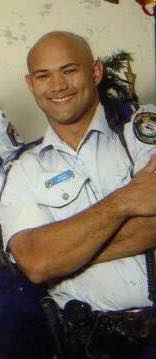
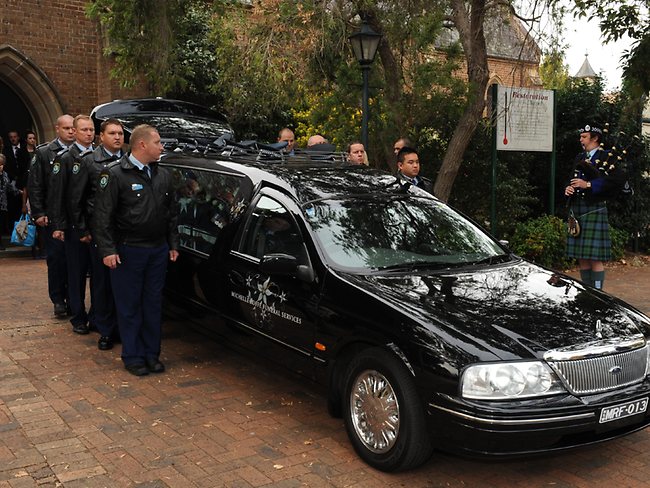
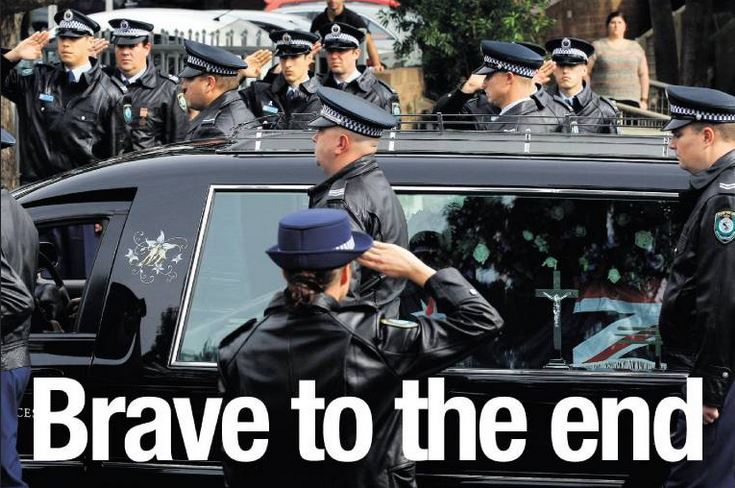
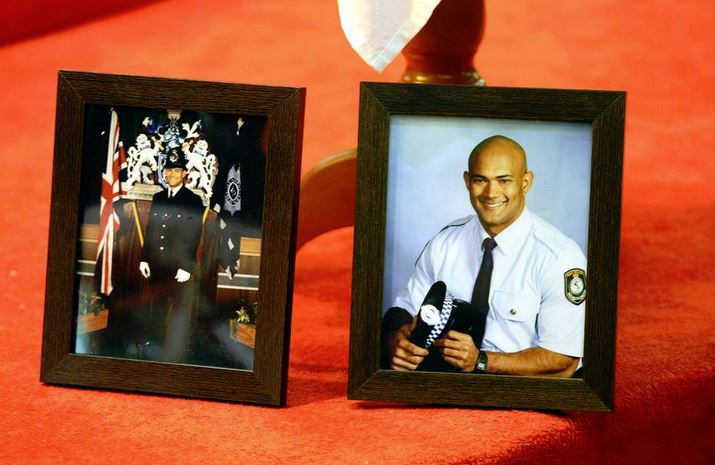
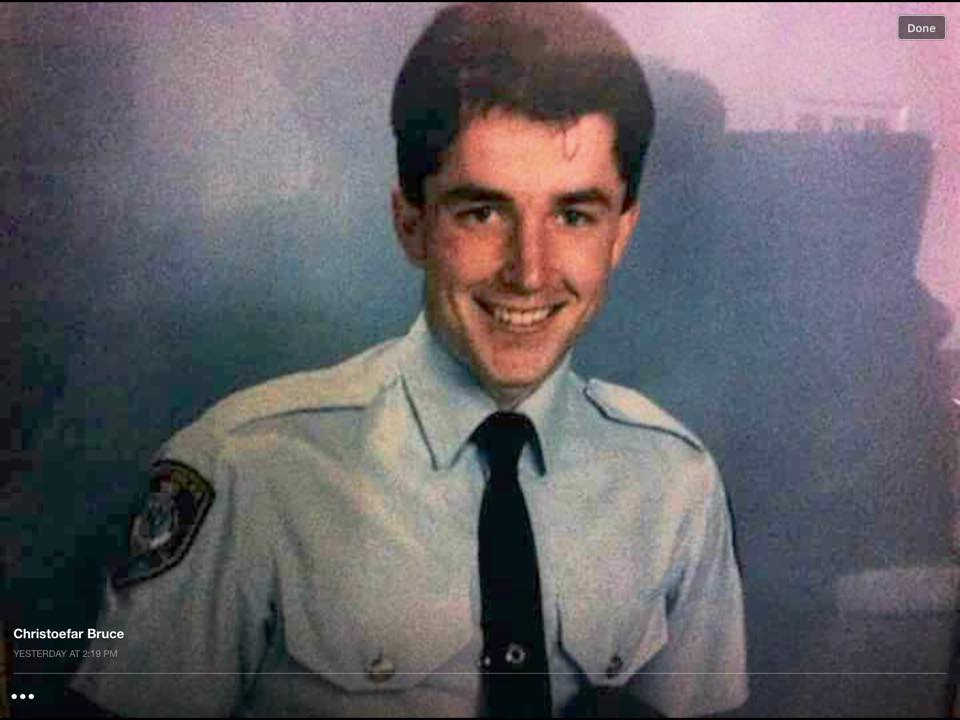
On Tuesday the 7th May 2013 Leading Senior Constable Chris Plummer, from Bankstown Local Area Command, lost his battle with an extremely aggressive form of cancer.
He was diagnosed only seven weeks before his death.
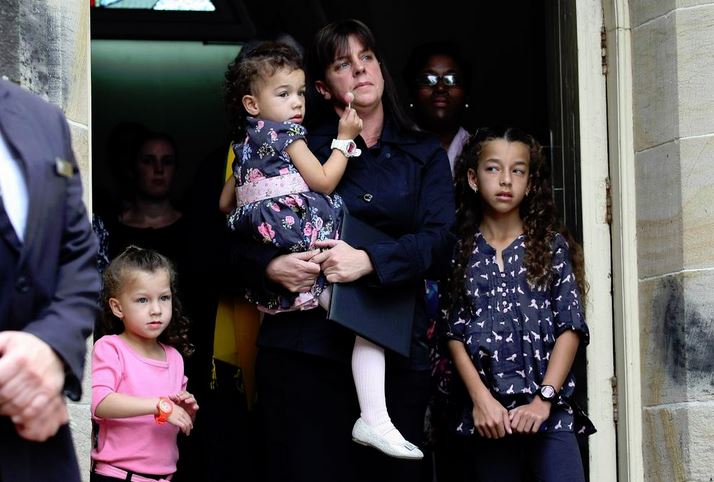
Chris was married to Juliet and they have four daughters, all under the age of 12.
The NSW Police Force is asking for the public to donate money to help support Chris’ wife and their children.
Funds can be donated to the following account:
POLICE BANK
ACCOUNT NAME: CHRIS AND JULIET PLUMMER
BSB: 815000
ACCOUNT No: 274618
TRIBUTES AND TEARS FOR OFFICER AND LOVED DAD
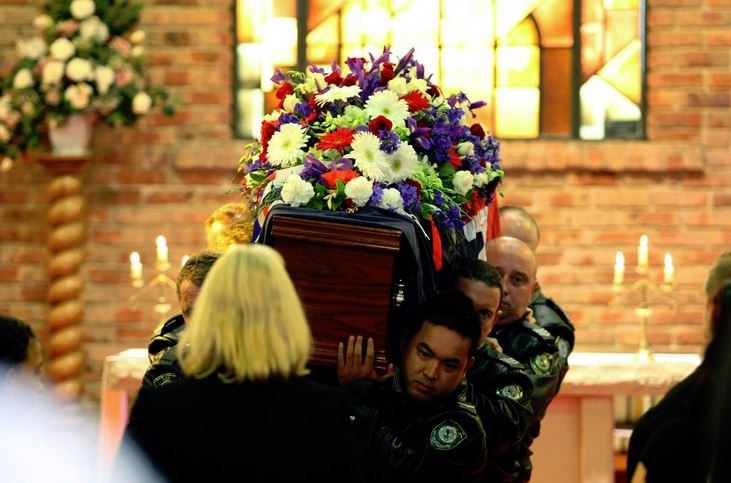
LEADING Senior-Constable Christopher Otis Plummer was remembered as a loving husband, proud father and outstanding policeman at his funeral service at St Paul’s Catholic Church, Camden, on Monday.
Sen-Constable Christopher Plummer with his wife, Juliet, and four daughters before his illness.
Tears flowed as the community and NSW Police farewelled the beloved family man, friend and colleague who died last Tuesday aged 43.
Sen-Constable Plummer’s death came as a shock after he was diagnosed with cancer just seven weeks ago. He is survived by wife Juliet and four children.
Supt David Eardley, of Bankstown police, said SenConstable Plummer, of Currans Hill, was a role model.
‘‘Chris was important to everyone, whether it was his colleagues, people at the gym or his friends in the Army Reserves,’’ he said.
‘‘Today we farewell a much loved member of the police force, and on behalf of the NSW Police, I offer our deepest condolences.’’
From his homeland of Jamaica, Sen- Constable Plummer’s sister, Anona Griffith, said her brother was a talented athlete who loved Liverpool Football Club. ‘‘He was always determined to be a good husband and father and I admired his strength of character,’’ she said.
In a statement on behalf of Juliet, sister-in-law Shannon Jansen said SenConstable Plummer was a great friend to many people.
‘‘It became apparent just how loved he was with the number of people who came to visit him in hospital,’’ she said. ‘‘Being a police officer wasn’t just his job, it was who he was.
‘‘Our four beautiful girls will remind me every day of the great man he was.’’
Police across southwestern Sydney have started an appeal for the Plummers.
Bankstown police have opened a bank account to help the family with expenses and the NSW Police Rugby League competition is also raising money.
Macarthur Bulls president Sgt Rod Sheraton said the police rugby league competition raised more than $3800 last Wednesday night.
‘‘ We all wore black armbands to mark Chris’s passing,’’ Sgt Sheraton said. ‘‘We’re hoping to raise more at future events.’’
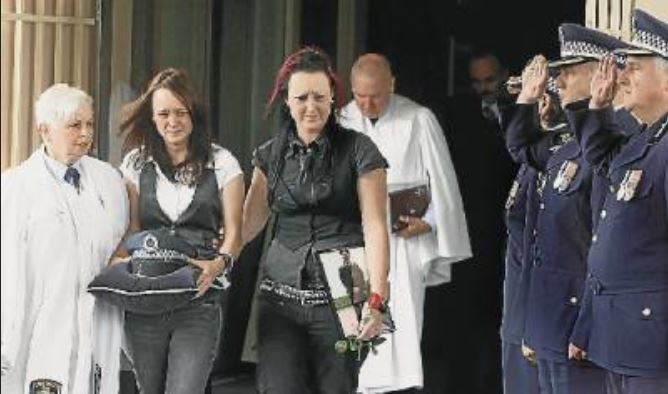
Police officers, family and friends farewelled Currans Hill police officer Constable Christopher Plummer in Camden on Monday. Picture:Jeff de Pasquale
Police officers, family and friends farewelled Currans Hill police officer Constable Christopher Plummer in Camden on Monday. Picture:Jeff de Pasquale
Police officers, family and friends farewelled Currans Hill police officer Constable Christopher Plummer in Camden on Monday. Picture:Jeff de Pasquale
Police officers, family and friends farewelled Currans Hill police officer Constable Christopher Plummer in Camden on Monday. Picture:Jeff de Pasquale
Police officers, family and friends farewelled Currans Hill police officer Constable Christopher Plummer in Camden on Monday. Picture:Jeff de Pasquale
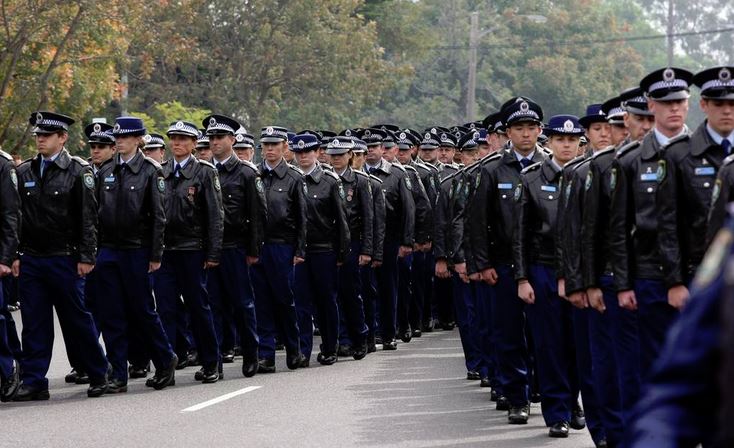
A POLICE helicopter flew low over the heads of more than 100 police officers in three long ranks on John Street, Camden, on Monday.
The officers formed a guard of honour for Leading Senior Constable Christopher Plummer, 42, who died on May 7 after a short battle with cancer.
Hundreds of family, friends and colleagues filled St Paul’s Catholic Church, Camden, on Monday including a representative of the Australia Army Reserves, politicians and Assistant Commissioner of Police Frank Minnelli — evidence of the high regard in which Leading Senior Constable Plummer was held.
The mourners heard how Leading Senior Constable Plummer had always worked for others, joining the London Metropolitan Police Force at the age of 23.
He moved to Australia after meeting his wife Juliet and after a brief period in The Oaks, settled in Currans Hill.
Leading Senior Constable Plummer joined the NSW Police Force in 2001 followed by the Australian Army Reserves in 2004.
He started his career at Campbelltown police station before moving to Bass Hill and Green Valley commands before settling in the Bankstown local area command.
He was awarded two Commissioner’s Unit Citations for outstanding bravery and dedication to duty.
Superintendent David Eardley from the Bankstown local area command spoke with an emotion-filled voice of farewelling “a much-loved member of the force”.
“It is with profound sorrow that I offer, on behalf of the police force, to Chris’s family our deepest sympathies on the loss of a very fine son, brother, husband and father and an outstanding police officer,” Superintendent Eardley said.
A eulogy read on behalf of Juliet Plummer spoke of her husband’s passion for his family, for health and fitness and his love of people.
“I always knew Chris was an amazing man, but when I saw how much he meant to so many people it really hit me,” she said.
“I want to thank everyone for letting Chris know how special he was in those last seven weeks.
“To me Chris was my world. He was my strength, the one who always seemed to know just what to do when I was at a loss.
“I have four beautiful little girls who will always remind me of the great man he was.”
Leading Senior Constable Plummer is survived by Juliet and his daughters Olympia, Amalia, Gypsy and Aliyah.
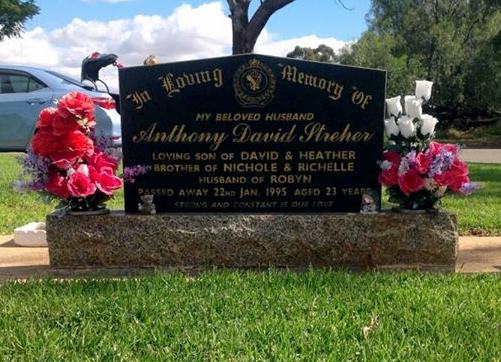
Robyn Molloy, daughter of Bob and Helen Molloy of Harden and sister to Graham, Judith and Phillip has been living in Perth for many years. Robyn attended Murrumburrah Public School and completed her studies as Dux of Murrumburrah High School in 1989. She took up a position as a cadet journalist with News Limited in Sydney working on the Daily Telegraph, The Mirror and The Sunday Telegraph in 1996. She met and married Anthony Streher, a police officer from Narrandera, in a beautiful ceremony in her parent’s garden. Sadly, only five weeks later Anthony was involved in a fatal car accident on the way home from work. After this tragic event Robyn travelled the world for a time and did travel writing for the UN in Laos. Upon returning to Australia, she made Perth her new home and worked on the Sunday Times whilst contributing to the West Australian. A total change of pace came with running Old Macdonald’s Farm for 9 years.
The business transported baby farm animals around schools, shows and nursing homes all over the state. A return to journalism came after Robyn had her 3rd boy. But this time she found that technology had undergone a major transformation. Instead of ‘bricks’ for phones and fax machines the internet had become the main mode of communication. Robyn fast tracked computing skills with Curtin University and took lessons in shorthand. She soon found herself on a News Website contract, then the Examiner in a part time position. She is now the editor of four newspapers under the Examiner umbrella. Robyn is a passionate photographer however, her writing skills have attracted attention of late. She has recently been honoured by being shortlisted as a finalist in the Western Australian Media Awards. Robyn, although the Editor says she still loves to write. To be eligible for the awards, journalists were asked to submit three feature stories.
She chose stories on emergency services workers on the front line as she found the people working in this area fascinating and they all had diverse stories to tell. One of her stories featured a hearing impaired fireman, another featured a policeman who had been a professional dancer in Asia before coming to Australia. The third story was about an ICU nurse and how he and his colleagues worked intensively to save people whilst at the same time working at preparing loved ones for the possible loss of that person. When asked if she had met any well known people in her career. She said that when she was in Sydney she had met quite a few, but then went on to say that she had met Tony Abbott and Julie Bishop recently as Don Randell’s electorate office was next door and they were in WA for the Canning By-election. She says she is honoured to be considered for the award as her colleagues produce high quality work. Robyn and her partner Andrew have 4 children, Jayden 13, Cameron 11, Lachlan 9 and Ryan 8. We would like to take this opportunity to wish her well from the Twin Town Times.
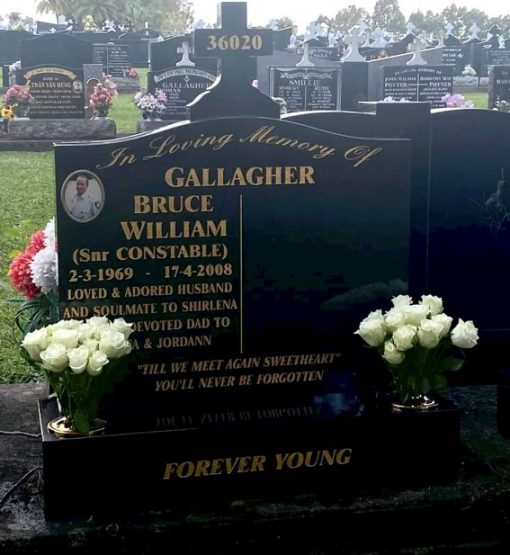
Bruce I am lost without u…you are Locked safe in my heart….36020…
Memorial: NSW Police Force Service Memorial Wall, Sydney Police Centre, Surry Hills, F13 ( right wall )
BRUCE is NOT mentioned on the Police Wall of Remembrance * NOT JOB RELATED
Bruce IS mentioned on the NSW Service Memorial Wall, Sydney Police Centre F13 ( Right Wall )
Funeral location: [codepeople-post-map]
Bruce William GALLAGHER – Memorial Plaque – Sydney Police Centre. Left Wall – Placement F13
Bruce GALLAGHER
Snr Const Gallagher’s daughters Jordann and Jessica with their father’s hat and photo. Picture: SYLVIA LIBER
Illawarra Mercury 28 April 2008
Thin Blue Line pays silent tribute to one of their own
IN a week clouded by grief, the region’s police demonstrated a show of unity yesterday at the funeral of colleague, Senior Constable Bruce Gallagher.
Onlookers were held breathless as more than 160 police formed a guard of honour and another 40 officers, led by Lake Illawarra police Superintendent Mick Plotecki and two mounted riders, escorted the cortege from Hansen & Cole at Kembla Grange.
Snr Const Gallagher‘s daughters Jessica, 17, and Jordann, 15, did their father proud, marching with his police hat and photo.
The 39-year-old Lake Illawarra police officer died suddenly from a heart attack last Thursday.
Jessica and Jordann remembered their dad as a loving man who was always ready with advice and support.
“I was always so proud to tell people my dad was a police officer,” Jessica told yesterday’s service.
“Dad, I am so grateful you taught me so much in life … I know you would not have left us if you didn’t think we could cope.”
Jordann added: “From the very first time you held me to the last time you saw me, you were always there for me no matter what, and I will never forget those memories.” Brother Mark Gallagher read a message on behalf of Snr Const Gallagher‘s wife Shirlena.
“You were my best friend, my husband and father to our two wonderful girls, but most of all you are my soul mate … I will never let you go. You will stay in my heart forever. Wait for me sweetheart, because one day I will be in your arms again.”
Mr Plotecki said Snr Const Gallagher displayed a strong work ethic that had earned him many accolades from the time he joined the force in May 2002. ( 2001 )
“Bruce’s name was often put forward as being involved in very meritorious and commendable police work,” he said.
“I have no doubt he had the potential and capability to add an even more significant contribution to his chosen profession.
“My last duty as Bruce’s commander is to pass on a message to his family, on behalf of the people of NSW. It’s a simple message, consisting of two words: ‘Thank you’. You were a real credit to your police uniform.”
Chief Inspector Bob Noble said that after meeting Snr Const Gallagher‘s wife and daughters, it was clear he was a reflection of a loving, supportive environment.
“The importance of family support in policing is paramount and it is for this reason that Bruce’s family has been, and will forever remain, a part of the police family,” he said.
Chief Insp Noble read a letter from colleague Senior Constable Chris Warren who said his close friend’s sudden death had left everyone in a state of shock.
The two men had joined the force at the same time, representing “two older blokes who were fulfilling a lifelong desire”.
Police chaplain Gordon Bradbery, who conducted the service, encouraged Snr Const Gallagher‘s grieving police colleagues to look after themselves.
Shirlena Gallagher, wife of the late Senior Constable Bruce Gallagher, joined police yesterday in remembering those lost. Picture: WAYNE VENABLES
Illawarra residents have been urged to “whinge” less and appreciate the good work of the NSW Police Force.Uniting Church minister and police chaplain Reverend Gordon Bradbery told yesterday’s Police Remembrance Day service that people “whinged” too much about peripheral concerns when they should be thankful for the things that were really important.
Assistant Commissioner Robert May, Wollongong Police Commander Wayne Dedden and Lake Illawarra Commander Mick Plotecki were among those who attended the service at Wollongong’s Wesley Church on the Mall.
Shirlena Gallagher, wife of Senior Constable Bruce Gallagher who died of a heart attack on April 17, also attended the 20th annual national day of remembering.
Another Illawarra officer to lose her life in the past 12 months was Constable Elise Krejci, who was killed in a car accident on Picton Rd, three days after Snr Const Gallagher’s death.
Back from a visit to Third World countries in South America, Rev Bradbery told the service that he had witnessed terrible scenes that made him appreciate living in Australia. “What a great country we live in, what a land of opportunity,” Rev Bradbery said. “But suddenly I am aware that on occasions like this, when we gather to remember the safety and security that we have in our community, how it has come at a cost. “I am conscious of the fact there are men and women who have lost their lives in the interests of policing this state – what it is when we don’t have to live in a land where our police wear flak jackets and carry machine guns.” He said that in appreciating these blessings, the community must also acknowledge they had come at a cost, sometimes in police lives.” They have gone beyond, they have given not only of themselves, but ultimately their breath and their pulse.”
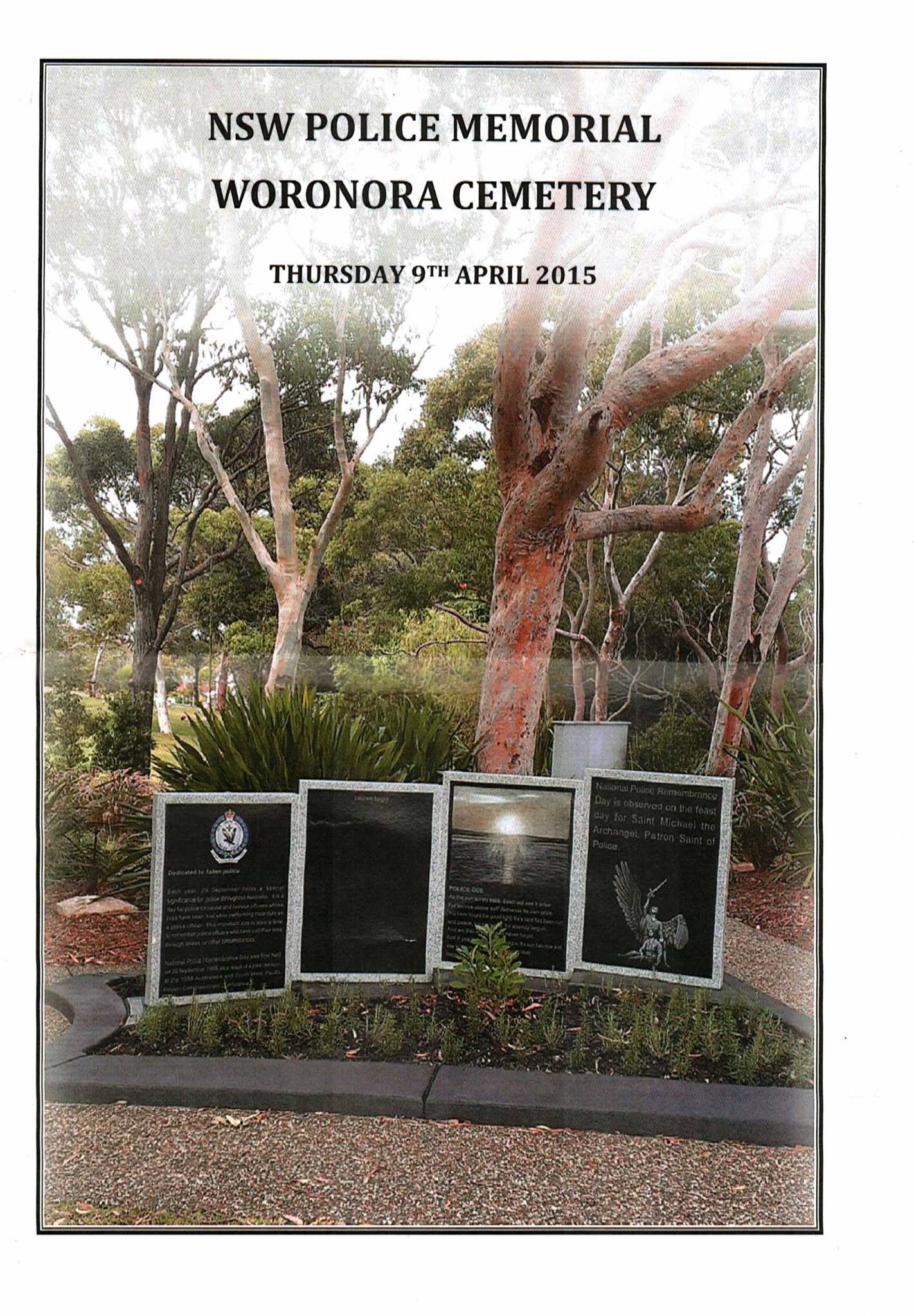
St George, Shire police memorial for Woronora Cemetery
By Kahlia Beichert
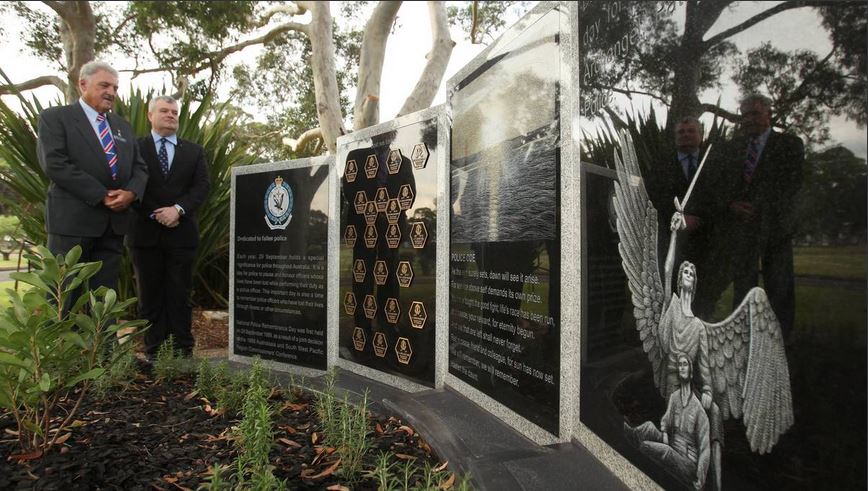
Remembering: NSW Police Commissioner Andrew Scipione helped unveil a new police memorial at Woronora Cemetery Sutherland on Thursday. Picture Chris Lane
NSW Police Commissioner Andrew Scipione helped unveil a new police memorial at Woronora Cemetery, Sutherland on Thursday. Pictured from left: Andrew Scipione, Tony Grant and Phil Peters. Picture Chris Lane
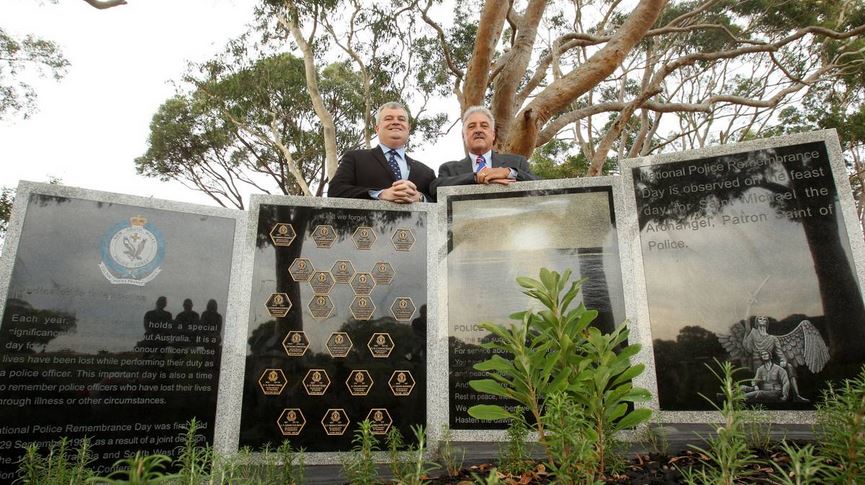
Remembered: Graham Boyd and Phil Peters at the police memorial will will be opened on Thursday. Picture: Chris Lane.
Remembered: Graham Boyd and Phil Peters at the police memorial will will be opened on Thursday. Picture: Chris Lane.
Remembered: Graham Boyd and Phil Peters at the police memorial will will be opened on Thursday. Picture: Chris Lane.
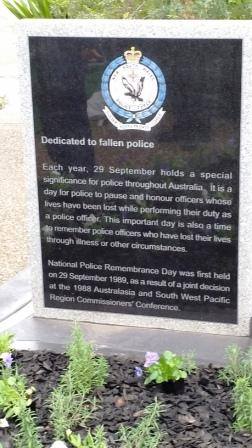
NSW Police Memorial Woronora Cemetery Thursday 9 April 2015
NSW Police Commissioner Andrew Scipione has officially dedicated a new memorial honouring fallen officers in St George and Sutherland Shire.
The Commissioner joined local police, families, friends, and colleagues, for the dedication of the NSW Police Memorial, led by Police Chaplain, Reverend David Warner, at Woronora Cemetery on Thursday April 9 ( 2015 ).
“As we unveil the plaques today, we reflect on the lives and achievements of the officers who died while serving this community. “One of the toughest challenges for police is starting work each day not knowing what will happen yet understanding they may have to risk their own life to save another.” – NSW Police Commissioner Andrew Scipione”
The memorial honours 24 NSW Police officers who have died on duty while serving in the St George, Sutherland and Miranda Local Area Commands or who were cremated or laid to rest at Woronora Cemetery. (See list below)
Commissioner Scipione said the plaques and memorial wall were a perfect way to honour local officers who have made the ultimate sacrifice.
“The NSW Police Memorial at Woronora Cemetery is our first collective police tribute in a private cemetery,” Commissioner Scipione said.
“As we unveil the plaques today, we reflect on the lives and achievements of the officers who died while serving this community.
“One of the toughest challenges for police is starting work each day not knowing what will happen yet understanding they may have to risk their own life to save another.
“It is with great pride I dedicate this memorial and honour the officers, whose names are inscribed, remembering their selfless sacrifice and courage. They will not be forgotten,” Commissioner Scipione said.
The names of the 24 local fallen officers, who died on duty since 1862, are inscribed on the wall of the memorial.
An additional two colonial police killed in 1845, prior to the inception of the NSW Police Force, will also be remembered in the form of separate plaques.
Officers honoured on NSW Police Memorial at Woronora Cemetery:
Sergeant 1st Class William Smith, killed on duty at Port Kembla on 1 September 1951, age 53
Constable Garnet Mortley, killed on duty at Waterfall 1 June 1953, age 25
Constable Edward Dilks, killed on duty at Corowa on 21 October 1954, age 28
Sergeant 2nd Class Cecil Ellis, killed on duty at Sydney on 29 April 1956, age 58
Constable William Lord, killed on duty at Randwick on 23 December 1958, age 24
Constable Colin Robb, killed on duty at Auburn on 7 September 1963, age 28
Constable 1st Class Cyril Howe, killed on duty at Oaklands on 20 December 1963, age 31
Constable Allan Shaw, killed on duty at Belmore on 11 May 1964, age 24
Constable Colin Roy, killed on duty at Kirrawee on 12 May 1967, age 28
Sergeant 2nd Class Adam Schell, killed on duty at Bobbin Head on 8 October 1968, age 52
Probationary Constable Warren Burns, killed on duty at Sutherland on 30 October 1968, age 25
Detective Senior Constable Denis Ware, killed on duty at Sutherland on 2 October 1970, age 32
Constable Joseph Gibb, killed on duty at Miranda on 23 January 1972, age 28
Senior Constable Neville Parker, killed on duty at Sans Souci on12 November 1972, age 34
Sergeant 2ns Class John Gill, killed on duty at Hurstville on 12 May 1973, age 47
Sergeant 1st Class John Colbert, killed on duty at Kingsgrove on 11 March 1979, age 58
Detective Sergeant Jillian Hawkes, killed on duty at Milsons Point on 22 April 1986, age 46
Probationary Constable Dana Heffernan, killed on duty at Randwick on 17 April 1987, age 20
Constable 1st Class Mark Burns, killed on duty at Tamworth on 17 March 1988, age 25
Constable John Burgess, killed on duty at Annandale on 27 April 1989, age 29
Constable Kenneth Short, killed on duty at Yarrawarra on 11 July 1990, age 27
Sergeant John Proops, killed on duty at Enfield on 22 May 1993, age 42
Senior Sergeant Raymond Smith, killed on duty at Calga on 13 July 1998, age 47
Senior Constable James (Jim) Affleck, killed on duty at Glen Alpine on 14 January 2001, age 43
Colonial police honoured:
Corporal Stephen Kirk, killed on duty at Heathcote on 12 November 1845, age 32
Trooper Luke Dunn, killed on duty at Heathcote on 21 November 1845, age 33
EARLIER STORY:
Fallen police officers from the region will be remembered with a police memorial at Woronora Cemetery to be unveiled on Thursday, April 9.
Eleven St George and Sutherland Shire officers will have their names engraved on the memorial alongside 13 other NSW police officers killed in the line of duty.
The memorial was the idea of Phil Peters, who chairs the Local Retired Police branch, and retired local commander Henry (Harry) Brennan.
It took more than 18 months for the project to be competed during which time Mr Brennan died.
Mr Peters said the unveiling was bitter-sweet.
‘‘It’s a beautiful memorial and I’m so proud that we’ve achieved this in 18 months,’’ he said.
‘‘I’m sorry that he [Mr Brennan] won’t be there in person but I’m certain he will be looking down with a mischievous grin to see that we got to his goal.’’
One of the officers honoured is James (Jim) Affleck who was killed at Glen Alpine in 2001.
The senior constable was laying out spikes to stop the driver of a stolen 4WD when the driver swerved, hitting the police officer.
He was killed instantly.
Mr Peters said the local memorial was the first of its kind.
‘‘This memorial will perpetuate their memory forever,’’ he said.
‘‘By having this memorial it keeps their memory alive and that’s important to me.’’
Woronora Cemetery chief executive Graham Boyd said the memorial sat close to a section honouring missing people.
‘‘Symbolically it fitted,’’ he said.
‘‘Police really give their all, so it links.
‘‘They are the backbone of society so we were proud to work with them.’’
Stations: pre mva: Force Reserve, Melbourne District Traffic and Patrol Division, Cranbourne Police Station, the Metro Traffic Operations Group and Echo District Traffic Operations Group.
post mva: recruiting, Youth Advisory Unit and as a Youth Affairs / Project Officer.
Service: From 29th January 1980 to 2005
Awards: National Medal – granted 31 July 1999
Born: 1963
Event date: 1990
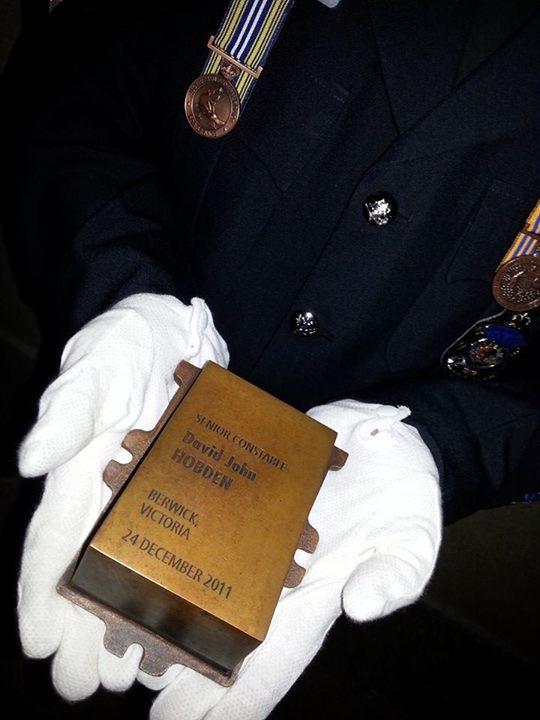
Died on: 24 December 2011
Cause: injuries sustained from 1990 mva
Age: 47
Funeral date: Wednesday 4 January 2012
Funeral location: Victoria Police Academy Chapel, 1 View Mount Rd, Glen Waverley
Buried at: ?
[alert_green]David IS mentioned on the Police Wall of Remembrance[/alert_green]
David John HOBDEN
The touchstone of Victoria Police Senior Constable David John Hobden left the manufacturer in Melbourne this morning. Under AFP Federal Agent escort, the touchstone has just been handed over to NSW Police – Monaro LAC Commander, where it will be blessed at their dawn service at Queanbeyan Police Station tomorrow morning. The touchstone will then be installed into the National Police Memorial ahead of the national service tomorrow evening. We will remember.
On 30th October 1990, Senior Constable David HOBDEN was travelling on his police motor bike with the lights and siren operating in response to a call from D24 of ‘offenders on’ in a house in Endeavour Hills.
At the intersection of Heatherton Road and James Cook Drive, Endeavour Hills he was involved in an accident with another vehicle.
He was conveyed to the Dandenong Hospital where he was diagnosed with a broken leg and two broken ribs. As a result of the injuries he was off duty for 12 months.
During the following years the injuries continued to trouble him and he required ongoing medical treatment and a further thirty operations.
Eventually the discomfort he suffered from the injuries forced him to retire from Victoria Police in 2005.
David Hobden joined Victoria Police as a Cadet on 29th January 1980 and after graduating in 1982 he performed general duties at Force Reserve, Melbourne District Traffic and Patrol Division, Cranbourne Police Station, the Metro Traffic Operations Group and Echo District Traffic Operations Group.
Upon his return to Victoria Police after the accident he performed duty in a variety of non-operational roles including recruiting, Youth Advisory Unit and as a Youth Affairs / Project Officer.
The injuries he sustained in 1990 subsequently led to David Hobden’s premature death on 24th December 2011.
Location of collision: [codepeople-post-map]
Location of funeral service:
Australian Pensioner Funerals, Ph (03) 9428 1600
Kym Andrew GODFREY
07/05/2015
Kym Andrew GODFREY
South Australia Police Force
Regd. # ?
Rank: Constable
Stations: Pt Adelaide C.1 Division
Service: From ? to 28 December 1981
Awards: ?
Born: ?
Died on: ?
Cause: Motor Vehicle Accident
Age: 22
Funeral date: ?
Funeral location: Enfield Memorial Park, Adelaide
Buried at: plot No. 15
[alert_green] Kym IS mentioned on the Police Wall of Remembrance[/alert_green ]
Kym was responding to an alleged incident, died after the police car in which he was a passenger crashed on South Road, Thebarton, S.A.
He was a beloved son and brother.
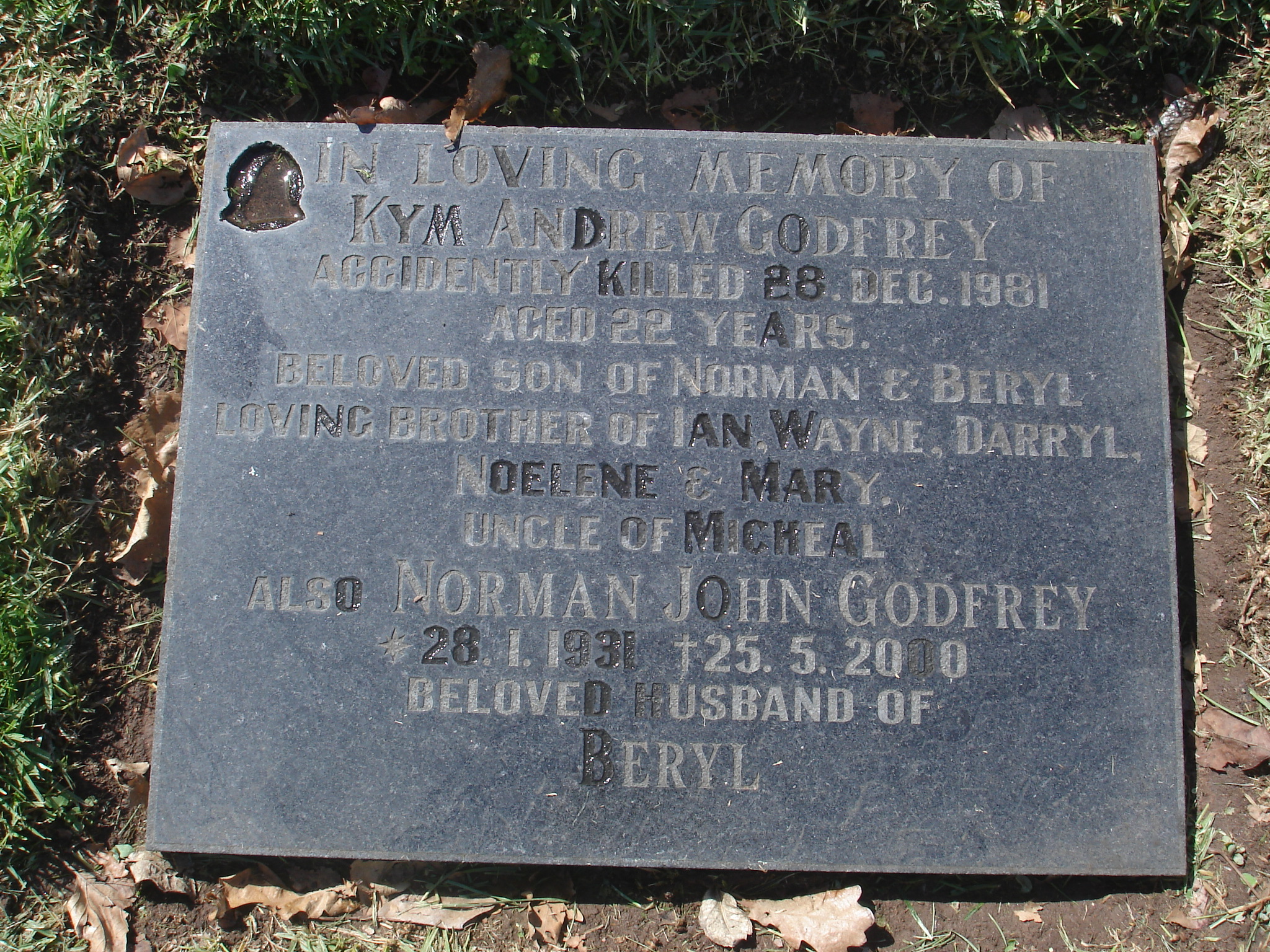
Kym Andrew GODFREY – grave stone
Inscription:
IN LOVING MEMORY OF
KYM ANDREW GODFREY
ACCIDENTLY KILLED 28.DEC.1981
AGED 22 YEARS.
BELOVED SON OF NORMAN & BERYL
LOVING BROTHER OF IAN, WAYNE, DARRYL,
NOELENE & MARY.
UNCLE OF MICKEAL
Peter Allen FIGTREE
07/05/2015
Peter Allen FIGTREE
AKA ?
Late of ?
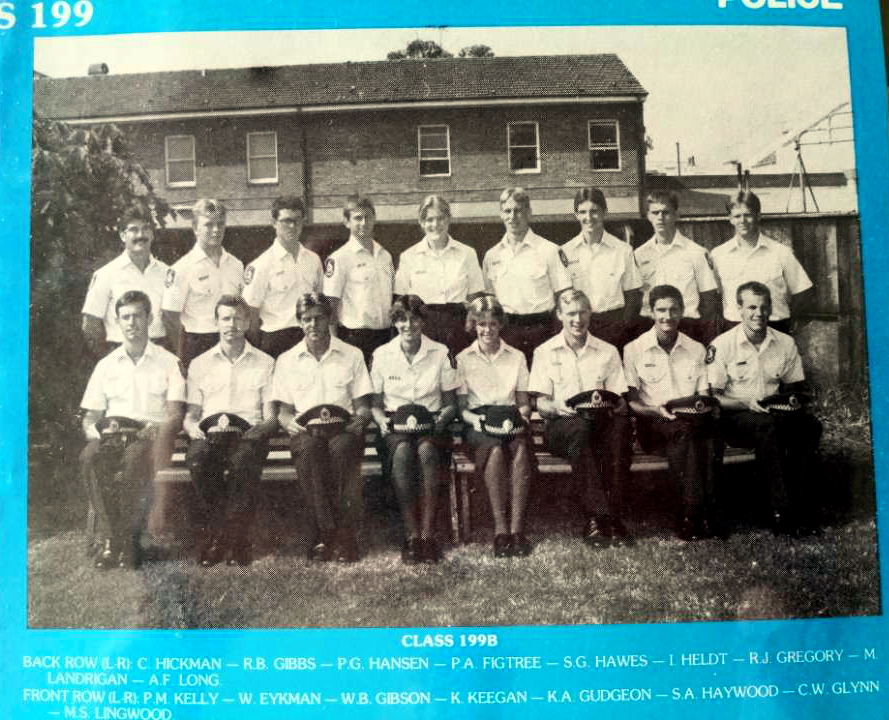
NSW Redfern Police Academy Class # 199B
New South Wales Police Force
Regd. # 21207
Rank: Commenced Training – Monday 28 November 1983
Probationary Constable – appointed 24 February 1984
Constable – appointed 24 February 1985
Constable 1st Class – appointed ? ? ?
Service: From 28 November 1983 to 13 June 1989 = 5+ years Service
Stations: ?, Ballina HWP
Awards: No find on It’s An Honour
Born: Friday 23 October 1964
Died: Tuesday 13 June 1989
Age: 24
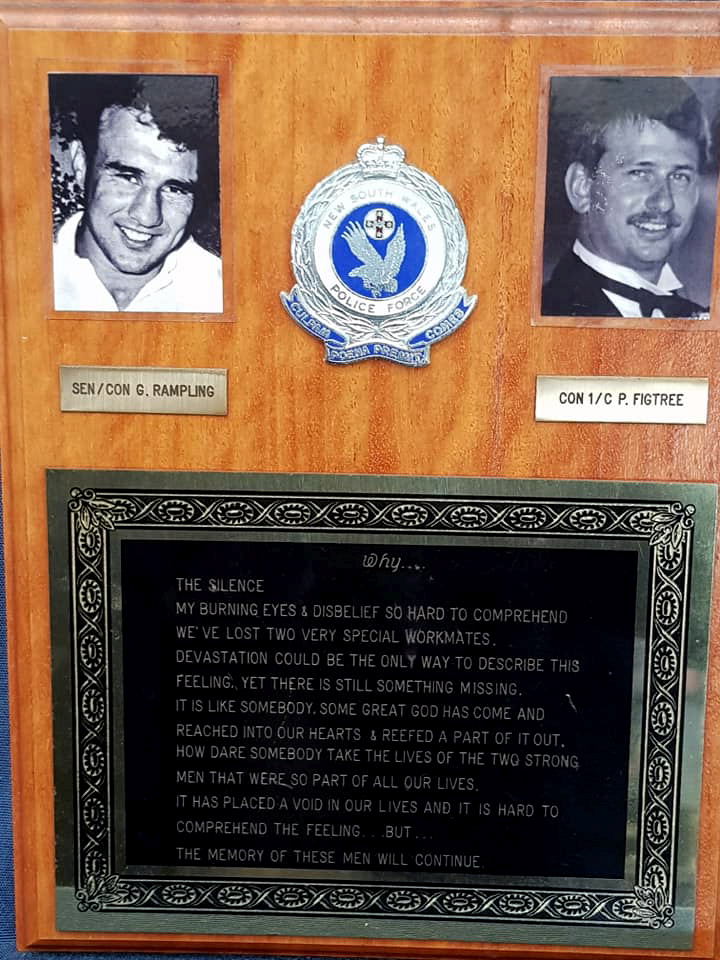
Cause: Motor vehicle accident – passenger – Urgent Duty – Pursuit of SMV
About 11.25pm on 13 June, 1989 police in Byron Bay commenced a high speed pursuit of a panel van. The pursued vehicle drove south in the Coast Road, followed by the Byron Bay Police vehicle, and into Ballina. As both vehicles continued south through Ballina, a local Highway Patrol vehicle driven by Constable 1st Class Beaver, with Senior Constable Rampling and Constable 1st Class Figtree as passengers, joined the pursuit. More police vehicles arrived to assist as the pursuit continued through the township of Wardell. About five kilometres south of Wardell the Ballina Highway Patrol vehicle began to draw level with the offending vehicle. As it did so, the driver of the pursued vehicle drove across to the centre of the roadway and clipped the front of the Byron Bay Police car. As a result, the police vehicle veered across the road and skidded in loose gravel before colliding with a power pole.
All three police were trapped for some time in the badly damaged police car and when freed were conveyed by ambulance to the Lismore Base Hospital. Constable Beaver recovered from internal injuries received, however Constable Figtree died before he reached hospital and Senior Constable Rampling died a short time later.
Senior Constable Rampling was born in 1959 and joined the New South Wales Police Force on 15 January, 1979. At the time of his death he was attached to the Ballina Detectives.
Constable Figtree was born in 1964 and joined the New South Wales Police Force on 28 November, 1983. At the time of his death he was attached to the Ballina Highway Patrol.
[divider]
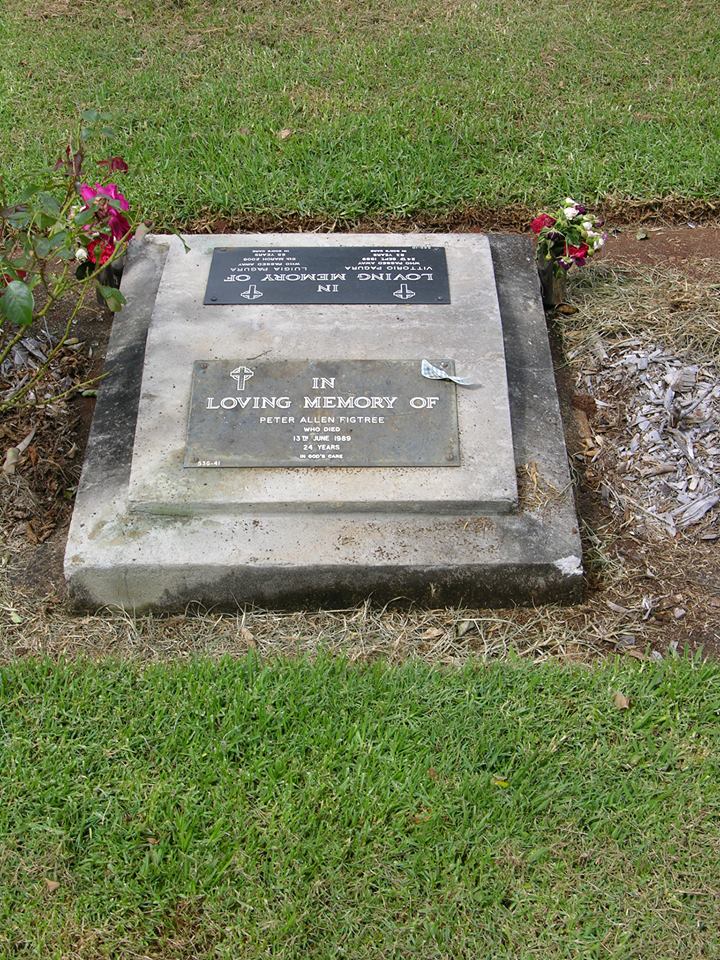
Peter Allen FIGTREE grave plaque
Deadly toll
By Jonathan Pearlman November 6, 2004
Alone in his patrol car, Chris Thornton had the police siren flashing as he chased a white sedan through Woy Woy.
Thornton, 35, a highway patrolman, had been in the force for 15 years. He was, his mother says, “the best driver I have ever seen”.
The reason for the chase that night in April 2002 is unknown. Both cars were seen travelling at high speed. Thornton was about 50 metres behind.
Meanwhile, Leonard Rowley, 56, an unlicensed driver, was driving to his local KFC to pick up dinner. He saw the first car flash past and judged – wrongly – that he had time to turn out in front of the patrol car. Thornton tried to avoid Rowley’s car but clipped the back, veered onto the wrong side of the road and hit a power pole.
Thornton died on the spot, which is marked by a permanent stainless-steel cross. Rowley later received a suspended two-year sentence.
“His life from the age of 12 was about helping people,” says Thornton’s mother, Freada Thornton. “He was in the surf club and he was there to rescue people and then he went into the force and he was doing the same thing.” His father, Barry Thornton, says: “He loved life. He had been in Gosford for 15 years and was so popular with the community there.”
Police pursuits are, says Barry, a necessary evil: “If they don’t catch the criminals there will be more deaths on the roads. The ones that they’re in pursuit of are the idiots that have done the wrong thing to start with.”
But pursuits have come at a cost to the NSW Police Department. Fifteen officers have died as a result of high-speed chases, beginning with the death of Constable George Boore in 1937.
Details provided by the NSW Police Association show a steady stream of fatalities involving cars and motorcycles. The full list of casualties is as follows:
Gezza J KtBelieve it or not, I was working the radio comms for this at Lismore station that night. Called the whole thing & did all the post crash co-ord. A horrible night shift with Sgt GJ Menzies, S/C Mark Burridge, Const’s Jordan, Gahan & Me.
*****
June 2019
30 year memorial – Senior Constable Glenn Rampling – Constable First Class Peter Figtree – A memorial service will be held at the Ballina Surf Club, Lighthouse Parade, Ballina on Thursday, 13 June 2019 at 1000hr to commemorate the 30th anniversary of the death of Senior Constable Glenn Donald Rampling and Constable 1st Class Peter Allen Figtree.
Senior Constable Rampling was tragically killed on duty on 14 June 1989 and Constable 1st Class Figtree was tragically killed on duty on 13 June 1989, both as a result of motor vehicle collision at Wardell, south of Ballina.
Attended this morning quite a moving 30 year memorial service for Glenn Rampling and Peter Figtree killed in a car chase near Ballina. May they rest in peace.
Photo by: Glenn Taylor
Photo by: Glenn Taylor
Photo from: Geoff Lowe Peter FIGTREE back row, 4th from left. Redfern Police Academy Class 199B
Photo by: Ken Medway
Ernest ANDREWS
07/05/2015
Ernest ANDREWS
New South Wales Police Force
Rank: Constable
Regd. # 31??
Stations: George Street North Police Station
Served: From 24 April 1929 to 3 January 1931 = 1+ years Service
Awards: No find on It’s An Honour
Born: ? ? 1908
Died: 3 January 1931
Age: 23
Cause: Shot – Murdered at Bondi Junction
Funeral date: 5 January 1931
Funeral location: Rookwood Cemetery
Buried: Buried in Rookwood Cemetery ( side by side with Norman Thomas ALLEN )
Zone: C Section: 09 Grave 4211
DOUBLE POLICE MURDER
Memorial location:
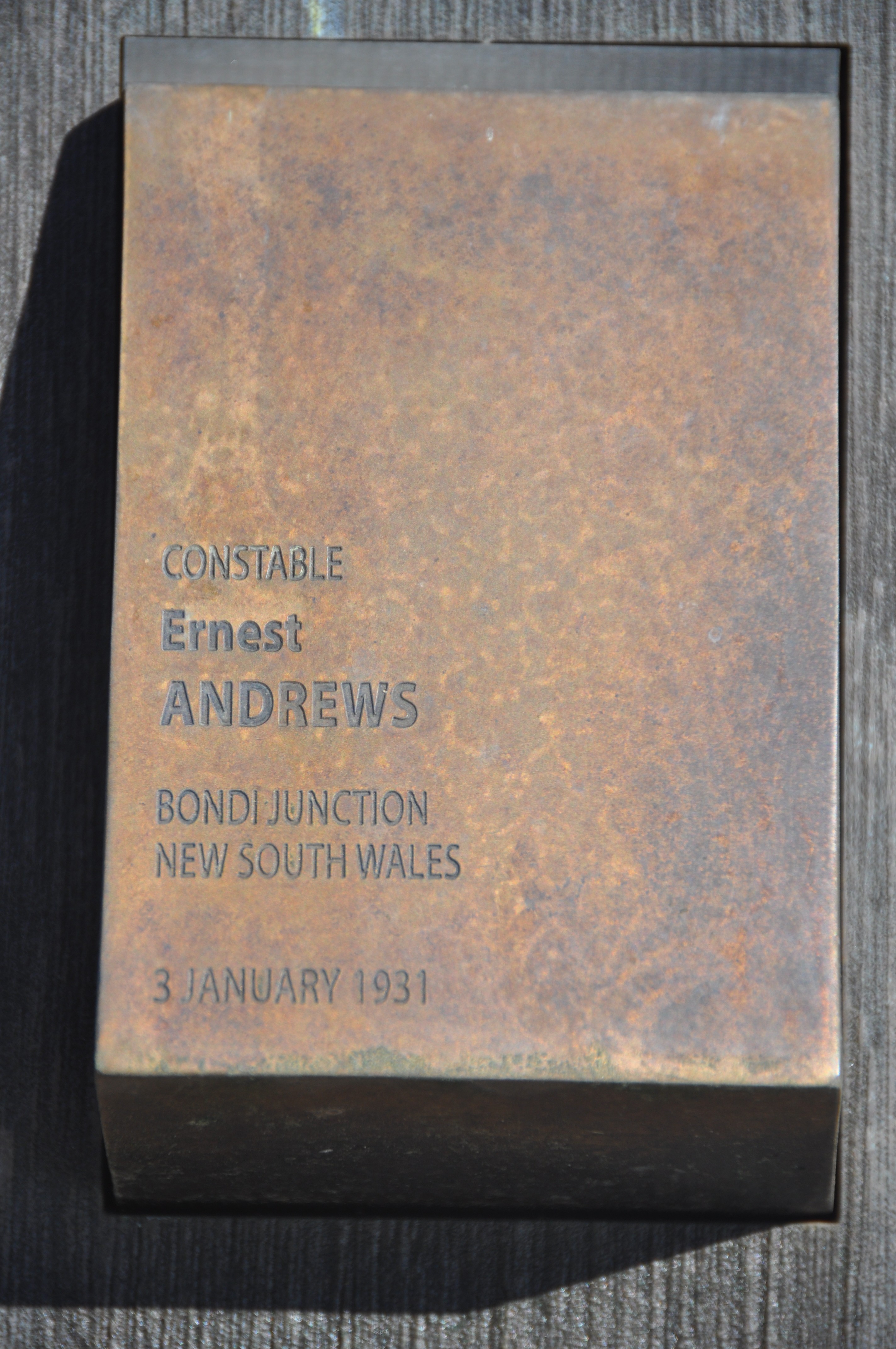
Ernest ANDREWS touch plate at the National Police Wall of Remembrance, Canberra
Ernest IS mentioned on the Police Wall of Remembrance
Constable Norman Thomas Allen ( 1931 )
Constable Ernest Andrews ( 1931 )
Constable Allen was shot in the street at Bondi Junction while attempting to detain an armed, deranged man named Kennedy who had earlier had an altercation with a local shopkeeper. The constable had been directing traffic and when informed of the dispute he found and confronted the offender. As he approached Kennedy from behind, the man spun around and shot Constable Allenin the chest at point blank range. He then shot the constable twice more in the heart. At this time Constable Andrews – unarmed, off duty and heading for the beach – passed by in a tram and saw a crowd gathered around the body of Constable Allen. Alighting from the tram he joined in the pursuit of Kennedy who managed to reach his home in nearby Lawson Street.
On arriving and finding the front door locked Constable Andrews went to the rear of the dwelling and burst through the back door. Unfortunately Kennedy was waiting with rifle raised and as Andrews lunged at him he shot him twice in the chest. He then took a knife and stabbed the constable in the throat. Sergeant Seery and Constable Johnson from Waverley Police then arrived and began to smash their way in through the front door. Although fired at by Kennedy, Constable Johnson returned fire, hitting Kennedy in the chest. Seery and Johnson then smashed their way in and found the offender in a bedroom bleeding to death. He died that night.
In the aftermath of the murders, the Brisbane Courier dated 5 January, 1931 published a complete account of the entire incident, and concluded with the following.
COMMISSIONER PRAISES MURDERED POLICE.
Both murdered constables were highly efficient and popular officers. Allen leaves a widow and young child. He lived in New Street, Bondi. Constable Andrews was single, his only relative in Australia being a sister, Mrs Clark. The men will be buried tomorrow with full police honours. The Commissioner of Police Mr. Childs, in an appreciation, said “I wish to pay a tribute to the manner in which both these young men carried out their duty according to the best traditions of the service. They saw their duty before them, and did not hesitate a moment in the execution of it. Although I would not make any distinction between them I cannot help referring to the action of Constable Andrews, who, though unarmed, rushed in to effect the arrest of a man who had already shot Constable Allen. “
Constable Norman Thomas ALLEN was born in 1901, joined the New South Wales Police Force on 14 May, 1926 and shortly thereafter resigned. He rejoined on 26 September, 1928. At the time of his death he was stationed at Waverley.
Constable Ernest ANDREWS was born in 1908 and joined the New South Wales Police Force on 24 April, 1929. At the time of his death he was stationed at George Street North Police Station.
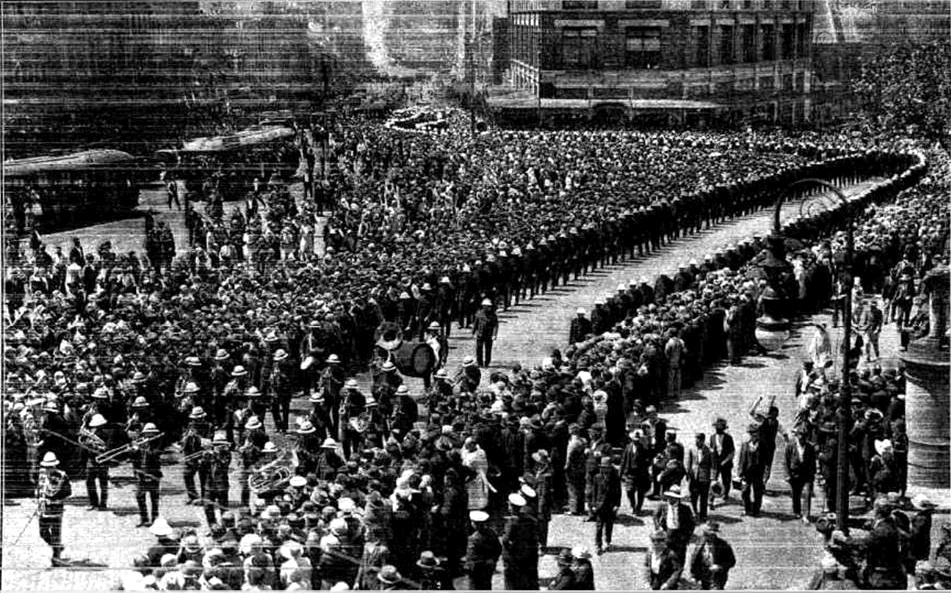
Funeral procession through Railway Square in 5 January 1931 for two police constables, Allen and Andrews, killed in the line of duty. Source: Sydney Mail newspaper 7 January 1931
The Sydney Morning Herald
Tuesday 6 January 1931 page 10 of 14
DEAD POLICEMEN.
Impressive Scenes at Funeral.
THOUSANDS PAY TRIBUTE.
The State paid homage yesterday to the two policemen, Constable Norman Thomas Allen and Constable Ernest Andrews who met their death at the hands of a madman at Bondi Junction on Saturday. There were mourners from almost every part of New South Wales.
Many thousands lined the route as the funeral cortege moved from Wood Coffill’s funeral parlours George-street to the mortuary station; the mortuary platform was thronged when the funeral train moved off to Rookwood and thousands had assembled in the cemetery.
The scene in the vicinity of Wood Coffill’s funeral parlours is likely to be remembered by the thousands of people who thronged the streets leading into Railway-square. Early in the morning bearers of wreaths and floral tributes passed through the doors to deposit their tokens of sympathy. At the approach of noon people began to assemble on the footpath and many entered the chapel to view the coffins. The near relatives arrived at 1 o’clock and the chapel was cleared while Constable Allen’s widow and her mother approached the silver mounted caskets which rested on trestles side by side. An affecting scene followed. Then the simple Church of England burial service was conducted by the Rev Frederick Riley and the coffins were borne to the waiting hearses.
MUFFLED DRUMS
The scene was unforgettable. A solid mass of people crowded the thoroughfares. Presently the mounted troopers urged their restive horses forward and with the deep roll of muffled drums the cortege moved off. Thousands of hats were removed.
Handel’s Dead March in “Saul” was played by the Police Band. Behind the band came a contingent of foot police under the direction of Superintendent Leary. Two hundred men drawn from the various stations, marched behind. Then came the hearses, the wreath-laden carriages, and the chief mourners, Firemen, the sun glinting on brightly-polished helmets, were represented by over 40 uniformed officers and men. At the end of the slow-moving procession came numbers of retired men, friends of the dead officers, and business people from the eastern suburbs.
Along the route to the mortuary thousands stood bareheaded as the cortege passed. At the mortuary gates another huge crowd paid tribute to the dead men.
Among those who marched in addition to the police and firemen, were employees of motor bus companies in the eastern suburbs.
“THEY SAW THEIR DUTY.”
A most affecting scene at the graveside in the Church of England section of the Rookwood Cemetery was the playing by the police band of the hymns “Lead Kindly Light” and “Abide With Me.” The remains were buried side by side.
“Let men’s opinions be what they may,” said the Rev. Frederick Riley in an address at the graveside, ” we should be doing violence to the most sacred emotions of human life if we were to allow our brethren to depart without a word of farewell. We are met here today to pay honour to the memory of two men who were comrades of yours men whom we all respected and loved. Let us remember that these two men died in the carrying out of their duty. They served their King and country as men and soldiers who fall for their King on the battlefield. They saw their duty and the fear of death could not deter them. They have not created a new tradition for the traditions of the police force of New South Wales are amongst the highest in the world already, but these two men have added a new lustre to the traditions of your past. These two young men Norman Thomas Allen and Ernest Andrews, died in the execution of their duty. There is no higher glory to which a man can aspire. We pray to God that those who have been so suddenly bereaved may share the comfort which we know these two brave men are experiencing in the nearer presence of God.”
MAGISTRATE’S TRIBUTE
At the Burwood Police Court yesterday Mr. G. R. Williams, S.M. commented on the bravery of the two constables. They acted nobly and upheld the traditions of the force,” he said.
PALL BEARERS AND MOURNERS.
The pall bearers were.- For late Constable Allen: Constables Tomkins, Martin, Moore, Hudson, Steele and White. For late Constable Andrews: Constables Booth, Kimber, Fraser, O’Neill, Morgan, and Wright.
The principal mourners were Relatives of the late Constable Allen: Mrs Allen (widow), Mrs Prankish (mother-in-law), Mr and Mrs N. Frankish (brother In law and sister in law), Mr and Mrs Sutcliffe (uncle and aunt) Mrs Lamb, Mrs Hourigan, and Mrs Cummings (aunts) and Mr Rowland Allen (cousin).
Relatives of the late Constable Andrews: Mr and Mrs Edward Clarke (sister and brother in law).
The Government was represented by Mr Gosling (Chief Secretary) and Mr McKell (Minister for local Government). Police representatives in addition to the non commissioned officers and men who marched were Mr W H Childs (Commissioner) Superintendents Leary, Mackay and Linegar, Inspectors Winter, Weir, Bennetts, McCauley, Woodrow, Lynch, Duffell, Roberts, McMaster, O’Brien, Chaseling, Anderson, White, Long, Roser, Scott, Michaelis, Robson, Allen, Farley and Fowler.
Retired members of the police force who attended were ex-Commissioner James Mitchell, ex-Superintendents Roche, Cook, McIntosh, Sinclair, Thom, Drew and Park, ex Inspectors Fullerton, W J Jones (also representing the Navy and Army Veterans Association) Fraser, Tracey, Bolton, Smith, Fewster, Doran, Mankletow, Stutchbury, Briggs, Ewen, Dunn, O’Dea and Robertson, ex-Sergeants McDonald, T. Dobson, Payne, A. Smith, Taylor, J. Salmon, J. Loomes, R. C. Harper, Bath and Butcher, ex-Constables Swan and Dixon.
The Board of Fire Commissioners of New South Wales was represented by Mr T J Smith, M.L.C. (president) Mr J McNamara (Commissioner), and Mr H M Webb (secretary and executive officer).
Mr Nance chief officer New South Wales Fire Brigades was present and 38 men marched under Mr Grimmond (deputy chief officer). Inspector Neeve, District Officer McLachlan, and Station Officers Arthur, Neville, Parkes, McCarthy, Rust, Currier and Sclater.
Others who attended were:- Judge Sheridan, Mir George Cann, ex M.L.A., Mr J Herlihy ( Under-Secretary for Lands) representatives of the Prisons Department including Mr Seery (superintendent of the Long Bay Penitentiary) Mr T.W. Irish (Assistant Under Secretary for Lands) Mr H. B. Mathews, (Surveyor General Department of Lands).
Mr N. W. Bond (representing the head office Bank, of New South Wales) representatives of ambulance divisions, Mr. and Mrs. C. R. Law, Mr. A. L. Parker (representing Superintendent O. H. Parker, of Goulburn) Mr Foster Doolan (vice president Police Association), Mr B Fortescue (secretary Police Association), Mr C T Thackeray (Police Association staff), Mr F M Jackson (representing Mr F C Hackett of Merriwa), Mr W T Missingham,
M.L.A., Mr A J Pollack, M.L.A., Mr W P Monaghan (Waverley Cemetery bus service), Mr W M Niland Mrs A Shuttleworth, Mr H L Harnett (representing Mr F M Burke, Speaker of the Legislative Assembly), Mr W E Clapin (representing Sir John Peden, President of the Legislative Council), Alderman David Hunter (Mayor of Waverley), Mr T J Thompson (Deputy Town Clerk of Waverley), Mr and Mrs A Williams, Miss Williams, Miss Beryl Williams, Miss Brady, Mr and Mrs McMorland, ex Warder Charles Stone, ex Warder Little and a number of eastern suburbs business people.
The wreaths Included those from the mother and other relatives of the late Constable Allen, relatives of the late Constable Andrews, the New South Wales Police Commissioned Officers Association, comrades of No 2 Division, Redfern Police, New South Wales Police Association, members of the Railway Detective Office, officers, detectives, and staff of the C.I.B., No 3 Police, comrades of No. 10 Division, cyclists and drivers of police headquarters, officers and men of Circular Quay Fire Station, comrades at No. 4 Station, police at No 7 Station, “police pals at Bondi Junction.” end eastern suburbs bus drivers and conductors.
Awards: Meritorious Unit Citation for work in East Timor.
Commendation for efforts in disarming a male carrying a replica pistol in Honiara Court.
Born: ?
Died on: Wednesday 22 December 2004
Cause: Shot – Murdered
whilst deployed on official duties at Honiara, Solomon Islands
Age: 26
Funeral date: Thursday 30 December 2004
Funeral location: ANZAC Memorial Chapel,
Royal Military College, Duntroon, ACT
Buried at: Cremated
Memorial: The main street of a new AFP training village in Canberra was named Adam Dunning Drive in his memory.
Adam DUNNING
Adam IS mentioned on the Police Wall of Remembrance
Tears for the fallen as Adam comes home
By Craig Skehan and Aban Contractor December 24, 2004
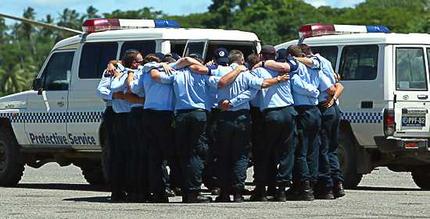
AFP officers farewell their mate Adam Dunning after loading his coffin into a RAAF jet at Honiara Domestic Airport. Photo: Andy Zakeli
They had slow-marched their comrade’s casket to the plane that would take him home.
Their backs were straight, but the emotions were too much: tears tumbled down the cheeks of the Australian Federal Police pallbearers as they did Adam Dunning this last honour.
Then, once his body was stowed in the hold of the RAAF jet on the tarmac in Honiara, his mates made a last gesture of solidarity with the colleague they were farewelling forever – forming a circle, heads bowed, arms locked around each other’s shoulders.
Adam Dunning, the 26-year-old AFP protective service officer who was killed by a sniper in the early hours of Wednesday morning, was accompanied home by the Minister for Justice, Chris Ellison, and the Opposition’s home affairs spokesman, Robert McClelland, but at Fairbairn air base in Canberra, where the RAAF 737 touched down just before 6pm, it was Mr Dunning’s family and friends – his parents, Michael and Christine, his sisters, Sarah and Emma, and his girlfriend, Elise Wiscombe – who formed the guard of honour.
Standing in two straight lines, they faced the plane.
With the Australian Federal Police Commissioner, Mick Keelty, standing watch nearby, Mr Dunning’s parents held their heads high, and his sisters and Ms Wiscombe quietly sobbed as eight AFP pallbearers bore his flag-draped casket from the plane. His parents held hands and seemed to stand even straighter as their only son was placed in the hearse that would take him to the mortuary.
In the Solomons, police are questioning a taxi driver about several suspects in the murder. A Solomon Islands police source told the Herald that the taxi – seen near the murder scene with several passengers before the shooting – had been seized.
On a narrow, potholed road on the outskirts of the Solomons capital, Honiara, locals offered heartfelt apologies for the shooting.
“I am so very sorry,” said one young man. “He came here to help us.”
By the roadside at Zion Junction, investigating officers had cut the long grass to help search for clues to the identity of the person who, in darkness shortly after 3am on Wednesday, shot Mr Dunning while he was on patrol in a Toyota Land Cruiser.
Zion Junction does not have a particularly dangerous reputation. Rather, locals said, other settlements further along the same ridge were known for trouble, ranging from extortion to payback shootings.
Moffat Suiga, a community elder who was awakened by the shots that killed Mr Dunning, said he and others were at a loss to explain the murder.
A middle-aged businessman said the overwhelming majority of Solomon Islanders wanted to see those responsible put in jail. He said it would be a good thing if the Australian-led intervention force remained for the next 40 years.
At a commemoration service earlier in Honiara, Mr Keelty said Mr Dunning had “died for peace”.
The Solomon Islands Prime Minister, Sir Allan Kemakeza, said the young man had been helping the country overcome ethnic strife and crime. “We will not forget him,” he said.
A police funeral will be held for Mr Dunning on a day to be announced.
AFP officers farewell their mate Adam Dunning after loading his coffin into a RAAF jet at Honiara Domestic Airport.
Photo: Andy Zakeli
Australian Protective Services officers salute the coffin in a guard of honour at Honiara Domestic Airport before Adam Dunning’s coffin was flown back to Australia.
Photo: Andy Zakeli
Australian Protective Services officer Robert Turnbull sheds a tear at the official wake in the compund before Adam Dunning’s coffin flew back to Australia.
Photo: Andy Zakeli
The RAAF jet carrying Adam Dunning’s body touches down.
Photo: Andrew Taylor
Adam Dunning’s coffin is loaded from the aircraft to a hearse at the RAAF Base at Fairbairn.
Photo: Andrew Tayl
Senior officers and other dignatories, along with family members, watch Adam Dunning’s coffin being loaded from the aircraft to a hearse at the RAAF Base at Fairbairn in Canberra.
Photo: Andrew Taylor
The girlfriend of Adam Dunning, Elise Wiscombe (far left), cries as police salute the farewell of the coffin.
Photo: Andrew Taylor
Friends of Adam Dunning after the hearse had left the tarmac.
Photo: Andrew Taylor
Memorial Tribute to Adam DUNNING, 10 years on. 22 December 2014, National Police Wall of Remembrance, Canberra.
Excellent turnout at NPM this morning for Adam and his family. RIP and we remember.
Peacekeeper killed ADG’s funeral brings Air Force and police together
By FLGOFF Fiona Peacock
The funeral of LAC Adam Dunning, a member of the PAF and Air Force Active Reserve.
LAC Adam Dunning.
LEADING Aircraftman Adam Dunning, an ADG with No. 28 (City of Canberra) Squadron and former member of No. 2 Air Field Defence Squadron, was killed in December last year while on operational duty with the Australian Federal Police as part of the Regional Assistance Mission to the Solomon Islands (RAMSI).
In the early hours of December 22, LAC Dunning and an Australian Protective Service colleague were on a routine vehicle patrol in Honiara, protecting the Prime Minister’s and Governor General’s residences.
A concealed gunman shot at the vehicle, fatally wounding LAC Dunning, who was 26.
He deployed to the Solomons in October and, after only six weeks there, was awarded a commendation for disarming a man in front of the Magistrates Court.
At LAC Dunning’s funeral, members of 28SQN played a part in recognising his Air Force service. The squadron’s honorary air commodore, Air Commodore Justice Terence Higgins, represented 28SQN among the official party of Service chiefs.
Members of the Air Field Defence Wing provided the firing party and the guard of honour for receiving VIPs. The RAAF Ensign was carried by Pilot Officer Shane McGaughey and was escorted by Flight Sergeant John Forth.
Two close friends of LAC Dunning, Leading Aircraftmen Tim Gresham and David Pauli, were members of the bearer party. The President of 28SQN Association, Steve Williams, represented former 28SQN members. 28SQN members joined AFP personnel to form a guard of honour.
AFP Commissioner Mick Keelty praised No. 34 Squadron for the way it handled bringing LAC Dunning’s body back to Australia.
By Misha Schubert
Political correspondent
Canberra December 31, 2004
They stood side by side. Two long lines of blue uniforms facing each other along the tree-lined road. Like a slow Mexican wave, each snapped to attention and saluted as the body of one of their own passed by.
Adam Dunning, murdered by a sniper while on patrol in the Solomons early last week, had begun the last leg of his journey home.
Earlier, these men and women of the Australian Federal Police and the Royal Australian Air Force had wept openly as Mr Dunning was farewelled with full police and military honours in the Duntroon chapel. “He was a great man,” said his federal police mate Pat Castle.
The nation’s military chiefs turned out to pay tribute, as did Prime Minister John Howard, Governor-General Michael Jeffery and senior cabinet ministers.
But this ritual belonged to those who knew and loved Adam Dunning.
His mother, Christine, read from a tribute that she and her husband, Mike, had written to their son in February. They had praised his courage, sensitivity and mettle.
His partner, Elise, who had brought red roses for the man she had loved, said he was her greatest friend. “He was my strength, my inspiration, my love.”
Peacekeeper Beau Tennant, who was with Mr Dunning the night before he died, broke down as he recalled his friend’s generosity.
“Before he left me, his last words were: ‘Are you right for money mate?’ That was the kind of bloke he was,” he said.
Federal Police Commissioner Mick Keelty said Mr Dunning would live on in the memories of grateful Solomon Islanders.
“Adam Dunning died for peace and law and order. His work and his death will always be remembered by his colleagues,” he told mourners.
The federal police hope to build a memorial to Mr Dunning at their new training centre for overseas police peacekeepers.
Mr Dunning also served with RAAF in Timor before joining the AFP.
Police believe his murder and another attack on police on October 21 were carried out by three former members of the Malaitan Eagle Force militia.
They have charged two men – John Ome and Philip Kwaimani – over the attacks and are hunting James Tatau, who Mr Keelty said was present at both events and had access to a cache of weapons.
Police believe the trio were working on their own, with no sign of any broader uprising against the peacekeeping effort.
It fell to Emma, who had adored her older brother, to claim his service medals and caps from the flag-shrouded coffin and hand them to her grieving parents.
As his police mates carried Mr Dunning’s coffin from the chapel into the sunlight, drummers and bagpipers ushered him on his way. A police motorcade led the cortege through Canberra’s streets to a private service and cremation.
A plane carrying the body of murdered Australian peacekeeper Adam Dunning has landed in his home town of Canberra.
The 26-year-old Australian Protective Services officer was shot twice in the back by a sniper while serving as part of a peacekeeping mission in the Solomon Islands yesterday morning.
Members of Mr Dunning’s family, and his colleagues were on hand to formally receive his body.
Australian Federal Police Commissioner Mick Keelty returned from the Solomon Islands about half an hour before the plane bearing Officer Dunning’s body landed.
He was among those waiting for Justice Minister Chris Ellison and Labor’s homeland security spokesman Robert McClelland, who accompanied the body on the flight back to Canberra.
Commissioner Keelty, Senator Ellison, Mr McClelland and AFP officers formed a guard of honour before the coffin was removed from the plane.
Family members, including Officer Dunning’s parents Mike and Christine, and girlfriend Elise Wiscombe, stood arm in arm watching proceedings.
A guard of honour, carrying Officer Dunning’s hat, led the flag-draped coffin to the hearse.
Eight pall bearers stood tall under the weight, as Officer Dunning’s police colleagues watched on.
A cavalcade of AFP motorcycles is waiting to lead the hearse to Canberra’s mortuary.
A full police funeral will be held for Officer Dunning on a day to be announced.
Officer Dunning’s parents took the time to thank those who attended the short ceremony before the hearse headed for Kingston mortuary under police escort.
Senator Ellison later said the Solomons people were behind RAMSI and Australia’s efforts to bring law and order to the country.
He said some adjustments might be made to the conduct of night patrols but any final decision would depend on recommendations from the AFP.
He denied the Government had too quickly reduced the AFP’s military support in the Solomons.
“We’ve made fantastic progress in the Solomons and we never underestimated the danger that our people faced,” he told ABC television
By Craig Skehan and Cynthia Banham December 23, 2004
Australia is rushing 100 extra troops to the Solomon Islands in defiant reaction to the sniper murder of Adam Dunning, the nation’s first peacekeeper to be killed by hostile fire.
The murder highlights the perils of the new interventionist role in the Pacific islands, but the Prime Minister, John Howard, vowed the mission to the Solomons would go on “undeterred, unrestrained, unaffected by what’s happened”.
“We won’t be cowed by this,” the Foreign Minister, Alexander Downer, added.
Mr Dunning, a 26-year-old Australian Protective Service officer from Canberra who had dodged bullets while serving in East Timor, was shot twice in the back while on a patrol in a four-wheel drives Toyota Land Cruiser in the capital, Honiara, at 3.10am on Wednesday. The bullets were among six shots fired rapidly from a high-powered military rifle.
“It looks as though the person who fired it had training in the use of such firearms,” a Solomon Islands official said.
Members of former ethnic militias – who had formed gangs and reduced the country to anarchy – are now being questioned. Australian investigators say the involvement of former Solomon Islands police officers, or an individual officer, cannot be ruled out.
At his Canberra home, Mr Dunning’s father, Michael, was distraught as he spoke of his son’s honourable death.
“It is sad as he cared for the [Solomons] people so much and was doing something really good on their behalf,” Mr Dunning told the Herald. “He always has been a decent person, tough and soft-hearted at the same time. He was totally honourable and very stubborn – nobody could make him do anything that he did not think was right. He was a credit to us.”
Adam Dunning had been planning a future with his 22-year-old girlfriend, Elise Wiscombe, on his return home next month. “I’m very, very proud of what he’s done over there,” she said. “He’s one of the greatest people I’ve ever met.”
Mr Dunning was part of the regional intervention force which has been seeking to stem ethnic and criminal violence in the Solomons since July last year.
A rapid-response, 100-member infantry company from the First Royal Australian Regiment was to leave Townsville on Thursday for the Solomons, just a day after the murder. The Defence Minister, Robert Hill, said: “This is to send a clear message to the thugs … that we will not tolerate the murder of our police officers.”
A meeting of departmental secretaries in Canberra recommended extra forces to support the 160 defence force personnel already there. Those troops are backing the 147 Australian Federal Police members who are serving in the Regional Assistance Mission to the Solomon Islands (RAMSI) – about 95 of them from the Australian Protective Service, which comes under the federal police. The Justice Minister, Chris Ellison, and the Federal Police Commissioner, Mick Keelty, flew to Honiara on Wednesday night. Australian forensic experts also flew in.
Mr Keelty said: “Over 4000 arrests have been made and over 3700 weapons have been seized [since the intervention began]. Clearly this indicates that there are some in the community in the Solomon Islands who are not happy about RAMSI’s presence.”
He said the hot tropical climate – and the large number of weapons already recovered – were among the reasons body armour had not been used for regular patrols. However, this is now under review.
Mr Keelty called Mr Dunning “a brave and courageous young Australian” and said his killing emphasised “the danger that our people face”.
The Solomons Prime Minister, Sir Allan Kemakeza, described the killing as barbaric and cowardly.
Mr Dunning’s partner on patrol, who had been driving, tried to resuscitate him.
The murder scene, on the outskirts of Honiara, was close to two settlements which are known to be frequented by former ethnic militiaman who formed criminal gangs.
The Australian police contingent has been at the forefront of efforts to clean up local police and officers have been charged with offences from corruption to assault and robbery. A number of local politicians are either under investigation or already facing various charges.
Mr Keelty said the ammunition used indicated the murder weapon was an SLR or possibly an AK-47. This was consistent with some of the weapons used before the arrival of the intervention force. The looting of many SLRs and other military-style weapons from Solomons police armouries had fuelled the five years of unrest that prompted the intervention of the Australian-led force.
There was a major riot at the Central Prison in Honiara this year, when inmates threw rocks at Australian personnel and painted anti-Australian slogans. Two months ago, an intervention force vehicle patrol was fired on.
Protective Service Officers were deployed along with other Australian law enforcement officers in the Solomon Islands as part of RAMSI. The peacekeeping force suffered their first casualty on 22 December 2004 when PSO1 Adam Dunning was shot and killed while deployed on official duties in the Solomon Islands. Two former members of a local militia were charged but acquitted of Dunning’s murder.[5] Officer Dunning was buried with full police honours.
The main street of a new AFP training village in Canberra was named Adam Dunning Drive in his memory.[6] The $2.8 million training facility at Mount Majura just outside Canberra, has been designed to replicate situations in regional countries to which personnel might be assigned.
The main street of a new training village for Australian Federal Police and other personnel being sent overseas has been named after murdered peacekeeper Adam Dunning.
The $2.8 million training facility at Majura, just outside Canberra, has been designed to replicate situations in regional countries to which personnel might be assigned.
Prime Minister John Howard officially opened the facility on Thursday in the presence of police chiefs from across the country as well as from several regional nations.
Australian Protective Service officer Mr Dunning, 26, was fatally shot twice in the back while on night patrol in the Solomon Islands capital of Honiara in December.
He was serving as part of the Regional Assistance Mission to the Solomons.
His parents attended the opening of the village, through the centre of which runs a road now named Adam Dunning Drive.
“The loss of Adam Dunning signified that this is very dangerous work,” Justice Minister Senator Chris Ellison said.
“That was the ultimate sacrifice paid in the course of his duties.”
Mr Howard said the new facility reflected the new security reality for Australia and its region.
“Events of the last five years have totally transformed both the demands and the expectations of the Australian community on the Australian Federal Police,” he told the gathering.
“In that five-year period we have seen the threatening arrival of international terrorism.
“We’ve (also) seen the emergence of an ongoing need on the part of this country, in cooperation with our friends in the Pacific region, to involve ourselves in the restoration of conditions of law and order and cooperation with police services and governments of those countries.”
The training village, to be used by a range of emergency services personnel as well as police, recreates the environment that police experience when on overseas missions.
Designed to reflect the streetscape of a small overseas township, it enables true-to-life scenario training which helps to prepare police for unknown and sometimes dangerous challenges.
It includes 18 buildings and structures including a corner store, a town hall, a police station, a school, a pub, a marketplace and even a cemetery, reflecting the fact that police are sometimes required to perform exhumations in the course of their work.
The spokesman said 124 personnel had already trained at the complex which was completed in March.
Rank: Commenced Training at Redfern Police Academy on Monday 7 May 1984
Probationary Constable – appointed 20 July 1984
Constable – appointed 20 July 1985
Constable 1st Class – appointed ?
Detective- appointed ? ? 1991
Senior Constable – appointed ? ? ?
Stations: Regional Crime Squad, Nth West ( Parramatta ), ?
Service: From: 7 May 1984 to To: ? ? ?
Awards: No Find on Australian Honours system
Born: Thursday 25 July 1963
Died: ? ? ?
Cause: Stomach Cancer – H.O.D.
Funeral date: ?
Funeral location: ?
Grave site location: ?
FURTHER INFORMATION IS NEEDED ABOUT THIS MEMBER
GREG IS Mentioned on the Police Memorial Wall, Sydney Police Centre, Surry Hills as of October 2022
25 October 2022
This afternoon, in a quiet and deeply-felt ceremony at the Sydney Police Centre, another thirteen names were added, and the memories of another thirteen dedicated NSW Police Force employees were honoured, at the NSW Police Force Service Memorial:
It took up 451 hearing days, heard from 902 public witnesses and cost an estimated $64 million. Malcolm Brown reports on the Wood royal commission, 10 years on.
It began on June 15, 1995, when an unnamed Annandale detective jumped to his death from the seventh floor of a building, apparently through fear of the Wood royal commission. The detective’s suicide was followed by those of Ray Jenkins, a dog trainer (July 10), and Inspector Robert Tait, the acting patrol commander at Narrabri ( March 29, 1996 ). Nineteen days later a former Wollongong alderman, Brian Tobin, gassed himself.
On May 8 the same year, Peter Foretic gassed himself the day after giving evidence about paedophilia. On September 23, Detective Senior Constable Wayne Johnson shot himselfand his estranged wife after being adversely named in the royal commission. On November 4, David Yeldham, a retired judge about to face the royal commission on questions of sexual impropriety, killed himself. A month later Danny Caines, a plumber and police confidant, committed suicide at Forster, on the North Coast.
Altogether, 12 people enmeshed in the Wood royal commissiontook their own lives. Scores of others were so profoundly affected by proceedings that their supporters and families believe it shortened their lives. A former detective, Greg Jensen, suffered a recurrence of the stomach cancer that ultimately ended his life, while another former detective, Ray McDougall, who faced the threat that commission investigators might expose his extramarital affair if he did not co-operate, succumbed to motor neurone disease.
There is no doubt that the Royal Commission into the NSW Police Service, headed by the Supreme Court judge James Wood, purged the force of a rollcall of rotters. A total of 284 police officers were adversely named, 46 briefs of evidence were sent to the Director of Public Prosecutions and by 2001 nine officers had pleaded guilty to corruption offences and three not guilty. Seven police officers received jail sentences, including the former Gosford drug squad chief Wayne Eade and a former chief of detectives, Graham “Chook” Fowler.
Several high-profile police ended their careers in disgrace, including Ray Donaldson, an assistant commissioner, whose contract was not renewed, and Bob Lysaught, the commissioner’s chief of staff, whose contract was torn up. Charges against 14 officers were dismissed because of irregularities in search warrants and their execution.
That left the question of what to do with police who were on the nose but who could not be brought to account by normal means. The solution was the creation of section 181B of the Police Service Act, under which the police commissioner could dismiss an officer on the basis of what had come out of the royal commission. Section 181D allowed the police commissioner to serve an officer with a notice indicating that he “does not have confidence in the police officer’s suitability to continue as a police officer”. The officer could show cause as to why he should be retained, and if dismissed could appeal to the Industrial Relations Tribunal.
In the wake of the two legislative changes, 380 officers were targeted for dismissal or internal investigation. By March 1998, 19 police officers had been dismissed under section 181B and three under 181D. Another had been dismissed under a separate provision of the act, 14 had resigned, four had been medically discharged and 15 had been given performance warning notices. Others were under consideration, and as the Police Integrity Commission – a legacy of the royal commission which became a permanent watchdog – has demonstrated, even officers who had been corrupt many years before were not necessarily in the clear.The former independent MP John Hatton, who was instrumental in setting up the royal commission, said he thought the Police Integrity Commission was the royal commission’s “greatest achievement”. The Child Protection Enforcement Agency, which launched a purge of sex offenders, is another positive legacy of the royal commission.But 10 years on, was the exercise worth it?To some there were considerable benefits. Some appalling malpractice – known as “process” or “noble cause” corruption – prompted Wood to wonder at one point about the quality of a lot of police evidence he had accepted over the years.Despite this, many officers still believe the royal commission was too puritanical. They claim the investigators, not able to grapple with the really big issues, jumped on anything they could: “They had to have runs on the board,” says Michael McGann, who as a policeman in 1984 participated in the so-called Kareela Cat Burglar case, in which police used mace on an uncooperative thief and sex offender. To some critics this treatment did no serious harm and only required a word of caution. But under the spotlight of the royal commission 12 years later, it ended the careers of high-flying police such as John Garvey, Brian Harding and Steve York. A decade later, Harding works in corporate security but insists that the real sting was that the investigators had fabricated evidence. When that finally came out, he says, the group received a confidential settlement, but it did little to redress the feelings of outrage.
Another former policeman, Dr Michael Kennedy, says the commission was a political response to the police commissioner, Tony Lauer, bringing about the downfall of the then police minister, Ted Pickering.
The attorney-general, ministry and judiciary took little responsibility for the state of the force, Kennedy says, while the responsibility of the police rank-and-file grew to “the size of a Pacific driftnet”. “I don’t think the royal commission contributed anything to the reform process except to provide a template for double standards,” he says.
“Chook Fowler put $200 into his pocket from Louis Bayeh. Chook was a lazy, good-for-nothing drunk. But he was put into the same category as Ray Williams and HIH.”McGann says that against the string of petty corrupt activities uncovered, “you have to look at what the government did and did not do with gambling and vice, over the decades. There have been direct links to Parliament for 50 or 60 years. That is hypocrisy.”The critics’ view is that the royal commission has left a demoralised police force, tarnished and rudderless, with limited operational effectiveness and the problem of corruption unsolved. Seven police officers have taken their lives since 2001, including two this year.”It highlights the fact that the structure no longer takes in the needs of the NSW police force,” says Mike Gallacher, the Opposition police spokesman, and a former internal affairs police officer. Gallacher believes, as does the NSW Police Commissioner, Ken Moroney, that the tentacles of corruption no longer spread to embrace entire squads or larger units. But it does not prevent low-level incidents of corruption and there are continuing nests of corruption.In its most recent report, the Police Integrity Commission said it had undertaken 21 major investigations in 2005-06. These dealt with extortion, theft, unauthorised disclosure of confidential government information and perverting the course of justice, police brutality and the handling of $250,000 stolen from automatic teller machines. The then police integrity commissioner, Terry Griffin, said there had been 51 investigations in the 12 months, compared with 44 in 2004-05, and the 1141 written complaints represented a 15 per cent increase. Moroney says all these reports are disappointing, but one of the significant statistics was the number of police who were reporting on other police. “You go back a decade and the number of informants who were police was 5 to 10 per cent,” he says. “In the Ombudsman’s last report, that figure was 49 per cent.”The mechanism for dealing with internal complaints has been expedited: “I have not been afraid to use a section 181D notice,” Moroney says.He believes there is a different mentality in the force. A video of the royal commission had been shown at a recent reunion dinner of the old criminal investigation branch. “It is part of our history. But the interesting thing is that when Chookie came onto the screen, everyone booed. That was a signal to the Fowlers and the Eades that those found to have acted corruptly would not be accepted.”
However, Moroney accepts that corruption is not a thing of the past. “In the contemporary period, there are huge monies to be made from the illicit drug environment. You are talking in some cases of millions of dollars. It is the greatest menace in society today. And the greatest menace to officers is drug money. That is why rotation of officers out of specialist squads on a regular basis is important.”Taking over as commissioner five years ago, he had brought a low-key “Uncle Ken” influence, sorely needed, and had had to balance the principles of police accountability against the public demand for law and order, and the task has been awkward.A senior counsel told the Heraldthis week that the focus on integrity, scrutiny of professional standards and attacks by defence lawyers meant that talented police prepared to do the dirty work were deterred. “In the old days the best and the brightest went into plain-clothes,” he said. “But when the police perceive that when they have to go the extra yard [to get convictions], they are crucified – ‘Why should I go to plain-clothes when I can just get some uniform job with a 12-hour shift, and a second job?”‘Clive Small, a former assistant commissioner who set up crime agencies and established the child protection unit, says that after so many detectives were disgraced in the royal commission, the police force sought to take the spotlight off detectives and put more of the onus of responsibility for crime control onto local area commands. Crime agencies had a continual battle to keep up to strength. Regionalising responsibility for crime control reflected a lack of understanding. “A lot of crime spreads through the metropolitan area, across the state and across the nation,” he says.Kennedy, now a university lecturer, says the “business model” approach is incompatible with good police work. “We cannot expect police to behave like they are in the private sector, where competence is measured in terms of productivity,” he says.Kennedy attended the recent CIB reunion dinner and sat at a table with former drug squad detectives who remained friends of Wayne Eade. He takes issue with Moroney‘s claim that people at the dinner made catcalls when Fowler came on screen. “No one supported Chook,” he says. “But the animosity of the crowd was directed straight at Justice Wood and his commission.”Clive Small, who was also at the dinner, says: “I think it is really a matter of interpretation who they were booing. There were things the royal commission did not take care about. There was a lot of collateral damage. And the implementation [of its recommendations] has been pretty ordinary.”
CRUSADER WHO MADE THE CALL
JOHN HATTON well remembers the audience on May 11, 1994, when he made his speech calling for a royal commission into the NSW Police Service. MPs were listening, of course, but it was a gallery above him, packed with the “top brass of the police force – the commissioner himself, the deputy commissioner, superintendents – they were an intimidating force on the Parliament”.
“They thought they could stare down the Labor Party support for my motion,” Hatton, now retired, says. “It was probably the best indicator of the way in which the police force thought they could control the agenda.”
Hatton won the day, putting paid to a claim by then police commissioner, Tony Lauer, that “systemic corruption” was “a figment of the political imagination”. Hearings started on November 24, 1994, and Justice James Wood delivered his final report on August 26, 1997.
Ten years later, Hatton believes he was vindicated. He says Wood was “the right man” to head the commission and the recruitment of interstate police was crucial, along with the decision to use phone taps and surveillance.
The 11 volumes of material Hatton gave the royal commission had been accumulated over 14 years, he says, from the time he had first spoken up. He had received information on illegal gambling, drug trafficking and police involvement with the mafia.
There had been earlier moves to address police corruption, including inquiries by the Independent Commission Against Corruption, but these had only scratched the surface. “I can remember on one occasion I reported a death threat which had to do with the McKay murder in Griffith and 48 hours later the bloke who had given the information was threatened by a shotgun at his door in Queensland,” Hatton says.
The royal commission came into being because Hatton and other independent MPs held the balance of power in Parliament. The Labor Party may have had high public motives, but also saw a chance to attack the Fahey government. Labor stipulated that an inquiry into police protection of paedophiles, previously in the hands of the ICAC, become part of the royal commission.
The process of gathering information was helped greatly by Trevor Haken, a detective who became an informer and covert investigator as part of a deal to avoid being prosecuted himself.
Hatton says Haken‘s entry was “out of the blue”. Though useful, in the long term it had had a detrimental effect on the fight against corruption. Living in fear and watching his back, Haken had provided “the greatest disincentive for someone coming forward to finger corruption in the system”.