David Christopher BOURKE
David Christopher BOURKE
Queensland Police Force
Regd. # ?
Rank: Constable
Stations: ?
Service: From ? to ?
[blockquote]

David Christopher BOURKE
| Regimental number | 1310 |
| Place of birth | Irvinestown, Ireland |
| Place of birth | Fermanagh, Ireland |
| Religion | Roman Catholic |
| Occupation | Labourer |
| Address | Police Station, South Brisbane, Queensland |
| Marital status | Single |
| Age at embarkation | 26 |
| Height | 5′ 10.5″ |
| Weight | 175 lbs |
| Next of kin | Mother, Mrs K Bourke, 90 Coventry Drive, Dennistown, Glasgow, Scotland |
| Previous military service | Served for 5 years in the Royal Irish Constabulary. |
| Enlistment date | 13 January 1915 |
| Place of enlistment | Brisbane, Queensland |
| Rank on enlistment | Private |
| Unit name | 15th Battalion, 2nd Reinforcement |
| AWM Embarkation Roll number | 23/32/2 |
| Embarkation details | Unit embarked from Brisbane, Queensland, on board HMAT A48 Seang Bee on 13 February 1915 |
| Rank from Nominal Roll | Private |
| Unit from Nominal Roll | 15th Battalion |
| Other details from Roll of Honour Circular | Enlisted 13 January 1915 – 15th Bn, 2nd Reinforcements. Taken on strength, 15th Bn, 12 April 1915. Mortally wounded, 2 May 1915. |
| Fate | Died of wounds 2 May 1915 |
| Place of death or wounding | Gallipoli, Turkey |
| Date of death | 2 May 1915 |
| Age at death | 26 |
| Place of burial | Chatby War Memorial Cemetery (Row E, Grave No. 83), Egypt |
| Panel number, Roll of Honour, Australian War Memorial |
75 |
| Other details | War service: Egypt, Gallipoli
Embarked Brisbane o HMAT ‘Seang Bee’, 13 February 1915. Proceeded to join Mediterranean Expeditionary Force, 12 April 1915. Wounded in action, Gallipoli, April 1915; admitted to Egyptian Government Hospital, 1 May 1915. Died of wounds, 2 May 1915. Buried at Chatby Military Cemetery, Alexandria, 3 May 1915. Medals: 1914-15 Star, British War Medal, Victory Medal |
| Sources | NAA: B2455, BOURKE David Christopher |
[/blockquote]
Awards: ?
Born: ? ? 1888 in Irvinestown, Ireland
Died on: Sunday 2 May 1915
Place of death: Gallipoli, Turkey
Cause: Died of wounds
Age: 26
Funeral date: Monday 3 May 1915
Funeral location: Chatby Military and War Memorial Cemetery, Alexandria, Egypt
Buried at: Chatby War Memorial Cemetery (Row E, Grave No. 83), Egypt
Memorial at: ?
[alert_green]DAVID is mentioned on the Police Wall of Remembrance[/alert_green] * CONSIDERED POLICE JOB RELATED
FURTHER INFORMATION IS NEEDED ABOUT THIS PERSON, THEIR LIFE, THEIR CAREER AND THEIR DEATH.
PLEASE SEND PHOTOS AND INFORMATION TO Cal@AustralianPolice.com.au
Scottish Military History Website
Hi, I am trying to find is a David Christopher BOURKE who immigrated to Australia and was a Queensland Police Service Officer. He took leave from the police to join the Australia Army during WWI. He died on 2 May 1915. His NOK was his mother, Mrs K Bourke, 90 Coventry Drive, Dennistown, Glasgow. I am looking to see if his name appears somewhere on a local war memorial or cenotaph where his family is from. Mel
Comment by: Melanie Wilkins
26 January 2015 – 12:17:29
http://www.scottishmilitaryresearch.org.uk/letters-to-the-guest-book
QLD WW1 POLICE DEATHS
THE BELOW QLD POLICE NAMES NEED TO BE SEPARATED INTO THEIR OWN MEMORIAL PAGE AND EXPLORED – WHEN I HAVE TIME.
New South Wales Police Force
Regd. # ?
Rank: ?
Stations: ?
Service: From ? to ?
[blockquote]
Australian Imperial Force
Regiment: ?
Enlisted: ?
Service # ?
Rank: ?
Embarkation: ?
Next of kin: ?
Religion: ?
Single / Married: ?
Returned to Australia: ?
[/blockquote]
Awards: ?
Born: ?
Died on: ?
Place of death: ?
Cause: ?
Age: ?
Funeral date: ?
Funeral location: ?
Buried at: ?
Memorial at: ?
? is NOT mentioned on the Police Wall of Remembrance * NOT JOB RELATED
Funeral location: ?
FROM THE VAULT – Lest we forget
 When the first world war was announced, many Queensland Police officers heard the call and took leave to join the A.I.F.
Of those police officers who joined the war effort, thirty paid the ultimate price and did not return home. Today we remember their sacrifice.
_________________________________
25 April 1915 – Private Patrick Moynihan, 9th Battalion AIF, while on leave from his job as Constable, is Killed In Action at the Dardanelles in Turkey.
2 May 1915 – Private David Bourke, 15th Battalion AIF, while on leave from his job as Constable, dies of wounds at Alexandria in Egypt.
3 May 1915 – Corporal William Hughes, 15th Battalion AIF, while on leave from his job as Constable, is KIA at the Dardanelles in Turkey.
7 May 1915- Private John Johnston, 15th battalion AIF, while on leave from his job as Constable is Killed In Action at the Dardanelles in Turkey.
19 July 1915 – Private Robert Ritchie, 25th Battalion AIF, on leave from his job as Constable, dies from illness while on active service at sea.
2 October 1915 – Private Phillip Vowles, 9th Battalion AIF, on leave from his job as Constable, dies from illness while on active service in London.
15 October 1915 – Private Eugene Nugent, 25th Battalion AIF, on leave from his job as Constable, is Killed in Action at the Dardanelles in Turkey.
22 November 1915 – Trooper John Christiansen, 5th Australian Light Horse, on leave from his job as Constable, is Killed In Action at Gallipoli in Turkey.
25 July 1916 – Corporal Joseph Thompson, 9th Battalion AIF, while on leave from his job as Constable, is Killed In Action in France.
26 July 1916 – Corporal Thomas Dedman, 12th Battalion AIF, while on leave from his job as Constable is Killed In Action at Pozieres in France.
5 November 1916 – Sergeant George Dewhurst, 25th Battalion AIF, on leave from his job as Constable, is Killed In Action at Pozieres in France.
5 November 1916 – Private William Bishop, 25th Battalion AIF, on leave from his job as a Constable, is Killed In Action in France.
1 February 1917 – Sergeant Peter Mulvie, 15th Battalion AIF, on leave from his job as Constable, is Killed In Action in France.
3 May 1917 – Lance Corporal Archibald Curvey, 20th Battalion AIF, while on leave from his job as Constable, is Killed In Action at Bullecourt in France.
10 September 1917 – Private Henry McLean, 1st Battalion Irish Guards, while on leave from his job as Constable is Killed In Action in Belgium.
22 September 1917 – Private John Graham D.C.M, 9th Battalion AIF, on leave from his job as Constable, dies of wounds in Belgium.
12 October 1917 – Corporal Oswald Goodrich, 12th Australian Light Trench Mortar Battery, on leave from his job as Constable, is Killed In Action in Belgium.
3 November 1917 – Lieutenant Patrick Devine, 9th Battalion AIF, on leave from his job as a Constable, is Killed In Action in Belgium.
28 March 1918 – Sergeant John Warfield, 47th battalion AIF, on leave from his job as Constable, is Killed In Action in France.
30 March 1918 – Sergeant John Fitzgerald, 8th Brigade Australian Field Artillery, on leave from his job as Constable, is Killed In Action in France.
31 March 1918 – Sergeant Harry Wells, 26th Battalion AIF, on leave from his job as Constable, is Killed In Action in Belgium.
19 April 1918 – Sergeant Walter Dumbrell, 41st Battalion AIF, on leave from his job as Constable, is Killed In Action at the Somme in France.
10 June 1918 – Lance Sergeant Frederick White, 25th Battalion AIF, on leave from his job as Constable, is Killed In Action in France.
20 June 1918 – Private David O’Donoghue, 9th Battalion AIF, on leave from his job as Constable, is Killed In Action in France.
8 July 1918 – Private Thomas McGillycuddy, 45th Battalion AIF, on leave from his job as Constable, is Killed In Action at the Somme in France.
15 August 1918 – Corporal Claude Castree, 49th Battalion AIF, on leave from his job as Constable, is Killed In Action in France.
9 September 1918 – Corporal John Herbert, 41 Battalion AIF, while on leave from his job as Constable, dies of wounds at the Somme in France.
25 September 1918 – Trooper Daryl Dodds, Australian Light Horse, while on leave from his job as Constable, is Killed In Action in Egypt.
12 October 1918 – Gunner Ernest Pastorelli, 156th Brigade RFA, on leave from his job as Constable, dies in a German Prisoner of War Camp.
21 November 1918 – Driver John Taylor, 38th Company Australian Service Corps, on leave from his job as a Constable, dies on Active Service in Egypt.

____________________
This information has been supplied by the Queensland Police Museum from the best resources available at the time of writing. The Police Museum is open 9am to 4pm Monday to Friday and 10am to 3pm on the last Sunday of the month (Feb-Nov) and is located on the Ground Floor of Police Headquarters at 200 Roma Street, Brisbane. Contact: E: museum@police.qld.gov.au
“Lest We Forget” by the Queensland Police Service is licensed under a Creative Commons Attribution (BY) 2.5 Australia Licence. Permissions may be available beyond the scope of this licence. http://creativecommons.org/licenses/by/2.5/au/legalcode
http://mypolice.qld.gov.au/museum/2012/04/25/from-the-vault-lest-we-forget/
Fletcher Evelyn QUINTAL
03/05/2016 Fletcher Evelyn QUINTAL
Norfolk Island Police
Regd. # ?
Rank:
Superintendent/O.I.C of Police on Norfolk Island
Stations: Norfolk Island
Service: From ? To 16/07/1916
[blockquote]
Australian Imperial Force
Regiment: 6th Light Horse Regiment, A Squadron
Enlisted: 7 October 1914
Service # 58
Rank: Corporal
Embarkation: 21/12/1914
Next of kin:
Wife Alice, care of Newtown Post Office, Newtown, NSW
Religion: C of E
Single / Married: Married
Returned to Australia:
Shot in left eye, Gallipoli Peninsular 12/06/1915
and returned 7 November 1915
[/blockquote]
Awards:
Boer War
Kings South Africa Medal, Queens South Africa Medal.
WW1
1914/15 Star, British War Medal, Victory Medal
Born:
1868, Norfolk Island
Died on:
31/12/1953
Place of death:
Norfolk Island
Cause: ?
Age: ?
Funeral date: ?
Funeral location:
Norfolk Island
Buried at:
Norfolk Island
Memorial at: ?
FLETCHER is NOT mentioned on the Police Wall of Remembrance * NOT JOB RELATED
Funeral location:
When Fletcher returned to Norfolk Island he was offered his original position in the Police when he enlisted but he realised he could not continue as a Police officer due to his eye injury. He resigned in 1916 and became a ‘farmer’. It is also mentioned that Fletcher is directly related to the members of the crew of the ‘Bounty’ Also in ‘A’ Squadron was Mounted NSW Police Constable Frank Walter MATTHEWS, Gloucester Police Station, NSW, Killed in action, 17/09/1915, Gallipoli Peninsular.
Frank Walter MATTHEWS
03/05/2016 Frank Walter MATTHEWS
New South Wales Police Force
Regd. # ?
Rank: Mounted Constable
Stations: ?, Barmedman Police Stn
Service: From ? to ?
[blockquote]
Australian Imperial Force
Regiment: 2nd Light Horse Brigade, A Squadron, 6th Light Horse Regiment
Enlisted: 18 September 1914 ( Rank: Private ) ( 26yrs 6mths old )
Service # 153
Rank: Lance Corporal
Embarkation: 21 December 1914 aboard HMAT Suevic A29
Next of kin: Mrs. Elizabeth. Kearney, mother, Tullamore, NSW & Sarah Gertrude MATTHEWS – wife, Church St, Gloucester.
Religion: C of E
Single / Married: Single
[/blockquote]
Awards: 1914/15 Star, British Ware Medal, Victoria Medal
Born: ? ? 1888 at Barmedman, NSW
Died on: 17 September 1915
Place of death: ANZAC Cove, Gallipoli Peninsular
Cause: Killed in Action
Age: ?
Funeral date: ?
Funeral location: ?
Buried at: No.1 Shell Green Cemetery, Plot 1, Row B, Grave 9, Gallipoli Peninsular.
Memorial at: ?
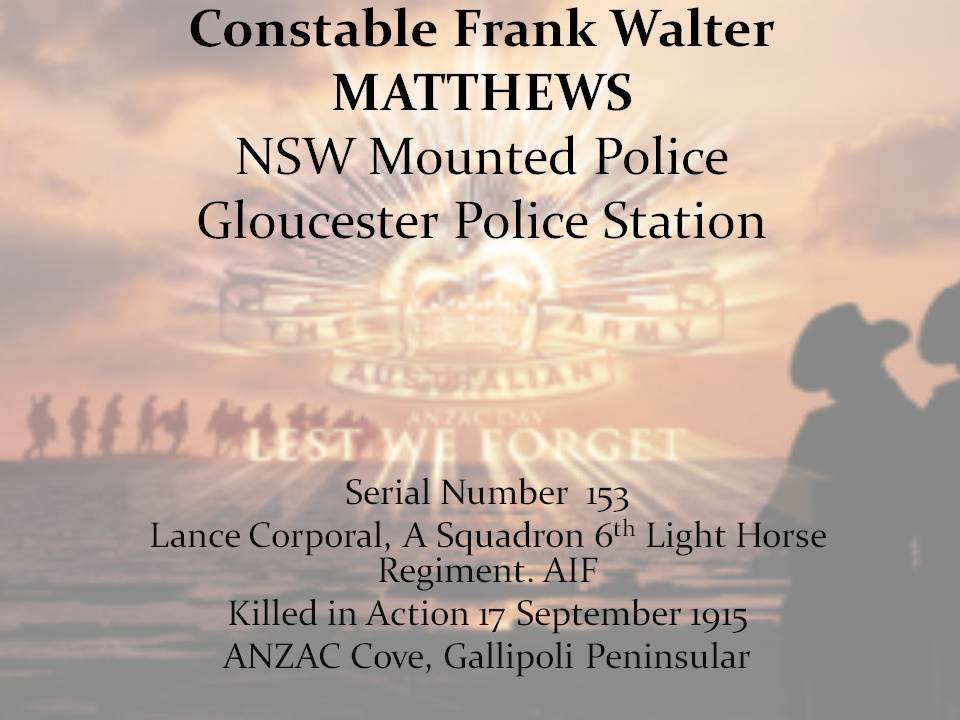
Frank Walter MATTHEWS
ANZAC
FRANK is NOT mentioned on the Police Wall of Remembrance * NOT JOB RELATED
Funeral location:
2nd Lieutenant Alexander Frank BUSKIN, 6th LHR. Killed in action at Bolton’s Ridge, 17/09/1915.
Trooper William Bradley INGRAM, 6th LHR. Killed in action 17/09/1915.
Trooper Frank Walter MATTHEWS, 6th LHR. Killed in action 17/09/1915.
Trooper Lyle Hugh Florian O’NEILL, 6th LHR. Killed in action 17/09/1915.
Captain Rupert Noel RICHARDSON, 6th LHR. Killed in action 17/09/1915.
Trooper David Matthew JACOMBS, 7th LHR. Killed in action 17/09/1915.
Trooper Ernest Ambrose ROBERTS, 7th LHR. Killed in action 17/09/1915.
http://pandora.nla.gov.au/pan/64423/20090520-1059/www.lighthorse.org.au/forum/postfaa8.html
Just as an aside, his wife applied for a pension in 1918 and was granted a pension for herself and their son, also named Frank Walter Mathews. Frank (Jr) was born in 1915 in the East Maitland District (NSW BDM). At this stage there is no death record of Frank (Jr).
Frank (Sr) enlisted 18/09/1914, killed 17/09/1915 – 364 days. Without getting a birth certificate for Frank (Jr) it is not known whether he was born just before or after Frank (Sr) was killed.
NSW Government Employees Granted Military Leave, 1914-1918
The below link, from the NSW Government Employees Granted Military Leave, 1914 – 1918 has F. W. MATTHEWS, Ordinary Constable of Gloucester; North Eastern District, Gloucester Station, being KILLED in Action at Gallipoli on the 6 September 1915 – being a conflicting date of death from that of the Light Horse.org.au website.
The below Citation comes from NRS 4481 Glass negatives ( NRS4481_ST6724P ), plus NRS 10946 Police salary registers [3/2995], SR Reel 1974, plus Police Department Annual Report for the year 1915, in Parliamentary Papers 1915-16, Vol.4, p.635, plus Police Department Annual Report for the year 1918, in NSW Parliamentary Papers 1919, Vol.3, p.603, plus Police Department Annual Report for the year ended 1917, in NSW Parliamentary Papers 1918, Vol.3, p.665.
Henry CHADBAN
03/05/2016 Henry CHADBAN
( late of Stroud, NSW )
New South Wales Police Force
Regd. # ?
Rank: Constable
Stations: Newcastle
Service: From ? January 1912 to ?
[blockquote]
Australian Imperial Force:
Regiment: 13th Battalion, Australian Infantry.
Enlisted: 30 April 1915
Service # 2129
Rank: Private
Embarkation: 14 June 1915 from Sydney aboard HMAT Wandilla A62
Next of kin: Son of Henry & Mary Jane Chadban
Religion: C of E
Single / Married: Single
Australian Ware Memorial Panel number: 68
[/blockquote]
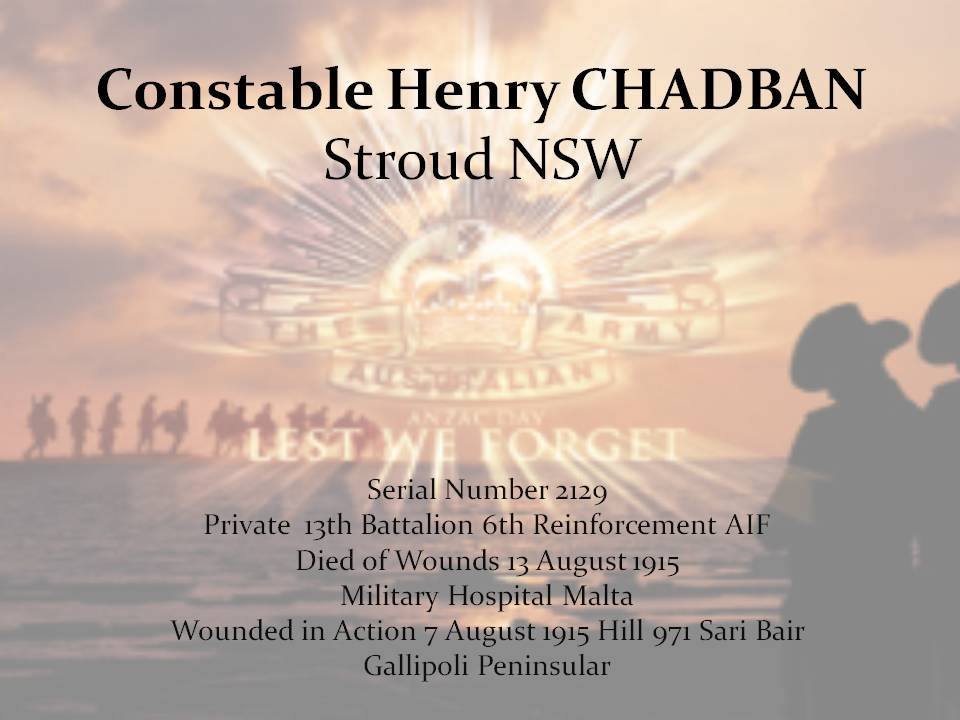
Awards: Memorial Scroll & King’s Message – received by his father on 29 August 1921
Memorial Plaque & King’s Message received by his father on 3 April 1922
Victory Medal – posthumously received by his father on 25 December 1922
Born: ? ? 1887
Event date: Saturday 7 August 1915
Event location: Hill 971, Sari Bair, Gallipoli Peninsular
Died on: Friday 13 August 1915
Place of death: Military Hospital, Malta
Cause: Died of wounds – WW I
Age: 28
Funeral date: 14 August 1915
Funeral location: ?
Buried at: Pieta Military Cemetery, Malta. Row 6B grave 3
Memorial at: ?
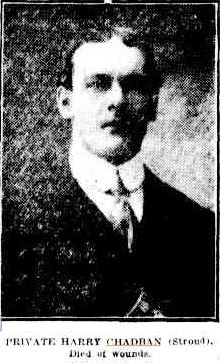
Harry CHADBAN aka Henry
HENRY is NOT mentioned on the Police Wall of Remembrance * NOT JOB RELATED
Funeral location: [codepeople-post-map]
Newcastle Morning Herald & Miner’s Advocate Friday 14 March 1913 page 7 of 8
A Violent Customer. Olaf Anderson (21), seaman, was charged with maliciously damaging one door and two windows, the property of Cenuto Gabriel Anderson. Accused said he pleaded guilty to breaking one window, but to nothing else.
Prosecutor stated that the accused came to the Blue Bell Hotel, of which witness was lessee, somewhat the worse for liquor, shortly before eleven o’clock on the previous evening. He smashed in the panel of the door, but whether he kicked it in or struck it with a stone he did not know. He also broke two of the windows with a stone.
Constable Chadban deposed to arresting the accused, and corroborated the extent of the damage done. Accused was fined £1, and ordered to pay £3, the amount of the damage done, in default, one month’s imprisonment.
http://trove.nla.gov.au/ndp/del/article/136826421
Newcastle Morning Herald & Miner’s Advocate Thursday 6 November 1913 page 7 of 8
William Craig was charged with having been drunk and disorderly in a railway carriage on October 26. Defendant, who was represented by Mr. A. H. James, pleaded not guilty.
Constable Chadban said he was a passenger on the train which left Toronto for Newcastle at 6p.m. on October 26. Defendant got in the train at Cockle Creek. He was very much under the influence of drink, and went into the guard’s compartment. He sat on the guard’s seat, and when asked to go into the other part of the compartment refused to do so. He stopped arguing with the guard for five minutes. Witness told the defendant he was a constable, and took his name and address.
To Mr. James: The guard’s compartment was the end portion of a long American car. Defendant could walk straight, and board the train. Defendant denied that he was drunk, or in any way disorderly. He was not aware that the compartment was reserved for the guard. He had been to Speers’ Point to see some friends, and had spent an hour and a half watching White law training. He had five medium-sized glasses of beer, but was by no means drunk. He put his foot on the guard’s tucker tin, and apologised for doing so. He had not travelled in such carriages before.
Thomas Gould said that the defendant was not drank. There were other people drinking beer out of bottles in the carriage, and they were pretty jolly. Neither defendant nor witness took any part with them. Evidence was given by E. Hunter, and the case was dismissed.
http://trove.nla.gov.au/ndp/del/article/137024704
Henry is described as being 5′ 10 3/4″ tall, 165 lbs, with a 34″ chest, brown eyes and dark hair and is 4th born of 15 children.
When he died, Henry’s possessions consisted of: Purse, two coins, key, tobacco, razor, fountain pen, note book & tin of thymenthol.
7 August 1915 – wounded at Gallipoli
12 August 1915 – Head wound
14 August 1915 – Fractured skull – Abscess on brain – died of wounds
On the 7 October 1916, Henry’s father received his meager belongings.
http://recordsearch.naa.gov.au/SearchNRetrieve/Interface/ViewImage.aspx?B=3223612
https://www.aif.adfa.edu.au/showPerson?pid=49499
The Sydney Morning Herald Saturday 18 September 1915 page 20 of 26
PRIVATE H. CHADBAN.
Private Henry Chadban (died of wounds) was 28 years of age, and a son of Mr. and Mrs. H. Chadban, of Stroud. He was educated at the Stroud Public School and afterwards worked in the Gloucester and Bellinger River districts as a timber-getter gaining a reputation as a wood chopper.
Deceased was a prominent member of the East Raleigh Football Club and was also a good cyclist, and the holder of several gold medals won at those sports. In 1912 he joined the police force and was stationed at Newcastle until war broke out when he enlisted with the 13th Battalion. Private Chadban was in 1913 awarded the Royal Humane Society’s certificate for life saving.
http://trove.nla.gov.au/ndp/del/article/15614381
The Gloucester Advocate ( NSW ) Saturday 18 September 1915 page 2 of 4
PRIVATE HENRY CHADBAN
The late Private Henry Chadban, reported killed at the Dardanelles, was 28 years of age, and a son of Mr. and Mars. H. Chadban, of Stroud. In his youthful days, Private Chadban was working about Gloucester, and afterwards went to the Belinger River, where he was engaged in the timber industry.
In January, 1912, he joined the Police force in Sydney, and later went to Newcastle. He was a prominent footballer and sportsman generally, and held the certificate of the Royal Live Saving Society. Private Herbert Chadban, a brother, is in hospital in Malta.
http://trove.nla.gov.au/ndp/del/article/158595188
Newcastle Morning Herald & Miners’ Advocate (NSW) Saturday 2 October 1915 page 5 of 16
A.N.A. SOLDIERS
Constable Harry Chadban, who, enlisted from Newcastle, where he was stationed for some months, died on August 13th of wounds received at the Dardanelles. His parents live at Stroud, and he was the first member of the Newcastle branch of the Australian Natives Association to be killed, although about thirty members have enlisted, a great many of whom are already at the front. At a meeting of the branch this week a special minute was passed appreciatively recording Mr. Chadban’s services, and the mortuary allowance of £20 was passed for payment to his next-of-kin.
Mr. C. H. Tonkin, the secretary of the branch, has formulated a scheme, which is to be considered at next meeting, whereby the members who are remaining at home will by special contribution keep those who have gone to the front financially good on the books during their absence. This scheme, which appears to be generally approved, will have the twofold effect of avoiding the need for the branch calling upon the ‘headquarters’ funds for the purpose, and of ensuring to members’ relatives the mortuary allowance of £20 in the event of them being killed or ensuring to members, in the event of injury, the full benefit of £1 1s per week for 52 weeks, and 5s per week for life should they be permanently incapacitated.
http://trove.nla.gov.au/ndp/del/article/137966556
Dungong Chronicle ( NSW ) Tuesday 2 May 1916 page 2 of 6
Whilst in Newcastle last week, the writer observed opposite the post office, in Hunter Street, a marble monument, erected in memory of the fallen of Newcastle. On ‘ Anzac Day ‘ the stone was covered with most beautiful wreaths; on looking over them, I discovered a magnificent wreath from the police of Newcastle to the late Pte. Chadban, of Stroud, who was in the police force at Newcastle at the time of enlisting. I was pleased to note that the police of Newcastle did not forget their comrade on that memorable day, who was so brave to give his life for King and country.
http://trove.nla.gov.au/ndp/del/article/136009502
The Newcastle Sun ( NSW ) Thursday 18 July 1918 page 5 of 6
POLICE HONOR ROLL
Unveiling Next Wednesday
A beautiful marble honor roll, one of the finest of its kind, will be unveiled at the city police station on Wednesday night. The names are inscribed in gold lettering on a black marble scroll, and this is set on a white marble tablet. The roll faces the public entrance to the station, and at present it is draped with the Southern Cross. The words: ” Our Heroes, ” surrounded by a wreath of laurel in bas-relief, with the words ” Newcastle District Police Roll of Honor ” beneath the wreath, are chiselled into the head of the white tablet. At the bottom of the same tablet is chiselled the inscription, ” The Great War, 1914-19. ” So the police apparently believe that the war will conclude next year.
Eight constables‘ names appear on the scroll: — H. Chadban ( of Newcastle, killed ), F. M. Doonan ( of Lambton, killed ), H. W. Hancock ( of Newcastle Water Police, killed ), T. Connell ( of Minmi, killed ), C. W. J. Grant ( of Newcastle Water Police, returned wounded ), D. J. Long ( of Newcastle, still on active service ), V. Digre ( of Newcastle, who served with the naval bridging train and is now in the artillery ) and S. Pender ( who has re-enlisted ). Constable Connell served with the Imperial Forces, being called up as an Irish Reservist.
http://trove.nla.gov.au/ndp/del/article/159096387
Newcastle Morning Herald & Miners’ Advocate Thursday 25 July 1918 page 5 of 8
NEWCASTLE POLICE. ROLL OF HONOUR UNVEILED. A roll of honour to the members of the Newcastle police who have gone to the war was unveiled at the police station last night, in the presence of a very large muster of members of the force.
The officers present were: Superintendent Goulder, who has entered on leave of absence prior to retirement; Superintendent Childs, his successor; Inspectors Cook, Buzacott, Hood, and Hojel. There were more than 40 police present.
Alderman Kilgour, the Mayor of Newcastle, Mr. C. F. Butler, S.M., and Mr. W. G. Chiplin, chamber magistrate at Newcastle, were also present.
There are eight names on the roll– H. Chadban, F.M. Doonan, H. W. Hancock, T. Connell, C. W. J. Grant, D. J Long, V Digre, and S Pender. The first four have made the supreme sacrifice. The last mentioned, as Superintendent Childs said, was mentioned in despatches for meritorious work at the Dardanelles. ( S. Pender )
On his return he rejoined the force, but had felt the call so strong that he had again resigned and enlisted. The names are inscribed on a scroll of black marble, which is mounted on a white polished panel, and surmounted with a white marble pediment richly carved, with a laurel wreath and the flags of the Empire and Australia. At the top is inscribed ” Our Heroes, ” and immediately below ” Newcastle District Police. ” Below the names are the words, ” For King and Country, ” and lower down, ” The Great War, 1914-19, ” space being left to fill in the year in which the war ends.
Superintendent Childs. who unveiled the roll, said it was with feelings of pleasure mingled with regret that he performed that function, pleasure because he felt proud of belonging to the same force as the men whose names were inscribed on the roll, and regret that four of them had laid down their lives, two in Gallipoli and two in France. When the Empire was in danger these men did not hesitate, but freely and voluntarily gave their services to their King and country. They had the satisfaction of knowing that the Empire was fighting for a righteous and just cause. He took that opportunity of mentioning that since the war began 158 members of the police force had enlisted, 40 had died on active service, 32 had returned, and 81 were still on military service. In addition, six clerks, who were attached to the Inspector-General’s Office, had enlisted. One of them died on the way to the front, another was invalided home, and the four others were still on active service. The Mayor briefly supported the remarks of Superintendent Childs, and paid a warm tribute to the patriotism of the men who had enlisted. He expressed his appreciation at being invited to take part in the function.
Superintendent Goulder said he felt it a great privilege to say a few words regarding their honoured comrades who had offered their lives on the altar of duty and patriotism. He always felt a thrill when he saw two or three soldiers who were voluntarily prepared to give their lives without any advantage whatever to themselves, apart from the satisfaction of knowing they had done their duty in the highest and fullest degree. ” I have always said ” added Superintendent Goulder, ” that military offenders who are going to the war, or have been, should not be treated in the same category as civilians guilty of similar minor offences. I would ask, as a special personal favour, if you have occasion to interfere with soldiers, do it as kindly and as charitably as you can, remembering the sacrifices they have made and the hardships they have suffered “.
In unveiling the roll, Superintendent Childs said he would apply words used by the Governor-General recently in unveiling a roll of honour, ” I unveil this roll to the honour of those connected with the Newcastle Police Force. I dedicate it to the glory of God, to the memory of those who have fallen, who have been wounded, who are returning to us, and who are about to serve in our renowned Australian Divisions. ” Inspector Cook paid a tribute to Constable J. Chandler, from whom the idea of having the memorial emanted, and who, once the superintendent’s permission was obtained, pushed the matter ahead with great energy. Constable Chandler expressed his pleasure at seeing such a large muster, and said when the movement was started the money was rapidly subscribed.
http://trove.nla.gov.au/ndp/del/article/140973599
Dungong Chronicle Tuesday 22 August 1916 page 2 of 6
ROLL OF HONOR. CHADBAN. —
In loving memory of our dear Son and Brother, Private Henry Chadban, No. 1292, 6th of 13 Batt., 4th Aus. Inf. Brigade, who died of wounds at Malta, on 13th Aug., received at Lone Pine Aug. 7th, 1915. Aged 29
He rose responsive to his country’s Call
And gave for her his best, his life, his all.
He fell a hero in the deadly strife,
For, King and Country he laid down his life.
Inserted by his loving Mother and Father, Sisters and Brothers.
M. and H. Chadban.
http://trove.nla.gov.au/ndp/del/article/136008568
Dungong Chronicle Tuesday 13 August 1918 page 2 of 6
ROLL OF’ HONOR CHADBAN. —
Private Henry Chadban, 13th Batt., wounded in the Lone Pine raid on 7 th August, and died on 13th, 1915, at Malta, aged 28 years.
He bravely answered duty’s call,
He gave his life for one and all.
Inserted by his loving father, mother, brothers and sisters.
http://trove.nla.gov.au/ndp/del/article/134141291
The Newcastle Sun ( NSW) Friday 10 January 1919 page 3 of 6
POLICE HONOR ROLL
From ‘The Sydney Sun”

Newcastle Police Honour Roll
The names on the roll are H. Chadban, F. M. Doonan, H. W. Hancock, T. Connell, all of whom have made the supreme sacrifice, and C. W. J. Grant, D. J. Long, V. Dicre and S. Pender. Many other Newcastle policemen volunteered for active service, but were rejected.
http://trove.nla.gov.au/ndp/del/article/159368377
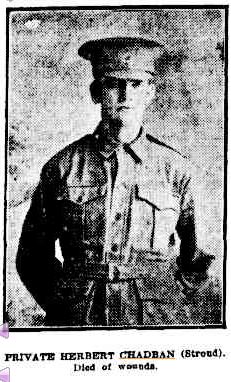
Herbert CHADBAN
Private Herbert CHADBAN, Service # 1926, with the 2nd Australian Infantry Battalion, Australian Army, died on 4 May 1917, in France, aged 26.
Herbert is mentioned / buried at: Villers-Bretonneux Memorial, Villers-Bretonneux, Picardie, France
Henry HODDER
03/05/2016 Henry HODDER
New South Wales Police Force
Regd. # ?
Rank: Constable
Stations: ?, Broken Hill
Service: From 1911 to 24/08/1914. 3 years
[blockquote]
Regimental Serial # 502
Private,
Headquarters 3rd Battalion AIF
Killed In Action at Lone Pine
ANZAC Cove, Gallipoli Peninsular
[/blockquote]
Awards: 1914-15 Star, British War Medal, Victory Medal
Born: Orange, NSW, 1888
Died on: 9 August 1915
Cause: Battle wounds in the Battle of Lone Pine WW I
Age: 26
Funeral date: NIL
Funeral location: NIL
Buried at: K.I.A. & M.I.A.
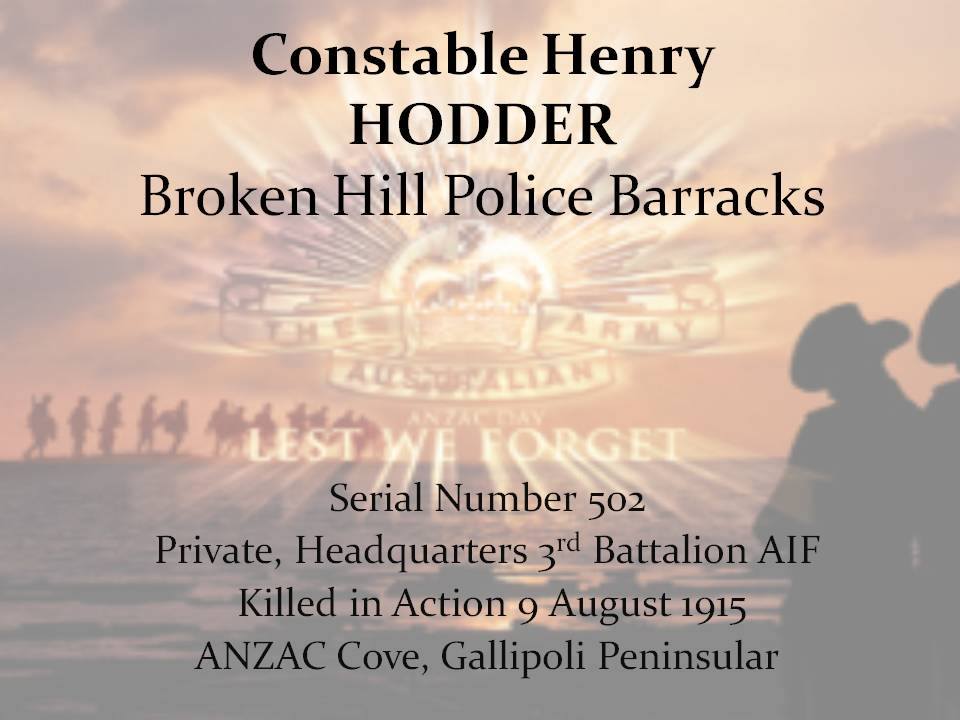
Henry HODDER – R.I.P.
HENRY is NOT mentioned on the Police Wall of Remembrance * NOT JOB RELATED
Funeral location: NO FUNERAL. K.I.A. & M.I.A.
Cemetery or memorial details: Lone Pine Memorial, Gallipoli Peninsula, Canakkale Province, Turkey
Henry HODDER
Regimental number
502
Religion
Church of England
Occupation
Police constable
Address
Police Barracks, Broken Hill, New South Wales
Marital status
Single
Age at embarkation
26
Next of kin
W Hodder, Wottomandara, via Cowra, New South Wales
Enlistment date
24 August 1914
Rank on enlistment
Private
Unit name
10th Battalion, H Company
AWM Embarkation Roll number
23/27/1
Embarkation details
Unit embarked from Adelaide, South Australia, on board Transport A11 Ascanius on 20 October 1914
Rank from Nominal Roll
Driver
Unit from Nominal Roll
3rd Brigade Headquarters
Fate
Killed in Action 9 August 1915
Other details
War service: Egypt, Gallipoli
Medals: 1914-15 Star, British War Medal, Victory Medal
https://www.aif.adfa.edu.au/showPerson?pid=139450
Hodder was attached to the Brigade Head Quarters and was hit about the end of June by a shell when in his dug out which blew off both his legs. His mate, Gordon Farnham, dressed his wounds and passed him on to the Dressing Station.
Informant heard that he was in Egypt and still alive.
Ref. Pte. G. A. Sergent, 1064,
10 A.I.F.
1st A. G. Hospital, Heliopolis, Cairo ( 6. 12. 15 )
Informant says he was told that Hodder had his leg blown off. He cannot say who told him nor can he fix the date. Hodder was a policeman at Broken Hill and he and several policemen came down with informant to Adelaide to enlist. Hodder was at one time in the 3rd Bgde. Transport.
Ref: Pte. A. R. Perry, 525,
10 A.I.F. C. Co. Gezira Hospital, CAIRO 5.1.16
Informant received the following information from Bgde. H.Q.:-
Whilst Hodder was doing police duty on the beach at Anzac during July, a shell exploded in the dug-out almost severing both legs and arms from body. Was sent back to Egypt and believed to have died in Alexandria.
Ref: Pte. Tanner, 25,
3rd Bgde. H. Q. Al liayat Convalescent Home, Helouan, Cairo. 3.12.15
He and Pte D. Fisher were in Police Duty at Brigade headquarters on August 6 and were each hit by same shell. Hodder had one or both legs blown off and Fisher lost one or more limbs. Witness did not see this happen but heard it from mates and regarded it as absolutely ture, but could never find out what became of either of them subsequently.
About 5ft 10 or 11, fair, clean shave, enlisted in South Australia, stout build, about 12 or 13 stone.
Pte. A. A. Smith 1040 A Coy, 10, A.I.F., Malta 6.1.16
Both legs were blown off by a shell explosion whilst in his dug-out behind the trenches to the right of Lone Pine.
He died in the dressing station on the beach. Informant received the above account of Hodder’s death from J. Thomas, Stretcher-bearer, 10 A.I.F.
Ref: Sgt. Neave, 131, Sporting Club Hospital, Heliopolis, Cairo 10.1.16
Court of Inquiry held in France 7.9.17 found this soldier K. in A. on or about 9.8.15. No hospital admission nor place of burial available.
H.Q. 11.12.17
London 13.12.17
http://static.awm.gov.au/images/collection/pdf/RCDIG1047376–1-.pdf
The above pd
f document is a ‘broader’ copy of the above text.
William George HOGG
03/05/2016 William George HOGG
Victoria Police Force
Regd. # 6320
Rank: Superintendent
Stations: Gun Bower, Swan Hill
Service: From ? ? 1919 to ? ? ? = ? years Service
Awards: * Police Valor Badge granted in 1923 for the arrest of an armed escapee from Castlemaine Prison
[blockquote]
Australian Commonwealth Military Forces
Regimental # 915
Enlisted: 19 August 1914 aged 19
Rank: Driver
Unit: Field Artillery Brigade 2, Battery 4
Returned to Australia: 8 October 1918
[/blockquote]
Born: ? ? ?
Died on: Thursday 4 June 1953
Cause: Illness – stomach cancer stemming from being ‘gassed’ during WWI
Age: 57
Funeral date: Monday 8 June 1953
Funeral location: ?
Buried at: Melton Cemetery, Centenary Ave, Melton, Victoria
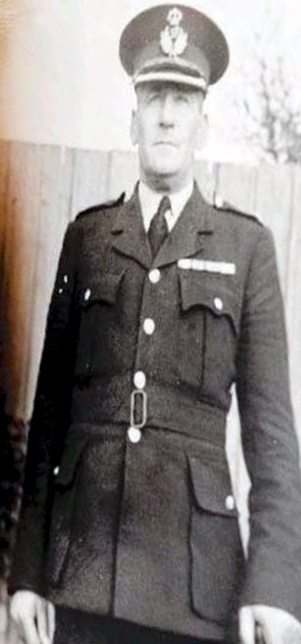
Supt. William George HOGG
WILLIAM is NOT mentioned on the Police Wall of Remembrance * NOT JOB RELATED
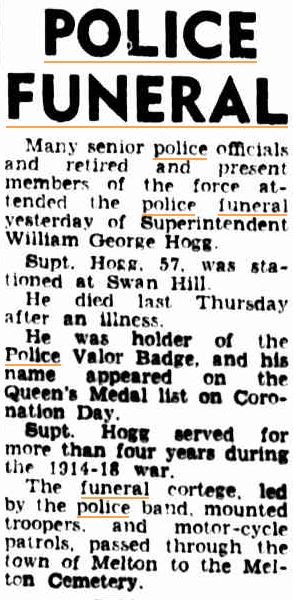
William George HOGG – death article.
The Argus ( Melb. ) Tues 9 June 1953 p 6 of 16

Private William George HOGG
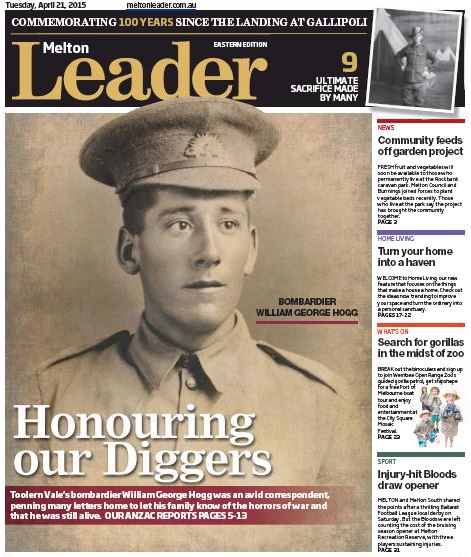
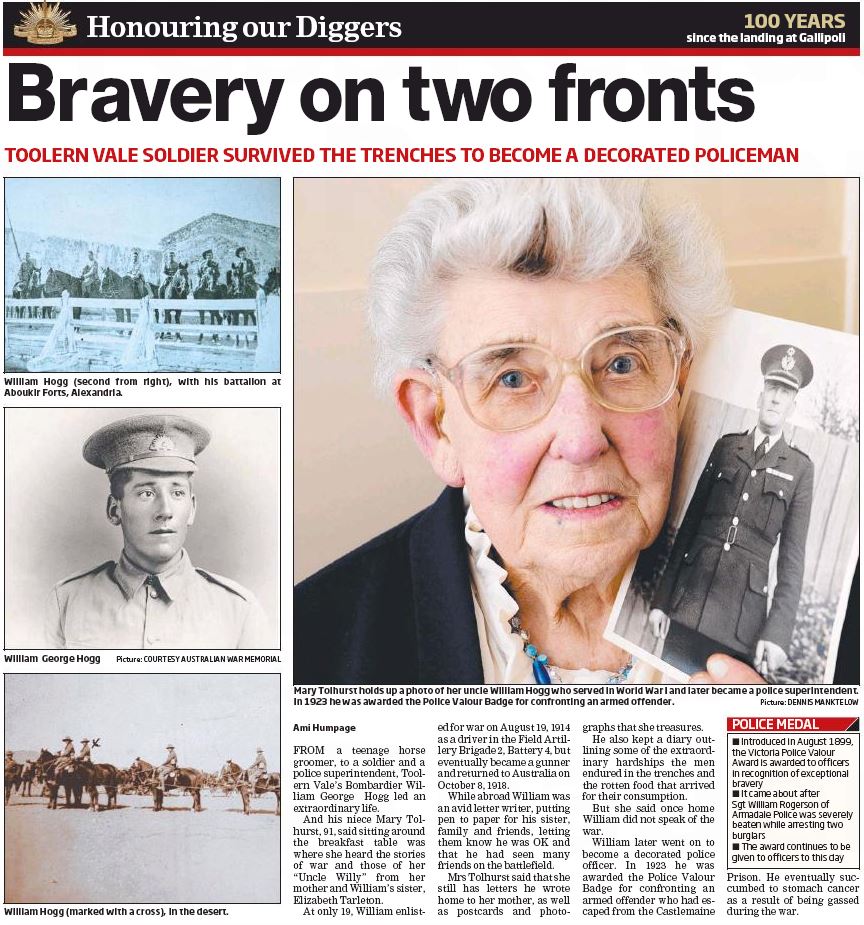
Leader Community Newspapers
http://leader.newspaperdirect.com/epaper/viewer.aspx
Melton Leader Eastern Edition
21 April 2015
Honouring our Diggers
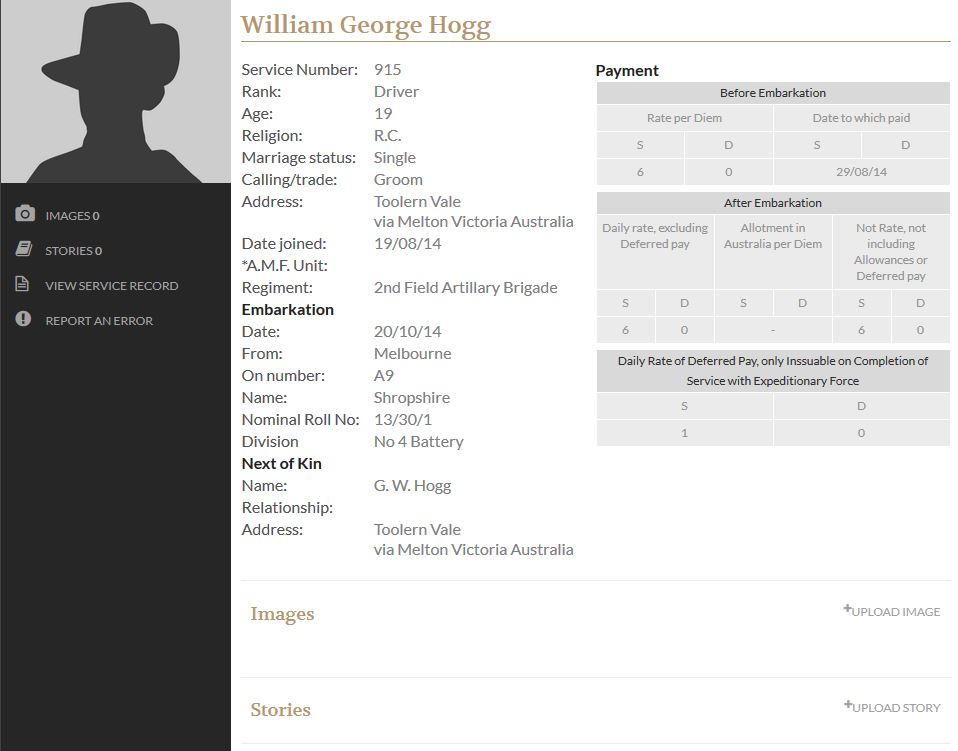
Constable William George Hogg 6320
Gunbower Police Station
Escaping from Castlemaine reformatory teenager Nathaniel Baker was tracked to the bank of the Murray at Braund’s farm, Wharparilla, 3 miles from Echuca. Mounted Constable Daniel O’Connor noticed impressions, which he recognised as those of boots worn by prisoners. Following the tracks for some distance, he learnt Braund’s boat having been taken from its mooring, evidence suggesting the fugitive travelled down stream. Setting off in pursuit, 3 miles from Lockington, he discovered the abandoned boat however no trace of the escaped prisoner.
Establishing through diligent enquiry a person, in possession of a double-barrelled gun, answering the description of Baker called at the farm of Mr. Williams, partaking of an evening meal. A request for cartridges was complied with without fuss with the provision of four. Departing, Baker informing Williams he intended travelling to Gunbower.
Assisting in the search, officer in charge of Gunbower, Bill Hogg, upon receiving the information, travelled on the night of Tuesday 18 June 1923 with Mounted Constable Daniel O’Connor, to an abandoned hut on Gunbower Island, arriving about 11.30 p.m.
Cautiously approaching, the policing pair discovered their man asleep in the room; double-barrelled shotgun within easy grasp. Making a dash through a window, Bill Hogg secured the weapon, whilst Daniel O’Connor arrested the escapee without resistance. Without food and with little clothing, Baker told the police that he would not have attempted to use the gun even if the opportunity presented itself.
Placing a good mark on their records, Superintendent Donovan of Bendigo, recommended Constable Bill Hogg, of Gunbower, and Mounted Constable Daniel O’Connor, of Echuca, for pre-eminent valor and bravery in the discharge of their police duties in capturing Nathaniel Baker, on Gunbower Island on Thursday 15 June 1923, recommended the pair receive a Merit Badge.
Superintendent William George Hogg, of Swan Hill, died in the Police Hospital, St. Kilda Road, on 4 June 1953, aged 57 years, after a brief illness [stomach cancer]. Bacchus Marsh, Victoria born son of George William Hogg and Catherine Jane Watts, 19 years old groom, Bill Hogg landed at Gallipoli on Anzac Day with the 4th Battery; later to be gassed in the battle trenches of the Western Front, France.
Joining the Victoria Police Force in 1919, at the outbreak of the Second World War, Bill Hogg was one of the original team of four to establish D24. Superintendent William George Hogg was buried with full police honours at Melton, Victoria, leaving a wife and three daughters to mourn their loss.
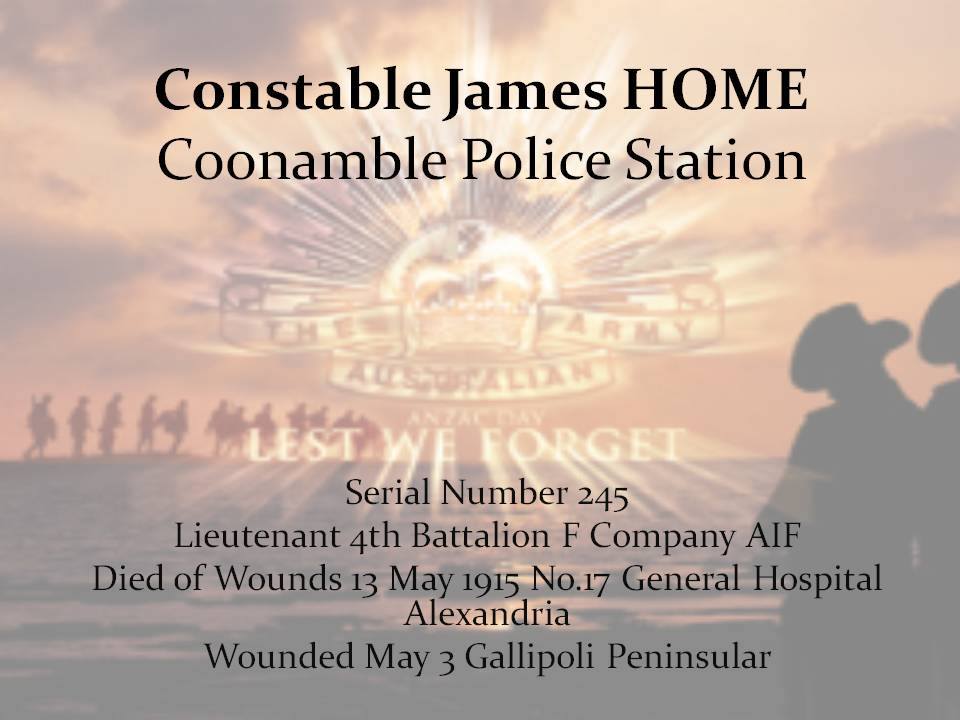
James HOME
03/05/2016 James HOME
New South Wales Police Force
Regd. # Q 9372
For the purposes of this website ‘Q‘ represents those Police joining between 1862 ( commencement of NSWPF ) – 23 February 1915 ( Commencement of NSWPF current numbering system )
Rank: Constable
Stations: Coonamble, Dubbo
Service: From 23 February 1912 to 13 May 1915 = 3+ years Service
[blockquote]
Australian Imperial Force
Regiment: 4th Battalion F Company
Enlisted: 18/08/1914, Sydney. Due to his previous military service he was sworn in as Colour Sergeant
Service # 245
Rank: 2nd Lieutenant
Embarkation: on board Transport A14 Euripides on 20 October 1914
Next of kin: Father George Home, Harwick, Scotland
Religion: ?
Single / Married: ?
[/blockquote]
Awards: Queens South Africa Medal. Served 7 years with 1st Argyle and Sutherland Highlanders.
1914/15 Star.
British War Medal.
Victory Medal
Born: c 1884, Scotland
Died on: 13 May 1915
Place of death: # 17 General hospital, Alexandria
Cause: died of wounds received on 3 May 1915 at Gallipoli Peninsular. Gun shot wound to the left leg
Age: 31
Funeral date: Buried same date 13/05/1915
Funeral location: Graveside
Buried at: Chatby Military Cemetery, Alexandria, Eqypt. Plot F, Grave 48
From his Father – “Came of a Border fighting clan, the Homes of HOME, very many of whom fell in Scotland’s wars, notably around their king at FLODDEN – vide Scott’s “Marmion.”” Details from Father.
Memorial at:
JAMES is NOT mentioned on the Police Wall of Remembrance * NOT JOB RELATED
ANZAC
John Philip SHEAHAN
03/05/2016 John Philip SHEAHAN
New South Wales Police Force
Regd. # ?
Rank: Police Constable
Stations: Parkes
Service: From ? to ?
[blockquote]
Australian Imperial Force
9th Australian Light Horse Regiment
Enlisted: 25 August 1914
Service # 466
Rank: Corporal, Squadron Quartermaster Sergeant
Embarkation: from Sydney on the HMAT A16 Star of Victoria on 20 October 1914
Next of kin: Mrs Mary Ann Sheahan, mother, Jugong, NSW
Religion: Roman Catholic
Fate: Returned to Australia 15 November 1918
Link: https://www.aif.adfa.edu.au/showPerson?pid=272285
[/blockquote]
Awards: ?
Born: ?
Died on:
Place of death:
Cause:
Age: 29
Funeral date: ?
Funeral location: ?
Buried at: ?
JOHN is NOT mentioned on the Police Wall of Remembrance * NOT JOB RELATED
Funeral location:
John Bede MOYLAN
03/05/2016 John Bede MOYLAN
New South Wales Police Force
Regd. # ?
Rank: Mounted Constable
Stations: Orange, Rylstone
Service: From ? to ?
[blockquote]
Australian Imperial Force
1st Australian Light Horse Regiment, C Squadron, I.C.C. ( Imperial Camel Corps. ) 1916/17.
Enlisted: 1 September 1914
Service # 435
Rank: Lance Corporal, 1st Lieutenant & QM ( Quarter Master ), Captain
Embarkation: From Sydney on HMAT A16 Star of Victoria on 20 October 1914
Next of kin: Mrs. A. H. Moylan, wife, of Rockley, vid George’s place, NSW
Religion: Roman Catholic
Injuries: May 1918 had a fall whilst alighting from a train in Egypt, suffering injury to his back & side but went back to duty a short time later ( this may have contributed to his death 4 months later ).
Links: http://discoveringanzacs.naa.gov.au/browse/records/308329/1
[/blockquote]
Awards: MC ( Military Cross ), Victory Medal & British War Medal.
Born: ? ? 1878 in Crookwell, NSW
Died on: 28 September 1918
Place of death: Egypt
Cause: Pneumonia & Nephitis
Age: 40
Funeral date: ?
Funeral location: ?
Buried at: Gaza Military Cemetery. Plot XXXII, G. 7., Palestine
JOHN is NOT mentioned on the Police Wall of Remembrance * NOT JOB RELATED
According to his records. He was born in Crookwell, NSW in 1878. At the time of his enlistment his occupation was Mounted Constable. He was stationed at Orange for a time and was stationed at Rylstone when he enlisted on 01/09/1914 aged 36.
He rose through the ranks very quickly and during 1916/17 whilst attached to the ICC (Imperial Camel Corps) was promoted to 1st Lieutenant and QM (Quarter Master).
In May 1918 he had a fall whilst alighting from a train in Egypt and suffered an injury to his back and side but went back to duty a short time later (This may have contributed to his death 4 months later).
At the time of his non HOD injury his rank was Captain and still QM ( Quarter Master ) of the 3rd British Camel Battalion.
In the London Gazette 03/06/1918 Captain John Bede MOYLAN awarded the Military Cross (MC) for Conspicuous Service.
The MC is granted in recognition of “an act or acts of exemplary gallantry during active operations against the enemy on land to all members, of any rank in Our Armed Forces”
He was also awarded the Victory Medal and British War Medal.
On 28/9/1918 aged 40 died in Egypt from Pneumonia and Nephitis ( a very painful and life threatening kidney complaint).
It should also be noted that he also enlisted and served as a Trooper in the NSW Lancers, Boer War.
He is buried in the Gaza Military Cemetery. Plot XXXII, G, 7. There are 2 other plot locations (may have been ‘relocated’ after initial burial).
I think they may have got his ‘age’ wrong giving it as 42. All records indicate that he was 40 at the time of his death.
Research by Kevin Banister
Funeral location: ?
FROM THE VAULT – Lest we forget
When the first world war was announced, many Queensland Police officers heard the call and took leave to join the A.I.F.
Of those police officers who joined the war effort, thirty paid the ultimate price and did not return home. Today we remember their sacrifice.
_________________________________
25 April 1915 – Private Patrick Moynihan, 9th Battalion AIF, while on leave from his job as Constable, is Killed In Action at the Dardanelles in Turkey.
2 May 1915 – Private David Bourke, 15th Battalion AIF, while on leave from his job as Constable, dies of wounds at Alexandria in Egypt.
3 May 1915 – Corporal William Hughes, 15th Battalion AIF, while on leave from his job as Constable, is KIA at the Dardanelles in Turkey.
7 May 1915- Private John Johnston, 15th battalion AIF, while on leave from his job as Constable is Killed In Action at the Dardanelles in Turkey.
19 July 1915 – Private Robert Ritchie, 25th Battalion AIF, on leave from his job as Constable, dies from illness while on active service at sea.
2 October 1915 – Private Phillip Vowles, 9th Battalion AIF, on leave from his job as Constable, dies from illness while on active service in London.
15 October 1915 – Private Eugene Nugent, 25th Battalion AIF, on leave from his job as Constable, is Killed in Action at the Dardanelles in Turkey.
22 November 1915 – Trooper John Christiansen, 5th Australian Light Horse, on leave from his job as Constable, is Killed In Action at Gallipoli in Turkey.
25 July 1916 – Corporal Joseph Thompson, 9th Battalion AIF, while on leave from his job as Constable, is Killed In Action in France.
26 July 1916 – Corporal Thomas Dedman, 12th Battalion AIF, while on leave from his job as Constable is Killed In Action at Pozieres in France.
5 November 1916 – Sergeant George Dewhurst, 25th Battalion AIF, on leave from his job as Constable, is Killed In Action at Pozieres in France.
5 November 1916 – Private William Bishop, 25th Battalion AIF, on leave from his job as a Constable, is Killed In Action in France.
1 February 1917 – Sergeant Peter Mulvie, 15th Battalion AIF, on leave from his job as Constable, is Killed In Action in France.
3 May 1917 – Lance Corporal Archibald Curvey, 20th Battalion AIF, while on leave from his job as Constable, is Killed In Action at Bullecourt in France.
10 September 1917 – Private Henry McLean, 1st Battalion Irish Guards, while on leave from his job as Constable is Killed In Action in Belgium.
22 September 1917 – Private John Graham D.C.M, 9th Battalion AIF, on leave from his job as Constable, dies of wounds in Belgium.
12 October 1917 – Corporal Oswald Goodrich, 12th Australian Light Trench Mortar Battery, on leave from his job as Constable, is Killed In Action in Belgium.
3 November 1917 – Lieutenant Patrick Devine, 9th Battalion AIF, on leave from his job as a Constable, is Killed In Action in Belgium.
28 March 1918 – Sergeant John Warfield, 47th battalion AIF, on leave from his job as Constable, is Killed In Action in France.
30 March 1918 – Sergeant John Fitzgerald, 8th Brigade Australian Field Artillery, on leave from his job as Constable, is Killed In Action in France.
31 March 1918 – Sergeant Harry Wells, 26th Battalion AIF, on leave from his job as Constable, is Killed In Action in Belgium.
19 April 1918 – Sergeant Walter Dumbrell, 41st Battalion AIF, on leave from his job as Constable, is Killed In Action at the Somme in France.
10 June 1918 – Lance Sergeant Frederick White, 25th Battalion AIF, on leave from his job as Constable, is Killed In Action in France.
20 June 1918 – Private David O’Donoghue, 9th Battalion AIF, on leave from his job as Constable, is Killed In Action in France.
8 July 1918 – Private Thomas McGillycuddy, 45th Battalion AIF, on leave from his job as Constable, is Killed In Action at the Somme in France.
15 August 1918 – Corporal Claude Castree, 49th Battalion AIF, on leave from his job as Constable, is Killed In Action in France.
9 September 1918 – Corporal John Herbert, 41 Battalion AIF, while on leave from his job as Constable, dies of wounds at the Somme in France.
25 September 1918 – Trooper Daryl Dodds, Australian Light Horse, while on leave from his job as Constable, is Killed In Action in Egypt.
12 October 1918 – Gunner Ernest Pastorelli, 156th Brigade RFA, on leave from his job as Constable, dies in a German Prisoner of War Camp.
21 November 1918 – Driver John Taylor, 38th Company Australian Service Corps, on leave from his job as a Constable, dies on Active Service in Egypt.
____________________
This information has been supplied by the Queensland Police Museum from the best resources available at the time of writing. The Police Museum is open 9am to 4pm Monday to Friday and 10am to 3pm on the last Sunday of the month (Feb-Nov) and is located on the Ground Floor of Police Headquarters at 200 Roma Street, Brisbane. Contact: E: museum@police.qld.gov.au
“Lest We Forget” by the Queensland Police Service is licensed under a Creative Commons Attribution (BY) 2.5 Australia Licence. Permissions may be available beyond the scope of this licence. http://creativecommons.org/licenses/by/2.5/au/legalcode
http://mypolice.qld.gov.au/museum/2012/04/25/from-the-vault-lest-we-forget/
FROM THE VAULT – Lest we forget
When the first world war was announced, many Queensland Police officers heard the call and took leave to join the A.I.F.
Of those police officers who joined the war effort, thirty paid the ultimate price and did not return home. Today we remember their sacrifice.
_________________________________
25 April 1915 – Private Patrick Moynihan, 9th Battalion AIF, while on leave from his job as Constable, is Killed In Action at the Dardanelles in Turkey.
2 May 1915 – Private David Bourke, 15th Battalion AIF, while on leave from his job as Constable, dies of wounds at Alexandria in Egypt.
3 May 1915 – Corporal William Hughes, 15th Battalion AIF, while on leave from his job as Constable, is KIA at the Dardanelles in Turkey.
7 May 1915- Private John Johnston, 15th battalion AIF, while on leave from his job as Constable is Killed In Action at the Dardanelles in Turkey.
19 July 1915 – Private Robert Ritchie, 25th Battalion AIF, on leave from his job as Constable, dies from illness while on active service at sea.
2 October 1915 – Private Phillip Vowles, 9th Battalion AIF, on leave from his job as Constable, dies from illness while on active service in London.
15 October 1915 – Private Eugene Nugent, 25th Battalion AIF, on leave from his job as Constable, is Killed in Action at the Dardanelles in Turkey.
22 November 1915 – Trooper John Christiansen, 5th Australian Light Horse, on leave from his job as Constable, is Killed In Action at Gallipoli in Turkey.
25 July 1916 – Corporal Joseph Thompson, 9th Battalion AIF, while on leave from his job as Constable, is Killed In Action in France.
26 July 1916 – Corporal Thomas Dedman, 12th Battalion AIF, while on leave from his job as Constable is Killed In Action at Pozieres in France.
5 November 1916 – Sergeant George Dewhurst, 25th Battalion AIF, on leave from his job as Constable, is Killed In Action at Pozieres in France.
5 November 1916 – Private William Bishop, 25th Battalion AIF, on leave from his job as a Constable, is Killed In Action in France.
1 February 1917 – Sergeant Peter Mulvie, 15th Battalion AIF, on leave from his job as Constable, is Killed In Action in France.
3 May 1917 – Lance Corporal Archibald Curvey, 20th Battalion AIF, while on leave from his job as Constable, is Killed In Action at Bullecourt in France.
10 September 1917 – Private Henry McLean, 1st Battalion Irish Guards, while on leave from his job as Constable is Killed In Action in Belgium.
22 September 1917 – Private John Graham D.C.M, 9th Battalion AIF, on leave from his job as Constable, dies of wounds in Belgium.
12 October 1917 – Corporal Oswald Goodrich, 12th Australian Light Trench Mortar Battery, on leave from his job as Constable, is Killed In Action in Belgium.
3 November 1917 – Lieutenant Patrick Devine, 9th Battalion AIF, on leave from his job as a Constable, is Killed In Action in Belgium.
28 March 1918 – Sergeant John Warfield, 47th battalion AIF, on leave from his job as Constable, is Killed In Action in France.
30 March 1918 – Sergeant John Fitzgerald, 8th Brigade Australian Field Artillery, on leave from his job as Constable, is Killed In Action in France.
31 March 1918 – Sergeant Harry Wells, 26th Battalion AIF, on leave from his job as Constable, is Killed In Action in Belgium.
19 April 1918 – Sergeant Walter Dumbrell, 41st Battalion AIF, on leave from his job as Constable, is Killed In Action at the Somme in France.
10 June 1918 – Lance Sergeant Frederick White, 25th Battalion AIF, on leave from his job as Constable, is Killed In Action in France.
20 June 1918 – Private David O’Donoghue, 9th Battalion AIF, on leave from his job as Constable, is Killed In Action in France.
8 July 1918 – Private Thomas McGillycuddy, 45th Battalion AIF, on leave from his job as Constable, is Killed In Action at the Somme in France.
15 August 1918 – Corporal Claude Castree, 49th Battalion AIF, on leave from his job as Constable, is Killed In Action in France.
9 September 1918 – Corporal John Herbert, 41 Battalion AIF, while on leave from his job as Constable, dies of wounds at the Somme in France.
25 September 1918 – Trooper Daryl Dodds, Australian Light Horse, while on leave from his job as Constable, is Killed In Action in Egypt.
12 October 1918 – Gunner Ernest Pastorelli, 156th Brigade RFA, on leave from his job as Constable, dies in a German Prisoner of War Camp.
21 November 1918 – Driver John Taylor, 38th Company Australian Service Corps, on leave from his job as a Constable, dies on Active Service in Egypt.
____________________
This information has been supplied by the Queensland Police Museum from the best resources available at the time of writing. The Police Museum is open 9am to 4pm Monday to Friday and 10am to 3pm on the last Sunday of the month (Feb-Nov) and is located on the Ground Floor of Police Headquarters at 200 Roma Street, Brisbane. Contact: E: museum@police.qld.gov.au
“Lest We Forget” by the Queensland Police Service is licensed under a Creative Commons Attribution (BY) 2.5 Australia Licence. Permissions may be available beyond the scope of this licence. http://creativecommons.org/licenses/by/2.5/au/legalcode
http://mypolice.qld.gov.au/museum/2012/04/25/from-the-vault-lest-we-forget/
Fletcher Evelyn QUINTAL
Fletcher Evelyn QUINTAL
Norfolk Island Police
Regd. # ?
Rank:
Superintendent/O.I.C of Police on Norfolk Island
Stations: Norfolk Island
Service: From ? To 16/07/1916
[blockquote]
Australian Imperial Force
Regiment: 6th Light Horse Regiment, A Squadron
Enlisted: 7 October 1914
Service # 58
Rank: Corporal
Embarkation: 21/12/1914
Next of kin:
Wife Alice, care of Newtown Post Office, Newtown, NSW
Religion: C of E
Single / Married: Married
Returned to Australia:
Shot in left eye, Gallipoli Peninsular 12/06/1915
and returned 7 November 1915
[/blockquote]
Awards:
Boer War
Kings South Africa Medal, Queens South Africa Medal.
WW1
1914/15 Star, British War Medal, Victory Medal
Born:
1868, Norfolk Island
Died on:
31/12/1953
Place of death:
Norfolk Island
Cause: ?
Age: ?
Funeral date: ?
Funeral location:
Norfolk Island
Buried at:
Norfolk Island
Memorial at: ?
FLETCHER is NOT mentioned on the Police Wall of Remembrance * NOT JOB RELATED
Funeral location:
When Fletcher returned to Norfolk Island he was offered his original position in the Police when he enlisted but he realised he could not continue as a Police officer due to his eye injury. He resigned in 1916 and became a ‘farmer’. It is also mentioned that Fletcher is directly related to the members of the crew of the ‘Bounty’ Also in ‘A’ Squadron was Mounted NSW Police Constable Frank Walter MATTHEWS, Gloucester Police Station, NSW, Killed in action, 17/09/1915, Gallipoli Peninsular.
Frank Walter MATTHEWS
03/05/2016 Frank Walter MATTHEWS
New South Wales Police Force
Regd. # ?
Rank: Mounted Constable
Stations: ?, Barmedman Police Stn
Service: From ? to ?
[blockquote]
Australian Imperial Force
Regiment: 2nd Light Horse Brigade, A Squadron, 6th Light Horse Regiment
Enlisted: 18 September 1914 ( Rank: Private ) ( 26yrs 6mths old )
Service # 153
Rank: Lance Corporal
Embarkation: 21 December 1914 aboard HMAT Suevic A29
Next of kin: Mrs. Elizabeth. Kearney, mother, Tullamore, NSW & Sarah Gertrude MATTHEWS – wife, Church St, Gloucester.
Religion: C of E
Single / Married: Single
[/blockquote]
Awards: 1914/15 Star, British Ware Medal, Victoria Medal
Born: ? ? 1888 at Barmedman, NSW
Died on: 17 September 1915
Place of death: ANZAC Cove, Gallipoli Peninsular
Cause: Killed in Action
Age: ?
Funeral date: ?
Funeral location: ?
Buried at: No.1 Shell Green Cemetery, Plot 1, Row B, Grave 9, Gallipoli Peninsular.
Memorial at: ?
Frank Walter MATTHEWS
ANZAC
FRANK is NOT mentioned on the Police Wall of Remembrance * NOT JOB RELATED
Funeral location:
2nd Lieutenant Alexander Frank BUSKIN, 6th LHR. Killed in action at Bolton’s Ridge, 17/09/1915.
Trooper William Bradley INGRAM, 6th LHR. Killed in action 17/09/1915.
Trooper Frank Walter MATTHEWS, 6th LHR. Killed in action 17/09/1915.
Trooper Lyle Hugh Florian O’NEILL, 6th LHR. Killed in action 17/09/1915.
Captain Rupert Noel RICHARDSON, 6th LHR. Killed in action 17/09/1915.
Trooper David Matthew JACOMBS, 7th LHR. Killed in action 17/09/1915.
Trooper Ernest Ambrose ROBERTS, 7th LHR. Killed in action 17/09/1915.
http://pandora.nla.gov.au/pan/64423/20090520-1059/www.lighthorse.org.au/forum/postfaa8.html
Just as an aside, his wife applied for a pension in 1918 and was granted a pension for herself and their son, also named Frank Walter Mathews. Frank (Jr) was born in 1915 in the East Maitland District (NSW BDM). At this stage there is no death record of Frank (Jr).
Frank (Sr) enlisted 18/09/1914, killed 17/09/1915 – 364 days. Without getting a birth certificate for Frank (Jr) it is not known whether he was born just before or after Frank (Sr) was killed.
NSW Government Employees Granted Military Leave, 1914-1918
The below link, from the NSW Government Employees Granted Military Leave, 1914 – 1918 has F. W. MATTHEWS, Ordinary Constable of Gloucester; North Eastern District, Gloucester Station, being KILLED in Action at Gallipoli on the 6 September 1915 – being a conflicting date of death from that of the Light Horse.org.au website.
The below Citation comes from NRS 4481 Glass negatives ( NRS4481_ST6724P ), plus NRS 10946 Police salary registers [3/2995], SR Reel 1974, plus Police Department Annual Report for the year 1915, in Parliamentary Papers 1915-16, Vol.4, p.635, plus Police Department Annual Report for the year 1918, in NSW Parliamentary Papers 1919, Vol.3, p.603, plus Police Department Annual Report for the year ended 1917, in NSW Parliamentary Papers 1918, Vol.3, p.665.
Henry CHADBAN
03/05/2016 Henry CHADBAN
( late of Stroud, NSW )
New South Wales Police Force
Regd. # ?
Rank: Constable
Stations: Newcastle
Service: From ? January 1912 to ?
[blockquote]
Australian Imperial Force:
Regiment: 13th Battalion, Australian Infantry.
Enlisted: 30 April 1915
Service # 2129
Rank: Private
Embarkation: 14 June 1915 from Sydney aboard HMAT Wandilla A62
Next of kin: Son of Henry & Mary Jane Chadban
Religion: C of E
Single / Married: Single
Australian Ware Memorial Panel number: 68
[/blockquote]
Awards: Memorial Scroll & King’s Message – received by his father on 29 August 1921
Memorial Plaque & King’s Message received by his father on 3 April 1922
Victory Medal – posthumously received by his father on 25 December 1922
Born: ? ? 1887
Event date: Saturday 7 August 1915
Event location: Hill 971, Sari Bair, Gallipoli Peninsular
Died on: Friday 13 August 1915
Place of death: Military Hospital, Malta
Cause: Died of wounds – WW I
Age: 28
Funeral date: 14 August 1915
Funeral location: ?
Buried at: Pieta Military Cemetery, Malta. Row 6B grave 3
Memorial at: ?
Harry CHADBAN aka Henry
HENRY is NOT mentioned on the Police Wall of Remembrance * NOT JOB RELATED
Funeral location: [codepeople-post-map]
Newcastle Morning Herald & Miner’s Advocate Friday 14 March 1913 page 7 of 8
A Violent Customer. Olaf Anderson (21), seaman, was charged with maliciously damaging one door and two windows, the property of Cenuto Gabriel Anderson. Accused said he pleaded guilty to breaking one window, but to nothing else.
Prosecutor stated that the accused came to the Blue Bell Hotel, of which witness was lessee, somewhat the worse for liquor, shortly before eleven o’clock on the previous evening. He smashed in the panel of the door, but whether he kicked it in or struck it with a stone he did not know. He also broke two of the windows with a stone.
Constable Chadban deposed to arresting the accused, and corroborated the extent of the damage done. Accused was fined £1, and ordered to pay £3, the amount of the damage done, in default, one month’s imprisonment.
http://trove.nla.gov.au/ndp/del/article/136826421
Newcastle Morning Herald & Miner’s Advocate Thursday 6 November 1913 page 7 of 8
William Craig was charged with having been drunk and disorderly in a railway carriage on October 26. Defendant, who was represented by Mr. A. H. James, pleaded not guilty.
Constable Chadban said he was a passenger on the train which left Toronto for Newcastle at 6p.m. on October 26. Defendant got in the train at Cockle Creek. He was very much under the influence of drink, and went into the guard’s compartment. He sat on the guard’s seat, and when asked to go into the other part of the compartment refused to do so. He stopped arguing with the guard for five minutes. Witness told the defendant he was a constable, and took his name and address.
To Mr. James: The guard’s compartment was the end portion of a long American car. Defendant could walk straight, and board the train. Defendant denied that he was drunk, or in any way disorderly. He was not aware that the compartment was reserved for the guard. He had been to Speers’ Point to see some friends, and had spent an hour and a half watching White law training. He had five medium-sized glasses of beer, but was by no means drunk. He put his foot on the guard’s tucker tin, and apologised for doing so. He had not travelled in such carriages before.
Thomas Gould said that the defendant was not drank. There were other people drinking beer out of bottles in the carriage, and they were pretty jolly. Neither defendant nor witness took any part with them. Evidence was given by E. Hunter, and the case was dismissed.
http://trove.nla.gov.au/ndp/del/article/137024704
Henry is described as being 5′ 10 3/4″ tall, 165 lbs, with a 34″ chest, brown eyes and dark hair and is 4th born of 15 children.
When he died, Henry’s possessions consisted of: Purse, two coins, key, tobacco, razor, fountain pen, note book & tin of thymenthol.
7 August 1915 – wounded at Gallipoli
12 August 1915 – Head wound
14 August 1915 – Fractured skull – Abscess on brain – died of wounds
On the 7 October 1916, Henry’s father received his meager belongings.
http://recordsearch.naa.gov.au/SearchNRetrieve/Interface/ViewImage.aspx?B=3223612
https://www.aif.adfa.edu.au/showPerson?pid=49499
The Sydney Morning Herald Saturday 18 September 1915 page 20 of 26
PRIVATE H. CHADBAN.
Private Henry Chadban (died of wounds) was 28 years of age, and a son of Mr. and Mrs. H. Chadban, of Stroud. He was educated at the Stroud Public School and afterwards worked in the Gloucester and Bellinger River districts as a timber-getter gaining a reputation as a wood chopper.
Deceased was a prominent member of the East Raleigh Football Club and was also a good cyclist, and the holder of several gold medals won at those sports. In 1912 he joined the police force and was stationed at Newcastle until war broke out when he enlisted with the 13th Battalion. Private Chadban was in 1913 awarded the Royal Humane Society’s certificate for life saving.
http://trove.nla.gov.au/ndp/del/article/15614381
The Gloucester Advocate ( NSW ) Saturday 18 September 1915 page 2 of 4
PRIVATE HENRY CHADBAN
The late Private Henry Chadban, reported killed at the Dardanelles, was 28 years of age, and a son of Mr. and Mars. H. Chadban, of Stroud. In his youthful days, Private Chadban was working about Gloucester, and afterwards went to the Belinger River, where he was engaged in the timber industry.
In January, 1912, he joined the Police force in Sydney, and later went to Newcastle. He was a prominent footballer and sportsman generally, and held the certificate of the Royal Live Saving Society. Private Herbert Chadban, a brother, is in hospital in Malta.
http://trove.nla.gov.au/ndp/del/article/158595188
Newcastle Morning Herald & Miners’ Advocate (NSW) Saturday 2 October 1915 page 5 of 16
A.N.A. SOLDIERS
Constable Harry Chadban, who, enlisted from Newcastle, where he was stationed for some months, died on August 13th of wounds received at the Dardanelles. His parents live at Stroud, and he was the first member of the Newcastle branch of the Australian Natives Association to be killed, although about thirty members have enlisted, a great many of whom are already at the front. At a meeting of the branch this week a special minute was passed appreciatively recording Mr. Chadban’s services, and the mortuary allowance of £20 was passed for payment to his next-of-kin.
Mr. C. H. Tonkin, the secretary of the branch, has formulated a scheme, which is to be considered at next meeting, whereby the members who are remaining at home will by special contribution keep those who have gone to the front financially good on the books during their absence. This scheme, which appears to be generally approved, will have the twofold effect of avoiding the need for the branch calling upon the ‘headquarters’ funds for the purpose, and of ensuring to members’ relatives the mortuary allowance of £20 in the event of them being killed or ensuring to members, in the event of injury, the full benefit of £1 1s per week for 52 weeks, and 5s per week for life should they be permanently incapacitated.
http://trove.nla.gov.au/ndp/del/article/137966556
Dungong Chronicle ( NSW ) Tuesday 2 May 1916 page 2 of 6
Whilst in Newcastle last week, the writer observed opposite the post office, in Hunter Street, a marble monument, erected in memory of the fallen of Newcastle. On ‘ Anzac Day ‘ the stone was covered with most beautiful wreaths; on looking over them, I discovered a magnificent wreath from the police of Newcastle to the late Pte. Chadban, of Stroud, who was in the police force at Newcastle at the time of enlisting. I was pleased to note that the police of Newcastle did not forget their comrade on that memorable day, who was so brave to give his life for King and country.
http://trove.nla.gov.au/ndp/del/article/136009502
The Newcastle Sun ( NSW ) Thursday 18 July 1918 page 5 of 6
POLICE HONOR ROLL
Unveiling Next Wednesday
A beautiful marble honor roll, one of the finest of its kind, will be unveiled at the city police station on Wednesday night. The names are inscribed in gold lettering on a black marble scroll, and this is set on a white marble tablet. The roll faces the public entrance to the station, and at present it is draped with the Southern Cross. The words: ” Our Heroes, ” surrounded by a wreath of laurel in bas-relief, with the words ” Newcastle District Police Roll of Honor ” beneath the wreath, are chiselled into the head of the white tablet. At the bottom of the same tablet is chiselled the inscription, ” The Great War, 1914-19. ” So the police apparently believe that the war will conclude next year.
Eight constables‘ names appear on the scroll: — H. Chadban ( of Newcastle, killed ), F. M. Doonan ( of Lambton, killed ), H. W. Hancock ( of Newcastle Water Police, killed ), T. Connell ( of Minmi, killed ), C. W. J. Grant ( of Newcastle Water Police, returned wounded ), D. J. Long ( of Newcastle, still on active service ), V. Digre ( of Newcastle, who served with the naval bridging train and is now in the artillery ) and S. Pender ( who has re-enlisted ). Constable Connell served with the Imperial Forces, being called up as an Irish Reservist.
http://trove.nla.gov.au/ndp/del/article/159096387
Newcastle Morning Herald & Miners’ Advocate Thursday 25 July 1918 page 5 of 8
NEWCASTLE POLICE. ROLL OF HONOUR UNVEILED. A roll of honour to the members of the Newcastle police who have gone to the war was unveiled at the police station last night, in the presence of a very large muster of members of the force.
The officers present were: Superintendent Goulder, who has entered on leave of absence prior to retirement; Superintendent Childs, his successor; Inspectors Cook, Buzacott, Hood, and Hojel. There were more than 40 police present.
Alderman Kilgour, the Mayor of Newcastle, Mr. C. F. Butler, S.M., and Mr. W. G. Chiplin, chamber magistrate at Newcastle, were also present.
There are eight names on the roll– H. Chadban, F.M. Doonan, H. W. Hancock, T. Connell, C. W. J. Grant, D. J Long, V Digre, and S Pender. The first four have made the supreme sacrifice. The last mentioned, as Superintendent Childs said, was mentioned in despatches for meritorious work at the Dardanelles. ( S. Pender )
On his return he rejoined the force, but had felt the call so strong that he had again resigned and enlisted. The names are inscribed on a scroll of black marble, which is mounted on a white polished panel, and surmounted with a white marble pediment richly carved, with a laurel wreath and the flags of the Empire and Australia. At the top is inscribed ” Our Heroes, ” and immediately below ” Newcastle District Police. ” Below the names are the words, ” For King and Country, ” and lower down, ” The Great War, 1914-19, ” space being left to fill in the year in which the war ends.
Superintendent Childs. who unveiled the roll, said it was with feelings of pleasure mingled with regret that he performed that function, pleasure because he felt proud of belonging to the same force as the men whose names were inscribed on the roll, and regret that four of them had laid down their lives, two in Gallipoli and two in France. When the Empire was in danger these men did not hesitate, but freely and voluntarily gave their services to their King and country. They had the satisfaction of knowing that the Empire was fighting for a righteous and just cause. He took that opportunity of mentioning that since the war began 158 members of the police force had enlisted, 40 had died on active service, 32 had returned, and 81 were still on military service. In addition, six clerks, who were attached to the Inspector-General’s Office, had enlisted. One of them died on the way to the front, another was invalided home, and the four others were still on active service. The Mayor briefly supported the remarks of Superintendent Childs, and paid a warm tribute to the patriotism of the men who had enlisted. He expressed his appreciation at being invited to take part in the function.
Superintendent Goulder said he felt it a great privilege to say a few words regarding their honoured comrades who had offered their lives on the altar of duty and patriotism. He always felt a thrill when he saw two or three soldiers who were voluntarily prepared to give their lives without any advantage whatever to themselves, apart from the satisfaction of knowing they had done their duty in the highest and fullest degree. ” I have always said ” added Superintendent Goulder, ” that military offenders who are going to the war, or have been, should not be treated in the same category as civilians guilty of similar minor offences. I would ask, as a special personal favour, if you have occasion to interfere with soldiers, do it as kindly and as charitably as you can, remembering the sacrifices they have made and the hardships they have suffered “.
In unveiling the roll, Superintendent Childs said he would apply words used by the Governor-General recently in unveiling a roll of honour, ” I unveil this roll to the honour of those connected with the Newcastle Police Force. I dedicate it to the glory of God, to the memory of those who have fallen, who have been wounded, who are returning to us, and who are about to serve in our renowned Australian Divisions. ” Inspector Cook paid a tribute to Constable J. Chandler, from whom the idea of having the memorial emanted, and who, once the superintendent’s permission was obtained, pushed the matter ahead with great energy. Constable Chandler expressed his pleasure at seeing such a large muster, and said when the movement was started the money was rapidly subscribed.
http://trove.nla.gov.au/ndp/del/article/140973599
Dungong Chronicle Tuesday 22 August 1916 page 2 of 6
ROLL OF HONOR. CHADBAN. —
In loving memory of our dear Son and Brother, Private Henry Chadban, No. 1292, 6th of 13 Batt., 4th Aus. Inf. Brigade, who died of wounds at Malta, on 13th Aug., received at Lone Pine Aug. 7th, 1915. Aged 29
He rose responsive to his country’s Call
And gave for her his best, his life, his all.
He fell a hero in the deadly strife,
For, King and Country he laid down his life.
Inserted by his loving Mother and Father, Sisters and Brothers.
M. and H. Chadban.
http://trove.nla.gov.au/ndp/del/article/136008568
Dungong Chronicle Tuesday 13 August 1918 page 2 of 6
ROLL OF’ HONOR CHADBAN. —
Private Henry Chadban, 13th Batt., wounded in the Lone Pine raid on 7 th August, and died on 13th, 1915, at Malta, aged 28 years.
He bravely answered duty’s call,
He gave his life for one and all.
Inserted by his loving father, mother, brothers and sisters.
http://trove.nla.gov.au/ndp/del/article/134141291
The Newcastle Sun ( NSW) Friday 10 January 1919 page 3 of 6
POLICE HONOR ROLL
From ‘The Sydney Sun”
Newcastle Police Honour Roll
The names on the roll are H. Chadban, F. M. Doonan, H. W. Hancock, T. Connell, all of whom have made the supreme sacrifice, and C. W. J. Grant, D. J. Long, V. Dicre and S. Pender. Many other Newcastle policemen volunteered for active service, but were rejected.
http://trove.nla.gov.au/ndp/del/article/159368377
Herbert CHADBAN
Private Herbert CHADBAN, Service # 1926, with the 2nd Australian Infantry Battalion, Australian Army, died on 4 May 1917, in France, aged 26.
Herbert is mentioned / buried at: Villers-Bretonneux Memorial, Villers-Bretonneux, Picardie, France
Henry HODDER
03/05/2016 Henry HODDER
New South Wales Police Force
Regd. # ?
Rank: Constable
Stations: ?, Broken Hill
Service: From 1911 to 24/08/1914. 3 years
[blockquote]
Regimental Serial # 502
Private,
Headquarters 3rd Battalion AIF
Killed In Action at Lone Pine
ANZAC Cove, Gallipoli Peninsular
[/blockquote]
Awards: 1914-15 Star, British War Medal, Victory Medal
Born: Orange, NSW, 1888
Died on: 9 August 1915
Cause: Battle wounds in the Battle of Lone Pine WW I
Age: 26
Funeral date: NIL
Funeral location: NIL
Buried at: K.I.A. & M.I.A.
Henry HODDER – R.I.P.
HENRY is NOT mentioned on the Police Wall of Remembrance * NOT JOB RELATED
Funeral location: NO FUNERAL. K.I.A. & M.I.A.
Cemetery or memorial details: Lone Pine Memorial, Gallipoli Peninsula, Canakkale Province, Turkey
Henry HODDER
Regimental number
502
Religion
Church of England
Occupation
Police constable
Address
Police Barracks, Broken Hill, New South Wales
Marital status
Single
Age at embarkation
26
Next of kin
W Hodder, Wottomandara, via Cowra, New South Wales
Enlistment date
24 August 1914
Rank on enlistment
Private
Unit name
10th Battalion, H Company
AWM Embarkation Roll number
23/27/1
Embarkation details
Unit embarked from Adelaide, South Australia, on board Transport A11 Ascanius on 20 October 1914
Rank from Nominal Roll
Driver
Unit from Nominal Roll
3rd Brigade Headquarters
Fate
Killed in Action 9 August 1915
Other details
War service: Egypt, Gallipoli
Medals: 1914-15 Star, British War Medal, Victory Medal
https://www.aif.adfa.edu.au/showPerson?pid=139450
Hodder was attached to the Brigade Head Quarters and was hit about the end of June by a shell when in his dug out which blew off both his legs. His mate, Gordon Farnham, dressed his wounds and passed him on to the Dressing Station.
Informant heard that he was in Egypt and still alive.
Ref. Pte. G. A. Sergent, 1064,
10 A.I.F.
1st A. G. Hospital, Heliopolis, Cairo ( 6. 12. 15 )
Informant says he was told that Hodder had his leg blown off. He cannot say who told him nor can he fix the date. Hodder was a policeman at Broken Hill and he and several policemen came down with informant to Adelaide to enlist. Hodder was at one time in the 3rd Bgde. Transport.
Ref: Pte. A. R. Perry, 525,
10 A.I.F. C. Co. Gezira Hospital, CAIRO 5.1.16
Informant received the following information from Bgde. H.Q.:-
Whilst Hodder was doing police duty on the beach at Anzac during July, a shell exploded in the dug-out almost severing both legs and arms from body. Was sent back to Egypt and believed to have died in Alexandria.
Ref: Pte. Tanner, 25,
3rd Bgde. H. Q. Al liayat Convalescent Home, Helouan, Cairo. 3.12.15
He and Pte D. Fisher were in Police Duty at Brigade headquarters on August 6 and were each hit by same shell. Hodder had one or both legs blown off and Fisher lost one or more limbs. Witness did not see this happen but heard it from mates and regarded it as absolutely ture, but could never find out what became of either of them subsequently.
About 5ft 10 or 11, fair, clean shave, enlisted in South Australia, stout build, about 12 or 13 stone.
Pte. A. A. Smith 1040 A Coy, 10, A.I.F., Malta 6.1.16
Both legs were blown off by a shell explosion whilst in his dug-out behind the trenches to the right of Lone Pine.
He died in the dressing station on the beach. Informant received the above account of Hodder’s death from J. Thomas, Stretcher-bearer, 10 A.I.F.
Ref: Sgt. Neave, 131, Sporting Club Hospital, Heliopolis, Cairo 10.1.16
Court of Inquiry held in France 7.9.17 found this soldier K. in A. on or about 9.8.15. No hospital admission nor place of burial available.
H.Q. 11.12.17
London 13.12.17
http://static.awm.gov.au/images/collection/pdf/RCDIG1047376–1-.pdf
The above pd
f document is a ‘broader’ copy of the above text.
William George HOGG
03/05/2016 William George HOGG
Victoria Police Force
Regd. # 6320
Rank: Superintendent
Stations: Gun Bower, Swan Hill
Service: From ? ? 1919 to ? ? ? = ? years Service
Awards: * Police Valor Badge granted in 1923 for the arrest of an armed escapee from Castlemaine Prison
[blockquote]
Australian Commonwealth Military Forces
Regimental # 915
Enlisted: 19 August 1914 aged 19
Rank: Driver
Unit: Field Artillery Brigade 2, Battery 4
Returned to Australia: 8 October 1918
[/blockquote]
Born: ? ? ?
Died on: Thursday 4 June 1953
Cause: Illness – stomach cancer stemming from being ‘gassed’ during WWI
Age: 57
Funeral date: Monday 8 June 1953
Funeral location: ?
Buried at: Melton Cemetery, Centenary Ave, Melton, Victoria
Supt. William George HOGG
WILLIAM is NOT mentioned on the Police Wall of Remembrance * NOT JOB RELATED
William George HOGG – death article.
The Argus ( Melb. ) Tues 9 June 1953 p 6 of 16
Private William George HOGG
Leader Community Newspapers
http://leader.newspaperdirect.com/epaper/viewer.aspx
Melton Leader Eastern Edition
21 April 2015
Honouring our Diggers
Constable William George Hogg 6320
Gunbower Police Station
Escaping from Castlemaine reformatory teenager Nathaniel Baker was tracked to the bank of the Murray at Braund’s farm, Wharparilla, 3 miles from Echuca. Mounted Constable Daniel O’Connor noticed impressions, which he recognised as those of boots worn by prisoners. Following the tracks for some distance, he learnt Braund’s boat having been taken from its mooring, evidence suggesting the fugitive travelled down stream. Setting off in pursuit, 3 miles from Lockington, he discovered the abandoned boat however no trace of the escaped prisoner.
Establishing through diligent enquiry a person, in possession of a double-barrelled gun, answering the description of Baker called at the farm of Mr. Williams, partaking of an evening meal. A request for cartridges was complied with without fuss with the provision of four. Departing, Baker informing Williams he intended travelling to Gunbower.
Assisting in the search, officer in charge of Gunbower, Bill Hogg, upon receiving the information, travelled on the night of Tuesday 18 June 1923 with Mounted Constable Daniel O’Connor, to an abandoned hut on Gunbower Island, arriving about 11.30 p.m.
Cautiously approaching, the policing pair discovered their man asleep in the room; double-barrelled shotgun within easy grasp. Making a dash through a window, Bill Hogg secured the weapon, whilst Daniel O’Connor arrested the escapee without resistance. Without food and with little clothing, Baker told the police that he would not have attempted to use the gun even if the opportunity presented itself.
Placing a good mark on their records, Superintendent Donovan of Bendigo, recommended Constable Bill Hogg, of Gunbower, and Mounted Constable Daniel O’Connor, of Echuca, for pre-eminent valor and bravery in the discharge of their police duties in capturing Nathaniel Baker, on Gunbower Island on Thursday 15 June 1923, recommended the pair receive a Merit Badge.
Superintendent William George Hogg, of Swan Hill, died in the Police Hospital, St. Kilda Road, on 4 June 1953, aged 57 years, after a brief illness [stomach cancer]. Bacchus Marsh, Victoria born son of George William Hogg and Catherine Jane Watts, 19 years old groom, Bill Hogg landed at Gallipoli on Anzac Day with the 4th Battery; later to be gassed in the battle trenches of the Western Front, France.
Joining the Victoria Police Force in 1919, at the outbreak of the Second World War, Bill Hogg was one of the original team of four to establish D24. Superintendent William George Hogg was buried with full police honours at Melton, Victoria, leaving a wife and three daughters to mourn their loss.
James HOME
03/05/2016 James HOME
New South Wales Police Force
Regd. # Q 9372
For the purposes of this website ‘Q‘ represents those Police joining between 1862 ( commencement of NSWPF ) – 23 February 1915 ( Commencement of NSWPF current numbering system )
Rank: Constable
Stations: Coonamble, Dubbo
Service: From 23 February 1912 to 13 May 1915 = 3+ years Service
[blockquote]
Australian Imperial Force
Regiment: 4th Battalion F Company
Enlisted: 18/08/1914, Sydney. Due to his previous military service he was sworn in as Colour Sergeant
Service # 245
Rank: 2nd Lieutenant
Embarkation: on board Transport A14 Euripides on 20 October 1914
Next of kin: Father George Home, Harwick, Scotland
Religion: ?
Single / Married: ?
[/blockquote]
Awards: Queens South Africa Medal. Served 7 years with 1st Argyle and Sutherland Highlanders.
1914/15 Star.
British War Medal.
Victory Medal
Born: c 1884, Scotland
Died on: 13 May 1915
Place of death: # 17 General hospital, Alexandria
Cause: died of wounds received on 3 May 1915 at Gallipoli Peninsular. Gun shot wound to the left leg
Age: 31
Funeral date: Buried same date 13/05/1915
Funeral location: Graveside
Buried at: Chatby Military Cemetery, Alexandria, Eqypt. Plot F, Grave 48
From his Father – “Came of a Border fighting clan, the Homes of HOME, very many of whom fell in Scotland’s wars, notably around their king at FLODDEN – vide Scott’s “Marmion.”” Details from Father.
Memorial at:
JAMES is NOT mentioned on the Police Wall of Remembrance * NOT JOB RELATED
ANZAC
John Philip SHEAHAN
03/05/2016 John Philip SHEAHAN
New South Wales Police Force
Regd. # ?
Rank: Police Constable
Stations: Parkes
Service: From ? to ?
[blockquote]
Australian Imperial Force
9th Australian Light Horse Regiment
Enlisted: 25 August 1914
Service # 466
Rank: Corporal, Squadron Quartermaster Sergeant
Embarkation: from Sydney on the HMAT A16 Star of Victoria on 20 October 1914
Next of kin: Mrs Mary Ann Sheahan, mother, Jugong, NSW
Religion: Roman Catholic
Fate: Returned to Australia 15 November 1918
Link: https://www.aif.adfa.edu.au/showPerson?pid=272285
[/blockquote]
Awards: ?
Born: ?
Died on:
Place of death:
Cause:
Age: 29
Funeral date: ?
Funeral location: ?
Buried at: ?
JOHN is NOT mentioned on the Police Wall of Remembrance * NOT JOB RELATED
Funeral location:
John Bede MOYLAN
03/05/2016 John Bede MOYLAN
New South Wales Police Force
Regd. # ?
Rank: Mounted Constable
Stations: Orange, Rylstone
Service: From ? to ?
[blockquote]
Australian Imperial Force
1st Australian Light Horse Regiment, C Squadron, I.C.C. ( Imperial Camel Corps. ) 1916/17.
Enlisted: 1 September 1914
Service # 435
Rank: Lance Corporal, 1st Lieutenant & QM ( Quarter Master ), Captain
Embarkation: From Sydney on HMAT A16 Star of Victoria on 20 October 1914
Next of kin: Mrs. A. H. Moylan, wife, of Rockley, vid George’s place, NSW
Religion: Roman Catholic
Injuries: May 1918 had a fall whilst alighting from a train in Egypt, suffering injury to his back & side but went back to duty a short time later ( this may have contributed to his death 4 months later ).
Links: http://discoveringanzacs.naa.gov.au/browse/records/308329/1
[/blockquote]
Awards: MC ( Military Cross ), Victory Medal & British War Medal.
Born: ? ? 1878 in Crookwell, NSW
Died on: 28 September 1918
Place of death: Egypt
Cause: Pneumonia & Nephitis
Age: 40
Funeral date: ?
Funeral location: ?
Buried at: Gaza Military Cemetery. Plot XXXII, G. 7., Palestine
JOHN is NOT mentioned on the Police Wall of Remembrance * NOT JOB RELATED
According to his records. He was born in Crookwell, NSW in 1878. At the time of his enlistment his occupation was Mounted Constable. He was stationed at Orange for a time and was stationed at Rylstone when he enlisted on 01/09/1914 aged 36.
He rose through the ranks very quickly and during 1916/17 whilst attached to the ICC (Imperial Camel Corps) was promoted to 1st Lieutenant and QM (Quarter Master).
In May 1918 he had a fall whilst alighting from a train in Egypt and suffered an injury to his back and side but went back to duty a short time later (This may have contributed to his death 4 months later).
At the time of his non HOD injury his rank was Captain and still QM ( Quarter Master ) of the 3rd British Camel Battalion.
In the London Gazette 03/06/1918 Captain John Bede MOYLAN awarded the Military Cross (MC) for Conspicuous Service.
The MC is granted in recognition of “an act or acts of exemplary gallantry during active operations against the enemy on land to all members, of any rank in Our Armed Forces”
He was also awarded the Victory Medal and British War Medal.
On 28/9/1918 aged 40 died in Egypt from Pneumonia and Nephitis ( a very painful and life threatening kidney complaint).
It should also be noted that he also enlisted and served as a Trooper in the NSW Lancers, Boer War.
He is buried in the Gaza Military Cemetery. Plot XXXII, G, 7. There are 2 other plot locations (may have been ‘relocated’ after initial burial).
I think they may have got his ‘age’ wrong giving it as 42. All records indicate that he was 40 at the time of his death.
Research by Kevin Banister
Funeral location:
When Fletcher returned to Norfolk Island he was offered his original position in the Police when he enlisted but he realised he could not continue as a Police officer due to his eye injury. He resigned in 1916 and became a ‘farmer’. It is also mentioned that Fletcher is directly related to the members of the crew of the ‘Bounty’ Also in ‘A’ Squadron was Mounted NSW Police Constable Frank Walter MATTHEWS, Gloucester Police Station, NSW, Killed in action, 17/09/1915, Gallipoli Peninsular.
When Fletcher returned to Norfolk Island he was offered his original position in the Police when he enlisted but he realised he could not continue as a Police officer due to his eye injury. He resigned in 1916 and became a ‘farmer’. It is also mentioned that Fletcher is directly related to the members of the crew of the ‘Bounty’ Also in ‘A’ Squadron was Mounted NSW Police Constable Frank Walter MATTHEWS, Gloucester Police Station, NSW, Killed in action, 17/09/1915, Gallipoli Peninsular.
Frank Walter MATTHEWS
Frank Walter MATTHEWS
New South Wales Police Force
Regd. # ?
Rank: Mounted Constable
Stations: ?, Barmedman Police Stn
Service: From ? to ?
[blockquote]
Australian Imperial Force
Regiment: 2nd Light Horse Brigade, A Squadron, 6th Light Horse Regiment
Enlisted: 18 September 1914 ( Rank: Private ) ( 26yrs 6mths old )
Service # 153
Rank: Lance Corporal
Embarkation: 21 December 1914 aboard HMAT Suevic A29
Next of kin: Mrs. Elizabeth. Kearney, mother, Tullamore, NSW & Sarah Gertrude MATTHEWS – wife, Church St, Gloucester.
Religion: C of E
Single / Married: Single
[/blockquote]
Awards: 1914/15 Star, British Ware Medal, Victoria Medal
Born: ? ? 1888 at Barmedman, NSW
Died on: 17 September 1915
Place of death: ANZAC Cove, Gallipoli Peninsular
Cause: Killed in Action
Age: ?
Funeral date: ?
Funeral location: ?
Buried at: No.1 Shell Green Cemetery, Plot 1, Row B, Grave 9, Gallipoli Peninsular.
Memorial at: ?
ANZAC
FRANK is NOT mentioned on the Police Wall of Remembrance * NOT JOB RELATED
Funeral location:
2nd Lieutenant Alexander Frank BUSKIN, 6th LHR. Killed in action at Bolton’s Ridge, 17/09/1915.
Trooper William Bradley INGRAM, 6th LHR. Killed in action 17/09/1915.
Trooper Frank Walter MATTHEWS, 6th LHR. Killed in action 17/09/1915.
Trooper Lyle Hugh Florian O’NEILL, 6th LHR. Killed in action 17/09/1915.
Captain Rupert Noel RICHARDSON, 6th LHR. Killed in action 17/09/1915.
Trooper David Matthew JACOMBS, 7th LHR. Killed in action 17/09/1915.
Trooper Ernest Ambrose ROBERTS, 7th LHR. Killed in action 17/09/1915.
http://pandora.nla.gov.au/pan/64423/20090520-1059/www.lighthorse.org.au/forum/postfaa8.html
Just as an aside, his wife applied for a pension in 1918 and was granted a pension for herself and their son, also named Frank Walter Mathews. Frank (Jr) was born in 1915 in the East Maitland District (NSW BDM). At this stage there is no death record of Frank (Jr).
Frank (Sr) enlisted 18/09/1914, killed 17/09/1915 – 364 days. Without getting a birth certificate for Frank (Jr) it is not known whether he was born just before or after Frank (Sr) was killed.
NSW Government Employees Granted Military Leave, 1914-1918
The below link, from the NSW Government Employees Granted Military Leave, 1914 – 1918 has F. W. MATTHEWS, Ordinary Constable of Gloucester; North Eastern District, Gloucester Station, being KILLED in Action at Gallipoli on the 6 September 1915 – being a conflicting date of death from that of the Light Horse.org.au website.
The below Citation comes from NRS 4481 Glass negatives ( NRS4481_ST6724P ), plus NRS 10946 Police salary registers [3/2995], SR Reel 1974, plus Police Department Annual Report for the year 1915, in Parliamentary Papers 1915-16, Vol.4, p.635, plus Police Department Annual Report for the year 1918, in NSW Parliamentary Papers 1919, Vol.3, p.603, plus Police Department Annual Report for the year ended 1917, in NSW Parliamentary Papers 1918, Vol.3, p.665.
Henry CHADBAN
03/05/2016 Henry CHADBAN
( late of Stroud, NSW )
New South Wales Police Force
Regd. # ?
Rank: Constable
Stations: Newcastle
Service: From ? January 1912 to ?
[blockquote]
Australian Imperial Force:
Regiment: 13th Battalion, Australian Infantry.
Enlisted: 30 April 1915
Service # 2129
Rank: Private
Embarkation: 14 June 1915 from Sydney aboard HMAT Wandilla A62
Next of kin: Son of Henry & Mary Jane Chadban
Religion: C of E
Single / Married: Single
Australian Ware Memorial Panel number: 68
[/blockquote]
Awards: Memorial Scroll & King’s Message – received by his father on 29 August 1921
Memorial Plaque & King’s Message received by his father on 3 April 1922
Victory Medal – posthumously received by his father on 25 December 1922
Born: ? ? 1887
Event date: Saturday 7 August 1915
Event location: Hill 971, Sari Bair, Gallipoli Peninsular
Died on: Friday 13 August 1915
Place of death: Military Hospital, Malta
Cause: Died of wounds – WW I
Age: 28
Funeral date: 14 August 1915
Funeral location: ?
Buried at: Pieta Military Cemetery, Malta. Row 6B grave 3
Memorial at: ?
Harry CHADBAN aka Henry
HENRY is NOT mentioned on the Police Wall of Remembrance * NOT JOB RELATED
Funeral location: [codepeople-post-map]
Newcastle Morning Herald & Miner’s Advocate Friday 14 March 1913 page 7 of 8
A Violent Customer. Olaf Anderson (21), seaman, was charged with maliciously damaging one door and two windows, the property of Cenuto Gabriel Anderson. Accused said he pleaded guilty to breaking one window, but to nothing else.
Prosecutor stated that the accused came to the Blue Bell Hotel, of which witness was lessee, somewhat the worse for liquor, shortly before eleven o’clock on the previous evening. He smashed in the panel of the door, but whether he kicked it in or struck it with a stone he did not know. He also broke two of the windows with a stone.
Constable Chadban deposed to arresting the accused, and corroborated the extent of the damage done. Accused was fined £1, and ordered to pay £3, the amount of the damage done, in default, one month’s imprisonment.
http://trove.nla.gov.au/ndp/del/article/136826421
Newcastle Morning Herald & Miner’s Advocate Thursday 6 November 1913 page 7 of 8
William Craig was charged with having been drunk and disorderly in a railway carriage on October 26. Defendant, who was represented by Mr. A. H. James, pleaded not guilty.
Constable Chadban said he was a passenger on the train which left Toronto for Newcastle at 6p.m. on October 26. Defendant got in the train at Cockle Creek. He was very much under the influence of drink, and went into the guard’s compartment. He sat on the guard’s seat, and when asked to go into the other part of the compartment refused to do so. He stopped arguing with the guard for five minutes. Witness told the defendant he was a constable, and took his name and address.
To Mr. James: The guard’s compartment was the end portion of a long American car. Defendant could walk straight, and board the train. Defendant denied that he was drunk, or in any way disorderly. He was not aware that the compartment was reserved for the guard. He had been to Speers’ Point to see some friends, and had spent an hour and a half watching White law training. He had five medium-sized glasses of beer, but was by no means drunk. He put his foot on the guard’s tucker tin, and apologised for doing so. He had not travelled in such carriages before.
Thomas Gould said that the defendant was not drank. There were other people drinking beer out of bottles in the carriage, and they were pretty jolly. Neither defendant nor witness took any part with them. Evidence was given by E. Hunter, and the case was dismissed.
http://trove.nla.gov.au/ndp/del/article/137024704
Henry is described as being 5′ 10 3/4″ tall, 165 lbs, with a 34″ chest, brown eyes and dark hair and is 4th born of 15 children.
When he died, Henry’s possessions consisted of: Purse, two coins, key, tobacco, razor, fountain pen, note book & tin of thymenthol.
7 August 1915 – wounded at Gallipoli
12 August 1915 – Head wound
14 August 1915 – Fractured skull – Abscess on brain – died of wounds
On the 7 October 1916, Henry’s father received his meager belongings.
http://recordsearch.naa.gov.au/SearchNRetrieve/Interface/ViewImage.aspx?B=3223612
https://www.aif.adfa.edu.au/showPerson?pid=49499
The Sydney Morning Herald Saturday 18 September 1915 page 20 of 26
PRIVATE H. CHADBAN.
Private Henry Chadban (died of wounds) was 28 years of age, and a son of Mr. and Mrs. H. Chadban, of Stroud. He was educated at the Stroud Public School and afterwards worked in the Gloucester and Bellinger River districts as a timber-getter gaining a reputation as a wood chopper.
Deceased was a prominent member of the East Raleigh Football Club and was also a good cyclist, and the holder of several gold medals won at those sports. In 1912 he joined the police force and was stationed at Newcastle until war broke out when he enlisted with the 13th Battalion. Private Chadban was in 1913 awarded the Royal Humane Society’s certificate for life saving.
http://trove.nla.gov.au/ndp/del/article/15614381
The Gloucester Advocate ( NSW ) Saturday 18 September 1915 page 2 of 4
PRIVATE HENRY CHADBAN
The late Private Henry Chadban, reported killed at the Dardanelles, was 28 years of age, and a son of Mr. and Mars. H. Chadban, of Stroud. In his youthful days, Private Chadban was working about Gloucester, and afterwards went to the Belinger River, where he was engaged in the timber industry.
In January, 1912, he joined the Police force in Sydney, and later went to Newcastle. He was a prominent footballer and sportsman generally, and held the certificate of the Royal Live Saving Society. Private Herbert Chadban, a brother, is in hospital in Malta.
http://trove.nla.gov.au/ndp/del/article/158595188
Newcastle Morning Herald & Miners’ Advocate (NSW) Saturday 2 October 1915 page 5 of 16
A.N.A. SOLDIERS
Constable Harry Chadban, who, enlisted from Newcastle, where he was stationed for some months, died on August 13th of wounds received at the Dardanelles. His parents live at Stroud, and he was the first member of the Newcastle branch of the Australian Natives Association to be killed, although about thirty members have enlisted, a great many of whom are already at the front. At a meeting of the branch this week a special minute was passed appreciatively recording Mr. Chadban’s services, and the mortuary allowance of £20 was passed for payment to his next-of-kin.
Mr. C. H. Tonkin, the secretary of the branch, has formulated a scheme, which is to be considered at next meeting, whereby the members who are remaining at home will by special contribution keep those who have gone to the front financially good on the books during their absence. This scheme, which appears to be generally approved, will have the twofold effect of avoiding the need for the branch calling upon the ‘headquarters’ funds for the purpose, and of ensuring to members’ relatives the mortuary allowance of £20 in the event of them being killed or ensuring to members, in the event of injury, the full benefit of £1 1s per week for 52 weeks, and 5s per week for life should they be permanently incapacitated.
http://trove.nla.gov.au/ndp/del/article/137966556
Dungong Chronicle ( NSW ) Tuesday 2 May 1916 page 2 of 6
Whilst in Newcastle last week, the writer observed opposite the post office, in Hunter Street, a marble monument, erected in memory of the fallen of Newcastle. On ‘ Anzac Day ‘ the stone was covered with most beautiful wreaths; on looking over them, I discovered a magnificent wreath from the police of Newcastle to the late Pte. Chadban, of Stroud, who was in the police force at Newcastle at the time of enlisting. I was pleased to note that the police of Newcastle did not forget their comrade on that memorable day, who was so brave to give his life for King and country.
http://trove.nla.gov.au/ndp/del/article/136009502
The Newcastle Sun ( NSW ) Thursday 18 July 1918 page 5 of 6
POLICE HONOR ROLL
Unveiling Next Wednesday
A beautiful marble honor roll, one of the finest of its kind, will be unveiled at the city police station on Wednesday night. The names are inscribed in gold lettering on a black marble scroll, and this is set on a white marble tablet. The roll faces the public entrance to the station, and at present it is draped with the Southern Cross. The words: ” Our Heroes, ” surrounded by a wreath of laurel in bas-relief, with the words ” Newcastle District Police Roll of Honor ” beneath the wreath, are chiselled into the head of the white tablet. At the bottom of the same tablet is chiselled the inscription, ” The Great War, 1914-19. ” So the police apparently believe that the war will conclude next year.
Eight constables‘ names appear on the scroll: — H. Chadban ( of Newcastle, killed ), F. M. Doonan ( of Lambton, killed ), H. W. Hancock ( of Newcastle Water Police, killed ), T. Connell ( of Minmi, killed ), C. W. J. Grant ( of Newcastle Water Police, returned wounded ), D. J. Long ( of Newcastle, still on active service ), V. Digre ( of Newcastle, who served with the naval bridging train and is now in the artillery ) and S. Pender ( who has re-enlisted ). Constable Connell served with the Imperial Forces, being called up as an Irish Reservist.
http://trove.nla.gov.au/ndp/del/article/159096387
Newcastle Morning Herald & Miners’ Advocate Thursday 25 July 1918 page 5 of 8
NEWCASTLE POLICE. ROLL OF HONOUR UNVEILED. A roll of honour to the members of the Newcastle police who have gone to the war was unveiled at the police station last night, in the presence of a very large muster of members of the force.
The officers present were: Superintendent Goulder, who has entered on leave of absence prior to retirement; Superintendent Childs, his successor; Inspectors Cook, Buzacott, Hood, and Hojel. There were more than 40 police present.
Alderman Kilgour, the Mayor of Newcastle, Mr. C. F. Butler, S.M., and Mr. W. G. Chiplin, chamber magistrate at Newcastle, were also present.
There are eight names on the roll– H. Chadban, F.M. Doonan, H. W. Hancock, T. Connell, C. W. J. Grant, D. J Long, V Digre, and S Pender. The first four have made the supreme sacrifice. The last mentioned, as Superintendent Childs said, was mentioned in despatches for meritorious work at the Dardanelles. ( S. Pender )
On his return he rejoined the force, but had felt the call so strong that he had again resigned and enlisted. The names are inscribed on a scroll of black marble, which is mounted on a white polished panel, and surmounted with a white marble pediment richly carved, with a laurel wreath and the flags of the Empire and Australia. At the top is inscribed ” Our Heroes, ” and immediately below ” Newcastle District Police. ” Below the names are the words, ” For King and Country, ” and lower down, ” The Great War, 1914-19, ” space being left to fill in the year in which the war ends.
Superintendent Childs. who unveiled the roll, said it was with feelings of pleasure mingled with regret that he performed that function, pleasure because he felt proud of belonging to the same force as the men whose names were inscribed on the roll, and regret that four of them had laid down their lives, two in Gallipoli and two in France. When the Empire was in danger these men did not hesitate, but freely and voluntarily gave their services to their King and country. They had the satisfaction of knowing that the Empire was fighting for a righteous and just cause. He took that opportunity of mentioning that since the war began 158 members of the police force had enlisted, 40 had died on active service, 32 had returned, and 81 were still on military service. In addition, six clerks, who were attached to the Inspector-General’s Office, had enlisted. One of them died on the way to the front, another was invalided home, and the four others were still on active service. The Mayor briefly supported the remarks of Superintendent Childs, and paid a warm tribute to the patriotism of the men who had enlisted. He expressed his appreciation at being invited to take part in the function.
Superintendent Goulder said he felt it a great privilege to say a few words regarding their honoured comrades who had offered their lives on the altar of duty and patriotism. He always felt a thrill when he saw two or three soldiers who were voluntarily prepared to give their lives without any advantage whatever to themselves, apart from the satisfaction of knowing they had done their duty in the highest and fullest degree. ” I have always said ” added Superintendent Goulder, ” that military offenders who are going to the war, or have been, should not be treated in the same category as civilians guilty of similar minor offences. I would ask, as a special personal favour, if you have occasion to interfere with soldiers, do it as kindly and as charitably as you can, remembering the sacrifices they have made and the hardships they have suffered “.
In unveiling the roll, Superintendent Childs said he would apply words used by the Governor-General recently in unveiling a roll of honour, ” I unveil this roll to the honour of those connected with the Newcastle Police Force. I dedicate it to the glory of God, to the memory of those who have fallen, who have been wounded, who are returning to us, and who are about to serve in our renowned Australian Divisions. ” Inspector Cook paid a tribute to Constable J. Chandler, from whom the idea of having the memorial emanted, and who, once the superintendent’s permission was obtained, pushed the matter ahead with great energy. Constable Chandler expressed his pleasure at seeing such a large muster, and said when the movement was started the money was rapidly subscribed.
http://trove.nla.gov.au/ndp/del/article/140973599
Dungong Chronicle Tuesday 22 August 1916 page 2 of 6
ROLL OF HONOR. CHADBAN. —
In loving memory of our dear Son and Brother, Private Henry Chadban, No. 1292, 6th of 13 Batt., 4th Aus. Inf. Brigade, who died of wounds at Malta, on 13th Aug., received at Lone Pine Aug. 7th, 1915. Aged 29
He rose responsive to his country’s Call
And gave for her his best, his life, his all.
He fell a hero in the deadly strife,
For, King and Country he laid down his life.
Inserted by his loving Mother and Father, Sisters and Brothers.
M. and H. Chadban.
http://trove.nla.gov.au/ndp/del/article/136008568
Dungong Chronicle Tuesday 13 August 1918 page 2 of 6
ROLL OF’ HONOR CHADBAN. —
Private Henry Chadban, 13th Batt., wounded in the Lone Pine raid on 7 th August, and died on 13th, 1915, at Malta, aged 28 years.
He bravely answered duty’s call,
He gave his life for one and all.
Inserted by his loving father, mother, brothers and sisters.
http://trove.nla.gov.au/ndp/del/article/134141291
The Newcastle Sun ( NSW) Friday 10 January 1919 page 3 of 6
POLICE HONOR ROLL
From ‘The Sydney Sun”
Newcastle Police Honour Roll
The names on the roll are H. Chadban, F. M. Doonan, H. W. Hancock, T. Connell, all of whom have made the supreme sacrifice, and C. W. J. Grant, D. J. Long, V. Dicre and S. Pender. Many other Newcastle policemen volunteered for active service, but were rejected.
http://trove.nla.gov.au/ndp/del/article/159368377
Herbert CHADBAN
Private Herbert CHADBAN, Service # 1926, with the 2nd Australian Infantry Battalion, Australian Army, died on 4 May 1917, in France, aged 26.
Herbert is mentioned / buried at: Villers-Bretonneux Memorial, Villers-Bretonneux, Picardie, France
Henry HODDER
03/05/2016 Henry HODDER
New South Wales Police Force
Regd. # ?
Rank: Constable
Stations: ?, Broken Hill
Service: From 1911 to 24/08/1914. 3 years
[blockquote]
Regimental Serial # 502
Private,
Headquarters 3rd Battalion AIF
Killed In Action at Lone Pine
ANZAC Cove, Gallipoli Peninsular
[/blockquote]
Awards: 1914-15 Star, British War Medal, Victory Medal
Born: Orange, NSW, 1888
Died on: 9 August 1915
Cause: Battle wounds in the Battle of Lone Pine WW I
Age: 26
Funeral date: NIL
Funeral location: NIL
Buried at: K.I.A. & M.I.A.
Henry HODDER – R.I.P.
HENRY is NOT mentioned on the Police Wall of Remembrance * NOT JOB RELATED
Funeral location: NO FUNERAL. K.I.A. & M.I.A.
Cemetery or memorial details: Lone Pine Memorial, Gallipoli Peninsula, Canakkale Province, Turkey
Henry HODDER
Regimental number
502
Religion
Church of England
Occupation
Police constable
Address
Police Barracks, Broken Hill, New South Wales
Marital status
Single
Age at embarkation
26
Next of kin
W Hodder, Wottomandara, via Cowra, New South Wales
Enlistment date
24 August 1914
Rank on enlistment
Private
Unit name
10th Battalion, H Company
AWM Embarkation Roll number
23/27/1
Embarkation details
Unit embarked from Adelaide, South Australia, on board Transport A11 Ascanius on 20 October 1914
Rank from Nominal Roll
Driver
Unit from Nominal Roll
3rd Brigade Headquarters
Fate
Killed in Action 9 August 1915
Other details
War service: Egypt, Gallipoli
Medals: 1914-15 Star, British War Medal, Victory Medal
https://www.aif.adfa.edu.au/showPerson?pid=139450
Hodder was attached to the Brigade Head Quarters and was hit about the end of June by a shell when in his dug out which blew off both his legs. His mate, Gordon Farnham, dressed his wounds and passed him on to the Dressing Station.
Informant heard that he was in Egypt and still alive.
Ref. Pte. G. A. Sergent, 1064,
10 A.I.F.
1st A. G. Hospital, Heliopolis, Cairo ( 6. 12. 15 )
Informant says he was told that Hodder had his leg blown off. He cannot say who told him nor can he fix the date. Hodder was a policeman at Broken Hill and he and several policemen came down with informant to Adelaide to enlist. Hodder was at one time in the 3rd Bgde. Transport.
Ref: Pte. A. R. Perry, 525,
10 A.I.F. C. Co. Gezira Hospital, CAIRO 5.1.16
Informant received the following information from Bgde. H.Q.:-
Whilst Hodder was doing police duty on the beach at Anzac during July, a shell exploded in the dug-out almost severing both legs and arms from body. Was sent back to Egypt and believed to have died in Alexandria.
Ref: Pte. Tanner, 25,
3rd Bgde. H. Q. Al liayat Convalescent Home, Helouan, Cairo. 3.12.15
He and Pte D. Fisher were in Police Duty at Brigade headquarters on August 6 and were each hit by same shell. Hodder had one or both legs blown off and Fisher lost one or more limbs. Witness did not see this happen but heard it from mates and regarded it as absolutely ture, but could never find out what became of either of them subsequently.
About 5ft 10 or 11, fair, clean shave, enlisted in South Australia, stout build, about 12 or 13 stone.
Pte. A. A. Smith 1040 A Coy, 10, A.I.F., Malta 6.1.16
Both legs were blown off by a shell explosion whilst in his dug-out behind the trenches to the right of Lone Pine.
He died in the dressing station on the beach. Informant received the above account of Hodder’s death from J. Thomas, Stretcher-bearer, 10 A.I.F.
Ref: Sgt. Neave, 131, Sporting Club Hospital, Heliopolis, Cairo 10.1.16
Court of Inquiry held in France 7.9.17 found this soldier K. in A. on or about 9.8.15. No hospital admission nor place of burial available.
H.Q. 11.12.17
London 13.12.17
http://static.awm.gov.au/images/collection/pdf/RCDIG1047376–1-.pdf
The above pd
f document is a ‘broader’ copy of the above text.
William George HOGG
03/05/2016 William George HOGG
Victoria Police Force
Regd. # 6320
Rank: Superintendent
Stations: Gun Bower, Swan Hill
Service: From ? ? 1919 to ? ? ? = ? years Service
Awards: * Police Valor Badge granted in 1923 for the arrest of an armed escapee from Castlemaine Prison
[blockquote]
Australian Commonwealth Military Forces
Regimental # 915
Enlisted: 19 August 1914 aged 19
Rank: Driver
Unit: Field Artillery Brigade 2, Battery 4
Returned to Australia: 8 October 1918
[/blockquote]
Born: ? ? ?
Died on: Thursday 4 June 1953
Cause: Illness – stomach cancer stemming from being ‘gassed’ during WWI
Age: 57
Funeral date: Monday 8 June 1953
Funeral location: ?
Buried at: Melton Cemetery, Centenary Ave, Melton, Victoria
Supt. William George HOGG
WILLIAM is NOT mentioned on the Police Wall of Remembrance * NOT JOB RELATED
William George HOGG – death article.
The Argus ( Melb. ) Tues 9 June 1953 p 6 of 16
Private William George HOGG
Leader Community Newspapers
http://leader.newspaperdirect.com/epaper/viewer.aspx
Melton Leader Eastern Edition
21 April 2015
Honouring our Diggers
Constable William George Hogg 6320
Gunbower Police Station
Escaping from Castlemaine reformatory teenager Nathaniel Baker was tracked to the bank of the Murray at Braund’s farm, Wharparilla, 3 miles from Echuca. Mounted Constable Daniel O’Connor noticed impressions, which he recognised as those of boots worn by prisoners. Following the tracks for some distance, he learnt Braund’s boat having been taken from its mooring, evidence suggesting the fugitive travelled down stream. Setting off in pursuit, 3 miles from Lockington, he discovered the abandoned boat however no trace of the escaped prisoner.
Establishing through diligent enquiry a person, in possession of a double-barrelled gun, answering the description of Baker called at the farm of Mr. Williams, partaking of an evening meal. A request for cartridges was complied with without fuss with the provision of four. Departing, Baker informing Williams he intended travelling to Gunbower.
Assisting in the search, officer in charge of Gunbower, Bill Hogg, upon receiving the information, travelled on the night of Tuesday 18 June 1923 with Mounted Constable Daniel O’Connor, to an abandoned hut on Gunbower Island, arriving about 11.30 p.m.
Cautiously approaching, the policing pair discovered their man asleep in the room; double-barrelled shotgun within easy grasp. Making a dash through a window, Bill Hogg secured the weapon, whilst Daniel O’Connor arrested the escapee without resistance. Without food and with little clothing, Baker told the police that he would not have attempted to use the gun even if the opportunity presented itself.
Placing a good mark on their records, Superintendent Donovan of Bendigo, recommended Constable Bill Hogg, of Gunbower, and Mounted Constable Daniel O’Connor, of Echuca, for pre-eminent valor and bravery in the discharge of their police duties in capturing Nathaniel Baker, on Gunbower Island on Thursday 15 June 1923, recommended the pair receive a Merit Badge.
Superintendent William George Hogg, of Swan Hill, died in the Police Hospital, St. Kilda Road, on 4 June 1953, aged 57 years, after a brief illness [stomach cancer]. Bacchus Marsh, Victoria born son of George William Hogg and Catherine Jane Watts, 19 years old groom, Bill Hogg landed at Gallipoli on Anzac Day with the 4th Battery; later to be gassed in the battle trenches of the Western Front, France.
Joining the Victoria Police Force in 1919, at the outbreak of the Second World War, Bill Hogg was one of the original team of four to establish D24. Superintendent William George Hogg was buried with full police honours at Melton, Victoria, leaving a wife and three daughters to mourn their loss.
James HOME
03/05/2016 James HOME
New South Wales Police Force
Regd. # Q 9372
For the purposes of this website ‘Q‘ represents those Police joining between 1862 ( commencement of NSWPF ) – 23 February 1915 ( Commencement of NSWPF current numbering system )
Rank: Constable
Stations: Coonamble, Dubbo
Service: From 23 February 1912 to 13 May 1915 = 3+ years Service
[blockquote]
Australian Imperial Force
Regiment: 4th Battalion F Company
Enlisted: 18/08/1914, Sydney. Due to his previous military service he was sworn in as Colour Sergeant
Service # 245
Rank: 2nd Lieutenant
Embarkation: on board Transport A14 Euripides on 20 October 1914
Next of kin: Father George Home, Harwick, Scotland
Religion: ?
Single / Married: ?
[/blockquote]
Awards: Queens South Africa Medal. Served 7 years with 1st Argyle and Sutherland Highlanders.
1914/15 Star.
British War Medal.
Victory Medal
Born: c 1884, Scotland
Died on: 13 May 1915
Place of death: # 17 General hospital, Alexandria
Cause: died of wounds received on 3 May 1915 at Gallipoli Peninsular. Gun shot wound to the left leg
Age: 31
Funeral date: Buried same date 13/05/1915
Funeral location: Graveside
Buried at: Chatby Military Cemetery, Alexandria, Eqypt. Plot F, Grave 48
From his Father – “Came of a Border fighting clan, the Homes of HOME, very many of whom fell in Scotland’s wars, notably around their king at FLODDEN – vide Scott’s “Marmion.”” Details from Father.
Memorial at:
JAMES is NOT mentioned on the Police Wall of Remembrance * NOT JOB RELATED
ANZAC
John Philip SHEAHAN
03/05/2016 John Philip SHEAHAN
New South Wales Police Force
Regd. # ?
Rank: Police Constable
Stations: Parkes
Service: From ? to ?
[blockquote]
Australian Imperial Force
9th Australian Light Horse Regiment
Enlisted: 25 August 1914
Service # 466
Rank: Corporal, Squadron Quartermaster Sergeant
Embarkation: from Sydney on the HMAT A16 Star of Victoria on 20 October 1914
Next of kin: Mrs Mary Ann Sheahan, mother, Jugong, NSW
Religion: Roman Catholic
Fate: Returned to Australia 15 November 1918
Link: https://www.aif.adfa.edu.au/showPerson?pid=272285
[/blockquote]
Awards: ?
Born: ?
Died on:
Place of death:
Cause:
Age: 29
Funeral date: ?
Funeral location: ?
Buried at: ?
JOHN is NOT mentioned on the Police Wall of Remembrance * NOT JOB RELATED
Funeral location:
John Bede MOYLAN
03/05/2016 John Bede MOYLAN
New South Wales Police Force
Regd. # ?
Rank: Mounted Constable
Stations: Orange, Rylstone
Service: From ? to ?
[blockquote]
Australian Imperial Force
1st Australian Light Horse Regiment, C Squadron, I.C.C. ( Imperial Camel Corps. ) 1916/17.
Enlisted: 1 September 1914
Service # 435
Rank: Lance Corporal, 1st Lieutenant & QM ( Quarter Master ), Captain
Embarkation: From Sydney on HMAT A16 Star of Victoria on 20 October 1914
Next of kin: Mrs. A. H. Moylan, wife, of Rockley, vid George’s place, NSW
Religion: Roman Catholic
Injuries: May 1918 had a fall whilst alighting from a train in Egypt, suffering injury to his back & side but went back to duty a short time later ( this may have contributed to his death 4 months later ).
Links: http://discoveringanzacs.naa.gov.au/browse/records/308329/1
[/blockquote]
Awards: MC ( Military Cross ), Victory Medal & British War Medal.
Born: ? ? 1878 in Crookwell, NSW
Died on: 28 September 1918
Place of death: Egypt
Cause: Pneumonia & Nephitis
Age: 40
Funeral date: ?
Funeral location: ?
Buried at: Gaza Military Cemetery. Plot XXXII, G. 7., Palestine
JOHN is NOT mentioned on the Police Wall of Remembrance * NOT JOB RELATED
According to his records. He was born in Crookwell, NSW in 1878. At the time of his enlistment his occupation was Mounted Constable. He was stationed at Orange for a time and was stationed at Rylstone when he enlisted on 01/09/1914 aged 36.
He rose through the ranks very quickly and during 1916/17 whilst attached to the ICC (Imperial Camel Corps) was promoted to 1st Lieutenant and QM (Quarter Master).
In May 1918 he had a fall whilst alighting from a train in Egypt and suffered an injury to his back and side but went back to duty a short time later (This may have contributed to his death 4 months later).
At the time of his non HOD injury his rank was Captain and still QM ( Quarter Master ) of the 3rd British Camel Battalion.
In the London Gazette 03/06/1918 Captain John Bede MOYLAN awarded the Military Cross (MC) for Conspicuous Service.
The MC is granted in recognition of “an act or acts of exemplary gallantry during active operations against the enemy on land to all members, of any rank in Our Armed Forces”
He was also awarded the Victory Medal and British War Medal.
On 28/9/1918 aged 40 died in Egypt from Pneumonia and Nephitis ( a very painful and life threatening kidney complaint).
It should also be noted that he also enlisted and served as a Trooper in the NSW Lancers, Boer War.
He is buried in the Gaza Military Cemetery. Plot XXXII, G, 7. There are 2 other plot locations (may have been ‘relocated’ after initial burial).
I think they may have got his ‘age’ wrong giving it as 42. All records indicate that he was 40 at the time of his death.
Research by Kevin Banister
Funeral location:
2nd Lieutenant Alexander Frank BUSKIN, 6th LHR. Killed in action at Bolton’s Ridge, 17/09/1915.
Trooper William Bradley INGRAM, 6th LHR. Killed in action 17/09/1915.
Trooper Frank Walter MATTHEWS, 6th LHR. Killed in action 17/09/1915.
Trooper Lyle Hugh Florian O’NEILL, 6th LHR. Killed in action 17/09/1915.
Captain Rupert Noel RICHARDSON, 6th LHR. Killed in action 17/09/1915.
Trooper David Matthew JACOMBS, 7th LHR. Killed in action 17/09/1915.
Trooper Ernest Ambrose ROBERTS, 7th LHR. Killed in action 17/09/1915.
http://pandora.nla.gov.au/pan/64423/20090520-1059/www.lighthorse.org.au/forum/postfaa8.html
Just as an aside, his wife applied for a pension in 1918 and was granted a pension for herself and their son, also named Frank Walter Mathews. Frank (Jr) was born in 1915 in the East Maitland District (NSW BDM). At this stage there is no death record of Frank (Jr).
Frank (Sr) enlisted 18/09/1914, killed 17/09/1915 – 364 days. Without getting a birth certificate for Frank (Jr) it is not known whether he was born just before or after Frank (Sr) was killed.
NSW Government Employees Granted Military Leave, 1914-1918
The below link, from the NSW Government Employees Granted Military Leave, 1914 – 1918 has F. W. MATTHEWS, Ordinary Constable of Gloucester; North Eastern District, Gloucester Station, being KILLED in Action at Gallipoli on the 6 September 1915 – being a conflicting date of death from that of the Light Horse.org.au website.
The below Citation comes from NRS 4481 Glass negatives ( NRS4481_ST6724P ), plus NRS 10946 Police salary registers [3/2995], SR Reel 1974, plus Police Department Annual Report for the year 1915, in Parliamentary Papers 1915-16, Vol.4, p.635, plus Police Department Annual Report for the year 1918, in NSW Parliamentary Papers 1919, Vol.3, p.603, plus Police Department Annual Report for the year ended 1917, in NSW Parliamentary Papers 1918, Vol.3, p.665.
Henry CHADBAN
03/05/2016 Henry CHADBAN
( late of Stroud, NSW )
New South Wales Police Force
Regd. # ?
Rank: Constable
Stations: Newcastle
Service: From ? January 1912 to ?
[blockquote]
Australian Imperial Force:
Regiment: 13th Battalion, Australian Infantry.
Enlisted: 30 April 1915
Service # 2129
Rank: Private
Embarkation: 14 June 1915 from Sydney aboard HMAT Wandilla A62
Next of kin: Son of Henry & Mary Jane Chadban
Religion: C of E
Single / Married: Single
Australian Ware Memorial Panel number: 68
[/blockquote]
Awards: Memorial Scroll & King’s Message – received by his father on 29 August 1921
Memorial Plaque & King’s Message received by his father on 3 April 1922
Victory Medal – posthumously received by his father on 25 December 1922
Born: ? ? 1887
Event date: Saturday 7 August 1915
Event location: Hill 971, Sari Bair, Gallipoli Peninsular
Died on: Friday 13 August 1915
Place of death: Military Hospital, Malta
Cause: Died of wounds – WW I
Age: 28
Funeral date: 14 August 1915
Funeral location: ?
Buried at: Pieta Military Cemetery, Malta. Row 6B grave 3
Memorial at: ?
Harry CHADBAN aka Henry
HENRY is NOT mentioned on the Police Wall of Remembrance * NOT JOB RELATED
Funeral location: [codepeople-post-map]
Newcastle Morning Herald & Miner’s Advocate Friday 14 March 1913 page 7 of 8
A Violent Customer. Olaf Anderson (21), seaman, was charged with maliciously damaging one door and two windows, the property of Cenuto Gabriel Anderson. Accused said he pleaded guilty to breaking one window, but to nothing else.
Prosecutor stated that the accused came to the Blue Bell Hotel, of which witness was lessee, somewhat the worse for liquor, shortly before eleven o’clock on the previous evening. He smashed in the panel of the door, but whether he kicked it in or struck it with a stone he did not know. He also broke two of the windows with a stone.
Constable Chadban deposed to arresting the accused, and corroborated the extent of the damage done. Accused was fined £1, and ordered to pay £3, the amount of the damage done, in default, one month’s imprisonment.
http://trove.nla.gov.au/ndp/del/article/136826421
Newcastle Morning Herald & Miner’s Advocate Thursday 6 November 1913 page 7 of 8
William Craig was charged with having been drunk and disorderly in a railway carriage on October 26. Defendant, who was represented by Mr. A. H. James, pleaded not guilty.
Constable Chadban said he was a passenger on the train which left Toronto for Newcastle at 6p.m. on October 26. Defendant got in the train at Cockle Creek. He was very much under the influence of drink, and went into the guard’s compartment. He sat on the guard’s seat, and when asked to go into the other part of the compartment refused to do so. He stopped arguing with the guard for five minutes. Witness told the defendant he was a constable, and took his name and address.
To Mr. James: The guard’s compartment was the end portion of a long American car. Defendant could walk straight, and board the train. Defendant denied that he was drunk, or in any way disorderly. He was not aware that the compartment was reserved for the guard. He had been to Speers’ Point to see some friends, and had spent an hour and a half watching White law training. He had five medium-sized glasses of beer, but was by no means drunk. He put his foot on the guard’s tucker tin, and apologised for doing so. He had not travelled in such carriages before.
Thomas Gould said that the defendant was not drank. There were other people drinking beer out of bottles in the carriage, and they were pretty jolly. Neither defendant nor witness took any part with them. Evidence was given by E. Hunter, and the case was dismissed.
http://trove.nla.gov.au/ndp/del/article/137024704
Henry is described as being 5′ 10 3/4″ tall, 165 lbs, with a 34″ chest, brown eyes and dark hair and is 4th born of 15 children.
When he died, Henry’s possessions consisted of: Purse, two coins, key, tobacco, razor, fountain pen, note book & tin of thymenthol.
7 August 1915 – wounded at Gallipoli
12 August 1915 – Head wound
14 August 1915 – Fractured skull – Abscess on brain – died of wounds
On the 7 October 1916, Henry’s father received his meager belongings.
http://recordsearch.naa.gov.au/SearchNRetrieve/Interface/ViewImage.aspx?B=3223612
https://www.aif.adfa.edu.au/showPerson?pid=49499
The Sydney Morning Herald Saturday 18 September 1915 page 20 of 26
PRIVATE H. CHADBAN.
Private Henry Chadban (died of wounds) was 28 years of age, and a son of Mr. and Mrs. H. Chadban, of Stroud. He was educated at the Stroud Public School and afterwards worked in the Gloucester and Bellinger River districts as a timber-getter gaining a reputation as a wood chopper.
Deceased was a prominent member of the East Raleigh Football Club and was also a good cyclist, and the holder of several gold medals won at those sports. In 1912 he joined the police force and was stationed at Newcastle until war broke out when he enlisted with the 13th Battalion. Private Chadban was in 1913 awarded the Royal Humane Society’s certificate for life saving.
http://trove.nla.gov.au/ndp/del/article/15614381
The Gloucester Advocate ( NSW ) Saturday 18 September 1915 page 2 of 4
PRIVATE HENRY CHADBAN
The late Private Henry Chadban, reported killed at the Dardanelles, was 28 years of age, and a son of Mr. and Mars. H. Chadban, of Stroud. In his youthful days, Private Chadban was working about Gloucester, and afterwards went to the Belinger River, where he was engaged in the timber industry.
In January, 1912, he joined the Police force in Sydney, and later went to Newcastle. He was a prominent footballer and sportsman generally, and held the certificate of the Royal Live Saving Society. Private Herbert Chadban, a brother, is in hospital in Malta.
http://trove.nla.gov.au/ndp/del/article/158595188
Newcastle Morning Herald & Miners’ Advocate (NSW) Saturday 2 October 1915 page 5 of 16
A.N.A. SOLDIERS
Constable Harry Chadban, who, enlisted from Newcastle, where he was stationed for some months, died on August 13th of wounds received at the Dardanelles. His parents live at Stroud, and he was the first member of the Newcastle branch of the Australian Natives Association to be killed, although about thirty members have enlisted, a great many of whom are already at the front. At a meeting of the branch this week a special minute was passed appreciatively recording Mr. Chadban’s services, and the mortuary allowance of £20 was passed for payment to his next-of-kin.
Mr. C. H. Tonkin, the secretary of the branch, has formulated a scheme, which is to be considered at next meeting, whereby the members who are remaining at home will by special contribution keep those who have gone to the front financially good on the books during their absence. This scheme, which appears to be generally approved, will have the twofold effect of avoiding the need for the branch calling upon the ‘headquarters’ funds for the purpose, and of ensuring to members’ relatives the mortuary allowance of £20 in the event of them being killed or ensuring to members, in the event of injury, the full benefit of £1 1s per week for 52 weeks, and 5s per week for life should they be permanently incapacitated.
http://trove.nla.gov.au/ndp/del/article/137966556
Dungong Chronicle ( NSW ) Tuesday 2 May 1916 page 2 of 6
Whilst in Newcastle last week, the writer observed opposite the post office, in Hunter Street, a marble monument, erected in memory of the fallen of Newcastle. On ‘ Anzac Day ‘ the stone was covered with most beautiful wreaths; on looking over them, I discovered a magnificent wreath from the police of Newcastle to the late Pte. Chadban, of Stroud, who was in the police force at Newcastle at the time of enlisting. I was pleased to note that the police of Newcastle did not forget their comrade on that memorable day, who was so brave to give his life for King and country.
http://trove.nla.gov.au/ndp/del/article/136009502
The Newcastle Sun ( NSW ) Thursday 18 July 1918 page 5 of 6
POLICE HONOR ROLL
Unveiling Next Wednesday
A beautiful marble honor roll, one of the finest of its kind, will be unveiled at the city police station on Wednesday night. The names are inscribed in gold lettering on a black marble scroll, and this is set on a white marble tablet. The roll faces the public entrance to the station, and at present it is draped with the Southern Cross. The words: ” Our Heroes, ” surrounded by a wreath of laurel in bas-relief, with the words ” Newcastle District Police Roll of Honor ” beneath the wreath, are chiselled into the head of the white tablet. At the bottom of the same tablet is chiselled the inscription, ” The Great War, 1914-19. ” So the police apparently believe that the war will conclude next year.
Eight constables‘ names appear on the scroll: — H. Chadban ( of Newcastle, killed ), F. M. Doonan ( of Lambton, killed ), H. W. Hancock ( of Newcastle Water Police, killed ), T. Connell ( of Minmi, killed ), C. W. J. Grant ( of Newcastle Water Police, returned wounded ), D. J. Long ( of Newcastle, still on active service ), V. Digre ( of Newcastle, who served with the naval bridging train and is now in the artillery ) and S. Pender ( who has re-enlisted ). Constable Connell served with the Imperial Forces, being called up as an Irish Reservist.
http://trove.nla.gov.au/ndp/del/article/159096387
Newcastle Morning Herald & Miners’ Advocate Thursday 25 July 1918 page 5 of 8
NEWCASTLE POLICE. ROLL OF HONOUR UNVEILED. A roll of honour to the members of the Newcastle police who have gone to the war was unveiled at the police station last night, in the presence of a very large muster of members of the force.
The officers present were: Superintendent Goulder, who has entered on leave of absence prior to retirement; Superintendent Childs, his successor; Inspectors Cook, Buzacott, Hood, and Hojel. There were more than 40 police present.
Alderman Kilgour, the Mayor of Newcastle, Mr. C. F. Butler, S.M., and Mr. W. G. Chiplin, chamber magistrate at Newcastle, were also present.
There are eight names on the roll– H. Chadban, F.M. Doonan, H. W. Hancock, T. Connell, C. W. J. Grant, D. J Long, V Digre, and S Pender. The first four have made the supreme sacrifice. The last mentioned, as Superintendent Childs said, was mentioned in despatches for meritorious work at the Dardanelles. ( S. Pender )
On his return he rejoined the force, but had felt the call so strong that he had again resigned and enlisted. The names are inscribed on a scroll of black marble, which is mounted on a white polished panel, and surmounted with a white marble pediment richly carved, with a laurel wreath and the flags of the Empire and Australia. At the top is inscribed ” Our Heroes, ” and immediately below ” Newcastle District Police. ” Below the names are the words, ” For King and Country, ” and lower down, ” The Great War, 1914-19, ” space being left to fill in the year in which the war ends.
Superintendent Childs. who unveiled the roll, said it was with feelings of pleasure mingled with regret that he performed that function, pleasure because he felt proud of belonging to the same force as the men whose names were inscribed on the roll, and regret that four of them had laid down their lives, two in Gallipoli and two in France. When the Empire was in danger these men did not hesitate, but freely and voluntarily gave their services to their King and country. They had the satisfaction of knowing that the Empire was fighting for a righteous and just cause. He took that opportunity of mentioning that since the war began 158 members of the police force had enlisted, 40 had died on active service, 32 had returned, and 81 were still on military service. In addition, six clerks, who were attached to the Inspector-General’s Office, had enlisted. One of them died on the way to the front, another was invalided home, and the four others were still on active service. The Mayor briefly supported the remarks of Superintendent Childs, and paid a warm tribute to the patriotism of the men who had enlisted. He expressed his appreciation at being invited to take part in the function.
Superintendent Goulder said he felt it a great privilege to say a few words regarding their honoured comrades who had offered their lives on the altar of duty and patriotism. He always felt a thrill when he saw two or three soldiers who were voluntarily prepared to give their lives without any advantage whatever to themselves, apart from the satisfaction of knowing they had done their duty in the highest and fullest degree. ” I have always said ” added Superintendent Goulder, ” that military offenders who are going to the war, or have been, should not be treated in the same category as civilians guilty of similar minor offences. I would ask, as a special personal favour, if you have occasion to interfere with soldiers, do it as kindly and as charitably as you can, remembering the sacrifices they have made and the hardships they have suffered “.
In unveiling the roll, Superintendent Childs said he would apply words used by the Governor-General recently in unveiling a roll of honour, ” I unveil this roll to the honour of those connected with the Newcastle Police Force. I dedicate it to the glory of God, to the memory of those who have fallen, who have been wounded, who are returning to us, and who are about to serve in our renowned Australian Divisions. ” Inspector Cook paid a tribute to Constable J. Chandler, from whom the idea of having the memorial emanted, and who, once the superintendent’s permission was obtained, pushed the matter ahead with great energy. Constable Chandler expressed his pleasure at seeing such a large muster, and said when the movement was started the money was rapidly subscribed.
http://trove.nla.gov.au/ndp/del/article/140973599
Dungong Chronicle Tuesday 22 August 1916 page 2 of 6
ROLL OF HONOR. CHADBAN. —
In loving memory of our dear Son and Brother, Private Henry Chadban, No. 1292, 6th of 13 Batt., 4th Aus. Inf. Brigade, who died of wounds at Malta, on 13th Aug., received at Lone Pine Aug. 7th, 1915. Aged 29
He rose responsive to his country’s Call
And gave for her his best, his life, his all.
He fell a hero in the deadly strife,
For, King and Country he laid down his life.
Inserted by his loving Mother and Father, Sisters and Brothers.
M. and H. Chadban.
http://trove.nla.gov.au/ndp/del/article/136008568
Dungong Chronicle Tuesday 13 August 1918 page 2 of 6
ROLL OF’ HONOR CHADBAN. —
Private Henry Chadban, 13th Batt., wounded in the Lone Pine raid on 7 th August, and died on 13th, 1915, at Malta, aged 28 years.
He bravely answered duty’s call,
He gave his life for one and all.
Inserted by his loving father, mother, brothers and sisters.
http://trove.nla.gov.au/ndp/del/article/134141291
The Newcastle Sun ( NSW) Friday 10 January 1919 page 3 of 6
POLICE HONOR ROLL
From ‘The Sydney Sun”
Newcastle Police Honour Roll
The names on the roll are H. Chadban, F. M. Doonan, H. W. Hancock, T. Connell, all of whom have made the supreme sacrifice, and C. W. J. Grant, D. J. Long, V. Dicre and S. Pender. Many other Newcastle policemen volunteered for active service, but were rejected.
http://trove.nla.gov.au/ndp/del/article/159368377
Herbert CHADBAN
Private Herbert CHADBAN, Service # 1926, with the 2nd Australian Infantry Battalion, Australian Army, died on 4 May 1917, in France, aged 26.
Herbert is mentioned / buried at: Villers-Bretonneux Memorial, Villers-Bretonneux, Picardie, France
Henry HODDER
03/05/2016 Henry HODDER
New South Wales Police Force
Regd. # ?
Rank: Constable
Stations: ?, Broken Hill
Service: From 1911 to 24/08/1914. 3 years
[blockquote]
Regimental Serial # 502
Private,
Headquarters 3rd Battalion AIF
Killed In Action at Lone Pine
ANZAC Cove, Gallipoli Peninsular
[/blockquote]
Awards: 1914-15 Star, British War Medal, Victory Medal
Born: Orange, NSW, 1888
Died on: 9 August 1915
Cause: Battle wounds in the Battle of Lone Pine WW I
Age: 26
Funeral date: NIL
Funeral location: NIL
Buried at: K.I.A. & M.I.A.
Henry HODDER – R.I.P.
HENRY is NOT mentioned on the Police Wall of Remembrance * NOT JOB RELATED
Funeral location: NO FUNERAL. K.I.A. & M.I.A.
Cemetery or memorial details: Lone Pine Memorial, Gallipoli Peninsula, Canakkale Province, Turkey
Henry HODDER
Regimental number
502
Religion
Church of England
Occupation
Police constable
Address
Police Barracks, Broken Hill, New South Wales
Marital status
Single
Age at embarkation
26
Next of kin
W Hodder, Wottomandara, via Cowra, New South Wales
Enlistment date
24 August 1914
Rank on enlistment
Private
Unit name
10th Battalion, H Company
AWM Embarkation Roll number
23/27/1
Embarkation details
Unit embarked from Adelaide, South Australia, on board Transport A11 Ascanius on 20 October 1914
Rank from Nominal Roll
Driver
Unit from Nominal Roll
3rd Brigade Headquarters
Fate
Killed in Action 9 August 1915
Other details
War service: Egypt, Gallipoli
Medals: 1914-15 Star, British War Medal, Victory Medal
https://www.aif.adfa.edu.au/showPerson?pid=139450
Hodder was attached to the Brigade Head Quarters and was hit about the end of June by a shell when in his dug out which blew off both his legs. His mate, Gordon Farnham, dressed his wounds and passed him on to the Dressing Station.
Informant heard that he was in Egypt and still alive.
Ref. Pte. G. A. Sergent, 1064,
10 A.I.F.
1st A. G. Hospital, Heliopolis, Cairo ( 6. 12. 15 )
Informant says he was told that Hodder had his leg blown off. He cannot say who told him nor can he fix the date. Hodder was a policeman at Broken Hill and he and several policemen came down with informant to Adelaide to enlist. Hodder was at one time in the 3rd Bgde. Transport.
Ref: Pte. A. R. Perry, 525,
10 A.I.F. C. Co. Gezira Hospital, CAIRO 5.1.16
Informant received the following information from Bgde. H.Q.:-
Whilst Hodder was doing police duty on the beach at Anzac during July, a shell exploded in the dug-out almost severing both legs and arms from body. Was sent back to Egypt and believed to have died in Alexandria.
Ref: Pte. Tanner, 25,
3rd Bgde. H. Q. Al liayat Convalescent Home, Helouan, Cairo. 3.12.15
He and Pte D. Fisher were in Police Duty at Brigade headquarters on August 6 and were each hit by same shell. Hodder had one or both legs blown off and Fisher lost one or more limbs. Witness did not see this happen but heard it from mates and regarded it as absolutely ture, but could never find out what became of either of them subsequently.
About 5ft 10 or 11, fair, clean shave, enlisted in South Australia, stout build, about 12 or 13 stone.
Pte. A. A. Smith 1040 A Coy, 10, A.I.F., Malta 6.1.16
Both legs were blown off by a shell explosion whilst in his dug-out behind the trenches to the right of Lone Pine.
He died in the dressing station on the beach. Informant received the above account of Hodder’s death from J. Thomas, Stretcher-bearer, 10 A.I.F.
Ref: Sgt. Neave, 131, Sporting Club Hospital, Heliopolis, Cairo 10.1.16
Court of Inquiry held in France 7.9.17 found this soldier K. in A. on or about 9.8.15. No hospital admission nor place of burial available.
H.Q. 11.12.17
London 13.12.17
http://static.awm.gov.au/images/collection/pdf/RCDIG1047376–1-.pdf
The above pd
f document is a ‘broader’ copy of the above text.
William George HOGG
03/05/2016 William George HOGG
Victoria Police Force
Regd. # 6320
Rank: Superintendent
Stations: Gun Bower, Swan Hill
Service: From ? ? 1919 to ? ? ? = ? years Service
Awards: * Police Valor Badge granted in 1923 for the arrest of an armed escapee from Castlemaine Prison
[blockquote]
Australian Commonwealth Military Forces
Regimental # 915
Enlisted: 19 August 1914 aged 19
Rank: Driver
Unit: Field Artillery Brigade 2, Battery 4
Returned to Australia: 8 October 1918
[/blockquote]
Born: ? ? ?
Died on: Thursday 4 June 1953
Cause: Illness – stomach cancer stemming from being ‘gassed’ during WWI
Age: 57
Funeral date: Monday 8 June 1953
Funeral location: ?
Buried at: Melton Cemetery, Centenary Ave, Melton, Victoria
Supt. William George HOGG
WILLIAM is NOT mentioned on the Police Wall of Remembrance * NOT JOB RELATED
William George HOGG – death article.
The Argus ( Melb. ) Tues 9 June 1953 p 6 of 16
Private William George HOGG
Leader Community Newspapers
http://leader.newspaperdirect.com/epaper/viewer.aspx
Melton Leader Eastern Edition
21 April 2015
Honouring our Diggers
Constable William George Hogg 6320
Gunbower Police Station
Escaping from Castlemaine reformatory teenager Nathaniel Baker was tracked to the bank of the Murray at Braund’s farm, Wharparilla, 3 miles from Echuca. Mounted Constable Daniel O’Connor noticed impressions, which he recognised as those of boots worn by prisoners. Following the tracks for some distance, he learnt Braund’s boat having been taken from its mooring, evidence suggesting the fugitive travelled down stream. Setting off in pursuit, 3 miles from Lockington, he discovered the abandoned boat however no trace of the escaped prisoner.
Establishing through diligent enquiry a person, in possession of a double-barrelled gun, answering the description of Baker called at the farm of Mr. Williams, partaking of an evening meal. A request for cartridges was complied with without fuss with the provision of four. Departing, Baker informing Williams he intended travelling to Gunbower.
Assisting in the search, officer in charge of Gunbower, Bill Hogg, upon receiving the information, travelled on the night of Tuesday 18 June 1923 with Mounted Constable Daniel O’Connor, to an abandoned hut on Gunbower Island, arriving about 11.30 p.m.
Cautiously approaching, the policing pair discovered their man asleep in the room; double-barrelled shotgun within easy grasp. Making a dash through a window, Bill Hogg secured the weapon, whilst Daniel O’Connor arrested the escapee without resistance. Without food and with little clothing, Baker told the police that he would not have attempted to use the gun even if the opportunity presented itself.
Placing a good mark on their records, Superintendent Donovan of Bendigo, recommended Constable Bill Hogg, of Gunbower, and Mounted Constable Daniel O’Connor, of Echuca, for pre-eminent valor and bravery in the discharge of their police duties in capturing Nathaniel Baker, on Gunbower Island on Thursday 15 June 1923, recommended the pair receive a Merit Badge.
Superintendent William George Hogg, of Swan Hill, died in the Police Hospital, St. Kilda Road, on 4 June 1953, aged 57 years, after a brief illness [stomach cancer]. Bacchus Marsh, Victoria born son of George William Hogg and Catherine Jane Watts, 19 years old groom, Bill Hogg landed at Gallipoli on Anzac Day with the 4th Battery; later to be gassed in the battle trenches of the Western Front, France.
Joining the Victoria Police Force in 1919, at the outbreak of the Second World War, Bill Hogg was one of the original team of four to establish D24. Superintendent William George Hogg was buried with full police honours at Melton, Victoria, leaving a wife and three daughters to mourn their loss.
James HOME
03/05/2016 James HOME
New South Wales Police Force
Regd. # Q 9372
For the purposes of this website ‘Q‘ represents those Police joining between 1862 ( commencement of NSWPF ) – 23 February 1915 ( Commencement of NSWPF current numbering system )
Rank: Constable
Stations: Coonamble, Dubbo
Service: From 23 February 1912 to 13 May 1915 = 3+ years Service
[blockquote]
Australian Imperial Force
Regiment: 4th Battalion F Company
Enlisted: 18/08/1914, Sydney. Due to his previous military service he was sworn in as Colour Sergeant
Service # 245
Rank: 2nd Lieutenant
Embarkation: on board Transport A14 Euripides on 20 October 1914
Next of kin: Father George Home, Harwick, Scotland
Religion: ?
Single / Married: ?
[/blockquote]
Awards: Queens South Africa Medal. Served 7 years with 1st Argyle and Sutherland Highlanders.
1914/15 Star.
British War Medal.
Victory Medal
Born: c 1884, Scotland
Died on: 13 May 1915
Place of death: # 17 General hospital, Alexandria
Cause: died of wounds received on 3 May 1915 at Gallipoli Peninsular. Gun shot wound to the left leg
Age: 31
Funeral date: Buried same date 13/05/1915
Funeral location: Graveside
Buried at: Chatby Military Cemetery, Alexandria, Eqypt. Plot F, Grave 48
From his Father – “Came of a Border fighting clan, the Homes of HOME, very many of whom fell in Scotland’s wars, notably around their king at FLODDEN – vide Scott’s “Marmion.”” Details from Father.
Memorial at:
JAMES is NOT mentioned on the Police Wall of Remembrance * NOT JOB RELATED
ANZAC
John Philip SHEAHAN
03/05/2016 John Philip SHEAHAN
New South Wales Police Force
Regd. # ?
Rank: Police Constable
Stations: Parkes
Service: From ? to ?
[blockquote]
Australian Imperial Force
9th Australian Light Horse Regiment
Enlisted: 25 August 1914
Service # 466
Rank: Corporal, Squadron Quartermaster Sergeant
Embarkation: from Sydney on the HMAT A16 Star of Victoria on 20 October 1914
Next of kin: Mrs Mary Ann Sheahan, mother, Jugong, NSW
Religion: Roman Catholic
Fate: Returned to Australia 15 November 1918
Link: https://www.aif.adfa.edu.au/showPerson?pid=272285
[/blockquote]
Awards: ?
Born: ?
Died on:
Place of death:
Cause:
Age: 29
Funeral date: ?
Funeral location: ?
Buried at: ?
JOHN is NOT mentioned on the Police Wall of Remembrance * NOT JOB RELATED
Funeral location:
John Bede MOYLAN
03/05/2016 John Bede MOYLAN
New South Wales Police Force
Regd. # ?
Rank: Mounted Constable
Stations: Orange, Rylstone
Service: From ? to ?
[blockquote]
Australian Imperial Force
1st Australian Light Horse Regiment, C Squadron, I.C.C. ( Imperial Camel Corps. ) 1916/17.
Enlisted: 1 September 1914
Service # 435
Rank: Lance Corporal, 1st Lieutenant & QM ( Quarter Master ), Captain
Embarkation: From Sydney on HMAT A16 Star of Victoria on 20 October 1914
Next of kin: Mrs. A. H. Moylan, wife, of Rockley, vid George’s place, NSW
Religion: Roman Catholic
Injuries: May 1918 had a fall whilst alighting from a train in Egypt, suffering injury to his back & side but went back to duty a short time later ( this may have contributed to his death 4 months later ).
Links: http://discoveringanzacs.naa.gov.au/browse/records/308329/1
[/blockquote]
Awards: MC ( Military Cross ), Victory Medal & British War Medal.
Born: ? ? 1878 in Crookwell, NSW
Died on: 28 September 1918
Place of death: Egypt
Cause: Pneumonia & Nephitis
Age: 40
Funeral date: ?
Funeral location: ?
Buried at: Gaza Military Cemetery. Plot XXXII, G. 7., Palestine
JOHN is NOT mentioned on the Police Wall of Remembrance * NOT JOB RELATED
According to his records. He was born in Crookwell, NSW in 1878. At the time of his enlistment his occupation was Mounted Constable. He was stationed at Orange for a time and was stationed at Rylstone when he enlisted on 01/09/1914 aged 36.
He rose through the ranks very quickly and during 1916/17 whilst attached to the ICC (Imperial Camel Corps) was promoted to 1st Lieutenant and QM (Quarter Master).
In May 1918 he had a fall whilst alighting from a train in Egypt and suffered an injury to his back and side but went back to duty a short time later (This may have contributed to his death 4 months later).
At the time of his non HOD injury his rank was Captain and still QM ( Quarter Master ) of the 3rd British Camel Battalion.
In the London Gazette 03/06/1918 Captain John Bede MOYLAN awarded the Military Cross (MC) for Conspicuous Service.
The MC is granted in recognition of “an act or acts of exemplary gallantry during active operations against the enemy on land to all members, of any rank in Our Armed Forces”
He was also awarded the Victory Medal and British War Medal.
On 28/9/1918 aged 40 died in Egypt from Pneumonia and Nephitis ( a very painful and life threatening kidney complaint).
It should also be noted that he also enlisted and served as a Trooper in the NSW Lancers, Boer War.
He is buried in the Gaza Military Cemetery. Plot XXXII, G, 7. There are 2 other plot locations (may have been ‘relocated’ after initial burial).
I think they may have got his ‘age’ wrong giving it as 42. All records indicate that he was 40 at the time of his death.
Research by Kevin Banister
2nd Lieutenant Alexander Frank BUSKIN, 6th LHR. Killed in action at Bolton’s Ridge, 17/09/1915.
Trooper William Bradley INGRAM, 6th LHR. Killed in action 17/09/1915.
Trooper Frank Walter MATTHEWS, 6th LHR. Killed in action 17/09/1915.
Trooper Lyle Hugh Florian O’NEILL, 6th LHR. Killed in action 17/09/1915.
Captain Rupert Noel RICHARDSON, 6th LHR. Killed in action 17/09/1915.
Trooper David Matthew JACOMBS, 7th LHR. Killed in action 17/09/1915.
Trooper Ernest Ambrose ROBERTS, 7th LHR. Killed in action 17/09/1915.
http://pandora.nla.gov.au/pan/64423/20090520-1059/www.lighthorse.org.au/forum/postfaa8.html
Just as an aside, his wife applied for a pension in 1918 and was granted a pension for herself and their son, also named Frank Walter Mathews. Frank (Jr) was born in 1915 in the East Maitland District (NSW BDM). At this stage there is no death record of Frank (Jr).
Frank (Sr) enlisted 18/09/1914, killed 17/09/1915 – 364 days. Without getting a birth certificate for Frank (Jr) it is not known whether he was born just before or after Frank (Sr) was killed.
NSW Government Employees Granted Military Leave, 1914-1918
The below link, from the NSW Government Employees Granted Military Leave, 1914 – 1918 has F. W. MATTHEWS, Ordinary Constable of Gloucester; North Eastern District, Gloucester Station, being KILLED in Action at Gallipoli on the 6 September 1915 – being a conflicting date of death from that of the Light Horse.org.au website.
The below Citation comes from NRS 4481 Glass negatives ( NRS4481_ST6724P ), plus NRS 10946 Police salary registers [3/2995], SR Reel 1974, plus Police Department Annual Report for the year 1915, in Parliamentary Papers 1915-16, Vol.4, p.635, plus Police Department Annual Report for the year 1918, in NSW Parliamentary Papers 1919, Vol.3, p.603, plus Police Department Annual Report for the year ended 1917, in NSW Parliamentary Papers 1918, Vol.3, p.665.
Henry CHADBAN
Henry CHADBAN
( late of Stroud, NSW )
New South Wales Police Force
Regd. # ?
Rank: Constable
Stations: Newcastle
Service: From ? January 1912 to ?
[blockquote]
Australian Imperial Force:
Regiment: 13th Battalion, Australian Infantry.
Enlisted: 30 April 1915
Service # 2129
Rank: Private
Embarkation: 14 June 1915 from Sydney aboard HMAT Wandilla A62
Next of kin: Son of Henry & Mary Jane Chadban
Religion: C of E
Single / Married: Single
Australian Ware Memorial Panel number: 68
[/blockquote]
Awards: Memorial Scroll & King’s Message – received by his father on 29 August 1921
Memorial Plaque & King’s Message received by his father on 3 April 1922
Victory Medal – posthumously received by his father on 25 December 1922
Born: ? ? 1887
Event date: Saturday 7 August 1915
Event location: Hill 971, Sari Bair, Gallipoli Peninsular
Died on: Friday 13 August 1915
Place of death: Military Hospital, Malta
Cause: Died of wounds – WW I
Age: 28
Funeral date: 14 August 1915
Funeral location: ?
Buried at: Pieta Military Cemetery, Malta. Row 6B grave 3
Memorial at: ?
HENRY is NOT mentioned on the Police Wall of Remembrance * NOT JOB RELATED
Funeral location: [codepeople-post-map]
Newcastle Morning Herald & Miner’s Advocate Friday 14 March 1913 page 7 of 8
A Violent Customer. Olaf Anderson (21), seaman, was charged with maliciously damaging one door and two windows, the property of Cenuto Gabriel Anderson. Accused said he pleaded guilty to breaking one window, but to nothing else.
Prosecutor stated that the accused came to the Blue Bell Hotel, of which witness was lessee, somewhat the worse for liquor, shortly before eleven o’clock on the previous evening. He smashed in the panel of the door, but whether he kicked it in or struck it with a stone he did not know. He also broke two of the windows with a stone.
Constable Chadban deposed to arresting the accused, and corroborated the extent of the damage done. Accused was fined £1, and ordered to pay £3, the amount of the damage done, in default, one month’s imprisonment.
http://trove.nla.gov.au/ndp/del/article/136826421
Newcastle Morning Herald & Miner’s Advocate Thursday 6 November 1913 page 7 of 8
William Craig was charged with having been drunk and disorderly in a railway carriage on October 26. Defendant, who was represented by Mr. A. H. James, pleaded not guilty.
Constable Chadban said he was a passenger on the train which left Toronto for Newcastle at 6p.m. on October 26. Defendant got in the train at Cockle Creek. He was very much under the influence of drink, and went into the guard’s compartment. He sat on the guard’s seat, and when asked to go into the other part of the compartment refused to do so. He stopped arguing with the guard for five minutes. Witness told the defendant he was a constable, and took his name and address.
To Mr. James: The guard’s compartment was the end portion of a long American car. Defendant could walk straight, and board the train. Defendant denied that he was drunk, or in any way disorderly. He was not aware that the compartment was reserved for the guard. He had been to Speers’ Point to see some friends, and had spent an hour and a half watching White law training. He had five medium-sized glasses of beer, but was by no means drunk. He put his foot on the guard’s tucker tin, and apologised for doing so. He had not travelled in such carriages before.
Thomas Gould said that the defendant was not drank. There were other people drinking beer out of bottles in the carriage, and they were pretty jolly. Neither defendant nor witness took any part with them. Evidence was given by E. Hunter, and the case was dismissed.
http://trove.nla.gov.au/ndp/del/article/137024704
Henry is described as being 5′ 10 3/4″ tall, 165 lbs, with a 34″ chest, brown eyes and dark hair and is 4th born of 15 children.
When he died, Henry’s possessions consisted of: Purse, two coins, key, tobacco, razor, fountain pen, note book & tin of thymenthol.
7 August 1915 – wounded at Gallipoli
12 August 1915 – Head wound
14 August 1915 – Fractured skull – Abscess on brain – died of wounds
On the 7 October 1916, Henry’s father received his meager belongings.
http://recordsearch.naa.gov.au/SearchNRetrieve/Interface/ViewImage.aspx?B=3223612
https://www.aif.adfa.edu.au/showPerson?pid=49499
The Sydney Morning Herald Saturday 18 September 1915 page 20 of 26
PRIVATE H. CHADBAN.
Private Henry Chadban (died of wounds) was 28 years of age, and a son of Mr. and Mrs. H. Chadban, of Stroud. He was educated at the Stroud Public School and afterwards worked in the Gloucester and Bellinger River districts as a timber-getter gaining a reputation as a wood chopper.
Deceased was a prominent member of the East Raleigh Football Club and was also a good cyclist, and the holder of several gold medals won at those sports. In 1912 he joined the police force and was stationed at Newcastle until war broke out when he enlisted with the 13th Battalion. Private Chadban was in 1913 awarded the Royal Humane Society’s certificate for life saving.
http://trove.nla.gov.au/ndp/del/article/15614381
The Gloucester Advocate ( NSW ) Saturday 18 September 1915 page 2 of 4
PRIVATE HENRY CHADBAN
The late Private Henry Chadban, reported killed at the Dardanelles, was 28 years of age, and a son of Mr. and Mars. H. Chadban, of Stroud. In his youthful days, Private Chadban was working about Gloucester, and afterwards went to the Belinger River, where he was engaged in the timber industry.
In January, 1912, he joined the Police force in Sydney, and later went to Newcastle. He was a prominent footballer and sportsman generally, and held the certificate of the Royal Live Saving Society. Private Herbert Chadban, a brother, is in hospital in Malta.
http://trove.nla.gov.au/ndp/del/article/158595188
Newcastle Morning Herald & Miners’ Advocate (NSW) Saturday 2 October 1915 page 5 of 16
A.N.A. SOLDIERS
Constable Harry Chadban, who, enlisted from Newcastle, where he was stationed for some months, died on August 13th of wounds received at the Dardanelles. His parents live at Stroud, and he was the first member of the Newcastle branch of the Australian Natives Association to be killed, although about thirty members have enlisted, a great many of whom are already at the front. At a meeting of the branch this week a special minute was passed appreciatively recording Mr. Chadban’s services, and the mortuary allowance of £20 was passed for payment to his next-of-kin.
Mr. C. H. Tonkin, the secretary of the branch, has formulated a scheme, which is to be considered at next meeting, whereby the members who are remaining at home will by special contribution keep those who have gone to the front financially good on the books during their absence. This scheme, which appears to be generally approved, will have the twofold effect of avoiding the need for the branch calling upon the ‘headquarters’ funds for the purpose, and of ensuring to members’ relatives the mortuary allowance of £20 in the event of them being killed or ensuring to members, in the event of injury, the full benefit of £1 1s per week for 52 weeks, and 5s per week for life should they be permanently incapacitated.
http://trove.nla.gov.au/ndp/del/article/137966556
Dungong Chronicle ( NSW ) Tuesday 2 May 1916 page 2 of 6
Whilst in Newcastle last week, the writer observed opposite the post office, in Hunter Street, a marble monument, erected in memory of the fallen of Newcastle. On ‘ Anzac Day ‘ the stone was covered with most beautiful wreaths; on looking over them, I discovered a magnificent wreath from the police of Newcastle to the late Pte. Chadban, of Stroud, who was in the police force at Newcastle at the time of enlisting. I was pleased to note that the police of Newcastle did not forget their comrade on that memorable day, who was so brave to give his life for King and country.
http://trove.nla.gov.au/ndp/del/article/136009502
The Newcastle Sun ( NSW ) Thursday 18 July 1918 page 5 of 6
POLICE HONOR ROLL
Unveiling Next Wednesday
A beautiful marble honor roll, one of the finest of its kind, will be unveiled at the city police station on Wednesday night. The names are inscribed in gold lettering on a black marble scroll, and this is set on a white marble tablet. The roll faces the public entrance to the station, and at present it is draped with the Southern Cross. The words: ” Our Heroes, ” surrounded by a wreath of laurel in bas-relief, with the words ” Newcastle District Police Roll of Honor ” beneath the wreath, are chiselled into the head of the white tablet. At the bottom of the same tablet is chiselled the inscription, ” The Great War, 1914-19. ” So the police apparently believe that the war will conclude next year.
Eight constables‘ names appear on the scroll: — H. Chadban ( of Newcastle, killed ), F. M. Doonan ( of Lambton, killed ), H. W. Hancock ( of Newcastle Water Police, killed ), T. Connell ( of Minmi, killed ), C. W. J. Grant ( of Newcastle Water Police, returned wounded ), D. J. Long ( of Newcastle, still on active service ), V. Digre ( of Newcastle, who served with the naval bridging train and is now in the artillery ) and S. Pender ( who has re-enlisted ). Constable Connell served with the Imperial Forces, being called up as an Irish Reservist.
http://trove.nla.gov.au/ndp/del/article/159096387
Newcastle Morning Herald & Miners’ Advocate Thursday 25 July 1918 page 5 of 8
NEWCASTLE POLICE. ROLL OF HONOUR UNVEILED. A roll of honour to the members of the Newcastle police who have gone to the war was unveiled at the police station last night, in the presence of a very large muster of members of the force.
The officers present were: Superintendent Goulder, who has entered on leave of absence prior to retirement; Superintendent Childs, his successor; Inspectors Cook, Buzacott, Hood, and Hojel. There were more than 40 police present.
Alderman Kilgour, the Mayor of Newcastle, Mr. C. F. Butler, S.M., and Mr. W. G. Chiplin, chamber magistrate at Newcastle, were also present.
There are eight names on the roll– H. Chadban, F.M. Doonan, H. W. Hancock, T. Connell, C. W. J. Grant, D. J Long, V Digre, and S Pender. The first four have made the supreme sacrifice. The last mentioned, as Superintendent Childs said, was mentioned in despatches for meritorious work at the Dardanelles. ( S. Pender )
On his return he rejoined the force, but had felt the call so strong that he had again resigned and enlisted. The names are inscribed on a scroll of black marble, which is mounted on a white polished panel, and surmounted with a white marble pediment richly carved, with a laurel wreath and the flags of the Empire and Australia. At the top is inscribed ” Our Heroes, ” and immediately below ” Newcastle District Police. ” Below the names are the words, ” For King and Country, ” and lower down, ” The Great War, 1914-19, ” space being left to fill in the year in which the war ends.
Superintendent Childs. who unveiled the roll, said it was with feelings of pleasure mingled with regret that he performed that function, pleasure because he felt proud of belonging to the same force as the men whose names were inscribed on the roll, and regret that four of them had laid down their lives, two in Gallipoli and two in France. When the Empire was in danger these men did not hesitate, but freely and voluntarily gave their services to their King and country. They had the satisfaction of knowing that the Empire was fighting for a righteous and just cause. He took that opportunity of mentioning that since the war began 158 members of the police force had enlisted, 40 had died on active service, 32 had returned, and 81 were still on military service. In addition, six clerks, who were attached to the Inspector-General’s Office, had enlisted. One of them died on the way to the front, another was invalided home, and the four others were still on active service. The Mayor briefly supported the remarks of Superintendent Childs, and paid a warm tribute to the patriotism of the men who had enlisted. He expressed his appreciation at being invited to take part in the function.
Superintendent Goulder said he felt it a great privilege to say a few words regarding their honoured comrades who had offered their lives on the altar of duty and patriotism. He always felt a thrill when he saw two or three soldiers who were voluntarily prepared to give their lives without any advantage whatever to themselves, apart from the satisfaction of knowing they had done their duty in the highest and fullest degree. ” I have always said ” added Superintendent Goulder, ” that military offenders who are going to the war, or have been, should not be treated in the same category as civilians guilty of similar minor offences. I would ask, as a special personal favour, if you have occasion to interfere with soldiers, do it as kindly and as charitably as you can, remembering the sacrifices they have made and the hardships they have suffered “.
In unveiling the roll, Superintendent Childs said he would apply words used by the Governor-General recently in unveiling a roll of honour, ” I unveil this roll to the honour of those connected with the Newcastle Police Force. I dedicate it to the glory of God, to the memory of those who have fallen, who have been wounded, who are returning to us, and who are about to serve in our renowned Australian Divisions. ” Inspector Cook paid a tribute to Constable J. Chandler, from whom the idea of having the memorial emanted, and who, once the superintendent’s permission was obtained, pushed the matter ahead with great energy. Constable Chandler expressed his pleasure at seeing such a large muster, and said when the movement was started the money was rapidly subscribed.
http://trove.nla.gov.au/ndp/del/article/140973599
Dungong Chronicle Tuesday 22 August 1916 page 2 of 6
ROLL OF HONOR. CHADBAN. —
In loving memory of our dear Son and Brother, Private Henry Chadban, No. 1292, 6th of 13 Batt., 4th Aus. Inf. Brigade, who died of wounds at Malta, on 13th Aug., received at Lone Pine Aug. 7th, 1915. Aged 29
He rose responsive to his country’s Call
And gave for her his best, his life, his all.
He fell a hero in the deadly strife,
For, King and Country he laid down his life.
Inserted by his loving Mother and Father, Sisters and Brothers.
M. and H. Chadban.
http://trove.nla.gov.au/ndp/del/article/136008568
Dungong Chronicle Tuesday 13 August 1918 page 2 of 6
ROLL OF’ HONOR CHADBAN. —
Private Henry Chadban, 13th Batt., wounded in the Lone Pine raid on 7 th August, and died on 13th, 1915, at Malta, aged 28 years.
He bravely answered duty’s call,
He gave his life for one and all.
Inserted by his loving father, mother, brothers and sisters.
http://trove.nla.gov.au/ndp/del/article/134141291
The Newcastle Sun ( NSW) Friday 10 January 1919 page 3 of 6
POLICE HONOR ROLL
From ‘The Sydney Sun”
The names on the roll are H. Chadban, F. M. Doonan, H. W. Hancock, T. Connell, all of whom have made the supreme sacrifice, and C. W. J. Grant, D. J. Long, V. Dicre and S. Pender. Many other Newcastle policemen volunteered for active service, but were rejected.
http://trove.nla.gov.au/ndp/del/article/159368377
Private Herbert CHADBAN, Service # 1926, with the 2nd Australian Infantry Battalion, Australian Army, died on 4 May 1917, in France, aged 26.
Herbert is mentioned / buried at: Villers-Bretonneux Memorial, Villers-Bretonneux, Picardie, France
Henry HODDER
Henry HODDER
New South Wales Police Force
Regd. # ?
Rank: Constable
Stations: ?, Broken Hill
Service: From 1911 to 24/08/1914. 3 years
[blockquote]
Regimental Serial # 502
Private,
Headquarters 3rd Battalion AIF
Killed In Action at Lone Pine
ANZAC Cove, Gallipoli Peninsular
[/blockquote]
Awards: 1914-15 Star, British War Medal, Victory Medal
Born: Orange, NSW, 1888
Died on: 9 August 1915
Cause: Battle wounds in the Battle of Lone Pine WW I
Age: 26
Funeral date: NIL
Funeral location: NIL
Buried at: K.I.A. & M.I.A.
HENRY is NOT mentioned on the Police Wall of Remembrance * NOT JOB RELATED
Funeral location: NO FUNERAL. K.I.A. & M.I.A.
Cemetery or memorial details: Lone Pine Memorial, Gallipoli Peninsula, Canakkale Province, Turkey
| Regimental number | 502 |
| Religion | Church of England |
| Occupation | Police constable |
| Address | Police Barracks, Broken Hill, New South Wales |
| Marital status | Single |
| Age at embarkation | 26 |
| Next of kin | W Hodder, Wottomandara, via Cowra, New South Wales |
| Enlistment date | 24 August 1914 |
| Rank on enlistment | Private |
| Unit name | 10th Battalion, H Company |
| AWM Embarkation Roll number | 23/27/1 |
| Embarkation details | Unit embarked from Adelaide, South Australia, on board Transport A11 Ascanius on 20 October 1914 |
| Rank from Nominal Roll | Driver |
| Unit from Nominal Roll | 3rd Brigade Headquarters |
| Fate | Killed in Action 9 August 1915 |
| Other details | War service: Egypt, Gallipoli |
Medals: 1914-15 Star, British War Medal, Victory Medal
https://www.aif.adfa.edu.au/showPerson?pid=139450
Hodder was attached to the Brigade Head Quarters and was hit about the end of June by a shell when in his dug out which blew off both his legs. His mate, Gordon Farnham, dressed his wounds and passed him on to the Dressing Station.
Informant heard that he was in Egypt and still alive.
Ref. Pte. G. A. Sergent, 1064,
10 A.I.F.
1st A. G. Hospital, Heliopolis, Cairo ( 6. 12. 15 )
Informant says he was told that Hodder had his leg blown off. He cannot say who told him nor can he fix the date. Hodder was a policeman at Broken Hill and he and several policemen came down with informant to Adelaide to enlist. Hodder was at one time in the 3rd Bgde. Transport.
Ref: Pte. A. R. Perry, 525,
10 A.I.F. C. Co. Gezira Hospital, CAIRO 5.1.16
Informant received the following information from Bgde. H.Q.:-
Whilst Hodder was doing police duty on the beach at Anzac during July, a shell exploded in the dug-out almost severing both legs and arms from body. Was sent back to Egypt and believed to have died in Alexandria.
Ref: Pte. Tanner, 25,
3rd Bgde. H. Q. Al liayat Convalescent Home, Helouan, Cairo. 3.12.15
He and Pte D. Fisher were in Police Duty at Brigade headquarters on August 6 and were each hit by same shell. Hodder had one or both legs blown off and Fisher lost one or more limbs. Witness did not see this happen but heard it from mates and regarded it as absolutely ture, but could never find out what became of either of them subsequently.
About 5ft 10 or 11, fair, clean shave, enlisted in South Australia, stout build, about 12 or 13 stone.
Pte. A. A. Smith 1040 A Coy, 10, A.I.F., Malta 6.1.16
Both legs were blown off by a shell explosion whilst in his dug-out behind the trenches to the right of Lone Pine.
He died in the dressing station on the beach. Informant received the above account of Hodder’s death from J. Thomas, Stretcher-bearer, 10 A.I.F.
Ref: Sgt. Neave, 131, Sporting Club Hospital, Heliopolis, Cairo 10.1.16
Court of Inquiry held in France 7.9.17 found this soldier K. in A. on or about 9.8.15. No hospital admission nor place of burial available.
H.Q. 11.12.17
London 13.12.17
http://static.awm.gov.au/images/collection/pdf/RCDIG1047376–1-.pdf
The above pd
William George HOGG
William George HOGG
Victoria Police Force
Regd. # 6320
Rank: Superintendent
Stations: Gun Bower, Swan Hill
Service: From ? ? 1919 to ? ? ? = ? years Service
Awards: * Police Valor Badge granted in 1923 for the arrest of an armed escapee from Castlemaine Prison
[blockquote]
Australian Commonwealth Military Forces
Regimental # 915
Enlisted: 19 August 1914 aged 19
Rank: Driver
Unit: Field Artillery Brigade 2, Battery 4
Returned to Australia: 8 October 1918
[/blockquote]
Born: ? ? ?
Died on: Thursday 4 June 1953
Cause: Illness – stomach cancer stemming from being ‘gassed’ during WWI
Age: 57
Funeral date: Monday 8 June 1953
Funeral location: ?
Buried at: Melton Cemetery, Centenary Ave, Melton, Victoria
WILLIAM is NOT mentioned on the Police Wall of Remembrance * NOT JOB RELATED
The Argus ( Melb. ) Tues 9 June 1953 p 6 of 16
http://leader.newspaperdirect.com/epaper/viewer.aspx
Melton Leader Eastern Edition
21 April 2015
Honouring our Diggers
Constable William George Hogg 6320
Gunbower Police Station
Escaping from Castlemaine reformatory teenager Nathaniel Baker was tracked to the bank of the Murray at Braund’s farm, Wharparilla, 3 miles from Echuca. Mounted Constable Daniel O’Connor noticed impressions, which he recognised as those of boots worn by prisoners. Following the tracks for some distance, he learnt Braund’s boat having been taken from its mooring, evidence suggesting the fugitive travelled down stream. Setting off in pursuit, 3 miles from Lockington, he discovered the abandoned boat however no trace of the escaped prisoner.
Establishing through diligent enquiry a person, in possession of a double-barrelled gun, answering the description of Baker called at the farm of Mr. Williams, partaking of an evening meal. A request for cartridges was complied with without fuss with the provision of four. Departing, Baker informing Williams he intended travelling to Gunbower.
Assisting in the search, officer in charge of Gunbower, Bill Hogg, upon receiving the information, travelled on the night of Tuesday 18 June 1923 with Mounted Constable Daniel O’Connor, to an abandoned hut on Gunbower Island, arriving about 11.30 p.m.
Cautiously approaching, the policing pair discovered their man asleep in the room; double-barrelled shotgun within easy grasp. Making a dash through a window, Bill Hogg secured the weapon, whilst Daniel O’Connor arrested the escapee without resistance. Without food and with little clothing, Baker told the police that he would not have attempted to use the gun even if the opportunity presented itself.
Placing a good mark on their records, Superintendent Donovan of Bendigo, recommended Constable Bill Hogg, of Gunbower, and Mounted Constable Daniel O’Connor, of Echuca, for pre-eminent valor and bravery in the discharge of their police duties in capturing Nathaniel Baker, on Gunbower Island on Thursday 15 June 1923, recommended the pair receive a Merit Badge.
Superintendent William George Hogg, of Swan Hill, died in the Police Hospital, St. Kilda Road, on 4 June 1953, aged 57 years, after a brief illness [stomach cancer]. Bacchus Marsh, Victoria born son of George William Hogg and Catherine Jane Watts, 19 years old groom, Bill Hogg landed at Gallipoli on Anzac Day with the 4th Battery; later to be gassed in the battle trenches of the Western Front, France.
Joining the Victoria Police Force in 1919, at the outbreak of the Second World War, Bill Hogg was one of the original team of four to establish D24. Superintendent William George Hogg was buried with full police honours at Melton, Victoria, leaving a wife and three daughters to mourn their loss.
James HOME
James HOME
New South Wales Police Force
Regd. # Q 9372
For the purposes of this website ‘Q‘ represents those Police joining between 1862 ( commencement of NSWPF ) – 23 February 1915 ( Commencement of NSWPF current numbering system )
Rank: Constable
Stations: Coonamble, Dubbo
Service: From 23 February 1912 to 13 May 1915 = 3+ years Service
[blockquote]
Australian Imperial Force
Regiment: 4th Battalion F Company
Enlisted: 18/08/1914, Sydney. Due to his previous military service he was sworn in as Colour Sergeant
Service # 245
Rank: 2nd Lieutenant
Embarkation: on board Transport A14 Euripides on 20 October 1914
Next of kin: Father George Home, Harwick, Scotland
Religion: ?
Single / Married: ?
[/blockquote]
Awards: Queens South Africa Medal. Served 7 years with 1st Argyle and Sutherland Highlanders.
1914/15 Star.
British War Medal.
Victory Medal
Born: c 1884, Scotland
Died on: 13 May 1915
Place of death: # 17 General hospital, Alexandria
Cause: died of wounds received on 3 May 1915 at Gallipoli Peninsular. Gun shot wound to the left leg
Age: 31
Funeral date: Buried same date 13/05/1915
Funeral location: Graveside
Buried at: Chatby Military Cemetery, Alexandria, Eqypt. Plot F, Grave 48
From his Father – “Came of a Border fighting clan, the Homes of HOME, very many of whom fell in Scotland’s wars, notably around their king at FLODDEN – vide Scott’s “Marmion.”” Details from Father.
Memorial at:
JAMES is NOT mentioned on the Police Wall of Remembrance * NOT JOB RELATED
ANZAC
ANZAC
John Philip SHEAHAN
John Philip SHEAHAN
New South Wales Police Force
Regd. # ?
Rank: Police Constable
Stations: Parkes
Service: From ? to ?
[blockquote]
Australian Imperial Force
9th Australian Light Horse Regiment
Enlisted: 25 August 1914
Service # 466
Rank: Corporal, Squadron Quartermaster Sergeant
Embarkation: from Sydney on the HMAT A16 Star of Victoria on 20 October 1914
Next of kin: Mrs Mary Ann Sheahan, mother, Jugong, NSW
Religion: Roman Catholic
Fate: Returned to Australia 15 November 1918
Link: https://www.aif.adfa.edu.au/showPerson?pid=272285
[/blockquote]
Awards: ?
Born: ?
Died on:
Place of death:
Cause:
Age: 29
Funeral date: ?
Funeral location: ?
Buried at: ?
JOHN is NOT mentioned on the Police Wall of Remembrance * NOT JOB RELATED
Funeral location:
John Bede MOYLAN
John Bede MOYLAN
New South Wales Police Force
Regd. # ?
Rank: Mounted Constable
Stations: Orange, Rylstone
Service: From ? to ?
[blockquote]
Australian Imperial Force
1st Australian Light Horse Regiment, C Squadron, I.C.C. ( Imperial Camel Corps. ) 1916/17.
Enlisted: 1 September 1914
Service # 435
Rank: Lance Corporal, 1st Lieutenant & QM ( Quarter Master ), Captain
Embarkation: From Sydney on HMAT A16 Star of Victoria on 20 October 1914
Next of kin: Mrs. A. H. Moylan, wife, of Rockley, vid George’s place, NSW
Religion: Roman Catholic
Injuries: May 1918 had a fall whilst alighting from a train in Egypt, suffering injury to his back & side but went back to duty a short time later ( this may have contributed to his death 4 months later ).
Links: http://discoveringanzacs.naa.gov.au/browse/records/308329/1
[/blockquote]
Awards: MC ( Military Cross ), Victory Medal & British War Medal.
Born: ? ? 1878 in Crookwell, NSW
Died on: 28 September 1918
Place of death: Egypt
Cause: Pneumonia & Nephitis
Age: 40
Funeral date: ?
Funeral location: ?
Buried at: Gaza Military Cemetery. Plot XXXII, G. 7., Palestine
JOHN is NOT mentioned on the Police Wall of Remembrance * NOT JOB RELATED
According to his records. He was born in Crookwell, NSW in 1878. At the time of his enlistment his occupation was Mounted Constable. He was stationed at Orange for a time and was stationed at Rylstone when he enlisted on 01/09/1914 aged 36.
He rose through the ranks very quickly and during 1916/17 whilst attached to the ICC (Imperial Camel Corps) was promoted to 1st Lieutenant and QM (Quarter Master).
In May 1918 he had a fall whilst alighting from a train in Egypt and suffered an injury to his back and side but went back to duty a short time later (This may have contributed to his death 4 months later).
At the time of his non HOD injury his rank was Captain and still QM ( Quarter Master ) of the 3rd British Camel Battalion.
In the London Gazette 03/06/1918 Captain John Bede MOYLAN awarded the Military Cross (MC) for Conspicuous Service.
The MC is granted in recognition of “an act or acts of exemplary gallantry during active operations against the enemy on land to all members, of any rank in Our Armed Forces”
He was also awarded the Victory Medal and British War Medal.
On 28/9/1918 aged 40 died in Egypt from Pneumonia and Nephitis ( a very painful and life threatening kidney complaint).
It should also be noted that he also enlisted and served as a Trooper in the NSW Lancers, Boer War.
He is buried in the Gaza Military Cemetery. Plot XXXII, G, 7. There are 2 other plot locations (may have been ‘relocated’ after initial burial).
I think they may have got his ‘age’ wrong giving it as 42. All records indicate that he was 40 at the time of his death.
Research by Kevin Banister