Alexander ALGIE
Alexander ALGIE
aka Alex and Alec
Late of South West Rocks
New South Wales Police Force
Penrith Police Academy – Class 18
Regd. # 6421
Rank: Probationary Constable – appointed 13 June 1949
Constable – appointed ? ? ?
Constable 1st Class – appointed ? ? ?
Senior Constable – appointed ? ? ?
Sergeant 3rd Class – appointed 11 November 1966
Sergeant 2nd Class – appointed ? ? ?
Sergeant 1st Class – 17 April 1976
Stations: ?, Young ( Cst – 1954 ), Dorrigo ( Cst – 1954 ), Uralla ( SenCon – 1962 / 1966 ), “possibly” was the last policeman to be stationed at Frederickton ( one manner ) near Kempsey, Temora ( Sgt 3/c – 1967 / 1969 ), OIC – Coffs Harbour ( 1970’s )
Service: From ? ? pre June 1949? to ? ? ? = ? years Service
[blockquote]
Australian Imperial Force Army
Regiment: 16 Aust. Ord. Am’n Coy. & 2 Aust Adv Amn Depot
Enlisted: Port Moresby, New Guinea on 5 February 1943 Was 18 when he Enlisted but attempted to to tell them he was 21
Attempted to used the DOB 20 Sept 1921 instead of 1923. Employed as a Farmer and was Single
Service # NX152148 Army # N161402
Rank: Private
Embarkation: ?
Next of kin: William Thomas Algie of Cundletown, Taree. His father.
Religion: Roman Catholic
Single / Married: Single
Returned to Australia: Home address: River View, Merriwa, NSW. Was married at time of Discharge and was 22 old. 6′ tall, brown eyes, fair complexion & brown hair. Embarked on 28 January 1943 and Disembarked in Australia on 8 August 1944. Served on continuous Full Time War Service in the CMF from 24 Feb 1942 to 11 March 1943 and then the AIF from 12 March 1943 to 22 Feb 1946 – a total of 1439 day which included Active Service in Australia of 832 days and Active Service Outside Australia for 588 days.
AWARDS RECEIVED: NONE
WAR BADGE CLASS & No.: A266088
https://recordsearch.naa.gov.au/SearchNRetrieve/Interface/ViewImage.aspx?B=5639684&S=3&R=0
[/blockquote]
Awards: *Queens Commendation for Brave Conduct – awarded 24 June 1977
* but I can’t find any other mention of this
Born: Thursday 20 September 1923, Taree
Died on: Thursday 12 October 2017
Age: 94 years, 0 months, 22 days
Cause: ?
Event location: ?
Event date: ?
Funeral date: Wednesday 18 October 2017 @ 11am
Funeral location: Star of the Sea Catholic Church, Gregory St, South West Rocks, NSW
Buried at: Arakoon Cemetery, 39 Lighthouse Road, Arakoon, NSW
Memorial located at: ?
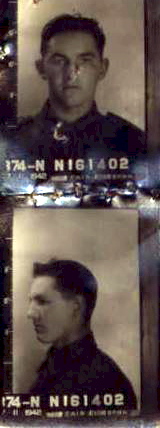
ALEX is NOT mentioned on the Police Wall of Remembrance *NEED MORE INFO
FURTHER INFORMATION IS NEEDED ABOUT THIS PERSON, THEIR LIFE, THEIR CAREER AND THEIR DEATH.
PLEASE SEND PHOTOS AND INFORMATION TO Cal
May they forever Rest In Peace
Ian Hodges
Algie, Alexander “Alex”
Passed away 12th October 2017
Aged 94 years
Late of Arthur Street, South West Rocks.
Beloved husband of Betty (dec).
Sadly missed by his children and their families.
Alex’s relatives and friends are invited to attend his funeral service at Our Lady Star of The Sea Catholic Church, South West Rocks on Wednesday 18th October 2017, service commencing at 11:00 am then for burial in the Arakoon Cemetery.
All service personnel are respectfully invited to attend.
ROBERT B WALKER FUNERALS Kempsey Ph 65624329 www.walkerfunerals.com.au
Published in Macleay Argus on Oct. 17, 2017
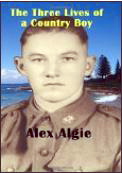
It would appear that Alex was also a published author – having penned a 148 page book – ‘ The Three Lives of a Country Boy ‘ in 2013.
The Don Dorrigo Gazette and Guy Fawkes Advocate.
Thursday 16 December 1954
A welcome is extended to Constable Algie and family who have taken up residence in Dorrigo.
http://trove.nla.gov.au/newspaper/article/173099386
Muswellbrook Chronicle (NSW : 1898 – 1955), Friday 11 May 1945, page 4
MILITARY WEDDING.
ALGIE — DUGGAN.
A very pretty wedding, followed by Nuptial Mass, was celebrated at St. Anne’s Church, Merriwa, on Saturday, 28th April, by Rev. Father Casey, when Betty, youngest daughter of Mrs Duggan, and the late Mr. T. Duggan, was joined in holy matrimony to Private Alexander Algie, A.I.F., eldest son of Mr. and Mrs. W. Algie, of Taree.
Besides the immediate relatives, there was a large gathering of friends present at the Church, testifying to the popularity of the young couple. As the bride, who was given away by her brother, Mr. Vince Duggan, entered the Church, Miss K. Robison, who presided at the organ, played the Wedding March. The choir was present, and during the signing of the register sang an anthem. The bride was charmingly attired in a dress of English satin, and her embroidered tulle veil was held in place by a coronet of orange blossom. Her bouquet was of pale pink and white chrysanthemums.
The bridesmaids were Miss Moreen Dowd and Miss Heather Algie (sister of the bridegroom). The former chose for her costume blue net over satin, with a headdress of tulle,, and carried a bouquet of chrysanthemums of matching shade. The latter was dressed in a pink lace frock, with matching headdress and carried a bouquet of pink and white chrysanthemums. The trainbearers were little Coleen and Pat Egan, daughters of Mr. and Mrs. Maurice Egan. Each was dressed in pink and blue satin, with coronets of net in matching color. The little ones looked charming and, with the bride, were the centre of attraction. The best man was Mr. Ted Duggan, brother of the bride, and Mr. Victor Jones was groomsman.
The reception was held in the School of Arts, where Mrs. Duggan and Mrs. Algie received some sixty guests. Mrs. Duggan chose a smart frock of pink English crepe, with black accessories, and wore a posy, of pale pink roses. Mrs. Algie looked attractive in a suit of grey, trimmed with red, with which she wore black accessories.
Father Casey presided, and the usual toasts were honored. The happy couple were the recipients of many valuable and useful presents.
The honeymoon is being spent at Tuggerah, and the future home of the young couple will be at Taree after Pte. Algie’s discharged from the Army.
http://trove.nla.gov.au/newspaper/article/107790225 and http://trove.nla.gov.au/newspaper/article/171983147
Spencer Henry WALKLATE
Spencer Henry WALKLATE
aka Spence
Late of Bondi Junction
New South Wales Police Force
Regd. # ????
Rank: Constable
Stations: Regent St – # 2 Division,
Service: From 3 July 1940 to 16 December 1943 ( Resigned to join Army in WWII ) = 3+ years Service
[blockquote]
World War II
Australian Imperial Force ‘Z’ Special Unit from 4 August 1944 Group ‘C’. Involved in Operation Copper.
Regiment: 33rd Militia Battalion
Enlisted: at Gunnedah
Service # NX202843
Rank: Lance Corporal
Embarkation: 21 February 1945 for Papua & New Guinea
Next of kin: Linda Maude O’Keefe – wife
Religion: Methodist
Single / Married: Married
Returned to Australia: No. K.I.A.
[/blockquote]
Awards: No find on It’s An Honour
Born: 11 January 1918 at Brushgrove, Clarence River, near Maclean, NSW
Died on: Between April – June 1945
Age: 27
Cause: Executed ( beheaded ) by OAWAGA Waichi – Japanese Petty Officer
Event location: ?
Event date: ? Between April – June 1945 ( WWII )
Funeral date: ? ? ?
Funeral location: ?
Buried at: Muschu Island, Papua & New Guinea
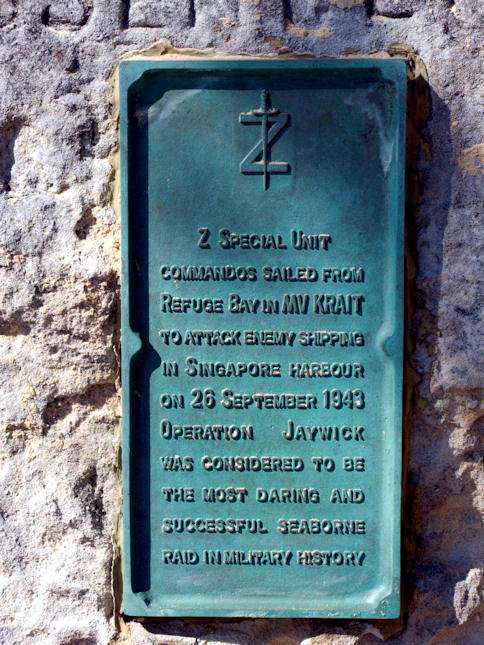
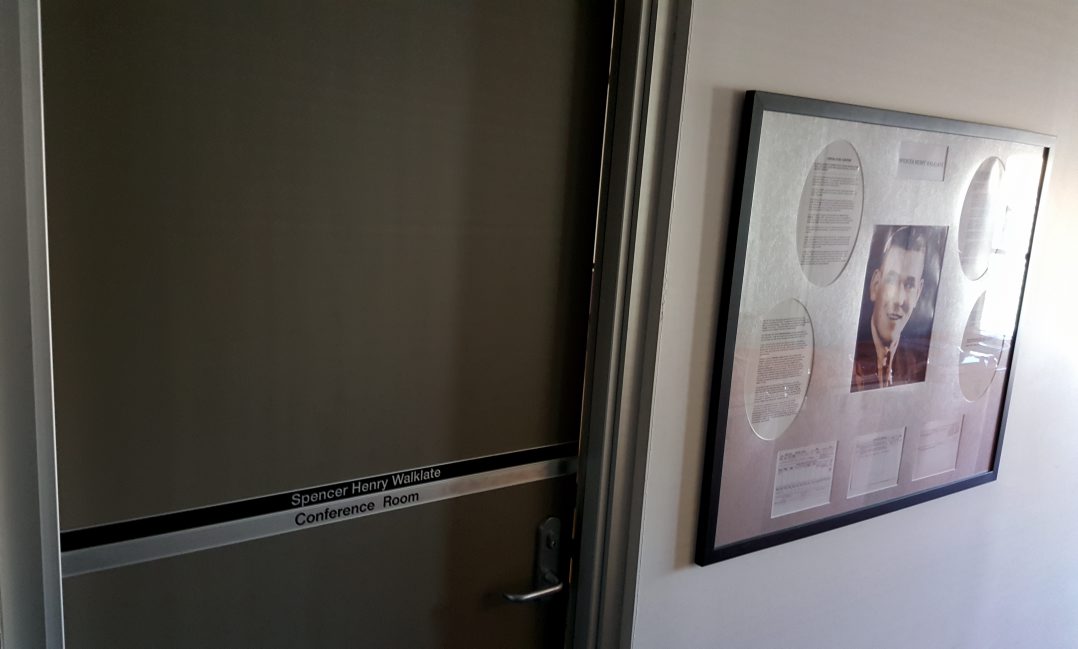
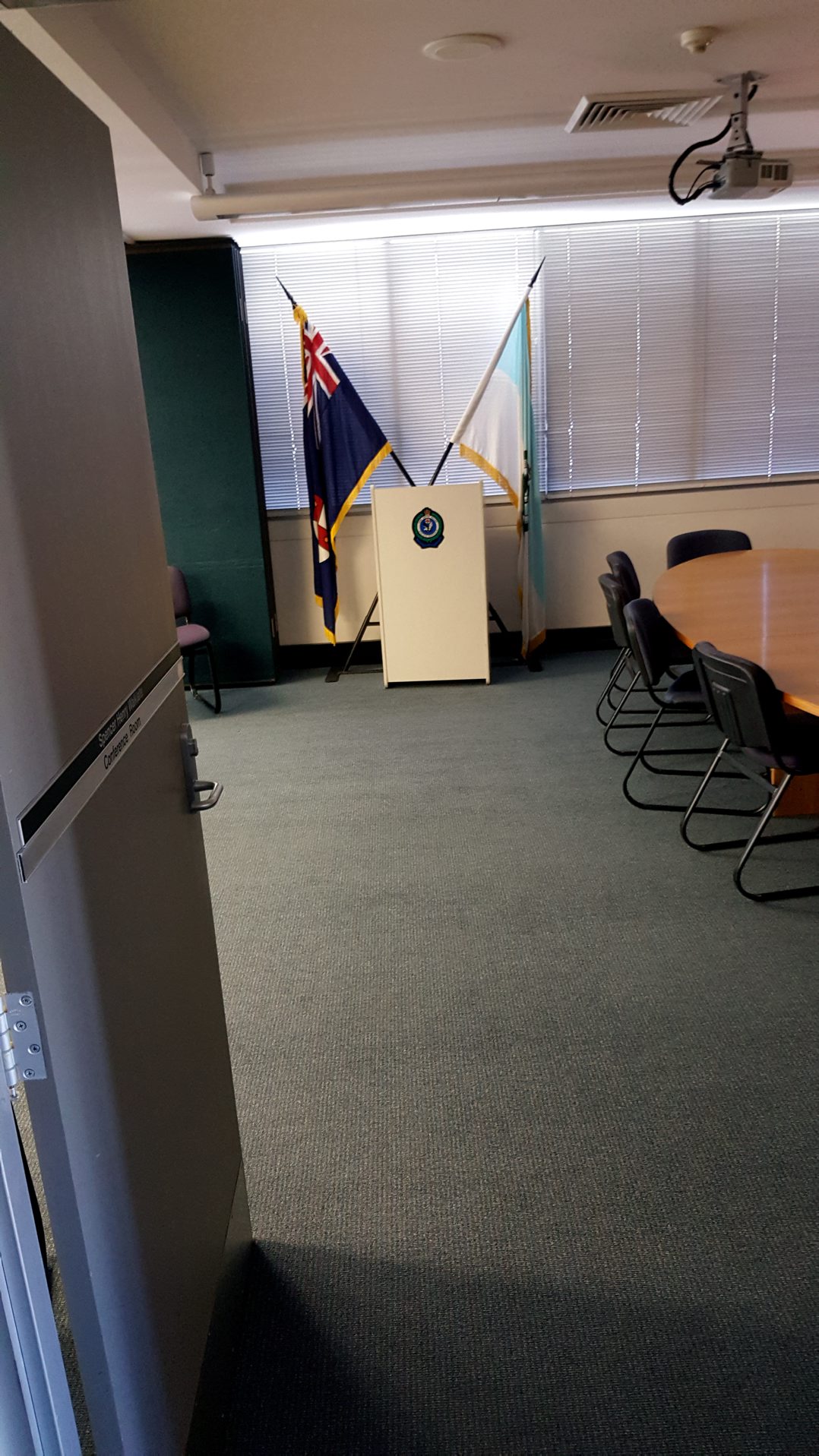
Memorial located at: St George Police Station has a conference room named the ‘ Spencer Henry Walklate ‘ room, named in honour and memory of the man.
A plaque and story is on display at the Police Station, 13 Montgomery St, Kogarah.
The room was named by the, then Commander, Peter J O’Brien, APM.
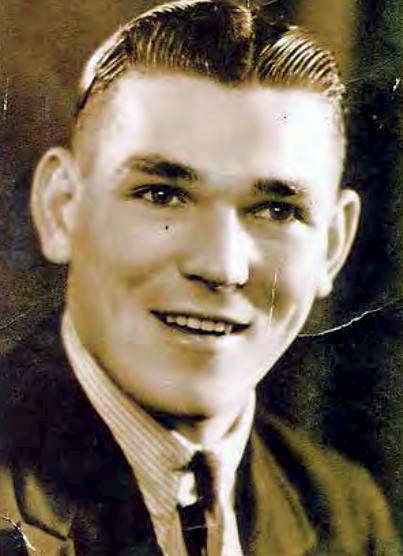
[alert_yellow]SPENCER is NOT mentioned on the Police Wall of Remembrance[/alert_yellow] *NEED MORE INFO
FURTHER INFORMATION IS NEEDED ABOUT THIS PERSON, THEIR LIFE, THEIR CAREER AND THEIR DEATH.
PLEASE SEND PHOTOS AND INFORMATION TO Cal
May they forever Rest In Peace
Spencer Henry Walklate conference room
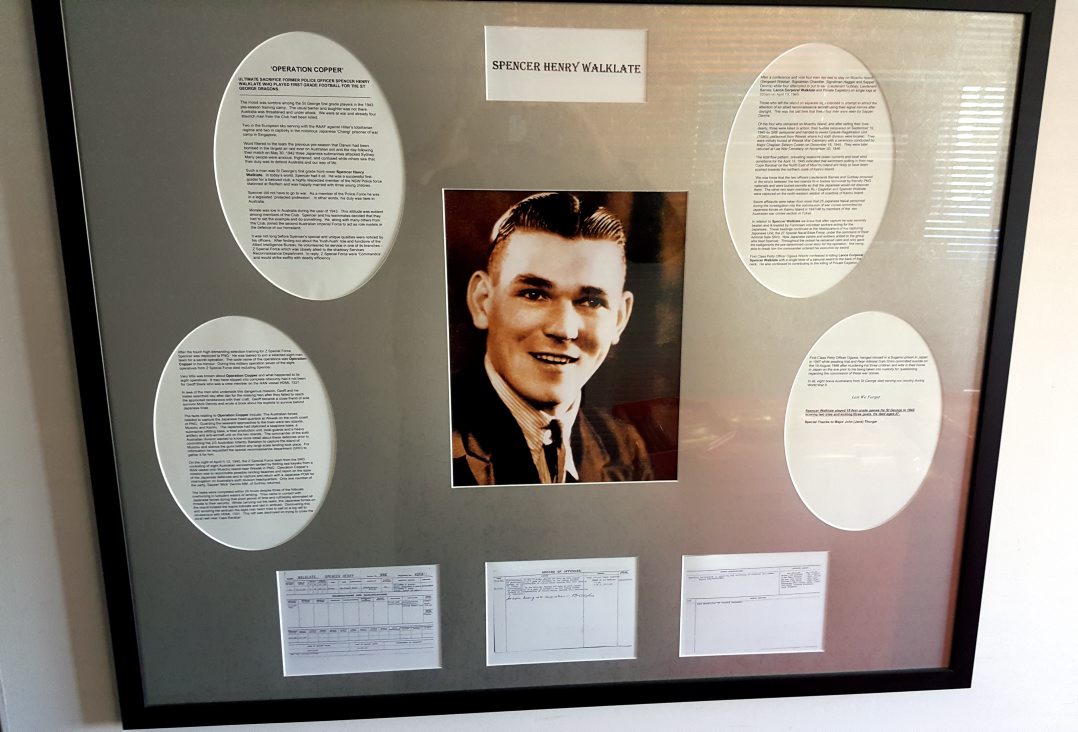

Operation Copper
Concerning the murder of NSW Police Constable Spencer Henry Walklate and others – Muschu Island in the Japanese occupied Territory of Papua & New Guinea – April 1945.
by Detective Senior Sergeant Garry Nowlan
On the 150th anniversary of the NSW Police Force many former and retired Police Officers who have contributed so richly to our history have been remembered. However, we rarely mention the achievements of Police Officers in times of war. Many NSW Police Officers have served during many wars, deployments and peacekeeping operations over many years and some have paid the supreme sacrifice.
This is the story of one of them.
Spencer Henry Walklate was born at Brushgrove on the Clarence River near Maclean in northern NSW on the 11th January 1918. He was enrolled and educated at the nearby Wardell Public School in 1923. Spencer attended Church, Methodist Sunday School and was a fit and healthy country kid who excelled at sport. After leaving school he became a grocery salesman and purveyor of small- goods. He later met a Grenfell girl named Linda Maude O’Keefe who was to become the love of his life. They married at Gunnedah on the 31 January 1938 and settled down to start a family.
But, these were uncertain times and war clouds gathered over Europe. A fragile peace had existed with Germany since the end of WW1 but that was shattered when Hitler invaded Poland in 1939. When Britain declared war on Germany and her allies Australia and all the other Commonwealth Nations also went to war. Many young Australian men went off to fight in Europe the Middle East and North Africa.
Life was good in quiet country NSW for a young man with a new wife and a bright future. However, due to events abroad, Spencer became unsettled and through a strong sense of duty to country, joined the 33rd Militia Battalion at Gunnedah, where he underwent basic military training.
Meanwhile, Japan watched events in Europe unfold with interest. Japan had until the 19th century been a very
isolationist society with little contact from the outside world.
Then, in 1860 Japan formed an unlikely but long standing cultural and intellectual association with Germany. But, due to conflicting political aspirations over China, Japan declared war on Germany and fought on the British side during WW1. An uneasy peace existed for the next decade or so but in 1931 Japan invaded Manchuria and fought a long and bloody war against China, committing many atrocities.
The conflict expanded Japanese military power in the region and it’s troops soon became battle hardened, experienced combat veterans. By the mid 1930’s a rising Japan had formed a strong military alliance with an increasingly aggressive Germany and became part of the Axis Alliance along with Mussolini’s Fascist Italy. The ultimate aim of this pact was world domination.
On observing Hitler’s early successes in Europe, Japan a small country with limited resources, cast it’s eyes south.
To the rich resources of land, agriculture, oil, rubber, iron ore and coal. And their aspirations turned to South East Asia, and beyond. The U.S. had remained neutral for the first 2 years of WW2 but they had a powerful naval presence in the pacific based at Pearl Harbour, which threatened Japanese ambitions. So, on 7 December 1941 the Japanese attacked Pearl Harbour to destroy the U.S. Pacific Fleet.
Simultaneously and through a series of coordinated, vicious attacks Japan invaded the Philippines, and moved quickly south through Indo-China taking Burma,
Thailand, Vietnam and Malaya. Fortress Singapore fell on 15 February 1942 after one week of bitter fighting and 130,000 Commonwealth troops
entered the hell of Japanese captivity.
This included over 22,000 Australian troops mainly from the 8th Division.
Just 4 days later on 19 February 1942 Darwin was bombed by a massive Japanese force destroying much of the town and many Allied ships in Darwin Harbour. The attack was carried out by the same bomber group which attacked Pearl Harbour, however more bombs were dropped on Darwin than at Pearl Harbour. Australia would be attacked and bombed by the Japanese on 63 occasions. This was followed up with the raid in Sydney harbour on 31 May 1942 by 3 midget Japanese submarines. Sydney and Newcastle were shelled by Japanese submarines and Allied shipping was sunk off the eastern coast of Australia.
The Japanese invaded Rabaul massacring 130 Australian POW’s at Tol Plantation and began building an airfield on Guadalcanal in the Solomon Islands to provide a base from which to further isolate and attack Australia. By July 1942 the Japanese occupied the Mandated Territory of Papua & New Guinea, Timor, Nauru, and the Solomon Islands and also held many other islands just to our north.
These were the darkest days for Australia and the Japanese advance south seemed unstoppable. Due to the imminent threat to Australia, Prime Minister Curtin defied Winston Churchill and brought Australian troops home from the Middle East and North Africa to defend Australia. The battle on the Kokoda Track was still raging, when in September 1942 Japanese land forces were for the first time stopped and defeated by Australian troops at the battle of Milne Bay. The tide had turned. Then the slow and painful slog through mud, swamp and jungle began, to push the Japanese back. To borrow the words of Winston Churchill, “This was not the end. It was not even the beginning of the end. But it was the end of the beginning.” It looked for the first time like the Battle for Australia could be won.
Meanwhile, Spencer Walklate observed events from afar. He had decided to move closer to the action and he and Linda left the bush and moved to Sydney taking up residence at Bondi Junction. Again through a sense of duty he decided to join the NSW Police Force at the age of 22 years so he could do his bit to defend the homeland. He joined the NSW Police Force on 3rd July 1940 and after initial training at the Burke Street Police Academy Redfern, was posted as a Probationary Constable to No 2 Division Regent Street. He performed wartime General Duties and was no doubt disturbed by world events, particularly the Darwin air raids and Japanese Submarine attacks on Sydney Harbour.
Spencer had developed into a fine, solidly built, very large and physically fit young man.
In addition to his demanding role as Constable of Police pounding the beat around Central Railway Station, Broadway and Paddy’s Market, he had developed into a first class footballer. He joined St. George Football Club and in 1943 played 15 first grade games as a forward scoring 2 tries and 3 goals. He was also a strong swimmer and in his spare time was a Bondi Surf Life Saver. Spencer Walklate was a big man of many talents. Just the kind of man you might need when your country was fighting for it’s very existence In June 1942 the Australian Military formed a Special Forces unit for clandestine commando operations behind enemy lines. Their main role was reconnaissance, intelligence gathering, sabotage and supporting resistance efforts in occupied territories. It was a secret force named
simply ‘Z’ Special Unit. The unit was administered through Special Operations Executive (SOE) Australia and was made up entirely of volunteers. It’s recruits came from various army and naval units who volunteered for ‘Special’ service in extremely high risk and dangerous operation’s.
They trained in a variety of secret training camps including Camp Z in Broken Bay, Z Experimental Station in Cairns and there was a commando school on Fraser Island. In June 1943 a ‘Z’ Special Unit commando team based on Magnetic Island staged a mock raid in Townsville Harbour by placing dummy limpet mines on allied shipping. When the mines were discovered it caused a furore as the navy thought the mines were real. The commander of the unit was arrested and subject to disciplinary action. But, the lessons learned here were later used in the highly successful Operation Jaywick raid by ‘Z’ Special Unit in Singapore Harbour, where 39,000 tons of enemy shipping was destroyed by limpet mines.
By late 1943 Constable Walklate was in a state of personal crisis. He did not want to leave his young wife or his job, but could find no other option.
His country was at war and he had army training. He knew men who were going off to fight. Not to go was unthinkable.
At the time the Police Force was designated a reserved occupation. Police were not permitted to join the military forces as it was deemed just as important for them to remain at home to keep the peace, defend the homeland and protect critical infrastructure. But, as so many Police were resigning to enlist, the rule was later relaxed and Police were allowed to enlist and return to the Force at the end of their military deployment.
So, Spencer made the only decision he could. In order to enlist he resigned from the NSW Police Force on 16th December 1943 and joined the AIF at Paddington on 31 December. On 5 January 1944 Spencer Henry Walklate Serial No NX202843 marched into 3rd Australian Army Recruit Training Battalion. He was 25 years of age.
Private Walklate‘s Police Training and leadership abilities held him in good stead and 3 months later he was promoted to Lance Corporal on 16 April. On 16 July 1944 Lance Corporal Walklate attended and successfully completed the jungle warfare course at the Australian Jungle Warfare Training Centre, Canungra. But, as in peacetime Spencer Walklate excelled and wanted to be among the best. So, on 4 August he volunteered for, and was accepted into ‘Z’ Special Unit. As this was a highly specialised unit he had to accept reduction to the rank of Private. But, after gaining all his skills and proficiency levels on 29 October 1944 his rank was reinstated to Lance Corporal.
Due to the level of secrecy involved, not much is known of his service over the next four months however it is highly likely he attended one or more of the ‘Z’ Special Unit training camps for specialised training in espionage and battle survival techniques. He departed Australia in secrecy for war service in the occupied Territory of Papua & New Guinea on 21 February 1945. He did not know he would never see Australia or his beloved wife Linda again.
Lance Corporal Spencer Walklate was posted to Group ‘C’ – ‘Z’ Special Unit in Lae where he trained in secret with other members of the group. It is not known what Spencer Walklate did or where he went for the next several weeks.
But, what is known is that he was about to enter the history books as taking part in one of the boldest, most heroic and tragic commando raids behind enemy lines in the South West Pacific theatre of war. Operation Copper.
Of course the name is a mere co-incidence, but the irony is not lost on the astute reader.
By April 1945 the allies were well and truly winning the war. In Europe the Russians were advancing on Berlin and Hitler would commit suicide within weeks. The Japanese had lost the war but were in denial and were being pushed back to Japan or decimated island by island. General Douglas MacArthur, the Supreme Allied Commander in the South West Pacific, was island hopping eager to complete his self fulfilling prophesy of, “I shall return” to the Philippines. And he did not care how many Australians had to die in order for him to fulfil it. As the Japanese had already proved they would rather die than surrender, the Americans were by-passing Japanese held islands in their rush north. MacArthur, determined to have all the glory for America had relegated the Australian troops, who were
the first to ever stop the Japanese and who had done the lion’s share of the fighting in New Guinea, to clearing up the stranded Japanese remnants. But, this was no easy task as the Japanese had been on some of these islands for years. They had established strong defences and built food gardens to enable them to survive and were willing to fight to the death to hold their ground.
And so it was that plans were made for an Australian invasion of Wewak on the north coast of New Guinea where the Japanese were stranded in strength, with nowhere else to go. Many diggers after the war would say that many a good man was lost and most of these operations were unnecessary as the Japanese could have just been left to starve and ‘wither on the vine’.
Intelligence reports indicated that there were two big 140mm naval guns situated on Muschu Island which commanded the coastline where the invasion was to take place and could wreak havoc on Australian invasion troops and shipping. Muschu was a small nondescript tropical island, like thousands of other small tropical islands, situated just 4kms off the coast near Wewak. Surrounded by coral reefs it was flat around the fringes, with scattered rocky coves, spectacular lagoons and beaches. It was hilly in the middle with a couple of isolated native villages and covered in dense tropical jungle. It was also the home for 700 very hostile Japanese soldiers. ‘Z’ Special Unit and Lance Corporal Spencer Walklate, were given the task of locating and disabling the guns on Muschu Island.
The following members of the Group ‘C’ – ‘Z’ Special Unit raiding party were assembled and briefed at Aitape on 8 April 1945:
Lt. Thomas Barnes, Lt. Alan Gubbay, Sergeant Max Weber, Signalman Michael Hagger, Private John Chandler, Private Ron Eagleton, Sapper Edward ‘Mick’ Dennis and Lance Corporal Spencer Henry Walklate.
‘Mick’ Dennis and ‘Spence’ Walklate had already become best mates and both had close familial connections with the NSW Police Force. ‘Mick‘ had been an unarmed combat instructor with the NSW Police Force before the war. His sister, Clare Dennis, was a 1932 Olympic 200 metre breaststroke swimming Gold Medallist, who was married to George Golding, a NSW Police Detective and 1930 Empire Games track and field Bronze Medallist. His father Alexander Dennis was a Police Prosecutor in the NSW Police Force at Burwood.
During the Aitape briefing the team was provided with maps, prismatic compasses, aerial photographs, secret wireless codes and intelligence reports on their area of operations. They would be inserted into the area by Naval Patrol Boat and would then paddle to the island by folding canvas kyak-like boats called ‘folboats’. Each man carried a 9mm automatic Sten SMG backed up by a .38 calibre Smith and Wesson Model 10 revolver. The raiding party was also issued with three 9mm ‘Welrods’ which were a silenced bolt action repeating pistol also known as ‘The Assassins Gun’. Other equipment included the Fairbairn Sykes commando fighting knife, two radio transmitters, walkie talkies, Very lights (flares), signal mirrors and rations for 24 hours. The mission was simple. Get in, capture a
Japanese prisoner for interrogation, find the guns, disable them if possible, contact the naval patrol boat by wireless and get out.
The night of 11 April 1945 was selected as it was a dark, moonless night with favourable tides. That afternoon the raiding party boarded Harbour Defence Motor Launch (HDML) 1231 at Aitape and was conveyed under cover of darkness on the 8 hour, 150 kms journey to within 5 kms of Muschu Island. At 2130 hrs they disembarked the patrol boat in four folboats, two men paddling in each and set off into enemy held territory. And into the lion’s den.
As the men’s night vision kicked in all eyes strained on the dark brooding mass ahead. The only sight that pierced the darkness was the luminous trail left in the rippling wake of the boats as they carved their way through the calm tropical waters. The only sound that broke the silence was the dip of paddles as they sliced the still black water, the slap of the waves against the flimsy canvas hulls of the tiny boats, and the faintly suppressed groans of straining men as they pulled the fragile craft closer. The eerie blackness was occasionally violated by the phosphorescent flash made by some unseen creature lurking in the murky depths below
the sweating, determined men. On they went through the still, balmy, tropical night towards the dark foreboding shadow of the unseen enemy’s lair.
Then disaster struck. At 2230 hrs the folboats hit an uncharted reef and capsized. The party managed to recover the boats but much of the party’s weapons and
equipment was saturated or lost in the black churning water. Two hours later 8 tired, wet and bedraggled men dragged themselves to shore where the party slept fitfully 15 metres inland.
At 0500 hrs on 12 April they stood to. Weapons at the ready clutched in tense, sweating hands, eyes straining through the thick jungle foliage and ears fine-tuned to pick up the slightest hostile sound. When no enemy activity was detected they concealed the boats 50 metres inland in dense undergrowth and set up a base camp some 100 metres further inland where the wireless transmitter and equipment was concealed.
The team then moved east for 30 minutes where they located two well oiled Juki machine guns in firing positions covering the beach. They dismantled the guns and threw them into the sea. The party continued across the island and found strong enemy posts every 50 metres along the coast with a network of trenches and connecting tracks behind. A further four machine guns were located and dismantled. A food garden and some enemy occupied huts were located. There were some bomb craters in this area and here they obtained fresh rain water for the first time.
That afternoon they captured a Japanese soldier who was bound and gagged.
They then tried to find their way back to their base camp but got lost. Taking the wrong track they came upon a Japanese camp. They diverted around the camp and on some cliffs found several gun positions.
They made contact with two Japanese near some huts and both were shot dead with the silenced ‘Welrods’.
They then moved back east and finally found the naval gun positions they were looking for. Grid references were taken so the guns could be destroyed by allied aircraft and with the mission nearly accomplished they began to make their way back to base camp.
But, again disaster struck. As they passed near a Japanese patrol the prisoner slipped his gag and called out alerting the enemy. The prisoner was immediately shot and the party went to ground. There was a strong Japanese presence on the island and by now they were alerted to the presence of the raiders and several hundred Japanese were out in force searching for the Australians. That evening they moved back to the folboats but found they had been discovered by the Japanese and an ambush had been set nearby with a machine gun covering the boats. The party then withdrew, made a fresh base camp and now with no wireless transmitters had to plan their getaway.
They decided to try for the mainland so constructed a raft from logs and at 2000 hrs put to sea but the raft smashed to pieces on a coral reef. This time they lost the remainder of their weapons and equipment and the only man to retain his weapon and pack was Sapper Dennis. It would save his life and enable him to live to tell the story of what happened next.
They returned to the island and after much debate decided by democratic vote to break up into two groups. One group of four men being Sergeant Weber, Private Chandler, Signalman Hagger and Sapper Dennis, favoured remaining on the island and would try to recover a wireless transmitter to contact the rescue boat. The other group comprising Lt Barnes, Lt Gubbay, Private Eagleton and Lance Corporal Spencer Walklate, favoured putting to sea on separate logs to try to make it to nearby Kairiru Island and signal patrolling allied reconnaissance aircraft with mirrors. The men said their goodbyes, shook hands and wished each other luck.
Spencer Walklate and his party then set to sea and the last time he or his mates were seen alive by friendly eyes was as they paddled quietly off into the darkness. Four tiny, bedraggled figures bobbing along on coconut logs carried on the unpredictable currents of the Solomon Sea. Into the vast, enemy held, shark infested unknown.
The story of what happened to Spencer Walklate and his mates cannot be told without reference to the extraordinary tale of survival by Sapper Dennis. The Dennis party moved inland and rested. They spent the 13/14 April observing the movements of the Japanese and watching for signals.
At 0600 hrs on 15 April they moved back to their original base and recovered one of the wireless transmitters. While moving back to a safe position to set up the radio they were ambushed by a Japanese patrol. Sapper Dennis shot two Japanese with his sten gun and the party split up discarding the wireless set in the scrub. Dennis was unable to locate the rest of the party throughout the day. He returned to the bomb crater to get fresh water but found it sour and bitter to the taste. The Japanese were poisoning the water holes to deny the intruders water. Dennis then moved west and in an encounter near a hut shot one Japanese. He then surprised a Japanese Patrol of four and shot one wounding several others. He hid for the night in the scrub and heard Japanese patrols moving around and heard shots near the beach.
Having given up hope of finding the rest of the party he continued west and found a Japanese machine gun in position but unattended so he toppled it over a cliff. He slept in a sago forest and could hear and see the Japanese searching for him. As per mission objectives he continued to record the details and grid references of all Japanese positions, strengths and infrastructure in his note book.
On 16 April he reached the west coast of the island near Muschu Bay and decided to try for the mainland. He found a suitable plank on a wrecked Japanese barge and hid it.
He remained in the area until night and returning to the plank found it had been removed back to the barge. He retrieved the plank and then paddled for 10 hours through shark infested waters and battled strong ocean currents until making the mainland two hours before dawn. He rested, then on 17 April set off north west towards what he hoped were the Australian lines. He evaded Japanese patrols but was observed by two Japanese and shot one.
He later encountered another four man Japanese patrol and shot two. He then surprised two Japanese but his SMG misfired.
The Japanese were so frightened one lost his rifle and they both ran away.
He continued west for 20 kms through enemy territory until 1400 hrs on 20 April when he contacted a patrol of the 2/7th Australian Commando Company. His ordeal was over and the details of his intelligence debrief conducted at Aitape on 21 April 1945 form the basis for this narrative.
Sapper ‘Mick’ Dennis, former NSW Police unarmed combat instructor, was awarded the Military Medal for this extraordinary feat of courage and endurance.
But what of the other 7 men of Operation Copper?
The war ended just 4 months later with the dropping of the atomic bombs ‘Little Boy’ and ‘Fat Man’ at Hiroshima and Nagasaki on 6th and 9th August 1945 respectively. After cessation of hostilities the Australian military commenced it’s War Crimes investigations and trials into Japanese atrocities. Muschu Island was converted to an internment camp for Japanese POW’s and Japanese officers and soldiers were interviewed to establish what happened to missing allied servicemen and women. But, the Japanese were often untruthful, uncooperative and sought to cover up the truth for fear of being tried and executed as war criminals. It had been a long and bloody war and most Allied Governments just wanted to forget about it. The Americans were even less enthusiastic to pursue high level war criminals as General MacArthur was given the task to re build post-war Japan and he used high ranking Japanese officers and officials, many of whom were war criminals, in the process. So, many war criminals escaped justice, as was to be the case for the missing men of Operation Copper.
In 1945/46 war crimes investigators interviewed senior Japanese officers on Muschu Island re the fate of the Operation Copper men. They were told that the three men from the Dennis party were ambushed and killed while trying to operate a radio set. However, natives had reported seeing the mutilated bodies of these men on Muschu in April 1945. While the Japanese claimed the bodies had been damaged by artillery shells, Sapper Dennis has always disagreed with this. He believes his three mates were captured, tortured and murdered by the Japanese.
The mutilated bodies could indicate they were cannibalised which was a common practice by the Japanese in New Guinea during WW2. After the war the remains of the bodies of Sergeant Weber, Private Chandler and Signalman Hagger were recovered from a shallow grave and re-buried at Wewak. They were later exhumed and moved to Lae war cemetery. At least one body appeared to have been decapitated and another was shot through the head.
But what of Spencer Walklate and his 3 mates, who set off into the unknown so long ago on coconut logs?
The Australian Army concluded in 1946 the party was drowned at sea or taken by sharks. But, many years after the war, with the declassification of military documents, new information became available and has shed fresh light on what happened.
It is now known that natives on nearby Kairiru Island told military investigators that up to three Australian’s came ashore on Kairiru in April 1945 and were executed by the Japanese. The Japanese denied this claim stating that two airmen did come ashore but they died of sickness and disease two days later. The native claims were ignored and never followed up at the time.
But, recently Australian Army documents have surfaced containing eye witness accounts of the murder of two Australian soldiers on Kairiru Island, including an account by the Japanese officer who carried out the executions.
According to these primary source documents between April-June (sic) 1945 a very large Australian ‘airman’, perfectly fitting the description of Spencer Walklate, was captured on Kairiru. ‘Z’ Special Unit operatives would have used a cover story if captured as espionage was punishable by summary execution, while ordinary servicemen were entitled to protection under the Japanese Code of Military Law. (Japan was not a signatory to the Geneva Convention). So, claiming to be an airman shot down or crash landing in the vicinity made perfect sense.
It is also known that checks of military war dairies indicate that no Australian airmen were lost in that location at that time. The Australian POW referred to in this document is almost certainly Spencer Henry Walklate.
Following is the disturbing firsthand account of his beheading murder, sourced from official Australian Department of Army War Crimes Archives and extracts taken from an interview with Ensign OAWAGA Waichi of the Japanese Imperial Navy, who was stationed on Muschu Island in 1945.
OAWAGA Waichi (states): During the first part of June 1945, an Australian airman was brought to headquarters from the north coast. At about 1300 Medical Officer MARUYAMA came to the sick bay and I received the order:
“Petty Officer OAGAWA, execute him.”
Thereupon I went to the scene of the action. At a spot about 100 yards away in the direction of headquarters a large Australian airman, blindfolded and wearing Japanese summer clothing, was being held with his arms behind his back by a guard detail of the sixth squad. He was kneeling on both knees in front of a hole in the ground. I approached Ensign FUMIYA, the chief of the guards, and reported:
“I have come upon orders from the medical officer.”
“Hurry and execute him.” (HYAKU Kire) I was ordered, so I borrowed the sword from the NCO who had come for liaison purposes and decapitated (the prisoner). With only a single stroke of the sword, he fell forward and died.
At this time there were present from headquarters the Staff Engineer Officer, Secretary KAWADA, Medical Ensign OMOTEZAKA, Supervisor Petty Officer (medical) SUZUKI and Leading Seaman MACHI.
Besides these there were fifteen to twenty officers and guards.
The corpse was buried on the spot under the direction of Ensign FUMIY A.
The same grim, barbaric ritual was repeated 10 days later with the capture and murder of a second member of the Operation Copper party. However, the precise identity of this soldier is not known and he was heavily drugged with Narcopon (Opium) prior to execution.
OAWAGA Waichi (states): “ About ten days had passed since the first incident when again an Australian airman was brought to headquarters from the north coast. At about 1500 I received the order from the medical officer:
‘Execute him with an injection of one CC of Narcopon.’
Thereupon I took one CC hypodermic needle and one CC of narcopon from the dispensary and went to the scene of the action. Lt (s.g) AMENOMORI and Secretary KAWADA were investigating in the finance room.
A fatigue detail was digging a hole. In about two hours the investigation was finished and an Australian of average stature, blindfolded and wearing Japanese summer clothes, was lead out by the guards. His hands were held behind his back and he was made to kneel in front of the hole.
The medical officer ordered me:
‘Give him the injection’ (CHUSHA SHIRO), so I injected one CC of Narcopon into the lower part of the left shoulder blade. Then I borrowed a sword from Superior Petty Officer KAWANO. About fifteen to twenty minutes after the injection the order:
‘Execute him’ (KIRE) was given, so I raised the sword over my head and brought it down, decapitating (the prisoner).
The Australian fell forward and died. Under the direction of Ensign FUMIYA, the corpse was buried on the spot.”
It appears that possibly one other member of the Walklate party met a similar fate with the fourth probably lost at sea.
Surprisingly, no Japanese solder was ever charged with war crimes regarding the murders of the Operation Copper men, in spite of this compelling evidence. The information provided by Sapper Dennis, the sole survivor of the Operation Copper raid, was used in the planning for the successful invasion of Wewak and the subsequent defeat of the Japanese which ended the Japanese occupation in New Guinea.
And so ends the heroic but tragic story of the men of Operation Copper and of the murder of Spencer Henry Walklate. Athlete, elite sportsman, football star, surf life saver, soldier, commando, POW, war hero, loving husband and NSW Constable of Police. Executed without trial by war criminals, he lies in an unmarked grave, in a lonely foreign place, on a tiny god forsaken island no one has ever heard of.
Postscript:
Each ANZAC Day, Edward Thomas ‘Mick’ Dennis MM, rises early.
He polishes his shoes, dresses in his best suit and carefully pins the shining row of bronze and silver medals with their brightly coloured ribands on the left breast of his jacket just above the pocket. The RSL badge and Returned From Active Service badge complete the ritual. Then, arming himself with his walking cane, he shuffles off to the dawn service. Rain, hail or shine, he has done it dutifully for 69 years. At 96 it is getting harder, but he knows he has to go. As he stands for The Last Post, on weakened, shaky legs, he remembers. He remembers the happy, smiling, youthful faces of his mates. He remembers them just the way they were, then. As if frozen still in time. Their bodies not wasted by age or sickness or despair. They have become ageless. He remembers Muschu Island, his mate ‘Spence’ Walklate and what they did there so long ago. And for a brief moment he stiffens and somehow grows taller. A tear comes to his eye. He wipes it with his handkerchief and with head bowed, shuffles slowly off home.
Until next year.
In a final irony, the naval guns at Muschu Island were never fired in anger and remained silent during the campaign.
The Japanese commander was afraid if they were used the Allies would be alerted to their position and they would be destroyed by superior allied air power. They are still there today. Lest We Forget.
Reference List:
Dennis D.
(2006)
‘The Guns of Muschu’,
Allen & Unwin,
Sydney,
Australia.
www.gunsofmuschu.com
Australian National Archives.
Australian War Memorial Archives.
http://www.peacekeepers.asn.au/mag/2014winter/PKWinter14.pdf
Henry Thomas STONE
Henry Thomas STONE
aka Tom
Late of ?
New South Wales Police Force
[alert_yellow]Regd. # 6206[/alert_yellow]
Rank: Probationary Constable – appointed 3 August 1948
Sergeant 1st Class – appointed 22 February 1975
Inspector 3rd Class – Retirement
Stations: ?, Cronulla ( 24 Division ), Sutherland ( 24 Division ) – Retirement
Service: From ? ? pre August 1948? to 29 November 1982= 34 years Service ( without taking one sick day )
[blockquote]
World War II
Australian Imperial Force Royal Air Force
Regiment: ?
Enlisted: ?
Service # ?
Rank: ?
Embarkation: ?
Next of kin: ?
Religion: ?
Single / Married: ?
Returned to Australia: ?
[/blockquote]
Awards: No find on It’s An Honour
Born: 30 November 1922
Died on: Tuesday 27 June 2017
Age: 94
Cause: ?
Event location: ?
Event date: ?
Funeral date: Tuesday 4 July 2017 @ 3pm
Funeral location: St Patrick’s Catholic Church, Sutherland
This was a “private” funeral but a Guard of Honour was provided by Sutherland LAC
Buried at: Cremated at Woronora Memorial Park
Memorial located at: ?
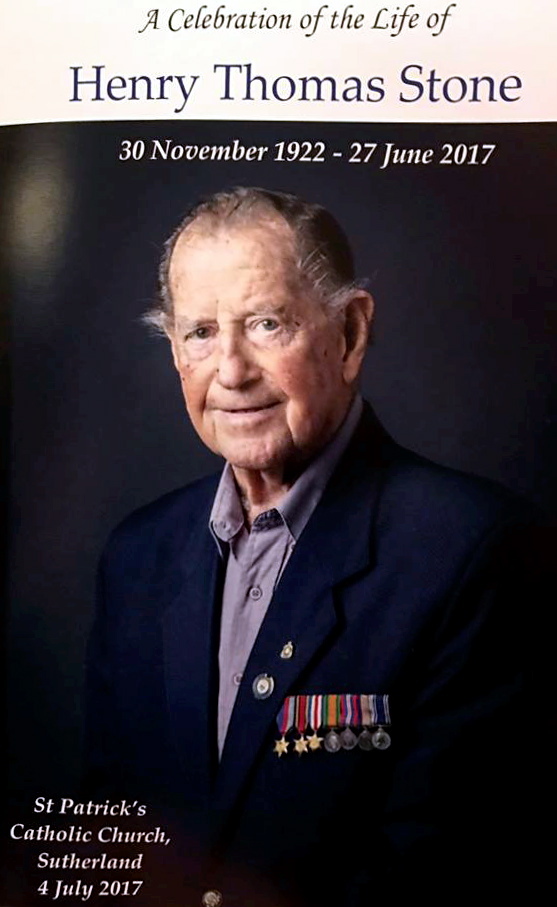
[alert_yellow]HENRY is NOT mentioned on the Police Wall of Remembrance[/alert_yellow] *NEED MORE INFO
FURTHER INFORMATION IS NEEDED ABOUT THIS PERSON, THEIR LIFE, THEIR CAREER AND THEIR DEATH.
PLEASE SEND PHOTOS AND INFORMATION TO Cal
May they forever Rest In Peace
Today we bury a great man – my father in law – Tom Stone – aged 94.
Tom’s passing for me marks the end of a remarkable generation of Australians.
Born in 1922, Tom – along with his five brothers & sisters – inherited the optimism, scars & traumas left over from WW1. Growing up through the Great Depression, you learnt how to make do & like so many who experienced that level of national suffering, the legacy of loyalty, appreciation, hard work & thriftiness stayed with him till the very end.
A celebrated athlete & Rugby Union player, when WW2 began Tom enlisted and survived flying bombers as an Australian within the RAF. Occasionally he would speak of his adventures throughout North America, Europe & Asia when as a young man – the world was truly wide.
After the War he became a policeman where he rose to the senior rank of Inspector – 34 years of service – with not one day off.
He married the beautiful Barbara Fisher & together they had seven children – thankfully getting it right with their last one – Lizzy – who became my wife.
We moved in with Tom over the last two years & in hindsight – it has been such a blessing – & certainly never dull! Combine a loving, deaf, increasingly confused old man with three teenage granddaughters, a giant hyperactive destructive puppy & two stretched parents and I think you get the idea. Despite the chaos there was – & remains boundless love, rich laughter & most importantly – no regrets with how it all ends.
Thank you Tom Stone – for from your life you have greatly shaped mine – & for that I am eternally grateful!
Rest in Peace mate.
Luke
Note: I’ve included the music video of ‘Ragged Bloody Heroes’ for it features Tom reciting the Ode – alongside his old mates war veteran mates Hillary Kelly (RIP) & Bill Lindwall – still going strong at 95.
 ❤️
❤️  ????
????
 ♥️
♥️ ❌❌
❌❌May he rest in peace.
 ???? My thoughts go out to yourself Luke,to Lizzy and the girls. Memories last a lifetime, I am sure you will find much comfort in looking back and remembering the fun times. Love to all
  ????
????Cheers
My condolences to your whole family Luke. Cheers
❤️ ???? what an amazing bunch of people that would have been around him until the end xxx<3 Hazzy xxxx Cheers Luke O’Shea
R.I.P Tom x
❤️❤️ ????????????????
❤
 ????
????Phil Doublet Mate I’m so sorry for your loss. Love and hugs to you and Lizzy, and to your wonderful family mate. All the very best
RIP Tom  🙁
🙁
 ???? Sending so much love from over here to you, Liz and the girls, and the whole Stone clan. RIP Tom
  ????❤❤
 ✨<3
✨<3 ????❤️love to all the Stone Family, you have been in our thoughts & prayers
So sorry to hear
Sending our love to you, Liz & the girls xxx
Beautiful words Luke
A huge loss to your family xx
❤️????❤️???? ????????????
 ????????????
RIP xo
????What an outstanding man…..94 is a good innings.
Our thoughts are with you all.
 ????❤️❤️❤️❤️❤️???????? Love Always Pixie Anne xxxxx????
 ????????
 ☀️☀️????????
Rip Tom
????RIP Mr Stone xx
❤???? to Lizzy, u and the girls. XRIP Tom.
❤️ ????????????????????????
 ???????? xxxx<3❤️
 ❤️
❤️
James Thomas Winchester WILLS
James Thomas Winchester WILLS
late of Seaforth
New South Wales Police Force
[alert_yellow]Regd. # 7515[/alert_yellow]
Rank: Probationary Constable – appointed 19 January 1953
Sergeant 2nd Class – appointed 2 April 1976
Senior Sergeant – retirement
Stations: ?, Frenchs Forest – Retirement
Service: From ? ? pre January 1953? to 23 November 1984 = 31+ years Service
[blockquote]
World War II
Australian Imperial Force
Regiment: ?
Enlisted: ?
Service # ?
Rank: ?
Embarkation: ?
Next of kin: ?
Religion: ?
Single / Married: ?
Returned to Australia: ?
[/blockquote]
Awards: No find on It’s An Honour
Born: about 1926?
Died on: Tuesday 7 February 2017 @ Manly Waters Hospital
Age: 91
Cause: ?
Funeral date: ?
Funeral location: ?
Buried at: Cremated
Memorial at: ?
JAMES is NOT mentioned on the Police Wall of Remembrance * NOT JOB RELATED
FURTHER INFORMATION IS NEEDED ABOUT THIS PERSON, THEIR LIFE, THEIR CAREER AND THEIR DEATH.
PLEASE SEND PHOTOS AND INFORMATION TO Cal
May they forever Rest In Peace
 WILLS, James Thomas Winchester.
Died 7 February 2017
Aged 91 years
Late of Seaforth
Passed away peacefully in Manly Waters Hospital.
James was a fit, strong man, a skilled carpenter who was working at the age of 91 years, as he loved woodwork.
He was a proud serving member of the NSW Police Force for 32 years, achieving the rank of senior sergeant and was awarded a medal for distinctive service. During WWII he served in the boat building industry at Cockatoo Island and Berrys Bay shipyards.
Son to Daphne Elizabeth Blanche and James Winchester Wills, we will remember James as loving husband to his late wife Noreen, a devoted father to his children James and Ross, grandfather to Daniel and Naomi, great-grandfather to Lucy and brother to Bruce, Margaret and Barbara.
He gave his time and effort beyond the call of duty, was someone who loved life and always tried his best. His strong sense of purpose in life afforded us many years of happiness for which we are forever grateful.
Privately cremated

Published in The Sydney Morning Herald on Feb. 22, 2017 – See more at: http://tributes.smh.com.au/obituaries/smh-au/obituary.aspx?n=james-thomas-winchester-wills&pid=184201821&eid=sp_ommatch&eid=sp_ommatch#sthash.YRmImR4e.dpuf
All members of the NSW Police Force are advised that retired *Sergeant 2nd Class James Thomas Winchester Wills, regd 7515 passed away on Tuesday, 7 February 2017 aged 91 years.
Records indicate that Sergeant 2nd Class Wills was performing duties at Frenchs Forest at the time of his retirement on 23 November 1984, completing 31 years service with NSW Police Force.
A private funeral service was held.
*Despite the official message stating that James was a retired Sergeant 2nd Class, looking at the 1979 NSW Police ‘Stud Book’, there is an asterisk next to his name – which indicates that the person has passed his next qualifying examination – that being Senior Sergeant / Sergeant 1st Class.
Cal
Edward John O’DONNELL
Edward John O’DONNELL
( late of Oswald St, Guildford )
aka Ted
New South Wales Police Force
Regd. # 5043
Rank: Probationary Constable – appointed 4 February 1946
Detective Sergeant 2nd Class –
Inspector 3rd Class – appointed 19 October 1977
Stations: ?, Parkes, Pillage Squad, Newcastle, Merrylands 1968 ( 26 Division ), Fairfield ( 34 Division ), Campbelltown ( 35 Division ), “possibly” Liverpool ( 22 Division ) – retirement
Service: From ? ? pre February 1946? to ? ? 1979? = ? years Service
[blockquote]
World War II
Australian Imperial Force
Regiment: ?
Enlisted: at Rowville, Victoria
Service # NX161851
Rank: ?
Embarkation: ?
Next of kin: Jean O’DONNELL
Religion: ?
Single / Married: ?
Returned to Australia: ?
[/blockquote]
Awards: ?
Born: 29 August 1919 @ West Wallsend, NSW
Died on: 23 June 2004
Age: 84
Cause: ?
Funeral date: 29 June 2004
Funeral location: St Mark’s Anglican Church, Granville
Buried at: Cremated at Rookwood
Memorial at: ?
In the January 1979 Issue of the “Police Stud Book” the name of Edward John O’Donnell has been crossed out.
It would appear that he retired sometime during 1979.
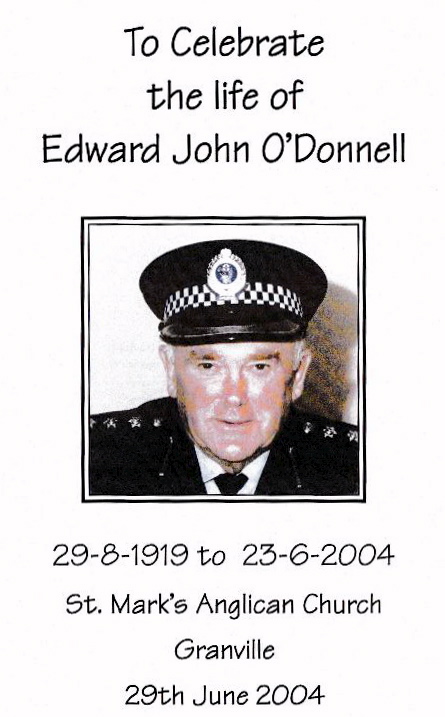
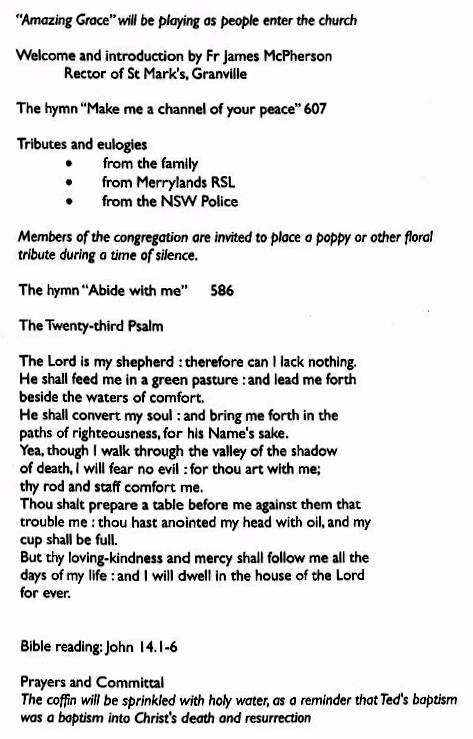
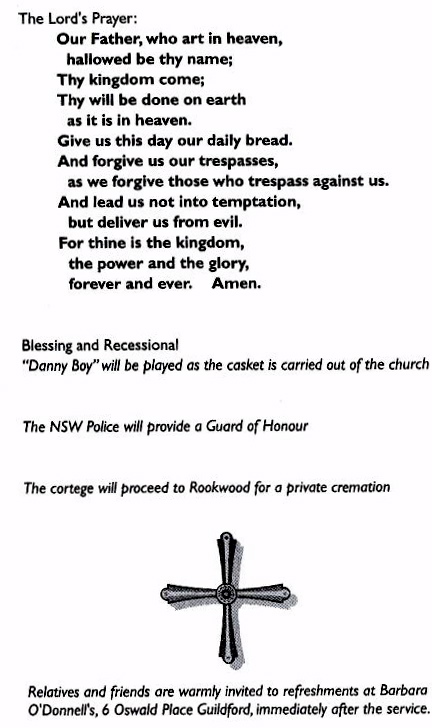

[alert_yellow]EDWARD is NOT mentioned on the Police Wall of Remembrance[/alert_yellow] *NEED MORE INFO
FURTHER INFORMATION IS NEEDED ABOUT THIS PERSON, THEIR LIFE, THEIR CAREER AND THEIR DEATH.
PLEASE SEND PHOTOS AND INFORMATION TO Cal
May they forever Rest In Peace
Email Rx on Friday 6 January 2017 via AustralianPolice.com.au
Hi Cal, going through some papers today and found the attached papers re the funeral of Ted O’Donnell. I then looked and could find no trace on “Australian Police”. So if he’s not there lets get started..
I first met him in June 68 on my arrival at Merrylands as a P/Cst. He was a 2/c Sgt in charge of a relief. He was very knowledgeable, and had no difficulty sharing this with everyone else. He also took a great interest in his team, and had no difficulty in pulling on the bosses as required.
He was a Detective, and I know he was stationed at Parkes and also the Pillage Squad, Newcastle. He married later in life to Barbara, who now resides with daughter Cathryn in Bathurst. He also had a son.
As a Commissioned Officer I think he was at Fairfield, Campbelltown and possibly finished up at Liverpool. He also served in WW2. I think he would have retired about 1984 and continued to live at his family home in Oswald St, Guildford until his death in 2004.
A great old style copper, and those who worked with him were proud to be referred to as “O’Donnell trained”
I am in touch with his wife if you require any further specific info.. Scotty.
Frederick John HANSON
Frederick John HANSON QPM CBE(C)
aka ‘ Slippery ‘
( late of Terrigal )
Penrith Police Academy Class # ??
New South Wales Police Force
Regd. # 3958
Rank: Probationary Constable – appointed 7 September 1936 ( aged 22 years, 3 months, 12 days )
Constable 1st Class ( during the War whilst with RAAF )
Sergeant 3rd Class – about 1947
Sergeant 2nd Class – 1952
Sergeant 1st Class – 1955
Inspector 3rd Class – appointed 26 September 1959
Inspector 2nd Class – appointed 16 April 1961
Inspector 1st Class – appointed 28 August 1962
Superintendent 3rd Class – appointed 31 October 1964
Superintendent 2nd Class – appointed 22 June 1966
Superintendent 1st Class – appointed 14 August 1967
Assistant Metropolitan Superintendent – 1967
Assistant Commissioner – appointed 25 September 1968
Acting Commissioner – appointed from 11 June 1970 to 22 July 1970, inclusive, during Commissioner ALLEN‘s recreation leave.
Acting Commissioner – appointed from 1 March 1971 to 28 March 1971, inclusive, during Commissioner ALLEN’s recreation leave.
Acting Commissioner – appointed 5 June 1971 ( due to illness of Norm ALLEN )
Deputy Commissioner – appointed 14 January 1972
Commissioner – appointed 15 November 1972
Resigned – December 1976
Stations: 4 Division – ( Pedestrian / Traffic Duties ),
Broken Hill GD’s ( September 1936 – 1940 ) & Plain clothes ( 1940 – 1942 ),
RAAF during the War years 31 January 1942 – 30 January 1946,
Vice Squad ( September 1946 – 1946 ),
Police Air Wing as Sgt 3/C ( 1946 – 1950 ),
21 Mobile Division – ( 1950 – 1953 ) Sgt 2/C
Broken Hill GD’s – ( 1953 – 1959 ) ( Sgt 2/c – Sgt 1/c )
Bega – ( 15 October 1959 – 17 April 1962 ) Inspector 3/C & O.I.C. (succeeded Insp. 3/C C. M. Lark, retired ).
Wollongong – ( 20 April 1962 – 16 June 1964 ) ( succeeded Insp. 1/C Allan Glenville Wild
Attended Australian Police College, Manly, 1963
Whilst at Police HQ, Phillip St and then College St, Sydney ( 22 June 1964 – 1976 ) he was the:
Metropolitan Police District – Superintendent 3rd Class
Superintendent 1st Class, Assistant Metropolitan Superintendent, Assistant Commissioner, Commissioner.
Service: From 7 September 1936 to 31 December 1976 = 40 years Service
[blockquote]
Australian Imperial Force Royal Australian Air Force
Regiment: ?
Enlisted: ?
Service # 407958
Rank: Flying Officer ( Lieutenant )
Embarkation: ?
Next of kin: ?
Religion: ?
Single / Married: Married
Returned to Australia: ?
Awards: M.I.D. ( Mentioned in Despatches) NCA ( No Citation Available ) Commonwealth of Australia Gazette 21 June 1945 Page 1353, position 54
[/blockquote]
Awards: King’s Commendation for Valuable Service in the Air – granted 1 January 1945
Queen’s Police Medal ( QPM ) – granted 11 June 1966
The Order of the British Empire – Commander ( Civil ) ( CBE(C)) – granted 1 January 1974
Born: Tuesday 26 May 1914 in Orange, NSW
Died on: Sunday 26 October 1980 in Terrigal, NSW ( his home )
Age: 66 years, 5 months, 0 days
Cause: Suicide – Carbon Monoxide poisoning
Funeral date: ?
Funeral location: ?
Buried at: Cremated
Memorial at: Police Rugby League competition ( 1970 ) Fred Hanson Shield.
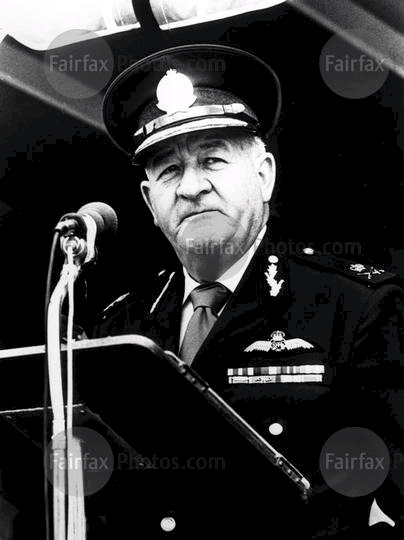
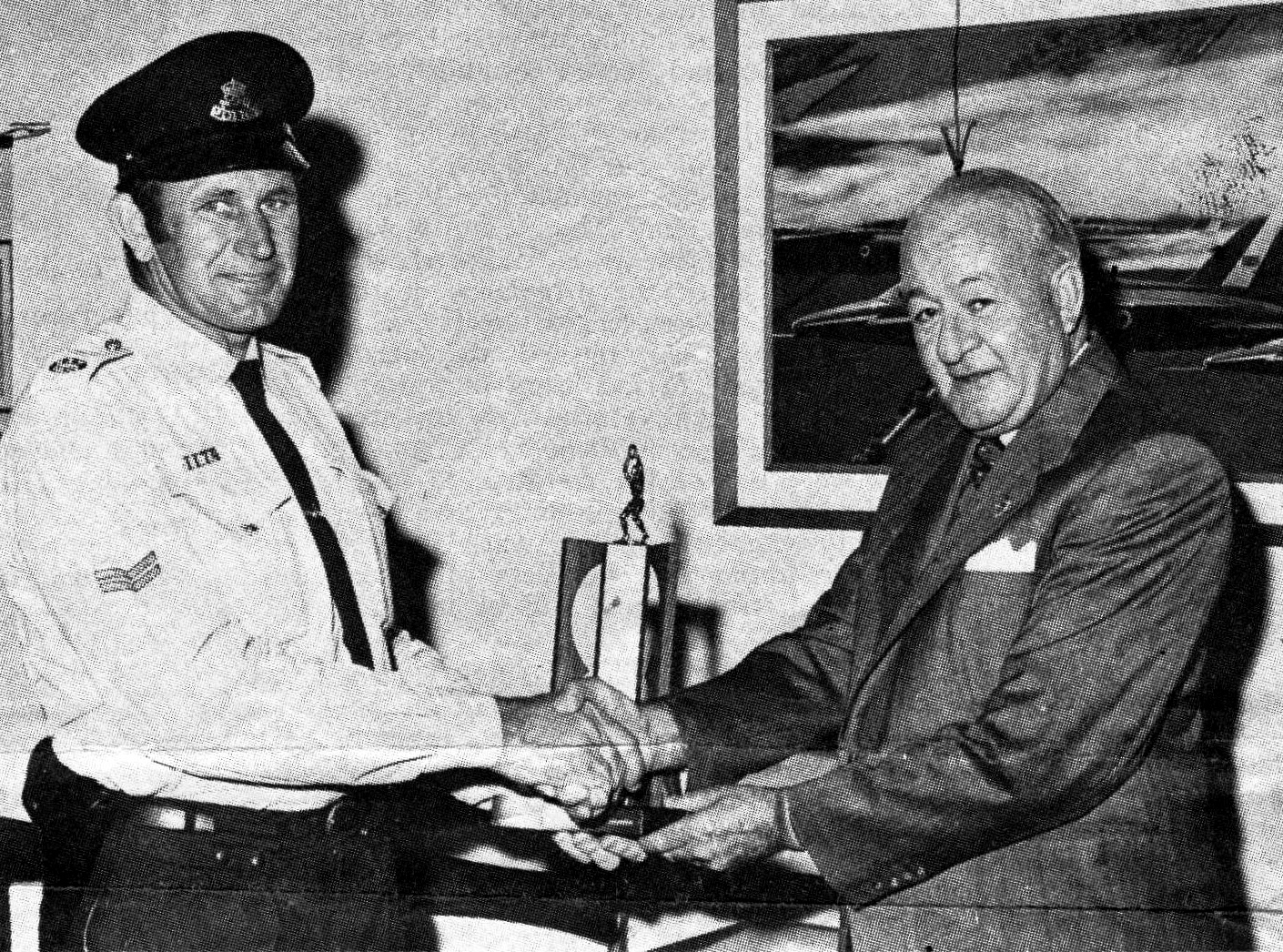
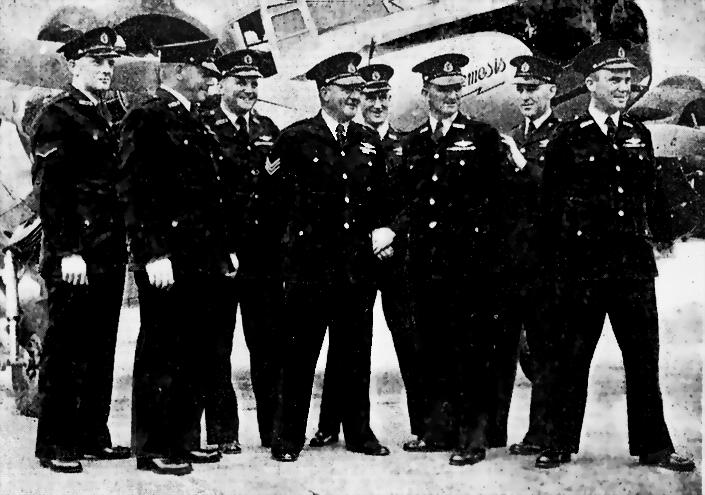
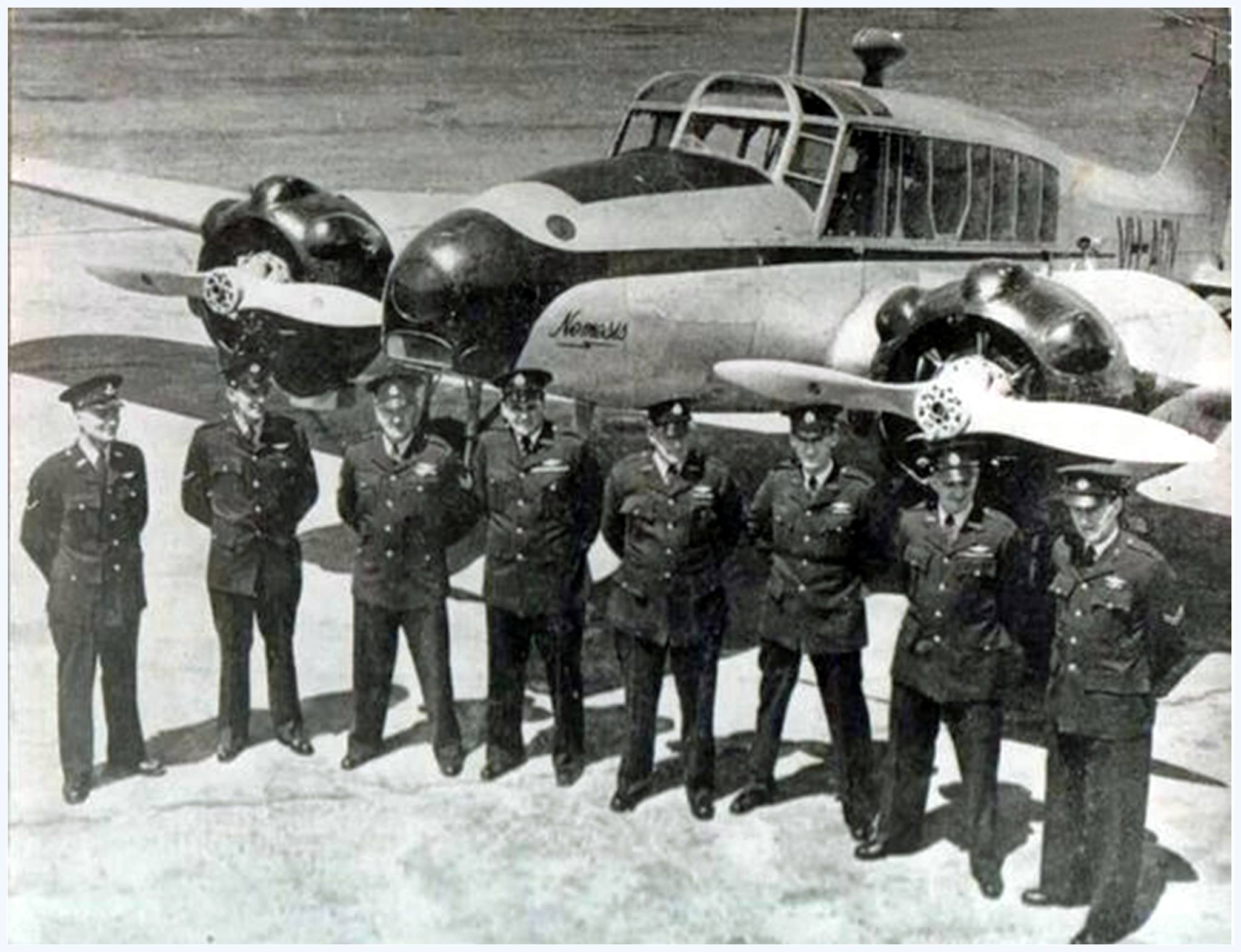
FRED is NOT mentioned on the Police Wall of Remembrance *NEED MORE INFO
FURTHER INFORMATION IS NEEDED ABOUT THIS PERSON, THEIR LIFE, THEIR CAREER AND THEIR DEATH.
PLEASE SEND PHOTOS AND INFORMATION TO Cal
May they forever Rest In Peace
Frederick John Hanson CBE (26 May 1914 at Orange, New South Wales – 26 October 1980 at Terrigal, New South Wales), was the Commissioner of the New South Wales Police from 15 November 1972 until his retirement in 1976.
Early life and career
Frederick Hanson was born the eldest of four children to Ernest Frederick Hanson and Vera Marie Hanson. He did not remain in Orange for long before moving to Burwood where he was educated at the Christian Brother’s Saint Mary’s Boy’s School. He became a jeweller’s assistant before being hired as a porter with the New South Wales Government Railways. Hanson joined the New South Wales Police on 7 September 1936 at the age of 22 and the next year was posted to Broken Hill where, in the Sacred Heart Cathedral, he married Carole Louise Whitehall with Catholic rites on 9 November 1938. In 1940 Hanson was transferred to plain clothes duties.[1]
Military service
Hanson served in the Citizen Air Force from 1932 to 1936 and obtained a private pilot licence in 1939. On 31 January 1942 he was transferred to the Royal Australian Air Force. Commissioned on 14 January 1943, Hanson served as a pilot in Britain, the Middle East and Ceylon (Sri Lanka), and was mentioned in despatches. On 30 January 1946 he was demobilized as acting squadron leader and returned to the police.[1]
Policing career
Hanson was promoted to the rank of Constable (first class) while on active service and briefly posted to the vice squad before being transferred to the police air wing as Sergeant (third class).
Such rapid advancement in an organization which was committed to seniority based promotion resulted in a number of appeals. The first appeal was rejected and the remainder were withdrawn which allowed Hanson to overtake more than a thousand other police on the seniority list. After this he became known as ‘Slippery’.
The air wing was disbanded in 1950 and Hanson then moved to the new Number 21 Mobile Division.
He returned to Broken Hill in 1953 and was promoted to Sergeant (first class) in 1955.
Hanson served as an Inspector (third class) and also officer in charge at Bega (1959–62) and Wollongong (1962–64) before moving to the Metropolitan Police District as a Superintendent (third class).
After attendance at the Australian Police College in 1963, Hanson rose to Superintendent (first class) and Assistant Metropolitan Superintendent in 1967.[1]
Hanson was appointed Assistant Commissioner in 1968, Deputy Commissioner on 14 January 1972 and Commissioner on 15 November 1972.
That year he also attended the general assembly of the International Criminal Police Organization at Frankfurt, Germany.
In 1974 he visited the Australian police contingent at Cyprus.
While Commissioner Hanson introduced merit rating, abolished seniority in executive promotions and also established the crime intelligence unit.
By objecting to New South Wales Police Association attempts to gain greater access to the Industrial Commission of New South Wales he sparked contention.
Hanson gained widespread support in 1975 when he initiated aggressive street patrols to counter hoodlum activity, however he failed to control illegal gambling which was to become a major public issue.
In 1976 Hanson sued the then Australian Broadcasting Commission for defamation when it had been suggested that he had a financial interest in an illegal casino situated at Gosford; the case was later settled out of court.[1]
Retirement
Pressured to resign after adverse publicity, he delayed doing so until he was replaced in 1976 by his preferred successor and air wing colleague Mervyn Wood.
Further allegations of corruption were made against Hanson in the 1980s.
Hanson was a modest however humorous man, he kept his family life extremely private. He was a noted practical joker and esteemed by his subordinates for his genuine interest in their welfare, his readiness to delegate responsibility and his unwillingness to be hindered by red tape.
Survived by his wife, Hanson died from carbon monoxide poisoning by inhalation on the night of 25 to 26 October 1980 at his Terrigal home; the Coroner dispensed with an inquest and Hanson was cremated.[1]
Corruption allegations
There were persistent allegations about Hanson’s involvement in organised crime, and was repeatedly claimed that he corruptly received payments from criminals and that he was the part-owner of an illegal casino at Gosford, in which former detective Ray “Gunner” Kelly is also alleged to have had an interest.
Hanson featured prominently in The Prince and the Premier, the 1985 book by investigative journalist David Hickie, which canvassed allegations of corruption against senior NSW government officials, including Premier Robert Askin and senior police including Norman Allan, Hanson and Merv Wood.
Hickie specifically named both Allan and Hanson as corrupt, stating that they knowingly allowed illegal casinos and illegal SP (off-track) betting to flourish in NSW. Citing an “impeccable” and highly placed source within the illegal gaming empire established by Perc Galea, Hickie alleged that Askin and his police commissioners, Allan and Hanson, were paid bribes amounting to A$100,000 per year from 1967 until Askin’s retirement.[2]
Another of Hickie’s informants, a former croupier at Galea’s Double Bay Bridge Club, claimed that A$5000 per week from the club was paid in bribes to Hanson and Askin.[3] Hickie also notes that Hanson was among the mourners at Galea’s funeral in 1976.[4]
In 1979 John Hatton, an independent politician claimed in the New South Wales Parliament that Askin and Hanson knew of and may have even encouraged the penetration of Australian crime by “overseas mobsters, gangsters and the Mafia“.[citation needed]
https://en.wikipedia.org/wiki/Frederick_Hanson
Ivan BEDELPH
Ivan BEDELPH
Tasmania Police Force
Regd. # ?
Rank: Trooper
Stations: ?, Hobart, Sprent, Campbell Town,
Service: From ? ? ? to ? ? ? = ? years Service
[blockquote]
Australian Imperial Force
Regiment: 281st L.A.D., 12th Infantry Bgde, 1943-45
Enlisted: ?
Service # TX13568
Rank: Craftsman
Embarkation: ?
Next of kin: Gloria BEDELPH
Religion: ?
Single / Married: ?
Returned to Australia: ?
http://recordsearch.naa.gov.au/
The war records of Ivan have not been digitised by National Archives, Australia, as of 10 October 2016
[/blockquote]
Awards: National Medal – granted 15 November 2001
1st Clasp to National Medal – granted 15 November 2001
2nd Clasp to National Medal – granted 15 November 2001
Born: ? 19 December 1921 ? in Bream Ck, Tasmania
Died on: ?
Age: ?
Cause: ?
Funeral date: ?
Funeral location: ?
Buried at: ?
Memorial at: ?
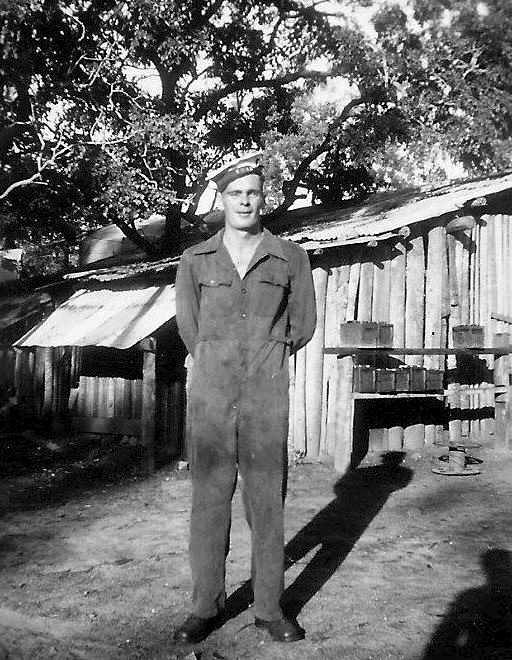
![Copy write (From the private collection of William Jones) Craftsman Ivan Bedelph (TX13568) [Left] and Val McGuinness (TX12841) [right] testing the battery voltage on a CMP F15A truck at 39 Mile.](https://www.australianpolice.com.au/wp-content/uploads/2016/10/Ivan-BEDELPH-2-TasPol-Died.jpg "http://milepegsnt.com/site/39-mile/")
IVAN is NOT mentioned on the Police Wall of Remembrance *NEED MORE INFO
Funeral location: ?
FURTHER INFORMATION IS NEEDED ABOUT THIS PERSON, THEIR LIFE, THEIR CAREER AND THEIR DEATH.
PLEASE SEND PHOTOS AND INFORMATION TO Cal
May they forever Rest In Peace
Husband to Amy Ethel BEDELPH nee Franklin nee Clee – deceased.
Advocate (Burnie, Tas. : 1890 – 1954), Thursday 1 June 1950, page 8
OFFICER PRAISED. – Trooper Ivan Bedelph, of the Sprent Police Station, has been advised of his pending transfer to Campbell Town. At the last sitting of the Police Court Sgt. A. E. Campbell praised the work of Trooper Bedelph while at Sprent, and said he had proved himself a good officer. He thanked him for his close co-operation, which had existed between them and wished him success in the future. The Police Magistrate, Mr. H. R. Dobbie, said that, working from the Sprent office, Tpr. Bedelph had carried out country and town duties conscientiously. Mr. F. B. Edwards, on behalf of the legal profession, and Mr. A. R. Quinn Clerk of Courts, supported. Tpr. Bedelph made an appreciative response.
http://trove.nla.gov.au/newspaper/rendition/nla.news-article69222585.txt
Advocate (Burnie, Tas. : 1890 – 1954), Tuesday 2 September 1947, page 4
SPRENT
NEW TROOPER. – Trooper Ivan Bedelph, of Hobart, has been transferred lo this district. He will succeed Trooper J. H. Smith, who was transferred to Launceston three weeks ago. Trooper Bedelph will take up duties in a few days.
http://trove.nla.gov.au/newspaper/rendition/nla.news-article69019356.txt
Mercury (Hobart, Tas. : 1860 – 1954), Saturday 28 June 1947, page 8
HEAVY FINE FOR ASSAULT ON POLICE
Trevor Finbar Earley was fined £12 In the Hobart Police Court yesterday when he pleaded guilty to having been in charge of a bicycle while under the influence of liquor and with having assaulted Constable Ivan Bedelph.
Constable Bedelph said he was on duty on the wharf at 11 pm on Thursday. He saw Earley fall off a bicycle he was riding, and arrested him. On the way to the police station Earley became abusive, and struck witness. Constable Martyn assisted in getting Earley to the charge room.
Insp Smith, who prosecuted, said Earley had a long record, but had not been in trouble since 1936.
Earley said he had been given wine, and he had not much recollection of what had happened.
Mr Brettingham-Moore, P.M., imposed a fine of £10, with 2/6 costs, on the charge of assault, and £2, with 2/6 costs, on the other charge.
http://trove.nla.gov.au/newspaper/rendition/nla.news-article26397683.txt
Mercury (Hobart, Tas. : 1860 – 1954), Wednesday 26 June 1946, page 14
BIRTHS
BEDELPH. – On June 23, 1946, at Calvary
Hospital, to Gloria, wife of Ivan Bedelph: a daughter, ( Merilyn Gay )
http://trove.nla.gov.au/newspaper/rendition/nla.news-article26205476.txt
Henry Derold George KUPKE
Henry Derold George KUPKE
( late of Auburn )
New South Wales Police Force
[alert_yellow]Regd. # 5672[/alert_yellow]
Rank: Probationary Constable – appointed 26 May 1947
Sergeant 2nd Class – appointed 28 September 1970 – retirement
Stations: ?, Rose Bay – retirement
Service: From ? ? pre May 1947 to 2 June 1980 = 33+ years Service
[blockquote]
World War II
Australian Imperial Force Australian Army
Regiment: ?
Enlisted: 28 May 1944 @ Kandos, NSW
Service # NX192842 (N348561)
Rank: Private
Embarkation: ?
Next of kin: Sarah KUPKE
Religion: ?
Single / Married: ?
Returned to Australia: ?
Date of Discharge: 25 February 1946
Posting at Discharge: 31/51 Australian Infantry Battalion
Henrys’ AIF files have not been scanned for public exhibition as of the date of his death.
[/blockquote]
Awards: Commissioner’s Commendation & twice received Bravery Awards
Bronze Medal & Bar to Bronze Medal
No find on It’s An Honour
Born: 3 June 1920 at Dubbo, NSW
Died on: Tuesday 27 September 2016
Cause: ?
Age: 96
Funeral date: Monday 10 October 2016 @ 11am
Funeral location: the Chapel, White Lady Funerals, 35 Kitchener Parade, BANKSTOWN
Buried at: ?
Memorial at: ?

[alert_yellow]HENRY is NOT mentioned on the Police Wall of Remembrance[/alert_yellow] *NEED MORE INFO
Funeral location: [codepeople-post-map]
FURTHER INFORMATION IS NEEDED ABOUT THIS PERSON, THEIR LIFE, THEIR CAREER AND THEIR DEATH.
PLEASE SEND PHOTOS AND INFORMATION TO Cal
May you forever Rest In Peace
Newcastle Morning Herald & Miner’s Advocate Monday 14 July 1952 p3
Quick Police Work Recovers Car
SYDNEY, Sunday, – Police last night. arrested two men and recovered a 1949 Rolls Royce car about 10 minutes after the car had been reported stolen.
A message was flashed over the police radio( at 10.52pm ) and five minutes later, Sergeant W. Smith and Constable G. Kupke saw a Rolls Royce pass them as they were driving into Rose Bay police station.
They halted the car at ( at 10.57pm ) at Vaucluse. Sergeant Smith said: “The car was so large we could not lose sight of it.”
The car belonged to. Mr. McDowell, managing director of McDowells Ltd. Mr. McDowell left the car in Castlereagh street, Sydney.
Two men were charged with having illegally used the car.
http://trove.nla.gov.au/newspaper/article/133183456
Mudgee Guardian and North-Western Representative (NSW : 1890 – 1954), Thursday 19 August 1948, page 18
PERSONAL
……… Mr. George Kupke, a well known ex-Kandos resident and now a member of the N.S.W. Police Force, paid a visit at the week-end. ………
Lithgow Mercury ( NSW ) Wednesday 4 July 1945 p 1
WOUNDED IN ACTION
SYDNEY, This Afternoon.
The following names appear in an Army casualty list issued to-day:— Wounded in Action:
Remaining on Duty: Pte. H. D. G. Kupke, Inf. ( Infantry ), Kandos.
Wounded in Action: Pte, J. L. Maher, Inf., Kandos;
Pte. O. J. Muir, Inf., Lithgow.
http://trove.nla.gov.au/newspaper/rendition/nla.news-article219726458.txt
Mudgee Guardian and North-Western Representative (NSW : 1890 – 1954), Thursday 28 June 1945, page 8
Personal
…………
Word has been.’ received that Pte. George Kupke, son of Mrs. Kupke, of Kandos, has been wounded in action. ( Keep your chin up, Georgie ). …….
http://trove.nla.gov.au/newspaper/rendition/nla.news-article156429796.txt
Mudgee Guardian and North-Western Representative (NSW : 1890 – 1954), Thursday 31 August 1944, page 3
Personal
…….. The following lads are at present home on leave:- Cpl. Tommy Windle, Pte. Charlie Collison, Pte. Bill Edwards, Pte. George Kupke; also Carmen Gilchrist, ……
http://trove.nla.gov.au/newspaper/article/156237083?searchTerm=%22george%20kupke%22&searchLimits=#
Mudgee Guardian and North-Western Representative (NSW : 1890 – 1954), Thursday 21 Oct 1943 , page 10
With The Forces
……… Pte. George Kupke was home at the week-end. ……
http://trove.nla.gov.au/newspaper/rendition/nla.news-article156205652.txt
National Advocate (Bathurst, NSW : 1889 – 1954), Friday 3 July 1942, page 2
EXEMPTION REFUSED
George Henry Harold Kupke, of 42 Fleming-street, Kandos, was refused exemption from military training duties by the S.M.. Mr. Bromhead, when he applied on the grounds of his call-up imposing hardship on his parents, at the Bathurst court, yesterday.
Kupke was previously granted exemption until the end of last month, in evidence he said that his father is bed-ridden and weight 17 stone. He has to be lifted into and from his bed, and his mother is suffering from a weak back. Kupke‘s brother, Trevor, had left school and was working.
Mudgee Guardian and North-Western Representative (NSW : 1890 – 1954), Thursday 26 June 1941, page 6
PATRIOTIC TENNIS TOURNAMENT.
A tournament to assist local war funds was held at the Park Courts on Sunday, 15th June. The event was won by George Kupke and Mrs Rex Kupke.
On Sunday last many entries were received for the gent’s doubles. A ? of the patriotic tournament ?, ? owing to ? ? J. Sparks and L. Ford will do battle against A. ?
http://trove.nla.gov.au/newspaper/rendition/nla.news-article157108635.txt
Mudgee Guardian and North-Western Representative (NSW : 1890 – 1954), Monday 16 November 1931, page 6
COLLAPSED AT WORK
George Kupke and Fred Beatson, two very well-known Kandos residents employed by the Kandos Cement Coy., collapsed during the week at the works and were admitted to the Rylstone District Hospital for treatment.
http://trove.nla.gov.au/newspaper/rendition/nla.news-article156225387.txt
Wife might be Winifred Elizabeth Annie Kupke late of 111- 115 Campbell Hill Rd, Chester Hill. Will ( death ) dated 15 March 1985
Residence:
1954 – 1958 = Woollahra
1963 – 1968 = Kingsford
John Charles GANDY
John Charles GANDY
aka Jack
( late of North Haven – formerly of Drummoyne & Mollymook )
New South Wales Police Force
[alert_yellow]Regd. # 7282[/alert_yellow]
Rank: Probationary Constable – appointed 10 June 1952
Sergeant 2nd Class – appointed 6 September 1976
Detective Sergeant 1st Class – retired
Stations: ?, Campsie ( 13 Division ) – retirement
Service: From ? ? ?pre June 1952 to 14 June 1982 = 30+ years Service
[blockquote]
World War II
Australian Imperial Force Royal Australian Navy
Regiment: ?
Enlisted: 23 July 1943
Service # 8945
Rank: ERA iv ( CPO )
Engine Room Artificer IV ( Chief Petty Officer )
Embarkation: ?
Next of kin: Phyllis Eileen – wife, 37 Thompson St, Drummoyne, NSW
Religion: C of E
Single / Married: Married
Returned to Australia: ?
Description: 6′ 1″, dark brown hair, grey eyes, medium complexion, tattoo on right forearm ( as of 3 August 1943 )
[/blockquote]
Awards: No find on It’s An Honour
Born: 8 February 1923, Sydney, NSW
Died on: Wednesday 7 September 2016
Cause: ?
Age: 93
Funeral date: Thursday 15 September 2016 @ 1pm
Funeral location: the Chapel of Innes Gardens Memorial Park, Philip Charley Drive, Port Macquarie
Buried at: ?
Memorial at: ?
[alert_yellow]JOHN is NOT mentioned on the Police Wall of Remembrance[/alert_yellow] *NEED MORE INFO
Funeral location: [codepeople-post-map]
FURTHER INFORMATION IS NEEDED ABOUT THIS PERSON, THEIR LIFE, THEIR CAREER AND THEIR DEATH.
PLEASE SEND PHOTOS AND INFORMATION TO Cal

At hospital 7th September. Late of North Haven. Formerly of Drummoyne and Mollymook.
Aged 93 years
Laurieton
Ph: 02 6559 5999
Accredited Member of FDA of NSW
Published in The Sydney Morning Herald on Sept. 10, 2016
May you rest in peace your service to your state and country done. My condolences to Joan and Family.
Canberra Times (ACT : 1926 – 1995), Saturday 12 August 1972, page 8
Man put on $100 bond for placing poison in sugar
SYDNEY, Friday. —
A man who placed poison in a bottle to catch a workmate who had stolen his sugar was released on a $100 bond today.
Mr Brian Bernard Theodore Haake, 28, storeman and packer, of Green Valley, appeared for sentence before Judge Robson in Sydney Quarter Sessions.
He pleaded guilty to maliciously causing poison to be taken with intent to annoy on March 28 at Botany.
Detective-Sergeant J. Gandy said Mr Haake worked for Australian Wool and Hide Pty Ltd. He had had things stolen from his locker over a period, including clothing and sugar.
When Mr Haake had found his sugar was missing, he had got some from a fellow worker and had put in it half a teaspoonful of sodium arsenate.
He had put it in his locker and a fellow worker had later used it in his tea.
The fellow worker had become ill and had spent four days in hospital and had then been off work for two weeks.
Judge Robson said the charge was unusual, and he was satisfied that Mr Haake had intended to annoy but not to cause harm.
http://trove.nla.gov.au/newspaper/rendition/nla.news-article101999039.txt
Desmond Kendrick HENNESSY
Desmond Kendrick HENNESSY
( late of Nowra )
New South Wales Police Force
[alert_yellow]Regd. # 7859[/alert_yellow]
Rank: Probationary Constable – appointed 6 December 1954
Sergeant 2nd Class – appointed 16 November 1977
Sergeant 1st Class – retired
Stations: ?, Tweed Heads – retirement
Service: From ? ? ?pre December 1954 to 9 December 1984 = 30+ Years Service
[blockquote]
World War II
Australian Imperial Force Royal Australian Air Force ( R.A.A.F. )
Regiment: ?
Enlisted: 20 April 1943 at Ermington, NSW at age 18
Service # 133219
Rank: Leading Aircraftman
Embarkation: ?
Next of kin: William Hennessy – father. Eva Alice Anderson – mother
Religion: RC
Single / Married: Single
Returned to Australia: ?
Date of Discharge: 19 February 1946
Posting at Discharge: 6 Stores Depot, Dubbo
WW2 Honours & Gallantry: None to display
Decorations, Medals: Pacific Start. Defence Medal. War Medal 1939/45
Prior to entering R.A.A.F., Desmond was employed as a Mechanic’s Assistance.
He was described at 6′ 1″ tall, Brown hair, Blue eyes, Fair complexion with no scars or tattoos and weighed 145 lbs ( 11 stone 3 lbs ) with a 34 – 37 inch chest measurement.
Attended Parramatta High School for two years and worked, as Mechanic’s assistant from age 16 – 18 for Mr. E.S. Shaw, Hunt Brothers, Sydney Motors Ltd.
Desmond and his parents appear to have started the ‘enlistment’ process on 1 February 1943 when he was aged 17.
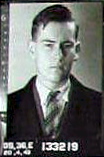
http://recordsearch.naa.gov.au/SearchNRetrieve/Interface/ViewImage.aspx?B=5362407
[/blockquote]
Awards: No find on It’s An Honour
Born: 4 April 1925 @ Lidcombe, NSW
Died on: Monday 29 August 2016
Cause: ?
Age: 91
Funeral date: Monday 5 September 2016 @ MD
Funeral location: Shoalhaven Cemetery, Worrigee Road, WORRIGEE
Buried at: ?
Memorial at: ?
[alert_yellow]DESMOND is NOT mentioned on the Police Wall of Remembrance[/alert_yellow] *NEED MORE INFO
Funeral location: [codepeople-post-map]
FURTHER INFORMATION IS NEEDED ABOUT THIS PERSON, THEIR LIFE, THEIR CAREER AND THEIR DEATH.
PLEASE SEND PHOTOS AND INFORMATION TO Cal
May you forever Rest In Peace.
Desmond appeared to be a ‘writer’ and had published, at least two books –
For King and country : recollections of my Pacific war by 133219 Leading Aircraftsman Desmond Kendrick Hennessy – 101 pages in 2004
A collection of short stories and poems by Desmond Kendrick Hennessy in Nowra, NSW.
Easy reading – 219 pages in 2005
The last hoorah – 242 pages in 2007
Encore – 228 pages in 2008
One last egg – ?