Gordon Charles FARNHAM
Gordon Charles FARNHAM – DCM, MM
New South Wales Police Force
Regd. # ?
Rank: Constable
Stations: Broken Hill, Wagga Wagga,
Service 1: From ? ? ? to ? ? pre 1914 – Broken Hill
Service 2: From 15 April 1919 to 10 March 1920 – Wagga Wagga – Resigned
[blockquote]
Australian Imperial Force
Regiment 1: 3rd Field Ambulance, B Squadron
Regiment 2: 3rd Light Trench Mortar Battery
Enlisted: 24 August 1914, Morphetville, South Australia
Service # 151 & 176
Rank 1: Corporal # 151
Rank 2: Lance Corporal # 176
Embarkation 1: 3rd Field Ambulance, B Squadron – Unit embarked from Adelaide, South Australia, on board Transport A12 ” Saldanah ” on 21 October 1914
Embarkation 2: 3rd Light Trench Motar Battery – Unit embarked from
Age: 26
Next of kin: Father: Thomas Farnham, Cessnock, NSW
Religion: C of E
Single / Married: Single
War Service: Egypt, Gallipoli, Western Front
21 October 1914: Lance Corporal, 3rd Field Ambulance
21 October 1914: Embarked HMAT Saldanha, Adelaide
1 March 1917: Corporal, 3rd Light Trench Mortar Battery
Returned to Australia: 4 December 1918
[/blockquote]
Awards: Distinguished Conduct Medal – granted 6 September 1915 – ‘For great gallantry on the 25th April, 1915, and throughout the landing operations near Gaba Tepe (Dardanelles). In attending to the wounded under a heavy fire, he showed the greatest zeal and disregard of danger, and at all times gave a fine exhibition of coolness and devotion to duty.’
Source: ‘London Gazette’ No. 8844
Date: 6 September 1915
Military Medal – granted on 7 October 1918 – ‘In the operations against the enemy positions at MONT DE MERRIS near STRAZEELE on night 2nd/3rd June, 1918 Corporal FARNHAM displayed great gallantry and initiative. When a gun close by which was firing on a very strong enemy machine gun position on the flank was put out of action, Corporal FARNHAM, regardless of his personal safety, carried the ammunition through the enemy’s barrage to his own gun position and expended both his own and the disabled gun crews’ quota. By great skill he was able to fire alternate shots at his own and the disabled gun crews’ targets, thereby saving casualties from flanking machine gun fire. He set a splendid example of gallantry and initiative.’
Source: ‘Commonwealth Gazette’ No.
1914 – 15 Star, British War Medal, Victory Medal
Born: 18 June 1888 at Cessnock, NSW
Died on: Friday 28 January 1921
Place of death: Wagga Wagga, NSW
Cause: Food poisoning
Age: 32
Funeral date: Friday 28 January 1921
Funeral location: Wagga Wagga
Buried at: Methodist portion of the Cessnock cemetery
Memorial at: ?
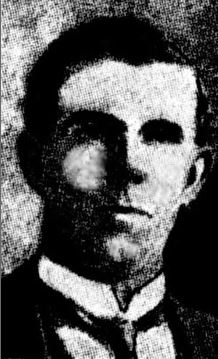
GORDON is NOT mentioned on the Police Wall of Remembrance * NOT JOB RELATED
The Cessnock Eagle & South Maitland Recorder Friday 28 January 1921 page 5 of 6
DEATH OF MR. GORDON FARNHAM A CESSNOCK DISTINGUISHED SOLDIER.
The relatives of Mr. Gordon Farnham D.C.M., M.M. were shocked to receive word this morning of his death at Wagga Wagga. The sad information came as a great shock as it was not even known by his relatives that he was ill. The deceased was a native of Cessnock, being born in the premises now occupied by Mr. Dennis Kenny, in Main Street. The deceased was 30 years of age and was an Anzac, being one of the first Australians to enlist. He enlisted from Broken Hill, where he was a member of the police force.
The late Mr Farnham secured the Distinguished Conduct medal at Gallipoli and the Military medal in France.
He returned on furlough in the early part of 1919 and during his stay at his home town the Armistice was signed.
His remains will be brought to Cessnock and will be interred in the Church of England cemetery on Sunday afternoon.
http://trove.nla.gov.au/ndp/del/article/99448638
Daily Advertiser ( Wagga Wagga ) Saturday 29 January 1921 page 6 of 8
OBITUARY.
MR. GORDON C. FARNHAM.
The death of Mr. Gordon C. Farnham, licensee of the Club House Hotel, Wagga, caused great regret, as the deceased was well-known throughout the district. Mr. Farnham was present at the boxing contests in the Riverina Hall on Wednesday night, and after returning to his hotel ate a supper which included cucumber, and had an iced drink. Later not feeling too well he had a glass of brandy, but during the night he suffered considerably from internal pains. In the morning his condition was such that Dr. Martin was called in, and he diagnosed the case as one of gastritis and enteritis. The sufferer was removed to a private hospital, but although everything possible was done for him he passed away about 3 o’clock on Friday morning. Dr. Martin certified that death was due to food poisoning, and this was endorsed by the deputy coroner after a formal inquiry.
The deceased, who was an ‘Anzac,’ rose to the rank of sergeant-major in the 1st Divisional Engineers, and earned the coveted awards of the D.C.M. and the M.M. At the time of his death he was on the committee of the Returned Soldiers’ League.
Prior to enlisting he was a member of the police force, attached to the Wagga station, and he rejoined the force on April 15, 1919, on his return from the front, and resigned on March 10, 1920, to take over the Club House Hotel.
He leaves a wife, five brothers, and two sisters.
The funeral left Traill-street for the Wagga railway station at 4.30pm on Friday, from where the remains were conveyed by rail to Cessnock for interment in the Methodist portion of the Cessnock cemetery. The chief mourners were the wife of the deceased, Mrs. W. Ball, and Messrs. D. Harris and N. J. Richards. A large number of members of the Returned Soldiers’ League marched behind the hearse, including the president, Ald. Gissing, the pall bearers being Messrs. V. Charker, T. A. Plummer, J. S. Wild, L. H. Shaw, T. A. Smith, and A. Stephenson. Sister Proctor, and members of the Red Cross League were also present, while Senior-sergeant Gallaher, Sergeant O’Brien, Senior-constable Cooper, Constables Brownlee and Waugh, and Tracker McLean represented the Wagga police. There were many beautiful floral tributes.
The funeral arrangements were entrusted to Messrs. McIntosh Bros.
http://trove.nla.gov.au/ndp/del/article/142355550
Service Number listed as 176 and 151
“AN ADELAIDE D.C.M.
Lance-Corporal Farnham, who came to Adelaide from Broken Hill to enlist, has won the Distinguished Conduct Medal for “showing the greatest zeal and disregard for danger during the landing at Gabi Tepe.” Lance-Corporal Farnham is a native of Cessnock (N.S.W.), and is 27 years of age. Like all the country recruits from the Cessnock district, he had a varied experience in rural pursuits in his native State, and was also for a time in New Zealand, and for 18 months prior to enlisting had been in the New South Wales police force, being stationed at Broken Hill. At the historic landing on April 25 he was for 10 hours under fire, “during which time,” says the official report, “he attended the wounded continuously, and made a fine exhibition of coolness and devotion to duty.” Lance-Corporal Farnham was in the trenches from April to the end of August, and is now on police patrol duty guarding prisoners. His parents are very old residents of Cessnock.” – from the Adelaide Advertiser 06 Oct 1915 (trove.nla.gov.au)
“D.C.M. FOR CESSNOCK.
The distinguished conduct medal has been won by Lance-corporal Gordon Farnham, a former resident of Cessnock, for “showing the greatest zeal and disregard for danger during the landing at Gaba Tepe.” The D.C.M. hero, who is a native of Cessnock, is 27 years of age, and previously was employed at the Aberdare Colliery and blacksmith. He is a fine example of Australian manhood, and has many friends in Cessnock who are naturally proud of him. His parents also live in Cessnock. After leaving his native town, Farnham journeyed to New Zealand, from whence he went to Broken Hill, where for eighteen months previous to his enlistment he was a member of the police force. The call of war was too strong, however, and he enlisted in Adelaide with the Third Field Ambulance Corps. He subsequently took part in the famous landing of the 25th April, and was for ten hours under fire, “during which time,” says the official report, “he attended the wounded continuously, and made a fine exhibition of coolness and devotion to duty.” – from the Newcastle Morning Herald and Miners’ Advocate 08 Oct 1915 (nla.gov.au)
“OBITUARY. MR. GORDON C. FARNHAM.
The death of Mr. Gordon C. Farnham, licensee of the Club House Hotel, Wagga, caused great regret, as the deceased was well-known through out the district. Mr. Farnham was present at the boxing contests in the Riverina Hall on Wednesday night, and after returning to his hotel ate a supper which included cucumber, and had an iced drink. Later not feeling too well he had a glass of brandy, but during the night he suffered considerably from intenial pains. In the morning his condition was such that Dr. Martin was called in, and he diagnosed the case as one of gastritis and enteritis. The sufferer was removed to a private hospital, but although everything possible was done for him he passed away about 3 o’clock on Friday morning. Dr. Martin certified that death was due to food poisoning, and this was endorsed by the deputy coroner after a formal inquiry.
The deceased, who was an ‘Anzac,’ rose to the rank of sergeant-major in the 1st Divisional Engineers, and earned the coveted awards of the D.C.M. and the M.M. At the time of his death he was on the committee of the Returned Soldiers’ League. Prior to enlisting he was a member of the police force, attached to the Wagga station, and he rejoined the force on April 15, 1919, on his return from the front, and resigned on March 10, 1920, to take over the Club House Hotel. He leaves a wife, five brothers, and two sisters. The funeral left Traill-street for the Wagga railway station at 4.30 p.m. on Friday, from where the remains were conveyed by rail to Cessnock for interment in the Methodist portion of the Cessnock cemetery. The chief mourners were the wife of the deceased, Mrs. W. Ball, and Messrs. D. Harris and N. J. Richards. A large number of members of the Returned Soldiers’ League marched behind the hearse, including the president, Ald. Gissing, the pall bearers being Messrs. V. Charker, T. A. Plummer, J. S. Wild, L. H. Shaw, T. A. Smith, and A. Stephenson. Sister Proctor, and members of the Red Cross League were also present, while Senior-sergeant Gallaher, Sergeant O’Brien, Senior-constable Cooper, Constables Brownlee and Waugh, and Tracker McLean represented the Wagga police. There were many beautiful floral tributes. The funeral arrangements were entrusted to Messrs. McIntosh Bros.” – from the Wagga Daily Advertiser 29 Jan 1921 (nla.gov.au)
https://rslvirtualwarmemorial.org.au/explore/people/137462
NSW Births, Deaths & Marriages
Death: 4551/1921 Father: Thomas Mother: Susan Wagga Wagga District
John ELSEY
John ELSEY
Victorian ( Melbourne ) Police Force
Regd. # ?
Rank: ( 1 ) Sergeant, ( 2 ) ex-Detective Constable
Stations: ?
Service: From ? 1852 to ?
Awards: ?
Born: ?
Died on: 15 August 1856
Cause: Suicide – slit own throat
Location: Galway Arms Hotel, Melbourne
Age: about 30 ?
Funeral date: ?
Funeral location: ?
Buried at: ?
[alert_yellow]JOHN is NOT mentioned on the Police Wall of Remembrance[/alert_yellow] *NEED MORE INFO
The Argus ( Melbourne ) Saturday 16 August 1856 page 5 of 8
DOMESTIC INTELLIGENCE.
SUICIDE OF AN EX- DETECTIVE OFFICER
Early yesterday morning it was discovered that John Elsey, late of the detective force of this city, had committed suicide by cutting his throat. The deceased was lodging in the Galway Arms Hotel, in Flinders-lane, and on his not making his customary appearance at breakfast, some person went to his room, and found the unfortunate man lying on his face on the floor, with his throat cut, and quite dead.
The deceased was about thirty years of age, a married man, and a native of Kentucky. Some time ago he left his wife behind him at Castlemaine, and went home to America. On his return, it appeared that she had formed an acquaintance with another man, by whom, it is alleged, she had two children.
Elsey obtained a situation in the detective force but was soon after summoned to Castlemaine to provide his wife with a maintenance, and the Bench made an order of £1 per week. This award the deceased was dissatisfied with, and as Mr. Smith, the late superintendent of the detective force, wished, to keep back from his salary the amount awarded by the Bench to his wife, the deceased left the force. This happened about a month ago.
Since that time Elsey appears to have been harassed by applications on the part of the man who is living with his wife for the award of the Castlemaine Bench for her maintenance, and the deceased had since given way to dissipation, and formed acquaintances with disreputable women. His health appears to have broken down, and those circumstances together are supposed to have led to the committal of the rash act.
An inquest will be held over the body this morning.
http://trove.nla.gov.au/ndp/del/article/7134976
Empire ( Sydney ) Friday 22 August 1856 page 6 of 8
The following extraordinary case of suicide by a detective officer is from the “Herald ” of the 10th instant : —
” Yesterday, Dr. Wilmot, City Coroner, held an inquest at the Galway Hotel, Flinders-lane east, on the body of John Elsey, who was found dead in his room with his throat cut that morning. The deceased had been a well-conducted member of the detective force, and the circumstances which led him to commit suicide were of a very painful nature, as will be seen from the following evidence given at the inquest :– Abraham Fenton, sergeant of police, said that he knew the deceased as belonging to the detective force, and hearing yesterday morning that he had committed suicide, he went immediately to the Galway Hotel, and found him lying on his face on the floor of the room, with a razor in his right hand, which was underneath the throat. On the dressing table there was a bottle labelled “laudanum,” and in his trunk, amongst other documents, he found the following paper, in the handwriting of deceased : —
[blockquote]
” Galway Hotel. August 11, 1856.
This is a correct statement of John Elsey. My name is John Elsey. I was born in the county of Norfolk, England. My people emigrated to the United States when I was only one year old. My mother died about six months after landing.
The first of my experience was working with a farmer for my board and clothes. At twelve years of age I went to drive on the Erie canal ; from that coasted out of New York till I came to this colony, which was in 1852. I came out as ordinary seaman in the brig Augustas ; I ran and left the ship three days after she arrived. I went to Gisborne and worked on the roads for two months, after which I went to Castlemaine, and joined the police.
I was promoted to sergeant, and made plenty of money, and on the 11th of February, 1855, commenced my troubles. I married a girl about sixteen years of age. She turned out very bad, so much so that I concluded to go home till she forgot. I went home, and was gone twelve months. When I arrived in this country again I joined the detective police. I had not been in them more than (?) before my wife summoned me to Castlemaine, and the bench of magistrates ordered me to pay the sum of 25s per week. I could not afford to pay the same. I went and saw the Chief Commissioner of Police, and he told me he would suspend me for the period of which I was gone to Castlemaine to find proof against my wife, and when I come back from Castlemaine he should immediately take me on again. When I came back from Castlemaine I went to him, and he told me he would take me on. After detaining my time for two weeks, he would not do it.
And now for that reason I am about to commit this : and may the great God cast a punishment on him that will make him feel that he has got this most abominable sin to answer for. I cannot do hard work, and there is nothing else left for me to do ; and before having to knock about the country like some, I will commit suicide.
Given under my hand this 14th day of August, 1856.
JOHN ELSEY.
14th August — I state that I owe nearly the sum of £3 for board which I wish to be awarded out of my effects.
JOHN ELSEY.
[/blockquote]
Patrick Kelly, landlord of the Galway Hotel, said that the deceased had been a lodger at his house for about three months, with the exception of a few weeks’ absence.
On his return to the house on the 31st of July, after being away for a few weeks, he observed a change in his appearance, and deceased told him that he had been unwell ever since he left his house, and was getting worse. He only complained of a cold, and about a week ago said that he had again joined the detective force, but had leave of absence for a week in order to get rid of his cold. The last time he saw him alive was on Thursday at mid-day, when he appeared the same as usual. One of the lodgers saying that he had knocked at the door of deceased without receiving any answer, he sent up to ascertain the fact, and subsequently forced open the door, when he saw deceased in the state in which he then lay. To his knowledge deceased was not addicted to drinking.
Patrick Boyle, teacher, had known the deceased for the last fortnight, and had opportunities of seeing a great deal of him. For the last eight or nine days he appeared very dejected in mind, and said that he was very unwell. For the last three days he could hardly go up and down stairs, and seemed to have lost the power of his limbs, and to have been very absent in mind. He had never seen him under the influence of liquor.
Henry White of the detective force, had known the deceased since March last, when he was in the detective force, and was a steady well conducted man. He resigned in June, and proceeded to Castlemaine, where he had been summoned by his wife for maintenance, and he was ordered to pay her a weekly allowance.
He felt greatly aggrieved at his wife living with another man. He then resigned the force, and had since been leading a very irregular life. The last time he saw him alive was on Monday, the 12th instant, when he seemed very low in spirits, and said he thought he should rejoin the force. He traced all his troubles to the conduct of his wife, which preyed heavily upon his mind.
The jury, by their verdict, found that John Elvey(sic) had died from a wound inflicted by his own hand by a certain razor across the throat, whilst in a state of temporary derangement.”
Gippsland Guardian ( Victoria )
Friday 29 August 1856 page 1 of 4
John Elsey, a native of Kentucky, and an ex-detective officer of the Melbourne Police, committed suicide by cutting his throat, on the 15th inst., in the Galway Arms Hotel, Melbourne, where he had been lodging.
[divider]
The Age ( Melbourne ) Thursday 17 April 1856 page 3 of 4
LOCAL INTELLIGENCE.
The Assault on the Detectives. — George Pickering, the oyster-dealer, who, on Tuesday, created a serious disturbance in Little Bourke street, and was secured with great difficulty, made his appearance on Wednesday, with his head and face severely mauled and blood-stained.
On Detective Elsey’s announcing his authority to arrest him, he said that he never went without a fight for it, and immediately struck the detective a violent blow in the chest.
In self-defence he drew and wielded his neddy vigorously, and, besides contending with the prisoner, had to withstand the attacks of a whole host of pick pockets and oyster men, the friends of the prisoner. At last, by the aid of Detectives White and Randall, he was hauled off to the lock-up.
His wife, at whose instance he had been arrested, appeared against him.
She supports herself by washing, and on the present occasion had a considerable quantity of clothes in the house. Pickering, just out of gaol, went into the house, and after brutally ill-treating his wife, threw all the clothes out of the window into the street.
She has two children by the prisoner, who broke the leg of one of them in a fit of drunkenness, some time previous. The prisoner was sentenced to three months’ hard labor, and at the conclusion of that term he was ordered to find two sureties of £25 each, to keep the peace towards his wife for twelve months.
http://trove.nla.gov.au/ndp/del/article/154863101
The Argus ( Melbourne ) Monday 12 May 1856 page 4 of 8
THE ARGUS Publish Daily.
MORE STURT’S JUSTICE
Another sample of this very peculiar commodity has been exhibited at the Melbourne Police Office during the past week.
Four ” fast ” young men, named James Bruce, William Bruce, Henry Younger, and John Ford were charged on Tuesday with having the previous evening created a disturbance at the Theatre Royal, and assaulted Detective Elsey in the execution of his duty.
The evidence of the detective was to the effect that, hearing James Bruce making use of disgraceful language he (Elsey) desired him (Bruce) to desist.
Bruce hereupon first abused and then struck Elsey, who tried to arrest his assailant, but the latter was immediately reinforced by the other three prisoners.
Elsey was severely beaten among them, his clothes torn, and a ” gold nugget pin ” plucked from his breast and flung away.
Ultimately Elsey received succor, and the brawlers were arrested. On being brought before the Police Court the next day, James Bruce, William Bruce, and Henry Younger were sentenced to one month’s imprisonment, Ford being released on payment of a forty shilling fine, his participation in the disturbance having been small.
http://trove.nla.gov.au/ndp/del/article/4837589
John McNALLY
John McNALLY
( the First Victorian Policeman killed ‘ on duty ” )
Victoria Police Force
Sergeant
Murdered – shot
Born 1826
Died 16 October 1856
30 old
McNally, John (1826–1856)
Intelligence was received on Saturday morning last, at the Detective Office, that on the preceding Thursday, the 16th inst., two of the mounted police force, Sergeant [John] McNally and Constable Moore, proceeded at seven o’clock on the night in question to a tent believed to be occupied by the notorious William Turner, alias Gipsy Smith, who stands charged with various acts of highway robbery, and with dismounting a constable from his horse near Castlemaine several months ago, and with escaping from custody.
On approaching the tent, the officers recognised Turner, who attempted to make his escape. The officers immediately closed with him, and, during the struggle, shots were fired from the tent, one of which entered the breast of Sergeant McNally, who fell dead on the spot. Several other shots were fired, and wounded the constable (Moore) severely in the face and other parts of the body.
As soon as the intelligence reached the Camp at Mount Ararat, the police went in search of the bushrangers, who, however, succeeded in eluding their vigilance. A woman was arrested in the tent. An active search is in progress, and it is thought the criminals cannot long escape detection. The gang, supposed to be under the leadership of Turner, is, without doubt, the same as that which committed the late daring acts of bushranging near Moliagul.
http://oa.anu.edu.au/obituary/mcnally-john-15338
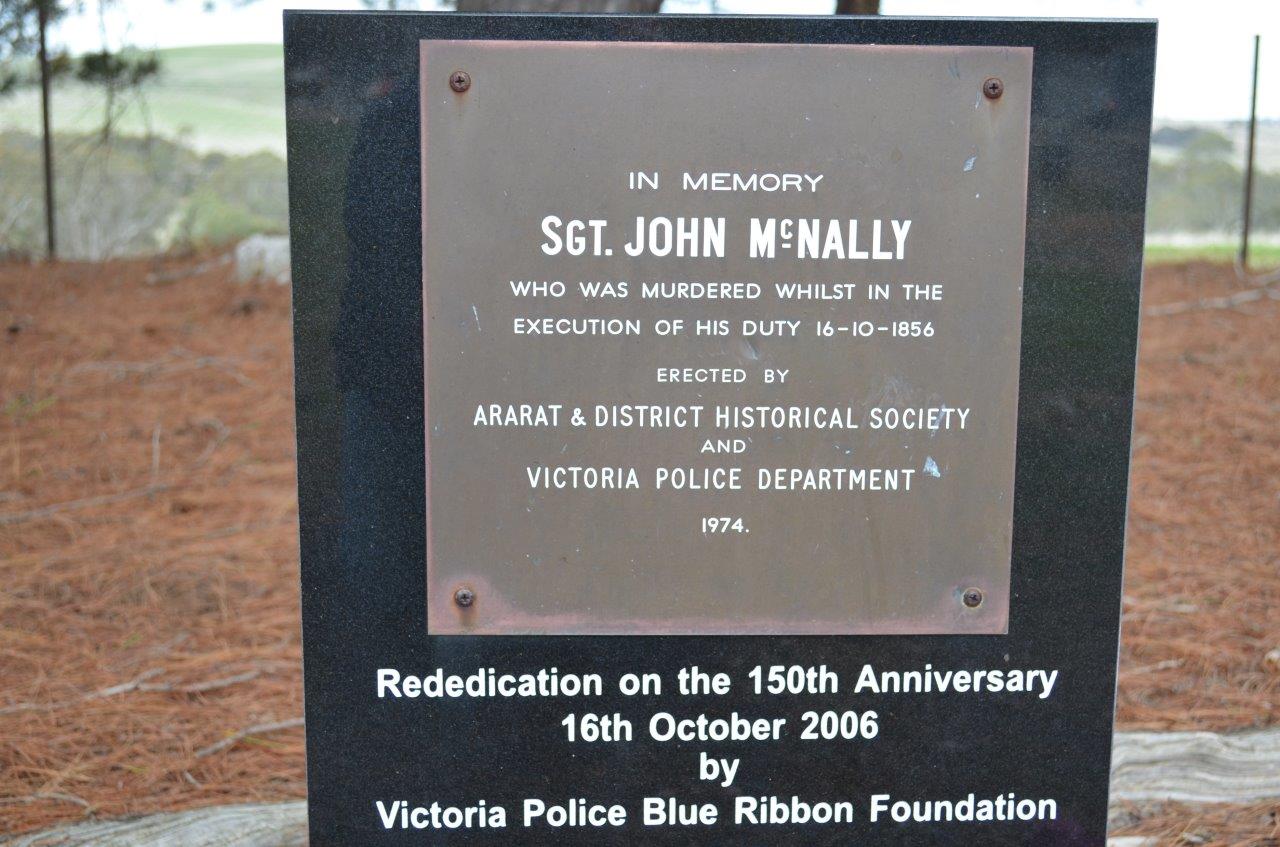 Sgt John McNally
Sergeant John McNally became the first member of the Victoria Police to be feloniously slain in the line of duty when he was murdered at the Cathcart diggings on 16th October, 1856.

Whilst trying to arrest a suspect (Gypsy Smith) over a string of armed robberies, an associate of the suspect intervened and fired his shotgun, killing Sergeant McNally and seriously injuring his partner, Constable John Moore. The two offenders then made their escape. Seven days later, the pair were arrested near Amherst and charged with the murder of McNally. One of the offenders was hanged in 1857 and the other received a sentence of fifteen years hard labour.
The offender, William Smith (Gypsy Smith) was transported to Botany Bay at the age of 15 for stealing a handkerchief. He went on to become a hardened bush ranger who, between the years of 1852 and 1856, became the notorious ‘Gypsy Smith’, a subject of fascination for the newspapers and police as he and his gang of desperate convicts created fear among the gold diggings of Victoria.
Sergeant McNally is buried in Cathcart Cemetery on a hill known as McNally’ Hill. The Cemetery is in a natural bushland setting and is very well maintained.
The emergency department at Ararat Hospital is known as the John McNally Emergency Department.
Cathcart is approx. 4.6 km from Ararat and is approx. 345 m above sea level. There is no town at Cathcart, it is only an area. It was a large attraction for Gold Miners in the early 1800′s. People from England, Ireland, Scotland, America, Switzerland, Germany, France, Russia and China descended on Cathcart to look for gold. Also many other from Australia took their families there as well.
There were many stories about horse thieves and murderers in the old days and these were dealt with tough justice by a self-established vigilante committee.
After the first rush the lead was lost and most miners moved on to other diggings except one of the original party J. P. Rodd who was in partnership with an American Negro Richard Davis (alias Black Harry). They traced the gold deeper and hit another lead calling it Blackman Lead. This attracted 3,000 diggers to the area, other leads were discovered each causing a new rush of miners.
The general area became known as Cathcart and with time the name was given to the Township where stores, school, hall and hotels had sprung up. There were many tents and lean-to shanties.
Today there is little evidence of the hustle and bustle of the frenzied gold diggers and their lively community of dreamers. Except maybe the Cemetery, which is on the Ararat- Pomonal Rd.
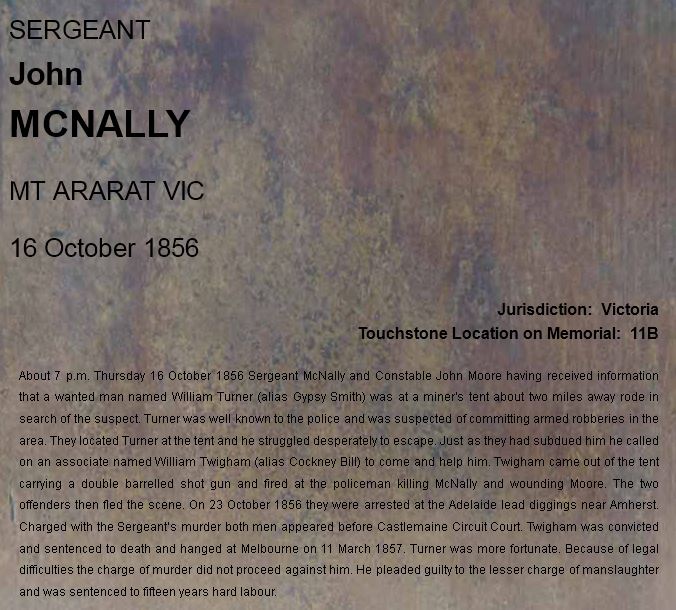
Sergeant John McNally: The system of registered number for police hadn’t been introduced when Sergeant John McNally was murdered on the Mt Ararat goldfield in 1856. He had joined the Victoria Police Force the previous year after service with the Royal Irish Constabulary.
On October 16, 1856 Sergeant McNally and Constable John Moore where told that William Turner, a wanted robber was staying in a tent in a camp about two miles away. Turner tired to flee but the police wrestled him to the ground. Turner called for help from his associate, William Twigham. Also known as Cockney Bill, Twigham came out of the tent armed with a double-barrelled shotgun. He fired, killing Sergeant McNally and wounding Constable Moore.
Turner and Twigham escaped and a reward of £400 was offered for their arrest. They were arrested a week later at the Adelaide diggings after being recognised by a shopkeeper.
After a trial held at Castlemaine, Twigham was convicted of murder and sentenced to death. he was hanged at the Melbourne Gaol on March 11, 1857.
Turner pleaded guilty to the lesser charge of manslaughter and was sentenced to 15 years hard labour on the roads and other public works.
Life of Sergeant John McNally’s murderer subject of new book
By BEN KIMBER
ARARAT – A book chronicling the life and times of the man responsible for the murder of police sergeant John McNally in 1856 is nearing completion.
The text, which is yet to be titled, tells the story of William Sydenham Smith and how his life of crime led to him crossing paths with Sergeant McNally.
Sergeant McNally was the first member of the Victorian Police force to be slain in the line of duty.
The research team of Marion McAdie, Greg Vivian, and Ian Batty along with author Laurie Moore have spent over 12 months on the book.
Mrs McAdie said she along with the genealogical society wanted to find the facts surrounding the murder of Sergeant McNally.
“Unfortunately, after much research we still know little about McNally or his partner Constable John Moore, who was wounded in the same incident,” she said.
The book uses Smith’s history to provide a broader context to the death of McNally.
“Like the public perception of most Australian bush rangers, Smith comes across in most accounts as a one-dimensional person,” Mrs McAdie said.
“His origins from England as a transported convict at the age of fifteen, his brutal treatment for minor misdemeanours at the hands of a ruthless system, his heroism in saving lives during his imprisonment, and his eventual participation as a free man in colonial New South Wales and Victoria, have never been mentioned before.
“As in many cases of murder by bush rangers, the victim hardly rates a mention and we hope that this book may help recognise the heroism and positive contributions made by the early police on the goldfields.”
Mrs McAdie said she believes it is an important story because it tells of how a young William Smith was transported to Botany Bay at the age of 15 for stealing a handkerchief.
“It traces his experiences as a convict around Sydney, Norfolk Island and Tasmania before he escaped in a whale boat from Tasmania,” she said.
The book goes on to show how the young boy became a hardened bush ranger who, between the years of 1852 and 1856, became the notorious ‘Gypsey Smith’, a subject of fascination for the newspapers and police as he and his gang of desperate convicts created fear among the gold diggings of Victoria.
The story culminates in the events at Cathcart diggings on October 16, 1856 when the bush rangers were confronted by Sergeant McNally and Constable Moore, leaving one dead and the other wounded.
“After the eventual capture of the bush rangers near Maryborough, Smith’s mate was hanged but a strange fate awaited Smith, and this is detailed in the forthcoming book,” Mrs McAdie said.
Although the story revolves around a bush ranger, it is set among the goldfields of 1850s’ Victoria.
It touches on the lives of many ordinary people, the legal system, the squatters, and the impacts of convicts who came in large numbers to look for gold and rob and terrorise the infant community.
“It is a good read and one that is set in Sydney, Norfolk Island, Tasmania, Melbourne, Yackandandah, Moliagul, Maryborough, Amherst, Beaufort, Ararat, Cathcart and Hay in New South Wales,” Mrs McAdie said.
The book’s author, Laurie Moore retired from Sydney to live in Western Victoria thirteen years ago.
Mr Moore’s first book involved nearly ten years of research by Mr Moore and his wife Dianne.
It told the story of the last declared outlaw in Australia, Jimmy Governor, who was the fictional character, Jimmie Blacksmith, in the book written by Thomas Keneally.
Since then he has written ‘Shot for Gold’, a bush ranging story that happened near Smythesdale, a draft for a book on the Clark Gang of Braidwood, and has now put together the history of the killing of the policeman, Sergeant John McNally, and the convict and bush ranging events that led to his death in October 1856 at Cathcart.
Mrs McAdie said despite all the hours of research the team still can’t place an exact location of the burial site of sergeant McNally.
“We would love to hear from people about the exact location,” she said.
“We think the site is located in the north west corner of the now Cathcart cemetery.”
The team hope to have the book finished by the 157th anniversary of the event on October 16 this year.
Sergeant John McNallyPrint Page 
Sergeant John McNally became the first member of Victoria Police to be feloniously slain in the line of duty when he was murdered at the Mt Ararat goldfields on 16th October, 1856. Whilst trying to arrest a suspect over a string of armed robberies an associate of the suspect intervened and fired his shotgun, killing Sergeant McNally and seriously injuring his partner, Constable John Moore. The two offenders then made their escape. Seven days later, the pair were arrested near Amherst and charged with the murder of McNally. One of the offenders was hanged in 1857 and the other received a sentence of fifteen years hard labour.
Location
| Address: | Phillips Flat Road, Cathcart Cemetery, Cathcart, 3377 |
|---|---|
| State: | VIC |
| Area: | AUS |
| GPS Coordinates: | Lat: -37.319616 Long: 142.888729 Note: GPS Coordinates are approximate. |
Details
| Monument Type: | Plaque |
|---|---|
| Monument Theme: | People |
| Sub-Theme: | Crime |
| Actual Event STart Date: | 16-October-1854 |
| Actual Event End Date: | 16-October-1854 |
Dedication
| Approx. Monument Dedication Date: | 1974 |
|---|
In memory Sgt. John McNally who was murdered whilst in the execution of his duty 16-10-1854. Erected by Victoria Police Department 1974.
Source: MA,RHSV
The John McNally Medical Imaging Unit at Ararat Hospital
With substantial donations from the Victoria Police Blue Ribbon Foundation the Ararat Hospital was able to purchase an image intensifier for its surgical department and new X-Ray equipment for the Medical Imaging Unit. This was a joint project between the Blue Ribbon Foundation and the local community through the Ararat Branch and was dedicated as a Police Memorial in memory of Sergeant John McNally who was murdered at the Mt Ararat Goldfields in 1856.
http://www.remember.org.au/Memorials/Hospitals/The-John-McNally-Medical-Imaging-Unit-at-Ararat-Ho
The John McNally Emergency Department at Ararat Hospital
In 2003 works commenced on a complete redevelopment of the Ararat Hospital and the Victoria Police Blue Ribbon Foundation was able to contribute to the re-building of the emergency department. This was completed as a joint project in partnership with the local community through the Ararat Barnch of the Blue Ribbon Foundation. Today the Ararat Hospital Emergency Department can provide state of the art emergency & trauma care to the people of Ararat and surrounding districts. This project, commissioned as a Police Memorial in May 2004, was the first stage in a continuing relationship with the community of Ararat and their public hospital.
Sergeant John McNally became the first member of Victoria Police to be feloniously slain in the line of duty when he was murdered at the Mt Ararat goldfields on 16th October, 1856. Whilst trying to arrest a suspect over a string of armed robberies an associate of the suspect intervened and fired his shotgun, killing Sergeant McNally and seriously injuring his partner, Constable John Moore. Sergeant McNally’s sacrifice is acknowledged through this an other projects installed at the Ararat Hospital.
http://www.remember.org.au/Memorials/Hospitals/The-John-McNally-Emergency-Department-at-Ararat-Ho
Chief Constable Charles FOX
Chief Constable Charles FOX
New South Wales Police Force
Illness – Suicide
Muswellbrook
25 August, 1856
Charles Fox was Chief Constable of Muswellbrook when he took his own life on Monday 25 August, 1856. The following paragraph appeared in the Sydney Morning Herald of 29 August, 1856.
On Monday, the 25th, an enquiry was held at the courthouse, Muswellbrook, before the coroner, Mr J.B.West, and a jury of twelve, touching on the death of Mr Charles Fox, chief constable, who, on the same morning, had committed suicide, by shooting himself with a pistol. It appeared on evidence that the deceased was latterly under medical treatment for general debility and depression of the mental faculties and had been for some time past labouring under hypochondria. It seemed on a view of the body, which presented a shocking spectacle that he had placed the muzzle of the weapon in his mouth, which dreadfully shattered… A finding of ‘Destroyed himself while labouring under temporary insanity’ was accordingly made. The deceased was much respected as a steady inoffensive man, and has left a widow and one son.
At the time of his death the chief constable was stationed at Muswellbrook.