William EIFFE
William EIFFE
Late of Singleton
New South Wales Police Force
Regd. # P 1154
For the purposes of this website ‘P‘ = represents those Police joining Pre 1862 when NSWPF “Officially” commenced
Rank: Constable
Stations: ?, Singleton
Service: From 11 August 1857 to 24 January 1867 = 9+ years Service
Awards: ?
Born: ? ? 1833 – 1834
Died on: Thursday 24 January 1867
Age: 33 – 34
Cause: Shot – accidental
Event location: between Bendemeer & Tamworth, NSW
Event date: 16 January 1867
Funeral date: Friday 25 January 1857
Funeral location: Old Bendemeer Cemetery
Funeral Parlour: ?
Buried at: Old Bendemeer Cemetery ( private property and unmarked )
Memorial located at: Bendemeer Cemetery, NSW
[alert_green]WILLIAM IS mentioned on the Police Wall of Remembrance – but under an incorrect surname of EFFE which they won’t correct[/alert_green]
FURTHER INFORMATION IS NEEDED ABOUT THIS PERSON, THEIR LIFE, THEIR CAREER AND THEIR DEATH.
PLEASE SEND PHOTOS AND INFORMATION TO Cal
May they forever Rest In Peace
Constable William Eiffe memorial unveiled by Oxley police at Bendemeer Cemetery

Breanna Chillingworth
A PERMANENT memorial to recognise a fallen officer has been unveiled near Tamworth on the 150th anniversary of his death.
Constable William Eiffe died from a gunshot wound to the thigh on January 24, 1867, and is buried in an unmarked grave in the Bendemeer cemetery.
Oxley police together with Tamworth Regional Council – who helped to construct the memorial – commemorated his career in the force in a service on Tuesday morning.
”It’s a great part of the local history to have this recorded and I think it brings some interest in the local cemetery and the history of Bendemeer,” Oxley Acting Superintendent Jeff Budd said.
“And, hopefully for centuries to come, people will be able to come here and look at this and remember what has happened in our past.”
The Singleton-based officer was on a police escort on the night before his death when he was accidentally shot in the leg.
“On the evening of Wednesday the 23rd of January, 1867, there was a gold escort moving through the Moonbi Ranges, approximately seven miles from Bendemeer,” Oxley Sergeant Josh McKenzie said.
“A rain show had caused members of the escort to retreat into the carriage, another member of the escort had handed his rifle to Constable Eiffe, he rested the rifle across his thighs with the butt resting against the side of the coach.
“It is thought that the shaking and bouncing of the carriage has caused the rifle to accidentally discharge, shooting Constable Eiffe in the thigh.”
Constable Eiffe was left at Shepherds Hut nearby and the coach returned to Tamworth.
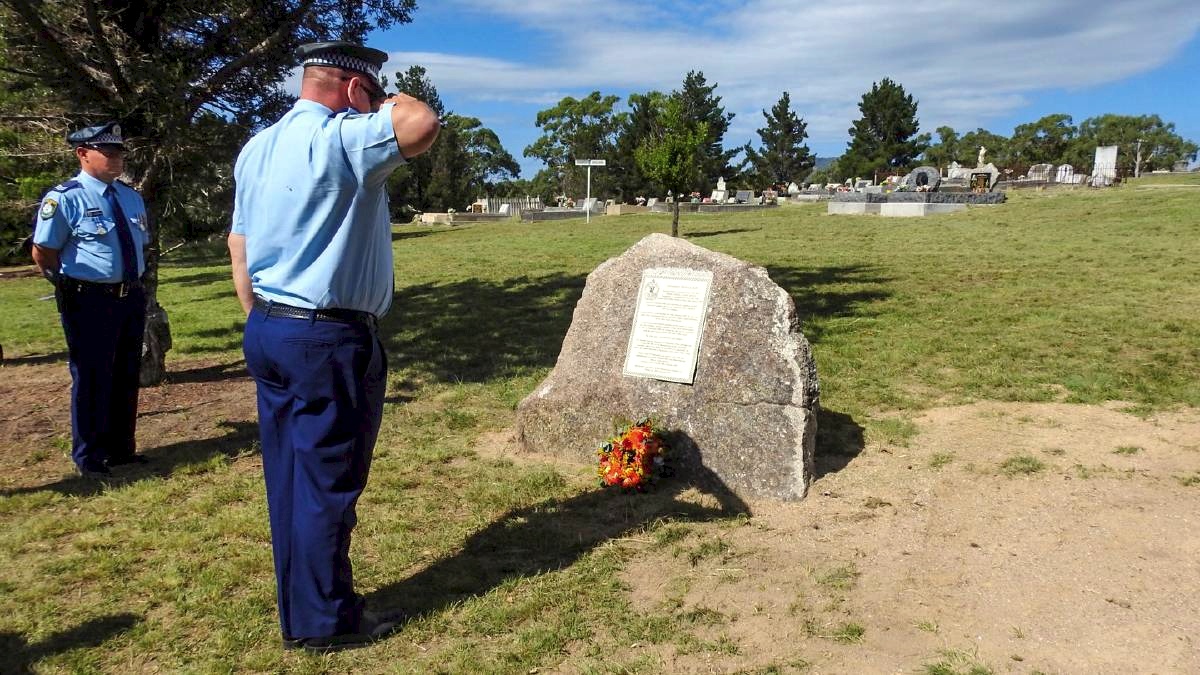
Memorial unveiled: Oxley Acting Superintendent Jeff Budd with Sergeant Josh McKenzie in Bendemeer.
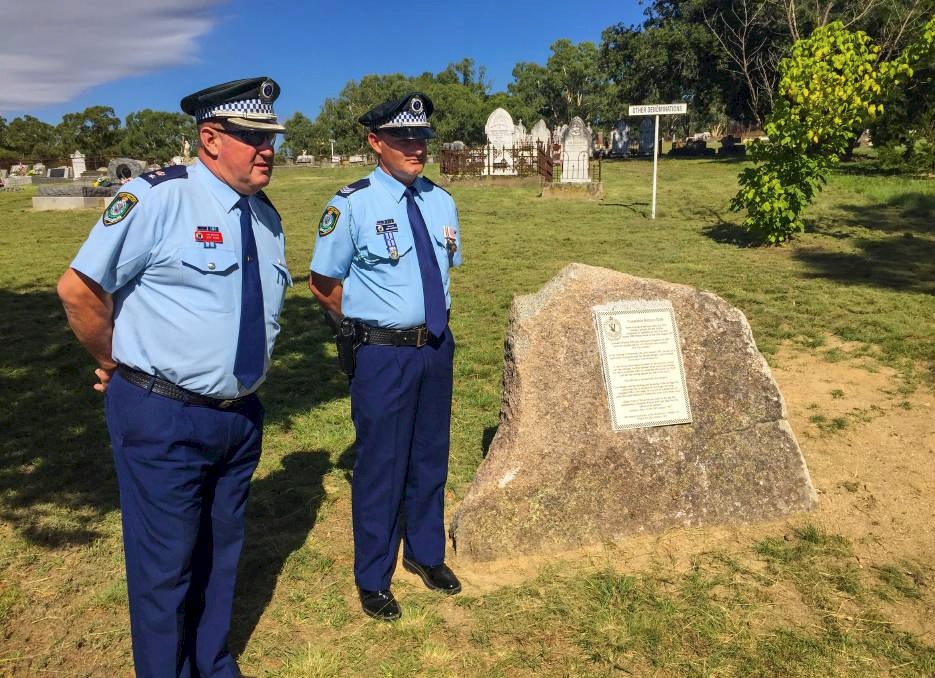
Memorial unveiled: Oxley Acting Superintendent Jeff Budd with Sergeant Josh McKenzie in Bendemeer.
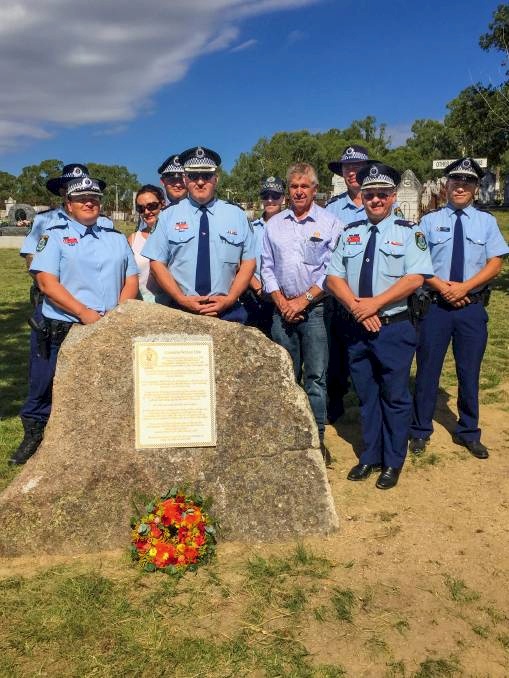

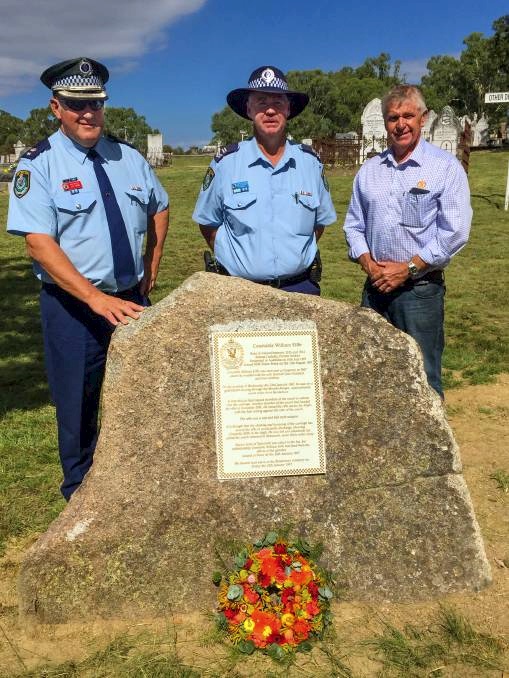
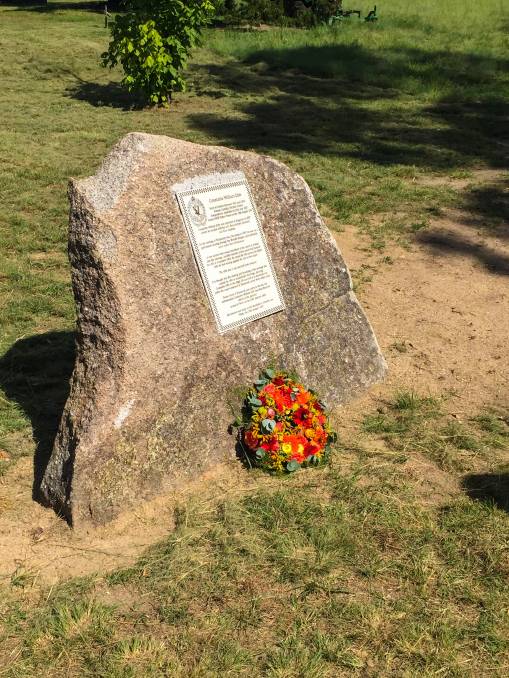
William is actually buried in an unmarked grave.
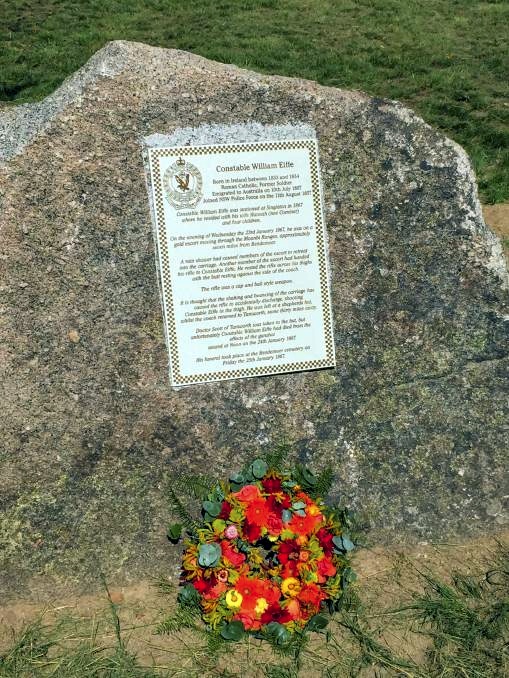
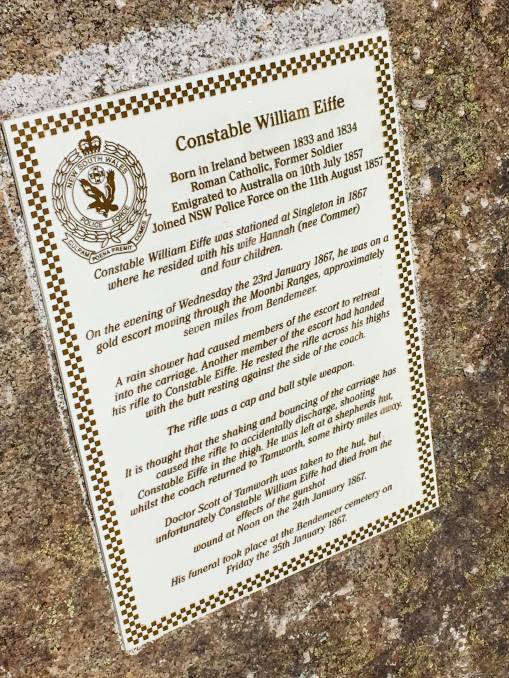
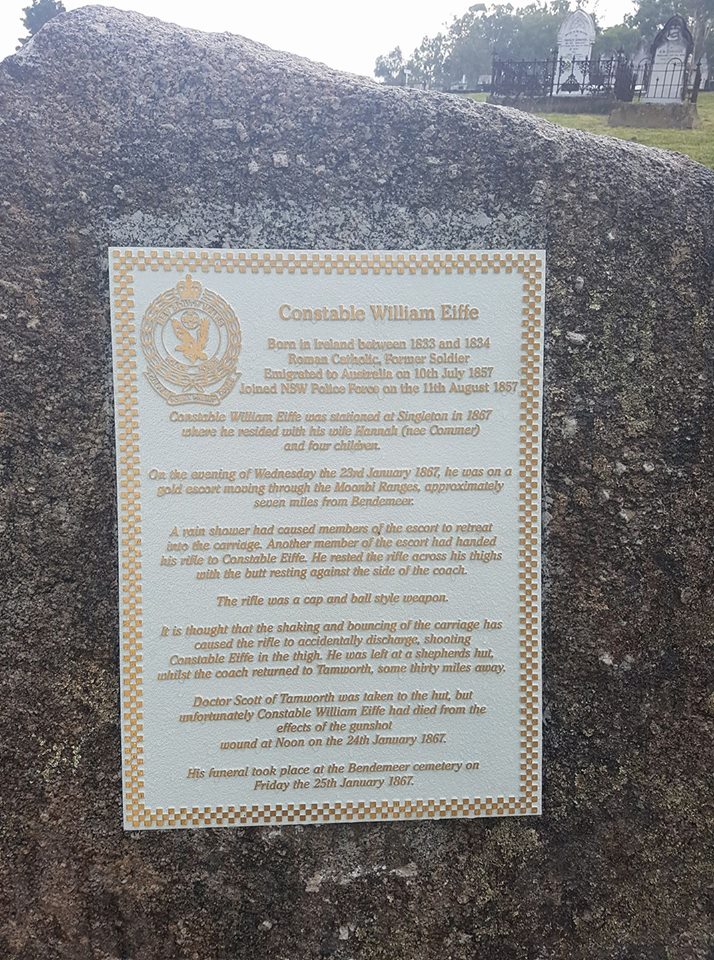
“Dr Scott of Tamworth was taken to the hut but unfortunately Constable William EIFFE died from the effects of the gunshot wound at noon on the 24th of January, 1867.”
Acting Superintendent Budd said the service was a reminder of how far the force had come in 150 years.
It is thought that the shaking and bouncing of the carriage has caused the rifle to accidentally discharge.
Sergeant Josh McKenzie
“One of the things that would be a tragedy today is for this to occur and his family to not be supported,” he said. “In the days of Constable William Eiffe, his wife and four children would have been destitute without the support we have today and we should be grateful for that.”
Constable William FYFFE
Accidentally Shot
Tamworth
24 January, 1867
On 16 January, 1867 Constable Fyffe was performing gold escort duty on a coach travelling between Bendemeer and Tamworth. It is thought that the shaking of the coach caused a rifle to accidentally discharge, shooting the constable. The wounded constable was left in a shepherd’s hut while the coach continued to Tamworth to obtain medical assistance. Dr Scott of Tamworth provided assistance for the constable, however the wound was to prove fatal and he died the following Thursday. He is sometimes referred to as William Effe.
The Sydney Morning Herald dated 25 January, 1867 reported that news from Tamworth had been received that ” Last evening, Constable Fyffe, on gold escort duty, was accidentally shot in the thigh whilst riding in the coach on Moonby Ranges, seven miles from Bendemere. His rifle accidentally discharged, it is supposed, by the shaking of the coach. He was left at a shepherd’s hut. The escort proceeded to Tamworth, and on its arrival there Dr. Scott was immediately started off. Fyffe died from the effects of the wound at noon today. He has left a wife and large family at Singleton.
The constable was born in 1834 and joined the police force on 11 August, 1857. In 1862 he became a member of the newly-formed New South Wales Police Force. At the time of his death he was stationed at Singleton.
Robert Dowker CODRINGTON
Robert Dowker CODRINGTON
New South Wales Police Force – Trooper
Regd. # ?
Trooper
Stations: Cheshire Creek Barracks ( Bathurst/Peel area ), Wyagden – Death
Served: From about 1854 to 22 December 1857
Awards: ?
Born: In Madras, India, about 1836
Died: Tuesday 22 December 1857
Age: 27
Cause: Shot – Murdered
Bathurst
Funeral Date: Thursday 24 December, 1857
Funeral location: ?
Funeral Parlour: ?
Service performed by H.A. Palmer
Buried at: Sofala Cemetery, 4440 Sofala Rd, Sofala, NSW
On 22 December, 1857 Trooper Codrington rode out to meet the gold escort from the Turon Valley. His duties included escorting the gold and mail being carried either by coach or packhorse down the steep Wyagdon Hill and into Bathurst. After he was reported missing, a search was conducted and his body, shot through the heart, was found off the side of the Bathurst – Turon Road in a ravine at the top of Wyagdon Hill. Bushes were found nearby piled on the roadside and it is thought that the bushrangers who probably killed the trooper had hidden at that spot to await and rob the escort. No other satisfactory reason could be found for the murder, although the escort passed the spot unmolested on that day. Local legend has it that the trooper was killed by an old enemy who then returned to England after the murder, however this remains unsubstantiated.
In late 1860 John Higgins (alias John Davis) appeared before the Albury Police Court charged with “having, on the 22nd day of November [sic], 1857, shot one Robert Codrington, a mounted trooper, in the District of Sofala, Bathurst”. He was found not guilty. An alleged witness to the murder was Richard Henry Mills Sampson, who was a man known for giving false evidence in a previous, unrelated trial. His statement, which may or may not be truthful, was as follows:
At that time I was going from Louisa Creek to Bathurst to spend Christmas. I there met the prisoner with three other men, two of them were travelling with the deceased trooper. I rode up sharply, and was immediately covered by a gun by one of the men. The prisoner, whom I now distinctly recognise, shot the trooper Codrington, and afterwards proposed to shoot me. A man named Cole, whom I have known for years, was one of the party…[and he] said I would not blab. The murder took place about 3 o’clock in the afternoon. I was about 50 yards from them when I first saw them. The prisoner said several times, “Shoot him,” and called the others cowards. He then shot Codrington himself, and was the only one of the party who had a gun. I did not see what they did with the body.
The constable was born about 1832 and joined the Gold Escort about 1854. At the time of his death he was stationed at Cheshire Creek Barracks (Bathurst/Peel area).
Robert IS mentioned on the National Police Wall of Remembrance
Location of ( Wiagdon ) Wyagdon: [codepeople-post-map]
Born in Madras ( India ) in 1836 to Robert Codrington and Louisa. Robert Dowker married Louisa Kershaw on 5 April 1856 and had a child – Robert William, born 27 November 1856 or 1857 & died 2 April 1930 in NSW. Robert Dowker CODRINGTON passed away on 22 Dec 1858
http://records.ancestry.com/robert_dowker_codrington_records.ashx?pid=3644377
My great great grandfather, Robert Dowker Codrington, a gold trooper (mounted policeman) who was shot at Kelso in about 1856. He migrated to Australia in 1853 from England.
http://www.stephencodrington.com/dempsey/Great_Grandparents.html
Witnesses to History
By Eric Pratt QC
See chapter 9: The Murder of Robert Codrington
 Bathurst Free Press and Mining Journal
THE TRAGEDY AT WYAGDEN.
(From a Correspondent of the Bathurst Free Press.)
Our quiet neighbourhood has been thrown into a state of great excitement, in consequence of Trooper Codrington, of the Gold Police being shot, at the top of Wyagden Hill.
It appears that Robert Codrington, trooper in the Gold Police, left the Police Barracks, at Cheshire Creek, where he was stationed, about 8 o’clock on Tuesday morning last, for the purpose of meeting the Gold Escort coming from Sofala; and by his not returning that day, some excitement was caused ; it was conceived that he had ‘received some fresh orders, and had gone on to Sofala. On the Wednesday morning his horse was discovered at the stable, with the saddle on, but without his bridle. So soon as this was known, a search was commenced along the road, but no traces could be discovered. Night coming on, instructions were given, that as many horsemen as could be procured, should be ready by daylight the following morning to renew the search. Just as we were on the point of starting from Wyagdon, our doubts were set at rest, by the arrival of Sergeant Major Giles, of the Gold Police, who communicated that the body of Robert Codrington had been found in a gulley on the top of Wyagden Hill. We immediately hastened to the spot, and found that the trooper bad been shot on the road, and the body dragged down the gulley some distance. The scene was most heartrending, and became still more so by the presence of his wife, a fine young woman in the bloom of life, with her baby about twelve months old, who had hastened to the spot so soon as the bad tidings had been made known to her, anxious to see the last of her affectionate husband.
On the arrival of Dr. Andrews from Sofala, who had been sent for, an inquiry was instituted in the presence of J. B. Suttor and Hugh Bridson, Esquires, magistrates.
It was found necessary to remove the body to the nearest public-house, for the purpose of a post-mortem examination. Evidence was taken to show that the deceased had been shot, and that six buck shots had passed through the heart. From inquiry it would appear that a plot had been made to waylay the mail, for the purpose of robbing it, and Codrington happening to pass up first, he was shot by the supposed robbers, and while they were getting him out of the way, the mail must have passed down in safety. It was quite evident from the way the bushes were placed, forming a sort of ambush just on the top of the first point, where the mailman always pulled up to put on the drags, and the guards generally get off, that the intention must have been to have shot the guards, for the purpose of robbing the mail only ; as one pound two shillings was found in Codrington’s pockets, which was all the money he was supposed to have had about him. The carbine and pistols were taken away.
The unfortunate victim of this lawless outrage was a young man of high respectability, and descended from a very high family, who have always stood foremost in the defence of their country ; and he was very much respected in this neighbourhood.
We very much regret that the serious illness of Mr. Johnson, the Gold Commissioner, has prevented his ready aid and presence on this melancholy occasion.
Every praise is due to Sergeant Major Giles and his troopers, in making every exertion to discover the body ; and it is to be hoped that his well-known experience will enable him and his troopers to discover the perpetrators of this awful murder.
After this tragical sacrifice to mistaken policy and economy, it is to be hoped that the Government will see the necessity of increasing the gold police force, as well as the rural police in the neighbourhood of the diggings.
Bathurst Free Press and Mining Journal
Saturday 9 January 1858 page 4 of 4
MURDER OF TROOPER CODRINGTON. Public Meeting.
At a Public Meeting held at the ” Carrier Inn, ” Bathurst, W. Hall Palmer, Esquire – P.M. in the Chair, it was proposed by W. H. Suttor, Esquire, seconded by W. Lee, Esquire :-
” 1st. That the recent barbarous murder of Trooper Codrington, at Wyagden, imperatively calls for some movement upon the part of the public in the district, having for its object, the discovery of the murderer or murderers. Carried. Proposed by A. Campbell, Esquire, seconded by J. B. McGuyigan, Esquire.
” 2nd. That a public Subscription be at once set on foot, the amount of which shall be offered as a reward to any person or persons who shall give such information as shall lead to the conviction of the parties concerned in the perpetration of the murder. Carried. Proposed by R. Y. Cousins, Esquire, seconded by Mr. D. Kenna.
” 3rd. That John Blight Suttor, Esquire, be requested to act as Treasurer, and A. G. Shadforth, Esquire, as Secretary, and that they shall at as earl a date as practicable, cause to be published in such of the colonial newspapers as they may deem advisable, the amount of the reward offered. Carried.