Det Cst 1/c Graham CLARK, P.C. Cst 1/c Stephen GORDON, Det Cst 1/c John DAVIDSON, Det Cst 1/c Stephen McCLELLAND, Det SenCon John LARKIN, Det SenCon Dennis HOLDMAN, Det SenCst Ted McCARTHY
Middle Row
Det SenCon John BRENNAN, P.C. Cst Bill BRANDER, Det SenCon Stephen LIVERSIDGE, Det SenCon Bill SUTTON, P.C. Cst 1/c Rod BRYAN, P.C. Cst 1/c Peter WHALAN, P.C. Cst 1/c Shayne McANULTY
Front Row
Det Sgt 3/c Jim THORNTHWAITE, Det Sgt 3/c Ken WATERS, Det Sgt 2.c Allen HALLIDAY, Det Sgt 1/c Russ COOK , Det Sgt 3/c Ray HALLAM, Det Sgt 3/c Brian BORTHWICH, P.C. P/W Const 1/c Jenny COUPER
Mark DAVIDSON & John Stuart DAVIDSON
Daily Telegraph – 15 January 2025
Class 127
Al Sparkes
20 January 2025
I have done my best to copy this article from the Daily Mail, a UK News Paper. Its a story about many stories about Davo, the great man. Unfortunately, the actual article is behind a pay wall and I cannot share it from the web. Many thanks to Ray Lambie for his contribution to the story. Unfortunately I wasnt able to place the photographs in with the story but have attached them as best I could.
Two anecdotes repeatedly come up when old cops remember legendary detective inspector John Davidson, who died in a Sydney aged care facility last week aged 75.
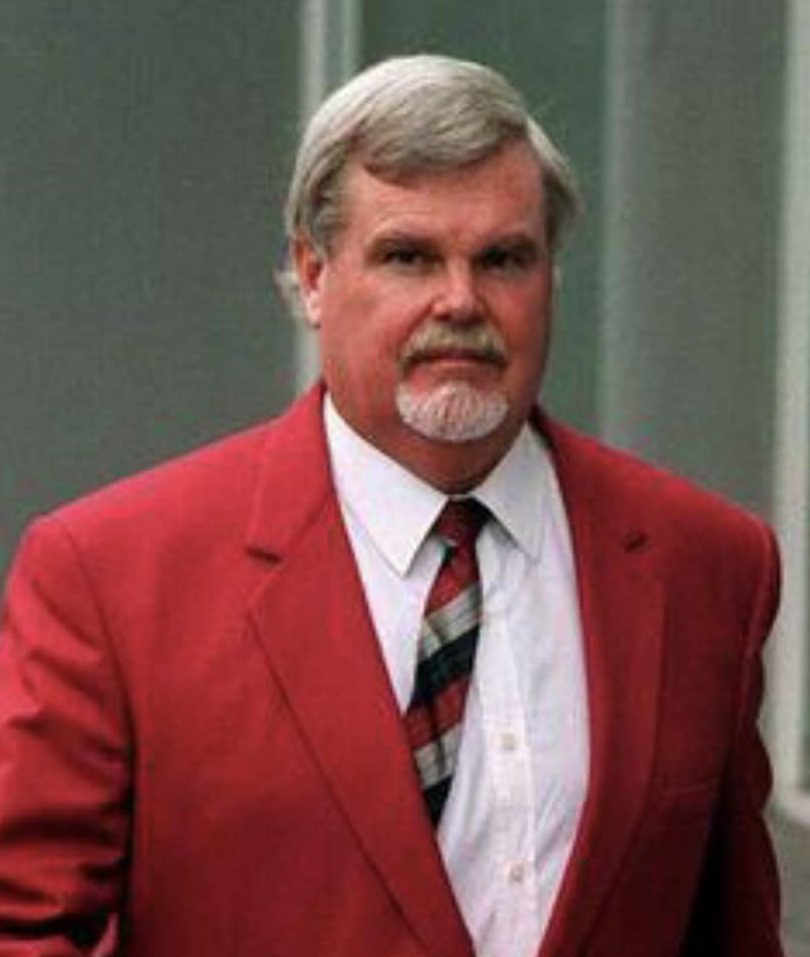
One is how Davidson walked into an Independent Commission Against Corruption inquiry hearing dressed in a bright red suit in the early 1990s.
‘If I’m going to a circus,’ the always colourful and wildly eccentric character said, ‘I’m going to dress like a clown.’
The second vignette is how Davidson seized a .357 Magnum revolver from Neddy Smith after arresting the notorious gangster in a foiled armed robbery and kept to it carry as his own sidearm.
The suit stunt, which occurred when ICAC was investigating the relationship between NSW police and criminals, showed Davidson’s disdain for dealing with what he once called the ‘complaint industry’.
The revolver story was part of a more significant narrative – how Davidson brought to an end one of Australia’s most infamous criminal careers by putting Smith permanently behind bars.
But the tale also has an intriguing twist: one of Smith’s accomplices claims the handgun Davidson took as a trophy that day was actually his and that Smith had been carrying a shotgun.
John Stuart Davidson – ‘Davo’ to his colleagues – was a genuine hard man of the NSW Police Force who served with particular distinction as a member of the ‘Breakers’, or Special Breaking Squad.
Tall and powerfully built, he instilled fear in the felons he pursued and gained a reputation for doing whatever it took to send serious wrongdoers to jail.
He further stood out due to his neatly clipped goatee and a sartorial style which sometimes saw his suits complemented by a pair of crocodile skin or red leather shoes.
Davidson was accused of fabricating confessions and planting evidence to secure convictions against suspects he knew or believed were guilty, earning the nickname ‘Front End Loader’ among some crooks and lawyers.
But unlike his corrupt decade-older contemporary Roger Rogerson – who Davidson dismissed as ‘a poisoned, evil little man’ – no one ever credibly claimed he took a bribe. His desire to deliver a particular version of justice was insatiable.
At the top of Davidson’s hit list of targets was Rogerson’s sometime partner in crime Arthur Stanley ‘Neddy’ Smith, a convicted rapist, major heroin dealer and prolific armed robber.
Smith, who was diagnosed with Parkinson’s disease in his mid 30s, claimed crooked cops including Rogerson had given him a ‘green light’ in the early 1980s to commit whatever offences he liked, except murder.
In October 1987, Smith and Glen Roderick Flack were accused of stabbing to death a man called Ronald Flavell during a drunken road rage incident at Coogee in Sydney’s eastern suburbs.
Both were granted bail and Smith spent much of the next year staging drug rip-offs and other small jobs before turning his attention back upon stripping payroll deliveries at the end of a gun.
‘I kept going back to the armed robberies,’ Smith wrote in his 1993 memoir Neddy. ‘Perhaps I had a death wish. Perhaps I just loved the adrenalin buzz. And perhaps it was just because it was so bloody easy.’
The last big score Smith planned was to intercept the Botany Council Christmas payroll – $160,000 in wages and holiday pay, all in cash – which was to be delivered on December 22, 1988.
Smith, then 44, asked 32-year-old Flack to take part in the robbery. They roped in clean-skin Richard John ‘Harry’ Harris, a 27-year-old boxer and bouncer who had impressed the pair by standing up to them one night in the city at the British Ex Services Club.
The afternoon the heist was to go down in Sydney’s inner-south, Smith cased the Botany Council chambers in Coward Street with Flack and Harris.
Unfortunately for Smith, the trio was spotted by then detective sergeant Davidson, who was driving home to the Sutherland Shire with fellow detectives Wayne Temby and Alan Conwell.
Davidson immediately recognised Smith and Flack but none of the Breakers knew Harris. Those involved have always insisted this random sighting was simply good police work and not the result of a tip-off.
The next morning, Davidson led a team of detectives backed up by the Special Weapons and Operations Squad who lay in wait for the robbers from dawn.
Four SWOS members including Davidson were inside the council chambers, with detective Allan Sparkes on the third floor in an over-watch position, while other police cars were stationed nearby.
Davidson instilled fear in the felons he pursued and gained a reputation for doing whatever it took to put wrongdoers behind bars. He is pictured in 1991 with a birthday cake featuring a likeness of the .357 Magnum he seized after arresting Neddy Smith three years earlier
Davidson would later say his men had ‘the adrenalin running out of their ears’ as they waited for the arrests to go down.
About 7.30am, Harris pulled up in Coward Street in a Ford Econovan with Smith and Flack in the back. Harris then left on foot and returned half an hour later in a Ford Falcon station wagon which he parked across the road behind a bank.
Smith and Flack could not see out of the van and were communicating by walkie-talkie radio with Harris, who was acting as their ‘cockatoo’ and had to be taken out before his accomplices.
When the payroll arrived, a fresh complication arose. Council staff eager to pick up their wages had begun appearing on the footpath and had to be ushered inside.
Once those employees were out of harm’s way, a prearranged signal was given and detectives Ray Lambie and Craig McDonald from the Armed Hold-Up Squad moved on Harris.
The getaway driver was sitting on a loaded .38 police-issue Smith & Wesson it was later revealed had been stolen from a cop’s house in November 1985 but caused little trouble.
In the station wagon police found a black balaclava, baseball cap, walkie-talkie and a kit bag containing a mouth guard – an unexpected item Lambie said Harris later explained.
‘When we were interviewing him he said, “Look, I know I had a gun but I would never have pulled you blokes on – I would have just put my mouth guard in and duked it out”,’ Lambie recalled.
‘He was not a massive bloke, so far as height was concerned, but he was so built that we couldn’t put his arms together at the back to handcuff him.’
McDonald had been amused by Harris’s take on what might have happened if he tried to fight his way out.
‘I told him, “It’s no good trying to punch on when I’ve got a Remington 870 shotgun in my hands”,’ McDonald said.
When Harris was secured, Davidson and the rest of the SWOS team came out of the council chambers to take down Flack and Smith in the van.
‘I ran out with a shotgun and said, “Police! Come out with your hands up”,’ Davidson later told a court.
Smith gave his own self-serving version of what happened in his book Neddy, starting with the armoured truck pulling up to the kerb.
‘The guards got out and started to get the tins,’ he wrote.
‘Just as I was about to pull the door open and take the money from the two guards – it would have been over in seconds – a voice called out: “You, in the back of the van. It’s the police here. Put down your weapons and come out of the van with your hands raised above your heads”.’
Smith said he paused for a second, stunned his plot had come undone, as a cop said: ‘Come out or we will commence firing into the van.’
‘It was the worst feeling I had ever had, like getting caught with your trousers down, so to speak,’ Smith wrote. ‘It wasn’t fear I felt, but disgust at being caught. Trying to escape was useless.’
Council staff watched from the windows – one even took photographs – as Smith slid open the van’s side door before he and Flack put their hands above their heads and stepped out.
‘Guns were pushed up against our heads,’ Smith wrote in Neddy. ‘One cop was nearly frothing at the mouth, he pressed his pump-action shogun up against my neck so hard. He was really uptight.’
Smith said that cop warned him, ‘You weak c***, why don’t you have a go so I can kill you?’ before he and Flack were thrown on the ground and their hands cuffed behind their backs.
‘A shotgun was again pressed against my neck and my hands pulled up as far as they would stretch,’ Smith wrote.
‘Then one low a***hole started to kick me in the face. He was screaming at me all the time: “You f***ing maggot, now I’ve got you. It’s taken me 10 years, now I’ve got you.’
Smith didn’t name that detective but he was referring to Davidson.
‘The boss of the SWOS came over and stopped the crazy cop from kicking me in the face,’ Smith wrote.
‘Then the police started going silly, hugging each other, jumping up and down, slapping their hands together and yelling: “You f***ing beauty, we have got Neddy Smith”.’
Smith, Davidson later said, was ‘rattling around like a a battery toy on the footpath and it wasn’t just his Parkinson’s disease’.
Davidson would claim a council clerk was asked at the scene if he had witnessed any police misconduct during the arrests. According to Davidson, the clerk told him he had seen Smith ‘trying to bite a police officer’s shoe’.
When journalist Neil Mercer was researching his recently published book The Kingpin and the Crooked Cop, which traces the criss-crossing careers of Smith and Rogerson, he asked Davidson if Smith had been given a good kicking at Botany.
‘He might have got a boot in the head – I didn’t see it happen,’ Davidson told Mercer.
A court would hear Smith wanted to know of one of the arresting officers: ‘Why didn’t you shoot me? I’d be better off dead.’ The officer allegedly answered: ‘Well, if you hadn’t dropped the gun, we may have.’
Years later, solicitor Chris Murphy – who despised Smith perhaps even more than Davidson – quoted the detective as having said that pinching Smith was ‘the best day of my life’.
In the van, police found two black balaclavas, a walkie-talkie and carry bag, as well as a sawn-off 12-gauge shotgun and a loaded Ruger Blackhawk .357 Magnum.
It was this stainless steel-barreled, wooden gripped, six-shot revolver which Davidson later checked into the SWOS armoury then signed out to use as his personal sidearm.
Smith faced further indignity back at the Sydney Police Centre in Surry Hills where he was photographed wearing only a T-shirt and boxer shorts.
‘I took his freedom, his gun and then pulled his pants down and took a mugshot in his undies to humiliate him,’ Davidson told his son Mark, according to the Daily Telegraph.
Smith wrote in Neddy: ‘The police centre was like a zoo – and I was the only animal attracting visitors.’
‘The only difference between me and real animals was I didn’t get any peanuts for my performance. The police were continually photographing me.
‘One fool of a policeman tried to get me to pose for photo with him. He stood beside me, then went to put his arm on my shoulder. “F*** off fool, I’m not a f***ing trophy”.’
Smith’s solicitor Val Bellamy arrived at the police station but had almost nothing to do. ‘I knew I didn’t need him, I was finally at the end of my road,’ Smith wrote. ‘There was no way I could get this blue fixed up, no way at all.’
Smith pleaded guilty in September 1989 to conspiring to commit armed robbery and was sentenced to 13 years in jail with a minimum eight years. He also admitted possessing the .357 and sawn-off shotgun.
At the sentencing hearing Davidson had described Smith as ‘by reputation one of the most violent and feared criminals in the state’.
Flack had pleaded guilty a month earlier to his role in the bungled stick-up and got 12 years with a non-parole period of seven.
Smith would spend the rest of his life in prison. He was found guilty in February 1990 of Flavell’s murder and sentenced to life then refused to give evidence against Flack, who the Crown alleged inflicted the fatal wound.
The case against Flack fell apart and he walked on the murder charge. Flack has largely stayed out of the limelight in recent decades and has always tried to avoid publicity but has told associates the firearm Davidson took was his and not Smith’s.
Lambie had not previously heard that claim and said physical descriptions of a gunman wielding a similar weapon in previous robberies matched 195cm (6’5″) tall Smith rather than the much smaller Flack.
‘The issue with the silver pistol was that it turned up in a number of robberies,’ he said. ‘That was the signature for Smith as far as I was aware.’
Retired armed robber Graham ‘Abo’ Henry, who ran with Smith through much of the 1980s and was no friend of Flack’s, said he had not seen his onetime confederate carry such a fearsome handgun.
‘On most occasions if I ever did anything with him all he had him was usually a police .38,’ Henry said of Smith.
‘I’ve never ever seen him with a f***in’ Magnum, ever. I had one but he f***in’ didn’t. I had a big silver c***. That could have been mine for all I know.’
Whoever previously owned the revolver, its new custodian wore the weapon – far more powerful than a standard police .38 – tucked into the back of his belt.
Lambie insisted Davidson had approval from his superiors to carry the imposing hand cannon while he was at work.
‘I remember seeing the report he put in to take possession of it as his own personal weapon for protection purposes because he’d been threatened by organised criminals,’ he said.
Davidson would go on to command Task Force Magnum which was formed in 1991 to investigate a spate of hits on armoured vans and other armed robberies.
He was quizzed about the .357 while giving evidence at a murder trial in July 1995, a year after retiring with a stress-related illness, having spent a quarter of a century on the force.
Davidson said the revolver had been used in several robberies before the Botany Council payroll attempt and he had carried it for almost two years.
‘I wanted to show Neddy Smith he couldn’t beat me, couldn’t buy me, and when it was all over I took his gun,’ he said. ‘I hated and despised the man and it was the final thrust, if you like, of pulling him off his throne.’
Attempts were made during the trial to challenge Davidson’s credibility and portray him as something of a cowboy.
He agreed with Greg Woods QC, representing one of two men charged with murder, that he had fired two shots from the .357 into the air while arresting drug dealer Danny Landini.
Davidson denied such actions were irresponsible. ‘It got his attention,’ he said.
Dr Woods: ‘Burwood is fairly densely populated?’
Davidson: ‘Not in the sky it’s not.’
Davidson also told Clive Steirn, a former fraud squad detective turned barrister representing the other accused killer, he had never admitted giving perjured evidence.
Steirn: ‘You have admitted to being a mug lair.’
Davidson: ‘I’ve been called that’.
Stroking his trim white beard, Davidson added, ‘I’ve also been called the Kentucky Fried Colonel.’
Davidson might have left the police force – he spent much of his time pursuing his passion for fishing on the NSW north coast – but he continued to make headlines.
In 1996, a serial conman and fantasist named Danny Shakespeare (or Page, or Baxter, or McPherson) made wild allegations against him at the coronial inquest into the May 1985 disappearance of hit-man Chris Flannery.
Shakespeare ludicrously claimed he had seen Davidson shoot Flannery dead with a .38 revolver at Geelong racetrack six months after his last known sighting. After spouting this nonsense, Shakespeare got into his lawyer’s BMW and drove off.
Davidson attended Smith’s 1998 trial for the July 1983 murder of brothel keeper Harvey Jones, not as a witness but as interested observer.
Smith had told a cell-mate at Long Bay’s Special Purpose Centre of Jones’s last moments ‘I blew his heart out with a big .357’ – five years before the Botany attempted robbery.
Wearing a leather jacket with snake heads stitched on either side of his chest and one below the back collar, he offered to buy Smith’s wife Debra a cup of coffee from a stall run by volunteers at the Darlinghurst courthouse. She told him to ‘p*** off’.
Forensic analysis of two bullets picked out of Jones’s ribs when his remains were dug out of a beach at Botany in March 1995 had determined they could have been either .357s or .38s.
For what it’s worth, Henry – who detested Smith at least as much as Davidson by the time they parted ways – has long maintained of his erstwhile collaborator: ‘He never shot any c***.’
Smith was convicted of Jones’s murder and died in September 2021 at Long Bay jail aged 76, having been cleared of six other underworld killings.
Rogerson died in Prince of Wales Hospital at Randwick on January 21 last year aged 83, while serving a life sentence for the May 2014 murder of drug dealer Jamie Gao.
Following the Wood Royal Commission into the NSW Police Service (1995-1997) Davidson was charged with several criminal offences.
He was accused with three other cops of having fabricated evidence and faking the confession of a cabaret singer arrested over a 1991 robbery.
Davidson told this reporter the tension waiting for the jury’s verdicts was better than backing horses.
Upon his acquittal and that of his former colleagues in April 2002, Davidson attacked what he called ‘the complaint industry that has blown up over the last decade’.
In March the next year he and four others were cleared of assaulting and fabricating evidence against an offender known as the Kareela Cat Burglar who had been arrested in June 1984.
All five officers had originally been commended for their roles in convicting the thief, whose criminal record included the sexual assault of a five-day-old boy in a Melbourne hospital.
Chris Murphy, who often sparred with Davidson when he was in the witness stand, summed up his old adversary in a Sun-Herald column published in March 1995:
‘The unorthodox detective in the conveniently blood-red shoes thought he was doing God’s work for him. Even when God forgot.
‘When he couldn’t get a signed confession out of a tough guy, he usually had verbal admissions by the time he got his quarry to court. Not that they always stuck.
‘Among the pure and the putrid in the police, Davidson’s methods brought him a varied reputation but nobody denies him his hour of glory.’
Giving Davidson a slight promotion in rank, Murphy concluded: ‘While others held the gate open for murderer Neddy Smith to rampage through the 1980s, Chief Inspector Davidson had his teeth at his tail.’
* Story behind any Nickname:
Nothing further, than what is recorded above, is known about this person at the time of publication and further information and photos would be appreciated.