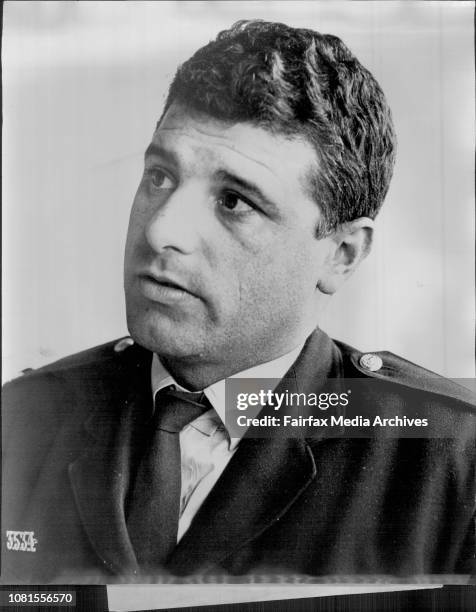
George Terrence NICOLL


George Terrence NICOLL
AKA Terry NICOLL
* Nickname: ?
Late of Kiama, NSW
Relations in ‘the job’:
“possible” relation in ‘the job‘: ?
NSW Police Training Centre – Redfern – Class # 051
New South Wales Police Force
Uniform # 3534
Regd. # 8777
Rank: Commenced Training at Redfern Police Academy on Monday ? ? ?
Probationary Constable – appointed 8 July 1957 ( aged 23 years, 10 months, 16 days )
Constable – appointed ? ? ?
Constable 1st Class – appointed 24 August 1963
Detective – appointed ? ? ? ( NO )
Senior Constable – appointed 1 July 1968
Leading Senior Constable – appointed ? ? ? ( N/A )
Sergeant 3rd Class – appointed 21 June 1976
Sergeant 2nd Class – appointed 26 May 1983
Sergeant 1st Class – appointed 31 December 1985
Final Rank: = Senior Sergeant
Stations: Mounted Unit, Eastern Suburbs Stations?, Redfern Police Training Centre ( Lecturer ), ?, Central Police Station – Retirement
Time employed ( Paid ) with NSW Police: From: ? ? c1957? to 22 August 1988 = 31 years, ? months, ? days Service
Service ( From Training Date ) period: From ? ? c1957? to 22 August 1988 = 31 years, ? months, ? days Service
Retirement / Leaving age: = 55 years, 0 months, 0 days
Time in Retirement from Police: 36 years, 3 months, 8 days
Awards: No Find on the Australian Honours system
Born: Tuesday 22 August 1933
Died on: Sunday 8 December 2024
Age: 91 years, 3 months, 17 days
Organ Donor: Y / N / ?
Cause: ?
Event location: ?
Event / Diagnosis date: ?
Funeral date: Thursday 19 December 2024 @ 2pm
Funeral location: H. Parsons Funeral Home, 125 Manning St, Kiama, NSW
Lake Illawarra Police District will provide an Official Police Guard of Honour
LIVE STREAM can be found HERE
Wake location: ???
Wake date: ???
Funeral Parlour: H. Parsons Funerals, 125 Manning St, Kiama, NSW
Buried at: ?
Grave Location: Section: Row: ? Plot: ?
Grave GPS: ?, ?
Memorial / Plaque / Monument located at: ?
Dedication date of Memorial / Plaque / Monument: Nil – at this time ( December 2024 )
TERRY is NOT mentioned on the Police Wall of Remembrance * NOT JOB RELATED
FURTHER INFORMATION IS NEEDED ABOUT THIS PERSON, THEIR LIFE, THEIR CAREER AND THEIR DEATH.
PLEASE SEND PHOTOS AND INFORMATION TO Cal
May they forever Rest In Peace
https://www.facebook.com/groups/AustralianPolice.com.au/
https://www.facebook.com/groups/NSWFallenPolice/
Australian Police YouTube Channel
Terry Nicoll – Funeral Announcement
Kiama mourns the loss of local legend and olympian, Terry Nicoll
11 December 2024, 1:49 PM
Terry Nicoll is onto his next glory, after a lifetime of Olympic triumphs and community service.
Kiama is mourning the passing of one of its most prominent locals, Terry Nicoll, who died on Tuesday 10 December at the age of 90. Terry was a well known member of the community, a decorated athlete, and a man of unwavering dedication and spirit.
Born and raised in outback NSW, Terry’s journey to Olympic glory began amidst the rugged landscape of sheep and cattle stations, where he developed exceptional horsemanship. His natural affinity for riding became the foundation for his success in the modern pentathlon, a challenging event combining fencing, swimming, show jumping, shooting, and running.
Terry’s Olympic story began when Australian swimming coach Forbes Carlisle noticed his potential and encouraged him to train for the Melbourne 1956 Olympics. After refining his skills in fencing and pistol shooting, Terry excelled at the Pre-Olympic Pentathlon trials, earning a coveted spot on the Australian team.
Though his Olympic career was brief, Terry went on to compete in World Championships in Mexico City and Leipzig, continuing to make his mark on the international stage.
After retiring from competitive sport, Terry dedicated himself to public service, joining the NSW Police Force in 1957. Over two decades, he served with distinction – mentoring and inspiring others. He also represented NSW in Police and Emergency Services games, adding to his collection of accolades.
In his later years, Terry and his wife Gloria settled here in Kiama, where he became an integral part of the community. Active in the Kiama Men’s Probus Club and Probus Choir, Terry remained a vibrant and inspiring presence.
Terry Nicoll’s life was a testament to perseverance, discipline, and community spirit. His legacy will endure in Kiama and beyond, inspiring future generations to reach for their dreams. He is survived by his wife Gloria and will be deeply missed by all who knew him.
Kiama mourns the loss of local legend and olympian, Terry Nicoll


Sergeant’s Course class 2 of 1979.
Back Row –
Darryl Somerville, Len De Audney, Bob Parry, Russell Reid, Ron Bloxham, Peter Woodman, Bob Raymond, Ian Bowyer-Smyth.
Middle Row –
John Lappan, Des Trute, Cecil Shears, Harry Delaforce, Warren Taylor, Jack Rumley, Don Sykes, Thomas Powick.
Front Row –
Mervyn Masterton, Terry Nicoll (Instructor), John Symons (Instructor), Bruce Gould (Director), Bryan Binns (Instructor), Peter Moffatt (Instructor), Graham Frazer, Michael Milham.
PISTOL INSTRUCTION
In September, 1960, the Police Association made representations to the Police Department that police undergo pistol practice at least once a year. In country districts at the time, pistol practice and instruction was carried out by superintendents’ drivers during station tours. Arrangements were now underway to train some police as pistol instructors for police in the metropolitan area and an order was placed with the Government Printer for 30,000 targets.
Approximately 70,000 rounds of .32 calibre ammunition were needed for 1960-1961 pistol practice. Expenditure for metropolitan pistol practice was expected to be about 900 pounds. This was based on the assumption that each member would fire 10 rounds from a .22 calibre target pistol and 10 rounds from his service pistol.
Instruction classes were to last two hours. The lessons were to cover firearms safety, pistol practice and pistol maintenance. Wynyard Railway pistol range was available to city police on request to the Commissioner of Railways, while police in outer divisions would be able to practice at army establishments and other authorised ranges. \Trainee Police at the Police Training
Centre received pistol practice using target pistols and their service revolvers, with additional practice being undertaken during their refresher course.
Some police who acted as pistol instructors in the late 1950s and early 1960s were,
Constable D.G. McInnes, 7 Division, pistol instructor to police in outer metropolitan police divisions in December, 1954 and January, 1955.
Constable W. Stanford, qualified as a pistol instructor for Parkes District after attending an armoury course from the 2nd to 6th July, 1962.
Constable R.G. Brown, qualified as a pistol instructor for the North Eastern District between 1st and 5th July, 1963.
Constable R. Gilmour, became a pistol instructor for the Dubbo District, after completing a course at the armoury from the 1st July, until the 5th July, 1963.
Constable G.T. Spurr, Broken Hill, attended a course from the 7 June, 1965, and qualified as a pistol instructor for Broken Hill Sub-District.
Constable 1Class Nicoll was required to attend a 5 day pistol instructors course late in June, 1965. Constable Nicoll qualified as a pistol instructor and was required to act as an assistant pistol instructor during metropolitan pistol practice in July, 1965.
Extract from pages 272 & 273 of NSW Police Heritage story.
Constables Nicoll and Michelson, applied for two Department target pistols in 1963. One was a .22 calibre Smith & Wesson K22 revolver and the other was a .22 calibre Hammerli self loading pistol. These pistols were required by Nicoll and Michelson for use in the Modern Pentathlon Championships being held in Melbourne in August, 1963.
In 1964, the two constables again borrowed pistols from the Police Department for use in the championships being held in March of that year.
Another accomplished target pistol shooter was Detective Sergeant 2Class Merchant, of the Scientific Bureau who was captain of the Police team selected to compete in the Dunlop Shield Police Pistol competition.
The competition was held in conjunction with the Queensland Police Centenary in 1964.
The competition was shot over 25 metres and 50 metres, with centre fire and rim fire pistols.
Merchant’s team members used their own .32 calibre service pistols as well as two .22 calibre Ruger self loading pistols and two .38 calibre revolvers.
Target pistol matches were also held between the Police Department and the Commonwealth Bank.
A competition between the two organisations was held on the 2nd May, 1961, at Sydney Pistol Club, La Perouse.
Sydney Pistol Club was established in 1953.
The Commonwealth Bank management approved the donation of a trophy for annual competition between the Police and the Commonwealth Bank.
The pistol competition was seen to be beneficial in providing pistol training for bank employees while at the same time providing a social activity within the bank. There had also been an accident where an employee of another bank was shot because of inadequate pistol training and the pistol match between the Commonwealth Bank and the Police Department was considered a way to improve firearms safety within the banks.
In 1962, another match took place between the Commonwealth Bank and the Police Department at Sydney Pistol Club. Members of the Police team were, Constable 1Class G. Green of 6 Division, Sergeant 3rd class A. Hall of Police Training Centre, Sergeant 3rd Class N. Merchant from the CIB, Sergeant 3rd Class R. Sutherland of the Fingerprint Branch, Sergeant 2nd Class J. W. Christie of the Police Armoury, and a team member named Mills, whose rank at the time is unknown me.
The Commonwealth Bank team consisted of Messrs Roberts, Lee, Harvey, Whiting, Worthington and Doolan. Sergeant Major N. Groth, Eastern Command Provost Corps, was appointed Range Master for the match.
The Police team won the competition and the Managing Director of the bank, Mr. E.B. Richardson, CBE, presented the trophy to the Commissioner of Police, N.T.W. Allan, who accepted the trophy on behalf of the police team. The match was shot over 15 yards with .32 calibre service pistols and consisted of slow fire and rapid fire phases with 10 rounds fired in each phase. During the rapid fire phase of the event, the targets turned away and then turned back to face the shooter for three seconds, similar to the duelling phase in what became the centre fire match in pistol clubs.
Extract from pages 275 & 276 of NSW Police Heritage story.
How Tarzan, Strickland and Cuthbert made sure Terry Nicoll competed at Melbourne 1956
When Melbourne 1956 Olympic modern pentathlete Terry Nicoll was a child in the late 1930s, his father took him to a theatre in Sydney to watch the newsreels. The show included a film about the Berlin Olympics and at the end of it, the greatest athlete in the world Jesse Owens spoke directly into a young Australian boy’s heart.
Terry Nicoll: A Lifetime of Dedication to Sport and Service
Brooke Pittman
25 March 2024, 1:27 PM

Terry Nicoll is a friendly Kiama local and former Australian Olympian who competed in the 1956 Melbourne Games. He is renowned for his prowess in the modern pentathlon, Terry’’s athletic journey began amidst the vast landscape of outback NSW, where he honed his riding skills while working on sheep and cattle stations.
The modern pentathlon comprises five disciplines; fencing, swimming, show jumping, shooting and running. Terry had a keen interest in horse riding, picking it up from a very young age and carrying it with him throughout his life which helped his performance in the Olympics as a young adult.
Terry’s path to Olympic glory took an unexpected turn when he was approached by Forbes Carlisle, Australia’s esteemed Olympic swimming coach. Encouraged by Carlisle, Terry took his skills from the bush to the pool, embarking on a rigorous training regime in preparation for the games
Terry’s riding skills were exemplary and he took to improving his fencing and pistol shooting skills with determination. His dedication paid off when he clinched victory in the Pre-Olympic Pentathlon trials, securing his spot on the Australian team for the Melbourne Olympics.
Another chance encounter with legendary swimmer Johnny Weissmuller left Terry with the invaluable advice to modify his swim stroke. Terry’s Olympic journey was not without hurdles, and he was unfortunately unable to participate in the subsequent Olympic games. However, as he continued to excel in the world of pentathlon he was then able to compete in the World Championships in Mexico City and Leipzig.
Beyond his sporting achievements, Terry’s commitment to public service and his community is equally commendable. Terry joined the NSW Police Force in 1957, he served with distinction for over two decades, imparting his knowledge and skills as an instructor and mentor. Representing NSW in various Police and Emergency Services games, Terry’s competitive spirit never waned, earning him accolades nationally and internationally.
Now 90 years old, Terry lives in Kiama with his wife Gloria, where he continues to be active in the community. Terry contributes to organisations like the Kiama Men’s Probus Club and Probus Choir and he and his wife love to play golf.
As a symbol of perseverance and dedication, Terry Nicoll’s legacy extends far beyond the Olympic arena, inspiring future generations to strive for excellence in all endeavours.
Terry Nicoll: A Lifetime of Dedication to Sport and Service

Terry Nicoll
Biographical information
| Roles | Competed in Olympic Games |
|---|---|
| Sex | Male |
| Full name | George Terence “Terry”•Nicoll |
| Used name | Terry•Nicoll |
| Born | 22 August 1933 in Sydney, New South Wales (AUS) |
| NOC |  Australia Australia |
Results
| Games | Discipline (Sport) / Event | NOC / Team | Pos | Medal | As | |
|---|---|---|---|---|---|---|
| 1956 Summer Olympics | Modern Pentathlon | AUS |
Terry Nicoll | |||
| Individual, Men (Olympic) | 35 | |||||
| Team, Men (Olympic) | Australia | 8 |
https://www.olympedia.org/athletes/34597


* Story behind any Nickname:
Nothing further, than what is recorded above, is known about this person at the time of publication and further information and photos would be appreciated.
**********