Nicholas Percival ABBOTT


Nicholas Percival ABBOTT
– former member of:
New South Wales Police
Registered # ‘Q‘ 7208
For the purposes of this website ‘Q‘ represents those Police joining between 1 March 1862 ( commencement of NSWPF ) – 23 February 1915 ( Commencement of NSWPF current numbering system )
Born: 30 January 1875 in Paddington, NSW
Killed on Wednesday 28 May 1912 – explosion
38 old
Grave location: Wollongong Cemetery,
Grave: Section: Church of England 2 Row: B Site: 44
Quarry Disaster near Kiama.
Minnamurra, a peaceful little hamlet, a couple of miles from Kiama, was shocked with a sudden and terrible tragedy early on Tuesday morning. By a premature explosion at Trevethan’s quarry, five men were killed outright, and seven others wounded.
When the serious extent of the accident became fully known, business was practically suspended, and flags were flown at half mast, while all the quarries suspended working operations.
Those killed were:
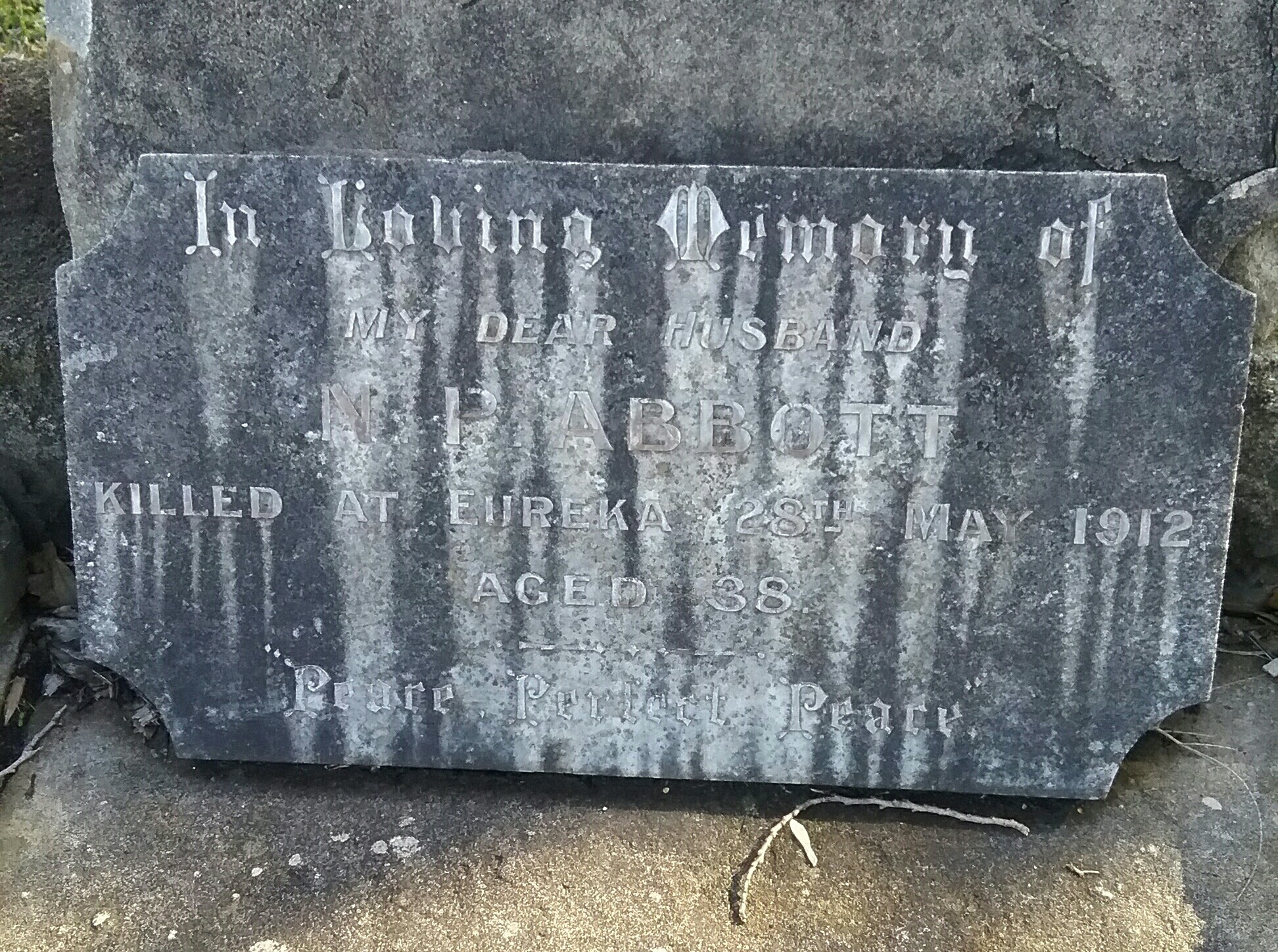
N. P. Abbott, ex-policeman, 39, married, residing at Wollongong, wife and six children :
F. Cooke, 40, Married, residing at Mount Drummond, Wollongong, wife and eight children ;
J. Lewis, 40, widower ;
J. McDonald, 35, single, residing, at Berry ;
J. Nurse, 30, single,
new arrival. S. Thurle,
J. Steffen, and J. Heald were admitted to the hospital, suffering from severe injuries.
Robertson Advocate ( NSW ) Friday 31 May 1912 page 2 of 4
Sydney Morning Herald (NSW : 1842 – 1954),
Wednesday 28 May 1913, page 12
IN MEMORIAM. ABBOTT. — In loving memory of my dear husband and our dear father,
Nicholas Percival Abbott, accidentally killed May 28, 1912, near Kiama, aged 38.
He bade no one a last good-bye, He waved his hand to none.
His spirit flew before we knew
That from us he had gone. Inserted by his loving wife and family.
https://trove.nla.gov.au/newspaper/article/28125837
Eureka Quarry Tragedy
In April 2006, amongst the rugged landscape of an old quarry site, now the home of Kiama Leisure Centre and various sporting fields, an exciting theatrical event was staged. The production called ‘Quarry’, was written and directed by Gordon Streek, performed by members of Shellharbour’s Roo Theatre and featured a cast of singers, actors, dancers and a 16 piece orchestra.
In 1990, when the production was first staged, as many as 3000 people turned out to see the story of a family named Murphy and their experiences during the Eureka Quarry disaster.
The recent 100th anniversary of the deadly explosion which occurred at Eureka Quarry, Minnamurra on 28th May, 1912 killing five men and seriously injuring three others. Several other workers escaped with slight injuries.
Killed in the initial explosion were Mr James Nurse, Mr Nicholas Percival Abbott, Mr Frederick Cooke, Mr. James Lewis, and Mr James McDonald. Mr John Staffen died a week later from injuries sustained in the explosion.
Following is an excerpt from the ‘Barrier Miner’ published in Broken Hill between 1888 -1954. This article was published on Friday, 31st May 1912.
“…it appears that the accident was caused through a top hole charge on the upper level exploding prematurely during the process of ramming. Eight men were employed on this level, and it is remarkable that all escaped uninjured, with the exception of Ganger Eyles, who, through the force of the explosion, was hurled across the cutting, sustaining a few abrasions and bruises. The men killed and seriously injured were working at the face of the cutting on the bottom level, and were shockingly mangled through the heavy fall of metal from above, which followed the explosion. Abbott was drilling on the bottom level, and Thomas Wilson and Staffens were striking with him when the explosion occurred. Abbott was killed instantly, being fearfully mutilated. Staffens had a foot shattered, and was badly cut about the face and body. Wilson, the other member of this group, escaped without a scratch, being sheltered behind a pillar of metal. A tip dray and horse were backed into the face of the cutting. Nurse, Lewis, Cooke, and McDonald being engaged in filling it. These men were killed almost instantly, as was the horse….D. Campbell, who was in charge of the horse and cart, was another to have a narrow escape from death. He was sitting on the cart when the explosion happened, and the concussion from the shot hurled him through space for about 20ft. He escaped with a few cuts and bruises.
The bodies of the killed were brought to Kiama by a pick-up train, which arrived at about 11 o’clock, and they were taken to the Kiama Hospital morgue. The injured men, with the exception of Eyles, Campbell, and Robinson, who were treated at the scene of the accident, were also taken to Kiama by the same train and conveyed to the hospital.
On receiving news of the accident all the quarries in the district suspended working operations, and flags are flying at half-mast. Many harrowing scenes were witnessed at the railway station when relatives and friends of the killed arrived.”
Gordon Streek, writer of ‘Quarry’ is quoted as saying that “Kiama quarries were some of the first industrialised sites in Australia, as a result of this tragic accident. After the accident they became the first organised, but not unionised, workforce because of the way people were treated after the disaster.”
In a tragic epilogue to the quarry disaster, Ganger Eyles was run over by a train at Minnamurra station about two weeks after the accident. Eyles was one of the men who were ramming the charge at the Eureka quarry when the fatal explosion occurred. Whether his death was an accident or suicide was never known.
Eureka Quarry Tradgedy Kiama Library
Huon Times (Franklin, Tas. : 1910 – 1933),
Wednesday 6 April 1910, page 4
Inter-State Items.
( From our Exchanges. )
NEW SOUTH WALES, CONSTABLE AND OFFICER.
INTENDED MURDER ALLEGED.
Nicholas Percival Abbott, a police constable, was brought before the Wollongong police court on Thursday last, and charged with having attempted to discharge a firearm with intent to murder Sergeant Noble.
The evidence showed that Abbott, while on night duty, became intoxicated. Noble asked him to go to the police station and see Inspector Pourtney.
Abbott drew the revolver, but Noble was too quick. He seized Abbott‘s wrist and threw him on the ground. When Abbott fell the revolver dropped from his hand, and whilst struggling he tried to draw another revolver out of his pocket.
He repeatedly tried to attack Noble in the police office, and expressed sorrow he could not have finished him.
Abbott was committed for trial.
Sydney Morning Herald (NSW : 1842 – 1954),
Saturday 4 June 1910, page 11
WOLLONGONG SENSATION.
CHARGE AGAINST A CONSTABLE.
ABBOTT ON TRIAL.
Nicholas Percival Abbott, ex-constable of police, pleaded not guilty at the Central Criminal Court yesterday, before Mr. Justice Cohen and jury, to a charge of attempting to discharge a loaded arm with intent to murder Sergeant Charles Noble, at Wollongong, on March 29.
There was also a second count against Abbott of attempting to discharge a loaded arm with intent to do grievous bodily harm to Noble. To this accused, who was defended by Mr. E. R. Abigail, also pleaded not guilty.
The Crown case was that Sergeant Noble was completing his rounds on the date mentioned, and saw accused in Crown-street, Wollongong.
He told Abbott that the Inspector had been asking for him, and advised him to go to the police station. Abbott replied, “I’ll give you station; I’ll blow your –brains out.” He thereupon pulled a revolver out of his pocket, but the-sergeant forestalled him, and threw him on the foot-path, the revolver falling at their feet.
They struggled, and accused used bad language, and threatened the Sergeant’s life.
Abbott endeavoured to draw a second revolver, but the sergeant again prevented him.
A man named Sloan came on the scene, and between them they placed the “snips” on the accused’s wrists, and removed him to the police station.
On the way he repeated the threats, and struggled to obtain the revolver from his hip pocket, but Sloan took it away.
At the police station accused, when asked why he had two revolvers, said that he put one in his pocket especially to shoot “the dog.”
William Joseph Sloan said that on March 29 accused was under the influence of liquor. Witness advised him to go home, as he might find himself in trouble, and accused put his fist in witness’s face, and said, “I’ll fix him”.
Subsequently the sergeant and the accused met, and a scuffle ensued.
Witness went to the assistance of the sergeant, who had accused down, and found a weapon at the feet of the two men.
The scuffle continued, and accused used bad language.
Witness told the sergeant to leave the other man alone, and the sergeant replied, “What is a man to do when he has firearms?”
Witness then advised accused to go to the police station, and on the way there he struggled to get free, and witness took another revolver from the pouch on accused‘s hip.
At the lock-up accused said he wished he had shot the sergeant.
To Mr. Abigail: When witness came on the scene the sergeant had accused down, punching him in the face. Witness told the sergeant that it was cowardly, and that if he hit accused again he (witness) would hit the sergeant.
Constable Porter said that when accused was charged at the police station he replied, “It’s a pity the thing never went off.”
To Mr. Abigail: Accused complained that someone had “walloped” him, and that whoever it was he deserved to be shot. Accused had five young children, and had been burnt out 12 months previously.
Accused said that he had been in the force some 12 years.
He had been on friendly terms with the sergeant up till the night of the trouble.
He did not remember going on duty that night, but remembered having two revolvers in his possession, one of which – a private weapon – he intended to lend to someone.
While walking along the footpath he received a blow from the sergeant, and was knocked down. He remembered nothing more till he found himself in the lock-up.
Witness denied having said to the Inspector that he told his wife he intended to shoot the sergeant.
Other witnesses called for the defence said that accused did not draw a revolver before he was struck by the sergeant.
A verdict of not guilty was returned, and accused was discharged.
https://trove.nla.gov.au/newspaper/article/15156286/1304289#
First published on 1 May 2014.
Updated with further information on 17 March 2026.